Tricyclic, Serotonergic and Sympathomimetic Toxicity in the Emergency Department
EMORBIT-CP-112 · Chapter 10 · Toxicological and Environmental Emergencies
Open in the appFree, works on your phone and offline, with every tool alongside.
Evidence base: ACMT; TOXBASE
1Purpose
1.1 Provide a standardised framework for recognising and treating tricyclic antidepressant (TCA) toxicity, serotonin syndrome and sympathomimetic toxicity in the Emergency Department (ED), the three hyperadrenergic and cardiotoxic overdose syndromes most likely to be confused with one another.
1.2 Fix the sodium bicarbonate and benzodiazepine doses to those already set in EMORBIT-CP-21, and confirm that hyperthermia — not the toxidrome label — is the immediate threat to life in serotonin syndrome and sympathomimetic toxicity.
1.3 State clearly why flumazenil, class Ia/Ic/III antiarrhythmics and unopposed beta-blockade are avoided in these toxidromes, and direct decontamination, the poisons centre contact and the general psychosocial pathway to EMORBIT-CP-21 and EMORBIT-CP-84 rather than repeating them here.
1.4 Align practice with American College of Medical Toxicology and American Academy of Clinical Toxicology position statements and the EXTRIP workgroup framework.
2Who this protocol applies to
2.1 Any patient with suspected or confirmed tricyclic antidepressant (or other sodium-channel-blocking drug) toxicity: reduced consciousness, seizure, hypotension, or a wide QRS complex, following amitriptyline, nortriptyline, imipramine, dosulepin or a related agent.
2.2 Any patient with suspected serotonin syndrome: agitation, clonus, hyperreflexia, tremor or hyperthermia after a serotonergic drug (selective serotonin reuptake inhibitor, serotonin-noradrenaline reuptake inhibitor, monoamine oxidase inhibitor, tramadol, linezolid, lithium, MDMA) taken alone, in combination, or after a recent dose increase.
2.3 Any patient with suspected sympathomimetic toxicity: agitation, tachycardia, hypertension, hyperthermia and diaphoresis after cocaine, amfetamine, methamfetamine, MDMA, a synthetic cathinone, or another stimulant.
2.4 Mixed and uncertain presentations, where more than one of these toxidromes is possible, are managed under this guideline until differentiated.
3Not covered by this protocol
3.1 Cardiac or respiratory arrest on arrival: go immediately to EMORBIT-CP-03; the hypothermic and sodium-channel-blockade cardiac arrest modifications in that guideline, not this one, govern resuscitation.
3.2 Opioid, benzodiazepine or sedative-hypnotic overdose without a hyperadrenergic feature: manage under EMORBIT-CP-71.
3.3 Anticholinergic toxicity with dry, flushed skin and absent bowel sounds and no hyperthermia or cardiotoxicity: use the toxidrome table in EMORBIT-CP-21 (Table 1) to confirm the picture before returning here if a mixed exposure is possible.
3.4 Reduced consciousness with a clear alternative cause established independently (hypoglycaemia EMORBIT-CP-49, head injury EMORBIT-CP-20, stroke EMORBIT-CP-14): treat the cause; return to this guideline only if one of these three toxidromes remains part of the differential (EMORBIT-CP-46).
4Protocol
4.1History and Assessment:
4.1.1Triage and Recognition:
4.1.1.1 Any patient with a wide-complex rhythm, a seizure, a core temperature above 39 °C, or haemodynamic instability shall be triaged to the highest acuity category (Category 1 / immediate) and taken directly to the resuscitation area.
4.1.1.2 Use the toxidrome table in EMORBIT-CP-21 (Table 1) to distinguish anticholinergic (dry skin, absent bowel sounds, normal reflexes), serotonergic (diaphoretic, clonus greatest in the lower limbs, hyperreflexia, bowel sounds present) and sympathomimetic (diaphoretic, agitated, bowel sounds present, no clonus) features; do not restate it here.
4.1.1.3 An ED physician shall attend within 5 minutes of Category 1 triage. The triage nurse shall not wait for physician review before applying oxygen, monitoring and an indwelling temperature probe.
4.1.2History:
4.1.2.1 Agent, formulation, dose and time of ingestion or last use; for a prescribed serotonergic drug, ask specifically about a recent dose increase, a new interacting drug, or an intentional overdose.
4.1.2.2 Co-ingestants, particularly another serotonergic drug, a stimulant, alcohol, or a sedative — combinations markedly increase the risk of serotonin syndrome and confound the toxidrome.
4.1.2.3 Circumstances (accidental, deliberate, recreational) and, in a deliberate overdose, previous self-harm and current psychiatric history; refer to the psychosocial pathway in EMORBIT-CP-21 and, for the risk assessment itself, EMORBIT-CP-84.
4.1.2.4 AMPLE history (Allergies, Medications, Past history, Last meal, Events); collateral history from ambulance crew, family or bystanders, and from any container or paraphernalia recovered.
4.1.3Examination:
4.1.3.1 Full set of vital signs including a core temperature by a rectal or oesophageal probe (tympanic and axillary readings are unreliable in hyperthermia), pupil size, and Glasgow Coma Scale (GCS); continuous ECG and pulse oximetry.
4.1.3.2 Neuromuscular examination for clonus (spontaneous, inducible and ocular), hyperreflexia, tremor and rigidity — greatest in the lower limbs in serotonin syndrome — and for the diaphoresis that distinguishes it and sympathomimetic toxicity from an anticholinergic picture.
4.1.3.3 Look for needle marks, transdermal patches, and evidence of trauma from agitation or a fall; abdominal examination if a body packer or stuffer is possible (EMORBIT-CP-21).
4.1.4Risk Stratification – Severity:
4.1.4.1 High risk: QRS above 100 ms, any seizure, a core temperature above 39 to 40 °C, haemodynamic instability, or a broad-complex arrhythmia.
4.1.4.2 Intermediate risk: agitation, tremor, hyperreflexia or moderate hypertension/tachycardia responding to a benzodiazepine, with a normal QRS and a core temperature below 39 °C.
4.1.4.3 Low risk: fully alert, mild or no neuromuscular signs, normal vital signs and a normal ECG, with a reliable account of a minor exposure.
4.1.5Differential Diagnosis:
4.1.5.1 Neuroleptic malignant syndrome (onset over days, not hours, after an antipsychotic; lead-pipe rigidity, normal or reduced reflexes) and malignant hyperthermia (temperature rise after a triggering anaesthetic agent) are treated by stopping the drug, cooling and benzodiazepines in the same way, but bromocriptine or dantrolene may be added on toxicology or anaesthesia advice — see the toxidrome comparison in EMORBIT-CP-21 (Table 2).
4.1.5.2 Heat stroke without a causative drug (EMORBIT-CP-23), meningitis/encephalitis (EMORBIT-CP-46), and alcohol or sedative withdrawal (agitation and tremor without clonus) are considered where the drug history is unclear.
4.1.6Special Populations:
4.1.6.1 Children: a single tablet of a tricyclic antidepressant can be fatal in a small child; treat any reported ingestion as high risk regardless of the apparent quantity, obtain an ECG immediately, and involve Paediatrics. Safeguarding review per EMORBIT-CP-83 if the source of the drug is unclear.
4.1.6.2 Pregnancy: hyperthermia from serotonin syndrome or sympathomimetic toxicity is harmful to the fetus; cool aggressively per EMORBIT-CP-23 and involve Obstetrics. Sympathomimetic use in pregnancy (particularly cocaine) is associated with placental abruption — assess accordingly.
4.1.6.3 Elderly: more likely to have a pre-existing conduction abnormality and to be taking an interacting drug (a monoamine oxidase inhibitor, tramadol, or another serotonergic agent); lower the threshold for ECG monitoring and admission.
4.1.6.4 Deliberate ingestion: apply the EMORBIT-CP-21 psychosocial checklist and refer for the EMORBIT-CP-84 risk assessment before discharge in every case.
4.2Investigations:
4.2.1 12-lead ECG within 30 minutes of arrival in every patient, with the QRS duration and QT interval measured and recorded as numbers: a QRS above 100 ms indicates sodium-channel blockade and predicts seizures; above 120 ms it predicts ventricular arrhythmia (EMORBIT-CP-21). A terminal R wave in lead aVR greater than 3 mm carries the same significance.
4.2.2 Capillary blood glucose immediately in every patient with reduced consciousness or agitation; correct hypoglycaemia per EMORBIT-CP-49 without waiting for the toxicology work-up.
4.2.3 Venous or arterial blood gas with lactate, creatine kinase, and renal function in any patient with hyperthermia, agitation requiring sedation, or reduced consciousness — rhabdomyolysis and acute kidney injury follow prolonged agitation and hyperthermia.
4.2.4 Paracetamol and salicylate levels in every deliberate overdose, per EMORBIT-CP-22, regardless of the reported agent.
4.2.5 A urine drug screen is not routine: it does not alter acute management and shall not be used to justify withholding treatment or to determine disposition.
4.3Plan of Care:
4.3.1Immediate Actions — All Three Toxidromes:
4.3.1.1 Airway, breathing, circulation; continuous ECG, pulse oximetry, and an indwelling core temperature probe; capillary glucose; IV access; stop any serotonergic drug still being administered.
4.3.1.2 Give a benzodiazepine as first-line treatment for agitation, seizure, or hypertension/tachycardia in any of the three toxidromes (Table 1, Attachment 2): it terminates the seizure, sedates the agitation that is itself generating heat, and is the initial treatment for sympathomimetic hypertension. Large cumulative doses are often required and are safe provided the airway and ventilation are monitored.
4.3.1.3 Flumazenil shall not be given in any of these three toxidromes: it can precipitate seizures that are then refractory to benzodiazepines.
4.3.2Tricyclic Antidepressant / Sodium-Channel Blockade: where the QRS exceeds 100 ms, give sodium bicarbonate without delay (Table 1); target arterial pH 7.45 to 7.55 and serum sodium below 155 mmol/L, repeating the ECG after every bolus. Class Ia, Ic and III antiarrhythmics (including amiodarone and procainamide) shall not be given — they worsen sodium-channel blockade. A seizure is terminated with a benzodiazepine (Table 1); a seizure not settling after two doses is escalated per EMORBIT-CP-02.
4.3.3Serotonin Syndrome: diagnose using the Hunter Criteria (a serotonergic drug plus spontaneous clonus, or inducible or ocular clonus with agitation or diaphoresis, or tremor with hyperreflexia, or hypertonia with a temperature above 38 °C and ocular or inducible clonus). Stop every serotonergic drug, give a benzodiazepine (Table 1), and start active cooling per EMORBIT-CP-23. Cyproheptadine (Table 1) is an adjunct only, given after benzodiazepines and cooling, where it is stocked.
4.3.4Sympathomimetic Toxicity: give a benzodiazepine first-line for agitation, tachycardia and hypertension, plus active cooling per EMORBIT-CP-23 and IV fluids. Avoid pure/unopposed beta-blockade — it leaves alpha-mediated vasoconstriction unopposed and can worsen hypertension and coronary vasospasm, particularly with cocaine. If hypertension remains severe after an adequate benzodiazepine dose, give phentolamine (Table 1) or a vasodilator per EMORBIT-CP-40 — never before the benzodiazepine. Chest pain is managed as per the ED Chest Pain and Acute Coronary Syndrome guideline, with benzodiazepine and glyceryl trinitrate first.
4.3.5Hyperthermia — the Killer in All Three: a core temperature above 39 to 40 °C in serotonin syndrome or sympathomimetic toxicity is the immediate threat to life; antipyretics do not work. Cool per EMORBIT-CP-23 (target below 39 °C within 30 minutes of recognition, stop active cooling at 38.5 °C) and sedate — sedation itself reduces the heat generated by muscle activity. Intubate and paralyse with a non-depolarising neuromuscular blocker if the core temperature exceeds 39.5 °C despite benzodiazepine sedation and cooling; paralysis stops muscle-generated heat but does not treat the underlying process, so cooling continues and specific treatment (stopping the drug, cyproheptadine) is not omitted.
4.3.6Escalation and Refractory Presentation:
4.3.6.1 Persistent wide QRS, ventricular arrhythmia, or refractory hypotension despite sodium bicarbonate: senior physician and critical care review; treat the arrhythmia per EMORBIT-CP-38, noting that class Ia/Ic/III antiarrhythmics are avoided in sodium-channel blockade.
4.3.6.2 GCS below 9, inadequate airway protection, or a seizure not terminated after two benzodiazepine doses: secure the airway per EMORBIT-CP-31 and escalate per EMORBIT-CP-02.
4.3.6.3 Core temperature above 39.5 °C despite benzodiazepine sedation and cooling: proceed to intubation and paralysis without delay (above); this is a senior physician and critical care decision.
4.3.7Monitoring and Reassessment:
4.3.7.1 Continuous ECG, pulse oximetry and core temperature until stable and improving; GCS and vital signs at least every 15 minutes during active treatment, then hourly.
4.3.7.2 Repeat the 12-lead ECG after every sodium bicarbonate bolus and before discharge in any patient who had a QRS above 100 ms or a QT-prolonging exposure.
4.3.8Disposition:
4.3.8.1ICU / HDU:
- Required airway intervention, paralysis for hyperthermia, or a cardiac arrhythmia.
- Core temperature above 39.5 °C at any point, or above 39 °C not settling with cooling and sedation.
- A sodium bicarbonate infusion or recurrent QRS widening.
4.3.8.2Monitored ED observation or ward bed:
- QRS above 100 ms that has narrowed with treatment: minimum 6 hours of monitored observation with serial ECGs.
- Serotonin syndrome or sympathomimetic toxicity settled with a benzodiazepine, temperature below 39 °C: monitored observation until asymptomatic and normothermic.
4.3.8.3Discharge:
- Fully alert, normal vital signs, normal repeat ECG with a documented QRS and QT, normothermic without ongoing cooling.
- Psychosocial assessment completed for any deliberate act (EMORBIT-CP-84, using the EMORBIT-CP-21 checklist meanwhile).
4.3.8.4 Discharge shall be by, or after discussion with, an ED specialist/consultant.
4.3.9Discharge and Follow-up:
4.3.9.1 Advise on stopping or reviewing an implicated serotonergic drug in discussion with the prescriber; refer every deliberate overdose for psychiatric/psychosocial follow-up per EMORBIT-CP-21 and EMORBIT-CP-84.
4.3.9.2 Safety-net advice: symptoms of serotonin syndrome can recur if a serotonergic drug is restarted or combined with another; return immediately for fever, muscle rigidity, or worsening agitation.
4.3.9.3 Provide a discharge letter documenting the agent, the treatment given, the observation period, the discharge ECG findings, and the referrals made.
4.3.10Documentation and Reporting:
4.3.10.1 Document: time of ingestion or last use and time of arrival; every ECG with the QRS and QT as numbers; the core temperature trend; every drug given with dose, route and time; the response; and the referrals made.
4.3.10.2 Cases requiring paralysis for hyperthermia, a sodium bicarbonate infusion, or an unplanned return within 72 hours shall be captured for the departmental audit (section 11).
5Algorithm
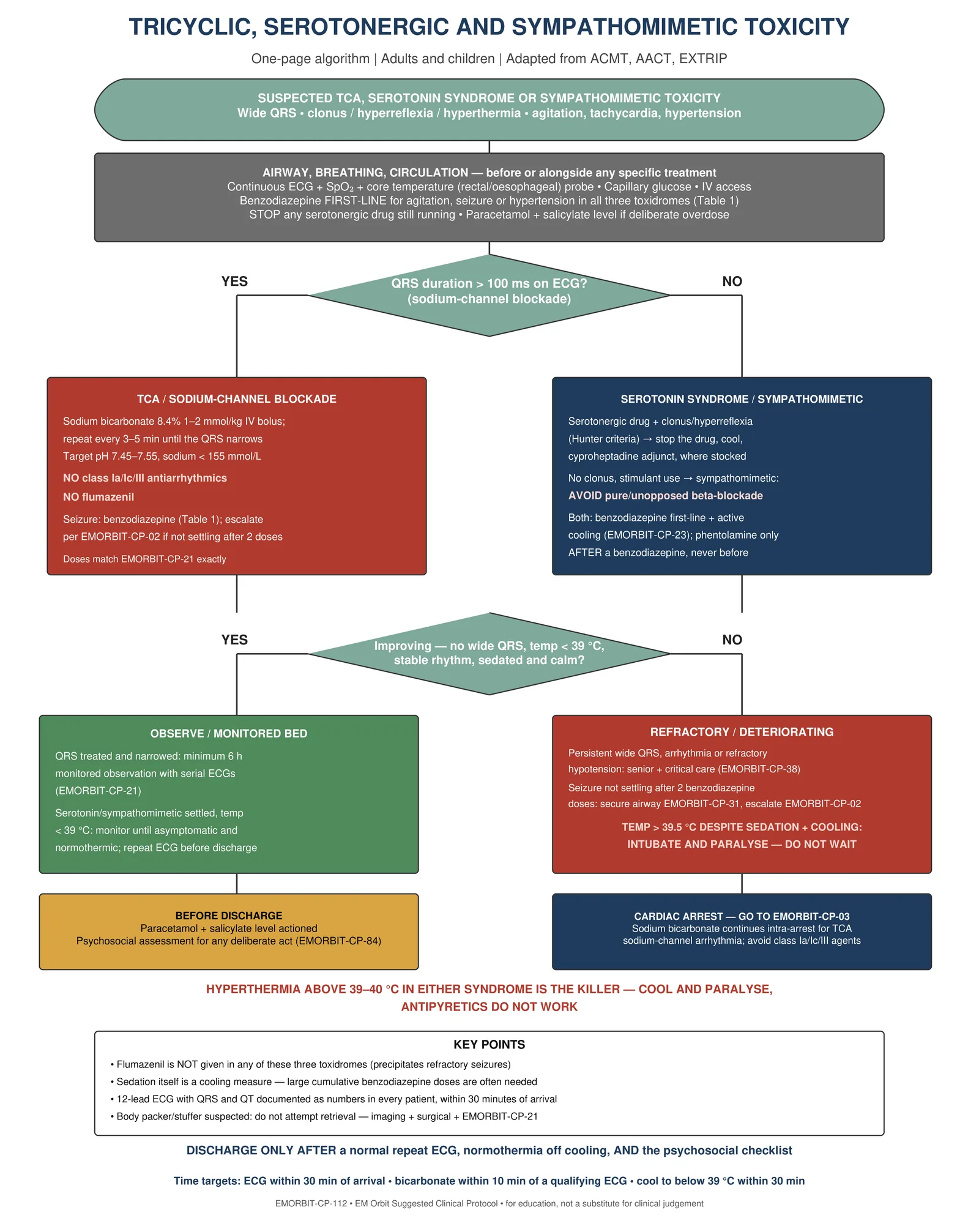
The one-page algorithm is shown at the top of this page.
6Team roles
6.1Triage and ED Nurses Role: obtain a core temperature by an indwelling probe, attach continuous monitoring, and prepare the age-appropriate benzodiazepine dose without waiting for physician review in a Category 1 patient; begin active cooling immediately where indicated.
6.2Pharmacist: verify sodium bicarbonate and benzodiazepine doses; confirm local cyproheptadine and phentolamine stock; advise on drug interactions with any implicated serotonergic medication.
6.3Critical Care / Anaesthesia: attend for airway compromise, sedation and paralysis for hyperthermia above 39.5 °C, or refractory arrhythmia; lead rapid sequence induction per EMORBIT-CP-31.
6.4Psychiatry / Mental Health Liaison: complete the psychosocial assessment for every deliberate overdose before discharge, per EMORBIT-CP-21 and EMORBIT-CP-84.
6.5Laboratory Staff: process paracetamol, salicylate, creatine kinase and blood gas samples urgently and report a critical result to the ED immediately.
6.6Ambulance / Pre-hospital Providers: hand over the agent, any pre-hospital cooling or sedation given, and the scene findings using the structured (ATMIST/SBAR) format; pre-alert for any patient with hyperthermia or a seizure.
7The patient's role
7.1 Inform staff of every substance taken, including any prescribed serotonergic medication and a recent dose change.
7.2 Remain in the department for the full observation period even after feeling well, because hyperthermia and arrhythmia can develop or recur over several hours.
7.3 Accept the referral for psychosocial follow-up or medication review where offered.
8Definitions
8.1Hunter Serotonin Toxicity Criteria: a serotonergic agent plus spontaneous clonus, or inducible or ocular clonus with agitation or diaphoresis, or tremor with hyperreflexia, or hypertonia with a temperature above 38 °C and ocular or inducible clonus.
8.2Sodium-Channel Blockade: slowed cardiac depolarisation from a tricyclic antidepressant or related drug, seen as QRS widening on the ECG and treated with sodium bicarbonate.
8.3Sympathomimetic Toxidrome: agitation, tachycardia, hypertension, hyperthermia and diaphoresis from excess adrenergic stimulation, typically from a stimulant drug.
8.4Serotonin Syndrome: a clinical triad of neuromuscular excitation (clonus, hyperreflexia, tremor), autonomic instability, and altered mental state from excess serotonergic activity, distinguished from an anticholinergic toxidrome by diaphoresis and clonus.
9Attachments
- Attachment 1: One-page algorithm (top of this page)
- Attachment 2: Key Drug Dosing Quick Reference
11Suggested quality indicators
11.1Time to ECG in suspected toxicity: (Number of patients with a 12-lead ECG performed within 30 minutes of arrival, with the QRS and QT documented as numbers / Total number of patients presenting with suspected TCA, serotonergic or sympathomimetic toxicity) × 100. Target ≥ 90%.
11.2Time to first sodium bicarbonate bolus where QRS > 100 ms: (Number of such patients receiving sodium bicarbonate within 10 minutes of the qualifying ECG / Total number of such patients) × 100. Target ≥ 90%.
11.3Core temperature monitored by an indwelling probe: (Number of patients with hyperthermia or agitation requiring sedation who had continuous core temperature monitoring / Total number of such patients) × 100. Target ≥ 95%.
11.4Safe disposition after treated sodium-channel blockade: (Number of patients with a treated QRS above 100 ms who completed a minimum 6-hour monitored observation with a normal repeat ECG before discharge / Total number of such patients) × 100. Target 100%.
11.5Unplanned return with recurrent toxicity within 72 hours: (Number of discharged patients returning with recurrent features of any of the three toxidromes within 72 hours / Total number discharged) × 100. Monitored as an outcome indicator.
13References
- American College of Medical Toxicology and American Academy of Clinical Toxicology. Position statements relevant to tricyclic antidepressant, serotonin syndrome and sympathomimetic toxicity.
- Boyer EW, Shannon M. The serotonin syndrome. N Engl J Med. 2005;352(11):1112–1120.
- Dunkley EJ, Isbister GK, Sibbritt D, Dawson AH, Whyte IM. The Hunter Serotonin Toxicity Criteria: simple and accurate diagnostic decision rules for serotonin toxicity. QJM. 2003;96(9):635–642.
- Body R, Bartram T, Azam F, Mackway-Jones K. Guidelines in Emergency Medicine Network (GEMNet): guideline for the management of tricyclic antidepressant overdose. Emerg Med J. 2011;28(4):347–368.
- Richards JR, Albertson TE, Derlet RW, Lange RA, Olson KR, Horowitz BZ. Treatment of toxicity from amphetamines, related derivatives, and analogues: a systematic review. Drug Alcohol Depend. 2015;150:1–13.
- Boehnert MT, Lovejoy FH. Value of the QRS duration versus the serum drug level in predicting seizures and ventricular arrhythmias after an acute overdose of tricyclic antidepressants. N Engl J Med. 1985;313(8):474–479.
A2Attachment 2: Key Drug Dosing Quick Reference
| Toxidrome / indication | Drug | Adult dose | Paediatric dose | Note |
|---|---|---|---|---|
| TCA / sodium-channel blockade: QRS > 100 ms | Sodium bicarbonate 8.4% | 1 to 2 mmol/kg (1 to 2 mL/kg) IV bolus; repeat every 3 to 5 minutes until the QRS narrows | 1 to 2 mmol/kg (1 to 2 mL/kg) IV bolus; repeat as for the adult | Target arterial pH 7.45 to 7.55, sodium below 155 mmol/L; repeat ECG after every bolus (EMORBIT-CP-21) |
| Toxic seizure, agitation, or first-line sedation in any of the three toxidromes | Lorazepam IV (preferred) | 4 mg IV | 0.1 mg/kg IV (maximum 4 mg) | Repeat once after 5 minutes if still seizing or agitated (EMORBIT-CP-21, EMORBIT-CP-02) |
| — no IV access | Midazolam IM or buccal | 10 mg | 0.15 to 0.2 mg/kg (maximum 10 mg) | Diazepam 5 to 10 mg IV, repeated once after 5 minutes, is an alternative (EMORBIT-CP-21) |
| Serotonin syndrome, adjunct only | Cyproheptadine | 12 mg orally or by nasogastric tube, then 2 mg every 2 hours while symptoms persist (maximum 32 mg in 24 hours) | 0.25 mg/kg in 24 hours in divided doses (maximum 12 mg in 24 hours) | Adjunct only: benzodiazepines and cooling come first (EMORBIT-CP-21) |
| Sympathomimetic hypertension refractory to benzodiazepine | Phentolamine | 2.5 to 5 mg IV, repeated every 5 to 10 minutes; infusion 0.5 to 1 mg/min | 0.05 to 0.1 mg/kg per dose (maximum 5 mg) | Given after a benzodiazepine, never before (EMORBIT-CP-40) |
Flumazenil shall not be given in any of these three toxidromes: it can precipitate seizures that are then refractory to benzodiazepines (EMORBIT-CP-21).