Opioid, Benzodiazepine and Sedative-Hypnotic Overdose in the Emergency Department
EMORBIT-CP-71 · Chapter 10 · Toxicological and Environmental Emergencies
Open in the appFree, works on your phone and offline, with every tool alongside.
Evidence base: AHA 2025; TOXBASE
1Purpose
1.1 Provide a standardised, evidence-based framework for the recognition and treatment of opioid, benzodiazepine and other sedative-hypnotic overdose in the Emergency Department (ED), with airway and ventilation always managed before or alongside any reversal agent.
1.2 Ensure naloxone is titrated to restore adequate ventilation, not full consciousness, using the doses already fixed in EMORBIT-CP-21 and EMORBIT-CP-46, and that every patient is observed for the explicit period needed to detect re-sedation once naloxone wears off.
1.3 State clearly why flumazenil is not used in the undifferentiated sedative-hypnotic overdose, and confirm its only accepted ED use is reversal of iatrogenic procedural sedation.
1.4 Direct decontamination, the poisons centre contact, and the general risk assessment and psychosocial pathway to EMORBIT-CP-21, rather than repeating them here.
1.5 Align practice with American Heart Association guidance on opioid-associated life-threatening emergencies and Royal College of Emergency Medicine standards.
2Who this protocol applies to
2.1 Any patient with suspected or confirmed opioid toxicity: reduced consciousness, respiratory depression (respiratory rate below 12/min), or miosis, following use of heroin, morphine, fentanyl (including illicit and transdermal), tramadol, codeine, oxycodone, methadone or buprenorphine, by any route and whether accidental, deliberate, or iatrogenic.
2.2 Any patient with suspected or confirmed benzodiazepine or other sedative-hypnotic overdose (Z-drugs such as zolpidem and zopiclone, barbiturates, GHB/GBL), alone or mixed with an opioid or another agent.
2.3 Patients who received naloxone before arrival (ambulance, take-home naloxone, bystander), even if alert on arrival.
2.4 Suspected body packers or body stuffers who have concealed opioid, benzodiazepine or other sedative packets.
3Not covered by this protocol
3.1 Alcohol intoxication alone, with no opioid or sedative-hypnotic co-ingestion: managed supportively under the hospital's intoxication pathway.
3.2 Opioid or benzodiazepine withdrawal without overdose: refer to the opioid substitution therapy service or the relevant addiction pathway; this guideline governs overdose, not withdrawal.
3.3 Cardiac or respiratory arrest on arrival: go immediately to EMORBIT-CP-03; give naloxone as an adjunct within the arrest algorithm, not as a substitute for it.
3.4 Reduced consciousness with a clear alternative cause established independently (hypoglycaemia EMORBIT-CP-49, head injury EMORBIT-CP-20, stroke EMORBIT-CP-14): treat the cause; return to this guideline only if a sedative toxidrome remains part of the differential (EMORBIT-CP-46).
4Protocol
4.1History and Assessment:
4.1.1Triage and Recognition:
4.1.1.1 Any patient with reduced consciousness, a respiratory rate below 12/min, oxygen saturation below 94% on air, or cyanosis shall be triaged to the highest acuity category (Category 1 / immediate) and taken directly to the resuscitation area.
4.1.1.2 Recognise the opioid toxidrome triad — reduced consciousness, respiratory depression, miosis — but treat on any one feature; the full triad is not required and pupils may be normal with certain agents (meperidine, tramadol) or co-ingestion.
4.1.1.3 An ED physician shall attend within 5 minutes of Category 1 triage. The triage nurse shall not wait for physician review before applying oxygen, monitoring, and supporting ventilation.
4.1.2History:
4.1.2.1 Agent, formulation, route and time; any naloxone already given (pre-hospital, bystander, take-home), its dose, route and time — this determines when re-sedation is expected.
4.1.2.2 Known or suspected opioid dependence, including current opioid substitution therapy (methadone or buprenorphine), because it changes the starting naloxone dose and the risk of precipitated withdrawal.
4.1.2.3 Co-ingestants: ask specifically about benzodiazepines, Z-drugs, alcohol, gabapentin or pregabalin, and any other sedating drug — these prolong and deepen sedation and are not reversed by naloxone.
4.1.2.4 Circumstances (accidental, deliberate, iatrogenic dose error, body packing or stuffing) and, in a deliberate overdose, previous self-harm and current psychiatric history.
4.1.2.5 AMPLE history (Allergies, Medications, Past history, Last meal, Events); collateral history from ambulance crew, family or bystanders, and from any container or paraphernalia recovered.
4.1.3Examination:
4.1.3.1 Full set of vital signs including respiratory rate counted over a full minute, pupil size, temperature, and Glasgow Coma Scale (GCS); continuous pulse oximetry and, where available, waveform capnography.
4.1.3.2 Examine the skin (needle marks, transdermal patches — including skin folds, behind the ears and the groin — remove any found), and look for evidence of trauma from a fall or aspiration.
4.1.3.3 Abdominal examination for a suspected body packer or stuffer: distension, tenderness or signs of obstruction or perforation.
4.1.4Risk Stratification – Severity:
4.1.4.1 High risk: apnoea or a respiratory rate below 8/min, GCS below 9, aspiration, co-ingestion of a cardiotoxic agent (methadone and QT prolongation; tricyclic antidepressant), or any body packer with signs of packet rupture or obstruction.
4.1.4.2 Intermediate risk: reduced consciousness responding to naloxone or to supportive care, no aspiration, stable vital signs after initial treatment.
4.1.4.3 Low risk: fully alert, protecting the airway, normal vital signs, no co-ingestant of concern, and a reliable account of a minor exposure.
4.1.5Differential Diagnosis:
4.1.5.1 Hypoglycaemia (check capillary glucose in every patient; treat below 4.0 mmol/L per EMORBIT-CP-49), head injury (EMORBIT-CP-20), carbon monoxide poisoning, stroke (EMORBIT-CP-14), and other causes of reduced consciousness in the differential framework of EMORBIT-CP-46.
4.1.5.2 A mixed presentation (opioid plus benzodiazepine, or either plus alcohol) is common; treat the opioid component with naloxone and manage the sedative component supportively — naloxone will not reverse a benzodiazepine, Z-drug or GHB effect.
4.1.6Special Populations:
4.1.6.1 Opioid-dependent patients (including those on methadone or buprenorphine): start naloxone at 40 to 100 micrograms to avoid precipitating severe withdrawal; expect a longer period at risk of re-sedation because methadone and buprenorphine outlast naloxone by many hours (Table 2).
4.1.6.2 Pregnancy: use the lowest effective naloxone dose titrated to ventilation; a large dose can precipitate acute maternal and fetal withdrawal and preterm labour. Involve Obstetrics; do not withhold naloxone from a hypoxic mother for this reason.
4.1.6.3 Children: any opioid exposure in a child is potentially fatal at a dose an adult would tolerate (a single methadone tablet, a used fentanyl patch); treat as high risk regardless of the apparent quantity and involve Paediatrics; safeguarding review per EMORBIT-CP-83 if the source of the drug is unclear.
4.1.6.4 Elderly: sedative accumulation is more likely with reduced renal or hepatic clearance; lower the threshold for admission and monitored observation.
4.2Investigations:
4.2.1 Capillary blood glucose immediately in every patient with reduced consciousness; correct hypoglycaemia per EMORBIT-CP-49 without waiting for the toxicology work-up.
4.2.2 12-lead ECG in every patient: measure the QT interval (methadone and some other opioids prolong it) and the QRS duration (co-ingested sodium-channel blockers).
4.2.3 Paracetamol and salicylate levels in every deliberate overdose, per EMORBIT-CP-22, regardless of the reported agent.
4.2.4 Venous or arterial blood gas with lactate for any patient with reduced consciousness, hypoxia, or suspected aspiration; renal function and creatine kinase if a prolonged down-time or rhabdomyolysis is possible.
4.2.5 Erect chest and abdominal imaging (or CT) for a suspected body packer, to identify and count packets; do not delay surgical or poisons-centre discussion for this.
4.2.6 A urine drug screen is not routine: it does not alter acute management, is neither sensitive nor specific for fentanyl analogues or novel sedatives, and shall not be used to justify withholding treatment or to determine disposition.
4.3Plan of Care:
4.3.1Immediate Actions — Airway and Ventilation First:
4.3.1.1 Airway and ventilation take priority over naloxone. Position, suction, and support ventilation with a bag-valve-mask and high-flow oxygen in any apnoeic or severely hypoventilating patient while naloxone is prepared; do not delay bagging to obtain IV access.
4.3.1.2 Call for help for any Category 1 patient; attach continuous pulse oximetry, ECG and, where available, capnography; obtain IV access.
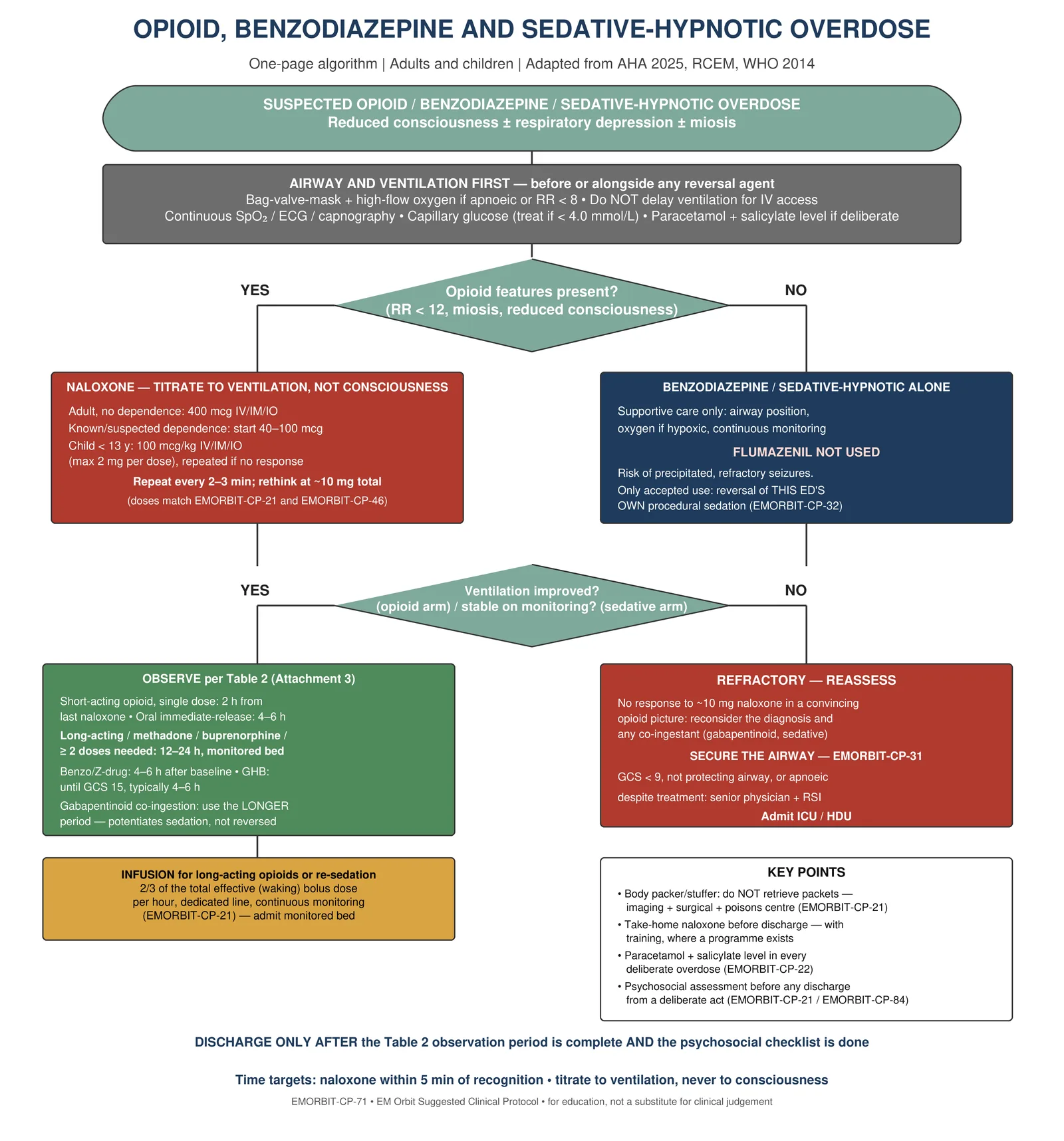
4.3.2Naloxone — First-Line Reversal for Opioid Toxicity: doses in Table 1 (Attachment 2) match EMORBIT-CP-21 and EMORBIT-CP-46 exactly and shall not be varied.
Table 1: Naloxone dosing (matches EMORBIT-CP-21 and EMORBIT-CP-46 exactly) Population Initial dose Repeat / titration Note Adult and child > 12 years, no known dependence 400 micrograms IV, IM or IO Every 2 to 3 minutes, titrated to ventilation; reconsider the diagnosis if there is no response after about 10 mg in total Titrate to restore ventilation, NOT to restore full consciousness Known or suspected opioid dependence (any age) 40–100 micrograms IV, IM or IO As above, titrated to ventilation Avoids precipitating acute withdrawal, agitation and non-cardiogenic pulmonary oedema Child (under 13 years) 100 micrograms/kg IV, IM or IO (maximum 2 mg per dose) Repeated every 2 to 3 minutes if no response Titrate to ventilation, not consciousness No IV access and apnoeic Same doses IM (or intranasal where stocked) Bag-valve-mask ventilate while naloxone is prepared Do NOT delay ventilation to obtain IV access No response to a convincing opioid toxidrome after about 10 mg total shall prompt reconsideration of the diagnosis (Table 1, Attachment 2 of EMORBIT-CP-46) rather than further naloxone.
4.3.3Naloxone Infusion for Long-Acting Opioids or Recurrent Re-sedation: where two or more effective boluses are needed, or re-sedation recurs, start an infusion at two-thirds of the total effective (waking) dose per hour, as set out in EMORBIT-CP-21, on a dedicated line with continuous monitoring; admit to a monitored bed. This applies particularly to methadone, buprenorphine and modified-release opioids (Table 2).
4.3.4Benzodiazepine and Other Sedative-Hypnotic Overdose: supportive care only — airway positioning, oxygen if hypoxic, and continuous monitoring. Flumazenil shall not be used in the undifferentiated sedative-hypnotic overdose: it can precipitate seizures that are then refractory to benzodiazepines, particularly with a co-ingested pro-convulsant or in benzodiazepine dependence. Its only accepted ED use is reversal of iatrogenic over-sedation from a procedure performed under this department's own sedation (EMORBIT-CP-32) — it is never given for a presentation from outside the department.
4.3.5Gabapentinoid and Other Co-ingestion: gabapentin and pregabalin potentiate opioid-induced respiratory depression and are not reversed by naloxone or flumazenil; a patient who has co-ingested either shall be observed for the longer of the two applicable periods in Table 2 and monitored closely even after apparent naloxone response.
4.3.6Body Packers and Body Stuffers: do not attempt endoscopic, manual, or induced-emesis retrieval of any packet — rupture causes massive, often fatal, absorption. Obtain imaging, involve the surgical team and the poisons centre, and manage per EMORBIT-CP-21 Table 7 for whole bowel irrigation and observation; a packer with signs of obstruction, perforation, or leak needs immediate surgical referral.
4.3.7Escalation and Refractory Presentation:
4.3.7.1 No improvement in ventilation after about 10 mg of naloxone in a convincing opioid toxidrome: reconsider the diagnosis and the co-ingestant, and secure the airway per EMORBIT-CP-31 rather than giving further naloxone empirically.
4.3.7.2 GCS below 9 with inadequate airway protection, from any sedative cause, is an indication for a senior physician and an airway plan per EMORBIT-CP-31; avoid intubating a patient who can still be reversed and observed if reversal is imminent and safe.
4.3.8Monitoring and Reassessment:
4.3.8.1 Continuous pulse oximetry and, where available, capnography for the duration of the risk period in Table 2; respiratory rate and GCS at least every 15 minutes until stable, then hourly.
4.3.8.2 Reassess after every naloxone dose and document the response; a patient who re-sedates is escalated, not simply re-dosed and left at the same level of observation.
4.3.9Disposition:
4.3.9.1ICU / HDU:
- Required airway intervention or prolonged bag-valve-mask ventilation.
- Aspiration, cardiac arrest, or haemodynamic instability.
- Naloxone infusion where a monitored ward bed with equivalent nursing is not available.
4.3.9.2Monitored ED observation or ward bed:
- Naloxone infusion running with stable observations.
- Long-acting or modified-release opioid, methadone or buprenorphine exposure (Table 2).
- Body packer or body stuffer (EMORBIT-CP-21 Table 7).
4.3.9.3Discharge:
- Table 2 minimum observation completed, fully alert, normal vital signs, no co-ingestant of concern.
- Psychosocial assessment completed for any deliberate act (EMORBIT-CP-84 — apply the EMORBIT-CP-21 psychosocial checklist meanwhile).
4.3.9.4 Discharge shall be by, or after discussion with, an ED specialist/consultant.
4.3.10Discharge and Follow-up:
4.3.10.1 Offer take-home naloxone and training to the patient and a household member before discharge from any opioid overdose.
Take-home naloxone and training are provided where a programme exists.
4.3.10.2 Refer every opioid-dependent patient to the opioid substitution therapy or addiction service; refer every deliberate overdose for psychiatric/psychosocial follow-up per the psychosocial checklist in EMORBIT-CP-21.
4.3.10.3 Give harm-reduction and safety-netting advice: do not use alone, the danger of combining opioids with benzodiazepines or alcohol, and to call the emergency number immediately for reduced responsiveness or slow breathing in themselves or another person.
4.3.10.4 Provide a discharge letter documenting the agent, the naloxone given, the observation period completed, and the referrals made.
4.3.11Documentation and Reporting:
4.3.11.1 Document: time of exposure and of arrival, the agent(s), every naloxone dose with time and route, the response, the observation period and its end point, co-ingestants, the paracetamol/salicylate results, and the referrals made.
4.3.11.2 Cases requiring a naloxone infusion, any body packer, and any unplanned return within 72 hours shall be captured for the departmental audit (section 11).
5Algorithm
The one-page algorithm is shown at the top of this page.
6Team roles
6.1Triage and ED Nurses Role: recognise the toxidrome, apply oxygen and monitoring, support ventilation, and prepare naloxone at the age-appropriate dose without waiting for physician review in a Category 1 patient; record every dose, time and response.
6.2Pharmacist: ensure naloxone and flumazenil stock and paediatric dosing charts are available in resuscitation; verify infusion prescriptions; advise on gabapentinoid and other interacting medication; support the take-home naloxone programme where it exists.
6.3Critical Care / Anaesthesia: attend for airway compromise, refractory sedation, or a naloxone infusion where no equivalent monitored bed exists; lead rapid sequence induction per EMORBIT-CP-31.
6.4Psychiatry / Mental Health Liaison: complete the psychosocial assessment for every deliberate overdose before discharge, per the pathway in EMORBIT-CP-21 and EMORBIT-CP-84.
6.5Laboratory Staff: process paracetamol, salicylate and blood gas samples urgently and report a critical result to the ED immediately.
6.6Ambulance / Pre-hospital Providers: hand over any naloxone already given (dose, route, time) and the scene findings using the structured (ATMIST/SBAR) format; pre-alert for any patient requiring ongoing ventilatory support.
7The patient's role
7.1 Inform staff of every substance taken, including benzodiazepines, alcohol, gabapentin or pregabalin, and any opioid substitution therapy.
7.2 Remain in the department for the full observation period even after feeling well, because sedation can return once naloxone wears off.
7.3 Accept the take-home naloxone kit and training where offered, and the referral for opioid dependence or psychosocial follow-up.
8Definitions
8.1Opioid Toxidrome: the pattern of reduced consciousness, respiratory depression and miosis produced by opioid excess; any one feature is sufficient to treat.
8.2Re-sedation: return of respiratory depression or reduced consciousness after an initial response to naloxone, because naloxone's duration of action (20 to 90 minutes) is shorter than that of most opioids.
8.3Body Packer: a person who has deliberately ingested or inserted multiple, well-wrapped packets of a drug for concealment or transport.
8.4Body Stuffer: a person who has hastily swallowed poorly wrapped or unwrapped drug packets, typically to avoid discovery.
8.5GHB / GBL: gamma-hydroxybutyrate / gamma-butyrolactone, a sedative-hypnotic with rapid onset and rapid, unpredictable recovery.
8.6Z-drug: a non-benzodiazepine sedative-hypnotic acting on the same receptor (e.g. zolpidem, zopiclone).
8.7Flumazenil: a benzodiazepine receptor antagonist; not used in the undifferentiated overdose because of the risk of precipitated, treatment-refractory seizures.
9Attachments
- Attachment 1: One-page algorithm (top of this page)
- Attachment 2: Naloxone Dosing and Infusion Quick Reference
- Attachment 3: Observation Periods and Discharge Checklist
11Suggested quality indicators
11.1Time to naloxone in respiratory depression: (Number of patients with a respiratory rate below 12/min who received naloxone within 5 minutes of recognition / Total number of such patients) × 100. Target ≥ 90%.
11.2Titration documented as ventilation, not consciousness: (Number of naloxone administrations with the respiratory rate response documented / Total naloxone administrations) × 100. Target ≥ 95%.
11.3Paracetamol level taken in deliberate overdose: (Number of deliberate overdose patients with a paracetamol level result / Total deliberate overdose patients presenting with opioid or sedative ingestion) × 100. Target 100%.
11.4Safe disposition after long-acting opioid exposure: (Number of patients exposed to a long-acting or modified-release opioid, methadone or buprenorphine who completed the Table 2 minimum observation before discharge / Total number of such patients) × 100. Target 100%.
11.5Unplanned return with recurrent sedation within 24 hours: (Number of discharged patients returning with recurrent sedation or respiratory depression within 24 hours / Total number discharged) × 100. Monitored as an outcome indicator.
13References
- American Heart Association. 2025 focused update: recognition and management of opioid-associated life-threatening emergencies. Circulation. 2025.
- Royal College of Emergency Medicine. Best practice guidance: management of poisoning and overdose in the Emergency Department. London: RCEM.
- World Health Organization. Community management of opioid overdose. Geneva: WHO; 2014.
- Boyer EW. Management of opioid analgesic overdose. N Engl J Med. 2012;367(2):146–155.
- Traub SJ, Hoffman RS, Nelson LS. Body packing — the internal concealment of illicit drugs. N Engl J Med. 2003;349(26):2519–2526.
- Evoy KE, Morrison MD, Saklad SR. Abuse and misuse of pregabalin and gabapentin: a systematic review update. Drugs. 2021;81(1):125–156.
A2Attachment 2: Naloxone Dosing and Infusion Quick Reference
Infusion for long-acting opioids or recurrent re-sedation: two-thirds of the total effective (waking) bolus dose per hour, on a dedicated line with continuous monitoring, exactly as EMORBIT-CP-21 (Table 6) sets out. Do not use flumazenil for a benzodiazepine or other sedative-hypnotic overdose; its only accepted use is reversal of this department's own iatrogenic procedural sedation (EMORBIT-CP-32).
| Population | Initial dose | Repeat / titration | Note |
|---|---|---|---|
| Adult and child > 12 years, no known dependence | 400 micrograms IV, IM or IO | Every 2 to 3 minutes, titrated to ventilation; reconsider the diagnosis if there is no response after about 10 mg in total | Titrate to restore ventilation, NOT to restore full consciousness |
| Known or suspected opioid dependence (any age) | 40–100 micrograms IV, IM or IO | As above, titrated to ventilation | Avoids precipitating acute withdrawal, agitation and non-cardiogenic pulmonary oedema |
| Child (under 13 years) | 100 micrograms/kg IV, IM or IO (maximum 2 mg per dose) | Repeated every 2 to 3 minutes if no response | Titrate to ventilation, not consciousness |
| No IV access and apnoeic | Same doses IM (or intranasal where stocked) | Bag-valve-mask ventilate while naloxone is prepared | Do NOT delay ventilation to obtain IV access |
No response to a convincing opioid toxidrome after about 10 mg total shall prompt reconsideration of the diagnosis (Table 1, Attachment 2 of EMORBIT-CP-46) rather than further naloxone.
A3Attachment 3: Observation Periods and Discharge Checklist
| Scenario | Minimum observation | Note |
|---|---|---|
| Short-acting opioid (e.g. heroin, IV morphine, fentanyl), full recovery after a single naloxone dose, ambulant | 2 hours from the last naloxone dose | Naloxone (20 to 90 minutes) is shorter-acting than most opioids; re-sedation can still occur — do not discharge directly from the resuscitation area |
| Immediate-release oral opioid, asymptomatic | 4 to 6 hours from ingestion | As the general low-risk rule, EMORBIT-CP-21 Table 7 |
| Long-acting or modified-release opioid, methadone, buprenorphine, or any recurrent re-sedation | 12 to 24 hours, monitored bed, usually with a naloxone infusion | Matches EMORBIT-CP-21 Table 7 exactly; do not discharge on a single reversal |
| Benzodiazepine or Z-drug alone, resolved without a reversal agent | 4 to 6 hours after return to baseline mental state | No re-sedation mechanism analogous to naloxone, but sedation can be prolonged in the elderly and in hepatic impairment |
| GHB (gamma-hydroxybutyrate) | Until Glasgow Coma Scale 15 and stable, typically 4 to 6 hours from ingestion | Onset and recovery are both rapid; a sudden return to deep sedation can still occur — do not leave unmonitored |
| Gabapentinoid (gabapentin, pregabalin) co-ingested with an opioid or sedative | The longer of the two applicable periods above | Gabapentinoids potentiate opioid-induced respiratory depression and are not reversed by naloxone or flumazenil |
| Body packer or body stuffer | As EMORBIT-CP-21 Table 7 (packer: until all packets have passed and imaging is clear, plus 24 hours; stuffer: 6 to 8 hours minimum) | Do not attempt endoscopic or manual retrieval — packet rupture causes massive absorption |
These are minimums for a medically fit patient and are extended for co-ingestion, an uncertain history, or on the advice of the poisons centre (EMORBIT-CP-21). No patient who has taken a deliberate overdose is discharged on medical grounds alone.
| ✓ | Item |
|---|---|
| ☐ | Table 2 minimum observation period completed and counted from the correct start point (last naloxone dose or time of ingestion). |
| ☐ | Fully alert, normal respiratory rate and oxygen saturation, no further naloxone required during the observation period. |
| ☐ | Paracetamol and salicylate results reviewed and acted upon (every deliberate overdose). |
| ☐ | Psychosocial assessment completed for any deliberate act, per EMORBIT-CP-21. |
| ☐ | Take-home naloxone offered and training given where a programme exists (section 4.3.9). |
| ☐ | Opioid substitution therapy or addiction service referral made where indicated. |
| ☐ | Discharge by, or after discussion with, an ED specialist/consultant. |