Procedural Sedation and Analgesia in the Emergency Department
EMORBIT-CP-32 · Chapter 1 · Resuscitation and Critical Care
Open in the appFree, works on your phone and offline, with every tool alongside.
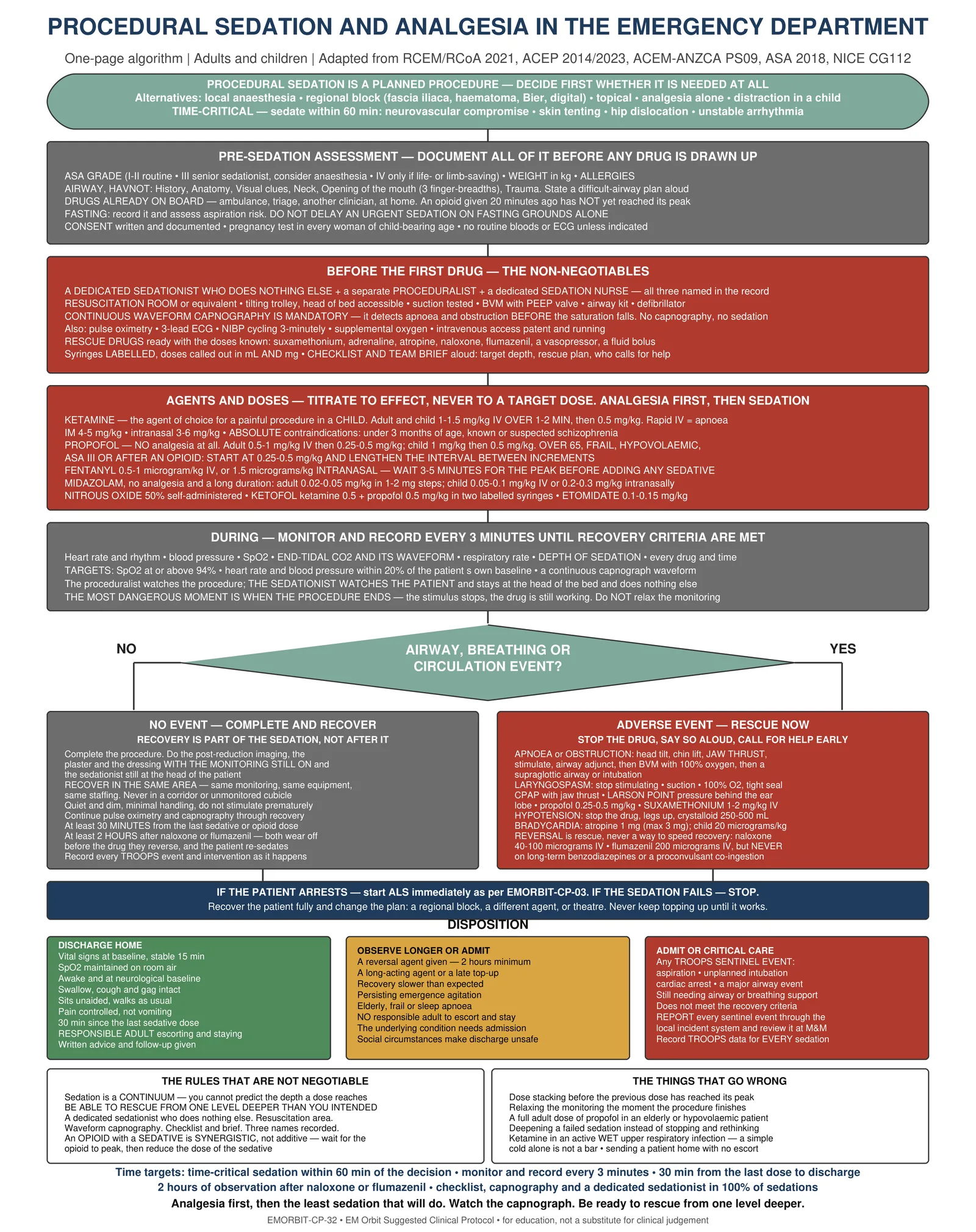
Evidence base: RCEM/RCoA 2021; ACEP CP 2014; ACEM
1Purpose
1.1 Provide a standardized, evidence-based framework for the safe delivery of procedural sedation and analgesia (PSA) to adults, children and young people in the Emergency Department (ED), from the decision to sedate through to safe discharge.
1.2 Establish that sedation is a continuum and that the depth reached by a given dose in a given patient cannot be predicted, and that the team shall therefore always be trained, staffed and equipped to rescue the patient from one level deeper than the level intended.
1.3 Establish the non-negotiable minimum conditions for any ED sedation: a dedicated sedationist who does nothing else, a separate proceduralist, a dedicated trained nurse, a resuscitation-capable area, and continuous waveform capnography in addition to pulse oximetry, electrocardiography and non-invasive blood pressure monitoring.
1.4 Standardize the pre-sedation assessment — ASA physical status, airway assessment, fasting status and aspiration risk, comorbidity and the drugs the patient already has on board — and require that it be documented on a structured record before any drug is drawn up.
1.5 State clearly that fasting status shall not by itself delay a sedation that is clinically urgent, because the published evidence does not show that pre-procedural fasting reduces vomiting or aspiration in emergency department sedation, while delay causes measurable harm from unrelieved pain, prolonged ischaemia and prolonged dislocation.
1.6 Define the agents used in the ED — ketamine, propofol, midazolam, fentanyl, nitrous oxide, ketofol, etomidate and dexmedetomidine — with adult and paediatric doses, onset, duration and specific cautions, and define the safe use of combinations.
1.7 Ensure that the additive respiratory depression of an opioid given with a sedative is understood and planned for, because it is the commonest mechanism of serious adverse events in procedural sedation.
1.8 Define the recognition and management of the complications that matter — apnoea, airway obstruction, laryngospasm, aspiration, hypotension, bradycardia, vomiting and emergence phenomena — and require that the rescue plan be stated aloud before the first drug is given.
1.9 Define objective recovery and discharge criteria, the written advice given to the patient and the responsible adult, and the follow-up arranged, so that no patient leaves the department while still sedated or unescorted.
1.10 Establish the documentation standard, the credentialing levels required to sedate, and the mandatory reporting of sedation adverse events using the TROOPS tool, so that the department can describe and improve its own safety record.
1.11 Ensure consistency of practice among all healthcare providers (HCP) and alignment with the Royal College of Emergency Medicine and the Royal College of Anaesthetists (RCEM/RCoA), the American College of Emergency Physicians (ACEP), the Australasian College for Emergency Medicine and the Australian and New Zealand College of Anaesthetists (ACEM/ANZCA PS09), the American Society of Anesthesiologists (ASA), and the National Institute for Health and Care Excellence (NICE CG112) for children and young people.
2Who this protocol applies to
2.1 Any patient in the ED who requires the administration of one or more sedative, dissociative or analgesic drugs to tolerate a diagnostic or therapeutic procedure, where the intention is to preserve airway patency, spontaneous ventilation, protective airway reflexes and haemodynamic stability.
2.2The procedures commonly requiring sedation in the ED:
- Reduction of a fracture or a dislocation, and application of a plaster or an external splint.
- Reduction of a joint dislocation — shoulder, elbow, hip, patella, ankle, temporomandibular joint.
- Synchronised electrical cardioversion of an unstable or symptomatic tachyarrhythmia, and transcutaneous pacing.
- Incision and drainage of a large abscess, and debridement of a burn or a contaminated wound.
- Complex laceration repair, particularly in a child, and repair of facial or hand injuries.
- Insertion of an intercostal drain, and other painful bedside procedures.
- Removal of a foreign body, particularly in a child.
- Lumbar puncture, and painful examination that cannot otherwise be completed.
- Reduction of a paraphimosis, and reduction of a hernia.
- Imaging in a young child who cannot lie still for a study that must be obtained now.
2.3 Patients of ASA physical status I and II, who are suitable for ED procedural sedation by any credentialed sedationist.
2.4 Patients of ASA physical status III are included, where the sedation is undertaken by an emergency medicine consultant or equivalent senior sedationist, with a documented consideration of the risks and of the alternatives. Note: Patients with severe systemic disease attend the ED with dislocations, with unstable arrhythmias and with fractures that are compromising a limb, and these procedures frequently cannot be deferred. The evidence and the RCEM/RCoA, ACEP and ACEM/ANZCA positions treat a higher ASA grade as a marker of increased risk that mandates a senior sedationist, a more cautious technique and consideration of anaesthetic involvement — not as an absolute bar to ED sedation. Note: confirm this position with anaesthesia, and agree the local escalation route.
2.5 Patients of ASA physical status IV are included only where the procedure is immediately life- or limb-saving, cannot be deferred, and cannot be performed under local or regional anaesthesia; an emergency medicine consultant shall be present and anaesthesia shall be involved or informed.
2.6 Children and young people of all ages are within the scope of this guideline. Note: Children under 3 years present to the ED with injuries that require sedation, and NICE CG112 covers children from birth. The under-3 restriction is retained in this guideline as a capability rule rather than as a clinical exclusion (section 4.3.6): a child under 3 years shall not undergo elective ED procedural sedation, and where sedation in this age group is unavoidable it shall involve paediatric anaesthesia. This preserves the local safety intention while allowing the department to treat the child who cannot wait. Note: confirm the age threshold and the paediatric anaesthesia escalation route locally.
2.7 Patients arriving already sedated or already given analgesia by the ambulance service or by another facility, in whom a further procedure requiring sedation is planned; the drugs already given shall be established before any further drug is administered.
3Not covered by this protocol
3.1 Rapid sequence induction and tracheal intubation, and the sedation of an intubated and ventilated patient, which are covered by their own ED guidelines and are not procedural sedation.
3.2 Sedation of the acutely agitated or violent patient for behavioural control, which is covered by EMORBIT-CP-27 (acute behavioural disturbance) and differs fundamentally in consent, indication and monitoring.
3.3 Analgesia given without any intent to sedate, including titrated intravenous opioid, nitrous oxide used as an analgesic alone, and sub-dissociative ketamine given for pain, which are covered by EMORBIT-CP-17 (pain management). Where these agents are given in doses intended to produce sedation, this guideline applies.
3.4 Local and regional anaesthesia, including haematoma block, Bier block and peripheral nerve block, which are alternatives to sedation and are covered separately. Where a block is supplemented with a sedative, this guideline applies.
3.5 Elective sedation for imaging or for a procedure that can safely be deferred to a scheduled list in theatre or in the radiology department, which shall be referred rather than performed in the ED.
3.6 Palliative sedation at the end of life, which is a different intervention with a different purpose and is governed by the local end-of-life care policy.
3.7 A patient whose conscious level is already depressed — Glasgow Coma Scale below 14 from intoxication, head injury, metabolic derangement or any other cause — shall not receive elective procedural sedation. Note: The exclusion is retained but its basis is restated: the reason is that sedation obscures the serial neurological assessment on which the management of a head injury depends, and that a depressed conscious level indicates a patient who is already at risk of airway compromise — not that ketamine raises intracranial pressure. The belief that ketamine is contraindicated in head injury because it raises intracranial pressure has been examined in multiple systematic reviews and is not supported. This matters because it determines whether ketamine may be used in a patient with a minor head injury who needs a dislocation reduced. Note: confirm the local position.
4Protocol
4.1History and Assessment:
4.1.1Recognition — Identifying the Patient Who Needs Sedation, and How Urgently:
4.1.1.1 Procedural sedation is a planned intervention, not an emergency one. The exceptions are the procedures in which delay causes harm, and these shall be identified at triage and prioritised.
4.1.1.2Time-critical sedation — the decision to sedate shall be made and the sedation started within 60 minutes of the decision where any of the following applies:
- A fracture or dislocation with neurovascular compromise — a pale, pulseless, cold or insensate limb; the ischaemic time starts at the injury, not at arrival.
- A dislocation threatening the skin, where tenting or blanching indicates imminent pressure necrosis.
- An unstable tachyarrhythmia requiring synchronised cardioversion, where the patient is in shock, has ongoing ischaemia, syncope or heart failure. In peri-arrest, cardioversion shall not be delayed for sedation.
- Symptomatic bradycardia requiring transcutaneous pacing.
- A hip dislocation, in which the risk of avascular necrosis of the femoral head rises with the time to reduction.
- Severe uncontrolled pain that cannot be relieved by any other means.
4.1.1.3 For all other indications, the sedation is scheduled within the ED at a time when the staff, the space and the equipment are available, and the patient is given adequate analgesia in the meantime.
4.1.1.4 A pain score and full observations shall be recorded at triage and analgesia given under the ED pain management standard. Adequate analgesia before the sedation reduces the dose of sedative required and improves the conditions for the procedure.
4.1.1.5 The department shall not commence a sedation when the staffing or the resuscitation area cannot support it. The overall safety of the department is one of the criteria for the decision to sedate.
4.1.2History — the Pre-Sedation Assessment:
4.1.2.1 Age and weight in kilograms. Every drug dose in this guideline is weight-based, and an estimated weight is a source of error; the patient shall be weighed, or a validated length-based tape used in a child.
4.1.2.2 Allergies, with the nature of the reaction, and specifically any previous reaction to an anaesthetic or sedative agent.
4.1.2.3 Previous sedation or anaesthesia, and any problem with it — a difficult airway, an awareness event, prolonged recovery, severe nausea, or an emergence reaction. Ask the patient and the family.
4.1.2.4 A family history of a problem with anaesthesia, including malignant hyperthermia and suxamethonium apnoea, which matters because suxamethonium is a rescue drug in this guideline.
4.1.2.5 Cardiovascular disease: ischaemic heart disease and the date of any myocardial infarction, heart failure and its functional class, valvular disease, arrhythmia, a pacemaker or implantable defibrillator, hypertension and its control, and exercise tolerance expressed in metabolic equivalents or in plain terms — can the patient climb a flight of stairs?
4.1.2.6 Respiratory disease: asthma and its control, chronic obstructive pulmonary disease and home oxygen, a recent respiratory tract infection, smoking, obstructive sleep apnoea and whether continuous positive airway pressure is used at home, and snoring, which is a marker of a difficult airway under sedation.
4.1.2.7 Neurological disease: epilepsy, previous stroke, raised intracranial pressure, and a psychiatric history — specifically schizophrenia or a psychotic illness, which is an absolute contraindication to ketamine.
4.1.2.8 Renal and hepatic disease, which alter the dose and the duration of most agents.
4.1.2.9 Drugs the patient already has on board. This is the single most important question in the pre-sedation history and it is regularly answered wrongly. Establish, with the dose and the exact time: every analgesic and sedative given by the ambulance service; every drug given at triage; every drug given by another clinician in the department; and every drug the patient has taken at home, including opioids, benzodiazepines, gabapentinoids, antihistamines, alcohol and recreational drugs. An opioid given 20 minutes ago has not yet reached its peak effect, and a sedative added to it will produce more respiratory depression than the same dose would produce alone.
4.1.2.10 Regular medication, in particular long-term opioids and benzodiazepines (which raise the dose required and make flumazenil dangerous), antihypertensives and beta-blockers, anticoagulants and antiplatelets, and monoamine oxidase inhibitors.
4.1.2.11 Fasting status: the time and content of the last food and the last clear fluid, recorded for the risk assessment in section 4.1.5 — and recorded in order to inform the assessment, not in order to postpone the procedure.
4.1.2.12 In women of child-bearing age, the last menstrual period and the possibility of pregnancy, with a βhCG performed and documented.
4.1.2.13 Social circumstances: whether a responsible adult can escort the patient home and remain with them, because this is a discharge criterion and a patient who has no escort may need a different plan made before, not after, the sedation.
4.1.3Examination — Airway Assessment and ASA Grading:
4.1.3.1 Every patient shall have a formal airway assessment recorded before sedation, in anticipation of the possibility that the airway will have to be managed. The purpose is not to predict whether intubation will be needed, but to know in advance whether it would be difficult if it were.
4.1.3.2The HAVNOT assessment:
- H — History: previous airway or anaesthetic problems, previous tracheostomy or tracheal surgery, head and neck radiotherapy, obstructive sleep apnoea.
- A — Anatomy: the face, mouth, jaw and teeth — a receding mandible, a short thyromental distance, prominent incisors, loose or capped teeth, dentures, a large tongue, a high arched palate, limited jaw protrusion.
- V — Visual clues: obesity and neck circumference, a full beard, extremes of age, pregnancy, facial burns or swelling.
- N — Neck: mobility and access, including cervical collar or in-line immobilisation, rheumatoid or ankylosing disease, and a mass or a goitre.
- O — Opening of the mouth: an inter-incisor distance of less than three of the patient's own finger-breadths suggests a potentially difficult airway.
- T — Trauma: to the face, mandible, neck or airway, and blood or secretions in the pharynx.
4.1.3.3 Where any HAVNOT feature is present, the sedationist shall state a difficult airway plan aloud before starting, shall consider a lighter target depth or an alternative to sedation, and shall consider involving anaesthesia.
4.1.3.4 Cardiorespiratory examination: heart sounds, murmurs, respiratory rate and effort, air entry, added sounds, and signs of heart failure.
4.1.3.5 Record a full set of baseline observations — heart rate and rhythm, blood pressure, respiratory rate, oxygen saturation on room air, temperature and conscious level — because every intra-procedure value is judged against this baseline, not against a textbook number.
4.1.3.6 Assign and record the ASA physical status (Table 1). An ASA grade that is not written down cannot be audited and was probably not considered.
4.1.3.7
Table 1: ASA Physical Status classification and its meaning for ED procedural sedation ASA Definition Implication for procedural sedation in the ED I A normal healthy patient Suitable for ED procedural sedation by a credentialed sedationist II A patient with mild systemic disease and no substantive functional limitation — for example controlled hypertension, controlled diabetes, a current smoker, pregnancy, obesity with a body mass index of 30–40 Suitable for ED procedural sedation by a credentialed sedationist III A patient with severe systemic disease that is not incapacitating — for example poorly controlled diabetes or hypertension, chronic obstructive pulmonary disease, morbid obesity (body mass index 40 or above), an implanted pacemaker, moderately reduced ejection fraction, end-stage renal disease on dialysis, a myocardial infarction or stroke more than 3 months ago Senior decision-maker required. Sedation may proceed in the ED where the procedure is urgent, the sedationist is an emergency medicine consultant or equivalent, and the risks have been considered and documented. Consider a lighter target depth, a lower dose, an agent with a better haemodynamic profile, and early discussion with anaesthesia. Where the procedure can safely wait, discuss with anaesthesia and consider the theatre environment IV A patient with severe systemic disease that is a constant threat to life — for example ongoing cardiac ischaemia, severe valve dysfunction, sepsis, disseminated intravascular coagulation, an ejection fraction below 25%, a recent (within 3 months) myocardial infarction or stroke Not for routine ED procedural sedation. Sedation shall proceed in the ED only where the procedure is immediately life- or limb-saving and cannot be deferred or performed under local or regional anaesthesia, and then with an emergency medicine consultant present and anaesthesia involved or informed V A moribund patient who is not expected to survive without the operation Procedural sedation is not applicable; management is resuscitative E Added to any grade for an emergency procedure Every ED sedation is by definition unscheduled; this raises risk relative to the same procedure performed electively, and is a reason for more preparation, not less
4.1.4Risk Stratification:
4.1.4.1The features that raise the risk of an adverse event and shall prompt a senior sedationist, a more cautious technique, or a decision not to sedate in the ED:
- ASA physical status III or above.
- Age over 70 years, and frailty at any age — the dose-response curve for every sedative shifts markedly, and the physiological reserve to tolerate a period of apnoea or hypotension is reduced.
- Age under 3 years (section 4.3.6).
- Any difficult airway feature on HAVNOT, and in particular obesity with a large neck, a beard, limited mouth opening, or a fixed cervical spine.
- Obstructive sleep apnoea, which predicts airway obstruction at a light depth of sedation and a slow, obstructed recovery.
- Obesity, with a body mass index above 35 and particularly above 40 — reduced functional residual capacity means desaturation occurs within seconds of apnoea rather than minutes.
- Significant cardiorespiratory disease, ongoing ischaemia, decompensated heart failure, severe aortic stenosis, or pulmonary hypertension.
- Hypovolaemia, active bleeding, sepsis or shock — a sedative given to a patient whose blood pressure is being maintained by sympathetic tone will unmask the hypovolaemia abruptly.
- Oxygen saturation below 92% on air, or a partial pressure of oxygen below 8 kPa.
- An ischaemic cardiac or cerebral event within the previous 6 weeks (note that the ASA classification uses 3 months, and local practice may use a different interval; check local policy).
- Active, progressive cardiovascular, respiratory or neurological disease.
- A procedure involving stimulation of the posterior pharynx, which provokes laryngospasm and which the airway cannot be protected against under sedation.
- A long or unpredictable procedure, which is a reason to use theatre and anaesthesia rather than a series of top-up doses in the ED.
- A patient on long-term opioids or benzodiazepines, in whom the dose required is unpredictable and the margin between effect and respiratory depression is not.
4.1.4.2 A high-risk patient is not necessarily a patient who should not be sedated. The decision is between sedating with more preparation, sedating elsewhere with anaesthetic support, and not sedating at all — and it is a senior decision that shall be documented with its reasoning.
4.1.4.3 Where the procedure is not urgent and the risk is high, the correct answer is frequently to arrange the procedure in theatre. The absence of an available theatre slot is not a clinical reason to sedate a high-risk patient in the ED, and where that pressure exists it shall be escalated rather than absorbed.
4.1.5Fasting Status and Aspiration Risk:
4.1.5.1 Fasting status shall be recorded, and shall not by itself delay a sedation that is clinically urgent.
4.1.5.2 The evidence: the elective fasting intervals — commonly 2 hours for clear fluid, 6 hours for a light meal — were derived for general anaesthesia with an unprotected airway and paralysis. Large emergency department series and the ACEP clinical policy have not demonstrated that non-compliance with elective fasting intervals increases the incidence of vomiting or of aspiration during procedural sedation. Clinically significant aspiration during ED procedural sedation is very rare. Meanwhile the harm of delay — continued severe pain, a prolonged period of limb ischaemia, a joint left dislocated, an arrhythmia left uncardioverted, and an overnight stay for a procedure that could have been done — is real, measurable and common.
4.1.5.3An aspiration risk assessment shall be made and recorded instead, taking account of:
- The urgency of the procedure, and the harm that delay would cause.
- The time and nature of the last oral intake — a large fatty meal 30 minutes ago is not the same as a cup of tea 90 minutes ago.
- Factors delaying gastric emptying: pain, opioids already given, trauma, pregnancy, diabetic gastroparesis, bowel obstruction, alcohol intoxication and obesity.
- The planned depth of sedation — the risk rises with depth, and is lowest with minimal sedation and with nitrous oxide.
- The agent — ketamine preserves airway reflexes relatively well; propofol abolishes them at a lower dose than most clinicians expect.
- The airway assessment and the ease with which the airway could be secured if it had to be.
- The patient's comorbidity and physiological reserve.
4.1.5.4 Where the risk assessment indicates a high aspiration risk and the procedure is not urgent, the reasonable responses are: defer the procedure for a period; choose a lighter depth of sedation; choose an alternative technique such as a regional block; or perform the procedure in theatre with a protected airway. Prolonged fasting is not, of itself, one of the responses — a patient fasted for 8 hours in pain with a full stomach from the opioid given at triage has not been made safe.
4.1.5.5 The assessment, the decision and its reasoning shall be recorded on the sedation record.
4.1.6Alternatives to Sedation — What Else Could Be Done Instead:
4.1.6.1 Procedural sedation shall be used only where a less invasive alternative will not achieve the objective. The alternatives shall be considered and the consideration documented.
4.1.6.2 Local anaesthetic infiltration, which is sufficient for most wound repairs, for many abscesses, and for the insertion of an intercostal drain.
4.1.6.3 Regional anaesthesia and peripheral nerve blockade — a fascia iliaca block for a fractured neck of femur, a haematoma block or a Bier block for a distal radius fracture, a digital block, a femoral or an interscalene block. Ultrasound-guided regional anaesthesia frequently removes the need for sedation altogether, and where it is available it is the preferred option in the elderly and the high-risk patient.
4.1.6.4 Topical anaesthesia — topical local anaesthetic gel for a laceration in a child, and a topical anaesthetic cream applied at triage before cannulation.
4.1.6.5 Analgesia alone, adequately titrated, which is often what the patient actually needed.
4.1.6.6 In children, non-pharmacological strategies are powerful and are systematically under-used: distraction with a screen, a toy, bubbles or a play specialist; the presence of a calm parent; a comfortable holding position rather than restraint; sucrose in an infant; topical anaesthetic; and simply doing the procedure in a quiet room without an audience. These shall be tried before a child is sedated.
4.1.6.7 Deferring the procedure to a theatre list with an anaesthetist, where the patient is high risk, the procedure is long, or the airway is difficult.
4.1.6.8 Doing nothing now — a stable, undisplaced fracture in a comfortable patient may not need to be manipulated tonight.
4.1.7Informed Consent:
4.1.7.1 Written consent shall be obtained from every competent adult patient before elective procedural sedation, on the local consent form, and shall cover both the procedure and the sedation.
4.1.7.2The discussion shall include, and the record shall show:
- What the procedure is and why it is needed.
- What sedation is, and that the patient may or may not remember the procedure. Sedation is not a guarantee of amnesia and is not general anaesthesia.
- The agent or agents proposed, and the alternatives considered — including regional anaesthesia, local anaesthesia and doing the procedure in theatre.
- The common effects: drowsiness, nausea and vomiting, unsteadiness, and pain on injection.
- The uncommon and serious risks: a temporary fall in the oxygen level requiring assistance with breathing; a temporary fall in blood pressure; the need for a breathing tube; laryngospasm; aspiration; an allergic reaction; and, very rarely, death.
- With ketamine specifically: vivid dreams, hallucinations, an unpleasant emergence experience, and a temporary rise in blood pressure and heart rate.
- That the procedure may not succeed and may have to be repeated or done in theatre.
- The discharge requirements — a responsible adult escort, no driving, no alcohol and no important decisions for 24 hours — which the patient shall be told before the sedation, not after it.
4.1.7.3 In a child, consent is taken from the person with parental responsibility; the child shall be given an age-appropriate explanation and their assent sought. A young person who is competent to consent may do so.
4.1.7.4 Where the patient lacks capacity, or where the procedure is immediately necessary and consent cannot be obtained, the procedure may proceed in the patient's best interests in accordance with local policy; the reason, the decision-maker and any consultation with the family shall be documented.
4.1.7.5 An interpreter shall be used wherever the patient does not speak the language of the consent discussion, and this shall be recorded. A family member shall not be used as the interpreter for consent where an interpreter service is available.
4.1.7.6 The consent discussion shall take place before any sedative or opioid is given. Consent obtained from a patient who has already had intravenous morphine is not valid consent.
4.1.8Special Populations:
4.1.8.1 The elderly patient: the dose-response curve for every sedative shifts left with age, and the effect is most marked with propofol — an induction dose in a patient over 65 years is commonly 25–50% lower than in a young adult, and the interval between increments must be longer because the arm-to-brain time and the time to peak effect are both prolonged. The elderly patient also has less cardiac reserve, a stiffer vasculature that responds badly to vasodilatation, a higher prevalence of ischaemic heart disease, and a reduced ability to tolerate even brief apnoea. Add polypharmacy and frequently an opioid already given for the fracture that brought them in. Start low, go slowly, and expect the effect to be greater and longer than intended. Consider regional anaesthesia in preference wherever it will do the job.
4.1.8.2 Pregnancy: procedural sedation in pregnancy, and particularly in the second and third trimesters, shall be treated as high risk and shall involve a senior clinical decision-maker early; it shall be undertaken only where the procedure is genuinely an emergency. The reasons are a reduced functional residual capacity and rapid desaturation, an increased risk of aspiration from a raised intra-abdominal pressure and a relaxed lower oesophageal sphincter, aortocaval compression from about 20 weeks (position the patient with left lateral tilt), a difficult airway from oedema and weight gain, and the effect on the fetus. Obstetric review shall be obtained, and fetal monitoring arranged where the gestation makes it appropriate. Nitrous oxide shall be avoided where an alternative exists. Where the procedure can be deferred or performed under regional anaesthesia, it shall be.
4.1.8.3 Obesity and obstructive sleep apnoea: reduced functional residual capacity means desaturation within seconds of apnoea; increased chest wall and airway soft tissue means obstruction at a light depth of sedation and a difficult mask seal. Position the patient in a ramped position with the external auditory meatus level with the sternal notch, pre-oxygenate properly, dose on lean body weight, target the lightest effective depth, and be prepared to use continuous positive airway pressure and an oropharyngeal airway early. A patient who uses home continuous positive airway pressure shall bring the machine or shall be observed on the ward.
4.1.8.4 The intoxicated patient: alcohol and recreational drugs are additive with every sedative, the conscious level is already depressed, the stomach is full, protective reflexes are impaired, and the history is unreliable. Elective sedation shall be deferred where possible. Where the procedure is urgent, use a senior sedationist, use less drug than the weight suggests, and anticipate a prolonged and agitated recovery that is difficult to distinguish from the intoxication itself.
4.1.8.5 The patient on long-term opioids or benzodiazepines: tolerance raises the dose required for sedation but does not raise the dose at which respiratory depression occurs to the same degree, so the therapeutic margin is narrowed rather than widened. Flumazenil shall not be given to a patient who takes benzodiazepines long term. Consider ketamine, which is less affected by opioid tolerance, and consider regional anaesthesia.
4.1.8.6 Renal and hepatic impairment: morphine and midazolam accumulate; fentanyl and, in single doses, propofol are safer choices. Reduce the dose and lengthen the interval.
4.1.8.7 The patient with a psychotic illness: ketamine is absolutely contraindicated in known or suspected schizophrenia. Choose another agent.
4.1.8.8 The patient who has already received sedation today, for example a second attempt at a reduction: the drugs already given are still present, and the second sedation shall be dosed and monitored on that basis, with the full checklist and brief repeated.
4.2Investigations:
4.2.1Routine Investigation Is Not Required:
4.2.1.1 No blood test, electrocardiogram or chest radiograph is required routinely before ED procedural sedation in a patient who is otherwise well. The evidence does not support routine pre-procedural testing, and waiting for results delays the procedure without changing the plan.
4.2.1.2 Investigation is directed by the history and examination, and by the underlying condition for which the patient attended — not by the fact that sedation is planned.
4.2.2Investigations in Selected Patients:
4.2.2.1 A 12-lead electrocardiogram where the patient has known cardiac disease, an arrhythmia, a pacemaker, syncope, electrolyte disturbance, or is over 65 with cardiovascular risk factors; and always before synchronised cardioversion.
4.2.2.2 Urea, electrolytes and creatinine where there is renal impairment, diuretic or digoxin use, vomiting, or an arrhythmia — and always before cardioversion, where potassium and magnesium shall be known.
4.2.2.3 Full blood count where there is bleeding, anaemia or sepsis.
4.2.2.4 Capillary blood glucose in every diabetic patient, in every child, and in any patient with an altered conscious level — before and after the sedation, because a fasted diabetic patient on insulin or a sulfonylurea is at risk of hypoglycaemia that will be attributed to the sedation.
4.2.2.5 A venous blood gas where the patient is unwell, hypoxic or has chronic obstructive pulmonary disease, to establish the baseline carbon dioxide.
4.2.2.6 A chest radiograph only where indicated by the presentation, for example before an intercostal drain.
4.2.2.7 Anticoagulation status where the procedure carries a bleeding risk.
4.2.3Pregnancy Test:
4.2.3.1 A urine or serum βhCG shall be performed and documented in every woman of child-bearing age before elective procedural sedation, and the result recorded on the sedation record.
4.2.3.2 The test shall be performed regardless of the reported menstrual history, contraception or the patient's own assessment of the possibility of pregnancy.
4.2.3.3 Where the procedure is immediately life- or limb-saving and the result is not available, the sedation shall not be delayed; the reason shall be documented.
4.2.4The Scoring Tools Used:
4.2.4.1 Depth of sedation shall be assessed and recorded at each monitoring interval using the ASA continuum in Table 2 — minimal, moderate, deep, general anaesthesia — or dissociation where ketamine is used. The sedationist states the intended depth before starting and records the depth achieved throughout.
4.2.4.2 Pain shall be scored before, during where possible, and after the procedure using the validated ED pain score appropriate to the patient — a numerical rating scale in an adult, and an age-appropriate observational scale such as FLACC in a young child.
4.2.4.3 Recovery shall be assessed against the objective discharge criteria in Attachment 4, which are derived from the modified post-anaesthetic discharge scoring approach, rather than against an impression that the patient "seems fine".
4.2.4.4 Note: The Behavioural Pain Scale for intubated patients (BPS) and its non-intubated variant (BPS-NI) are intensive care pain-assessment instruments for the critically ill and are not the appropriate tools for procedural sedation, where the requirements are a depth-of-sedation assessment at every interval and a conventional pain score. The BPS tools are not used here, and are replaced by the tools above.
4.2.4.5
Table 2: The depth-of-sedation continuum (ASA) — sedation is a continuum, not four separate states Minimal sedation (anxiolysis) Moderate sedation ("conscious sedation") Deep sedation General anaesthesia Responsiveness Normal response to verbal command Purposeful response to verbal command, alone or with light touch Purposeful response only after repeated or painful stimulation Unrousable, even to painful stimulation Airway Unaffected No intervention required Intervention may be required Intervention often required Spontaneous ventilation Unaffected Adequate May be inadequate Frequently inadequate Cardiovascular function Unaffected Usually maintained Usually maintained May be impaired What the ED team must be able to do Observe and reassure Rescue from deep sedation Rescue from general anaesthesia — bag-valve-mask ventilation, advanced airway management and haemodynamic support Not a planned ED end-point. If it occurs, manage it as an anaesthetic emergency The single most important principle in this guideline: the depth of sedation achieved by a given dose in a given patient cannot be reliably predicted, so the practitioner shall be trained, equipped and staffed to rescue a patient from one level deeper than the level intended. A team intending moderate sedation must be able to manage deep sedation; a team intending deep sedation must be able to manage general anaesthesia, including apnoea, loss of airway reflexes and cardiovascular depression. Dissociative sedation with ketamine sits outside this continuum and is described separately in section 4.3.2.
4.3Plan of Care:
4.3.1Immediate Actions — Environment, Team and Equipment Before Any Drug Is Given:
4.3.1.1 LOCATION. Procedural sedation shall take place in the resuscitation room, or in an area with identical resuscitation capability, on a tilting trolley with unobstructed access to the head of the bed. This is a requirement, not a preference. A cubicle with a curtain and a portable monitor is not an acceptable location.
4.3.1.2THE TEAM. Three people, with three separate jobs, named in the record:
- The sedationist — a credentialed clinician whose only task is the sedation. The sedationist gives the drugs, watches the patient, watches the monitor, manages the airway, and does not perform the procedure, does not assist with it, and does not leave the bedside. This is the single most important staffing rule in this guideline.
- The proceduralist — a separate clinician who performs the procedure and who is responsible for it.
- The sedation nurse — a trained nurse dedicated to the sedation, who prepares and hands over the drugs, records the observations and the drug administration on the sedation record, and assists the sedationist.
- Additional staff as the procedure requires — for example a second person for traction during a reduction, a radiographer, or a play specialist for a child.
4.3.1.3 All three names, with grades, shall be recorded in the electronic medical record and on the sedation record.
4.3.1.4MONITORING — attached, working, alarmed and observed before the first drug:
- Continuous waveform capnography. This is mandatory for every ED procedural sedation in this guideline.
- Continuous pulse oximetry with an audible tone.
- Continuous three-lead electrocardiography.
- Non-invasive blood pressure, cycling at least every 3 minutes — and more frequently where the blood pressure is falling.
- Continuous observation of the patient by the sedationist — the monitor supplements the sedationist and does not replace them.
4.3.1.5 Why capnography is mandatory: end-tidal carbon dioxide detects hypoventilation, obstruction and apnoea before the oxygen saturation falls, and the interval between the two is longer, not shorter, when the patient is receiving supplemental oxygen. A desaturation on a patient breathing 15 litres per minute of oxygen is a very late event. Capnography is the earliest warning the team has, and this requirement is retained and strengthened. A sedation shall not proceed without working capnography.
4.3.1.6EQUIPMENT — present, checked and within the sedationist's reach:
- A tilting trolley; oxygen with a means of delivering it; suction, connected and tested.
- Bag-valve-mask with a reservoir and a PEEP valve; oropharyngeal and nasopharyngeal airways in the sizes for this patient; supraglottic airways; laryngoscope, tracheal tubes and a bougie.
- A resuscitation trolley and a defibrillator immediately accessible.
- Rescue drugs immediately available with their doses known for this patient's weight: suxamethonium, adrenaline, atropine, naloxone, flumazenil, a vasopressor, and a crystalloid bolus.
4.3.1.7 INTRAVENOUS ACCESS shall be patent, flushed and running for every parenteral sedation. The exception is a planned single intramuscular or intranasal dose, which shall be stated in advance, with access obtained thereafter if the patient allows.
4.3.1.8 OXYGEN. Supplemental oxygen shall be given to every patient receiving parenteral sedation, with the capnography sampling line sited within or beneath the delivery device. Note: Supplemental oxygen is retained as mandatory, because it is supported by evidence to reduce hypoxia; the fixed 15 litres per minute for every patient is not retained as an absolute, because the flow and the device shall be matched to the patient — a non-rebreathing mask where a period of apnoea would be poorly tolerated or the sedation is deep, and nasal cannulae where a lighter sedation is planned and the mask interferes with the procedure or the capnography seal. The team must understand that high-flow oxygen delays desaturation, which is desirable, but also conceals hypoventilation, which is why capnography is mandatory. Note: agree a local default.
4.3.1.9DRUG PREPARATION — the local safety rules, retained in full:
- Every syringe shall be labelled with the drug, the concentration, the dose and the time.
- Drugs shall be drawn up by the nurse in charge and handed to the team member who will give them, with a verbal check.
- Every dose shall be agreed and called out in both millilitres and milligrams before it is drawn and again as it is given.
- Intravenous sedatives and analgesics shall be given slowly, over 30 to 60 seconds, in small incremental doses titrated to the desired end-point.
- Procedural sedation shall be treated as a two-step process: analgesia first, then sedation — the analgesia allows a lighter depth of sedation to suffice.
4.3.1.10 THE PRE-SEDATION CHECKLIST AND TEAM BRIEF (Attachment 3). The sedationist shall complete the checklist and lead a verbal brief with the whole team before any drug is drawn up, covering the plan, the target depth, the first doses, the rescue plan for apnoea, obstruction, laryngospasm and hypotension, who calls for help and how, and the point at which the procedure will be abandoned. This brief is a requirement; this guideline formalises it into a written checklist and makes its completion an auditable performance indicator.
4.3.2The Depth-of-Sedation Continuum and the Duty to Rescue:
4.3.2.1 Sedation is a continuum (Table 2). The four described levels are points on that continuum, not discrete states, and a patient moves between them continuously and unpredictably. Two patients of the same weight given the same dose of the same drug will reach different depths; the same patient will reach different depths on different days; and the depth changes abruptly when the painful stimulus of the procedure stops.
4.3.2.2 The governing rule of this guideline: the sedationist shall be trained, staffed and equipped to rescue the patient from a level of sedation one deeper than that intended.
4.3.2.3 A practitioner intending minimal sedation must be able to manage moderate sedation. A practitioner intending moderate sedation must be able to manage deep sedation — which means managing an obstructed or apnoeic patient with a bag-valve-mask. A practitioner intending deep sedation must be able to manage general anaesthesia — which means advanced airway management, ventilation and haemodynamic support.
4.3.2.4 Rescue is an active intervention, not the act of waiting for the patient to wake up. It is the ability to recognise the deeper level, to open and support the airway, to ventilate, to secure the airway if necessary, and to support the circulation.
4.3.2.5 Dissociative sedation with ketamine sits outside this continuum. It produces a trance-like cataleptic state in which the patient may have eyes open, may vocalise, and retains airway reflexes and respiratory drive to a greater degree than at an equivalent level of sedation with any other agent. It is not "light" sedation, and it does not remove the requirement for full monitoring, a dedicated sedationist and full rescue capability — laryngospasm, apnoea from rapid injection, and airway obstruction all occur with ketamine.
4.3.2.6 The end-point is the effect, not the dose. The dose in Table 3 is a starting point for titration and is not a target to be reached.
4.3.2.7 If the patient is not responding as expected, stop. The commonest route to an unintended general anaesthetic is the repeated top-up given to a patient in whom the previous dose has not yet peaked.
4.3.3Choosing the Technique and the Agent:
4.3.3.1The choice depends on, in this order:
- Whether the procedure is painful or merely requires the patient to be still. A non-painful procedure needs sedation without analgesia; a painful one needs analgesia first, and then only as much sedation as is still required.
- The depth required and the duration of the procedure.
- The patient's physiology — cardiovascular stability, volume status, airway, age, comorbidity and the drugs already on board.
- The training and familiarity of the sedationist with the agent. A clinician shall use the drug they know well rather than the drug that is theoretically ideal.
- The environment, the staffing and the monitoring available at that moment.
4.3.3.2Practical guidance:
- A short, very painful procedure in an adult — joint reduction, abscess drainage: an opioid titrated to effect, then propofol titrated; or ketamine alone; or ketofol.
- A painful procedure in a child: ketamine is the agent of choice, intravenously where access exists and intramuscularly where it does not. Nitrous oxide is an excellent alternative for a shorter, less painful procedure in a cooperative child.
- Synchronised cardioversion: a short-acting agent with the least haemodynamic effect in a patient who is already compromised — etomidate or a cautiously titrated dose of propofol, with a small dose of an opioid or of midazolam for amnesia. The shock is brief; the sedation should be too.
- A non-painful procedure requiring stillness — imaging in a young child: intranasal dexmedetomidine or oral or intranasal midazolam, avoiding an agent with analgesic properties that are not needed.
- A short procedure needing anxiolysis only — a dressing change, cannulation, a simple manipulation: nitrous oxide 50% in oxygen, self-administered.
- A haemodynamically unstable patient: ketamine or etomidate, and not propofol. And ask again whether the procedure can be done under regional or local anaesthesia instead.
- A patient with a difficult airway or significant obstructive sleep apnoea: the lightest technique that will work, preferably a regional block; and consider anaesthetic involvement.
4.3.3.3 Titrate. Wait. Reassess. Give a dose, wait for the full arm-to-brain and peak-effect time of that drug, assess the depth, and only then decide whether more is needed.
4.3.3.4
Table 3: Agents for ED procedural sedation — adult and paediatric doses Agent Adult dose Paediatric dose Onset / duration Specific cautions DISSOCIATIVE SEDATION Ketamine Intravenous: 1–1.5 mg/kg over 1–2 minutes, then 0.5 mg/kg every 5–10 minutes as required. Intramuscular: 4–5 mg/kg as a single dose where there is no intravenous access. Sub-dissociative analgesia (not sedation): 0.1–0.3 mg/kg intravenously over 10–15 minutes Intravenous: 1–1.5 mg/kg over 1–2 minutes, then 0.5 mg/kg top-up. Intramuscular: 4–5 mg/kg. Intranasal: 3–6 mg/kg (sedation) or 1 mg/kg (analgesia) IV 1 minute / dissociation 10–20 minutes, full recovery 60–120 minutes. IM 3–5 minutes / 20–30 minutes The agent of choice for painful procedures in children. Preserves airway reflexes, respiratory drive and blood pressure better than any alternative, but it does not abolish the risk of airway obstruction, apnoea or laryngospasm. Give slowly — rapid intravenous injection causes apnoea. Laryngospasm occurs in approximately 0.3% and is the characteristic complication. Vomiting in approximately 8–10% of children and more in adolescents and adults. Emergence phenomena in adults. Raises heart rate and blood pressure. Absolute contraindications: age under 3 months, and known or suspected schizophrenia INTRAVENOUS SEDATIVE-HYPNOTICS Propofol 0.5–1 mg/kg intravenously over 30–60 seconds, then 0.25–0.5 mg/kg every 1–3 minutes titrated to effect. In the patient over 65 years, the frail patient, the hypovolaemic patient, the ASA III patient, and after an opioid: start at 0.25–0.5 mg/kg and lengthen the interval between increments 1 mg/kg intravenously, then 0.5 mg/kg increments. Children commonly require a higher dose per kilogram than adults 30–60 seconds / 4–8 minutes No analgesic effect at all — it must be paired with analgesia for a painful procedure. Dose-related respiratory depression, apnoea and hypotension; the dose-response curve shifts markedly to the left with age, frailty, hypovolaemia and any opioid already given, so the elderly patient may become apnoeic on a dose that would barely sedate a young adult. Pain on injection. Short duration is its principal advantage and also its trap: repeated top-ups accumulate Ketofol (ketamine with propofol) Either drawn 1:1 in one syringe (10 mg/mL of each) and given as 0.5–0.75 mg/kg of each agent, titrated; or, preferred, given as two separate labelled syringes — ketamine 0.5 mg/kg followed by propofol 0.5 mg/kg titrated Ketamine 0.5 mg/kg with propofol 0.5 mg/kg, titrated 30–60 seconds / 10–15 minutes Combines ketamine analgesia and haemodynamic support with propofol antiemesis and rapid offset. The evidence shows a similar overall adverse event rate to propofol alone, with less hypotension and possibly less respiratory depression, and less emergence agitation than ketamine alone. Separate syringes are preferred because a fixed mixture cannot be titrated independently and a single syringe carries the labelling risk of two drugs at two concentrations Etomidate 0.1–0.15 mg/kg intravenously, then 0.05 mg/kg increments Not routinely used for procedural sedation in children 15–30 seconds / 5–10 minutes Haemodynamically the most stable induction agent, which is its only real advantage here. Myoclonus in 20–30% can make a reduction or a joint relocation impossible and can be mistaken for a seizure. No analgesia. Pain on injection. A single dose causes measurable adrenal suppression; avoid in sepsis and in critical illness. Contraindicated in porphyria. A second-line agent in the ED BENZODIAZEPINES Midazolam 0.02–0.05 mg/kg intravenously, given as 1–2 mg increments every 2–3 minutes titrated to effect; typical total 2.5–5 mg. In the patient over 65 years or the frail patient, use 0.5–1 mg increments and a longer interval, and expect a total dose of half or less Intravenous: 0.05–0.1 mg/kg (initial dose usually not more than 2.5 mg). Intranasal: 0.2–0.3 mg/kg (maximum 10 mg). Oral: 0.5 mg/kg (maximum 20 mg). Buccal: 0.3–0.5 mg/kg IV 2–3 minutes, peak 3–5 minutes / 30–60 minutes. IN 5–10 minutes. PO 20–30 minutes Anxiolysis and amnesia, no analgesia. Long duration relative to the procedure, so recovery and departmental stay are prolonged. Respiratory depression is markedly potentiated by any opioid. Paradoxical agitation, particularly in children and the elderly. Accumulates in hepatic impairment and in the elderly. The intranasal route stings and is poorly tolerated by some children OPIOIDS (analgesia, not sedation) Fentanyl 0.5–1 microgram/kg intravenously, typically 25–50 microgram increments every 3–5 minutes titrated to effect. Intranasal: 1.5 micrograms/kg (maximum 100 micrograms per dose) Intravenous: 0.5–1 microgram/kg (maximum 50 micrograms per increment). Intranasal: 1.5 micrograms/kg (maximum 100 micrograms) — the route of choice for a child before intravenous access IV 1–2 minutes, peak 3–5 minutes / 30–60 minutes. IN 5–10 minutes The opioid of choice for procedural sedation: rapid onset, short duration, no histamine release, haemodynamically stable, and safe in renal impairment. Wait for the peak effect before giving the sedative — most respiratory depression in procedural sedation comes from stacking a sedative onto an opioid that has not yet peaked. Chest wall rigidity occurs with large, rapid doses Morphine 0.1 mg/kg intravenously in 2–2.5 mg increments every 5 minutes 0.1 mg/kg intravenously (maximum 5 mg initially), in 0.02–0.05 mg/kg increments 5–10 minutes, peak 15–20 minutes / 2–4 hours Slow onset and long duration make it a poor partner for a short procedure; it is an analgesic for the pain before and after, not for the procedure itself. Histamine release and hypotension. Accumulates in renal impairment INHALED Nitrous oxide 50% in oxygen Self-administered through a demand valve with a mouthpiece or mask, continuously during the procedure Same, in a child old enough to cooperate with the mouthpiece — in practice from about 5 years. A child who cannot hold the mouthpiece is not a candidate, and the mask shall not be held on by a parent or a nurse 30 seconds / offset within 60 seconds of stopping Excellent for short, moderately painful procedures and for dressing changes and cannulation; self-administration is itself a safety mechanism. Contraindicated where a closed gas space may expand: pneumothorax, pneumomediastinum, bowel obstruction, decompression illness, air embolism, recent intraocular gas injection, and middle-ear disease or recent middle-ear surgery. Also avoid in the patient with an impaired conscious level, and in vitamin B12 or folate deficiency. Requires active scavenging, and occupational exposure limits apply — relevant to pregnant staff ALPHA-2 AGONIST Dexmedetomidine 1 microgram/kg intravenously over 10 minutes, then 0.2–0.7 micrograms/kg/hour by infusion. Rarely indicated for a short ED procedure Intranasal 2–3 micrograms/kg is an established option for a non-painful procedure such as computed tomography or an echocardiogram in a young child IV 10–15 minutes / 1–2 hours. IN 25–45 minutes / 1–2 hours Sedation without meaningful respiratory depression, which is its attraction, but bradycardia and hypotension are common and the onset and offset are far too slow for most ED procedures. No analgesia at usual doses. Its ED role is essentially confined to non-painful imaging sedation in children where it is available and staff are familiar with it. Check local availability: whether dexmedetomidine is stocked and whether ED staff are credentialed to use it. REVERSAL AGENTS — for rescue, never to shorten recovery Naloxone 40–100 micrograms intravenously, repeated every 1–2 minutes and titrated to respiratory rate, not to consciousness (maximum usually 400 micrograms in this setting). 400 micrograms intramuscularly where there is no access 1–2 micrograms/kg intravenously, repeated and titrated; 10 micrograms/kg where full reversal is required 1–2 minutes / 30–60 minutes Its duration is shorter than that of most opioids, so the patient shall be observed for at least 2 hours after the last dose for re-sedation. Full-dose reversal causes an acute pain crisis, agitation, vomiting, hypertension and, rarely, pulmonary oedema — titrate. Use it for genuine respiratory depression, not to speed up the bay turnover Flumazenil 200 micrograms intravenously over 15 seconds, then 100 micrograms at 60-second intervals to a usual total of 300–600 micrograms (maximum 1 mg) 10 micrograms/kg intravenously (maximum 200 micrograms per dose), repeated to a maximum of 50 micrograms/kg or 1 mg 1–2 minutes / 45–60 minutes Shall not be used routinely to shorten recovery. Its duration is shorter than that of midazolam, so re-sedation occurs and the patient must be observed for at least 2 hours. Contraindicated where the patient takes benzodiazepines long-term, has an epilepsy syndrome controlled by benzodiazepines, or may have co-ingested a tricyclic antidepressant or other proconvulsant — it precipitates seizures that are then difficult to treat Every dose in this table shall be verified by the ED clinical pharmacist against the local formulary and the paediatric formulary before use. All doses are for the intravenous route unless another route is stated. Weight-based doses in obesity shall be calculated on lean or ideal body weight for propofol, midazolam and fentanyl, not on total body weight.
4.3.4Combinations, and the Additive Respiratory Depression of an Opioid with a Sedative:
4.3.4.1 The combination of an opioid with a sedative is the commonest technique in procedural sedation and it is also the commonest mechanism of serious adverse events. The respiratory depression produced by the two together is greater than the sum of the two given separately — the interaction is synergistic, not merely additive.
4.3.4.2 The specific and repeated error is dose stacking: an opioid is given, the patient appears unaffected because the opioid has not yet reached its peak effect, a sedative is added, and the peak effects of both arrive together, producing apnoea and airway obstruction some minutes after the last injection — often just as the painful stimulus of the procedure ends and the patient is left with a sedative on board and nothing to stimulate them.
4.3.4.3The rules for combination technique:
- Give the opioid first, and wait for its peak effect before giving any sedative — 3 to 5 minutes for fentanyl, 15 to 20 minutes for morphine.
- Reduce the dose of the sedative when an opioid has been given. With propofol, reduce the initial dose by at least a third; in an elderly patient, by half.
- One drug at a time, one change at a time, so that the effect of each can be attributed.
- Watch the capnograph, not the clock.
- The most dangerous moment is immediately after the procedure finishes, when the stimulus is removed and the drug is still working. Monitoring shall not be relaxed at the end of the procedure; it shall be intensified.
4.3.4.4 Midazolam with an opioid is a particularly common and particularly hazardous combination because of midazolam's long duration relative to the procedure. Where it is used, the midazolam dose shall be small and the interval between increments long.
4.3.4.5 Ketamine with an opioid is rarely necessary — ketamine is itself a potent analgesic — and adds respiratory depression without adding much analgesia.
4.3.4.6 Ketamine with propofol (ketofol) is a rational combination in which each agent offsets a weakness of the other: propofol counteracts ketamine's emergence phenomena and vomiting; ketamine counteracts propofol's hypotension and respiratory depression and supplies the analgesia that propofol lacks. Two separate labelled syringes are preferred to a single mixed syringe, because a fixed mixture cannot be titrated independently.
4.3.4.7 Ketamine with midazolam: prophylactic midazolam reduces unpleasant emergence reactions in adults and may be given for that purpose; it does not reduce recovery agitation in children and shall not be given routinely to a child, in whom it adds respiratory depression and prolongs recovery for no benefit.
4.3.4.8 Prophylactic ondansetron reduces vomiting with ketamine and should be considered, particularly in an adolescent or an adult.
4.3.4.9 Nitrous oxide with an intravenous sedative or opioid produces a deeper level of sedation than either alone and loses the principal safety feature of nitrous oxide, which is that a patient who becomes drowsy stops self-administering. Where the two are combined, the full deep-sedation standard applies.
4.3.5Procedural Sedation in Children:
4.3.5.1 Children are not small adults for this purpose. They desaturate faster, they obstruct more readily, their laryngeal reflexes are more irritable, their doses are weight-based with a narrow margin for arithmetic error, and their cooperation cannot be assumed.
4.3.5.2 Try everything else first. Topical anaesthesia, local infiltration, a nerve block, distraction, a play specialist, a parent, sucrose in an infant, and a comfortable holding position resolve a large proportion of procedures in children without any sedative at all. This shall be documented.
4.3.5.3 Age thresholds:
4.3.5.4The local age rules, restated as capability rules:
- Under 3 months: ketamine is absolutely contraindicated. Sedation in this age group is not an ED procedure.
- Under 3 years: elective procedural sedation shall not be performed in the ED. Where sedation in a child under 3 is unavoidable because the procedure is immediately necessary, it shall involve paediatric anaesthesia and shall be performed with an anaesthetist present, or the child shall be taken to theatre.
- 3 to 13 years: the decision to sedate shall involve a senior emergency medicine clinical decision-maker, and the sedationist shall be credentialed for paediatric sedation.
- Over 13 years: managed as for an adult, with attention to the higher rate of vomiting and emergence phenomena with ketamine in adolescents.
4.3.5.5 Ketamine is the agent of choice for a painful procedure in a child, intravenously at 1–1.5 mg/kg over 1 to 2 minutes, or intramuscularly at 4–5 mg/kg where there is no access. Give it slowly — rapid intravenous injection causes apnoea. It preserves respiratory drive and blood pressure better than any alternative, but it does not remove the requirement for full monitoring and a dedicated sedationist.
4.3.5.6The intranasal route is the route of choice for the child who has no intravenous access and in whom obtaining one would itself be the worst part of the visit. A mucosal atomiser device shall be used; the dose is divided between both nostrils; the volume in each nostril shall not exceed about 1 mL; and the child shall be monitored from the moment the drug is given:
- Fentanyl 1.5 micrograms/kg intranasally (maximum 100 micrograms) — for analgesia, rapid and well tolerated.
- Ketamine 1 mg/kg intranasally for analgesia; 3–6 mg/kg where sedation is intended.
- Midazolam 0.2–0.3 mg/kg intranasally (maximum 10 mg) for anxiolysis — it stings, and some children will not tolerate a second dose.
- Dexmedetomidine 2–3 micrograms/kg intranasally for a non-painful procedure such as imaging, where it is available and staff are familiar with it.
4.3.5.7 Nitrous oxide 50% in oxygen is excellent for a short, moderately painful procedure in a cooperative child, generally from about 5 years of age. The child must hold the mouthpiece or mask themselves — this is the safety mechanism, and a mask held on by an adult converts a self-limiting technique into an uncontrolled one.
4.3.5.8 Laryngospasm is the characteristic serious complication of ketamine in children, occurring in approximately 0.3%. It is more likely with an active wet upper respiratory tract infection with copious secretions, with a procedure that stimulates the posterior pharynx, and with blood or secretions in the airway. Its management is in Table 4 and shall be rehearsed in the team brief.
4.3.5.9 Note: "URTI when using Ketamine" is not retained as an absolute contraindication. An isolated coryzal upper respiratory tract infection — a runny nose without a wet cough, without wheeze and without fever — is not a contraindication to ketamine sedation in a child who otherwise needs an urgent procedure. An active infection with a productive wet cough, copious secretions, wheeze, or a child who is systemically unwell does carry an increased risk of laryngospasm, and elective sedation shall be deferred in that child. This distinction determines whether a child with a cold and a displaced forearm fracture is treated tonight or sent home to come back.
4.3.5.10 Recovery agitation in children is usually mild and settles with a quiet, dimly lit area, minimal handling and the parent present. Prophylactic midazolam does not prevent it and shall not be given routinely.
4.3.5.11 A parent or carer should be present wherever possible, prepared for what they will see — particularly the open eyes, the nystagmus and the vocalisation of ketamine dissociation, which are alarming if unexpected.
4.3.5.12 Recovery and discharge follow the same objective criteria as for an adult, with the addition that the child must have returned to their usual level of responsiveness and be able to sit up and to take oral fluid, and that the carer receives the written advice in Attachment 4.
4.3.6Conduct of the Sedation, Monitoring and Reassessment:
4.3.6.1 The sedationist remains at the head of the patient, in contact with the patient, for the whole of the sedation and the whole of the recovery until the patient meets the recovery criteria. The sedationist has no other task during this period.
4.3.6.2Recorded at least every 3 minutes from the first drug until the patient meets recovery criteria (this 3-minute interval is retained as the local standard; it is more frequent than the 5-minute minimum in the ASA and RCEM guidance):
- Heart rate and rhythm.
- Blood pressure.
- Oxygen saturation.
- End-tidal carbon dioxide and the shape of the waveform.
- Respiratory rate.
- The depth of sedation achieved (Table 2).
- Every drug given, with the dose in milligrams and millilitres, the route and the exact time.
4.3.6.3Physiological targets, expressed against the patient's own baseline:
- Oxygen saturation maintained at or above 94%; a saturation below 92%, or any rapid fall, requires immediate intervention.
- Heart rate and blood pressure within 20% of the pre-sedation baseline. Absolute numbers are a poor guide in a patient whose usual systolic pressure is 160 mmHg or 95 mmHg.
- A continuous capnography waveform with an end-tidal carbon dioxide within 10 mmHg (approximately 1.3 kPa) of the baseline. A rise of more than 10 mmHg, a fall of more than 10%, or loss of the waveform, all require immediate assessment of the airway and of ventilation.
4.3.6.4 Note: A saturation target of 96% generates alarm fatigue and is not the threshold at which intervention is required; a heart rate of 55 in a fit young adult and a systolic pressure of 95 in a small adult woman are normal for those patients and are not adverse events. The targets have been restated as saturation at or above 94%, and heart rate and blood pressure within 20% of the patient's own pre-sedation baseline, which is the standard in the RCEM/RCoA, ACEP and ASA guidance. Note: confirm these thresholds locally.
4.3.6.5 The team shall not become absorbed in the procedure. The proceduralist watches the procedure; the sedationist watches the patient. A verbal check between them at intervals — "what is the saturation, what is the capnograph doing" — keeps both tasks visible.
4.3.6.6 Monitoring shall not stop when the procedure ends. The stimulus of the procedure is itself keeping the patient awake and breathing; when it is removed the patient may deepen abruptly. The period immediately after the procedure is the highest-risk period of the whole sedation.
4.3.6.7 Post-procedure imaging, plaster application and wound dressing shall be done with the monitoring still attached and the sedationist still present.
4.3.7Complications and Rescue — Escalation:
4.3.7.1 Every complication in Table 4 shall have been discussed in the team brief before the first drug was given, with the specific rescue plan for this patient stated aloud.
4.3.7.2 The general sequence for any respiratory event, in order and without delay: stop giving the drug and say so → open the airway (head tilt, chin lift, jaw thrust) → stimulate the patient → airway adjunct → bag-valve-mask ventilation with 100% oxygen → supraglottic airway or tracheal intubation → and call for help early rather than late.
4.3.7.3 The general sequence for any circulatory event: stop giving the drug → lay the patient flat and raise the legs → fluid bolus → vasopressor and senior help → and reconsider whether the cause is the sedation or the underlying illness.
4.3.7.4 Call for help early. The threshold for summoning the ED consultant, the anaesthetist and additional nursing staff shall be low, and calling for help that turns out not to be needed shall never be criticised.
4.3.7.5 Failed sedation is itself a complication. Where the procedure cannot be completed, the patient shall be recovered fully and the plan reconsidered — regional anaesthesia, a different agent, or theatre — rather than the sedation being deepened incrementally until it succeeds.
4.3.7.6
Table 4: Complications of procedural sedation — recognition and management Complication Frequency (approximate) Recognition Management, in order Respiratory depression and apnoea Apnoea in approximately 1–2% of adults; a transient 15–30 second apnoea in about 1 in 20 deep sedations The capnograph changes first — a rising end-tidal carbon dioxide, then a falling or absent waveform. The pulse oximeter falls late, and later still if the patient is on supplemental oxygen. Look at the chest and at the reservoir bag 1. Stop giving the drug and say so out loud. 2. Airway opening manoeuvre — head tilt, chin lift, jaw thrust. 3. Stimulate the patient. 4. Oropharyngeal or nasopharyngeal airway. 5. Bag-valve-mask ventilation with 100% oxygen. 6. Supraglottic airway or tracheal intubation if ventilation is not restored. 7. Reversal agent only where an opioid or benzodiazepine is the cause Airway obstruction The commonest airway adverse event Snoring, paradoxical chest and abdominal movement, a flattened or absent capnograph waveform with continued respiratory effort Reposition the head and jaw first — this alone resolves the large majority. Then an airway adjunct, then assisted ventilation. Obstruction is not an error; failure to recognise it is Laryngospasm Approximately 0.3% with ketamine; rarer with other agents Stridor, a high-pitched crowing inspiratory noise, or complete silence with vigorous respiratory effort and no capnograph trace. Most likely at the moment of stimulation, with secretions or blood in the pharynx, and in a child with an active wet upper respiratory infection 1. Stop the procedure and stop stimulating. 2. Suction the pharynx under direct vision. 3. 100% oxygen with a tight mask seal and continuous positive airway pressure with a jaw thrust. 4. Firm bilateral pressure in the laryngospasm notch (the Larson point) behind the ear lobe, angled anteriorly and medially, with jaw thrust. 5. Propofol 0.25–0.5 mg/kg intravenously. 6. Suxamethonium 1–2 mg/kg intravenously (or 3–4 mg/kg intramuscularly where there is no access) and intubate. Nebulised adrenaline 5 mL of 1:1000 has a role in post-procedure stridor in a spontaneously ventilating patient, not in acute complete laryngospasm Hypoxia Approximately 4% of adult sedations Oxygen saturation below 92%, or below 94% and falling. On supplemental oxygen this is a late sign Treat the cause, which is almost always obstruction or hypoventilation: open the airway, stimulate, assist ventilation. Increase the inspired oxygen. Do not simply turn up the oxygen and wait Aspiration Very rare — of the order of 1 in 10,000 or fewer in published ED series Coughing, desaturation, wheeze or new crackles during or after the procedure, followed by a rising oxygen requirement Suction, position the patient head-down and on the side where possible, oxygen, and airway support. Chest radiograph. Antibiotics are not given routinely and are reserved for established infection. Admit for observation Hypotension Common and usually transient, particularly with propofol Systolic blood pressure falling more than 20% below the baseline, or below 90 mmHg Stop or slow the drug. Lay the patient flat and raise the legs. Balanced crystalloid 250–500 mL in an adult (10 mL/kg in a child), repeated as needed. A vasopressor and senior help where hypotension persists — and reconsider whether the cause is the sedation or the underlying condition Bradycardia Uncommon; more likely with propofol, dexmedetomidine, and with vagal stimulation Heart rate below 50 per minute, or a rate that is falling with hypotension or poor perfusion Stop the stimulus. Atropine 1 mg intravenously in an adult, repeated every 3–5 minutes to a maximum of 3 mg (20 micrograms/kg in a child, may repeat once, maximum single dose 500 micrograms) (AHA 2025). Treat only where the patient is compromised Vomiting Approximately 8–10% with ketamine in children; higher with the intramuscular route and in adolescents and adults Usually on emergence rather than during dissociation Position the patient on the side, suction, oxygen. Ondansetron 4 mg intravenously in an adult, 0.1–0.15 mg/kg (maximum 4 mg) in a child. Prophylactic ondansetron reduces vomiting with ketamine and should be considered Emergence phenomena (ketamine) Unpleasant emergence reactions in approximately 10–20% of adults; clinically important recovery agitation in children is uncommon, of the order of 1–2% Agitation, distress, vivid dreaming, hallucination, floating sensations, crying or thrashing during recovery A quiet, dimly lit recovery area, minimal handling and a calm familiar voice prevent most of it. Reassure and re-orientate; keep a parent with a child. Midazolam 1–2 mg intravenously in an adult where the reaction is severe. Prophylactic midazolam reduces emergence reactions in adults but does not reduce recovery agitation in children and should not be given routinely to children Paradoxical agitation (benzodiazepine) Uncommon; commoner in children and the elderly Restlessness, disinhibition and agitation instead of anxiolysis Stop the benzodiazepine. Do not treat by giving more. Consider a different technique. Flumazenil reverses it but carries its own risks Myoclonus (etomidate) 20–30% Involuntary jerking of the limbs and trunk at induction, which may be mistaken for a seizure Usually self-limiting and harmless, but it can make the procedure impossible. A small dose of an opioid or a benzodiazepine before etomidate reduces it. Choose another agent where fine control is needed Failed sedation Not rare, and under-reported The procedure cannot be completed, or the patient is distressed throughout Stop. Do not keep giving drug to a patient who is not responding as expected — this is how deep sedation and general anaesthesia are reached unintentionally. Recover the patient, reconsider the technique, and involve anaesthesia or theatre Frequencies are approximate figures from published emergency department series and meta-analyses and are given for counselling and for setting audit expectations, not as local performance data. They shall be checked against the department's own TROOPS data once collection begins.
4.3.8Reversal Agents:
4.3.8.1 Reversal agents are rescue drugs. They shall be immediately available for every sedation, and they shall not be used routinely to shorten recovery.
4.3.8.2 Naloxone is given for opioid-induced respiratory depression, titrated to the respiratory rate and not to the level of consciousness, in 40–100 microgram increments in an adult. Full-dose reversal produces an acute pain crisis, agitation, vomiting, hypertension and, rarely, pulmonary oedema. Its duration is shorter than that of most opioids, so the patient shall be observed for at least 2 hours after the last dose for re-sedation.
4.3.8.3 Flumazenil is given for benzodiazepine-induced respiratory depression, 200 micrograms intravenously then 100 microgram increments. It shall not be given to a patient who takes benzodiazepines long term, who has an epilepsy syndrome controlled by benzodiazepines, or who may have co-ingested a tricyclic antidepressant or other proconvulsant, because it precipitates seizures that are then very difficult to treat. Its duration is shorter than that of midazolam, so the patient shall be observed for at least 2 hours for re-sedation.
4.3.8.4 There is no reversal agent for propofol, ketamine, etomidate or nitrous oxide. For these agents the only management is airway and ventilatory support until the drug wears off, which is why the rescue capability requirement in section 4.3.2 is absolute.
4.3.8.5 The administration of a reversal agent is a reportable TROOPS intervention and shall be recorded, reported and reviewed.
4.3.9Recovery and the Criteria for Safe Discharge:
4.3.9.1 Recovery shall take place in the same clinical area, with the same monitoring, the same equipment and the same staffing, until the patient meets the objective recovery criteria. The patient shall not be moved to a corridor, a waiting area or an unmonitored cubicle to recover.
4.3.9.2 Continuous pulse oximetry and capnography shall continue through recovery, and observations shall continue to be recorded at the same interval until the patient is awake and stable.
4.3.9.3 The patient shall not be stimulated prematurely. A quiet, dimly lit space with minimal handling reduces emergence phenomena; the patient shall be allowed to wake in their own time. This advice is given to family and carers explicitly.
4.3.9.4 Minimum observation periods: at least 30 minutes from the last dose of any sedative or opioid before discharge is considered, and at least 2 hours from any dose of naloxone or flumazenil. A longer period applies where the agent was long-acting, where a top-up was given late, or where an adverse event occurred.
4.3.9.5The objective discharge criteria — all shall be met and each shall be documented (Attachment 4):
- Vital signs have returned to the patient's pre-sedation baseline and have been stable for at least 15 minutes.
- Oxygen saturation is maintained on room air at the pre-sedation baseline.
- The patient is awake and orientated and is at their pre-sedation neurological baseline; a child has returned to the usual level of responsiveness for their age.
- Protective airway reflexes — swallow, cough and gag — are intact.
- The patient can sit unaided and can walk with or without their usual assistance, where that is appropriate to their baseline and to the procedure.
- Pain is controlled, with a documented score, on analgesia that can be continued at home.
- Nausea, vomiting and dizziness are absent or minimal, and oral fluid is tolerated.
- Hydration is adequate.
- A discharge order and instructions have been written by the physician.
- A responsible adult is present to escort the patient home and to stay with them.
- Written discharge advice has been given and explained, and follow-up has been arranged.
4.3.9.6 The recovery criteria are retained in full and are here made explicit, timed and auditable.
4.3.10Disposition:
4.3.10.1Discharge home — where every criterion above is met, and:
- The underlying condition for which the procedure was performed permits discharge.
- The responsible adult understands the advice and will remain with the patient.
- Follow-up is arranged and the patient knows the arrangements.
4.3.10.2Extended observation in the ED — where:
- A reversal agent has been given (minimum 2 hours).
- A long-acting agent was used, or a top-up was given late in the procedure.
- Recovery is slower than expected, or emergence agitation persists.
- The patient is elderly, frail or has obstructive sleep apnoea and is recovering slowly.
4.3.10.3Admission — where:
- Any TROOPS sentinel adverse event occurred — aspiration, unplanned intubation, cardiac arrest, a significant airway event.
- The patient does not meet the recovery criteria within a reasonable period.
- No responsible adult is available to escort the patient and remain with them, and the sedation cannot be deferred.
- The underlying condition requires admission — the fracture needs operative fixation, the arrhythmia needs cardiology, the abscess needs intravenous antibiotics.
- Social circumstances make discharge unsafe.
4.3.10.4 Critical care referral where there has been an airway or cardiovascular event requiring sustained intervention, or where the patient remains dependent on airway or ventilatory support.
4.3.11Discharge Advice and Follow-Up:
4.3.11.1 Written advice shall be given to every patient and to the responsible adult, in Arabic and English as a minimum, and shall be explained verbally with an interpreter where required (Attachment 4).
4.3.11.2 For 24 hours after the sedation the patient shall not drive, ride a bicycle or motorcycle, operate machinery, cook, drink alcohol, take any unprescribed sedating medicine, sign legal documents, or be the sole carer for a child or a dependent adult.
4.3.11.3 A responsible adult shall take the patient home and remain with them, and the patient shall not travel home alone.
4.3.11.4 Advice on eating and drinking, on analgesia to be taken regularly rather than only when the pain returns, and on the care of the procedure site — the wound, the plaster, the sling, the joint.
4.3.11.5 Explicit return advice: increasing drowsiness or difficulty waking; slow, noisy or difficult breathing; persistent vomiting; severe or different pain; a limb that becomes numb, cold, blue, swollen or immobile; fever; or any other concern.
4.3.11.6 For a child, the carer is additionally told that the child may be unsteady and clumsy for the rest of the day and must be supervised; that the child shall not be left to sleep unobserved in a car seat or pushchair, where the head can fall forward and obstruct the airway; and that the child shall not return to school, nursery or sport until the following day.
4.3.11.7 The follow-up arranged — fracture clinic, wound check, the specialty clinic — shall be stated, with the date and the means by which the appointment will reach the patient.
4.3.12Documentation, the Sedation Record and Adverse Event Reporting:
4.3.12.1 A structured sedation record shall be completed contemporaneously for every procedural sedation (Attachment 3, Part B). It is the source document for every performance indicator in section 11.
4.3.12.2 The names and grades of the sedationist, the proceduralist and the sedation nurse shall be recorded — three separate people — together with the sedation credentialing level of the sedationist.
4.3.12.3 The intended depth of sedation shall be recorded before the sedation begins, and the depth achieved shall be recorded at each monitoring interval.
4.3.12.4 Every drug shall be recorded with dose, route and exact time, including drugs given before the sedation by anyone else.
4.3.12.5 Every TROOPS sentinel event and every TROOPS intervention shall be recorded (Table 5), with the lowest oxygen saturation, the lowest blood pressure, the lowest and highest heart rate, vomiting and recovery agitation recorded for every sedation whether or not an event occurred.
4.3.12.6 Every sentinel adverse event shall additionally be reported through the local incident reporting system and reviewed at the departmental morbidity and mortality meeting.
4.3.12.7 The department shall hold a monthly review of its sedation data, examining the adverse event rate, the agent mix, the completeness of the checklist and the record, and any near miss, and shall feed the findings back to the sedating clinicians.
4.3.12.8 Certain interventions — airway repositioning above all — are a normal part of competent procedural sedation, and recording one does not by itself signify an error. This point is important: a reporting system that is experienced as blame will not be used.
4.3.12.9
Table 5: TROOPS — the adverse events and interventions that shall be recorded for every sedation Sentinel event — always reportable and always reviewed Intervention — recorded, and reviewed in aggregate Death • Pulmonary aspiration • Cardiac arrest • Unplanned tracheal intubation • Unplanned hospital admission or a higher level of care attributable to the sedation • Permanent neurological deficit • Failure to complete the procedure because of a sedation adverse event Airway repositioning or an airway adjunct • Suctioning for secretions or vomit • Positive-pressure ventilation • Administration of a reversal agent • Administration of a neuromuscular blocking drug • Administration of an antiarrhythmic, a vasopressor or a fluid bolus for hypotension • Administration of an antiemetic • Prolonged or unplanned extension of the recovery period Minimum recording for every sedation: the lowest oxygen saturation, the presence of apnoea, airway obstruction or laryngospasm, the lowest blood pressure, the lowest and highest heart rate, vomiting, and recovery agitation. Interpretation: certain interventions — airway repositioning above all — are a normal and expected part of competent procedural sedation, and recording one does not by itself signify an error. The purpose of TROOPS is to describe the department's real risk profile over time, not to attribute blame to an individual sedation. TROOPS (Tracking and Reporting Outcomes Of Procedural Sedation) is used in this guideline. Its strength is that it counts interventions and outcomes, so it does not depend on arbitrary thresholds or durations that different clinicians interpret differently.
4.3.13Training, Credentialing and Governance:
4.3.13.1 Only a clinician who has been formally credentialed and privileged by the department shall provide procedural sedation. A register of credentialed sedationists, with their level, shall be maintained by the ED and reviewed annually.
4.3.13.2The three levels of sedation competency:
- Level 1 — nitrous oxide, intravenous opioids, and midazolam up to a maximum of 0.05 mg/kg to a maximum of 3 mg. The practitioner shall be familiar with the agents, shall have read the departmental sedation policy, and shall have performed three consultant-supervised level 1 sedations.
- Level 2 — ketamine, in addition to level 1. The practitioner shall demonstrate familiarity with the agents and the safety equipment, shall hold a current Advanced Life Support provider certificate (and Paediatric or Advanced Paediatric Life Support where children are sedated), and a junior clinician shall have performed three consultant-supervised level 2 sedations.
- Level 3 — propofol, etomidate and ketofol. These require a thorough knowledge of the agents and of the safety equipment, and shall be performed by ED consultants or by a clinician of equivalent credentialed competence.
4.3.13.3 The midazolam ceiling at level 1 is a competency limit, not a statement that 3 mg is the maximum safe dose of midazolam; a level 2 or level 3 sedationist titrates midazolam to effect within the doses in Table 3.
4.3.13.4 Every credentialed sedationist shall maintain a current advanced life support certificate, shall maintain airway skills including bag-valve-mask ventilation and supraglottic airway insertion, and shall participate in the departmental sedation audit.
4.3.13.5 All members of the sedation team, including nursing staff, shall receive training in the monitoring used, in the recognition of the complications, and in their roles in the rescue plan. Capnography waveform interpretation shall be part of this training.
4.3.13.6 The department shall run periodic simulation of the sedation emergencies — apnoea, laryngospasm, hypotension and failed sedation — with the whole team.
4.3.13.7 The restriction of propofol and etomidate to ED consultants is retained as a local governance decision. Note: It is more restrictive than RCEM/RCoA and ACEP, which permit any appropriately trained and credentialed emergency physician to use propofol. Practice varies on whether to retain the consultant-only restriction or to extend level 3 credentialing to senior specialists through a defined supervised pathway; follow local policy, particularly where the department performs many sedations outside consultant hours.
5Algorithm
The one-page algorithm is shown at the top of this page.
6Team roles
6.1Triage Nurse:
6.1.1 Identify and escalate immediately the patient who needs time-critical sedation — a limb with neurovascular compromise, a dislocation tenting the skin, a hip dislocation, an unstable arrhythmia.
6.1.2 Record a pain score and full observations, and give analgesia under the approved standing order without waiting for physician review.
6.1.3 Record the time and dose of any analgesia or sedation given by the ambulance service, and pass this to the treating team.
6.1.4 Obtain a weight in kilograms, and a βhCG in every woman of child-bearing age.
6.2The Sedation Nurse:
6.2.1 Be dedicated to the sedation and to no other task for its duration and for the recovery.
6.2.2 Prepare and label every syringe with drug, concentration, dose and time; hand each over with a verbal check; and confirm every dose aloud in millilitres and milligrams.
6.2.3 Check that suction, oxygen, airway equipment, rescue drugs, the resuscitation trolley and the defibrillator are present and working before the brief.
6.2.4 Record the observations, the depth of sedation and every drug on the sedation record at least every 3 minutes, and alert the sedationist to any change immediately.
6.2.5 Observe the patient through recovery, assess the discharge criteria, give the written advice and confirm the responsible adult is present.
6.2.6 Speak up immediately if any element of the checklist has not been completed, or if the patient looks wrong. The nurse has the authority to stop the sedation.
6.3ED Nurses:
6.3.1 Protect the sedation bay and the sedation team from interruption for the duration of the procedure and the recovery.
6.3.2 Ensure the recovery area retains full monitoring and staffing until the patient meets the discharge criteria.
6.3.3 Ensure that the written discharge advice is given and understood, using an interpreter where required.
6.4Clinical Pharmacist:
6.4.1 Verify every dose in Table 3 against the local adult and paediatric formularies before use, and advise on the concentrations stocked and on the presentation of each agent.
6.4.2 Advise on interactions with the patient's regular medication, on dosing in renal and hepatic impairment, and on dosing in obesity using lean body weight.
6.4.3 Ensure that naloxone, flumazenil, suxamethonium, atropine, adrenaline and a vasopressor are stocked and in date in the sedation area, and that ketamine is stored and recorded in accordance with controlled drug requirements.
6.4.4 Support the labelling standard and the two-person drug check, and review drug-related sedation incidents.
6.5Anaesthesia:
6.5.1 Agree with the ED the credentialing standard, the supervised case numbers and the competency assessment for each sedation level.
6.5.2 Be available for advice and for attendance where the patient is ASA III or above, where the airway assessment is concerning, where the procedure is long or complex, or where an ED sedation has failed.
6.5.3 Provide the theatre route for the patient in whom ED sedation is not appropriate, and agree the referral pathway and its expected response time.
6.5.4 Participate in the departmental sedation audit and in the simulation programme.
6.6Paediatrics and Paediatric Anaesthesia:
6.6.1 Agree the local age threshold below which a child shall not be sedated in the ED, and the escalation route when a child below that threshold needs an immediate procedure.
6.6.2 Be available for the sedation of a child under 3 years where it is unavoidable, and advise on the child with significant comorbidity.
6.6.3 Support the provision of play specialists and of non-pharmacological distraction in the ED.
6.7Radiology:
6.7.1 Provide the post-reduction and post-procedure imaging promptly, and where possible at the bedside, so that the patient is not moved to a remote department while still sedated.
6.7.2 Where a child requires sedation for imaging, agree the scheduling and the sedation technique with the ED in advance rather than at the scanner.
6.8Ambulance and Pre-hospital Providers:
6.8.1 Record and hand over the drug, dose, route and exact time of every analgesic and sedative given before arrival, because this determines the ED sedation dose.
6.8.2 Pre-alert the ED for the patient with a limb that is neurovascularly compromised, or with an unstable arrhythmia, so that the sedation team and the resuscitation area can be prepared before arrival.
7The patient's role
7.1 Tell the team about every medicine taken today, including painkillers and sedatives taken at home, alcohol and recreational drugs, and about any previous problem with an anaesthetic or a sedative.
7.2 Tell the team about heart disease, lung disease, sleep apnoea, kidney or liver disease, epilepsy, any psychiatric illness, and allergies.
7.3 Tell the team when you last ate and drank — the answer will not usually delay your treatment, but the team needs to know it.
7.4 Women: tell the team the date of your last menstrual period and allow a pregnancy test to be performed.
7.5 Ask questions about the sedation and about the alternatives before you agree to it, and tell the team if anything is not clear or if an interpreter is needed.
7.6 Arrange for a responsible adult to take you home and to stay with you — you will not be allowed to leave alone.
7.7 Do not drive, cycle, operate machinery, cook, drink alcohol or make important decisions for 24 hours afterwards.
7.8 Take the pain relief you are given regularly as directed, follow the advice about the wound or plaster, and attend the follow-up appointment arranged for you.
7.9 Return to the ED immediately if you become difficult to wake, your breathing becomes slow or noisy, you cannot stop vomiting, the pain becomes severe or different, or the limb becomes numb, cold or blue.
8Definitions
8.1Procedural Sedation and Analgesia (PSA): the administration of one or more pharmacological agents to facilitate a diagnostic or therapeutic procedure while targeting a state during which airway patency, spontaneous respiration, protective airway reflexes and haemodynamic stability are preserved, while alleviating anxiety and pain.
8.2The Sedation Continuum: the uninterrupted progression from minimal sedation through moderate and deep sedation to general anaesthesia, along which a patient moves unpredictably in response to a given dose. See Table 2.
8.3Minimal Sedation (Anxiolysis): a drug-induced state in which the patient responds normally to verbal command; airway, ventilation and cardiovascular function are unaffected.
8.4Moderate Sedation: a drug-induced depression of consciousness during which the patient responds purposefully to verbal command alone or with light touch; no airway intervention is required and ventilation is adequate.
8.5Deep Sedation: a drug-induced depression of consciousness during which the patient cannot be easily roused but responds purposefully to repeated or painful stimulation; airway intervention may be required and ventilation may be inadequate.
8.6General Anaesthesia: a drug-induced loss of consciousness during which the patient is unrousable even to painful stimulation; airway intervention is often required, ventilation is frequently inadequate and cardiovascular function may be impaired. It is not a planned end-point of ED procedural sedation.
8.7Dissociative Sedation: a trance-like cataleptic state, produced by ketamine, in which analgesia and amnesia are profound while airway reflexes, spontaneous ventilation and cardiovascular stability are relatively preserved. It lies outside the sedation continuum and cannot be graded along it.
8.8Rescue: the active intervention by the sedationist to restore an airway, ventilation or circulation in a patient who has reached a level of sedation deeper than intended. The ability to rescue from one level deeper than that intended is the minimum competency for any sedation.
8.9The Sedationist: the credentialed clinician whose sole responsibility for the duration of the sedation and the recovery is the administration of the sedative drugs and the monitoring, support and rescue of the patient. The sedationist performs no part of the procedure.
8.10Waveform Capnography: continuous measurement and display of exhaled carbon dioxide as a waveform, which detects hypoventilation, airway obstruction and apnoea earlier than pulse oximetry, and earlier still when the patient is receiving supplemental oxygen.
8.11ASA Physical Status Classification: the American Society of Anesthesiologists six-grade classification of a patient's pre-procedural systemic health (Table 1), used to stratify the risk of sedation.
8.12Sedation-Related Adverse Incident: an unexpected and undesirable response to a medication or medical intervention used to facilitate procedural sedation and analgesia that threatens or causes patient injury or discomfort.
8.13TROOPS: Tracking and Reporting Outcomes Of Procedural Sedation — a standardised tool that records sentinel adverse events and the interventions performed, without requiring events to be defined by arbitrary thresholds or durations (Table 5).
8.14HAVNOT: the structured pre-sedation airway assessment — History, Anatomy, Visual clues, Neck, Opening of the mouth, Trauma.
8.15RCEM, RCoA, ACEP, ACEM, ANZCA, ASA, NICE: Royal College of Emergency Medicine; Royal College of Anaesthetists; American College of Emergency Physicians; Australasian College for Emergency Medicine; Australian and New Zealand College of Anaesthetists; American Society of Anesthesiologists; National Institute for Health and Care Excellence.
9Attachments
- Attachment 1: One-page algorithm (top of this page)
- Attachment 2: Drug Table, the Sedation Continuum and the ASA Classification
- Attachment 3: Pre-Sedation Checklist, Team Brief and Sedation Record
- Attachment 4: Recovery and Discharge Criteria, and Written Discharge Advice
11Suggested quality indicators
11.1Capnography used: (Number of ED procedural sedations in which continuous waveform capnography was used and recorded / Total number of ED procedural sedations) × 100. Target 100%.
11.2Pre-sedation checklist completed: (Number of ED procedural sedations with a fully completed pre-sedation checklist and documented team brief / Total number of ED procedural sedations) × 100. Target ≥ 95%.
11.3Dedicated sedationist documented: (Number of ED procedural sedations in which a sedationist, a proceduralist and a sedation nurse are separately named in the record / Total number of ED procedural sedations) × 100. Target 100%.
11.4Time to time-critical sedation: (Number of patients requiring time-critical sedation — neurovascular compromise, a dislocation threatening the skin, hip dislocation, or an unstable arrhythmia requiring cardioversion — in whom sedation was commenced within 60 minutes of the decision to sedate / Total number of patients requiring time-critical sedation) × 100. Target ≥ 90%.
11.5Recovery criteria met before discharge: (Number of patients discharged after ED procedural sedation with every objective discharge criterion documented as met / Total number of patients discharged after ED procedural sedation) × 100. Target ≥ 95%.
11.6Outcome indicator — sedation adverse events: (Number of ED procedural sedations with one or more TROOPS sentinel adverse events / Total number of ED procedural sedations) × 100. Reported monthly with the case mix and the agent used. Every sentinel event shall be reviewed individually; the rate is monitored against the department's own trend and against published ED series rather than against a fixed target, and a rising trend shall trigger a review of practice, credentialing and case selection.
11.7Outcome indicators (monitored, no fixed target): the proportion of sedations in which a TROOPS intervention was required; the proportion of failed or abandoned sedations; unplanned admission attributable to the sedation; unplanned re-attendance within 72 hours of a sedation; the proportion of sedations performed by each credentialing level; and the proportion of eligible procedures completed under regional or local anaesthesia instead of sedation.
13References
- Royal College of Emergency Medicine and Royal College of Anaesthetists. Safe Sedation of Adults in the Emergency Department. London: RCEM/RCoA; 2021.
- Godwin SA, Burton JH, Gerardo CJ, et al. Clinical policy: procedural sedation and analgesia in the emergency department. Ann Emerg Med. 2014;63(2):247–258.
- American College of Emergency Physicians. Policy Statement: Procedural Sedation and Analgesia in the Emergency Department. Irving, TX: ACEP; revised 2023.
- Australian and New Zealand College of Anaesthetists, Australasian College for Emergency Medicine, Royal Australasian College of Surgeons and Royal Australian and New Zealand College of Radiologists. PS09: Guideline on Procedural Sedation. Melbourne: ANZCA.
- American Society of Anesthesiologists Task Force on Moderate Procedural Sedation and Analgesia. Practice Guidelines for Moderate Procedural Sedation and Analgesia 2018. Anesthesiology. 2018;128(3):437–479.
- National Institute for Health and Care Excellence. Sedation in under 19s: using sedation for diagnostic and therapeutic procedures. Clinical guideline CG112. London: NICE; 2010.
- Green SM, Roback MG, Krauss BS, et al. Unscheduled procedural sedation: a multidisciplinary consensus practice guideline. Ann Emerg Med. 2019;73(5):e51–e65.
- Green SM, Roback MG, Kennedy RM, Krauss B. Clinical practice guideline for emergency department ketamine dissociative sedation: 2011 update. Ann Emerg Med. 2011;57(5):449–461.
- Roback MG, Green SM, Andolfatto G, Leroy PL, Mason KP. Tracking and Reporting Outcomes Of Procedural Sedation (TROOPS): standardized quality improvement and research tools from the International Committee for the Advancement of Procedural Sedation. Br J Anaesth. 2018;120(1):164–172.
- Bellolio MF, Gilani WI, Barrionuevo P, et al. Incidence of adverse events in adults undergoing procedural sedation in the emergency department: a systematic review and meta-analysis. Acad Emerg Med. 2016;23(2):119–134.
- Bellolio MF, Puls HA, Anderson JL, et al. Incidence of adverse events in paediatric procedural sedation in the emergency department: a systematic review and meta-analysis. BMJ Open. 2016;6(6):e011384.
- Green SM, Roback MG, Krauss B, et al. Predictors of airway and respiratory adverse events with ketamine sedation in the emergency department: an individual-patient data meta-analysis of 8,282 children. Ann Emerg Med. 2009;54(2):158–168.
- Green SM, Roback MG, Krauss B. Laryngospasm during emergency department ketamine sedation: a case-control study. Pediatr Emerg Care. 2010;26(11):798–802.
- Bhatt M, Johnson DW, Chan J, et al. Risk factors for adverse events in emergency department procedural sedation for children. JAMA Pediatr. 2017;171(10):957–964.
- Larson MS. Laryngospasm — the best treatment. Anesthesiology. 1998;89(5):1293–1294.
- Aldrete JA. The post-anesthesia recovery score revisited. J Clin Anesth. 1995;7(1):89–91.
- Deitch K, Miner J, Chudnofsky CR, Dominici P, Latta D. Does end-tidal CO2 monitoring during emergency department procedural sedation and analgesia with propofol decrease the incidence of hypoxic events? A randomized, controlled trial. Ann Emerg Med. 2010;55(3):258–264.
- Miner JR, Burton JH. Clinical practice advisory: emergency department procedural sedation with propofol. Ann Emerg Med. 2007;50(2):182–187.
- Andolfatto G, Abu-Laban RB, Zed PJ, et al. Ketamine-propofol combination (ketofol) versus propofol alone for emergency department procedural sedation and analgesia: a randomized double-blind trial. Ann Emerg Med. 2012;59(6):504–512.
- Cohen VG, Krauss B. Recurrent episodes of intractable laryngospasm during dissociative sedation with intramuscular ketamine. Pediatr Emerg Care. 2006;22(4):247–249.
A2Attachment 2: Drug Table, the Sedation Continuum and the ASA Classification
All doses are intravenous unless another route is stated, and all are starting points for titration rather than targets to be reached. Give intravenous sedatives and analgesics slowly, over 30 to 60 seconds, in small incremental doses titrated to the desired end-point. Treat every sedation as a two-step process: analgesia first, then only as much sedation as is still required. In obesity, calculate propofol, midazolam and fentanyl doses on lean or ideal body weight.
Reduce every dose, and lengthen every interval, in the patient over 65 years, the frail patient, the hypovolaemic patient, the patient of ASA III or above, and the patient who has already received an opioid.
| Agent | Adult dose | Paediatric dose | Onset / duration | Specific cautions |
|---|---|---|---|---|
| DISSOCIATIVE SEDATION | ||||
| Ketamine | Intravenous: 1–1.5 mg/kg over 1–2 minutes, then 0.5 mg/kg every 5–10 minutes as required. Intramuscular: 4–5 mg/kg as a single dose where there is no intravenous access. Sub-dissociative analgesia (not sedation): 0.1–0.3 mg/kg intravenously over 10–15 minutes | Intravenous: 1–1.5 mg/kg over 1–2 minutes, then 0.5 mg/kg top-up. Intramuscular: 4–5 mg/kg. Intranasal: 3–6 mg/kg (sedation) or 1 mg/kg (analgesia) | IV 1 minute / dissociation 10–20 minutes, full recovery 60–120 minutes. IM 3–5 minutes / 20–30 minutes | The agent of choice for painful procedures in children. Preserves airway reflexes, respiratory drive and blood pressure better than any alternative, but it does not abolish the risk of airway obstruction, apnoea or laryngospasm. Give slowly — rapid intravenous injection causes apnoea. Laryngospasm occurs in approximately 0.3% and is the characteristic complication. Vomiting in approximately 8–10% of children and more in adolescents and adults. Emergence phenomena in adults. Raises heart rate and blood pressure. Absolute contraindications: age under 3 months, and known or suspected schizophrenia |
| INTRAVENOUS SEDATIVE-HYPNOTICS | ||||
| Propofol | 0.5–1 mg/kg intravenously over 30–60 seconds, then 0.25–0.5 mg/kg every 1–3 minutes titrated to effect. In the patient over 65 years, the frail patient, the hypovolaemic patient, the ASA III patient, and after an opioid: start at 0.25–0.5 mg/kg and lengthen the interval between increments | 1 mg/kg intravenously, then 0.5 mg/kg increments. Children commonly require a higher dose per kilogram than adults | 30–60 seconds / 4–8 minutes | No analgesic effect at all — it must be paired with analgesia for a painful procedure. Dose-related respiratory depression, apnoea and hypotension; the dose-response curve shifts markedly to the left with age, frailty, hypovolaemia and any opioid already given, so the elderly patient may become apnoeic on a dose that would barely sedate a young adult. Pain on injection. Short duration is its principal advantage and also its trap: repeated top-ups accumulate |
| Ketofol (ketamine with propofol) | Either drawn 1:1 in one syringe (10 mg/mL of each) and given as 0.5–0.75 mg/kg of each agent, titrated; or, preferred, given as two separate labelled syringes — ketamine 0.5 mg/kg followed by propofol 0.5 mg/kg titrated | Ketamine 0.5 mg/kg with propofol 0.5 mg/kg, titrated | 30–60 seconds / 10–15 minutes | Combines ketamine analgesia and haemodynamic support with propofol antiemesis and rapid offset. The evidence shows a similar overall adverse event rate to propofol alone, with less hypotension and possibly less respiratory depression, and less emergence agitation than ketamine alone. Separate syringes are preferred because a fixed mixture cannot be titrated independently and a single syringe carries the labelling risk of two drugs at two concentrations |
| Etomidate | 0.1–0.15 mg/kg intravenously, then 0.05 mg/kg increments | Not routinely used for procedural sedation in children | 15–30 seconds / 5–10 minutes | Haemodynamically the most stable induction agent, which is its only real advantage here. Myoclonus in 20–30% can make a reduction or a joint relocation impossible and can be mistaken for a seizure. No analgesia. Pain on injection. A single dose causes measurable adrenal suppression; avoid in sepsis and in critical illness. Contraindicated in porphyria. A second-line agent in the ED |
| BENZODIAZEPINES | ||||
| Midazolam | 0.02–0.05 mg/kg intravenously, given as 1–2 mg increments every 2–3 minutes titrated to effect; typical total 2.5–5 mg. In the patient over 65 years or the frail patient, use 0.5–1 mg increments and a longer interval, and expect a total dose of half or less | Intravenous: 0.05–0.1 mg/kg (initial dose usually not more than 2.5 mg). Intranasal: 0.2–0.3 mg/kg (maximum 10 mg). Oral: 0.5 mg/kg (maximum 20 mg). Buccal: 0.3–0.5 mg/kg | IV 2–3 minutes, peak 3–5 minutes / 30–60 minutes. IN 5–10 minutes. PO 20–30 minutes | Anxiolysis and amnesia, no analgesia. Long duration relative to the procedure, so recovery and departmental stay are prolonged. Respiratory depression is markedly potentiated by any opioid. Paradoxical agitation, particularly in children and the elderly. Accumulates in hepatic impairment and in the elderly. The intranasal route stings and is poorly tolerated by some children |
| OPIOIDS (analgesia, not sedation) | ||||
| Fentanyl | 0.5–1 microgram/kg intravenously, typically 25–50 microgram increments every 3–5 minutes titrated to effect. Intranasal: 1.5 micrograms/kg (maximum 100 micrograms per dose) | Intravenous: 0.5–1 microgram/kg (maximum 50 micrograms per increment). Intranasal: 1.5 micrograms/kg (maximum 100 micrograms) — the route of choice for a child before intravenous access | IV 1–2 minutes, peak 3–5 minutes / 30–60 minutes. IN 5–10 minutes | The opioid of choice for procedural sedation: rapid onset, short duration, no histamine release, haemodynamically stable, and safe in renal impairment. Wait for the peak effect before giving the sedative — most respiratory depression in procedural sedation comes from stacking a sedative onto an opioid that has not yet peaked. Chest wall rigidity occurs with large, rapid doses |
| Morphine | 0.1 mg/kg intravenously in 2–2.5 mg increments every 5 minutes | 0.1 mg/kg intravenously (maximum 5 mg initially), in 0.02–0.05 mg/kg increments | 5–10 minutes, peak 15–20 minutes / 2–4 hours | Slow onset and long duration make it a poor partner for a short procedure; it is an analgesic for the pain before and after, not for the procedure itself. Histamine release and hypotension. Accumulates in renal impairment |
| INHALED | ||||
| Nitrous oxide 50% in oxygen | Self-administered through a demand valve with a mouthpiece or mask, continuously during the procedure | Same, in a child old enough to cooperate with the mouthpiece — in practice from about 5 years. A child who cannot hold the mouthpiece is not a candidate, and the mask shall not be held on by a parent or a nurse | 30 seconds / offset within 60 seconds of stopping | Excellent for short, moderately painful procedures and for dressing changes and cannulation; self-administration is itself a safety mechanism. Contraindicated where a closed gas space may expand: pneumothorax, pneumomediastinum, bowel obstruction, decompression illness, air embolism, recent intraocular gas injection, and middle-ear disease or recent middle-ear surgery. Also avoid in the patient with an impaired conscious level, and in vitamin B12 or folate deficiency. Requires active scavenging, and occupational exposure limits apply — relevant to pregnant staff |
| ALPHA-2 AGONIST | ||||
| Dexmedetomidine | 1 microgram/kg intravenously over 10 minutes, then 0.2–0.7 micrograms/kg/hour by infusion. Rarely indicated for a short ED procedure | Intranasal 2–3 micrograms/kg is an established option for a non-painful procedure such as computed tomography or an echocardiogram in a young child | IV 10–15 minutes / 1–2 hours. IN 25–45 minutes / 1–2 hours | Sedation without meaningful respiratory depression, which is its attraction, but bradycardia and hypotension are common and the onset and offset are far too slow for most ED procedures. No analgesia at usual doses. Its ED role is essentially confined to non-painful imaging sedation in children where it is available and staff are familiar with it. Check local availability: whether dexmedetomidine is stocked and whether ED staff are credentialed to use it. |
| REVERSAL AGENTS — for rescue, never to shorten recovery | ||||
| Naloxone | 40–100 micrograms intravenously, repeated every 1–2 minutes and titrated to respiratory rate, not to consciousness (maximum usually 400 micrograms in this setting). 400 micrograms intramuscularly where there is no access | 1–2 micrograms/kg intravenously, repeated and titrated; 10 micrograms/kg where full reversal is required | 1–2 minutes / 30–60 minutes | Its duration is shorter than that of most opioids, so the patient shall be observed for at least 2 hours after the last dose for re-sedation. Full-dose reversal causes an acute pain crisis, agitation, vomiting, hypertension and, rarely, pulmonary oedema — titrate. Use it for genuine respiratory depression, not to speed up the bay turnover |
| Flumazenil | 200 micrograms intravenously over 15 seconds, then 100 micrograms at 60-second intervals to a usual total of 300–600 micrograms (maximum 1 mg) | 10 micrograms/kg intravenously (maximum 200 micrograms per dose), repeated to a maximum of 50 micrograms/kg or 1 mg | 1–2 minutes / 45–60 minutes | Shall not be used routinely to shorten recovery. Its duration is shorter than that of midazolam, so re-sedation occurs and the patient must be observed for at least 2 hours. Contraindicated where the patient takes benzodiazepines long-term, has an epilepsy syndrome controlled by benzodiazepines, or may have co-ingested a tricyclic antidepressant or other proconvulsant — it precipitates seizures that are then difficult to treat |
Every dose in this table shall be verified by the ED clinical pharmacist against the local formulary and the paediatric formulary before use. All doses are for the intravenous route unless another route is stated. Weight-based doses in obesity shall be calculated on lean or ideal body weight for propofol, midazolam and fentanyl, not on total body weight.
| Minimal sedation (anxiolysis) | Moderate sedation ("conscious sedation") | Deep sedation | General anaesthesia | |
|---|---|---|---|---|
| Responsiveness | Normal response to verbal command | Purposeful response to verbal command, alone or with light touch | Purposeful response only after repeated or painful stimulation | Unrousable, even to painful stimulation |
| Airway | Unaffected | No intervention required | Intervention may be required | Intervention often required |
| Spontaneous ventilation | Unaffected | Adequate | May be inadequate | Frequently inadequate |
| Cardiovascular function | Unaffected | Usually maintained | Usually maintained | May be impaired |
| What the ED team must be able to do | Observe and reassure | Rescue from deep sedation | Rescue from general anaesthesia — bag-valve-mask ventilation, advanced airway management and haemodynamic support | Not a planned ED end-point. If it occurs, manage it as an anaesthetic emergency |
The single most important principle in this guideline: the depth of sedation achieved by a given dose in a given patient cannot be reliably predicted, so the practitioner shall be trained, equipped and staffed to rescue a patient from one level deeper than the level intended. A team intending moderate sedation must be able to manage deep sedation; a team intending deep sedation must be able to manage general anaesthesia, including apnoea, loss of airway reflexes and cardiovascular depression. Dissociative sedation with ketamine sits outside this continuum and is described separately in section 4.3.2.
| ASA | Definition | Implication for procedural sedation in the ED |
|---|---|---|
| I | A normal healthy patient | Suitable for ED procedural sedation by a credentialed sedationist |
| II | A patient with mild systemic disease and no substantive functional limitation — for example controlled hypertension, controlled diabetes, a current smoker, pregnancy, obesity with a body mass index of 30–40 | Suitable for ED procedural sedation by a credentialed sedationist |
| III | A patient with severe systemic disease that is not incapacitating — for example poorly controlled diabetes or hypertension, chronic obstructive pulmonary disease, morbid obesity (body mass index 40 or above), an implanted pacemaker, moderately reduced ejection fraction, end-stage renal disease on dialysis, a myocardial infarction or stroke more than 3 months ago | Senior decision-maker required. Sedation may proceed in the ED where the procedure is urgent, the sedationist is an emergency medicine consultant or equivalent, and the risks have been considered and documented. Consider a lighter target depth, a lower dose, an agent with a better haemodynamic profile, and early discussion with anaesthesia. Where the procedure can safely wait, discuss with anaesthesia and consider the theatre environment |
| IV | A patient with severe systemic disease that is a constant threat to life — for example ongoing cardiac ischaemia, severe valve dysfunction, sepsis, disseminated intravascular coagulation, an ejection fraction below 25%, a recent (within 3 months) myocardial infarction or stroke | Not for routine ED procedural sedation. Sedation shall proceed in the ED only where the procedure is immediately life- or limb-saving and cannot be deferred or performed under local or regional anaesthesia, and then with an emergency medicine consultant present and anaesthesia involved or informed |
| V | A moribund patient who is not expected to survive without the operation | Procedural sedation is not applicable; management is resuscitative |
| E | Added to any grade for an emergency procedure | Every ED sedation is by definition unscheduled; this raises risk relative to the same procedure performed electively, and is a reason for more preparation, not less |
A3Attachment 3: Pre-Sedation Checklist, Team Brief and Sedation Record
Part A shall be completed by the sedationist, aloud, with the whole team present, before any drug is drawn up. Any member of the team may stop the sedation at any point if an item is not satisfied. Part B shall be completed contemporaneously during the sedation and the recovery, and filed in the medical record.
| ✓ | Item — all shall be confirmed aloud by the sedationist during the team brief |
|---|---|
| ☐ | PATIENT: identity confirmed, weight recorded in kilograms, allergies checked. |
| ☐ | INDICATION: the procedure is stated, and the reason sedation is required rather than local anaesthesia, regional anaesthesia, distraction or analgesia alone. |
| ☐ | ASSESSMENT: ASA physical status recorded; comorbidity, cardiorespiratory and neurological disease reviewed. |
| ☐ | AIRWAY: formally assessed using HAVNOT and the finding recorded; a difficult airway plan stated where any feature is present. |
| ☐ | DRUGS ON BOARD: every analgesic, sedative and opioid already given today — by the ambulance service, at triage, and by another clinician — is known, with the dose and the time. |
| ☐ | FASTING STATUS: recorded and an aspiration risk assessment made. Urgent sedation shall not be delayed on fasting grounds alone. |
| ☐ | PREGNANCY: a βhCG result is documented in every woman of child-bearing age, or the reason it is not applicable. |
| ☐ | CONSENT: obtained and documented, or the reason it could not be obtained and the basis on which the team is proceeding. |
| ☐ | LOCATION: the patient is in the resuscitation room or an equivalent fully resuscitation-capable area, on a tilting trolley, with the head of the bed accessible. |
| ☐ | TEAM: a dedicated sedationist with no other task, a separate proceduralist, and a dedicated trained nurse. All three are named in the record. |
| ☐ | MONITORING attached and working: continuous waveform capnography, pulse oximetry, three-lead electrocardiogram, non-invasive blood pressure cycling, with alarms audible and set. |
| ☐ | OXYGEN: supplemental oxygen applied, with the capnography sampling line in place under or within the mask. |
| ☐ | SUCTION: connected, tested and within reach of the sedationist. |
| ☐ | AIRWAY EQUIPMENT: bag-valve-mask with a reservoir and a PEEP valve, oropharyngeal and nasopharyngeal airways in the correct sizes, supraglottic airways, laryngoscope and tracheal tubes, bougie, and a working capnograph for tube confirmation. |
| ☐ | INTRAVENOUS ACCESS: patent and flushed, with a running line (except where a single intramuscular or intranasal dose is the planned technique, which shall be stated). |
| ☐ | RESCUE DRUGS immediately available and their doses known: suxamethonium, adrenaline, atropine, naloxone, flumazenil, a vasopressor, and a fluid bolus drawn or ready. |
| ☐ | RESUSCITATION TROLLEY AND DEFIBRILLATOR immediately accessible. |
| ☐ | DRUG PREPARATION: every syringe labelled with the drug, concentration, dose and time; drawn up by the nurse in charge and handed over with a verbal check; every dose called out in both millilitres and milligrams on preparation and again on administration. |
| ☐ | PLAN STATED ALOUD: the target depth of sedation; the agents and the first dose; what the team will do for apnoea, obstruction, laryngospasm and hypotension; who will call for help and how; and the maximum time the procedure will be allowed to take before it is abandoned. |
| ☐ | RECOVERY: the recovery area, the nurse who will observe the patient, and the expected recovery duration are identified before starting. |
| Field | To be recorded |
|---|---|
| Patient and procedure | Name, identifier, weight in kilograms, allergies; the procedure performed and its indication; whether the sedation was time-critical. |
| Team | The sedationist, the proceduralist and the sedation nurse, each named with grade — three separate people. The sedation credentialing level of the sedationist. |
| Pre-sedation assessment | ASA physical status; airway assessment (HAVNOT) and findings; fasting status and the aspiration risk assessment; comorbidity; drugs already given today with doses and times; βhCG where applicable. |
| Consent | The form of consent obtained, who gave it, what was explained, and the interpreter used where applicable. |
| Checklist and brief | That the pre-sedation checklist was completed and the team brief performed, with the time. |
| Target depth | The intended depth of sedation, stated before starting — minimal, moderate, deep, or dissociative. |
| Drugs | Every drug, with dose in milligrams and in millilitres, route, and the exact time of each increment, including drugs given by anyone else. |
| Monitoring | Heart rate, rhythm, blood pressure, oxygen saturation, end-tidal carbon dioxide and respiratory rate at least every 3 minutes from the first drug until the patient meets recovery criteria, plus the depth of sedation achieved at each interval. |
| Oxygen | The device and flow rate, and any change during the procedure. |
| Events and interventions | Every TROOPS sentinel event and every intervention (Table 5), with the time. Lowest oxygen saturation, lowest blood pressure, lowest and highest heart rate. |
| Procedure outcome | Whether the procedure was completed, abandoned or repeated, and whether the sedation was adequate. |
| Recovery | The time of the last drug dose; observations through recovery; the time at which each discharge criterion was met and by whom it was assessed. |
| Discharge | Discharge destination; the written advice given; the responsible adult escorting the patient; the follow-up arranged. |
The sedation record is a single structured form completed contemporaneously. It is the document from which every performance indicator in section 11 is derived, and an entry made retrospectively from memory is not an acceptable substitute.
Sedationist: ______________________ Grade: __________ Credentialing level: ☐ 1 ☐ 2 ☐ 3
Proceduralist: ____________________ Grade: __________ Sedation nurse: ____________________ Grade: __________
Checklist completed at: ____________ Team brief completed at: ____________ First drug given at: ____________
A copy of this record shall be filed in the medical record and a copy retained by the ED quality team for audit against the performance indicators in section 11.
A4Attachment 4: Recovery and Discharge Criteria, and Written Discharge Advice
Recovery takes place in the same clinical area, with the same monitoring, equipment and staffing, until every criterion in Part A is met and documented. The patient shall not be moved to an unmonitored area to recover, and shall not be stimulated prematurely. A minimum of 30 minutes shall have elapsed since the last dose of any sedative or opioid, and a minimum of 2 hours since any dose of naloxone or flumazenil.
| ✓ | Criterion |
|---|---|
| ☐ | Airway, breathing and circulation are stable, and the vital signs have returned to the patient's pre-sedation baseline and have been stable for at least 15 minutes. |
| ☐ | Oxygen saturation is maintained at or above the pre-sedation baseline on room air, unless the patient is normally on oxygen. |
| ☐ | The patient is awake and orientated, and is at their pre-sedation neurological baseline; a child has returned to the usual level of responsiveness for their age and development. |
| ☐ | Protective airway reflexes — swallow, cough and gag — are intact, and the patient is no longer at risk of a further fall in the level of consciousness. |
| ☐ | The patient can sit unaided, and can walk with or without the usual assistance, where that is appropriate to their baseline and to the procedure performed. |
| ☐ | Pain is controlled, with a documented pain score, on analgesia that can be continued at home. |
| ☐ | Nausea, vomiting and dizziness are absent or minimal, and the patient is able to take oral fluid. |
| ☐ | Hydration is adequate; the patient has passed urine where that was a concern before the procedure. |
| ☐ | At least 30 minutes have elapsed since the last dose of sedative or opioid, and at least 2 hours since any dose of naloxone or flumazenil. |
| ☐ | The procedure site has been checked — the wound, the plaster, the neurovascular status of the limb, the post-reduction imaging. |
| ☐ | A discharge order and instructions have been written by the physician. |
| ☐ | A responsible adult is present to take the patient home and to remain with them, and the patient is not driving, cycling or operating machinery. |
| ☐ | Written discharge advice has been given and explained, in Arabic and English as a minimum, with an interpreter where required. |
| ☐ | Follow-up has been arranged and the patient knows when, where and with whom. |
| Topic | What the patient is told, in writing and verbally |
|---|---|
| What happened | You were given medicine to make you sleepy and comfortable for your procedure. It is normal to feel drowsy, unsteady or a little forgetful about the procedure for the rest of the day. |
| For the next 24 hours you shall NOT | Drive any vehicle or ride a bicycle or motorcycle. • Operate machinery or power tools. • Cook or use sharp knives. • Drink alcohol. • Take any sedating medicine that was not prescribed today. • Sign legal documents or make important decisions. • Look after a small child or a dependent adult on your own. |
| Someone must stay with you | A responsible adult shall take you home and stay with you overnight. Do not travel home alone and do not use a taxi or a bus without someone with you. |
| Eating and drinking | Start with sips of clear fluid. Eat something light when you feel able. Feeling sick for a few hours afterwards is common. |
| Pain relief | Take the pain relief you have been given regularly as directed, not only when the pain returns. Do not take extra paracetamol on top of a combination tablet that already contains it. |
| The procedure site | Specific instructions for the wound, plaster, sling or joint, and when the dressing or plaster is to be checked. |
| Come back to the Emergency Department straight away if | You become difficult to wake, confused, or much more drowsy than when you left. • Your breathing becomes slow, noisy or difficult. • You keep vomiting and cannot keep fluids down. • The pain becomes severe or different. • The limb becomes numb, cold, blue, swollen or you cannot move the fingers or toes. • You develop a fever. • You are worried about anything at all. |
| Follow-up | The clinic or service you are to attend, the date, and how the appointment will reach you. A copy of this advice is filed in your record. |
For a child, the same advice is given to the parent or carer, together with: the child may be unsteady and clumsy for the rest of the day and shall be supervised closely; a child shall not be left to sleep unobserved in a car seat or a pushchair on the way home, because the head can fall forward and obstruct the airway; and the child shall not return to school, nursery or sport until the following day.
All discharge criteria met at: ____________ Assessed by: ______________________ Grade: __________
Written advice given and explained: ☐ Arabic ☐ English ☐ Interpreter used: ____________________
Responsible adult escorting the patient: ______________________ Relationship: ____________________
Follow-up arranged: ____________________________________ Date: ____________