Safeguarding and Non-Accidental Injury in the Emergency Department
EMORBIT-CP-83 · Chapter 12 · Paediatric Emergencies
Open in the appFree, works on your phone and offline, with every tool alongside.
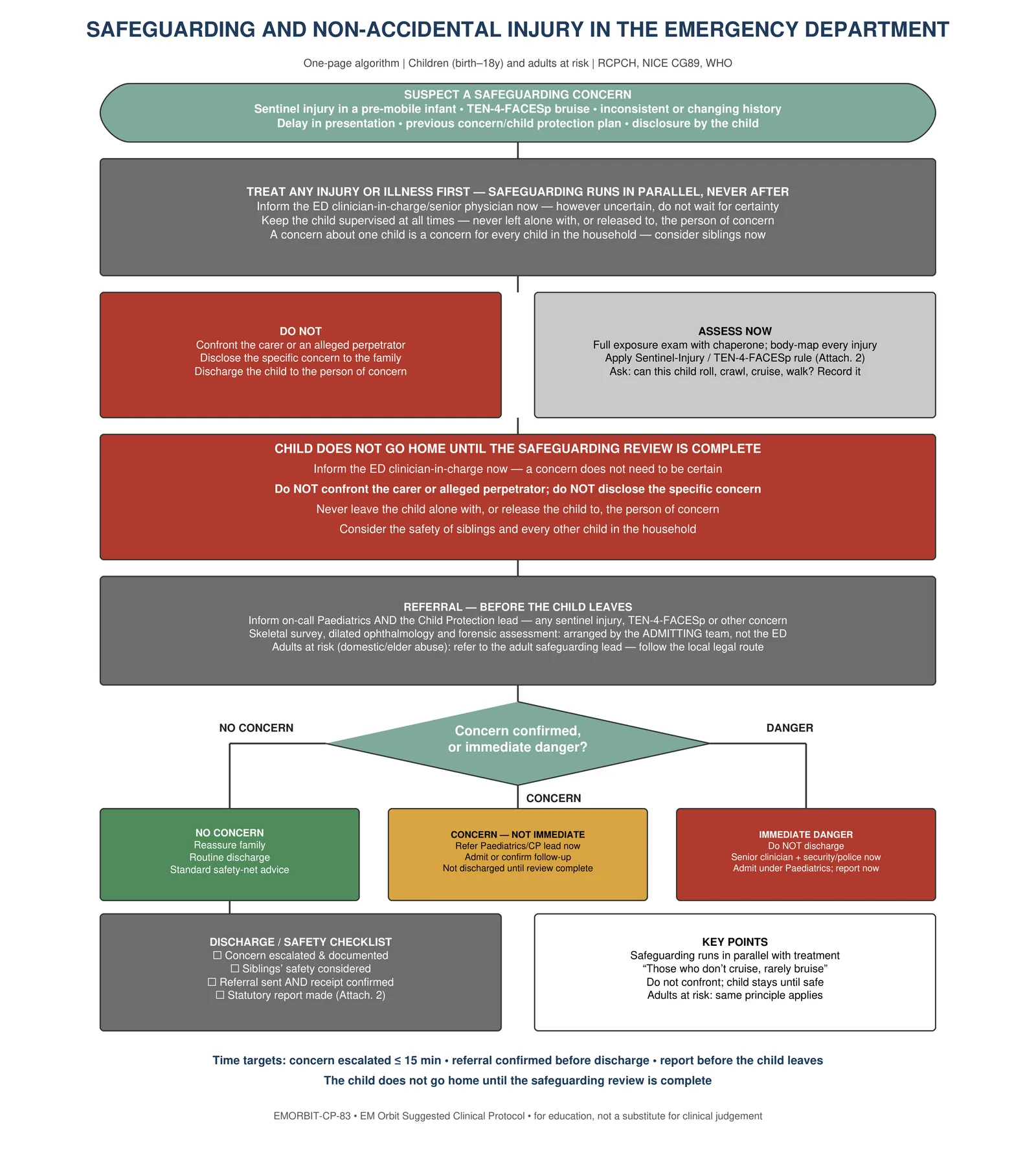
Evidence base: RCPCH; NICE CG89
1Purpose
1.1 Provide a standardized approach for Emergency Department (ED) staff to recognize, assess, keep safe, document and refer a child in whom abuse or neglect is suspected, and to recognize and refer an adult at risk, aligned with the Royal College of Paediatrics and Child Health (RCPCH) and NICE CG89.
1.2 Make the safeguarding assessment a routine, documented part of every paediatric injury attendance, not a step triggered only when something "feels wrong" — the suspicion is the assessment’s output, not its entry criterion.
1.3 State plainly that no child leaves the ED, and no child is released to a person of concern, until the safeguarding review is complete, and that the statutory reporting duty is met through the hospital's child protection pathway.
1.4 Set out, briefly, how ED staff recognize and refer an adult at risk (domestic abuse, elder abuse, a vulnerable adult), without duplicating the child-focused content that forms the majority of this guideline.
2Who this protocol applies to
2.1 Any child (from birth to the 18th birthday) attending the ED with an injury, an illness that does not fit the account given, or any other presentation in which abuse, neglect, or fabricated or induced illness is suspected.
2.2 Any child meeting the sentinel-injury rule or the TEN-4-FACESp bruising rule (Attachment 2), whatever the stated mechanism.
2.3 Any adult in whom domestic abuse, elder abuse, exploitation, or abuse of a vulnerable adult (cognitive impairment, mental illness, physical dependency) is suspected or disclosed.
2.4 Any child or adult in whom a safeguarding concern arises during treatment for an unrelated presentation.
3Not covered by this protocol
3.1 Definitive skeletal survey, dilated ophthalmological examination, forensic assessment, and the multi-agency child protection conference process, which are the admitting paediatric team’s and the statutory agencies’ work (section 4.2).
3.2 Routine developmental or safety advice with no injury and no concern (managed as routine ED discharge advice).
3.3 Chronic case management of an established child protection plan, which is coordinated by the paediatric safeguarding lead and social work, not by the ED.
4Protocol
4.1History and Assessment:
4.1.1Triage and Recognition:
4.1.1.1 Consider safeguarding in every child with an injury, and in any presentation, physical or behavioural, that does not fit the account given. This is a routine assessment for every injured child, not a response to certainty.
4.1.1.2 A sentinel injury (Table 1) — any bruise, oral injury, fracture, or intracranial or abdominal injury in an infant who is not yet independently mobile — has no innocent explanation and mandates the pathway below without waiting for a "typical" pattern.
4.1.1.3 Triage and all staff shall raise any concern immediately to the treating clinician; a concern raised does not need to be certain, and shall never be dismissed because the history sounds plausible.
4.1.1.4 Do not delay treatment of any injury or illness while the safeguarding assessment is completed: the two run in parallel, not in sequence (section 4.3.1).
4.1.2History:
4.1.2.1 Take the history from the primary carer in their own words; record it close to verbatim. Where developmentally appropriate, see the child alone for part of the assessment, with a chaperone, using open, non-leading questions.
4.1.2.2 Note explicitly: a mechanism inconsistent with the injury or with the child’s developmental stage (ask what the child can actually do — roll, sit, crawl, cruise, walk, climb, run — and record the answer, not an inference from age); an absent, vague or changing account; a delay between injury and presentation without adequate reason; repeated ED or primary-care attendances; a previous child protection plan or social-work involvement affecting the child or a sibling.
4.1.2.3 Ask, sensitively and away from the child, about domestic violence, substance misuse, parental mental illness, and any relevant previous conviction in the household — these are risk factors that raise the index of suspicion, not diagnostic criteria on their own.
4.1.2.4 Do not put the suspicion of abuse to the carer or any other adult, and do not confront or interview an alleged perpetrator. A premature confrontation or disclosure can increase danger to the child and compromise a subsequent investigation; this decision belongs to the paediatric/Child Protection team, not to the individual ED clinician.
4.1.3Examination:
4.1.3.1 Full exposure examination in a warm, private space, with a chaperone present; record every mark on a body map — site, size, shape, colour, and any pattern (a hand, ligature, implement, cord, buckle or bite mark).
4.1.3.2 Apply the sentinel-injury and TEN-4-FACESp bruising rule (Table 1, Attachment 2): a bruise, oral injury (including a torn frenulum) or fracture in a pre-mobile infant, or any TEN-4-FACESp finding, is suspected physical abuse until a paediatric assessment says otherwise.
4.1.3.3 A non-accidental burn pattern (glove-and-stocking or symmetrical scald, sharply demarcated edges, buttock or perineal sparing, or any scald in a non-mobile infant) is assessed as in EMORBIT-CP-67 and referred under this guideline.
4.1.3.4 Retinal examination for suspected abusive head trauma is a dilated, specialist ophthalmological examination arranged by the admitting paediatric team, and is not performed in the ED (section 4.2).
4.1.4Risk Stratification:
4.1.4.1 Physical abuse: bruising, fractures, burns, bites, or intra-abdominal or intracranial injury inconsistent with the history or developmental stage.
4.1.4.2 Neglect: failure to thrive, poor hygiene, inadequate supervision, missed medical care or immunisation, or a home environment that places the child at risk.
4.1.4.3 Sexual abuse: a disclosure by the child, genital or anal injury or bleeding, a sexually transmitted infection, or sexualized behaviour inconsistent with age.
4.1.4.4 Emotional abuse: developmental or behavioural signs of persistent emotional harm, often alongside another category above rather than alone.
4.1.4.5 Fabricated or induced illness: a history, signs, or reported symptoms that do not match objective findings, or that resolve only away from a particular carer.
4.1.4.6 Any one alerting feature above, in isolation, is enough to trigger the pathway in section 4.3; features are not required to add up before acting.
4.1.5Differential Diagnosis:
4.1.5.1 Accidental injury genuinely consistent with the history and the child’s developmental stage.
4.1.5.2 A bleeding disorder (coagulopathy) or a bone-fragility disorder (e.g., osteogenesis imperfecta) presenting with bruising or fracture — these are investigated by the admitting paediatric team as part of, not instead of, the safeguarding referral; they are never used in the ED to exclude a concern before referral.
4.1.5.3 A cultural practice (e.g., cupping, coining, ritual scarring) — assess without assumption in either direction, document the finding and the explanation, and still refer if any element of the presentation remains of concern.
4.1.6Special Populations:
4.1.6.1 Infants who are not yet independently mobile: any injury at all is a sentinel injury (Table 1) and mandates this pathway.
4.1.6.2 Adolescents (13 years up to the 18th birthday): the general adult/paediatric clinical age boundary used elsewhere in this library is 13 years, but the safeguarding duty in this guideline continues to the 18th birthday. Consider self-harm (EMORBIT-CP-84), sexual exploitation, forced marriage, domestic abuse, and honour-based concerns; see the adolescent alone for part of the consultation wherever safe to do so.
4.1.6.3 A child with disability: at higher risk of abuse and harder to assess; apply a lower threshold of suspicion and do not attribute an injury or presentation to the disability without full assessment.
4.1.6.4 The pregnant minor: as per EMORBIT-CP-73, see her alone for at least part of the consultation with a female nurse as chaperone, and consider exploitation, coercion and an age difference with a partner as safeguarding concerns in their own right.
4.1.6.5 Adults at risk (brief): ask about domestic abuse sensitively and in private wherever a presentation raises suspicion (injury pattern, frequent attendance, a partner who will not leave the room); apply the same principle to a vulnerable or elderly adult with unexplained injury, poor hygiene, or signs of neglect or financial exploitation. Refer to the hospital adult safeguarding lead/social worker. The specific national legal duty, reporting authority and route for an adult at risk are set by national law — take advice from your institution's legal services.
4.2Investigations:
4.2.1 A safeguarding concern is a clinical judgement, not a laboratory or imaging diagnosis: no investigation is required to raise or act on one.
4.2.2 Skeletal survey, dilated ophthalmological examination, cranial imaging performed specifically to evaluate for abuse, and forensic sampling are arranged and interpreted by the admitting paediatric team and the relevant specialty once the child is referred; the ED’s role is timely recognition and same-day referral, not initiating these tests itself.
4.2.3 A coagulation screen, where a bleeding disorder is a realistic differential for bruising, is arranged at the admitting team’s direction, in parallel with the referral, never as a reason to delay it.
4.2.4 Photographic documentation of injuries follows local policy and consent process.
4.2.5 For any disclosure of current or recent sexual assault, treat the child’s medical needs first and follow the hospital’s forensic/sexual-assault pathway for evidence collection, including its timing.
4.3Plan of Care:
4.3.1Immediate Actions:
4.3.1.1 Treat any presenting injury or illness first, per the relevant clinical guideline (for example EMORBIT-CP-82 for a head injury, EMORBIT-CP-67 for a burn); the safeguarding pathway runs alongside clinical care, never after it.
4.3.1.2 Ensure the child is not left alone with, and is not allowed to leave the department with, anyone about whom a concern exists, including for a bathroom visit or in a corridor.
4.3.1.3 Inform the ED clinician-in-charge or senior ED physician immediately of any concern, however uncertain; a concern does not need to be confirmed before it is escalated.
4.3.2Assessment and Referral:
4.3.2.1 Complete and document the safeguarding assessment (Attachment 2) at first contact for every child with an injury or a presentation that does not fit the account given — not deferred to the point of discharge.
4.3.2.2 Do not confront the carer or an alleged perpetrator, and do not disclose the specific concern beyond what is needed for consent to treatment. Whether and how to inform the family of the concern is a decision for the paediatric/Child Protection team, made with the safety of the child in mind.
4.3.2.3 Assess and document the safety of siblings and any other children in the household: a concern about one child in a home is a concern for every child in that home.
4.3.2.4 Refer to the on-call paediatric team and the hospital Child Protection lead/social worker before the child leaves the department for any sentinel injury, any TEN-4-FACESp finding, or any other concern.
4.3.2.5 For a current disclosure of sexual abuse, or an adult or child in immediate danger, involve hospital security and, where indicated, the police without delay, per local policy.
4.3.3Escalation — Immediate Danger or Removal Against Advice:
4.3.3.1 A child in active danger, or a carer who is intoxicated, aggressive, or attempting to remove the child while a safeguarding concern is unresolved, is a safeguarding emergency: involve the senior ED physician, hospital security, the Child Protection lead, and — where the danger is immediate — the police, without delay.
4.3.3.2 The legal basis for keeping a child in the department against a carer’s wishes on safeguarding grounds is set by national law; check with your institution's legal services and the child protection lead.
4.3.4Monitoring and Reassessment:
4.3.4.1 Continue the clinical observation required by the presenting condition (per the relevant guideline); reassess and document the child’s safety at each review while the child remains in the department.
4.3.5Disposition:
4.3.5.1 The child does not go home, and is not released to a person of concern, until the safeguarding review is complete and the department is satisfied it is safe to do so.
4.3.5.2 Admit under the paediatric team for definitive investigation (skeletal survey, ophthalmology, extended assessment) and for the child’s safety whenever a sentinel injury or a significant concern is identified.
4.3.5.3 Where discharge is agreed with the paediatric team and no admission is required, confirm a safe carer, a documented safety plan, and a confirmed (not merely sent) referral and follow-up appointment with the paediatric safeguarding lead, social work, or the community/health-visitor service before the child leaves.
4.3.6Discharge and Follow-up:
4.3.6.1 Explain the medical treatment given to the carer in the usual way; whether and how to disclose the safeguarding process itself is a decision for the paediatric/Child Protection team, not the discharging ED clinician alone, where disclosure could compromise the child’s safety or the investigation.
4.3.6.2 Confirm that a referral has been both sent and received by the paediatric team/social work before the episode is closed: a referral sent but not confirmed received is not a complete referral.
4.3.7Documentation and Reporting:
4.3.7.1 Record, contemporaneously: who was present; the account given, in the speaker’s own words; examination findings on a body map; the times of assessment, escalation and referral; who was informed and when; the outcome of the discussion with the paediatric team/Child Protection lead; and the plan.
4.3.7.2 Separate fact from opinion; note explicitly if an account changed between one question and the next, without drawing the conclusion in the record.
4.3.7.3 Report externally as required by the local child protection and safeguarding policy and national child-protection legislation, which places a duty on health professionals to report suspected abuse or neglect. The reporting authority, the form in use, the telephone number, and the out-of-hours arrangement follow the hospital's child protection policy.
4.3.7.4 For an adult at risk, document and refer per the local adult safeguarding process; the specific reporting duty for adults likewise follows national law (section 4.1.6).
5Algorithm
The one-page algorithm is shown at the top of this page.
6Team roles
6.1Triage and ED Nurses:
6.1.1 Raise any concern immediately to the treating clinician, however uncertain; do not wait for physician review to keep the child safe and supervised.
6.1.2 Support the examination and body-map documentation with a chaperone present; support the child and family without disclosing the specific concern.
6.2ED Physician:
6.2.1 Lead the history, examination, differential diagnosis and referral decision; inform the clinician-in-charge and the paediatric team; complete the documentation.
6.3Paediatric Team:
6.3.1 Accept and act on every referral before the child leaves the department; arrange skeletal survey, ophthalmology and extended assessment; lead the multi-agency process.
6.4Hospital Child Protection Lead / Social Worker:
6.4.1 Receive the referral, confirm receipt, coordinate the statutory report, and advise the ED and paediatric team on immediate safety planning.
6.5Hospital Security / Police (where indicated):
6.5.1 Attend for a child or adult in immediate danger, or where a carer attempts to remove a child against a safety concern, per local policy.
6.6ED Pharmacist:
6.6.1 No specific medication role; support the treatment of any concurrent injury or illness per its own guideline.
6.7Adult Safeguarding Lead / Social Worker:
6.7.1 Receive referrals for an adult at risk and coordinate the safety plan and any statutory process.
7The patient's role
7.1 Carers: give an accurate account of how the injury or illness occurred to support the child’s care.
7.2 The child or adolescent, where developmentally able: tell a member of staff, in private if preferred, about anything that is happening that worries them.
7.3 An adult at risk: tell a member of staff, in private if preferred, about any concern for their own safety; staff will listen and offer help without requiring the person to decide immediately what happens next.
8Definitions
8.1Safeguarding: the process of protecting a child or an adult at risk from abuse or neglect, and promoting their welfare.
8.2Non-Accidental Injury (NAI) / Inflicted Injury: injury inflicted on a child, or caused by a failure to protect a child, suspected where the history is absent, vague, inconsistent, changing, or incompatible with the injury or the child’s developmental stage.
8.3Sentinel Injury: a bruise, oral injury, fracture, or intracranial or abdominal injury in a pre-mobile infant with no adequate explanation; a marker of current or future serious abuse if not acted upon (Sheets et al., 2013).
8.4TEN-4-FACESp: a validated bruising decision rule (Pierce et al., 2021): Torso, Ear or Neck bruising under 4 years; any bruising under 4 months; Frenulum, Angle of jaw, Cheek, Eyelid or Subconjunctival haemorrhage, or any patterned bruise, under 4 years.
8.5Fabricated or Induced Illness (FII): a form of child maltreatment in which a carer fabricates, exaggerates, or induces signs or symptoms of illness in a child.
8.6Child Protection Plan: a formal, multi-agency plan for a child already known to be at risk of significant harm.
8.7Adult at Risk / Vulnerable Adult: an adult who, because of age, disability, illness, or dependency, is less able to protect themselves from abuse, neglect or exploitation.
8.8RCPCH, NICE: Royal College of Paediatrics and Child Health; National Institute for Health and Care Excellence.
9Attachments
- Attachment 1: One-page algorithm (top of this page)
- Attachment 2: Sentinel-Injury and TEN-4-FACESp Quick Reference, and Safeguarding Referral Checklist
11Suggested quality indicators
11.1Time to escalation: (Number of patients with a documented safeguarding concern in whom the ED clinician-in-charge/senior clinician was informed within 15 minutes of the concern being raised / Total number of patients with a documented concern) × 100. Target ≥ 90%.
11.2Safeguarding assessment documented: (Number of paediatric injury attendances with a documented safeguarding assessment, covering consistency of the history with the injury and developmental stage, delay in presentation, and TEN-4-FACESp/sentinel-injury status / Total number of paediatric injury attendances) × 100. Target 100%.
11.3Referral confirmed before discharge: (Number of patients with a safeguarding concern in whom referral to the paediatric team/Child Protection lead or adult safeguarding lead was made and its receipt confirmed before the patient left the ED / Total number of patients with a documented concern) × 100. Target 100%.
11.4No unsafe discharge: (Number of patients with an unresolved safeguarding concern discharged to the person of concern / Total number of patients with a documented concern). Target 0.
11.5Outcome indicator (monitored, no fixed ED target): the number of ED-raised safeguarding concerns subsequently substantiated at multi-agency or paediatric review.
13References
- National Institute for Health and Care Excellence. When to suspect child maltreatment. NICE Clinical Guideline CG89; 2009 (updated 2017).
- Royal College of Paediatrics and Child Health. Child Protection Companion. London: RCPCH.
- Royal College of Paediatrics and Child Health. Safeguarding Children and Young People: Roles and Competencies for Healthcare Staff (intercollegiate document). London: RCPCH.
- Pierce MC, Kaczor K, Lorenz DJ, et al. Validation of a clinical decision rule to predict abuse in young children based on bruising characteristics (TEN-4-FACESp). JAMA Netw Open. 2021;4(4):e215832.
- Sheets LK, Leach ME, Koszewski IJ, Lessmeier AM, Nugent M, Simpson P. Sentinel injuries in infants evaluated for child physical abuse. Pediatrics. 2013;131(4):701–707.
- World Health Organization. Responding to child maltreatment: a clinical handbook for health professionals. Geneva: WHO; 2022.
- World Health Organization. Responding to intimate partner violence and sexual violence against women: WHO clinical and policy guidelines. Geneva: WHO; 2013.
- United Arab Emirates. Federal Law No. 3 of 2016 on Child Rights ("Wadeema’s Law").
A2Attachment 2: Sentinel-Injury and TEN-4-FACESp Quick Reference, and Safeguarding Referral Checklist
| Rule | Criterion |
|---|---|
| Sentinel injury (any age, pre-mobile infant) | Any bruise, oral injury, fracture, intracranial or abdominal injury in an infant who cannot yet roll, sit, crawl, cruise or walk has no innocent mechanism. "Those who don’t cruise rarely bruise." |
| T — Torso, E — Ear, N — Neck | Bruising at these sites in a child under 4 years |
| 4 — under 4 months | Any bruise at all, anywhere, in an infant under 4 months old |
| FACES — Frenulum, Angle of jaw, Cheek, Eyelid, Subconjunctival | Bruising or haemorrhage at any of these sites in a child under 4 years |
| p — patterned | Any patterned mark (hand, ligature, implement, bite, cord, buckle) at any age |
| Non-accidental burn pattern | Glove-and-stocking or symmetrical scald, sharply demarcated edges, buttock/perineal sparing, or any scald in a non-mobile infant (EMORBIT-CP-67) |
Ask the carer what the child can actually do and record the developmental stage explicitly, not by inference from age.
| ✓ | Item |
|---|---|
| ☐ | Concern raised immediately to the ED clinician-in-charge, however uncertain — not held until certain. |
| ☐ | Child not left alone with, or discharged to, the person of concern; not allowed to leave the department unsupervised. |
| ☐ | History taken in the carer’s own words (verbatim) and, where developmentally appropriate, from the child alone. |
| ☐ | Full exposure examination with a chaperone; every injury recorded on a body map (site, size, shape, colour, pattern). |
| ☐ | Safety of siblings and other children in the household considered and documented. |
| ☐ | No confrontation of the carer or alleged perpetrator, and no disclosure of the specific concern beyond what treatment consent requires. |
| ☐ | On-call paediatric team and hospital Child Protection lead/social worker informed before the child leaves the department. |
| ☐ | Referral sent AND receipt by the receiving team/agency confirmed (a referral sent but not confirmed received is not complete). |
| ☐ | External statutory report made per the local child protection and safeguarding policy and applicable national legislation. |
| ☐ | Documentation is factual, contemporaneous, and records who was present, exact words used, times, and the plan — opinion is separated from fact. |