Burns — Emergency Department Resuscitation and Referral
EMORBIT-CP-67 · Chapter 9 · Trauma and Musculoskeletal Emergencies
Open in the appFree, works on your phone and offline, with every tool alongside.
Evidence base: ISBI 2016; BBA; ANZBA; EMSB
1Purpose
1.1 This protocol covers the Emergency Department (ED) front-door phase of burns care. It does not replace, amend, or restate your institution's own guideline on burns resuscitation and management; definitive wound management, grafting, reconstructive planning, and ward or intensive care remain governed there and by Plastic Surgery.
1.2 Standardize ED first aid, primary survey, airway and inhalation-injury recognition, total body surface area (TBSA) estimation, the trigger for formal intravenous fluid resuscitation, analgesia, escharotomy recognition, and referral to the Plastic Surgery/Burns on-call service.
1.3 Extend the pathway, which currently applies from 13 years of age, to children under 13 years presenting to the ED, using the paediatric weight, fluid and TBSA conventions of EMORBIT-CP-24 and EMORBIT-CP-25.
1.4 Define the point from which fluid-resuscitation timing runs — the time of the burn, not the time of arrival — and the urine-output target used to titrate it, and state clearly where your institution's own guideline gives more than one figure.
1.5 Align ED practice with ISBI 2016, ATLS 10th edition, the Australian and New Zealand Burn Association (ANZBA) Emergency Management of Severe Burns (EMSB) course, and British Burn Association (BBA) referral guidance.
2Who this protocol applies to
2.1 Any patient of any age presenting to the ED with a burn beyond simple erythema — thermal, scald, flame, chemical, electrical, or radiation — consistent with the injury types.
2.2 Patients pre-alerted by ambulance with a significant burn, and patients transferred from another facility for burns care.
2.3 Patients with suspected inhalation injury, carbon monoxide or cyanide exposure with or without a visible surface burn.
3Not covered by this protocol
3.1 Isolated first-degree (erythema only, no blistering) burns not requiring analgesia beyond simple oral agents or intravenous fluid.
3.2 Definitive burn wound management, grafting, reconstructive planning, and ward or intensive care beyond the ED phase, governed by your institution's own guideline and Plastic Surgery.
3.3 Selection of an antibiotic regimen beyond an immediate first ED dose where sepsis or a heavily contaminated wound mandates one: governed by the Antimicrobial Stewardship Policy (EMORBIT-CP-57); penicillin-allergy regimens are not improvised in the ED.
4Protocol
4.1History and Assessment:
4.1.1Triage and Recognition:
4.1.1.1 First aid before or at triage: stop the burning process; remove smouldering or chemically contaminated clothing and all jewellery and rings before swelling begins; cool the burn under running water at 15–20°C for 20 minutes, started as soon as possible and still of benefit up to 3 hours after the burn; never apply ice or iced water. Cover with cling film, applied in layers rather than circumferentially, or a clean dry sheet; keep the rest of the patient warm.
4.1.1.2 Triage as a trauma patient: assume associated injury until excluded, and apply cervical spine precautions where the mechanism suggests it.
4.1.1.3 A physician shall assess without delay any burn meeting a high-risk or referral criterion (section 4.1.1.4).
4.1.2History:
4.1.2.1 Time and mechanism of the burn (thermal, scald, flame, chemical — agent and concentration, electrical — voltage, AC or DC, duration of contact), whether it occurred in an enclosed space, and the time elapsed since injury, which sets the fluid-resuscitation clock (section 4.3.1.2).
4.1.2.2 Tetanus immunisation status; comorbidities that increase severity regardless of TBSA — extremes of age, diabetes, cardiac, respiratory or peripheral vascular disease; current medications and allergies.
4.1.2.3 In a child: who was present, how the burn happened, and whether the account is consistent with the pattern of injury (Special Populations, below).
4.1.3Examination:
4.1.3.1 Primary survey (ABCDE) before wound assessment; full exposure once the burn is cooled; examine for associated trauma.
4.1.3.2 Airway and inhalation-injury red flags: burns to the face, lips, mouth or neck; singed nasal or facial hair; soot in the mouth, nose or sputum; hoarseness; stridor; drooling; dysphagia; reduced consciousness; a history of fire in an enclosed space.
4.1.3.3 Perfusion of any burned limb, and chest-wall movement for a chest or neck burn: a circumferential or near-circumferential full-thickness burn can obstruct perfusion or ventilation as oedema develops (section 4.3.1.2, escharotomy).
4.1.3.4 Burn depth (first, second superficial, second deep, third or fourth degree) and TBSA by a recognized method (Attachment 2).
4.1.4Risk Stratification and Referral Criteria:
4.1.4.1 Low risk (manage and discharge from the ED): first-degree burns not requiring intravenous fluid or opioid analgesia; superficial second-degree burns under 5% TBSA away from the face, hands, feet, genitalia, perineum and major joints, and not circumferential.
4.1.4.2 Moderate risk (manage in the ED, arrange wound review): second-degree burns requiring re-evaluation or ongoing wound management that do not meet a high-risk criterion.
4.1.4.3 High risk — call the Plastic Surgery/Burns on-call service now: third- or fourth-degree burn of any size at any age; second-degree burn to the face, hands, feet, genitalia, perineum, or crossing a major joint; circumferential or near-circumferential burn of any extremity, the chest, or the neck; adult >15% TBSA (any degree) or child under 13 years >10% TBSA; inhalation injury; a significant chemical burn; an electrical burn of any voltage; suspected non-accidental injury in a child (EMORBIT-CP-83); or significant comorbidity or an extreme of age (extended to children and to non-accidental injury).
4.1.5Differential Diagnosis:
4.1.5.1 Toxic epidermal necrolysis and Stevens–Johnson syndrome; staphylococcal scalded skin syndrome; severe cellulitis or necrotizing soft-tissue infection (EMORBIT-CP-54); frostbite; in a trauma patient, non-burn causes of shock.
4.1.6Special Populations:
4.1.6.1 Children under 13 years: use an actual weight, or the APLS age-based estimate (EMORBIT-CP-24/EMORBIT-CP-25 Table 3), for every fluid and drug calculation. Estimate TBSA by a paediatric Lund–Browder chart, not the adult rule of nines (Attachment 2) — a child's head is proportionally larger and legs proportionally smaller. The formal fluid-resuscitation threshold is >10% TBSA, lower than the adult threshold; the urine-output target is 1 mL/kg/hour (section 4.3.1.2). Involve Paediatrics and Plastic Surgery early. Suspect non-accidental injury for a scald with a glove-and-stocking or symmetrical distribution, sharply demarcated edges, buttock or perineal sparing, an inconsistent or delayed history, or in a non-mobile infant, and act under EMORBIT-CP-83.
4.1.6.2 Pregnancy: the same first aid and referral thresholds apply; involve Obstetrics for any burn ≥15–20% TBSA or any high-risk criterion; left lateral tilt beyond 20 weeks' gestation.
4.1.6.3 Elderly patients and extremes of age: more likely to have deeper burns and to develop fluid-related complications at a given TBSA; reassess more frequently and involve Plastic Surgery earlier.
4.1.6.4 Suxamethonium: safe in the first 24 hours after a burn; avoided from 24 hours to about one year afterwards because of the risk of hyperkalaemic cardiac arrest; use rocuronium 1.2 mg/kg instead (EMORBIT-CP-31).
4.2Investigations:
4.2.1 For any burn meeting formal fluid-resuscitation or high-risk criteria: full blood count, urea and electrolytes, glucose, and group and save.
4.2.2 Venous or arterial blood gas with lactate and carboxyhaemoglobin where inhalation injury, carbon monoxide, or cyanide exposure is suspected; a normal pulse oximetry reading does not exclude carbon monoxide poisoning.
4.2.3 12-lead ECG for every electrical burn or pre-existing cardiac disease; urine or serum myoglobin and creatine kinase for electrical injury or extensive deep burns.
4.2.4 Chest radiograph where inhalation injury is suspected, or a chest burn or associated trauma requires it; further imaging for associated trauma as clinically indicated.
4.2.5 Pregnancy test in any woman who has started menarche, regardless of age.
4.3Plan of Care:
4.3.1Immediate Actions:
4.3.1.1 First aid as in section 4.1.1.1 (stop the burning, cool for 20 minutes within 3 hours, cover, keep warm); primary survey; 100% oxygen by non-rebreather mask for any suspected inhalation injury, carbon monoxide, or cyanide exposure, irrespective of the oxygen saturation reading.
4.3.2Fluid Resuscitation:
4.3.2.1 Formal intravenous fluid resuscitation is started when a TBSA or risk threshold in section 4.1.1.4 is met, using two large-bore cannulae. Pending the TBSA calculation, a large visible burn is started empirically on Ringer's lactate at 250 mL/hour (age 13 years) or 500 mL/hour (age 14 years and above).
4.3.2.2 The clock for the calculated volume starts at the TIME OF THE BURN, not the time of arrival. Where time has already elapsed, the first 8-hour period is shortened accordingly.
4.3.2.3 The Parkland formula (ABA/ATLS) gives the adjusted fluid rate as Ringer's lactate 2 mL × body weight (kg) × %TBSA for flame or scald burns, and 4 mL × kg × %TBSA for electrical injury, at any age from 13 years, giving half in the first 8 hours from the burn and the remainder over the next 16 hours. This is consistent with the ISBI 2016 and ATLS 10th-edition consensus range of 2–4 mL/kg/%TBSA.
4.3.2.4 Parkland 2 mL × kg × %TBSA (ABA/ATLS) applies to flame and scald burns and 4 mL × kg × %TBSA to electrical injury; the consensus range is 2–4 mL (ISBI/ATLS). Both are reproduced in Attachment 2.
4.3.2.5 The calculated volume is a starting estimate, never a fixed prescription. Adjusted fluid rates shall be titrated hourly against urine output, which is the primary guide to adequacy of resuscitation; strict adherence to a fixed formula without hourly urine-output monitoring is not recommended, and over-resuscitation ("fluid creep") causes abdominal compartment syndrome and pulmonary oedema.
4.3.2.6 Urine output target: adults and children 14 years and above, 0.5 mL/kg/hour (30–50 mL/hour); children under 14 years, 1 mL/kg/hour; high-voltage electrical injury with myoglobinuria, 75–100 mL/hour until the urine clears (extended to children). Base the expected output on ideal body weight, not actual weight, in an obese patient.
4.3.2.7 Insert a urinary catheter for any burn ≥20% TBSA or where hourly output is otherwise required; insert a nasogastric tube in an intubated patient and monitor others for nausea and vomiting.
4.3.3Airway and Inhalation Injury:
4.3.3.1 Early intubation, before airway oedema progresses over the following 18–24 hours, for stridor, hoarseness, drooling, extensive or deep facial/oral burns, TBSA burn >40–50%, or a falling level of consciousness — as per EMORBIT-CP-31 (RSI), using a large-lumen tube and observing the suxamethonium timing in section 4.1.1.5.6.
4.3.3.2 Carbon monoxide: continue 100% oxygen until carboxyhaemoglobin approaches normal and symptoms resolve.
4.3.3.3 Cyanide: suspect in a fire victim with soot, reduced consciousness, or a lactate ≥8–10 mmol/L; give hydroxocobalamin 5 g intravenously over 15 minutes (adult) or 70 mg/kg intravenously to a maximum of 5 g (child), as per EMORBIT-CP-21. A dedicated guideline on carbon monoxide and cyanide poisoning (EMORBIT-CP-70) is planned; until it is published, this section and EMORBIT-CP-21 govern ED action.
4.3.4Analgesia:
4.3.4.1 Titrate intravenous opioid without delay, using the doses and routes of EMORBIT-CP-28; sub-dissociative ketamine is an appropriate adjunct. Analgesia is never delayed for the TBSA calculation.
4.3.5Escharotomy:
4.3.5.1 Recognize a circumferential or near-circumferential full-thickness burn of a limb (absent or reducing distal pulses or capillary return, increasing pain, tense oedema, paraesthesia) or of the chest or neck (impaired ventilation).
4.3.5.2 Call the Plastic Surgery/Burns on-call service immediately. A competent operator shall not delay a limb- or life-threatening decompression for transfer to another facility.
4.3.6Chemical Burns:
4.3.6.1 Brush off any powdered chemical before irrigating; irrigate copiously with running water and continue until pain settles — never attempt to neutralize a chemical burn, as the reaction generates heat and worsens injury. Remove all contaminated clothing and protect staff with personal protective equipment.
4.3.6.2 For an ocular chemical burn: continuous irrigation until conjunctival pH is normal, and immediate Ophthalmology involvement.
4.3.7Electrical Burns:
4.3.7.1 12-lead ECG and cardiac monitoring for any high-voltage injury, an abnormal ECG, syncope, or loss of consciousness; treat cardiac arrest with standard advanced life support.
4.3.7.2 Examine entry and exit wounds and assess for compartment syndrome and rhabdomyolysis; a normal-appearing skin surface does not exclude deep injury.
4.3.8Wound Cover Pending Plastic Surgery Review:
4.3.8.1 Silver sulfadiazine for all burn wounds except the face, perineum and eyes, covered with a loose sterile dressing. For tar or bitumen: cool with water; do not attempt to remove; a petrolatum-based ointment is applied once cooled.
4.3.8.2 Tetanus prophylaxis according to the wound and immunisation history, per local policy — any burn beyond superficial is a tetanus-prone wound.
4.3.9Escalation and Reassessment:
4.3.9.1 Urine output below target despite the calculated fluid rate: increase the rate and involve Plastic Surgery and Critical Care early; do not exceed the calculated volume substantially without senior review, because of the risk of over-resuscitation.
4.3.9.2 Airway compromise progressing despite oxygen: proceed to intubation without waiting for further deterioration (section 4.3.2).
4.3.9.3 Cardiovascular or respiratory compromise from a circumferential burn: perform escharotomy without delay (section 4.3.4).
4.3.9.4 Continuous ECG, pulse oximetry and hourly vital signs for any burn meeting formal fluid-resuscitation criteria; reassess perfusion of a burned limb and ventilation of a chest or neck burn at least hourly until the risk of compartment syndrome has passed.
4.3.10Disposition:
4.3.10.1 Low and moderate risk (section 4.1.1.4): manage and discharge from the ED with dressing, analgesia, and a burns or outpatient dressing-clinic appointment; no Plastic Surgery referral is required.
4.3.10.2 High risk (section 4.1.1.4): discuss with or refer to the Plastic Surgery/Burns on-call service before disposition; admit under Plastic Surgery, or arrange transfer where the required level of care is not available.
4.3.10.3 For transfer: cover with cling film or a clean dry sheet rather than soaked dressings, to avoid hypothermia; keep the patient warm; continue titrated fluid en route with the volume documented; secure adequate analgesia; give a structured handover including time of the burn, TBSA, fluid given, and airway status.
4.3.10.4 Suspected non-accidental injury: notify the child protection/safeguarding lead per EMORBIT-CP-83 before a child is discharged.
4.3.11Discharge and Follow-up:
4.3.11.1 Written wound-care advice, analgesia, and safety-netting advice for infection (increasing pain, spreading redness, fever, malodour); a specific burns or dressing-clinic appointment for any burn requiring ongoing wound review.
4.3.12Documentation and Reporting:
4.3.12.1 Record: time of the burn, time first aid/cooling started, TBSA and depth with the method used, time intravenous fluid started and the calculated versus actual volume given, hourly urine output, airway assessment and any intubation, and the outcome of any Plastic Surgery/Burns on-call discussion.
4.3.12.2 Report a delay to escharotomy, an unrecognized inhalation injury, or a fluid-resuscitation error through the local incident reporting system.
5Algorithm
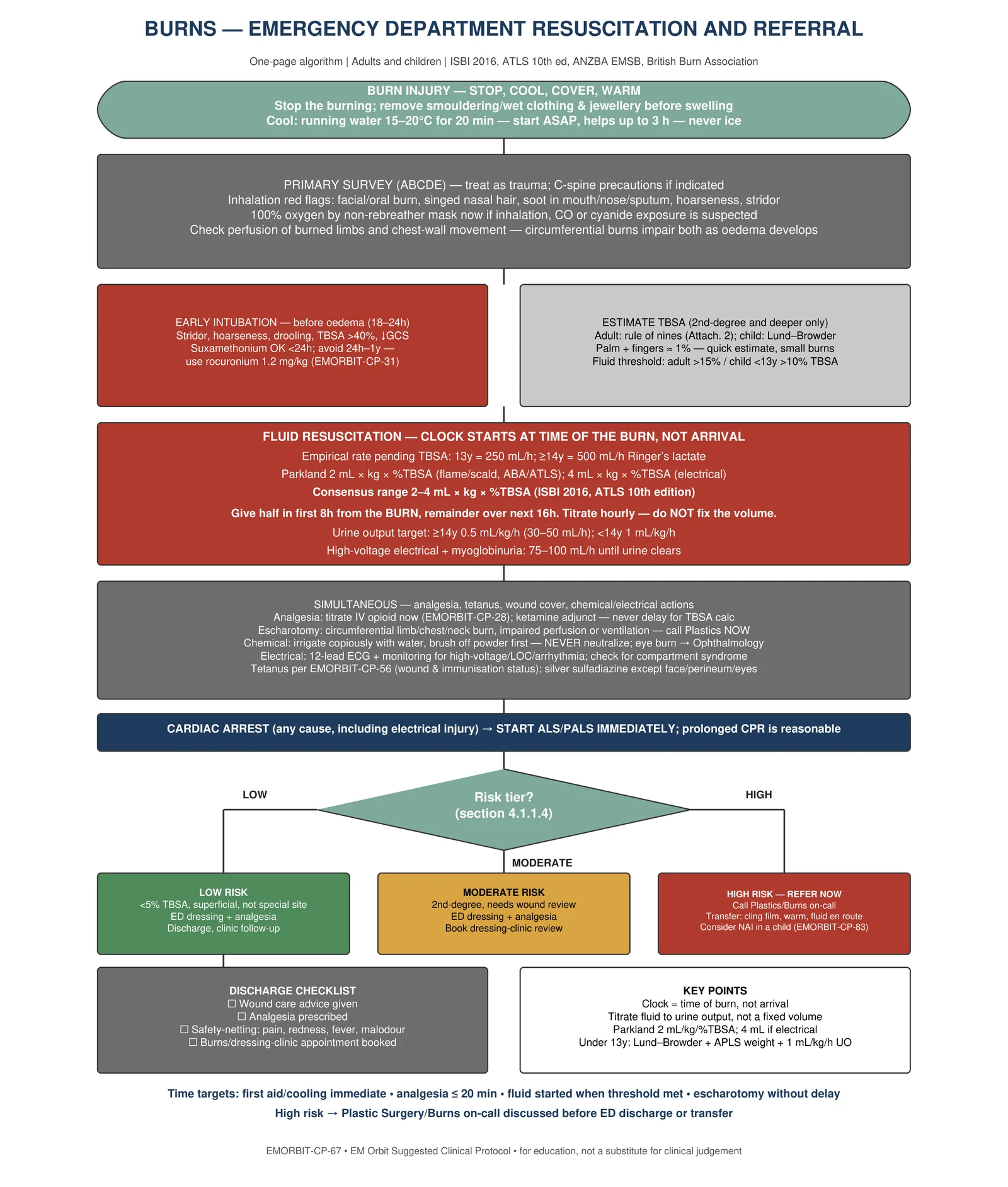
The one-page algorithm is shown at the top of this page.
6Team roles
The roles below are additional to, and consistent with, those defined in your institution's own guideline.
6.1Triage Nurse:
6.1.1 Begin first aid (cooling, cover, warmth) under the approved nursing standing order without waiting for physician review; triage as trauma; escalate any high-risk feature immediately.
6.2ED Nurses:
6.2.1 Record the time of the burn and every fluid, analgesia and observation time; measure and record hourly urine output; inspect any burned limb and chest/neck burn hourly for signs of compartment syndrome; provide patient and family explanation and safety-netting advice on discharge.
6.3ED Pharmacist:
6.3.1 Verify weight-based fluid and analgesia calculations, particularly in children; confirm hydroxocobalamin availability and dosing where cyanide poisoning is suspected.
6.4Plastic Surgery/Burns On-call:
6.4.1 Attend on referral for any high-risk criterion; direct escharotomy, wound management, and admission or transfer decisions.
6.5Anaesthesia/Critical Care:
6.5.1 Attend for airway compromise, escalating fluid requirement, or an unstable electrical injury; direct central access and invasive monitoring where ED fluid resuscitation alone is not achieving the urine-output target.
6.6Ophthalmology:
6.6.1 Attend for any ocular chemical burn or a burn involving the face and orbital region.
6.7Laboratory and Radiology:
6.7.1 Process carboxyhaemoglobin, myoglobin and creatine kinase urgently; prioritize imaging for suspected inhalation injury or associated trauma.
6.8Child Protection/Safeguarding Lead:
6.8.1 Respond immediately to a referral of suspected non-accidental injury in a child (EMORBIT-CP-83).
7The patient's role
7.1 Report the time and circumstances of the burn, allergies, tetanus status, and any worsening pain, breathlessness, or numbness during the ED stay.
7.2 Actively participate in wound care planning and attend the arranged follow-up or dressing-clinic appointment.
7.3 Family and carers: raise any concern about a child's injury or account with staff.
8Definitions
The definitions in your institution's own guideline apply in full. The following are additional terms used in this protocol.
8.1Time of the Burn: the moment the injury occurred, from which fluid-resuscitation timing is measured; it is not the time of arrival.
8.2Total Body Surface Area (TBSA): the percentage of body surface involved by second-degree burn or deeper; first-degree (erythema only) areas are excluded from the calculation.
8.3Rule of Nines: a rapid adult TBSA estimation method dividing the body into areas of 9% or multiples of 9%.
8.4Lund–Browder Chart: an age-adjusted TBSA chart, preferred for children and for large or irregular burns.
8.5Escharotomy: a surgical incision through full-thickness burnt skin (eschar) to relieve constriction of an underlying limb, chest, or neck.
8.6ISBI, ANZBA, EMSB, BBA: International Society for Burn Injuries; Australian and New Zealand Burn Association; Emergency Management of Severe Burns course; British Burn Association.
9Attachments
- Attachment 1: One-page algorithm (top of this page)
- Attachment 2: TBSA and Fluid Resuscitation Quick Reference
11Suggested quality indicators
11.1Time to fluid resuscitation: (Number of patients meeting formal fluid-resuscitation criteria who had intravenous crystalloid started within 30 minutes of ED assessment / Total number of such patients) × 100. Target ≥ 90%.
11.2TBSA and depth documentation: (Number of patients with TBSA ≥ 10% or a high-risk criterion with TBSA and depth documented by a recognized method before disposition / Total number of such patients) × 100. Target ≥ 95%.
11.3Safe referral: (Number of patients meeting a high-risk criterion who were discussed with or referred to the Plastic Surgery/Burns on-call service before ED discharge or transfer / Total number of such patients) × 100. Target 100%.
11.4Outcome indicator (monitored, no fixed ED target): incidence of acute kidney injury in patients admitted with ≥ 20% TBSA burns.
13References
- ISBI Practice Guidelines Committee. ISBI Practice Guidelines for Burn Care. Burns. 2016;42(5):953–1021.
- American College of Surgeons Committee on Trauma. Advanced Trauma Life Support (ATLS) Student Course Manual, 10th ed. Chicago: American College of Surgeons; 2018.
- Pham TN, Cancio LC, Gibran NS; American Burn Association. American Burn Association practice guidelines burn shock resuscitation. J Burn Care Res. 2008;29(1):257–266.
- Australian and New Zealand Burn Association. Emergency Management of Severe Burns (EMSB) course manual. Albury, NSW: ANZBA.
- British Burn Association. Referral guidance for burn injury. London: BBA.
- Cancio LC. Airway management and smoke inhalation injury in the burn patient. Clin Plast Surg. 2009;36(4):555–567.
- Nielson CB, Duethman NC, Howard JM, et al. Burns: pathophysiology of systemic complications and current management. J Burn Care Res. 2017;38(1):e469–e481.
A2Attachment 2: TBSA and Fluid Resuscitation Quick Reference
For use once a burn meets a formal fluid-resuscitation or high-risk criterion (section 4.1.1.4). First-degree (erythema-only) area is excluded from every TBSA calculation.
| Region | % TBSA |
|---|---|
| Head and neck | 9% |
| Each arm (whole) | 9% (18% both) |
| Anterior trunk | 18% |
| Posterior trunk | 18% |
| Each leg (whole) | 18% (36% both) |
| Perineum/genitalia | 1% |
| Patient's palm and fingers | ≈1% — quick estimate for small or scattered burns |
| Item | Value |
|---|---|
| Formula (Parkland, ABA/ATLS) | Ringer's lactate 2 mL × weight (kg) × %TBSA (flame/scald); 4 mL × kg × %TBSA (electrical) |
| Consensus range (ISBI/ATLS) | 2–4 mL × weight (kg) × %TBSA |
| Timing | Half of the calculated volume in the first 8 hours from the TIME OF THE BURN (not arrival); remainder over the next 16 hours |
| Threshold to start formal resuscitation | Adult (≥13y) >15% TBSA (any degree); child (<13y) >10% TBSA; or any high-risk criterion (section 4.1.1.4) |
| Empirical rate pending TBSA calculation | 13 years old: 250 mL/hour; 14 years and above: 500 mL/hour, Ringer's lactate |
| Urine output target | Age ≥14y: 0.5 mL/kg/hour (30–50 mL/hour); age <14y: 1 mL/kg/hour; high-voltage electrical with myoglobinuria: 75–100 mL/hour until urine clears |
| Adjustment | Titrate hourly to urine output — the calculated volume is a starting estimate, not a fixed prescription. Avoid over-resuscitation ("fluid creep"): abdominal compartment syndrome and pulmonary oedema follow excess fluid. |