Necrotising Soft-Tissue Infection in the Emergency Department
EMORBIT-CP-54 · Chapter 7 · Infectious Disease Emergencies
Open in the appFree, works on your phone and offline, with every tool alongside.
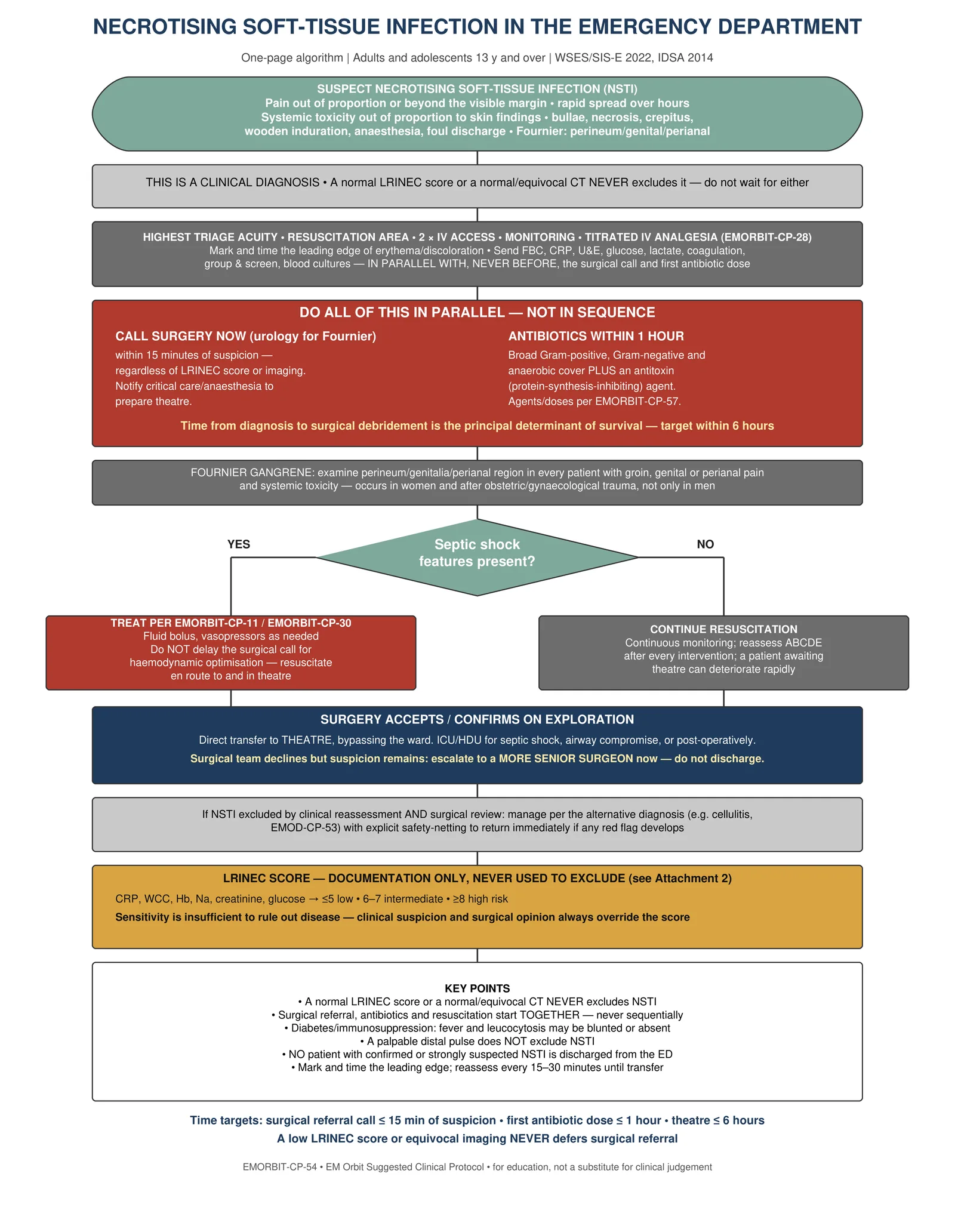
Evidence base: WSES/SIS-E 2022; IDSA 2014
1Purpose
1.1 Provide a standardized framework for the early recognition, resuscitation, empirical antimicrobial cover, and immediate surgical referral of adults and adolescents presenting to the Emergency Department (ED) with suspected necrotising soft-tissue infection (NSTI), a clinical diagnosis and a surgical emergency.
1.2 Ensure that surgical referral is made immediately on clinical suspicion, in parallel with resuscitation and antibiotics, and is never delayed by imaging or deferred on the basis of a reassuring LRINEC score.
1.3 Ensure early recognition of Fournier gangrene as an anatomical subtype requiring the same emergency pathway.
1.4 Align with the World Society of Emergency Surgery (WSES) global clinical pathways for skin and soft tissue infections (2022) and the Infectious Diseases Society of America (IDSA 2014) guideline.
2Who this protocol applies to
2.1 Any patient (13 years and over) with suspected necrotising soft-tissue infection: severe pain out of proportion to visible skin findings, pain extending beyond the visible margin of erythema, rapid progression over hours, systemic toxicity disproportionate to the apparent skin findings, or specific skin signs (bullae, grey/dusky discoloration, skin necrosis, crepitus, wooden-hard induration, cutaneous anaesthesia, malodorous discharge).
2.2 Fournier gangrene: necrotising infection of the perineal, genital, or perianal region.
2.3 Deterioration or failure to improve on antibiotics in a patient already being treated for cellulitis or an abscess.
2.4 Suspicion arising after recent surgery, trauma, injection drug use, or a skin break, in a patient with diabetes, immunosuppression, obesity, peripheral vascular disease, chronic kidney disease, or cirrhosis.
3Not covered by this protocol
3.1 Simple cellulitis without any red flag in section 4.1.1: manage per EMORBIT-CP-53.
3.2 A localized abscess without diffuse spread, systemic toxicity, or the red flags above: incision and drainage per EMORBIT-CP-53.
3.3 Isolated acute scrotal pain or swelling without systemic toxicity or skin necrosis: assess per EMORBIT-CP-61 (acute scrotum) — reconsider this guideline immediately if red flags develop.
3.4 Children under 13 years: refer to the paediatric surgical pathway. Recognition principles and the immediate surgical referral standard in this guideline still apply while paediatric surgical care is arranged.
4Protocol
4.1History and Assessment:
4.1.1Triage and Recognition:
4.1.1.1 Suspected NSTI shall be triaged to the highest acuity category and taken directly to the resuscitation area; the treating physician shall attend within 5 minutes.
4.1.1.2Red flags (any one raises suspicion; several together are highly specific):
- Pain out of proportion to the visible skin findings, or pain extending beyond the visible margin of erythema.
- Rapid progression — visible spread within hours; mark and time the leading edge at first assessment (as for cellulitis, but reassess every 15–30 minutes, not hourly).
- Systemic toxicity disproportionate to the skin appearance: fever, tachycardia, hypotension, confusion.
- Skin necrosis, grey or dusky discoloration, haemorrhagic bullae, crepitus or gas on palpation, wooden-hard induration, cutaneous anaesthesia, or foul-smelling discharge.
- Failure to improve, or worsening, despite antibiotics started for a presumed simple skin infection.
4.1.1.3 This is a clinical diagnosis. If red flags are present, call the surgical team immediately (section 4.3.2) — do not wait for laboratory results or imaging.
4.1.2History (obtained in parallel with resuscitation and the surgical call):
4.1.2.1 Onset, speed of progression, and pain severity relative to examination findings; preceding wound, injection drug use, surgery, or trauma.
4.1.2.2 Diabetes, immunosuppression (including steroids, chemotherapy, HIV), obesity, peripheral vascular disease, chronic kidney disease, cirrhosis, and current alcohol use.
4.1.2.3 Antibiotics already given and response; tetanus immunisation status.
4.1.3Examination:
4.1.3.1 Mark and time the extent of erythema/discoloration; note bullae, necrosis, crepitus, induration, and anaesthesia; assess distal perfusion and pulses (a palpable pulse does not exclude NSTI).
4.1.3.2 Fournier gangrene: examine the perineum, genitalia, and perianal region in every patient with lower abdominal, groin, or genital pain and systemic toxicity, including a gentle digital rectal and genital examination; more common in men, diabetics, and the elderly, but occurs in women and after obstetric or gynaecological trauma.
4.1.3.3 In a woman who has started menarche (any age) with perineal or vulval involvement, ask "pregnant?" and "last period?" per standard triage questions; the treating team obtains the pregnancy test without delay.
4.1.3.4 Assess for septic shock (heart rate, blood pressure, mental status, capillary refill, lactate) per the undifferentiated shock approach (EMORBIT-CP-30).
4.1.4Risk Stratification and Severity:
4.1.4.1 The LRINEC score (Table 1) may be calculated to support documentation, but has insufficient sensitivity to exclude NSTI and shall never be used to defer, delay, or cancel surgical referral.
Table 1: LRINEC score (Wong et al. 2004) — for documentation only; NEVER used to exclude necrotising soft-tissue infection Variable Value Points C-reactive protein < 150 mg/L
≥ 150 mg/L0
4White cell count < 15 ×10⁹/L
15–25 ×10⁹/L
> 25 ×10⁹/L0
1
2Haemoglobin > 135 g/L
110–135 g/L
< 110 g/L0
1
2Sodium ≥ 135 mmol/L
< 135 mmol/L0
2Creatinine ≤ 141 micromol/L
> 141 micromol/L0
2Glucose ≤ 10 mmol/L
> 10 mmol/L0
1Maximum 13 points: ≤ 5 low risk, 6–7 intermediate risk, ≥ 8 high risk (original derivation cohort). Sensitivity is insufficient to rule out disease (Fernando et al. 2019): a low score in a patient with clinical red flags (section 4.1.1) does NOT defer or cancel surgical referral.
4.1.4.2 Clinical suspicion and surgical opinion override the score in every case.
4.1.5Differential Diagnosis:
4.1.5.1 Severe cellulitis or erysipelas, abscess, pyomyositis, septic arthritis, deep vein thrombosis, acute compartment syndrome, calciphylaxis, and toxic shock syndrome.
4.1.5.2 Gas gangrene (clostridial myonecrosis) is a fulminant subtype with a similar emergency pathway; do not delay referral to characterise the organism.
4.1.5.3 A discordant surgical opinion in a patient who remains clinically concerning shall be escalated to a more senior surgeon; the ED does not discharge, or accept a "cellulitis" label, while red flags persist.
4.1.6Special Populations:
4.1.6.1 Diabetes and immunosuppression: fever and leucocytosis may be blunted or absent; a normal temperature or white cell count does not exclude NSTI.
4.1.6.2 Obesity: deep fascial and muscle involvement may be difficult to assess clinically; have a lower threshold for surgical opinion.
4.1.6.3 Injection drug use: consider NSTI at any injection site with disproportionate pain or spread.
4.1.6.4 Elderly: presentation may be subtle with less pain and lower physiological reserve; mortality is higher for a given delay to surgery.
4.2Investigations:
4.2.1 No investigation or imaging shall delay the surgical referral call once red flags are present. NSTI is a clinical diagnosis; surgical exploration is both diagnostic and therapeutic.
4.2.2 Full blood count, C-reactive protein, urea and electrolytes, creatinine, glucose (for the LRINEC score), venous or arterial blood gas with lactate, coagulation screen, group and screen/crossmatch, and blood cultures — send in parallel with, not before, the surgical call and first antibiotic dose.
4.2.3 Plain radiography may show soft-tissue gas but a normal film does not exclude NSTI.
4.2.4 Contrast-enhanced CT or MRI may support the diagnosis (fascial thickening, non-enhancement, gas) where the diagnosis is genuinely uncertain and the patient is stable enough to leave the resuscitation area; a normal or equivocal scan does NOT exclude NSTI and shall not delay or cancel surgical referral.
4.2.5 Bedside ultrasound may show fascial fluid/gas but has not been validated to exclude the diagnosis.
4.3Plan of Care:
4.3.1Immediate Actions (first 10 minutes):
4.3.1.1 Call for help; move to the resuscitation area; two large-bore IV cannulae; oxygen if hypoxaemic; continuous monitoring (ECG, SpO₂, non-invasive blood pressure).
4.3.1.2 Begin crystalloid resuscitation and treat septic shock per EMORBIT-CP-11 and EMORBIT-CP-30 where criteria are met.
4.3.1.3 Titrated IV analgesia per EMORBIT-CP-28; pain is characteristically severe and out of proportion — do not under-treat while awaiting the surgical review.
4.3.2Definitive ED Treatment — Surgical Referral, Antibiotics and Resuscitation (all begun together):
4.3.2.1Immediate surgical referral is the single most important action: call the on-call general/plastic surgical team (urology for Fournier gangrene) as a time-critical emergency the moment NSTI is suspected — in parallel with, not after, resuscitation and antibiotics. Time from diagnosis to surgical debridement is the principal determinant of survival; WSES/SIS-E (2022) recommends debridement as soon as possible and within 6 hours where feasible. Call critical care/anaesthesia at the same time to prepare for theatre.
4.3.2.2Broad-spectrum empirical antibiotics within 1 hour of suspicion: the regimen shall cover Gram-positive, Gram-negative, and anaerobic organisms, and shall include an agent with antitoxin (protein-synthesis-inhibiting) activity for toxin-producing Group A streptococcus and clostridial species. Select the specific agents, doses, and any penicillin-allergy substitution per EMORBIT-CP-57 (Antimicrobial Stewardship) and the local antibiogram; do not delay the first dose to draw blood cultures if this takes more than a few minutes.
4.3.2.3 Send group and screen/crossmatch early; anticipate blood product requirements for theatre.
4.3.3Escalation and Refractory Disease:
4.3.3.1 Septic shock not responding to the initial fluid step: vasopressors and further management per EMORBIT-CP-30 and EMORBIT-CP-11; do not delay the surgical call for haemodynamic optimisation — resuscitate en route to, and in, theatre.
4.3.3.2 If the surgical team declines referral or plans outpatient follow-up in a patient who remains clinically concerning, escalate to a more senior surgeon immediately; document the discrepancy and do not discharge the patient.
4.3.3.3 Hyperbaric oxygen and intravenous immunoglobulin are occasionally used as adjuncts by the admitting surgical/critical-care team in confirmed disease; they are not ED interventions, shall never delay surgery, and availability varies by centre.
4.3.4Monitoring and Reassessment:
4.3.4.1 Continuous vital signs and reassessment of the marked margin every 15–30 minutes until the patient leaves the ED for theatre or critical care; repeat lactate to assess resuscitation response.
4.3.4.2 Reassess ABCDE after every intervention; a patient awaiting theatre may deteriorate rapidly.
4.3.5Disposition:
4.3.5.1 Confirmed or strongly suspected NSTI: direct transfer to theatre once accepted by surgery, bypassing the ward; ICU/HDU for septic shock, airway compromise, or post-operatively.
4.3.5.2 Fournier gangrene: joint urology/general surgery (± plastic surgery) referral for emergency debridement.
4.3.5.3 A patient in whom NSTI has been excluded by clinical reassessment and surgical review is managed per the relevant alternative diagnosis (e.g., cellulitis, EMORBIT-CP-53) with explicit safety-netting to return immediately if any red flag develops.
4.3.6Discharge and Follow-up:
4.3.6.1 No patient with confirmed or strongly suspected NSTI is discharged from the ED under any circumstance; all are admitted to theatre or critical care.
4.3.6.2 Ongoing wound management, repeat debridement planning, nutrition, and rehabilitation are admitting-team (surgical) decisions once the time-critical ED phase is complete.
4.3.7Documentation and Reporting:
4.3.7.1 Document: time of clinical suspicion, red flags present, LRINEC score (with an explicit note if low but referral still made), time of the surgical referral call, time and agent of the first antibiotic dose, resuscitation given, time of transfer to theatre/critical care, and any discrepancy with the surgical opinion.
4.3.7.2 NSTI presentations shall be captured for the departmental audit (section 11).
5Algorithm
The one-page algorithm is shown at the top of this page.
6Team roles
6.1Triage and ED Nurses Role:
6.1.1 Recognize the red flags in section 4.1.1 at triage, assign the highest acuity category, move the patient to the resuscitation area, and notify the physician immediately.
6.1.2 Obtain IV access, send the investigation panel, and prepare antibiotics without waiting for the surgical review; mark and time the leading edge of skin change and reassess every 15–30 minutes.
6.2Pharmacist:
6.2.1 Verify the empirical antibiotic regimen (including the antitoxin agent and any penicillin-allergy substitution) per EMORBIT-CP-57 and the local antibiogram; expedite first-dose administration.
6.3General / Plastic Surgery and Urology (Fournier gangrene):
6.3.1 Attend or advise immediately on referral; the decision to operate is clinical and shall not be deferred pending imaging or a low LRINEC score; lead debridement, staged re-look surgery, and reconstruction planning.
6.4Critical Care / Anaesthesia:
6.4.1 Attend for septic shock or airway compromise; prepare theatre and post-operative critical care in parallel with the surgical call.
6.5Laboratory and Radiology:
6.5.1 Process blood cultures, full blood count, and biochemistry urgently; perform any imaging requested without delaying the patient’s transfer for surgical review.
6.6Ambulance / Pre-hospital Providers:
6.6.1 Pre-alert the ED for any patient with suspected severe skin/soft-tissue infection and systemic toxicity; hand over using the structured (ATMIST/SBAR) format.
7The patient's role
7.1 Report the speed of onset, pain severity, and any preceding wound, injection, surgery, or trauma.
7.2 Report any perineal, genital, or perianal symptoms without embarrassment; these require urgent examination.
7.3 Understand that surgery, not antibiotics alone, is the treatment, and that admission to theatre is expected.
8Definitions
8.1Necrotising Soft-Tissue Infection (NSTI): a rapidly progressive infection of the skin, subcutaneous tissue, fascia, or muscle causing tissue necrosis, diagnosed clinically and confirmed by surgical exploration; historically subdivided into polymicrobial (type I) and monomicrobial, often Group A streptococcal (type II) disease, a distinction that does not change the ED pathway.
8.2Fournier Gangrene: necrotising soft-tissue infection of the perineal, genital, or perianal region.
8.3Gas Gangrene (Clostridial Myonecrosis): a fulminant NSTI subtype caused by Clostridium species, managed via the same emergency surgical pathway.
8.4LRINEC Score: Laboratory Risk Indicator for Necrotizing Fasciitis — a six-variable score (Table 1) with insufficient sensitivity to exclude NSTI; never used to defer surgical referral.
8.5Antitoxin (Protein-Synthesis-Inhibiting) Antibiotic: an agent added to the empirical regimen to suppress bacterial exotoxin production in toxin-producing organisms; the specific agent is selected per EMORBIT-CP-57.
9Attachments
- Attachment 1: One-page algorithm (top of this page)
- Attachment 2: LRINEC Score and Immediate Action Checklist
11Suggested quality indicators
11.1Time to surgical referral call from clinical suspicion: (Number of suspected NSTI patients with a documented surgical referral call within 15 minutes of clinical suspicion / Total number of suspected NSTI patients) × 100. Target ≥ 95%.
11.2Time to first antibiotic dose: (Number of suspected NSTI patients receiving the first dose of broad-spectrum antibiotics within 1 hour of clinical suspicion / Total number of suspected NSTI patients) × 100. Target ≥ 90%.
11.3LRINEC not used to defer referral: (Number of suspected NSTI patients with a low LRINEC score or equivocal imaging in whom surgical referral was still made without delay / Total number of suspected NSTI patients with a low score or equivocal imaging) × 100. Target 100%.
11.4Safe disposition — no ED discharge of confirmed disease: (Number of confirmed NSTI patients transferred directly to theatre or critical care without ED discharge / Total number of confirmed NSTI patients) × 100. Target 100%.
11.5In-hospital mortality and unplanned return to theatre within 48 hours: monitored as outcome indicators; reviewed at the departmental mortality and morbidity meeting for every case.
13References
- Sartelli M, Coccolini F, Kluger Y, et al. WSES/GAIS/SIS-E/WSIS/AAST global clinical pathways for patients with skin and soft tissue infections. World J Emerg Surg. 2022;17(1):3.
- Stevens DL, Bisno AL, Chambers HF, et al. Practice guidelines for the diagnosis and management of skin and soft tissue infections: 2014 update by the Infectious Diseases Society of America. Clin Infect Dis. 2014;59(2):e10–e52.
- Wong CH, Khin LW, Heng KS, Tan KC, Low CO. The LRINEC (Laboratory Risk Indicator for Necrotizing Fasciitis) score: a tool for distinguishing necrotizing fasciitis from other soft tissue infections. Crit Care Med. 2004;32(7):1535–1541.
- Fernando SM, Tran A, Cheng W, et al. Necrotizing Soft Tissue Infection: Diagnostic Accuracy of Physical Examination, Imaging, and LRINEC Score: A Systematic Review and Meta-Analysis. Ann Surg. 2019;269(1):58–65.
- Hakkarainen TW, Kopari NM, Pham TN, Evans HL. Necrotizing soft tissue infections: review and current concepts in treatment, systems of care, and outcomes. Curr Probl Surg. 2014;51(8):344–362.
- Montrief T, Long B, Koyfman A, Auerbach J. Fournier Gangrene: A Review for Emergency Clinicians. J Emerg Med. 2019;57(4):488–500.
A2Attachment 2: LRINEC Score and Immediate Action Checklist
The LRINEC score below supports documentation only. A low score never excludes necrotising soft-tissue infection and never delays or cancels the surgical referral call.
| Variable | Value | Points |
|---|---|---|
| C-reactive protein | < 150 mg/L ≥ 150 mg/L | 0 4 |
| White cell count | < 15 ×10⁹/L 15–25 ×10⁹/L > 25 ×10⁹/L | 0 1 2 |
| Haemoglobin | > 135 g/L 110–135 g/L < 110 g/L | 0 1 2 |
| Sodium | ≥ 135 mmol/L < 135 mmol/L | 0 2 |
| Creatinine | ≤ 141 micromol/L > 141 micromol/L | 0 2 |
| Glucose | ≤ 10 mmol/L > 10 mmol/L | 0 1 |
Maximum 13 points: ≤ 5 low risk, 6–7 intermediate risk, ≥ 8 high risk (original derivation cohort). Sensitivity is insufficient to rule out disease (Fernando et al. 2019): a low score in a patient with clinical red flags (section 4.1.1) does NOT defer or cancel surgical referral.
1Immediate action checklist (complete in parallel, not in sequence):
- ☐ Highest triage acuity; resuscitation area; two IV cannulae; monitoring attached.
- ☐ Leading edge of erythema/discoloration marked and timed.
- ☐ Surgical team (urology for Fournier gangrene) called within 15 minutes of suspicion — regardless of LRINEC score or imaging.
- ☐ Critical care/anaesthesia notified to prepare theatre.
- ☐ Broad-spectrum antibiotics with an antitoxin agent given within 1 hour (EMORBIT-CP-57).
- ☐ Blood cultures, group and screen/crossmatch sent without delaying the referral or first antibiotic dose.
- ☐ Septic shock bundle if criteria met (EMORBIT-CP-11, EMORBIT-CP-30).
- ☐ Reassessment of the marked margin and vital signs every 15–30 minutes until transfer.
- ☐ No ED discharge of confirmed or strongly suspected disease.