Antimicrobial Stewardship for Common Emergency Department Infections
EMORBIT-CP-57 · Chapter 7 · Infectious Disease Emergencies
Open in the appFree, works on your phone and offline, with every tool alongside.
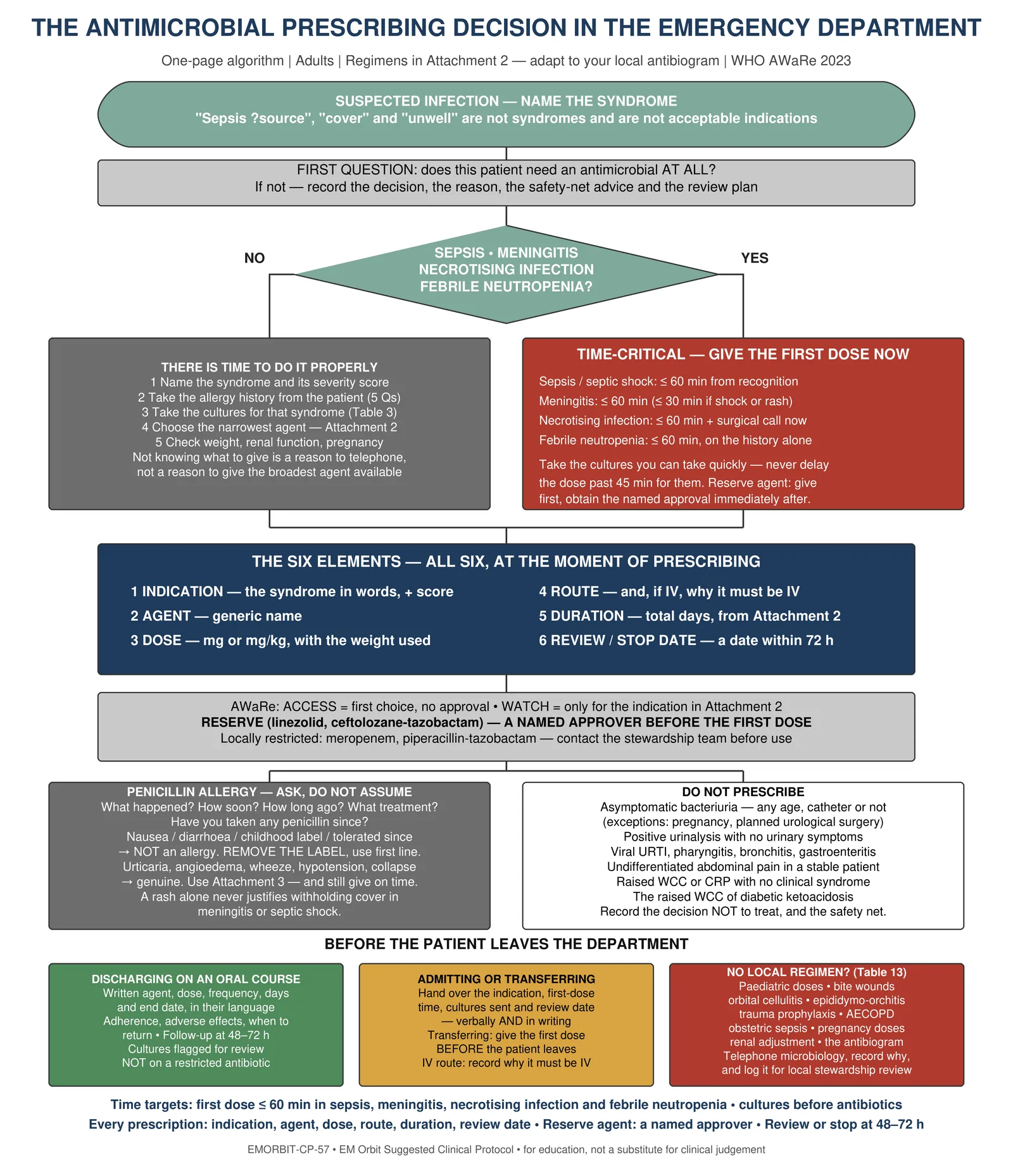
Evidence base: IDSA; NICE; local antibiogram
1Purpose
1.1 Provide a single, standardized source of empirical antimicrobial therapy for the common infections treated in the Emergency Department (ED), so that the agent, dose, route and duration are decided once, centrally, and are not restated and slowly diverged from in a dozen separate documents.
1.2 Set out the empirical agents, doses, routes and durations for the common emergency infections in one reference. This guideline structures that content into a clinical practice guideline format, adds the stewardship process, and states the points at which common practice differs from current evidence.
1.3 State the principle on which the whole guideline rests: in an ED the pressure is to start broad, and the value is in starting right. Starting right means naming the syndrome, recording the indication, choosing the narrowest agent that covers the likely organism, and setting a review or stop date at the moment of prescription.
1.4 Require that the indication, agent, dose, route, duration and review date are all recorded at the moment of prescription (Table 1), because none of them is reliably recoverable afterwards.
1.5 Require that cultures are taken before the first dose wherever this does not delay treatment (Table 3), and define the four conditions in which nothing delays the first dose (Table 2).
1.6 Define the assessment of a reported penicillin allergy, which is the commonest single cause of unnecessary second-line prescribing in the ED, and the alternatives to use when the allergy is genuine (Tables 14 and 15).
1.7 Apply the World Health Organization AWaRe classification (2023) to every agent named here, and require a named approver for every Reserve agent (Table 4).
1.8 Define the criteria for intravenous to oral switch (Table 16) and set out the evidence that shorter courses are as effective as longer ones for almost every common infection (Table 17).
1.9 State explicitly, and in the body of the document, every infection for which another guideline in this library defers to this one but for which no standard regimen applies (Table 13). No regimen is given where no standard one applies.
1.10 Ensure consistency of practice among all healthcare providers (HCP) and alignment with the local antimicrobial stewardship policy, the Infectious Diseases Society of America (IDSA) syndrome guidelines, the National Institute for Health and Care Excellence (NICE) antimicrobial prescribing guidelines and NG15, the Surviving Sepsis Campaign 2021, and the current local antibiogram.
2Who this protocol applies to
2.1 Every patient of any age in whom an antibacterial agent is started, continued, changed or withheld in the ED, whether the patient is admitted, transferred, or discharged.
2.2 Every patient discharged from the ED with a prescription for an oral antibacterial agent, including those given a single dose in the department.
2.3 Every patient in whom a reported antimicrobial allergy influences the choice of agent.
2.4 The prescribing, documentation, review and audit process itself, which applies whether or not the empirical regimen for that infection is contained in this guideline.
3Not covered by this protocol
3.1 Antituberculous therapy, antiretroviral therapy and human immunodeficiency virus post-exposure prophylaxis, which are managed under the relevant national and local programmes.
3.2 Rabies and tetanus post-exposure prophylaxis, which are managed under EMORBIT-CP-56; the antibacterial management of the bite wound itself is within scope, but this protocol gives no regimen for it (Table 13); seek microbiology advice.
3.3 Antifungal and antiparasitic therapy, other than where a named agent appears in a carried-forward local regimen; and antiviral therapy, other than aciclovir for suspected herpes simplex encephalitis (Table 12).
3.4 Surgical antimicrobial prophylaxis given in the operating theatre, which is governed by the surgical prophylaxis policy; the single pre-operative dose given in the ED before transfer to theatre is within scope.
3.5 Inpatient de-escalation, therapeutic drug monitoring beyond the first dose, outpatient parenteral antimicrobial therapy, and the management of Clostridioides difficile infection, which are governed by the hospital Antimicrobial Stewardship Programme.
3.6 Infection prevention and control measures — isolation, personal protective equipment, notification of communicable disease — which are governed by the local infection prevention and control policy and run in parallel with this guideline.
4Protocol
4.1History and Assessment:
4.1.1Triage and Recognition:
4.1.1.1 The first stewardship question is not which antibiotic, but whether this patient needs one now. There are three answers: this patient needs an antimicrobial within the hour (Table 2); this patient needs an antimicrobial but there is time to do it properly; this patient does not need an antimicrobial at all (section 4.3.9).
4.1.1.2 A patient meeting any trigger in Table 2 — a positive sepsis screen, suspected bacterial meningitis, a suspected necrotising soft-tissue infection, or fever in a patient who has had chemotherapy within 6 weeks — shall be moved directly to a treatment area and the first dose given within the stated target. The triage nurse shall alert the treating physician immediately and shall not queue the patient.
4.1.1.3 For every other patient with a suspected infection, the triage assessment records the temperature, the full observation set and the NEWS2 score, the suspected site, and the allergy history as it is actually described by the patient, not as it is recorded in the system.
4.1.1.4 A drug allergy label in the health information system is a starting point for a conversation, not a fact. The five questions in Table 14 take about two minutes and change the antibiotic in a large proportion of patients who carry a penicillin label.
4.1.1.5
Table 2: The four time-critical exceptions — in these, stewardship never delays the first dose Condition Recognition trigger Time to first dose What must not be waited for SEPSIS AND SEPTIC SHOCK A positive sepsis screen with suspected infection; NEWS2 or the local screening tool triggering; hypotension or a lactate above 2 mmol/L Within 60 minutes of recognition (T0) Cultures beyond 45 minutes of attempted sampling, imaging, a source diagnosis, senior review, a stewardship telephone call, a bed SUSPECTED BACTERIAL MENINGITIS Fever with any of headache, neck stiffness, altered consciousness, seizure or a non-blanching rash As soon as it is suspected — within 60 minutes of arrival, and within 30 minutes where there is shock or a rash Computed tomography, lumbar puncture, blood culture results, a microbiology discussion, transfer NECROTISING SOFT-TISSUE INFECTION, INCLUDING FOURNIER GANGRENE Pain out of proportion to the appearance, crepitus, bullae, skin necrosis, rapid progression, systemic toxicity Within 60 minutes of recognition, together with the immediate surgical call Imaging — a normal radiograph or computed tomogram does not exclude it; the diagnosis is surgical FEBRILE NEUTROPENIA Fever as defined in Table 11 in a patient who has had chemotherapy within 6 weeks, or is known to be neutropenic — treat on the history, before the neutrophil count returns Within 60 minutes of arrival The full blood count, the oncology opinion, a portacath swab, triage queueing — these patients shall be triaged directly to a cubicle In these four conditions the stewardship value lies entirely in giving the right agent quickly and then reviewing it at 48 hours. Nothing in this guideline shall be quoted as a reason to delay the first dose. Outside these four, and outside undifferentiated critical illness, there is almost always time to take a culture, check the allergy history and choose the narrowest agent that covers the likely organism.
4.1.2History:
4.1.2.1 The syndrome: the site, the duration, and what has changed. An antimicrobial prescription requires a named syndrome; "?sepsis", "unwell", "raised inflammatory markers" and "cover" are not syndromes and are not acceptable indications.
4.1.2.2 Antimicrobial exposure in the preceding 3 months, with the agent where the patient can recall it: recent beta-lactam exposure is a risk factor for a resistant organism and is the commonest reason to move away from the first-line agent.
4.1.2.3 Healthcare exposure: hospital admission in the preceding 90 days, residence in a long-term care facility, haemodialysis, recent surgery or instrumentation, and any current indwelling device — urinary catheter, central venous catheter, prosthetic joint, prosthetic valve, ventriculoperitoneal shunt, stent.
4.1.2.4 Known colonisation or previous isolation of a resistant organism: MRSA, an extended-spectrum beta-lactamase producer, a carbapenem-resistant organism, or Pseudomonas.
4.1.2.5 Immunosuppression: chemotherapy and its date, neutropenia, asplenia, high-dose or long-term corticosteroids, biologic therapy, transplantation, human immunodeficiency virus, diabetes mellitus, chronic liver or renal disease.
4.1.2.6 Travel in the preceding 12 months, and the country of residence and of recent healthcare — relevant to Legionella, to enteric fever, to malaria in any febrile returning traveller, and to the probability of carbapenem resistance.
4.1.2.7 The allergy history in full, using Table 14; and specifically whether the patient has taken a penicillin or a cephalosporin since the reported reaction.
4.1.2.8 Pregnancy status in every woman of child-bearing age, and the breastfeeding status, both of which change the choice of agent.
4.1.2.9 Current medication, with attention to warfarin and the direct oral anticoagulants, methotrexate, statins, theophylline, ciclosporin and tacrolimus, and to drugs that prolong the QT interval where a macrolide or a fluoroquinolone is being considered.
4.1.2.10 Renal and hepatic function, and the patient’s weight, both of which are required before the dose can be written.
4.1.3Examination:
4.1.3.1 The purpose of the examination is to find the source, because the source determines the agent and, where drainage or debridement is required, determines the treatment itself.
4.1.3.2 A full set of observations with NEWS2, capillary refill, mental state, and a lactate where any trigger in Table 2 is met.
4.1.3.3 A systematic search for the source: chest, abdomen, renal angles, skin including the back, the perineum, the feet and between the toes, every intravenous and urinary device, every surgical wound, the throat, the ears, the teeth, the joints and the spine.
4.1.3.4 Undress the patient. A necrotising infection, a pressure sore, a diabetic foot ulcer and a perineal abscess are all missed by an examination performed through clothing.
4.1.3.5 Mark the margin of any area of cellulitis with a skin pencil and record the time, so that progression or response can be judged rather than guessed at the next review.
4.1.3.6 Where no source is found and the patient is not critically ill, this is itself an important finding: an absent source is a reason to investigate further and to review, not a reason to start the broadest available agent.
4.1.4Severity and Risk Stratification:
4.1.4.1 Severity determines the route, the setting and often the agent. Use the tool specific to the syndrome: CURB-65 for community-acquired pneumonia (Table 5); the presence of systemic features and of a drainable collection for skin and soft-tissue infection (Table 9); the presence of obstruction or sepsis for urinary tract infection (Table 7); and the ED sepsis screen for every patient (EMORBIT-CP-11).
4.1.4.2 Risk factors for a resistant organism, which move the patient off the first-line agent: recent broad-spectrum antibiotic exposure, recent hospitalisation or instrumentation, known colonisation, residence in a long-term care facility, and recurrent infection at the same site.
4.1.4.3 Risk factors for MRSA: previous MRSA infection or colonisation, intravenous drug use, recent hospitalisation, and recurrent abscesses.
4.1.4.4 A risk factor is a reason to broaden cover, and it is equally a reason to narrow it at 48 hours when it proves absent. Broadening without a review date is not risk management; it is a deferred harm.
4.1.5Differential Diagnosis — the non-infective conditions most often treated with antibiotics in error:
4.1.5.1 Asymptomatic bacteriuria, particularly in older people and in catheterised patients: a positive urine culture or a "dirty" urinalysis without urinary symptoms is not an infection, and treating it does not prevent one. It is the single commonest inappropriate antibiotic prescription in emergency medicine. The exceptions are pregnancy and planned urological instrumentation.
4.1.5.2 Confusion or a fall in an older person with a positive urinalysis and no urinary symptoms: look for the actual cause — dehydration, constipation, pain, drugs, hypoxia, a subdural haematoma — before accepting a urinary tract infection.
4.1.5.3 Venous eczema, lipodermatosclerosis, dependent rubor, gout, an acute deep vein thrombosis and a ruptured Baker cyst, all of which are misdiagnosed as cellulitis. Bilateral lower-limb "cellulitis" is almost never cellulitis.
4.1.5.4 Viral upper respiratory infection, viral pharyngitis, bronchitis and viral gastroenteritis, none of which benefits from an antibacterial agent.
4.1.5.5 Acute exacerbation of asthma (EMORBIT-CP-08): most exacerbations are viral and routine antibiotics are not indicated.
4.1.5.6 The raised white cell count of diabetic ketoacidosis (EMORBIT-CP-17), which arises from the acidosis and does not by itself indicate infection.
4.1.5.7 Non-infective causes of a raised C-reactive protein and of fever: pulmonary embolism, malignancy, drug fever, inflammatory and autoimmune disease, thyroid storm, transfusion reaction, venous thromboembolism and heat illness (EMORBIT-CP-23).
4.1.5.8 Where the patient is critically ill and the diagnosis is uncertain, antimicrobials are given and the diagnosis is pursued in parallel — but the uncertainty shall be recorded, so that the course can be stopped when the alternative diagnosis is confirmed.
4.1.6Special Populations:
4.1.6.1 Children: the local guidelines contain no paediatric content whatsoever. Paediatric empirical therapy for the septic or febrile child is taken from EMORBIT-CP-25; there is no local source for any other paediatric infection. This is recorded as a gap in Table 13 and is the highest local priority.
4.1.6.2 Pregnancy: pregnancy shall be assessed because it alters antibiotic selection. Penicillins, cephalosporins and erythromycin are generally regarded as safe in pregnancy; tetracyclines, fluoroquinolones and trimethoprim in the first trimester are generally avoided, and nitrofurantoin is avoided at term. A specific pregnancy-adapted regimen for each syndrome is not given in this protocol (Table 13); discuss with obstetrics and clinical pharmacy. Asymptomatic bacteriuria IS treated in pregnancy.
4.1.6.3 Renal impairment: doses in the empirical tables assume normal renal function. This protocol gives no renal adjustment (Table 13); the ED pharmacist shall adjust every dose against the estimated glomerular filtration rate; the first dose in sepsis is not reduced, only the subsequent doses and intervals.
4.1.6.4 The elderly and the frail: higher risk of adverse drug reactions, of Clostridioides difficile infection, of drug interactions and of falls; lower threshold for the alternative non-infective diagnosis; and the group in which asymptomatic bacteriuria is most often treated in error.
4.1.6.5 The immunocompromised: a lower threshold for treatment, broader initial cover, and earlier specialist involvement; fever in a patient who has had chemotherapy within 6 weeks is febrile neutropenia until proved otherwise (Table 11).
4.1.6.6 Intravenous drug users: consider endocarditis, epidural abscess and deep-seated infection in any febrile injector; take blood cultures before any antibiotic; MRSA cover is usually required.
4.1.6.7 Patients with prosthetic material: joints, valves, grafts, shunts and lines. In a stable patient, do not start empirical therapy before discussion, because premature antibiotics may make the organism unrecoverable and the definitive diagnosis impossible (Table 3).
4.2Investigations:
4.2.1 The investigations that matter to a stewardship decision are those that identify the organism, those that identify the source, and those that establish the safe dose. Everything else is secondary.
4.2.2 Cultures before antibiotics wherever this does not delay treatment — the syndrome-by-syndrome requirement is in Table 3. Record the time the cultures were taken and the time the first dose was given; the audit in section 11 depends on both.
4.2.3 Blood cultures: two sets from separate venepuncture sites, taken with aseptic technique, before the first dose, in every patient treated for sepsis, bacteraemia, meningitis, febrile neutropenia, severe pneumonia, pyelonephritis with systemic upset, or a deep-seated infection. Where venous access is difficult in a septic patient, one set and a timely antibiotic is better than two sets and a delay.
4.2.4 Urinalysis in every suspected urinary tract infection, with urine culture only where complicated features are present. A urine sample shall not be sent from an asymptomatic patient, because the result will be acted on.
4.2.5 Wound, pus and tissue specimens wherever purulent material is accessible; tissue or pus is a better specimen than a surface swab, and a surface swab of intact cellulitis grows colonisers and should not be sent.
4.2.6 Baseline safety and dosing bloods: renal function and estimated glomerular filtration rate, liver function, full blood count, and the patient’s weight. These determine the dose and are needed before the prescription is written, not after.
4.2.7 Lactate in every patient meeting a sepsis trigger, and repeated where the initial value is above 2 mmol/L (EMORBIT-CP-11).
4.2.8 Imaging directed at source control rather than at confirming the infection: a chest radiograph in suspected pneumonia; computed tomography of the abdomen and pelvis where intra-abdominal collection, obstruction or abscess is suspected; ultrasound for an abscess or an obstructed kidney. Imaging shall not delay the first dose in any condition in Table 2, and a normal image does not exclude a necrotising infection.
4.2.9Biomarkers:
4.2.9.1 C-reactive protein and the white cell count are neither sensitive nor specific for bacterial infection in an undifferentiated ED population, and neither shall be used as the sole reason to start or to withhold an antibiotic.
4.2.9.2 Procalcitonin may be used to guide cessation where the value is below 0.25 micrograms/L. The evidence for procalcitonin-guided discontinuation comes from critical care and from lower respiratory tract infection, not from the ED front door, and procalcitonin has repeatedly failed to safely identify which undifferentiated ED patients can have antibiotics withheld. It shall never be used to delay or withhold the first dose in suspected sepsis, meningitis, necrotising infection or febrile neutropenia. Its role is limited to guiding cessation in the admitted patient.
4.2.9.3 A positive viral polymerase chain reaction result — influenza, respiratory syncytial virus, SARS-CoV-2 — makes bacterial co-infection less likely and is a legitimate reason to stop an antibacterial agent in a patient who is improving.
4.2.10
Table 3: Cultures and specimens before antibiotics — taken first wherever this does not delay treatment Syndrome Specimens before the first dose Notes and exceptions Sepsis, septic shock, undifferentiated critical illness Two sets of blood cultures from separate sites; lactate; urine culture; culture of any accessible suspected source Sampling shall not delay antibiotics beyond 45 minutes. Where access is difficult, one set and the antibiotic is better than two sets and a delay. Community-acquired pneumonia Blood cultures if severe; sputum culture if intubated; Legionella urinary antigen if there is a travel history Routine sputum culture in a non-severe, non-intubated patient is not required and its result is rarely actionable. Urinary tract infection Urinalysis in all cases. Urine culture only where complicated features are present. Blood cultures × 2 and serum lactate in pyelonephritis and urosepsis Do not send a urine culture from an asymptomatic patient, and do not treat a positive culture without symptoms — see section 4.3.9. Skin and soft-tissue infection Wound culture wherever purulent material is present; blood cultures if systemically unwell A surface swab of intact, non-purulent cellulitis grows colonisers and should not be sent. Intra-abdominal infection Blood cultures; intra-operative or drainage specimens when obtained Source control is the treatment; antibiotics support it. Suspected bacterial meningitis Blood cultures, and a meningococcal and pneumococcal polymerase chain reaction sample where available Lumbar puncture shall not delay the first dose. Cerebrospinal fluid taken within a few hours of the first dose still shows the cell count, protein, glucose and polymerase chain reaction result. Febrile neutropenia Peripheral blood cultures and cultures from every lumen of any central venous catheter, plus urine culture The first dose is given within 60 minutes; culture sampling shall be compressed, not the antibiotic delayed. Suspected device or prosthesis infection Blood cultures before any antibiotic; do not start empirical therapy in a stable patient before discussion In a stable patient with a suspected prosthetic joint or endovascular infection, premature antibiotics may make the organism unrecoverable and the definitive diagnosis impossible. Discuss with microbiology first. The audited standard is that blood cultures are taken before the first dose in every patient treated for sepsis or a bloodstream infection. Record the time the cultures were taken and the time the antibiotic was given.
4.3Plan of Care:
4.3.1Immediate Actions — the four time-critical exceptions:
4.3.1.1 In sepsis and septic shock, suspected bacterial meningitis, necrotising soft-tissue infection and febrile neutropenia, nothing in this guideline delays the first dose (Table 2).
4.3.1.2 In these four conditions the sequence is: recognise, take what cultures can be taken quickly, give the antimicrobial, then think about narrowing it. The stewardship value lies entirely in giving the right agent quickly and reviewing it at 48 hours.
4.3.1.3 The first dose shall be prescribed and administered in the ED and shall not be deferred to the receiving ward. Where the patient is being transferred, the first dose is given before the patient leaves the department.
4.3.1.4 A reserve agent required in one of these four conditions is given first and approved immediately afterwards (Table 4).
4.3.1.5 Outside these four conditions, and outside undifferentiated critical illness, there is almost always time to take a culture, take the allergy history, name the syndrome, and choose the narrowest agent that covers the likely organism.
4.3.2The Prescription — six elements, recorded at the moment of prescribing:
4.3.2.1 Every antimicrobial prescription written in the ED shall record the indication, agent, dose, route, duration and stop or review date (Table 1). A prescription missing any of the six is an incomplete prescription and shall be completed before the patient leaves the department.
4.3.2.2 The indication shall be the clinical syndrome in words, with the severity score where one applies — "community-acquired pneumonia, CURB-65 = 1"; "pyelonephritis, no obstruction on ultrasound"; "cellulitis of the left lower leg, margin marked". Where the diagnosis is uncertain, the uncertainty shall be stated together with what would change it.
4.3.2.3 The review or stop date shall be a calendar date no later than 48 to 72 hours from the first dose. This is the mechanism by which the ED’s empirical guess is corrected, and it is set in the ED because the ED writes the first prescription.
4.3.2.4 Where the prescriber departs from the empirical table in Attachment 2, the departure is legitimate and the reason shall be recorded. Undocumented departures cannot be reviewed, and a table with unexplained exceptions cannot be audited.
4.3.2.5
Table 1: The six elements of an antimicrobial prescription — all six are required at the moment of prescribing, not afterwards Element What shall be recorded Why it is the ED’s responsibility Indication The clinical syndrome being treated, in words — "community-acquired pneumonia, CURB-65 = 1", not "infection" or "sepsis ?source". Where the diagnosis is uncertain, say so and say what would change it. The receiving team cannot safely stop, narrow or continue a course whose reason it cannot find. An unrecorded indication is the single commonest stewardship defect in every published ED audit. Agent The generic name of every agent, with the reason for any departure from the empirical table in Attachment 2. Departures are legitimate; undocumented departures cannot be reviewed. Dose The dose in milligrams or milligrams per kilogram, with the weight used, and the renal function on which it was based. Under-dosing in sepsis and over-dosing in renal impairment both begin in the ED. Route Intravenous, oral, intramuscular; and for an intravenous prescription, the reason it must be intravenous. An intravenous prescription started in the ED is often still running on the ward five days later because nobody recorded why it began. Duration The total intended course length in days, taken from Attachment 2. A course without an end date does not end. Stop or review date A calendar date, no later than 48–72 hours from the first dose, at which the prescription shall be reviewed against the culture results and the clinical response. This is the mechanism by which the ED’s empirical guess is corrected. It is set in the ED because the ED writes the first prescription. A prescription missing any of the six elements is an incomplete prescription. These six elements are the audited standard in section 11 and appear as the first block of the checklist in Attachment 4.
4.3.3Empirical Therapy by Syndrome:
4.3.3.1 The empirical regimens in Tables 5 to 12 are the regimens used in this guideline; adapt them to your local antibiogram. They are reproduced together as Attachment 2 for use at the bedside.
4.3.3.2 Where a carried-forward choice appears to differ from current evidence, the local choice has been retained and the concern raised as a bracketed note beneath the relevant table. Those notes are the medical review agenda for this guideline; they are not instructions to prescribers, and a prescriber shall follow the table until it is locally reviewed and changed. The one exception is the meningitis penicillin-allergy row, where the note states a safety limit that applies immediately.
4.3.3.3 All doses assume an adult of normal renal and hepatic function. There is no paediatric column; this protocol gives no paediatric regimens (Table 13).
4.3.3.4
Table 5: Community-acquired pneumonia — CURB-65 severity score and disposition Component Criteria Points Score, disposition and action C — Confusion New disorientation or altered mental status 1 0–1: Discharge home. Oral antibiotics; follow-up in family health or primary care in 48–72 hours; safety-net advice. U — Urea Serum urea > 7 mmol/L 1 2: Medical on-call or pulmonology review for inpatient admission. Initiate intravenous antibiotics. R — Respiratory rate ≥ 30 breaths per minute 1 3–5: Admit to hospital; may require high-dependency or intensive care if the score is ≥ 4. Full workup, intravenous antibiotics, monitor observations, consider the sepsis protocol (EMORBIT-CP-11). B — Blood pressure Systolic < 90 mmHg or diastolic ≤ 60 mmHg 1 The score supports, and does not replace, clinical judgement and the Triage Standard (EMORBIT-CP-29). Hypoxaemia, an unsafe home, or a significant comorbidity may each justify admission at a score of 0–1. 65 — Age ≥ 65 years 1 Diagnostics: blood cultures if severe; sputum culture if intubated; Legionella urinary antigen if there is a travel history. 4.3.3.5
Table 6: Community-acquired pneumonia — empirical therapy Setting Empirical therapy Duration AWaRe group Discharge home (CURB-65 0–1) Amoxicillin/clavulanate 1 g orally every 12 hours PLUS azithromycin 500 mg orally every 24 hours
OR
Levofloxacin 750 mg orally every 24 hours (monotherapy)5 days Access + Watch; Watch Standard inpatient (CURB-65 ≥ 2) Ceftriaxone 1–2 g intravenously every 24 hours PLUS azithromycin 500 mg intravenously or orally every 24 hours 5–7 days Watch Severe or intensive care admission The standard inpatient regimen, and ADD vancomycin 15–20 mg/kg intravenously every 8–12 hours OR linezolid 600 mg intravenously every 12 hours where there is a meticillin-resistant Staphylococcus aureus (MRSA) risk factor 7–10 days Watch; linezolid is Reserve For a CURB-65 of 0–1 in a previously healthy adult, ATS/IDSA 2019 and NICE NG138 recommend amoxicillin alone, or doxycycline, and reserve combination therapy or a respiratory fluoroquinolone for patients with comorbidity or recent antibiotic exposure; combination therapy is broader than those guidelines advise for the low-risk group. Levofloxacin monotherapy as a first-line option for a patient being discharged conflicts with the WHO AWaRe intent for Watch agents and with the European, United Kingdom and United States regulatory restrictions on fluoroquinolones (tendinopathy and tendon rupture, aortic aneurysm and dissection, peripheral neuropathy, and disabling neuropsychiatric effects); it is restricted to documented beta-lactam allergy. The severe and intensive-care row provides MRSA cover but no anti-pseudomonal option; severe CAP with a structural lung disease, recent broad-spectrum antibiotics or previous Pseudomonas isolation is not covered by ceftriaxone. An anti-pseudomonal agent is added for those patients.
4.3.3.6
Table 7: Urinary tract infection — clinical criteria and warning signs Infection type Key clinical features Additional indicators Warning signs of severe infection Cystitis Dysuria; urinary frequency; urgency; suprapubic pain No fever; no flank pain; mild symptoms only Persistent symptoms beyond 7 days; visible haematuria Pyelonephritis Fever above 38 °C; flank pain or costovertebral angle tenderness; nausea and vomiting Chills and rigors; malaise; dehydration Hypotension (systolic below 90 mmHg); tachypnoea (respiratory rate above 24); altered mental status Urosepsis Systemic inflammatory response criteria: temperature above 38 °C or below 36 °C; heart rate above 90; respiratory rate above 20; white cell count above 12 000 or below 4000 Hypotension; lactate above 2 mmol/L; organ dysfunction Septic shock; acute kidney injury; respiratory failure Diagnostics: urinalysis in all cases, with urine culture only where complicated features are present; blood cultures × 2, serum lactate and renal function in pyelonephritis and urosepsis; computed tomography of the abdomen and pelvis where obstruction or abscess is suspected or pyelonephritis is recurrent. Broader-spectrum cover is required where any of the following is present: diabetes mellitus, immunocompromise, a structural urinary abnormality, recent urinary instrumentation, or a hospital-acquired infection. Pregnancy shall be assessed in every woman of child-bearing age, because it changes both the antibiotic and the imaging decision. EMORBIT-CP-11 and the Surviving Sepsis Campaign 2021 define sepsis as life-threatening organ dysfunction (Sepsis-3), screened with NEWS2; the urosepsis trigger is aligned with that ED sepsis screen.
4.3.3.7
Table 8: Urinary tract infection — empirical therapy Presentation Empirical therapy Duration UNCOMPLICATED CYSTITIS — suitable for discharge First line Nitrofurantoin 100 mg orally every 12 hours
OR
Fosfomycin 3 g orally as a single dose (repeat once after 72 hours if required)3–5 days The "penicillin allergy" option Trimethoprim-sulfamethoxazole double strength, 1 tablet orally every 12 hours — only where local Escherichia coli resistance is below 20% 3 days URINARY TRACT INFECTION, STABLE FOR DISCHARGE — stable observations, tolerating oral intake, mild to moderate symptoms, no sign of sepsis First line Amoxicillin/clavulanate 1 g orally every 12 hours
OR
Ciprofloxacin 500 mg orally every 12 hours (where local resistance patterns allow)7 days PYELONEPHRITIS, MILD TO MODERATE — clinically stable after ED assessment with or without one intravenous dose, no vomiting, no sign of sepsis or urinary obstruction First line Ciprofloxacin 500 mg orally every 12 hours
OR
Cefixime 400 mg orally every 24 hours, following a single intravenous dose of ceftriaxone if required7–10 days COMPLICATED PYELONEPHRITIS — admit First line Ceftriaxone 2 g intravenously every 24 hours PLUS gentamicin 5 mg/kg intravenously every 24 hours for 3 days Preferred regimen; adjust on culture Alternative Ciprofloxacin 400 mg intravenously every 12 hours, where the pathogen is fluoroquinolone-susceptible, or where there is a beta-lactam allergy Adjust on culture Extended-spectrum beta-lactamase risk Ertapenem 1 g intravenously every 24 hours Adjust on culture UROSEPSIS — admit; first dose within 60 minutes of recognition First line Piperacillin-tazobactam 4.5 g intravenously every 6 hours PLUS vancomycin 15–20 mg/kg intravenously every 8–12 hours* All urosepsis; healthcare-associated infection; post-procedural infection Alternative Meropenem 1 g intravenously every 8 hours, with or without vancomycin* Suspected extended-spectrum beta-lactamase producer; failure of first-line therapy Penicillin allergy Ciprofloxacin 400 mg intravenously every 12 hours PLUS metronidazole 500 mg intravenously every 8 hours, with or without vancomycin* Non-anaphylactic allergy only * Vancomycin is added for: an MRSA risk factor; an indwelling device; or a previous MRSA infection. For uncomplicated cystitis the duration differs by agent: nitrofurantoin requires 5 days and a 3-day course is inadequate, whereas fosfomycin is a single dose. Nitrofurantoin is ineffective in pyelonephritis and should be avoided where the estimated glomerular filtration rate is below 45 mL/min/1.73 m². Nitrofurantoin, fosfomycin and trimethoprim-sulfamethoxazole are not penicillins, so labelling the trimethoprim-sulfamethoxazole row "penicillin allergy" is a category error; the 20% resistance threshold is a resistance decision, not an allergy decision. The routine addition of gentamicin for 3 days to ceftriaxone in complicated pyelonephritis adds nephrotoxicity and ototoxicity; it requires ideal-body-weight dosing, level monitoring and avoidance in acute kidney injury. Vancomycin is added only where there is MRSA risk. Metronidazole adds nothing to a purely urinary source; and both ciprofloxacin rows and the trimethoprim-sulfamethoxazole row depend on a local resistance figure from the antibiogram (section 4.3.8).
4.3.3.8
Table 9: Skin and soft-tissue infection — classification, disposition and empirical therapy Type Clinical features Disposition Empirical therapy Non-purulent (cellulitis) Erythema, warmth, swelling; no drainable abscess Mild: discharge home Discharge: amoxicillin/clavulanate 1 g orally every 12 hours OR cefuroxime 500 mg orally every 12 hours, for 7 days. Penicillin allergy: clindamycin 300–450 mg orally every 8 hours, for 7 days Purulent (abscess) Fluctuance; visible or palpable pus or drainage Incision and drainage, with or without oral antibiotics; discharge if stable Incision and drainage is the treatment. Antibiotics only where there are systemic symptoms, immunocompromise, or facial involvement: trimethoprim-sulfamethoxazole double strength 1–2 tablets orally every 12 hours OR doxycycline 100 mg orally every 12 hours Necrotising infection Severe pain disproportionate to the physical findings; crepitus, bullae or skin necrosis; systemic toxicity (fever, hypotension); rapid progression URGENT SURGICAL CONSULT. Admit for intravenous antibiotics and debridement Piperacillin-tazobactam 4.5 g intravenously every 6 hours PLUS clindamycin 600 mg intravenously every 8 hours PLUS vancomycin 15–20 mg/kg intravenously every 8–12 hours. Consider meropenem where there is an extended-spectrum beta-lactamase risk Cellulitis requiring hospitalisation (non-purulent) Systemic features, failed oral therapy, or an unsafe discharge Admit for intravenous therapy Cefazolin 1–2 g intravenously every 8 hours OR cefuroxime 750 mg intravenously every 8 hours. Alternative or MRSA cover: clindamycin 600 mg intravenously every 8 hours OR vancomycin 15–20 mg/kg intravenously every 8–12 hours. Reserve vancomycin for confirmed MRSA or a high-risk patient Purulent infection requiring hospitalisation Systemic features with a drainable collection Admit; drainage remains essential Incision and drainage PLUS vancomycin 15–20 mg/kg intravenously every 8–12 hours in severe cases Surgical site infection, mild and superficial Localised erythema and discharge at a surgical wound in a systemically well patient Discharge home; inform the operating team Amoxicillin/clavulanate 1 g orally every 12 hours OR cefuroxime 500 mg orally every 12 hours OR, in penicillin allergy, clindamycin 300–450 mg orally every 8 hours, for 7 days Wound cultures shall be obtained for every skin and soft-tissue infection where purulent material is present. MRSA risk factors (local list): previous MRSA infection or colonisation; intravenous drug use; recent hospitalisation; recurrent abscesses. Necrotising fasciitis red flags (local list): pain disproportionate to the examination; crepitus on palpation; rapid progression; systemic toxicity. In necrotising infection the duration is determined by the adequacy of surgical debridement, and the clindamycin component of the necrotising regimen is given for toxin suppression and is usually stopped once the patient is stable.
4.3.3.9
Table 10: Intra-abdominal infection (for example appendicitis, diverticulitis) — empirical therapy Severity Empirical therapy Alternative Duration Special considerations Mild to moderate Ceftriaxone 2 g intravenously every 24 hours PLUS metronidazole 500 mg intravenously every 8 hours Ertapenem 1 g intravenously every 24 hours (for penicillin allergy) 4–7 days Consider oral step-down with ciprofloxacin 500 mg orally every 12 hours PLUS metronidazole 500 mg orally every 8 hours Severe or healthcare-associated Piperacillin-tazobactam 4.5 g intravenously every 6 hours OR meropenem 1 g intravenously every 8 hours Ceftolozane-tazobactam 1.5 g intravenously every 8 hours (for multidrug-resistant Pseudomonas) 7–14 days Add vancomycin where MRSA risk factors are present or the infection is post-operative Clinical criteria: abdominal pain, tenderness, guarding, and imaging findings. Source control is the treatment and the antibiotic supports it: the duration clock in intra-abdominal infection starts at adequate source control, and a course started in the ED without a source-control plan is a course that will not end. Antibiotics shall not be given to a stable patient with undifferentiated abdominal pain, because they obscure the picture and delay the diagnosis (EMORBIT-CP-15). Ertapenem is a carbapenem and shares the beta-lactam ring; it is the penicillin-allergy alternative. Carbapenem cross-reactivity with penicillin is low (well under 1%), so this is defensible, but it is not an appropriate choice in documented severe beta-lactam anaphylaxis without specialist advice. See Table 15.
4.3.3.10
Table 11: Bloodstream infection, sepsis and febrile neutropenia — empirical therapy and definitions Clinical scenario Empirical therapy Duration No MRSA risk Ceftriaxone 2 g intravenously every 24 hours Determined by the source and the clinical response; typically 5–7 days, longer if complicated MRSA risk Vancomycin 15–20 mg/kg intravenously every 8–12 hours Determined by the source and the trough levels; typically 7–10 days FEBRILE NEUTROPENIA Piperacillin-tazobactam 4.5 g intravenously every 6 hours, PLUS vancomycin where there is a central line or a soft-tissue infection. First dose within 60 minutes of arrival. Until the neutropenia resolves and the patient has been afebrile for at least 48 hours; typically 7–14 days Febrile neutropenia is diagnosed only when BOTH criteria below are present. Treat on the history — do not wait for the neutrophil count. Criterion 1 — fever A single oral temperature ≥ 38.3 °C, OR a temperature ≥ 38.0 °C sustained for ≥ 1 hour Chemotherapy within the preceding 6 weeks, or known neutropenia, is sufficient to trigger the pathway at triage Criterion 2 — neutropenia An absolute neutrophil count < 500 cells/mm³, OR < 1000 cells/mm³ with a predicted fall to below 500 within 48 hours The count is confirmatory; the antibiotic is given before it returns Clinical criteria: systemic inflammatory response criteria together with a suspected source of infection. Fluid resuscitation, lactate, source identification and the 60-minute target are governed by EMORBIT-CP-11, which this table does not override. Ceftriaxone and vancomycin are chosen by MRSA risk, but neither covers Pseudomonas or an extended-spectrum beta-lactamase producer, and vancomycin as a single agent has no Gram-negative activity at all — it is always an addition, never a replacement. A vancomycin loading dose of 25–30 mg/kg is standard practice in sepsis, and area-under-the-curve-guided monitoring has replaced trough monitoring in current guidance. Meropenem 1 g every 8 hours is below the 2 g every 8 hours now commonly used in sepsis and critical illness, and extended-infusion administration of both meropenem and piperacillin-tazobactam is an option.
4.3.3.11
Table 12: Central nervous system infection — empirical therapy. Read with EMORBIT-CP-47 Condition Empirical therapy Additions Suspected bacterial meningitis Ceftriaxone 2 g intravenously every 12 hours. Vancomycin 15–20 mg/kg intravenously every 8–12 hours where there is penicillin allergy Dexamethasone 10 mg intravenously every 6 hours for 4 days, started before or with the first antibiotic dose Age over 50 years, immunocompromise, alcohol dependence, or pregnancy The above PLUS ampicillin 2 g intravenously every 4 hours To cover Listeria monocytogenes, which is intrinsically resistant to all cephalosporins Suspected herpes simplex encephalitis Aciclovir 10 mg/kg intravenously every 8 hours, adjusted for renal function Give where there is fever with altered behaviour, altered consciousness, new seizures or a focal neurological deficit Post-neurosurgical or device-related central nervous system infection Meropenem 2 g intravenously every 8 hours PLUS vancomycin intravenously Consider an infectious diseases consultation. Note the higher meningeal dose of meropenem Meningitis dosing is higher and more frequent than standard dosing for the same agents; prescribe from this table and not from memory. Vancomycin is never used as sole therapy in suspected bacterial meningitis, including in penicillin or cephalosporin allergy. Vancomycin has no activity against Neisseria meningitidis, Haemophilus influenzae or Listeria monocytogenes; used alone in a penicillin- or cephalosporin-allergic patient it would leave the commonest meningeal pathogens uncovered. In current practice vancomycin is added to ceftriaxone where a penicillin- or cephalosporin-non-susceptible pneumococcus is suspected, and the accepted alternatives in genuine severe beta-lactam allergy are chloramphenicol, or moxifloxacin plus vancomycin, with co-trimoxazole replacing ampicillin for Listeria cover. EMORBIT-CP-47 already states that co-trimoxazole is the usual Listeria alternative. No patient with suspected meningitis shall receive vancomycin as sole therapy.
4.3.4Penicillin Allergy:
4.3.4.1 Approximately one in ten hospital patients carries a penicillin allergy label, and more than nine in ten of them are not allergic when formally tested. The label is the commonest single cause of second-line prescribing in the ED.
4.3.4.2 The label is not harmless. Patients labelled penicillin-allergic receive more vancomycin, clindamycin and fluoroquinolone, and have more MRSA infection, more Clostridioides difficile infection, longer hospital stays and worse surgical outcomes.
4.3.4.3 Take the history using the five questions in Table 14. It takes about two minutes — less time than switching to a second-line agent — and it is a stewardship intervention in its own right.
4.3.4.4 Where the history excludes allergy — an isolated gastrointestinal upset, a childhood label with no recalled reaction, or a penicillin tolerated since — the label shall be removed from the health information system, with the reason and the clinician’s name recorded, and the first-line agent used.
4.3.4.5 Where the reported reaction is a delayed, non-severe rash, a cephalosporin may be given; cross-reactivity between penicillins and modern cephalosporins with dissimilar side chains is low.
4.3.4.6 Where the reaction was genuinely immediate and severe — urticaria, angioedema, wheeze, hypotension, collapse, or a reaction requiring adrenaline or admission — use the alternatives in Table 15, and still give the first dose within the time target. The alternative is chosen and given; it is not deferred while advice is sought.
4.3.4.7 A history of a rash alone is not a reason to withhold a beta-lactam in a life-threatening infection. The risk of untreated meningitis or septic shock exceeds the risk of the reaction. Where cover is genuinely unsafe, an alternative is used — cover is never simply omitted.
4.3.4.8 Refer every patient with a genuine allergy to allergy or immunology for formal testing at discharge, and record the referral. De-labelling is the definitive stewardship intervention and it begins in the ED.
4.3.4.9
Table 14: Taking a penicillin allergy history in the ED — five questions that take two minutes and change the antibiotic Question Answer suggesting the label is NOT a true allergy Answer suggesting a genuine allergy 1. What exactly happened? Nausea, vomiting, diarrhoea, headache, oral or vaginal candidiasis, an isolated non-itchy rash, "my mother told me", "it did not work" Urticaria, angioedema, wheeze, stridor, hypotension, collapse, an anaphylactic reaction 2. How long after the dose did it start? More than 72 hours after the first dose, or after the course had finished Within 1 hour of a dose (immediate, IgE-mediated), or 1–72 hours with urticaria 3. How old were you, and how long ago? In childhood, and more than 10 years ago — about 80% of patients labelled penicillin-allergic lose the sensitivity within 10 years Recent, in adulthood, or a reaction on more than one separate occasion 4. What treatment did the reaction need? None; the drug was simply stopped; the patient stayed at home Adrenaline, admission, intensive care, or a documented anaphylaxis code 5. Have you taken any penicillin or cephalosporin since? Yes, and tolerated it — this excludes the allergy and the label shall be removed from the record Never taken one since, or reacted again on re-exposure Around 10% of hospital patients carry a penicillin allergy label and more than 90% of them are not allergic on formal testing. The label is not harmless: it is associated with longer stay, more MRSA and Clostridioides difficile infection, more vancomycin, fluoroquinolone and clindamycin use, and worse surgical outcomes. Taking this history is a stewardship intervention in its own right, and takes less time than switching to a second-line agent. Where the history excludes allergy, the label shall be removed from the health information system, with the reason and the clinician’s name recorded.
4.3.4.10
Table 15: What to use when the penicillin allergy is genuine — the alternatives; adapt to your local antibiogram Syndrome Reported non-severe reaction (delayed rash, unknown childhood label) Severe reaction (anaphylaxis, angioedema, documented IgE-mediated reaction) Note Community-acquired pneumonia A cephalosporin (ceftriaxone) may be given; cross-reactivity with modern cephalosporins is low Levofloxacin 750 mg orally or intravenously every 24 hours (listed locally as the monotherapy option), with azithromycin Avoid a fluoroquinolone where there is aortic disease, tendinopathy or a seizure disorder Uncomplicated cystitis Nitrofurantoin or fosfomycin (neither is a penicillin) Nitrofurantoin or fosfomycin; or trimethoprim-sulfamethoxazole where local resistance allows No beta-lactam is needed for this syndrome at all Complicated pyelonephritis Ceftriaxone with gentamicin as in Table 8 Ciprofloxacin 400 mg intravenously every 12 hours (listed locally for beta-lactam allergy) Susceptibility-dependent Urosepsis Piperacillin-tazobactam as in Table 8 Ciprofloxacin 400 mg intravenously every 12 hours PLUS metronidazole 500 mg intravenously every 8 hours, with or without vancomycin — for non-anaphylactic allergy only No regimen is given here for urosepsis with true anaphylaxis: seek specialist infectious diseases or microbiology advice. Skin and soft-tissue infection Cefazolin or cefuroxime Clindamycin 300–450 mg orally every 8 hours, or 600 mg intravenously every 8 hours; vancomycin where severe The local regimen is unchanged Intra-abdominal infection Ceftriaxone with metronidazole Ertapenem 1 g intravenously every 24 hours (listed locally as the penicillin-allergy option) Carbapenem cross-reactivity with penicillin is under 1%, but see the note under Table 10 Suspected bacterial meningitis Ceftriaxone as in Table 12 — a rash history alone is NOT a reason to withhold a cephalosporin in a life-threatening infection Vancomycin is the listed agent. See the note under Table 12: vancomycin alone does not cover the common meningeal pathogens and shall not be used as sole therapy. Discuss immediately with microbiology or infectious diseases; do not simply omit cover. A genuine anaphylaxis requires an agreed alternative that is already decided and available at the bedside, not improvised at three in the morning. Two principles govern every row. First, a history of a rash alone is not a reason to withhold a beta-lactam in a life-threatening infection — the risk of the untreated infection exceeds the risk of the reaction. Second, in a genuinely allergic patient the first dose is still given within the time target: the alternative is chosen and given, not deferred while advice is sought. Where a patient has a genuine allergy, refer them to allergy or immunology for formal testing at discharge, and record the referral.
4.3.5The AWaRe Classification and Reserve Agents:
4.3.5.1 Every agent named in this guideline is classified in Table 4 according to the World Health Organization AWaRe classification (2023) as Access, Watch or Reserve.
4.3.5.2 Access agents are the first and second choices for most syndromes. The WHO target is that at least 70% of total antibiotic consumption comes from the Access group, and the proportion of ED prescriptions in each group is a performance indicator in section 11.
4.3.5.3 Watch agents are appropriate first choices for the specific syndromes listed in Attachment 2; any other use requires the reason to be recorded.
4.3.5.4 A Reserve agent shall not be given without a named approver. The approver’s name, grade and the time of approval shall be recorded in the prescription. The exception is the four time-critical conditions in Table 2, where the dose is given first and the approval obtained immediately afterwards.
4.3.5.5 Use of meropenem and piperacillin-tazobactam is additionally restricted: contact the stewardship team, and do not discharge a patient on either unless the stewardship team has approved it.
4.3.5.6
Table 4: WHO AWaRe classification (2023) of every agent named in this guideline, and who may authorise it in the ED AWaRe group Agents in this guideline What the group means Authorisation in the ED ACCESS Amoxicillin; amoxicillin/clavulanate; ampicillin; cefazolin; clindamycin; doxycycline; gentamicin; metronidazole; nitrofurantoin; fosfomycin (oral); trimethoprim-sulfamethoxazole First- and second-choice agents for common syndromes; narrow spectrum, low resistance-selection potential, widely available and inexpensive. WHO’s national target is that at least 70% of total antibiotic consumption is from the Access group. Any prescribing clinician. No approval required. WATCH Azithromycin; cefixime; cefuroxime; ceftriaxone; ciprofloxacin; levofloxacin; ertapenem; meropenem; piperacillin-tazobactam; vancomycin (intravenous) Higher resistance potential; first-choice only for the specific syndromes listed in Attachment 2. These are the agents most often started unnecessarily in an ED. Any prescribing clinician for the indication listed in Attachment 2. Any other use requires the reason to be recorded and the case flagged to the stewardship team. RESERVE Linezolid; ceftolozane-tazobactam; and any other last-resort agent (for example ceftazidime-avibactam, colistin, daptomycin, tigecycline) Last-resort agents for confirmed or strongly suspected multidrug-resistant infection. Their use shall be monitored and reported as a priority. A NAMED APPROVER is required before the first dose, except in the four time-critical conditions in Table 2, where the dose is given first and the approval is obtained immediately afterwards. The approver’s name, grade and the time of approval shall be recorded in the prescription. LOCALLY RESTRICTED (a separate local rule, additional to AWaRe) Meropenem and piperacillin-tazobactam are named as restricted antibiotics in this guideline Contact the Antimicrobial Stewardship Programme team for these two agents, and do not discharge a patient on them unless the stewardship team has approved it. Carried forward unchanged. In hours this is the stewardship team; out of hours see section 4.3.10. The AWaRe group of every agent shall be visible in the ED prescribing screen. Reporting the proportion of ED prescriptions falling in each group is a performance indicator in section 11. Meropenem and piperacillin-tazobactam are restricted agents; linezolid and ceftolozane-tazobactam are WHO Reserve agents and are likewise restricted.
4.3.6Intravenous to Oral Switch:
4.3.6.1 The route chosen in the ED is often never revisited. An intravenous prescription started at the front door is frequently still running on the ward five days later, because nobody recorded why it began.
4.3.6.2 The switch criteria are clinical improvement, the absence of ongoing sepsis, and intact gastrointestinal absorption; Table 16 sets these out with the two additions that make them usable at the front door — whether a bioavailable oral agent exists, and whether the syndrome itself mandates the intravenous route.
4.3.6.3 Ciprofloxacin, levofloxacin, metronidazole, doxycycline, linezolid, fluconazole and trimethoprim-sulfamethoxazole all have oral bioavailability approaching the intravenous form; for these agents an oral course is the same drug at the same exposure, not a compromise.
4.3.6.4 Bacterial meningitis, endocarditis, an undrained deep abscess, a prosthetic or endovascular infection, febrile neutropenia and severe sepsis require the intravenous route regardless of how well the patient looks.
4.3.6.5 Whenever the intravenous route is chosen, one sentence shall record why. That sentence is what allows the ward to switch the patient on day two instead of day five.
4.3.6.6 An intravenous course is not by itself a reason to admit a patient who would otherwise be safely discharged; and a patient shall not be discharged on a restricted antibiotic unless the stewardship team has approved it.
4.3.6.7
Table 16: Intravenous to oral switch — the criteria used in this guideline Criterion What it means Why it matters in the ED Clinical improvement Afebrile and haemodynamically stable; symptoms improving The ED decides the route for the first dose, and that route is often never revisited No sign of ongoing sepsis Lactate below 2 mmol/L and the white cell count normalising Ongoing sepsis requires intravenous therapy Gastrointestinal absorption intact No vomiting, no diarrhoea, not nil by mouth, no malabsorption, no ileus, no shock impairing gut perfusion The commonest true reason for an intravenous route An oral agent exists with adequate bioavailability and tissue penetration Ciprofloxacin, levofloxacin, metronidazole, doxycycline, linezolid, fluconazole and trimethoprim-sulfamethoxazole all have oral bioavailability approaching that of the intravenous form An oral course for these agents is not a compromise; it is the same drug at the same exposure The syndrome does not mandate the intravenous route Bacterial meningitis, endocarditis, an undrained deep abscess, a prosthetic or endovascular infection, febrile neutropenia and severe sepsis all require the intravenous route regardless of how well the patient looks This is the exception column; everything else is a candidate for oral therapy A reason is recorded whenever the intravenous route is chosen One sentence in the prescription: "intravenous because vomiting", "intravenous because severe sepsis" This is the single entry that allows the ward to switch the patient on day 2 instead of day 5 Where a patient is well enough to go home, they are usually well enough for oral therapy. An intravenous course is not a reason by itself to admit a patient who would otherwise be discharged; and a patient shall not be discharged on a restricted antibiotic (meropenem, piperacillin-tazobactam) unless the stewardship team has approved it.
4.3.7Duration:
4.3.7.1 For almost every common infection the shorter course is as effective as the longer one, and it causes less resistance, less Clostridioides difficile infection and fewer adverse drug reactions. The durations are set out in Table 17 against the current evidence position.
4.3.7.2 The ED contribution is to write the shorter duration in the first place, because the first prescription anchors every decision that follows it.
4.3.7.3 In intra-abdominal infection the duration clock starts at adequate source control, not at the first dose; a course begun in the ED without a source-control plan is a course that will not end.
4.3.7.4 Where a longer course is clinically justified — an undrained collection, Staphylococcus aureus bacteraemia, endocarditis, osteomyelitis, a prosthetic infection — the reason shall be recorded, and an infectious diseases opinion sought.
4.3.7.5 A chest radiograph that still looks abnormal, a C-reactive protein that is still falling, and a patient who "does not look quite right" are not reasons to extend a course in a patient who is clinically improving.
4.3.7.6
Table 17: Duration — the durations used in this guideline, with the evidence that shorter is as effective Syndrome Local duration Evidence position Note Community-acquired pneumonia, discharged (CURB-65 0–1) 5 days Concordant. 5 days is as effective as 10 provided the patient is afebrile for 48 hours and clinically stable Do not extend the course because the chest radiograph still looks abnormal Community-acquired pneumonia, inpatient 5–7 days Concordant Reassess at 48–72 hours and stop at the shorter end where the patient is stable Community-acquired pneumonia, severe or intensive care 7–10 days Concordant Longer only for a documented complication — empyema, abscess, Staphylococcus aureus bacteraemia Uncomplicated cystitis 3–5 days (fosfomycin single dose) Concordant, but the row conflates two agents — see the note under Table 8 Nitrofurantoin requires 5 days Urinary tract infection, discharged 7 days Concordant — Pyelonephritis, mild to moderate 7–10 days Concordant; 7 days with a fluoroquinolone is standard — Skin and soft-tissue infection, mild 7 days Concordant; 5 days is adequate for uncomplicated cellulitis that is responding Mark the erythema margin and reassess rather than extending blindly Intra-abdominal infection, mild to moderate 4–7 days Concordant; 4 days after adequate source control is as effective as a longer course The clock starts at source control, not at the first dose Intra-abdominal infection, severe 7–14 days Concordant where source control is incomplete — Bloodstream infection 5–7 days, or 7–10 with MRSA risk Concordant for uncomplicated Gram-negative bacteraemia (7 days equals 14) Staphylococcus aureus bacteraemia is the exception and requires at least 14 days with an infectious diseases consultation Febrile neutropenia Until neutropenia resolves and afebrile ≥ 48 hours; typically 7–14 days Concordant — Bacterial meningitis Not stated locally Organism-dependent: meningococcal 5–7 days, pneumococcal 10–14 days, Listeria at least 21 days The ED sets the review date, not the total duration; the admitting team sets the duration on the organism The general position is that for almost every common infection, the shorter course is as effective as the longer one, and causes less resistance, less Clostridioides difficile infection and fewer adverse drug reactions. The ED contribution is to write the shorter duration in the first place, because the first prescription anchors every subsequent decision. Where a longer course is clinically justified, the reason shall be recorded.
4.3.8The Local Antibiogram and Resistance Pattern:
4.3.8.1 Empirical therapy is a probability statement about the local organisms, and it is only as good as the antibiogram behind it.
4.3.8.2 Prescribing here is conditional on local resistance — trimethoprim-sulfamethoxazole for cystitis "only if local Escherichia coli resistance is below 20%", and ciprofloxacin "where local resistance patterns allow" — but neither document contains the figure, and the current antibiogram was not available when this guideline was written.
4.3.8.3 Until the antibiogram is published and attached, the conditional rows in Tables 8 and 10 cannot be applied, because the prescriber has no way to test the condition. This is recorded as a gap in Table 13.
4.3.8.4 The patterns that the antibiogram must report, because this guideline depends on them: the proportion of urinary Escherichia coli resistant to trimethoprim-sulfamethoxazole, to ciprofloxacin, to co-amoxiclav and to nitrofurantoin; the local prevalence of extended-spectrum beta-lactamase production among urinary and bloodstream Enterobacterales; the prevalence of MRSA among Staphylococcus aureus isolates; carbapenem resistance among Gram-negative bloodstream isolates; and pneumococcal susceptibility to penicillin and to ceftriaxone.
4.3.8.5 The antibiogram shall be published, dated, displayed in the ED, and reviewed with this guideline at every revision. Microbiology holds it; it is essential to ensure that the empirical tables and the antibiogram are revised together and never separately.
4.3.8.6 Where the antibiogram changes an empirical choice, the change is made in this document, and the guidelines that defer here (Table 18) do not need to be reopened. That is the reason for the single-source convention.
4.3.9When NOT to Prescribe:
4.3.9.1 Asymptomatic bacteriuria shall not be treated, in any patient, except in pregnancy and before planned urological instrumentation. A positive culture or a positive urinalysis without urinary symptoms is not an infection, and treating it does not prevent one.
4.3.9.2 A urine culture shall not be sent from an asymptomatic patient, because a result that is available will be acted on.
4.3.9.3 A viral upper respiratory tract infection, a viral pharyngitis, acute bronchitis in a patient without chronic lung disease, and a viral gastroenteritis shall not receive an antibacterial agent.
4.3.9.4 Antibiotics shall not be given "blind" to a stable patient with undifferentiated abdominal pain, because they obscure the clinical picture and delay the diagnosis (EMORBIT-CP-15).
4.3.9.5 A raised white cell count or C-reactive protein in the absence of a clinical syndrome is not an indication; neither is a raised white cell count in diabetic ketoacidosis (EMORBIT-CP-17).
4.3.9.6 In a stable patient with a suspected prosthetic joint, prosthetic valve or endovascular infection, empirical therapy shall not be started before discussion with microbiology, because it may make the organism unrecoverable.
4.3.9.7 Where the decision is not to prescribe, that decision, its reason, the safety-net advice given and the review arrangement shall be recorded. A documented decision not to treat is a clinical decision; an undocumented one is indistinguishable from an omission.
4.3.9.8 Where the patient or the family expects an antibiotic and none is indicated, the explanation, the expected natural history, and the specific reasons to return shall be given in a language the patient speaks, in writing. Where a delayed or back-up prescription is used, the conditions under which it is to be taken shall be written on it.
4.3.10Escalation, Advice, and the Route Out of Hours:
4.3.10.1 The Antimicrobial Stewardship Programme team is available for advice on complex cases and on any deviation from the empirical tables. Its hours are 07:30 to 14:30 on weekdays.
4.3.10.2 The ED operates 24 hours a day, and most reserve-agent decisions and most difficult allergy decisions are taken outside those hours. Out-of-hours advice is obtained from the on-call microbiologist or infectious diseases physician, per the hospital's pathway, with contact numbers published in the department.
4.3.10.3 Until that route is defined, the interim arrangement is: out of hours, the ED senior clinician on duty is the named approver for a reserve or restricted agent required for a patient who cannot wait; the decision, the indication and the approver’s name are recorded in the prescription; and the case is notified to the stewardship team on the next working day for review.
4.3.10.4 The on-call microbiologist or infectious diseases physician shall be contacted directly, at any hour, for: suspected meningitis with a genuine severe beta-lactam allergy; a suspected multidrug-resistant organism; a suspected prosthetic or endovascular infection; a returning traveller with a fever and no clear source; a patient failing empirical therapy; and any situation in which the prescriber does not know what to give.
4.3.10.5 Not knowing what to give is a reason to telephone, not a reason to give the broadest agent available.
4.3.10.6 Every deviation from the empirical tables and every reserve-agent authorisation shall be flagged to the stewardship team for review, whether it was approved in hours or out of hours.
4.3.11Monitoring and Reassessment in the Department:
4.3.11.1 Reassess the patient clinically after the first dose, and record the response; a patient who deteriorates after an appropriate first dose requires senior review and reconsideration of the diagnosis, not simply a broader agent.
4.3.11.2 Observe for an immediate hypersensitivity reaction during and after the first parenteral dose; anaphylaxis is managed under EMORBIT-CP-01, and any reaction shall be documented in the allergy record with what happened, how soon, and what was required to treat it.
4.3.11.3 Where a culture result becomes available while the patient is still in the department, act on it before the patient leaves.
4.3.11.4 Where the patient is being admitted, the indication, the six elements of the prescription, the time of the first dose, the cultures sent and the review date shall be handed over explicitly to the receiving team, verbally and in writing.
4.3.11.5 Where the patient is being transferred to another facility, the first dose is given before departure and the antimicrobial details travel with the patient.
4.3.12Disposition:
4.3.12.1 Disposition is determined by the severity of the infection and by the syndrome-specific criteria in Tables 5 to 12, and not by the route of the antibiotic.
4.3.12.2 Admit: any patient meeting a Table 2 trigger; CURB-65 ≥ 2; pyelonephritis with vomiting, obstruction or sepsis; a necrotising infection; febrile neutropenia; suspected meningitis; an undrained deep collection; a significant comorbidity or immunocompromise with a systemic infection; and any patient in whom oral therapy is not possible and intravenous therapy is required.
4.3.12.3 Discharge with an oral course: a patient meeting the discharge criteria in the relevant table, who is systemically well, tolerating oral intake, has a safe environment and understands the plan.
4.3.12.4 A patient shall not be discharged on a restricted antibiotic (meropenem, piperacillin-tazobactam) unless the stewardship team has approved it.
4.3.12.5 Where the decision is for discharge and the patient is having a single intravenous dose in the department before an oral course, the plan, the oral agent and the follow-up shall be recorded before the intravenous dose is given, not afterwards.
4.3.13Discharge and Follow-up:
4.3.13.1 Every discharged patient shall receive the agent, dose, route, frequency, duration and the date the course ends, in writing, in a language they read.
4.3.13.2 Counselling shall cover adherence and completion of the stated course, the common and the serious adverse effects, the interaction with any anticoagulant or other relevant medication, and the specific reasons to return to the ED — worsening symptoms, a new rash, breathlessness, swelling of the face or tongue, persistent vomiting, and profuse or bloody diarrhoea.
4.3.13.3 Follow-up with primary care or the appropriate outpatient clinic shall be advised within 48 to 72 hours, and arranged before the patient leaves where the follow-up is time-critical.
4.3.13.4 Culture results shall be flagged for review. A named ED process shall ensure that every culture taken in the department is reviewed after the patient has left, that the patient is contacted where the organism is not covered by the agent prescribed, and that the therapy is amended. The ED team or the stewardship team is responsible, with a named role and a defined mechanism for recalling a patient.
4.3.13.5 Where the patient was de-labelled of a penicillin allergy in the department, the discharge letter shall say so explicitly, so that the label is not reinstated at the next attendance.
4.3.13.6 Where the patient has a genuine allergy, the discharge letter shall record the reaction in the patient’s own description and shall include the allergy referral.
4.3.14Documentation and Reporting:
4.3.14.1 The six elements of the prescription (Table 1) shall be recorded in the electronic medical record and repeated in the discharge summary.
4.3.14.2 The following times shall be recorded for every patient treated under Table 2: arrival, recognition (T0), cultures taken, and first dose administered.
4.3.14.3 Every reserve or restricted agent shall carry the name and grade of the approver and the time of approval.
4.3.14.4 Every departure from the empirical tables shall carry its reason.
4.3.14.5 Every decision not to prescribe, in a patient in whom an antibiotic might have been expected, shall carry its reason and the safety-net advice given.
4.3.14.6 Every allergy de-labelling shall be recorded with the history that supported it and the clinician’s name.
4.3.14.7 Adverse drug reactions shall be reported through the local incident reporting system and to the national pharmacovigilance system.
4.3.14.8 The ED quality team shall audit the indicators in section 11 monthly, report them to the Antimicrobial Stewardship Programme committee, and feed the results back to the department by prescriber group rather than by individual.
4.3.15Infections Other Guidelines Defer Here For, For Which This Protocol Gives No Regimen:
4.3.15.1 About a dozen guidelines in this library deliberately do not state an antibiotic regimen, on the agreement that the regimen lives in this document (Table 18). Where no standard regimen applies to the infection, none is given, and this is stated here.
4.3.15.2 Table 13 lists every such gap. The four that carry the greatest immediate risk are: the complete absence of any paediatric dosing; the absence of an orbital and peri-orbital cellulitis regimen, without which EMORBIT-CP-87 cannot be used at all; the absence of a bite-wound regimen for EMORBIT-CP-56; and the absence of the antibiogram on which two conditional rows in this guideline depend.
4.3.15.3 No regimen has been invented to close any gap in Table 13. Where a clinician must treat one of these infections before the gap is filled, they shall use the best available published guidance, discuss the case with the stewardship team or the on-call microbiologist, record the reason for the choice, and log the case for local review.
4.3.15.4
Table 13: Infections for which other guidelines in this library defer to this document, but which these protocols do not cover. No regimen has been invented to fill these Infection or situation Deferring guideline Status in this protocol What must still be supplied locally Paediatric doses for every syndrome in this guideline EMORBIT-CP-25, and every guideline that treats children NOT COVERED. This guideline is adult-only; there is not one paediatric dose in either. A complete paediatric column for Attachment 2, by weight and age band, verified against the local paediatric formulary. Until it exists, paediatric empirical therapy for the septic or febrile child is taken from EMORBIT-CP-25 Table 5, and there is no local source for any other paediatric infection. Animal and human bite wounds — prophylaxis, and the infected bite EMORBIT-CP-56 NOT COVERED. The skin and soft-tissue section does not address bite flora. An agent, dose and duration covering the mixed aerobic and anaerobic oral flora of the biting species, including Pasteurella and Eikenella, and the penicillin-allergic alternative. Peri-orbital and orbital cellulitis, including intracranial spread EMORBIT-CP-87 NOT COVERED. Orbital infection is not a skin and soft-tissue infection and needs sinus and intracranial cover. The empirical regimen for peri-orbital and for orbital cellulitis, the change where intracranial spread is suspected, and the penicillin-allergic alternative. EMORBIT-CP-87 states that it cannot be used without this entry. Epididymo-orchitis, by age band and sexually transmitted infection risk EMORBIT-CP-61 NOT COVERED. Regimens for the pre-pubertal boy, for the sexually active man under 35 years, and for the man over 35 years or with a urinary source. Fournier gangrene EMORBIT-CP-61 PARTLY. A necrotising fasciitis regimen exists (Table 9) but Fournier gangrene is not named. Confirmation that the necrotising fasciitis regimen is the Fournier regimen, or a separate perineal regimen. Antibiotic prophylaxis in trauma: open fracture, penetrating abdominal injury, tube thoracostomy EMORBIT-CP-19 NOT COVERED. The agent and the single pre-operative dose for each, and the time target from arrival for an open fracture. Acute exacerbation of chronic obstructive pulmonary disease EMORBIT-CP-09 NOT COVERED. The pneumonia section does not apply. Ratification of the regimen in EMORBIT-CP-09 Table 6 (amoxicillin, doxycycline or a macrolide by local resistance) as the local entry, or a replacement. Antibiotic prophylaxis in cirrhosis with upper gastrointestinal bleeding EMORBIT-CP-16 NOT COVERED. Ratification of ceftriaxone 1 g intravenously every 24 hours for up to 7 days (Baveno VII), or a local alternative, and the choice in cephalosporin allergy. Obstetric sepsis: chorioamnionitis, endometritis, septic abortion, invasive group A streptococcal infection EMORBIT-CP-11 NOT COVERED. A pregnancy-safe regimen for each, agreed with obstetrics. Catheter-related and line-associated bloodstream infection EMORBIT-CP-11 PARTLY. The MRSA-risk row covers the Staphylococcus, not the Gram-negative or the line-removal decision. A specific regimen and the rule on line removal and line-lock therapy. Pregnancy-adapted selection for every syndrome All NOT COVERED. Pregnancy shall be assessed because it alters antibiotic selection, but this protocol does not say how; discuss with obstetrics and clinical pharmacy. A pregnancy column or a pregnancy footnote for each syndrome in Attachment 2. Renal and hepatic dose adjustment All NOT COVERED. No adjustment guidance appears anywhere in either document. A renal dose-adjustment table for every agent in Attachment 2, by estimated glomerular filtration rate. Acute otitis media, tonsillopharyngitis, sinusitis and dental infection None — but these are the highest-volume antibiotic prescriptions in any ED NOT COVERED. Entries for the next revision, with the explicit delayed-prescribing and no-antibiotic options from NICE, since this is where the largest volume of avoidable prescribing sits. Septic arthritis, osteomyelitis and diabetic foot infection None currently NOT COVERED. Entries for the next revision, together with the rule that a stable patient with a suspected prosthetic joint infection is not started on antibiotics before discussion. Aspiration pneumonia and hospital-acquired pneumonia None currently NOT COVERED. Entries for the next revision. Sexually transmitted infection and pelvic inflammatory disease None currently NOT COVERED. Entries for the next revision, with partner notification and sexual health referral. Infective endocarditis, and enteric fever and severe gastroenteritis None currently NOT COVERED. Entries for the next revision. The local antibiogram itself All REFERENCED BUT NOT SUPPLIED. Both documents make prescribing conditional on local resistance ("only if local Escherichia coli resistance is below 20%"; "where local resistance patterns allow") but neither contains the figure. The current local antibiogram, published, dated, and attached to this guideline. Until it is published the conditional rows in Tables 8 and 10 cannot be applied, because the prescriber has no way to test the condition. Each row of this table is a hole in the guideline library, not an omission from this document. Every guideline listed in the second column has deliberately not stated a regimen, on the agreement that the regimen lives here. No regimen has been invented to close any of these gaps. Until a row is filled, the ED clinician treating that infection shall use the best available published guidance, discuss the case with the stewardship team or the on-call microbiologist, and record the reason for the choice; and the case shall be logged for local review.
4.3.15.5
Table 18: The guidelines in this library that defer their antimicrobial choice to this document Guideline Title What it defers here, and where the answer is EMORBIT-CP-08 Acute asthma in adults Whether to give an antibiotic at all; when there is objective evidence of bacterial infection the syndrome is pneumonia — Table 6. EMORBIT-CP-09 Acute exacerbation of COPD The agent for an infective exacerbation. Not covered locally — Table 13. EMORBIT-CP-11 Sepsis and septic shock The empirical regimen by source. Tables 6, 8, 9, 10, 11, 12. Obstetric and line-related sepsis are not covered — Table 13. EMORBIT-CP-15 Acute abdominal pain The regimen for intra-abdominal sepsis — Table 10; and the rule not to treat undifferentiated abdominal pain blind — section 4.3.9. EMORBIT-CP-16 Upper gastrointestinal bleeding Prophylaxis in cirrhosis. Not covered locally — Table 13. EMORBIT-CP-17 Diabetic ketoacidosis and hyperosmolar state Whether a raised white cell count justifies an antibiotic; it does not — section 4.3.9. The precipitating infection is treated by its own syndrome. EMORBIT-CP-18 Renal colic The regimen for the infected obstructed kidney — the urosepsis row of Table 8, with source control by decompression within 6 hours. EMORBIT-CP-19 Major trauma Prophylaxis for open fracture, penetrating abdominal injury and tube thoracostomy. Not covered locally — Table 13. EMORBIT-CP-25 The febrile child and paediatric sepsis Paediatric empirical regimens. This protocol gives no paediatric regimens — Table 13. EMORBIT-CP-25 Table 5 is the paediatric source. EMORBIT-CP-47 Acute bacterial meningitis and encephalitis The agent, dose, interval and duration — Table 12, subject to the correction required in the note beneath it. EMORBIT-CP-56 Animal and human bites, rabies and tetanus The prophylactic and treatment regimen for bite wounds. Not covered locally — Table 13. EMORBIT-CP-61 Acute scrotal pain and testicular torsion Epididymo-orchitis by age band, and Fournier gangrene. Epididymo-orchitis is not covered locally — Table 13. EMORBIT-CP-87 Peri-orbital and orbital cellulitis The entire antimicrobial regimen; that guideline states it cannot be used without this entry. Not covered locally — Table 13. This table shall be kept current. When a new guideline is written that defers its antimicrobial choice here, a row is added; when a gap in Table 13 is filled, the corresponding row here is updated. A guideline that points at an empty entry is a guideline with a hole in it, and that is a patient-safety matter, not a documentation matter.
5Algorithm
The one-page algorithm is shown at the top of this page.
6Team roles
6.1Triage Nurse:
6.1.1 Recognise and move directly to a treatment area any patient meeting a trigger in Table 2, and alert the treating physician immediately; these patients shall not be queued.
6.1.2 Record the full observation set with NEWS2, the temperature and the suspected source, and take the allergy history as the patient describes it, flagging any label that appears vague or unverified.
6.1.3 Identify at triage the patient who has had chemotherapy within 6 weeks, and start the febrile neutropenia pathway on the history alone.
6.2ED Nurses:
6.2.1 Take blood cultures with aseptic technique before the first dose wherever this does not delay treatment, and record the time the cultures were taken and the time the first dose was given.
6.2.2 Administer the first dose within the time target and escalate immediately where it cannot be given on time, stating the reason.
6.2.3 Observe for hypersensitivity during and after the first parenteral dose; know where the anaphylaxis trolley is.
6.2.4 Prompt the prescriber where any of the six elements of the prescription is missing — this is an explicit nursing responsibility, not an intrusion into prescribing.
6.2.5 Ensure the written discharge information on the antibiotic course is given and understood, in a language the patient reads.
6.3ED Clinical Pharmacist:
6.3.1 Verify every antimicrobial prescription against the empirical tables in Attachment 2, the allergy history, the weight, the renal and hepatic function, and the current medication, without delaying the first dose.
6.3.2 Clarify a reported penicillin allergy using Table 14 rather than defaulting to a broader agent, and support removal of the label from the record where the history excludes allergy.
6.3.3 Adjust doses for renal impairment; this protocol gives no renal adjustment, and the pharmacist adjusts case by case.
6.3.4 Advise on intravenous to oral switch at the earliest point at which the criteria in Table 16 are met, and challenge an intravenous prescription that carries no recorded reason.
6.3.5 Advise on reserve and restricted agents, ensure a named approver is recorded, and maintain the ED entry in the stewardship protocol.
6.3.6 Ensure the first-dose stock of every agent in Attachment 2 is held in the department, with a first-dose card giving meningitis dosing and the penicillin-allergic alternatives.
6.3.7 Participate in the monthly audit of the indicators in section 11 and feed the results back to the department.
6.4Microbiology and Infectious Diseases:
6.4.1 Hold, publish, date and display the local antibiogram, and review it at every revision of this guideline; the empirical tables and the antibiogram are revised together and never separately.
6.4.2 Provide advice on complex cases, on deviations from the empirical tables, and on every reserve-agent authorisation.
6.4.3 Define and staff an out-of-hours advice route and publish the contact numbers.
6.4.4 Process urgent specimens, report critical results verbally, and telephone a positive blood culture to the ED where the patient has been discharged.
6.4.5 Supply the regimens for every gap listed in Table 13, in priority order, beginning with paediatric dosing, orbital cellulitis and bite wounds.
6.4.6 Correct the meningitis penicillin-allergy row identified in the note beneath Table 12 before use.
6.5Antimicrobial Stewardship Programme Team:
6.5.1 Review every flagged deviation, every reserve and restricted agent authorisation, and every case logged against a gap in Table 13.
6.5.2 Approve or decline discharge on a restricted antibiotic.
6.5.3 Report the AWaRe distribution of ED prescribing and the indicators in section 11 to the hospital committee, and feed them back to the ED.
6.5.4 Maintain the ED entry in the hospital antimicrobial stewardship protocol so that this guideline and that protocol cannot diverge.
6.6Laboratory:
6.6.1 Prioritise blood cultures, lactate, renal function and the full blood count from ED patients under Table 2, and report critical results verbally.
6.6.2 Provide rapid molecular diagnostics where available — meningococcal and pneumococcal polymerase chain reaction, respiratory viral panel — and report them to the ED promptly, since a positive viral result supports stopping an antibacterial agent.
6.7Ambulance and Pre-hospital Providers:
6.7.1 Pre-alert the ED for suspected sepsis, suspected meningitis and the febrile patient known to be neutropenic, so that the clock starts before arrival.
6.7.2 Report any antimicrobial already given, the time it was given, and the allergy history obtained at the scene.
6.8ED Quality Team:
6.8.1 Audit the indicators in section 11 monthly; report door-to-antibiotic times, indication documentation, review-date documentation, cultures before antibiotics, empirical-table compliance, reserve-agent authorisation and the AWaRe distribution.
6.8.2 Maintain the log of cases treated against a gap in Table 13, which is the evidence base for closing those gaps.
7The patient's role
7.1 Describe the allergy accurately: what happened, how soon after the dose, how long ago, what treatment it needed, and whether any penicillin has been taken since. This single conversation often allows a better antibiotic to be used.
7.2 Report all current medication, including anticoagulants, and any recent antibiotic course.
7.3 Tell the team about pregnancy or the possibility of pregnancy, and about breastfeeding.
7.4 Understand that not every infection needs an antibiotic, that most sore throats, colds, coughs and episodes of diarrhoea get better without one, and that taking one that is not needed causes harm and makes future infections harder to treat.
7.5 Complete the course as prescribed and for the stated number of days; do not save tablets for a future illness, do not take another person’s antibiotics, and do not share them.
7.6 Return to the ED or seek urgent advice for worsening symptoms, a new rash, breathlessness, swelling of the face or tongue, persistent vomiting, or profuse or bloody diarrhoea.
7.7 Attend the follow-up appointment at 48 to 72 hours, and answer the telephone if the department calls about a culture result.
8Definitions
8.1Antimicrobial Stewardship: a coordinated programme of interventions designed to improve and measure the appropriate use of antimicrobial agents, by promoting the selection of the optimal agent, dose, route and duration, in order to achieve the best clinical outcome while minimising toxicity, resistance and cost.
8.2Empirical Therapy: antimicrobial therapy started before the causative organism is known, chosen on the basis of the clinical syndrome, the likely organisms and the local resistance pattern.
8.3Definitive (Directed) Therapy: therapy chosen once the organism and its susceptibilities are known.
8.4De-escalation: narrowing the spectrum of therapy, or stopping it, once culture results or the clinical course allow. The ED enables de-escalation by taking cultures before the first dose and by setting a review date.
8.5AWaRe Classification: the World Health Organization classification of antibiotics into Access (first and second choice, narrow spectrum), Watch (higher resistance potential, restricted to specific indications) and Reserve (last resort, to be protected and monitored). The 2023 edition is used in this guideline.
8.6Reserve Agent: an antibiotic in the WHO Reserve group, requiring a named approver before the first dose in this department, except in the four time-critical conditions in Table 2.
8.7Restricted Antibiotic (local): an agent requiring contact with the stewardship team — currently meropenem and piperacillin-tazobactam — and on which a patient shall not be discharged without stewardship approval.
8.8Antibiogram: a periodic report of the susceptibility of organisms isolated locally to the antimicrobials tested against them, and the evidence base on which every empirical regimen rests.
8.9Asymptomatic Bacteriuria: the presence of bacteria in the urine without urinary symptoms. It is not an infection and shall not be treated except in pregnancy and before planned urological instrumentation.
8.10Review or Stop Date: a calendar date, no later than 48 to 72 hours from the first dose, at which the prescription is reviewed against the culture results and the clinical response, and is stopped, narrowed, switched to the oral route, or continued with a recorded reason.
8.11Penicillin Allergy De-labelling: the removal of an unsupported penicillin allergy label from the patient record after a structured history, and where indicated after formal allergy testing.
8.12Febrile Neutropenia: a single oral temperature of 38.3 °C or more, or 38.0 °C or more sustained for at least 1 hour, with an absolute neutrophil count below 500 cells/mm³, or below 1000 cells/mm³ with a predicted fall to below 500 within 48 hours. Both criteria are required for the diagnosis; only the fever and the chemotherapy history are required to start treatment.
8.13MRSA, ESBL, CURB-65, PCT: meticillin-resistant Staphylococcus aureus; extended-spectrum beta-lactamase; the confusion, urea, respiratory rate, blood pressure and age 65 severity score for community-acquired pneumonia; procalcitonin.
8.14IDSA, NICE, WHO, ASP: Infectious Diseases Society of America; National Institute for Health and Care Excellence; World Health Organization; Antimicrobial Stewardship Programme.
9Attachments
- Attachment 1: One-page algorithm (top of this page)
- Attachment 2: Empirical Therapy by Syndrome — carried from the local A&E source documents
- Attachment 3: Penicillin Allergy — Assessment and Alternatives
- Attachment 4: Antimicrobial Prescribing and Audit Checklist
11Suggested quality indicators
11.1Indication documented at the moment of prescription: (Number of ED antimicrobial prescriptions with a named clinical syndrome recorded as the indication / Total number of ED antimicrobial prescriptions audited) × 100. Target ≥ 95%. "Sepsis ?source", "cover" and "infection" do not count as an indication.
11.2Duration or review date documented: (Number of ED antimicrobial prescriptions with a total duration in days, or a calendar review or stop date within 72 hours, recorded / Total number of ED antimicrobial prescriptions audited) × 100. Target ≥ 95%.
11.3Cultures before antibiotics: (Number of patients treated for sepsis or a suspected bloodstream infection in whom blood cultures were taken before the first antimicrobial dose / Total number of such patients) × 100. Target ≥ 90%.
11.4Compliance with the empirical table: (Number of ED antimicrobial prescriptions concordant with Attachment 2, or with a documented reason for the departure / Total number of ED antimicrobial prescriptions for a syndrome covered by Attachment 2) × 100. Target ≥ 85%.
11.5Reserve or restricted agent with a named approver: (Number of ED prescriptions for a WHO Reserve agent, or for meropenem or piperacillin-tazobactam, recording the approver’s name, grade and the time of approval / Total number of such prescriptions) × 100. Target 100%.
11.6Time to first dose in the time-critical conditions: (Number of patients with sepsis, suspected bacterial meningitis, necrotising soft-tissue infection or febrile neutropenia receiving the first antimicrobial dose within 60 minutes of recognition / Total number of such patients) × 100. Target ≥ 90%, and ≥ 95% for suspected meningitis with shock or a non-blanching rash within 30 minutes.
11.7Safe disposition: (Number of patients discharged from the ED on an antimicrobial who reattend within 72 hours with the same infection and require admission / Total number of patients discharged from the ED on an antimicrobial) × 100. Monitored with a local threshold for review rather than a fixed target; every such reattendance is reviewed. Patients discharged on a restricted antibiotic without stewardship approval: target zero.
11.8Outcome indicators (monitored, reported quarterly): the proportion of ED antimicrobial prescriptions falling in the WHO Access group, reported against the WHO 70% aspiration; the AWaRe distribution of ED prescribing overall; the number of penicillin allergy labels removed in the ED; hospital-onset Clostridioides difficile infection; and the number of cases treated against a gap in Table 13, which measures the cost of the gaps until they are closed.
13References
- World Health Organization. WHO Access, Watch, Reserve (AWaRe) classification of antibiotics for evaluation and monitoring of use, 2023. Geneva: WHO; 2023.
- World Health Organization. The WHO AWaRe (Access, Watch, Reserve) antibiotic book. Geneva: WHO; 2022.
- Barlam TF, Cosgrove SE, Abbo LM, et al. Implementing an Antibiotic Stewardship Program: Guidelines by the Infectious Diseases Society of America and the Society for Healthcare Epidemiology of America. Clin Infect Dis. 2016;62(10):e51–e77.
- Evans L, Rhodes A, Alhazzani W, et al. Surviving Sepsis Campaign: International Guidelines for Management of Sepsis and Septic Shock 2021. Crit Care Med. 2021;49(11):e1063–e1143.
- Metlay JP, Waterer GW, Long AC, et al. Diagnosis and Treatment of Adults with Community-acquired Pneumonia. An Official Clinical Practice Guideline of the American Thoracic Society and Infectious Diseases Society of America. Am J Respir Crit Care Med. 2019;200(7):e45–e67.
- Gupta K, Hooton TM, Naber KG, et al. International Clinical Practice Guidelines for the Treatment of Acute Uncomplicated Cystitis and Pyelonephritis in Women: Infectious Diseases Society of America and the European Society for Microbiology and Infectious Diseases. Clin Infect Dis. 2011;52(5):e103–e120.
- Nicolle LE, Gupta K, Bradley SF, et al. Clinical Practice Guideline for the Management of Asymptomatic Bacteriuria: 2019 Update by the Infectious Diseases Society of America. Clin Infect Dis. 2019;68(10):e83–e110.
- Stevens DL, Bisno AL, Chambers HF, et al. Practice Guidelines for the Diagnosis and Management of Skin and Soft Tissue Infections: 2014 Update by the Infectious Diseases Society of America. Clin Infect Dis. 2014;59(2):e10–e52.
- Mazuski JE, Tessier JM, May AK, et al. The Surgical Infection Society Revised Guidelines on the Management of Intra-Abdominal Infection. Surg Infect. 2017;18(1):1–76.
- Freifeld AG, Bow EJ, Sepkowitz KA, et al. Clinical Practice Guideline for the Use of Antimicrobial Agents in Neutropenic Patients with Cancer: 2010 Update by the Infectious Diseases Society of America. Clin Infect Dis. 2011;52(4):e56–e93.
- Tunkel AR, Hartman BJ, Kaplan SL, et al. Practice Guidelines for the Management of Bacterial Meningitis. Infectious Diseases Society of America. Clin Infect Dis. 2004;39(9):1267–1284; and van de Beek D, Cabellos C, Dzupova O, et al. ESCMID guideline: diagnosis and treatment of acute bacterial meningitis. Clin Microbiol Infect. 2016;22(Suppl 3):S37–S62.
- National Institute for Health and Care Excellence. Antimicrobial stewardship: systems and processes for effective antimicrobial medicine use (NG15). London: NICE; 2015.
- National Institute for Health and Care Excellence. Antimicrobial prescribing guidelines (the NG series for pneumonia, urinary tract infection, cellulitis, sinusitis, sore throat, otitis media and other common infections). London: NICE.
- National Institute for Health and Care Excellence. Drug allergy: diagnosis and management (CG183). London: NICE; 2014.
- Centers for Disease Control and Prevention. Core Elements of Hospital Antibiotic Stewardship Programs. Atlanta: CDC; 2019.
- Blumenthal KG, Peter JG, Trubiano JA, Phillips EJ. Antibiotic allergy. Lancet. 2019;393(10167):183–198.
- Spellberg B, Rice LB. Duration of Antibiotic Therapy: Shorter Is Better. Ann Intern Med. 2019;171(3):210–211.
- Royal College of Emergency Medicine. Clinical standards and best practice guidance relevant to infection and sepsis in the emergency department. London: RCEM.
- Related guidelines in this library: EMORBIT-CP-11 (Sepsis and septic shock), EMORBIT-CP-25 (The febrile child and paediatric sepsis), EMORBIT-CP-47 (Acute bacterial meningitis and encephalitis), EMORBIT-CP-87 (Peri-orbital and orbital cellulitis), EMORBIT-CP-56 (Animal and human bites), EMORBIT-CP-61 (Acute scrotal pain), EMORBIT-CP-09 (Acute exacerbation of COPD), EMORBIT-CP-15 (Acute abdominal pain), EMORBIT-CP-16 (Upper gastrointestinal bleeding), EMORBIT-CP-18 (Renal colic), EMORBIT-CP-19 (Major trauma).
A2Attachment 2: Empirical Therapy by Syndrome — carried from the local A&E source documents
These tables are the reference for agents, doses, routes and durations. They are reproduced here as one bedside reference. All doses assume an adult with normal renal and hepatic function.
How to use this attachment. Name the syndrome. Find it below. Check the allergy history against Attachment 3. Check the dose against the weight and the renal function. Write the six elements from Table 1. Set a review date within 48 to 72 hours. Where you depart from the table, write why.
What this attachment does not contain. There is no paediatric column, no pregnancy column and no renal adjustment column, because none are available locally. Table 13 in the body of this guideline lists every infection for which another guideline in this library defers here and for which no local regimen exists. No regimen has been invented to fill a gap.
| Component | Criteria | Points | Score, disposition and action |
|---|---|---|---|
| C — Confusion | New disorientation or altered mental status | 1 | 0–1: Discharge home. Oral antibiotics; follow-up in family health or primary care in 48–72 hours; safety-net advice. |
| U — Urea | Serum urea > 7 mmol/L | 1 | 2: Medical on-call or pulmonology review for inpatient admission. Initiate intravenous antibiotics. |
| R — Respiratory rate | ≥ 30 breaths per minute | 1 | 3–5: Admit to hospital; may require high-dependency or intensive care if the score is ≥ 4. Full workup, intravenous antibiotics, monitor observations, consider the sepsis protocol (EMORBIT-CP-11). |
| B — Blood pressure | Systolic < 90 mmHg or diastolic ≤ 60 mmHg | 1 | The score supports, and does not replace, clinical judgement and the Triage Standard (EMORBIT-CP-29). Hypoxaemia, an unsafe home, or a significant comorbidity may each justify admission at a score of 0–1. |
| 65 — Age | ≥ 65 years | 1 | Diagnostics: blood cultures if severe; sputum culture if intubated; Legionella urinary antigen if there is a travel history. |
| Setting | Empirical therapy | Duration | AWaRe group |
|---|---|---|---|
| Discharge home (CURB-65 0–1) | Amoxicillin/clavulanate 1 g orally every 12 hours PLUS azithromycin 500 mg orally every 24 hours OR Levofloxacin 750 mg orally every 24 hours (monotherapy) | 5 days | Access + Watch; Watch |
| Standard inpatient (CURB-65 ≥ 2) | Ceftriaxone 1–2 g intravenously every 24 hours PLUS azithromycin 500 mg intravenously or orally every 24 hours | 5–7 days | Watch |
| Severe or intensive care admission | The standard inpatient regimen, and ADD vancomycin 15–20 mg/kg intravenously every 8–12 hours OR linezolid 600 mg intravenously every 12 hours where there is a meticillin-resistant Staphylococcus aureus (MRSA) risk factor | 7–10 days | Watch; linezolid is Reserve |
For a CURB-65 of 0–1 in a previously healthy adult, ATS/IDSA 2019 and NICE NG138 recommend amoxicillin alone, or doxycycline, and reserve combination therapy or a respiratory fluoroquinolone for patients with comorbidity or recent antibiotic exposure; combination therapy is broader than those guidelines advise for the low-risk group. Levofloxacin monotherapy as a first-line option for a patient being discharged conflicts with the WHO AWaRe intent for Watch agents and with the European, United Kingdom and United States regulatory restrictions on fluoroquinolones (tendinopathy and tendon rupture, aortic aneurysm and dissection, peripheral neuropathy, and disabling neuropsychiatric effects); it is restricted to documented beta-lactam allergy. The severe and intensive-care row provides MRSA cover but no anti-pseudomonal option; severe CAP with a structural lung disease, recent broad-spectrum antibiotics or previous Pseudomonas isolation is not covered by ceftriaxone. An anti-pseudomonal agent is added for those patients.
| Infection type | Key clinical features | Additional indicators | Warning signs of severe infection |
|---|---|---|---|
| Cystitis | Dysuria; urinary frequency; urgency; suprapubic pain | No fever; no flank pain; mild symptoms only | Persistent symptoms beyond 7 days; visible haematuria |
| Pyelonephritis | Fever above 38 °C; flank pain or costovertebral angle tenderness; nausea and vomiting | Chills and rigors; malaise; dehydration | Hypotension (systolic below 90 mmHg); tachypnoea (respiratory rate above 24); altered mental status |
| Urosepsis | Systemic inflammatory response criteria: temperature above 38 °C or below 36 °C; heart rate above 90; respiratory rate above 20; white cell count above 12 000 or below 4000 | Hypotension; lactate above 2 mmol/L; organ dysfunction | Septic shock; acute kidney injury; respiratory failure |
Diagnostics: urinalysis in all cases, with urine culture only where complicated features are present; blood cultures × 2, serum lactate and renal function in pyelonephritis and urosepsis; computed tomography of the abdomen and pelvis where obstruction or abscess is suspected or pyelonephritis is recurrent. Broader-spectrum cover is required where any of the following is present: diabetes mellitus, immunocompromise, a structural urinary abnormality, recent urinary instrumentation, or a hospital-acquired infection. Pregnancy shall be assessed in every woman of child-bearing age, because it changes both the antibiotic and the imaging decision. EMORBIT-CP-11 and the Surviving Sepsis Campaign 2021 define sepsis as life-threatening organ dysfunction (Sepsis-3), screened with NEWS2; the urosepsis trigger is aligned with that ED sepsis screen.
| Presentation | Empirical therapy | Duration |
|---|---|---|
| UNCOMPLICATED CYSTITIS — suitable for discharge | ||
| First line | Nitrofurantoin 100 mg orally every 12 hours OR Fosfomycin 3 g orally as a single dose (repeat once after 72 hours if required) | 3–5 days |
| The "penicillin allergy" option | Trimethoprim-sulfamethoxazole double strength, 1 tablet orally every 12 hours — only where local Escherichia coli resistance is below 20% | 3 days |
| URINARY TRACT INFECTION, STABLE FOR DISCHARGE — stable observations, tolerating oral intake, mild to moderate symptoms, no sign of sepsis | ||
| First line | Amoxicillin/clavulanate 1 g orally every 12 hours OR Ciprofloxacin 500 mg orally every 12 hours (where local resistance patterns allow) | 7 days |
| PYELONEPHRITIS, MILD TO MODERATE — clinically stable after ED assessment with or without one intravenous dose, no vomiting, no sign of sepsis or urinary obstruction | ||
| First line | Ciprofloxacin 500 mg orally every 12 hours OR Cefixime 400 mg orally every 24 hours, following a single intravenous dose of ceftriaxone if required | 7–10 days |
| COMPLICATED PYELONEPHRITIS — admit | ||
| First line | Ceftriaxone 2 g intravenously every 24 hours PLUS gentamicin 5 mg/kg intravenously every 24 hours for 3 days | Preferred regimen; adjust on culture |
| Alternative | Ciprofloxacin 400 mg intravenously every 12 hours, where the pathogen is fluoroquinolone-susceptible, or where there is a beta-lactam allergy | Adjust on culture |
| Extended-spectrum beta-lactamase risk | Ertapenem 1 g intravenously every 24 hours | Adjust on culture |
| UROSEPSIS — admit; first dose within 60 minutes of recognition | ||
| First line | Piperacillin-tazobactam 4.5 g intravenously every 6 hours PLUS vancomycin 15–20 mg/kg intravenously every 8–12 hours* | All urosepsis; healthcare-associated infection; post-procedural infection |
| Alternative | Meropenem 1 g intravenously every 8 hours, with or without vancomycin* | Suspected extended-spectrum beta-lactamase producer; failure of first-line therapy |
| Penicillin allergy | Ciprofloxacin 400 mg intravenously every 12 hours PLUS metronidazole 500 mg intravenously every 8 hours, with or without vancomycin* | Non-anaphylactic allergy only |
| * Vancomycin is added for: an MRSA risk factor; an indwelling device; or a previous MRSA infection. |
For uncomplicated cystitis the duration differs by agent: nitrofurantoin requires 5 days and a 3-day course is inadequate, whereas fosfomycin is a single dose. Nitrofurantoin is ineffective in pyelonephritis and should be avoided where the estimated glomerular filtration rate is below 45 mL/min/1.73 m². Nitrofurantoin, fosfomycin and trimethoprim-sulfamethoxazole are not penicillins, so labelling the trimethoprim-sulfamethoxazole row "penicillin allergy" is a category error; the 20% resistance threshold is a resistance decision, not an allergy decision. The routine addition of gentamicin for 3 days to ceftriaxone in complicated pyelonephritis adds nephrotoxicity and ototoxicity; it requires ideal-body-weight dosing, level monitoring and avoidance in acute kidney injury. Vancomycin is added only where there is MRSA risk. Metronidazole adds nothing to a purely urinary source; and both ciprofloxacin rows and the trimethoprim-sulfamethoxazole row depend on a local resistance figure from the antibiogram (section 4.3.8).
| Type | Clinical features | Disposition | Empirical therapy |
|---|---|---|---|
| Non-purulent (cellulitis) | Erythema, warmth, swelling; no drainable abscess | Mild: discharge home | Discharge: amoxicillin/clavulanate 1 g orally every 12 hours OR cefuroxime 500 mg orally every 12 hours, for 7 days. Penicillin allergy: clindamycin 300–450 mg orally every 8 hours, for 7 days |
| Purulent (abscess) | Fluctuance; visible or palpable pus or drainage | Incision and drainage, with or without oral antibiotics; discharge if stable | Incision and drainage is the treatment. Antibiotics only where there are systemic symptoms, immunocompromise, or facial involvement: trimethoprim-sulfamethoxazole double strength 1–2 tablets orally every 12 hours OR doxycycline 100 mg orally every 12 hours |
| Necrotising infection | Severe pain disproportionate to the physical findings; crepitus, bullae or skin necrosis; systemic toxicity (fever, hypotension); rapid progression | URGENT SURGICAL CONSULT. Admit for intravenous antibiotics and debridement | Piperacillin-tazobactam 4.5 g intravenously every 6 hours PLUS clindamycin 600 mg intravenously every 8 hours PLUS vancomycin 15–20 mg/kg intravenously every 8–12 hours. Consider meropenem where there is an extended-spectrum beta-lactamase risk |
| Cellulitis requiring hospitalisation (non-purulent) | Systemic features, failed oral therapy, or an unsafe discharge | Admit for intravenous therapy | Cefazolin 1–2 g intravenously every 8 hours OR cefuroxime 750 mg intravenously every 8 hours. Alternative or MRSA cover: clindamycin 600 mg intravenously every 8 hours OR vancomycin 15–20 mg/kg intravenously every 8–12 hours. Reserve vancomycin for confirmed MRSA or a high-risk patient |
| Purulent infection requiring hospitalisation | Systemic features with a drainable collection | Admit; drainage remains essential | Incision and drainage PLUS vancomycin 15–20 mg/kg intravenously every 8–12 hours in severe cases |
| Surgical site infection, mild and superficial | Localised erythema and discharge at a surgical wound in a systemically well patient | Discharge home; inform the operating team | Amoxicillin/clavulanate 1 g orally every 12 hours OR cefuroxime 500 mg orally every 12 hours OR, in penicillin allergy, clindamycin 300–450 mg orally every 8 hours, for 7 days |
Wound cultures shall be obtained for every skin and soft-tissue infection where purulent material is present. MRSA risk factors (local list): previous MRSA infection or colonisation; intravenous drug use; recent hospitalisation; recurrent abscesses. Necrotising fasciitis red flags (local list): pain disproportionate to the examination; crepitus on palpation; rapid progression; systemic toxicity. In necrotising infection the duration is determined by the adequacy of surgical debridement, and the clindamycin component of the necrotising regimen is given for toxin suppression and is usually stopped once the patient is stable.
| Severity | Empirical therapy | Alternative | Duration | Special considerations |
|---|---|---|---|---|
| Mild to moderate | Ceftriaxone 2 g intravenously every 24 hours PLUS metronidazole 500 mg intravenously every 8 hours | Ertapenem 1 g intravenously every 24 hours (for penicillin allergy) | 4–7 days | Consider oral step-down with ciprofloxacin 500 mg orally every 12 hours PLUS metronidazole 500 mg orally every 8 hours |
| Severe or healthcare-associated | Piperacillin-tazobactam 4.5 g intravenously every 6 hours OR meropenem 1 g intravenously every 8 hours | Ceftolozane-tazobactam 1.5 g intravenously every 8 hours (for multidrug-resistant Pseudomonas) | 7–14 days | Add vancomycin where MRSA risk factors are present or the infection is post-operative |
Clinical criteria: abdominal pain, tenderness, guarding, and imaging findings. Source control is the treatment and the antibiotic supports it: the duration clock in intra-abdominal infection starts at adequate source control, and a course started in the ED without a source-control plan is a course that will not end. Antibiotics shall not be given to a stable patient with undifferentiated abdominal pain, because they obscure the picture and delay the diagnosis (EMORBIT-CP-15). Ertapenem is a carbapenem and shares the beta-lactam ring; it is the penicillin-allergy alternative. Carbapenem cross-reactivity with penicillin is low (well under 1%), so this is defensible, but it is not an appropriate choice in documented severe beta-lactam anaphylaxis without specialist advice. See Table 15.
| Clinical scenario | Empirical therapy | Duration |
|---|---|---|
| No MRSA risk | Ceftriaxone 2 g intravenously every 24 hours | Determined by the source and the clinical response; typically 5–7 days, longer if complicated |
| MRSA risk | Vancomycin 15–20 mg/kg intravenously every 8–12 hours | Determined by the source and the trough levels; typically 7–10 days |
| FEBRILE NEUTROPENIA | Piperacillin-tazobactam 4.5 g intravenously every 6 hours, PLUS vancomycin where there is a central line or a soft-tissue infection. First dose within 60 minutes of arrival. | Until the neutropenia resolves and the patient has been afebrile for at least 48 hours; typically 7–14 days |
| Febrile neutropenia is diagnosed only when BOTH criteria below are present. Treat on the history — do not wait for the neutrophil count. | ||
| Criterion 1 — fever | A single oral temperature ≥ 38.3 °C, OR a temperature ≥ 38.0 °C sustained for ≥ 1 hour | Chemotherapy within the preceding 6 weeks, or known neutropenia, is sufficient to trigger the pathway at triage |
| Criterion 2 — neutropenia | An absolute neutrophil count < 500 cells/mm³, OR < 1000 cells/mm³ with a predicted fall to below 500 within 48 hours | The count is confirmatory; the antibiotic is given before it returns |
Clinical criteria: systemic inflammatory response criteria together with a suspected source of infection. Fluid resuscitation, lactate, source identification and the 60-minute target are governed by EMORBIT-CP-11, which this table does not override. Ceftriaxone and vancomycin are chosen by MRSA risk, but neither covers Pseudomonas or an extended-spectrum beta-lactamase producer, and vancomycin as a single agent has no Gram-negative activity at all — it is always an addition, never a replacement. A vancomycin loading dose of 25–30 mg/kg is standard practice in sepsis, and area-under-the-curve-guided monitoring has replaced trough monitoring in current guidance. Meropenem 1 g every 8 hours is below the 2 g every 8 hours now commonly used in sepsis and critical illness, and extended-infusion administration of both meropenem and piperacillin-tazobactam is an option.
| Condition | Empirical therapy | Additions |
|---|---|---|
| Suspected bacterial meningitis | Ceftriaxone 2 g intravenously every 12 hours. Vancomycin 15–20 mg/kg intravenously every 8–12 hours where there is penicillin allergy | Dexamethasone 10 mg intravenously every 6 hours for 4 days, started before or with the first antibiotic dose |
| Age over 50 years, immunocompromise, alcohol dependence, or pregnancy | The above PLUS ampicillin 2 g intravenously every 4 hours | To cover Listeria monocytogenes, which is intrinsically resistant to all cephalosporins |
| Suspected herpes simplex encephalitis | Aciclovir 10 mg/kg intravenously every 8 hours, adjusted for renal function | Give where there is fever with altered behaviour, altered consciousness, new seizures or a focal neurological deficit |
| Post-neurosurgical or device-related central nervous system infection | Meropenem 2 g intravenously every 8 hours PLUS vancomycin intravenously | Consider an infectious diseases consultation. Note the higher meningeal dose of meropenem |
Meningitis dosing is higher and more frequent than standard dosing for the same agents; prescribe from this table and not from memory. Vancomycin is never used as sole therapy in suspected bacterial meningitis, including in penicillin or cephalosporin allergy. Vancomycin has no activity against Neisseria meningitidis, Haemophilus influenzae or Listeria monocytogenes; used alone in a penicillin- or cephalosporin-allergic patient it would leave the commonest meningeal pathogens uncovered. In current practice vancomycin is added to ceftriaxone where a penicillin- or cephalosporin-non-susceptible pneumococcus is suspected, and the accepted alternatives in genuine severe beta-lactam allergy are chloramphenicol, or moxifloxacin plus vancomycin, with co-trimoxazole replacing ampicillin for Listeria cover. EMORBIT-CP-47 already states that co-trimoxazole is the usual Listeria alternative. No patient with suspected meningitis shall receive vancomycin as sole therapy.
| Infection or situation | Deferring guideline | Status in this protocol | What must still be supplied locally |
|---|---|---|---|
| Paediatric doses for every syndrome in this guideline | EMORBIT-CP-25, and every guideline that treats children | NOT COVERED. This guideline is adult-only; there is not one paediatric dose in either. | A complete paediatric column for Attachment 2, by weight and age band, verified against the local paediatric formulary. Until it exists, paediatric empirical therapy for the septic or febrile child is taken from EMORBIT-CP-25 Table 5, and there is no local source for any other paediatric infection. |
| Animal and human bite wounds — prophylaxis, and the infected bite | EMORBIT-CP-56 | NOT COVERED. The skin and soft-tissue section does not address bite flora. | An agent, dose and duration covering the mixed aerobic and anaerobic oral flora of the biting species, including Pasteurella and Eikenella, and the penicillin-allergic alternative. |
| Peri-orbital and orbital cellulitis, including intracranial spread | EMORBIT-CP-87 | NOT COVERED. Orbital infection is not a skin and soft-tissue infection and needs sinus and intracranial cover. | The empirical regimen for peri-orbital and for orbital cellulitis, the change where intracranial spread is suspected, and the penicillin-allergic alternative. EMORBIT-CP-87 states that it cannot be used without this entry. |
| Epididymo-orchitis, by age band and sexually transmitted infection risk | EMORBIT-CP-61 | NOT COVERED. | Regimens for the pre-pubertal boy, for the sexually active man under 35 years, and for the man over 35 years or with a urinary source. |
| Fournier gangrene | EMORBIT-CP-61 | PARTLY. A necrotising fasciitis regimen exists (Table 9) but Fournier gangrene is not named. | Confirmation that the necrotising fasciitis regimen is the Fournier regimen, or a separate perineal regimen. |
| Antibiotic prophylaxis in trauma: open fracture, penetrating abdominal injury, tube thoracostomy | EMORBIT-CP-19 | NOT COVERED. | The agent and the single pre-operative dose for each, and the time target from arrival for an open fracture. |
| Acute exacerbation of chronic obstructive pulmonary disease | EMORBIT-CP-09 | NOT COVERED. The pneumonia section does not apply. | Ratification of the regimen in EMORBIT-CP-09 Table 6 (amoxicillin, doxycycline or a macrolide by local resistance) as the local entry, or a replacement. |
| Antibiotic prophylaxis in cirrhosis with upper gastrointestinal bleeding | EMORBIT-CP-16 | NOT COVERED. | Ratification of ceftriaxone 1 g intravenously every 24 hours for up to 7 days (Baveno VII), or a local alternative, and the choice in cephalosporin allergy. |
| Obstetric sepsis: chorioamnionitis, endometritis, septic abortion, invasive group A streptococcal infection | EMORBIT-CP-11 | NOT COVERED. | A pregnancy-safe regimen for each, agreed with obstetrics. |
| Catheter-related and line-associated bloodstream infection | EMORBIT-CP-11 | PARTLY. The MRSA-risk row covers the Staphylococcus, not the Gram-negative or the line-removal decision. | A specific regimen and the rule on line removal and line-lock therapy. |
| Pregnancy-adapted selection for every syndrome | All | NOT COVERED. Pregnancy shall be assessed because it alters antibiotic selection, but this protocol does not say how; discuss with obstetrics and clinical pharmacy. | A pregnancy column or a pregnancy footnote for each syndrome in Attachment 2. |
| Renal and hepatic dose adjustment | All | NOT COVERED. No adjustment guidance appears anywhere in either document. | A renal dose-adjustment table for every agent in Attachment 2, by estimated glomerular filtration rate. |
| Acute otitis media, tonsillopharyngitis, sinusitis and dental infection | None — but these are the highest-volume antibiotic prescriptions in any ED | NOT COVERED. | Entries for the next revision, with the explicit delayed-prescribing and no-antibiotic options from NICE, since this is where the largest volume of avoidable prescribing sits. |
| Septic arthritis, osteomyelitis and diabetic foot infection | None currently | NOT COVERED. | Entries for the next revision, together with the rule that a stable patient with a suspected prosthetic joint infection is not started on antibiotics before discussion. |
| Aspiration pneumonia and hospital-acquired pneumonia | None currently | NOT COVERED. | Entries for the next revision. |
| Sexually transmitted infection and pelvic inflammatory disease | None currently | NOT COVERED. | Entries for the next revision, with partner notification and sexual health referral. |
| Infective endocarditis, and enteric fever and severe gastroenteritis | None currently | NOT COVERED. | Entries for the next revision. |
| The local antibiogram itself | All | REFERENCED BUT NOT SUPPLIED. Both documents make prescribing conditional on local resistance ("only if local Escherichia coli resistance is below 20%"; "where local resistance patterns allow") but neither contains the figure. | The current local antibiogram, published, dated, and attached to this guideline. Until it is published the conditional rows in Tables 8 and 10 cannot be applied, because the prescriber has no way to test the condition. |
Each row of this table is a hole in the guideline library, not an omission from this document. Every guideline listed in the second column has deliberately not stated a regimen, on the agreement that the regimen lives here. No regimen has been invented to close any of these gaps. Until a row is filled, the ED clinician treating that infection shall use the best available published guidance, discuss the case with the stewardship team or the on-call microbiologist, and record the reason for the choice; and the case shall be logged for local review.
Note: every bracketed note beneath a table is a point on which the authors considered the local choice to differ from current evidence. The local choice has been retained in every case. These notes are the medical review agenda and are not instructions to prescribers — with the single exception of the note beneath Table 12, which states a safety limit that applies immediately.
Note: the empirical tables and the local antibiogram shall be reviewed together and never separately. Where the antibiogram changes a choice, the change is made in this document and the guidelines that defer here do not need to be reopened.
A3Attachment 3: Penicillin Allergy — Assessment and Alternatives
Approximately 10% of hospital patients carry a penicillin allergy label. More than 90% of them are not allergic on formal testing. Taking this history takes about two minutes and is one of the highest-value stewardship interventions available in an emergency department.
Why it matters. A penicillin allergy label is associated with more vancomycin, clindamycin and fluoroquinolone use, more MRSA and Clostridioides difficile infection, longer hospital stays, more treatment failure, and worse surgical outcomes. The label, not the allergy, causes most of that harm.
The rule in a life-threatening infection. A history of a rash alone is not a reason to withhold a beta-lactam when the alternative is untreated meningitis or septic shock. Where cover is genuinely unsafe, an alternative is chosen and given within the time target — cover is never simply omitted, and the first dose is never deferred while advice is sought.
| Question | Answer suggesting the label is NOT a true allergy | Answer suggesting a genuine allergy |
|---|---|---|
| 1. What exactly happened? | Nausea, vomiting, diarrhoea, headache, oral or vaginal candidiasis, an isolated non-itchy rash, "my mother told me", "it did not work" | Urticaria, angioedema, wheeze, stridor, hypotension, collapse, an anaphylactic reaction |
| 2. How long after the dose did it start? | More than 72 hours after the first dose, or after the course had finished | Within 1 hour of a dose (immediate, IgE-mediated), or 1–72 hours with urticaria |
| 3. How old were you, and how long ago? | In childhood, and more than 10 years ago — about 80% of patients labelled penicillin-allergic lose the sensitivity within 10 years | Recent, in adulthood, or a reaction on more than one separate occasion |
| 4. What treatment did the reaction need? | None; the drug was simply stopped; the patient stayed at home | Adrenaline, admission, intensive care, or a documented anaphylaxis code |
| 5. Have you taken any penicillin or cephalosporin since? | Yes, and tolerated it — this excludes the allergy and the label shall be removed from the record | Never taken one since, or reacted again on re-exposure |
Around 10% of hospital patients carry a penicillin allergy label and more than 90% of them are not allergic on formal testing. The label is not harmless: it is associated with longer stay, more MRSA and Clostridioides difficile infection, more vancomycin, fluoroquinolone and clindamycin use, and worse surgical outcomes. Taking this history is a stewardship intervention in its own right, and takes less time than switching to a second-line agent. Where the history excludes allergy, the label shall be removed from the health information system, with the reason and the clinician’s name recorded.
| Syndrome | Reported non-severe reaction (delayed rash, unknown childhood label) | Severe reaction (anaphylaxis, angioedema, documented IgE-mediated reaction) | Note |
|---|---|---|---|
| Community-acquired pneumonia | A cephalosporin (ceftriaxone) may be given; cross-reactivity with modern cephalosporins is low | Levofloxacin 750 mg orally or intravenously every 24 hours (listed locally as the monotherapy option), with azithromycin | Avoid a fluoroquinolone where there is aortic disease, tendinopathy or a seizure disorder |
| Uncomplicated cystitis | Nitrofurantoin or fosfomycin (neither is a penicillin) | Nitrofurantoin or fosfomycin; or trimethoprim-sulfamethoxazole where local resistance allows | No beta-lactam is needed for this syndrome at all |
| Complicated pyelonephritis | Ceftriaxone with gentamicin as in Table 8 | Ciprofloxacin 400 mg intravenously every 12 hours (listed locally for beta-lactam allergy) | Susceptibility-dependent |
| Urosepsis | Piperacillin-tazobactam as in Table 8 | Ciprofloxacin 400 mg intravenously every 12 hours PLUS metronidazole 500 mg intravenously every 8 hours, with or without vancomycin — for non-anaphylactic allergy only | No regimen is given here for urosepsis with true anaphylaxis: seek specialist infectious diseases or microbiology advice. |
| Skin and soft-tissue infection | Cefazolin or cefuroxime | Clindamycin 300–450 mg orally every 8 hours, or 600 mg intravenously every 8 hours; vancomycin where severe | The local regimen is unchanged |
| Intra-abdominal infection | Ceftriaxone with metronidazole | Ertapenem 1 g intravenously every 24 hours (listed locally as the penicillin-allergy option) | Carbapenem cross-reactivity with penicillin is under 1%, but see the note under Table 10 |
| Suspected bacterial meningitis | Ceftriaxone as in Table 12 — a rash history alone is NOT a reason to withhold a cephalosporin in a life-threatening infection | Vancomycin is the listed agent. See the note under Table 12: vancomycin alone does not cover the common meningeal pathogens and shall not be used as sole therapy. Discuss immediately with microbiology or infectious diseases; do not simply omit cover. | A genuine anaphylaxis requires an agreed alternative that is already decided and available at the bedside, not improvised at three in the morning. |
Two principles govern every row. First, a history of a rash alone is not a reason to withhold a beta-lactam in a life-threatening infection — the risk of the untreated infection exceeds the risk of the reaction. Second, in a genuinely allergic patient the first dose is still given within the time target: the alternative is chosen and given, not deferred while advice is sought. Where a patient has a genuine allergy, refer them to allergy or immunology for formal testing at discharge, and record the referral.
1Action after the history:
- Label excluded (gastrointestinal upset only; childhood label with no recalled reaction; a penicillin tolerated since): remove the label from the health information system, record the reason and your name, use the first-line agent, and say so in the discharge letter so the label is not reinstated.
- Non-severe delayed reaction (a delayed, non-itchy rash more than 72 hours after a dose): a cephalosporin may be given; avoid the specific penicillin; record the history in detail.
- Severe or immediate reaction (urticaria, angioedema, wheeze, hypotension, collapse, adrenaline or admission required): use Table 15, give the first dose within the time target, record the reaction in the patient’s own words, and refer to allergy or immunology for formal testing.
- Unknown or unobtainable history in a critically ill patient: treat the allergy as genuine for the first dose, use the Table 15 severe-reaction column, and obtain the history as soon as a collateral source is available.
Note: no regimen is given for urosepsis in a patient with true anaphylaxis — the penicillin-allergy option is explicitly for non-anaphylactic allergy only. Seek specialist infectious diseases or microbiology advice.
Note: the local meningitis penicillin-allergy entry requires correction before use — see the note beneath Table 12. Until it is corrected, no patient with suspected meningitis shall receive vancomycin as sole therapy.
A4Attachment 4: Antimicrobial Prescribing and Audit Checklist
Completed for every patient who receives an antimicrobial in the ED. Filed in the medical record; a copy retained by the ED quality team for the monthly audit in section 11.
| ✓ | Item |
|---|---|
| ☐ | Does this patient need an antimicrobial at all? If not, the decision, the reason, the safety-net advice and the review arrangement are recorded. |
| ☐ | Is this one of the four time-critical conditions (Table 2)? If yes, give the first dose now and complete the rest of this checklist afterwards. |
| ☐ | The syndrome is named, with its severity score where one applies. |
| ☐ | The allergy history has been taken from the patient using the five questions in Table 14, not read off the screen. |
| ☐ | Cultures appropriate to the syndrome (Table 3) have been taken, or the reason they were not has been recorded. |
| ☐ | Weight, renal function and current medication are known. |
| ☐ | Pregnancy status established in every woman of child-bearing age. |
| ✓ | Element | Entry |
|---|---|---|
| ☐ | Indication — the syndrome in words | ____________________________________________ |
| ☐ | Agent — generic name | ____________________________________________ |
| ☐ | Dose — mg or mg/kg, with the weight used | ____________________________________________ |
| ☐ | Route — and, if intravenous, why it must be intravenous | ____________________________________________ |
| ☐ | Duration — total days, from Attachment 2 | ____________________________________________ |
| ☐ | Review or stop date — a calendar date within 72 hours | ____________________________________________ |
| Event | Time | Initials |
|---|---|---|
| Arrival at the ED | ||
| Recognition (T0) | ||
| Blood cultures taken | ||
| First antimicrobial dose administered (target ≤ 60 min from T0) | ||
| Lactate result available | ||
| Source control initiated or surgical team called, where applicable |
| ✓ | Item | Entry |
|---|---|---|
| ☐ | A WHO Reserve agent was prescribed | Approver name and grade: ______________ Time: ______ |
| ☐ | A locally restricted agent (meropenem, piperacillin-tazobactam) was prescribed | Stewardship contact / approver: ______________ Time: ______ |
| ☐ | The prescription departs from Attachment 2 | Reason: ____________________________________________ |
| ☐ | Advice was sought out of hours | From whom: ______________ Notified to ASP on: ______ |
| ☐ | The infection is one for which no local regimen exists (Table 13) | Which: ______________ Logged for follow-up: ☐ |
| ✓ | Item |
|---|---|
| ☐ | All six elements of the prescription are recorded in the electronic medical record and repeated in the discharge summary. |
| ☐ | For an admitted patient: the indication, the first-dose time, the cultures sent and the review date have been handed over verbally and in writing. |
| ☐ | For a transferred patient: the first dose was given before departure and the antimicrobial details travel with the patient. |
| ☐ | For a discharged patient: written information on agent, dose, frequency, duration and the end date, in a language they read. |
| ☐ | For a discharged patient: counselling on adherence, adverse effects, interactions, and the specific reasons to return. |
| ☐ | Follow-up advised within 48–72 hours, and arranged where it is time-critical. |
| ☐ | Cultures flagged for review, with a named process for contacting the patient if the organism is not covered. |
| ☐ | Not discharged on a restricted antibiotic without stewardship approval. |
| ☐ | Penicillin allergy label removed where the history excluded it, with the reason and the clinician’s name recorded and stated in the discharge letter. |
| ☐ | Genuine allergy: the reaction recorded in the patient’s own words, and an allergy or immunology referral made. |
The items in Block 2, together with cultures before antibiotics, empirical-table compliance and reserve-agent authorisation, are the audited standard in section 11 of this guideline.