Emergency Department Triage Standard and Time-Critical Presentations
EMORBIT-CP-29 · Chapter 16 · Cross-cutting ED Standards
Open in the appFree, works on your phone and offline, with every tool alongside.
Evidence base: ACEM ATS; CTAS; ESI v5; RCEM
1Purpose
1.1 Establish a single triage standard for all the Emergency Department (ED), so that every patient is assessed for clinical urgency within 15 minutes of arrival and allocated to one of five categories with a defined maximum waiting time for physician assessment.
1.2 Define the triage categories that are referenced by every other EM Orbit Clinical Protocol, so that a direction such as "triage as Category 1" carries the same meaning in every guideline and in every facility.
1.3 Define the time-critical actions that shall be performed at triage under approved nursing standing orders, before the patient reaches a cubicle and before physician assessment, and the presentations that trigger them.
1.4 Define mandatory re-triage of waiting patients, so that deterioration in the waiting area is detected and acted upon.
1.5 Ensure consistency of practice among all healthcare providers (HCP) and alignment with the Australasian Triage Scale of the Australasian College for Emergency Medicine (ACEM), the Canadian Triage and Acuity Scale (CTAS), the Emergency Severity Index (ESI), and the standards of the Royal College of Emergency Medicine (RCEM) and the American College of Emergency Physicians (ACEP).
2Who this protocol applies to
2.1 Every patient of any age presenting to the Emergency Department, by any mode of arrival, including ambulance arrivals, walk-in patients, patients referred by a physician, interfacility transfers, and patients returning for review.
2.2 Patients who remain in the waiting area after triage, for the purposes of re-triage (section 4.3.4).
2.3 Patients who present to any ED front-of-house area, including registration and the ambulatory or minors area, and who report new or worsening symptoms.
2.4 Patients presenting during a major incident, using the modified process in section 4.3.7.
3Not covered by this protocol
3.1 Patients already accepted and admitted to an inpatient ward or intensive care unit, who are covered by the hospital-wide early warning score and escalation policy.
3.2 Pre-hospital triage and scene triage, which are performed by the ambulance service under its own protocols; the ED triage assessment is nonetheless repeated on arrival for every ambulance patient.
3.3 Streaming, redirection, and the allocation of a patient to a specific clinical area, which are operational decisions that follow triage and never replace it (section 4.3.6).
3.4 Determination of the clinical diagnosis, which is not a function of triage.
4Protocol
4.1History and Assessment:
4.1.1Who performs triage and when:
4.1.1.1 Triage shall be performed by a registered nurse who has completed the departmental triage training and competency assessment and who maintains that competency through annual reassessment and audit of triage decisions.
4.1.1.2 Every patient shall be triaged within 15 minutes of arrival. Triage takes priority over registration; registration shall never delay triage, and a patient shall never be asked to complete administrative steps before being triaged.
4.1.1.3 Triage is a brief assessment of clinical urgency lasting approximately 2 to 5 minutes. It is not a diagnosis and not a full clinical assessment; it determines how long the patient can safely wait.
4.1.1.4 The triage area shall be staffed at all times the department is open, with a defined escalation for periods when more than one patient is awaiting triage.
4.1.1.5 A patient who arrives by ambulance shall be triaged on arrival even where a pre-hospital assessment has been performed; the ambulance handover does not substitute for triage.
4.1.2The triage assessment — required elements:
4.1.2.1 Presenting complaint recorded in the patient's own words, and the time of onset of symptoms.
4.1.2.2 A rapid Airway, Breathing, Circulation, Disability, Exposure look, sufficient to identify an immediate threat to life.
4.1.2.3 A full set of observations: respiratory rate, oxygen saturation and any oxygen requirement, blood pressure, heart rate, temperature, level of consciousness (AVPU or GCS), capillary blood glucose where indicated, and a pain score.
4.1.2.4 The aggregate early warning score: NEWS2 for patients aged 13 years and above, and the age-appropriate Paediatric Early Warning Score (PEWS) for children under 13 years.
4.1.2.5 The red flags relevant to the presenting complaint, as defined in the corresponding EM Orbit Clinical Protocol.
4.1.2.6 Risk factors that modify urgency: immunosuppression, pregnancy, frailty, anticoagulation, recent surgery or procedure, recent travel, and known high-risk conditions.
4.1.2.7 Allergies and current medication, recorded and flagged in the electronic record.
4.1.3Assigning the category:
4.1.3.1 The category is assigned according to Table 1, on the basis of the single highest-acuity criterion present. Where the assessment falls between two categories, the higher category shall be assigned.
4.1.3.2 A normal-looking set of observations does not override a high-risk presenting complaint. Compensated shock, early sepsis, and acute coronary syndrome frequently present with normal observations; the triage decision is based on the complaint and the risk as well as on the numbers.
4.1.3.3 The category and the specific criterion that triggered it shall both be documented, so that the decision can be audited.
4.1.3.4
Table 1: Emergency Departments triage categories, maximum time to physician assessment, and representative criteria Category Maximum time to physician Representative criteria (not exhaustive) Location 1
IMMEDIATEImmediate (0 minutes); simultaneous nursing and medical care Cardiac or respiratory arrest; obstructed or threatened airway; respiratory rate below 10 or above 30 with distress; SpO₂ below 90 per cent on oxygen; systolic blood pressure below 80 mmHg in an adult, or shock at any age; unresponsive or GCS below 9; ongoing seizure; anaphylaxis; major trauma with physiological instability; ST-elevation myocardial infarction on the triage electrocardiogram; acute stroke within the reperfusion window; septic shock; uncontrolled external haemorrhage. Resuscitation area 2
EMERGENCY10 minutes Chest pain suggestive of acute coronary syndrome; stroke symptoms outside the reperfusion window; sepsis alert (NEWS2 of 5 or more, or any red flag); severe pain scored 8 to 10 out of 10; moderate to severe respiratory distress; GCS 9 to 13 or new confusion; major trauma that is physiologically stable; significant overdose or poisoning; febrile neutropenia; limb deformity with neurovascular compromise; acute testicular pain or acute visual loss or chemical eye injury; any child with an abnormal PEWS; pregnancy beyond 20 weeks with abdominal pain or bleeding; acute behavioural disturbance with risk to self or others. Resuscitation or monitored bay 3
URGENT30 minutes Moderate pain scored 4 to 7 out of 10; persistent vomiting or clinical dehydration; moderate haemorrhage now controlled; abdominal pain without red flags; head injury without red flags; fever without sepsis criteria; moderate limb injury; psychiatric presentation without immediate risk. Majors / monitored cubicle 4
SEMI-URGENT60 minutes Mild pain scored 1 to 3 out of 10; minor injury or laceration; minor localized infection; simple foreign body; chronic symptom without acute change. Ambulatory / minors area 5
NON-URGENT120 minutes Minimal or no pain; wound review or dressing change; medication request; medical certificate; review of a result. Ambulatory / minors area The category is assigned on the single highest-acuity criterion present. A patient meeting one Category 2 criterion is Category 2 even if every other parameter is normal. Categories may be raised at any time by any clinician; lowering a category requires review by the ED physician in charge and the reason shall be documented.
4.1.4Presentations that require the category to be raised by at least one level:
- Any infant under 3 months of age with fever, and any child with an abnormal PEWS or a parent reporting that the child is "not themselves".
- Immunosuppressed, neutropenic, asplenic or transplant patients, and patients who have received chemotherapy within 6 weeks.
- Pregnancy beyond 20 weeks, or within 6 weeks of delivery or termination.
- Frail elderly patients presenting with a fall, new confusion, reduced mobility or "off legs", in whom serious illness commonly presents without abnormal observations.
- Return from an area with a high-consequence infectious disease, or contact with a confirmed case.
- Unaccompanied minors, patients with a safeguarding concern, and patients unable to communicate or advocate for themselves.
- Re-attendance within 72 hours with the same complaint.
- Referral by a physician as an emergency, or arrival with a pre-alert.
- Concern expressed by any member of staff, by the patient, or by the family, about actual or impending deterioration.
4.1.5Special considerations:
4.1.5.1 Children: use PEWS and age-appropriate physiological ranges; a child's heart rate and respiratory rate must be interpreted against age, and hypotension is a late and pre-terminal sign. Weight (actual or estimated) shall be recorded at triage for any child likely to require weight-based treatment.
4.1.5.2 Mental health and behavioural presentations: triage assesses both medical urgency and risk of harm to the patient or others; a patient with acute behavioural disturbance and risk is at least Category 2 and shall not be left unobserved in the waiting area. Physical causes of an altered mental state shall be excluded before a presentation is treated as psychiatric.
4.1.5.3 Patients with communication or language barriers, cognitive impairment or disability: allow additional time, use an interpreter or the telephone interpreting service rather than a family member for clinical information where possible, and lower the threshold for a higher category.
4.1.5.4 Frequent attenders and patients with a chronic pain diagnosis: are triaged on the presentation of the day using the same criteria as any other patient; a previous pattern of attendance shall never lower the category.
4.2Investigations:
4.2.1 Triage is a clinical assessment; the only investigations performed at triage are those that are themselves time-critical actions (Table 2) or that are required to assign the category.
4.2.2 12-lead electrocardiogram for any chest pain or acute coronary syndrome equivalent, within 10 minutes of arrival, shown immediately to a physician.
4.2.3 Capillary blood glucose for any patient with altered consciousness, seizure, weakness or stroke symptoms, any known diabetic, any child who is unwell, and any patient in whom hypoglycaemia is possible.
4.2.4 Point-of-care or laboratory lactate as part of the sepsis screen where a screening trigger is present.
4.2.5 Urinalysis and pregnancy testing may be initiated at triage under standing order for the relevant presentations (abdominal pain, urinary symptoms, and in any woman of child-bearing age where pregnancy would change management).
4.2.6 Nurse-requested radiography for isolated limb injury may be initiated at triage under an approved standing order where such a protocol exists locally, and shall never delay the assignment of the category or the treatment of pain.
4.2.7 Blood sampling, cannulation and other investigations are otherwise performed after the patient has been placed in a clinical area, and do not form part of triage.
4.3Plan of Care:
4.3.1Immediate actions at triage:
4.3.1.1 A Category 1 patient shall be taken directly to the resuscitation area and the resuscitation team called; triage documentation follows the clinical response and never precedes it.
4.3.1.2 A Category 2 patient shall be taken to the resuscitation area or a monitored bay, and the ED physician informed by direct verbal communication, not by the electronic queue alone.
4.3.1.3 The time-critical actions in Table 2 shall be initiated at triage under the approved nursing standing orders, before the patient reaches a cubicle and without waiting for physician assessment.
4.3.1.4
Table 2: Time-critical actions performed at triage under approved nursing standing orders, before the patient reaches a cubicle Presentation Action at triage Target Chest pain or acute coronary syndrome equivalent (including epigastric pain, dyspnoea or syncope in a patient at risk) 12-lead electrocardiogram, shown immediately to a physician for interpretation ECG within 10 minutes of arrival; physician interpretation within 10 minutes of the ECG Suspected stroke Record exact time last known well, capillary glucose, FAST/ROSIER assessment, activate the stroke pathway Stroke pathway activated at triage; no delay for registration Suspected sepsis Sepsis screen (NEWS2, red flags), record T0, declare sepsis alert, draw cultures and lactate Screen at triage; antibiotics within 60 minutes of T0 Major trauma Apply the trauma team activation criteria of EMORBIT-CP-19 (Major Trauma); pre-alert response Trauma team activated before or on arrival Anaphylaxis Prepare and give intramuscular adrenaline under standing order; do not wait for a cubicle Adrenaline within 5 minutes of recognition Active seizure Airway position, oxygen, capillary glucose, prepare benzodiazepine Benzodiazepine within 5 minutes if still seizing Hypoglycaemia (capillary glucose below 3 mmol/L) Oral or intravenous glucose under standing order Treatment at triage; recheck in 15 minutes Severe pain (8 to 10 out of 10) First analgesia under the triage standing order Analgesia within 20 minutes of arrival Suspected airborne or high-consequence infection Mask, isolate or separate at the front door; notify infection control Isolation before entering the main waiting area
4.3.2Analgesia at triage:
4.3.2.1 A pain score shall be recorded for every patient at triage and at every re-triage, using a numerical scale for adults and older children and an age-appropriate observational scale for young children.
4.3.2.2 Severe pain (8 to 10 out of 10) is a Category 2 criterion in its own right.
4.3.2.3 First analgesia shall be given within 20 minutes of arrival under the approved triage nursing standing order, with the agent and dose selected by pain severity, age and weight in accordance with the ED Pain Management guideline.
4.3.2.4 The pain score shall be reassessed within 30 minutes of the dose, and unrelieved pain shall trigger re-triage and escalation.
4.3.3Communication and the waiting area:
4.3.3.1 The patient and family shall be told the triage category, the expected waiting time, and the instruction to report immediately any worsening of symptoms; this information shall be given in a language the patient understands.
4.3.3.2 The waiting area shall be visible to a member of clinical staff at all times, and a nurse shall be identified as responsible for the waiting area during every shift.
4.3.3.3 Patients who leave before being seen shall be recorded, and Category 1 to 3 patients who leave before assessment shall be contacted by telephone the same day where contact details are available.
4.3.4Re-triage:
4.3.4.1 Every patient waiting for assessment shall be re-triaged at the interval in Table 3, and immediately upon any of the triggers listed beneath it.
4.3.4.2 Deterioration shall result in the patient being moved to a higher category, relocated to a monitored area, and referred to the ED physician in charge, who shall be informed verbally.
4.3.4.3 The ED physician in charge shall be informed whenever a Category 2 patient breaches the 10-minute target and whenever any patient breaches their category target by more than 100 per cent.
4.3.4.4
Table 3: Mandatory re-triage intervals for patients waiting for assessment Category Observation interval while waiting Additional requirement 1 Not applicable Continuous monitoring in the resuscitation area; never waits 2 Every 15 minutes Nurse-initiated escalation to the ED physician in charge if the target of 10 minutes is breached 3 Every 30 minutes Escalation if the 30-minute target is breached or pain remains uncontrolled 4 Every 60 minutes Re-triage on any patient or family report of deterioration 5 Every 60 minutes Re-triage on any patient or family report of deterioration Re-triage is performed immediately, irrespective of the interval, on: any new red flag; a rise in NEWS2 or PEWS of 2 or more points; pain unrelieved 30 minutes after analgesia; any request by the patient, family or carer; a breached time target; or any concern expressed by any member of staff. Every re-triage is recorded with its time, the new observation set, and the resulting category.
4.3.5Escalation when the department is crowded:
4.3.5.1 Crowding does not change the triage categories or their targets; it changes the response to a breach.
4.3.5.2 When triage targets are being breached, the ED physician in charge shall be informed and shall implement the departmental escalation plan, which may include a senior clinician assessing patients in the waiting area, opening additional clinical space, or requesting additional staffing.
4.3.5.3 Ambulance patients who cannot be offloaded shall be triaged by the ED triage nurse while on the ambulance trolley, and their category and observations recorded, so that a time-critical patient is not concealed in an offload queue.
4.3.5.4 Repeated or sustained breaches shall be escalated by the ED physician in charge to the hospital command structure.
4.3.6Streaming and infection control:
4.3.6.1 Streaming to the ambulatory or minors area may be applied to Category 4 and Category 5 patients only, and only after the complete triage assessment has been performed. Streaming never replaces triage and never delays a time-critical action.
4.3.6.2 A patient streamed to an ambulatory area who is subsequently found to be more unwell shall be re-triaged and relocated; the streaming decision does not fix the category.
4.3.6.3 Patients with suspected airborne or high-consequence infection shall be masked and isolated or separated at the front door, before entering the main waiting area, and infection control informed.
4.3.7Major incident:
4.3.7.1 On declaration of a major incident, the department moves to the major incident triage system defined in the local and hospital major incident plans (primary triage sieve and secondary triage sort), and the five-category scale in Table 1 is suspended for incident casualties.
4.3.7.2 Patients already in the department at the time of declaration retain their assigned category and continue to be re-triaged.
4.3.8Documentation:
4.3.8.1 Every triage entry shall record: time of arrival, time of triage, the identity of the triaging nurse, the presenting complaint in the patient's own words, the full observation set, NEWS2 or PEWS, the pain score, allergies, the category assigned, the specific criterion that triggered that category, and any action taken at triage.
4.3.8.2 Every re-triage shall be recorded with its time, the new observation set, and the resulting category.
4.3.8.3 A category may be raised at any time by any clinician. Lowering a category requires review by the ED physician in charge, and the reason shall be documented.
4.3.8.4 Triage decisions shall be audited monthly against this standard by the ED quality team, including a review of all patients who deteriorated in the waiting area, all patients who left before being seen, and a random sample of triage entries.
5Algorithm
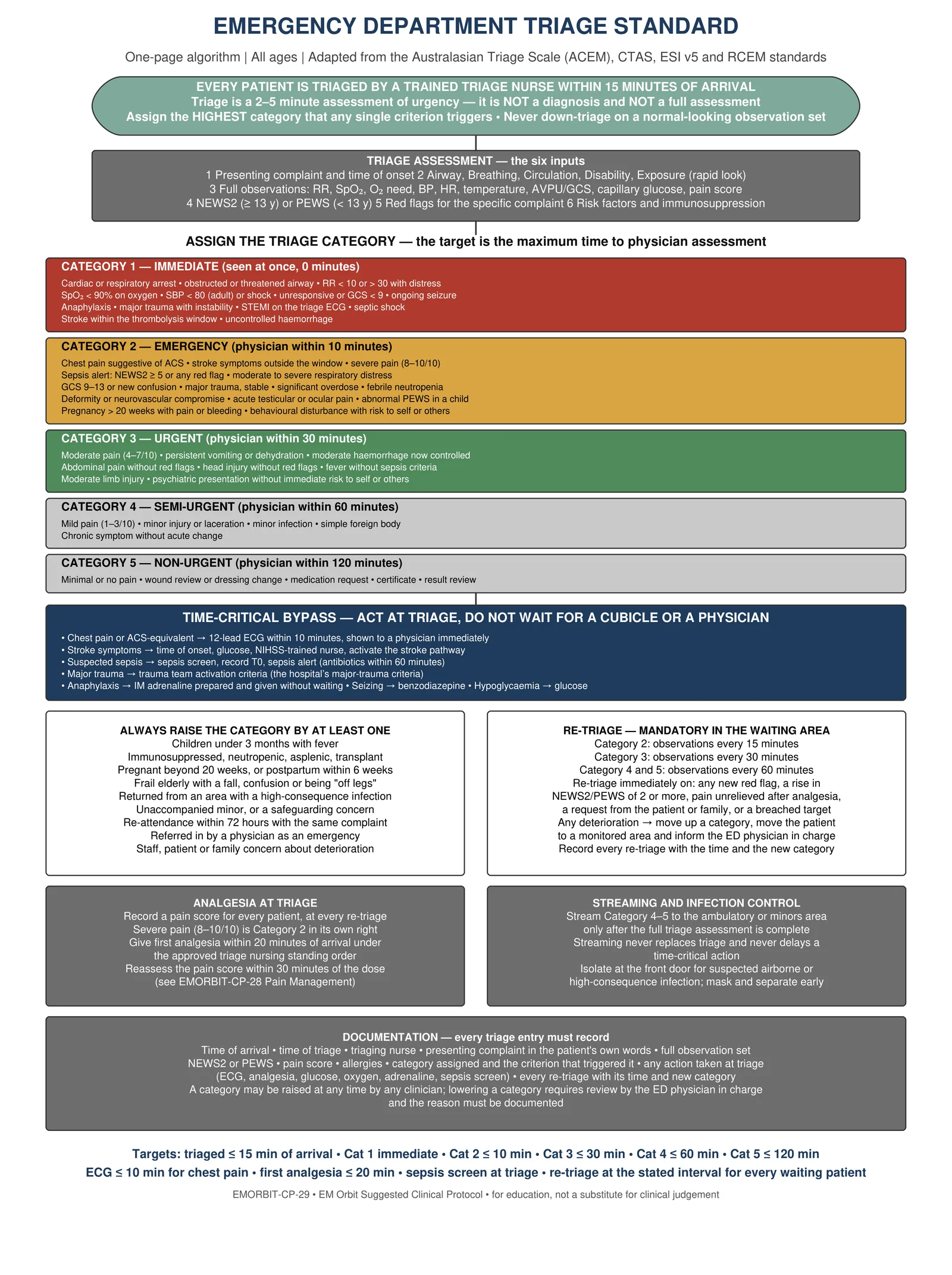
The one-page algorithm is shown at the top of this page.
6Team roles
6.1Triage Nurse:
6.1.1 Perform the triage assessment within 15 minutes of arrival for every patient, assign the category, and document the criterion that triggered it.
6.1.2 Initiate the time-critical actions in Table 2 under the approved standing orders without waiting for physician assessment.
6.1.3 Communicate Category 1 and Category 2 patients verbally and directly to the ED physician and the nurse in charge.
6.1.4 Re-triage waiting patients at the intervals in Table 3 and escalate any deterioration or breach.
6.1.5 Maintain triage competency through annual reassessment and participation in the triage audit.
6.2ED Nurse in Charge:
6.2.1 Ensure the triage post is staffed at all times, monitor the triage queue and the waiting area, allocate patients to clinical areas, and support the triage nurse during periods of high demand.
6.2.2 Ensure that re-triage is being performed and recorded, and that a nurse is identified as responsible for the waiting area on every shift.
6.3ED Physician in Charge:
6.3.1 Respond immediately to Category 1 and Category 2 notifications, review any request to lower a category, and be informed of every breach of a Category 2 target.
6.3.2 Implement the departmental escalation plan when targets are being breached, and escalate sustained breaches to the hospital command structure.
6.3.3 Support the triage nurse in decisions of uncertainty; where a triage decision is disputed, the higher category applies until the physician has assessed the patient.
6.4Ambulance and Pre-hospital Providers:
6.4.1 Pre-alert the ED for any time-critical patient so that the receiving area, team and equipment are prepared, and give a structured handover on arrival.
6.5Registration and Reception Staff:
6.5.1 Direct every arriving patient to triage before registration, and inform the triage nurse immediately of any patient who appears unwell, is in severe pain, or reports chest pain, breathing difficulty, stroke symptoms, or bleeding.
6.5.2 Never advise a patient on clinical urgency or ask a patient to wait before being triaged.
6.6Clinical Pharmacist:
6.6.1 Maintain and review the triage nursing standing orders for analgesia, glucose, adrenaline and other front-door medicines, and ensure those medicines are immediately available at triage.
6.7Infection Control:
6.7.1 Define and review the front-door isolation criteria and support the triage team in their application.
6.8Quality and Patient Safety:
6.8.1 Conduct the monthly triage audit, review all incidents involving triage, and report performance against section 11 to the relevant clinical governance committee.
7The patient's role
7.1 Report to the triage nurse on arrival, before registration, and describe the main problem and when it started.
7.2 Report all current medication, allergies, pregnancy, and any condition that weakens the immune system.
7.3 Report immediately to a member of staff any worsening of symptoms while waiting, including new chest pain, difficulty breathing, worsening pain, bleeding, drowsiness or confusion.
7.4 Family and carers: report any concern about deterioration to staff; such concern is itself a trigger for re-triage.
7.5 Inform staff before leaving the department if the decision is made not to wait.
8Definitions
8.1Triage: the brief structured assessment of clinical urgency performed on arrival, which determines the maximum time a patient can safely wait for physician assessment. It is not a diagnosis.
8.2Triage Category: one of the five levels in Table 1, each with a defined maximum time to physician assessment.
8.3Re-triage: the repeat assessment of a patient who is waiting, at defined intervals or on defined triggers, to detect deterioration.
8.4Streaming: the allocation of a triaged patient to a particular clinical area or care pathway; an operational decision that follows triage and does not replace it.
8.5Standing Order: a written, approved instruction that authorizes a nurse to initiate a specified assessment or treatment for a defined presentation before physician assessment.
8.6NEWS2: the National Early Warning Score 2 (Royal College of Physicians, 2017), the aggregate physiological score used for patients aged 13 years and above.
8.7PEWS: the Paediatric Early Warning Score, the age-appropriate aggregate physiological score used for children under 13 years.
8.8Time-Critical Presentation: a presentation in which the outcome depends on an action delivered within a defined short interval, listed in Table 2.
8.9ATS, CTAS, ESI: Australasian Triage Scale; Canadian Triage and Acuity Scale; Emergency Severity Index — the three internationally validated five-level triage scales from which this standard is adapted.
8.10ACEM, RCEM, ACEP: Australasian College for Emergency Medicine; Royal College of Emergency Medicine; American College of Emergency Physicians.
9Attachments
- Attachment 1: One-page algorithm (top of this page)
- Attachment 2: Triage Category Criteria — Desk Reference
- Attachment 3: Time-Critical Actions at Triage and Re-triage Intervals
- Attachment 4: Triage Audit Tool
11Suggested quality indicators
11.1Time to triage: (Number of patients triaged within 15 minutes of arrival / Total number of ED attendances) × 100. Target ≥ 95%.
11.2Category 1 and 2 compliance: (Number of Category 1 patients seen immediately and Category 2 patients seen by a physician within 10 minutes / Total number of Category 1 and 2 patients) × 100. Target ≥ 90%.
11.3Door-to-ECG for chest pain: (Number of patients presenting with chest pain or an acute coronary syndrome equivalent who had a 12-lead ECG within 10 minutes of arrival / Total number of such patients) × 100. Target ≥ 90%.
11.4Analgesia at triage: (Number of patients with a pain score of 8 or above who received analgesia within 20 minutes of arrival / Total number of such patients) × 100. Target ≥ 80%.
11.5Re-triage compliance: (Number of waiting patients with re-triage documented at the required interval / Total number of patients who waited beyond their category target) × 100. Target ≥ 90%.
11.6Triage accuracy: (Number of audited triage entries in which the assigned category matched the category determined on retrospective review / Total number of audited entries) × 100. Target ≥ 85%; under-triage is reported separately from over-triage.
11.7Outcome indicators (monitored, no fixed target): number of patients who deteriorated in the waiting area and required resuscitation; number who left before being seen, by category; and 72-hour re-attendance rate after leaving before being seen.
13References
- Australasian College for Emergency Medicine. Guidelines on the Implementation of the Australasian Triage Scale in Emergency Departments (G24). Melbourne: ACEM.
- Australasian College for Emergency Medicine. Policy on the Australasian Triage Scale (P06). Melbourne: ACEM.
- Canadian Association of Emergency Physicians. Canadian Triage and Acuity Scale (CTAS): Combined Adult and Paediatric Guidelines, 2016 revision. CJEM.
- Agency for Healthcare Research and Quality / Emergency Nurses Association. Emergency Severity Index (ESI): A Triage Tool for Emergency Department Care, version 5; 2023.
- Royal College of Emergency Medicine. Initial assessment of emergency department patients — clinical standards and quality indicators. London: RCEM.
- Royal College of Physicians. National Early Warning Score (NEWS) 2: standardising the assessment of acute-illness severity in the NHS. London: RCP; 2017.
- Royal College of Paediatrics and Child Health / NHS England. Paediatric Early Warning System (PEWSystem) — national score and escalation framework.
- Gilboy N, Tanabe P, Travers D, Rosenau AM. Emergency Severity Index implementation handbook. Rockville: AHRQ.
A2Attachment 2: Triage Category Criteria — Desk Reference
| Category | Maximum time to physician | Representative criteria (not exhaustive) | Location |
|---|---|---|---|
| 1 IMMEDIATE | Immediate (0 minutes); simultaneous nursing and medical care | Cardiac or respiratory arrest; obstructed or threatened airway; respiratory rate below 10 or above 30 with distress; SpO₂ below 90 per cent on oxygen; systolic blood pressure below 80 mmHg in an adult, or shock at any age; unresponsive or GCS below 9; ongoing seizure; anaphylaxis; major trauma with physiological instability; ST-elevation myocardial infarction on the triage electrocardiogram; acute stroke within the reperfusion window; septic shock; uncontrolled external haemorrhage. | Resuscitation area |
| 2 EMERGENCY | 10 minutes | Chest pain suggestive of acute coronary syndrome; stroke symptoms outside the reperfusion window; sepsis alert (NEWS2 of 5 or more, or any red flag); severe pain scored 8 to 10 out of 10; moderate to severe respiratory distress; GCS 9 to 13 or new confusion; major trauma that is physiologically stable; significant overdose or poisoning; febrile neutropenia; limb deformity with neurovascular compromise; acute testicular pain or acute visual loss or chemical eye injury; any child with an abnormal PEWS; pregnancy beyond 20 weeks with abdominal pain or bleeding; acute behavioural disturbance with risk to self or others. | Resuscitation or monitored bay |
| 3 URGENT | 30 minutes | Moderate pain scored 4 to 7 out of 10; persistent vomiting or clinical dehydration; moderate haemorrhage now controlled; abdominal pain without red flags; head injury without red flags; fever without sepsis criteria; moderate limb injury; psychiatric presentation without immediate risk. | Majors / monitored cubicle |
| 4 SEMI-URGENT | 60 minutes | Mild pain scored 1 to 3 out of 10; minor injury or laceration; minor localized infection; simple foreign body; chronic symptom without acute change. | Ambulatory / minors area |
| 5 NON-URGENT | 120 minutes | Minimal or no pain; wound review or dressing change; medication request; medical certificate; review of a result. | Ambulatory / minors area |
The category is assigned on the single highest-acuity criterion present. A patient meeting one Category 2 criterion is Category 2 even if every other parameter is normal. Categories may be raised at any time by any clinician; lowering a category requires review by the ED physician in charge and the reason shall be documented.
A3Attachment 3: Time-Critical Actions at Triage and Re-triage Intervals
| Presentation | Action at triage | Target |
|---|---|---|
| Chest pain or acute coronary syndrome equivalent (including epigastric pain, dyspnoea or syncope in a patient at risk) | 12-lead electrocardiogram, shown immediately to a physician for interpretation | ECG within 10 minutes of arrival; physician interpretation within 10 minutes of the ECG |
| Suspected stroke | Record exact time last known well, capillary glucose, FAST/ROSIER assessment, activate the stroke pathway | Stroke pathway activated at triage; no delay for registration |
| Suspected sepsis | Sepsis screen (NEWS2, red flags), record T0, declare sepsis alert, draw cultures and lactate | Screen at triage; antibiotics within 60 minutes of T0 |
| Major trauma | Apply the trauma team activation criteria of EMORBIT-CP-19 (Major Trauma); pre-alert response | Trauma team activated before or on arrival |
| Anaphylaxis | Prepare and give intramuscular adrenaline under standing order; do not wait for a cubicle | Adrenaline within 5 minutes of recognition |
| Active seizure | Airway position, oxygen, capillary glucose, prepare benzodiazepine | Benzodiazepine within 5 minutes if still seizing |
| Hypoglycaemia (capillary glucose below 3 mmol/L) | Oral or intravenous glucose under standing order | Treatment at triage; recheck in 15 minutes |
| Severe pain (8 to 10 out of 10) | First analgesia under the triage standing order | Analgesia within 20 minutes of arrival |
| Suspected airborne or high-consequence infection | Mask, isolate or separate at the front door; notify infection control | Isolation before entering the main waiting area |
| Category | Observation interval while waiting | Additional requirement |
|---|---|---|
| 1 | Not applicable | Continuous monitoring in the resuscitation area; never waits |
| 2 | Every 15 minutes | Nurse-initiated escalation to the ED physician in charge if the target of 10 minutes is breached |
| 3 | Every 30 minutes | Escalation if the 30-minute target is breached or pain remains uncontrolled |
| 4 | Every 60 minutes | Re-triage on any patient or family report of deterioration |
| 5 | Every 60 minutes | Re-triage on any patient or family report of deterioration |
Re-triage is performed immediately, irrespective of the interval, on: any new red flag; a rise in NEWS2 or PEWS of 2 or more points; pain unrelieved 30 minutes after analgesia; any request by the patient, family or carer; a breached time target; or any concern expressed by any member of staff. Every re-triage is recorded with its time, the new observation set, and the resulting category.
A4Attachment 4: Triage Audit Tool
A minimum of 30 triage entries per month shall be audited by the ED quality team, together with every case in which a patient deteriorated in the waiting area, every Category 1 to 3 patient who left before being seen, and every incident in which triage was a contributing factor. Under-triage (a category assigned that is lower than the retrospectively determined category) is reported separately from over-triage.
| ✓ | Audit item | Result / comment |
|---|---|---|
| ☐ | Patient triaged within 15 minutes of arrival | |
| ☐ | Presenting complaint recorded in the patient's own words | |
| ☐ | Complete observation set recorded, including pain score | |
| ☐ | NEWS2 or PEWS calculated and recorded | |
| ☐ | Category assigned, and the triggering criterion documented | |
| ☐ | Category assigned matches the category on retrospective review (state under- or over-triage) | |
| ☐ | Time-critical action performed where indicated (ECG, sepsis screen, adrenaline, glucose, analgesia, stroke or trauma activation) | |
| ☐ | Patient seen by a physician within the category target | |
| ☐ | Re-triage performed and recorded at the required interval where the patient waited | |
| ☐ | Escalation documented where the target was breached | |
| ☐ | Any category lowered was reviewed by the ED physician in charge with a documented reason | |
| ☐ | Patient and family informed of category and waiting time, and of when to report deterioration |