Major Trauma: Emergency Department Reception, Activation and Damage-Control Resuscitation
EMORBIT-CP-19 · Chapter 9 · Trauma and Musculoskeletal Emergencies
Open in the appFree, works on your phone and offline, with every tool alongside.
Evidence base: ATLS 11; NICE NG39; ETC; European Bleeding Guideline 2023
1Purpose
1.1 This guideline adopts your institution's Major Trauma Management Policy in full, and adds the Emergency Department (ED) front-door phase of care. It does not replace, amend, or restate that policy. Activation levels and activation criteria, the ATMIST handover, the xABCDE approach, damage control resuscitation, the massive transfusion protocol, tranexamic acid, the laboratory panel, the imaging pathway, the CT safety checklist, the secondary survey, specific interventions, spinal motion restriction, traumatic cardiac arrest, disposition, transfer to a tertiary centre, institutional documentation, the institutional key performance indicators, and the paediatric, obstetric and burns appendices are all governed by that policy and are cross-referenced here by their heading names.
1.2 Define what the ED shall have ready before the patient arrives: the reception of the pre-alert, the single trauma call, and a ten-minute trauma bay preparation that fixes who stands where, what equipment is open, what blood is on standby, how the patient will be kept warm, and that the ultrasound machine and the airway trolley are ready (section 4.3.1 and Attachment 3).
1.3 Define the ED role of every member of the trauma team, so that tasks are allocated by name rather than by seniority or by whoever is nearest, and publish that allocation as a role card (Attachment 2).
1.4 Define the exact triage action for a patient who walks in, or is brought by private vehicle, and who meets the activation criteria of the policy, so that the absence of a pre-alert never delays activation (section 4.1.1).
1.5 Establish horizontal (team-based, simultaneous) resuscitation as the ED standard for a Level 1 activation, define how simultaneous tasks are allocated, and establish a read-back and closed-loop communication standard for every order given in the trauma bay (sections 4.3.2 and 4.3.3).
1.6 Establish the ten-second round on arrival and the structured pause before the patient leaves the resuscitation bay for computed tomography (sections 4.3.1 and 4.3.5).
1.7 Define the ED analgesia and sedation plan in trauma, and the tetanus and antibiotic prophylaxis that shall be given or formally excluded at the front door (sections 4.3.4.1 to 4.3.4.3).
1.8 Define the ED operational role within the massive haemorrhage protocol, cross-referenced to EMORBIT-CP-27 Massive Haemorrhage and Massive Transfusion — ED Activation and to the policy sections "Damage Control Resuscitation (DCR)" and "Massive Transfusion Protocol (MTP)".
1.9 Define the documentation the ED shall complete before the patient leaves the department, and the handover format used to theatre, to critical care, and to a receiving hospital (sections 4.3.7, 4.3.9 and Attachment 4).
1.10 Define what happens when trauma team members are unavailable, or when the department is already committed to another resuscitation (section 4.3.8).
1.11 Ensure consistency of practice among all healthcare providers (HCP) and alignment with Advanced Trauma Life Support (ATLS, 11th edition), the National Institute for Health and Care Excellence (NICE NG39 and NG40), the European guideline on the management of major bleeding and coagulopathy following trauma (sixth edition, 2023), the European Trauma Course (ETC), and the Royal College of Emergency Medicine (RCEM).
2Who this protocol applies to
2.1 Every patient who meets any activation criterion of your institution's Major Trauma Management Policy, section "Trauma Activation System — Activation Criteria", whether physiological, anatomical, or by mechanism and special consideration, and whether arriving by ambulance, on foot, by private vehicle, or transferred from another facility.
2.2 Every patient for whom a trauma pre-alert has been received, from the moment the pre-alert is taken until the patient arrives, is stood down, or is diverted.
2.3 Every patient in whom major trauma is recognised after arrival, including a patient triaged into a cubicle or the waiting area in whom occult injury or deterioration is subsequently identified; the activation and the clock start at that moment.
2.4 Patients in traumatic cardiac arrest, who are managed as a Level 1 activation as per the policy section "Traumatic Cardiac Arrest" and its appendix.
2.5 Paediatric, obstetric and major burns trauma at the ED front door, with the modifications set out in the policy appendices "Pediatric Trauma Resuscitation Guidelines", "Obstetric Trauma Management Guidelines" and "Major Burns Management Guidelines"; this protocol governs only the reception, activation and team process for those patients.
2.6 Patients who are stood down from a Level 1 or Level 2 activation after senior assessment; the de-escalation, its reason, and the responsible clinician shall be documented (section 4.3.9).
3Not covered by this protocol
3.1 Patients who do not meet any activation criterion and have an isolated minor injury; these are managed through the normal ED streams under the Emergency Department Triage Standard (EMORBIT-CP-29), with re-triage if any criterion subsequently appears.
3.2 Inpatient and definitive management of the injured patient, including operative and non-operative management of specific injuries, critical care management, rehabilitation, and the tertiary survey once the patient has left the ED, all of which are governed by your institution's Major Trauma Management Policy and the admitting specialty.
3.3 The clinical content already set out in the policy: activation levels and criteria, the ATMIST content, the xABCDE sequence and its interventions, damage control resuscitation principles, massive transfusion protocol activation criteria and content, tranexamic acid indications, timing, dose and contraindications, the laboratory panel, the imaging decision table, the CT safety checklist items, secondary survey content, spinal motion restriction indications, traumatic cardiac arrest management, disposition and admitting-service rules, transfer indications and the transfer checklist. This protocol shall not be read as amending any of them.
3.4 Isolated burns without trauma, isolated head injury without activation criteria, and drowning or hanging without associated major trauma, which are managed under their own ED Clinical Practice Guidelines while adopting the same team and communication standards.
3.5 Mass-casualty and major-incident reception, which is governed by the local and facility major incident plans; the team roles in Attachment 2 remain valid within that plan.
4Protocol
4.1History and Assessment:
4.1.1Reception, Triage and Recognition at the Front Door:
4.1.1.1 Pre-alert reception. A trauma pre-alert shall be taken on a dedicated trauma telephone by the ED nurse in charge, with the senior ED physician present or immediately informed. The receiver shall record the ATMIST verbatim on the ED trauma record, read it back to the caller, and confirm the expected time of arrival. The receiver shall not attempt to give clinical advice to the crew during the pre-alert; a clinical question is answered by the senior ED physician on the same call.
4.1.1.2 Declaring the level. The senior ED physician shall declare the activation level (Level 1, Level 2 or Level 3) as defined in the policy section "Trauma Activation System — Activation Levels", using the criteria in "Activation Criteria". Where the information is incomplete or conflicting, the higher level shall be declared; over-triage at the front door is expected and is safer than under-triage. Any team member may request escalation of the level at any time, and the request shall be granted.
4.1.1.3 One call. A single switchboard trauma call shall be made within 2 minutes of the pre-alert, stating the activation level, whether the patient is adult, paediatric or obstetric, the mechanism in one phrase, the expected time of arrival, and the bay. Individual bleeping or telephoning of team members shall not replace the single call, because it delays assembly and produces an incomplete team.
4.1.1.4 Ten-minute bay preparation. The trauma bay shall be prepared according to Table 1 and Attachment 3. The preparation is a checklist with named owners and is completed before arrival; where the pre-alert gives less than ten minutes’ notice, the steps are performed in the order shown and the team leader states aloud which steps were not completed.
4.1.1.5 Walk-in and private-vehicle arrivals. The triage nurse shall apply the policy activation criteria to every patient presenting with an injury, at the moment of first contact and before registration. Where any criterion is met, the triage nurse shall: (a) not send the patient to the waiting area and not complete registration first; (b) move the patient directly to the resuscitation bay on an ED trolley, with manual in-line stabilisation of the cervical spine where indicated and a pelvic binder applied where the mechanism suggests pelvic injury; (c) make the trauma call personally within 2 minutes of first contact, without needing the authorisation of a physician; (d) give a substitute handover to the team, because there will be no ATMIST — mechanism, time of injury, presenting complaint, the first observation set, allergies, anticoagulants, and who accompanied the patient; (e) register the patient under the pre-prepared unknown-patient identity where the name is not known, so that samples can be labelled and blood can be issued without delay; and (f) record the time of first contact as T0.
4.1.1.6 The triage nurse has standing authority to activate the trauma team. An activation made by a nurse shall never be criticised retrospectively where the criteria were met, and a stand-down may be made only by the senior ED physician after review at the bedside.
4.1.1.7 Recognition after arrival. Any patient already in the department in whom major trauma or occult injury is recognised, including a patient who deteriorates while waiting for imaging or a bed, shall be moved to the resuscitation bay and a trauma call made at that moment. The time of recognition becomes T0 and every target in Table 3 runs from it.
4.1.1.8 Interfacility transfers in. A patient arriving from another facility shall be received as a Level 1 or Level 2 activation according to the same criteria, with the team assembled before arrival, and shall be re-examined from the beginning; findings and imaging from the sending facility are treated as information to be verified, not as a completed assessment.
4.1.1.9
Table 1: The ten-minute trauma bay preparation, counted back from the expected time of arrival (T0). Where the pre-alert gives less than ten minutes, the steps are performed in the order shown and the team leader states aloud which steps were not completed. Time Action Responsible T − 10 Receive the ATMIST pre-alert on the dedicated trauma telephone; read it back to the caller; record it verbatim on the ED trauma record (Attachment 4); declare the activation level and the expected time of arrival. ED nurse in charge with the senior ED physician T − 9 Make one single trauma call through the agreed switchboard code, stating: activation level, adult or paediatric or obstetric, mechanism in one phrase, expected time of arrival, and the bay number. Individual bleeping of team members shall not replace the single call. ED nurse in charge T − 8 Clear the resuscitation bay: move any stable patient out, remove the previous patient’s equipment and waste, and confirm that a second bay and a second team are available for a concurrent case. ED nurses T − 7 Start active warming of the environment: raise the bay temperature to at least 25 °C where the system allows, switch on the forced-air warming device and the fluid warmer, and place warmed blankets on the trolley. ED nurse T − 6 Switch on and test the monitor (three-lead electrocardiogram, non-invasive blood pressure cycling every 3 minutes, pulse oximetry, capnography); test two suction units; connect oxygen and a bag-valve-mask with reservoir. ED nurse T − 5 Check the airway trolley: videolaryngoscope charged, blades, bougie, supraglottic airways, and the front-of-neck access set opened and visible. The airway doctor states the airway plan A to D aloud and names the person who will perform front-of-neck access. Airway doctor and airway assistant T − 4 Lay out vascular access on both sides: two large-bore cannulae and an intraosseous device, blood tubes including group and crossmatch, arterial and venous blood gas syringes, the point-of-care haemoglobin device, and pre-printed labels (unknown-patient identity where the name is not known). ED nurses T − 3 Lay out haemorrhage control: two tourniquets, haemostatic dressings, a pelvic binder positioned on the trolley beneath the expected position of the greater trochanters, trauma shears, two chest drain sets and a thoracostomy kit. Procedure doctors T − 2 Confirm blood: emergency O RhD-negative units immediately available in the ED satellite refrigerator (O RhD-negative reserved for females of childbearing potential), the rapid infuser primed and warmed, and the blood bank informed that a Level 1 activation is inbound so that the first massive haemorrhage pack can be prepared as per EMORBIT-CP-27. Circulation nurse and runner T − 2 Switch on the ultrasound machine with the curvilinear probe selected and gel applied; call the radiographer to the bay with the mobile unit; place lead aprons at the bay entrance. ED nurse and radiographer T − 1 The team assembles in the bay in full personal protective equipment (fluid-repellent gown, gloves, eye protection, lead apron). Each member states name and role aloud. The team leader gives the pre-arrival brief: activation level, expected injuries, the first three tasks and who owns each, the transfusion plan, and the intended destination. Trauma team leader T − 1 Name the scribe, start the clock on the ED trauma record, name the runner, and name the clinician who will speak to the family. Restrict the bay to the named team; all others observe from outside the marked zone. Trauma team leader and scribe T 0 Patient arrives. Hands off the patient for the ten-second round unless the patient is in extremis (see section 4.3.1). Whole team
4.1.2History at the Front Door (obtained in parallel with resuscitation, never delaying it):
4.1.2.1 The ATMIST as received, recorded verbatim, and then updated by the team leader as findings emerge. The AMPLE history is completed as per the policy section "Secondary Survey and Trauma History".
4.1.2.2 Anticoagulant and antiplatelet therapy shall be asked for explicitly and early in every trauma patient, and the answer recorded even when it is negative, together with the time of the last dose. Reversal is arranged through the massive haemorrhage arrangements and EMORBIT-CP-27.
4.1.2.3 Time of injury, which starts the tranexamic acid window defined in the policy section "Tranexamic Acid (TXA)"; where the time is unknown, the time the patient was last seen well shall be recorded.
4.1.2.4 Pre-hospital interventions with their times: tourniquet application time, pelvic binder, decompression, airway manoeuvres, fluids, blood, analgesia, and any drug given by the crew.
4.1.2.5 Entrapment and extrication time, the fate of other occupants, the height of a fall and the surface landed on, the weapon or calibre in penetrating injury, and any fire, smoke or chemical exposure.
4.1.2.6 Pre-existing disease and functional baseline, in particular ischaemic heart disease, chronic kidney disease, cirrhosis, and frailty, which change the interpretation of the observations and the ceiling of care discussion.
4.1.2.7 Safeguarding and forensic history: mechanism inconsistent with the injuries, delayed presentation, interpersonal violence, suspected non-accidental injury in a child or a vulnerable adult, and whether the police are involved.
4.1.3Examination at the Front Door:
4.1.3.1 The primary survey follows the xABCDE sequence set out in the policy section "Initial Assessment and Resuscitation"; it is not restated here. The ED addition is that it is performed horizontally by the whole team simultaneously (section 4.3.2), with the findings called out to the leader and recorded by the scribe.
4.1.3.2 The patient shall be fully exposed for examination and immediately re-covered; exposure and hypothermia are managed together and the temperature is measured within 10 minutes of arrival and again before the patient leaves the department.
4.1.3.3 A structured log roll shall be performed once, at a time chosen by the team leader, with a named person controlling the head, and shall include inspection of the back, palpation of the spine, examination of the perineum and buttocks, and a rectal examination only where it will change management.
4.1.3.4 Every wound shall be counted, described and documented, including the number and site of penetrating wounds, before dressings are applied; wounds concealed by hair, in skin folds, in the axillae and in the perineum are commonly missed.
4.1.3.5 Distal neurovascular status shall be documented before and after every splint, binder, reduction or block, and again before the patient leaves the department.
4.1.3.6 The eFAST examination shall be performed by a clinician credentialled to do so, its findings called out as positive, negative or indeterminate, and the images saved to the record; a negative eFAST does not exclude haemorrhage and shall not be used to overrule the clinical picture.
4.1.4Severity and Risk Stratification at the Front Door:
4.1.4.1 Activation level is assigned as per the policy section "Trauma Activation System"; the ED classification below describes the response to resuscitation and drives the ED decision on destination.
4.1.4.2 Responder: physiology normalises after initial resuscitation and remains normal. Proceed to imaging as per the policy section "Imaging Pathway" after the structured pause in section 4.3.5.
4.1.4.3 Transient responder: physiology improves and then deteriorates again. This patient is bleeding. Continue blood product resuscitation, keep the surgeon at the bedside, obtain imaging only if it is safe and will change the operation, and prepare theatre in parallel.
4.1.4.4 Non-responder: no improvement despite resuscitation. This patient needs haemorrhage control now. Activate the massive haemorrhage protocol, do not leave the resuscitation area for computed tomography, and move to theatre, interventional radiology or transfer as per the policy sections "Imaging Pathway" and "Disposition".
4.1.4.5 Physiological triggers for immediate senior escalation regardless of the declared level: systolic blood pressure below 90 mmHg at any point; a shock index (heart rate divided by systolic blood pressure) above 1; base deficit worse than −6 mmol/L or lactate above 4 mmol/L; a temperature below 36 °C; a Glasgow Coma Scale of 8 or less; or a requirement for more than two units of blood in the first 30 minutes.
4.1.4.6 The elderly, the anticoagulated, the pregnant patient and the young child compensate and then decompensate abruptly; a normal blood pressure in these groups is not reassurance and the activation level shall not be reduced on the basis of it.
4.1.5Front-Door Traps, and Conditions that Mimic or Complicate Major Trauma:
4.1.5.1 A medical event that caused the trauma: syncope, arrhythmia, seizure, hypoglycaemia, stroke, myocardial infarction, aortic dissection, or drug and alcohol intoxication. A twelve-lead electrocardiogram and a capillary glucose shall be obtained in every adult trauma patient in whom the mechanism is unexplained.
4.1.5.2 Non-haemorrhagic causes of shock in the injured patient: tension pneumothorax, cardiac tamponade, high spinal cord injury with neurogenic shock, and myocardial contusion. Haemorrhage remains the working diagnosis until these are actively excluded.
4.1.5.3 Attributing a reduced level of consciousness to alcohol, drugs or pain rather than to traumatic brain injury, hypoxia or hypoperfusion.
4.1.5.4 The distracting injury: an obvious deformed limb or a dramatic facial wound draws the team away from the torso, which is where patients bleed to death.
4.1.5.5 Occult injury in the elderly after a low fall, and in the anticoagulated patient after apparently trivial head injury; both may meet activation criteria on mechanism alone and both are under-triaged.
4.1.5.6 Hypothermia, acidosis and coagulopathy develop silently in the resuscitation bay itself; the ED is where they are prevented, not where they are discovered.
4.1.6Special Populations at the Front Door:
4.1.6.1 Children: the activation threshold is lower, as set out in the policy appendix "Pediatric Trauma Resuscitation Guidelines". The ED additions are that a length-based weight tape shall be applied at the moment of arrival and the weight written on the board, that all doses are calculated by the scribe and read back before administration, that a parent shall be offered a place in the bay with a named staff member to support them, and that a safeguarding assessment is completed before the child leaves the department.
4.1.6.2 Pregnancy beyond 12 weeks: manage as per the policy appendix "Obstetric Trauma Management Guidelines". The ED additions are that the obstetric and neonatal teams are called with the trauma call rather than after it, that left lateral tilt or manual uterine displacement is assigned to a named team member at the moment of arrival, and that the fundal height and the time of the last fetal movement are recorded on arrival.
4.1.6.3 Major burns: manage as per the policy appendix "Major Burns Management Guidelines". The ED additions are that a burn is a trauma call where it meets the major burn definition or is accompanied by trauma, that active warming is started despite the burn, and that the time cooling started and stopped is recorded.
4.1.6.4 Older and frail patients: an activation shall not be downgraded on the basis of a normal blood pressure; anticoagulation shall be identified in the first minutes; a ceiling of care discussion shall be started early, involving the patient where possible, and shall be documented before the patient leaves the ED.
4.1.6.5 Patients under police custody, and suspected interpersonal violence: clinical need takes precedence over all other considerations; clothing shall be cut along seams and not through wounds, and retained; evidence handed over to the police shall be documented with the name and number of the receiving officer; the patient’s confidentiality is preserved and information is disclosed only as permitted by the local information governance and safeguarding policies.
4.1.6.6 Patients who decline assessment or transfer: capacity shall be assessed and documented, the risks explained with an interpreter where needed, and the senior ED physician involved before any injured patient with activation criteria leaves the department.
4.2Investigations:
4.2.1 The trauma blood panel, point-of-care testing, viscoelastic testing and the imaging pathway are set out in the policy sections "Laboratory Investigation and Monitoring" and "Imaging Pathway", and are not restated. The requirements below are the ED operational additions.
4.2.2 Blood samples shall be taken at the moment of first vascular access, on both sides where two cannulae are sited, and shall include the group and crossmatch sample. Samples shall be labelled at the bedside by the person who took them, never in advance and never away from the patient.
4.2.3 Where the identity is unknown, the pre-prepared unknown-patient identity pack shall be used for every sample and every request, and the identity shall be reconciled with the true identity by a documented merge process once it is known; a second crossmatch sample is required after any identity change.
4.2.4 The runner shall carry the samples to the laboratory personally for a Level 1 activation, or send them by the dedicated route agreed with the laboratory; samples for a trauma call shall not be left in a general collection point.
4.2.5 Point-of-care testing performed in the bay — blood gas, lactate, base deficit, haemoglobin, glucose, ionised calcium and potassium — shall be repeated after every four units of blood product and whenever the physiology changes, and the results shall be called out to the team and written on the board.
4.2.6 Portable chest and pelvic radiographs shall be taken in the bay on the team leader’s call, with the radiographer announcing the exposure and the team stepping back; the images shall be reviewed by the team leader within 2 minutes of acquisition and the interpretation stated aloud.
4.2.7 No patient shall leave the resuscitation bay for computed tomography without the structured pause in section 4.3.5 and the CT safety checklist in the policy section "CT Safety Checklist".
4.2.8 Critical imaging findings shall be communicated verbally and immediately as required by the policy section "Imaging Pathway"; the ED shall record who gave the verbal report, to whom, and at what time.
4.2.9 A pregnancy test shall be performed in every female of childbearing potential before imaging where it does not delay life-saving imaging; a negative or pending result shall never delay imaging in the unstable patient.
4.2.10 An electrocardiogram and a capillary glucose shall be obtained in every adult patient whose mechanism is unexplained, and in every patient over 65 years with a fall.
4.3Plan of Care:
4.3.1Immediate Actions — Arrival and the First Ten Minutes:
4.3.1.1 The ten-second round. At the moment of arrival the team stops. Nobody touches the patient, nobody speaks except the pre-hospital crew, and the patient is not moved from the ambulance trolley, for up to ten seconds, while the crew delivers the ATMIST. The team leader then repeats back the ATMIST in one sentence, states the working problem list and the first three tasks with the name of the person who owns each, and says "transfer on my count".
4.3.1.2 The ten-second round is omitted only where the patient is in extremis — in cardiac arrest, with an obstructed airway, or with uncontrolled external haemorrhage. In that case the leader states "no round, [name] take the airway, [name] control the bleeding", the ATMIST is given by the crew to the scribe while the team works, and the leader summarises it aloud within the first two minutes.
4.3.1.3 The pre-hospital crew shall not leave until the team leader has confirmed the ATMIST, the drugs and times given, and the tourniquet application time, and has thanked and released them explicitly.
4.3.1.4 Transfer from the ambulance trolley shall be a single controlled move on the leader’s count, with a named person controlling the head, using a scoop or a slide sheet; the patient shall not be moved between surfaces more than necessary.
4.3.1.5 The remainder of the first ten minutes follows the policy section "Initial Assessment and Resuscitation", performed horizontally: catastrophic haemorrhage control, airway with spinal motion restriction, breathing, circulation with access and blood, disability, and exposure with warming, together with the adjuncts listed in "Adjuncts to Primary Survey".
4.3.1.6 Active warming shall be started at the same time as the primary survey and not after it: warmed blood and fluids through the fluid warmer, a forced-air warming device, removal of wet clothing and packaging, a warm bay, and the temperature measured and recorded within 10 minutes. Hypothermia in the injured patient is an ED-preventable complication.
4.3.1.7 Analgesia shall be given within 15 minutes (section 4.3.4.1) unless it is contraindicated, and the reason for any delay shall be recorded.
4.3.2Horizontal versus Vertical Resuscitation, and the Allocation of Simultaneous Tasks:
4.3.2.1 Vertical resuscitation is the sequential, single-clinician xABCDE assessment taught for the lone practitioner: each step is completed and its problem corrected before the next is begun. It is the correct model where one clinician is working alone, where the team is not yet assembled, and for Level 3 activations.
4.3.2.2 Horizontal resuscitation is the team-based model in which the same xABCDE priorities are addressed simultaneously by several clinicians under one leader. It is the ED standard for every Level 1 activation and for every Level 2 activation with abnormal physiology. The priorities of xABCDE are unchanged; only the number of hands changes.
4.3.2.3 In the horizontal model, the following proceed at the same time from the moment of transfer to the ED trolley: the airway doctor secures the airway and oxygenation at the head; procedure doctor 1 examines and manages the right chest and gains right-sided access; procedure doctor 2 gains left-sided access, controls external haemorrhage and checks the pelvic binder; the circulation nurse attaches monitoring and begins blood administration; the radiographer prepares the chest and pelvic films; and the scribe records.
4.3.2.4 The team leader shall not perform a procedure while leading. Where the leader must intervene, leadership shall be handed to a named clinician aloud — "[name], you are now team leader" — and handed back explicitly.
4.3.2.5 Task allocation rules: every task is given to a named person, not to the room; a person holds only one task at a time; a person who cannot complete a task says so immediately and the leader reallocates it; and a task that is finished is reported back to the leader with its result, not merely completed.
4.3.2.6 The leader shall give a verbal summary to the whole team within 15 minutes of arrival and then at least every 5 to 10 minutes, in the form: what we know, what we have done, what we are worried about, what happens next, and what would change the plan. Every summary is an opportunity for any team member to raise a concern.
4.3.2.7 Noise discipline: only the leader and the person being addressed speak during an instruction. The leader may call "stop" or "quiet" at any time, at which point everyone stops moving and speaking; any team member may call "stop" for a safety concern.
4.3.2.8 The number of people in the bay shall be limited to the named team; the ED nurse in charge controls entry. Observers stand outside the marked zone.
4.3.3Closed-Loop Communication and the Read-Back Standard:
4.3.3.1 Every instruction in the trauma bay shall be a closed loop with three parts: (1) the leader names the person and states the instruction; (2) the person reads back the instruction in full; (3) the person reports completion with the result and the time. An instruction that is not read back has not been given.
4.3.3.2 For a drug or blood product the read-back shall state the drug or product, the dose or number of units, the route, and the time, and shall be checked against the label by a second person before administration. Example: leader — "Ahmed, give one gram of tranexamic acid intravenously over ten minutes now"; nurse — "one gram of tranexamic acid, intravenously, over ten minutes, starting now"; nurse on completion — "tranexamic acid one gram given at 14:22, infusion running".
4.3.3.3 Numbers shall be read back digit by digit where they could be misheard, and units shall always be spoken (milligrams, micrograms, millilitres); the abbreviations "mcg" and "mg" shall never be spoken as "mic" or as a bare number.
4.3.3.4 Findings shall be called out to the leader in the same closed-loop form, stating the finding, its significance, and whether the leader has heard it: "Team leader — right chest, no breath sounds, trachea central, blood pressure 80" and the leader replies "heard, right chest no air entry".
4.3.3.5 Any team member may use the graded assertiveness escalation until the concern is acknowledged: state the observation, state the concern, state the problem, state the proposed action, and finally use the agreed challenge phrase, which shall be honoured immediately by stopping and re-examining the situation.
4.3.3.6 A concern raised and not acted upon shall be recorded on the ED trauma record and reviewed at the trauma governance meeting.
4.3.4Definitive ED Treatment at the Front Door:
4.3.4.1Analgesia and Sedation in Trauma:
4.3.4.1.1 Pain shall be scored within 15 minutes of arrival, using a numerical or visual scale in the communicating patient, and a behavioural scale in the child or the patient with impaired consciousness; the score shall be repeated 30 minutes after every analgesic intervention.
4.3.4.1.2 Analgesia shall be given during the primary survey. It shall not be withheld because the patient is going for imaging, because the abdomen has not yet been assessed by a surgeon, or because a head injury is suspected; a titrated opioid does not obscure the surgical abdomen and does not prevent neurological assessment when titrated and documented.
4.3.4.1.3 Analgesia in the shocked patient shall be given in reduced increments with the anticipation that even a small dose may cause hypotension; haemorrhage control and blood product resuscitation are themselves analgesic interventions.
4.3.4.1.4 Splintage, realignment, traction for an isolated femoral shaft fracture, covering burns, and keeping the patient warm and informed shall be used in every patient (Table 4).
4.3.4.1.5
Table 4: ED analgesia in major trauma. Analgesia is a resuscitation intervention, not an optional extra; it is given during the primary survey and is not deferred until imaging is complete. Every dose shall be titrated to effect, with the patient monitored and naloxone immediately available. Agent and route Adult Paediatric Notes and cautions Fentanyl, intranasal (first-line where there is no intravenous access) 50–100 micrograms (approximately 1.5 micrograms/kg), divided between both nostrils 1.5 micrograms/kg (maximum 100 micrograms), divided between both nostrils Onset 5–10 minutes; use the concentrated preparation with a mucosal atomiser; avoid where there is significant epistaxis or mid-face trauma; may be repeated once after 10 minutes. Fentanyl, intravenous (preferred opioid in shock) 0.5–1 microgram/kg, then 25 microgram increments every 5 minutes titrated to effect 0.5–1 microgram/kg, titrated Less histamine release and less hypotension than morphine; monitor respiratory rate and capnography; reduce the dose in the elderly and in head injury. Morphine, intravenous 2–2.5 mg increments every 5 minutes titrated to effect (approximately 0.1 mg/kg in total) 0.1 mg/kg, given in 0.05 mg/kg increments and titrated Reduce in shock, in the elderly, and in respiratory compromise; not the first choice while the patient is actively bleeding and hypotensive. Ketamine, analgesic (sub-dissociative) dose 0.1–0.3 mg/kg intravenously over 5 minutes; may be repeated 0.1–0.3 mg/kg intravenously over 5 minutes Useful where opioids are limited by hypotension or have failed; may cause emergence phenomena — warn the patient and keep the environment calm; does not replace haemorrhage control. Paracetamol, intravenous 1 g (15 mg/kg if under 50 kg) 15 mg/kg Adjunct only; reduce in hepatic impairment and in the malnourished. Non-steroidal anti-inflammatory drugs Avoid at the front door Avoid at the front door Platelet inhibition, renal hypoperfusion in the shocked patient, and possible effect on fracture healing; may be considered by the inpatient team once haemorrhage and renal injury are excluded. Regional analgesia — fascia iliaca compartment block For femoral shaft or femoral neck fracture, by a trained clinician, using a long-acting local anaesthetic within the maximum safe weight-based dose By a trained clinician using the weight-based dose; not a substitute for systemic analgesia in the unstable child Markedly reduces opioid requirement; document the drug, the concentration, the total dose in mg/kg, the maximum safe dose, and the neurovascular examination before and after the block; do not perform through infected or burned skin. Non-pharmacological Realign and splint every long-bone fracture; apply a traction splint for an isolated femoral shaft fracture; cover burns; reduce a dislocation causing neurovascular compromise; keep the patient warm and informed As for adults, with a parent present wherever possible and distraction techniques used Splintage and realignment are among the most effective analgesic manoeuvres in trauma and also reduce bleeding; a traction splint shall not be used where there is a co-existing pelvic or tibial fracture on the same side. All doses shall be verified by the ED pharmacist against the local formulary before use. Procedural sedation for reduction of a fracture or dislocation follows the local procedural sedation arrangements and shall not be undertaken during an ongoing trauma resuscitation.
4.3.4.1.6 Sedation and induction of anaesthesia. Emergency airway management in trauma follows the policy sections "Initial Assessment and Resuscitation — A" and "Specific Interventions — Airway". The ED additions are: a written, verbalised airway plan A to D before any drug is drawn; a named operator and a named person for front-of-neck access; manual in-line stabilisation rather than a hard collar during laryngoscopy; and the principle of resuscitating before intubating — correct hypovolaemia with blood, and have a vasoactive drug drawn up and a fluid or blood bolus running before induction.
4.3.4.1.7 Induction drug doses in the shocked trauma patient shall be reduced substantially from the standard dose, and a neuromuscular blocking drug given at full dose. The agent and dose shall be stated aloud, read back, and recorded with the time. Agents that cause vasodilatation and myocardial depression shall be avoided in uncontrolled haemorrhage.
4.3.4.1.8 Procedural sedation for the reduction of a fracture or dislocation shall not be performed during an ongoing trauma resuscitation, and shall follow the local procedural sedation arrangements with a dedicated sedationist, monitoring, and a recovery area.
4.3.4.2Tetanus and Antibiotic Prophylaxis at the Front Door:
4.3.4.2.1 Tetanus status shall be established and prophylaxis given or formally excluded before the patient leaves the ED, including for a patient going straight to theatre, using Table 5. The assessment and the outcome shall be recorded on the ED trauma record; "for the ward to do" is not acceptable, because it is the step most often lost at handover.
4.3.4.2.2 Antibiotic prophylaxis at the front door is set out in Table 6. For an open long-bone fracture the first intravenous dose shall be given as soon as possible and within one hour of injury, and always before the patient leaves the ED; the wound shall be photographed once, grossly contaminated material removed, the wound covered with a saline-soaked gauze and an occlusive dressing, the limb splinted, and the dressing not disturbed again in the ED.
4.3.4.2.3 Antibiotic choice, dose and duration are governed by EMORBIT-CP-57 (Antimicrobial Stewardship) and the local antibiogram; the ED responsibility is the timely first dose, the allergy check, and the record.
4.3.4.2.4 The time of tourniquet application shall be recorded and communicated at every handover; the tourniquet shall not be removed in the ED without a surgeon present and a plan for the resulting haemorrhage.
4.3.4.2.5
Table 5: Tetanus prophylaxis at the ED front door. This assessment shall be completed and documented for every trauma patient with a wound before the patient leaves the Emergency Department, including patients going directly to theatre. Immunisation status Clean minor wound Tetanus-prone wound High-risk tetanus-prone wound Complete course, boosters up to date (five doses, most recent within 10 years) No vaccine, no immunoglobulin No vaccine, no immunoglobulin No vaccine; give human tetanus immunoglobulin Primary course complete, boosters incomplete or overdue No vaccine needed for this wound; offer a dose to complete the schedule Give one reinforcing dose of a tetanus-containing vaccine Give one reinforcing dose of vaccine and human tetanus immunoglobulin Primary immunisation incomplete, unknown, or not received Give an immediate dose of a tetanus-containing vaccine and arrange the full course Give vaccine and human tetanus immunoglobulin Give vaccine and human tetanus immunoglobulin Tetanus-prone wound: a puncture wound or a wound in contact with soil or manure; a wound containing a foreign body; a compound fracture; a wound with devitalised tissue; a wound or burn in a patient with systemic sepsis; a wound sustained more than six hours before surgical treatment. High-risk: heavy contamination with material likely to contain tetanus spores, extensive devitalised tissue, or an injury requiring surgical intervention that is delayed by more than six hours. Human tetanus immunoglobulin is given at a separate site with a separate syringe from the vaccine. The immunoglobulin dose and the vaccine product shall be checked against the product information and the national immunisation schedule before use.
4.3.4.2.6
Table 6: Antibiotic prophylaxis at the ED front door. Antibiotic choice is governed by EMORBIT-CP-57 (Antimicrobial Stewardship) and the local antibiogram; the ED responsibility is to give the first dose on time and to record it. Injury ED action Timing Open long-bone fracture (any Gustilo grade) Give an intravenous antibiotic with staphylococcal and streptococcal cover (for example co-amoxiclav 1.2 g, or cefuroxime 1.5 g; clindamycin 600 mg where there is genuine penicillin allergy) as a single first dose, then as prescribed until debridement. Photograph the wound once, remove gross contamination, do not scrub or irrigate in the ED, cover with a saline-soaked gauze and an occlusive film dressing, splint, and do not re-expose the wound until theatre. As soon as possible and within 1 hour of injury; always before the patient leaves the ED Traumatic amputation or a wound with devitalised tissue or gross contamination As for open fracture; add anaerobic cover where the wound is contaminated with soil, water or organic material. Within 1 hour of arrival Penetrating abdominal trauma with suspected hollow-viscus injury Give a single pre-operative broad-spectrum dose with anaerobic cover, agreed with the surgical team and the stewardship policy. Do not start a course from the ED. Before theatre Tube thoracostomy for traumatic haemothorax or pneumothorax A single peri-procedural dose of a first-generation cephalosporin may be given. It shall not be continued as a course. At insertion Human or animal bite, or a wound sustained in contaminated water Give co-amoxiclav (or doxycycline with metronidazole where there is penicillin allergy) and consider rabies risk assessment as per the local rabies arrangements. At the front door Burns Prophylactic systemic antibiotics shall not be given for burns, as per the policy appendix "Major Burns Management Guidelines". Not applicable Basal skull fracture, cerebrospinal fluid leak, or penetrating cranial injury Prophylactic antibiotics are not given routinely; the decision rests with neurosurgery. On neurosurgical advice
4.3.4.3The ED Role in the Massive Haemorrhage Protocol:
4.3.4.3.1 The clinical content of damage control resuscitation and of the massive transfusion protocol is governed by the policy sections "Damage Control Resuscitation (DCR)" and "Massive Transfusion Protocol (MTP)", and by EMORBIT-CP-27 Massive Haemorrhage and Massive Transfusion — ED Activation, which sets out pack composition, ratios, targets, calcium replacement and reversal. The items below are the ED operational role only.
4.3.4.3.2 Who activates. The trauma team leader, or the senior ED physician, may activate the massive haemorrhage protocol without the authorisation of any other specialty. Activation shall not wait for a haemoglobin result, for a crossmatch, or for a surgical opinion.
4.3.4.3.3 How the call is made. One named person — normally the ED nurse in charge — makes a single call to the blood bank and states: "Massive haemorrhage protocol activation", the facility and location, the patient identifiers or the unknown-patient identity, the activating clinician, and a call-back number that will be answered. The blood bank reads the message back. That person then remains the single point of contact with the blood bank for the whole episode.
4.3.4.3.4 The runner. A named runner is assigned solely to blood collection and shall not be given any other task. The runner collects the emergency O RhD-negative units from the ED satellite refrigerator immediately and the first pack from the blood bank as soon as it is ready, transports products in the validated container, and returns unused products promptly so that they can be reissued.
4.3.4.3.5 Administration in the ED. All blood products shall be given through a fluid warmer and a rapid infusion device where available. The circulation nurse records the type, the unit number and the start time of every unit on the ED trauma record. Crystalloid shall be minimised as required by the policy section "Damage Control Resuscitation (DCR)".
4.3.4.3.6 Monitoring during transfusion. Ionised calcium, potassium, haemoglobin, lactate or base deficit, and temperature shall be measured before transfusion and after every four units, and after any change in physiology. Calcium replacement follows EMORBIT-CP-27; hypocalcaemia is expected during massive transfusion and shall be anticipated rather than discovered.
4.3.4.3.7 Stand-down. The team leader shall stand the protocol down explicitly, by the same single point of contact, as soon as haemorrhage is controlled, and shall record the stand-down time. Failure to stand down wastes products and is reportable.
4.3.4.3.8 Documentation and traceability. Every unit issued, transfused, returned or wasted shall be accounted for before the patient leaves the ED, and the transfusion record reconciled with the ED trauma record by the scribe.
4.3.5The Structured Pause Before Leaving the Resuscitation Bay:
4.3.5.1 Before the patient leaves the resuscitation bay for computed tomography, theatre, the ward or a transfer vehicle, the team leader shall call a structured pause. All activity stops, the leader is the only person speaking, and the pause takes less than one minute.
4.3.5.2 The pause has five parts: (1) the leader states the destination and the reason for going; (2) the CT safety checklist in the policy section "CT Safety Checklist" is read aloud and each item is confirmed by the person responsible for it; (3) the leader names the person who owns the airway during the move and the person who owns the circulation, and confirms that both will travel; (4) the leader states the abort plan — the physiological triggers that will end the scan, where the patient will go instead, and who will be called; and (5) the leader asks the whole team, by silence or objection, whether anyone believes the patient should not leave the bay.
4.3.5.3 The transfer bag shall be checked before the move: oxygen with sufficient reserve for twice the expected journey, a bag-valve-mask, suction, the airway rescue kit, monitoring with capnography for the intubated patient, blood products in the validated container where transfusion is running, and the drugs required for the journey.
4.3.5.4 The scanner is not a resuscitation room. A patient who is not responding to resuscitation shall not be taken to computed tomography, in accordance with the policy section "Imaging Pathway"; the correct destination is theatre, interventional radiology, or transfer.
4.3.5.5 The pause, its outcome, and the identity of the escorting staff shall be recorded on the ED trauma record.
4.3.6Monitoring and Reassessment in the ED:
4.3.6.1 Continuous electrocardiogram, pulse oximetry and capnography where the airway is instrumented, with non-invasive blood pressure at least every 3 minutes in a Level 1 activation until the patient is stable, then at least every 15 minutes.
4.3.6.2 Temperature at arrival, at 30 minutes, and before departure; a temperature below 36 °C requires an active warming intervention and a recorded response.
4.3.6.3 A full reassessment of the primary survey shall be repeated after every intervention, after every move, whenever the physiology changes, and before departure, as required by the policy section "Secondary Survey and Trauma History".
4.3.6.4 The team leader shall state the current status aloud at each five- to ten-minute summary, and the scribe shall record it; a deterioration between summaries shall be called out immediately and shall not wait for the next summary.
4.3.6.5 Where a patient is de-escalated from a Level 1 or Level 2 activation, the de-escalation, the reason, the responsible senior clinician, and the ongoing observation plan shall be recorded, and the patient shall remain on at least hourly observations in a monitored area until seen by the admitting team or formally discharged.
4.3.7Escalation, the Refractory Patient, and Resource Limitation:
4.3.7.1 Deterioration during the ED phase. Any deterioration triggers an immediate return to the primary survey, a call for the surgeon and the anaesthetist to the bedside, and reconsideration of the destination. The commonest reversible causes at the front door are tension pneumothorax, ongoing haemorrhage, an inadequately controlled airway, and hypothermia with coagulopathy.
4.3.7.2 The non-responder. Do not leave the resuscitation area for imaging. Activate the massive haemorrhage protocol, continue damage control resuscitation as per the policy, obtain the surgical decision at the bedside, and move to theatre, interventional radiology or transfer as per the policy sections "Disposition" and "Transfer to Tertiary Center".
4.3.7.3 Traumatic cardiac arrest is managed as per the policy section "Traumatic Cardiac Arrest" and its appendix. The ED additions are that the roles for the simultaneous reversible-cause bundle shall be allocated by name before or at the moment of arrest, that the team leader states aloud which reversible causes have been addressed and at what time, and that the decision to stop is made by the most senior clinician present, stated aloud, timed, and communicated to the family by a named clinician.
4.3.7.4 When trauma team members are unavailable. The ED shall never delay resuscitation because a team member has not arrived. The team leader shall: (a) state aloud which roles are unfilled; (b) fill them in the following priority order — airway, circulation and haemorrhage control, leader, scribe, runner — combining roles where necessary, with a minimum viable team of four (airway, two procedure or circulation clinicians, and a combined leader-scribe); (c) escalate by name to the ED consultant on call, the duty anaesthetist, the second on-call surgeon, and the hospital duty manager, using a single call each; (d) record the time each role was requested and the time it was filled; and (e) submit an incident report where an unfilled role affected care.
4.3.7.5 When the department is already committed to another resuscitation. A single team leader shall not lead two resuscitations. Where a second Level 1 activation arrives or is pre-alerted, the senior ED physician shall: (a) name a second team leader for the second patient, drawing on the ED consultant on call and the in-house specialty teams; (b) declare which patient is the priority for the scarce resources — the resuscitation bay, the ultrasound machine, the rapid infuser, the blood, the CT scanner and the theatre — and state that decision aloud to both teams; (c) decompress the resuscitation area by moving stable patients out before the second patient arrives; (d) call the hospital duty manager to open a second monitored area, secure additional staff, and confirm theatre and critical care capacity; (e) contact the blood bank so that a second set of packs is prepared; and (f) where the department genuinely cannot receive a second major trauma safely, request diversion or an alternative destination through the ambulance service and the duty manager, at the earliest possible moment and never after the ambulance has arrived. Every diversion request shall be documented, escalated to the on-call executive, and reviewed.
4.3.7.6 Where care is compromised by a resource limitation, this shall be recorded contemporaneously in the ED trauma record and reported through the local incident reporting system on the same shift.
4.3.8Disposition and Departure from the ED:
4.3.8.1 Destination is determined as per the policy sections "Disposition" and "Transfer to Tertiary Center"; the admitting service is decided by injury pattern and local specialty availability as set out there, and is not redefined here.
4.3.8.2 The destination decision shall be stated aloud and documented within 30 minutes of arrival for a Level 1 activation, together with the name of the clinician who accepted the patient.
4.3.8.3 The patient shall not leave the ED until: the structured pause has been completed; the ED trauma record is complete; tetanus and antibiotic prophylaxis have been given or excluded; the temperature has been recorded and is 36 °C or above, or an active warming plan is running and handed over; the analgesia plan is documented; every blood product has been accounted for; the spinal motion restriction status and who may clear it are documented; and the structured handover in Table 7 has been given and accepted.
4.3.8.4 An escort appropriate to the acuity shall accompany the patient, with equipment and drugs for the journey; the escort for an intubated or transfusing patient shall include a physician competent in airway management and a nurse.
4.3.8.5 Transfer to another facility additionally requires everything in the policy section "Transfer Checklist", plus the ED items: images transferred or accompanying the patient, blood products in a validated container with the transfusion record, the named accepting consultant recorded, next of kin informed, and a copy of the ED trauma record travelling with the patient.
4.3.8.6
Table 7: The ED trauma handover — five parts, given by the team leader, in this order, with the receiving team silent until the end. The whole handover should take no more than two minutes and is followed by questions and an explicit acceptance of responsibility. Part Content Destination-specific additions 1. ATMIST The ATMIST as received, updated with what has been found since: age, time of injury, mechanism, injuries confirmed and suspected, signs, treatment given. Identical for every destination. 2. Injuries and imaging Injury list in body-region order, each marked confirmed, suspected or excluded; imaging performed, who reported it, verbally or formally, and at what time; injuries not yet excluded. Theatre: side and site marked. Transfer: images pushed or on disc, and the report status. 3. Interventions, drugs and products Every procedure with the time, the operator and the complications; airway status and tube position; drugs with times, in particular tranexamic acid, analgesia, antibiotics, tetanus, induction agents and vasoactive drugs; blood products by type, number of units and unit numbers; total crystalloid. Theatre: fasting status, weight, allergies, consent, tourniquet time and site. Critical care: line sites and whether they were placed under sterile conditions, ventilator settings, temperature, calcium and coagulation results. 4. Current physiology and trend The current observation set, the trend since arrival, the response to resuscitation, the temperature, the lactate or base deficit, and the current haemodynamic support. Transfer: the trend on which the acceptance decision was made, and the escort level. 5. Plan, outstanding tasks and governance The agreed plan and its owner; tasks not yet done; results still awaited; spinal motion restriction status and who may clear it; the tertiary survey handover statement; ceiling of care and resuscitation status; next of kin informed or not; safeguarding, forensic and police issues. Transfer: the named accepting consultant and facility, the transfer documents, and what to do if the patient deteriorates en route. The receiving clinician shall state their name and grade, repeat back the injury list and the immediate plan, and accept responsibility explicitly. The time of handover and the name of the receiving clinician are recorded on the ED trauma record (Attachment 4).
4.3.9Discharge and Follow-up from the ED:
4.3.9.1 Discharge directly from the ED after a trauma activation is exceptional and requires review by a senior ED physician who documents that the activation criteria were met by mechanism only, that all injuries considered have been excluded clinically or by imaging, and that the physiology has been normal throughout.
4.3.9.2 Before discharge: tetanus prophylaxis given or excluded; analgesia supplied with written instructions; wound care and dressing change arrangements made; a documented neurovascular examination; and a plan for any imaging reported after discharge, with a named person responsible for acting on it.
4.3.9.3 Written safety-netting advice shall be given in a language the patient understands, listing the reasons to return immediately: increasing pain, abdominal pain or distension, breathlessness, vomiting, fainting, black stool, worsening headache, drowsiness, new weakness or numbness, wound redness or discharge, or fever.
4.3.9.4 A patient who lives alone, who is anticoagulated, who is frail or over 65 years, or who was intoxicated at assessment shall not be discharged without either a responsible adult or a documented senior decision and a follow-up arrangement.
4.3.9.5 Head injury discharge advice shall be given as per the local and ED head injury guideline; where the patient is anticoagulated, discharge requires senior review and a documented imaging decision.
4.3.9.6 A follow-up appointment or a telephone review shall be arranged where any imaging is outstanding, where a fracture was managed conservatively, or where safeguarding concerns were identified.
4.3.10Documentation and Reporting from the ED:
4.3.10.1 The institutional documentation requirements are set out in the policy section "Documentation" and shall be completed in the designated local medical record system. The ED shall additionally complete, before the patient leaves the department, the ED trauma record at Attachment 4, which contains the following and shall be filed in the medical record with a copy retained by the ED quality team.
4.3.10.2The ED trauma record shall contain:
- Times: pre-alert received, trauma call made, team assembled, arrival (T0), ten-second round completed, primary survey complete, each radiograph, eFAST, first blood product, CT in and out, destination decision, and departure from the ED.
- The ATMIST as received, verbatim, and the substitute handover where the patient walked in.
- The activation level, the criteria on which it was based, the identity of the activating clinician, and any escalation or de-escalation with its reason and the responsible senior clinician.
- The names, grades and roles of every trauma team member present, and the identity of the team leader, including any handover of leadership.
- Primary survey findings, the adjuncts performed and their results, and the interpretation of each image stated aloud with the name of the person who gave it.
- Every procedure with the time, the operator, the indication, the findings, the complications, and the consent status; tourniquet application and release times.
- Every drug with dose, route and time, including tranexamic acid, analgesia, induction agents, antibiotics, tetanus vaccine and immunoglobulin, and vasoactive drugs.
- Every blood product by type, unit number, start time, and the massive haemorrhage protocol activation and stand-down times; the reconciliation of units issued, transfused, returned and wasted.
- Temperature at arrival and at departure, and the warming interventions used.
- The spinal motion restriction decision and its rationale, and who may clear the spine.
- Fluid balance, urine output where measured, and the total crystalloid volume.
- Pain scores and the response to analgesia; the regional block record where a block was performed.
- Ceiling of care and resuscitation status where discussed, with who was present.
- Safeguarding, forensic and police matters: clothing and evidence retained and to whom handed, non-accidental injury concerns and the referral made, and any alcohol or drug testing performed with the reason.
- Family: who was informed, by whom, at what time, and what was said; the interpreter used.
- The structured pause record, the escort, the handover in Table 7, the name and grade of the receiving clinician, and the time responsibility was accepted.
- A tertiary survey handover statement — the injuries not yet excluded and the examinations not yet possible — passed explicitly to the admitting team.
4.3.10.3 Every Level 1 activation shall be entered into the facility trauma register within 24 hours, and the record reviewed at the trauma governance meeting.
4.3.10.4 The following shall be reported through the local incident reporting system: unexpected death in the ED; missed injury identified after ED departure; deterioration during transfer to computed tomography, theatre or another facility; an unfilled trauma team role that affected care; a delay in blood product availability; failure to stand down the massive haemorrhage protocol; a wrong-patient or mislabelled sample event; and any diversion of a major trauma patient.
4.3.10.5 A hot debrief shall be offered by the team leader immediately after every Level 1 activation, covering what went well, what was difficult, and one action with an owner; it shall take no more than three minutes, shall not attribute blame, and shall be recorded as an action only. Staff welfare support shall be offered after any traumatic or paediatric death.
4.3.10.6
Table 3: ED time targets, measured from T0 (the moment the patient arrives on the ED trolley) unless stated otherwise. These are ED operational targets and are additional to the institutional targets in the policy section "KPI Table". Action Target Recorded by Trauma call made after a pre-alert ≤ 2 minutes from the pre-alert ED nurse in charge Trauma bay preparation checklist complete and the team assembled in the bay Before T0 (within 10 minutes of the pre-alert) Scribe on the ED trauma record Trauma call made for a walk-in patient meeting activation criteria ≤ 2 minutes from first contact at triage Triage nurse Ten-second round completed and the ATMIST received ≤ 60 seconds from T0 Scribe Catastrophic external haemorrhage controlled ≤ 3 minutes Scribe Primary survey with adjuncts (eFAST, chest and pelvic radiograph) complete ≤ 10 minutes Team leader Temperature measured and active warming started ≤ 10 minutes Circulation nurse First unit of emergency O RhD-negative running in a Level 1 activation with class III or IV shock ≤ 10 minutes Circulation nurse Analgesia given, or the reason for withholding it documented ≤ 15 minutes Circulation nurse Verbal summary by the team leader and the first structured reassessment ≤ 15 minutes, then every 5–10 minutes Scribe Structured pause before CT completed and documented Immediately before leaving the bay Team leader Destination decision (theatre, interventional radiology, CT, critical care, transfer) stated aloud and documented ≤ 30 minutes Team leader Tetanus and antibiotic prophylaxis given, or documented as not indicated Before the patient leaves the ED Treating physician ED trauma record complete and structured handover given to the receiving team Before the patient leaves the ED Team leader and scribe
5Algorithm
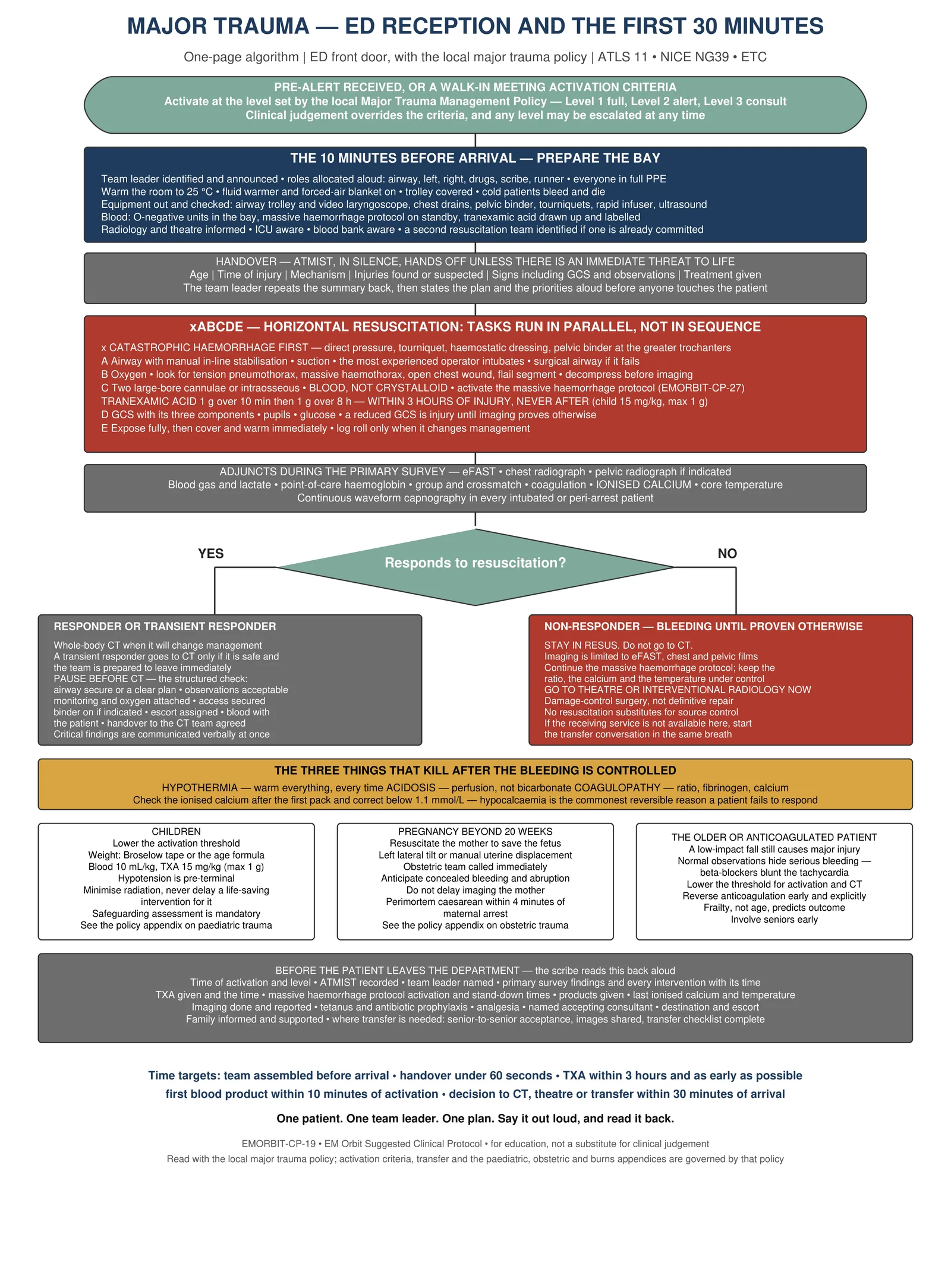
The one-page algorithm is shown at the top of this page.
6Team roles
The roles below are the ED front-door roles and are additional to, and consistent with, the team composition set out in the policy section "Trauma Team Leadership and Team Composition". The position of each member at the trolley and the full task list are given in Attachment 2.
6.1Triage Nurse:
6.1.1 Apply the policy activation criteria to every injured patient at first contact, before registration, and activate the trauma team personally within 2 minutes where any criterion is met, without waiting for physician authorisation.
6.1.2 Move the patient directly to the resuscitation bay, apply manual in-line stabilisation and a pelvic binder where indicated, and give the substitute handover set out in section 4.1.1.
6.1.3 Register the patient under the unknown-patient identity where the name is not known, and record the time of first contact as T0.
6.2ED Nurse in Charge:
6.2.1 Receive the pre-alert, read it back, make the single trauma call, and run the ten-minute bay preparation in Table 1 with named owners.
6.2.2 Control entry to the bay, secure the next bay, the critical care bed and theatre, and act as the single point of contact with the blood bank during a massive haemorrhage activation.
6.2.3 Activate the escalation in section 4.3.8 when roles are unfilled or the department is already committed, and inform the hospital duty manager.
6.3ED Nurses (circulation, airway assistant, scribe, runner):
6.3.1 Deliver and record monitoring, warming, access, blood administration through the warmer, and drug administration with read-back, as set out in Attachment 2.
6.3.2 Complete the ED trauma record contemporaneously, call out the elapsed time every five minutes, and prompt the team leader for any step not yet done.
6.3.3 Account for every blood product, reconcile the transfusion record, and check tetanus and antibiotic prophylaxis before the patient leaves the department.
6.4ED Physicians:
6.4.1 The senior ED physician declares the activation level, leads the resuscitation, allocates every task by name, maintains the shared mental model, and makes the destination decision within 30 minutes.
6.4.2 ED physicians fill the airway and procedure roles as allocated, use read-back for every order received, and report completion with the result.
6.4.3 The team leader gives the structured handover in Table 7 and offers a hot debrief after every Level 1 activation.
6.5Anaesthesia:
6.5.1 Attend every Level 1 activation; take the airway role, state the airway plan A to D before drugs are drawn, and name the person for front-of-neck access.
6.5.2 Advise on induction agents and doses in the shocked patient, and accompany the patient to computed tomography and theatre where the airway is instrumented.
6.6General Surgery and Orthopaedics:
6.6.1 Attend the resuscitation bay for every Level 1 activation and remain at the bedside for the transient responder and the non-responder.
6.6.2 Make the theatre and damage-control decision at the bedside, confirm pelvic binder position and splintage, and manage open fractures including the antibiotic timing in Table 6.
6.6.3 Confirm the admitting service in accordance with the policy section "Disposition".
6.7Critical Care:
6.7.1 Attend on request for the intubated or shocked patient, confirm the critical care destination, and receive the structured handover in Table 7 including line sterility, ventilator settings, temperature, calcium and coagulation.
6.8Blood Bank and Transfusion Services:
6.8.1 Maintain the ED satellite refrigerator stock of emergency O RhD-negative units, read back the massive haemorrhage activation call, and issue packs as per EMORBIT-CP-27 and the policy section "Massive Transfusion Protocol (MTP)".
6.8.2 Confirm receipt of the stand-down and reconcile units issued, transfused, returned and wasted with the ED.
6.9Laboratory:
6.9.1 Prioritise trauma samples, report critical results by telephone to a named clinician, and support point-of-care and viscoelastic testing as available.
6.10Radiology and Radiography:
6.10.1 Attend the bay with the mobile unit for every Level 1 activation, expose on the team leader’s call, and confirm CT readiness to the ED before the structured pause.
6.10.2 Communicate critical findings verbally and immediately as required by the policy section "Imaging Pathway", and record to whom and when.
6.11Pharmacy:
6.11.1 Maintain immediate availability in the ED of tranexamic acid, the first-dose antibiotics in Table 6, tetanus vaccine and immunoglobulin, analgesics, induction agents and calcium.
6.11.2 Verify the doses in Tables 4, 5 and 6 against the local formulary, provide a weight-based paediatric dosing card for the trauma bay, and audit door-to-antibiotic and door-to-analgesia times with the ED quality team.
6.12Ambulance and Pre-hospital Providers:
6.12.1 Give the pre-alert with a structured ATMIST as required by the policy section "Prehospital Care and Handover", with as much notice as is safely possible.
6.12.2 Deliver the ATMIST at the ten-second round, remain until released by the team leader, and state the tourniquet application time and all drugs and times given.
6.13Hospital Duty Manager and Portering:
6.13.1 Secure beds, theatre, critical care capacity and additional staff on activation; support diversion decisions; and provide a dedicated porter for a Level 1 activation.
7The patient's role
7.1 Report the mechanism and time of injury, all symptoms, and in particular pain that is not controlled, breathlessness, and any new numbness or weakness.
7.2 Report allergies, all regular medicines, and in particular anticoagulant and antiplatelet therapy with the time of the last dose.
7.3 Report pregnancy or possible pregnancy, and the time of the last fetal movement where relevant.
7.4 Consent to, or decline, examination, imaging, transfusion and transfer after explanation, and ask for an interpreter where needed.
7.5 Family and carers: provide the history where the patient cannot, identify the patient where identity is unknown, and raise concern immediately with staff if the patient appears to be deteriorating.
7.6 After discharge: follow the written safety-netting advice, attend the arranged follow-up, complete any prescribed antibiotic course, and return immediately for any of the listed warning symptoms.
8Definitions
The definitions in the policy section "Definitions" apply in full, including major trauma, polytrauma, trauma team activation, and stabilise-first transfer. The following are additional terms used in this protocol.
8.1T0 (time zero): the moment the patient arrives on the ED trolley; or, for a patient recognised after arrival, the moment of recognition; or, for a walk-in patient, the moment of first contact at triage. All ED time targets in Table 3 run from T0.
8.2Pre-alert: the structured advance notification from the ambulance service or a referring facility that a major trauma patient is inbound, which triggers the trauma call and the ten-minute bay preparation.
8.3Ten-minute bay preparation: the checklist of named actions in Table 1 and Attachment 3, counted back from the expected time of arrival, that makes the bay, the team, the equipment, the blood and the warming ready before the patient arrives.
8.4Ten-second round: the pause at the moment of arrival in which the team is hands-off and silent for up to ten seconds while the pre-hospital crew delivers the ATMIST, after which the team leader repeats it back and states the first tasks. It is omitted only in extremis.
8.5Structured pause: the team stop called by the team leader before the patient leaves the resuscitation bay, in which the CT safety checklist is read aloud, the owners of the airway and circulation for the move are named, and the abort plan is stated.
8.6Horizontal resuscitation: the team-based model in which the xABCDE priorities are addressed simultaneously by several clinicians under one leader; the standard for a Level 1 activation.
8.7Vertical resuscitation: the sequential single-clinician xABCDE assessment in which each step is completed before the next begins; the correct model for the lone practitioner and for a Level 3 activation.
8.8Closed-loop communication: the three-part standard in which an instruction is given to a named person, read back in full, and reported complete with the result and the time.
8.9Responder, transient responder, non-responder: the ED classification of the response to resuscitation, which drives the imaging and destination decision as set out in the policy section "Imaging Pathway".
8.10Minimum viable team: the four roles that must be filled before a Level 1 resuscitation proceeds — airway, two procedure or circulation clinicians, and a combined leader-scribe — used only while the full team is being assembled.
8.11Unknown-patient identity: the pre-prepared unique identity, with labels and a medical record number, used for a patient whose name is not known, so that samples, blood and imaging can proceed without delay.
8.12ATLS, ETC, NICE, RCEM: Advanced Trauma Life Support; European Trauma Course; National Institute for Health and Care Excellence; Royal College of Emergency Medicine.
9Attachments
- Attachment 1: One-page algorithm (top of this page)
- Attachment 2: ED Trauma Team Role Card
- Attachment 3: Trauma Bay Preparation Checklist — the Ten Minutes Before Arrival
- Attachment 4: ED Trauma Documentation and Handover Record
11Suggested quality indicators
The institutional indicators — time to trauma activation, time to senior clinician review, time to CT, time to first blood product issue, tranexamic acid within three hours, transfer decision-to-departure time, and documentation completeness — are set out in the policy section "KPI Table" and are not repeated here. The indicators below measure the ED front-door process that this protocol adds, and shall be reported to the ED quality team monthly and to the trauma governance meeting quarterly.
11.1Trauma bay readiness after a pre-alert: (Number of pre-alerted Level 1 and Level 2 activations in which the bay preparation checklist was completed and the team was assembled in the bay before the patient arrived / Total number of pre-alerted Level 1 and Level 2 activations with at least 10 minutes of notice) × 100. Target ≥ 90%.
11.2Recognition and activation for walk-in patients: (Number of walk-in or private-vehicle patients meeting activation criteria in whom the trauma team was activated within 2 minutes of first contact at triage / Total number of walk-in or private-vehicle patients subsequently found to meet activation criteria) × 100. Target ≥ 90%. Cases identified retrospectively are reported separately as under-triage.
11.3Time to analgesia in major trauma: (Number of trauma activation patients who received analgesia, or in whom the reason for withholding it was documented, within 15 minutes of T0 / Total number of trauma activation patients with a pain score of 4 or more, or who were unable to report pain) × 100. Target ≥ 80%.
11.4Front-door prophylaxis completed before departure: (Number of trauma activation patients with a wound in whom tetanus status was assessed and prophylaxis given or documented as not indicated, and, where an open fracture was present, the first antibiotic dose was given within 1 hour of injury, before leaving the ED / Total number of such patients) × 100. Target ≥ 90%.
11.5Safe departure from the resuscitation bay: (Number of trauma activation patients for whom the structured pause was completed and documented before leaving the bay, and the structured handover in Table 7 was given to a named receiving clinician / Total number of trauma activation patients leaving the ED) × 100. Target ≥ 90%.
11.6Outcome indicators (monitored, with review of every case): proportion of trauma activation patients with a temperature below 36 °C at departure from the ED, target < 10%; number of patients who deteriorated significantly or arrested during transfer from the ED to computed tomography, theatre or another facility, target zero; and number of injuries identified after ED departure that were present and detectable at the front door, each of which shall be reviewed at the trauma governance meeting.
13References
- American College of Surgeons Committee on Trauma. Advanced Trauma Life Support (ATLS) Student Course Manual, 11th edition. Chicago: American College of Surgeons.
- National Institute for Health and Care Excellence. Major trauma: assessment and initial management. NICE guideline NG39; 2016.
- National Institute for Health and Care Excellence. Major trauma: service delivery. NICE guideline NG40; 2016.
- Rossaint R, Afshari A, Bouillon B, et al. The European guideline on management of major bleeding and coagulopathy following trauma: sixth edition. Critical Care. 2023;27:80.
- European Trauma Course Organisation. European Trauma Course: The Team Approach — course manual. European Resuscitation Council / European Society for Trauma and Emergency Surgery / European Society of Anaesthesiology.
- Royal College of Emergency Medicine. Best Practice Guideline: Traumatic Cardiac Arrest in Adults. London: RCEM; 2022.
- Royal College of Emergency Medicine. Best Practice Guideline: Management of Pain in Adults. London: RCEM.
- Royal College of Emergency Medicine. Clinical audit and quality standards for major trauma and for pain in adults. London: RCEM.
- British Orthopaedic Association and British Association of Plastic, Reconstructive and Aesthetic Surgeons. BOAST: Open Fractures. London: British Orthopaedic Association; 2017.
- National Institute for Health and Care Excellence. Fractures (complex): assessment and management. NICE guideline NG37; 2016.
- National Institute for Health and Care Excellence. Head injury: assessment and early management. NICE guideline NG232; 2023.
- Shakur H, Roberts I, Bautista R, et al. Effects of tranexamic acid on death, vascular occlusive events, and blood transfusion in trauma patients with significant haemorrhage (CRASH-2): a randomised, placebo-controlled trial. Lancet. 2010;376(9734):23–32.
- CRASH-3 trial collaborators. Effects of tranexamic acid on death, disability, vascular occlusive events and other morbidities in patients with acute traumatic brain injury (CRASH-3): a randomised, placebo-controlled trial. Lancet. 2019;394(10210):1713–1723.
- Higgs A, McGrath BA, Goddard C, et al. Guidelines for the management of tracheal intubation in critically ill adults. British Journal of Anaesthesia. 2018;120(2):323–352.
- UK Health Security Agency. Immunisation against infectious disease (the Green Book), chapter 30: Tetanus. London: UK Health Security Agency.
- Advanced Life Support Group. Advanced Paediatric Life Support: The Practical Approach. Wiley-Blackwell.
A2Attachment 2: ED Trauma Team Role Card
This card shall be displayed in the resuscitation bay and printed on the reverse of the trauma tabards. Roles are allocated by name at the pre-arrival brief and are stated aloud at the ten-second round. A team member who has not been given a role does not enter the bay.
| Role | Position | Core ED tasks |
|---|---|---|
| Trauma team leader | At the foot of the trolley, one to two metres back, ungloved and hands-free | Declares leadership aloud; receives the ATMIST; runs the ten-second round; allocates every task by name; keeps the shared mental model with a verbal summary at least every five minutes; decides on blood, imaging, theatre, transfer and ceiling of care; performs no procedure while leading; gives the handover. |
| Airway doctor (anaesthesia, or the most airway-competent ED physician) | At the head of the trolley | Airway assessment and oxygenation; manual in-line stabilisation with the assistant; pre-oxygenation; rapid sequence induction and ventilation; capnography; states the induction drug plan for the shocked patient before drawing up. |
| Airway assistant (ED nurse or anaesthetic technician) | At the head, on the patient’s left | Airway trolley, suction, laryngoscope and bougie; manual in-line stabilisation as directed; draws up, labels and double-checks induction and vasoactive drugs; records the intubation time and grade. |
| Procedure doctor 1 | Patient’s right side | Primary survey examination as directed by the leader; right-sided intravenous access and blood sampling; chest examination, right thoracostomy or chest drain; arterial and venous gas. |
| Procedure doctor 2 | Patient’s left side | Left-sided intravenous or intraosseous access; left thoracostomy or chest drain; external haemorrhage control, tourniquet and haemostatic dressing; pelvic binder position check; long-bone splintage. |
| Circulation nurse | Patient’s left, at the level of the infusion pumps | Monitoring and the observation set at the stated intervals; administration of blood through the warmer; drug administration with read-back; records volumes, unit numbers and times; keeps the patient covered between examinations. |
| Scribe | At the side of the bay, in sight of the leader and the clock | Completes the ED trauma record (Attachment 4) contemporaneously; records every order, read-back and time; calls out the elapsed time every five minutes; prompts the leader for any step not yet done. |
| Runner | Outside the trolley zone | Collects blood from the satellite refrigerator or blood bank; carries samples and the request form; fetches equipment; liaises with the porter and the CT radiographer. Does not join the trolley team. |
| General surgeon | Patient’s right, beside procedure doctor 1 | Torso assessment; decision on damage-control surgery and theatre; surgical procedures within scope; accepts or directs the surgical destination as per the policy section "Disposition". |
| Orthopaedic surgeon | At the foot, beside the leader | Pelvic and long-bone assessment; confirms binder position and splintage; open fracture management including photograph, dressing and antibiotic timing; theatre planning. |
| Radiographer | At the foot with the mobile unit | Chest and pelvic radiographs on the leader’s call, announcing "X-ray, everyone step back"; radiation safety; prepares the CT scanner and confirms readiness to the runner. |
| ED nurse in charge or duty manager | Outside the bay | Controls entry to the bay; secures the next bay, the theatre and the critical care bed; activates the escalation in section 4.3.8 when the department is already committed; manages the family, the police and the media at the door. |
1Rules that apply to every role:
- One patient, one leader, one plan (your institution's Major Trauma Management Policy, section "Trauma Team Leadership and Team Composition").
- The leader does not perform procedures; leadership is handed over aloud, by name, and handed back.
- Every instruction is given to a named person, read back in full, and reported complete with the result and the time.
- A task is held by one person at a time; a person who cannot complete a task says so at once.
- Any team member may call "stop" for a safety concern, and everyone stops.
- Where a role is unfilled, the leader states it aloud and fills roles in the order: airway, circulation and haemorrhage control, leader, scribe, runner.
A3Attachment 3: Trauma Bay Preparation Checklist — the Ten Minutes Before Arrival
This checklist shall be completed for every Level 1 and Level 2 activation with advance notice, and started for a walk-in activation at the moment the trauma call is made. The ED nurse in charge owns the checklist; each line has a named owner. Where there is less than ten minutes of notice, the steps are performed in the order shown and the team leader states aloud which steps were not completed.
| Time | Action | Responsible |
|---|---|---|
| T − 10 | Receive the ATMIST pre-alert on the dedicated trauma telephone; read it back to the caller; record it verbatim on the ED trauma record (Attachment 4); declare the activation level and the expected time of arrival. | ED nurse in charge with the senior ED physician |
| T − 9 | Make one single trauma call through the agreed switchboard code, stating: activation level, adult or paediatric or obstetric, mechanism in one phrase, expected time of arrival, and the bay number. Individual bleeping of team members shall not replace the single call. | ED nurse in charge |
| T − 8 | Clear the resuscitation bay: move any stable patient out, remove the previous patient’s equipment and waste, and confirm that a second bay and a second team are available for a concurrent case. | ED nurses |
| T − 7 | Start active warming of the environment: raise the bay temperature to at least 25 °C where the system allows, switch on the forced-air warming device and the fluid warmer, and place warmed blankets on the trolley. | ED nurse |
| T − 6 | Switch on and test the monitor (three-lead electrocardiogram, non-invasive blood pressure cycling every 3 minutes, pulse oximetry, capnography); test two suction units; connect oxygen and a bag-valve-mask with reservoir. | ED nurse |
| T − 5 | Check the airway trolley: videolaryngoscope charged, blades, bougie, supraglottic airways, and the front-of-neck access set opened and visible. The airway doctor states the airway plan A to D aloud and names the person who will perform front-of-neck access. | Airway doctor and airway assistant |
| T − 4 | Lay out vascular access on both sides: two large-bore cannulae and an intraosseous device, blood tubes including group and crossmatch, arterial and venous blood gas syringes, the point-of-care haemoglobin device, and pre-printed labels (unknown-patient identity where the name is not known). | ED nurses |
| T − 3 | Lay out haemorrhage control: two tourniquets, haemostatic dressings, a pelvic binder positioned on the trolley beneath the expected position of the greater trochanters, trauma shears, two chest drain sets and a thoracostomy kit. | Procedure doctors |
| T − 2 | Confirm blood: emergency O RhD-negative units immediately available in the ED satellite refrigerator (O RhD-negative reserved for females of childbearing potential), the rapid infuser primed and warmed, and the blood bank informed that a Level 1 activation is inbound so that the first massive haemorrhage pack can be prepared as per EMORBIT-CP-27. | Circulation nurse and runner |
| T − 2 | Switch on the ultrasound machine with the curvilinear probe selected and gel applied; call the radiographer to the bay with the mobile unit; place lead aprons at the bay entrance. | ED nurse and radiographer |
| T − 1 | The team assembles in the bay in full personal protective equipment (fluid-repellent gown, gloves, eye protection, lead apron). Each member states name and role aloud. The team leader gives the pre-arrival brief: activation level, expected injuries, the first three tasks and who owns each, the transfusion plan, and the intended destination. | Trauma team leader |
| T − 1 | Name the scribe, start the clock on the ED trauma record, name the runner, and name the clinician who will speak to the family. Restrict the bay to the named team; all others observe from outside the marked zone. | Trauma team leader and scribe |
| T 0 | Patient arrives. Hands off the patient for the ten-second round unless the patient is in extremis (see section 4.3.1). | Whole team |
| Item | Entry | Time / initials |
|---|---|---|
| Activation level declared (1 / 2 / 3) | ||
| Adult / paediatric / obstetric / burn | ||
| Expected time of arrival | ||
| Trauma call made at | ||
| Bay number | ||
| Team assembled and briefed at | ||
| Blood bank informed / packs standing by | ||
| Steps not completed before arrival (list) | ||
| Checklist completed by (name, role) |
Note: this checklist supports, and does not replace, the CT safety checklist and the transfer checklist in your institution's Major Trauma Management Policy.
A4Attachment 4: ED Trauma Documentation and Handover Record
This record shall be started at the pre-alert, completed contemporaneously by the scribe, and finished before the patient leaves the Emergency Department. It is filed in the medical record and a copy is retained by the ED quality team for the trauma register and audit. It supplements, and does not replace, the institutional documentation required by the policy section "Documentation".
| Field | Entry |
|---|---|
| Patient label / unknown-patient identity used (Y/N) | |
| Mode of arrival: ambulance / walk-in / private vehicle / interfacility transfer | |
| Pre-alert received at (time) and by (name) | |
| ATMIST as received (verbatim), or the substitute handover for a walk-in | |
| Activation level and the criteria met (physiological / anatomical / mechanism) | |
| Activating clinician (name, role) and time of trauma call | |
| Escalation or de-escalation of level, reason, and responsible senior clinician | |
| Time of arrival (T0) and time the ten-second round completed | |
| Time of injury; tourniquet applied at; anticoagulant / antiplatelet and last dose |
| Role | Name and grade | Time in / out |
|---|---|---|
| Team leader (and any handover of leadership) | ||
| Airway doctor | ||
| Airway assistant | ||
| Procedure doctor 1 (right) | ||
| Procedure doctor 2 (left) | ||
| Circulation nurse | ||
| Scribe | ||
| Runner | ||
| General surgeon | ||
| Orthopaedic surgeon | ||
| Anaesthesia / critical care | ||
| Radiographer | ||
| Roles unfilled, time requested, time filled |
| Item | Target from T0 | Time done | Initials |
|---|---|---|---|
| Catastrophic haemorrhage controlled (method: ______) | ≤ 3 min | ||
| Airway secured (method and grade: ______) | As indicated | ||
| Both cannulae / intraosseous sited | ≤ 5 min | ||
| Chest radiograph | ≤ 10 min | ||
| Pelvic radiograph | ≤ 10 min | ||
| eFAST (result: ______) | ≤ 10 min | ||
| Blood gas / lactate / base deficit (result: ______) | ≤ 10 min | ||
| Temperature on arrival (______ °C); active warming started | ≤ 10 min | ||
| Analgesia given (drug, dose, route: ______); pain score before / after | ≤ 15 min | ||
| Tranexamic acid given (per policy section "Tranexamic Acid") | Per policy | ||
| Massive haemorrhage protocol activated / stood down | At recognition | ||
| First blood product running (type and unit no.: ______) | ≤ 10 min if class III–IV shock | ||
| Units transfused / returned / wasted (reconciled) | Before departure | ||
| Ionised calcium and potassium after every 4 units (results: ______) | Per EMORBIT-CP-27 | ||
| Antibiotic prophylaxis (agent: ______) for open fracture | ≤ 1 h from injury | ||
| Tetanus: status, vaccine given, immunoglobulin given | Before departure | ||
| Pelvic binder / splints / traction applied; neurovascular check before and after | As indicated | ||
| Spinal motion restriction decision and who may clear the spine | Documented | ||
| Team leader verbal summaries (times) | Every 5–10 min | ||
| Structured pause before leaving the bay completed | Before departure from the bay | ||
| Destination decision stated aloud (destination: ______) | ≤ 30 min | ||
| Temperature before departure (______ °C) | Before departure | ||
| Departure from the ED |
| Field | Entry |
|---|---|
| Procedures: time, operator, indication, findings, complications, consent status | |
| Drugs given: agent, dose, route, time, given by, checked by | |
| Wounds: number, site, description; photograph taken (Y/N) | |
| Ceiling of care / resuscitation status discussed; who was present | |
| Safeguarding or non-accidental injury concern; referral made to | |
| Forensic: clothing and evidence retained; handed to (officer name and number) | |
| Family informed by (name) at (time); interpreter used |
| Field | Entry |
|---|---|
| Destination: theatre / interventional radiology / critical care / ward / transfer | |
| 1. ATMIST as updated | |
| 2. Injuries confirmed, suspected, excluded; imaging and who reported it verbally | |
| 3. Interventions, drugs and blood products with times | |
| 4. Current physiology and trend; temperature; lactate or base deficit | |
| 5. Plan, outstanding tasks, results awaited, ceiling of care, next of kin | |
| Tertiary survey handover statement: injuries not yet excluded | |
| Escort: names and grades; equipment and drugs checked | |
| For transfer: named accepting consultant and facility; images sent; documents sent | |
| Receiving clinician (name, grade) accepted responsibility at (time) | |
| Hot debrief offered (Y/N); action agreed and owner | |
| Incident report submitted (Y/N); reason |
Note: entries in this record are made contemporaneously by the scribe and countersigned by the trauma team leader before the patient leaves the department. Where any item was not done, the reason shall be recorded; a blank entry is treated as not done for audit.