Animal and Human Bites, Rabies and Tetanus Prophylaxis
EMORBIT-CP-56 · Chapter 7 · Infectious Disease Emergencies
Open in the appFree, works on your phone and offline, with every tool alongside.
Evidence base: WHO; UK Green Book
1Purpose
1.1 Provide a standardized, evidence-based framework for the assessment and management of animal and human bites, and for rabies and tetanus prophylaxis, in adults and children presenting to the Emergency Department (ED).
1.2 Establish that immediate, thorough washing of the wound with soap and running water for at least 15 minutes, followed by a virucidal agent, is the single most effective measure in preventing rabies, that it is performed before, and not instead of, everything else, and that it is started at triage. This step alone substantially reduces transmission, and it is the step most often done badly, done briefly, or not done at all.
1.3 Standardize the assignment of a World Health Organization (WHO) exposure category to every potential rabies exposure, and the actions that each category triggers, so that no patient with a bleeding wound, a mucous membrane exposure, or any bat contact leaves the department without immunoglobulin and vaccine.
1.4 Define the rabies vaccine schedules for the previously unvaccinated and the previously vaccinated patient, by both the intramuscular and the intradermal route, and establish that the first dose is given in the ED at the first attendance and is never deferred to another facility or another day.
1.5 Define the use of rabies immunoglobulin: who receives it, the dose by weight for each product, and the technical point on which its effectiveness depends — that as much of the dose as is anatomically possible is infiltrated into and around the wound itself, and that it is never mixed with the vaccine, never given through the same syringe, and never given at the same site.
1.6 Establish that rabies prophylaxis has no time limit once an exposure is established: a patient presenting days, weeks or months after the bite receives the full course, and lateness is never a reason to withhold it.
1.7 Establish that rabies prophylaxis is never withheld in pregnancy, in lactation, in infancy, or in the presence of any comorbidity, and that the immunocompromised patient receives an extended course with immunoglobulin and serological confirmation.
1.8 Standardize tetanus risk assessment by wound type and immunisation history, with explicit vaccine and immunoglobulin decisions, and ensure that the tetanus decision is made and documented in every bite patient.
1.9 Standardize bite wound management: irrigation, debridement, and the decision to close or to leave open, which differs by site; and ensure that the hand bite and the clenched-fist injury — the classic missed serious infection — are recognised, imaged, treated with intravenous antimicrobials and referred to hand surgery on the same visit.
1.10 Define the indications for antibiotic prophylaxis, with the choice of agent, dose and duration deferred to EMORBIT-CP-57 (Antimicrobial Stewardship for Common ED Infections) and the local antibiogram, in accordance with the convention of this guideline library.
1.11 Define the additional blood-borne virus risk of human bites and cross-refer it to EMORBIT-CP-55 (Post-Exposure Prophylaxis), and ensure that safeguarding concerns raised by a bite are acted upon.
1.12 Define the duty to report the exposure and the animal to the local public health and municipal authorities, and to document the notification.
1.13 Ensure consistency of practice among all healthcare providers (HCP) and alignment with the WHO Expert Consultation on Rabies (third report, 2018), the WHO position papers on rabies and tetanus vaccines, the national health authority rabies guidance, the UK Health Security Agency (UKHSA) Green Book, the National Institute for Health and Care Excellence (NICE NG184), the Infectious Diseases Society of America (IDSA), and the Royal College of Emergency Medicine (RCEM).
1.14 Provide the rabies post-exposure prophylaxis protocol for the ED, including the arrangement with the primary health centre for completing the vaccine course.
2Who this protocol applies to
2.1 Patients of any age presenting to the ED after a bite, scratch, lick or saliva contact from any mammal, whether domestic, stray, wild or captive, and whether or not the skin appears to be broken.
2.2 Patients presenting after any direct contact with a bat, including where no bite or scratch is recalled, and including a bat found in the room of a sleeping person, an unattended child, or a person unable to give a reliable account.
2.3 Patients presenting after a human bite, whether inflicted deliberately, during a fight, during a seizure, during care of a person with dementia or learning disability, or by a child.
2.4 Patients with a clenched-fist injury, in whom a wound over a metacarpophalangeal joint was sustained by striking another person's teeth, however the history is initially given.
2.5 Patients presenting late — days, weeks or months after a potential rabies exposure — who have had no prophylaxis, or an incomplete or interrupted course, including courses started in another country or another facility.
2.6 Patients presenting with an infected bite wound, at any interval after the bite.
2.7 Patients presenting for a subsequent dose of a rabies vaccine course where the designated primary health centre is not available, and patients attending for advice about a course already started.
2.8 Patients with a potential rabies exposure to a mucous membrane, including a saliva splash to the eye, mouth or nose, and those who have consumed raw milk or uncooked tissue from a suspect animal.
3Not covered by this protocol
3.1 Snake bite, scorpion sting, spider bite and marine envenomation, which are managed under EMORBIT-CP-72 (Snake Bite and Scorpion Sting Envenomation). These carry no rabies risk; tetanus and wound care assessment still apply.
3.2 Insect bites and stings without envenomation or anaphylaxis. Anaphylaxis from any cause is managed under EMORBIT-CP-01.
3.3 Established deep soft-tissue infection, necrotizing soft-tissue infection and septic arthritis arising from a bite, whose definitive management follows EMORBIT-CP-53, EMORBIT-CP-54 and the relevant surgical pathway. The recognition of these conditions and the immediate ED actions remain within this guideline.
3.4 The choice, dose, route and duration of any antimicrobial agent, which is determined by EMORBIT-CP-57 and the current local antibiogram and is deliberately not stated here.
3.5 Occupational needle-stick injury and sexual exposure, and the detailed management of hepatitis B, hepatitis C and HIV post-exposure prophylaxis, which are covered by EMORBIT-CP-55. The identification of blood-borne virus risk in a human bite and the referral into that pathway remain within this guideline.
3.6 Pre-exposure rabies vaccination of travellers, laboratory workers, veterinary staff and animal handlers, which is a primary care and occupational health activity, not an ED one.
3.7 The clinical management of established rabies encephalitis, which is a critical care and infectious diseases matter; the ED role is recognition, isolation, protection of staff, and immediate infectious diseases and public health notification.
3.8 Veterinary decisions about the animal, and the quarantine, testing or destruction of an animal, which are matters for the municipal and veterinary authorities.
4Protocol
4.1History and Assessment:
4.1.1Triage and Recognition:
4.1.1.1 Wound washing shall begin at triage. A patient presenting after any bite, scratch or saliva exposure shall be taken to a sink or a treatment room and the wound washed with soap under running water for at least 15 minutes by the clock before, and in parallel with, any other assessment. This is a nursing action under an approved standing order and shall not wait for a physician.
4.1.1.2 Triage category: any bite patient with uncontrolled bleeding, an airway or facial injury, a major crush or avulsion injury, signs of sepsis, or an anaphylactic reaction shall be triaged as Category 1 (immediate) and taken to the resuscitation area.
4.1.1.3 Category 2 (emergency) applies to: a bite to the face, head or neck; a hand bite or any clenched-fist injury; an actively infected wound with systemic features; a large animal bite such as a camel or horse bite; a bite in an immunocompromised, asplenic or diabetic patient; a child with a facial or scalp bite; and any bat exposure.
4.1.1.4 All other bite presentations shall be triaged no lower than Category 3 (urgent). A bite is not a minor presentation for the purposes of streaming, and shall not be placed in a queue that delays wound washing or the first vaccine dose.
4.1.1.5 The triage nurse shall record: the animal, the time of the exposure, the site or sites of the wound, whether the wound bled, whether washing has already been performed and for how long, and the patient's tetanus and rabies vaccination history.
4.1.1.6 The WHO exposure category shall be assigned at the first medical assessment and documented explicitly in the record (Table 1), because every subsequent decision follows from it.
4.1.1.7 A patient who presents only for a further dose of an existing vaccine course shall not be made to wait through a full assessment; the dose is checked against the schedule and given.
4.1.2History:
4.1.2.1 The animal: species; whether owned, stray, feral, wild or captive; whether it can be identified and traced; its vaccination status and whether that status is documented; whether it appeared ill, was salivating, or behaved abnormally; and whether the attack was provoked or unprovoked — an unprovoked attack by an otherwise docile animal raises the suspicion of rabies.
4.1.2.2 The exposure: the date and the time; where it happened, including the country if abroad; the mechanism — bite, scratch, lick, saliva splash to a mucous membrane, or contact with a bat; the number and site of wounds; and whether the wound bled, which is the single question that most often decides the category.
4.1.2.3 What has already been done: washing and for how long, with what; any dressing or closure; any vaccine, immunoglobulin or antibiotic given elsewhere, with dates and documentation; and any treatment received abroad.
4.1.2.4 Rabies vaccination history: any previous pre-exposure or post-exposure course, with documentary evidence; any documented antibody titre. An undocumented claim of previous vaccination shall not be accepted, and the patient is treated as unvaccinated.
4.1.2.5 Tetanus immunisation history: the number of doses of tetanus-containing vaccine ever received and the date of the last. Where the history is unclear, unknown or undocumented, the patient is treated as incompletely immunised. Many adults who received their childhood schedule in another country cannot document it.
4.1.2.6 Host risk factors: diabetes; immunosuppression of any cause, including chemotherapy, biological therapy, long-term corticosteroids, transplantation and HIV infection; asplenia or hyposplenism; cirrhosis and chronic liver disease; peripheral vascular disease; prosthetic joints and prosthetic heart valves; and pregnancy.
4.1.2.7 Medication and allergy: anticoagulants and antiplatelets; immunosuppressants and corticosteroids; chloroquine or mefloquine, which reduce the response to intradermal rabies vaccine; previous reaction to a vaccine, to immunoglobulin, or to an antimicrobial.
4.1.2.8 For a human bite: the circumstances, the identity and blood-borne virus risk of the biter where known, whether blood was drawn, and whether the patient was the biter or the bitten. Ask directly and privately about assault, domestic violence and abuse, and in a child consider non-accidental injury (EMORBIT-CP-83).
4.1.2.9 For a child: who was present, how the bite happened, and whether the account is consistent with the injury. A bite to a child by a family dog usually happens to the face and head, because of the child's height.
4.1.2.10 Hand injuries: ask specifically and neutrally how the wound over the knuckle was sustained. Patients rarely volunteer that they punched someone in the mouth, and the wound is often described as being caused by a wall, a door or a fall.
4.1.3Examination:
4.1.3.1 Full observations including temperature; a pain score; and capillary glucose in the diabetic or the unwell patient.
4.1.3.2 Examine and describe every wound: site, size, depth, the presence of puncture points, devitalised tissue, contamination, foreign material, and whether it bled. Count the wounds — a bite frequently produces more wounds than the patient has noticed, and every wound requires infiltration with immunoglobulin where that is indicated.
4.1.3.3 Assess the tissues beneath: tendon function of every digit tested individually and against resistance, neurovascular status distally, the integrity of joints, and bone tenderness suggesting fracture or penetration.
4.1.3.4 In any wound over a metacarpophalangeal joint, examine the hand in the position in which it was injured — the clenched fist — not the flat hand, because the skin wound and the deep injury separate as the fingers extend.
4.1.3.5 Examine for signs of established infection: erythema and its extent marked on the skin with the time, swelling, warmth, tenderness, discharge, fluctuance, lymphangitis and regional lymphadenopathy.
4.1.3.6 Signs of a necrotizing process: pain out of proportion to the appearance, rapidly advancing erythema, skin anaesthesia, bullae, dusky or necrotic skin, crepitus, and systemic toxicity. These require immediate senior review, resuscitation and surgical referral (EMORBIT-CP-54).
4.1.3.7 Examine the face, scalp and skull in any child bitten about the head; a dog bite to the head of a small child may penetrate the skull.
4.1.3.8 Examine for other injuries: a bite is often one part of an assault or a fall, and a large animal may also have kicked, crushed or knocked the patient down.
4.1.3.9 Photograph wounds where consent is given and where local policy permits, particularly in suspected assault, in safeguarding cases, and where delayed closure is planned.
4.1.4Risk Stratification:
4.1.4.1 Rabies risk is stratified entirely by the WHO exposure category (Table 1) and the animal (Table 2). It is not stratified by the size of the wound: a single unnoticed bat bite and a large dog bite carry the same category III consequence.
4.1.4.2 Wound infection risk is high where any of the following is present: a cat bite or any puncture wound; a bite to the hand, wrist, foot, face or genitalia; a bite involving a joint, tendon, bone or prosthesis; a crush or avulsion mechanism; delayed presentation beyond 8 to 12 hours; a wound that has been closed; and a host who is diabetic, immunocompromised, asplenic, cirrhotic or elderly.
4.1.4.3 Systemic sepsis risk: Capnocytophaga canimorsus following a dog bite in an asplenic, alcohol-dependent or immunocompromised patient can produce fulminant sepsis, purpura fulminans and death from an unremarkable-looking wound. Asplenia shall be asked about in every dog-bite patient.
4.1.4.4 Functional risk: a hand bite threatens function permanently. A missed tendon-sheath or joint infection in the hand leads to stiffness, contracture, amputation and loss of livelihood.
4.1.4.5 Tetanus risk is stratified by the wound type and the immunisation history (Table 5). Most bites that breach the skin are tetanus-prone wounds.
4.1.4.6 Blood-borne virus risk applies to human bites where blood was involved on either side, and is assessed under EMORBIT-CP-55.
4.1.5Differential Diagnosis and What Not to Miss:
4.1.5.1 A trivial-looking wound with a serious injury beneath it — the cat bite over a joint, the clenched-fist injury, the small puncture over a flexor tendon sheath. The most dangerous bite wounds are the ones that look least impressive.
4.1.5.2 Retained foreign body — a tooth or tooth fragment, a fragment of claw, gravel or clothing. Suspect it in every deep or crushing bite and in every clenched-fist injury, and image accordingly.
4.1.5.3 Fracture or joint penetration, particularly of the hand, the skull in a small child, and the facial bones.
4.1.5.4 Flexor tenosynovitis — a finger held in slight flexion, fusiform swelling, tenderness along the tendon sheath, and pain on passive extension (the four Kanavel signs). This is a surgical emergency.
4.1.5.5 Septic arthritis of a metacarpophalangeal or interphalangeal joint following a bite.
4.1.5.6 Necrotizing soft-tissue infection (EMORBIT-CP-54) and sepsis (EMORBIT-CP-11).
4.1.5.7 An underlying assault, domestic violence, or non-accidental injury that the bite is the visible part of.
4.1.5.8 Rabies itself in a patient presenting with encephalitis, hydrophobia, aerophobia, agitation, autonomic instability or ascending paralysis after a compatible exposure: this is not a prophylaxis problem but an immediate isolation, infectious diseases and public health emergency. Once symptoms appear, rabies is virtually always fatal, and prophylaxis after the onset of symptoms is of no value — which is the whole reason for the urgency of everything in this guideline.
4.1.6Special Populations:
4.1.6.1 Pregnancy and lactation: rabies prophylaxis is never withheld from a pregnant or breastfeeding woman. Rabies is essentially always fatal, and neither the vaccine nor the immunoglobulin is a live product; neither has been shown to harm the fetus. The full schedule, including immunoglobulin, is given as for any other patient. Tetanus-containing vaccine is likewise safe in pregnancy.
4.1.6.2 Children and infants: the rabies vaccine dose is the same as the adult dose and is not adjusted for weight; the immunoglobulin dose is weight-based. The anterolateral thigh is used in children under 2 years. Children are bitten about the face and head, which are category III sites close to the central nervous system, and a facial bite in a child warrants early plastic surgery involvement. Consider safeguarding in every child with a bite (EMORBIT-CP-83), and give the parents specific written advice about the remaining doses.
4.1.6.3 Immunocompromised patients: the five-dose intramuscular schedule is used; immunoglobulin is given for category II exposures as well as category III; the intradermal route shall not be used; corticosteroids and other immunosuppressants should be avoided during the course where the underlying condition allows; and rabies-neutralising antibody shall be measured 2 to 4 weeks after the final dose, with further doses if the titre is inadequate. Arrange this with Infectious Diseases before the patient leaves the department.
4.1.6.4 Asplenic and hyposplenic patients: a high-risk group for fulminant post-bite sepsis. They receive antibiotic prophylaxis for any bite that breaks the skin, are given explicit written warning about fever, and have a low threshold for admission.
4.1.6.5 The elderly and the frail: the immunisation history is more often incomplete or undocumented; comorbidity and anticoagulation complicate wound care; and infection presents with less fever and more confusion and functional decline.
4.1.6.6 The traveller and the patient bitten abroad: establish the country, the animal and what was given. A course begun abroad is continued, not restarted, where the product was a cell-culture vaccine. Where the product cannot be identified, or where nerve-tissue vaccine may have been used, discuss with Infectious Diseases.
4.1.6.7 The patient who declines prophylaxis: the consequence of untreated rabies exposure is death, and the conversation shall be conducted by a senior clinician with an interpreter where needed. The discussion, the information given, the patient's reasons and the outcome shall be documented, along with the offer to return at any time. Prophylaxis remains available to the patient at any later date.
4.1.6.8 The occupational exposure — veterinary staff, animal handlers, laboratory workers, municipal animal control staff — shall additionally be referred to Occupational Health, and the exposure reported through the employer's route as well as the clinical one.
4.2Investigations:
4.2.1The Wound Is the Investigation:
4.2.1.1 The examination and, where indicated, the exploration of the wound in a bloodless field under local or regional anaesthesia is the principal investigation, and no laboratory test replaces it.
4.2.1.2 Exploration is indicated for any deep wound, any wound over a joint or tendon, any wound with a possible retained foreign body, and every clenched-fist injury. Exploration in the ED shall be limited to what can be done safely and adequately; where it cannot, the wound is explored in theatre.
4.2.2Imaging:
4.2.2.1A plain radiograph shall be obtained where any of the following applies:
- Every clenched-fist injury and every bite over a joint — looking for fracture, a retained tooth fragment, a foreign body, and air within the joint, which indicates penetration.
- Any suspicion of fracture, including from a crush or large-animal bite.
- Any suspicion of a retained foreign body, including a tooth or a claw fragment.
- A late presentation with signs suggesting osteomyelitis or septic arthritis.
- A penetrating scalp or facial wound in a small child, in whom computed tomography of the head shall be obtained where skull penetration is possible.
4.2.2.2 Ultrasound may be used at the bedside to identify a radiolucent foreign body, a collection or an abscess.
4.2.2.3 Computed tomography is indicated for suspected skull or facial bone penetration, for deep neck wounds, and for suspected deep collections; magnetic resonance imaging is a specialist request for suspected osteomyelitis or deep hand-space infection, and is arranged by the receiving team.
4.2.2.4 A normal radiograph does not exclude joint penetration or a retained fragment, and does not alter the decision to explore a clenched-fist injury or to refer it.
4.2.3Microbiology:
4.2.3.1 Wound swabs are not taken from a fresh, clean, uninfected bite — they grow oral flora and mislead.
4.2.3.2 A wound swab shall be taken, before antimicrobials where possible, from any wound with signs of infection, any wound with purulent discharge, and any wound being explored in theatre, and deep tissue or pus is a better specimen than a surface swab.
4.2.3.3 Blood cultures shall be taken in any patient with fever, rigors, systemic upset or any feature of sepsis, and in any asplenic or immunocompromised patient with an infected bite, before antimicrobials.
4.2.3.4 Rabies serology has no role in the ED decision to give prophylaxis and shall not be requested to justify withholding or delaying it. Antibody titres are relevant only to the post-course confirmation of response in the immunocompromised, and to a documented previously vaccinated patient.
4.2.3.5 Testing of the animal is a veterinary and public health function, arranged through the notification route in section 4.3.15; the ED does not wait for it.
4.2.4Blood Tests:
4.2.4.1 Blood tests are not required for the uncomplicated, uninfected bite in a well patient.
4.2.4.2 Where infection is established or suspected: full blood count, C-reactive protein, renal function and glucose; venous lactate in any patient who is unwell, febrile or tachycardic; and coagulation where surgery is likely or the patient is anticoagulated.
4.2.4.3 Where a human bite has involved blood exposure: baseline hepatitis B surface antibody and antigen, hepatitis C antibody and HIV serology on the exposed person, with consent, as directed by EMORBIT-CP-55. The source person's testing is arranged under that guideline and requires their own consent.
4.2.4.4 Group and save where significant bleeding, a large-animal injury or surgery is anticipated.
4.3Plan of Care:
4.3.1Immediate Actions — The First 15 Minutes:
4.3.1.1 WASH THE WOUND. This is the first action and the most effective one. Wash and flush every wound with soap and running water for a minimum of 15 minutes, timed by the clock. Where soap is not available, wash copiously with running water alone; where the patient cannot reach a sink, irrigate with sterile 0.9% sodium chloride under a running tap or with a syringe, for the same duration.
4.3.1.2 Then apply a virucidal agent — povidone-iodine, or an alcohol-based or other preparation with proven virucidal activity against rabies virus — to every wound.
4.3.1.3 This step substantially reduces the risk of rabies transmission on its own, and it is the step most often performed inadequately. Fifteen minutes is a long time at a sink and it is routinely cut short. The duration of the washing, and the agent applied afterwards, shall be documented in the record as a timed entry.
4.3.1.4 A mucous membrane exposure — eye, mouth or nose — shall be irrigated copiously with water or 0.9% sodium chloride; a virucidal agent is not applied to the eye.
4.3.1.5 Control bleeding by direct pressure and elevation; a bite bleeding heavily is managed as any other bleeding wound, but washing is still performed once bleeding is controlled.
4.3.1.6 Do not suture, glue, staple or otherwise close any wound before the washing is complete and the decision in section 4.3.8 has been made, and never before rabies immunoglobulin has been infiltrated where it is indicated.
4.3.1.7 Provide analgesia early and adequately: wound washing and exploration are painful, and inadequate analgesia is the commonest reason washing is cut short. Local anaesthetic infiltration or a regional block (for example a digital or wrist block) shall be offered where it will allow proper cleaning and exploration (EMORBIT-CP-28).
4.3.1.8 Assign and document the WHO exposure category (Table 1), and ask the three questions that decide everything else: did the wound bleed or break the skin? was it a bat? is the patient previously vaccinated, with documentation?
4.3.2Rabies Vaccine — The First Dose Is Given Here:
4.3.2.1 Where prophylaxis is indicated, the first vaccine dose shall be given in the ED at the first attendance, and shall not be deferred to another facility, another clinic or the next day.
4.3.2.2 Only a cell-culture or embryonated-egg rabies vaccine shall be used. Nerve-tissue vaccine shall not be used.
4.3.2.3 The schedules for the previously unvaccinated, the previously vaccinated and the immunocompromised patient, by both routes, are in Table 3, together with the site, the volume, and the administration rules.
4.3.2.4 The intramuscular volume of one dose depends on the product — one full vial of the reconstituted vaccine — and shall be read from the product in use: human diploid cell and purified chick embryo cell vaccine are 1.0 mL per intramuscular dose, and purified vero cell vaccine is 0.5 mL. State the dose volume of the product in use explicitly — a medication-safety risk if this is not checked.
4.3.2.5 The intradermal regimen is 0.1 mL at two sites on days 0, 3 and 7 — the WHO one-week regimen. The intradermal route has its own schedule and its own number of sites, and it shall not be combined with the intramuscular schedule (days 0, 3, 7 and 14). The intradermal route is dose-sparing and WHO-recommended, but it requires trained staff, a reliable multi-dose vial policy and adequate throughput; where those conditions are not met, the intramuscular route is safer.
4.3.2.6 Never give rabies vaccine into the gluteal region. Absorption is unreliable and prophylaxis failures have been reported.
4.3.2.7 Where two sites are required on one day, use both deltoids (or both thighs in a small child), a separate syringe for each.
4.3.2.8 Observe every patient for 15 to 30 minutes after a dose, with anaphylaxis treatment immediately available (EMORBIT-CP-01).
4.3.2.9 Record the product name, batch number, expiry date, dose, route, site, time and the identity of the person administering it, for every dose, and give the patient a written record of the same.
4.3.2.10 An interrupted course is resumed, not restarted.
4.3.3Rabies Immunoglobulin — The Technical Point That Decides Whether It Works:
4.3.3.1 Rabies immunoglobulin is indicated for every previously unvaccinated patient with a category III exposure, and for every immunocompromised patient with a category II or III exposure. It is not given to a previously vaccinated patient, and it is not given for a category I exposure.
4.3.3.2 Dose: human rabies immunoglobulin 20 IU/kg body weight; equine rabies immunoglobulin 40 IU/kg body weight. The dose for children is the same on a weight basis. The calculated dose shall never be exceeded, because excess immunoglobulin suppresses the active response to the vaccine.
4.3.3.3 As much of the calculated dose as is anatomically possible shall be infiltrated into and around each and every wound, including small punctures and wounds that have already healed over. This is the mechanism by which immunoglobulin works: it neutralises virus at the site of inoculation during the week before the vaccine takes effect.
4.3.3.4 Where the calculated volume is insufficient to infiltrate all the wounds, it shall be diluted two- to three-fold with sterile 0.9% sodium chloride so that every wound receives infiltration. The answer to "there is not enough to go round" is dilution, never omission.
4.3.3.5 Infiltrate slowly, in small aliquots, with particular care in the digits, the pinna, the nose and the penis, where the tissue compartment is tight; monitor distal perfusion.
4.3.3.6 The immunoglobulin and the vaccine shall never be drawn into the same syringe and shall never be given at the same anatomical site. The vaccine is given in a limb remote from the infiltrated wounds.
4.3.3.7 Timing: immunoglobulin is given at the same visit as the first vaccine dose. Where it was not available at that visit, it may be given up to day 7 after the first vaccine dose; beyond that it shall not be given. This window runs from the first vaccine dose, not from the bite — a patient presenting six weeks after a bite who has had no vaccine still receives immunoglobulin with their first dose.
4.3.3.8 If immunoglobulin is not immediately available, give the vaccine now and arrange the immunoglobulin within the window. The vaccine shall not wait.
4.3.3.9 Skin testing before equine immunoglobulin is not recommended; it does not predict anaphylaxis and it delays treatment. Administer with resuscitation facilities and adrenaline immediately available.
4.3.3.10 The disposal of any volume remaining after all wounds have been infiltrated: WHO concluded in 2018 that a remainder given intramuscularly at a distant site provides little or no additional protection and that infiltration into and around the wound is what matters. Infiltrate all the volume the anatomy allows; do not infiltrate less in order to keep some back for a distant injection.
4.3.3.11
Table 4: Rabies immunoglobulin — who gets it, how much, and where it goes Question Answer Detail Why it matters Who gets it Every previously unvaccinated patient with a category III exposure, and every immunocompromised patient with a category II or III exposure It is given at the same visit as the first vaccine dose. It is not given to a previously vaccinated patient, and not for a category I or an uncomplicated category II exposure Immunoglobulin provides immediate passive neutralising antibody at the wound during the 7 to 10 days before the vaccine produces an active response. In a severe bite, particularly to the face, neck or hand, that interval is when the virus enters the nerve Which product and what dose Human rabies immunoglobulin (HRIG): 20 IU/kg body weight Equine rabies immunoglobulin (ERIG): 40 IU/kg body weight Monoclonal antibody products: the dose stated in the product licence The dose is the same in adults and children on a weight basis, and the calculated dose shall never be exceeded Exceeding the dose suppresses the active immune response to the vaccine. The product stocked locally determines the dose — the two figures are not interchangeable, and the wrong figure halves or doubles the dose Where it goes — the point on which the whole treatment turns As much of the calculated dose as is anatomically possible shall be infiltrated into and around every wound, including wounds that have healed over and old puncture marks Infiltrate slowly, into the wound edges and the tissue immediately around and beneath each wound. Where the calculated volume is too small to reach all the wounds, dilute it two- to three-fold with sterile 0.9% sodium chloride so that every wound can be infiltrated Immunoglobulin given into a buttock does not protect a wound on a hand. Neutralising the virus where it was inoculated is the entire mechanism; a dose given distantly and not into the wound is the commonest technical failure of rabies prophylaxis and has been associated with deaths The remaining volume Where infiltration of all wounds has been achieved and volume remains, WHO advises that no additional distant intramuscular injection is required In the traditional approach, any remainder is given intramuscularly at a site distant from the vaccine site, for example the gluteal region when the vaccine is in the deltoid WHO 2018 concluded that the distant intramuscular remainder adds little or no protection. Infiltration into and around the wound is what matters; the distant intramuscular remainder adds little. Anatomical limits Infiltrate with care in a digit, the pinna, the nose and the penis, where the tissue compartment is tight Inject slowly and in small aliquots and monitor perfusion; do not create a compartment problem in a finger. Discuss the hand, the face and the genitalia with the relevant surgical service A digit lost to a tense infiltrate is an avoidable harm; the answer is dilution, patience and small aliquots, not omitting the infiltration Timing With the first vaccine dose. If it was not available then, it may be given up to day 7 after the first vaccine dose After day 7 from the first vaccine dose it shall not be given, because the active antibody response has begun and immunoglobulin would suppress it This is a limit measured from the first vaccine dose, not from the bite. A patient presenting late who has had no vaccine at all still receives immunoglobulin with their first dose, however long ago the bite was Never Never in the same syringe as the vaccine. Never at the same anatomical site as the vaccine. Never to a previously vaccinated patient. Never as a reason to delay the first vaccine dose If immunoglobulin is not immediately available, give the vaccine now and arrange the immunoglobulin within the 7-day window Waiting for immunoglobulin to arrive before starting the vaccine delays the only part of the treatment that produces lasting immunity Adverse reactions Local pain and low-grade fever are common. Anaphylaxis is rare; serum sickness is described with equine product Skin testing before equine immunoglobulin is not recommended: it does not predict anaphylaxis and delays treatment. Give the product with resuscitation facilities and adrenaline immediately available, and observe the patient A negative skin test has falsely reassured clinicians and a positive one has led to prophylaxis being withheld from a patient who needed it The product, its concentration and the dose figure that therefore applies shall be checked against the product information; the arrangements for obtaining it out of hours follow the hospital's pathway.
4.3.4Deciding About the Animal, and the Reporting Duty:
4.3.4.1 The 10-day observation rule applies only to dogs, cats and ferrets. It exists because an animal shedding rabies virus in its saliva at the time of the bite will develop signs of disease and die within 10 days. It does not apply to wild animals, to bats, to livestock, or to any animal that cannot be reliably observed.
4.3.4.2 Prophylaxis shall be started immediately and may then be discontinued if the animal remains healthy through the 10-day observation period, or if laboratory testing of the animal is negative. Starting and stopping is safe; waiting and hoping is not.
4.3.4.3 Start prophylaxis immediately and discontinue it if a healthy, currently vaccinated dog, cat or ferret available for observation remains healthy at 10 days (WHO). Deferral is not the default, because a deferred course depends on the patient returning, on the animal actually being observed, and on someone acting on the result — three failure points that do not exist if the course is simply started. Deferral is permitted only where every one of the following is true: the exposure is category II; the animal is an owned, identifiable, currently and verifiably vaccinated dog, cat or ferret; the owner is contactable and the animal is genuinely under observation; the patient is not immunocompromised; a named clinician has documented the decision; and a definite review appointment within 10 days has been made and given to the patient in writing.
4.3.4.4 Where prophylaxis has been started and the animal completes 10 days in good health, or is tested and found negative, the remaining doses may be stopped on the advice of Infectious Diseases or Public Health, and the decision documented.
4.3.4.5 Where the animal is not traceable, is a stray, is wild, is a bat, has been killed or has disappeared, the full course is completed. The absence of the animal is never a reason to withhold prophylaxis.
4.3.4.6 Reporting duty: every animal bite and every potential rabies exposure shall be notified to the local public health authority in accordance with local communicable disease notification requirements, and the animal reported to the municipal animal control or veterinary authority so that it can be traced, observed or tested.
4.3.4.7 The notification is made from the ED on the same day, is not delegated to the patient, and the fact and time of notification, the authority contacted and the person spoken to shall be recorded in the notes.
4.3.4.8 The notification route (authority, form, telephone number, what is notifiable, and the out-of-hours arrangement) follows national public health requirements and the hospital's infection prevention and control pathway. Reporting of rabies exposures and completed PEP courses is shared with the primary health centre. Reporting shall not depend on a patient attending a later appointment: the ED that sees the exposure makes the notification.
4.3.5The Patient Who Presents Late:
4.3.5.1 There is no time limit on starting rabies post-exposure prophylaxis. A patient presenting days, weeks or months after a bite, who has had no prophylaxis, receives the full course exactly as if the exposure had occurred today, including immunoglobulin where the category indicates it.
4.3.5.2 This is common and it is frequently mishandled. The patient who was bitten on holiday three weeks ago, the patient who thought the wound had healed, and the patient who was told at the time that it was nothing, are all still candidates for the full course.
4.3.5.3 The incubation period of rabies is typically one to three months but may be years, and prophylaxis started at any point before symptoms appear may still prevent the disease. Only the onset of symptoms ends the opportunity — and at that point the disease is virtually always fatal.
4.3.5.4 For a late presenter, day 0 is the day the first vaccine dose is given, and the remaining doses follow from that day. The 7-day immunoglobulin window also runs from that first dose.
4.3.5.5 Do not attempt to calculate a risk that justifies withholding the course on the basis of elapsed time. No such calculation exists.
4.3.5.6 Where a course was started elsewhere and interrupted, resume it from where it stopped and do not restart; where the product or the dates cannot be established, discuss with Infectious Diseases.
4.3.6Tetanus Prophylaxis:
4.3.6.1 A tetanus decision shall be made and documented for every bite patient, including those receiving rabies prophylaxis and those not.
4.3.6.2 Classify the wound as clean, tetanus-prone or high-risk, and establish the immunisation history; then apply Table 5. Most bites that breach the skin are tetanus-prone.
4.3.6.3 Where the history is unknown, undocumented or unreliable, the patient shall be treated as incompletely immunised.
4.3.6.4 The tetanus-containing vaccine and human tetanus immunoglobulin shall be given at different sites with different syringes, and both recorded with product, batch and site.
4.3.6.5 Human tetanus immunoglobulin is given 250 IU intramuscularly as a single dose, at any age (CDC).
4.3.6.6 The immunosuppressed patient with a tetanus-prone wound receives immunoglobulin whatever the immunisation history, because the response to previous vaccination may be inadequate.
4.3.6.7 A patient given a dose of tetanus-containing vaccine in the ED who has not completed a primary course shall be referred to primary care to complete the schedule, and told so in writing; a single dose is not protection.
4.3.7Bite Wound Management — Irrigation, Debridement and Closure:
4.3.7.1 Irrigation: after the initial 15-minute wash, irrigate each wound with a copious volume of sterile 0.9% sodium chloride or clean running water — as a guide, not less than 250 mL per wound and more for a large or contaminated wound — using a syringe and splash protection. High-pressure irrigation shall not be forced into a closed space or a puncture tract, where it drives contamination deeper.
4.3.7.2 Debridement: excise devitalised and crushed tissue and remove visible foreign material. Debridement that cannot be performed adequately under local anaesthesia in the department shall be performed in theatre. Conservative debridement of the face is performed by the specialist, not in the ED.
4.3.7.3 Closure: the decision differs by site and is set out in Table 6. The general rule is that bite wounds are left open; the face is the exception, where primary closure after thorough cleaning gives a better result and the excellent blood supply makes infection less likely.
4.3.7.4 The wounds that shall never be closed primarily: any wound of the hand, wrist or foot; every clenched-fist injury; any puncture wound, including most cat bites; any wound already infected; any wound more than 12 hours old (24 hours on the face); any crush or avulsion wound with devitalised tissue; and any bite in an immunocompromised, diabetic, asplenic or cirrhotic patient.
4.3.7.5 Never close a wound before rabies immunoglobulin has been infiltrated where it is indicated. Where closure is appropriate and immunoglobulin is indicated, infiltrate first, then close.
4.3.7.6 Where a wound is left open: dress it, elevate and, for a hand, splint it in the position of safe immobilisation, and arrange review within 24 to 48 hours. Delayed primary closure may be considered at 3 to 5 days where the wound remains clean.
4.3.7.7 Explain to the patient that leaving the wound open is a deliberate decision taken to prevent infection.
4.3.7.8
Table 6: The decision to close a bite wound Wound Close or leave open Reasoning and practical points FACE, HEAD AND NECK — the exception May be closed primarily, after thorough irrigation and debridement, where the patient presents early and the wound is not already infected The cosmetic and functional consequences of leaving a facial wound open outweigh the infection risk, and the facial blood supply is excellent. Give antibiotic prophylaxis, and involve plastic surgery or maxillofacial surgery for anything more than a simple laceration, for any wound involving the lip margin, eyelid, nose, ear cartilage or parotid duct, and for any facial bite in a child, in whom a dog bite to the head may also have penetrated the skull Trunk, arm, thigh and leg — a clean, fresh, non-puncture laceration May be closed, or closed loosely with interrupted sutures, after thorough irrigation and debridement Use interrupted sutures with no deep buried absorbable material where it can be avoided; never close under tension; and explain to the patient what infection looks like and when to return HAND, WRIST AND FOOT — NEVER CLOSED PRIMARILY Leave open. Clean, debride, dress, elevate, splint, give antibiotic prophylaxis, and arrange review within 24 to 48 hours. Delayed primary closure at 3 to 5 days where the wound stays clean The hand is the site with the highest rate of bite-wound infection and the highest cost of that infection in lost function. The tissue planes are tight, the compartments are closed, and infection tracks along tendon sheaths CLENCHED-FIST INJURY ("fight bite") NEVER CLOSED. Explore, irrigate, X-ray, give intravenous antibiotics, and refer to hand surgery on the same visit This is the classic missed serious infection of the emergency department. See section 4.3.9 in full Any puncture wound — a cat bite, a small dog canine puncture, a needle-like injury Leave open A puncture cannot be irrigated effectively and closing it creates an anaerobic abscess. Cat teeth are long and fine and inoculate organisms deep into tissue, tendon sheath or joint through a wound that looks trivial Any wound already showing signs of infection Leave open Take a wound swab, treat as an established infection under EMORBIT-CP-57, and arrange review or admission depending on severity Any wound more than 12 hours old (more than 24 hours on the face) Leave open Delayed primary closure may be considered at 3 to 5 days if the wound remains clean Crush, avulsion and devitalised wounds — including most camel and horse bites Leave open, after surgical debridement Refer for formal debridement in theatre. These wounds are tetanus-prone or high-risk and often need more than one procedure Any bite in an immunocompromised, diabetic, asplenic or cirrhotic patient, or one with a prosthetic joint or valve Leave open, and treat as high risk Lower threshold for admission, intravenous antibiotics and specialist referral. Asplenic patients are at particular risk of fulminant sepsis from Capnocytophaga canimorsus after a dog bite Where a wound is left open, this shall be explained to the patient as a deliberate decision made to prevent infection, not as an omission, and the arrangement for review or delayed closure shall be written down and given to them.
4.3.8The Hand Bite and the Clenched-Fist Injury:
4.3.8.1 A wound over a metacarpophalangeal joint sustained by striking another person in the mouth is a clenched-fist injury, and it is the classic missed serious infection of emergency medicine. It is missed because the wound is small, because the patient presents late, and because the mechanism is not volunteered.
4.3.8.2 Ask how the wound happened, directly and without judgement, in every patient with a wound over a knuckle. A wound described as caused by a wall, a door or a fall shall still be treated as a fight bite where its position and appearance fit.
4.3.8.3 Why it is dangerous: at the moment of impact the tooth penetrates the extensor tendon and often the joint capsule with the finger flexed. When the hand opens, the skin, tendon and capsule wounds slide apart and seal, inoculating human oral flora directly into a closed joint or tendon sheath and leaving a skin wound of a few millimetres that appears trivial.
4.3.8.4What shall happen to every clenched-fist injury:
- Examine the hand in the clenched position as well as extended, and test each tendon individually against resistance.
- Radiograph the hand in every case — looking for fracture, a retained tooth fragment, and air in the joint.
- Copious irrigation and wound exploration, under adequate anaesthesia (a wrist or metacarpal block) and, where the wound is deep or the joint may be involved, in theatre rather than in the department.
- Antimicrobial cover started in the department — intravenous where there is any sign of infection, joint involvement or a late presentation — under EMORBIT-CP-57.
- Tetanus assessment, and blood-borne virus risk assessment under EMORBIT-CP-55 because this is a human bite.
- THE WOUND IS NEVER CLOSED.
- Referral to hand surgery or orthopaedics on the same visit, not to a clinic appointment days later. Elevate and splint the hand while awaiting review.
- Where the patient is to be discharged after specialist review, give explicit written return advice and a named review appointment within 24 hours.
4.3.8.5 A hand bite from a cat deserves the same seriousness. A cat's canine tooth is long, fine and sharp; it inoculates organisms into a tendon sheath or joint through a wound the size of a pinhole, and Pasteurella multocida infection can be established within 12 hours.
4.3.8.6 Signs that a hand bite has already become a serious infection, requiring immediate senior and surgical review: a finger held in slight flexion, fusiform swelling of the digit, tenderness along the flexor sheath, and severe pain on passive extension; a hot, swollen, painful joint with pain on axial loading; spreading erythema or lymphangitis; or systemic upset.
4.3.9Antibiotic Prophylaxis and the Infected Bite:
4.3.9.1 The indications for antibiotic prophylaxis are in Table 7. The agent, dose, route and duration are set by EMORBIT-CP-57 and the current local antibiogram and are deliberately not stated in this guideline.
4.3.9.2 The principles that apply here are: cover is directed at the mixed aerobic and anaerobic flora of the biting species' mouth together with the patient's own skin flora; the choice is made from the departmental antimicrobial protocol, not improvised; and a penicillin-allergic patient receives the alternative specified in that protocol.
4.3.9.3 The timing: where the wound is infected, the first dose shall be given within 1 hour of the decision to treat, and within 1 hour of recognition in any patient with features of sepsis (EMORBIT-CP-11). Where antimicrobials are given as prophylaxis, the first dose shall be given before the patient leaves the department and not left to a community pharmacy.
4.3.9.4 The route: intravenous where there is spreading infection, systemic upset, any established hand infection, a deep or joint infection, an immunocompromised or asplenic patient, or a patient who cannot take or absorb oral medication.
4.3.9.5 Take a wound swab and, where systemically unwell, blood cultures before the first dose, where doing so does not delay it.
4.3.9.6 Antimicrobial prophylaxis does not substitute for wound washing, debridement, or leaving the wound open, and shall never be used to justify closing a wound that should be left open.
4.3.9.7 Arrange review within 24 to 48 hours for every patient given prophylaxis for a high-risk wound, and tell the patient what a failing wound looks like.
4.3.9.8
Table 7: Antibiotic prophylaxis after a bite — the indications. The agent, dose and duration are set by EMORBIT-CP-57 and the local antibiogram, and are not stated here Bite Prophylaxis Notes Human bite that has broken the skin and drawn blood Offer prophylaxis Includes the clenched-fist injury, which additionally requires intravenous treatment and hand surgery referral Human bite that has broken the skin but not drawn blood Consider prophylaxis where the wound is to a high-risk site, or the patient is at risk of serious infection High-risk sites are the hand, foot, face, genitalia, a joint, a tendon, a graft or a prosthesis Cat bite that has broken the skin and drawn blood Offer prophylaxis Cat bites are puncture wounds and have the highest infection rate of any bite; Pasteurella multocida infection can appear within hours Cat bite or scratch that has broken the skin but not drawn blood Consider prophylaxis where the wound could be deep A cat scratch also raises the possibility of cat-scratch disease, which presents later with regional lymphadenopathy Dog or other traditional mammal bite that has broken the skin and drawn blood Offer prophylaxis where the wound could be deep, or involves the hand, foot, face, genitalia, a joint, a tendon or a prosthesis, or where the patient is at risk of serious infection A superficial dog bite on a well patient's trunk or limb that has been thoroughly cleaned may not need prophylaxis Any bite in a patient at risk of serious infection Offer prophylaxis in every case Diabetes; immunosuppression including chemotherapy and long-term corticosteroids; asplenia or hyposplenism; cirrhosis; prosthetic joint or valve; peripheral vascular disease; the very young and the frail elderly Any bite already showing signs of infection This is treatment, not prophylaxis — under EMORBIT-CP-57 Erythema, swelling, increasing pain, discharge, lymphangitis, fever or systemic upset. Take a wound swab first, and consider blood cultures where systemically unwell Any bite with signs of spreading or severe infection, or of a necrotising process Immediate intravenous antimicrobials, resuscitation and surgical referral Follow EMORBIT-CP-11 for sepsis, EMORBIT-CP-53 for cellulitis and EMORBIT-CP-54 for necrotising soft-tissue infection. Pain out of proportion to the appearance, rapid progression, crepitus or systemic toxicity are the warning signs Bites that are more than 48 hours old with no sign of infection Prophylaxis is generally not indicated The wound has already declared itself; assess, clean and safety-net rather than starting antibiotics The agent, dose, route and duration are deferred entirely to EMORBIT-CP-57 (Antimicrobial Stewardship for Common ED Infections) and the current local antibiogram, and shall not be stated in this guideline. The principles that belong here are: cover is directed at the mixed aerobic and anaerobic oral flora of the biting species and the patient's own skin flora; the first dose shall be given within 1 hour of the decision to treat in an established or spreading infection, and before the patient leaves the department where it is prophylaxis; the route is intravenous where there is spreading infection, systemic upset, a hand infection, or a patient unable to take oral medication; and the penicillin-allergic patient requires an alternative specified in EMORBIT-CP-57 rather than an improvised choice.
4.3.10Human Bites and Blood-Borne Virus Risk:
4.3.10.1 A human bite carries no rabies risk but carries a risk of hepatitis B, hepatitis C and HIV transmission, and a high risk of wound infection.
4.3.10.2 The risk is greatest where blood was present — where the bite drew blood from the bitten person, and where the biter had blood in their mouth, for example after facial injury in a fight.
4.3.10.3 Hepatitis B is the most transmissible of the three by this route. The bitten person's hepatitis B immunisation status shall be established, and hepatitis B vaccine, a booster, or hepatitis B immunoglobulin given as directed by EMORBIT-CP-55.
4.3.10.4 HIV transmission by biting is rare but reported where blood was present and the source is known to be HIV positive with a detectable viral load. Assessment for HIV post-exposure prophylaxis is time-critical — within hours, and at the latest within 72 hours — and follows EMORBIT-CP-55. Where that assessment cannot be completed in the department, the patient shall be referred the same day, not given an outpatient appointment for the following week.
4.3.10.5 Both parties may be exposed. Where the biter is also a patient in the department, both are assessed; a person bitten while restraining or caring for another person is an exposure like any other.
4.3.10.6 Baseline serology on the exposed person is taken with consent under EMORBIT-CP-55; testing of the source person requires that person's own consent and shall not be assumed.
4.3.10.7 Occupational human bites — sustained by staff, by carers, or during restraint — shall additionally be reported through Occupational Health and the incident reporting system.
4.3.10.8 Consider assault, domestic violence, and non-accidental injury in a child (EMORBIT-CP-83), and act on the concern rather than recording it only.
4.3.11Monitoring and Reassessment in the Department:
4.3.11.1 Observe every patient for 15 to 30 minutes after a vaccine or immunoglobulin dose, with observations recorded and anaphylaxis treatment immediately available (EMORBIT-CP-01).
4.3.11.2 Where the wound is infected, mark the extent of the erythema on the skin with the time, and reassess before any discharge decision.
4.3.11.3 Repeat observations at least hourly in any patient with systemic features, and immediately on any deterioration.
4.3.11.4 Reassess neurovascular status and perfusion distal to any wound that has been infiltrated with immunoglobulin, particularly in a digit or the pinna.
4.3.11.5 Reassess analgesia; wound care in a bite is painful and under-treated.
4.3.12Disposition:
4.3.12.1Resuscitation area and immediate senior and surgical involvement:
- Airway compromise, uncontrolled haemorrhage, or a major crush, avulsion or facial injury.
- Sepsis or septic shock from an infected bite (EMORBIT-CP-11).
- Suspected necrotizing soft-tissue infection (EMORBIT-CP-54).
- Anaphylaxis to a vaccine or immunoglobulin product (EMORBIT-CP-01).
- A patient presenting with symptoms compatible with rabies encephalitis — isolate, protect staff, and inform Infectious Diseases and Public Health immediately.
4.3.12.2Admission:
- Any established hand infection, clenched-fist injury requiring theatre, or suspected tendon-sheath or joint infection.
- Spreading cellulitis, systemic features, or failure of oral antimicrobials.
- A wound requiring formal debridement or exploration in theatre.
- A bite to the face, head or neck requiring specialist repair.
- An asplenic, immunocompromised, cirrhotic or poorly controlled diabetic patient with an infected bite.
- A child with a significant facial or scalp bite, any suspicion of skull penetration, or a safeguarding concern requiring admission.
- A patient who cannot manage the wound, cannot return for review, or has no safe place to go.
4.3.12.3Discharge from the ED — all of the following shall be satisfied:
- The wound has been washed for at least 15 minutes and a virucidal agent applied, and both are documented.
- The WHO exposure category has been assigned and documented.
- Where prophylaxis is indicated, the first vaccine dose has been given in the department, and the remaining dates are written down and given to the patient.
- Where immunoglobulin is indicated, it has been given and infiltrated into and around every wound, and the site and volume documented.
- The tetanus decision has been made and documented, and any vaccine or immunoglobulin given.
- Antimicrobial prophylaxis has been decided on the criteria in Table 7, and the first dose given before the patient leaves where it is indicated.
- The wound has been appropriately left open or closed, dressed, and where relevant elevated and splinted.
- Blood-borne virus risk has been assessed in every human bite, and referral made under EMORBIT-CP-55 where indicated.
- The notification to the public health and municipal authorities has been made and recorded.
- Follow-up is arranged and written advice given, including the return criteria in section 4.3.14.
4.3.12.4 No patient with a category II or category III exposure shall leave the department without their first vaccine dose. Sending a patient to another facility, or to the next day, for the first dose is a failure of this guideline.
4.3.13Discharge, Advice and Follow-Up:
4.3.13.1 Completing the vaccine course: the ED gives the first dose and, where indicated, the immunoglobulin. The remaining doses are completed at the designated primary health centre.
4.3.13.2 The patient shall leave with a written record of: what was given, the product and batch, the date of day 0, the exact dates the remaining doses are due, and the name, location and contact details of the primary health centre where they are to be given.
4.3.13.3 Explain, in a language the patient understands, that an incomplete course may not protect them, and that rabies is virtually always fatal once symptoms begin. This conversation shall be held with the patient or the parent, with an interpreter where needed, and recorded.
4.3.13.4 Advise the patient to contact the primary health centre to arrange the appointments, and give them the telephone number rather than an instruction to find it.
4.3.13.5 Wound care advice: how to keep the wound clean and dry, when to change the dressing, and to keep the limb elevated.
4.3.13.6 Where a wound has been left open for delayed closure or review, state the date and place of that review in writing.
4.3.13.7Return immediately to the ED if any of the following occurs — given in writing, in Arabic and English as a minimum, and explained verbally:
- Increasing pain, redness, swelling or heat around the wound, or a red line spreading up the limb.
- Pus or discharge from the wound.
- Fever, shivering or feeling generally unwell.
- For a hand wound: any difficulty moving a finger, pain on straightening a finger, or swelling of the whole finger.
- Numbness, tingling or loss of movement anywhere beyond the wound.
- Any reaction after a vaccine or immunoglobulin dose: rash, swelling, wheeze or faintness.
- Any doubt about whether a dose is due, or any missed dose — attend for it rather than skipping it; the course is resumed, never restarted.
4.3.13.8 Prevention advice: do not approach stray dogs or cats; do not handle bats; supervise young children around all animals, including familiar family pets; and ensure household animals are vaccinated. Advise travellers to rabies-endemic countries to consider pre-exposure vaccination through primary care before they travel.
4.3.14Documentation, Notification and Reporting:
4.3.14.1 Document: the animal and its identifiability and vaccination status; the time, place and circumstances of the exposure; whether the attack was provoked; the number, site and depth of every wound; and whether the wound bled.
4.3.14.2 Document the wound washing as a timed entry — the time it started, the duration, the agent used for washing, and the virucidal agent applied.
4.3.14.3 Document the WHO exposure category explicitly, in those words.
4.3.14.4 Document the rabies vaccination history and the evidence for it, and the tetanus immunisation history.
4.3.14.5 Document, for every product given: name, batch number, expiry, dose, route, anatomical site, time, and the identity of the administering clinician. For immunoglobulin, document the calculated dose, the volume infiltrated into each wound, whether the dose was diluted, and where any remainder was given.
4.3.14.6 Document the tetanus decision and its basis, including where nothing was given and why.
4.3.14.7 Document the antimicrobial decision and its basis, and the time of the first dose.
4.3.14.8 Document the closure decision for each wound and the reason for it.
4.3.14.9 Document the blood-borne virus assessment in every human bite and the referral made.
4.3.14.10 Document the notification to the public health authority and to the municipal or veterinary authority: the time, the authority, the person spoken to and the reference given.
4.3.14.11 Document the follow-up arrangement, the dates of the remaining doses, the facility named, and that written advice was given and understood.
4.3.14.12 Any of the following shall be reported through the local incident reporting system and reviewed at the departmental morbidity and mortality meeting: a patient with a category II or III exposure who left the department without a first vaccine dose; immunoglobulin indicated but not given, or given without wound infiltration; a missed clenched-fist injury or hand-bite infection; a bite wound closed that should have been left open; a tetanus decision not made; and any case of human rabies.
5Algorithm
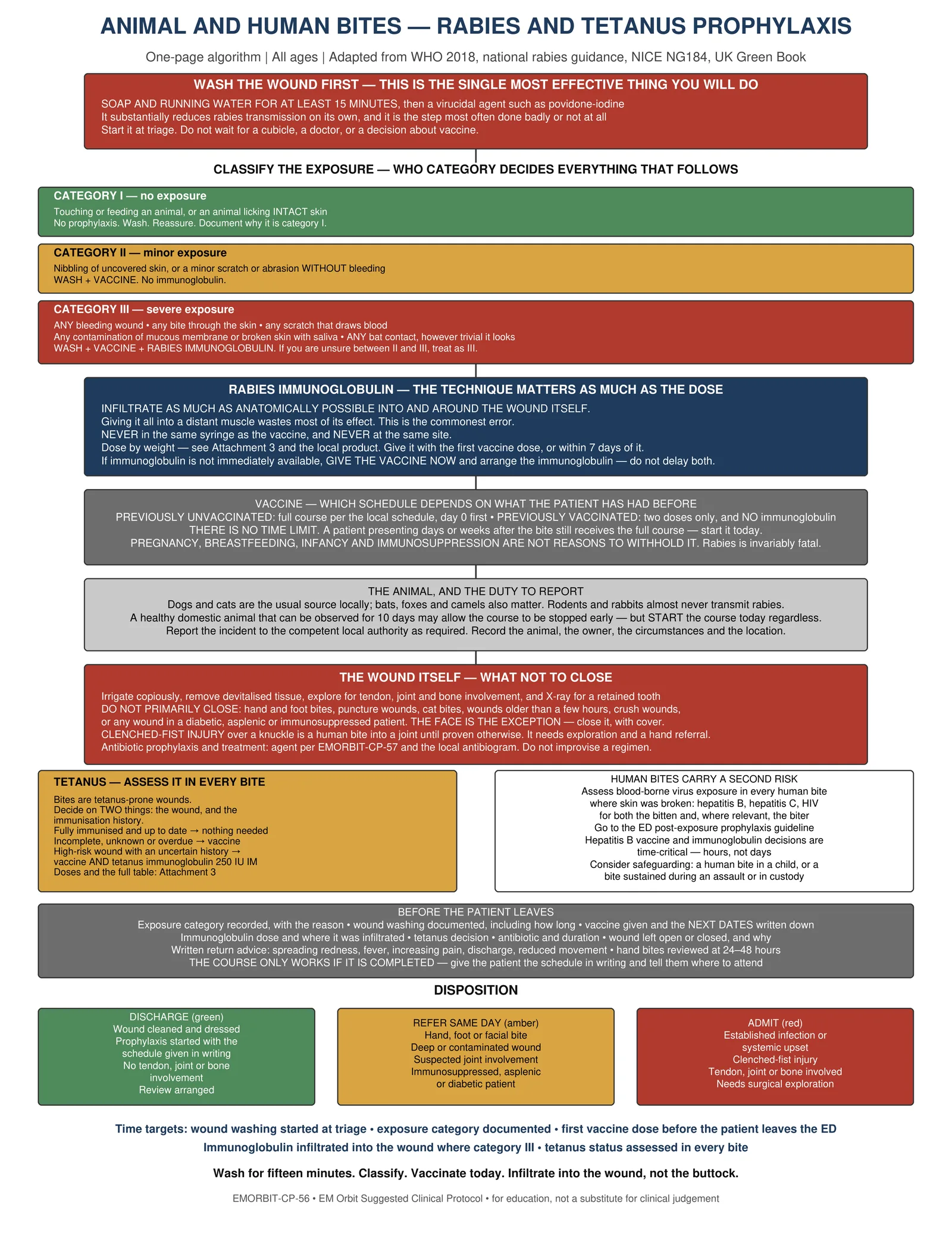
The one-page algorithm is shown at the top of this page.
6Team roles
6.1Triage Nurse:
6.1.1 Start wound washing at triage under the approved standing order — soap and running water for at least 15 minutes, timed — before the patient waits for anything else.
6.1.2 Triage bites by the criteria in section 4.1.1 and do not stream a bite as a minor presentation that can wait.
6.1.3 Record the animal, the time of exposure, the site of the wounds, whether the wound bled, whether washing has already been done and for how long, and the tetanus and rabies vaccination history.
6.1.4 Alert the treating physician immediately to: any bat exposure, any bite to the face, head or neck, any hand bite or knuckle wound, any large-animal bite, any infected wound with systemic features, and any immunocompromised or asplenic patient.
6.2ED Nurses:
6.2.1 Complete and document the wound washing and the application of the virucidal agent, with times.
6.2.2 Prepare and check the vaccine and the immunoglobulin as two separate products, in two separate syringes, for two separate sites, and check the weight-based immunoglobulin dose with a second practitioner.
6.2.3 Observe the patient for 15 to 30 minutes after each dose and record observations; have anaphylaxis treatment immediately available.
6.2.4 Record every product, batch, dose, route, site and time, and prepare the patient's written dose record and schedule.
6.2.5 Provide the written return advice and the follow-up details, confirm the patient understands them, and use an interpreter where required.
6.3Clinical Pharmacist:
6.3.1 Confirm which rabies vaccine product is stocked and the volume of one intramuscular dose of that product, and ensure it is displayed where the vaccine is stored.
6.3.2 Confirm which immunoglobulin product is stocked and therefore which dose figure applies — 20 IU/kg for human, 40 IU/kg for equine — and maintain the out-of-hours access arrangement.
6.3.3 Maintain stock and cold chain for rabies vaccine, rabies immunoglobulin, tetanus-containing vaccine and human tetanus immunoglobulin, and define what happens when the department has none.
6.3.4 Verify the antimicrobial choice against EMORBIT-CP-57 and the current antibiogram; advise on the penicillin-allergic patient.
6.3.5 Advise on drugs that interfere with the vaccine response, in particular corticosteroids, other immunosuppressants, chloroquine and mefloquine.
6.4Infectious Diseases and Microbiology:
6.4.1 Advise on the immunocompromised patient, on the arrangement of post-course serology 2 to 4 weeks after the final dose, and on further doses where the titre is inadequate.
6.4.2 Advise on courses started abroad, on unidentifiable products, on nerve-tissue vaccine exposure, and on interrupted or confused schedules.
6.4.3 Advise on macaque and other primate exposures and B virus prophylaxis.
6.4.4 Agree with the ED, and keep current, the empirical antimicrobial regimens for bite wounds within EMORBIT-CP-57 and the local antibiogram.
6.5Public Health, Infection Prevention and Control:
6.5.1 Define and keep current the notification route for animal bites and potential rabies exposures, including the out-of-hours arrangement, and the route to the municipal and veterinary authorities.
6.5.2 Advise on the observation and testing of an animal, and on discontinuing a course where the animal remains healthy or tests negative.
6.5.3 Lead the response to any suspected human rabies case, including contact tracing of staff and family.
6.6Hand Surgery, Orthopaedics, Plastic Surgery and Maxillofacial Surgery:
6.6.1 Accept and review every clenched-fist injury and every established hand-bite infection on the same visit, and agree the arrangement by which that referral is made out of hours.
6.6.2 Provide exploration, irrigation and debridement in theatre where the wound requires it.
6.6.3 Review facial, scalp, lip, eyelid, ear and nasal wounds, and all facial bites in children, and undertake primary repair where appropriate.
6.7Radiology:
6.7.1 Provide plain radiographs of the hand and of any bitten joint, reporting fracture, retained tooth or foreign body, and air within a joint.
6.7.2 Provide computed tomography where skull or facial penetration is possible, particularly in a small child bitten about the head.
6.8Laboratory:
6.8.1 Process wound and blood cultures from infected bites and report positives verbally; process baseline blood-borne virus serology under EMORBIT-CP-55; and process rabies-neutralising antibody titres where these are requested by Infectious Diseases.
6.9Primary Health Centre:
6.9.1 Administer the remaining doses of the rabies vaccine course on the scheduled days, monitor for adverse reactions, and ensure completion of the course.
6.9.2 Contact the patient who does not attend for a scheduled dose, and inform the ED or Public Health where a patient defaults.
6.9.3 Complete tetanus primary courses begun in the ED.
6.10Ambulance and Pre-hospital Providers:
6.10.1 Begin wound washing with water at the scene and continue it during transfer where it is safe to do so, and record what was done and for how long.
6.10.2 Record the animal, the circumstances, and whether the wound bled; pre-alert the ED for major wounds, facial injury, uncontrolled bleeding or systemic illness.
6.10.3 Do not apply an occlusive dressing that prevents washing on arrival, and do not close or pack a bite wound.
7The patient's role
7.1 Allow the wound to be washed thoroughly, even though it is uncomfortable and takes a quarter of an hour — this is the most effective part of the treatment.
7.2 Describe the animal and the circumstances honestly, including where and when it happened, and say if it happened abroad.
7.3 Say honestly how a wound over the knuckles was caused; the treatment of that particular wound depends entirely on it.
7.4 Bring any documentation of previous rabies or tetanus vaccination, and any record of treatment started elsewhere.
7.5 Attend for every remaining dose on the day it is due, at the health centre named. If a dose is missed, attend as soon as possible — the course is continued, not started again.
7.6 Keep the written record given by the department and take it to every appointment.
7.7 Return immediately for increasing pain, redness, swelling, pus, fever, or any difficulty moving a finger.
7.8 Help the health authority trace the animal by giving the location and any details of the owner.
8Definitions
8.1Rabies: an acute viral encephalomyelitis caused by lyssaviruses, transmitted to humans almost exclusively through the saliva of an infected mammal by a bite, a scratch or contact with a mucous membrane. The incubation period is typically one to three months but ranges from days to years. Once clinical symptoms appear the disease is virtually always fatal, and it is entirely preventable by timely post-exposure prophylaxis.
8.2Post-Exposure Prophylaxis (PEP): the combination of immediate thorough wound washing, rabies vaccine, and — where the exposure category and vaccination status indicate it — rabies immunoglobulin.
8.3Pre-Exposure Prophylaxis (PrEP): rabies vaccination given before any exposure, to travellers to endemic areas and to occupationally exposed groups. A person with a documented complete pre-exposure course is treated as "previously vaccinated".
8.4WHO Exposure Category I, II and III: the WHO classification of a potential rabies exposure, set out in Table 1, which determines what prophylaxis is given.
8.5Virucidal Agent: an agent with proven activity against rabies virus applied to the wound after washing — povidone-iodine, an alcohol-based preparation, or another agent of proven virucidal activity.
8.6Rabies Immunoglobulin (RIG): passive antibody preparation infiltrated into and around the wound to neutralise virus at the site of inoculation during the interval before the vaccine produces an active response. Human RIG (HRIG) is dosed at 20 IU/kg and equine RIG (ERIG) at 40 IU/kg.
8.7Previously Vaccinated: a person with documented completion of a pre-exposure or post-exposure course of a cell-culture rabies vaccine, or a documented rabies-neutralising antibody titre of 0.5 IU/mL or above. An undocumented claim does not qualify.
8.8Cell-Culture Vaccine: a modern rabies vaccine produced in cell culture or embryonated eggs — purified vero cell (PVRV), human diploid cell (HDCV) or purified chick embryo cell (PCECV). Nerve-tissue vaccines are obsolete and shall not be used.
8.9Intradermal (ID) Regimen: the WHO dose-sparing route in which 0.1 mL of vaccine is given intradermally at each of two sites on days 0, 3 and 7 in the previously unvaccinated patient.
8.1010-Day Observation: the confinement and observation of a dog, cat or ferret for 10 days from the date of the exposure. An animal that remains healthy throughout was not shedding virus at the time of the bite. It does not apply to any other species.
8.11Tetanus-Prone Wound: a wound at increased risk of tetanus, as defined in Table 5; animal and human bites that breach the skin are tetanus-prone.
8.12High-Risk (Tetanus) Wound: a tetanus-prone wound with heavy contamination with material likely to contain tetanus spores, extensive devitalised tissue, or surgical treatment delayed beyond 6 hours.
8.13Clenched-Fist Injury ("Fight Bite"): a wound over a metacarpophalangeal joint sustained by striking another person's teeth. It inoculates human oral flora into the extensor tendon and often the joint, is frequently trivial in appearance, and is never closed primarily.
8.14Delayed Primary Closure: closure of a wound at 3 to 5 days after injury, once it has been shown to remain clean.
8.15WHO, the national health authority, UKHSA, NICE, IDSA, RCEM: World Health Organization; the national health authority; United Kingdom Health Security Agency; National Institute for Health and Care Excellence; Infectious Diseases Society of America; Royal College of Emergency Medicine.
9Attachments
- Attachment 1: One-page algorithm (top of this page)
- Attachment 2: WHO Exposure Categories, the Animals That Matter, and What Each Category Triggers
- Attachment 3: Rabies Vaccine and Immunoglobulin Schedules, and Tetanus Prophylaxis
- Attachment 4: Wound Care, Closure, Follow-Up and Notification Checklist
11Suggested quality indicators
11.1Wound washing documented: (Number of patients presenting with a potential rabies exposure in whom wound washing with soap and running water for at least 15 minutes, and the application of a virucidal agent, is documented with times / Total number of patients presenting with a potential rabies exposure) × 100. Target ≥ 95%.
11.2Exposure category documented: (Number of patients presenting with a potential rabies exposure in whom the WHO exposure category is explicitly documented / Total number of patients presenting with a potential rabies exposure) × 100. Target 100%.
11.3Time to first vaccine dose: (Number of patients with a category II or category III exposure who received their first rabies vaccine dose within 2 hours of arrival / Total number of patients with a category II or III exposure) × 100. Target ≥ 90%. No patient in this denominator shall leave the department without a first dose; any such case is reported as an incident.
11.4Immunoglobulin infiltrated into the wound: (Number of patients in whom rabies immunoglobulin was indicated and in whom infiltration into and around every wound is documented / Total number of patients in whom rabies immunoglobulin was indicated) × 100. Target 100%.
11.5Tetanus status assessed: (Number of bite patients in whom the tetanus immunisation history and the tetanus prophylaxis decision are documented / Total number of bite patients) × 100. Target ≥ 95%.
11.6Safe disposition — the hand bite: (Number of patients with a clenched-fist injury or an established hand-bite infection referred to hand surgery or orthopaedics on the same visit, with the wound left open / Total number of patients with a clenched-fist injury or established hand-bite infection) × 100. Target 100%.
11.7Outcome indicator — completion of the vaccine course: (Number of patients started on rabies post-exposure prophylaxis in the ED who completed the full scheduled course / Total number of patients started on rabies post-exposure prophylaxis in the ED) × 100. Target ≥ 90%, measured with the primary health centres at 8 weeks. This indicator cannot be measured by the ED alone and requires the data-sharing arrangement described in section 4.3.14 to be established.
11.8Outcome indicators (monitored, no fixed target): unplanned re-attendance with bite-wound infection within 14 days; bite wounds closed that this guideline directs to be left open; time from arrival to notification of the public health authority; and any case of human rabies, which is reviewed as a serious incident.
13References
- World Health Organization. WHO Expert Consultation on Rabies: third report. WHO Technical Report Series No. 1012. Geneva: World Health Organization; 2018.
- World Health Organization. Rabies vaccines: WHO position paper — April 2018. Wkly Epidemiol Rec. 2018;93(16):201–220.
- World Health Organization. Rabies vaccines and immunoglobulins: WHO position. Summary of the 2017 recommendations. Geneva: World Health Organization; 2018.
- World Health Organization. Tetanus vaccines: WHO position paper — February 2017. Wkly Epidemiol Rec. 2017;92(6):53–76.
- the national health authority. National guidance on the prevention of rabies and post-exposure prophylaxis. Dubai: the national health authority.
- Department of Health – Abu Dhabi. Updates on the instructions for reconstitution and administration of rabies vaccine (VERORAB). Circular USO-53-20. Abu Dhabi: DOH; 2020.
- UK Health Security Agency. Immunisation against infectious disease (the Green Book), Chapter 27: Rabies. London: UKHSA.
- UK Health Security Agency. Immunisation against infectious disease (the Green Book), Chapter 30: Tetanus. London: UKHSA.
- National Institute for Health and Care Excellence. Human and animal bites: antimicrobial prescribing. NICE guideline NG184. London: NICE; 2020.
- Stevens DL, Bisno AL, Chambers HF, et al. Practice guidelines for the diagnosis and management of skin and soft tissue infections: 2014 update by the Infectious Diseases Society of America. Clin Infect Dis. 2014;59(2):e10–e52.
- Rupprecht CE, Briggs D, Brown CM, et al. Use of a reduced (4-dose) vaccine schedule for postexposure prophylaxis to prevent human rabies: recommendations of the Advisory Committee on Immunization Practices. MMWR Recomm Rep. 2010;59(RR-2):1–9.
- Manning SE, Rupprecht CE, Fishbein D, et al. Human rabies prevention — United States, 2008: recommendations of the Advisory Committee on Immunization Practices. MMWR Recomm Rep. 2008;57(RR-3):1–28.
- Hampson K, Coudeville L, Lembo T, et al. Estimating the global burden of endemic canine rabies. PLoS Negl Trop Dis. 2015;9(4):e0003709.
- Talan DA, Citron DM, Abrahamian FM, Moran GJ, Goldstein EJC. Bacteriologic analysis of infected dog and cat bites. N Engl J Med. 1999;340(2):85–92.
- Medeiros IM, Saconato H. Antibiotic prophylaxis for mammalian bites. Cochrane Database Syst Rev. 2001;(2):CD001738.
- Royal College of Emergency Medicine. Best practice guidance and clinical standards relevant to wound care, bite injuries and hand injuries in the emergency department. London: RCEM.
- ED Clinical Practice Guidelines EMORBIT-CP-01, EMORBIT-CP-11, EMORBIT-CP-28, EMORBIT-CP-53, EMORBIT-CP-54, EMORBIT-CP-55, EMORBIT-CP-57, EMORBIT-CP-72 and EMORBIT-CP-83.
A2Attachment 2: WHO Exposure Categories, the Animals That Matter, and What Each Category Triggers
The exposure category is assigned at the first medical assessment and documented explicitly, because every subsequent decision follows from it. It is decided on the exposure — what happened to the skin and the mucous membranes — and not on the appearance of the animal or the reassurance of its owner.
Category III includes any bleeding wound, any bite through the skin, any contamination of a mucous membrane with saliva, and any direct contact with a bat regardless of apparent injury. Where the category is uncertain or the history unreliable, the higher category is assumed.
| Category | What it means | Typical examples | What it triggers |
|---|---|---|---|
| CATEGORY I No exposure | Contact with an animal that does not breach the skin and does not involve a mucous membrane: touching or feeding an animal, or a lick on intact skin | Stroking a cat; feeding a camel; a dog licking an unbroken forearm; being in the same room as an animal | No rabies prophylaxis. Wash the contact area with soap and water. Reassure, document the category, and give written advice to return if the history changes or a breach of skin is later identified |
| CATEGORY II Minor exposure | Nibbling of uncovered skin, or minor scratches or abrasions without bleeding | A cat scratch that reddens but does not bleed; a puppy mouthing a hand and leaving an indentation without breaking the skin surface into the dermis | Immediate wound washing + rabies vaccine. Rabies immunoglobulin is NOT indicated, except in an immunocompromised patient, in whom it is given as for category III. Tetanus assessment. Antibiotic prophylaxis considered on wound criteria |
| CATEGORY III Severe exposure | Any transdermal bite or scratch; any wound that bleeds; any bite through the skin; contamination of a mucous membrane or of broken skin with saliva, including a lick on broken skin; any direct contact with a bat, whatever the apparent injury; and consumption of raw milk or tissue from a suspect animal | A dog bite that draws blood, however small; a cat bite puncture; a saliva splash into the eye, mouth or nose; a bat found in a room with a sleeping person, an unattended child, or a person unable to give a reliable history; a scratch that bleeds | Immediate wound washing + rabies vaccine + RABIES IMMUNOGLOBULIN in every previously unvaccinated patient. Tetanus assessment. Antibiotic prophylaxis. Notification to the local health authority |
The category is decided on the exposure, not on the appearance of the animal, the owner's reassurance, or the patient's wish not to have injections. Where the category is uncertain, or where the history is unreliable — a small child, an intoxicated or confused patient, a patient who cannot describe the contact — the higher category shall be assumed. A wound that bleeds, however trivial it looks, is category III.
| Animal | Rabies risk and local relevance | Observation | ED position |
|---|---|---|---|
| Dog (owned, stray or feral) | The commonest source of human rabies worldwide and the source of the great majority of human deaths. Stray and feral dogs are present locally and in the surrounding region, and imported and travelling animals add further risk | A healthy, owned, identifiable dog may be observed for 10 days | Give PEP by category. Where the animal is owned, identifiable and under reliable observation, see section 4.3.5 for the only circumstances in which the course may be discontinued |
| Cat (owned, stray or feral) | Stray cats are numerous in many urban areas and cat bites and scratches are among the commonest bite presentations to emergency departments. Cats are a recognised rabies vector | A healthy, owned, identifiable cat may be observed for 10 days | Give PEP by category. In addition, the cat bite is the bite with the highest rate of wound infection — see sections 4.3.8 and 4.3.10 |
| BAT — ANY CONTACT | Every direct contact with a bat is category III, whatever the apparent injury. Bat teeth are fine and a bite may leave no visible mark and may not be felt. Bat lyssaviruses are present across the region and cause a disease clinically identical to classical rabies | Never observed. The animal is not returned to the wild or held for observation | Vaccine and immunoglobulin, in every case. This includes a bat found in the room of a sleeping person, an unattended child, or a person who cannot give a reliable account — treat as an exposure even with no history of a bite |
| Fox, jackal, wolf, mongoose, hyena and other wild carnivores | The Arabian red fox and other wild carnivores are the principal wildlife reservoir in this region. Any unprovoked approach by, or attack from, a wild carnivore is a high-risk exposure | Not observed; the animal is treated as rabid unless laboratory testing proves otherwise | Vaccine and immunoglobulin for any category II or III exposure; do not wait for the animal to be traced |
| Camel | Rabies in camels is reported in the region, usually following a bite by a rabid dog or fox. Independently of rabies, a camel bite is a major wound: crushing, avulsion, deep tissue destruction, fracture, and a heavily contaminated wound | Report to the veterinary and public health authority; herd observation is arranged by them, not by the ED | Treat as a rabies exposure by category, and manage the wound as a contaminated crush and avulsion injury with early surgical involvement |
| Horse, donkey, cattle, sheep, goat and other livestock | Rabies transmission from livestock to humans is rare but reported; the risk rises where the animal is behaving abnormally, is salivating, or is known to have been attacked by a dog or fox | Veterinary assessment and report; the public health authority decides | Discuss with the local public health authority and infectious diseases. Where the animal is ill or behaving abnormally, give PEP and do not wait for the veterinary result |
| Monkey and other non-human primates | Primate bites and scratches are treated as rabies exposures. Macaque exposures additionally carry a risk of B virus (Herpesvirus simiae), which is rare but frequently fatal and requires its own specific prophylaxis | Not observed | Give rabies PEP by category and discuss every macaque exposure with infectious diseases on the same visit for consideration of B virus prophylaxis |
| Rodents and lagomorphs — rats, mice, squirrels, hamsters, guinea pigs, gerbils, rabbits and hares | Small rodents and lagomorphs are almost never found to be rabid and have never been shown to transmit rabies to a human. | Not applicable | Rabies PEP is not indicated. Tetanus assessment, wound care and antibiotic consideration still apply, and rat bites carry their own infection risk |
| Birds, snakes, lizards, fish and other non-mammals | Not susceptible to rabies and cannot transmit it. | Not applicable | Rabies PEP is not indicated. Manage as a contaminated wound; a reptile bite may require specific wound and envenomation advice (EMORBIT-CP-72) |
| Human | Human-to-human rabies transmission by a bite has never been documented outside transplantation. The important risks of a human bite are wound infection and blood-borne virus transmission | Not applicable | No rabies PEP. Assess for hepatitis B, hepatitis C and HIV exposure under EMORBIT-CP-55, assess tetanus, give antibiotic prophylaxis, and consider safeguarding and domestic violence |
A patient bitten abroad shall be asked where, and the exposure assessed against the rabies risk of that country. A patient who was bitten in a rabies-endemic country and has already started a course there shall have the course continued, not restarted (section 4.3.6).
A3Attachment 3: Rabies Vaccine and Immunoglobulin Schedules, and Tetanus Prophylaxis
The first vaccine dose is given in the Emergency Department at the first attendance. Day 0 is the day of the first dose, not the day of the bite, and there is no time limit on starting a course. An interrupted course is resumed, never restarted.
Rabies immunoglobulin works by neutralising virus at the site of inoculation: as much of the calculated dose as is anatomically possible is infiltrated into and around every wound, diluting it with sterile 0.9% sodium chloride where the volume will not reach them all. It is never drawn into the same syringe as the vaccine and never given at the same site.
| Patient group | Intramuscular (IM) regimen | Intradermal (ID) regimen | Notes |
|---|---|---|---|
| NOT previously vaccinated — the usual ED patient | |||
| Adult or child, any age or weight | Days 0, 3, 7 and 14 — one full IM dose at one site on each day (the four-dose "Essen" regimen) | Days 0, 3 and 7 — 0.1 mL at two sites on each of the three days (the WHO one-week regimen) | The paediatric dose is the same as the adult dose — rabies vaccine is not weight-adjusted. The full ED course is completed over 14 days (IM) or 7 days (ID) |
| Alternative IM regimen where it is the locally approved schedule | Day 0 — one dose into EACH deltoid (two doses); day 7 — one dose; day 21 — one dose (the "2-1-1" or Zagreb regimen) | Not applicable | An accepted WHO alternative. It shall not be mixed with the four-dose schedule. Only one schedule shall be in use in the department, and which one shall be stated locally |
| Immunocompromised patient | Days 0, 3, 7, 14 and 28 — five doses | The ID route shall not be used; give the full IM course | Rabies immunoglobulin is given for category II as well as category III exposures. Rabies-neutralising antibody shall be measured 2 to 4 weeks after the final dose, and further doses given where the titre is inadequate. Arrange this with infectious diseases before the patient leaves |
| PREVIOUSLY vaccinated — documented complete pre-exposure or post-exposure course, or a documented neutralising antibody titre of 0.5 IU/mL or above | |||
| Adult or child | Days 0 and 3 — one full IM dose on each day | Days 0 and 3 — 0.1 mL at one site on each day; or 4 sites of 0.1 mL on day 0 alone as a single-visit alternative | Rabies immunoglobulin shall NOT be given to a previously vaccinated patient. It confers no benefit and suppresses the anamnestic response. The claim of previous vaccination shall be accepted only on documentary evidence; where there is no record, treat the patient as unvaccinated |
| ADMINISTRATION — applies to every regimen | |||
| Volume of one IM dose | One full vial of the reconstituted vaccine — the volume depends on the product. Purified vero cell rabies vaccine (PVRV) is 0.5 mL per dose; human diploid cell vaccine (HDCV) and purified chick embryo cell vaccine (PCECV) are 1.0 mL per dose | The volume shall be read from the product in use and not assumed. The ED shall display the volume of the product currently stocked beside the vaccine fridge | |
| Site | Deltoid in adults and children aged 2 years and over; anterolateral thigh in infants and children under 2 years. The gluteal region shall never be used — absorption is unreliable and vaccine failures have occurred | Where two sites are required on the same day, use the two deltoids, or the two thighs in a small child | |
| Relationship to immunoglobulin | The vaccine and the immunoglobulin shall never be drawn into the same syringe and shall never be given at the same anatomical site. Give the vaccine in a limb distant from the infiltrated wound | Use a separate syringe, a separate needle and a separate limb, and record both sites | |
| After the dose | Observe the patient for 15 to 30 minutes for an immediate hypersensitivity reaction, with anaphylaxis treatment immediately available (EMORBIT-CP-01) | Record the product, batch number, expiry, dose, route, site and time of every dose given, and the dates the remaining doses are due | |
| Interrupted or delayed course | Resume the course — do not restart it. A dose given late is given as soon as the patient presents and the remaining doses are rescheduled from that point | A course started with another cell-culture product may be completed with the product available; record the change | |
| Drugs that interfere | Corticosteroids and other immunosuppressants blunt the response and should be avoided during the course where the underlying condition allows; chloroquine and mefloquine reduce the response to the intradermal route | Where these drugs cannot be stopped, use the intramuscular route, treat the patient as immunocompromised, and arrange serology |
Doses, products, volumes and the schedule in local use shall be verified by Clinical Pharmacy and the Infectious Diseases service against the local formulary and the current national health authority guidance before use. Rabies vaccine has no contraindication in the post-exposure setting: there is no age limit, no weight limit, no dose adjustment, and pregnancy, lactation and infancy are not reasons to withhold it.
| Question | Answer | Detail | Why it matters |
|---|---|---|---|
| Who gets it | Every previously unvaccinated patient with a category III exposure, and every immunocompromised patient with a category II or III exposure | It is given at the same visit as the first vaccine dose. It is not given to a previously vaccinated patient, and not for a category I or an uncomplicated category II exposure | Immunoglobulin provides immediate passive neutralising antibody at the wound during the 7 to 10 days before the vaccine produces an active response. In a severe bite, particularly to the face, neck or hand, that interval is when the virus enters the nerve |
| Which product and what dose | Human rabies immunoglobulin (HRIG): 20 IU/kg body weight Equine rabies immunoglobulin (ERIG): 40 IU/kg body weight Monoclonal antibody products: the dose stated in the product licence | The dose is the same in adults and children on a weight basis, and the calculated dose shall never be exceeded | Exceeding the dose suppresses the active immune response to the vaccine. The product stocked locally determines the dose — the two figures are not interchangeable, and the wrong figure halves or doubles the dose |
| Where it goes — the point on which the whole treatment turns | As much of the calculated dose as is anatomically possible shall be infiltrated into and around every wound, including wounds that have healed over and old puncture marks | Infiltrate slowly, into the wound edges and the tissue immediately around and beneath each wound. Where the calculated volume is too small to reach all the wounds, dilute it two- to three-fold with sterile 0.9% sodium chloride so that every wound can be infiltrated | Immunoglobulin given into a buttock does not protect a wound on a hand. Neutralising the virus where it was inoculated is the entire mechanism; a dose given distantly and not into the wound is the commonest technical failure of rabies prophylaxis and has been associated with deaths |
| The remaining volume | Where infiltration of all wounds has been achieved and volume remains, WHO advises that no additional distant intramuscular injection is required | In the traditional approach, any remainder is given intramuscularly at a site distant from the vaccine site, for example the gluteal region when the vaccine is in the deltoid | WHO 2018 concluded that the distant intramuscular remainder adds little or no protection. Infiltration into and around the wound is what matters; the distant intramuscular remainder adds little. |
| Anatomical limits | Infiltrate with care in a digit, the pinna, the nose and the penis, where the tissue compartment is tight | Inject slowly and in small aliquots and monitor perfusion; do not create a compartment problem in a finger. Discuss the hand, the face and the genitalia with the relevant surgical service | A digit lost to a tense infiltrate is an avoidable harm; the answer is dilution, patience and small aliquots, not omitting the infiltration |
| Timing | With the first vaccine dose. If it was not available then, it may be given up to day 7 after the first vaccine dose | After day 7 from the first vaccine dose it shall not be given, because the active antibody response has begun and immunoglobulin would suppress it | This is a limit measured from the first vaccine dose, not from the bite. A patient presenting late who has had no vaccine at all still receives immunoglobulin with their first dose, however long ago the bite was |
| Never | Never in the same syringe as the vaccine. Never at the same anatomical site as the vaccine. Never to a previously vaccinated patient. Never as a reason to delay the first vaccine dose | If immunoglobulin is not immediately available, give the vaccine now and arrange the immunoglobulin within the 7-day window | Waiting for immunoglobulin to arrive before starting the vaccine delays the only part of the treatment that produces lasting immunity |
| Adverse reactions | Local pain and low-grade fever are common. Anaphylaxis is rare; serum sickness is described with equine product | Skin testing before equine immunoglobulin is not recommended: it does not predict anaphylaxis and delays treatment. Give the product with resuscitation facilities and adrenaline immediately available, and observe the patient | A negative skin test has falsely reassured clinicians and a positive one has led to prophylaxis being withheld from a patient who needed it |
The product, its concentration and the dose figure that therefore applies shall be checked against the product information; the arrangements for obtaining it out of hours follow the hospital's pathway.
| Immunisation history | Clean wound | Tetanus-prone wound | High-risk wound |
|---|---|---|---|
| Complete course and boosters appropriate for age (five doses of tetanus-containing vaccine, the last within 10 years) | None required | None required | Human tetanus immunoglobulin (HTIG); vaccine not required |
| Complete primary course but boosters incomplete or overdue | None required now; refer to primary care to complete the schedule | A dose of tetanus-containing vaccine now, and refer to complete the schedule | Tetanus-containing vaccine now + HTIG |
| Primary course incomplete, unknown, or no record — including a patient who cannot give a reliable history, and many adults who arrived from countries with different schedules | A dose of tetanus-containing vaccine now, and refer to complete the full course | Tetanus-containing vaccine now + HTIG | Tetanus-containing vaccine now + HTIG |
| Any immunosuppressed patient — including HIV infection regardless of CD4 count, and patients on immunosuppressive therapy | Vaccinate according to history as above | HTIG in addition to the vaccine, whatever the immunisation history, because the response to previous vaccination may be inadequate | HTIG in addition to the vaccine, whatever the immunisation history |
| WOUND DEFINITIONS | |||
| Clean wound | Less than 6 hours old, non-penetrating, with negligible tissue damage and no contamination. Few bite wounds meet this definition — a bite that punctures the skin is a puncture wound | ||
| Tetanus-prone wound | Puncture-type injury in a contaminated environment; a wound containing a foreign body; a compound fracture; a wound or burn with systemic sepsis; significant devitalised tissue; and animal and human bites and scratches that breach the skin. Most bites presenting to this department are tetanus-prone | ||
| High-risk wound | Any tetanus-prone wound with heavy contamination with material likely to contain tetanus spores — soil, manure, stable or farmyard material; extensive devitalised tissue; or a wound requiring surgical intervention that is delayed beyond 6 hours. A camel, horse or livestock bite sustained in a stable or a farm is the typical example | ||
| HUMAN TETANUS IMMUNOGLOBULIN — DOSE | |||
| HTIG dose | 250 IU by intramuscular injection, as a single dose (CDC). The dose is the same in children. Give it at a different site from the tetanus-containing vaccine, with a different syringe | ||
| Which vaccine | An age-appropriate tetanus-containing vaccine as defined by the national immunisation schedule — a combined preparation in young children, and a tetanus, diphtheria and acellular pertussis preparation in older children and adults. Use the product specified in national public health guidance |
Tetanus is the prophylaxis most often forgotten once the conversation turns to rabies. Every bite patient shall have a tetanus decision made and documented, including those who are receiving rabies prophylaxis and those who are not. Where HTIG is unavailable, intravenous immunoglobulin may be used on the advice of Pharmacy and Infectious Diseases.
A4Attachment 4: Wound Care, Closure, Follow-Up and Notification Checklist
This checklist shall be completed for every patient presenting to the ED after an animal or human bite, and filed in the medical record. The written advice sheet shall be given to the patient in a language they understand.
| ✓ | Action |
|---|---|
| ☐ | The wound has been washed with soap under running water for at least 15 minutes, timed by the clock. Start time ______ End time ______ |
| ☐ | A virucidal agent (povidone-iodine or equivalent) has been applied to every wound. Agent: ______________________ |
| ☐ | A mucous membrane exposure has been irrigated copiously with water or 0.9% sodium chloride. |
| ☐ | Adequate analgesia, and local or regional anaesthesia where needed to allow proper cleaning and exploration. |
| ☐ | Every wound has been counted, examined and described, including small punctures and wounds that have already healed over. |
| ☐ | Tendon function tested individually, neurovascular status checked, joint involvement considered. |
| ☐ | A knuckle wound has been asked about directly, and the hand examined in the clenched position. |
| ☐ | The WHO exposure category has been assigned and written in the notes: I ☐ II ☐ III ☐ |
| ✓ | Item |
|---|---|
| ☐ | Rabies vaccine first dose given in the department. Product ____________ Batch ________ Dose ______ Route ____ Site ____ Time ______ |
| ☐ | The remaining dose dates have been calculated from today and written on the patient's record: Day 3 ______ Day 7 ______ Day 14 ______ (Day 28 if immunocompromised ______). |
| ☐ | Rabies immunoglobulin indicated? Yes ☐ No ☐ — if yes: product ____________ weight ______ kg, calculated dose ______ IU. |
| ☐ | Infiltrated into and around EVERY wound. Diluted with 0.9% sodium chloride to reach all wounds? Yes ☐ No ☐ Not needed ☐ |
| ☐ | Given with a different syringe, at a different site, from the vaccine. Any remainder given at: ______________________ |
| ☐ | Tetanus decision made: wound is clean ☐ tetanus-prone ☐ high-risk ☐; immunisation complete ☐ incomplete/unknown ☐ |
| ☐ | Tetanus-containing vaccine given ☐ not required ☐; human tetanus immunoglobulin given ☐ (dose ______ IU) not required ☐ |
| ☐ | Antibiotic prophylaxis or treatment decided on the Table 7 criteria, agent per EMORBIT-CP-57; first dose given before the patient leaves ☐ not indicated ☐ |
| ☐ | The patient was observed for 15 to 30 minutes after each dose with no adverse reaction. |
| ✓ | Item |
|---|---|
| ☐ | Closure decision made per Table 6 — left open ☐ closed ☐; reason documented. Nothing was closed before immunoglobulin was infiltrated. |
| ☐ | No hand, foot, puncture, infected, old, crush or clenched-fist wound has been closed. |
| ☐ | Radiograph obtained where indicated (clenched-fist injury, bite over a joint, suspected fracture or foreign body); CT head considered in a child bitten about the head. |
| ☐ | Clenched-fist injury or established hand-bite infection referred to hand surgery or orthopaedics on this visit, hand elevated and splinted. |
| ☐ | Human bite: blood-borne virus risk assessed and referred under EMORBIT-CP-55; hepatitis B status established. |
| ☐ | Safeguarding, domestic violence or non-accidental injury considered and acted upon where present (EMORBIT-CP-83). |
| ☐ | The public health authority has been notified. Time ______ Authority ____________ Person ____________ Reference ____________ |
| ☐ | The municipal or veterinary authority has been informed about the animal, where it is traceable. |
| ☐ | The patient has a written record of what was given, the dates of the remaining doses, and the named primary health centre with its telephone number. |
| ☐ | The patient has been told, and has understood, that an incomplete course may not protect them. Interpreter used? Yes ☐ No ☐ Not needed ☐ |
| ☐ | Wound review appointment arranged where the wound was left open or prophylaxis was given for a high-risk wound: date ____________ |
| ☐ | Written return advice given in Arabic and English — increasing pain, redness, swelling, pus, fever, or difficulty moving a finger. |
Completed by: ______________________ Grade: ____________ Date and time: ____________________
A copy of this checklist shall be filed in the medical record and a copy retained by the ED quality team for audit against the performance indicators in section 11.