Pain Management in the Emergency Department (Adults and Children)
EMORBIT-CP-28 · Chapter 16 · Cross-cutting ED Standards
Open in the appFree, works on your phone and offline, with every tool alongside.
Evidence base: RCEM Best Practice 2021/2017; ACEP
1Purpose
1.1 Provide a single, department-wide standard for the assessment and treatment of acute pain in adults and children presenting to the Emergency Department (ED), which every other EM Orbit Clinical Protocol may reference rather than restate.
1.2 Establish that pain is a vital sign: that a pain score shall be measured and recorded with the observation set at triage, after every analgesic intervention, and before the patient leaves the department, and that a pain score is as much a part of the record as a blood pressure.
1.3 Establish that untreated pain is a failure of care, not an inconvenience. Untreated acute pain causes measurable physiological harm — tachycardia, hypertension, increased myocardial oxygen demand and myocardial ischaemia, splinting of the chest with atelectasis and hypoxaemia, immobility with venous thromboembolism, a catabolic stress response with hyperglycaemia and impaired wound healing, delirium in older patients, and an increased risk of persistent post-injury pain.
1.4 Establish that analgesia shall not be withheld pending a diagnosis, a decision, a specialty opinion, or the arrival of a result. In particular, state explicitly and with its evidence that opioid analgesia does not mask an acute abdomen and shall not be withheld from a patient with abdominal pain awaiting surgical assessment.
1.5 Define the assessment tool appropriate to each age and ability, including the tools for pre-verbal children and for patients who cannot self-report because of dementia, learning disability, aphasia or intubation, so that no patient goes unassessed because they cannot speak.
1.6 Define the time targets that the department is measured against: any analgesia within 20 minutes of arrival for a patient in severe pain, reassessment of the pain score within 30 minutes of every dose, and a documented plan where pain remains uncontrolled.
1.7 Set out a stepwise approach by severity, with the specific agents, doses, routes, maximums and cautions for adults and for children by weight, including the intranasal route as the first-line route for severe pain in a child and wherever intravenous access is not yet established.
1.8 Embed the adjuncts and non-pharmacological measures that are consistently under-used — splinting, ice, elevation, position, reassurance, distraction, parental presence, sucrose in infants, and topical anaesthetic applied at triage.
1.9 Establish regional anaesthesia as routine ED practice, with the fascia iliaca block for hip and femoral fracture as the reference technique, together with the mandatory local anaesthetic systemic toxicity plan and immediate access to lipid emulsion.
1.10 Define safe opioid practice in the ED and on discharge — titration rather than fixed dosing, monitoring, the management of opioid-related respiratory depression, short courses only, no routine repeat supply, and communication with the primary physician — adapted to local controlled-drug regulations.
1.11 Ensure consistency of practice among all healthcare providers (HCP) and alignment with the Royal College of Emergency Medicine (RCEM), the American College of Emergency Physicians (ACEP), the Australasian College for Emergency Medicine (ACEM), the World Health Organization (WHO) and the National Institute for Health and Care Excellence (NICE).
2Who this protocol applies to
2.1 All patients of any age presenting to the ED with pain of any cause and any severity, whether the pain is the presenting complaint or is found during assessment.
2.2 All patients in whom a painful procedure is to be performed in the ED, including cannulation, venepuncture, wound care, dressing change, fracture or dislocation reduction, catheterisation, lumbar puncture, chest drain insertion and incision and drainage.
2.3 All patients who cannot report pain for themselves — pre-verbal children, patients with dementia or delirium, patients with a learning disability or autism, patients with aphasia, and intubated or sedated patients — in whom pain is assessed observationally and by proxy.
2.4 Patients with an acute exacerbation of a chronic painful condition, and patients who are opioid-tolerant, on opioid substitution therapy, or have an opioid use disorder.
2.5 Patients arriving by ambulance who have already received analgesia, in whom the dose, route and time given shall be recorded and the effect reassessed on arrival.
3Not covered by this protocol
3.1 Procedural sedation, which is governed by the ED procedural sedation standard and requires a separate pre-sedation assessment, fasting consideration, dedicated monitoring and a second practitioner. Analgesic (sub-dissociative) doses of ketamine as described in this guideline are not procedural sedation.
3.2 The ongoing management of chronic non-cancer pain, and the initiation or escalation of long-term opioid therapy, which are not ED functions and are referred to the primary physician or the pain service.
3.3 Specialist palliative and end-of-life symptom control beyond immediate relief in the ED, which is delivered with the palliative care service under its own pathway. Immediate analgesia in the ED is never deferred pending that referral.
3.4 Regional techniques requiring the operating theatre environment, neuraxial anaesthesia, and continuous catheter techniques, which are the responsibility of the Anaesthesia and Pain Service.
3.5 The management of the specific underlying condition, which remains governed by the relevant ED guideline — this guideline governs only the pain.
4Protocol
4.1History and Assessment:
4.1.1Triage and Recognition:
4.1.1.1 A pain score shall be recorded for every patient at triage, as part of the observation set, using the tool appropriate to the patient's age and ability (Table 1). Where no pain is reported, the score is recorded as zero; "not assessed" is not an acceptable entry.
4.1.1.2 Severe pain scored 8 to 10 out of 10 is a Category 2 triage criterion in its own right, in accordance with the ED Triage Standard (EMORBIT-CP-29), irrespective of the apparent severity of the underlying condition.
4.1.1.3 First analgesia shall be given within 20 minutes of arrival under the approved triage nursing standing order, without waiting for a cubicle, for a physician assessment, for radiography, or for a diagnosis. The standing order shall specify the agents, doses and routes that the triage nurse may give by severity, age and weight.
4.1.1.4 At the same triage contact: splint the injured limb, apply ice and elevate where indicated, and apply topical local anaesthetic to any child expected to need a cannula or a blood test, so that the waiting time is used.
4.1.1.5 The pain score shall be reassessed within 30 minutes of every analgesic intervention, and unrelieved pain shall trigger re-triage, a further intervention and escalation.
4.1.1.6 The score obtained is the patient's report. It is not moderated by the clinician's view of how much the condition ought to hurt, by the patient's appearance or behaviour, by a previous attendance pattern, or by a suspicion about the patient's motives.
4.1.1.7
Table 1: Pain assessment tools — the tool is chosen by age and by the ability to self-report, never by the clinician's impression Tool Who it is for How it is used Notes Numerical Rating Scale (NRS), 0–10 Adults and children of about 8 years and above who can understand numbers Ask: "On a scale of nought to ten, where nought is no pain and ten is the worst pain you can imagine, what is your pain now?" Record the number. The default adult tool. A verbal question needs no card and works over the telephone and through an interpreter. Verbal Rating Scale (none / mild / moderate / severe) Adults who cannot use numbers, including some older and cognitively impaired patients Ask the patient to choose one of the four words; map to none = 0, mild = 1–3, moderate = 4–7, severe = 8–10. Acceptable where the NRS fails; record which scale was used. Wong-Baker FACES Pain Rating Scale, 0–10 Children of about 4 years and above, and adults with limited literacy or language Show the six faces; ask the child to point to the face that shows how much they hurt. Score 0, 2, 4, 6, 8, 10. Show the faces to the child, not to the parent. Do not ask the child to grade how the face looks — ask how they feel. FLACC scale, 0–10 Pre-verbal children (approximately 2 months to 4 years) and any child who cannot self-report Observe Face, Legs, Activity, Cry and Consolability; score each 0–2 and sum. An observational score, not a self-report. The parent's statement that the child is in pain is evidence and shall be recorded. Neonatal observational scale (for example the Neonatal Infant Pain Scale) Neonates and infants under about 2 months Observed facial expression, cry, breathing pattern, limb tone and arousal. Use the tool adopted by the paediatric service; neonates feel pain and are systematically under-treated. Abbey Pain Scale, 0–18 Adults with dementia or advanced cognitive impairment who cannot self-report Score 0–3 for each of six domains — vocalisation, facial expression, change in body language, behavioural change, physiological change, physical change. 0–2 no pain, 3–7 mild, 8–13 moderate, 14 or more severe. Designed for observation during movement. A rising score after movement is strong evidence of pain. PAINAD scale, 0–10 Adults with advanced dementia Score 0–2 for each of five items — breathing, negative vocalisation, facial expression, body language, consolability. A score of 2 or more indicates pain requiring treatment. Quick to apply at triage. Either Abbey or PAINAD may be used; the department shall adopt one and use it consistently. Proxy report Any patient with a learning disability, autism, aphasia, intubation or a language barrier Ask the parent, carer or family: "How do you know when they are in pain, and is this that?" Record the answer verbatim. A carer who says the patient is in pain is more accurate than any score. Never discount it. A pain score shall be recorded using one of these tools at triage, after every analgesic intervention, and before the patient leaves the department. The tool used shall be named in the record, and the same tool shall be used for every reassessment of that patient so that the scores are comparable.
4.1.2History of the Pain (taken in parallel with giving the first analgesia, never before it):
4.1.2.1 Site, radiation, character, severity now and at its worst, onset (sudden or gradual, and what the patient was doing), duration, and the time course since onset.
4.1.2.2 What makes it better and what makes it worse, including movement, position, breathing, eating and micturition.
4.1.2.3 Associated symptoms, which frequently identify the time-critical diagnosis: sweating, vomiting, syncope, fever, breathlessness, neurological deficit, or a cold or numb limb.
4.1.2.4 Analgesia already taken or given, with the drug, dose, route and time — including everything given by the ambulance service and everything taken at home in the preceding 24 hours, counting the paracetamol content of combination preparations.
4.1.2.5 Usual analgesia, regular medication, and specifically any opioid, benzodiazepine, gabapentinoid, anticoagulant or antiplatelet therapy; opioid substitution therapy with buprenorphine or methadone and the prescribing service.
4.1.2.6 Allergy and previous adverse reaction to analgesics, and any previous reaction to local anaesthetic.
4.1.2.7 Relevant comorbidity: renal impairment, hepatic disease, peptic ulceration or gastrointestinal bleeding, ischaemic heart disease, heart failure, asthma sensitive to aspirin or non-steroidal anti-inflammatory drugs, obstructive sleep apnoea, pregnancy or breastfeeding, and sickle cell disease.
4.1.2.8 For a patient with a chronic painful condition — in particular sickle cell disease — whether an individual care plan exists, and what dose is known to work for that patient.
4.1.2.9 For a child: the weight (measured wherever possible), the parent's account of how the child normally behaves in pain, and what has already been given at home.
4.1.3Examination:
4.1.3.1 Airway, breathing, circulation and conscious level first — pain in a physiologically unstable patient is treated as part of the resuscitation, not after it.
4.1.3.2 Examine the painful part, with adequate exposure and adequate analgesia already given; a patient who cannot tolerate examination needs more analgesia, not a shorter examination.
4.1.3.3 Record the distal neurovascular status of any injured limb before any splinting, reduction, plaster or regional block, and again afterwards.
4.1.3.4 Observe the behavioural signs that constitute the pain score in a patient who cannot self-report: facial expression, guarding, posture, vocalisation, restlessness, consolability, and the change in all of these on movement.
4.1.3.5 Note the physiological consequences of pain that should resolve as it is treated: tachycardia, hypertension, tachypnoea and sweating. A persistent tachycardia after adequate analgesia is a sign of something else and shall be investigated.
4.1.3.6 Record the pain score obtained, the tool used, and the time.
4.1.4Severity and Risk Stratification:
4.1.4.1 Pain is banded as none, mild (1 to 3), moderate (4 to 7) or severe (8 to 10), and the band determines both the time target and the first-line approach (Table 2).
4.1.4.2 The band is reassessed at every reassessment; a patient may move between bands in both directions, and the treatment follows the current band.
4.1.4.3 Patients at particular risk of under-treatment, in whom the score shall be actively sought rather than waited for: older people, especially with cognitive impairment; pre-verbal and young children; patients with a learning disability, autism or aphasia; patients who do not speak the language of the department; patients with sickle cell disease; patients known or assumed to have an opioid use disorder; frequent attenders; and patients with a psychiatric diagnosis.
4.1.4.4 Patients at particular risk of harm from analgesia, in whom the dose and the monitoring are adjusted: age over 70 years; frailty and low body weight; renal or hepatic impairment; obstructive sleep apnoea or obesity; concurrent sedatives, benzodiazepines, gabapentinoids or alcohol; chronic obstructive pulmonary disease; and any patient who has already received an opioid before arrival.
4.1.4.5
Table 2: Severity bands, time targets and the first-line approach Band Score Typical presentation Time target and first-line approach SEVERE 8–10 Unable to speak in sentences for the pain; fractured neck of femur or long bone; dislocation; renal or biliary colic; ischaemic limb; sickle cell crisis; major burn; pain dominating the consultation Triage Category 2. First analgesia within 20 minutes of arrival under the triage nursing standing order. Strong opioid titrated intravenously, or intranasal fentanyl or diamorphine where there is no intravenous access, together with paracetamol and — unless contraindicated — a non-steroidal anti-inflammatory drug. Reassess within 30 minutes. MODERATE 4–7 Limb injury, soft-tissue injury, abdominal pain, headache, otitis, dental pain, back pain without red flags Triage Category 3. Analgesia within 30 minutes of arrival. Paracetamol plus a non-steroidal anti-inflammatory drug, with an oral opioid added if not controlled at reassessment. Intranasal fentanyl is appropriate in a distressed child. MILD 1–3 Minor injury, minor laceration, localised infection, simple headache Triage Category 4. Analgesia within 60 minutes of arrival. Paracetamol, with or without a non-steroidal anti-inflammatory drug, plus non-pharmacological measures. NONE 0 No pain reported and no behavioural evidence of pain Record the score. Reassess if the patient's condition, position or activity changes, and before any procedure. The band is set by the patient's own report, or by the observational score where the patient cannot self-report. The clinician's impression of how much a given injury "should" hurt shall not override the patient's score. A patient who is smiling, using a telephone, or sleeping may still be in severe pain; none of these is evidence that the score is false.
4.1.5Pain That Signals a Time-Critical Diagnosis — Treat the Pain and Pursue the Cause Together:
4.1.5.1 Giving analgesia and making the diagnosis are simultaneous tasks. The following presentations require the pain to be treated immediately and a specific time-critical diagnosis to be excluded, and none of them justifies delaying the analgesia:
4.1.5.2 Chest pain — acute coronary syndrome, aortic dissection, pulmonary embolism, tension pneumothorax, oesophageal rupture (EMORBIT-CP-05, EMORBIT-CP-06, EMORBIT-CP-07, EMORBIT-CP-09).
4.1.5.3 Abdominal pain — ruptured abdominal aortic aneurysm, mesenteric ischaemia, perforation, ectopic pregnancy, testicular or ovarian torsion, obstruction (EMORBIT-CP-12).
4.1.5.4 Back pain — cauda equina syndrome, aortic dissection or aneurysm, spinal epidural abscess, vertebral fracture, malignancy.
4.1.5.5 Headache — subarachnoid haemorrhage, meningitis, venous sinus thrombosis, acute angle-closure glaucoma, giant cell arteritis, carbon monoxide poisoning.
4.1.5.6 Limb pain — acute limb ischaemia, compartment syndrome, necrotising soft-tissue infection, septic arthritis, deep vein thrombosis.
4.1.5.7 Pain out of proportion to the clinical findings, or pain that escalates despite adequate opioid, is a red flag for compartment syndrome, mesenteric ischaemia, necrotising fasciitis and acute limb ischaemia, and shall prompt immediate senior review. Adequate analgesia does not conceal these diagnoses — the escalating requirement for analgesia is itself the diagnostic sign.
4.1.5.8 In a limb with a possible compartment syndrome, analgesia is given and the compartments are assessed and monitored; the pain is not used as an untreated monitoring device. Repeated assessment, pressure measurement where indicated, and early surgical review are the monitoring, not withheld analgesia.
4.1.6Special Populations:
4.1.6.1 The dose, the route, the monitoring and, in some cases, the whole approach change in the groups set out in Table 10. The recurring theme in every one of them is under-treatment rather than over-treatment.
4.1.6.2
Table 10: Analgesia in special populations Population What changes What to do Older people Pain is systematically under-recognised and under-treated in this group, particularly where there is cognitive impairment. Renal function falls with age even when the creatinine is normal; gastrointestinal and cardiovascular risk from non-steroidals is high; opioid-related delirium and falls are common. Use paracetamol at full dose as the base. Non-steroidal anti-inflammatory drugs are usually avoided; where one is unavoidable, use the lowest dose for the shortest time with gastroprotection. Start opioids at 25 to 50% of the adult dose and titrate slowly. Use an observational scale where self-report is unreliable. Treat pain actively as delirium prevention — untreated pain is itself a common cause of delirium. Children Doses are weight-based; the assessment tool changes with age; the intranasal route removes the need to cannulate a frightened child; codeine and tramadol are prohibited under 12 years. See Tables 4 and 5. Apply topical anaesthetic at triage. Keep the parent present. Use distraction and a play specialist where available. Never withhold analgesia from a child because the injury "looks minor". Pregnancy Paracetamol is the analgesic of choice. Non-steroidals are avoided from 20 weeks (oligohydramnios and fetal renal effects) and are contraindicated from 30 weeks (premature closure of the ductus arteriosus). Opioids are acceptable for short-term acute pain. Paracetamol first line; opioids titrated where severe pain requires them, with neonatal team awareness near term; nitrous oxide is acceptable in labour. Involve obstetrics for any pain that may be obstetric in origin, and do not attribute abdominal pain in pregnancy to a benign cause without assessment. Renal impairment Morphine metabolites (morphine-6-glucuronide) accumulate and cause prolonged sedation and respiratory depression. Non-steroidals worsen renal function. Codeine is metabolised to morphine and accumulates similarly. Avoid non-steroidal anti-inflammatory drugs. Use paracetamol at full dose. Prefer fentanyl or oxycodone; where morphine is used, reduce the dose and lengthen the interval, and monitor for longer. Avoid pethidine absolutely. Hepatic impairment Paracetamol metabolism is impaired; opioids may precipitate encephalopathy; non-steroidals cause bleeding and renal failure in cirrhosis. Reduce paracetamol to a maximum of 2 to 3 g/day in significant impairment (do not omit it). Avoid non-steroidals. Use opioids at reduced dose with extended intervals and close observation. Opioid tolerance and opioid use disorder The usual starting dose will be inadequate. These patients are at particular risk of having their pain disbelieved, under-treated and mislabelled as drug-seeking. Acute pain in a patient who is opioid-tolerant is treated, and will require higher doses titrated to effect. Continue the patient's usual maintenance opioid and add analgesia on top of it. Make maximal use of non-opioid analgesia, ketamine and regional techniques. Involve the pain service early. A history of opioid use disorder is not a reason to withhold analgesia; it is a reason to plan it carefully and involve senior help. Buprenorphine or methadone maintenance Buprenorphine is a partial agonist with high receptor affinity; methadone has a long and variable half-life. Both give little or no analgesia at maintenance dosing intervals. Do not stop the maintenance dose — verify it with the prescribing service and continue it. Add a full agonist opioid (morphine, fentanyl or oxycodone) titrated to effect, expecting to need higher than usual doses for buprenorphine. Use regional blocks, ketamine and non-opioid agents fully. Discuss with the addiction or pain service the same day; naloxone is less effective against buprenorphine. Sickle cell vaso-occlusive crisis This is one of the most severe pains in medicine and one of the most consistently under-treated presentations in emergency departments worldwide, because patients are wrongly suspected of drug-seeking. Patients know their own disease and their effective dose. Triage Category 2. A strong opioid shall be given within 30 minutes of arrival, and the standard of care is rapid, adequate-dose opioid titrated to effect — use the patient's own written individual care plan where one exists. Reassess the pain score every 30 minutes until controlled, then hourly. Add paracetamol and, where not contraindicated, a non-steroidal. Give oxygen if hypoxic, keep warm, hydrate, and look for the precipitant and for acute chest syndrome, stroke, sepsis and splenic sequestration. A patient with sickle cell disease shall never be labelled as drug-seeking for requesting analgesia. Communication difficulty, dementia, learning disability and autism Self-report may be impossible or unreliable; distress may present as agitation, withdrawal, refusal or aggression, which is often mistaken for behaviour rather than pain. Use the Abbey or PAINAD scale, and ask the carer how this patient shows pain. New agitation in a patient with dementia shall prompt a search for pain, retention of urine, constipation and infection before any sedative is considered. Reduce noise and light; minimise moves; use a hospital passport or care plan where one exists; allow the carer to remain. Language barrier Pain scores obtained through a family member, or not obtained at all, are a recognised source of under-treatment. Use a professional interpreter or a telephone interpreting service, and a faces scale, which crosses languages. Record the language and the interpretation method used. Major trauma and the shocked patient Standard opioid doses may precipitate hypotension; pain itself worsens shock. Titrate small opioid increments, use ketamine at analgesic dose, and use regional and splinting techniques early. Pain relief is part of the resuscitation, not a reward for completing it.
4.2Investigations:
4.2.1 No investigation shall delay analgesia. Blood is taken and imaging requested while the analgesia is being given, not before it.
4.2.2 There is no investigation for pain itself. Investigation is directed at the underlying condition under the relevant guideline.
4.2.3 Where a non-steroidal anti-inflammatory drug is being considered in a patient with risk factors, renal function should be checked, but the first dose of paracetamol and the first opioid shall not wait for it.
4.2.4 Where a regional block is planned in a patient on an anticoagulant, the relevant clotting studies and the timing of the last dose shall be established and discussed with anaesthesia.
4.2.5 Pulse oximetry and, where available, capnography monitoring accompany intravenous opioid titration in a high-risk patient; these are monitoring rather than investigation.
4.2.6 Where pain is disproportionate or escalating, the investigation is of the cause — for example serial compartment assessment, lactate, computed tomography angiography, or urgent surgical review — and is requested urgently.
4.3Plan of Care:
4.3.1Immediate Actions — the first 20 minutes:
4.3.1.1 Record the pain score at triage using the appropriate tool.
4.3.1.2 Give the first analgesia within 20 minutes of arrival for severe pain, under the triage nursing standing order, without waiting for a physician, a cubicle, a diagnosis or a result. Aim for 30 minutes in moderate pain and 60 minutes in mild pain.
4.3.1.3 Choose the route by the severity and by what is available: oral where the pain is mild or moderate and the patient can swallow; intranasal where the pain is severe and there is no intravenous access; intravenous and titrated where access exists or is being obtained; inhaled nitrous oxide for immediate relief while another route is prepared.
4.3.1.4 Apply the non-pharmacological measures at the same time, not instead and not afterwards: splint the limb, apply ice, elevate, position for comfort, explain what is happening, and keep the parent with the child.
4.3.1.5 Apply topical local anaesthetic to any child who will need a cannula or a blood test.
4.3.1.6 Do not withhold analgesia pending a diagnosis, a surgical opinion, imaging, a decision about admission, or the consent process. Withholding analgesia so that an examination will be "clean" is not acceptable practice and is addressed specifically in section 4.3.2.5.
4.3.1.7 Set and record the time at which the pain will be reassessed — within 30 minutes of the dose given.
4.3.2Definitive ED Treatment — Adults, Stepwise by Severity:
4.3.2.1 Analgesia is multimodal: a base of paracetamol, plus a non-steroidal anti-inflammatory drug unless contraindicated, plus an opioid titrated to severity, plus the adjuncts and non-pharmacological measures, plus a regional technique where one is indicated. Each component allows a lower dose of the others.
4.3.2.2 Opioids are titrated, not fixed-dosed. A written order of "morphine 10 mg intramuscularly as required" is not a titration and is not acceptable for severe pain. Morphine 10 mg is diluted to 1 mg/mL and given in 2 mg increments every 5 minutes until the pain is tolerable or sedation appears; the correct dose is whatever achieves that, and it varies severalfold between patients.
4.3.2.3 The stepwise approach moves up as well as down: a patient whose severe pain is not controlled by an oral agent moves to a titrated intravenous or intranasal opioid at the reassessment, and the department does not wait for a second oral dose to fail.
4.3.2.4
Table 3: Adult analgesia by severity — agent, dose, route, maximum and caution Step Agent Dose and route Maximum, and the cautions that matter STEP 1
Base layer
for every
patient in
painParacetamol Oral 1 g every 4 to 6 hours. Intravenous 1 g over 15 minutes where the oral route is unavailable or the pain is severe. Rectal 1 g where neither is possible. Maximum 4 g in 24 hours by any route combined. Body weight under 50 kg: 15 mg/kg per dose intravenously, maximum 60 mg/kg/day and not more than 3 g/day. Reduce to a maximum of 3 g/day in chronic alcohol use, malnutrition, low body weight or hepatic impairment. Count paracetamol contained in combination products. Ibuprofen Oral 400 mg every 6 to 8 hours with food. Maximum 2.4 g in 24 hours. See the non-steroidal cautions below. Diclofenac Oral 50 mg every 8 hours; rectal 100 mg once daily; intramuscular 75 mg (renal colic). Maximum 150 mg in 24 hours. Highest cardiovascular risk of the common non-steroidals; avoid in established cardiovascular disease. Naproxen Oral 500 mg initially, then 250 mg every 6 to 8 hours. Maximum 1.25 g on day one, 1 g daily thereafter. Preferred non-steroidal where cardiovascular risk is a concern. STEP 2
Moderate
painCodeine Oral 30 to 60 mg every 4 to 6 hours, always with paracetamol. Maximum 240 mg in 24 hours. Shall not be given to any child under 12 years, to any breastfeeding mother, or to any patient under 18 years after tonsillectomy or adenoidectomy. Ineffective in poor metabolisers and dangerous in ultra-rapid metabolisers. Constipation is near-universal. Tramadol Oral 50 to 100 mg every 6 hours. Maximum 400 mg in 24 hours. Lowers the seizure threshold; risk of serotonin syndrome with selective serotonin reuptake inhibitors, serotonin-noradrenaline reuptake inhibitors, triptans and linezolid. Avoid in epilepsy and in the elderly where an alternative exists. Not for children under 12 years. Oral morphine (immediate release) Oral 5 to 10 mg every 4 hours as required (opioid-naive adult). Start at 2.5 to 5 mg in patients over 70 years, in frailty, and in renal impairment. An effective and under-used option for moderate pain in a patient who does not need a cannula. STEP 3
Severe pain
TITRATE —
do not give
a fixed doseMorphine, intravenous Dilute 10 mg in 10 mL of 0.9% sodium chloride (1 mg/mL). Give 2 mg every 5 minutes, titrated to the pain score and the respiratory rate, until the pain is tolerable or sedation appears. A typical total is 0.1 mg/kg, but the correct dose is the dose that works. Reduce the increment to 1 mg and lengthen the interval in patients over 70 years, in frailty, in renal or hepatic impairment, and where a sedative has already been given. Monitor respiratory rate, oxygen saturation, sedation score and blood pressure. Naloxone, oxygen and a bag-valve-mask shall be immediately available. Fentanyl, intravenous 25 to 50 microgram every 5 minutes, titrated to effect. Faster onset and shorter duration than morphine; preferred in renal impairment and in haemodynamic instability. Rapid large boluses may cause chest-wall rigidity. Fentanyl, intranasal 1.5 microgram/kg, to a maximum of 100 microgram, delivered by mucosal atomiser, half into each nostril. May be repeated once at 0.75 to 1.5 microgram/kg after 10 minutes. The first-line route for severe pain where there is no intravenous access. Onset 5 to 10 minutes. Not effective if the nostrils are obstructed by blood or mucus. Concentration must be checked before use — use the 50 microgram/mL preparation for children. Oxycodone, oral immediate release 5 to 10 mg every 4 to 6 hours. Preferred oral opioid in renal impairment. 5 mg oral oxycodone is approximately equivalent to 10 mg oral morphine. ADJUNCT
agentsKetamine, analgesic (sub-dissociative) dose 0.1 to 0.3 mg/kg intravenously, diluted in 50 to 100 mL of 0.9% sodium chloride and infused over 10 to 15 minutes. May be repeated after 20 minutes. Intramuscular 0.5 mg/kg where there is no access. A slow infusion, never a rapid push — a rapid push causes dysphoria, and this is the commonest reason ketamine is abandoned. Useful in opioid-tolerant patients, in trauma with hypotension, and where the opioid dose is limited by sedation. Warn the patient about transient visual disturbance and a feeling of unreality. Relative cautions: uncontrolled hypertension, ischaemic heart disease, psychosis. Nitrous oxide 50% with oxygen 50% Self-administered through a demand valve and mouthpiece or mask, from the start of the painful stimulus. Onset within 30 seconds, offset within 60 seconds. Requires a cooperative patient who can hold the device — never hold the mask on for the patient. Requires scavenging or adequate ventilation. Contraindications are listed in section 4.3.4.4. Lidocaine and levobupivacaine (local and regional) Local infiltration, haematoma block, digital block, or a fascia iliaca block (section 4.3.5). See section 4.3.5 for doses, maximums and the local anaesthetic systemic toxicity plan. NOT
RECOMMENDEDPethidine (meperidine) Shall not be used for acute pain in the ED. No analgesic advantage over morphine in renal or biliary colic; accumulates as normeperidine causing tremor, agitation and seizures, particularly in renal impairment and the elderly; higher abuse potential. Intramuscular opioid for severe pain Should be avoided where an intravenous or intranasal route is available. Onset is slow and unpredictable, absorption is poor in shock, and the dose cannot be titrated. Repeated intramuscular injection is painful in its own right. Non-steroidal anti-inflammatory cautions in every adult: acute or chronic kidney injury, dehydration or hypovolaemia of any cause; previous peptic ulceration or gastrointestinal bleeding; concurrent anticoagulant, antiplatelet or corticosteroid therapy; established ischaemic heart disease, cerebrovascular disease or heart failure; known aspirin- or non-steroidal-sensitive asthma; pregnancy from 20 weeks and absolutely from 30 weeks; age over 65 years without gastroprotection; and the triad of a non-steroidal with an angiotensin-converting enzyme inhibitor or receptor blocker and a diuretic. Where a non-steroidal is still indicated, use the lowest effective dose for the shortest period.
4.3.2.5Analgesia in the Undifferentiated Acute Abdomen — the Evidence:
4.3.2.5.1 Opioid analgesia shall be given to a patient with severe abdominal pain, including a patient awaiting surgical assessment, and shall not be withheld on the grounds that it will mask the signs.
4.3.2.5.2 The practice of withholding analgesia from the acute abdomen originates in a nineteenth-century textbook instruction and has been repeatedly tested and refuted. Randomised trials and systematic reviews, including the Cochrane review of analgesia in acute abdominal pain and the JAMA Rational Clinical Examination systematic review, show that opioid analgesia changes the comfort of the patient without increasing the rate of diagnostic error or of inappropriate management decisions, and that any alteration in the physical findings is small and does not lead to missed surgical pathology. Patient satisfaction and the ability to cooperate with examination improve.
4.3.2.5.3 The practical consequence is that the surgical registrar examines a patient who is comfortable enough to allow a proper examination, which is a better examination, not a worse one.
4.3.2.5.4 Where a surgeon asks for analgesia to be withheld, the request shall be discussed at consultant level and the outcome documented; the default is that the patient is treated.
4.3.2.5.5 The same principle applies to renal and biliary colic, to limb injury awaiting radiography, to head injury awaiting computed tomography (using a titrated short-acting opioid with attention to the conscious level, which is recorded before and after), and to chest pain awaiting a troponin result.
4.3.2.6Condition-Specific First-Line Choices:
- Renal colic: a non-steroidal anti-inflammatory drug is first line and is more effective than an opioid — diclofenac 75 mg intramuscularly or 100 mg rectally, or intravenous ketorolac where stocked; add a titrated opioid where the non-steroidal is contraindicated or insufficient. Paracetamol intravenously is an effective second line.
- Fractured neck of femur and femoral shaft fracture: paracetamol, a titrated opioid, and a fascia iliaca block, which should be offered to every such patient (section 4.3.5).
- Migraine: a non-steroidal or aspirin with an antiemetic; intravenous metoclopramide or prochlorperazine; intravenous fluids; a quiet dark area. Opioids are not first-line for migraine and should be avoided, as they worsen medication-overuse headache and increase recurrence.
- Musculoskeletal back pain: paracetamol and a non-steroidal, early mobilisation, and reassurance; opioids only briefly and only where the pain prevents mobilisation; exclude cauda equina syndrome first.
- Burns: immediate cooling with running water for 20 minutes, cling-film cover, titrated opioid, and nitrous oxide or ketamine for dressing changes.
- Rib fractures: regular paracetamol and a non-steroidal, an opioid titrated to allow deep breathing and coughing, early incentive spirometry, and a serratus anterior plane block or specialist referral where the pain prevents adequate ventilation.
- Sickle cell crisis: as in Table 10 — a strong opioid within 30 minutes, the patient's own care plan, and reassessment every 30 minutes.
- Dental pain: a non-steroidal with paracetamol is more effective than an opioid; a dental block gives immediate relief; antibiotics are only for spreading infection, and the definitive treatment is dental.
4.3.3Definitive ED Treatment — Children:
4.3.3.1 A child's pain is treated with the same urgency as an adult's. Children with fractures are among the most consistently under-treated patients in emergency medicine, and the proportion of children with a fracture who receive analgesia is a departmental performance indicator (section 11).
4.3.3.2 The intranasal route is first line for severe pain in a child, and removes the need to cannulate a distressed child before the pain is treated. Intranasal fentanyl 1.5 microgram/kg, or intranasal diamorphine 0.1 mg/kg where it is stocked and permitted, works within 5 to 10 minutes.
4.3.3.3 Every dose is calculated on an actual measured weight where the child can safely be weighed, and independently checked before administration.
4.3.3.4 Oral paracetamol and ibuprofen are given together for moderate pain — the combination is more effective than either alone — unless one is contraindicated.
4.3.3.5 Codeine and tramadol shall not be used in any child under 12 years.
4.3.3.6 Non-pharmacological measures are not optional extras in children: the parent stays, the child is distracted, a comfort hold replaces restraint, topical anaesthetic is applied before cannulation, and sucrose or breastfeeding is used in infants.
4.3.3.7
Table 4: Paediatric analgesia — every dose is calculated on actual body weight, and the calculation is checked by a second person Agent Route Dose Maximum, and notes Paracetamol Oral 15 mg/kg every 4 to 6 hours Maximum 4 doses (60 mg/kg) in 24 hours; maximum 1 g per dose. A loading dose of 20 mg/kg may be used for the first dose in moderate or severe pain. Paracetamol Rectal 20 mg/kg for the first dose, then 15 mg/kg every 6 hours Maximum 60 mg/kg in 24 hours. Absorption is slower and less reliable than the oral route; use only when oral is impossible. Paracetamol Intravenous Body weight 10 kg to under 50 kg: 15 mg/kg every 6 hours. Body weight under 10 kg: 7.5 mg/kg every 6 hours. Body weight 50 kg and above: 1 g every 6 hours. Maximum 60 mg/kg/day (30 mg/kg/day if under 10 kg), never exceeding 3 g/day under 50 kg or 4 g/day at or above 50 kg. Intravenous paracetamol is a recognised source of ten-fold overdose in small children: the prescription shall state the dose in milligrams AND in millilitres, and the volume shall be independently checked before it is given. Ibuprofen Oral 10 mg/kg every 6 to 8 hours Maximum 30 mg/kg/day; maximum 400 mg per dose. Not for infants under 3 months or under 5 kg. Give with food or milk. Avoid in dehydration, in significant vomiting or diarrhoea, and in any child with reduced urine output. Diclofenac Oral or rectal 1 mg/kg every 8 hours (child over 6 months) Maximum 3 mg/kg/day, maximum 50 mg per dose. Alternative non-steroidal where ibuprofen is unavailable. Fentanyl INTRANASAL 1.5 microgram/kg, maximum 100 microgram, atomised half into each nostril. A second dose of 0.75 to 1.5 microgram/kg may be given after 10 minutes if the pain is not controlled. The first-line route for severe pain in a child and wherever intravenous access is not yet established. Onset 5 to 10 minutes; duration about 45 to 60 minutes. Use the 50 microgram/mL preparation and check the concentration aloud with a second nurse. Maximum volume 0.5 mL per nostril; divide larger volumes between the nostrils and repeat. Ineffective where the nose is blocked by blood, mucus or a foreign body. Diamorphine INTRANASAL 0.1 mg/kg (100 microgram/kg) made up in 0.2 mL of 0.9% sodium chloride and instilled into one nostril. An equally acceptable first-line intranasal option where the preparation is stocked and permitted under the applicable controlled-drug regulations. Onset within 10 minutes. Check the availability and legal status of diamorphine locally before this route is adopted; where it is not available, intranasal fentanyl is used. Morphine Oral (immediate release) 0.2 to 0.4 mg/kg (200 to 400 microgram/kg) as a single dose, then 0.2 mg/kg every 4 hours as required Maximum 10 mg per dose for a child under 12 years. Onset 20 to 30 minutes. An effective option for moderate to severe pain where no cannula is needed. Morphine Intravenous Dilute to 100 microgram/mL. Give 50 microgram/kg as the first increment, then 20 microgram/kg every 5 minutes, titrated to effect, to a usual total of 100 to 200 microgram/kg. Under 3 months of age, halve the dose and give it only with senior and, where available, paediatric or anaesthetic involvement; monitor continuously with pulse oximetry. Naloxone shall be immediately available. Ketamine, analgesic dose Intravenous 0.2 to 0.3 mg/kg diluted and infused over 10 to 15 minutes A senior decision. Not to be confused with procedural sedation doses (1 to 1.5 mg/kg intravenously or 4 mg/kg intramuscularly), which require the full sedation standard, fasting assessment, monitoring and a second practitioner. Nitrous oxide 50% with oxygen 50% Inhaled Self-administered from the onset of the painful stimulus Generally suitable from about 5 years of age, in a child able to understand and hold the device. Excellent for wound care, dressing changes, reduction of a simple fracture and cannulation. Contraindications as in section 4.3.4.4. Sucrose 24% Oral (onto the tongue) 0.5 to 2 mL onto the anterior tongue 2 minutes before the painful procedure, with a dummy for non-nutritive sucking; the dose may be repeated during the procedure For infants up to about 6 months (and up to 12 months in some protocols) undergoing venepuncture, cannulation, heel prick, immunisation or catheterisation. Breastfeeding during the procedure is at least as effective and should be offered first. Contraindicated if the infant is not permitted oral intake. Lidocaine with prilocaine cream, or tetracaine 4% gel Topical, before cannulation or venepuncture Apply under an occlusive dressing: lidocaine-prilocaine requires 60 minutes; tetracaine gel requires 30 to 45 minutes Topical anaesthetic shall be applied at triage to every child expected to need a cannula or a blood test, so that the waiting time is used rather than wasted. Tetracaine gel causes local erythema, which is expected. Lidocaine-prilocaine is avoided in infants under 3 months and where methaemoglobinaemia is a concern. Codeine — Shall not be used in any child under 12 years. Also contraindicated in any patient under 18 years after tonsillectomy or adenoidectomy for obstructive sleep apnoea, in any child with obstructive sleep apnoea, and in breastfeeding mothers. Metabolism is unpredictable and ultra-rapid metabolisers have died. Tramadol shall likewise not be used under 12 years. Every paediatric dose shall be calculated from an actual measured weight where the child can be weighed, and from an age-based or length-based estimate only where weighing is unsafe or would delay analgesia. The calculation shall be independently checked, and the dose recorded in milligrams or micrograms with the corresponding volume.
4.3.3.8
Table 5: Paediatric ready reckoner — single doses by weight. Always confirm against the prescription; this table does not replace the calculation. Agent and route 5 kg 10 kg 15 kg 20 kg 30 kg 40 kg Paracetamol oral 15 mg/kg 75 mg 150 mg 225 mg 300 mg 450 mg 600 mg Paracetamol IV (7.5 mg/kg under 10 kg; 15 mg/kg at or above 10 kg) 37.5 mg 150 mg 225 mg 300 mg 450 mg 600 mg Ibuprofen oral 10 mg/kg not under 5 kg 100 mg 150 mg 200 mg 300 mg 400 mg Fentanyl INTRANASAL 1.5 microgram/kg 7.5 mcg 15 mcg 22.5 mcg 30 mcg 45 mcg 60 mcg Diamorphine INTRANASAL 0.1 mg/kg (where stocked) 0.5 mg 1 mg 1.5 mg 2 mg 3 mg 4 mg Morphine oral 0.2 mg/kg 1 mg 2 mg 3 mg 4 mg 6 mg 8 mg Morphine IV — first increment 50 microgram/kg 0.25 mg 0.5 mg 0.75 mg 1 mg 1.5 mg 2 mg Morphine IV — subsequent increments 20 microgram/kg every 5 minutes 0.1 mg 0.2 mg 0.3 mg 0.4 mg 0.6 mg 0.8 mg Naloxone for opioid-induced respiratory depression, 1 to 2 microgram/kg 5–10 mcg 10–20 mcg 15–30 mcg 20–40 mcg 30–60 mcg 40–80 mcg Approximate ages: 5 kg ≈ 3 months, 10 kg ≈ 1 year, 15 kg ≈ 3 years, 20 kg ≈ 6 years, 30 kg ≈ 9 years, 40 kg ≈ 12 years. Above 50 kg, adult doses apply. mcg = microgram.
4.3.4Non-Pharmacological Measures and Adjuncts:
4.3.4.1 These measures are part of the analgesia and are delivered at the same time as the drug, not instead of it and not once the drug has failed. They are the most consistently omitted element of ED pain management.
4.3.4.2
Table 6: Non-pharmacological measures and adjuncts — consistently the most under-used analgesia in the department Measure How it is done Why it matters Splinting and immobilisation Splint every long-bone fracture and every dislocation at triage, before radiography. Apply a traction splint for a mid-shaft femoral fracture. Sling an upper limb injury. Realign a grossly deformed limb after analgesia. The single most effective non-drug analgesic in trauma. Movement of fracture ends is the pain. An unsplinted limb sent to radiography undoes every milligram of morphine given. Ice and compression A cold pack wrapped in a cloth, applied for 15 to 20 minutes, with compression where appropriate. Reduces swelling and pain in soft-tissue injury. Never apply ice directly to skin, and avoid over an insensate area or in peripheral vascular disease. Elevation Elevate an injured limb above the level of the heart; elevate the head of the trolley for headache and for dental and facial pain. Reduces venous congestion and throbbing pain; costs nothing and requires no prescription. Position of comfort Allow the patient to adopt the position that hurts least, including sitting upright, and provide a pillow, a blanket and a supported limb. A patient made to lie flat for the convenience of the department is a patient in avoidable pain. Explanation and reassurance Explain what is happening, what will hurt, how long it will last, and what has been given for the pain. Never say "this will not hurt" when it will. Anxiety amplifies pain. Honest warning before a painful step reduces the reported pain and preserves trust for the next one. Distraction Bubbles, a toy, a story, counting, a video on a telephone or tablet, a play specialist where the department has one. Measurably reduces procedural pain and distress in children, and works in adults during wound care and cannulation. Parental presence A parent or carer shall be allowed to stay with the child throughout, including during cannulation and imaging, and may hold the child in a comfort position rather than the child being held down. Separation is itself painful. A child held supine by several adults is restrained, not comforted; a comfort hold on the parent's lap achieves the same procedure with far less distress. Breastfeeding, skin-to-skin and sucrose For infants: breastfeed during the procedure, or provide skin-to-skin contact, or give 24% sucrose with a dummy 2 minutes beforehand. Each has good trial evidence for procedural pain in neonates and small infants. Breastfeeding is offered first where it is possible. Topical local anaesthetic before cannulation Apply lidocaine-prilocaine cream (60 minutes) or tetracaine 4% gel (30 to 45 minutes) at triage to any child likely to need a cannula or a blood test. The waiting time is the resource. A child who has had topical anaesthetic applied at triage can be cannulated without a fight an hour later. Warmed and buffered local anaesthetic Warm lidocaine to body temperature and buffer it with sodium bicarbonate 8.4% in a ratio of about 1 mL to 9 mL of lidocaine; inject slowly through a fine needle, through the wound edge rather than through intact skin. Reduces the burning of infiltration substantially, at no cost. Wound care and dressings Irrigate with warmed fluid; use a non-adherent dressing; soak off an adherent dressing rather than pulling it. Dressing changes are a major and avoidable source of pain, particularly in burns. A quiet, dim environment For migraine, photophobia, delirium and dementia: reduce noise and light, minimise moves between areas, and avoid unnecessary repeated examination. Sensory load worsens pain and agitation, particularly in older people and in patients with autism or learning disability. 4.3.4.3Nitrous Oxide 50% with Oxygen 50%:
- Indications: immediate short-term analgesia while another route is prepared, and cover for a short painful procedure — wound cleaning, dressing change, splint application, simple reduction, cannulation in an older child.
- It is self-administered. The patient holds the mask or mouthpiece; no member of staff shall hold it in place, because the patient dropping it is the safety mechanism.
- Contraindications: pneumothorax; bowel obstruction or any trapped gas in a body cavity; recent diving or suspected decompression sickness; intracranial air, recent head injury with impaired consciousness, or recent neurosurgery; recent intraocular surgery using an intraocular gas (sulphur hexafluoride or perfluoropropane); recent middle-ear surgery; severe bullous emphysema; maxillofacial injury preventing a seal or protective reflexes; known vitamin B12 or folate deficiency; a patient unable to understand or cooperate with the device; and intoxication or reduced conscious level. Prolonged or repeated use is avoided, and use in the first trimester of pregnancy is a relative contraindication.
- Requires adequate scavenging or ventilation to protect staff, and a record of the duration of use.
4.3.5Regional Anaesthesia in the Emergency Department:
4.3.5.1 Regional techniques give the most complete pain relief available in the ED, spare opioid, and reduce opioid-related delirium, vomiting and respiratory depression. They are an expected part of emergency practice, not a specialist favour.
4.3.5.2 The fascia iliaca block for fracture of the neck of femur or the femoral shaft is the reference technique, and the department shall be able to deliver it at all hours.
4.3.5.3
Table 7: Fascia iliaca block in the ED — the reference regional technique for hip and femoral fracture Item Standard Indication Fracture of the neck of femur, and fracture of the femoral shaft, in a patient in pain. A fascia iliaca block should be offered to every patient with a fractured neck of femur unless it is contraindicated, and should be given in the ED rather than deferred to the ward or the anaesthetic room. Benefit Reduces pain at rest and on movement, reduces the total opioid dose and therefore opioid-related delirium, vomiting and respiratory depression, and improves the tolerability of transfer, radiography and positioning. Who may perform it An emergency physician who has completed the departmental training and sign-off for the technique, or an anaesthetist. The department shall maintain a register of practitioners signed off to perform the block, with the number performed and the date of the most recent. Ultrasound guidance is preferred and shall be used where the operator is trained in it. Contraindications Patient refusal or inability to consent where no lawful alternative basis exists; known allergy to the local anaesthetic; infection at the injection site; previous femoral bypass graft on that side; therapeutic anticoagulation or a significant coagulopathy (seek anaesthetic advice); and pre-existing femoral nerve deficit that has not been documented before the block. Agent, dose and maximum Levobupivacaine or bupivacaine 0.25%, 0.3 to 0.4 mL/kg, to a usual adult volume of 30 mL (75 mg) and a maximum of 40 mL. The maximum dose of levobupivacaine or bupivacaine is 2 mg/kg of lean body weight; ropivacaine 0.2% 30 to 40 mL is an alternative where it is stocked. The dose shall be calculated in milligrams per kilogram and written in the record before the injection, not after. Reduce the dose in the frail, the elderly and the low-weight patient. Before the block Document the distal neurovascular examination; obtain and record consent, or record the basis for proceeding in a patient who lacks capacity; confirm the side and mark it; establish intravenous access; attach monitoring; confirm that lipid emulsion 20% is immediately available in the room, with the current dosing card. Technique Aseptic technique. Ultrasound-guided suprainguinal or infrainguinal approach, or the landmark approach with two distinct losses of resistance (fascia lata, then fascia iliaca) at the junction of the lateral and middle thirds of a line from the pubic tubercle to the anterior superior iliac spine, 1 cm below the inguinal ligament. Aspirate before and during injection, injecting in 5 mL increments, and stop at once if the patient reports circumoral tingling, a metallic taste, tinnitus or agitation. After the block Observe with continuous monitoring for at least 30 minutes. Record the time, agent, concentration, volume, total milligrams, side, operator, ultrasound use, and the pain score before and at 30 minutes. Document the distal neurovascular examination again. Hand over the time and dose to the receiving team so that the block is not repeated. Other ED blocks Haematoma block for distal radius fracture; digital ring block; femoral nerve block; serratus anterior plane block for multiple rib fractures; auricular, dental and scalp blocks; Bier's block only where the department has an approved protocol, dedicated equipment and trained staff. Each requires local sign-off and the same local anaesthetic systemic toxicity preparation. 4.3.5.4Local Anaesthetic Systemic Toxicity:
4.3.5.4.1 Every practitioner who performs a block or a large-volume infiltration shall know the maximum dose in milligrams per kilogram, shall calculate and record it before injecting, and shall know where the lipid emulsion is kept.
4.3.5.4.2 Maximum doses for guidance (check against the product information): lidocaine 4.5 mg/kg plain (maximum 300 mg), 7 mg/kg with adrenaline (maximum 500 mg); bupivacaine and levobupivacaine 2 mg/kg; ropivacaine 3 mg/kg. Doses are calculated on lean body weight and reduced in the elderly, the frail, and in hepatic or cardiac impairment.
4.3.5.4.3 Injection is made in 5 mL increments with aspiration between each, while talking to the patient, so that early symptoms are detected before a large volume has been given.
4.3.5.4.4
Table 8: Local anaesthetic systemic toxicity (LAST) — recognition and immediate management Step Action Recognise Early: circumoral or tongue numbness, a metallic taste, tinnitus, visual disturbance, light-headedness, agitation or confusion. Late: loss of consciousness, seizures, bradycardia, conduction block, ventricular arrhythmia, cardiovascular collapse and asystole. Onset may be delayed by up to 60 minutes after injection, so observation continues after the block. Stop and call Stop injecting immediately. Call for help and state clearly that this is suspected local anaesthetic toxicity. Send for the lipid emulsion pack. Airway and breathing Give 100% oxygen; ensure adequate ventilation; hyperventilation may help by raising the pH in the presence of metabolic acidosis. Intubate if the airway is at risk. Seizures Treat with a benzodiazepine — midazolam or lorazepam in incremental intravenous doses. Avoid large doses of propofol in a cardiovascularly unstable patient. Lipid emulsion 20% — adult (and by weight in children) Bolus 1.5 mL/kg over 1 minute (approximately 100 mL in a 70 kg adult), then start an infusion at 15 mL/kg/hour. If cardiovascular stability is not restored or deteriorates: repeat the bolus up to twice more at 5-minute intervals, and double the infusion rate to 30 mL/kg/hour. Do not exceed a cumulative total of approximately 12 mL/kg. Cardiac arrest Start cardiopulmonary resuscitation as per EMORBIT-CP-01 and continue it — recovery from local anaesthetic cardiac arrest may take more than an hour, and prolonged resuscitation is appropriate. Use small incremental doses of adrenaline (for example 1 microgram/kg boluses) rather than standard boluses. Avoid vasopressin, calcium channel blockers, beta-blockers and lidocaine. Treat ventricular arrhythmia with amiodarone. Afterwards Transfer to a critical care area; monitor for at least 12 hours; check amylase or lipase, as pancreatitis is a reported complication of lipid emulsion. Report the event through the local incident reporting system and to the pharmacovigilance route. Preparation Lipid emulsion 20% shall be immediately available wherever a regional block or a large-volume local infiltration is performed, with a laminated dosing card, and its location shall be known to every member of the resuscitation team. Stock and expiry shall be checked on the departmental resuscitation equipment check.
4.3.6Escalation and Refractory Pain:
4.3.6.1 Pain that remains at 7 or above after two appropriate interventions shall be reviewed by the senior emergency physician on duty, and the review recorded. Uncontrolled pain is treated as an unresolved clinical problem, in the same way as a persistent tachycardia would be.
4.3.6.2 The senior review asks four questions in order: is the diagnosis right (pain out of proportion signals compartment syndrome, ischaemia, necrotising infection or an intra-abdominal catastrophe); has enough analgesia actually been given (a fixed dose that was never titrated is the commonest answer); has a regional technique been considered; and has a multimodal combination been used, or has one drug been repeated.
4.3.6.3 Options at escalation: further opioid titration with appropriate monitoring; ketamine at analgesic dose; a regional block; nitrous oxide as a bridge; an antiemetic where vomiting prevents oral analgesia; and treatment of the specific mechanism, such as glyceryl trinitrate in an anal fissure or a benzodiazepine for muscle spasm.
4.3.6.4 Early involvement of the Anaesthesia and Pain Service is appropriate for the opioid-tolerant patient, the patient on buprenorphine or methadone, the patient with a complex regional technique requirement, and any patient whose pain remains uncontrolled after senior emergency review.
4.3.6.5 Where the pain is controlled only by doses that produce unacceptable sedation, the answer is to change the approach — regional, ketamine, multimodal — and not to accept either an over-sedated patient or an untreated one.
4.3.6.6 Admission for analgesia is a legitimate indication for admission in its own right, and shall be recorded as such.
4.3.7Monitoring and Reassessment:
4.3.7.1 The pain score shall be reassessed within 30 minutes of every analgesic intervention and the new score recorded with its time. An intervention without a recorded reassessment is an incomplete episode of care.
4.3.7.2 Where the score is unchanged or higher at reassessment, a further intervention shall be given, and the reason for uncontrolled pain documented.
4.3.7.3 A pain score shall be recorded before the patient leaves the department, whether the destination is home, a ward, theatre, the intensive care unit or another facility, and the score shall be handed over.
4.3.7.4 The tool used shall be the same throughout the episode so that scores are comparable, and shall be named in the record.
4.3.7.5
Table 9: Monitoring after opioid analgesia, and the management of opioid-related respiratory depression Item Standard Action Monitoring after an intravenous opioid Respiratory rate, oxygen saturation, sedation score, heart rate and blood pressure before the first dose, before each further increment, and at 5, 15 and 30 minutes after the last dose. Record each set. A falling respiratory rate or a rising sedation score is the earliest sign; oxygen desaturation is a late sign, especially if oxygen is being given. Sedation score 0 = awake and alert; 1 = mildly drowsy, easy to rouse; 2 = frequently drowsy, easy to rouse, unable to stay awake in conversation; 3 = difficult to rouse. Stop further opioid at a sedation score of 2. A score of 3 requires immediate assessment, oxygen, airway support and consideration of naloxone. Sedation precedes respiratory depression and is the more sensitive warning. Risk factors for opioid-related respiratory depression Age over 70 years; frailty; opioid-naive; obstructive sleep apnoea or obesity; renal or hepatic impairment; concurrent benzodiazepine, gabapentinoid, antihistamine or alcohol; chronic obstructive pulmonary disease; and a recent large dose given elsewhere, including pre-hospital. Halve the increment and lengthen the interval. Monitor continuously. Do not leave the patient unobserved in a corridor or a remote cubicle after an opioid. Naloxone — adult, for respiratory depression in a patient receiving therapeutic analgesia Dilute naloxone 400 microgram in 10 mL of 0.9% sodium chloride, giving 40 microgram/mL. Give 40 to 100 microgram intravenously every 1 to 2 minutes, titrated to the respiratory rate, not to consciousness. The aim is a respiratory rate above 10 and an arousable patient, not a wide-awake patient in agony. A full 400 microgram bolus reverses the analgesia completely, precipitates severe pain and, in a dependent patient, acute withdrawal and agitation. Intramuscular naloxone 400 microgram may be used where there is no intravenous access. Naloxone — child 1 to 2 microgram/kg intravenously, repeated every 1 to 2 minutes and titrated to the respiratory rate; up to 10 microgram/kg where the response is inadequate. Supportive airway management, oxygen and bag-valve-mask ventilation come first and are often all that is needed. Duration Naloxone has a shorter duration of action (about 20 to 60 minutes) than morphine, and far shorter than a modified-release preparation or methadone. Re-sedation shall be anticipated. Keep the patient under continuous observation for at least 2 hours after the last naloxone dose, longer after a modified-release or long-acting opioid, and start a naloxone infusion with critical care involvement where repeated doses are needed. Buprenorphine Naloxone is less effective against buprenorphine because of its high receptor affinity. Much larger doses and an infusion may be required; prioritise airway support and ventilation, and involve critical care early. Equipment Oxygen, suction, a bag-valve-mask, airway adjuncts, monitoring and naloxone shall be immediately available wherever an intravenous opioid is given. Checked on the daily departmental equipment check and recorded.
4.3.8Disposition:
4.3.8.1Discharge from the ED:
- Pain controlled to a level the patient accepts and can manage at home, with a documented score.
- A clear written analgesia plan in a language the patient understands, and the medicines to follow it.
- The underlying condition diagnosed or safely excluded under the relevant guideline.
- The patient understands what would make the pain a reason to return.
4.3.8.2Observation or short-stay:
- Pain requiring further titration or observation after opioid, particularly in an older or high-risk patient.
- Pain expected to settle within a few hours, such as renal colic responding to treatment.
- Awaiting a block to take effect, or observation after a block.
4.3.8.3Admission:
- Pain that cannot be controlled with analgesia that can be given at home is an indication for admission, irrespective of the diagnosis.
- Sickle cell crisis not controlled after adequate titrated opioid, or with any complication.
- A patient who has needed naloxone, or who has had significant opioid-related respiratory depression.
- A fractured neck of femur or other injury requiring ongoing regional or parenteral analgesia.
- A patient in whom escalating analgesic requirement suggests an evolving diagnosis.
4.3.8.4 Handover on transfer shall state the current pain score, every analgesic given with dose, route and time, the time and dose of any regional block so that it is not repeated, the time of any naloxone, and the plan for the next dose.
4.3.9Discharge, Analgesia on Discharge and Follow-Up:
4.3.9.1 The discharge analgesia plan is written, not verbal, and is given in a language the patient understands.
4.3.9.2 It states: what to take, how much, how often, the maximum in 24 hours, for how long, what to expect, what not to do, and when to seek review.
4.3.9.3
Table 11: Analgesia on discharge — the balance between under-treatment and the creation of harm Principle Standard Start with the non-opioid Every discharged patient in pain leaves with clear written instructions for regular paracetamol, and a non-steroidal anti-inflammatory drug where it is not contraindicated. Regular dosing for the first 48 hours controls pain better than "as required" dosing, and this shall be explained. Short course only Where an opioid is required, supply the smallest quantity that covers the expected duration of severe pain — as a rule no more than 3 days, and exceptionally no more than 5 to 7 days for a defined severe injury. Use an immediate-release preparation. Modified-release opioids shall not be initiated from the ED. No routine repeat supply The ED shall not provide repeat or replacement supplies of opioids, and shall not re-issue a lost or finished prescription. A patient whose pain persists beyond the supplied course needs a review of the diagnosis, not more of the same drug; refer to the primary physician or the appropriate specialty. Chronic pain is not an ED prescription The ED shall not initiate or escalate long-term opioid therapy for chronic non-cancer pain. Acute exacerbations are managed with a clear plan agreed with the usual prescriber where possible, and with referral to the pain service. Check what is already taken Ask about all analgesia taken in the preceding 24 hours, including combination cold and flu preparations, and count the paracetamol content. Ask about benzodiazepines, gabapentinoids and alcohol before supplying an opioid. Counselling before supply Explain: the expected duration of pain; how to take the drug and when to stop; that constipation, nausea, drowsiness and impaired driving are expected; not to drive or operate machinery while drowsy; not to combine with alcohol or sedatives; to keep the medicine out of reach of children; and how to dispose of what is left over. Supply a laxative with any opioid course beyond a single dose. Communication with the primary physician The discharge summary shall state the analgesia given in the ED, the analgesia supplied on discharge with the exact quantity, the plan for stopping it, and any concern about escalating use, so that the primary physician can take over the plan. Controlled-drug regulation All prescribing, recording and dispensing of controlled medicines shall comply with the national health authority's controlled medicines regulations, with the local controlled drugs policy, and with the local hospital controlled-drug procedure — including the prescriber authorisation required, the prescription form, the maximum quantity that may be dispensed from an emergency department, and the register entries. Safety net Every patient is told what would make the pain a reason to return: pain not controlled by the supplied analgesia, new or changing pain, fever, a cold or numb limb, a tight cast or dressing, vomiting, or inability to take the medicine.
4.3.10Documentation and Reporting:
4.3.10.1 The record for every patient shall contain: the pain score at triage with the tool used; every analgesic intervention with drug, dose, route and time; the reassessment score with its time; the score before leaving the department; and the discharge analgesia plan.
4.3.10.2 Where analgesia was delayed or withheld, the reason shall be recorded. "Awaiting review" and "awaiting diagnosis" are not acceptable reasons.
4.3.10.3 Where a regional block was performed, the record shall contain the block performed, the agent, concentration, volume and total milligrams, the side, the operator, the use of ultrasound, the consent, the neurovascular examination before and after, and the pain score before and at 30 minutes.
4.3.10.4 Where an opioid was given, the record shall contain the monitoring observations, the sedation score, and any naloxone given with its indication and effect.
4.3.10.5 Controlled-drug administration shall be recorded in the controlled drugs register in accordance with the local controlled drugs policy and national regulation, with a second-person check as required.
4.3.10.6 The following shall be reported through the local incident reporting system: any opioid-related respiratory depression requiring naloxone; any local anaesthetic systemic toxicity or use of lipid emulsion; any ten-fold or wrong-route drug error; and any patient discharged with a documented pain score of 7 or above.
4.3.10.7 The ED quality team shall report the performance indicators in section 11 monthly, with the paediatric fracture analgesia rate and the proportion of patients discharged in uncontrolled pain reported separately.
5Algorithm
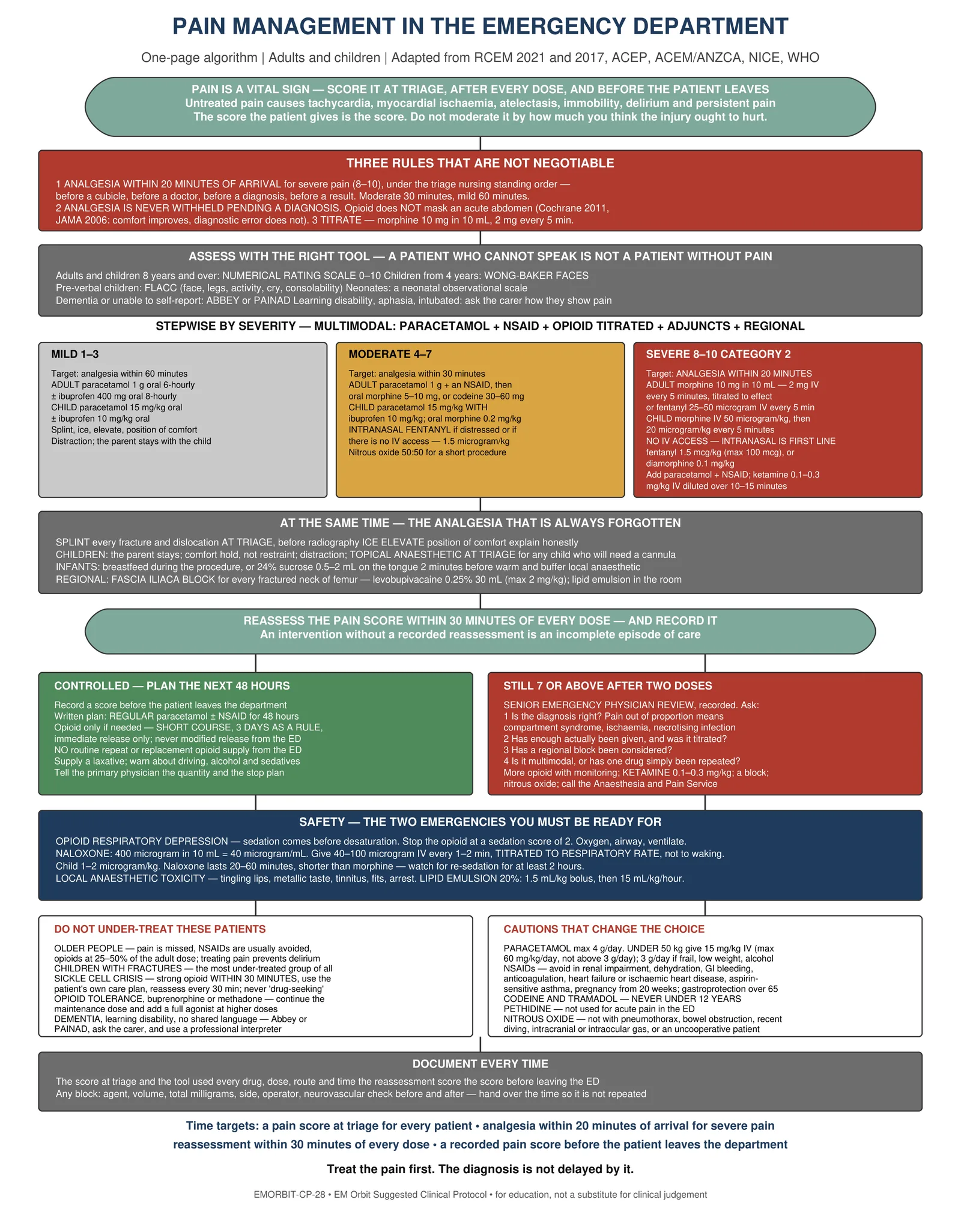
The one-page algorithm is shown at the top of this page.
6Team roles
6.1Triage Nurse:
6.1.1 Record a pain score for every patient at triage, using the tool appropriate to the age and ability, and record which tool was used.
6.1.2 Assign Category 2 to any patient with severe pain scored 8 to 10, in accordance with EMORBIT-CP-29.
6.1.3 Give the first analgesia within 20 minutes of arrival under the approved triage nursing standing order, without waiting for a cubicle or a physician.
6.1.4 Splint, apply ice, elevate, and position for comfort at the point of triage.
6.1.5 Apply topical local anaesthetic to any child who is likely to need a cannula or a blood test.
6.1.6 Re-triage any patient whose pain is unrelieved 30 minutes after analgesia.
6.2ED Nurses:
6.2.1 Reassess and record the pain score within 30 minutes of every intervention, and escalate where it is unchanged or higher.
6.2.2 Prepare and check analgesia, including the independent double check of every paediatric calculation and of the concentration of intranasal fentanyl.
6.2.3 Monitor respiratory rate, oxygen saturation, sedation score and blood pressure during and after opioid titration, and stop the opioid and call for help at a sedation score of 2 or more.
6.2.4 Deliver the non-pharmacological measures — splinting, ice, elevation, positioning, distraction, comfort holding, sucrose, keeping the parent present — and record them.
6.2.5 Ensure a pain score is recorded before the patient leaves the department and is included in the handover.
6.2.6 Maintain the controlled drugs register entries and the second-person checks.
6.3Emergency Physicians:
6.3.1 Prescribe multimodal analgesia and titrate opioids personally where the pain is severe.
6.3.2 Perform or arrange a fascia iliaca block for every eligible patient with a hip or femoral fracture, and maintain personal competence and sign-off.
6.3.3 Review personally any patient whose pain remains at 7 or above after two interventions, and record the review and the plan.
6.3.4 Make the discharge analgesia plan, keep opioid courses short, and write the plan into the discharge summary for the primary physician.
6.4Clinical Pharmacist:
6.4.1 Maintain immediate availability of paracetamol in all three formulations, non-steroidal anti-inflammatory drugs, oral and parenteral opioids, intranasal fentanyl at the correct concentration with mucosal atomisers, ketamine, nitrous oxide, local anaesthetics, naloxone, lipid emulsion 20% with a current dosing card, topical anaesthetic preparations and 24% sucrose.
6.4.2 Review the analgesia of complex patients — renal and hepatic impairment, opioid tolerance, buprenorphine and methadone maintenance, polypharmacy and interacting medicines — and advise on dose adjustment.
6.4.3 Maintain the triage nursing standing order for analgesia with the Nursing and Medical leads, and review it annually.
6.4.4 Audit controlled-drug practice, discharge opioid quantities, and compliance with national controlled medicines regulation; flag any issue with the regulatory content of Table 11 to departmental leadership.
6.4.5 Deliver education on opioid titration, naloxone dosing and local anaesthetic maximum doses.
6.5Anaesthesia and Pain Service:
6.5.1 Provide advice and attendance for pain that remains uncontrolled after senior emergency review, for the opioid-tolerant patient, and for the patient on opioid substitution therapy.
6.5.2 Train and sign off emergency physicians in the fascia iliaca block and other approved ED regional techniques, and maintain the competence register jointly with the ED.
6.5.3 Advise on complex regional techniques and on continuing analgesia after admission.
6.6Surgical and Other Specialties:
6.6.1 Assess patients who have received adequate analgesia, and do not request that analgesia be withheld for the purpose of examination.
6.6.2 Where a specialty clinician considers that analgesia should be withheld in an individual case, the matter shall be resolved at consultant level and the decision and its reason recorded in the notes.
6.6.3 Continue and document the analgesia plan on admission, including the time and dose of any regional block given in the ED.
6.7Paediatric Service and Play Specialist:
6.7.1 Support the ED in the assessment of pain in children who cannot self-report, and in the management of children with complex needs or a hospital passport.
6.7.2 The play specialist, where the department has one, provides distraction and preparation for procedures and is involved early.
6.8Radiology and Portering:
6.8.1 Ensure that a patient with a suspected fracture is splinted and has received analgesia before being moved and imaged, and report to the nurse in charge where this has not happened.
6.8.2 Move patients gently, with the limb supported, and allow analgesia to take effect before positioning for imaging.
6.9Ambulance and Pre-Hospital Providers:
6.9.1 Assess and treat pain at the scene and during transport, and hand over the drug, dose, route and time given, and the pain score before and after.
6.9.2 Splint and immobilise before movement, and pre-alert where the pain is severe or a regional block is likely to be needed on arrival.
7The patient's role
7.1 Report the pain honestly, including its severity, and say when it changes. The number given is believed and acted upon.
7.2 Tell the team about all analgesia and other medicines taken in the last 24 hours, including anything bought without a prescription and any combination cold or flu preparation, and about any opioid substitution therapy.
7.3 Report any allergy or previous bad reaction to a painkiller or to a local anaesthetic.
7.4 Tell the team if the pain is not improving 30 minutes after treatment, or if it becomes worse or changes in character, and do not wait to be asked.
7.5 Report any side effect — drowsiness, nausea, itching, difficulty breathing, or numbness or tingling around the mouth after a local anaesthetic injection — immediately.
7.6 Parents and carers: stay with the child, help with distraction and comfort holding, and tell the team how this child normally shows pain; for a patient with dementia or a learning disability, tell the team how they show pain and what usually helps.
7.7 After discharge: take the analgesia regularly as written for the first 48 hours rather than waiting for the pain to return; do not exceed the stated maximum; do not take additional paracetamol-containing products; do not drive or operate machinery while drowsy; do not combine opioids with alcohol or sedatives; keep all medicines out of reach of children; and return any unused opioid to a pharmacy.
7.8 Return to the ED if the pain is not controlled by the medicine supplied, if it changes in character, or if any of the warning features described on discharge occurs.
8Definitions
8.1Acute Pain: pain of recent onset and probable limited duration, usually with an identifiable temporal and causal relationship to an injury or disease.
8.2Pain Score: a recorded measure of pain intensity obtained with a validated tool appropriate to the patient's age and ability, treated as part of the observation set.
8.3Numerical Rating Scale (NRS): a 0 to 10 self-reported scale in which 0 is no pain and 10 is the worst pain imaginable.
8.4Wong-Baker FACES Pain Rating Scale: a six-face self-report scale scored 0 to 10, validated in children from about 4 years of age.
8.5FLACC: Face, Legs, Activity, Cry, Consolability — an observational scale scored 0 to 10 for pre-verbal children and children unable to self-report.
8.6Abbey Pain Scale: a six-domain observational scale scored 0 to 18, developed for patients with dementia who cannot verbalise pain.
8.7PAINAD: Pain Assessment in Advanced Dementia — a five-item observational scale scored 0 to 10.
8.8Multimodal Analgesia: the simultaneous use of two or more agents or techniques with different mechanisms of action, together with non-pharmacological measures, to achieve better pain relief at lower doses of each.
8.9Titration: the administration of repeated small doses of an analgesic at defined intervals, each guided by the response to the last, until the desired effect is reached; the opposite of a single fixed dose.
8.10Sub-Dissociative (Analgesic) Dose Ketamine: ketamine given at 0.1 to 0.3 mg/kg intravenously as a short infusion for analgesia, below the dose that produces dissociation; it is not procedural sedation.
8.11Opioid-Naive and Opioid-Tolerant: opioid-naive describes a patient not taking regular opioids; opioid-tolerant describes a patient on regular opioid therapy in whom usual starting doses will be inadequate.
8.12Opioid Substitution Therapy: maintenance treatment of opioid dependence with buprenorphine or methadone; the maintenance dose provides little or no analgesia and shall be continued in addition to acute analgesia.
8.13Fascia Iliaca Block: injection of local anaesthetic beneath the fascia iliaca to block the femoral, obturator and lateral femoral cutaneous nerves, used for hip and femoral fractures.
8.14Local Anaesthetic Systemic Toxicity (LAST): systemic toxicity from local anaesthetic, presenting with neurological symptoms and progressing to seizures and cardiovascular collapse, treated with lipid emulsion 20% and prolonged resuscitation.
8.15Sedation Score: a 0 to 3 measure of arousability used to detect opioid-induced central nervous system depression before respiratory depression occurs.
8.16Vaso-Occlusive Crisis: an acute painful episode of sickle cell disease caused by microvascular occlusion, requiring rapid strong opioid analgesia.
8.17RCEM, ACEP, ACEM, NICE, WHO: Royal College of Emergency Medicine; American College of Emergency Physicians; Australasian College for Emergency Medicine; National Institute for Health and Care Excellence; World Health Organization.
9Attachments
- Attachment 1: One-page algorithm (top of this page)
- Attachment 2: Adult Analgesia by Severity — Agents, Doses, Routes and Cautions
- Attachment 3: Paediatric Weight-Based Analgesia, Including the Intranasal Routes
- Attachment 4: Pain Assessment Tools by Age and Ability, and the Pain Reassessment Record
11Suggested quality indicators
11.1Pain score recorded at triage: (Number of ED attendances with a pain score and the tool used documented at triage / Total number of ED attendances) × 100. Target ≥ 95%.
11.2Time to first analgesia in severe pain: (Number of patients with a triage pain score of 8 to 10 who received any analgesia within 20 minutes of arrival / Total number of patients with a triage pain score of 8 to 10) × 100. Target ≥ 80%.
11.3Reassessment after analgesia: (Number of patients who received analgesia in the ED and had a pain score reassessed and recorded within 30 minutes of the dose / Total number of patients who received analgesia in the ED) × 100. Target ≥ 90%.
11.4Analgesia for children with fractures: (Number of children under 16 years with a radiologically confirmed fracture who received analgesia in the ED / Total number of children under 16 years with a radiologically confirmed fracture) × 100. Target ≥ 90%.
11.5Fascia iliaca block in hip fracture: (Number of patients with a fractured neck of femur who received a fascia iliaca block in the ED / Total number of patients with a fractured neck of femur without a contraindication to the block) × 100. Target ≥ 70%.
11.6Discharged with uncontrolled pain (outcome indicator): (Number of patients discharged from the ED with a final recorded pain score of 7 or above / Total number of patients discharged from the ED with a pain score recorded) × 100. Target ≤ 5%, with every case reviewed.
11.7Safety indicators (monitored, no fixed target): naloxone administration for opioid-related respiratory depression; use of lipid emulsion for local anaesthetic systemic toxicity; ten-fold or wrong-route analgesic drug errors; and the median quantity of opioid supplied on discharge.
13References
- Royal College of Emergency Medicine. Best Practice Guideline: Management of Pain in Adults. London: RCEM; 2021.
- Royal College of Emergency Medicine. Best Practice Guideline: Management of Pain in Children. London: RCEM; 2017 (revised 2020).
- Royal College of Emergency Medicine. Best Practice Guideline: Fascia Iliaca Block in the Emergency Department. London: RCEM; 2020.
- American College of Emergency Physicians. Policy Statement: Optimizing the Treatment of Acute Pain in the Emergency Department. Ann Emerg Med. 2017;70(3):446–448.
- American College of Emergency Physicians. Clinical Policy: Critical Issues in the Prescribing of Opioids for Adult Patients in the Emergency Department. Ann Emerg Med. 2012;60(4):499–525.
- Australian and New Zealand College of Anaesthetists and Faculty of Pain Medicine. Acute Pain Management: Scientific Evidence. 5th ed. Melbourne: ANZCA; 2020.
- Australasian College for Emergency Medicine. Statement on the Management of Acute Pain in Emergency Departments. Melbourne: ACEM.
- Ranji SR, Goldman LE, Simel DL, Shojania KG. Do opiates affect the clinical evaluation of patients with acute abdominal pain? JAMA. 2006;296(14):1764–1774.
- Manterola C, Vial M, Moraga J, Astudillo P. Analgesia in patients with acute abdominal pain. Cochrane Database Syst Rev. 2011;(1):CD005660.
- Attard AR, Corlett MJ, Kidner NJ, Leslie AP, Fraser IA. Safety of early pain relief for acute abdominal pain. BMJ. 1992;305(6853):554–556.
- Murphy A, O'Sullivan R, Wakai A, et al. Intranasal fentanyl for the management of acute pain in children. Cochrane Database Syst Rev. 2014;(10):CD009942.
- Motov S, Rockoff B, Cohen V, et al. Intravenous subdissociative-dose ketamine versus morphine for analgesia in the emergency department: a randomized controlled trial. Ann Emerg Med. 2015;66(3):222–229.
- Ritcey B, Pageau P, Woo MY, Perry JJ. Regional nerve blocks for hip and femoral neck fractures in the emergency department: a systematic review. CJEM. 2016;18(1):37–47.
- Association of Anaesthetists of Great Britain and Ireland. AAGBI Safety Guideline: Management of Severe Local Anaesthetic Toxicity. London: AAGBI; 2010, and the AAGBI Quick Reference Handbook.
- National Institute for Health and Care Excellence. Sickle cell disease: managing acute painful episodes in hospital. Clinical guideline CG143. London: NICE; 2012.
- National Institute for Health and Care Excellence. Renal and ureteric stones: assessment and management. NG118. London: NICE; 2019.
- National Institute for Health and Care Excellence. Controlled drugs: safe use and management. NG46. London: NICE; 2016.
- National Institute for Health and Care Excellence. Hip fracture: management. Clinical guideline CG124. London: NICE; 2011 (updated).
- World Health Organization. Cancer pain relief, with a guide to opioid availability. 2nd ed. Geneva: WHO; 1996 (analgesic ladder principles).
- World Health Organization. Guidelines on the management of chronic pain in children. Geneva: WHO; 2020.
- Abbey J, Piller N, De Bellis A, et al. The Abbey pain scale: a 1-minute numerical indicator for people with end-stage dementia. Int J Palliat Nurs. 2004;10(1):6–13.
- Warden V, Hurley AC, Volicer L. Development and psychometric evaluation of the Pain Assessment in Advanced Dementia (PAINAD) scale. J Am Med Dir Assoc. 2003;4(1):9–15.
- Merkel SI, Voepel-Lewis T, Shayevitz JR, Malviya S. The FLACC: a behavioral scale for scoring postoperative pain in young children. Pediatr Nurs. 1997;23(3):293–297.
- Stevens B, Yamada J, Ohlsson A, Haliburton S, Shorkey A. Sucrose for analgesia in newborn infants undergoing painful procedures. Cochrane Database Syst Rev. 2016;(7):CD001069.
- Medicines and Healthcare products Regulatory Agency. Codeine for analgesia: restricted use in children; and tramadol restrictions. Drug Safety Update. London: MHRA; 2013 and subsequent.
- British National Formulary and BNF for Children. London: BMJ Group and Pharmaceutical Press; current edition.
A2Attachment 2: Adult Analgesia by Severity — Agents, Doses, Routes and Cautions
This table is the reference for the triage nursing standing order and for prescribing in the ED. Doses are for an adult of average size with normal renal and hepatic function; reduce them in patients over 70 years, in frailty, in low body weight, and in renal or hepatic impairment. Opioids are titrated to effect and are never given as a single fixed dose for severe pain.
Analgesia is not withheld pending a diagnosis, a specialty opinion or a result. Opioid analgesia does not mask an acute abdomen.
| Band | Score | Typical presentation | Time target and first-line approach |
|---|---|---|---|
| SEVERE | 8–10 | Unable to speak in sentences for the pain; fractured neck of femur or long bone; dislocation; renal or biliary colic; ischaemic limb; sickle cell crisis; major burn; pain dominating the consultation | Triage Category 2. First analgesia within 20 minutes of arrival under the triage nursing standing order. Strong opioid titrated intravenously, or intranasal fentanyl or diamorphine where there is no intravenous access, together with paracetamol and — unless contraindicated — a non-steroidal anti-inflammatory drug. Reassess within 30 minutes. |
| MODERATE | 4–7 | Limb injury, soft-tissue injury, abdominal pain, headache, otitis, dental pain, back pain without red flags | Triage Category 3. Analgesia within 30 minutes of arrival. Paracetamol plus a non-steroidal anti-inflammatory drug, with an oral opioid added if not controlled at reassessment. Intranasal fentanyl is appropriate in a distressed child. |
| MILD | 1–3 | Minor injury, minor laceration, localised infection, simple headache | Triage Category 4. Analgesia within 60 minutes of arrival. Paracetamol, with or without a non-steroidal anti-inflammatory drug, plus non-pharmacological measures. |
| NONE | 0 | No pain reported and no behavioural evidence of pain | Record the score. Reassess if the patient's condition, position or activity changes, and before any procedure. |
The band is set by the patient's own report, or by the observational score where the patient cannot self-report. The clinician's impression of how much a given injury "should" hurt shall not override the patient's score. A patient who is smiling, using a telephone, or sleeping may still be in severe pain; none of these is evidence that the score is false.
| Step | Agent | Dose and route | Maximum, and the cautions that matter |
|---|---|---|---|
| STEP 1 Base layer for every patient in pain | Paracetamol | Oral 1 g every 4 to 6 hours. Intravenous 1 g over 15 minutes where the oral route is unavailable or the pain is severe. Rectal 1 g where neither is possible. | Maximum 4 g in 24 hours by any route combined. Body weight under 50 kg: 15 mg/kg per dose intravenously, maximum 60 mg/kg/day and not more than 3 g/day. Reduce to a maximum of 3 g/day in chronic alcohol use, malnutrition, low body weight or hepatic impairment. Count paracetamol contained in combination products. |
| Ibuprofen | Oral 400 mg every 6 to 8 hours with food. | Maximum 2.4 g in 24 hours. See the non-steroidal cautions below. | |
| Diclofenac | Oral 50 mg every 8 hours; rectal 100 mg once daily; intramuscular 75 mg (renal colic). | Maximum 150 mg in 24 hours. Highest cardiovascular risk of the common non-steroidals; avoid in established cardiovascular disease. | |
| Naproxen | Oral 500 mg initially, then 250 mg every 6 to 8 hours. | Maximum 1.25 g on day one, 1 g daily thereafter. Preferred non-steroidal where cardiovascular risk is a concern. | |
| STEP 2 Moderate pain | Codeine | Oral 30 to 60 mg every 4 to 6 hours, always with paracetamol. | Maximum 240 mg in 24 hours. Shall not be given to any child under 12 years, to any breastfeeding mother, or to any patient under 18 years after tonsillectomy or adenoidectomy. Ineffective in poor metabolisers and dangerous in ultra-rapid metabolisers. Constipation is near-universal. |
| Tramadol | Oral 50 to 100 mg every 6 hours. | Maximum 400 mg in 24 hours. Lowers the seizure threshold; risk of serotonin syndrome with selective serotonin reuptake inhibitors, serotonin-noradrenaline reuptake inhibitors, triptans and linezolid. Avoid in epilepsy and in the elderly where an alternative exists. Not for children under 12 years. | |
| Oral morphine (immediate release) | Oral 5 to 10 mg every 4 hours as required (opioid-naive adult). | Start at 2.5 to 5 mg in patients over 70 years, in frailty, and in renal impairment. An effective and under-used option for moderate pain in a patient who does not need a cannula. | |
| STEP 3 Severe pain TITRATE — do not give a fixed dose | Morphine, intravenous | Dilute 10 mg in 10 mL of 0.9% sodium chloride (1 mg/mL). Give 2 mg every 5 minutes, titrated to the pain score and the respiratory rate, until the pain is tolerable or sedation appears. A typical total is 0.1 mg/kg, but the correct dose is the dose that works. | Reduce the increment to 1 mg and lengthen the interval in patients over 70 years, in frailty, in renal or hepatic impairment, and where a sedative has already been given. Monitor respiratory rate, oxygen saturation, sedation score and blood pressure. Naloxone, oxygen and a bag-valve-mask shall be immediately available. |
| Fentanyl, intravenous | 25 to 50 microgram every 5 minutes, titrated to effect. | Faster onset and shorter duration than morphine; preferred in renal impairment and in haemodynamic instability. Rapid large boluses may cause chest-wall rigidity. | |
| Fentanyl, intranasal | 1.5 microgram/kg, to a maximum of 100 microgram, delivered by mucosal atomiser, half into each nostril. May be repeated once at 0.75 to 1.5 microgram/kg after 10 minutes. | The first-line route for severe pain where there is no intravenous access. Onset 5 to 10 minutes. Not effective if the nostrils are obstructed by blood or mucus. Concentration must be checked before use — use the 50 microgram/mL preparation for children. | |
| Oxycodone, oral immediate release | 5 to 10 mg every 4 to 6 hours. | Preferred oral opioid in renal impairment. 5 mg oral oxycodone is approximately equivalent to 10 mg oral morphine. | |
| ADJUNCT agents | Ketamine, analgesic (sub-dissociative) dose | 0.1 to 0.3 mg/kg intravenously, diluted in 50 to 100 mL of 0.9% sodium chloride and infused over 10 to 15 minutes. May be repeated after 20 minutes. Intramuscular 0.5 mg/kg where there is no access. | A slow infusion, never a rapid push — a rapid push causes dysphoria, and this is the commonest reason ketamine is abandoned. Useful in opioid-tolerant patients, in trauma with hypotension, and where the opioid dose is limited by sedation. Warn the patient about transient visual disturbance and a feeling of unreality. Relative cautions: uncontrolled hypertension, ischaemic heart disease, psychosis. |
| Nitrous oxide 50% with oxygen 50% | Self-administered through a demand valve and mouthpiece or mask, from the start of the painful stimulus. | Onset within 30 seconds, offset within 60 seconds. Requires a cooperative patient who can hold the device — never hold the mask on for the patient. Requires scavenging or adequate ventilation. Contraindications are listed in section 4.3.4.4. | |
| Lidocaine and levobupivacaine (local and regional) | Local infiltration, haematoma block, digital block, or a fascia iliaca block (section 4.3.5). | See section 4.3.5 for doses, maximums and the local anaesthetic systemic toxicity plan. | |
| NOT RECOMMENDED | Pethidine (meperidine) | Shall not be used for acute pain in the ED. | No analgesic advantage over morphine in renal or biliary colic; accumulates as normeperidine causing tremor, agitation and seizures, particularly in renal impairment and the elderly; higher abuse potential. |
| Intramuscular opioid for severe pain | Should be avoided where an intravenous or intranasal route is available. | Onset is slow and unpredictable, absorption is poor in shock, and the dose cannot be titrated. Repeated intramuscular injection is painful in its own right. |
Non-steroidal anti-inflammatory cautions in every adult: acute or chronic kidney injury, dehydration or hypovolaemia of any cause; previous peptic ulceration or gastrointestinal bleeding; concurrent anticoagulant, antiplatelet or corticosteroid therapy; established ischaemic heart disease, cerebrovascular disease or heart failure; known aspirin- or non-steroidal-sensitive asthma; pregnancy from 20 weeks and absolutely from 30 weeks; age over 65 years without gastroprotection; and the triad of a non-steroidal with an angiotensin-converting enzyme inhibitor or receptor blocker and a diuretic. Where a non-steroidal is still indicated, use the lowest effective dose for the shortest period.
Maximum local anaesthetic doses for reference: lidocaine 4.5 mg/kg plain (maximum 300 mg) and 7 mg/kg with adrenaline (maximum 500 mg); bupivacaine and levobupivacaine 2 mg/kg; ropivacaine 3 mg/kg — calculated on lean body weight and reduced in the elderly and the frail. Confirm against the product information.
Lipid emulsion 20% shall be immediately available wherever a block or a large-volume infiltration is performed. Bolus 1.5 mL/kg over 1 minute, then 15 mL/kg/hour; repeat the bolus up to twice at 5-minute intervals and double the infusion rate if needed; cumulative maximum approximately 12 mL/kg.
Check all doses with clinical pharmacy before use.
A3Attachment 3: Paediatric Weight-Based Analgesia, Including the Intranasal Routes
Every paediatric dose is calculated on an actual measured weight wherever the child can safely be weighed, and the calculation is independently checked before the dose is given. The intranasal route is first line for severe pain in a child and wherever intravenous access is not yet established: it works within 5 to 10 minutes and removes the need to cannulate a frightened child before the pain is treated.
Codeine and tramadol shall not be used in any child under 12 years. Above 50 kg, adult doses apply.
| Agent | Route | Dose | Maximum, and notes |
|---|---|---|---|
| Paracetamol | Oral | 15 mg/kg every 4 to 6 hours | Maximum 4 doses (60 mg/kg) in 24 hours; maximum 1 g per dose. A loading dose of 20 mg/kg may be used for the first dose in moderate or severe pain. |
| Paracetamol | Rectal | 20 mg/kg for the first dose, then 15 mg/kg every 6 hours | Maximum 60 mg/kg in 24 hours. Absorption is slower and less reliable than the oral route; use only when oral is impossible. |
| Paracetamol | Intravenous | Body weight 10 kg to under 50 kg: 15 mg/kg every 6 hours. Body weight under 10 kg: 7.5 mg/kg every 6 hours. Body weight 50 kg and above: 1 g every 6 hours. | Maximum 60 mg/kg/day (30 mg/kg/day if under 10 kg), never exceeding 3 g/day under 50 kg or 4 g/day at or above 50 kg. Intravenous paracetamol is a recognised source of ten-fold overdose in small children: the prescription shall state the dose in milligrams AND in millilitres, and the volume shall be independently checked before it is given. |
| Ibuprofen | Oral | 10 mg/kg every 6 to 8 hours | Maximum 30 mg/kg/day; maximum 400 mg per dose. Not for infants under 3 months or under 5 kg. Give with food or milk. Avoid in dehydration, in significant vomiting or diarrhoea, and in any child with reduced urine output. |
| Diclofenac | Oral or rectal | 1 mg/kg every 8 hours (child over 6 months) | Maximum 3 mg/kg/day, maximum 50 mg per dose. Alternative non-steroidal where ibuprofen is unavailable. |
| Fentanyl | INTRANASAL | 1.5 microgram/kg, maximum 100 microgram, atomised half into each nostril. A second dose of 0.75 to 1.5 microgram/kg may be given after 10 minutes if the pain is not controlled. | The first-line route for severe pain in a child and wherever intravenous access is not yet established. Onset 5 to 10 minutes; duration about 45 to 60 minutes. Use the 50 microgram/mL preparation and check the concentration aloud with a second nurse. Maximum volume 0.5 mL per nostril; divide larger volumes between the nostrils and repeat. Ineffective where the nose is blocked by blood, mucus or a foreign body. |
| Diamorphine | INTRANASAL | 0.1 mg/kg (100 microgram/kg) made up in 0.2 mL of 0.9% sodium chloride and instilled into one nostril. | An equally acceptable first-line intranasal option where the preparation is stocked and permitted under the applicable controlled-drug regulations. Onset within 10 minutes. Check the availability and legal status of diamorphine locally before this route is adopted; where it is not available, intranasal fentanyl is used. |
| Morphine | Oral (immediate release) | 0.2 to 0.4 mg/kg (200 to 400 microgram/kg) as a single dose, then 0.2 mg/kg every 4 hours as required | Maximum 10 mg per dose for a child under 12 years. Onset 20 to 30 minutes. An effective option for moderate to severe pain where no cannula is needed. |
| Morphine | Intravenous | Dilute to 100 microgram/mL. Give 50 microgram/kg as the first increment, then 20 microgram/kg every 5 minutes, titrated to effect, to a usual total of 100 to 200 microgram/kg. | Under 3 months of age, halve the dose and give it only with senior and, where available, paediatric or anaesthetic involvement; monitor continuously with pulse oximetry. Naloxone shall be immediately available. |
| Ketamine, analgesic dose | Intravenous | 0.2 to 0.3 mg/kg diluted and infused over 10 to 15 minutes | A senior decision. Not to be confused with procedural sedation doses (1 to 1.5 mg/kg intravenously or 4 mg/kg intramuscularly), which require the full sedation standard, fasting assessment, monitoring and a second practitioner. |
| Nitrous oxide 50% with oxygen 50% | Inhaled | Self-administered from the onset of the painful stimulus | Generally suitable from about 5 years of age, in a child able to understand and hold the device. Excellent for wound care, dressing changes, reduction of a simple fracture and cannulation. Contraindications as in section 4.3.4.4. |
| Sucrose 24% | Oral (onto the tongue) | 0.5 to 2 mL onto the anterior tongue 2 minutes before the painful procedure, with a dummy for non-nutritive sucking; the dose may be repeated during the procedure | For infants up to about 6 months (and up to 12 months in some protocols) undergoing venepuncture, cannulation, heel prick, immunisation or catheterisation. Breastfeeding during the procedure is at least as effective and should be offered first. Contraindicated if the infant is not permitted oral intake. |
| Lidocaine with prilocaine cream, or tetracaine 4% gel | Topical, before cannulation or venepuncture | Apply under an occlusive dressing: lidocaine-prilocaine requires 60 minutes; tetracaine gel requires 30 to 45 minutes | Topical anaesthetic shall be applied at triage to every child expected to need a cannula or a blood test, so that the waiting time is used rather than wasted. Tetracaine gel causes local erythema, which is expected. Lidocaine-prilocaine is avoided in infants under 3 months and where methaemoglobinaemia is a concern. |
| Codeine | — | Shall not be used in any child under 12 years. | Also contraindicated in any patient under 18 years after tonsillectomy or adenoidectomy for obstructive sleep apnoea, in any child with obstructive sleep apnoea, and in breastfeeding mothers. Metabolism is unpredictable and ultra-rapid metabolisers have died. Tramadol shall likewise not be used under 12 years. |
Every paediatric dose shall be calculated from an actual measured weight where the child can be weighed, and from an age-based or length-based estimate only where weighing is unsafe or would delay analgesia. The calculation shall be independently checked, and the dose recorded in milligrams or micrograms with the corresponding volume.
| Agent and route | 5 kg | 10 kg | 15 kg | 20 kg | 30 kg | 40 kg |
|---|---|---|---|---|---|---|
| Paracetamol oral 15 mg/kg | 75 mg | 150 mg | 225 mg | 300 mg | 450 mg | 600 mg |
| Paracetamol IV (7.5 mg/kg under 10 kg; 15 mg/kg at or above 10 kg) | 37.5 mg | 150 mg | 225 mg | 300 mg | 450 mg | 600 mg |
| Ibuprofen oral 10 mg/kg | not under 5 kg | 100 mg | 150 mg | 200 mg | 300 mg | 400 mg |
| Fentanyl INTRANASAL 1.5 microgram/kg | 7.5 mcg | 15 mcg | 22.5 mcg | 30 mcg | 45 mcg | 60 mcg |
| Diamorphine INTRANASAL 0.1 mg/kg (where stocked) | 0.5 mg | 1 mg | 1.5 mg | 2 mg | 3 mg | 4 mg |
| Morphine oral 0.2 mg/kg | 1 mg | 2 mg | 3 mg | 4 mg | 6 mg | 8 mg |
| Morphine IV — first increment 50 microgram/kg | 0.25 mg | 0.5 mg | 0.75 mg | 1 mg | 1.5 mg | 2 mg |
| Morphine IV — subsequent increments 20 microgram/kg every 5 minutes | 0.1 mg | 0.2 mg | 0.3 mg | 0.4 mg | 0.6 mg | 0.8 mg |
| Naloxone for opioid-induced respiratory depression, 1 to 2 microgram/kg | 5–10 mcg | 10–20 mcg | 15–30 mcg | 20–40 mcg | 30–60 mcg | 40–80 mcg |
Approximate ages: 5 kg ≈ 3 months, 10 kg ≈ 1 year, 15 kg ≈ 3 years, 20 kg ≈ 6 years, 30 kg ≈ 9 years, 40 kg ≈ 12 years. Above 50 kg, adult doses apply. mcg = microgram.
Naloxone for opioid-induced respiratory depression in a child: 1 to 2 microgram/kg intravenously, repeated every 1 to 2 minutes and titrated to the respiratory rate, up to 10 microgram/kg. Airway support, oxygen and bag-valve-mask ventilation come first.
Intranasal fentanyl: use the 50 microgram/mL preparation, check the concentration aloud with a second nurse, and give a maximum of 0.5 mL per nostril.
Check all doses with clinical pharmacy before use.
A4Attachment 4: Pain Assessment Tools by Age and Ability, and the Pain Reassessment Record
A pain score is recorded for every patient at triage, after every analgesic intervention, and before the patient leaves the department. The tool is chosen by the patient's age and ability to self-report, is named in the record, and the same tool is used throughout the episode so that the scores are comparable.
A patient who cannot self-report is not a patient without pain. Use the observational scale, ask the carer how this patient shows pain, and record the answer.
| Tool | Who it is for | How it is used | Notes |
|---|---|---|---|
| Numerical Rating Scale (NRS), 0–10 | Adults and children of about 8 years and above who can understand numbers | Ask: "On a scale of nought to ten, where nought is no pain and ten is the worst pain you can imagine, what is your pain now?" Record the number. | The default adult tool. A verbal question needs no card and works over the telephone and through an interpreter. |
| Verbal Rating Scale (none / mild / moderate / severe) | Adults who cannot use numbers, including some older and cognitively impaired patients | Ask the patient to choose one of the four words; map to none = 0, mild = 1–3, moderate = 4–7, severe = 8–10. | Acceptable where the NRS fails; record which scale was used. |
| Wong-Baker FACES Pain Rating Scale, 0–10 | Children of about 4 years and above, and adults with limited literacy or language | Show the six faces; ask the child to point to the face that shows how much they hurt. Score 0, 2, 4, 6, 8, 10. | Show the faces to the child, not to the parent. Do not ask the child to grade how the face looks — ask how they feel. |
| FLACC scale, 0–10 | Pre-verbal children (approximately 2 months to 4 years) and any child who cannot self-report | Observe Face, Legs, Activity, Cry and Consolability; score each 0–2 and sum. | An observational score, not a self-report. The parent's statement that the child is in pain is evidence and shall be recorded. |
| Neonatal observational scale (for example the Neonatal Infant Pain Scale) | Neonates and infants under about 2 months | Observed facial expression, cry, breathing pattern, limb tone and arousal. | Use the tool adopted by the paediatric service; neonates feel pain and are systematically under-treated. |
| Abbey Pain Scale, 0–18 | Adults with dementia or advanced cognitive impairment who cannot self-report | Score 0–3 for each of six domains — vocalisation, facial expression, change in body language, behavioural change, physiological change, physical change. 0–2 no pain, 3–7 mild, 8–13 moderate, 14 or more severe. | Designed for observation during movement. A rising score after movement is strong evidence of pain. |
| PAINAD scale, 0–10 | Adults with advanced dementia | Score 0–2 for each of five items — breathing, negative vocalisation, facial expression, body language, consolability. A score of 2 or more indicates pain requiring treatment. | Quick to apply at triage. Either Abbey or PAINAD may be used; the department shall adopt one and use it consistently. |
| Proxy report | Any patient with a learning disability, autism, aphasia, intubation or a language barrier | Ask the parent, carer or family: "How do you know when they are in pain, and is this that?" Record the answer verbatim. | A carer who says the patient is in pain is more accurate than any score. Never discount it. |
A pain score shall be recorded using one of these tools at triage, after every analgesic intervention, and before the patient leaves the department. The tool used shall be named in the record, and the same tool shall be used for every reassessment of that patient so that the scores are comparable.
| Time | Score | Tool used | Intervention given (drug, dose, route) | Score at 30 minutes | Action / initials |
|---|---|---|---|---|---|
| Triage | |||||
| Before leaving the ED |
If the score at 30 minutes is unchanged or higher, a further intervention shall be given and the reason for uncontrolled pain documented; if the score remains 7 or above after two interventions, the patient shall be reviewed by the senior clinician on duty and the reason recorded.
| Measure | How it is done | Why it matters |
|---|---|---|
| Splinting and immobilisation | Splint every long-bone fracture and every dislocation at triage, before radiography. Apply a traction splint for a mid-shaft femoral fracture. Sling an upper limb injury. Realign a grossly deformed limb after analgesia. | The single most effective non-drug analgesic in trauma. Movement of fracture ends is the pain. An unsplinted limb sent to radiography undoes every milligram of morphine given. |
| Ice and compression | A cold pack wrapped in a cloth, applied for 15 to 20 minutes, with compression where appropriate. | Reduces swelling and pain in soft-tissue injury. Never apply ice directly to skin, and avoid over an insensate area or in peripheral vascular disease. |
| Elevation | Elevate an injured limb above the level of the heart; elevate the head of the trolley for headache and for dental and facial pain. | Reduces venous congestion and throbbing pain; costs nothing and requires no prescription. |
| Position of comfort | Allow the patient to adopt the position that hurts least, including sitting upright, and provide a pillow, a blanket and a supported limb. | A patient made to lie flat for the convenience of the department is a patient in avoidable pain. |
| Explanation and reassurance | Explain what is happening, what will hurt, how long it will last, and what has been given for the pain. Never say "this will not hurt" when it will. | Anxiety amplifies pain. Honest warning before a painful step reduces the reported pain and preserves trust for the next one. |
| Distraction | Bubbles, a toy, a story, counting, a video on a telephone or tablet, a play specialist where the department has one. | Measurably reduces procedural pain and distress in children, and works in adults during wound care and cannulation. |
| Parental presence | A parent or carer shall be allowed to stay with the child throughout, including during cannulation and imaging, and may hold the child in a comfort position rather than the child being held down. | Separation is itself painful. A child held supine by several adults is restrained, not comforted; a comfort hold on the parent's lap achieves the same procedure with far less distress. |
| Breastfeeding, skin-to-skin and sucrose | For infants: breastfeed during the procedure, or provide skin-to-skin contact, or give 24% sucrose with a dummy 2 minutes beforehand. | Each has good trial evidence for procedural pain in neonates and small infants. Breastfeeding is offered first where it is possible. |
| Topical local anaesthetic before cannulation | Apply lidocaine-prilocaine cream (60 minutes) or tetracaine 4% gel (30 to 45 minutes) at triage to any child likely to need a cannula or a blood test. | The waiting time is the resource. A child who has had topical anaesthetic applied at triage can be cannulated without a fight an hour later. |
| Warmed and buffered local anaesthetic | Warm lidocaine to body temperature and buffer it with sodium bicarbonate 8.4% in a ratio of about 1 mL to 9 mL of lidocaine; inject slowly through a fine needle, through the wound edge rather than through intact skin. | Reduces the burning of infiltration substantially, at no cost. |
| Wound care and dressings | Irrigate with warmed fluid; use a non-adherent dressing; soak off an adherent dressing rather than pulling it. | Dressing changes are a major and avoidable source of pain, particularly in burns. |
| A quiet, dim environment | For migraine, photophobia, delirium and dementia: reduce noise and light, minimise moves between areas, and avoid unnecessary repeated examination. | Sensory load worsens pain and agitation, particularly in older people and in patients with autism or learning disability. |
Target times: any analgesia within 20 minutes of arrival for severe pain (within 30 minutes for moderate, 60 minutes for mild); reassessment within 30 minutes of every dose; a documented senior review where the score remains 7 or above after two interventions; and a recorded score before the patient leaves the department.