Snake Bite and Scorpion Sting Envenomation in the Emergency Department
EMORBIT-CP-72 · Chapter 10 · Toxicological and Environmental Emergencies
Open in the appFree, works on your phone and offline, with every tool alongside.
Evidence base: WHO 2016
1Purpose
1.1 Provide a standardized, evidence-based framework for the recognition and treatment of snake bite and scorpion sting envenomation in patients of all ages presenting to the Emergency Department (ED).
1.2 Ensure that harmful and ineffective first-aid practices (tourniquet, incision, suction, ice, electric shock, traditional remedies) are actively corrected, and that the 20-minute whole blood clotting test is used where laboratory coagulation is not immediately available.
1.3 Ensure antivenom, where indicated, is given without a predictive skin or conjunctival sensitivity test, with adrenaline immediately available, and that an antivenom reaction is treated as anaphylaxis without stopping definitive treatment of the envenoming.
1.4 Ensure the autonomic storm and cardiovascular collapse of severe scorpion sting are recognised early, particularly in children, who carry the greatest risk of severe systemic envenoming.
1.5 Align with the World Health Organization (WHO) 2016 guidelines for the management of snakebites and with regional clinical literature, noting that antivenom stock and country-specific detail vary by region.
2Who this protocol applies to
2.1 Any patient of any age with a suspected or confirmed snake bite, whether or not envenoming is yet apparent.
2.2 Any patient of any age with a suspected or confirmed scorpion sting, whether or not systemic features are yet apparent.
2.3 A patient who cannot identify the animal but who has a bite or sting mark, local swelling, or a systemic feature consistent with envenomation.
3Not covered by this protocol
3.1 Bee, wasp or ant sting presenting as an allergic or anaphylactic reaction without a venom-specific toxidrome: manage per EMORBIT-CP-01 (Anaphylaxis).
3.2 Spider bite: manage supportively and discuss with the poisons centre.
3.3 Marine envenomation (jellyfish, stingray, venomous fish): manage supportively and discuss with the poisons centre.
3.4 Human or animal bite without venom effect (mechanical wound only): manage per EMORBIT-CP-56 (Animal and Human Bites, Rabies and Tetanus Prophylaxis).
4Protocol
4.1History and Assessment:
4.1.1Triage and Recognition:
4.1.1.1 Any bite or sting with a systemic feature (bleeding, neurological sign, autonomic feature, shock, or respiratory distress) shall be triaged to the highest acuity category and taken directly to the resuscitation area.
4.1.1.2 A bite or sting with no systemic feature at triage is still triaged no lower than Category 2, because envenoming — particularly coagulopathy after a viper bite — may declare itself only after a delay of several hours.
4.1.2History:
4.1.2.1 Time of the bite or sting; a description of the animal if it was seen, and whether it was provoked; the number of bites/stings; first aid already given, including any harmful measure (Table 2) that must now be reversed or accounted for.
4.1.2.2 Speed and progression of local and systemic symptoms; previous snake bite or antivenom exposure (increases the risk of an antivenom reaction); anticoagulant or antiplatelet use; tetanus immunisation history; comorbidities that increase severity (cardiac disease, bleeding disorder, pregnancy).
4.1.2.3 Occupational or domestic context (agricultural work, handling firewood or rubble, a child playing outdoors) supports the diagnosis but a clear history of a bite/sting is not required to treat a consistent clinical picture.
4.1.3Examination:
4.1.3.1 Vital signs; mark and time the leading edge of local swelling with a skin pencil at first assessment, exactly as for cellulitis, so that progression can be judged at review rather than restated.
4.1.3.2Snake bite — look specifically for:
- Fang marks, local bruising, blistering or early tissue necrosis; swelling crossing a joint or extending beyond half the limb.
- Bleeding from the gums, venepuncture or bite sites, epistaxis, haematuria, or any spontaneous bleeding — the clinical signature of venom-induced consumption coagulopathy from regional saw-scaled/carpet vipers (Echis species).
- Neurotoxic signs — ptosis, diplopia, dysarthria, dysphagia, or progressive limb or respiratory weakness — uncommon with the predominant regional vipers but the reason every patient is examined for it.
- Shock: tachycardia, hypotension, or reduced consciousness.
4.1.3.3Scorpion sting — look specifically for:
- The sting site itself is often unimpressive; severity is judged by systemic, not local, findings.
- Autonomic storm: profuse sweating, hypersalivation, vomiting, priapism, piloerection, restlessness or agitation.
- Cardiovascular instability: tachycardia or bradycardia, initial hypertension that may progress to hypotension, and signs of acute pulmonary oedema (tachypnoea, crepitations, frothy sputum).
4.1.4Risk Stratification – Severity:
4.1.4.1 Grade every scorpion sting using Table 1 at presentation and at every reassessment; a Grade I sting can progress, particularly in a child.
4.1.4.2 Snake bite severity is judged by the systemic features in section 4.1.3 and the 20-minute whole blood clotting test, not by a numbered grade.
Table 1: Scorpion sting severity grading (adapted from regional and Indian clinical literature) Grade Features ED action I Local pain, swelling or paraesthesia only; no systemic feature. Local care, analgesia (EMORBIT-CP-28), tetanus assessment (EMORBIT-CP-56, Table 5); observe 2–4 hours. II Grade I plus mild systemic feature: nausea, vomiting, mild sweating, restlessness. As Grade I; observe minimum 4 hours; admit if any feature progresses. III Autonomic storm: profuse sweating, vomiting, priapism, hypersalivation, and cardiovascular instability — tachycardia or bradycardia, hypertension progressing to hypotension. Continuous cardiac monitoring, ECG and troponin; control the autonomic surge (section 4.3.2); admit. IV Cardiovascular collapse, acute pulmonary oedema, myocarditis, or respiratory failure. Treat as cardiogenic shock / acute pulmonary oedema (EMORBIT-CP-06); critical care immediately; ICU/HDU. Children have the highest risk of progressing to Grade III–IV because of a higher venom-to-body-weight ratio; apply a lower threshold for admission and monitoring in every child.
4.1.5Differential Diagnosis:
4.1.5.1 Cellulitis or a localised allergic reaction at a sting/bite site without a systemic envenomation feature.
4.1.5.2 Compartment syndrome from progressive limb swelling — pain out of proportion and pain on passive stretch, pulses present until late (EMORBIT-CP-66); a tensely swollen envenomed limb shall be reassessed specifically for it.
4.1.5.3 Sepsis or another cause of shock, and panic/anxiety reaction in a patient with a confirmed dry bite and no objective sign of envenoming.
4.1.6Special Populations:
4.1.6.1 Children: the highest risk group for severe systemic envenoming from both snake bite and scorpion sting because of the higher venom-to-body-weight ratio; apply a lower threshold for admission, cardiac monitoring, and antivenom, and weight-based dosing throughout.
4.1.6.2 Pregnancy (any woman who has started menarche, regardless of age): manage envenoming identically; antivenom is not withheld for pregnancy when systemic envenoming is present. Notify Obstetrics; monitor fetal wellbeing once the mother is stable.
4.1.6.3 Anticoagulated or antiplatelet patients: a lower threshold for laboratory coagulation testing and for antivenom in a viper bite, because their coagulopathy is compounded.
4.2Investigations:
4.2.1 No investigation shall delay first aid correction, monitoring, or a clearly indicated dose of antivenom.
4.2.220-minute whole blood clotting test (20WBCT): place 2 mL of fresh venous blood in a new, clean, dry glass test tube; leave it undisturbed for 20 minutes at ambient temperature; then tip the tube once. A firm clot that stays in the tube is a normal test. No clot, or a clot that breaks up, indicates incoagulable blood (venom-induced consumption coagulopathy) and is itself an indication for antivenom. Use the 20WBCT as an immediate bedside test where laboratory coagulation results will be delayed; it does not replace a formal coagulation screen, and both shall be sent.
4.2.3 Full blood count, coagulation screen (prothrombin time, activated partial thromboplastin time, fibrinogen), renal function, creatine kinase, and group and save/crossmatch in every suspected snake bite.
4.2.4 Urinalysis for haematuria or myoglobinuria; 12-lead ECG and troponin in every scorpion sting graded II or above, and in any snake bite with cardiovascular instability.
4.2.5 Repeat the 20WBCT and coagulation screen at 6 hours and at 24 hours after a snake bite, and before and after each antivenom dose, to guide further dosing (section 4.3.3).
4.2.6 Blood glucose in every child and any patient with altered consciousness.
4.3Plan of Care:
4.3.1Immediate Actions:
4.3.1.1 Correct harmful first aid and apply the safe measures in Table 2 without delay.
4.3.1.2 ABCDE assessment, continuous monitoring (ECG, pulse oximetry, non-invasive blood pressure), and IV access.
4.3.1.3 Analgesia per EMORBIT-CP-28; avoid the intramuscular route and non-steroidal anti-inflammatory drugs until coagulopathy has been excluded (Table 2).
4.3.1.4 Assess and update tetanus status per EMORBIT-CP-56 (Table 5) — a fang or sting puncture wound is a tetanus-prone wound.
4.3.1.5 Contact the national poison centre for every case (use the local telephone number; never invented) for species advice, antivenom guidance, and to notify the exposure.
4.3.2Definitive ED Treatment — Snake Bite:
4.3.2.1Indications for antivenom (any one):
- Spontaneous systemic bleeding, or an abnormal 20WBCT/coagulation screen.
- Neurotoxic signs (ptosis, bulbar weakness, respiratory weakness).
- Cardiovascular instability or shock attributable to the bite.
- Local swelling that is rapidly progressive, crosses a joint, or involves more than half the bitten limb.
4.3.2.2 Do not give antivenom for a dry bite with no systemic feature and a normal serial 20WBCT/coagulation screen.
4.3.2.3Skin and conjunctival sensitivity testing: shall NOT be performed before antivenom (WHO 2016). It does not reliably predict a reaction, and it delays treatment of a time-critical coagulopathy or neurotoxicity.
4.3.2.4Antivenom product, dose, diluent and infusion rate: Use the antivenom product held by the hospital pharmacy, with its indicated species coverage, reconstitution, infusion protocol and paediatric dose taken from the product information and poison-centre or clinical toxicology advice. No dose is stated here because antivenom products differ.
4.3.2.5Before starting antivenom: draw up adrenaline (dose as per EMORBIT-CP-01) and have it immediately available; ensure resuscitation equipment and monitoring are in place; administer under direct physician observation, starting slowly with the rate increased if no reaction occurs in the first 10 minutes.
4.3.2.6Antivenom reaction: an anaphylactoid reaction (early, non-IgE-mediated) is common and is managed exactly as anaphylaxis (EMORBIT-CP-01) — stop the infusion, give IM adrenaline without delay, treat per that guideline, and do not withhold or permanently discontinue antivenom for a treatable reaction once the patient is stabilised; resume at a slower rate under direct observation.
4.3.2.7Repeat dosing: recheck the 20WBCT/coagulation screen at 6 hours; if still incoagulable, or if neurotoxic or cardiovascular features have not improved, repeat the antivenom dose and discuss with Clinical Toxicology.
4.3.2.8Local wound care: elevate once any indicated antivenom has been given (elevation before antivenom in a coagulopathic limb increases the risk of bleeding into the tissues); do not incise, debride or apply pressure dressings over a bite site with suspected coagulopathy.
4.3.3Definitive ED Treatment — Scorpion Sting:
4.3.3.1Grade I–II: local care, analgesia (EMORBIT-CP-28), tetanus assessment (EMORBIT-CP-56), and observation as in Table 1.
4.3.3.2Grade III — autonomic storm: continuous cardiac monitoring; treat the physiological derangement rather than a single sign. Prazosin (an alpha-1 adrenergic antagonist) has been used in regional and Indian clinical literature to control the autonomic surge; the dose used in that literature has not been validated for the Arabian Peninsula species managed in this department and shall be confirmed by Clinical Toxicology/Clinical Pharmacy before adoption — no dose is stated here.
4.3.3.3Grade IV — cardiovascular collapse or acute pulmonary oedema: treat as cardiogenic shock/acute pulmonary oedema per EMORBIT-CP-06; critical care review immediately. A species-specific scorpion antivenom may be available in some regions; where it is stocked, use it on poison-centre advice.
4.3.3.4Do NOT rely on the appearance of the sting site to judge severity: a scorpion sting can look trivial while systemic envenoming evolves, especially in a child.
4.3.4Escalation / Refractory:
4.3.4.1 Neurotoxic paralysis progressing to respiratory weakness: prepare for airway support and ventilation (EMORBIT-CP-31); discuss an anticholinesterase (neostigmine) trial with Clinical Toxicology for a post-synaptic neurotoxin, per WHO 2016 — this is a specialist decision, not a routine ED step.
4.3.4.2 Coagulopathy not responding to antivenom, or major bleeding: involve Haematology, consider blood product support (fresh frozen plasma or cryoprecipitate do not correct venom-induced coagulopathy on their own and are given only alongside adequate antivenom, per Haematology advice), and reserve further antivenom for a documented lack of response.
4.3.4.3 Refractory scorpion Grade III–IV, or any airway or ventilatory compromise from either cause: Critical Care immediately.
4.3.4.4 Suspected compartment syndrome in a swollen envenomed limb: correct any coagulopathy before any surgical intervention is considered and refer urgently (EMORBIT-CP-66).
4.3.5Monitoring / Reassessment:
4.3.5.1 Reassess and re-measure the marked swelling margin, vital signs, and neurological signs at least hourly until stable; repeat 20WBCT/coagulation screen at 6 and 24 hours after a snake bite and before/after each antivenom dose.
4.3.5.2 Continuous cardiac monitoring for every scorpion sting Grade II or above, and for any snake bite with cardiovascular instability, until the systemic feature has resolved.
4.3.5.3 Observe for a delayed serum sickness-type reaction to antivenom, typically 5 to 24 days later — this is a discharge-advice item, not an in-ED monitoring item.
4.3.6Disposition:
4.3.6.1 Discharge: a snake bite with no systemic feature and a normal serial 20WBCT/coagulation screen after a minimum 24-hour observation period; or a scorpion sting Grade I–II with full resolution of any systemic feature after a minimum 4-hour observation.
4.3.6.2 Monitored ward bed: a snake bite that has required antivenom and is improving, with coagulation normalising; a scorpion sting Grade II with a persisting systemic feature.
4.3.6.3 ICU/HDU: any patient requiring an antivenom infusion for coagulopathy, neurotoxicity, or shock; airway or ventilatory support; scorpion sting Grade III with an uncontrolled autonomic storm or Grade IV; refractory bleeding.
4.3.7Discharge and Follow-up:
4.3.7.1 Written advice to return immediately for bleeding, bruising, breathlessness, drooping eyelids, difficulty swallowing, or worsening swelling, and for a fever, rash, joint pain or lymphadenopathy 5 to 24 days after antivenom, which may indicate serum sickness and requires medical review.
4.3.7.2 Confirm tetanus prophylaxis given or arranged (EMORBIT-CP-56, Table 5); arrange wound review where local tissue damage or blistering is present.
4.3.7.3 A dry bite discharged after observation is given the same written safety-netting advice, because a bite initially thought dry has, rarely, declared coagulopathy after discharge in the reported literature.
4.3.8Documentation and Reporting:
4.3.8.1 Document: time of bite/sting, first aid received (including any harmful measure), time and result of every 20WBCT and coagulation screen, systemic features present, antivenom product/batch/dose/time and any reaction, tetanus status, and disposition.
4.3.8.2 Report the exposure to the national poison centre (section 4.3.1) and follow national notification requirements where these exist.
4.3.8.3 Envenomation presentations shall be captured for the departmental audit (section 11).
5Algorithm
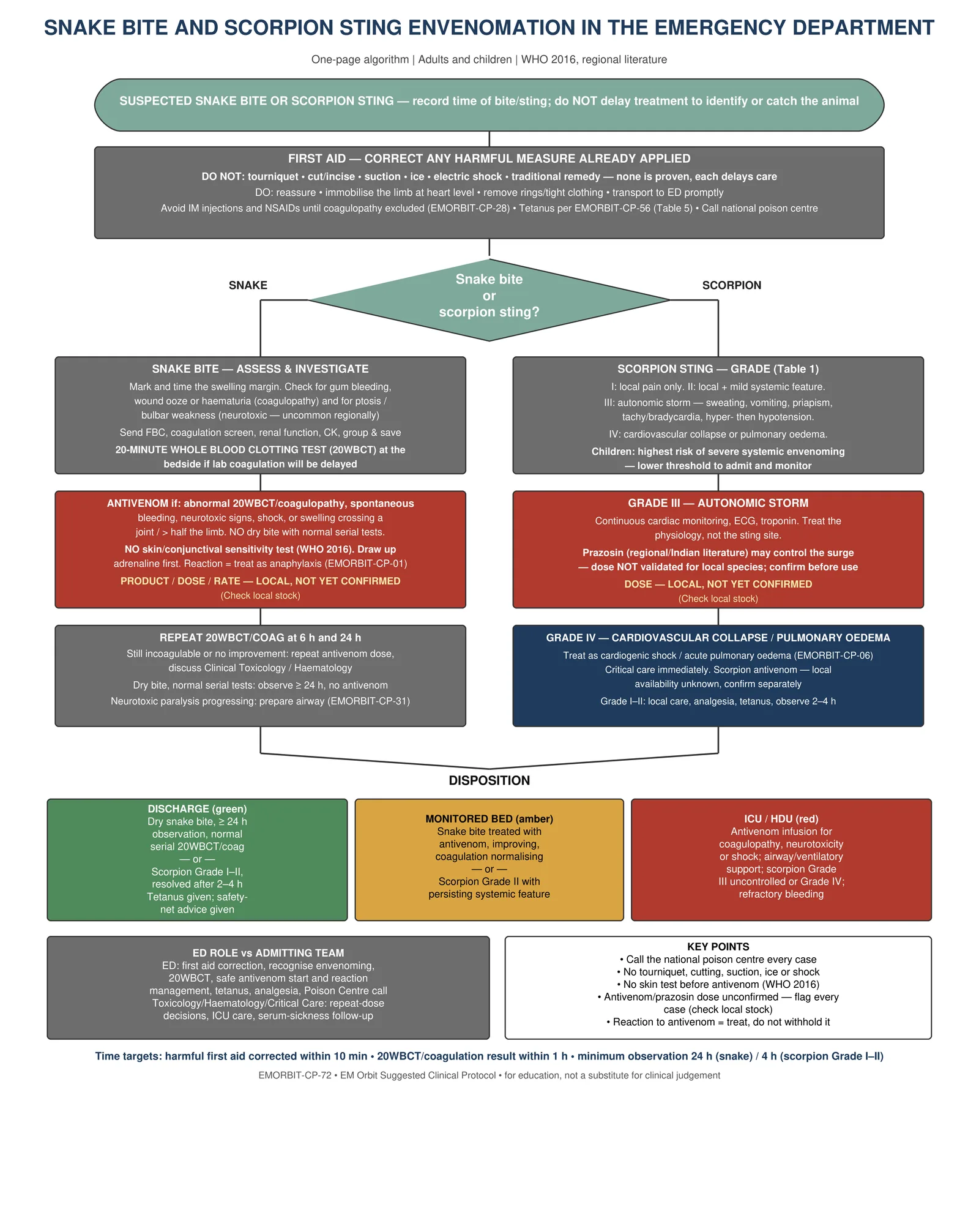
The one-page algorithm is shown at the top of this page.
6Team roles
6.1Triage and ED Nurses Role:
6.1.1 Recognise a systemic feature at triage and assign the highest acuity category; mark and time the swelling margin where not yet done; correct any harmful first aid still in place (Table 2).
6.1.2 Prepare and monitor during antivenom administration; have adrenaline immediately available; record vital signs and the time of every intervention.
6.2Pharmacist:
6.2.1 Confirm and maintain the antivenom product held for the department, its species coverage, reconstitution, and paediatric dosing; verify prazosin availability and dose before any administration.
6.2.2 Advise on drug interactions in the anticoagulated or antiplatelet patient.
6.3Clinical Toxicology / Critical Care:
6.3.1 Provide the treating physician with species and antivenom advice for every case in conjunction with the national poison centre; lead management of refractory coagulopathy, neurotoxicity, or scorpion Grade III–IV envenoming; accept ICU/HDU referrals.
6.4Haematology:
6.4.1 Advise on blood product support alongside antivenom for major bleeding, and on the interval for repeat coagulation testing.
6.5Laboratory Staff:
6.5.1 Process coagulation screens for suspected snake bite as an urgent sample at every timepoint requested.
6.6Ambulance / Pre-hospital Providers:
6.6.1 Pre-alert the ED for any bite/sting with a systemic feature; hand over the time of the bite/sting and any first aid already given using the structured (ATMIST/SBAR) format; do not bring the live or dead animal into the ED.
7The patient's role
7.1 Report the time of the bite/sting and any change in symptoms promptly, including new bleeding, weakness, or breathlessness.
7.2 Do not attempt to catch, kill, or transport the animal; a photograph taken at a safe distance is sufficient.
7.3 Complete the full observation period even if symptoms seem to have settled, and return immediately for the warning symptoms given at discharge, including those that can appear days after antivenom.
8Definitions
8.1Envenomation: the injection of venom by a bite or sting sufficient to produce a local or systemic clinical effect, as distinct from a bite/sting with no venom effect (a "dry bite").
8.2Venom-Induced Consumption Coagulopathy (VICC): a coagulopathy caused by venom components that activate and then deplete the clotting cascade, detected by an abnormal 20WBCT or coagulation screen; the principal mechanism of regional viper envenoming.
8.320-Minute Whole Blood Clotting Test (20WBCT): a bedside test for coagulopathy after snake bite (section 4.2).
8.4Autonomic Storm: the cholinergic and adrenergic surge of severe scorpion envenoming — sweating, salivation, vomiting, priapism, and cardiovascular instability (Table 1, Grade III).
8.5Anaphylactoid Reaction: an acute hypersensitivity-type reaction to antivenom that is not IgE-mediated but is clinically indistinguishable from, and treated as, anaphylaxis (EMORBIT-CP-01).
8.6Dry Bite: a snake bite in which no venom, or an insufficient quantity, has been injected, so no local or systemic envenoming feature develops.
9Attachments
- Attachment 1: One-page algorithm (top of this page)
- Attachment 2: First-Aid and Severity Quick Reference
11Suggested quality indicators
11.1Harmful first aid corrected within 10 minutes of arrival: (Number of patients presenting with a Table 2 harmful measure in place who had it corrected within 10 minutes / Total number of such patients) × 100. Target ≥ 95%.
11.2Coagulation status established within 1 hour: (Number of suspected snake bite patients with a 20WBCT or laboratory coagulation result within 1 hour of arrival / Total number of suspected snake bite patients) × 100. Target ≥ 90%.
11.3Antivenom without prior skin test: (Number of patients given antivenom without a preceding skin/conjunctival sensitivity test / Total number of patients given antivenom) × 100. Target 100%.
11.4Scorpion sting graded at triage and on reassessment: (Number of scorpion sting patients with a documented Table 1 grade at triage and before disposition / Total number of scorpion sting patients) × 100. Target ≥ 90%.
11.5Safe disposition: (Number of patients meeting the ICU/HDU criteria in section 4.3.6 who were admitted to a monitored critical care bed / Total number of such patients) × 100. Target 100%.
11.6Unplanned return within 7 days: (Number of discharged envenomation patients re-attending within 7 days with a related complication, including serum sickness / Total number discharged) × 100. Monitored as an outcome indicator.
13References
- World Health Organization Regional Office for South-East Asia. Guidelines for the management of snakebites. 2nd ed. New Delhi: WHO-SEARO; 2016.
- World Health Organization. Guidelines for the prevention and clinical management of snakebite in Africa. Brazzaville: WHO Regional Office for Africa; 2019.
- Warrell DA. Venomous bites, stings, and poisoning: an update. Infect Dis Clin North Am. 2019;33(1):17–38.
- Chippaux JP. Snakebite envenomation turns again into a neglected tropical disease. J Venom Anim Toxins Incl Trop Dis. 2017;23:38.
- Bawaskar HS, Bawaskar PH. Scorpion sting: update. J Assoc Physicians India. 2012;60:46–55.
- Isbister GK, Bawaskar HS. Scorpion envenomation. N Engl J Med. 2014;371(5):457–463.
- Chippaux JP, Goyffon M. Epidemiology of scorpionism: a global appraisal. Acta Trop. 2008;107(2):71–79.
A2Attachment 2: First-Aid and Severity Quick Reference
| Do NOT | Do instead |
|---|---|
| Apply a tourniquet or any constricting band. | Remove rings, watches and tight clothing from the affected limb before swelling progresses. |
| Cut, incise or excise the bite/sting site. | Clean the site gently; do not manipulate it further. |
| Attempt to suck out venom (by mouth or a suction device). | Reassure the patient; anxiety worsens autonomic and cardiovascular symptoms. |
| Apply ice, an electric shock device, or a traditional/herbal remedy. | Immobilise the bitten or stung limb in a position of function, kept at heart level. |
| Delay transport to try to catch, kill or identify the animal. | A photograph taken at a safe distance may help identification; the animal itself is never brought into the ED. |
| Give an intramuscular injection or a non-steroidal anti-inflammatory drug before coagulation status is known. | Use paracetamol or a titrated intravenous/intranasal opioid for analgesia (EMORBIT-CP-28) until coagulopathy is excluded. |
| Grade | Features | ED action |
|---|---|---|
| I | Local pain, swelling or paraesthesia only; no systemic feature. | Local care, analgesia (EMORBIT-CP-28), tetanus assessment (EMORBIT-CP-56, Table 5); observe 2–4 hours. |
| II | Grade I plus mild systemic feature: nausea, vomiting, mild sweating, restlessness. | As Grade I; observe minimum 4 hours; admit if any feature progresses. |
| III | Autonomic storm: profuse sweating, vomiting, priapism, hypersalivation, and cardiovascular instability — tachycardia or bradycardia, hypertension progressing to hypotension. | Continuous cardiac monitoring, ECG and troponin; control the autonomic surge (section 4.3.2); admit. |
| IV | Cardiovascular collapse, acute pulmonary oedema, myocarditis, or respiratory failure. | Treat as cardiogenic shock / acute pulmonary oedema (EMORBIT-CP-06); critical care immediately; ICU/HDU. |
Children have the highest risk of progressing to Grade III–IV because of a higher venom-to-body-weight ratio; apply a lower threshold for admission and monitoring in every child.
Antivenom product, dose and scorpion antivenom availability vary by region and are not stated in this guideline — see section 4.3.3 and 4.3.4.