Post-Exposure Prophylaxis (HIV, Hepatitis B, Needle-Stick and Sexual Exposure) in the Emergency Department
EMORBIT-CP-55 · Chapter 7 · Infectious Disease Emergencies
Open in the appFree, works on your phone and offline, with every tool alongside.
Evidence base: WHO 2024; CDC
1Purpose
1.1 Provide a standardized, evidence-based framework for the risk assessment and timely post-exposure prophylaxis (PEP) of HIV, hepatitis B and hepatitis C after occupational and non-occupational blood/body fluid exposure, including sexual exposure and sexual assault, in patients and staff presenting to the Emergency Department (ED).
1.2 Ensure that HIV PEP is started within 72 hours of exposure, ideally within 2 hours, and that a decision on the source status or the availability of baseline bloods never delays the first dose.
1.3 Standardize the hepatitis B decision by the exposed person's immune status and the source's HBsAg status, and establish that hepatitis C has no post-exposure prophylaxis and instead requires a defined follow-up testing schedule.
1.4 Provide a safe, non-judgemental, trauma-informed pathway for sexual assault, including safeguarding, forensic and legal considerations, without these delaying medical treatment.
1.5 Define the occupational health reporting route for staff exposures.
1.6 Align with the World Health Organization (WHO), the Centers for Disease Control and Prevention (CDC), the British Association for Sexual Health and HIV (BASHH), and the national health authority guidance where confirmed.
2Who this protocol applies to
2.1 Any patient or staff member presenting after an occupational exposure (needle-stick, sharps injury, or mucous-membrane/skin splash) to blood or a body fluid.
2.2 Any patient presenting after non-occupational exposure, including consensual sexual exposure and sexual assault, of any age.
2.3 Patients presenting with an interrupted, incomplete, or delayed PEP course, including a course begun elsewhere.
2.4 Patients presenting late — beyond 72 hours — for risk discussion, hepatitis B/C assessment, and baseline/follow-up testing, even though HIV PEP is no longer indicated.
3Not covered by this protocol
3.1 Animal or human bite wounds: manage the wound and rabies/tetanus risk per EMORBIT-CP-56, which points to this guideline for the blood-borne virus assessment of a human bite.
3.2 A patient already known to be HIV-, HBV- or HCV-positive presenting for reasons unrelated to a new exposure: refer to their existing Infectious Diseases/hepatology follow-up.
3.3 Definitive forensic examination and police statement-taking, which are not an ED role beyond the initial medical assessment and referral (section 4.3.6).
3.4 Chronic antiretroviral therapy, hepatitis B or hepatitis C treatment initiation and monitoring, which are outpatient Infectious Diseases and hepatology activities.
4Protocol
4.1History and Assessment:
4.1.1Triage and Recognition:
4.1.1.1 Any patient reporting a possible blood-borne virus exposure shall be triaged no lower than Category 2–3 and seen promptly: the HIV PEP window is measured in hours, not the length of the queue.
4.1.1.2 A disclosed sexual assault shall be triaged as Category 2, taken to a private area, and given a same-visit physician assessment; the patient shall not be made to repeat their account to multiple staff.
4.1.1.3 First aid begins immediately, in parallel with triage (section 4.3.1); it is not deferred to the treating physician.
4.1.2History:
4.1.2.1 The exposure: date and time (the interval since exposure decides whether HIV PEP remains an option); the fluid involved; the route (percutaneous, mucosal, sexual); whether the exposure was occupational, consensual non-occupational, or assault.
4.1.2.2 The source, where known: HIV, hepatitis B and hepatitis C status if documented; risk factors if status is unknown; whether the source can be tested and consents.
4.1.2.3 The exposed person: hepatitis B vaccination history and any documented antibody titre; current medications and renal function relevant to antiretroviral dosing; allergy history; last menstrual period in any woman who has started menarche, regardless of age; breastfeeding status.
4.1.2.4 For a sexual exposure or assault: the nature of the contact, whether ejaculation occurred, any condom use or failure, and time since the incident, asked directly but without repeated retelling.
4.1.2.5 For an occupational exposure: the device involved, whether it was used on the source patient, and whether the incident has already been reported to Occupational Health.
4.1.3Examination:
4.1.3.1 Examine and document the wound or contact site; for a needle-stick, whether the injury was deep and whether blood was visible on the device.
4.1.3.2 For sexual assault: a general examination focused on injury and safety, deferring detailed intimate/forensic examination to the specialist service where local pathway exists (section 4.3.6); document only what is needed for immediate clinical care unless the patient consents to more.
4.1.3.3 Assess capacity and safeguarding needs in every presentation, particularly in a minor, an intoxicated patient, or one with a disability.
4.1.4Risk Stratification – Severity:
4.1.4.1 Assign the exposure to a risk category and decide whether HIV PEP is indicated (Table 1).
Table 1: Exposure type and whether it triggers HIV post-exposure prophylaxis (PEP) Exposure Risk if source positive PEP indicated? Percutaneous injury with a hollow-bore needle, a deep injury, or visible blood on the device High Yes — start now if source positive or unknown/high-risk Percutaneous injury with a solid needle or a superficial scratch, no visible blood Low Individual risk assessment; generally not required if source negative or very low-risk Mucous membrane or non-intact skin splash with blood or a visibly blood-stained fluid Moderate Yes if source positive or unknown/high-risk Receptive anal or vaginal intercourse, consensual or assault Highest sexual-exposure risk Yes if source positive, unknown from a high-prevalence group, or an unknown assailant Insertive vaginal or anal intercourse; receptive oral sex with ejaculation Lower, not negligible Offer after individualised risk discussion Human bite breaking the skin (either direction) Low; case reports only Manage the wound per EMORBIT-CP-56; PEP by individual risk assessment, not routine Blood/body fluid on intact skin; urine, faeces, saliva, sweat, tears or vomit not visibly blood-stained Negligible PEP not indicated Where the source is unknown, base the decision on the exposure type and the local epidemiology of the community, not on assumption. A source who declines testing, or who cannot be traced, is managed as unknown risk.
4.1.4.2 A source who is HIV-negative on a recent test and has no ongoing high-risk exposure is treated as negative; a source with a possible recent seroconversion (within the last 3 months) is treated as unknown risk.
4.1.5Differential Diagnosis:
4.1.5.1 Distinguish a true blood-borne exposure (fresh blood or a visibly blood-stained fluid, a breach of skin or mucosa) from a non-exposure (dried blood, intact skin contact, non-blood-stained fluid), which requires reassurance and wound care only.
4.1.5.2 In an occupational injury, distinguish a hollow-bore needle used on a patient from a community-discarded needle of unknown origin, which changes the risk assessment but does not exclude the need for one.
4.1.6Special Populations:
4.1.6.1 Children (under 13 years): any sexual exposure in a child is a safeguarding emergency — refer to EMORBIT-CP-83 and do not discharge until the child's safety is confirmed. Dosing is weight-based (Table 2); the child does not wait behind adult presentations for the first dose.
4.1.6.2 Pregnancy and breastfeeding: HIV PEP is not withheld or delayed for either. Obtain the pregnancy test without delaying the first dose, and involve Obstetrics.
4.1.6.3 Sexual assault (any age): offer emergency contraception (levonorgestrel 1.5 mg single dose within 72 hours, or ulipristal acetate 30 mg within 120 hours, per product licence) and empirical sexually transmitted infection prophylaxis per EMORBIT-CP-57 — the specific agents are not restated here. Offer referral to a forensic/sexual-assault service for evidence collection where a pathway exists; reporting to police is the patient's choice unless a local mandatory-reporting law applies.
4.1.6.4 Occupational exposure (staff): refer to Occupational/Employee Health on the same shift; the specific reporting form and route follows the hospital's occupational health pathway.
4.1.6.5 Source patient known HIV-positive and virally suppressed on treatment: PEP is still generally offered per current guidance; discuss with Infectious Diseases where time allows, without delaying the first dose.
4.2Investigations:
4.2.1 No investigation shall delay the first dose of HIV PEP where the 72-hour window applies (Table 2).
4.2.2 Obtain baseline bloods for the exposed person, and for the source with consent, per the schedule in Table 4.
Table 4: Baseline and follow-up testing schedule Time point Tests Baseline (ED visit, day 0) HIV antigen/antibody combination test; HBsAg; anti-HBs if vaccination history is uncertain; HCV antibody; full blood count; renal profile; liver function tests; pregnancy test in any woman who has started menarche, regardless of age, obtained by the treating team without delay — the triage nurse does not perform it (library decision) Source patient (with consent) Rapid HIV test; HBsAg; HCV antibody, where the source can be identified and consents 2 weeks (if taking HIV PEP) Renal function and liver function tests, for drug toxicity 6 weeks HIV antigen/antibody combination test; HCV antibody (± HCV RNA if the source is HCV-positive or high-risk) 12 weeks (3 months) HIV antigen/antibody combination test (confirmatory); HCV antibody 4–6 months Repeat HCV antibody if the baseline exposure risk was significant and earlier tests were negative (window period) 4–8 weeks after completing a hepatitis B vaccine course Anti-HBs, to confirm immunity 4.2.3 A rapid point-of-care HIV test on the source, where available, supports the decision but a pending result never delays the first PEP dose in a high-risk exposure.
4.3Plan of Care:
4.3.1Immediate Actions:
4.3.1.1 Wound: wash with soap and water; do not suck or scrub the wound.
4.3.1.2 Mucous membrane or eye splash: irrigate immediately with water or saline.
4.3.1.3 First aid is never delayed for risk assessment, forms, or consent discussions.
4.3.2Definitive ED Treatment:
4.3.2.1HIV post-exposure prophylaxis: start the regimen in Table 2 for any exposure meeting Table 1 criteria, within 72 hours of exposure and ideally within 2 hours.
Table 2: HIV post-exposure prophylaxis — starter regimen (28-day course) Population Regimen Duration / notes Adult and adolescent (≥ 13 years), normal renal function Tenofovir disoproxil fumarate 300 mg + emtricitabine 200 mg once daily, PLUS dolutegravir 50 mg once daily (preferred, WHO/CDC) 28 days. First dose given in the ED without waiting for baseline serology or the source result Dolutegravir unavailable or contraindicated Same backbone PLUS raltegravir 400 mg twice daily 28 days Renal impairment (eGFR < 60 mL/min) Backbone dose adjustment or an alternative agent is required Seek Pharmacy/Infectious Diseases advice, but do not omit the first dose while awaiting it if within the 72-hour window Child (< 13 years) Weight-based regimen per WHO paediatric antiretroviral dosing Obtain from Paediatrics/Pharmacy at first presentation — not restated here Pregnancy or breastfeeding The standard adult regimen above is not withheld or delayed Involve Obstetrics; do not wait for the pregnancy test result before the first dose Known or suspected drug-resistant source virus Start the standard regimen; do not delay it Discuss regimen adjustment with Infectious Diseases as soon as possible A starter pack of 3–5 days' supply in the ED, and the means for the patient to obtain the remaining course, shall be agreed with Pharmacy before the patient leaves the ED. Ideally within 2 hours of exposure; PEP shall not be started after 72 hours have elapsed.
4.3.2.2Hepatitis B prophylaxis: decide vaccine and/or hepatitis B immunoglobulin (HBIG) by the exposed person's immune status and the source's HBsAg status.
Table 3: Hepatitis B post-exposure prophylaxis, by the exposed person's immune status Exposed person's status Source HBsAg positive, or unknown/high-risk Source HBsAg negative Complete vaccine course, documented immune (anti-HBs ≥ 10 mIU/mL) No action No action Complete vaccine course, immunity not previously documented Check anti-HBs urgently; if inadequate, treat as a non-responder (below) Check anti-HBs; vaccinate only if inadequate Documented non-responder to a primary course HBIG 500 IU IM (adult) as soon as possible, within 48 hours and no later than 7 days, PLUS start a second full vaccine course No action Unvaccinated, incomplete course, or no documentation Start an accelerated vaccine course now (0, 1, 2 months + booster at 12 months) PLUS HBIG as above Start a standard vaccine course now (vaccine alone) HBIG dose in children is weight-based — confirm with Pharmacy. Give the vaccine and HBIG at different sites, never the same syringe. A super-accelerated schedule (0, 7, 21 days + 12-month booster) may be used where completion of the standard course cannot be assured — confirm local policy.
4.3.2.3Hepatitis C: there is no post-exposure prophylaxis for hepatitis C. Manage by baseline and follow-up antibody/RNA testing (Table 4) and early referral to Infectious Diseases/hepatology if the source is HCV-positive or the follow-up test is positive.
4.3.2.4Sexual assault adjuncts: emergency contraception and sexually transmitted infection prophylaxis as in section 4.1.6; do not let these delay HIV PEP or vice versa.
4.3.3Escalation / Refractory:
4.3.3.1 Refer to Infectious Diseases for: a known or suspected drug-resistant source virus, significant renal impairment affecting the regimen, pregnancy or breastfeeding, or any regimen intolerance — start the standard regimen first and adjust on advice, rather than withholding it.
4.3.3.2 Refer any child or safeguarding concern to EMORBIT-CP-83 immediately; the patient does not leave the department until safety is confirmed.
4.3.4Monitoring / Reassessment:
4.3.4.1 Assess adherence, side effects (principally gastrointestinal), and renal/liver function at the 2-week review while the patient is taking HIV PEP (Table 4).
4.3.4.2 Reinforce that missing doses reduces effectiveness and that the full 28-day course is required even if the source later tests negative on a rapid test — stop the course only once a confirmatory source result is available.
4.3.5Disposition:
4.3.5.1 Low-risk exposure not meeting Table 1 criteria: discharge with safety-netting and baseline/follow-up bloods arranged; no PEP required.
4.3.5.2 PEP started, patient stable: discharge with the starter pack, follow-up bloods and PEP-clinic/Infectious Diseases appointment arranged before leaving the department.
4.3.5.3 Any safeguarding concern, a minor, or an occupational exposure requiring same-day reporting: do not discharge until the relevant referral (safeguarding, Occupational Health) has been made.
4.3.6Discharge and Follow-up:
4.3.6.1 Provide the starter pack (3–5 days) or the arranged means of obtaining the full course, written dosing instructions, and side-effect advice.
4.3.6.2 Book follow-up bloods per Table 4 and a review appointment with Infectious Diseases/the PEP clinic before the patient leaves.
4.3.6.3 Give written safety-netting advice: return earlier for a rash, jaundice, or an inability to tolerate the medication, and continue the course pending review.
4.3.6.4 For sexual assault: provide contact details for ongoing psychological support and the forensic/legal pathway discussed in section 4.1.6.
4.3.7Documentation and Reporting:
4.3.7.1 Document: time of exposure, time of first assessment, exposure category (Table 1), source status and consent for testing, time of first PEP dose, hepatitis B decision, baseline bloods sent, and all referrals made.
4.3.7.2 Report an occupational exposure to Occupational/Employee Health per the local route (section 4.1.6); report a sexual assault per the patient's wishes and the local legal requirement once confirmed.
4.3.7.3 Post-exposure prophylaxis presentations shall be captured for the departmental audit (section 11).
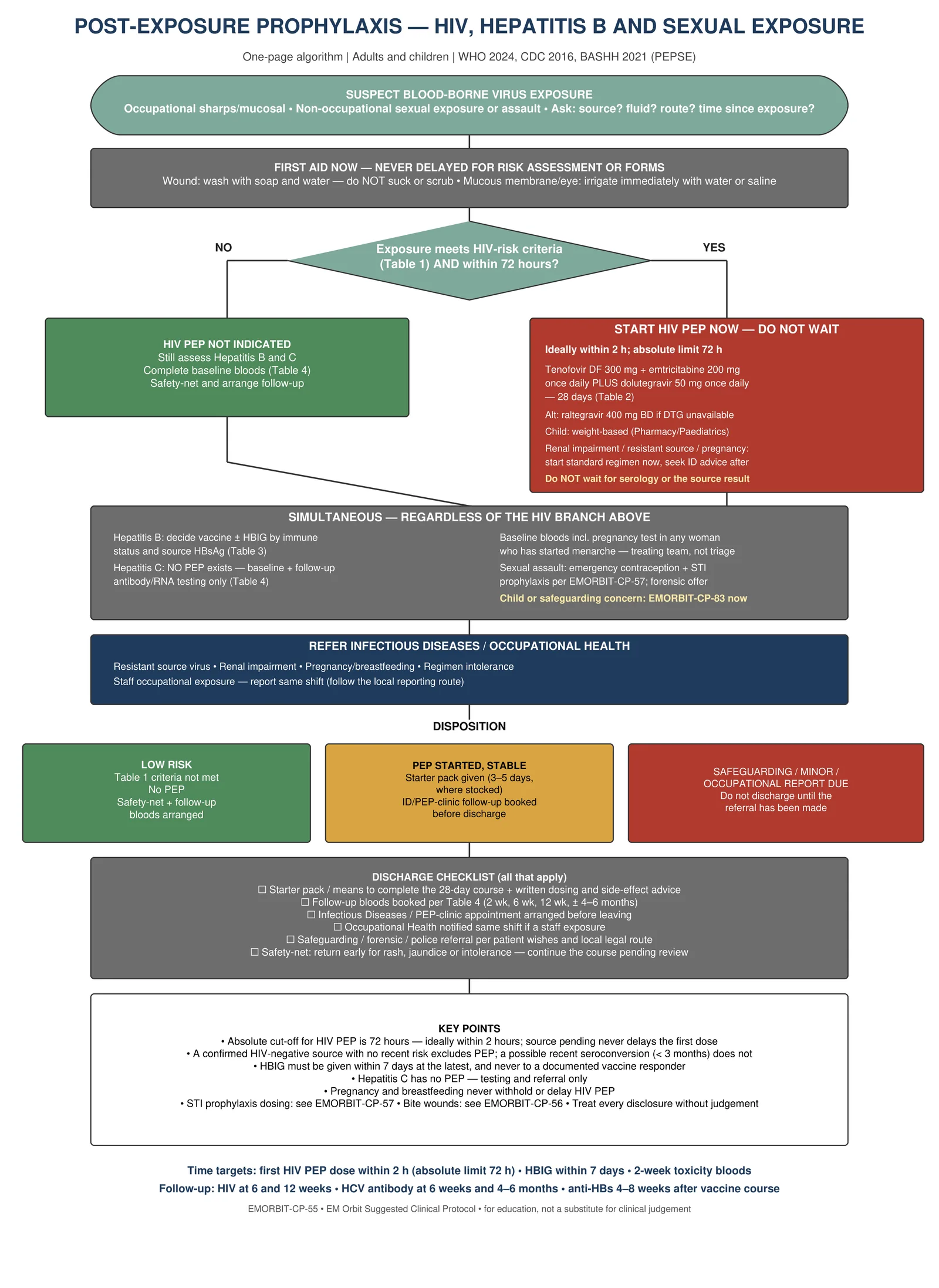
5Algorithm
The one-page algorithm is shown at the top of this page.
6Team roles
6.1Triage and ED Nurses Role:
6.1.1 Recognize a possible blood-borne virus exposure, triage appropriately, and begin wound washing or irrigation immediately, without waiting for a physician.
6.1.2 Provide a private area and a single, trauma-informed point of contact for a patient disclosing sexual assault.
6.2Pharmacist:
6.2.1 Verify the HIV PEP and hepatitis B regimen against renal function, pregnancy, drug interactions, and the local formulary; confirm starter-pack availability and the route to complete the course.
6.3Infectious Diseases:
6.3.1 Advise on regimen adjustment for renal impairment, pregnancy, breastfeeding, or a resistant source virus; provide the PEP-clinic follow-up appointment.
6.4Laboratory:
6.4.1 Process baseline and follow-up serology per Table 4 and expedite a rapid HIV test on the source where requested.
6.5Occupational/Employee Health:
6.5.1 Receive and log staff occupational exposure reports and coordinate source testing and staff follow-up (local reporting route).
7The patient's role
7.1 Disclose the exposure and its timing as accurately as possible, including for sexual exposure, without fear of judgement.
7.2 Take the full 28-day HIV PEP course as prescribed, even if early results are reassuring, and complete the hepatitis B vaccine schedule where started.
7.3 Attend the arranged follow-up blood tests and appointments.
7.4 Return earlier for a rash, jaundice, or intolerance of the medication, or if new symptoms develop.
8Definitions
8.1PEP: post-exposure prophylaxis — medication or immunisation given after a blood-borne virus exposure to prevent infection.
8.2nPEP: non-occupational PEP, including sexual and other community exposures, as distinct from an occupational (workplace) exposure.
8.3Source: the person whose blood or body fluid caused the exposure.
8.4Window period: the interval after infection during which a test may not yet detect it, requiring repeat testing later.
8.5HBIG: hepatitis B immunoglobulin, providing immediate passive antibody while the vaccine produces an active response.
8.6Anti-HBs: hepatitis B surface antibody, the marker of immunity to hepatitis B.
8.7Woman who has started menarche: the library definition of a woman of child-bearing age for this guideline library, applied regardless of age.
9Attachments
- Attachment 1: One-page algorithm (top of this page)
- Attachment 2: Quick Reference — Exposure Risk, HIV Regimen, Hepatitis B Decision and Follow-up Testing
11Suggested quality indicators
11.1Time to first HIV PEP dose: (Number of eligible patients receiving the first PEP dose within 2 hours of presentation / Total number of patients started on HIV PEP) × 100. Target ≥ 80%.
11.2Exposure risk category documented: (Number of exposure presentations with the Table 1 category explicitly recorded / Total number of exposure presentations) × 100. Target ≥ 90%.
11.3Baseline bloods completed without delaying the first dose: (Number of patients with baseline bloods sent per Table 4 and no delay to the first PEP dose / Total number of patients started on PEP) × 100. Target ≥ 90%.
11.4Follow-up arranged before discharge: (Number of discharged patients with follow-up bloods and an Infectious Diseases/PEP-clinic appointment arranged before leaving / Total number of patients started on PEP) × 100. Target 100%.
11.5Occupational exposures reported within 24 hours: (Number of staff occupational exposures reported to Occupational Health within 24 hours / Total number of staff occupational exposures) × 100. Target ≥ 95%.
11.6HIV seroconversion among PEP recipients: (Number of patients completing HIV PEP who seroconvert by 12 weeks / Total number completing HIV PEP) × 100. Monitored as an outcome indicator; target 0%.
13References
- World Health Organization. Consolidated guidelines on HIV prevention, testing, treatment, service delivery and monitoring — post-exposure prophylaxis chapter. Geneva: WHO; 2024 update.
- Centers for Disease Control and Prevention. Updated Guidelines for Antiretroviral Postexposure Prophylaxis After Occupational Exposure to HIV — United States. MMWR; 2016.
- Centers for Disease Control and Prevention. Updated Guidelines for Antiretroviral Postexposure Prophylaxis After Sexual, Injection Drug Use, or Other Nonoccupational Exposure to HIV — United States. MMWR; 2016.
- British Association for Sexual Health and HIV (BASHH). UK Guideline for the Use of HIV Post-Exposure Prophylaxis Following Sexual Exposure (PEPSE); 2021 update.
- US Public Health Service. Updated U.S. Public Health Service Guidelines for the Management of Occupational Exposures to Hepatitis B Virus, Hepatitis C Virus, and Human Immunodeficiency Virus and Recommendations for Postexposure Prophylaxis. MMWR Recomm Rep.
- World Health Organization. Clinical management of survivors of sexual assault / Responding to intimate partner violence and sexual violence against women: WHO clinical and policy guidelines. Geneva: WHO; 2013.
- the national health authority. National HIV and viral hepatitis guidance.
A2Attachment 2: Quick Reference — Exposure Risk, HIV Regimen, Hepatitis B Decision and Follow-up Testing
| Exposure | Risk if source positive | PEP indicated? |
|---|---|---|
| Percutaneous injury with a hollow-bore needle, a deep injury, or visible blood on the device | High | Yes — start now if source positive or unknown/high-risk |
| Percutaneous injury with a solid needle or a superficial scratch, no visible blood | Low | Individual risk assessment; generally not required if source negative or very low-risk |
| Mucous membrane or non-intact skin splash with blood or a visibly blood-stained fluid | Moderate | Yes if source positive or unknown/high-risk |
| Receptive anal or vaginal intercourse, consensual or assault | Highest sexual-exposure risk | Yes if source positive, unknown from a high-prevalence group, or an unknown assailant |
| Insertive vaginal or anal intercourse; receptive oral sex with ejaculation | Lower, not negligible | Offer after individualised risk discussion |
| Human bite breaking the skin (either direction) | Low; case reports only | Manage the wound per EMORBIT-CP-56; PEP by individual risk assessment, not routine |
| Blood/body fluid on intact skin; urine, faeces, saliva, sweat, tears or vomit not visibly blood-stained | Negligible | PEP not indicated |
Where the source is unknown, base the decision on the exposure type and the local epidemiology of the community, not on assumption. A source who declines testing, or who cannot be traced, is managed as unknown risk.
| Population | Regimen | Duration / notes |
|---|---|---|
| Adult and adolescent (≥ 13 years), normal renal function | Tenofovir disoproxil fumarate 300 mg + emtricitabine 200 mg once daily, PLUS dolutegravir 50 mg once daily (preferred, WHO/CDC) | 28 days. First dose given in the ED without waiting for baseline serology or the source result |
| Dolutegravir unavailable or contraindicated | Same backbone PLUS raltegravir 400 mg twice daily | 28 days |
| Renal impairment (eGFR < 60 mL/min) | Backbone dose adjustment or an alternative agent is required | Seek Pharmacy/Infectious Diseases advice, but do not omit the first dose while awaiting it if within the 72-hour window |
| Child (< 13 years) | Weight-based regimen per WHO paediatric antiretroviral dosing | Obtain from Paediatrics/Pharmacy at first presentation — not restated here |
| Pregnancy or breastfeeding | The standard adult regimen above is not withheld or delayed | Involve Obstetrics; do not wait for the pregnancy test result before the first dose |
| Known or suspected drug-resistant source virus | Start the standard regimen; do not delay it | Discuss regimen adjustment with Infectious Diseases as soon as possible |
A starter pack of 3–5 days' supply in the ED, and the means for the patient to obtain the remaining course, shall be agreed with Pharmacy before the patient leaves the ED. Ideally within 2 hours of exposure; PEP shall not be started after 72 hours have elapsed.
| Exposed person's status | Source HBsAg positive, or unknown/high-risk | Source HBsAg negative |
|---|---|---|
| Complete vaccine course, documented immune (anti-HBs ≥ 10 mIU/mL) | No action | No action |
| Complete vaccine course, immunity not previously documented | Check anti-HBs urgently; if inadequate, treat as a non-responder (below) | Check anti-HBs; vaccinate only if inadequate |
| Documented non-responder to a primary course | HBIG 500 IU IM (adult) as soon as possible, within 48 hours and no later than 7 days, PLUS start a second full vaccine course | No action |
| Unvaccinated, incomplete course, or no documentation | Start an accelerated vaccine course now (0, 1, 2 months + booster at 12 months) PLUS HBIG as above | Start a standard vaccine course now (vaccine alone) |
HBIG dose in children is weight-based — confirm with Pharmacy. Give the vaccine and HBIG at different sites, never the same syringe. A super-accelerated schedule (0, 7, 21 days + 12-month booster) may be used where completion of the standard course cannot be assured — confirm local policy.
| Time point | Tests |
|---|---|
| Baseline (ED visit, day 0) | HIV antigen/antibody combination test; HBsAg; anti-HBs if vaccination history is uncertain; HCV antibody; full blood count; renal profile; liver function tests; pregnancy test in any woman who has started menarche, regardless of age, obtained by the treating team without delay — the triage nurse does not perform it (library decision) |
| Source patient (with consent) | Rapid HIV test; HBsAg; HCV antibody, where the source can be identified and consents |
| 2 weeks (if taking HIV PEP) | Renal function and liver function tests, for drug toxicity |
| 6 weeks | HIV antigen/antibody combination test; HCV antibody (± HCV RNA if the source is HCV-positive or high-risk) |
| 12 weeks (3 months) | HIV antigen/antibody combination test (confirmatory); HCV antibody |
| 4–6 months | Repeat HCV antibody if the baseline exposure risk was significant and earlier tests were negative (window period) |
| 4–8 weeks after completing a hepatitis B vaccine course | Anti-HBs, to confirm immunity |