Carbon Monoxide Poisoning
EMORBIT-CP-70 · Chapter 10 · Toxicological and Environmental Emergencies
Open in the appFree, works on your phone and offline, with every tool alongside.
Evidence base: ACEP CP 2017; UKHSA
1Purpose
1.1 Standardize the recognition of carbon monoxide (CO) poisoning in the Emergency Department (ED), including presentations without an obvious history of exposure, and ensure pulse oximetry is never used to exclude it.
1.2 Ensure high-flow oxygen is started immediately in every suspected case, define the treatment endpoint, and standardize recognition and treatment of co-existing cyanide toxicity in smoke inhalation.
1.3 Define who needs a hyperbaric oxygen referral, who is admitted, and who can be discharged, and ensure every other person who shared the exposure is identified and assessed.
1.4 Align ED practice with the ACEP Clinical Policy 2017 and UK Health Security Agency (UKHSA) guidance on carbon monoxide poisoning.
2Who this protocol applies to
2.1 Any patient of any age with suspected or confirmed exposure to carbon monoxide: fire or smoke exposure, a fuel-burning heater, generator, water heater, vehicle exhaust, shisha/hookah, or a poorly ventilated cooking or heating appliance.
2.2 Patients with unexplained headache, nausea, dizziness, or a flu-like illness where more than one person from the same building, vehicle, or workplace is affected, or symptoms improve away from the location.
2.3 Patients pre-alerted with a measured elevated carboxyhaemoglobin (COHb), and any other occupant of the same building, room, or vehicle, whether or not they are symptomatic.
2.4 Patients with a burn or suspected inhalation injury and possible CO or cyanide co-exposure (EMORBIT-CP-67).
2.5 Suspected deliberate self-poisoning by vehicle exhaust or combustion of fuel in an enclosed space.
3Not covered by this protocol
3.1 An asymptomatic chronic tobacco smoker with a mildly elevated COHb consistent with smoking alone (typically below 10%) and no exposure history: manage the presenting complaint on its own merits.
3.2 Delivery of hyperbaric oxygen therapy itself, which is a referral from the ED, not an ED-delivered treatment.
3.3 Definitive burn wound management and admission decisions in a burn patient, governed by EMORBIT-CP-67; this guideline governs the CO/cyanide component only.
3.4 Selection of an antidote regimen for a poisoning other than CO or cyanide, governed by the general approach in EMORBIT-CP-21.
4Protocol
4.1History and Assessment:
4.1.1Triage and Recognition:
4.1.1.1 Standard pulse oximetry (SpO₂) reads falsely normal or even 100% in significant CO poisoning and shall never be used to exclude it: it cannot distinguish carboxyhaemoglobin from oxyhaemoglobin.
4.1.1.2 Suspect CO poisoning in any patient with headache, nausea, dizziness, weakness, or confusion that is otherwise unexplained, particularly where several people or a pet from the same building, vehicle, or workplace are affected, or symptoms improve on leaving the location.
4.1.1.3 Triage to a high acuity category, and a physician shall attend without delay, for any reduced consciousness, seizure, chest pain, pregnancy, or haemodynamic instability with suspected CO exposure.
4.1.1.4 Start high-flow oxygen at triage under the approved nursing standing order without waiting for physician review.
4.1.2History:
4.1.2.1 Source and duration of exposure (heater, generator, vehicle, fire, shisha), whether the space was enclosed, time removed from exposure, and whether symptoms improve away from the source.
4.1.2.2 Number and location of every other person who shared the exposure, whether they have been assessed, and where they are now — this is required for every patient, not only the index case (section 4.3.7).
4.1.2.3 Deliberate exposure (vehicle exhaust or fuel combustion in an enclosed space) raises the possibility of self-harm; assess suicidal intent and involve psychiatric liaison per the local mental health pathway (EMORBIT-CP-84 Self-harm and Suicide Risk Assessment).
4.1.2.4 Pre-existing cardiac or respiratory disease, and pregnancy in any woman who has started menarche, regardless of age.
4.1.3Examination:
4.1.3.1 Full set of vital signs, oxygen saturation (with the caveat above), and a focused neurological examination including cognition, gait, and cerebellar signs.
4.1.3.2 Cardiovascular examination and 12-lead ECG in every adult (section 4.2): myocardial injury can occur with few other clinical signs.
4.1.3.3 "Cherry-red" skin is a late, unreliable, and frequently absent sign and shall not be relied upon.
4.1.3.4 Examine for soot, singed facial hair, burns, or other evidence of smoke inhalation (EMORBIT-CP-67).
4.1.4Risk Stratification and Severity:
4.1.4.1 The measured COHb level correlates poorly with clinical severity and shall not by itself determine treatment or disposition: treat the patient in front of you, not the number. A low COHb does not exclude significant exposure, particularly if oxygen has already been given or time has passed since removal from the source.
4.1.4.2 Mild: headache, mild nausea, dizziness, normal examination and ECG.
4.1.4.3 Moderate: confusion, ataxia, chest pain, vomiting, or ECG changes without haemodynamic compromise.
4.1.4.4 Severe (high-risk — discuss hyperbaric referral, section 4.3.5): any loss of consciousness (even transient), seizure, coma, focal neurological deficit, cardiac ischaemia or arrhythmia, haemodynamic instability, or pregnancy with any of the above.
4.1.5Differential Diagnosis:
4.1.5.1 Viral illness, migraine, gastroenteritis, alcohol intoxication, and other causes of headache (EMORBIT-CP-45) — actively ask about an exposure source in any of these presentations, especially in cold weather with fuel-burning heating in use.
4.1.5.2 Cyanide toxicity may coexist rather than being a true alternative diagnosis (section 4.3.2) in a fire or enclosed-space smoke exposure.
4.1.6Special Populations:
4.1.6.1 Pregnancy: fetal haemoglobin has a higher affinity for carbon monoxide than adult hameoglobin and clears it more slowly, so the fetus is at greater risk than the mother for a given exposure; give oxygen for longer than the maternal endpoint would suggest, keep the threshold for hyperbaric discussion low, obtain a pregnancy test in any woman who has started menarche, involve Obstetrics early, and arrange cardiotocography once the mother is stable beyond the threshold of viability (EMORBIT-CP-73).
4.1.6.2 Children: use weight-based hydroxocobalamin dosing (section 4.3.2, Attachment 2); a child sharing a household exposure may be minimally symptomatic despite significant COHb and shall be assessed and treated on the same criteria as an adult.
4.1.6.3 Pre-existing cardiac or respiratory disease: at higher risk of myocardial injury and decompensation at a lower COHb; have a lower threshold for admission and troponin measurement.
4.2Investigations:
4.2.1 Carboxyhaemoglobin (COHb) by co-oximetry on a venous or arterial blood gas in every suspected case — venous sampling is adequate and avoids an unnecessary arterial puncture. Do not rely on standard pulse oximetry.
4.2.2 12-lead ECG in every adult; troponin where the ECG is abnormal, there is chest pain, or the exposure is significant, because myocardial injury can occur silently and predicts a worse outcome.
4.2.3 Venous or arterial lactate: a level ≥8–10 mmol/L in a fire-related exposure with soot or reduced consciousness raises suspicion of cyanide co-poisoning (section 4.3.2).
4.2.4 Blood glucose in every patient with altered consciousness; pregnancy test in any woman who has started menarche, regardless of age.
4.2.5 No investigation shall delay the start of high-flow oxygen.
4.3Plan of Care:
4.3.1Immediate Actions:
4.3.1.1 Ensure the patient has been removed from the source and the scene is safe for staff; do not send staff into an unassessed enclosed space.
4.3.1.2 Start 100% oxygen immediately by tight-fitting non-rebreather mask at 15 L/min (or the highest FiO₂ available), regardless of the pulse oximetry reading or symptom severity. Do not titrate down while COHb remains elevated.
4.3.1.3 Airway and breathing support (bag-valve-mask, then rapid sequence induction per EMORBIT-CP-31 with FiO₂ 1.0) for any patient unable to protect the airway or ventilate adequately.
4.3.2Definitive ED Treatment:
4.3.2.1 Continue 100% oxygen until the patient is asymptomatic and COHb is below 3%. This endpoint is stricter than the figure of below 5% used in the general poisoning and altered-mental-status pathways (EMORBIT-CP-21, EMORBIT-CP-46); the figure here applies to CO poisoning specifically.
4.3.2.2 Treat a seizure per EMORBIT-CP-02 (Status Epilepticus).
4.3.2.3Cyanide co-poisoning: suspect in any patient from an enclosed-space fire with soot, reduced consciousness, or a lactate ≥8–10 mmol/L. Give hydroxocobalamin 5 g intravenously over 15 minutes (adult) or 70 mg/kg intravenously to a maximum of 5 g (child), as per EMORBIT-CP-21 and EMORBIT-CP-67. Do not wait for a cyanide level, which is not available in real time.
4.3.2.4 Poisons advice: contact the national poison centre for any severe, pregnant, paediatric, or diagnostically uncertain case.
4.3.3Escalation and Refractory Features:
4.3.3.1 Coma, focal neurological deficit, cardiac ischaemia or arrhythmia, or haemodynamic instability: involve the senior ED physician and Critical Care immediately.
4.3.3.2 Cardiac arrest: standard advanced life support (EMORBIT-CP-03); consider hydroxocobalamin empirically where cyanide co-poisoning is possible (fire exposure) and contact the poisons centre.
4.3.4Monitoring and Reassessment:
4.3.4.1 Continuous ECG and repeat COHb by co-oximetry until it is falling and the patient is asymptomatic; a repeat 12-lead ECG before disposition in any patient with an initial abnormality or significant exposure.
4.3.4.2 Reassess neurological status at least hourly while symptomatic; a new or persisting deficit warrants senior and Critical Care review before discharge is considered.
4.3.5Disposition:
4.3.5.1 Discharge: asymptomatic, COHb below 3%, normal ECG, no severe feature (section 4.1.4), a safe environment confirmed to return to (section 4.3.7), and adequate supervision.
4.3.5.2 Admit: any severe feature, persistent symptoms despite oxygen, an abnormal ECG or troponin, pregnancy with any severe feature, or where the home environment cannot yet be confirmed safe.
4.3.5.3 Hyperbaric oxygen — refer for discussion, do not deliver in the ED: any loss of consciousness (even transient), seizure, coma, focal neurological deficit, cardiac ischaemia, pregnancy with significant exposure, or symptoms persisting despite adequate normobaric oxygen. Refer through the hospital's hyperbaric oxygen pathway where one exists.
4.3.6Discharge and Follow-up:
4.3.6.1 Warn every discharged patient of possible delayed neurological or neuropsychiatric sequelae (memory, concentration, mood, or personality change) that can appear days to weeks after apparent recovery, and advise return to the ED if these occur; arrange a follow-up point of contact.
4.3.6.2 Do not allow the patient, or anyone else exposed, to return to the source location until it has been declared safe by a qualified engineer or Civil Defence (section 4.3.7).
4.3.7Documentation and Reporting:
4.3.7.1 Record: source and duration of exposure, time oxygen started, every COHb result with its time, ECG and troponin results, hyperbaric referral discussion and outcome, and safety-netting given.
4.3.7.2 Identify every other person who shared the exposure by name and location, and confirm each has been assessed or is being assessed — this is a patient-safety action for the current case, not solely a public-health afterthought. Notify the relevant civil defence/public health authority of a suspected environmental or appliance source; report through the hospital's notifiable-disease pathway.
4.3.7.3 Report any delay to oxygen therapy or a missed diagnosis through the local incident reporting system.
5Algorithm
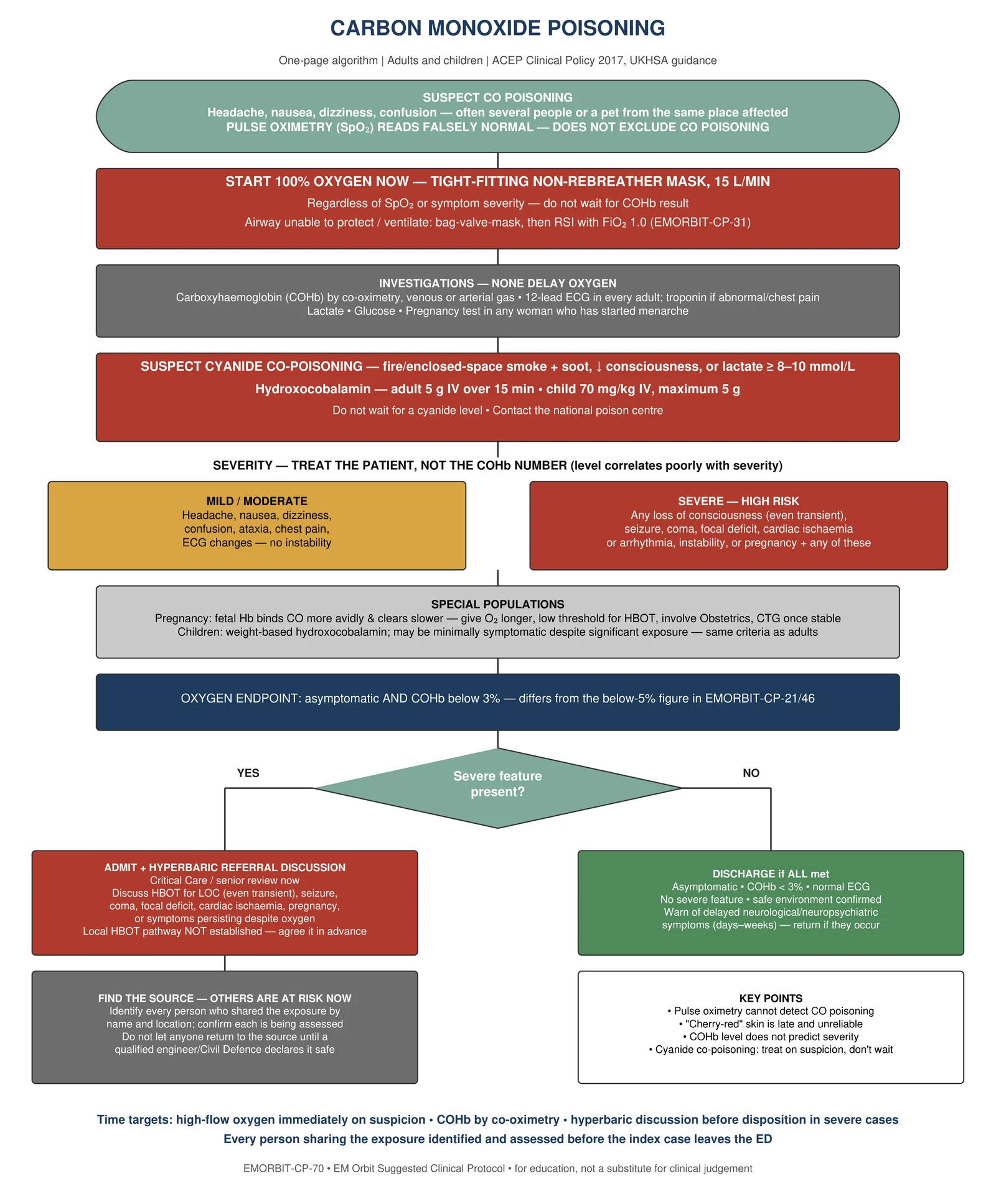
The one-page algorithm is shown at the top of this page.
6Team roles
6.1Triage/ED Nurse:
6.1.1 Recognize the non-specific presentation, ask specifically about a combustion source and about others exposed, and start high-flow oxygen under the approved standing order without waiting for physician review.
6.2ED Pharmacist:
6.2.1 Confirm hydroxocobalamin availability, weight-based paediatric dosing, and known assay interference (COHb, creatinine, and colorimetric tests) after its administration.
6.3Clinical Toxicology / Poisons Centre:
6.3.1 Provide advice for severe, pregnant, paediatric, or diagnostically uncertain cases and on the hyperbaric oxygen referral pathway.
6.4Critical Care / Anaesthesia:
6.4.1 Attend for coma, seizure, cardiac instability, or a patient requiring airway support; accept admissions meeting section 4.3.5 criteria.
6.5Obstetrics:
6.5.1 Review any pregnant patient with a significant exposure or a severe feature, and arrange cardiotocography once the mother is stable.
6.6Laboratory:
6.6.1 Process carboxyhaemoglobin by co-oximetry and troponin urgently, and report critical results to the treating team by telephone.
6.7Civil Defence / Public Health / Occupational Health:
6.7.1 Receive notification of a suspected environmental or appliance source and confirm the location is safe before the patient, or anyone else exposed, returns to it.
7The patient's role
7.1 Report the exposure source and every other person who was present, and help staff contact them so they can be assessed.
7.2 Do not return to the source location until it has been declared safe.
7.3 Report any new headache, memory or mood change, or other new symptom in the weeks after discharge, and attend the arranged follow-up.
8Definitions
8.1Carboxyhaemoglobin (COHb): the percentage of haemoglobin bound to carbon monoxide rather than oxygen, measured by co-oximetry; standard two-wavelength pulse oximetry cannot measure it.
8.2Co-oximetry: multi-wavelength blood gas analysis that distinguishes carboxyhaemoglobin and methaemoglobin from oxyhaemoglobin.
8.3Delayed Neurological/Neuropsychiatric Sequelae (DNS): new cognitive, motor, or psychiatric symptoms appearing days to weeks after apparently complete recovery from acute CO poisoning.
8.4Hyperbaric Oxygen Therapy (HBOT): treatment with 100% oxygen at greater than atmospheric pressure in a pressurized chamber; a referral from the ED, not delivered in the ED.
9Attachments
- Attachment 1: One-page algorithm (top of this page)
- Attachment 2: Oxygen, Hydroxocobalamin, and Hyperbaric Referral Quick Reference
11Suggested quality indicators
11.1Time to high-flow oxygen: (Number of patients with suspected CO poisoning who received high-flow oxygen within 15 minutes of arrival / Total number of such patients) × 100. Target ≥ 90%.
11.2COHb measured by co-oximetry: (Number of patients with suspected CO poisoning who had COHb measured by co-oximetry before disposition / Total number of such patients) × 100. Target ≥ 95%.
11.3Others-exposed identified: (Number of index cases with every other exposed person identified and their assessment status documented / Total number of index cases) × 100. Target 100%.
11.4Safe disposition: (Number of patients meeting a severe/high-risk criterion with a hyperbaric referral discussion or Critical Care/senior review documented before disposition / Total number of such patients) × 100. Target 100%.
11.5Outcome indicator (monitored, no fixed ED target): unplanned re-attendance within 30 days with a new neurological or neuropsychiatric symptom following CO poisoning.
13References
- Wolf SJ, Lavonas EJ, Sloan EP, Jagoda AS; American College of Emergency Physicians Clinical Policies Committee. Clinical policy: critical issues in the evaluation and management of adult patients presenting to the emergency department with acute carbon monoxide poisoning. Ann Emerg Med. 2017;69(1):98–107.e6.
- UK Health Security Agency. Carbon monoxide poisoning: guidance and management for healthcare professionals. London: UKHSA.
- Rose JJ, Wang L, Xu Q, et al. Carbon monoxide poisoning: pathogenesis, management, and future directions of therapy. Am J Respir Crit Care Med. 2017;195(5):596–606.
- Weaver LK, Hopkins RO, Chan KJ, et al. Hyperbaric oxygen for acute carbon monoxide poisoning. N Engl J Med. 2002;347(14):1057–1067.
- Buckley NA, Juurlink DN, Isbister G, Bennett MH, Lavonas EJ. Hyperbaric oxygen for carbon monoxide poisoning. Cochrane Database Syst Rev. 2011;(4):CD002041.
A2Attachment 2: Oxygen, Hydroxocobalamin, and Hyperbaric Referral Quick Reference
| Item | Value |
|---|---|
| Starting therapy | 100% oxygen by tight-fitting non-rebreather mask, 15 L/min (or highest available FiO₂), started immediately regardless of SpO₂ or symptom severity |
| Endpoint | Asymptomatic AND COHb below 3% — differs from the below-5% figure in EMORBIT-CP-21/EMORBIT-CP-46; unresolved, see section 4.3.2 |
| Airway compromise | Bag-valve-mask, then rapid sequence induction with FiO₂ 1.0 (EMORBIT-CP-31) |
| Pregnancy | Give oxygen for longer than the maternal endpoint suggests — fetal haemoglobin binds CO more avidly and clears it more slowly |
| Adult | Child | |
|---|---|---|
| Dose | 5 g intravenously over 15 minutes | 70 mg/kg intravenously, maximum 5 g |
As per EMORBIT-CP-21 and EMORBIT-CP-67. Do not wait for a cyanide level before treating.
| Refer for discussion where any of the following is present |
|---|
| Loss of consciousness at any point, even transient, or seizure or coma |
| Focal neurological deficit |
| Cardiac ischaemia or arrhythmia |
| Pregnancy with significant exposure or any severe feature |
| Symptoms persisting despite adequate normobaric oxygen |
Refer through the hospital's hyperbaric oxygen pathway where one exists.