Self-Harm and Suicide Risk Assessment in the Emergency Department
EMORBIT-CP-84 · Chapter 13 · Psychiatric and Behavioural Emergencies
Open in the appFree, works on your phone and offline, with every tool alongside.
Evidence base: NICE NG225 2022; ACEP
1Purpose
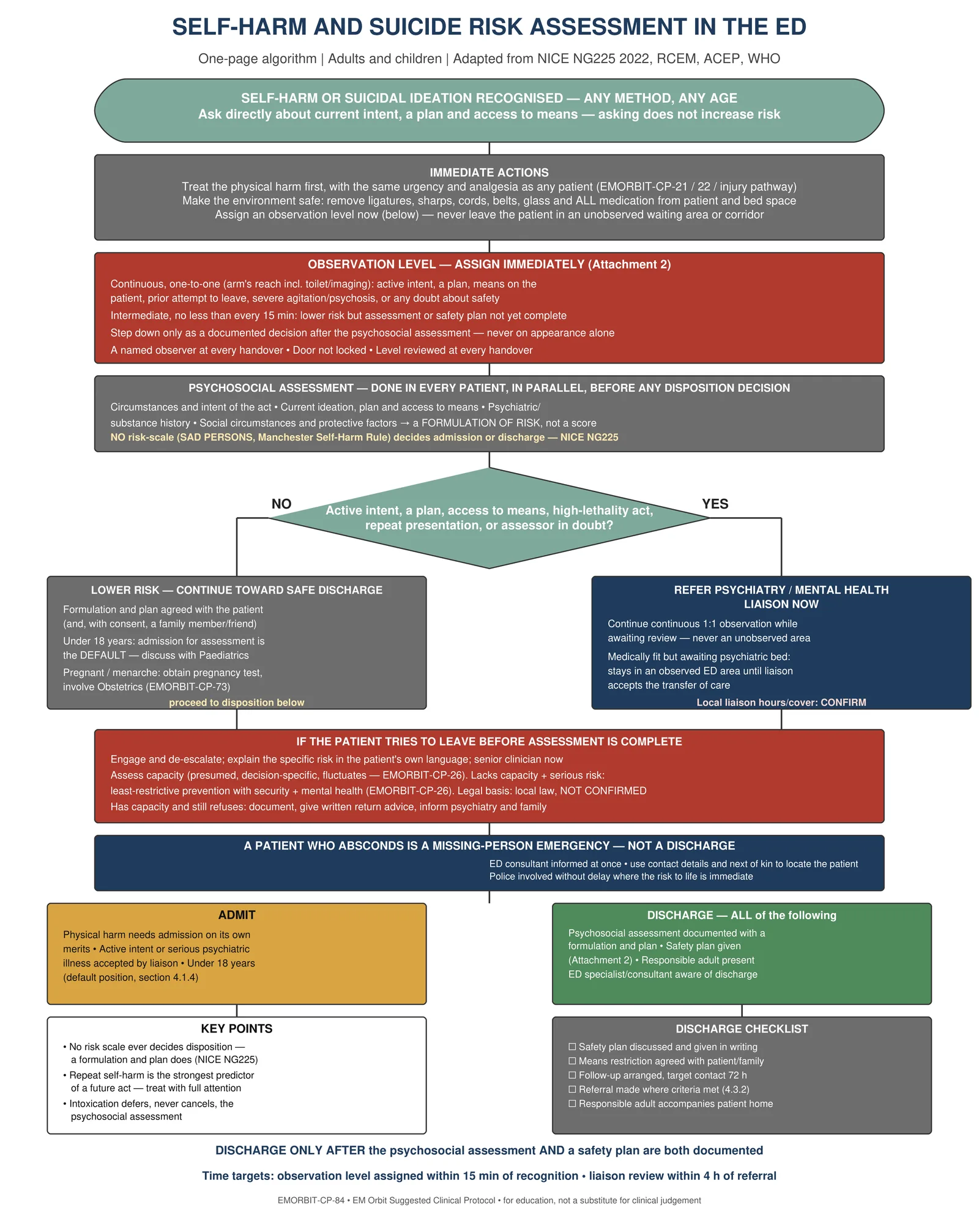
1.1 Provide a standardized, evidence-based framework for the immediate safety, physical treatment, psychosocial assessment, and safe disposition of patients of any age presenting to the Emergency Department (ED) after self-harm, or with suicidal ideation without an act.
1.2 Ensure the physical harm is treated first, with the same urgency, analgesia, and dignity as any other patient, and without judgement of the act.
1.3 Ensure that no risk-stratification tool or scale is used to predict future suicide or repetition of self-harm, or to decide who is offered assessment, admission, or discharge, in line with NICE NG225 (2022); a personalised, compassionate psychosocial assessment replaces it in every case.
1.4 Ensure a safe environment and an observation level are in place from the moment self-harm or suicidal intent is recognised, and that a patient who leaves before assessment is complete is treated as a missing-person emergency.
1.5 Ensure consistency of practice among all healthcare providers (HCP) and alignment with NICE NG225, the Royal College of Emergency Medicine (RCEM), the American College of Emergency Physicians (ACEP), and the World Health Organization (WHO).
2Who this protocol applies to
2.1 All patients of any age presenting to, or identified within, the ED after an act of self-harm by any method (self-poisoning, self-injury, attempted hanging or suffocation, jumping, or any other deliberate act of self-harm), regardless of the apparent severity of the act or the stated intent.
2.2 Patients presenting with suicidal ideation, a plan, or a stated intent to end their life, without a physical act.
2.3 Patients brought by ambulance, police, family, or who self-present, including those brought against their expressed wish.
2.4 Self-harm or a suicide attempt occurring while the patient is already an inpatient or an ED attender for another reason.
3Not covered by this protocol
3.1 Definitive physical treatment of the method used — poisoning (EMORBIT-CP-21), paracetamol overdose (EMORBIT-CP-22), specific wound or airway management — which is not restated here; this guideline covers recognition, the psychosocial assessment, safety, and disposition that run alongside it.
3.2 An injury with no element of intent to self-harm (a genuine accident), where the history is clear and consistent; if there is any doubt about intent, this guideline applies.
3.3 Ongoing psychiatric treatment, psychotherapy, and community follow-up beyond the ED assessment and referral, which are the responsibility of the mental health service.
3.4 Acute behavioural disturbance requiring rapid tranquillisation or restraint as the presenting problem without self-harm, which is managed under EMORBIT-CP-26; where both are present, both guidelines apply together (section 4.3.3).
4Protocol
4.1History and Assessment:
4.1.1Triage and Recognition:
4.1.1.1 Self-harm and suicidal ideation are recognised at triage and the patient is brought into the department without delay; a patient shall never wait in the general waiting area once self-harm or active suicidal intent is identified.
4.1.1.2 The physical harm is triaged and treated on its own clinical merit and acuity, exactly as it would be for any other cause; the fact that the injury is self-inflicted is never a reason to delay analgesia or treatment.
4.1.1.3 An observation level (Table 1) is assigned at the moment of recognition, before the psychosocial assessment begins, by the triage nurse or the first clinician to see the patient.
4.1.1.4 The immediate environment is made safe on recognition: remove or secure ligature points, cords, sharps, glass, belts, and all medications (the patient's own and any left at the bedside); this applies in the waiting area, the cubicle, the toilet, and during transfer for imaging.
4.1.1.5 Time zero for this guideline is the moment self-harm or suicidal intent is recognised; the time targets in section 11 run from that point.
4.1.2History (obtained with compassion, in the patient's own words where possible, and in parallel with physical treatment):
4.1.2.1 Method, timing, and the physical consequences of the act; for self-poisoning, take the full history required by EMORBIT-CP-21 and EMORBIT-CP-22 (not restated here).
4.1.2.2 The circumstances and degree of intent: planning, precautions against discovery, a note or message, final acts such as giving away possessions, the expectation and hoped-for outcome of the act, and the patient's feelings now about having survived.
4.1.2.3 Current suicidal ideation, plan, and access to means; hopelessness; and, separately, current self-harm intent, which may differ from suicidal intent.
4.1.2.4 Previous self-harm and previous suicide attempts — the strongest predictor of repetition — psychiatric history, current treatment and adherence, and alcohol or substance use.
4.1.2.5 Social circumstances: housing, employment, finances, relationships, recent loss or bereavement, isolation, dependants and whether they are safe, and any known safeguarding concern.
4.1.2.6 Protective factors and the patient's own view of what would help; ask directly rather than avoiding the subject — asking about suicide does not increase risk.
4.1.3Examination:
4.1.3.1 Physical examination and treatment follow the guideline for the method used (EMORBIT-CP-21, EMORBIT-CP-22, or the relevant injury pathway); it is not restated here.
4.1.3.2 A mental state examination is performed once the patient is able to engage: appearance and behaviour, speech, mood, thought content including suicidal and self-harm ideation, perception, cognition, and insight.
4.1.4Risk Stratification – Severity:
4.1.4.1 No risk-stratification tool or scale (including SAD PERSONS and the Manchester Self-Harm Rule) is used to predict future suicide or repetition of self-harm, or to decide who is admitted, referred, or discharged (NICE NG225). Any such scale in departmental use for this purpose is discontinued.
4.1.4.2 In place of a scale, every patient receives the structured, personalised psychosocial assessment in section 4.3.2, which produces a formulation of risk and an agreed plan rather than a number.
4.1.4.3 A scale may still be used descriptively to structure the history (for example, to prompt the questions above) but its score shall never appear in the record as the reason for a disposition decision.
4.1.5Differential Diagnosis:
4.1.5.1 Establish that the act was self-harm and not, or not only, an accident, and consider whether an acute psychiatric or organic disturbance (psychosis, delirium, intoxication) is driving the presentation; where behavioural disturbance dominates the picture, apply EMORBIT-CP-26 alongside this guideline.
4.1.5.2 A patient found after a suicide attempt who has a reduced level of consciousness is assessed for the medical cause first (hypoxia, hypoglycaemia, head injury, intoxication) before it is attributed to the act itself.
4.1.6Special Populations:
4.1.6.1 Under 18 years: every young person who has self-harmed is discussed with the paediatric team; admission for a period of assessment, rather than ED discharge, is the default. A parent or carer is involved unless doing so itself creates a safeguarding risk. Consider safeguarding per EMORBIT-CP-83 for every presentation and, especially, for a repeated one.
4.1.6.2 Pregnancy and any woman who has started menarche (regardless of age): the triage nurse does not perform the pregnancy test; the treating team asks "pregnant?" and "last period?" and obtains the test without delay (EMORBIT-CP-73). Involve Obstetrics for any pregnant or postpartum patient.
4.1.6.3 Older adults and patients with a serious physical illness: self-harm and suicidal ideation in this group carry a high risk of completed suicide and are never dismissed as an understandable reaction to illness without a full assessment.
4.1.6.4 Patients who self-harm repeatedly: treated with the same dignity, analgesia, and full assessment as a first presentation; repetition is not "attention-seeking" and is itself the strongest risk marker for a future completed act.
4.1.6.5 Intoxication: does not exclude, and does not defer, the physical treatment or the safety measures in section 4.3.1; the formal psychosocial assessment is completed once the patient can meaningfully engage, not abandoned.
4.2Investigations:
4.2.1 Investigations are directed by the method of self-harm and by any physical complaint; a psychiatric presentation alone does not require a fixed panel of blood tests.
4.2.2 Paracetamol and salicylate concentrations are taken in every patient after a deliberate overdose, regardless of the stated agent, per EMORBIT-CP-21 and EMORBIT-CP-22 (not restated here).
4.2.3 Capillary glucose in any patient with reduced consciousness or agitation; further investigation of an altered mental state follows EMORBIT-CP-46.
4.3Plan of Care:
4.3.1Immediate Actions:
4.3.1.1 Treat the physical harm first; the psychosocial assessment does not delay time-critical treatment, and time-critical treatment does not delay the safety measures in this section.
4.3.1.2 Confirm the observation level (Table 1) and the safe environment (section 4.1.1) are in place and documented before the patient is left in any area, including a corridor or the waiting room.
4.3.1.3 A responsible clinician introduces themselves, explains what will happen, and asks directly about current suicidal and self-harm intent; directness and compassion are not in conflict.
4.3.2Definitive ED Treatment — the Psychosocial Assessment:
4.3.2.1 Every patient who presents after self-harm, or with suicidal ideation, receives a documented psychosocial assessment before a disposition decision is made, irrespective of the medical severity of the act. An act described as "minor" or "not serious" is not a reason to omit it.
4.3.2.2The assessment shall record at least:
- The circumstances and degree of intent (section 4.1.2), and the patient's current suicidal and self-harm ideation, plan, and access to means.
- Psychiatric history, current treatment and adherence, alcohol and substance use, and previous self-harm.
- Social circumstances, protective factors, and the patient's own view of what would help.
- A formulation of risk in narrative form and an agreed plan, including safety planning (Attachment 2), rather than a numerical score.
4.3.2.3 Local availability, training, and out-of-hours cover of a psychiatric or mental health liaison service to perform or supervise this assessment varies between sites; where liaison is not immediately available, an ED physician trained in the assessment completes it and liaison is contacted for every case meeting the referral criteria below.
4.3.2.4Refer to the on-call psychiatry / mental health liaison service for:
- Active suicidal intent, a plan, or access to means.
- A serious psychiatric illness, or a presentation raising a new concern about one.
- An act of high lethality or high planning, regardless of the outcome.
- A repeated presentation, or any case where the assessing clinician has doubt.
4.3.3Escalation — the Patient Who Wants to Leave, and Capacity:
4.3.3.1 A patient who has capacity may decline assessment or treatment; capacity is presumed, is decision-specific, and frequently fluctuates with intoxication, injury, or acute distress — assess and document it in relation to the decision at hand, per the capacity framework in EMORBIT-CP-26 (not restated here).
4.3.3.2 Do not allow the patient to simply walk out. Engage and de-escalate; explain the specific risk in plain language and the patient's own language; involve a senior clinician immediately.
4.3.3.3 Where the patient lacks capacity and faces a serious risk of harm, they are prevented from leaving using the least restrictive means, with security and mental health input, following the doctrine-of-necessity and restraint framework set out in EMORBIT-CP-26. The lawful basis for detaining or restraining a patient is set by the applicable mental health law — check hospital policy and national law; do not invent it.
4.3.3.4 Where the patient has capacity and still refuses, document the assessment, the information given, and the refusal; give written return advice; and inform psychiatry and, with consent, the family.
4.3.3.5 A patient who absconds after presenting with self-harm or suicidal intent is a missing-person emergency, not an administrative discharge. The ED consultant is informed immediately; security, the contact details on file, the next of kin, and — where the risk to life is immediate — the police, are used to attempt to locate the patient without delay.
4.3.4Monitoring and Reassessment:
4.3.4.1 The observation level (Table 1) is reviewed at every nursing handover and whenever the patient's presentation changes; it is stepped down only as a documented clinical decision after the psychosocial assessment, never on appearance alone.
4.3.4.2 Capacity is reassessed whenever a new decision arises (for example, to accept treatment, or to leave), because it can change as intoxication resolves or distress settles.
4.3.5Disposition:
4.3.5.1Admission (medical, paediatric, or psychiatric bed as clinically indicated):
- The physical harm requires admission on its own merits, per the relevant guideline.
- Active suicidal intent, a serious psychiatric illness, or any case accepted by psychiatry / mental health liaison for admission.
- Under 18 years (section 4.1.4, default position).
4.3.5.2 Discharge from the ED requires ALL of the following: the physical treatment and its minimum observation period are complete; the psychosocial assessment (section 4.3.2) is documented with a formulation of risk and an agreed plan; a safety plan (Attachment 2) has been discussed and given; referral has been made where the criteria above are met; and discharge is by, or after discussion with, an ED specialist or consultant.
4.3.5.3 A patient who is medically fit but awaiting psychiatric admission remains in a safe, observed area of the ED with the appropriate observation level until the mental health team accepts the transfer; they are never moved to an unobserved waiting area.
4.3.6Discharge and Follow-up:
4.3.6.1Safety planning (Attachment 2) is offered to every patient discharged after self-harm or suicidal ideation and covers:
- Personal warning signs of a crisis, and internal coping strategies the patient can use alone.
- People and social settings that provide distraction, and people the patient can ask directly for help.
- Professionals and services to contact, including an emergency route back to the ED.
- Means restriction: reducing access to medication, sharps, or other means at home, and involving a family member or friend to hold them where possible.
4.3.6.2 Follow-up with community mental health or the referral pathway agreed with psychiatry / mental health liaison is arranged before discharge, with a target of contact within 72 hours. Give the crisis-line or rapid-access contact details where one is available.
4.3.6.3 A responsible adult accompanies the patient home wherever possible, and the discharge conversation includes both the patient and, with consent, the accompanying adult.
4.3.7Documentation and Reporting:
4.3.7.1 Document: the method and time of self-harm, the observation level assigned and its reviews, the psychosocial assessment and formulation of risk, capacity assessments, any referral and its outcome, the safety plan given, and the disposition decision and who authorised it.
4.3.7.2 Self-harm presentations are captured for the departmental audit (section 11) and, where a safeguarding concern is identified, for the safeguarding pathway (EMORBIT-CP-83).
5Algorithm
The one-page algorithm is shown at the top of this page.
6Team roles
6.1Triage and ED Nurses Role:
6.1.1 Recognise self-harm or suicidal intent at triage, bring the patient into the department without delay, assign the observation level (Table 1), and make the immediate environment safe.
6.1.2 Maintain and document the assigned observation level at every check and handover; escalate any change in presentation immediately.
6.2Psychiatry / Mental Health Liaison Service:
6.2.1 Perform or supervise the psychosocial assessment per the referral criteria in section 4.3.2; advise on capacity, safety planning, and disposition; accept transfer of care for patients requiring psychiatric admission without delay.
6.3Security:
6.3.1 Support the safe-environment and observation measures under the direction of the treating clinician; assist immediately if a patient at risk attempts to leave, per EMORBIT-CP-26.
6.4Social Worker / Safeguarding Lead:
6.4.1 Receive referrals for any patient under 18 years, any dependent adult concern, or any repeated presentation; support family engagement and the safety plan.
6.5Ambulance / Pre-hospital Providers:
6.5.1 Pre-alert the ED for any patient with active suicidal intent or a serious act of self-harm; hand over the method, any pre-hospital treatment, and current mental state.
7The patient's role
7.1 Tell the treating team about current thoughts of suicide or self-harm, a plan, or access to means, even if this feels difficult; asking and answering honestly does not make things worse.
7.2 Take part in the psychosocial assessment and the safety plan, and say what has helped in the past and what the patient feels would help now.
7.3 Return to the ED, or use the agreed crisis contact, immediately if thoughts of suicide or self-harm return or intensify.
7.4 Where possible, allow a family member or friend to be involved in the safety plan and in holding access to means.
8Definitions
8.1Self-Harm: any act of deliberate self-poisoning or self-injury, irrespective of the apparent motivation or the degree of suicidal intent (NICE NG225).
8.2Suicidal Ideation: thoughts of ending one's own life, ranging from passive wishes to be dead to an active plan and intent.
8.3Psychosocial Assessment: a structured, personalised, and compassionate assessment of the circumstances, intent, psychiatric and social factors, and protective factors surrounding an act of self-harm or suicidal ideation, producing a formulation of risk and an agreed plan (section 4.3.2).
8.4Safety Plan: a brief, collaborative, written intervention identifying warning signs, coping strategies, sources of support, and means restriction, given in place of, not in addition to, a numerical risk score (Stanley and Brown, 2012).
8.5Capacity: the ability, at the time of a particular decision, to understand the relevant information, retain it, weigh it, and communicate a choice; assessed per the framework in EMORBIT-CP-26.
9Attachments
- Attachment 1: One-page algorithm (top of this page)
- Attachment 2: Observation Levels and Safety Planning Quick Reference
11Suggested quality indicators
11.1Time to observation level assignment: (Number of self-harm/suicidal-ideation patients with an observation level documented within 15 minutes of recognition / Total number of such patients) × 100. Target ≥ 90%.
11.2Time to psychiatry / mental health liaison review for referred patients: (Number of patients meeting the referral criteria reviewed within 4 hours of referral / Total number referred) × 100. Target ≥ 90%.
11.3Psychosocial assessment completed before disposition: (Number of self-harm patients with a documented psychosocial assessment before the disposition decision / Total number of self-harm presentations) × 100. Target 100%.
11.4No risk-scale score used as the basis for discharge: (Number of discharge decisions with no risk-stratification score recorded as the reason for discharge / Total number of discharge decisions after self-harm) × 100. Target 100%.
11.5Safety plan given at discharge: (Number of patients discharged after self-harm or suicidal ideation with a documented safety plan / Total number discharged) × 100. Target ≥ 90%.
11.6Repeat self-harm presentation within 72 hours: (Number of patients re-attending with repeat self-harm within 72 hours of discharge / Total number discharged after self-harm) × 100. Monitored as an outcome indicator.
13References
- National Institute for Health and Care Excellence. Self-harm: assessment, management and preventing recurrence. NICE guideline NG225; 2022.
- Royal College of Emergency Medicine. Mental Health Toolkit for Emergency Departments. London: RCEM.
- American College of Emergency Physicians. Clinical Policy: Critical Issues in the Diagnosis and Management of the Adult Psychiatric Patient in the Emergency Department. 2017.
- World Health Organization. Preventing Suicide: A Global Imperative. Geneva: WHO; 2014.
- Stanley B, Brown GK. Safety planning intervention: a brief intervention to mitigate suicide risk. Cogn Behav Pract. 2012;19(2):256–264.
A2Attachment 2: Observation Levels and Safety Planning Quick Reference
| Level | Assign when | What it requires |
|---|---|---|
| Continuous, one-to-one | Active suicidal intent, a stated plan, or means still on the patient; a serious or high-lethality method; the patient has already tried to leave or abscond; severe agitation or psychosis; or any doubt about immediate safety. | A named observer within arm's reach at all times, including in the toilet, in imaging, and during transfer. Ligatures, sharps, medications, belts, glass and other means are removed from the patient and the bed space. The door is not locked. The observer is named at every handover. |
| Intermittent, close (no less than every 15 minutes) | Risk is lower than continuous but the psychosocial assessment is not yet complete, or the safety plan is not yet agreed. | Checked and sighted no less often than every 15 minutes; clear sightlines maintained; the bed space checked for hazards at the start of the level; each check timed and recorded. |
| General ward-level observation | The psychosocial assessment and safety plan are complete and no acute risk feature remains. | Standard ward observation. The level is only stepped down after the assessment in section 4.3.2, never on the strength of the patient's appearance alone. |
The level is set at recognition (section 4.1.1), reviewed at every nursing handover, and never left at the default level of the bay the patient happens to occupy. Stepping down a level is a documented clinical decision, not an administrative one.
1Safety planning intervention — discuss and give in writing before every discharge:
- Personal warning signs of a developing crisis, and internal coping strategies the patient can use alone.
- People and social settings that provide distraction; people the patient can contact directly for help.
- Professionals and services to contact, including how to return to the ED urgently.
- Means restriction agreed with the patient (and, where possible, a family member or friend): reducing access to medication, sharps or other means at home.