Paracetamol Poisoning in the Emergency Department
EMORBIT-CP-22 · Chapter 10 · Toxicological and Environmental Emergencies
Open in the appFree, works on your phone and offline, with every tool alongside.
Evidence base: MHRA/TOXBASE 2023; ANZ Guideline 2020; ACMT
1Purpose
1.1 Provide a standardized, evidence-based framework for the risk assessment, antidote treatment, monitoring and safe disposition of patients of all ages who present to the Emergency Department (ED) after ingesting paracetamol (acetaminophen), whether by deliberate self-poisoning, by staggered ingestion, or by therapeutic excess.
1.2 Recognise that paracetamol is the commonest agent in significant overdose, that the poisoned patient is characteristically asymptomatic and normal-looking during the first 24 hours, and that the antidote is reliably effective only when it is started early. The diagnosis and the treatment decision are therefore made on the ingested dose, the time since ingestion, and the measured plasma concentration — never on how well the patient appears.
1.3 Ensure that the ingestion is correctly classified as an acute single ingestion, a staggered ingestion, or an ingestion at an unknown time, because each of the three carries a different rule and the commonest serious error in this pathway is applying the acute-ingestion treatment line to an ingestion for which it is invalid.
1.4 Ensure that intravenous acetylcysteine is started within 8 hours of ingestion in every patient who meets the criteria, and that it is started without waiting for a plasma concentration in the situations in which waiting would cause that target to be missed.
1.5 Ensure that an anaphylactoid reaction to acetylcysteine — which is common, is not an allergy, and is not a reason to abandon the antidote — is managed by slowing or interrupting the infusion and giving an antihistamine, and that the full 300 mg/kg course is nevertheless completed.
1.6 Ensure that every patient has end-of-infusion bloods taken and interpreted before the infusion is stopped, that developing hepatotoxicity is recognised, and that patients requiring a specialist liver unit are referred on the early indicators rather than when the King’s College transplantation criteria are already met.
1.7 Ensure that every patient who has taken paracetamol with intent to self-harm receives a psychosocial assessment before leaving the department, in accordance with the local mental health pathway and NICE NG225.
1.8 Ensure consistency of practice among all healthcare providers (HCP) — triage nurses, ED physicians, clinical pharmacists, clinical toxicology, hepatology, laboratory and mental health services — and alignment with the United Kingdom Medicines and Healthcare products Regulatory Agency (MHRA) and National Poisons Information Service (TOXBASE) guidance, the Australian and New Zealand clinical guideline (2020), the American College of Medical Toxicology (ACMT), and the Royal College of Emergency Medicine (RCEM) standards.
2Who this protocol applies to
2.1 All patients of any age presenting to, or developing within, the ED after ingestion of paracetamol in a quantity exceeding the licensed daily dose, whether taken with intent to self-harm, with therapeutic intent, or accidentally.
2.2 Patients reporting ingestion of a combination preparation containing paracetamol (for example paracetamol with codeine, tramadol, caffeine, or a cold-and-flu compound), including those who did not know the preparation contained paracetamol.
2.3 Patients with an ingestion of paracetamol at an unknown or unreliable time, including those found collapsed, intoxicated, or with an empty container beside them.
2.4 Patients presenting with staggered ingestion — the total taken over a period of more than one hour — including those who have been taking repeated supratherapeutic doses over days.
2.5 Patients presenting late, including more than 24 hours after ingestion, and patients presenting with jaundice, coagulopathy, encephalopathy or acute liver failure in whom paracetamol is a possible cause.
2.6 Patients who have received a tenfold or other dosing error with intravenous paracetamol, including neonates and infants.
2.7 Pregnant patients who have taken paracetamol in overdose, at any gestation.
3Not covered by this protocol
3.1 Patients taking paracetamol within the licensed dose (adults not more than 4 g in 24 hours; children not more than 75 mg/kg in 24 hours) with no features of toxicity and no suggestion that the stated dose is inaccurate.
3.2 Poisoning by other agents without paracetamol co-ingestion; these are managed per EMORBIT-CP-21 (General Approach to the Poisoned Patient) and the relevant agent-specific guideline. Where paracetamol co-ingestion cannot be excluded, this guideline applies.
3.3 Chronic liver disease, alcoholic hepatitis, viral hepatitis, drug-induced liver injury from other agents, and non-paracetamol acute liver failure, except where paracetamol is a contributing cause.
3.4 The inpatient management of established acute liver failure, liver transplantation assessment and listing, and extracorporeal liver support, which are the responsibility of the receiving hepatology and transplantation service. This guideline covers the ED phase and the decision to refer.
3.5 The ongoing psychiatric management of self-harm beyond the ED psychosocial assessment and referral, which is covered by the local mental health pathway.
4Protocol
4.1History and Assessment:
4.1.1Triage and Recognition:
4.1.1.1 Any patient stating or suspected to have taken an overdose of paracetamol shall be triaged as Category 2 (very urgent) or higher, irrespective of how well the patient looks, and shall be seen by an ED physician within 15 minutes of triage.
4.1.1.2 A patient with reduced consciousness, respiratory depression, hypotension, seizure, or hypoglycaemia after any overdose shall be triaged Category 1 and taken directly to the resuscitation area; airway, breathing and circulation are managed per EMORBIT-CP-21 before the paracetamol-specific pathway is applied.
4.1.1.3 The normal appearance of the patient shall never be used to down-triage or to defer assessment. Almost every patient who later dies of paracetamol-induced liver failure looked entirely well in the ED.
4.1.1.4 The triage nurse shall record, at the point of triage and in the triage note: (a) the name and strength of every preparation taken, (b) the total number of tablets or millilitres, (c) the time the first tablet was taken and the time the last tablet was taken, (d) the patient’s weight, and (e) any co-ingestant including alcohol. These five items determine the entire pathway.
4.1.1.5 The triage nurse shall calculate and record the time at which a 4-hour paracetamol concentration becomes valid (time of ingestion plus 4 hours) and shall flag it in the record, so that the sample is neither taken too early nor forgotten.
4.1.1.6 Any container, blister pack, ambulance record or note brought with the patient shall be retained and shown to the treating physician; tablets shall be counted where a count is possible.
4.1.1.7 Patients who have taken an overdose shall not be left unobserved, shall be nursed in a visible area, and shall have removal of any remaining medication and of ligature risks in accordance with the departmental self-harm observation standard.
4.1.2History (taken in parallel with the initial blood sampling, and never allowed to delay acetylcysteine where treatment is already indicated):
4.1.2.1 What: every preparation taken, by brand and by strength. Paracetamol is present in a very large number of over-the-counter compounds; the patient may not know. Ask specifically about cold-and-flu sachets, combination analgesics, and paediatric suspensions.
4.1.2.2 How much: the total quantity, converted to milligrams and to milligrams per kilogram of actual body weight. The weight shall be measured, not estimated, wherever the patient can stand on a scale.
4.1.2.3 When: the time the first tablet was taken and the time the last tablet was taken. The interval between these two times is what distinguishes an acute ingestion from a staggered ingestion and is the single most important question in the history.
4.1.2.4 Over what period, and how many days: whether the ingestion was a single event or repeated over days, and whether the patient has been exceeding the licensed dose for pain in the days before presentation.
4.1.2.5 Why: self-harm intent, therapeutic intent, accidental or exploratory ingestion in a child, or a dosing error. Intent does not change the antidote, but it changes the disposition and the psychosocial pathway.
4.1.2.6 Co-ingestants: other medicines, alcohol, and recreational drugs, with quantities and times. Opioid, salicylate, tricyclic and anticholinergic co-ingestion change the resuscitation and are managed per EMORBIT-CP-21.
4.1.2.7 Vomiting: whether the patient has vomited, when, and whether tablets were seen. Vomiting does not permit the pathway to be abandoned.
4.1.2.8 Background: regular medication (including enzyme-inducing drugs and anticoagulants), alcohol use, weight loss or an eating disorder, chronic liver disease, pregnancy and last menstrual period, previous overdose and previous self-harm, current mental health care, and social circumstances.
4.1.2.9 Collateral history shall be actively sought from ambulance crew, family, flatmates and the electronic health record whenever the patient is drowsy, intoxicated, or gives an account that does not hold together. A collateral history that contradicts the patient shall be acted upon.
4.1.3Examination:
4.1.3.1 Perform a structured ABCDE assessment and record a full set of observations, including capillary blood glucose in every patient and a temperature.
4.1.3.2 Expect the examination to be normal. In the first 24 hours the only findings are usually nausea, vomiting, pallor, sweating and malaise. A normal examination excludes nothing and shall be documented as such. The clinical course of untreated poisoning is set out in Table 1, and is the reason the treatment decision is made on the dose, the timing and the concentration rather than on the examination.
Table 1: The clinical course of untreated paracetamol poisoning — the reason the diagnosis is made on the concentration and the timing, not on how the patient looks Phase Time after ingestion Findings I 0 to 24 hours Asymptomatic, or nausea, vomiting, pallor, malaise and sweating only. Vital signs and level of consciousness are normal. Liver function tests and INR are normal. A well-looking patient in this phase may still be facing fatal liver failure, and this is the phase in which almost every ED presentation occurs and in which the antidote works. II 24 to 72 hours Right upper quadrant pain and tenderness, hepatomegaly, continued vomiting. ALT begins to rise, then rises steeply; INR begins to rise; oliguria and a rising creatinine may appear. III 72 to 96 hours Peak hepatotoxicity. Jaundice, encephalopathy, coagulopathy, hypoglycaemia, lactic acidosis, acute kidney injury, and multi-organ failure. ALT may exceed 10 000 U/L. Death from fulminant hepatic failure occurs in this window. IV 4 days to 2 weeks Either complete resolution with normal liver architecture in survivors, or progression to death or liver transplantation. Two exceptions to the asymptomatic first phase shall be recognised. Massive overdose (30 g or more) can present within hours with reduced consciousness, lactic acidosis and hypoglycaemia caused by mitochondrial inhibition, before any transaminase rise. Co-ingestants — opioids, salicylate, ethanol, tricyclic antidepressants and the many combination preparations containing paracetamol — may dominate the early picture and must be actively sought (EMORBIT-CP-21).
4.1.3.3 Examine specifically for right upper quadrant tenderness and hepatomegaly (phase II), jaundice (phase III), bruising and bleeding, and for any degree of encephalopathy — inattention, drowsiness, agitation, inversion of the sleep–wake cycle, or asterixis.
4.1.3.4 Examine for features of a co-ingestant toxidrome: pinpoint pupils and respiratory depression (opioid), tachycardia with dry flushed skin and delirium (anticholinergic), hyperthermia with clonus (serotonergic), tinnitus with hyperventilation (salicylate).
4.1.3.5 Examine for evidence of self-harm — wounds, ligature marks, injection sites — and for signs of chronic alcohol use or malnutrition.
4.1.3.6 Document the Glasgow Coma Scale by its three components. A reduced conscious level shortly after a paracetamol ingestion is not caused by paracetamol unless the overdose is massive; look for another cause.
4.1.4Classification of the Ingestion, and Risk Stratification:
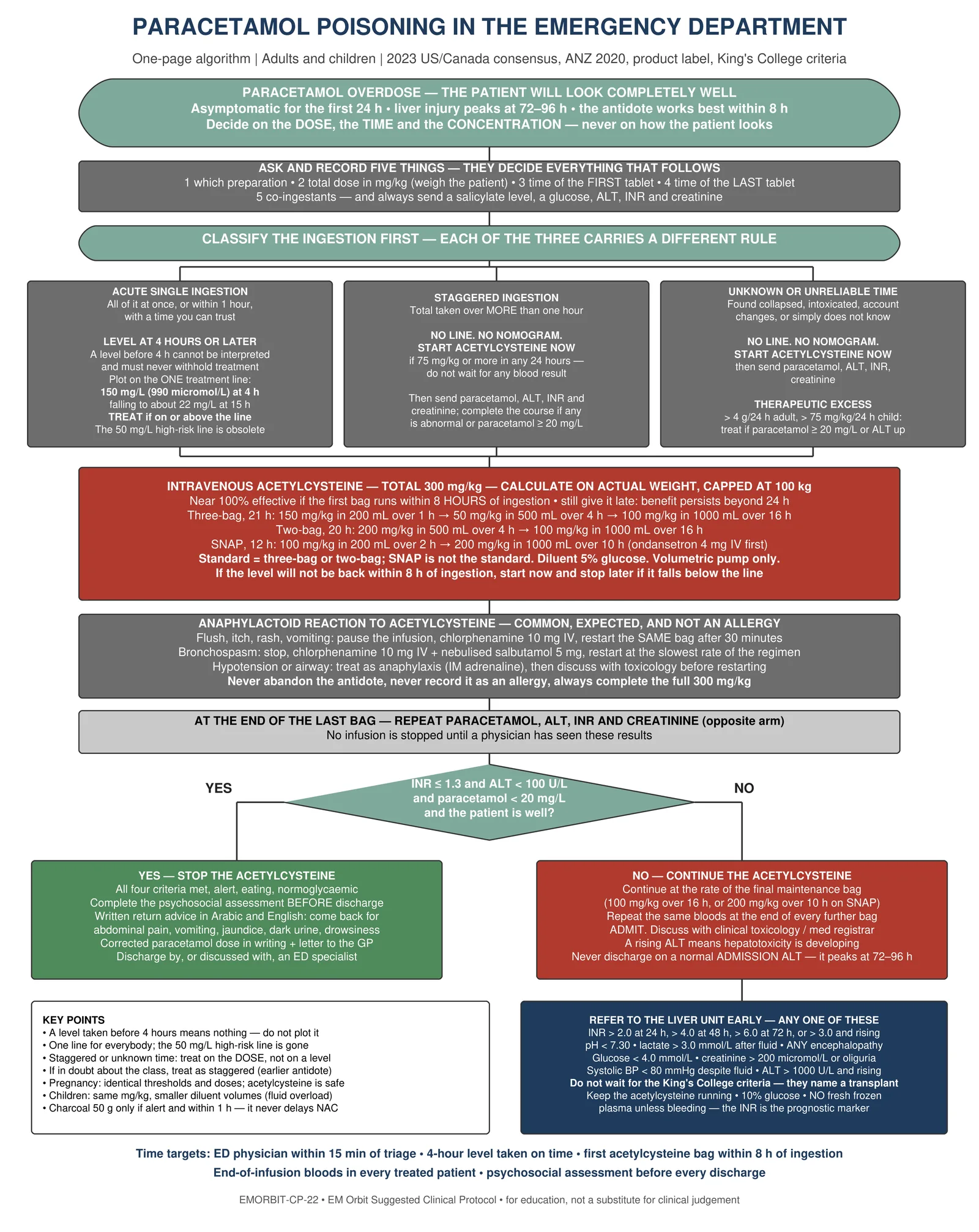
4.1.4.1 The ingestion shall be classified before any treatment decision is made. The classification, not the patient’s appearance, determines which rule applies. The three classes and the rule attached to each are set out in Table 2; the dose thresholds are in Table 3; the clinical course that explains why the timing matters is in Table 1.
4.1.4.2Acute single ingestion: the whole quantity taken at one time or within a period of one hour or less, at a time the patient or a witness can state with confidence. This is the only class in which a plasma paracetamol concentration can be plotted against a treatment line (4.3.3).
Table 2: Classification of the ingestion — this single decision determines which rule applies Type of ingestion Definition Rule that applies Acute single ingestion The whole quantity taken at one time, or all of it taken within a period of one hour or less, with a time of ingestion the patient or a witness can state with confidence. A paracetamol concentration taken at or after 4 hours from ingestion is plotted against the single treatment line of 150 mg/L at 4 hours (Table 4). Treat if the concentration is on or above the line. A concentration taken before 4 hours cannot be interpreted. Staggered ingestion The total quantity taken over a period of more than one hour, in two or more separate amounts, with the intention of self-harm. The treatment line cannot be used. Start acetylcysteine without waiting for any result in anyone who has ingested 75 mg/kg or more in any 24-hour period (4.3.4). Ingestion at an unknown or uncertain time The patient cannot state when the tablets were taken, the history is not reliable (intoxication, confusion, reduced consciousness), or the account changes. The treatment line cannot be used. Treat as a staggered ingestion: start acetylcysteine, then take paracetamol concentration, alanine aminotransferase (ALT), international normalised ratio (INR) and creatinine, and use them to decide whether to continue (4.3.4). Therapeutic excess Ingestion of more than the licensed daily dose with therapeutic intent (pain or fever), not with intent to self-harm — typically an adult exceeding 4 g in 24 hours, or a child exceeding 75 mg/kg in 24 hours. Take paracetamol concentration, ALT, INR and creatinine on arrival. Treat if the paracetamol concentration is 20 mg/L or above, or if the ALT is above the laboratory reference range, or if the patient is symptomatic (4.3.5). A history obtained from a patient after self-poisoning is unreliable in both directions. Where the type of ingestion cannot be established with confidence, the patient shall be managed by the pathway that gives the earlier acetylcysteine — that is, as a staggered ingestion — and the decision reviewed when collateral information becomes available.
4.1.4.3Staggered ingestion: the total taken over a period of more than one hour. The plasma concentration reflects the last tablet and not the total dose absorbed, so no line and no nomogram is valid. Treatment is decided on the ingested dose and on the presence of any abnormality in ALT, INR or the paracetamol concentration (4.3.4).
4.1.4.4Ingestion at an unknown or uncertain time: including the patient found collapsed or intoxicated, the patient whose account changes, and the patient who genuinely does not know. The concentration cannot be plotted because there is no valid x-axis. These patients are treated as staggered ingestions (4.3.4).
4.1.4.5Therapeutic excess: ingestion of more than the licensed daily dose with therapeutic intent, most often an older patient taking paracetamol for chronic pain, or a child given an adult preparation or a double dose by two carers. Managed per 4.3.5.
Table 3: Treatment thresholds by total ingested dose (use actual body weight; for patients weighing more than 100 kg use 100 kg for every calculation) Total dose ingested Acute single ingestion (all within 1 hour) Staggered ingestion, unknown time, or presentation after 8 hours Less than 75 mg/kg in 24 hours Hepatotoxicity is very unlikely. In deliberate self-poisoning a concentration shall still be taken at 4 hours or later, because the stated dose is unreliable. No acetylcysteine on dose grounds. Take a paracetamol concentration, ALT and INR if the history is uncertain or the patient is symptomatic. 75 mg/kg or more in 24 hours (approximately 10 × 500 mg tablets in a 70 kg adult) Take a paracetamol concentration at 4 hours or later and plot it on the 150 mg/L line (Table 4). Treat if on or above the line. Start acetylcysteine immediately, before any blood result. Then take paracetamol concentration, ALT, INR and creatinine to decide whether to complete the course. 150 mg/kg or more, or 12 g or more, whichever is the smaller Substantial risk. If the paracetamol concentration cannot be resulted and acted upon within 8 hours of ingestion, start acetylcysteine now and stop it if the concentration later falls below the line and the patient is well. Start acetylcysteine immediately and complete the full course. Do not wait for any result. 30 g or more, or 500 mg/kg or more (or a concentration more than twice the treatment line) Massive overdose. Start acetylcysteine immediately, discuss with clinical toxicology, and consider an increased-dose regimen (4.3.9). Take a venous gas with lactate and a glucose. Massive overdose. As for the acute column; these patients may develop early coma, lactic acidosis and hypoglycaemia before any transaminase rise. Thresholds are expressed per 24-hour period. The adult maximum licensed dose is 4 g (8 × 500 mg tablets) in 24 hours; the paediatric maximum licensed dose is 75 mg/kg in 24 hours (lower in neonates and infants under 3 months). Where the ingested dose is genuinely unknown, the patient shall be treated as though the threshold had been exceeded until a concentration and liver profile prove otherwise.
4.1.4.6Risk factors formerly thought to lower the treatment threshold: chronic alcohol excess, malnutrition, anorexia nervosa and other eating disorders, cachexia, human immunodeficiency virus infection, cystic fibrosis, and the enzyme-inducing drugs (carbamazepine, phenytoin, phenobarbital, primidone, rifampicin, and St John’s wort) were formerly used to select a lower, "high-risk" treatment line of 50 mg/L at 4 hours. That high-risk line no longer exists. Every patient is now treated on the single 150 mg/L line (2023 US/Canada consensus; also used in Australia and New Zealand), which does not change for these groups. These factors shall therefore not be used to lower the line, and equally shall not be used to raise it — a patient without any of them is treated on exactly the same line as a patient with all of them. The factors remain clinically relevant in two ways: they make hepatotoxicity more likely at a given concentration, and so support a lower threshold for admission, for repeating the liver profile, and for early discussion with clinical toxicology.
4.1.4.7Features that mark the patient out as high risk irrespective of the numbers:
- Massive overdose: 30 g or more, 500 mg/kg or more, or a measured concentration more than twice the treatment line.
- Presentation more than 8 hours after ingestion — the point beyond which the antidote is no longer near-completely protective.
- Any abnormality of ALT, INR, bicarbonate, lactate, creatinine or glucose on arrival.
- Vomiting that prevents oral intake, or reduced consciousness.
- Pre-existing liver disease, pregnancy, extremes of age, or significant co-ingestion.
- A patient who will not, or cannot, remain for the full course of treatment.
4.1.5Differential Diagnosis:
4.1.5.1 Of the ingestion itself: a combination preparation in which the patient reports only the non-paracetamol component; deliberate misreporting of the agent or the quantity; an ingestion of a modified-release paracetamol preparation, in which absorption is prolonged and a single concentration below the line does not exclude toxicity (discuss with clinical toxicology and take a second concentration 4 hours after the first).
4.1.5.2 Of the abnormal liver profile: viral hepatitis, alcoholic hepatitis, ischaemic hepatitis after shock or cardiac arrest, other drug-induced liver injury (including herbal and traditional remedies and anti-tuberculous therapy), Budd–Chiari syndrome, autoimmune hepatitis, Wilson disease, and acute fatty liver of pregnancy or HELLP syndrome in a pregnant patient.
4.1.5.3 Of the unwell overdose patient with a normal paracetamol concentration: salicylate, iron, colchicine, amanita mushroom, and toxic alcohol poisoning, and non-toxicological causes including sepsis and intracranial pathology.
4.1.5.4 Of the raised lactate and acidosis in the first hours: massive paracetamol overdose causes mitochondrial inhibition with coma and lactic acidosis before any transaminase rise, and shall not be mistaken for a co-ingestant or for sepsis.
4.1.6Special Populations:
4.1.6.1Children: exploratory ingestion by a child under 6 years is common and is rarely of a toxic quantity, because a small child cannot swallow many tablets; deliberate overdose in an adolescent is treated exactly as in an adult. The treatment line, the thresholds in milligrams per kilogram, and the acetylcysteine dose in milligrams per kilogram are identical to the adult values; only the dilution volumes change (Table 8). Liquid preparations are the specific hazard in this group: paracetamol oral suspension is supplied as 120 mg in 5 mL and as 250 mg in 5 mL, and a carer who uses the wrong strength or who gives the dose twice can produce a therapeutic excess very easily. Ask which bottle was used, and ask to see it. Every paediatric overdose requires a safeguarding assessment and paediatric review; an ingestion in a child under 12 months, a repeated ingestion, or an account that does not fit the child’s developmental stage shall prompt a child protection referral.
4.1.6.2Pregnancy: paracetamol is the commonest agent in overdose in pregnancy. Management is exactly the same as in the non-pregnant patient — the same thresholds, the same treatment line, the same acetylcysteine regimen, calculated on the patient’s actual current weight. Acetylcysteine is safe in pregnancy, crosses the placenta, and protects the fetal liver; it shall never be withheld or delayed on account of the pregnancy. Paracetamol itself crosses the placenta and the fetus can suffer hepatotoxicity. Notify Obstetrics at the time of the decision to treat; perform cardiotocography if the gestation is viable and once the mother is stable; and involve the obstetric and neonatal teams early where liver injury develops. The psychosocial assessment shall include the pregnancy and, where relevant, the perinatal mental health service.
4.1.6.3The patient on long-term paracetamol: an older, frail, or low-weight patient taking paracetamol regularly for chronic pain may exceed 75 mg/kg in 24 hours on a standard 1 g four-times-daily prescription — a 45 kg patient taking 4 g daily is receiving 89 mg/kg per day. Managed as therapeutic excess (4.3.5). The discharge plan shall include a corrected paracetamol prescription (reduced dose for low body weight) and communication of that change to the primary care physician.
4.1.6.4The patient with chronic liver disease or heavy alcohol use: treated on the same line and with the same regimen. Admission and a repeat liver profile shall be considered at a lower threshold, and clinical toxicology involved earlier.
4.1.6.5The patient with reduced consciousness or a protected airway: the paracetamol pathway continues in parallel with airway management. Activated charcoal shall not be given to an unprotected airway. Take the paracetamol concentration and the liver profile as part of the standard unconscious-poisoning screen (EMORBIT-CP-21).
4.1.6.6Intravenous paracetamol dosing errors: tenfold errors occur in neonates, infants and low-weight adults where the dose is calculated in milligrams but the volume is drawn as though for a 50 kg patient. Intravenous administration bypasses first-pass metabolism, so the plasma concentration peaks immediately and the treatment line does not apply. Treat on the dose alone: start acetylcysteine for any error delivering 75 mg/kg or more as a single dose, or 150 mg/kg or more in 24 hours, and discuss every case with clinical toxicology and Clinical Pharmacy. Complete an incident report.
4.1.6.7The patient who wishes to leave before treatment is complete: assess and document capacity. A patient who lacks capacity by reason of intoxication, overdose, or mental disorder shall be treated in their best interests and prevented from leaving in accordance with local law and the local policy on the patient who wishes to leave against medical advice; involve the senior ED physician, the mental health team and hospital security early rather than late.
4.2Investigations:
4.2.1 The single most important rule about the investigation is a rule about its timing: a plasma paracetamol concentration taken before 4 hours from ingestion cannot be interpreted and shall not be taken as a treatment sample. Absorption may be incomplete, and a low value obtained at 2 or 3 hours gives false reassurance and has caused deaths. If the patient arrives before 4 hours, take the baseline bloods listed below, record the time at which the concentration becomes valid, and return for it.
4.2.2Plasma paracetamol concentration:
4.2.2.1 Taken at or after 4 hours from the time of ingestion in an acute single ingestion, and plotted against the single treatment line of 150 mg/L at 4 hours (Table 4).
4.2.2.2 Taken on arrival, whatever the time, in staggered ingestion, unknown-time ingestion, therapeutic excess and late presentation — in these situations it is used only as a "detectable or not" test alongside the ALT and the INR, and is never plotted.
4.2.2.3 The request form and the specimen shall state the time the sample was taken and the time of ingestion. A concentration without a documented sampling time is uninterpretable and shall be repeated.
4.2.2.4 The treating physician shall confirm the units reported by the laboratory. Results may be issued in mg/L (equivalently micrograms/mL) or in micromol/L; 1 mg/L = 6.62 micromol/L, and the treatment line at 4 hours is 150 mg/L or 990 micromol/L.
4.2.3Bloods to be taken on arrival in every patient:
- Alanine aminotransferase (ALT) — the baseline value against which every later value is compared. A doubling from this baseline is one of the criteria for continuing the antidote.
- International normalised ratio (INR) or prothrombin time — the earliest and most sensitive marker of hepatic injury, and the key referral trigger.
- Urea, electrolytes and creatinine — acute kidney injury occurs in paracetamol poisoning independently of liver failure.
- Venous blood gas with bicarbonate and lactate in any patient who is unwell, drowsy, hypotensive, or who has taken a massive overdose.
- Capillary blood glucose in every patient, and a laboratory glucose in any patient who is unwell — hypoglycaemia is an ominous sign of hepatic failure.
- Full blood count, including platelets.
- Salicylate concentration in every deliberate self-poisoning, because salicylate co-ingestion is common and is easily missed.
- Beta human chorionic gonadotrophin in every female patient of childbearing potential.
4.2.4 A 12-lead electrocardiogram shall be performed in every patient with a deliberate overdose, to detect the QRS and QT effects of co-ingestants; paracetamol itself does not cause electrocardiographic change.
4.2.5 Ethanol concentration, and a wider toxicology screen, only where the result will change management (EMORBIT-CP-21). A urine drug screen rarely changes ED management and shall not delay treatment.
4.2.6 Repeat bloods at the end of the acetylcysteine infusion — paracetamol concentration, ALT, INR and creatinine — are mandatory in every treated patient, and the criteria for stopping or continuing are in Table 10 (4.3.8).
4.2.7 In a patient with established hepatotoxicity: repeat ALT, INR, creatinine, glucose, blood gas with lactate, and phosphate every 6 to 12 hours; add hepatitis serology, an abdominal ultrasound with hepatic Doppler, and blood cultures under the direction of the admitting team.
4.2.8 Imaging has no role in the risk assessment of paracetamol poisoning and shall not delay treatment.
4.3Plan of Care:
4.3.1Immediate Actions (first 15 minutes):
4.3.1.1 Assess and manage airway, breathing and circulation first. A patient with reduced consciousness, hypoventilation, hypotension or seizure has a problem that is not paracetamol; manage it per EMORBIT-CP-21 while the paracetamol pathway runs in parallel.
4.3.1.2 Measure and record a capillary blood glucose in every patient, and treat hypoglycaemia immediately with 10% glucose.
4.3.1.3 Obtain intravenous access and take the arrival bloods listed in 4.2 at the same cannulation.
4.3.1.4 Weigh the patient and record the weight in kilograms. Every threshold and every acetylcysteine dose in this guideline is weight-based, and an estimated weight is a common source of dose error.
4.3.1.5 Classify the ingestion (Table 2) and calculate the dose in milligrams per kilogram (Table 3). Write both in the medical record.
4.3.1.6 Decide, within the first 15 minutes, whether this patient is to be treated now or on a concentration later, and record the decision and its reason. Where treatment is indicated now, the first bag of acetylcysteine shall be prescribed immediately.
4.3.1.7 Where the patient is to be treated on a 4-hour concentration, write the time the sample is due in the record and on the nursing plan, and set a departmental reminder.
4.3.1.8 Remove any remaining medication from the patient and their belongings; place the patient where they can be observed; and initiate the departmental self-harm observation level.
4.3.2Gastrointestinal Decontamination:
4.3.2.1 Activated charcoal may be considered for a patient who presents within 1 hour of ingesting 150 mg/kg or more, and may be considered up to 2 hours where the ingestion is very large (30 g or more) or of a modified-release preparation, on the advice of clinical toxicology.
4.3.2.2 Dose: 50 g orally in adults; 1 g/kg (maximum 50 g) in children.
4.3.2.3 Activated charcoal shall be given only to a patient who is fully alert, cooperative, and able to protect their own airway. It shall not be given to a drowsy or vomiting patient, shall not be given by nasogastric tube in the ED for this indication, and shall never be given to an unprotected airway.
4.3.2.4 Charcoal is an adjunct only. It does not alter the treatment line, does not remove the need for a 4-hour concentration, and shall never delay acetylcysteine.
4.3.2.5 Gastric lavage, induced emesis and whole-bowel irrigation have no role in paracetamol poisoning.
4.3.3Acute Single Ingestion — the 4-Hour Concentration and the Single Treatment Line:
4.3.3.1 This pathway applies only where the whole quantity was taken at one time or within one hour, and the time of ingestion is known with confidence.
4.3.3.2 Take the plasma paracetamol concentration at or after 4 hours from the time of ingestion. A concentration taken before 4 hours cannot be interpreted and shall not be used to withhold treatment (4.2).
4.3.3.3Plot the result against the single treatment line: 150 mg/L (990 micromol/L) at 4 hours (2023 US/Canada consensus), declining with a 4-hour half-life to approximately 22 mg/L at 15 hours. The values for each hour are in Table 4. Treat if the concentration is on or above the line for the sampling time.
Table 4: The single treatment line — plasma paracetamol concentration of 150 mg/L at 4 hours, declining with a half-life of 4 hours. Treat if the measured concentration is on or above the value for the sampling time Hours after ingestion mg/L micromol/L Hours after ingestion mg/L micromol/L 4 150 990 10 53 350 5 126 840 11 45 300 6 106 700 12 38 250 7 89 590 13 32 210 8 75 500 14 27 180 9 63 420 15 22 150 Conversion: 1 mg/L = 6.62 micromol/L. There is one line for every patient. The former "high-risk" line at 50 mg/L was withdrawn in the United Kingdom in 2012; chronic alcohol excess, malnutrition, eating disorders, human immunodeficiency virus infection and enzyme-inducing drugs no longer move the treatment line, and every patient is treated on the single 150 mg/L line (4.1.4.6). A concentration taken before 4 hours from ingestion is uninterpretable and shall not be plotted — absorption may be incomplete and a low value gives false reassurance. The line shall not be used at all beyond 15 hours, nor for staggered ingestion, nor when the time of ingestion is unknown. The treating physician shall confirm the units used by the reporting laboratory before acting on any result.
4.3.3.4 There is one line for every patient. The former high-risk line has been withdrawn (4.1.4.6).
4.3.3.5 Where the concentration cannot be resulted and acted upon within 8 hours of ingestion — because of laboratory turnaround, a late arrival, departmental crowding, or a large ingestion presenting at 6 or 7 hours — acetylcysteine shall be started empirically and stopped later if the concentration proves to be below the line and the ALT is normal and the patient is well. Waiting for a result and missing the 8-hour window is the more dangerous of the two errors.
4.3.3.6 Patients presenting between 8 and 15 hours after an acute ingestion of 150 mg/kg or more shall have acetylcysteine started immediately, and the concentration taken at the same time. If the concentration then falls below the line, the ALT is normal, and the patient is well, the infusion may be stopped.
4.3.3.7 Patients presenting more than 15 hours after ingestion shall be started on acetylcysteine and shall complete the course; the line is not valid at that distance from ingestion and a low concentration at that point does not exclude toxicity.
4.3.3.8 Patients presenting more than 24 hours after an acute ingestion shall have paracetamol concentration, ALT, INR and creatinine taken; acetylcysteine shall be started if paracetamol is detectable, the ALT is raised, or the patient is symptomatic, and clinical toxicology shall be involved.
4.3.3.9 A patient whose 4-hour concentration is below the line, who is asymptomatic, who has a normal ALT and INR, and in whom the history of a single acute ingestion is reliable, does not require acetylcysteine and does not require a repeat concentration. The reliability of the history is the whole of the decision, and shall be documented explicitly by the ED physician.
4.3.4Staggered Ingestion and Ingestion at an Unknown Time:
4.3.4.1 In both of these situations the treatment line cannot be used. A plasma concentration in a staggered ingestion reflects only the most recent tablets; in an unknown-time ingestion there is no valid time axis on which to plot it. Applying the line in either situation is the commonest serious error in this pathway and has caused preventable deaths.
4.3.4.2 Start intravenous acetylcysteine immediately, before any blood result, in any patient who has ingested 75 mg/kg or more in any 24-hour period as a staggered ingestion, or in whom the time of ingestion is unknown and the quantity may have reached that threshold. Do not wait for the paracetamol concentration, the ALT or the INR.
4.3.4.3 At the same time as starting the infusion, take paracetamol concentration, ALT, INR and creatinine.
4.3.4.4Use those results to decide whether to complete the course:
- Complete the full course if the paracetamol concentration is 20 mg/L or above, or the ALT is above the laboratory reference range, or the INR is above 1.3 and not explained by anticoagulation, or the patient is symptomatic.
- Acetylcysteine may be stopped early only where all of the following are true: paracetamol is undetectable or below 10 mg/L, the ALT is within the reference range, the INR is 1.3 or less, the patient is asymptomatic, and the senior ED physician is satisfied that the history no longer suggests a significant ingestion.
4.3.4.5 Where the patient has ingested less than 75 mg/kg in 24 hours as a staggered ingestion and is asymptomatic, acetylcysteine need not be started on dose grounds alone; take paracetamol concentration, ALT and INR, and treat if any of them is abnormal.
4.3.4.6 Repeated supratherapeutic ingestion over several days — for example a patient taking 6 g daily for a week for toothache — is managed on this pathway, using the highest 24-hour total.
4.3.4.7 Every staggered and unknown-time ingestion shall be discussed with clinical toxicology or the medical registrar where there is any doubt about the total dose or about stopping treatment early.
4.3.4.8Summary of which rule applies: the decision for each type of ingestion is summarised in Table 5 and reproduced as Attachment 2.
Table 5: One-line summary of the decision, by ingestion type Ingestion type Is the concentration interpretable? When is acetylcysteine started? What ends the treatment? Acute single, presenting before 8 hours Yes, if taken at 4 hours or later Only if the concentration is on or above the 150 mg/L line — but start empirically if the result will not be available by 8 hours after ingestion Complete the course; then Table 10 Acute single, presenting 8–15 hours after ingestion Yes, but treat first Start now, then take the concentration. Stop if it is below the line, ALT is normal and the patient is well Table 10, or stopped early on a concentration below the line Acute single, presenting after 15 hours No Start now Table 10 Staggered (over more than 1 hour) No Start now if 75 mg/kg or more in any 24 hours Table 10; stop early only if paracetamol is undetectable and ALT and INR are normal Unknown or unreliable time No Start now Table 10 Therapeutic excess Only as a "detectable or not" test If paracetamol 20 mg/L or above, or ALT above the reference range, or symptomatic Table 10 Presenting more than 24 hours after ingestion No Start if paracetamol is detectable, or ALT is raised, or the patient is symptomatic Table 10; involve clinical toxicology
4.3.5Therapeutic Excess and the Patient on Long-Term Paracetamol:
4.3.5.1 Therapeutic excess is ingestion of more than the licensed daily dose with therapeutic intent — an adult taking more than 4 g in 24 hours, or a child more than 75 mg/kg in 24 hours. It is under-recognised, and the patient often presents for another reason entirely.
4.3.5.2 Suspect it in: the low-weight or frail older patient prescribed 1 g four times daily; the patient taking a prescribed paracetamol and an over-the-counter combination containing paracetamol at the same time; the child given both a paediatric suspension and a suppository; and any patient with an unexplained rise in transaminases.
4.3.5.3 Take paracetamol concentration, ALT, INR and creatinine on arrival. The concentration is used only as a detectable-or-not test; it is not plotted.
4.3.5.4 Start acetylcysteine if the paracetamol concentration is 20 mg/L or above, or the ALT is above the laboratory reference range, or the INR is above 1.3, or the patient has abdominal pain, vomiting or jaundice.
4.3.5.5 Where the paracetamol concentration is below 20 mg/L, the ALT and INR are normal, and the patient is asymptomatic, acetylcysteine is not required. The patient shall be given a corrected paracetamol dose and written advice, and the primary care physician informed.
4.3.5.6 Calculate the weight-appropriate maximum and write it on the discharge letter: adults under 50 kg shall receive 15 mg/kg per dose to a maximum of 60 mg/kg (and not more than 3 g) in 24 hours rather than the standard 1 g four times daily. Clinical Pharmacy shall review the medication list of every patient treated for therapeutic excess.
4.3.6Acetylcysteine — the Antidote:
4.3.6.1 Acetylcysteine replenishes hepatic glutathione and detoxifies N-acetyl-p-benzoquinone imine (NAPQI), the reactive metabolite responsible for hepatocyte necrosis. It is near 100% effective in preventing hepatotoxicity when the first dose is given within 8 hours of ingestion, and its effectiveness falls progressively thereafter. It retains benefit beyond 24 hours and in established liver injury.
4.3.6.2Regimens: the standard regimen is the 21-hour intravenous course of 300 mg/kg: 150 mg/kg over 1 hour, then 50 mg/kg over 4 hours, then 100 mg/kg over 16 hours (three-bag, product label), or the two-bag alternative of 200 mg/kg over 4 hours, then 100 mg/kg over 16 hours (2023 US/Canada consensus; Australia and New Zealand 2020). Both are set out in Table 6, with the 12-hour SNAP regimen, which is not the standard. Once one of the two standard regimens is chosen, it shall be used for all patients, supported by a single pre-printed prescription and administration chart.
Table 6: Intravenous acetylcysteine regimens — all deliver a total of 300 mg/kg. The standard is the three-bag or the two-bag regimen; SNAP is not the standard (section 4.3.6.2) Regimen Bags, doses and durations Comment Three-bag, 21 hours (current United Kingdom standard) Bag 1: 150 mg/kg in 200 mL over 1 hour
Bag 2: 50 mg/kg in 500 mL over 4 hours
Bag 3: 100 mg/kg in 1000 mL over 16 hoursThe regimen most local pharmacies and infusion charts are built around. The first bag was lengthened from 15 minutes to 1 hour in 2012 specifically to reduce anaphylactoid reactions. Requires two bag changes and 21 hours of a monitored bed. Two-bag, 20 hours (Australia and New Zealand 2020) Bag 1: 200 mg/kg in 500 mL over 4 hours
Bag 2: 100 mg/kg in 1000 mL over 16 hoursSame total dose. Fewer bag changes, fewer prescribing and rate errors, and a significantly lower rate of adverse drug reactions than the three-bag regimen. The regimen recommended by the Australian and New Zealand guideline. SNAP, 12 hours (Scottish and Newcastle Acetylcysteine Protocol) Bag 1: 100 mg/kg in 200 mL over 2 hours
Bag 2: 200 mg/kg in 1000 mL over 10 hours
With ondansetron 4 mg intravenously before Bag 1Same total dose delivered in 12 hours. Randomised evidence of markedly fewer anaphylactoid reactions and less vomiting, with equivalent hepatic protection; shortest length of stay and the fewest interrupted infusions. Requires the 12-hour stopping rule in Table 10 to be applied rigorously. Acetylcysteine is near 100% effective in preventing hepatotoxicity when the first dose is given within 8 hours of ingestion, and its benefit falls progressively after that. It retains benefit beyond 24 hours and in established liver injury, so late presentation is never a reason to withhold it. Whichever regimen is adopted, the same regimen shall be used throughout the department, with one pre-printed prescription and administration chart, and the total dose shall remain 300 mg/kg.
4.3.6.3Dose by body weight: the milligram and millilitre values for 50, 100, 150 and 200 mg/kg are in Table 7, so that the same table serves whichever regimen is adopted. Acetylcysteine is supplied as a 200 mg/mL concentrate (10 mL ampoule = 2 g).
Table 7: Acetylcysteine dose by body weight — milligrams and millilitres of the 200 mg/mL concentrate (10 mL ampoule = 2 g). Use this table for whichever regimen the department adopts Body weight 50 mg/kg 100 mg/kg 150 mg/kg 200 mg/kg 40 kg 2 g / 10 mL 4 g / 20 mL 6 g / 30 mL 8 g / 40 mL 50 kg 2.5 g / 12.5 mL 5 g / 25 mL 7.5 g / 37.5 mL 10 g / 50 mL 60 kg 3 g / 15 mL 6 g / 30 mL 9 g / 45 mL 12 g / 60 mL 70 kg 3.5 g / 17.5 mL 7 g / 35 mL 10.5 g / 52.5 mL 14 g / 70 mL 80 kg 4 g / 20 mL 8 g / 40 mL 12 g / 60 mL 16 g / 80 mL 90 kg 4.5 g / 22.5 mL 9 g / 45 mL 13.5 g / 67.5 mL 18 g / 90 mL 100 kg 5 g / 25 mL 10 g / 50 mL 15 g / 75 mL 20 g / 100 mL Over 100 kg (capped) 5 g / 25 mL 10 g / 50 mL 15 g / 75 mL 20 g / 100 mL The weight used for calculation shall be capped at 100 kg. Doses above this cap increase adverse reactions without increasing hepatic protection. Use actual body weight up to 100 kg (not ideal or lean body weight). The diluent is 5% glucose; 0.9% sodium chloride may be used where glucose is unsuitable. Every bag shall be prescribed in milligrams with the infusion duration stated, and shall be delivered by a volumetric pump — never by gravity.
4.3.6.4 The weight used for the calculation shall be capped at 100 kg. A patient weighing 140 kg receives the dose calculated for 100 kg. Doses above the cap increase adverse reactions without improving hepatic protection.
4.3.6.5 The diluent is 5% glucose; 0.9% sodium chloride may be used where glucose is unsuitable. Every bag shall be prescribed in milligrams, with the volume and the infusion duration stated, and shall be administered by a volumetric infusion pump. Acetylcysteine shall never be run by gravity and the rate shall never be increased to "catch up".
4.3.6.6Children: the dose in milligrams per kilogram is the same as in adults; only the dilution volume changes, to avoid fluid overload and hyponatraemia. See Table 8. Blood glucose and serum sodium shall be checked at the start and at the end of the infusion in every child.
Table 8: Paediatric acetylcysteine dilution volumes (three-bag regimen) — the dose in milligrams per kilogram is unchanged; only the volume of diluent changes, to avoid fluid overload and hyponatraemia in small children Body weight Bag 1 — 150 mg/kg over 1 hour Bag 2 — 50 mg/kg over 4 hours Bag 3 — 100 mg/kg over 16 hours Under 20 kg in 3 mL/kg of 5% glucose in 7 mL/kg of 5% glucose in 14 mL/kg of 5% glucose 20 kg to 40 kg in 100 mL of 5% glucose in 250 mL of 5% glucose in 500 mL of 5% glucose Over 40 kg in 200 mL of 5% glucose (adult volume) in 500 mL of 5% glucose (adult volume) in 1000 mL of 5% glucose (adult volume) Blood glucose and serum sodium shall be checked in any child receiving acetylcysteine, at the start and at the end of the infusion. A child under 20 kg receiving adult diluent volumes may receive several times maintenance fluid requirement as free water; this has caused hyponatraemic seizures and is a recognised never-event in paracetamol treatment. Where the department adopts the two-bag or SNAP regimen, the paediatric dilution volumes shall be recalculated by Clinical Pharmacy on the same millilitre-per-kilogram basis before the regimen is used in children.
4.3.6.7 The oral route (oral acetylcysteine, or methionine 2.5 g orally every 4 hours for four doses in adults) is reserved for the situation in which intravenous acetylcysteine is unavailable or cannot be given, and shall be used only after discussion with clinical toxicology.
4.3.6.8 The time the first bag is started shall be recorded in the medical record, on the observation chart, and against the time of ingestion, so that the 8-hour target can be audited.
4.3.7Anaphylactoid Reaction to Acetylcysteine:
4.3.7.1 An anaphylactoid reaction to acetylcysteine is common, is expected, and is not an allergy. It is a dose-related and rate-related non-immunological histamine release. It occurs most often during the first, fastest bag and in patients with a low paracetamol concentration, because paracetamol itself appears to attenuate it.
4.3.7.2 It is not a reason to abandon the antidote. Untreated paracetamol poisoning is lethal; the reaction is not. The correct response is to slow or interrupt the infusion, treat the symptoms, and then restart so that the full 300 mg/kg is delivered.
4.3.7.3Recognition and management by severity: see Table 9. In summary: for flushing, itch, urticaria or vomiting, pause the infusion and give chlorphenamine 10 mg intravenously (with an antiemetic if vomiting), then restart the same bag after 30 minutes. For bronchospasm, stop the infusion, give chlorphenamine and nebulised salbutamol, and restart at the slowest rate of the regimen once symptoms have resolved. For hypotension or airway compromise, treat as anaphylaxis per EMORBIT-CP-01 and discuss with clinical toxicology before restarting.
Table 9: Anaphylactoid reaction to acetylcysteine — recognition and management. This is a dose-related, rate-related histamine release, not an immunoglobulin E mediated allergy Severity Features Action Mild — flushing, itch, rash, urticaria, nausea or vomiting alone Occurs in a large minority of patients, most often during the first bag, typically 15–60 minutes after starting. The patient is not hypotensive and has no airway or breathing problem. Do not stop the course. Slow or pause the infusion. Give an antihistamine: chlorphenamine 10 mg intravenously in adults (child 6 months–6 years 2.5 mg; 6–12 years 5 mg). Give an antiemetic (ondansetron 4 mg intravenously in adults) for vomiting. Restart the same bag at the original rate after 30 minutes, or at a slower rate and extend the duration, so that the full dose is still delivered. Moderate — bronchospasm, wheeze, chest tightness, marked angioedema, or systemic symptoms with normal blood pressure More common in patients with asthma and in those with a low paracetamol concentration (paracetamol itself appears to be protective against the reaction). Stop the infusion. Give chlorphenamine 10 mg intravenously and nebulised salbutamol 5 mg (2.5 mg in a child under 5 years) driven by oxygen. Senior ED physician review. When symptoms have fully settled, restart at the lowest rate of the regimen (the rate of the final bag) and increase stepwise as tolerated, so that the full 300 mg/kg is completed. Severe — hypotension, airway compromise, stridor, or collapse Rare. Clinically indistinguishable at the bedside from true anaphylaxis and shall be treated as such. Stop the infusion. Treat as anaphylaxis per EMORBIT-CP-01, including intramuscular adrenaline. Discuss with clinical toxicology before any attempt to restart. Where acetylcysteine cannot be restarted, discuss oral methionine or oral acetylcysteine and admit for liver-function surveillance; the patient is not thereby "allergic to acetylcysteine" and this must not be recorded as a drug allergy without toxicology advice. Key principles. (a) An anaphylactoid reaction is not a reason to abandon the antidote — untreated paracetamol poisoning kills, the reaction does not. (b) Reactions are concentrated in the first, fastest bag; the two-bag and SNAP regimens exist largely to reduce them. (c) A patient whose infusion was interrupted must still receive the full 300 mg/kg; the nurse shall record the volume delivered before the interruption and the pharmacist shall confirm the remaining dose. (d) Every reaction shall be documented in the medical record and reported through the local pharmacovigilance / adverse drug reaction pathway. (e) The reaction shall not be entered in the electronic health record as an allergy to acetylcysteine, because that record will deny the patient the antidote at a future presentation.
4.3.7.4 The nurse shall record the volume delivered before any interruption, and the clinical pharmacist shall confirm the remaining dose, so that the full course is completed and not silently truncated.
4.3.7.5 A reaction shall not be recorded as an allergy to acetylcysteine in the electronic health record. Doing so will deny the patient the only effective antidote at a future presentation. It shall be recorded as an adverse drug reaction, in the clinical notes, and reported through the local pharmacovigilance pathway.
4.3.7.6 A patient with asthma is at higher risk of bronchospasm and shall have salbutamol available at the bedside before the infusion starts.
4.3.7.7 Where the department adopts the SNAP regimen, ondansetron 4 mg intravenously shall be given before the first bag as part of the protocol, to reduce vomiting and interruption of the infusion.
4.3.8End of the Acetylcysteine Infusion:
4.3.8.1 No acetylcysteine infusion shall be stopped without repeat bloods being taken and interpreted by a physician. Stopping the infusion at the end of the last bag without checking is one of the recognised failure modes of this pathway, and the point at which a developing hepatotoxicity is missed.
4.3.8.2Repeat, in the final hour of the last bag or immediately after it finishes: paracetamol concentration, ALT, INR and creatinine, with a capillary glucose. Take the sample from the arm opposite the infusion; blood drawn through or near a running acetylcysteine line may falsely lower the paracetamol concentration and falsely raise the INR. The full criteria are in Table 10.
Table 10: End of the acetylcysteine infusion — repeat bloods and the decision to stop or continue Step Requirement When to sample In the final hour of the last bag, or immediately after it finishes. Blood taken while acetylcysteine is running through the same limb may falsely lower the measured paracetamol concentration and falsely raise the INR; take the sample from the opposite arm. What to send Paracetamol concentration, ALT, INR and creatinine (with a venous bicarbonate or blood gas if the patient is unwell). A capillary glucose shall be recorded at the same time. Stop acetylcysteine when ALL of these are met • INR 1.3 or less (and not explained by warfarin or a direct oral anticoagulant)
• ALT less than 100 U/L and not more than doubled from the admission value
• Paracetamol concentration less than 20 mg/L
• The patient is clinically well, alert, not vomiting, and has a normal capillary glucoseContinue acetylcysteine if ANY of these are present • INR above 1.3 and rising
• ALT above the laboratory reference range and higher than the previous value and more than doubled since admission
• Paracetamol concentration 20 mg/L or above
• The patient is encephalopathic, acidotic, hypoglycaemic, oliguric, or clinically deterioratingHow to continue Continue at the rate of the final (maintenance) bag — that is, 100 mg/kg over 16 hours on the three-bag or two-bag regimen, or 200 mg/kg over 10 hours on the SNAP regimen — and repeat the same bloods at the end of each further bag. Continue until the criteria to stop are met, or until the patient is transferred to a liver unit. Discuss every patient who needs a second maintenance bag with clinical toxicology or the medical registrar. A rising ALT at the end of the infusion is the single most important signal in the whole pathway: it means hepatotoxicity is developing and the patient requires admission, continued acetylcysteine, and assessment against Table 12. No patient shall be discharged on the strength of a normal admission ALT alone — the transaminases peak at 72–96 hours after ingestion, not at presentation.
4.3.8.3Stop the infusion only when ALL of the following are met:
- INR 1.3 or less, not explained by anticoagulation.
- ALT less than 100 U/L and not more than doubled from the admission value.
- Paracetamol concentration less than 20 mg/L.
- The patient is clinically well, alert, not vomiting, and normoglycaemic.
4.3.8.4Continue the infusion — at the rate of the final maintenance bag — if ANY of the following are present:
- INR above 1.3 and rising.
- ALT above the reference range, higher than the previous value, and more than doubled since admission.
- Paracetamol concentration 20 mg/L or above.
- Encephalopathy, acidosis, hypoglycaemia, oliguria, or any clinical deterioration.
4.3.8.5 Where the infusion is continued, repeat the same bloods at the end of each further bag and continue until the stopping criteria are met or the patient is transferred to a liver unit. Every patient requiring a second maintenance bag shall be discussed with clinical toxicology or the medical registrar, and shall be admitted.
4.3.8.6 A normal ALT on arrival means nothing about the outcome; transaminases peak at 72 to 96 hours after ingestion. No patient shall be discharged on the strength of an admission ALT alone.
4.3.9Massive Overdose:
4.3.9.1 A massive overdose is an ingestion of 30 g or more, or 500 mg/kg or more, or a measured plasma concentration more than twice the treatment line for the sampling time.
4.3.9.2 These patients may present within hours with reduced consciousness, lactic acidosis and hypoglycaemia caused by mitochondrial inhibition, before any transaminase rise, and they are at higher risk of hepatotoxicity despite standard-dose acetylcysteine.
4.3.9.3 Start acetylcysteine immediately and discuss every case with clinical toxicology at the time of the decision, not afterwards.
4.3.9.4 An increased-dose regimen shall be considered. The Australian and New Zealand guideline recommends doubling the maintenance bag — that is, 200 mg/kg over 16 hours instead of 100 mg/kg over 16 hours — where the concentration is more than twice the nomogram line, or the ingestion is 30 g or 500 mg/kg or more. Whether the department adopts the increased-dose regimen, and at what trigger, is a local decision to be taken with clinical toxicology.
4.3.9.5 Take a venous or arterial blood gas with lactate, and a laboratory glucose, on arrival and repeat them at least 6-hourly; give 10% glucose to maintain the blood glucose above 4.0 mmol/L.
4.3.9.6 Consider activated charcoal up to 2 hours after ingestion in a fully alert patient (4.3.2), and consider a second paracetamol concentration 4 hours after the first to detect continued absorption.
4.3.9.7 Extracorporeal removal (intermittent haemodialysis) may be considered in the patient with a very high concentration together with coma, metabolic acidosis and haemodynamic instability, in accordance with the EXTRIP workgroup recommendations, and only on the joint advice of clinical toxicology and nephrology. Acetylcysteine is dialysable and the infusion rate shall be increased during dialysis on toxicology advice.
4.3.9.8 All patients with massive overdose shall be admitted to a monitored bed, and to critical care where there is acidosis, reduced consciousness, or haemodynamic instability.
4.3.10Established Hepatotoxicity, Acute Liver Failure, and Referral to a Liver Unit:
4.3.10.1 Hepatotoxicity is defined as an ALT above 1000 U/L. Acute liver failure is hepatotoxicity accompanied by coagulopathy and encephalopathy.
4.3.10.2 Refer early, on the indicators in Table 11, and not on the King’s College criteria. The King’s College criteria (Table 12) identify a patient who needs a transplant; by the time they are met, the opportunity for optimal transfer may already have passed.
4.3.10.3Call the hepatology or liver transplantation service if ANY one of the following is present: coagulopathy (INR above 2.0 at 24 hours, above 4.0 at 48 hours, above 6.0 at 72 hours, or any INR above 3.0 and rising), acidosis (pH below 7.30), lactate above 3.0 mmol/L after fluid resuscitation, any grade of encephalopathy, hypoglycaemia or a glucose requirement, creatinine above 200 micromol/L or oliguria, or hypotension despite fluid. The full list is in Table 11.
Table 11: Early indicators mandating discussion with the hepatology or liver transplantation service — one is enough Indicator Threshold that triggers the call Coagulopathy — the earliest and most useful marker INR above 2.0 at 24 hours, above 4.0 at 48 hours, or above 6.0 at 72 hours after ingestion; or an INR above 3.0 that is still rising at any time; or any INR above 4.5. Vitamin K may be given but fresh frozen plasma shall not be given to correct the INR unless there is active bleeding or an invasive procedure is planned, because it removes the prognostic marker. Acidosis Arterial or venous pH below 7.30, or bicarbonate below 18 mmol/L, after adequate fluid resuscitation. Lactate Arterial lactate above 3.0 mmol/L after fluid resuscitation, or any rising lactate. Encephalopathy Any grade, including mild inversion of the sleep–wake cycle, inattention, asterixis or agitation. Encephalopathy in paracetamol liver failure can progress to cerebral oedema within hours. Hypoglycaemia Capillary or laboratory glucose below 4.0 mmol/L, or a requirement for a glucose infusion to maintain normoglycaemia. This reflects loss of hepatic gluconeogenesis and glycogen and is an ominous sign. Renal impairment Creatinine above 200 micromol/L or rising, or urine output below 0.5 mL/kg/hour. Hypotension Systolic blood pressure below 80 mmHg despite fluid resuscitation, or a need for vasopressors. Transaminases ALT above 1000 U/L defines hepatotoxicity and requires admission; the ALT value alone does not predict outcome, but a very high and rising ALT with any of the indicators above is a reason to call early. While waiting for the liver unit: continue acetylcysteine (do not stop it because a referral has been made), give 10% glucose to maintain blood glucose above 4.0 mmol/L, correct hypovolaemia, nurse the patient head-up at 30°, treat any seizure, avoid sedation that will mask encephalopathy, avoid hepatotoxic and nephrotoxic drugs, and check paracetamol, ALT, INR, creatinine, glucose, and a blood gas with lactate every 6 to 12 hours. Hepatorenal and infective complications are common: take cultures and treat infection promptly.
4.3.10.4King’s College criteria for transplantation: arterial pH below 7.30 after adequate fluid resuscitation more than 24 hours after ingestion; or arterial lactate above 3.5 mmol/L at 4 hours or above 3.0 mmol/L at 12 hours after full resuscitation; or all three together of prothrombin time greater than 100 seconds (INR greater than 6.5), creatinine greater than 300 micromol/L, and grade III or IV encephalopathy. See Table 12.
Table 12: King’s College criteria for liver transplantation in paracetamol-induced acute liver failure (O’Grady 1989, with the Bernal lactate modification 2002) Criterion Detail Either — arterial pH Arterial pH below 7.30 after adequate fluid resuscitation and more than 24 hours after ingestion. Or — arterial lactate Arterial lactate above 3.5 mmol/L after early fluid resuscitation (at about 4 hours), or above 3.0 mmol/L after full fluid resuscitation (at about 12 hours). Or — all three of the following together • Prothrombin time greater than 100 seconds (INR greater than 6.5), and
• Serum creatinine greater than 300 micromol/L (or anuria), and
• Grade III or IV hepatic encephalopathy (marked confusion or incoherence, somnolence rousable only by pain, or coma).These are criteria for transplantation, not criteria for referral. A patient who meets them is already very sick and may be too late. Referral to the liver unit shall be made on the earlier indicators in Table 11, long before the King’s College criteria are satisfied. The criteria are recorded here so that the ED can state clearly, at the moment of referral, which of them the patient does and does not meet.
4.3.10.5While waiting for the liver unit, the ED shall:
- Continue acetylcysteine — it is not stopped because a referral has been made, and it improves outcome in established liver failure.
- Maintain blood glucose above 4.0 mmol/L with a 10% glucose infusion, checking the glucose at least hourly.
- Correct hypovolaemia with a balanced crystalloid, and treat hypotension; involve critical care for vasopressor support.
- Not correct the INR with fresh frozen plasma unless there is active bleeding or an invasive procedure is planned — the INR is the prognostic marker and correcting it blinds the liver unit. Vitamin K may be given.
- Nurse the patient head-up at 30° with a neutral neck, avoid sedation that will mask encephalopathy, and treat seizures promptly.
- Avoid hepatotoxic and nephrotoxic drugs, including non-steroidal anti-inflammatory drugs and aminoglycosides.
- Take blood, urine and, where relevant, sputum cultures, and treat infection early; sepsis is a common and lethal complication.
- Repeat ALT, INR, creatinine, glucose, phosphate and a blood gas with lactate every 6 to 12 hours.
4.3.10.6 The referring physician shall state, at the time of the call, the time of ingestion, the total dose, the time acetylcysteine was started, the current and previous INR, ALT, creatinine, pH, lactate and glucose, and the grade of encephalopathy — and shall record which of the King’s College criteria are and are not met.
4.3.10.7 Transfer shall be arranged through the local inter-facility transfer pathway with critical care escort where there is encephalopathy of any grade.
4.3.11Monitoring and Reassessment:
4.3.11.1 Observations (heart rate, blood pressure, respiratory rate, oxygen saturation, temperature, level of consciousness) at least hourly during the first bag, then at least 2-hourly for the remainder of the infusion, and more often if the patient is unwell.
4.3.11.2 Capillary glucose at the start of the infusion, at the end of the infusion, and at any point the patient becomes drowsy or unwell; hourly in any patient with hepatotoxicity.
4.3.11.3 The infusion site shall be checked at every bag change; acetylcysteine extravasation causes local irritation.
4.3.11.4 The patient shall be reviewed by a physician at each bag change, and specifically asked about nausea, itch, rash, flushing and breathlessness — the symptoms of the anaphylactoid reaction.
4.3.11.5 Any interruption of the infusion, its reason, its duration, and the volume delivered before the interruption shall be recorded.
4.3.11.6 Mental state and level of self-harm observation shall be reviewed at least every 4 hours while the patient is in the department, and the patient shall remain under continuous or intermittent observation as determined by the risk assessment.
4.3.12Psychosocial Assessment:
4.3.12.1 Every patient who has taken paracetamol with intent to self-harm shall receive a psychosocial assessment before leaving the department, in accordance with the local mental health pathway and NICE NG225. Medical fitness for discharge is not sufficient for discharge.
4.3.12.2 The ED physician shall perform and document an initial risk assessment — current suicidal intent, plan and means, the circumstances and the degree of planning of the overdose, whether the patient expected to die, whether the patient regrets survival, previous self-harm, current psychiatric care, substance use, and social and family supports.
4.3.12.3 Referral to the mental health / psychiatric liaison service shall be made at the time of the initial assessment, not at the end of the infusion, so that the assessment happens in parallel with the medical treatment.
4.3.12.4 Capacity to refuse treatment shall be formally assessed and documented in any patient who wishes to leave; a patient who lacks capacity shall be treated in their best interests (4.1.6.7).
4.3.12.5 Safeguarding: a child, an adolescent, an older person, or a dependent adult who has taken an overdose shall be assessed for abuse, neglect and coercion, and referred to the safeguarding service where there is any concern.
4.3.12.6 The assessment, the risk formulation, the plan and the follow-up arrangement shall be documented in the medical record and in the discharge letter.
4.3.13Disposition:
4.3.13.1Critical care (ICU / HDU):
- Encephalopathy of any grade, or a falling level of consciousness.
- Metabolic acidosis (pH below 7.30) or lactate above 3.0 mmol/L after fluid resuscitation.
- Hypotension requiring vasopressors, or hypoglycaemia requiring a continuous glucose infusion.
- Massive overdose with reduced consciousness or acidosis.
- Any patient meeting, or approaching, the criteria in Table 11 while awaiting liver unit transfer.
4.3.13.2Medical admission to a monitored bed:
- ALT above the reference range and rising, or INR above 1.3 at the end of the infusion.
- Any patient requiring acetylcysteine beyond the standard course.
- Massive overdose, staggered ingestion with abnormal bloods, and significant co-ingestion.
- Persistent vomiting, dehydration, or acute kidney injury.
- Significant comorbidity, pregnancy, or a social situation that makes safe discharge impossible.
4.3.13.3Continued ED / clinical decision unit care:
- The patient receiving an uncomplicated acetylcysteine course who is otherwise well, where the department is able to provide the required observations and bag changes for the full duration of the regimen.
- The patient awaiting a valid 4-hour paracetamol concentration.
- The patient awaiting psychosocial assessment.
4.3.13.4Discharge from the ED (ALL of the following shall be met):
- Either an acute single ingestion with a paracetamol concentration below the treatment line, a reliable history, a normal ALT and INR, and an asymptomatic patient; or completion of the full acetylcysteine course with end-of-infusion bloods meeting the stopping criteria in Table 10.
- The patient is asymptomatic, tolerating oral fluids, with normal observations and a normal capillary glucose.
- The psychosocial assessment is complete and the mental health service has agreed the discharge plan.
- The discharge has been made by, or discussed with, an ED specialist or consultant.
- A responsible adult accompanies the patient, and written and verbal safety-net advice has been given.
4.3.14Discharge and Follow-up:
4.3.14.1 Give written advice in Arabic and English to return immediately if abdominal pain, vomiting, jaundice, dark urine, confusion, drowsiness or bleeding develops, and explain that liver injury from paracetamol appears two to four days after the tablets were taken, not on the same day.
4.3.14.2 Provide the weight-appropriate maximum paracetamol dose in writing for any patient who will continue to take paracetamol, and name the combination preparations that also contain it.
4.3.14.3 Write to the primary care physician stating the ingestion, the treatment given, the end-of-infusion results, the corrected paracetamol dose where relevant, and the mental health plan.
4.3.14.4 Arrange the follow-up agreed with the mental health service, and provide the crisis contact number; where the patient is under existing psychiatric care, inform that team directly.
4.3.14.5 Discuss means restriction with the patient and the family: the quantity of medication kept at home, safe storage, and who will hold it.
4.3.14.6 Refer to the hepatology clinic any patient discharged with an ALT that was raised but falling, for a repeat liver profile.
4.3.14.7 Where the presentation was a therapeutic excess arising from a prescribing or dispensing issue, Clinical Pharmacy shall review the regimen and an incident report shall be completed.
4.3.15Documentation and Reporting:
4.3.15.1 The medical record shall contain, as a minimum: the preparations and quantities taken; the time of the first and the last tablet; the patient’s weight; the calculated dose in mg/kg; the classification of the ingestion; the time of the paracetamol sample and its relationship to the time of ingestion; the result with its units; the treatment decision and its reason; the time the first acetylcysteine bag was started; any interruption and its reason; the end-of-infusion results and the decision to stop or continue; the psychosocial assessment; and the discharge criteria met.
4.3.15.2 The pre-printed acetylcysteine prescription and administration chart shall be completed in full and filed in the record.
4.3.15.3 Every anaphylactoid reaction shall be documented and reported through the local pharmacovigilance / adverse drug reaction pathway, and shall not be entered as an allergy.
4.3.15.4 Every therapeutic excess arising from a prescribing, dispensing or administration error, and every intravenous paracetamol dosing error, shall be reported through the local incident reporting system.
4.3.15.5 Deaths and cases transferred for liver transplantation shall be reviewed at the departmental morbidity and mortality meeting.
4.3.15.6 Paracetamol presentations shall be captured for the departmental audit against the indicators in section 11.
5Algorithm
The one-page algorithm is shown at the top of this page.
6Team roles
6.1Triage and ED Nurses Role:
6.1.1 Triage every suspected paracetamol overdose as Category 2 or higher irrespective of appearance, and record at triage the preparation, the quantity, the time of the first and last tablet, the weight, and any co-ingestant.
6.1.2 Calculate and flag the time at which the 4-hour paracetamol concentration becomes valid, and ensure the sample is taken at that time and not before.
6.1.3 Take the arrival bloods at first cannulation, record a capillary glucose in every patient, and ensure the sample times are written on the request.
6.1.4 Prepare and administer acetylcysteine by volumetric pump exactly as prescribed; record the start time of each bag, the volume delivered, and any interruption.
6.1.5 Observe for and report the anaphylactoid reaction at every bag change; know that it is not an allergy and that the infusion is to be restarted.
6.1.6 Maintain the self-harm observation level, remove remaining medication and ligature risks, and keep the patient in a visible area.
6.1.7 Ensure the end-of-infusion bloods are taken from the opposite arm and that a physician reviews them before the infusion is discontinued.
6.1.8 Provide patient and family education and contribute to the interdisciplinary plan of care.
6.2Clinical Pharmacist:
6.2.1 Maintain an immediately available stock of acetylcysteine concentrate in the ED, sufficient for at least two full adult courses, and audit the stock monthly.
6.2.2 Maintain the pre-printed, weight-banded acetylcysteine prescription and administration chart for the regimen the department adopts, including the paediatric dilution volumes.
6.2.3 Verify every acetylcysteine prescription against the patient’s actual weight, apply the 100 kg cap, and confirm the remaining dose after any interruption.
6.2.4 Identify paracetamol-containing combination preparations in the patient’s medication history, review the regimen of every patient treated for therapeutic excess, and advise the weight-appropriate maximum dose.
6.2.5 Report adverse drug reactions to the pharmacovigilance system and ensure that anaphylactoid reactions are not recorded as allergies.
6.3Clinical Toxicology / Poisons Information Service:
6.3.1 Advise on massive overdose and the increased-dose regimen, modified-release preparations, intravenous paracetamol dosing errors, stopping acetylcysteine early, extracorporeal removal, and any case in which the classification of the ingestion is genuinely unclear.
6.3.2 Support the departmental standard and review the guideline at revision.
6.4Hepatology / Liver Transplantation Service:
6.4.1 Receive referrals made on the early indicators in Table 11, advise on ongoing management while transfer is arranged, and accept patients for specialist liver care and transplantation assessment.
6.5Mental Health / Psychiatric Liaison Service:
6.5.1 Receive the referral at the time of the initial ED assessment, complete the psychosocial assessment in parallel with medical treatment, agree the discharge plan and follow-up, and advise on capacity and on detention where the patient wishes to leave.
6.6Paediatrics:
6.6.1 Review every child treated with acetylcysteine, advise on dilution volumes and on sodium and glucose monitoring, and lead the safeguarding assessment.
6.7Obstetrics:
6.7.1 Attend for any pregnant patient requiring acetylcysteine, arrange fetal monitoring once the mother is stable, and manage the pregnancy alongside the medical treatment.
6.8Laboratory:
6.8.1 Provide a plasma paracetamol concentration as an urgent assay with a defined turnaround time, report the result with explicit units, and flag results at or above the treatment line to the treating team by telephone.
6.8.2 Provide urgent ALT, INR, creatinine, venous gas, lactate and glucose, and ensure the sampling time recorded on the request is reproduced on the report.
6.9Ambulance / Pre-hospital Providers:
6.9.1 Bring the containers, blister packs and any note found with the patient; hand over the time of the first and last tablet, the quantity, the co-ingestants and the patient’s weight using the structured (ATMIST/SBAR) format; and pre-alert for any patient with reduced consciousness.
6.10Quality and Patient Safety:
6.10.1 Support the audit of the indicators in section 11, review every case of hepatotoxicity or liver unit referral, and review every incident arising from a paracetamol dosing error.
7The patient's role
7.1 Tell the treating team exactly what was taken, how much, and at what time the first and the last tablet were taken, including anything taken over the preceding days, and show the containers. The whole treatment decision rests on these facts.
7.2 Tell the team about every other medicine, alcohol or substance taken, and about all regular medication.
7.3 Remain in the department for the full period of treatment and observation, even when feeling completely well. Feeling well during the first day does not mean the liver is unharmed.
7.4 Report immediately any itch, rash, flushing, wheeze or breathlessness during the infusion, so that it can be treated and the infusion continued.
7.5 Attend the psychosocial assessment and be open about intent and circumstances, so that the right support can be arranged.
7.6 After discharge, return immediately or call for an ambulance if abdominal pain, vomiting, jaundice, dark urine, confusion or drowsiness develops in the following week.
7.7 Follow the corrected paracetamol dose given in writing, check whether any other medicine contains paracetamol before taking it, and keep only small quantities of medication at home.
7.8 Attend the mental health and medical follow-up arranged, and use the crisis contact number if intent returns.
8Definitions
8.1Paracetamol (acetaminophen): a widely available analgesic and antipyretic, safe at licensed doses, and the agent most frequently involved in significant overdose worldwide.
8.2Acute single ingestion: ingestion of the whole quantity at one time, or within a period of one hour or less, at a time that is known with confidence. The only situation in which the plasma concentration may be plotted against a treatment line.
8.3Staggered ingestion: ingestion of the total quantity over a period of more than one hour. The plasma concentration cannot be plotted and the treatment decision is made on the ingested dose and on the ALT, INR and paracetamol concentration.
8.4Therapeutic excess: ingestion of more than the licensed daily dose with therapeutic intent — more than 4 g in 24 hours in an adult, or more than 75 mg/kg in 24 hours in a child.
8.5Treatment line: the single plasma paracetamol concentration line of 150 mg/L (990 micromol/L) at 4 hours after ingestion (2023 US/Canada consensus), declining with a 4-hour half-life to approximately 22 mg/L at 15 hours. A concentration on or above the line indicates treatment with acetylcysteine.
8.6High-risk line: the former, lower treatment line of 50 mg/L at 4 hours, applied to patients thought to be at increased risk. It is obsolete; a single line now applies to all patients.
8.7NAPQI: N-acetyl-p-benzoquinone imine, the reactive metabolite of paracetamol that depletes hepatic glutathione and causes hepatocyte necrosis; the target of acetylcysteine.
8.8Acetylcysteine (N-acetylcysteine, NAC): the intravenous antidote; a glutathione precursor, near-completely protective against hepatotoxicity when started within 8 hours of ingestion, with benefit persisting beyond 24 hours and in established liver injury.
8.9Anaphylactoid reaction: a dose-related and rate-related non-immunological histamine release caused by acetylcysteine, producing flushing, urticaria, vomiting, and sometimes bronchospasm or hypotension. Not an allergy, and not a reason to abandon the antidote.
8.10Hepatotoxicity: alanine aminotransferase (ALT) above 1000 U/L following paracetamol ingestion.
8.11Acute liver failure: hepatotoxicity accompanied by coagulopathy and encephalopathy in a patient without pre-existing chronic liver disease.
8.12SNAP regimen: the Scottish and Newcastle Acetylcysteine Protocol — a 12-hour, two-bag intravenous acetylcysteine regimen (100 mg/kg over 2 hours, then 200 mg/kg over 10 hours) with routine antiemetic pre-treatment, associated with fewer adverse reactions than the 21-hour regimen.
8.13Two-bag regimen: a 20-hour intravenous acetylcysteine regimen (200 mg/kg over 4 hours, then 100 mg/kg over 16 hours) recommended in the Australian and New Zealand guideline.
8.14King’s College criteria: the prognostic criteria identifying patients with paracetamol-induced acute liver failure who require liver transplantation (Table 12).
8.15MHRA, TOXBASE, NPIS, ACMT, RCEM, EXTRIP: Medicines and Healthcare products Regulatory Agency (United Kingdom); the clinical toxicology database of the United Kingdom National Poisons Information Service; National Poisons Information Service; American College of Medical Toxicology; Royal College of Emergency Medicine; Extracorporeal Treatments in Poisoning workgroup.
8.16ALT, INR, ICU / HDU: alanine aminotransferase; international normalised ratio; Intensive Care Unit / High Dependency Unit.
9Attachments
- Attachment 1: One-page algorithm (top of this page)
- Attachment 2: Treatment Decision by Type of Ingestion
- Attachment 3: Acetylcysteine — Regimens, Weight-Based Volumes, and the Anaphylactoid Reaction
- Attachment 4: King’s College Criteria and Liver Unit Referral Checklist
11Suggested quality indicators
11.1Paracetamol concentration timing correct (process): (Number of patients with an acute single ingestion in whom the paracetamol concentration used for the treatment decision was taken at or after 4 hours from ingestion, with the sampling time and the time of ingestion both documented / Total number of patients with an acute single ingestion) × 100. Target ≥ 95%.
11.2Time to acetylcysteine in patients meeting treatment criteria (time to treatment): (Number of patients meeting the criteria for acetylcysteine in whom the first bag was started within 8 hours of ingestion / Total number of patients meeting the criteria for acetylcysteine who presented within 8 hours of ingestion) × 100. Target ≥ 90%. Reported alongside the median time from ED arrival to the start of the first bag, with a departmental standard of 60 minutes.
11.3Treatment started without waiting for a concentration where indicated (process): (Number of patients with a staggered ingestion of 75 mg/kg or more in 24 hours, an ingestion at an unknown time, or a presentation more than 8 hours after an ingestion of 150 mg/kg or more, in whom acetylcysteine was started before the paracetamol result was available / Total number of such patients) × 100. Target ≥ 90%.
11.4Treatment line not misapplied (process, safety): (Number of patients with a staggered or unknown-time ingestion in whom acetylcysteine was withheld on the basis of a plotted paracetamol concentration / Total number of such patients) × 100. Target 0%. Every occurrence shall be reviewed as a patient safety incident.
11.5End-of-infusion bloods taken and acted upon (safe disposition): (Number of treated patients with a documented paracetamol concentration, ALT and INR taken in the final hour of, or immediately after, the last bag, and a documented physician decision to stop or continue / Total number of patients who completed an acetylcysteine course) × 100. Target ≥ 95%.
11.6Psychosocial assessment before discharge (safe disposition): (Number of patients presenting after deliberate self-poisoning who received a documented psychosocial assessment before leaving the department / Total number of such patients discharged) × 100. Target ≥ 90%.
11.7Hepatotoxicity and liver unit referral (outcome): (Number of treated patients developing an ALT above 1000 U/L / Total number of patients treated with acetylcysteine) × 100, reported with the number referred to a liver unit, the number transplanted, and the number of deaths. Monitored as an outcome indicator; every case of hepatotoxicity in a patient who presented within 8 hours of ingestion shall be reviewed individually.
13References
- Medicines and Healthcare products Regulatory Agency. Treating paracetamol overdose with intravenous acetylcysteine: new guidance. Drug Safety Update. London: MHRA; September 2012.
- Commission on Human Medicines. Benefit–risk profile of acetylcysteine in the management of paracetamol overdose: review and recommendations. London: MHRA; 2012.
- National Poisons Information Service. TOXBASE monograph: Paracetamol. Edinburgh: NPIS (accessed 2026).
- Chiew AL, Reith D, Pomerleau A, et al. Updated guidelines for the management of paracetamol poisoning in Australia and New Zealand. Med J Aust. 2020;212(4):175–183.
- Chiew AL, Isbister GK, Kirby KA, Page CB, Chan BSH, Buckley NA. Massive paracetamol overdose: an observational study of the effect of activated charcoal and increased acetylcysteine dose (ATOM-2). Clin Toxicol (Phila). 2017;55(10):1055–1065.
- Bateman DN, Dear JW, Thanacoody HKR, et al. Reduction of adverse effects from intravenous acetylcysteine treatment for paracetamol poisoning: a randomised controlled trial. Lancet. 2014;383(9918):697–704.
- Pettie JM, Caparrotta TM, Hunter RW, et al. Safety and efficacy of the SNAP 12-hour acetylcysteine regimen for the treatment of paracetamol overdose. EClinicalMedicine. 2019;11:11–17.
- Wong A, Graudins A. Simplification of the standard three-bag intravenous acetylcysteine regimen for paracetamol poisoning results in a lower incidence of adverse drug reactions. Clin Toxicol (Phila). 2016;54(2):115–119.
- Chiew AL, Gluud C, Brok J, Buckley NA. Interventions for paracetamol (acetaminophen) overdose. Cochrane Database Syst Rev. 2018;2:CD003328.
- Dart RC, Mullins ME, Matoushek T, et al. Management of acetaminophen poisoning in the US and Canada: a consensus statement. JAMA Netw Open. 2023;6(8):e2327739.
- Rumack BH, Matthew H. Acetaminophen poisoning and toxicity. Pediatrics. 1975;55(6):871–876.
- O’Grady JG, Alexander GJM, Hayllar KM, Williams R. Early indicators of prognosis in fulminant hepatic failure. Gastroenterology. 1989;97(2):439–445.
- Bernal W, Donaldson N, Wyncoll D, Wendon J. Blood lactate as an early predictor of outcome in paracetamol-induced acute liver failure: a cohort study. Lancet. 2002;359(9306):558–563.
- Gosselin S, Juurlink DN, Kielstein JT, et al. Extracorporeal treatment for acetaminophen poisoning: recommendations from the EXTRIP workgroup. Clin Toxicol (Phila). 2014;52(8):856–867.
- Royal College of Emergency Medicine. Clinical Audit and Quality Improvement Programme: Paracetamol Overdose. London: RCEM.
- National Institute for Health and Care Excellence. Self-harm: assessment, management and preventing recurrence. NICE Guideline NG225; 2022.
- Joint Formulary Committee. British National Formulary and BNF for Children — Acetylcysteine; Paracetamol: emergency treatment of poisoning. London: BMJ Group and Pharmaceutical Press; 2025.
A2Attachment 2: Treatment Decision by Type of Ingestion
Classify the ingestion first. The classification, and not the appearance of the patient, decides which rule applies.
Three questions settle the whole decision: What was the total dose in milligrams per kilogram? Over what period was it taken? How long ago did it start? Write the answers in the record before prescribing anything.
| Type of ingestion | Definition | Rule that applies |
|---|---|---|
| Acute single ingestion | The whole quantity taken at one time, or all of it taken within a period of one hour or less, with a time of ingestion the patient or a witness can state with confidence. | A paracetamol concentration taken at or after 4 hours from ingestion is plotted against the single treatment line of 150 mg/L at 4 hours (Table 4). Treat if the concentration is on or above the line. A concentration taken before 4 hours cannot be interpreted. |
| Staggered ingestion | The total quantity taken over a period of more than one hour, in two or more separate amounts, with the intention of self-harm. | The treatment line cannot be used. Start acetylcysteine without waiting for any result in anyone who has ingested 75 mg/kg or more in any 24-hour period (4.3.4). |
| Ingestion at an unknown or uncertain time | The patient cannot state when the tablets were taken, the history is not reliable (intoxication, confusion, reduced consciousness), or the account changes. | The treatment line cannot be used. Treat as a staggered ingestion: start acetylcysteine, then take paracetamol concentration, alanine aminotransferase (ALT), international normalised ratio (INR) and creatinine, and use them to decide whether to continue (4.3.4). |
| Therapeutic excess | Ingestion of more than the licensed daily dose with therapeutic intent (pain or fever), not with intent to self-harm — typically an adult exceeding 4 g in 24 hours, or a child exceeding 75 mg/kg in 24 hours. | Take paracetamol concentration, ALT, INR and creatinine on arrival. Treat if the paracetamol concentration is 20 mg/L or above, or if the ALT is above the laboratory reference range, or if the patient is symptomatic (4.3.5). |
A history obtained from a patient after self-poisoning is unreliable in both directions. Where the type of ingestion cannot be established with confidence, the patient shall be managed by the pathway that gives the earlier acetylcysteine — that is, as a staggered ingestion — and the decision reviewed when collateral information becomes available.
| Total dose ingested | Acute single ingestion (all within 1 hour) | Staggered ingestion, unknown time, or presentation after 8 hours |
|---|---|---|
| Less than 75 mg/kg in 24 hours | Hepatotoxicity is very unlikely. In deliberate self-poisoning a concentration shall still be taken at 4 hours or later, because the stated dose is unreliable. | No acetylcysteine on dose grounds. Take a paracetamol concentration, ALT and INR if the history is uncertain or the patient is symptomatic. |
| 75 mg/kg or more in 24 hours (approximately 10 × 500 mg tablets in a 70 kg adult) | Take a paracetamol concentration at 4 hours or later and plot it on the 150 mg/L line (Table 4). Treat if on or above the line. | Start acetylcysteine immediately, before any blood result. Then take paracetamol concentration, ALT, INR and creatinine to decide whether to complete the course. |
| 150 mg/kg or more, or 12 g or more, whichever is the smaller | Substantial risk. If the paracetamol concentration cannot be resulted and acted upon within 8 hours of ingestion, start acetylcysteine now and stop it if the concentration later falls below the line and the patient is well. | Start acetylcysteine immediately and complete the full course. Do not wait for any result. |
| 30 g or more, or 500 mg/kg or more (or a concentration more than twice the treatment line) | Massive overdose. Start acetylcysteine immediately, discuss with clinical toxicology, and consider an increased-dose regimen (4.3.9). Take a venous gas with lactate and a glucose. | Massive overdose. As for the acute column; these patients may develop early coma, lactic acidosis and hypoglycaemia before any transaminase rise. |
Thresholds are expressed per 24-hour period. The adult maximum licensed dose is 4 g (8 × 500 mg tablets) in 24 hours; the paediatric maximum licensed dose is 75 mg/kg in 24 hours (lower in neonates and infants under 3 months). Where the ingested dose is genuinely unknown, the patient shall be treated as though the threshold had been exceeded until a concentration and liver profile prove otherwise.
| Hours after ingestion | mg/L | micromol/L | Hours after ingestion | mg/L | micromol/L |
|---|---|---|---|---|---|
| 4 | 150 | 990 | 10 | 53 | 350 |
| 5 | 126 | 840 | 11 | 45 | 300 |
| 6 | 106 | 700 | 12 | 38 | 250 |
| 7 | 89 | 590 | 13 | 32 | 210 |
| 8 | 75 | 500 | 14 | 27 | 180 |
| 9 | 63 | 420 | 15 | 22 | 150 |
Conversion: 1 mg/L = 6.62 micromol/L. There is one line for every patient. The former "high-risk" line at 50 mg/L was withdrawn in the United Kingdom in 2012; chronic alcohol excess, malnutrition, eating disorders, human immunodeficiency virus infection and enzyme-inducing drugs no longer move the treatment line, and every patient is treated on the single 150 mg/L line (4.1.4.6). A concentration taken before 4 hours from ingestion is uninterpretable and shall not be plotted — absorption may be incomplete and a low value gives false reassurance. The line shall not be used at all beyond 15 hours, nor for staggered ingestion, nor when the time of ingestion is unknown. The treating physician shall confirm the units used by the reporting laboratory before acting on any result.
| Ingestion type | Is the concentration interpretable? | When is acetylcysteine started? | What ends the treatment? |
|---|---|---|---|
| Acute single, presenting before 8 hours | Yes, if taken at 4 hours or later | Only if the concentration is on or above the 150 mg/L line — but start empirically if the result will not be available by 8 hours after ingestion | Complete the course; then Table 10 |
| Acute single, presenting 8–15 hours after ingestion | Yes, but treat first | Start now, then take the concentration. Stop if it is below the line, ALT is normal and the patient is well | Table 10, or stopped early on a concentration below the line |
| Acute single, presenting after 15 hours | No | Start now | Table 10 |
| Staggered (over more than 1 hour) | No | Start now if 75 mg/kg or more in any 24 hours | Table 10; stop early only if paracetamol is undetectable and ALT and INR are normal |
| Unknown or unreliable time | No | Start now | Table 10 |
| Therapeutic excess | Only as a "detectable or not" test | If paracetamol 20 mg/L or above, or ALT above the reference range, or symptomatic | Table 10 |
| Presenting more than 24 hours after ingestion | No | Start if paracetamol is detectable, or ALT is raised, or the patient is symptomatic | Table 10; involve clinical toxicology |
Note 1: A plasma paracetamol concentration taken before 4 hours after ingestion is uninterpretable and shall not be used to withhold treatment.
Note 2: The single 150 mg/L treatment line applies to every patient. The former 50 mg/L high-risk line is obsolete and shall not be used.
Note 3: Where the laboratory reports in micromol/L, divide by 6.62 to obtain mg/L.
Note 4: Where the type of ingestion cannot be established, manage the patient by the pathway that gives the earlier antidote — that is, as a staggered ingestion.
A3Attachment 3: Acetylcysteine — Regimens, Weight-Based Volumes, and the Anaphylactoid Reaction
All regimens deliver a total of 300 mg/kg. The standard is the 21-hour three-bag regimen or the two-bag regimen (section 4.3.6.2).
Acetylcysteine is supplied as a 200 mg/mL concentrate (10 mL ampoule = 2 g). The weight used for every calculation shall be capped at 100 kg. The diluent is 5% glucose; 0.9% sodium chloride may be used where glucose is unsuitable. Every bag shall be given by volumetric pump, prescribed in milligrams, with the duration stated.
| Regimen | Bags, doses and durations | Comment |
|---|---|---|
| Three-bag, 21 hours (current United Kingdom standard) | Bag 1: 150 mg/kg in 200 mL over 1 hour Bag 2: 50 mg/kg in 500 mL over 4 hours Bag 3: 100 mg/kg in 1000 mL over 16 hours | The regimen most local pharmacies and infusion charts are built around. The first bag was lengthened from 15 minutes to 1 hour in 2012 specifically to reduce anaphylactoid reactions. Requires two bag changes and 21 hours of a monitored bed. |
| Two-bag, 20 hours (Australia and New Zealand 2020) | Bag 1: 200 mg/kg in 500 mL over 4 hours Bag 2: 100 mg/kg in 1000 mL over 16 hours | Same total dose. Fewer bag changes, fewer prescribing and rate errors, and a significantly lower rate of adverse drug reactions than the three-bag regimen. The regimen recommended by the Australian and New Zealand guideline. |
| SNAP, 12 hours (Scottish and Newcastle Acetylcysteine Protocol) | Bag 1: 100 mg/kg in 200 mL over 2 hours Bag 2: 200 mg/kg in 1000 mL over 10 hours With ondansetron 4 mg intravenously before Bag 1 | Same total dose delivered in 12 hours. Randomised evidence of markedly fewer anaphylactoid reactions and less vomiting, with equivalent hepatic protection; shortest length of stay and the fewest interrupted infusions. Requires the 12-hour stopping rule in Table 10 to be applied rigorously. |
Acetylcysteine is near 100% effective in preventing hepatotoxicity when the first dose is given within 8 hours of ingestion, and its benefit falls progressively after that. It retains benefit beyond 24 hours and in established liver injury, so late presentation is never a reason to withhold it. Whichever regimen is adopted, the same regimen shall be used throughout the department, with one pre-printed prescription and administration chart, and the total dose shall remain 300 mg/kg.
| Body weight | 50 mg/kg | 100 mg/kg | 150 mg/kg | 200 mg/kg |
|---|---|---|---|---|
| 40 kg | 2 g / 10 mL | 4 g / 20 mL | 6 g / 30 mL | 8 g / 40 mL |
| 50 kg | 2.5 g / 12.5 mL | 5 g / 25 mL | 7.5 g / 37.5 mL | 10 g / 50 mL |
| 60 kg | 3 g / 15 mL | 6 g / 30 mL | 9 g / 45 mL | 12 g / 60 mL |
| 70 kg | 3.5 g / 17.5 mL | 7 g / 35 mL | 10.5 g / 52.5 mL | 14 g / 70 mL |
| 80 kg | 4 g / 20 mL | 8 g / 40 mL | 12 g / 60 mL | 16 g / 80 mL |
| 90 kg | 4.5 g / 22.5 mL | 9 g / 45 mL | 13.5 g / 67.5 mL | 18 g / 90 mL |
| 100 kg | 5 g / 25 mL | 10 g / 50 mL | 15 g / 75 mL | 20 g / 100 mL |
| Over 100 kg (capped) | 5 g / 25 mL | 10 g / 50 mL | 15 g / 75 mL | 20 g / 100 mL |
The weight used for calculation shall be capped at 100 kg. Doses above this cap increase adverse reactions without increasing hepatic protection. Use actual body weight up to 100 kg (not ideal or lean body weight). The diluent is 5% glucose; 0.9% sodium chloride may be used where glucose is unsuitable. Every bag shall be prescribed in milligrams with the infusion duration stated, and shall be delivered by a volumetric pump — never by gravity.
| Body weight | Bag 1 — 150 mg/kg over 1 hour | Bag 2 — 50 mg/kg over 4 hours | Bag 3 — 100 mg/kg over 16 hours |
|---|---|---|---|
| Under 20 kg | in 3 mL/kg of 5% glucose | in 7 mL/kg of 5% glucose | in 14 mL/kg of 5% glucose |
| 20 kg to 40 kg | in 100 mL of 5% glucose | in 250 mL of 5% glucose | in 500 mL of 5% glucose |
| Over 40 kg | in 200 mL of 5% glucose (adult volume) | in 500 mL of 5% glucose (adult volume) | in 1000 mL of 5% glucose (adult volume) |
Blood glucose and serum sodium shall be checked in any child receiving acetylcysteine, at the start and at the end of the infusion. A child under 20 kg receiving adult diluent volumes may receive several times maintenance fluid requirement as free water; this has caused hyponatraemic seizures and is a recognised never-event in paracetamol treatment. Where the department adopts the two-bag or SNAP regimen, the paediatric dilution volumes shall be recalculated by Clinical Pharmacy on the same millilitre-per-kilogram basis before the regimen is used in children.
| Severity | Features | Action |
|---|---|---|
| Mild — flushing, itch, rash, urticaria, nausea or vomiting alone | Occurs in a large minority of patients, most often during the first bag, typically 15–60 minutes after starting. The patient is not hypotensive and has no airway or breathing problem. | Do not stop the course. Slow or pause the infusion. Give an antihistamine: chlorphenamine 10 mg intravenously in adults (child 6 months–6 years 2.5 mg; 6–12 years 5 mg). Give an antiemetic (ondansetron 4 mg intravenously in adults) for vomiting. Restart the same bag at the original rate after 30 minutes, or at a slower rate and extend the duration, so that the full dose is still delivered. |
| Moderate — bronchospasm, wheeze, chest tightness, marked angioedema, or systemic symptoms with normal blood pressure | More common in patients with asthma and in those with a low paracetamol concentration (paracetamol itself appears to be protective against the reaction). | Stop the infusion. Give chlorphenamine 10 mg intravenously and nebulised salbutamol 5 mg (2.5 mg in a child under 5 years) driven by oxygen. Senior ED physician review. When symptoms have fully settled, restart at the lowest rate of the regimen (the rate of the final bag) and increase stepwise as tolerated, so that the full 300 mg/kg is completed. |
| Severe — hypotension, airway compromise, stridor, or collapse | Rare. Clinically indistinguishable at the bedside from true anaphylaxis and shall be treated as such. | Stop the infusion. Treat as anaphylaxis per EMORBIT-CP-01, including intramuscular adrenaline. Discuss with clinical toxicology before any attempt to restart. Where acetylcysteine cannot be restarted, discuss oral methionine or oral acetylcysteine and admit for liver-function surveillance; the patient is not thereby "allergic to acetylcysteine" and this must not be recorded as a drug allergy without toxicology advice. |
Key principles. (a) An anaphylactoid reaction is not a reason to abandon the antidote — untreated paracetamol poisoning kills, the reaction does not. (b) Reactions are concentrated in the first, fastest bag; the two-bag and SNAP regimens exist largely to reduce them. (c) A patient whose infusion was interrupted must still receive the full 300 mg/kg; the nurse shall record the volume delivered before the interruption and the pharmacist shall confirm the remaining dose. (d) Every reaction shall be documented in the medical record and reported through the local pharmacovigilance / adverse drug reaction pathway. (e) The reaction shall not be entered in the electronic health record as an allergy to acetylcysteine, because that record will deny the patient the antidote at a future presentation.
| Step | Requirement |
|---|---|
| When to sample | In the final hour of the last bag, or immediately after it finishes. Blood taken while acetylcysteine is running through the same limb may falsely lower the measured paracetamol concentration and falsely raise the INR; take the sample from the opposite arm. |
| What to send | Paracetamol concentration, ALT, INR and creatinine (with a venous bicarbonate or blood gas if the patient is unwell). A capillary glucose shall be recorded at the same time. |
| Stop acetylcysteine when ALL of these are met | • INR 1.3 or less (and not explained by warfarin or a direct oral anticoagulant) • ALT less than 100 U/L and not more than doubled from the admission value • Paracetamol concentration less than 20 mg/L • The patient is clinically well, alert, not vomiting, and has a normal capillary glucose |
| Continue acetylcysteine if ANY of these are present | • INR above 1.3 and rising • ALT above the laboratory reference range and higher than the previous value and more than doubled since admission • Paracetamol concentration 20 mg/L or above • The patient is encephalopathic, acidotic, hypoglycaemic, oliguric, or clinically deteriorating |
| How to continue | Continue at the rate of the final (maintenance) bag — that is, 100 mg/kg over 16 hours on the three-bag or two-bag regimen, or 200 mg/kg over 10 hours on the SNAP regimen — and repeat the same bloods at the end of each further bag. Continue until the criteria to stop are met, or until the patient is transferred to a liver unit. Discuss every patient who needs a second maintenance bag with clinical toxicology or the medical registrar. |
A rising ALT at the end of the infusion is the single most important signal in the whole pathway: it means hepatotoxicity is developing and the patient requires admission, continued acetylcysteine, and assessment against Table 12. No patient shall be discharged on the strength of a normal admission ALT alone — the transaminases peak at 72–96 hours after ingestion, not at presentation.
Note 1: An anaphylactoid reaction is not an allergy and shall never be recorded as one; doing so denies the patient the antidote at a future presentation.
Note 2: A patient whose infusion was interrupted must still receive the full 300 mg/kg. Record the volume delivered before the interruption and have the pharmacist confirm the remaining dose.
Note 3: No infusion shall be stopped without repeat paracetamol, ALT, INR and creatinine being taken and reviewed by a physician.
Note 4: For massive overdose (30 g or more, 500 mg/kg or more, or a concentration more than twice the treatment line), discuss an increased-dose maintenance bag with clinical toxicology.
A4Attachment 4: King’s College Criteria and Liver Unit Referral Checklist
Refer on the early indicators. By the time the King’s College criteria are met, the window for optimal transfer may already have closed.
| Indicator | Threshold that triggers the call |
|---|---|
| Coagulopathy — the earliest and most useful marker | INR above 2.0 at 24 hours, above 4.0 at 48 hours, or above 6.0 at 72 hours after ingestion; or an INR above 3.0 that is still rising at any time; or any INR above 4.5. Vitamin K may be given but fresh frozen plasma shall not be given to correct the INR unless there is active bleeding or an invasive procedure is planned, because it removes the prognostic marker. |
| Acidosis | Arterial or venous pH below 7.30, or bicarbonate below 18 mmol/L, after adequate fluid resuscitation. |
| Lactate | Arterial lactate above 3.0 mmol/L after fluid resuscitation, or any rising lactate. |
| Encephalopathy | Any grade, including mild inversion of the sleep–wake cycle, inattention, asterixis or agitation. Encephalopathy in paracetamol liver failure can progress to cerebral oedema within hours. |
| Hypoglycaemia | Capillary or laboratory glucose below 4.0 mmol/L, or a requirement for a glucose infusion to maintain normoglycaemia. This reflects loss of hepatic gluconeogenesis and glycogen and is an ominous sign. |
| Renal impairment | Creatinine above 200 micromol/L or rising, or urine output below 0.5 mL/kg/hour. |
| Hypotension | Systolic blood pressure below 80 mmHg despite fluid resuscitation, or a need for vasopressors. |
| Transaminases | ALT above 1000 U/L defines hepatotoxicity and requires admission; the ALT value alone does not predict outcome, but a very high and rising ALT with any of the indicators above is a reason to call early. |
While waiting for the liver unit: continue acetylcysteine (do not stop it because a referral has been made), give 10% glucose to maintain blood glucose above 4.0 mmol/L, correct hypovolaemia, nurse the patient head-up at 30°, treat any seizure, avoid sedation that will mask encephalopathy, avoid hepatotoxic and nephrotoxic drugs, and check paracetamol, ALT, INR, creatinine, glucose, and a blood gas with lactate every 6 to 12 hours. Hepatorenal and infective complications are common: take cultures and treat infection promptly.
| Criterion | Detail |
|---|---|
| Either — arterial pH | Arterial pH below 7.30 after adequate fluid resuscitation and more than 24 hours after ingestion. |
| Or — arterial lactate | Arterial lactate above 3.5 mmol/L after early fluid resuscitation (at about 4 hours), or above 3.0 mmol/L after full fluid resuscitation (at about 12 hours). |
| Or — all three of the following together | • Prothrombin time greater than 100 seconds (INR greater than 6.5), and • Serum creatinine greater than 300 micromol/L (or anuria), and • Grade III or IV hepatic encephalopathy (marked confusion or incoherence, somnolence rousable only by pain, or coma). |
These are criteria for transplantation, not criteria for referral. A patient who meets them is already very sick and may be too late. Referral to the liver unit shall be made on the earlier indicators in Table 11, long before the King’s College criteria are satisfied. The criteria are recorded here so that the ED can state clearly, at the moment of referral, which of them the patient does and does not meet.
| ✓ | Item to state at the time of the call |
|---|---|
| ☐ | Age, weight, pregnancy status, and relevant comorbidity (chronic liver disease, alcohol use). |
| ☐ | Preparation, total dose in grams and in mg/kg, and whether the ingestion was acute, staggered, or of unknown time. |
| ☐ | Time of ingestion and the current time interval since ingestion, in hours. |
| ☐ | Time the first acetylcysteine bag was started, the regimen used, and whether it is still running. |
| ☐ | Current and previous INR with the times taken, and whether the patient is anticoagulated. |
| ☐ | Current and previous ALT, and the admission ALT. |
| ☐ | Creatinine and urine output; glucose and any glucose infusion running. |
| ☐ | pH and lactate, with the time relative to fluid resuscitation. |
| ☐ | Grade of encephalopathy, Glasgow Coma Scale, and any need for airway protection. |
| ☐ | Which King’s College criteria are met and which are not. |
| ☐ | Current vital signs, vasopressor requirement, and level of care. |
| ☐ | Whether fresh frozen plasma has been given (and if so, why) — this affects interpretation of the INR. |
| ☐ | Co-ingestants and the results of the salicylate concentration. |
| ☐ | Psychosocial assessment status and safeguarding concerns. |
Note 1: Continue acetylcysteine while awaiting transfer. Do not stop it because a referral has been made.
Note 2: Do not correct the INR with fresh frozen plasma unless there is active bleeding or a planned invasive procedure — the INR is the prognostic marker.
Note 3: Maintain blood glucose above 4.0 mmol/L with a 10% glucose infusion, checking at least hourly.
Note 4: Transfer with critical care escort where there is encephalopathy of any grade.