Hypoglycaemia in the Emergency Department
EMORBIT-CP-49 · Chapter 6 · Endocrine and Metabolic Emergencies
Open in the appFree, works on your phone and offline, with every tool alongside.
Evidence base: JBDS 2023; ADA Standards 2025
1Purpose
1.1 Standardize the recognition, immediate treatment, cause-finding and safe disposition of hypoglycaemia in adults and children in the Emergency Department (ED).
1.2 Measure a capillary blood glucose in every patient with an altered level of consciousness, a seizure, a focal neurological deficit, a collapse, agitation or abnormal behaviour, or any presentation that could be a stroke.
1.3 Set the treatment threshold at a blood glucose below 4.0 mmol/L — "make 4 the floor" — the departmental standard for every ED pathway, with or without symptoms.
1.4 Eliminate the three commonest ED failures: the glucose never measured; concentrated glucose through a small or tissuing cannula; and the number corrected without long-acting carbohydrate, a cause, or the monitoring the cause demanded.
1.5 Define sulfonylurea-induced hypoglycaemia, in which rebound is expected, the patient is not discharged but admitted under the acute medical on-call team, and octreotide is the specific treatment (EMORBIT-CP-21).
1.6 Define the samples the ED draws during the episode in a patient who is not a treated diabetic; the diagnostic opportunity ends when the glucose is corrected.
1.7 Align practice with JBDS, the ADA Standards of Care 2025, the Endocrine Society, BSPED, RCEM, ACEP and ACEM.
2Who this protocol applies to
2.1 Any age, presenting to or developing within the ED, with a capillary or laboratory blood glucose below 4.0 mmol/L, with or without symptoms.
2.2 Any age with symptoms consistent with hypoglycaemia (section 8) at any measured glucose, until an alternative explanation is established.
2.3 Any patient brought in after an episode treated by a relative, carer, colleague or the ambulance service, including those whose glucose is normal on arrival. The episode, not the arrival value, is what is being managed.
2.4 Known or suspected insulin or sulfonylurea overdose — accidental, iatrogenic or deliberate — including the asymptomatic patient and the child with a single-tablet ingestion.
2.5 Hypoglycaemia in a patient who is not diabetic and not taking a glucose-lowering drug, for the ED samples in section 4.2.3 and Attachment 3.
3Not covered by this protocol
3.1 Neonatal hypoglycaemia under 28 days, managed by the neonatal team under the local neonatal guidelines; the ED rescue dose is nevertheless given while that team is called (Attachment 2, Table 3).
3.2 Hypoglycaemia occurring during treatment of diabetic ketoacidosis or hyperosmolar hyperglycaemic state, managed within EMORBIT-CP-17: the fixed-rate insulin infusion is not stopped, the intercurrent glucose is treated, and the background 10% glucose infusion is increased.
3.3 A low capillary reading in a well patient that is not reproducible and in whom the paired laboratory glucose is normal; exclude meter fault, a cold or poorly perfused finger and a contaminated sample first.
3.4 Long-term titration of therapy, diabetes education, continuous glucose monitoring and hypoglycaemia-awareness rehabilitation, which belong to the diabetes service.
4Protocol
4.1History and Assessment:
4.1.1Triage and Recognition — the rule that finds the diagnosis:
4.1.1.1 Measure and record a capillary glucose at triage in: altered consciousness or confusion; seizure or post-ictal state; focal deficit or possible stroke; collapse, fall or syncope; agitation or abnormal behaviour; slurred speech or unsteadiness attributed to alcohol; "off legs", "found down"; any unwell child; any patient with diabetes attending for any reason; every ambulance arrival with a reduced Glasgow Coma Scale.
4.1.1.2 Hypoglycaemia is the commonest stroke mimic: measure the glucose before imaging and before thrombolysis. A documented glucose is mandatory on the stroke pathway (EMORBIT-CP-14).
4.1.1.3 Below 4.0 mmol/L with reduced consciousness, seizure or unsafe swallow: Category 1; conscious and cooperative: Category 2. Treat within 10 minutes of the low reading. Nursing staff treat under the approved standing order without waiting for a physician.
4.1.1.4 Neither a normal reading nor the absence of symptoms excludes hypoglycaemia. Send a laboratory glucose (fluoride-oxalate) in any symptomatic patient and treat while waiting. Impaired awareness may present unconscious at 2 mmol/L; long-standing poor control may be symptomatic at 5 to 6 mmol/L — treat the symptoms, give no intravenous glucose. Levels 1 to 3: section 8.
4.1.2History (patient, family, carer, ambulance crew, medication list, diabetes record):
4.1.2.1 The episode: onset, activity, treatment before arrival, speed of response. Every glucose-lowering drug with dose, time of last dose and any recent change; pen, pump or closed-loop; previous episodes needing assistance; awareness — does the patient still feel hypoglycaemia coming on.
4.1.2.2 The precipitant: missed meal; fasting for a procedure or religious observance; vomiting, diarrhoea or intercurrent illness; double dose, wrong pen or wrong insulin (look-alike packaging); injection into lipohypertrophy; pump fault or changed basal rate; exercise; alcohol, with the time of the last drink and meal; a new or changed drug; worsening renal function; weight loss, weight-loss diet or bariatric surgery. If not a treated diabetic: 4.1.5.
4.1.2.3 In deliberate ingestion record quantity, preparation, time, co-ingestants and the stated intention verbatim. Ask every patient about driving, machinery, height, lone or safety-critical work, and whether the episode happened at work.
4.1.3Examination:
4.1.3.1 Assess and document the ability to swallow safely and protect the airway before anything is put in the mouth.
4.1.3.2 Glasgow Coma Scale, pupils, focal signs, and the resolution of any deficit after treatment. Autonomic features may be entirely absent in impaired awareness, autonomic neuropathy, beta-blockade and at the extremes of age. Also temperature, injection sites, pump settings, head injury after an unwitnessed collapse, and aspiration.
4.1.4Severity and Risk Stratification:
4.1.4.1 The clinical state, not the number, defines severity: an episode in which the patient needed another person is severe (Level 3) whatever the glucose, and is an admission-level event until the cause is corrected.
4.1.4.2 Longer observation after: a sulfonylurea in any dose; a long-acting insulin analogue; renal or hepatic impairment; alcohol; malnutrition; age over 70; deliberate overdose; a first episode in a patient not known to be diabetic; more than one treatment needed.
4.1.4.3 A glucose that does not respond to two adequate treatments is a diagnosis not yet made: escalate to the senior ED physician, start an infusion, and work through 4.1.2 and 4.1.5.
4.1.5Differential Diagnosis:
4.1.5.1 Hypoglycaemia mimics every presentation in 4.1.1 — stroke, delirium, dementia, psychosis, acute behavioural disturbance (EMORBIT-CP-26), intoxication; each shall carry a documented glucose. In the child also sepsis, inborn errors, ketotic hypoglycaemia and adrenal insufficiency. Mimicking hypoglycaemia: anxiety, phaeochromocytoma, arrhythmia, thyrotoxicosis, alcohol withdrawal, sepsis. If the neurology does not resolve fully within 15 to 20 minutes of a corrected glucose, activate the stroke pathway.
4.1.5.2 In the patient who is not diabetic and not on a glucose-lowering drug, consider: exogenous insulin; a sulfonylurea taken, given or dispensed in error; adrenal insufficiency or hypopituitarism, including corticosteroid withdrawal; liver failure; sepsis and critical illness (EMORBIT-CP-11); malnutrition, anorexia nervosa or advanced malignancy; coeliac disease or malabsorption; post-bariatric late dumping (1 to 3 hours after a carbohydrate meal, never fasting); insulinoma; non-islet cell (IGF-2-mediated) tumour; and drugs and toxins — quinine, quinolones, tramadol, salicylates, pentamidine, beta-blockers in overdose, alcohol and unripe ackee fruit (EMORBIT-CP-21). The diagnosis can be made only during the episode: 4.2.3. The work-up beyond the ED samples is the admitting medical team's.
4.1.6Special Populations:
4.1.6.1 Impaired awareness: urgent diabetes referral and explicit driving advice. The older patient: presents as confusion, a fall or "acopia"; renal impairment and polypharmacy prolong the episode; question tight glycaemic targets in frailty.
4.1.6.2 The child: Attachment 2, Table 3. A child not known to be diabetic needs the Attachment 3 samples and paediatric referral.
4.1.6.3 Pregnancy: treatment unchanged, glucagon may be used, left lateral tilt from 20 weeks. A first episode in late pregnancy or the puerperium — consider acute fatty liver of pregnancy, HELLP, adrenal insufficiency and sepsis, and refer urgently to obstetrics (EMORBIT-CP-74). Insulin requirements fall abruptly after delivery; review before discharge.
4.1.6.4 Fasting: a documented insulin and sulfonylurea plan is required, and a sulfonylurea is not taken on a day the patient does not eat. Pump or closed-loop: do not remove or reprogramme it without the diabetes team, but suspend or disconnect it if it is delivering insulin into a hypoglycaemic patient. Not diabetic: 4.1.5 and 4.2.3.
4.2Investigations:
4.2.1 No investigation shall delay treatment. The ED orders the tests in this section and no more: the wider work-up — short Synacthen test, supervised fast, mixed-meal test, imaging, IGF-2 — is arranged by the admitting medical team.
4.2.2Ordered by the ED:
- Capillary glucose at recognition, 10 to 15 minutes after each treatment, then at least hourly for 4 hours and longer where the cause has a long tail; a paired laboratory glucose (fluoride-oxalate) where the diagnosis is not certain, where the patient is not a treated diabetic, and in every deliberate overdose.
- Urea, electrolytes and creatinine against the previous value where the episode is severe, recurrent, drug-related or unexplained. Full blood count, liver function and a venous gas with lactate only where the patient is unwell; 12-lead electrocardiogram after a severe episode, in the older patient and in any overdose. In a treated diabetic with an obvious cause who recovers fully, the glucose is the only ED test.
- In suspected overdose: paracetamol and salicylate levels (EMORBIT-CP-21, EMORBIT-CP-22); potassium on arrival and repeated during treatment in significant insulin overdose, with magnesium and phosphate during a sustained infusion. In malnutrition, anorexia nervosa or advanced malignancy, beware refeeding syndrome — check phosphate, magnesium and potassium before and after feeding.
4.2.3The hypoglycaemia screen — drawn by the ED DURING the episode, BEFORE glucose is given, in any patient not known to be diabetic and in any unexplained hypoglycaemia:
- Worthless once the glucose is corrected, and no admitting team can recover them. Draw one set of tubes at the same venepuncture as the treatment access, before the glucose. If access is difficult in an unconscious patient, treat first and document the omission.
- The set: laboratory glucose (fluoride-oxalate), insulin, C-peptide, proinsulin, beta-hydroxybutyrate, cortisol, sulfonylurea and meglitinide screen (plasma or urine), and a saved serum sample. Tubes and interpretation: Attachment 3.
- The ED draws and sends this one set and orders, chases and interprets nothing beyond it. The set is retained because it is interpretable only while the patient is hypoglycaemic and before treatment: if the ED does not draw it then, the diagnosis is lost permanently.
4.2.4 Computed tomography of the head where consciousness or the neurology does not fully recover, after head injury or an unwitnessed collapse, or where anticoagulation makes haemorrhage likely: a corrected glucose with a persisting deficit is a stroke or a bleed until imaged. Septic screen and chest radiograph where infection is the precipitant or the consequence (aspiration).
4.3Plan of Care:
4.3.1Immediate Actions (first 10 minutes from the low reading):
4.3.1.1 Assess the swallow first; in any doubt nothing goes in the mouth. Treat by conscious level using Attachment 2, Table 2 (adult) and Table 3 (child) for every preparation, dose and rate: oral fast-acting carbohydrate; 40% glucose gel; 20% or 10% glucose intravenously with airway, oxygen and monitoring; or glucagon only where there is no access (4.3.4). Intraosseous access without delay where no vein can be found. Dialysis-dependent or fluid-restricted adult: 4.3.2.
4.3.1.2 Recheck and repeat as in Table 2 (4.3.3). Record the times of recognition and treatment, and the preparation, dose and route.
4.3.1.3 Ideally, give thiamine 100 to 500 mg intravenously before or with the glucose in alcohol dependence, malnutrition, cachexia or a suspected eating disorder. Where thiamine is not to hand the glucose is not delayed — give it when it arrives (4.3.8).
4.3.1.4 Fast-acting carbohydrate in 15 to 20 g portions, 40% glucose gel, 10% and 20% glucose, glucagon and long-acting carbohydrate shall be available at the point of care in triage, the treatment area and resuscitation (hypoglycaemia box, section 6).
4.3.2Concentrated Glucose — the Secure Route, Extravasation, and the Fluid-Restricted Patient:
4.3.2.1 Give concentrated glucose into a large vein, through a cannula checked freely running beforehand, watched throughout and flushed afterwards. Extravasation causes phlebitis, tissue necrosis and, at worst, compartment syndrome and skin loss.
4.3.2.2 50% glucose shall not be used to treat hypoglycaemia in routine practice, and shall not be used in children in any circumstances. 10% and 20% glucose are the preparations used.
4.3.2.3 The one exception — the fluid-restricted adult. In the dialysis-dependent patient, and in any adult in whom the volume of 100 mL of 20% glucose (or 200 mL of 10%) is itself a hazard, 50% glucose may be given on the decision of the senior ED physician: the smallest effective aliquot (25 mL of 50% = 12.5 g), repeated on the same measurement rule, by the route and precautions above, with the reason recorded. The extravasation risk is unchanged.
4.3.2.4 A small stock of 50% glucose is retained in the ED for this exception and for the other indications in EMORBIT-CP-21 (high-dose insulin euglycaemia therapy). Nursing staff shall receive documented education on the three presentations, the volumes, the secure route and this exception before implementation.
4.3.2.5 On extravasation: stop, aspirate through the cannula before removing it, elevate the limb, mark and photograph the area, refer to plastic surgery for blistering, deep pain or compromised perfusion, and report through the local incident reporting system.
4.3.3Repeat Measurement and the Patient Who Does Not Respond:
4.3.3.1 Recheck the capillary glucose 10 to 15 minutes after every treatment — mandatory and audited (section 11). Still below 4.0 mmol/L: repeat the same treatment, oral up to three times, then intravenously.
4.3.3.2 Still low after two adequate intravenous treatments: start a continuous 10% glucose infusion, escalate to the senior ED physician, take the Attachment 3 samples if not already taken, and work through 4.1.2 and 4.1.5. Titrate to above 4.0 mmol/L, not to a normal or high value. A glucose that keeps falling has a cause still acting — a sulfonylurea, a long-acting insulin, renal failure, alcohol, liver failure, sepsis, adrenal insufficiency.
4.3.3.3 Corrected glucose but the patient does not wake: the question changes. Stroke, intracranial haemorrhage, head injury, meningitis, poisoning, non-convulsive status epilepticus, cerebral oedema, hypothermia — confirm the glucose is genuinely corrected, then image.
4.3.4Glucagon and Its Limitations:
4.3.4.1 Glucagon is the fallback where there is no access, not the treatment. It cannot work where there is no glycogen — malnutrition, cachexia, anorexia, prolonged fasting, alcohol, liver failure — each further dose is weaker, and it is not the answer in sulfonylurea overdose (4.3.6). Onset, size and duration of effect, vomiting, and every situation in which it fails: Attachment 2, Table 4. Always follow it with 40 g of long-acting carbohydrate, and with intravenous glucose if the patient cannot eat.
4.3.5After the Glucose Is Corrected — the Step That Is Most Often Missed:
4.3.5.1 Once the glucose is above 4.0 mmol/L and the patient has recovered, give 20 g of long-acting carbohydrate — 40 g if glucagon was used (preparations: Attachment 2, Table 2). Every treatment is shorter-acting than most of the causes (4.3.6, 4.3.7).
4.3.5.2 The step the ED performs least reliably. Assigned to the nurse caring for the patient, recorded and audited (section 11). Long-acting carbohydrate — bread, biscuits, milk or a meal — shall be obtainable in the ED at any hour, including overnight and for a patient with dietary restrictions.
4.3.5.3 Do not omit the regular insulin: basal insulin is continued and the regimen reviewed (EMORBIT-CP-17). Withhold the sulfonylurea; record why and who will review it. Where an intercurrent illness — sepsis, heart failure, liver disease, adrenal insufficiency, malabsorption or unintended weight loss — has reduced the insulin requirement, reduce the diabetes regimen rather than treat repeated hypoglycaemia. Continue capillary glucose at least hourly for 4 hours and for the duration the cause dictates.
4.3.6Sulfonylurea-Induced Hypoglycaemia — the Specific and Dangerous Case:
4.3.6.1 Sulfonylureas (gliclazide, glibenclamide, glimepiride) and meglitinides are the oral drugs that cause hypoglycaemia; metformin, DPP-4 inhibitors, SGLT2 inhibitors and GLP-1 receptor agonists do not alone, but potentiate insulin and sulfonylureas. They drive endogenous insulin release, so glucose provokes more insulin and the hypoglycaemia returns; rebound is expected. No prophylactic glucose infusion in a patient who is not hypoglycaemic.
4.3.6.2 Not discharged from the ED, and admitted under the acute medical on-call team (a child under paediatrics) — however well the patient looks, however long the glucose has been normal, and after a single tablet. Refer as soon as the drug is identified.
4.3.6.3 Observation 24 hours minimum from the last hypoglycaemic episode, hourly to two-hourly glucose, longer with renal impairment, age, a long-acting agent or deliberate overdose; a child 12 to 24 hours even if asymptomatic, 24 hours if any hypoglycaemia occurred (EMORBIT-CP-21).
4.3.6.4 Octreotide is the specific treatment: adult 50 micrograms subcutaneously every 6 to 12 hours, child 1 microgram/kg on the same schedule (EMORBIT-CP-21), for recurrence after adequate glucose treatment, a large or intentional ingestion, or on poison-centre advice. It does not replace glucose or shorten the observation. Held in hospital pharmacy, obtainable within 1 hour: request it early.
4.3.6.5 Consult the the national poison centre — telephone (use the local number) — in every deliberate sulfonylurea overdose and every paediatric ingestion; overseas poisons databases are not relied upon. Withhold the drug, reconcile the medication list with the clinical pharmacist, and check renal function against the previous value: acute kidney injury and chronic kidney disease are the commonest silent cause in the older patient, reducing the clearance of insulin, of sulfonylureas and of their active metabolites.
4.3.7Insulin Overdose — Accidental, Iatrogenic or Deliberate:
4.3.7.1 Report iatrogenic wrong-dose and wrong-route administration through the local incident reporting system.
4.3.7.2 The duration of the risk is the duration of the preparation, not of the symptoms. Rapid-acting analogues 3 to 5 hours; soluble insulin 6 to 8; intermediate 12 to 18; glargine and detemir up to 24 hours; degludec considerably longer, possibly beyond 42 hours, with a tail of several days after a large overdose.
4.3.7.3 Run a continuous 10% or 20% glucose infusion through a secure line, titrated to keep the glucose above 4.0 mmol/L rather than repeated boluses; measure hourly; admit under the acute medical on-call team for a period set by the preparation, not by the current reading. Monitor and replace potassium, with magnesium and phosphate during a prolonged infusion. Do not excise or aspirate the injection site.
4.3.7.4 Deliberate overdose is managed jointly under EMORBIT-CP-21: risk assessment, poisons advice, a monitored bed, psychiatric assessment when medically fit. A patient who denies injecting but has a suppressed C-peptide has received exogenous insulin; with no access to insulin this requires a safeguarding referral.
4.3.8Alcohol-Associated Hypoglycaemia, and the Thiamine Rule:
4.3.8.1 Hypoglycaemia occurs many hours after drinking stopped, and it recurs. Every intoxicated patient shall have a documented glucose: a conscious level that does not match the alcohol level is hypoglycaemia, head injury or a second poison until proven otherwise.
4.3.8.2 Ideally, give thiamine 100 to 500 mg intravenously (or one pair of ampoules of the combined preparation) before or with the glucose in alcohol dependence and malnutrition, as in EMORBIT-CP-02 and EMORBIT-CP-21; if it is not to hand in an unconscious patient the glucose is not delayed. Glucagon is unreliable here (Attachment 2, Table 4).
4.3.8.3 Admit or observe; screen for and treat withdrawal, and offer alcohol liaison. Where no alcohol liaison service is available, refer to the family physician or addiction service and record it.
4.3.9Driving and Occupational Advice — given, and documented:
4.3.9.1 This section follows international licensing practice. Local licensing thresholds, the duty to notify after a severe episode or with impaired awareness, the position of the employer and the insurer, and the forms vary; give the advice in general terms and tell the patient to contact their licensing authority.
4.3.9.2 Give driving advice to every patient with diabetes treated for hypoglycaemia and discharged, and record in the notes and the discharge letter that it was given. The patient does not drive from the department — arrange transport and record it.
4.3.9.3 Before any later drive: check the glucose; do not drive at or below 5.0 mmol/L — "five to drive"; treat, and wait at least 45 minutes after the glucose is above 5.0 mmol/L; carry fast-acting carbohydrate within reach in the vehicle; check at least every 2 hours on a long journey; if symptoms occur while driving, stop safely, remove the keys, leave the driving seat and treat.
4.3.9.4 A severe episode — one requiring another person's assistance — and impaired awareness both have licensing consequences: stop driving, notify the licensing authority and the insurer, refer to the diabetes service. Requirements are stricter for commercial, heavy goods and passenger-carrying licences, for which a single severe episode is usually disqualifying pending specialist assessment.
4.3.9.5 Occupational advice: on the day of the episode, no machinery, no work at height, near a live electrical or hot surface, alone in a hazardous environment, or in a safety-critical role; where the episode occurred at work or the role is safety-critical, inform occupational health with consent.
4.3.10Disposition:
4.3.10.1 Attachment 4 shall be completed and filed for every patient treated for hypoglycaemia: part A is who shall not be discharged, part B the criteria that must all be true before discharge; neither is discretionary.
4.3.10.2 Two rules override: no patient whose hypoglycaemia is attributable to a sulfonylurea or meglitinide is discharged (including the asymptomatic patient and the child with a single tablet), and no patient who has taken a long-acting insulin in overdose is discharged, degludec in particular. Both are admitted under the acute medical on-call team, children under paediatrics. Admit also anyone needing a glucose infusion or octreotide, and the frail or elderly patient whose episode reflects a change in health or renal function.
4.3.10.3 Critical care referral: persisting coma or need for airway protection; status epilepticus; aspiration with respiratory failure; refractory hypoglycaemia needing high-concentration glucose through a central line; significant hypokalaemia or arrhythmia in massive insulin overdose.
4.3.11Discharge, Follow-up and What the Patient and Family Are Told:
4.3.11.1 Attachment 4, part C is the patient advice checklist: give every item, in the patient's language, with the family present, in writing, and record it.
4.3.11.2 Refer every patient with a severe episode, a second episode, impaired awareness or recurrent hypoglycaemia to the diabetes service, and every non-diabetic patient with confirmed hypoglycaemia to endocrinology; state the referral and its timescale in the discharge letter, sent the same day to the family physician or diabetes clinic. The ED refers; the service reviews (section 6).
4.3.11.3 Practice varies: each ED should have one referral route and one timescale — the form or electronic order, the receiving service at each hospital, and the expected time to be seen. Where a site has no diabetes service, refer to the family physician with the timescale stated.
4.3.12Documentation and Reporting:
4.3.12.1 Record: the time and value of the first glucose; preparation, dose, route and time of every treatment; every repeat glucose with its time; the time long-acting carbohydrate was given; the neurological state before and after; the cause; drugs withheld and changed; the advice given; the disposition and its reason; the follow-up; the swallow assessment; the reason for any use of 50% glucose; and why any diagnostic sample was omitted.
4.3.12.2 Report through the local incident reporting system and review at the departmental morbidity and mortality meeting: any sulfonylurea-related episode discharged from the ED; any wrong-insulin, wrong-dose or wrong-route administration; any extravasation of concentrated glucose; any re-attendance within 7 days; any hypoglycaemia found only after thrombolysis or imaging; any death or permanent neurological injury. Where insulin or a sulfonylurea appears to have been given by another person, or a child has repeatedly ingested a relative's medication, make a safeguarding referral. The ED quality team reports the section 11 indicators monthly.
5Algorithm
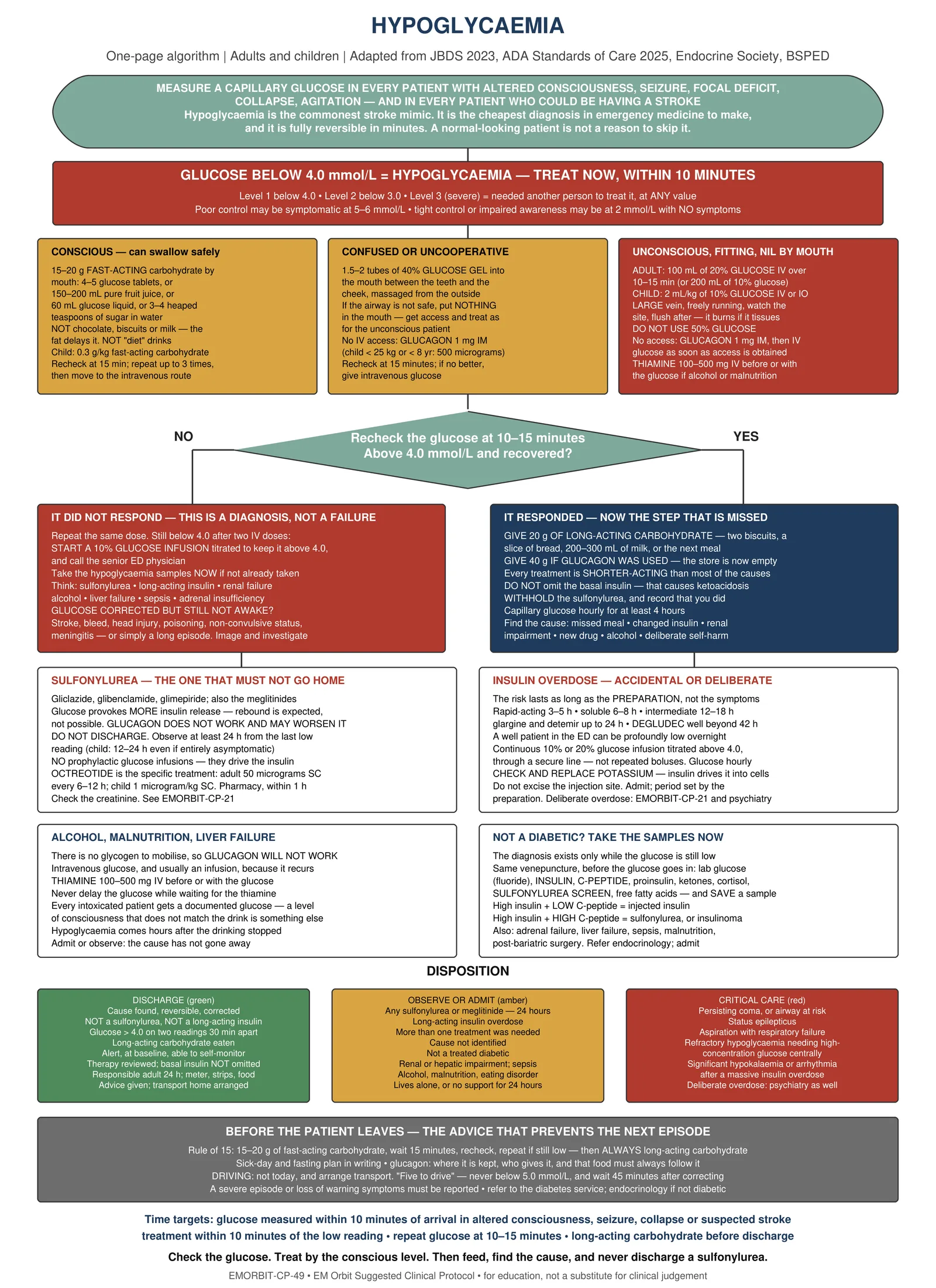
The one-page algorithm is shown at the top of this page.
6Team roles
6.1Triage Nurse:
6.1.1 Measure and record a capillary glucose at triage in every patient listed in 4.1.1 — before, and independently of, medical assessment. Category 1 below 4.0 mmol/L if drowsy, fitting or unable to swallow safely, otherwise Category 2, treated immediately under the approved nursing standing order.
6.2ED Nurses:
6.2.1 Treat, record the time and recheck the capillary glucose at 10 to 15 minutes — a nursing-owned indicator. Check the cannula before concentrated glucose, watch the site, flush afterwards, and report any extravasation at once. Ensure long-acting carbohydrate is given once the patient has recovered, and record it; continue hourly monitoring and escalate any repeat value below 4.0 mmol/L immediately.
6.2.2 Keep a hypoglycaemia box — fast-acting carbohydrate, 40% glucose gel, long-acting carbohydrate, 10% and 20% glucose, glucagon and the algorithm — stocked and checked every shift in triage, the treatment area and resuscitation. The box contents, locations, who checks it and how the check is recorded shall be defined in the department.
6.3Clinical Pharmacist:
6.3.1 Reconcile the medication list, identify the drug responsible, advise on withholding or substituting it and on insulin duration of action, and check renal function against the dose. Ensure 10% and 20% glucose, 40% gel and glucagon are stocked, octreotide obtainable from hospital pharmacy within 1 hour, and the small retained stock of 50% glucose (4.3.2, EMORBIT-CP-21) labelled for those indications only.
6.4Endocrinology and the Diabetes Service — a referral the ED initiates, not ED work:
6.4.1 The ED makes the referral before the patient leaves and states it, with its timescale, in the discharge letter (4.3.11). The service adjusts the regimen, restores awareness, arranges education and continuous glucose monitoring, advises on driving and occupational fitness, interprets the diagnostic samples and arranges the supervised fast and imaging — none of it ED work.
6.5Acute Medicine and Paediatrics:
6.5.1 Acute medicine accepts under the on-call team every patient admitted under this guideline — sulfonylurea or meglitinide hypoglycaemia, long-acting insulin overdose, and any patient in Attachment 4 part A — and continues the observation, monitoring and wider work-up. Paediatrics attends every child who is not a known diabetic, directs the metabolic and endocrine investigation, and admits every child with a sulfonylurea ingestion.
6.6Clinical Toxicology and the national poison centre:
6.6.1 Advise on every deliberate or large ingestion of insulin or a sulfonylurea, on the observation period, and on the timing and dose of octreotide (EMORBIT-CP-21). The contact number is held in the ED and in 4.3.6.
6.7Laboratory:
6.7.1 Prioritise and report the paired laboratory glucose; stock fluoride-oxalate tubes in the ED; accept, separate and store insulin, C-peptide, proinsulin and cortisol samples promptly; retain a saved sample; report critical results verbally. Maintain the ED glucose meters under the point-of-care quality programme: calibration, quality control, operator competency and lot verification, all documented.
6.8Ambulance and Pre-hospital Providers:
6.8.1 Measure a glucose in every patient with altered consciousness, a seizure, a collapse or a suspected stroke; treat before arrival and record the pre-treatment value and the treatment given. Convey, and do not leave at home, any patient treated for hypoglycaemia who takes a sulfonylurea or long-acting insulin, lives alone, or in whom the cause is unclear.
7The patient's role
7.1 Carry fast-acting carbohydrate at all times, and identification stating that you have diabetes and what treatment you take.
7.2 Bring all medication or an accurate list; say honestly how much was taken and when, whether you still feel your hypoglycaemia coming on, and whether you drive or operate machinery.
7.3 Eat the long-acting carbohydrate offered after treatment even if you feel recovered; it is what prevents the episode returning.
7.4 Do not drive home; arrange transport, and follow the driving rules in Attachment 4, part C. Test the glucose before driving, before exercise, when a meal is delayed and when unwell, and follow the written sick-day and fasting plans.
7.5 Family and carers: know where the fast-acting carbohydrate and glucagon are kept, know that food must follow glucagon, and call an ambulance for any episode with a seizure, unconsciousness or failure to recover.
7.6 Return to the ED for any further episode needing another person's help, any seizure, any episode that will not correct, or repeated low readings at home; and attend the follow-up arranged.
8Definitions
8.1Hypoglycaemia (operational definition): blood glucose below 4.0 mmol/L, with or without symptoms — "make 4 the floor". This is the departmental threshold for every pathway.
8.2Level 1 (alert value): below 4.0 and at or above 3.0 mmol/L. Level 2 (clinically significant): below 3.0 mmol/L, at which cognition is impaired in most people. Level 3 (severe): an episode with severe cognitive impairment requiring external assistance for recovery, defined by the clinical state and not by any glucose value.
8.3Autonomic and neuroglycopenic symptoms: autonomic — sweating, tremor, palpitations, hunger, anxiety, tingling: the warning symptoms, absent or blunted in impaired awareness, autonomic neuropathy and beta-blockade. Neuroglycopenic — confusion, drowsiness, slurred speech, incoordination, abnormal behaviour, aggression, focal deficit, seizure, coma.
8.4Impaired Awareness of Hypoglycaemia: loss of the autonomic warning symptoms, so the first manifestation is neuroglycopenia; it multiplies the risk of a severe episode, is potentially reversible by strict avoidance for some weeks, and has driving consequences (4.3.9).
8.5Fast-acting and long-acting carbohydrate: fast-acting is absorbed within minutes — glucose tablets, a glucose drink or gel, pure fruit juice, sugar in water; chocolate, biscuits and milk are not fast-acting. Long-acting is starch released over hours — bread, biscuits, milk or a meal: 20 g after every treated episode, 40 g after glucagon.
8.6Whipple Triad: symptoms consistent with hypoglycaemia, a laboratory-confirmed low plasma glucose at the time of those symptoms, and relief when the glucose is raised; a capillary reading alone does not satisfy it. It establishes a hypoglycaemic disorder in a patient not on glucose-lowering therapy.
8.7C-peptide: released with endogenous insulin; present when the pancreas is secreting, absent when the insulin was injected — the test that separates exogenous insulin from every other hyperinsulinaemic cause.
8.8Sulfonylurea and octreotide: a sulfonylurea (gliclazide, glibenclamide, glimepiride) stimulates endogenous insulin release; its hypoglycaemia is prolonged, recurrent and unresponsive to glucagon. Octreotide is a somatostatin analogue suppressing pancreatic insulin release — the specific treatment for it.
8.9JBDS, ADA, BSPED, RCEM, ACEP, ACEM: Joint British Diabetes Societies for Inpatient Care; American Diabetes Association; British Society for Paediatric Endocrinology and Diabetes; Royal College of Emergency Medicine; American College of Emergency Physicians; Australasian College for Emergency Medicine.
9Attachments
- Attachment 1: One-page algorithm (top of this page)
- Attachment 2: Treatment by Conscious Level — Preparations and Doses, Adult and Paediatric
- Attachment 3: The Causes to Identify, and the Samples to Take During the Episode
- Attachment 4: Discharge Criteria, Who Must Not Go Home, and the Patient Advice Checklist
11Suggested quality indicators
11.1Glucose measured where it finds the diagnosis: (ED patients with an altered level of consciousness, a seizure, a collapse, acute agitation or a suspected stroke with a capillary glucose recorded within 10 minutes of arrival / all such patients) × 100. Target ≥ 95%, and 100% on the stroke pathway.
11.2Recognition to treatment: (Patients with a glucose below 4.0 mmol/L treated within 10 minutes of the low reading / all such patients) × 100. Target ≥ 90%.
11.3Repeat glucose documented: (Treated episodes with a repeat capillary glucose recorded within 20 minutes / all treated episodes) × 100. Target ≥ 95%.
11.4Long-acting carbohydrate given: (Treated episodes in which long-acting carbohydrate was given and recorded after recovery / all treated episodes in patients able to eat) × 100. Target ≥ 90%. Nursing-owned.
11.5No sulfonylurea patient discharged: (Patients with sulfonylurea or meglitinide hypoglycaemia admitted under the acute medical on-call team, or observed at least 24 hours from the last episode / all such patients) × 100. Target 100%; every breach is an incident report reviewed at the morbidity and mortality meeting.
11.6Outcome indicators: re-attendance at any ED within 7 days with hypoglycaemia after discharge, monitored monthly against a review threshold of 5%, reviewed against local data annually. Monitored without a fixed target: extravasation injury; wrong-insulin and wrong-dose events; hypoglycaemia found only after imaging or thrombolysis; death or permanent neurological injury; and the proportion of episodes with a documented cause.
13References
- Joint British Diabetes Societies for Inpatient Care. The hospital management of hypoglycaemia in adults with diabetes mellitus. JBDS-IP; 2023 revision.
- American Diabetes Association Professional Practice Committee. Standards of Care in Diabetes — 2025. Section 6: Glycemic Goals and Hypoglycemia. Diabetes Care. 2025;48(Suppl 1).
- Cryer PE, Axelrod L, Grossman AB, et al. Evaluation and management of adult hypoglycemic disorders: an Endocrine Society clinical practice guideline. J Clin Endocrinol Metab. 2009;94(3):709–728.
- International Hypoglycaemia Study Group. Glucose concentrations of less than 3.0 mmol/L (54 mg/dL) should be reported in clinical trials: a joint position statement of the ADA and the EASD. Diabetes Care. 2017;40(1):155–157.
- British Society for Paediatric Endocrinology and Diabetes. Recommended clinical guideline for the investigation and management of hypoglycaemia in children. BSPED.
- Advanced Life Support Group. Advanced Paediatric Life Support: A Practical Approach to Emergencies. 7th ed. Wiley-Blackwell.
- The national poison centre. The poisons advice service for Emergency Departments: insulin and sulfonylurea poisoning, and octreotide. (use the local number).
- Glatstein M, Scolnik D, Bentur Y. Octreotide for the treatment of sulfonylurea poisoning. Clin Toxicol (Phila). 2012;50(9):795–804.
- Dougherty PP, Klein-Schwartz W. Octreotide's role in the management of sulfonylurea-induced hypoglycemia. J Med Toxicol. 2010;6(2):199–206.
- Royal College of Emergency Medicine. Clinical standards and best practice guidance relevant to the patient with a reduced level of consciousness and to diabetic emergencies. London: RCEM.
- National Institute for Health and Care Excellence. Type 1 diabetes in adults: diagnosis and management (NG17); Type 2 diabetes in adults: management (NG28). London: NICE.
- EMORBIT-CP-02 Convulsive Status Epilepticus; EMORBIT-CP-11 Sepsis and Septic Shock; EMORBIT-CP-14 Acute Ischaemic Stroke and TIA; EMORBIT-CP-17 Diabetic Ketoacidosis and Hyperosmolar Hyperglycaemic State; EMORBIT-CP-21 General Approach to the Poisoned Patient.
A2Attachment 2: Treatment by Conscious Level — Preparations and Doses, Adult and Paediatric
The route is chosen by the ability to swallow safely, not by the number on the meter.
Threshold throughout: below 4.0 mmol/L. Recheck 10 to 15 minutes after every treatment. Long-acting carbohydrate follows every corrected episode — 20 g, or 40 g after glucagon.
| Clinical state | First treatment | Then — and the cautions |
|---|---|---|
| CONSCIOUS, oriented, able to swallow and cooperate (most Level 1 and many Level 2 episodes) | 15 to 20 g of fast-acting carbohydrate by mouth, for example 4 to 5 glucose tablets, 150 to 200 mL of pure fruit juice, 60 mL of a proprietary glucose liquid, 5 to 7 dextrose tablets, or 3 to 4 heaped teaspoons of sugar dissolved in water | Repeat the capillary glucose at 15 minutes. If still below 4.0 mmol/L, repeat the fast-acting carbohydrate. After three cycles without response, move to the intravenous route. Chocolate, biscuits and milk are not fast-acting carbohydrate and shall not be used for the first treatment — fat delays absorption; diet or "zero sugar" drinks are useless |
| CONSCIOUS but confused, uncooperative or aggressive, yet able to swallow safely | 1.5 to 2 tubes of 40% glucose gel squeezed into the mouth between the teeth and the cheek, and massaged from the outside | Recheck at 15 minutes; if no improvement or the patient will not take it, gain intravenous access and treat as for the unconscious patient. If the patient cannot protect the airway, nothing is put in the mouth — where there is no intravenous access, glucagon 1 mg intramuscularly |
| UNCONSCIOUS, seizing, nil by mouth, or unable to protect the airway (always Level 3) | 100 mL of 20% glucose intravenously over 10 to 15 minutes (or 200 mL of 10% glucose over 10 to 15 minutes) through a large vein with a freely running cannula | Recheck the capillary glucose at 10 to 15 minutes; if still below 4.0 mmol/L repeat the same dose, and after a second dose start a 10% glucose infusion and seek a cause beyond a missed meal. In the dialysis-dependent or otherwise fluid-restricted adult, where this volume is itself a hazard, see section 4.3.2 — a smaller aliquot of 50% glucose may be used on a senior decision. First-aliquot difference against EMORBIT-CP-02 and EMORBIT-CP-21: see the footnote below |
| NO INTRAVENOUS ACCESS and unconscious | Glucagon 1 mg intramuscularly (or subcutaneously) while access is obtained | Expect a response in about 10 minutes and a rise of only 3 to 4 mmol/L, lasting less than an hour. Give intravenous glucose as soon as access is available. Glucagon may not work at all — see section 4.3.4; expect nausea and vomiting |
| AFTER the glucose is above 4.0 mmol/L and the patient has recovered — the step that is most often missed | Give 20 g of long-acting carbohydrate, for example two biscuits, a slice of bread or toast, 200 to 300 mL of milk, or the next meal if it is due within the hour. Give 40 g if glucagon was used | Continue capillary glucose monitoring at least hourly for 4 hours, and for considerably longer where the cause has a long tail (4.3.6, 4.3.7). Assigned to the nurse caring for the patient, and audited (section 11) |
Give intravenous glucose through a large, secure, freely running cannula, watched throughout and flushed afterwards; extravasation causes tissue necrosis. 50% glucose is not used to treat hypoglycaemia in routine practice and is never used in children; the single exception — the fluid-restricted or dialysis-dependent adult — and the small stock retained for it are in section 4.3.2. Stock assumed at the point of care: 4.3.1 and section 6.
| Clinical state | Dose | Then — and the cautions |
|---|---|---|
| Conscious, able to swallow | 0.3 g/kg of fast-acting carbohydrate by mouth (approximately 10 to 20 g in an older child); glucose tablets, juice or a glucose drink | Recheck at 15 minutes and repeat if still below 4.0 mmol/L, then give long-acting carbohydrate or the next feed; in an infant, a milk feed follows |
| Unconscious, seizing, or unable to swallow | 2 mL/kg of 10% glucose intravenously or intraosseously (equivalent to 200 mg/kg), given over several minutes. No more than 2 mL/kg per bolus, and do not use 50% glucose in children — the osmotic load risks cerebral injury and rebound hypoglycaemia | Recheck at 10 to 15 minutes and repeat once if required; then start a 10% glucose infusion at a maintenance rate and continue hourly glucose |
| No intravenous or intraosseous access | Glucagon intramuscularly: 500 micrograms if under 25 kg or under 8 years; 1 mg if 25 kg or over | Obtain access and give intravenous glucose as soon as possible. Glucagon fails as it does in adults — in the child that usually means a prolonged fast or an inborn error of metabolism |
| Neonate (under 28 days) | Treatment threshold is lower and unit-specific; 2 mL/kg of 10% glucose and immediate neonatal referral | Continuous 10% glucose infusion; the neonatal team directs further care under the local neonatal guideline, not this one |
In any child who is not a known diabetic on treatment, the ED shall take the Attachment 3 samples at the time of the episode, before or with the glucose. Ketotic hypoglycaemia of childhood, an inborn error of fatty acid oxidation or of carbohydrate metabolism, congenital hyperinsulinism, adrenal insufficiency, growth hormone deficiency and ingestion of a parent's sulfonylurea or insulin are all in the differential.
| Situation | Does glucagon work? | What to do instead |
|---|---|---|
| Insulin-treated diabetic, eating normally, well nourished, no intravenous access | Yes — a reasonable temporising measure | Give 1 mg intramuscularly, then intravenous glucose as soon as access is obtained, then long-acting carbohydrate |
| Malnourished, cachectic, anorexic or prolonged fasting | No — there is no glycogen to mobilise | Intravenous glucose. Obtain access, including intraosseous access if necessary |
| Alcohol-dependent, or acutely intoxicated with a poor recent food intake | No — glycogen is depleted and alcohol blocks gluconeogenesis | Intravenous glucose, ideally with thiamine given before or with the glucose |
| Liver failure, advanced cirrhosis, or hepatic congestion | No or unreliable — the store and the machinery are both impaired | Intravenous glucose and an infusion; involve the medical team early |
| Sulfonylurea or meglitinide overdose | No — and it may make things worse, because glucagon stimulates further insulin release from a pancreas that is already being driven | Intravenous glucose for the episode and octreotide as the specific treatment (section 4.3.6 and EMORBIT-CP-21) |
| A second or third episode in the same admission | Progressively less effective — the first dose used up what glycogen there was | Intravenous glucose and an infusion; look hard for the cause |
| Adrenal insufficiency | Partially, and briefly | Intravenous glucose; give hydrocortisone where adrenal crisis is suspected; take the samples in Attachment 3 first if it can be done in seconds |
Glucagon is a bridge, not a treatment: about 10 minutes to act, a rise of only 3 to 4 mmol/L, well under an hour of effect, an emptied glycogen store (hence 40 g of long-acting carbohydrate after it, and a second dose is of little use), and vomiting in a patient whose airway may already be at risk. In the ED, intravenous glucose is the treatment and glucagon is the fallback.
Consistency with the library: EMORBIT-CP-17 uses the same threshold and the same intravenous dose; EMORBIT-CP-21 the same threshold, paediatric dose, thiamine rule and octreotide doses but an initial adult aliquot of 50 mL of 20% glucose (100 mL of 10%) repeated at 15 minutes; EMORBIT-CP-02 that same aliquot and a threshold of below 3.0 mmol/L, or below 4.0 with symptoms. Below 4.0 mmol/L is the departmental threshold for every pathway, with or without symptoms, and EMORBIT-CP-02 shall be aligned to it. The size of the first aliquot is not yet reconciled across protocols — a difference of first dose, not of target, both regimens re-measuring at 15 minutes.
A3Attachment 3: The Causes to Identify, and the Samples to Take During the Episode
In the non-diabetic patient the diagnosis exists only while the glucose is still low.
The ED identifies the precipitant (4.1.2), draws the set below and refers. The review of the cause, and the differential in the patient who is not diabetic and not on a glucose-lowering drug (4.1.5), are worked through by the admitting medical team and by the diabetes or endocrinology service — not by the ED.
| Sample | Tube | Why |
|---|---|---|
| Laboratory glucose | Fluoride-oxalate | Confirms the meter reading and satisfies the Whipple triad |
| Insulin | Serum (separate and freeze promptly) | Hyperinsulinaemic or not |
| C-peptide | Serum | Suppressed with exogenous insulin; high when the pancreas is secreting — the most useful discriminator |
| Proinsulin | Serum | Raised in insulinoma |
| Beta-hydroxybutyrate (ketones) | Serum or bedside meter | Suppressed in hyperinsulinism; high in fasting, alcohol, adrenal insufficiency, liver failure |
| Sulfonylurea and meglitinide screen | Plasma and/or urine | Separates sulfonylurea from insulinoma — both give high insulin and high C-peptide |
| Cortisol | Serum | Low or inappropriately normal during hypoglycaemia: adrenal insufficiency or hypopituitarism |
| Free fatty acids | Serum | Suppressed in hyperinsulinism and in IGF-2-mediated hypoglycaemia |
| Growth hormone (children), lactate, ammonia, acylcarnitines, urine organic acids | As per the laboratory | Inborn errors of metabolism in the child; taken with paediatric advice |
| A SAVED serum or plasma sample | Serum, labelled and stored | So that an assay nobody thought of in the resuscitation room can still be run tomorrow — the cheapest and most frequently regretted omission |
Interpretation: high insulin + suppressed C-peptide = exogenous insulin. High insulin + high C-peptide + positive drug screen = sulfonylurea or meglitinide; + negative drug screen = endogenous hyperinsulinism, in practice insulinoma. Low insulin + high ketones = fasting, alcohol, adrenal insufficiency, hypopituitarism or liver failure. Low insulin + low ketones + low free fatty acids = IGF-2-mediated (non-islet cell tumour) hypoglycaemia. Where the samples were not taken, the patient is admitted for a supervised 72-hour fast.
If taking the samples would delay treatment in a patient who is unconscious, fitting or losing the airway, treat first, record that they were not taken and why, and admit for investigation.
A4Attachment 4: Discharge Criteria, Who Must Not Go Home, and the Patient Advice Checklist
To be completed for every patient treated for hypoglycaemia and filed in the medical record.
| ✓ | Criterion |
|---|---|
| ☐ | Hypoglycaemia attributable to a sulfonylurea or meglitinide — including the asymptomatic patient and the child with a single-tablet ingestion. Minimum 24 hours of observation from the last hypoglycaemic episode. |
| ☐ | Overdose of a long-acting insulin (glargine, detemir, degludec or an intermediate preparation), accidental or deliberate. The observation period follows the preparation, not the current glucose. |
| ☐ | Any deliberate overdose of insulin or any glucose-lowering drug. |
| ☐ | More than one treatment was required, or the glucose fell again during observation. |
| ☐ | The cause has not been identified, or the patient is not a treated diabetic. |
| ☐ | Renal impairment or acute kidney injury, hepatic impairment, sepsis, or suspected adrenal insufficiency. |
| ☐ | Conscious level, cognition or neurology not fully returned to baseline. |
| ☐ | Alcohol-associated hypoglycaemia, malnutrition, or an eating disorder. |
| ☐ | Lives alone, no responsible adult for 24 hours, unable to eat, unable to self-monitor, or no meter, strips or food at home. |
| ☐ | Safeguarding concern, or possible administration of insulin or a sulfonylurea by another person. |
| ☐ | A severe (Level 3) episode in which the precipitant has not been corrected. |
| ✓ | Criterion |
|---|---|
| ☐ | The cause is identified, reversible and corrected. |
| ☐ | Glucose above 4.0 mmol/L on at least two readings at least 30 minutes apart. |
| ☐ | Long-acting carbohydrate given and eaten (20 g; 40 g if glucagon was used). |
| ☐ | The drug involved is not a sulfonylurea, a meglitinide, or a long-acting insulin taken in overdose. |
| ☐ | Fully alert, at baseline cognition, eating and drinking, able to self-monitor. |
| ☐ | Insulin or oral therapy reviewed and adjusted; basal insulin not omitted; the change written down and explained. |
| ☐ | A responsible adult for 24 hours; food, fast-acting carbohydrate, a working meter and strips at home. |
| ☐ | Transport home arranged — the patient does not drive from the department. |
| ☐ | Follow-up arranged with the diabetes service or the family physician, with the timescale stated, and the discharge letter sent the same day. |
| ✓ | Advice given |
|---|---|
| ☐ | What happened, why it happened, and how to avoid it — explained in the patient's language, with the family present. |
| ☐ | The rule of 15: 15 to 20 g of fast-acting carbohydrate, wait 15 minutes, recheck, repeat if still below 4.0 mmol/L, then always long-acting carbohydrate. |
| ☐ | What fast-acting carbohydrate is (glucose tablets, juice, glucose drink) and what it is not (chocolate, biscuits, "diet" or "zero sugar" drinks). |
| ☐ | Glucagon: where it is kept, who can give it, and that food must follow it. |
| ☐ | The medication changes made, in writing, repeated back by the patient. |
| ☐ | Prevention: do not skip meals; adjust for exercise; eat with alcohol; a written sick-day plan; and a plan before any day of fasting. |
| ☐ | Driving: do not drive today. "Five to drive" — do not drive at or below 5.0 mmol/L, and wait 45 minutes after correcting. Carry carbohydrate within reach; check every 2 hours on a long journey; stop safely and leave the driving seat if symptoms occur. (See section 4.3.9.) |
| ☐ | A severe episode, or impaired awareness of hypoglycaemia, requires stopping driving and notifying the licensing authority and the insurer; referral to the diabetes service made. (See section 4.3.9.) |
| ☐ | Occupational advice: no machinery, height, or safety-critical or lone work today; occupational health informed with consent where the episode occurred at work. |
| ☐ | When to return or call an ambulance: any episode needing another person's help, any seizure, any failure to correct, repeated low readings at home. |
| ☐ | Referral made — diabetes service (severe, recurrent, impaired awareness, pump problem) or endocrinology (not a treated diabetic). |
Completed by: __________________________ Designation: __________________________ Date and time: __________________
A discharge in which any box in section A is ticked shall be reported through the local incident reporting system and reviewed at the departmental morbidity and mortality meeting.