Hypertensive Disorders of Pregnancy, Pre-eclampsia and Eclampsia
EMORBIT-CP-74 · Chapter 11 · Obstetric and Gynaecological Emergencies
Open in the appFree, works on your phone and offline, with every tool alongside.
Evidence base: NICE NG133; ACOG PB 222
1Purpose
1.1 Provide a standardized, evidence-based framework for the recognition, immediate treatment, monitoring and safe referral of hypertensive disorders of pregnancy — including gestational hypertension, pre-eclampsia with and without severe features, eclampsia and HELLP syndrome — in women presenting to the Emergency Department (ED) during pregnancy and in the first 6 weeks after delivery.
1.2 Establish the central Emergency Department message of this guideline: pre-eclampsia is not a blood pressure complaint, and it is not over when the pregnancy is over. Any woman who is pregnant, or who has been pregnant within the last 6 weeks, presenting with headache, visual disturbance, epigastric or right upper quadrant pain, vomiting, breathlessness, swelling, or simply feeling unwell, shall have a blood pressure and a urine protein measured before any other diagnostic pathway is entered.
1.3 Define the diagnostic criteria, including the blood pressure thresholds, the quantitative proteinuria thresholds, and the organ-based criteria that allow the diagnosis to be made without any proteinuria at all.
1.4 Define the immediate treatment of severe hypertension in pregnancy — the agents, doses, routes, the target blood pressure and the permitted rate of reduction — stated identically to EMORBIT-CP-40 (Hypertensive Emergency and Hypertensive Urgency), so that the two guidelines cannot be followed to different numbers.
1.5 Define the magnesium sulphate regimen for the prevention and the treatment of eclamptic seizures, with the loading dose, the maintenance infusion, the dose for a recurrent seizure, the bedside monitoring required, the signs of toxicity and the antidote — stated identically to EMORBIT-CP-40 and EMORBIT-CP-02 (Convulsive Status Epilepticus and First Seizure).
1.6 Establish that magnesium sulphate, and not a benzodiazepine, is the first-line anticonvulsant for an eclamptic seizure, and that the seizure itself is usually self-limiting and is managed by airway protection, left lateral positioning and prevention of injury.
1.7 Establish that fluid restriction, not fluid resuscitation, is the rule in severe pre-eclampsia, because pulmonary oedema is a leading cause of death in this condition and is largely iatrogenic.
1.8 Establish that delivery is the only definitive treatment, that the decision to deliver is an obstetric decision, and that maternal stabilisation comes first — the ED stabilises the mother, and the obstetric team delivers the baby.
1.9 Ensure consistency of practice among all healthcare providers (HCP) and alignment with the National Institute for Health and Care Excellence (NICE) NG133, the Royal College of Obstetricians and Gynaecologists (RCOG), the American College of Obstetricians and Gynecologists (ACOG), the International Society for the Study of Hypertension in Pregnancy (ISSHP), and the standards of the Royal College of Emergency Medicine (RCEM), the American College of Emergency Physicians (ACEP) and the Australasian College for Emergency Medicine (ACEM).
2Who this protocol applies to
2.1 Any woman who is pregnant at 20 completed weeks of gestation or beyond, or who has delivered, miscarried or terminated a pregnancy within the last 6 weeks, presenting to the ED with a blood pressure of 140/90 mmHg or more.
2.2 Any woman who is pregnant, or who has been pregnant within the last 6 weeks, presenting with any symptom in Table 4 — headache, visual disturbance, epigastric or right upper quadrant pain, nausea and vomiting, breathlessness, sudden swelling of the face or hands, seizure or collapse, or a non-specific feeling of being unwell — irrespective of the recorded blood pressure.
2.3 Any woman who is pregnant, or who has been pregnant within the last 6 weeks, presenting with a seizure, a reduced conscious level, or an unexplained collapse.
2.4 Any pregnant or recently pregnant woman with abnormal liver function, thrombocytopenia, haemolysis, acute kidney injury or new proteinuria found on investigation, whatever the presenting complaint.
2.5 Women with known chronic hypertension or chronic kidney disease who are pregnant and present with any deterioration, new symptom or rise in blood pressure.
2.6 Women brought by ambulance or transferred from another facility with suspected pre-eclampsia or eclampsia, including those in whom magnesium sulphate or an antihypertensive has already been given.
2.7 Women who present at less than 20 weeks of gestation with hypertension are included for the purposes of assessment, exclusion of a secondary cause, and referral, although pre-eclampsia before 20 weeks is rare and raises the possibility of molar pregnancy or underlying renal disease.
3Not covered by this protocol
3.1 Hypertensive emergency in a woman who is not pregnant and has not been pregnant within the last 6 weeks, which is managed under EMORBIT-CP-40.
3.2 Seizure in a woman who is not pregnant and has not been pregnant within the last 6 weeks, which is managed under EMORBIT-CP-02.
3.3 Bleeding and pain in early pregnancy — ectopic pregnancy and miscarriage — which is managed under EMORBIT-CP-73 (Bleeding and Pain in Early Pregnancy). Where a woman under 20 weeks presents with pain, bleeding and hypertension, both pathways apply and both teams shall be involved.
3.4 The definitive obstetric management of pre-eclampsia — the decision on timing and mode of delivery, antenatal corticosteroids for fetal lung maturity, fetal surveillance, and inpatient antihypertensive titration — which belongs to the obstetric team and to the local obstetric pathway. This guideline covers the ED front-door phase: recognition, first-hour treatment, monitoring and handover.
3.5 Trauma in pregnancy, which is managed under EMORBIT-CP-19 (Major Trauma) and the related ED guideline, although pre-eclampsia and abruption shall be considered in any pregnant trauma patient.
3.6 Routine antenatal blood pressure surveillance and the community management of chronic hypertension in pregnancy, which are antenatal-clinic functions.
4Protocol
4.1History and Assessment:
4.1.1Triage and Recognition:
4.1.1.1 Every woman of child-bearing age attending the ED shall be asked at triage whether she is pregnant, or has been pregnant in the last 6 weeks, and the answer shall be recorded. Where she is or may be, the gestation or the date of delivery shall be recorded with it.
4.1.1.2 Any pregnant or recently pregnant woman presenting with any symptom in Table 4 shall have a manual blood pressure and a urine protein-to-creatinine ratio obtained within 15 minutes of arrival, under the approved triage nursing standing order and without waiting for physician review.
4.1.1.3 The following shall be triaged Category 1 (immediate) and taken directly to the resuscitation area: a seizure, or a seizure in the preceding period with incomplete recovery; any reduced conscious level; any new focal neurological deficit; blindness or acute visual loss; pulmonary oedema or oxygen saturation below 95% on air; and any pregnant or recently pregnant woman with a systolic of 160 mmHg or more (identical to EMORBIT-CP-40).
4.1.1.4 The following shall be triaged Category 2 (emergency): a blood pressure of 140/90 mmHg or more with any symptom in Table 4; severe headache or visual disturbance at any blood pressure; epigastric or right upper quadrant pain at any blood pressure; reduced fetal movements; or vaginal bleeding with hypertension.
4.1.1.5 A single normal blood pressure does not exclude pre-eclampsia and does not end the assessment. Repeat it manually with an appropriately sized cuff, and send the bloods and the urine protein-to-creatinine ratio regardless.
4.1.1.6 Blood pressure shall be measured with the woman seated or in a left lateral tilt, the arm supported at heart level, using a cuff appropriate to the arm circumference. An undersized cuff over-reads. Automated oscillometric devices under-read systematically in pre-eclampsia and any severe or borderline reading shall be confirmed manually.
4.1.1.7 Capillary glucose shall be measured in every woman presenting with a seizure, a reduced conscious level or collapse.
4.1.1.8
Table 4: The ED trigger rule — any woman who is pregnant, or who has been pregnant within the last 6 weeks, presenting with any of these shall have a blood pressure and a urine protein measured before any other pathway is entered Presenting complaint What it may be Where it is usually mis-sent Headache Pre-eclampsia; eclampsia prodrome; posterior reversible encephalopathy syndrome; cerebral venous thrombosis; subarachnoid haemorrhage Discharged as migraine, tension headache or dehydration, with analgesia and no blood pressure recorded Visual disturbance — blurring, flashing lights, spots, double or lost vision Pre-eclampsia; retinal arteriolar spasm; cortical blindness; PRES Referred to ophthalmology without a blood pressure Epigastric or right upper quadrant pain HELLP syndrome and hepatic capsular distension Treated as gastritis, reflux or biliary colic; given a proton-pump inhibitor and discharged Nausea and vomiting, particularly new in the second half of pregnancy Pre-eclampsia; HELLP syndrome Treated as gastroenteritis or as hyperemesis, which is a first-trimester diagnosis Breathlessness, orthopnoea, cough, chest tightness Pulmonary oedema of pre-eclampsia; peripartum cardiomyopathy; pulmonary embolism (EMORBIT-CP-07) Treated as anxiety, anaemia or "normal in pregnancy" Swelling of the face, hands or feet; sudden weight gain Pre-eclampsia Dismissed as physiological oedema. Oedema alone is not diagnostic, but sudden facial or hand swelling with any other symptom is Seizure or collapse Eclampsia until proved otherwise (EMORBIT-CP-02) Treated as a first fit or as syncope, with benzodiazepines and no magnesium Reduced fetal movements, abdominal pain, vaginal bleeding Abruption complicating pre-eclampsia Sent to the obstetric unit without a maternal blood pressure being recorded first "Just feeling unwell", malaise, restlessness, a sense that something is wrong Pre-eclampsia and HELLP syndrome both present this way Triaged low and left in the waiting area ANY of the above in a woman who has delivered in the last 6 weeks Postpartum pre-eclampsia and postpartum eclampsia, which may arise for the first time after delivery The single commonest circumstance in which this diagnosis is missed in the ED, because the pregnancy is over and is not asked about The question "are you pregnant, or have you been pregnant in the last 6 weeks?" shall be asked of every woman of child-bearing age at triage, and the answer shall be recorded. Where the answer is yes and any symptom above is present, a manual blood pressure and a urine protein-to-creatinine ratio are mandatory and shall be obtained within 15 minutes of arrival.
4.1.2History (obtained from the woman, her family, her hand-held antenatal notes and the ambulance crew):
4.1.2.1 Gestation by dates and by scan; or the date and mode of delivery where she has delivered, and where she delivered.
4.1.2.2 Antenatal care: booking blood pressure, booking urinalysis, whether she has booked at all, the attending unit, and the most recent clinic readings — a rise from her own booking pressure matters even where the absolute number is not yet 140/90 mmHg.
4.1.2.3 Symptoms in the last 48 hours: headache and its character and response to analgesia; visual disturbance of any kind; epigastric or right upper quadrant pain; nausea and vomiting; breathlessness and orthopnoea; swelling of the face, hands or feet and any sudden weight gain; reduced urine output; restlessness or a sense that something is wrong.
4.1.2.4 Fetal movements, abdominal pain, contractions, vaginal bleeding and rupture of membranes.
4.1.2.5 Risk factors for pre-eclampsia. High risk: previous pre-eclampsia, chronic hypertension, chronic kidney disease, diabetes mellitus type 1 or 2, and autoimmune disease including systemic lupus erythematosus and antiphospholipid syndrome. Moderate risk: first pregnancy, age 40 years or above, pregnancy interval of more than 10 years, body mass index of 35 kg/m² or more at booking, family history of pre-eclampsia, and multiple pregnancy. Note also assisted conception, molar pregnancy and a new partner.
4.1.2.6 Whether low-dose aspirin was prescribed for prophylaxis and whether it was taken.
4.1.2.7 Current medication, including antihypertensives and their last dose, magnesium already given, uterotonics given after delivery, and any non-steroidal anti-inflammatory drug taken for postnatal pain.
4.1.2.8 Previous obstetric history: previous pre-eclampsia or eclampsia, HELLP syndrome, fetal growth restriction, abruption, stillbirth or preterm birth.
4.1.2.9 Where she has had a seizure: the description from a witness, the duration, whether there was tongue biting or incontinence, whether she has known epilepsy, and the time she was last seen well.
4.1.3Examination:
4.1.3.1 Blood pressure, repeated manually, in both arms at first assessment; pulse; respiratory rate; oxygen saturation; temperature; and the Glasgow Coma Scale.
4.1.3.2 Deep tendon reflexes and ankle clonus. Sustained clonus of three beats or more is a severe feature and a warning of imminent eclampsia; it is also the baseline against which magnesium toxicity is later judged, so it shall be documented before magnesium is given.
4.1.3.3 Neurological examination: conscious level, orientation, pupils, visual acuity and visual fields to confrontation, fundoscopy where it can be done without delaying treatment, and focal signs.
4.1.3.4 Respiratory examination for basal crackles, and for the tachypnoea and orthopnoea of early pulmonary oedema.
4.1.3.5 Abdominal examination for epigastric and right upper quadrant tenderness, uterine tenderness or a woody-hard uterus suggesting abruption, and the fundal height.
4.1.3.6 Oedema of the face, hands and sacrum. Oedema alone is not diagnostic, and its absence does not exclude the diagnosis, but sudden facial or hand swelling with any other symptom is significant.
4.1.3.7 Fetal assessment where the gestation makes it appropriate: fetal heart auscultation or cardiotocography, arranged with the obstetric or midwifery team. Fetal assessment does not precede maternal stabilisation.
4.1.3.8 In a woman who has delivered: the uterine fundus, lochia, the perineum or caesarean wound, and the calves, since venous thromboembolism is the main alternative postnatal emergency.
4.1.4Severity and Risk Stratification:
4.1.4.1 The diagnosis is made against Table 2 and the severity against Table 3. A single severe feature makes the disease severe, irrespective of the blood pressure.
4.1.4.2 Features that predict imminent eclampsia: severe or escalating headache, visual disturbance, sustained clonus of three beats or more, agitation or restlessness, and a rapidly rising blood pressure. These warrant magnesium sulphate.
4.1.4.3 Features that predict maternal death: pulmonary oedema, a platelet count below 50 × 10⁹/L, disseminated intravascular coagulation, hepatic rupture, stroke, acute kidney injury requiring replacement therapy, and eclampsia occurring in hospital after arrival.
4.1.4.4 Early-onset disease (before 34 weeks) carries a substantially higher risk of severe maternal and fetal complication than late-onset disease and shall be escalated with a lower threshold.
4.1.4.5 Objective illness severity scores developed for this condition, such as fullPIERS and PREP-S, are validated for inpatient obstetric use to guide the timing of delivery. They are not ED triage tools and shall not be used to justify discharge from the ED.
4.1.4.6
Table 1: Classification of the hypertensive disorders of pregnancy (ISSHP 2018/2021, NICE NG133, ACOG PB 222) Disorder Timing Definition What it means in the ED Chronic (pre-existing) hypertension Present before pregnancy, or before 20 completed weeks Blood pressure of 140/90 mmHg or more, present before conception or before 20 weeks, or persisting beyond 12 weeks postpartum She is not protected. About one in four develops superimposed pre-eclampsia. Check for new proteinuria and new organ dysfunction at every attendance Gestational hypertension New after 20 completed weeks New hypertension of 140/90 mmHg or more after 20 weeks, without proteinuria and without maternal organ dysfunction or uteroplacental dysfunction Up to one quarter progress to pre-eclampsia, and the progression can be rapid. It is a reason for urgent obstetric review, not for reassurance PRE-ECLAMPSIA (without severe features) After 20 weeks, and up to 6 weeks postpartum New hypertension of 140/90 mmHg or more after 20 weeks with proteinuria, or with any maternal organ dysfunction listed in Table 2, or with uteroplacental dysfunction — proteinuria is no longer required for the diagnosis Obstetric assessment on the same day. The ED does not exclude this diagnosis and does not discharge the patient without obstetric review PRE-ECLAMPSIA WITH SEVERE FEATURES As above Pre-eclampsia with any feature in Table 3 — including a systolic of 160 mmHg or more or a diastolic of 110 mmHg or more, neurological or visual symptoms, epigastric or right upper quadrant pain, pulmonary oedema, a platelet count below 100 × 10⁹/L, renal or hepatic involvement A time-critical emergency. Antihypertensive treatment and magnesium sulphate, obstetric attendance immediately, and admission ECLAMPSIA After 20 weeks, and up to 6 weeks postpartum A generalised tonic–clonic seizure in a woman with pre-eclampsia, in the absence of another cause. In up to a third of cases the seizure is the first sign and there was no preceding diagnosis of pre-eclampsia Resuscitation-room emergency. Magnesium sulphate is the first-line anticonvulsant, not a benzodiazepine (EMORBIT-CP-02) HELLP SYNDROME Usually third trimester; up to one third present postpartum Haemolysis, Elevated Liver enzymes and Low Platelets, usually but not always with hypertension and proteinuria May present as epigastric pain and vomiting with a normal blood pressure and no proteinuria. Send the bloods in Table 9 on any pregnant or recently pregnant woman with upper abdominal pain Superimposed pre-eclampsia After 20 weeks in a woman with chronic hypertension or chronic kidney disease New proteinuria, a sudden rise in existing proteinuria, a sudden rise in blood pressure, or new maternal organ dysfunction in a woman with pre-existing hypertension or renal disease The hardest group to recognise, because the hypertension is not new. Compare with her booking and clinic readings, which shall be obtained White-coat and masked hypertension Any Raised in clinic and normal at home (white-coat), or normal in clinic and raised at home (masked) Not an ED diagnosis. A single normal ED reading in a symptomatic woman does not exclude pre-eclampsia; repeat it and refer Gestational age is counted from the first day of the last menstrual period. Hypertension arising before 20 weeks is chronic hypertension until proved otherwise, and if it is accompanied by proteinuria and organ dysfunction the differential includes molar pregnancy, renal disease, thrombotic microangiopathy and phaeochromocytoma; obstetric and physician input is required.
4.1.4.7
Table 2: Diagnostic criteria for pre-eclampsia — hypertension after 20 weeks PLUS at least one of the following. Proteinuria is NOT required Criterion What satisfies it HYPERTENSION (required in every case) Systolic 140 mmHg or more, or diastolic 90 mmHg or more, on two occasions at least 4 hours apart — or on a single occasion where the reading is 160/110 mmHg or more, which shall not be left unconfirmed and untreated while a repeat is awaited. Use an appropriately sized cuff, the arm supported at heart level, the woman seated or in a left lateral tilt, and Korotkoff phase V for the diastolic and at least ONE of: Proteinuria Urine protein-to-creatinine ratio of 30 mg/mmol or more, or albumin-to-creatinine ratio of 8 mg/mmol or more, or 300 mg or more in a 24-hour collection. An automated reagent-strip reading of 1+ or more is a screening trigger only and shall always be followed by a quantitative ratio on the same sample. A negative dipstick does not exclude pre-eclampsia Renal involvement Serum creatinine above 90 micromol/L (about 1.02 mg/dL) in the absence of other renal disease, or a doubling from a known baseline, or oliguria. Creatinine falls in normal pregnancy, so a "normal" adult value may already represent injury Hepatic involvement Transaminases above 40 IU/L (NICE) or more than twice the upper limit of the local reference range (ACOG), with or without severe persistent right upper quadrant or epigastric pain not accounted for by another diagnosis Haematological involvement Platelet count below 150 × 10⁹/L, disseminated intravascular coagulation, or haemolysis. A platelet count below 100 × 10⁹/L is a severe feature Neurological involvement Eclampsia; altered mental state; blindness, scotomata or other persistent visual disturbance; stroke; clonus (three beats or more); severe headache; persistent visual scintillations Pulmonary involvement Pulmonary oedema, or new hypoxaemia not otherwise explained Uteroplacental dysfunction Fetal growth restriction, abnormal umbilical artery Doppler waveform analysis, placental abruption, or stillbirth — assessed by the obstetric team, not by the ED The single most important consequence of this table for emergency practice is that a woman can have pre-eclampsia with no protein in her urine. Pre-eclampsia is a multi-system disorder, and a normal dipstick has been the recorded reason for a missed diagnosis in maternal death enquiries. Send a protein-to-creatinine ratio, a full blood count, renal function and liver function, and refer on the clinical picture.
4.1.4.8
Table 3: Severe features. Any one of these makes the pre-eclampsia severe and changes the ED management System Severe feature What it changes Blood pressure Systolic 160 mmHg or more, or diastolic 110 mmHg or more Antihypertensive treatment is required. Target systolic 130–150 mmHg and diastolic 80–100 mmHg, achieved within 30–60 minutes (identical to EMORBIT-CP-40) Neurological New or severe headache unrelieved by simple analgesia; visual disturbance — blurring, flashing lights, scotomata, diplopia, transient or persistent blindness; altered mental state; hyper-reflexia with sustained clonus of three beats or more; stroke Magnesium sulphate. Headache and visual disturbance are the prodrome of eclampsia and are the symptoms most often attributed to migraine, dehydration or "normal pregnancy" Abdominal Severe persistent right upper quadrant or epigastric pain, with or without nausea and vomiting, not responding to medication and not accounted for by another diagnosis Hepatic capsular distension or HELLP syndrome. Send the HELLP bloods (Table 9). Do not attribute it to gastritis, reflux or biliary colic without excluding pre-eclampsia Respiratory Pulmonary oedema, breathlessness, orthopnoea, oxygen saturation below 95% on air Sit her up, give oxygen, restrict fluid, and involve critical care. Pulmonary oedema is a leading cause of death in this condition and is usually iatrogenic or fluid-related Haematological Platelet count below 100 × 10⁹/L; evidence of haemolysis; disseminated intravascular coagulation HELLP syndrome. Group and save, coagulation profile with fibrinogen, and early haematology and obstetric involvement Renal Creatinine above 90 micromol/L or doubling from baseline; oliguria below 0.5 mL/kg/hour or less than 100 mL over 4 hours Reduce the magnesium maintenance infusion and monitor more closely (Table 7). Oliguria is not an indication for a fluid challenge in this condition Hepatic Transaminases above 40 IU/L, or more than twice the upper limit of the local reference range; hepatic haematoma or rupture HELLP syndrome; consider hepatic imaging where the pain is severe and the transaminases are very high Fetal Fetal growth restriction, abnormal Doppler, abruption, reduced or absent fetal movements, fetal heart rate abnormality Obstetric and midwifery assessment. Fetal assessment does not precede maternal stabilisation Severe features are additive but not cumulative in their urgency: one is enough. A woman with a normal blood pressure and a platelet count of 60 × 10⁹/L has severe disease. A woman with a systolic of 175 mmHg and no symptoms has severe disease. Both need magnesium sulphate considered, immediate obstetric involvement and admission.
4.1.5Differential Diagnosis:
4.1.5.1 In a pregnant or recently pregnant woman with a seizure: eclampsia is the first diagnosis until it is excluded. Also consider epilepsy, intracranial haemorrhage, cerebral venous sinus thrombosis, ischaemic stroke, posterior reversible encephalopathy syndrome, meningitis and encephalitis (EMORBIT-CP-47), hypoglycaemia, hyponatraemia, amniotic fluid embolism, local anaesthetic toxicity following regional anaesthesia, and drug or alcohol withdrawal (EMORBIT-CP-02).
4.1.5.2 With headache: migraine, tension headache, subarachnoid haemorrhage, cerebral venous sinus thrombosis, post-dural-puncture headache after regional anaesthesia, idiopathic intracranial hypertension, and pituitary apoplexy.
4.1.5.3 With epigastric or right upper quadrant pain: HELLP syndrome, acute fatty liver of pregnancy, biliary colic and cholecystitis, acute pancreatitis, peptic ulcer disease, hepatitis, and — where she has delivered — a rectus sheath haematoma or a wound complication.
4.1.5.4 With breathlessness: pulmonary oedema of pre-eclampsia, peripartum cardiomyopathy, pulmonary embolism (EMORBIT-CP-07), amniotic fluid embolism, pneumonia, anaemia, and asthma.
4.1.5.5 With thrombocytopenia and haemolysis: HELLP syndrome, thrombotic thrombocytopenic purpura, haemolytic uraemic syndrome, acute fatty liver of pregnancy, disseminated intravascular coagulation from any cause, sepsis, and systemic lupus erythematosus. The distinction is made with haematology and obstetrics; the ED action is the same.
4.1.5.6 With hypertension before 20 weeks: chronic hypertension, molar pregnancy, renal disease, renal artery stenosis, coarctation of the aorta, phaeochromocytoma, Cushing syndrome, primary hyperaldosteronism, and thyrotoxicosis.
4.1.6Special Populations:
4.1.6.1The postpartum woman — the group in whom this diagnosis is most often missed:
- Pre-eclampsia and eclampsia may present for the first time after delivery, at any point up to 6 weeks, and most commonly in the first 48 hours to 7 days. She may have had an entirely normal pregnancy.
- She presents to the ED rather than to the maternity unit because she has been discharged home, and she is booked in as a general medical or surgical patient. The pregnancy is not asked about and the blood pressure is not interpreted.
- "Have you been pregnant in the last 6 weeks?" is the question that prevents this death.
- The blood pressure typically peaks between days 3 and 6 after delivery. A woman who was normotensive on discharge from the maternity unit may be severely hypertensive when she attends the ED.
- The same thresholds, the same antihypertensives and the same magnesium regimen apply after delivery as before it. Delivery has already occurred and therefore no longer offers a treatment.
4.1.6.2The woman with chronic hypertension:
- Superimposed pre-eclampsia is the hardest form to recognise because the hypertension is not new. Obtain the booking and clinic readings for comparison.
- Look for what is new: new or rising proteinuria, a new rise in the blood pressure requiring more treatment, or any new organ dysfunction in Table 2.
- Angiotensin-converting enzyme inhibitors and angiotensin receptor blockers taken into pregnancy shall be stopped and the woman referred the same day.
4.1.6.3Multiple pregnancy:
- Higher incidence, earlier onset and a higher rate of severe disease and HELLP syndrome. Escalate earlier.
4.1.6.4The unbooked woman:
- Women with no antenatal care, recent arrivals, and those with language or access barriers are over-represented in maternal deaths from this condition. There is no baseline to compare against, so the assessment rests entirely on today's findings. Arrange an interpreter early.
4.1.6.5Cardiac arrest in a pregnant woman at 20 weeks or beyond:
- Manual left uterine displacement or a left lateral tilt, chest compressions in the standard position, and resuscitative hysterotomy (perimortem caesarean section) started within 4 minutes of arrest and delivery achieved by 5 minutes, performed in the resuscitation room and not in theatre, as per EMORBIT-CP-03. Obstetric and neonatal teams are called at the moment of arrest.
4.1.6.6Adolescent and older mothers:
- Age below 20 and age 40 or above are both associated with a higher incidence. In the adolescent, safeguarding and consent considerations apply in parallel.
4.2Investigations:
4.2.1 No investigation shall delay the treatment of severe hypertension, the administration of magnesium sulphate, or the obstetric referral. Blood is taken as intravenous access is obtained.
4.2.2 Urine protein-to-creatinine ratio (or albumin-to-creatinine ratio) on a spot sample — this is the test, not the dipstick. An automated reagent strip may be used as an immediate screen; 1+ or more triggers the quantitative test, and a negative strip does not exclude the diagnosis. A 24-hour collection has no place in the ED.
4.2.3 Full blood count, for the platelet count and for anaemia.
4.2.4 Urea, electrolytes and creatinine, interpreted against the lower reference range of pregnancy — a creatinine above 90 micromol/L is abnormal in pregnancy.
4.2.5 Liver function tests including transaminases and bilirubin, and lactate dehydrogenase, which must be requested explicitly.
4.2.6 Coagulation profile including fibrinogen, where the platelet count is low, where there is bleeding or abruption, or where delivery is anticipated.
4.2.7 Blood film for schistocytes where haemolysis is suspected; haptoglobin where available.
4.2.8 Group and save, and cross-match where there is bleeding, abruption or a low platelet count.
4.2.9 Serum magnesium where magnesium sulphate is running and there is renal impairment, oliguria, a recurrent seizure, or any clinical sign of toxicity. It is not required routinely where the bedside observations in Table 7 are normal.
4.2.10 Capillary glucose in any woman with a seizure, collapse or reduced conscious level; venous blood gas with lactate where she is unwell.
4.2.11 Urinalysis and culture where infection is suspected; a urinary catheter with hourly urine output measurement in severe pre-eclampsia and eclampsia.
4.2.12 12-lead electrocardiogram, and continuous cardiac monitoring in severe disease.
4.2.13 Chest radiograph where pulmonary oedema or another respiratory cause is suspected. Necessary imaging shall not be withheld because the woman is pregnant; the abdomen is shielded and the risk is explained.
4.2.14 Computed tomography of the head where the seizure is focal, where there is a focal neurological deficit, where consciousness is not regained, where the seizure recurs despite magnesium, where the headache is thunderclap in onset, or where the presentation is atypical for eclampsia. Magnetic resonance imaging where posterior reversible encephalopathy syndrome or cerebral venous sinus thrombosis is suspected and the woman is stable.
4.2.15 Bedside ultrasound of the liver where hepatic haematoma or rupture is suspected; formal imaging with the surgical and obstetric teams.
4.2.16 Cardiotocography or fetal heart assessment, arranged with the obstetric and midwifery teams, at a gestation where it is appropriate. This is arranged in parallel with, and never before, maternal stabilisation.
4.3Plan of Care:
4.3.1Immediate Actions — the first 15 minutes:
4.3.1.1 Move any woman with a seizure, a reduced conscious level, a systolic of 160 mmHg or more, or pulmonary oedema to the resuscitation area, and call the obstetric team immediately. Obstetric attendance is not a referral made later in the assessment; it is part of the immediate response.
4.3.1.2 Airway, breathing and circulation; high-flow oxygen where saturation is below 94%; intravenous access with two cannulae; continuous monitoring of blood pressure, oxygen saturation and cardiac rhythm.
4.3.1.3 Position her in the left lateral position, or with a left lateral tilt, at any gestation beyond 20 weeks, to relieve aortocaval compression.
4.3.1.4 Measure the blood pressure manually and confirm any severe reading. Send the bloods and the urine protein-to-creatinine ratio.
4.3.1.5 Check the capillary glucose.
4.3.1.6 Where the systolic is 160 mmHg or more, or the diastolic is 110 mmHg or more: start antihypertensive treatment now (section 4.3.2). The target is systolic 130–150 mmHg and diastolic 80–100 mmHg within 30 to 60 minutes.
4.3.1.7 Where there is eclampsia, or severe pre-eclampsia with neurological features: give magnesium sulphate now (section 4.3.3).
4.3.1.8 Restrict fluid from the outset (section 4.3.4). Do not start maintenance crystalloid by reflex.
4.3.1.9 Catheterise and start an hourly fluid balance chart in severe pre-eclampsia and eclampsia.
4.3.1.10 Nurse her in a monitored bed with one-to-one nursing, in a quiet area, with the cot sides padded where there is a seizure risk.
4.3.2Treatment of Severe Hypertension:
4.3.2.1 Treat any systolic of 160 mmHg or more, or any diastolic of 110 mmHg or more. Treatment is not deferred for a confirmatory reading taken hours later, and it is not deferred until the obstetric team arrives.
4.3.2.2 The target is a systolic of 130–150 mmHg and a diastolic of 80–100 mmHg, achieved within 30 to 60 minutes. This target and this timeframe are identical to those in EMORBIT-CP-40 and shall not be changed in one guideline alone.
4.3.2.3 The agents are intravenous labetalol, intravenous hydralazine, or immediate-release oral nifedipine tablets (Table 5). All three are acceptable; the choice depends on intravenous access, contraindications and local familiarity.
4.3.2.4 Angiotensin-converting enzyme inhibitors, angiotensin receptor blockers and sodium nitroprusside are contraindicated. Short-acting nifedipine capsules, sublingual or bitten, shall not be used.
4.3.2.5 Do not aim for a normal blood pressure. An excessive or abrupt fall reduces uteroplacental perfusion and causes fetal compromise; the diastolic shall not be driven below 80 mmHg. Where the pressure falls below the target band, stop the antihypertensive, place her in the left lateral position and reassess before giving fluid.
4.3.2.6 Record the blood pressure every 5 minutes until the target is reached and every 15 minutes thereafter, and arrange continuous fetal monitoring during and after the first dose where the gestation makes it appropriate.
4.3.2.7 Where the pressure remains above threshold after the maximum dose of the first agent, add or switch to a second agent from Table 5 and involve the obstetric team and critical care. Refractory severe hypertension requires a high-dependency or intensive care bed and, on obstetric advice, a titratable infusion.
4.3.2.8 Continue any antihypertensive she is already taking unless it is contraindicated; do not omit her usual dose because she has been given a parenteral agent.
4.3.2.9
Table 5: Antihypertensive treatment of severe hypertension in pregnancy and the puerperium. Doses, targets and the rate of reduction are identical to EMORBIT-CP-40 and shall not be changed in one guideline alone. Every dose shall be verified by the ED clinical pharmacist against the local formulary before use Agent Dose and route Onset / duration Cautions TREAT ANY SYSTOLIC OF 160 mmHg OR MORE, OR ANY DIASTOLIC OF 110 mmHg OR MORE. TARGET SYSTOLIC 130–150 mmHg AND DIASTOLIC 80–100 mmHg, ACHIEVED WITHIN 30–60 MINUTES. Labetalol, intravenously (first line where intravenous access is available) 20 mg intravenously over 2 minutes. If the pressure remains above threshold at 10 minutes, 40 mg; then at 10 minutes, 80 mg; repeating and doubling to a maximum cumulative dose of 300 mg. Infusion: 0.5–2 mg/min titrated to effect, at a concentration of 1 mg/mL (200 mg made up to 200 mL with 0.9% sodium chloride or 5% glucose), which is 30–120 mL/hour Onset 5–10 minutes; duration 2–6 hours Asthma, decompensated heart failure, high-grade atrioventricular block, bradycardia. Neonatal bradycardia and hypoglycaemia where given close to delivery — inform the neonatal team Hydralazine, intravenously 5–10 mg intravenously over 2 minutes; repeat every 20–30 minutes as required, to a maximum of 20 mg. Infusion, where used: 200–300 micrograms/min initially, maintenance 50–150 micrograms/min Onset 5–20 minutes; duration 2–6 hours and unpredictable The effect is unpredictable in magnitude and duration, and precipitous falls occur, with fetal heart rate abnormality. Reflex tachycardia and maternal headache are common and the headache may be mistaken for a worsening prodrome. It has the longest record of use in pregnancy Nifedipine, immediate-release oral tablets (where there is no intravenous access, or as first line by some units) 10 mg orally. If the pressure remains above threshold at 20 minutes, 20 mg orally; and a further 20 mg at 20 minutes if still above threshold. Note: the ceiling dose in the first hour, and whether the department adopts oral nifedipine or intravenous labetalol as its default first agent, should be agreed locally with Obstetrics and Clinical Pharmacy. Onset 10–20 minutes; duration 4–6 hours Short-acting nifedipine CAPSULES, and any sublingual or bitten capsule, shall not be used — the fall is uncontrolled and cannot be stopped (EMORBIT-CP-40). The immediate-release tablet is a different, controlled preparation. Headache and flushing are common CONTRAINDICATED — SHALL NOT BE GIVEN Angiotensin-converting enzyme inhibitors and angiotensin receptor blockers Shall not be given in pregnancy — Fetal renal failure, oligohydramnios, skull hypoplasia and death. Enalapril and captopril may be used postpartum, including during breastfeeding, on obstetric or physician advice Sodium nitroprusside Shall not be given — Fetal cyanide and thiocyanate accumulation; it also raises intracranial pressure. Reserve agent only, and only on critical care advice after delivery (EMORBIT-CP-40) Diuretics for blood pressure control, and volume expansion to "improve the circulation" Shall not be given for blood pressure control — The intravascular volume is already contracted and the problem is endothelial, not volumetric. A loop diuretic is given only for established pulmonary oedema Ergometrine and combined ergometrine–oxytocin (Syntometrine) for the third stage or for postpartum haemorrhage Shall not be given where there is hypertension or pre-eclampsia — Causes a severe rise in blood pressure, stroke and eclampsia. Use oxytocin alone; discuss any further uterotonic with obstetrics Non-steroidal anti-inflammatory drugs, including for postpartum analgesia Avoid where the blood pressure is difficult to control, where there is oliguria or renal impairment, or where the platelet count is low — They raise the blood pressure, worsen renal function and add bleeding risk. Use paracetamol and opioids instead (EMORBIT-CP-20) The rate of reduction matters. A sudden or excessive fall reduces uteroplacental perfusion and causes fetal distress; continuous fetal monitoring shall be in place during and after the first dose where the gestation makes it appropriate, and the blood pressure shall be recorded every 5 minutes until the target is reached and every 15 minutes thereafter. Do not chase a normal blood pressure: the target band in the row above is the target, and the diastolic shall not be driven below 80 mmHg.
4.3.3Magnesium Sulphate — Prophylaxis and Treatment of Seizures:
4.3.3.1 Magnesium sulphate is the first-line anticonvulsant for eclampsia. It is superior to diazepam and to phenytoin for the prevention of recurrent seizures and for maternal outcome (Collaborative Eclampsia Trial, 1995), and it halves the risk of eclampsia when given for pre-eclampsia (Magpie Trial, 2002). A benzodiazepine is not the first-line drug for an eclamptic seizure (EMORBIT-CP-02).
4.3.3.2 Loading dose: 4 g intravenously over 5–15 minutes.
4.3.3.3 Maintenance: 1 g/hour for 24 hours after the seizure or after delivery, whichever is later.
4.3.3.4 Recurrent seizure: a further 2 g intravenously over 5–10 minutes.
4.3.3.5 Toxicity: stop the infusion and give calcium gluconate 1 g intravenously (10 mL of 10% calcium gluconate) over 10 minutes.
4.3.3.6 These four figures are identical to those in EMORBIT-CP-40 and in EMORBIT-CP-02 and shall not be changed in one guideline alone.
4.3.3.7 Give magnesium sulphate to every woman with eclampsia. Give it in severe pre-eclampsia where birth is planned within 24 hours, where there are neurological signs or symptoms — severe headache, visual disturbance, sustained clonus, agitation — or where the obstetric team requests it.
4.3.3.8 Monitor the patellar reflexes, the respiratory rate and the urine output as set out in Table 7, and record them on the magnesium monitoring chart in Attachment 3. These three bedside observations are sufficient in a woman with normal renal function.
4.3.3.9 Reduce or omit the maintenance infusion in renal impairment and in oliguria, and measure the serum magnesium. The loading dose is unchanged. Magnesium is cleared entirely by the kidney and this is the commonest route to toxicity.
4.3.3.10 Magnesium sulphate is not an antihypertensive. It lowers the blood pressure only modestly and shall never be used in place of an antihypertensive (EMORBIT-CP-40). A woman given magnesium still needs labetalol, hydralazine or nifedipine if her pressure meets the treatment threshold.
4.3.3.11 Continue the infusion during transfer to the obstetric unit, the operating theatre or the intensive care unit, and hand over the start time, the total dose given and the last set of monitoring observations.
4.3.3.12
Table 6: Magnesium sulphate — the regimen. Identical to EMORBIT-CP-40 and EMORBIT-CP-02 Indication / phase Dose and route Notes Loading dose — eclamptic seizure, or prophylaxis in severe pre-eclampsia 4 g intravenously over 5–15 minutes Give it at the first seizure and do not wait for it to stop; the seizure is usually self-limiting within 60–90 seconds. Usually given as 4 g (8 mL of 50% magnesium sulphate) diluted in 100 mL of 0.9% sodium chloride Maintenance infusion 1 g/hour for 24 hours after the seizure or after delivery, whichever is later Started immediately after the loading dose and continued through transfer. It is not stopped because the woman has stopped fitting Recurrent seizure while on magnesium A further 2 g intravenously over 5–10 minutes Alternatively the infusion rate may be increased to 1.5–2 g/hour on obstetric advice. Send a magnesium level. A third seizure, or a seizure with a focal deficit or a failure to regain consciousness, requires urgent imaging and critical care — it may not be eclampsia (EMORBIT-CP-02) Prophylaxis — who gets it The same loading and maintenance regimen Give magnesium sulphate to every woman with eclampsia. Give it in severe pre-eclampsia where birth is planned within 24 hours, where there are neurological signs or symptoms, or where the obstetric team requests it. The Magpie Trial showed that magnesium halves the risk of eclampsia in pre-eclampsia Renal impairment The loading dose is unchanged. Reduce or omit the maintenance infusion where the creatinine is raised or the urine output is low, and measure serum magnesium Magnesium is cleared entirely by the kidney. This is the commonest route to toxicity in this condition. Where the creatinine is above 90–150 micromol/L, a maintenance rate of 0.5 g/hour with 4-hourly levels is a reasonable starting position, on obstetric or critical care advice Toxicity — antidote Calcium gluconate 1 g intravenously (10 mL of 10% calcium gluconate) over 10 minutes Stop the magnesium infusion at the same time. Support the airway and ventilation; the effect of calcium is transient and a further dose may be needed Magnesium sulphate is an anticonvulsant, not an antihypertensive. It lowers the blood pressure only modestly and shall never be used as the antihypertensive in pre-eclampsia (EMORBIT-CP-40). A woman who has received magnesium still requires an antihypertensive if her systolic is 160 mmHg or more or her diastolic is 110 mmHg or more, and a woman who has received an antihypertensive still requires magnesium if she has eclampsia or severe pre-eclampsia with neurological features.
4.3.3.13
Table 7: Monitoring during magnesium sulphate, and the signs of toxicity Parameter Frequency Threshold that requires action Response Patellar (deep tendon) reflexes Hourly, and before any rate increase Reflexes absent or markedly reduced Stop the infusion. Assess the respiratory rate and conscious level. Send a magnesium level. Loss of reflexes is the earliest clinical sign and precedes respiratory depression Respiratory rate Every 15 minutes during the loading dose, then hourly Fewer than 12 breaths per minute Stop the infusion. Give calcium gluconate 1 g intravenously over 10 minutes. Give oxygen, support ventilation, call for anaesthetic help Urine output Hourly, with an indwelling catheter and a fluid balance chart Less than 100 mL over 4 hours, or below 0.5 mL/kg/hour Reduce or stop the maintenance infusion and send a magnesium level and creatinine. Do not give a fluid challenge to correct the urine output — see section 4.3.4 Oxygen saturation and conscious level Continuously during the loading dose and while the infusion runs Any fall in saturation, drowsiness, slurred speech, double vision, flushing or a feeling of warmth with weakness Reassess for toxicity; slow or stop the infusion; send a level Blood pressure and pulse Every 5 minutes until the target is reached, then every 15 minutes Systolic 160 mmHg or more, or diastolic 110 mmHg or more; or a fall below the target band Treat or reduce as in Table 5. A diastolic below 80 mmHg or any fetal heart rate abnormality means the reduction has gone too far Serum magnesium concentration Not required routinely where the reflexes, respiratory rate and urine output are normal. Required where there is renal impairment, oliguria, a recurrent seizure, or any clinical sign of toxicity Therapeutic range approximately 2–4 mmol/L. Loss of patellar reflexes at approximately 4–5 mmol/L; respiratory depression at approximately 5–6.5 mmol/L; cardiac conduction change and arrest above approximately 10–12 mmol/L These concentration bands are approximate and laboratory units differ. Note: the exact reporting unit and reference range of the local laboratory should be inserted before use. Cardiac monitoring Continuous Widening QRS, prolonged PR, bradycardia, hypotension Stop the infusion; calcium gluconate; critical care The three bedside observations — patellar reflexes, respiratory rate and urine output — are sufficient to detect magnesium toxicity in a woman with normal renal function, and shall be recorded on the magnesium monitoring chart in Attachment 3 by the nurse caring for her. A woman receiving magnesium sulphate requires one-to-one nursing in a monitored bed and shall not be left in a corridor or a cubicle without direct observation.
4.3.4The Eclamptic Seizure Itself:
4.3.4.1 The seizure is usually self-limiting and lasts 60 to 90 seconds. Do not attempt to abort it with drugs before magnesium. The management during the seizure is airway, position and prevention of injury.
4.3.4.2 Call for help and note the time. Summon the obstetric, anaesthetic and, where the gestation makes it appropriate, neonatal teams.
4.3.4.3 Place her in the left lateral position. This protects the airway from aspiration and relieves aortocaval compression at the same time.
4.3.4.4 Protect her from injury; pad the cot sides; do not restrain her and do not put anything in her mouth.
4.3.4.5 Give high-flow oxygen by mask, apply suction to the oropharynx, and use an airway adjunct once the jaw relaxes.
4.3.4.6 Give the magnesium sulphate loading dose of 4 g intravenously over 5–15 minutes as soon as access allows, and start the maintenance infusion of 1 g/hour immediately afterwards.
4.3.4.7 Where the seizure recurs, give a further 2 g intravenously over 5–10 minutes.
4.3.4.8 A benzodiazepine is reserved for status that does not respond to magnesium, and its use is a reason to call for anaesthetic help early because it will depress the airway and the respiratory drive on top of the magnesium (EMORBIT-CP-02).
4.3.4.9 Where the woman does not regain consciousness, where the seizure is focal, where there is a focal deficit, or where seizures continue despite adequate magnesium, the diagnosis may not be eclampsia: arrange urgent computed tomography of the head and manage as status epilepticus under EMORBIT-CP-02, with neurology and critical care involvement.
4.3.4.10 Treat the blood pressure after the seizure as in section 4.3.2 — the seizure and the hypertension are treated separately and simultaneously.
4.3.4.11 Assess the fetus once the mother is stable. Fetal bradycardia is common immediately after an eclamptic seizure and usually recovers within a few minutes as the mother is oxygenated and repositioned; it is not in itself an indication for immediate delivery, and the decision belongs to the obstetric team.
4.3.5Fluid Management — Why the Usual Resuscitation Instinct Is Wrong:
4.3.5.1 Pulmonary oedema is a leading cause of death in pre-eclampsia, and it is largely iatrogenic. The endothelium leaks, the colloid oncotic pressure is low, and fluid given to correct a number ends in the alveoli.
4.3.5.2 Total fluid intake — including drug infusions, flushes and oral intake — shall be restricted to approximately 80 mL/hour (about 1 mL/kg/hour) in severe pre-eclampsia and eclampsia, unless there is ongoing measured loss.
4.3.5.3 Oliguria shall not be treated with repeated fluid challenges. A urine output below 0.5 mL/kg/hour, or less than 100 mL over 4 hours, is recorded, the magnesium infusion is reviewed, and the obstetric and critical care teams are informed. Oliguria for some hours is tolerated in this condition and usually resolves after delivery.
4.3.5.4 Where she is breathless or the saturation is falling, assume pulmonary oedema: sit her up, give oxygen, stop all non-essential fluid, give a loop diuretic on obstetric or critical care advice, and consider non-invasive ventilation.
4.3.5.5 The exception is haemorrhage. Measured blood loss from abruption or postpartum haemorrhage is replaced, with blood products and under the massive haemorrhage pathway (EMORBIT-CP-27). Restriction applies to maintenance fluid, not to the replacement of measured loss.
4.3.5.6 A strict, contemporaneous hourly fluid balance chart with a urinary catheter is mandatory in severe pre-eclampsia and eclampsia, and shall be handed over with the patient.
4.3.5.7
Table 8: Fluid management — where the usual resuscitation instinct is wrong Situation The instinct What this guideline requires Oliguria in severe pre-eclampsia Give a fluid challenge and repeat it until she passes urine Do not. Total fluid, including drug infusions and oral intake, shall be restricted to approximately 80 mL/hour (about 1 mL/kg/hour) unless there is ongoing measured loss such as haemorrhage. Oliguria for a few hours is tolerated. Persistent oliguria is discussed with obstetrics and critical care, not corrected with boluses Hypotension after an antihypertensive Fluid bolus Stop or slow the antihypertensive first, and position her in the left lateral position to relieve aortocaval compression. Give fluid only in a small, measured aliquot (250 mL) and only after senior review Breathlessness or falling saturation Fluid and oxygen Assume pulmonary oedema. Sit her up, give oxygen, stop all non-essential fluid, and give furosemide on obstetric or critical care advice. Consider non-invasive ventilation. Pulmonary oedema is a leading cause of death in pre-eclampsia and is largely iatrogenic Haemorrhage — abruption or postpartum haemorrhage Restrict fluid because she has pre-eclampsia Resuscitate the haemorrhage. Measured blood loss is replaced with blood products under the massive haemorrhage pathway (EMORBIT-CP-27). The fluid restriction applies to maintenance fluid, not to the replacement of measured loss Before regional anaesthesia or caesarean section Preload with a litre of crystalloid This is an anaesthetic decision and shall not be pre-empted in the ED Why: pre-eclampsia is a disorder of the vascular endothelium. The plasma is already leaking out of the intravascular space into the interstitium, the colloid oncotic pressure is low, and the lung is the organ that shows it first. Fluid given to correct a number — a low urine output, a low blood pressure — ends in the alveoli. The correct response to oliguria in pre-eclampsia is restriction, monitoring and obstetric involvement, and the correct treatment of the whole disease is delivery.
4.3.6HELLP Syndrome:
4.3.6.1 Suspect HELLP syndrome in any pregnant or recently pregnant woman with epigastric or right upper quadrant pain, nausea and vomiting, or malaise — even where the blood pressure is normal and the urine contains no protein. In 15 to 20% of cases the blood pressure is normal at presentation.
4.3.6.2 Send a full blood count, liver function tests, lactate dehydrogenase, a blood film, coagulation profile with fibrinogen, renal function and a group and save. The thresholds are in Table 9.
4.3.6.3 A normal or near-normal result does not exclude evolving HELLP where the pain persists: repeat the bloods at 6 hours and do not discharge her in the interval.
4.3.6.4 Manage as severe pre-eclampsia: control the blood pressure, give magnesium sulphate, restrict fluid, and involve obstetrics immediately. Involve haematology where the platelet count is below 50 × 10⁹/L or there is disseminated intravascular coagulation.
4.3.6.5 Sudden severe right upper quadrant or shoulder-tip pain with hypotension or shock suggests subcapsular hepatic haematoma or hepatic rupture — a surgical and obstetric emergency requiring immediate resuscitation, blood products, imaging and theatre.
4.3.6.6 Corticosteroids are not given in the ED for the platelet count; antenatal corticosteroids for fetal lung maturity are an obstetric decision at the appropriate gestation.
4.3.6.7 Platelet transfusion is given for active bleeding or before an operative procedure at the obstetric and haematology teams' request, not to correct a number.
4.3.6.8
Table 9: HELLP syndrome — the bloods, the thresholds, and why the blood pressure may be normal Component Threshold Note H — Haemolysis Lactate dehydrogenase above 600 IU/L; raised unconjugated bilirubin; fragmented red cells (schistocytes) on the blood film; falling haptoglobin; anaemia Send a blood film and lactate dehydrogenase explicitly — they are not part of a standard full blood count request EL — Elevated Liver enzymes Aspartate transaminase or alanine transaminase above 70 IU/L, or more than twice the upper limit of the local reference range The rise may be modest at first and rises steeply over hours. A normal result does not exclude evolving HELLP — repeat at 6 hours if the pain persists LP — Low Platelets Platelet count below 100 × 10⁹/L The Mississippi classification grades severity by platelet count: class 1 at 50 × 10⁹/L or below, class 2 above 50 up to 100 × 10⁹/L, class 3 above 100 up to 150 × 10⁹/L Blood pressure May be normal in 15–20% of cases This is the trap. HELLP presents as epigastric or right upper quadrant pain, nausea and vomiting, and malaise, in a woman who may be normotensive and may have no proteinuria. It has been diagnosed as gastritis, viral illness, cholecystitis and gastroenteritis in women who subsequently died Timing Up to one third present after delivery, usually within 48 hours but up to 6 weeks Ask every woman with upper abdominal pain whether she has delivered in the last 6 weeks Complications to look for Disseminated intravascular coagulation; placental abruption; acute kidney injury; pulmonary oedema; subcapsular hepatic haematoma and hepatic rupture; stroke Sudden severe right upper quadrant or shoulder-tip pain with shock suggests hepatic rupture: this is a surgical and obstetric emergency requiring immediate imaging, blood products and theatre Differential diagnosis Acute fatty liver of pregnancy; thrombotic thrombocytopenic purpura; haemolytic uraemic syndrome; acute viral hepatitis; antiphospholipid syndrome; cholestasis of pregnancy; systemic lupus erythematosus flare; sepsis The distinction is made with obstetrics, haematology and physicians; the ED action — bloods, obstetric referral, admission — is the same for all of them
4.3.7Fetal Considerations and the Place of Delivery:
4.3.7.1 Delivery is the only definitive treatment for pre-eclampsia. It is an obstetric decision and it is never made in the Emergency Department.
4.3.7.2 Maternal stabilisation comes first. Control the blood pressure, give magnesium, restrict fluid and correct hypoxia. A mother who is stable gives the fetus the best chance; a delivery attempted before the mother is stable endangers both.
4.3.7.3 Arrange fetal assessment in parallel — fetal heart auscultation or cardiotocography by the obstetric or midwifery team — at a gestation where it is appropriate.
4.3.7.4 Antenatal corticosteroids for fetal lung maturity, magnesium sulphate for fetal neuroprotection at early gestations, tocolysis, and the timing and mode of delivery are all obstetric decisions taken under the local obstetric pathway. The ED role is to have the mother stable, monitored, on magnesium where indicated, and in the right place.
4.3.7.5 Where the fetus has died, or where the gestation is below the limit of viability, the mother is managed identically: the disease is maternal and the treatment thresholds do not change.
4.3.7.6 Where the woman arrests at 20 weeks or beyond, proceed to resuscitative hysterotomy as in EMORBIT-CP-03 — it is performed for maternal benefit.
4.3.8Escalation and the Refractory Patient:
4.3.8.1 Obstetric involvement is immediate, not sequential. The obstetric registrar or consultant shall be called at the point of recognition of severe pre-eclampsia, eclampsia or HELLP syndrome, and shall attend the ED.
4.3.8.2 Call the ED consultant for every case of eclampsia, severe pre-eclampsia and suspected HELLP syndrome.
4.3.8.3 Call anaesthesia and critical care for: eclampsia; a reduced conscious level or the need for airway protection; pulmonary oedema; refractory severe hypertension; a magnesium toxicity event; or a platelet count below 50 × 10⁹/L with planned delivery.
4.3.8.4 Call haematology for severe thrombocytopenia, disseminated intravascular coagulation or an uncertain microangiopathy.
4.3.8.5 Call the neonatal team where delivery at a viable gestation is anticipated.
4.3.8.6 Where the receiving obstetric unit is at another facility, the woman shall be stabilised before transfer, with the blood pressure controlled and the magnesium infusion running, and shall be escorted by a suitably skilled clinician with a transfer checklist (Attachment 4). Transfer of an unstable woman with uncontrolled severe hypertension or an unprotected airway is not acceptable.
4.3.8.7 The transfer shall not be delayed for investigations whose results will not change what is done in the next hour.
4.3.9Monitoring and Reassessment:
4.3.9.1 Blood pressure every 5 minutes until the target is reached, then every 15 minutes; more frequently after every dose change.
4.3.9.2 Continuous oxygen saturation and cardiac monitoring; respiratory rate at least hourly and every 15 minutes during the magnesium loading dose.
4.3.9.3 Patellar reflexes hourly while magnesium runs; hourly urine output with a catheter; a contemporaneous fluid balance chart.
4.3.9.4 Repeat the neurological assessment — conscious level, headache, visual symptoms, clonus — at least hourly, and at once if she deteriorates.
4.3.9.5 Repeat the full blood count, renal function and liver function at 6 hours where the first set was normal and the symptoms persist, and sooner if she deteriorates.
4.3.9.6 Continuous or intermittent fetal monitoring as directed by the obstetric team.
4.3.9.7 Any new headache, visual symptom, epigastric pain, breathlessness or restlessness is a deterioration and requires immediate medical review, whatever the blood pressure reading.
4.3.10Disposition:
4.3.10.1Intensive care or high dependency:
- Eclampsia; any seizure requiring airway protection; a persistently reduced conscious level.
- Pulmonary oedema, or any need for respiratory support.
- Refractory severe hypertension requiring a titratable infusion.
- Magnesium toxicity requiring calcium gluconate or ventilatory support.
- HELLP syndrome with a platelet count below 50 × 10⁹/L, disseminated intravascular coagulation, hepatic haematoma or rupture, or acute kidney injury.
- Stroke, or any new focal neurological deficit.
4.3.10.2Admission under Obstetrics (the default for this diagnosis):
- Any woman with pre-eclampsia, with or without severe features.
- Any woman with gestational hypertension of 140/90 mmHg or more with any symptom in Table 4.
- Suspected HELLP syndrome, including where the first set of bloods is normal and the pain persists.
- Any woman who has received magnesium sulphate or a parenteral antihypertensive in the ED.
- Any woman within 6 weeks of delivery with a blood pressure of 140/90 mmHg or more and any symptom, or with a blood pressure of 160/110 mmHg or more at any time.
4.3.10.3Discharge from the ED:
- No woman with suspected or confirmed pre-eclampsia shall be discharged from the Emergency Department without obstetric review. This is an absolute requirement of this guideline.
- Where the woman is asymptomatic, the blood pressure is below 140/90 mmHg on repeated manual measurement, the protein-to-creatinine ratio and all bloods are normal, and the obstetric team has reviewed her and agreed discharge, she may go home with a documented follow-up appointment within 48 hours and written safety-netting advice.
- The obstetric review, the name and grade of the reviewer, the agreed plan and the follow-up appointment shall all be recorded in the notes.
- A normal blood pressure alone is not a discharge criterion, and neither is a negative urine dipstick.
4.3.11Discharge and Follow-up Advice:
4.3.11.1 Written advice in the woman's own language, and to her family, to return immediately to the Emergency Department or the maternity unit with: a headache that is severe or will not settle; any change in vision; pain below the ribs or in the upper abdomen; vomiting; breathlessness; sudden swelling of the face, hands or feet; reduced fetal movements; vaginal bleeding; a fit; or simply feeling much worse.
4.3.11.2 Explain that these symptoms can appear for the first time after the baby is born, at any time in the first 6 weeks, and that she must seek help then as urgently as she would during the pregnancy.
4.3.11.3 A documented blood pressure check within 48 hours, at the maternity day assessment unit or as directed by the obstetric team.
4.3.11.4 Where an antihypertensive is continued or started, the drug, dose and the arrangements for review shall be written down, and she shall be told not to stop it because she feels well.
4.3.11.5 Where she has had pre-eclampsia, explain that she is at increased risk in a future pregnancy and at increased long-term cardiovascular risk, that low-dose aspirin prophylaxis from 12 weeks is indicated in a future pregnancy on obstetric advice, and that she should have her blood pressure checked annually.
4.3.11.6 A postnatal woman shall be told which unit to contact and shall be given the number; she shall not be told to "see your GP" without a defined route back.
4.3.12Documentation and Reporting:
4.3.12.1 Document: whether she is pregnant or has been pregnant in the last 6 weeks, and the gestation or date of delivery; the time of the first blood pressure and every subsequent reading with the method used; the urine protein result and the type of test; the presence or absence of each symptom in Table 4; and the reflexes and clonus before magnesium.
4.3.12.2 Document the time of the first antihypertensive dose, the agent and the dose; the time the blood pressure target was reached; the time of the magnesium loading dose and the start of the maintenance infusion; the total magnesium given; and the monitoring observations.
4.3.12.3 Document the time the obstetric team was called, the time of attendance, the name and grade of the reviewer, and the agreed plan.
4.3.12.4 Document the fluid balance, the urine output and the total fluid given.
4.3.12.5 Any eclamptic seizure occurring after arrival in the Emergency Department, any case of pre-eclampsia not recognised at a first ED attendance, any magnesium toxicity event, any case of pulmonary oedema developing in the ED, and any maternal death or near-miss shall be reported through the local incident reporting system and reviewed at the departmental morbidity and mortality meeting jointly with Obstetrics.
4.3.12.6 Cases shall be submitted to the local maternal morbidity and mortality review process, and the ED shall contribute to any national confidential enquiry reporting in force.
5Algorithm
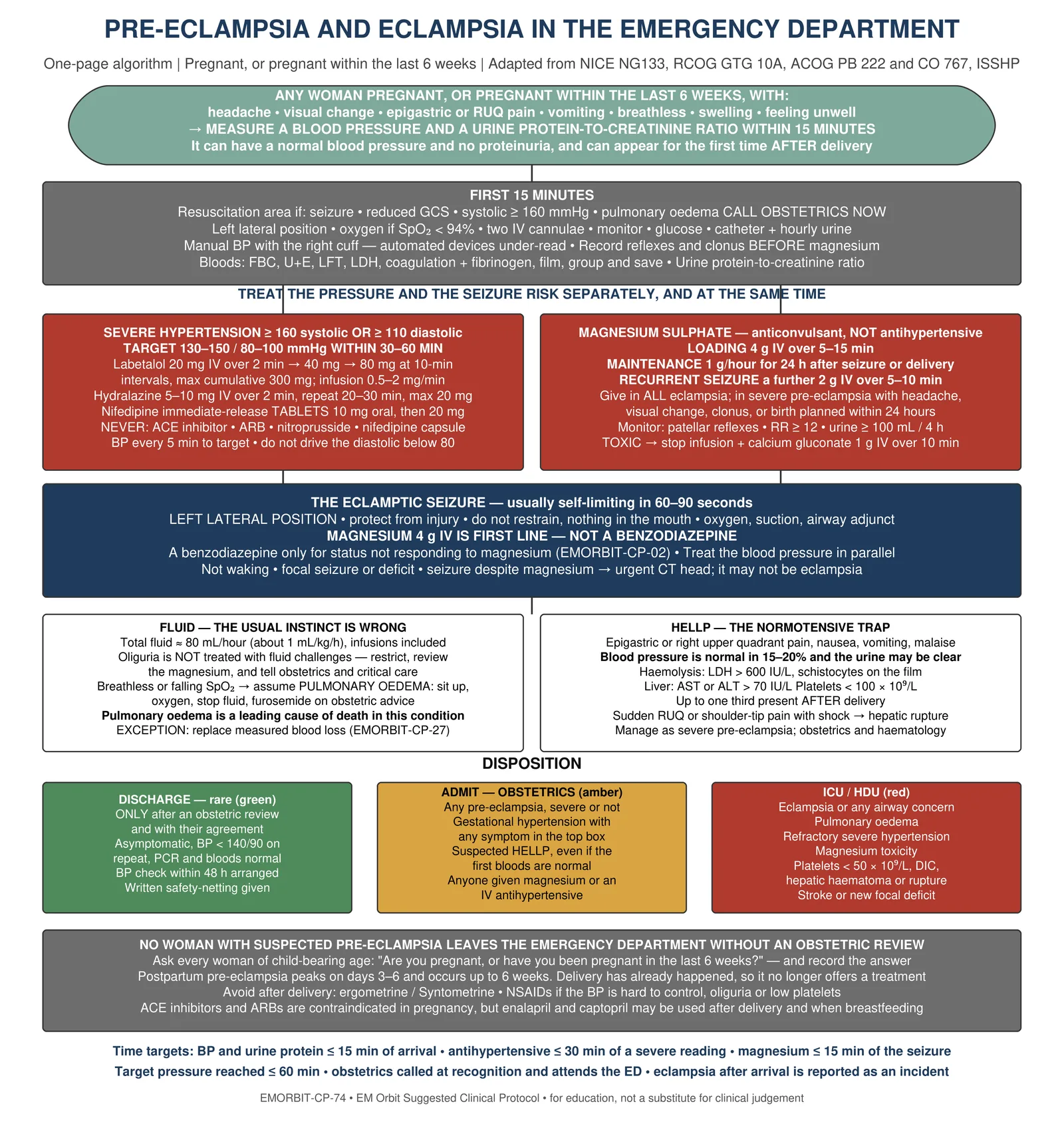
The one-page algorithm is shown at the top of this page.
6Team roles
6.1Triage Nurse:
6.1.1 Ask every woman of child-bearing age whether she is pregnant, or has been pregnant in the last 6 weeks, and record the answer with the gestation or the date of delivery.
6.1.2 Measure a manual blood pressure and obtain a urine sample for a protein-to-creatinine ratio within 15 minutes of arrival in any pregnant or recently pregnant woman with any symptom in Table 4, under the approved standing order and without waiting for physician review.
6.1.3 Assign Category 1 to any seizure, reduced conscious level, visual loss, pulmonary oedema, or a systolic of 160 mmHg or more in a pregnant or recently pregnant woman, and move her directly to the resuscitation area.
6.1.4 Alert the treating physician immediately to any pregnant or recently pregnant woman with a blood pressure of 140/90 mmHg or more, or with headache, visual disturbance, epigastric pain, vomiting or breathlessness at any blood pressure.
6.1.5 Use an appropriately sized cuff and confirm any severe automated reading manually.
6.2ED Nurses:
6.2.1 Nurse the woman in a monitored bed with one-to-one care, in a quiet area, in the left lateral position, with the cot sides padded where there is a seizure risk.
6.2.2 Record the blood pressure every 5 minutes until the target is reached and every 15 minutes thereafter.
6.2.3 Record the patellar reflexes, the respiratory rate and the hourly urine output on the magnesium monitoring chart and report immediately any loss of reflexes, a respiratory rate below 12 breaths per minute, or a urine output below 100 mL over 4 hours.
6.2.4 Maintain the fluid restriction and the hourly fluid balance chart, and challenge any fluid order that is not for measured loss.
6.2.5 Prepare and check the magnesium sulphate loading dose and infusion with a second nurse, and keep calcium gluconate immediately available at the bedside whenever magnesium is running.
6.2.6 Catheterise as directed; ensure privacy and dignity; keep her family informed and present where she wishes.
6.3Clinical Pharmacist:
6.3.1 Verify the magnesium sulphate loading and maintenance preparation against the local standard concentration, and ensure a ready-prepared presentation is stocked in the ED.
6.3.2 Ensure labetalol, hydralazine, immediate-release nifedipine tablets and calcium gluconate are stocked, in date and immediately accessible, and that short-acting nifedipine capsules are not stocked in the ED for this purpose.
6.3.3 Review the woman's medication for angiotensin-converting enzyme inhibitors, angiotensin receptor blockers, non-steroidal anti-inflammatory drugs and ergometrine-containing uterotonics, and advise on substitution.
6.3.4 Advise on dose adjustment of magnesium in renal impairment and on the interpretation of serum magnesium concentrations.
6.3.5 Provide postnatal and breastfeeding advice on antihypertensive choice with the obstetric team.
6.4Obstetrics and Gynaecology:
6.4.1 Attend the Emergency Department immediately for eclampsia, severe pre-eclampsia, suspected HELLP syndrome, and any pregnant or recently pregnant woman with a systolic of 160 mmHg or more.
6.4.2 Attend the same day for pre-eclampsia without severe features and for gestational hypertension with any symptom.
6.4.3 Take over the management, decide on fetal assessment, on magnesium prophylaxis where the ED has not already started it, and on the timing and mode of delivery.
6.4.4 Agree with the Emergency Department, and record in a joint standard operating procedure, the route by which a postnatal woman presenting to the ED is seen, the local threshold for immediate attendance, and the telephone number that is answered at all hours.
6.4.5 Provide an obstetric review before any woman with suspected pre-eclampsia is discharged from the ED.
6.5Midwifery:
6.5.1 Provide fetal heart assessment and cardiotocography in the ED where the obstetric team directs, and support the woman and her family.
6.5.2 Advise on the interpretation of the hand-held antenatal record.
6.6Anaesthesia and Critical Care:
6.6.1 Attend for eclampsia, airway compromise, pulmonary oedema, refractory hypertension and magnesium toxicity; advise on transfer and accept to intensive care or high dependency.
6.7Haematology:
6.7.1 Advise on severe thrombocytopenia, disseminated intravascular coagulation, the microangiopathy differential, and blood component support.
6.8Laboratory and Radiology:
6.8.1 Prioritise and report the full blood count, renal function, liver function, lactate dehydrogenase, coagulation profile and urine protein-to-creatinine ratio for this indication, and report critical results verbally.
6.8.2 Provide serum magnesium with a stated turnaround time and report the result in a unit that matches the guideline.
6.8.3 Provide urgent computed tomography of the head and hepatic imaging, and do not require a separate justification for imaging a pregnant woman where the indication is stated.
6.9Ambulance and Pre-hospital Providers:
6.9.1 Pre-alert the ED for any pregnant or recently pregnant woman with a seizure, a reduced conscious level, a systolic of 160 mmHg or more, or breathlessness, stating the gestation or the date of delivery.
6.9.2 Transport in the left lateral position; give oxygen; obtain intravenous access; record serial blood pressures.
6.9.3 Report the blood pressure at the scene, any magnesium or antihypertensive already given with the time and dose, and the description of any seizure.
7The patient's role
7.1 Tell the healthcare team if you are pregnant, or have been pregnant, given birth, miscarried or had a termination in the last 6 weeks, however unrelated it seems to why you came.
7.2 Bring your hand-held antenatal notes and any medicines you are taking, and say whether you have been taking aspirin.
7.3 Describe your symptoms plainly: headache, changes in your vision, pain below the ribs, vomiting, breathlessness, swelling, or simply that you feel unwell or unlike yourself.
7.4 Allow a blood pressure to be measured and a urine sample to be taken, even if you feel well.
7.5 Understand that fluids are deliberately restricted in this condition, and that this is a treatment and not neglect.
7.6 After discharge, attend the blood pressure check that is arranged for you, take any medicine as prescribed, and do not stop it because you feel better.
7.7 Return immediately for a severe headache, any change in vision, pain below the ribs, vomiting, breathlessness, sudden swelling, reduced baby movements, a fit, or feeling much worse — including in the weeks after your baby is born.
7.8 Family and partners: if she becomes confused, drowsy, restless or has a fit, call the emergency number at once, lay her on her left side, and do not put anything in her mouth.
8Definitions
8.1Hypertension in Pregnancy: a systolic blood pressure of 140 mmHg or more, or a diastolic blood pressure of 90 mmHg or more, measured correctly. Severe hypertension is a systolic of 160 mmHg or more, or a diastolic of 110 mmHg or more.
8.2Chronic (Pre-existing) Hypertension: hypertension present before pregnancy or before 20 completed weeks of gestation, or persisting beyond 12 weeks postpartum.
8.3Gestational Hypertension: new hypertension after 20 completed weeks without proteinuria, maternal organ dysfunction or uteroplacental dysfunction.
8.4Pre-eclampsia: new hypertension after 20 completed weeks, or up to 6 weeks postpartum, accompanied by proteinuria, by maternal organ dysfunction, or by uteroplacental dysfunction. Proteinuria is not required for the diagnosis.
8.5Superimposed Pre-eclampsia: pre-eclampsia developing in a woman with chronic hypertension or chronic kidney disease.
8.6Severe Pre-eclampsia: pre-eclampsia with any severe feature listed in Table 3.
8.7Eclampsia: a generalised tonic–clonic seizure occurring in a woman with pre-eclampsia, in the absence of another cause, from 20 weeks of gestation to 6 weeks postpartum. In up to one third of cases the seizure is the first manifestation of the disease.
8.8HELLP Syndrome: the combination of haemolysis, elevated liver enzymes and a low platelet count, a severe variant of pre-eclampsia that may present with epigastric pain and a normal blood pressure.
8.9Proteinuria (for this guideline): a urine protein-to-creatinine ratio of 30 mg/mmol or more, an albumin-to-creatinine ratio of 8 mg/mmol or more, or 300 mg or more of protein in a 24-hour collection. A reagent-strip result is a screening trigger only.
8.10Magnesium Sulphate: the anticonvulsant of choice for the prevention and treatment of eclamptic seizures. It is not an antihypertensive. It is spelled "magnesium sulfate" in EMORBIT-CP-40 and "magnesium sulphate" in EMORBIT-CP-02 and in this guideline; it is the same drug and the regimen is identical in all three. Note: one spelling should be adopted across the library.
8.11Posterior Reversible Encephalopathy Syndrome (PRES): vasogenic cerebral oedema, typically parieto-occipital on magnetic resonance imaging, which may accompany eclampsia and severe hypertension and which usually reverses with control of the blood pressure.
8.12Resuscitative Hysterotomy (Perimortem Caesarean Section): delivery of the fetus during maternal cardiac arrest at 20 weeks of gestation or beyond, performed primarily for maternal benefit by relieving aortocaval compression; started within 4 minutes of arrest (EMORBIT-CP-03).
8.13NICE, RCOG, ACOG, ISSHP, RCEM, ACEP, ACEM, MBRRACE-UK: National Institute for Health and Care Excellence; Royal College of Obstetricians and Gynaecologists; American College of Obstetricians and Gynecologists; International Society for the Study of Hypertension in Pregnancy; Royal College of Emergency Medicine; American College of Emergency Physicians; Australasian College for Emergency Medicine; Mothers and Babies: Reducing Risk through Audits and Confidential Enquiries across the UK.
9Attachments
- Attachment 1: One-page algorithm (top of this page)
- Attachment 2: Classification, Diagnostic Criteria and Severe Features
- Attachment 3: Magnesium Sulphate and Antihypertensive Regimens, with Monitoring, Toxicity Management, Fluid Rules and the HELLP Screen
- Attachment 4: Obstetric Referral and Handover Checklist
11Suggested quality indicators
11.1Blood pressure and urine protein measured (process): (Number of women who are pregnant or within 6 weeks of delivery presenting with headache, visual disturbance, epigastric or right upper quadrant pain, vomiting, breathlessness, swelling or malaise in whom a blood pressure AND a urine protein test were documented / Total number of such women) × 100. Target ≥ 95%.
11.2Time to first antihypertensive in severe hypertension: (Number of pregnant or recently pregnant women with a systolic of 160 mmHg or more, or a diastolic of 110 mmHg or more, who received an antihypertensive within 30 minutes of that reading / Total number of such women) × 100. Target ≥ 90%.
11.3Blood pressure target achieved: (Number of pregnant or recently pregnant women with severe hypertension in whom a systolic of 130–150 mmHg and a diastolic of 80–100 mmHg were documented within 60 minutes of the first severe reading / Total number of such women) × 100. Target ≥ 80%.
11.4Time to magnesium sulphate: (Number of women with eclampsia who received the magnesium sulphate loading dose within 15 minutes of the seizure, and women with severe pre-eclampsia with neurological features who received it within 30 minutes of the decision to give it / Total number of such women) × 100. Target ≥ 90%.
11.5Obstetric review documented (safe disposition): (Number of women with suspected or confirmed pre-eclampsia in whom an obstetric review, with the reviewer's name and grade and the agreed plan, was documented before they left the ED / Total number of such women) × 100. Target 100%.
11.6Pregnancy status asked at triage: (Number of women of child-bearing age attending the ED in whom pregnancy status, including pregnancy within the last 6 weeks, is recorded at triage / Total number of women of child-bearing age attending) × 100. Target ≥ 95%.
11.7Outcome indicators (monitored, no fixed target): Eclampsia occurring after arrival in the Emergency Department; any case of pre-eclampsia, eclampsia or HELLP syndrome not recognised at a first ED attendance and diagnosed at a subsequent one; pulmonary oedema developing in the ED; magnesium toxicity requiring calcium gluconate; admission to intensive care; and maternal death or near-miss. Note: all targets above are proposed departmental figures, not published standards, and require agreement with Obstetrics and the Quality team.
13References
- National Institute for Health and Care Excellence. Hypertension in pregnancy: diagnosis and management. NICE guideline NG133. London: NICE; 2019 (updated 2023).
- Royal College of Obstetricians and Gynaecologists. The Management of Severe Pre-eclampsia/Eclampsia. Green-top Guideline No. 10(A). London: RCOG; 2006 (reviewed).
- Royal College of Obstetricians and Gynaecologists. Maternal Collapse in Pregnancy and the Puerperium. Green-top Guideline No. 56. London: RCOG; 2011.
- American College of Obstetricians and Gynecologists. Gestational Hypertension and Preeclampsia. ACOG Practice Bulletin No. 222. Obstet Gynecol. 2020;135(6):e237–e260.
- American College of Obstetricians and Gynecologists. Emergent Therapy for Acute-Onset, Severe Hypertension During Pregnancy and the Postpartum Period. ACOG Committee Opinion No. 767. Obstet Gynecol. 2019;133(2):e174–e180.
- Brown MA, Magee LA, Kenny LC, et al. Hypertensive Disorders of Pregnancy: ISSHP Classification, Diagnosis, and Management Recommendations for International Practice. Hypertension. 2018;72(1):24–43.
- Magee LA, Brown MA, Hall DR, et al. The 2021 International Society for the Study of Hypertension in Pregnancy classification, diagnosis and management recommendations for international practice. Pregnancy Hypertens. 2022;27:148–169.
- Altman D, Carroli G, Duley L, et al. Do women with pre-eclampsia, and their babies, benefit from magnesium sulphate? The Magpie Trial: a randomised placebo-controlled trial. Lancet. 2002;359(9321):1877–1890.
- The Eclampsia Trial Collaborative Group. Which anticonvulsant for women with eclampsia? Evidence from the Collaborative Eclampsia Trial. Lancet. 1995;345(8963):1455–1463.
- Duley L, Gülmezoglu AM, Henderson-Smart DJ, Chou D. Magnesium sulphate and other anticonvulsants for women with pre-eclampsia. Cochrane Database Syst Rev. 2010;(11):CD000025.
- World Health Organization. WHO recommendations for prevention and treatment of pre-eclampsia and eclampsia. Geneva: WHO; 2011.
- Sibai BM. Diagnosis, controversies, and management of the syndrome of hemolysis, elevated liver enzymes, and low platelet count. Obstet Gynecol. 2004;103(5):981–991.
- Knight M, Bunch K, Felker A, et al., on behalf of MBRRACE-UK. Saving Lives, Improving Mothers' Care: lessons learned to inform maternity care from the UK and Ireland Confidential Enquiries into Maternal Deaths and Morbidity. Oxford: National Perinatal Epidemiology Unit, University of Oxford.
- Royal College of Emergency Medicine. Best practice and clinical standards relevant to the pregnant and recently pregnant patient in the Emergency Department. London: RCEM.
A2Attachment 2: Classification, Diagnostic Criteria and Severe Features
The diagnosis does not require proteinuria, and it does not require the pregnancy to be ongoing.
| Disorder | Timing | Definition | What it means in the ED |
|---|---|---|---|
| Chronic (pre-existing) hypertension | Present before pregnancy, or before 20 completed weeks | Blood pressure of 140/90 mmHg or more, present before conception or before 20 weeks, or persisting beyond 12 weeks postpartum | She is not protected. About one in four develops superimposed pre-eclampsia. Check for new proteinuria and new organ dysfunction at every attendance |
| Gestational hypertension | New after 20 completed weeks | New hypertension of 140/90 mmHg or more after 20 weeks, without proteinuria and without maternal organ dysfunction or uteroplacental dysfunction | Up to one quarter progress to pre-eclampsia, and the progression can be rapid. It is a reason for urgent obstetric review, not for reassurance |
| PRE-ECLAMPSIA (without severe features) | After 20 weeks, and up to 6 weeks postpartum | New hypertension of 140/90 mmHg or more after 20 weeks with proteinuria, or with any maternal organ dysfunction listed in Table 2, or with uteroplacental dysfunction — proteinuria is no longer required for the diagnosis | Obstetric assessment on the same day. The ED does not exclude this diagnosis and does not discharge the patient without obstetric review |
| PRE-ECLAMPSIA WITH SEVERE FEATURES | As above | Pre-eclampsia with any feature in Table 3 — including a systolic of 160 mmHg or more or a diastolic of 110 mmHg or more, neurological or visual symptoms, epigastric or right upper quadrant pain, pulmonary oedema, a platelet count below 100 × 10⁹/L, renal or hepatic involvement | A time-critical emergency. Antihypertensive treatment and magnesium sulphate, obstetric attendance immediately, and admission |
| ECLAMPSIA | After 20 weeks, and up to 6 weeks postpartum | A generalised tonic–clonic seizure in a woman with pre-eclampsia, in the absence of another cause. In up to a third of cases the seizure is the first sign and there was no preceding diagnosis of pre-eclampsia | Resuscitation-room emergency. Magnesium sulphate is the first-line anticonvulsant, not a benzodiazepine (EMORBIT-CP-02) |
| HELLP SYNDROME | Usually third trimester; up to one third present postpartum | Haemolysis, Elevated Liver enzymes and Low Platelets, usually but not always with hypertension and proteinuria | May present as epigastric pain and vomiting with a normal blood pressure and no proteinuria. Send the bloods in Table 9 on any pregnant or recently pregnant woman with upper abdominal pain |
| Superimposed pre-eclampsia | After 20 weeks in a woman with chronic hypertension or chronic kidney disease | New proteinuria, a sudden rise in existing proteinuria, a sudden rise in blood pressure, or new maternal organ dysfunction in a woman with pre-existing hypertension or renal disease | The hardest group to recognise, because the hypertension is not new. Compare with her booking and clinic readings, which shall be obtained |
| White-coat and masked hypertension | Any | Raised in clinic and normal at home (white-coat), or normal in clinic and raised at home (masked) | Not an ED diagnosis. A single normal ED reading in a symptomatic woman does not exclude pre-eclampsia; repeat it and refer |
Gestational age is counted from the first day of the last menstrual period. Hypertension arising before 20 weeks is chronic hypertension until proved otherwise, and if it is accompanied by proteinuria and organ dysfunction the differential includes molar pregnancy, renal disease, thrombotic microangiopathy and phaeochromocytoma; obstetric and physician input is required.
| Criterion | What satisfies it |
|---|---|
| HYPERTENSION (required in every case) | Systolic 140 mmHg or more, or diastolic 90 mmHg or more, on two occasions at least 4 hours apart — or on a single occasion where the reading is 160/110 mmHg or more, which shall not be left unconfirmed and untreated while a repeat is awaited. Use an appropriately sized cuff, the arm supported at heart level, the woman seated or in a left lateral tilt, and Korotkoff phase V for the diastolic |
| and at least ONE of: | |
| Proteinuria | Urine protein-to-creatinine ratio of 30 mg/mmol or more, or albumin-to-creatinine ratio of 8 mg/mmol or more, or 300 mg or more in a 24-hour collection. An automated reagent-strip reading of 1+ or more is a screening trigger only and shall always be followed by a quantitative ratio on the same sample. A negative dipstick does not exclude pre-eclampsia |
| Renal involvement | Serum creatinine above 90 micromol/L (about 1.02 mg/dL) in the absence of other renal disease, or a doubling from a known baseline, or oliguria. Creatinine falls in normal pregnancy, so a "normal" adult value may already represent injury |
| Hepatic involvement | Transaminases above 40 IU/L (NICE) or more than twice the upper limit of the local reference range (ACOG), with or without severe persistent right upper quadrant or epigastric pain not accounted for by another diagnosis |
| Haematological involvement | Platelet count below 150 × 10⁹/L, disseminated intravascular coagulation, or haemolysis. A platelet count below 100 × 10⁹/L is a severe feature |
| Neurological involvement | Eclampsia; altered mental state; blindness, scotomata or other persistent visual disturbance; stroke; clonus (three beats or more); severe headache; persistent visual scintillations |
| Pulmonary involvement | Pulmonary oedema, or new hypoxaemia not otherwise explained |
| Uteroplacental dysfunction | Fetal growth restriction, abnormal umbilical artery Doppler waveform analysis, placental abruption, or stillbirth — assessed by the obstetric team, not by the ED |
The single most important consequence of this table for emergency practice is that a woman can have pre-eclampsia with no protein in her urine. Pre-eclampsia is a multi-system disorder, and a normal dipstick has been the recorded reason for a missed diagnosis in maternal death enquiries. Send a protein-to-creatinine ratio, a full blood count, renal function and liver function, and refer on the clinical picture.
| System | Severe feature | What it changes |
|---|---|---|
| Blood pressure | Systolic 160 mmHg or more, or diastolic 110 mmHg or more | Antihypertensive treatment is required. Target systolic 130–150 mmHg and diastolic 80–100 mmHg, achieved within 30–60 minutes (identical to EMORBIT-CP-40) |
| Neurological | New or severe headache unrelieved by simple analgesia; visual disturbance — blurring, flashing lights, scotomata, diplopia, transient or persistent blindness; altered mental state; hyper-reflexia with sustained clonus of three beats or more; stroke | Magnesium sulphate. Headache and visual disturbance are the prodrome of eclampsia and are the symptoms most often attributed to migraine, dehydration or "normal pregnancy" |
| Abdominal | Severe persistent right upper quadrant or epigastric pain, with or without nausea and vomiting, not responding to medication and not accounted for by another diagnosis | Hepatic capsular distension or HELLP syndrome. Send the HELLP bloods (Table 9). Do not attribute it to gastritis, reflux or biliary colic without excluding pre-eclampsia |
| Respiratory | Pulmonary oedema, breathlessness, orthopnoea, oxygen saturation below 95% on air | Sit her up, give oxygen, restrict fluid, and involve critical care. Pulmonary oedema is a leading cause of death in this condition and is usually iatrogenic or fluid-related |
| Haematological | Platelet count below 100 × 10⁹/L; evidence of haemolysis; disseminated intravascular coagulation | HELLP syndrome. Group and save, coagulation profile with fibrinogen, and early haematology and obstetric involvement |
| Renal | Creatinine above 90 micromol/L or doubling from baseline; oliguria below 0.5 mL/kg/hour or less than 100 mL over 4 hours | Reduce the magnesium maintenance infusion and monitor more closely (Table 7). Oliguria is not an indication for a fluid challenge in this condition |
| Hepatic | Transaminases above 40 IU/L, or more than twice the upper limit of the local reference range; hepatic haematoma or rupture | HELLP syndrome; consider hepatic imaging where the pain is severe and the transaminases are very high |
| Fetal | Fetal growth restriction, abnormal Doppler, abruption, reduced or absent fetal movements, fetal heart rate abnormality | Obstetric and midwifery assessment. Fetal assessment does not precede maternal stabilisation |
Severe features are additive but not cumulative in their urgency: one is enough. A woman with a normal blood pressure and a platelet count of 60 × 10⁹/L has severe disease. A woman with a systolic of 175 mmHg and no symptoms has severe disease. Both need magnesium sulphate considered, immediate obstetric involvement and admission.
| Presenting complaint | What it may be | Where it is usually mis-sent |
|---|---|---|
| Headache | Pre-eclampsia; eclampsia prodrome; posterior reversible encephalopathy syndrome; cerebral venous thrombosis; subarachnoid haemorrhage | Discharged as migraine, tension headache or dehydration, with analgesia and no blood pressure recorded |
| Visual disturbance — blurring, flashing lights, spots, double or lost vision | Pre-eclampsia; retinal arteriolar spasm; cortical blindness; PRES | Referred to ophthalmology without a blood pressure |
| Epigastric or right upper quadrant pain | HELLP syndrome and hepatic capsular distension | Treated as gastritis, reflux or biliary colic; given a proton-pump inhibitor and discharged |
| Nausea and vomiting, particularly new in the second half of pregnancy | Pre-eclampsia; HELLP syndrome | Treated as gastroenteritis or as hyperemesis, which is a first-trimester diagnosis |
| Breathlessness, orthopnoea, cough, chest tightness | Pulmonary oedema of pre-eclampsia; peripartum cardiomyopathy; pulmonary embolism (EMORBIT-CP-07) | Treated as anxiety, anaemia or "normal in pregnancy" |
| Swelling of the face, hands or feet; sudden weight gain | Pre-eclampsia | Dismissed as physiological oedema. Oedema alone is not diagnostic, but sudden facial or hand swelling with any other symptom is |
| Seizure or collapse | Eclampsia until proved otherwise (EMORBIT-CP-02) | Treated as a first fit or as syncope, with benzodiazepines and no magnesium |
| Reduced fetal movements, abdominal pain, vaginal bleeding | Abruption complicating pre-eclampsia | Sent to the obstetric unit without a maternal blood pressure being recorded first |
| "Just feeling unwell", malaise, restlessness, a sense that something is wrong | Pre-eclampsia and HELLP syndrome both present this way | Triaged low and left in the waiting area |
| ANY of the above in a woman who has delivered in the last 6 weeks | Postpartum pre-eclampsia and postpartum eclampsia, which may arise for the first time after delivery | The single commonest circumstance in which this diagnosis is missed in the ED, because the pregnancy is over and is not asked about |
The question "are you pregnant, or have you been pregnant in the last 6 weeks?" shall be asked of every woman of child-bearing age at triage, and the answer shall be recorded. Where the answer is yes and any symptom above is present, a manual blood pressure and a urine protein-to-creatinine ratio are mandatory and shall be obtained within 15 minutes of arrival.
A3Attachment 3: Magnesium Sulphate and Antihypertensive Regimens, with Monitoring, Toxicity Management, Fluid Rules and the HELLP Screen
Every figure in the two regimen tables below is reproduced from EMORBIT-CP-40 (Hypertensive Emergency and Hypertensive Urgency) and EMORBIT-CP-02 (Convulsive Status Epilepticus and First Seizure). They are shared numbers: if any of these figures is revised, all three guidelines shall be amended together.
The four magnesium figures to remember: loading 4 g over 5–15 minutes; maintenance 1 g/hour for 24 hours after the seizure or after delivery, whichever is later; a recurrent seizure 2 g over 5–10 minutes; toxicity calcium gluconate 1 g intravenously.
The two blood pressure figures to remember: treat at 160 systolic or 110 diastolic; target 130–150 over 80–100 within 30 to 60 minutes.
| Agent | Dose and route | Onset / duration | Cautions |
|---|---|---|---|
| TREAT ANY SYSTOLIC OF 160 mmHg OR MORE, OR ANY DIASTOLIC OF 110 mmHg OR MORE. TARGET SYSTOLIC 130–150 mmHg AND DIASTOLIC 80–100 mmHg, ACHIEVED WITHIN 30–60 MINUTES. | |||
| Labetalol, intravenously (first line where intravenous access is available) | 20 mg intravenously over 2 minutes. If the pressure remains above threshold at 10 minutes, 40 mg; then at 10 minutes, 80 mg; repeating and doubling to a maximum cumulative dose of 300 mg. Infusion: 0.5–2 mg/min titrated to effect, at a concentration of 1 mg/mL (200 mg made up to 200 mL with 0.9% sodium chloride or 5% glucose), which is 30–120 mL/hour | Onset 5–10 minutes; duration 2–6 hours | Asthma, decompensated heart failure, high-grade atrioventricular block, bradycardia. Neonatal bradycardia and hypoglycaemia where given close to delivery — inform the neonatal team |
| Hydralazine, intravenously | 5–10 mg intravenously over 2 minutes; repeat every 20–30 minutes as required, to a maximum of 20 mg. Infusion, where used: 200–300 micrograms/min initially, maintenance 50–150 micrograms/min | Onset 5–20 minutes; duration 2–6 hours and unpredictable | The effect is unpredictable in magnitude and duration, and precipitous falls occur, with fetal heart rate abnormality. Reflex tachycardia and maternal headache are common and the headache may be mistaken for a worsening prodrome. It has the longest record of use in pregnancy |
| Nifedipine, immediate-release oral tablets (where there is no intravenous access, or as first line by some units) | 10 mg orally. If the pressure remains above threshold at 20 minutes, 20 mg orally; and a further 20 mg at 20 minutes if still above threshold. Note: the ceiling dose in the first hour, and whether the department adopts oral nifedipine or intravenous labetalol as its default first agent, should be agreed locally with Obstetrics and Clinical Pharmacy. | Onset 10–20 minutes; duration 4–6 hours | Short-acting nifedipine CAPSULES, and any sublingual or bitten capsule, shall not be used — the fall is uncontrolled and cannot be stopped (EMORBIT-CP-40). The immediate-release tablet is a different, controlled preparation. Headache and flushing are common |
| CONTRAINDICATED — SHALL NOT BE GIVEN | |||
| Angiotensin-converting enzyme inhibitors and angiotensin receptor blockers | Shall not be given in pregnancy | — | Fetal renal failure, oligohydramnios, skull hypoplasia and death. Enalapril and captopril may be used postpartum, including during breastfeeding, on obstetric or physician advice |
| Sodium nitroprusside | Shall not be given | — | Fetal cyanide and thiocyanate accumulation; it also raises intracranial pressure. Reserve agent only, and only on critical care advice after delivery (EMORBIT-CP-40) |
| Diuretics for blood pressure control, and volume expansion to "improve the circulation" | Shall not be given for blood pressure control | — | The intravascular volume is already contracted and the problem is endothelial, not volumetric. A loop diuretic is given only for established pulmonary oedema |
| Ergometrine and combined ergometrine–oxytocin (Syntometrine) for the third stage or for postpartum haemorrhage | Shall not be given where there is hypertension or pre-eclampsia | — | Causes a severe rise in blood pressure, stroke and eclampsia. Use oxytocin alone; discuss any further uterotonic with obstetrics |
| Non-steroidal anti-inflammatory drugs, including for postpartum analgesia | Avoid where the blood pressure is difficult to control, where there is oliguria or renal impairment, or where the platelet count is low | — | They raise the blood pressure, worsen renal function and add bleeding risk. Use paracetamol and opioids instead (EMORBIT-CP-20) |
The rate of reduction matters. A sudden or excessive fall reduces uteroplacental perfusion and causes fetal distress; continuous fetal monitoring shall be in place during and after the first dose where the gestation makes it appropriate, and the blood pressure shall be recorded every 5 minutes until the target is reached and every 15 minutes thereafter. Do not chase a normal blood pressure: the target band in the row above is the target, and the diastolic shall not be driven below 80 mmHg.
| Indication / phase | Dose and route | Notes |
|---|---|---|
| Loading dose — eclamptic seizure, or prophylaxis in severe pre-eclampsia | 4 g intravenously over 5–15 minutes | Give it at the first seizure and do not wait for it to stop; the seizure is usually self-limiting within 60–90 seconds. Usually given as 4 g (8 mL of 50% magnesium sulphate) diluted in 100 mL of 0.9% sodium chloride |
| Maintenance infusion | 1 g/hour for 24 hours after the seizure or after delivery, whichever is later | Started immediately after the loading dose and continued through transfer. It is not stopped because the woman has stopped fitting |
| Recurrent seizure while on magnesium | A further 2 g intravenously over 5–10 minutes | Alternatively the infusion rate may be increased to 1.5–2 g/hour on obstetric advice. Send a magnesium level. A third seizure, or a seizure with a focal deficit or a failure to regain consciousness, requires urgent imaging and critical care — it may not be eclampsia (EMORBIT-CP-02) |
| Prophylaxis — who gets it | The same loading and maintenance regimen | Give magnesium sulphate to every woman with eclampsia. Give it in severe pre-eclampsia where birth is planned within 24 hours, where there are neurological signs or symptoms, or where the obstetric team requests it. The Magpie Trial showed that magnesium halves the risk of eclampsia in pre-eclampsia |
| Renal impairment | The loading dose is unchanged. Reduce or omit the maintenance infusion where the creatinine is raised or the urine output is low, and measure serum magnesium | Magnesium is cleared entirely by the kidney. This is the commonest route to toxicity in this condition. Where the creatinine is above 90–150 micromol/L, a maintenance rate of 0.5 g/hour with 4-hourly levels is a reasonable starting position, on obstetric or critical care advice |
| Toxicity — antidote | Calcium gluconate 1 g intravenously (10 mL of 10% calcium gluconate) over 10 minutes | Stop the magnesium infusion at the same time. Support the airway and ventilation; the effect of calcium is transient and a further dose may be needed |
Magnesium sulphate is an anticonvulsant, not an antihypertensive. It lowers the blood pressure only modestly and shall never be used as the antihypertensive in pre-eclampsia (EMORBIT-CP-40). A woman who has received magnesium still requires an antihypertensive if her systolic is 160 mmHg or more or her diastolic is 110 mmHg or more, and a woman who has received an antihypertensive still requires magnesium if she has eclampsia or severe pre-eclampsia with neurological features.
| Parameter | Frequency | Threshold that requires action | Response |
|---|---|---|---|
| Patellar (deep tendon) reflexes | Hourly, and before any rate increase | Reflexes absent or markedly reduced | Stop the infusion. Assess the respiratory rate and conscious level. Send a magnesium level. Loss of reflexes is the earliest clinical sign and precedes respiratory depression |
| Respiratory rate | Every 15 minutes during the loading dose, then hourly | Fewer than 12 breaths per minute | Stop the infusion. Give calcium gluconate 1 g intravenously over 10 minutes. Give oxygen, support ventilation, call for anaesthetic help |
| Urine output | Hourly, with an indwelling catheter and a fluid balance chart | Less than 100 mL over 4 hours, or below 0.5 mL/kg/hour | Reduce or stop the maintenance infusion and send a magnesium level and creatinine. Do not give a fluid challenge to correct the urine output — see section 4.3.4 |
| Oxygen saturation and conscious level | Continuously during the loading dose and while the infusion runs | Any fall in saturation, drowsiness, slurred speech, double vision, flushing or a feeling of warmth with weakness | Reassess for toxicity; slow or stop the infusion; send a level |
| Blood pressure and pulse | Every 5 minutes until the target is reached, then every 15 minutes | Systolic 160 mmHg or more, or diastolic 110 mmHg or more; or a fall below the target band | Treat or reduce as in Table 5. A diastolic below 80 mmHg or any fetal heart rate abnormality means the reduction has gone too far |
| Serum magnesium concentration | Not required routinely where the reflexes, respiratory rate and urine output are normal. Required where there is renal impairment, oliguria, a recurrent seizure, or any clinical sign of toxicity | Therapeutic range approximately 2–4 mmol/L. Loss of patellar reflexes at approximately 4–5 mmol/L; respiratory depression at approximately 5–6.5 mmol/L; cardiac conduction change and arrest above approximately 10–12 mmol/L | These concentration bands are approximate and laboratory units differ. Note: the exact reporting unit and reference range of the local laboratory should be inserted before use. |
| Cardiac monitoring | Continuous | Widening QRS, prolonged PR, bradycardia, hypotension | Stop the infusion; calcium gluconate; critical care |
The three bedside observations — patellar reflexes, respiratory rate and urine output — are sufficient to detect magnesium toxicity in a woman with normal renal function, and shall be recorded on the magnesium monitoring chart in Attachment 3 by the nurse caring for her. A woman receiving magnesium sulphate requires one-to-one nursing in a monitored bed and shall not be left in a corridor or a cubicle without direct observation.
| Situation | The instinct | What this guideline requires |
|---|---|---|
| Oliguria in severe pre-eclampsia | Give a fluid challenge and repeat it until she passes urine | Do not. Total fluid, including drug infusions and oral intake, shall be restricted to approximately 80 mL/hour (about 1 mL/kg/hour) unless there is ongoing measured loss such as haemorrhage. Oliguria for a few hours is tolerated. Persistent oliguria is discussed with obstetrics and critical care, not corrected with boluses |
| Hypotension after an antihypertensive | Fluid bolus | Stop or slow the antihypertensive first, and position her in the left lateral position to relieve aortocaval compression. Give fluid only in a small, measured aliquot (250 mL) and only after senior review |
| Breathlessness or falling saturation | Fluid and oxygen | Assume pulmonary oedema. Sit her up, give oxygen, stop all non-essential fluid, and give furosemide on obstetric or critical care advice. Consider non-invasive ventilation. Pulmonary oedema is a leading cause of death in pre-eclampsia and is largely iatrogenic |
| Haemorrhage — abruption or postpartum haemorrhage | Restrict fluid because she has pre-eclampsia | Resuscitate the haemorrhage. Measured blood loss is replaced with blood products under the massive haemorrhage pathway (EMORBIT-CP-27). The fluid restriction applies to maintenance fluid, not to the replacement of measured loss |
| Before regional anaesthesia or caesarean section | Preload with a litre of crystalloid | This is an anaesthetic decision and shall not be pre-empted in the ED |
Why: pre-eclampsia is a disorder of the vascular endothelium. The plasma is already leaking out of the intravascular space into the interstitium, the colloid oncotic pressure is low, and the lung is the organ that shows it first. Fluid given to correct a number — a low urine output, a low blood pressure — ends in the alveoli. The correct response to oliguria in pre-eclampsia is restriction, monitoring and obstetric involvement, and the correct treatment of the whole disease is delivery.
| Component | Threshold | Note |
|---|---|---|
| H — Haemolysis | Lactate dehydrogenase above 600 IU/L; raised unconjugated bilirubin; fragmented red cells (schistocytes) on the blood film; falling haptoglobin; anaemia | Send a blood film and lactate dehydrogenase explicitly — they are not part of a standard full blood count request |
| EL — Elevated Liver enzymes | Aspartate transaminase or alanine transaminase above 70 IU/L, or more than twice the upper limit of the local reference range | The rise may be modest at first and rises steeply over hours. A normal result does not exclude evolving HELLP — repeat at 6 hours if the pain persists |
| LP — Low Platelets | Platelet count below 100 × 10⁹/L | The Mississippi classification grades severity by platelet count: class 1 at 50 × 10⁹/L or below, class 2 above 50 up to 100 × 10⁹/L, class 3 above 100 up to 150 × 10⁹/L |
| Blood pressure | May be normal in 15–20% of cases | This is the trap. HELLP presents as epigastric or right upper quadrant pain, nausea and vomiting, and malaise, in a woman who may be normotensive and may have no proteinuria. It has been diagnosed as gastritis, viral illness, cholecystitis and gastroenteritis in women who subsequently died |
| Timing | Up to one third present after delivery, usually within 48 hours but up to 6 weeks | Ask every woman with upper abdominal pain whether she has delivered in the last 6 weeks |
| Complications to look for | Disseminated intravascular coagulation; placental abruption; acute kidney injury; pulmonary oedema; subcapsular hepatic haematoma and hepatic rupture; stroke | Sudden severe right upper quadrant or shoulder-tip pain with shock suggests hepatic rupture: this is a surgical and obstetric emergency requiring immediate imaging, blood products and theatre |
| Differential diagnosis | Acute fatty liver of pregnancy; thrombotic thrombocytopenic purpura; haemolytic uraemic syndrome; acute viral hepatitis; antiphospholipid syndrome; cholestasis of pregnancy; systemic lupus erythematosus flare; sepsis | The distinction is made with obstetrics, haematology and physicians; the ED action — bloods, obstetric referral, admission — is the same for all of them |
A4Attachment 4: Obstetric Referral and Handover Checklist
This checklist shall be completed for every woman referred to Obstetrics with a hypertensive disorder of pregnancy and filed in the medical record, with a copy retained by the ED quality team for audit. It is also the transfer checklist where the receiving obstetric unit is at another facility.
| Item | Time | Entry / initials |
|---|---|---|
| Arrival at the ED | ||
| Pregnancy status asked and recorded (pregnant / delivered within 6 weeks) | Gestation ______ weeks or delivered ____ / ____ | |
| First blood pressure (state manual or automated) | ______ / ______ mmHg | |
| Urine protein test sent (state which test) | PCR ______ mg/mmol | |
| Highest blood pressure recorded in the ED | ______ / ______ mmHg | |
| First antihypertensive given (agent and dose) | ||
| Target 130–150 / 80–100 mmHg first achieved | ______ / ______ mmHg | |
| Magnesium sulphate loading dose 4 g started | ||
| Magnesium maintenance 1 g/hour started | ||
| Further 2 g given for a recurrent seizure | ||
| Obstetric team called | Name / grade: ____________ | |
| Obstetric team attended | ||
| Departure from the ED (destination) |
| Item | Entry |
|---|---|
| Gestation, parity, booking unit, booking blood pressure | |
| Symptoms present: headache / visual / epigastric / vomiting / breathless / swelling / malaise | |
| Reflexes and clonus before magnesium (beats) | |
| Seizures: number, duration, time of each | |
| Platelets / creatinine / ALT or AST / LDH / PCR | |
| Total fluid given in the ED (mL) and urine output (mL) | |
| Fetal assessment performed and by whom | |
| Drugs given, with times; drugs deliberately withheld and why | |
| Outstanding results and who will chase them |
| ✓ | Item |
|---|---|
| ☐ | Pregnancy status, including pregnancy within the last 6 weeks, is documented. |
| ☐ | A blood pressure and a quantitative urine protein have been obtained, not a dipstick alone. |
| ☐ | Full blood count, renal function, liver function and lactate dehydrogenase have been sent. |
| ☐ | Severe hypertension was treated, and the target 130–150 / 80–100 mmHg was reached or the reason it was not is documented. |
| ☐ | Magnesium sulphate was given where indicated, and the loading dose, infusion rate and start time are handed over. |
| ☐ | Calcium gluconate is available and travels with the woman while magnesium is running. |
| ☐ | Reflexes, respiratory rate and urine output are documented on the magnesium monitoring chart. |
| ☐ | Fluid has been restricted to approximately 80 mL/hour and the running total is handed over. |
| ☐ | No angiotensin-converting enzyme inhibitor, angiotensin receptor blocker, sodium nitroprusside, ergometrine or short-acting nifedipine capsule has been given. |
| ☐ | Obstetric review is documented with the reviewer's name, grade and plan. |
| ☐ | The woman is stable for transfer, escorted appropriately, and the receiving unit has accepted her by name. |
| ☐ | Written safety-netting advice has been given in the woman's own language, including the postnatal symptoms and the route back. |
| ☐ | Any eclampsia occurring after ED arrival, or any missed first attendance, has been reported through the local incident reporting system. |