Febrile Neutropenia (Neutropenic Sepsis)
EMORBIT-CP-52 · Chapter 7 · Infectious Disease Emergencies
Open in the appFree, works on your phone and offline, with every tool alongside.
Evidence base: NICE CG151; ESMO 2016; IDSA/ASCO 2018
1Purpose
1.1 Establish, as the single operational message of this guideline, that febrile neutropenia is a medical emergency in which an intravenous antibiotic shall be given within 60 minutes of arrival at the Emergency Department (ED), before the neutrophil count is known. The diagnosis is presumed from the history that the patient is receiving, or has recently received, anticancer or immunosuppressive treatment; no laboratory result is required to start treatment.
1.2 Eliminate the commonest avoidable cause of death in this group, which is waiting for the blood count before giving the antibiotic. Every hour of delay in a neutropenic patient who is becoming septic is associated with a higher mortality, and the patient who looks well at the front door is precisely the patient in whom the delay occurs.
1.3 Define recognition at triage, including the fact that the patient may be afebrile — or hypothermic — and still be neutropenic and septic, particularly while taking corticosteroids, so that a low temperature, or simply feeling unwell, in a patient on chemotherapy carries the same weight as a fever.
1.4 Define the first-hour ED bundle, including blood cultures taken from a peripheral site and from every lumen of any central venous catheter, with the explicit rule that culture sampling is compressed, never the antibiotic delayed.
1.5 Define risk stratification using the MASCC risk index, and CISNE where it applies, and state clearly that a low-risk score does not mean that antibiotics are withheld, and that any outpatient or ambulatory pathway requires a defined arrangement agreed with the oncology service before it is used.
1.6 Define the escalation route for septic shock in this group, the specific complications and syndromes that shall be actively considered, and the disposition, isolation and handover arrangements.
1.7 Ensure consistency of practice among all healthcare providers (HCP) and alignment with NICE CG151, the European Society for Medical Oncology (ESMO), the Infectious Diseases Society of America (IDSA) and the American Society of Clinical Oncology (ASCO), the UK Sepsis Trust, the Royal College of Emergency Medicine (RCEM), the American College of Emergency Physicians (ACEP), and the Australasian College for Emergency Medicine (ACEM).
1.8 Antibiotic agent selection is not made in this guideline. The empirical regimen, its dose, its route and its modification for allergy, renal function and known resistance are governed by EMORBIT-CP-57 (Antimicrobial Stewardship for Common ED Infections), the local antimicrobial stewardship policy and the local antibiogram. This guideline states the principles and the timing.
2Who this protocol applies to
2.1 Any patient aged 13 years and above who presents to the ED with fever, or with any new illness or deterioration, and who is receiving or has received cytotoxic chemotherapy within the previous 6 weeks.
2.2 Any patient with a haematological malignancy, whether or not they are currently receiving treatment, and any haematopoietic stem cell transplant recipient, presenting with fever or new illness.
2.3 Any patient known to be neutropenic from any cause, including drug-induced agranulocytosis unrelated to cancer, presenting with fever or new illness.
2.4 Any patient receiving immunosuppressive or biologic therapy, or long-term or high-dose corticosteroids, presenting with fever or new illness, including those whose neutrophil count is normal.
2.5 Any patient in the groups above who has a central venous catheter, port or peripherally inserted central catheter and who has fever, rigors, or symptoms on flushing the line.
2.6 Patients in the groups above who are pre-alerted by ambulance, transferred from another facility, or telephoned in by their treating oncology or haematology unit.
2.7 Patients in the groups above who become febrile or unwell while already in the ED, including while boarding.
3Not covered by this protocol
3.1 Children under 13 years of age, who are managed under EMORBIT-CP-25 (The Febrile Child and Paediatric Sepsis). The definition of neutropenic sepsis, the 60-minute target measured from arrival, the prohibition on rectal examination and rectal temperature, and the requirement for cultures from every lumen are identical in both guidelines.
3.2 Fever in a patient with cancer who has had no anticancer or immunosuppressive treatment, has no haematological malignancy, and is not neutropenic; these patients are assessed under the relevant infection guideline and under EMORBIT-CP-11 (Sepsis and Septic Shock — ED Front-Door Addendum). If in doubt, treat as febrile neutropenia until the count is known.
3.3 Definitive inpatient management, including antibiotic de-escalation and duration, empirical antifungal therapy, the decision to remove a central venous catheter, granulocyte colony stimulating factor, and the ongoing management of tumour lysis syndrome, all of which are directed by the haematology, oncology and infectious diseases teams.
3.4 Selection of the empirical antimicrobial agent, which is governed by EMORBIT-CP-57, the local antimicrobial stewardship policy and the local antibiogram.
3.5 Patients for whom active treatment has been limited by a documented advance decision or ceiling-of-treatment agreement; care follows that agreed plan, which is sought before it is reinvented (section 4.3.8).
4Protocol
4.1History and Assessment:
4.1.1Triage and Recognition:
4.1.1.1 Every patient who states that they are having chemotherapy, or have had it recently, shall be triaged as a suspected neutropenic sepsis, whatever their temperature and however well they appear. The question "are you having any treatment for cancer?" shall be asked of every adult presenting with fever or with a non-specific deterioration.
4.1.1.2 The trigger for the pathway is any row of Table 1. The operational threshold adopted here is a single temperature reading of 38 °C or above, consistent with NICE CG151 and with EMORBIT-CP-25; the IDSA definition of a single oral reading of 38.3 °C or a temperature of 38.0 °C sustained for one hour is also accepted, and the lower threshold is used so that no patient is turned away on a decimal.
4.1.1.3 The patient may be afebrile and still be neutropenic and septic. Corticosteroids, which are part of very many chemotherapy regimens and of the antiemetic protocol, blunt the febrile response; so do paracetamol and non-steroidal anti-inflammatory drugs taken at home. A temperature below 36 °C carries a worse prognosis than a fever. A patient on chemotherapy who simply feels unwell, or whose family says they are not themselves, is treated with the same urgency as one with a documented fever.
4.1.1.4 Triage category: a patient meeting any trigger in Table 1 shall be triaged as Category 2 at a minimum, with the ED physician informed by direct verbal communication and at the bedside within 10 minutes (EMORBIT-CP-29). A patient with hypotension, a lactate of 4 mmol/L or above, a reduced conscious level, or any red flag of EMORBIT-CP-11 shall be triaged as Category 1 and taken directly to the resuscitation area.
4.1.1.5 These patients shall not be left in the general waiting area. They shall be moved within 5 minutes of arrival to a single room or, where none is available, to a cubicle away from other patients, with a surgical mask offered and hand hygiene reinforced. This is required for two independent reasons: the patient can deteriorate rapidly and unobserved, and the patient must be protected from the transmissible infections of other people waiting. Where no single room is available, the reason and the alternative arrangement shall be documented and the patient prioritised for the next room.
4.1.1.6 The triage nurse shall not wait for physician review before obtaining intravenous access, drawing blood cultures and the full panel, and sending a lactate, under the approved nursing standing order.
4.1.1.7 The time of arrival is recorded as the start point for every time target in Table 3. In febrile neutropenia the clock starts at arrival rather than at recognition, because the diagnosis is presumed and requires no test.
4.1.1.8
Table 1: When febrile neutropenia shall be presumed — any one row is enough to start the pathway Trigger Threshold Action Fever in a patient having, or within 6 weeks of, anticancer treatment A single reading of 38 °C or above, at any site other than the rectum Presume neutropenic sepsis; start the pathway; antibiotic within 60 minutes of arrival Sustained lower-grade fever in the same group 38 °C or above sustained for one hour (the IDSA definition uses a single reading of 38.3 °C or one hour at 38.0 °C) Treat exactly as above; do not wait for a second reading before starting the pathway Feeling unwell, with no fever, in the same group Rigors, shaking, sweats, new confusion, vomiting, diarrhoea, abdominal or perianal pain, breathlessness, or simply "not right" Presume neutropenic sepsis; a normal or low temperature does not exclude it Hypothermia in the same group Temperature below 36 °C Presume neutropenic sepsis; hypothermia carries a worse prognosis than fever Known neutropenia from any cause, with fever or illness Neutrophil count 0.5 × 10⁹/L or below, or 1.0 × 10⁹/L and expected to fall Presume neutropenic sepsis Any red flag of EMORBIT-CP-11 in the same group Hypotension, tachypnoea, new confusion, mottling, lactate 2 mmol/L or above Category 1, resuscitation area, and the sepsis and the neutropenia pathways together The neutrophil count is not part of the trigger. Treatment is started on the history — that the patient is on, or has recently had, anticancer treatment — and the count is used afterwards to confirm the diagnosis and to stratify risk. The patient taking corticosteroids, and the patient taking paracetamol or a non-steroidal anti-inflammatory drug for any reason, may be afebrile while profoundly septic; in these patients the presentation is a change in how the patient feels or behaves, not a number on the thermometer.
4.1.2History (obtained in parallel with treatment, never delaying the first dose):
4.1.2.1 The cancer diagnosis, the current regimen, and the date of the last cycle. Ask for the treatment alert card, the chemotherapy passport, or the treating unit's contact details; the patient or the family usually knows the regimen and the date.
4.1.2.2 Whether the patient has a haematological malignancy, has had a stem cell transplant, or is on an immunosuppressive or biologic agent, and whether prophylactic antimicrobials (antibacterial, antifungal, antiviral, or Pneumocystis prophylaxis) are being taken and whether any have lapsed.
4.1.2.3 Growth factor support: whether granulocyte colony stimulating factor was given after the last cycle, and on what date.
4.1.2.4 Localising symptoms, asked for explicitly and in this order because they are otherwise not volunteered: mouth and swallowing, perianal pain or pain on sitting, cough and breathlessness including breathlessness only on exertion, abdominal pain and diarrhoea, dysuria, headache, skin lesions, and pain, redness or rigors related to the line.
4.1.2.5 Rigors, and in particular rigors that occur when the central venous catheter is flushed.
4.1.2.6 Antibiotics already taken, including those started by the treating unit or in the community; hospital admission or antibiotic exposure within 90 days; known colonisation or previous infection with a resistant organism, which shall be sought in the record and handed to the prescriber.
4.1.2.7 Allergies, with the nature of the reaction recorded, so that a true anaphylaxis is distinguished from an intolerance and the first dose is not delayed by uncertainty.
4.1.2.8 Comorbidity relevant to the risk score: chronic obstructive pulmonary disease, chronic cardiovascular disease, diabetes and any hyperglycaemia, and the baseline performance status.
4.1.2.9 Contacts, travel, and exposure to transmissible infection, which changes the isolation requirement.
4.1.2.10 Any existing ceiling-of-treatment decision or advance care plan, which is very often already recorded in the oncology notes (section 4.3.8).
4.1.3Examination:
4.1.3.1 Full ABCDE assessment with a complete set of observations including the temperature and the oxygen saturation on air, and calculation of NEWS2; repeat at least every 15 minutes until the patient is stable and responding, and at least hourly thereafter while in the ED.
4.1.3.2 The usual signs of infection may be absent, because the signs of infection are largely made by neutrophils. There may be no pus, no consolidation, no fluctuance, no pyuria and no meningism. The absence of a sign is not evidence of the absence of infection.
4.1.3.3 The focused examination in Table 6 shall be performed and documented in every case, and shall explicitly include the mouth, the perianal region, every line site, the chest and the whole skin.
4.1.3.4 Do not perform a digital rectal examination and do not take a rectal temperature. Do not give intramuscular injections or per-rectum medication. Inspection and gentle external palpation of the perianal region are required and are not prohibited.
4.1.3.5 Record the oxygen saturation at rest and, where the patient is well enough, after walking; exertional desaturation with a clear chest is an important finding.
4.1.3.6 Examine and document the exit site, the tunnel and the port pocket of any central venous catheter, and record whether flushing provokes pain or rigors.
4.1.3.7
Table 6: The focused examination — the signs of infection may be absent because there are no neutrophils to produce them Site What is looked for The trap Mouth and oropharynx Mucositis and its grade, ulceration, plaques, candidiasis, herpetic vesicles, dental and gingival infection, tonsillar swelling Mucositis is both a portal of entry for gut organisms and an independent risk factor; it is easily missed if the mouth is not actually opened and inspected with a light Perianal region and perineum Perianal tenderness, induration, fissure, fistula, cellulitis and pilonidal infection; ask directly about pain on sitting or on defaecation This area is frequently not examined at all. A perianal abscess may present as pain and fever with no fluctuance and no pus, because pus cannot form. Inspect and gently palpate; do not perform a digital rectal examination and do not take a rectal temperature Central venous catheter, port or PICC Exit-site erythema, tenderness or discharge; tenderness along the tunnel or over the port pocket; pain or rigors on flushing the line Erythema may be minimal. Rigors occurring reproducibly when the line is flushed are close to diagnostic of line infection Chest Respiratory rate, oxygen saturation on air, saturation on exertion where the patient is well enough, cough, pleuritic pain, focal signs Absent chest signs and a clear chest radiograph do not exclude pneumonia — consolidation is a neutrophil product. Hypoxia with a clear film suggests Pneumocystis, viral pneumonitis, or early fungal infection Skin and soft tissue Cellulitis, pressure areas, biopsy and aspiration sites, cannula sites, nail folds, and any new nodule, papule or necrotic lesion A single necrotic or violaceous skin lesion in a neutropenic patient may be ecthyma gangrenosum or a disseminated fungal lesion, and should be photographed, discussed and considered for biopsy Abdomen Right iliac fossa tenderness, distension, diarrhoea, rebound; recent abdominal surgery or stent Neutropenic enterocolitis (typhlitis) mimics appendicitis; peritonism may be muted. Recent broad-spectrum antibiotics also raise the possibility of Clostridioides difficile Central nervous system Conscious level, confusion, neck stiffness, photophobia, focal signs, seizure Meningism may be absent. New confusion in this group is sepsis until proven otherwise; where meningitis is suspected, follow EMORBIT-CP-47 and give the antibiotic first Genitourinary and, where relevant, gynaecological Dysuria, loin pain, catheter, recent instrumentation Pyuria may be absent in neutropenia, so a bland urinalysis does not exclude urinary infection There is no isolated abnormal sign in this group that can be safely dismissed, and the absence of every sign is not reassurance. Roughly half of patients with febrile neutropenia never have a source identified, and a substantial proportion of those have a true bacteraemia.
4.1.4Severity and Risk Stratification:
4.1.4.1 Risk stratification is performed after the antibiotic has been given, not before it. No score in this section may be used to defer, reduce or withhold the first dose.
4.1.4.2 Immediate high risk, requiring resuscitation-area management regardless of any score: hypotension, a lactate of 2 mmol/L or above, tachypnoea, new confusion or a reduced conscious level, mottling or prolonged capillary refill, oliguria, hypothermia, or any red flag of EMORBIT-CP-11.
4.1.4.3 The MASCC risk index (Table 4) is calculated in every adult, and the score documented. A score of 21 or more indicates low risk of serious medical complication; 20 or less indicates high risk. The index is scored from the clinical state at presentation and can be completed at the bedside.
4.1.4.4 CISNE (Table 5) may be calculated in addition in the clinically stable adult with a solid tumour, where a more conservative stratification is wanted; it is not applicable to the unstable patient, to haematological malignancy, to acute leukaemia or to transplant recipients, and it requires a monocyte count and therefore cannot be completed at the front door.
4.1.4.5 A low-risk score does not mean no antibiotics. Every patient with presumed febrile neutropenia receives an intravenous antibiotic within 60 minutes of arrival. The score informs the subsequent decision about the route, the setting and the duration of care; it never informs the decision whether to treat.
4.1.4.6 The following override any low-risk score and mandate admission: haematological malignancy, acute leukaemia or stem cell transplant; an anticipated prolonged or profound neutropenia; clinical instability at any point; a suspected line infection; significant mucositis preventing oral intake; uncontrolled vomiting or diarrhoea; organ dysfunction; suspected typhlitis; a concurrent oncological emergency; and the inability to take or absorb oral medication.
4.1.4.7 The risk score and the reasoning shall be documented in the record. It is an auditable indicator (section 11).
4.1.4.8
Table 4: The MASCC risk index (Multinational Association for Supportive Care in Cancer). Select one option from each row; the maximum score is 26 Characteristic Points Score Burden of febrile neutropenia — no symptoms or mild symptoms 5 Burden of febrile neutropenia — moderate symptoms 3 Burden of febrile neutropenia — severe symptoms or moribund 0 No hypotension (systolic blood pressure above 90 mmHg) 5 No chronic obstructive pulmonary disease 4 Solid tumour, or haematological malignancy with no previous fungal infection 4 No dehydration requiring parenteral fluid 3 Outpatient at the onset of fever 3 Age under 60 years 2 TOTAL (maximum 26). A score of 21 or more identifies LOW risk of serious complication; 20 or less is HIGH risk Only one of the three burden-of-illness options is scored. The age criterion is not applied to patients under 16 years, in whom the index is not validated. A high score is a statement about the probability of a complication; it is not a statement that the patient does not need antibiotics.
4.1.4.9
Table 5: CISNE (Clinical Index of Stable Febrile Neutropenia) — for the CLINICALLY STABLE adult with a SOLID tumour only Variable Points Score ECOG performance status of 2 or more 2 Stress-induced hyperglycaemia 2 Chronic obstructive pulmonary disease 1 Chronic cardiovascular disease 1 Mucositis of NCI grade 2 or more 1 Monocyte count below 0.2 × 10⁹/L 1 TOTAL: 0 = low risk | 1–2 = intermediate risk | 3 or more = high risk CISNE was derived and validated only in apparently stable outpatients with solid tumours and is not applicable to the unstable patient, to haematological malignancy, to stem cell transplant recipients, or to acute leukaemia. Where CISNE is used it is used in addition to MASCC, not instead of it, and it requires a monocyte count, which means it cannot be calculated at the front door before the blood count returns — it is therefore never a reason to delay the antibiotic.
4.1.5Differential Diagnosis (each may coexist with, and none excludes, bacterial infection):
4.1.5.1 Non-neutropenic sepsis in the patient with cancer, which is managed identically at the front door under EMORBIT-CP-11.
4.1.5.2 Fungal, viral and opportunistic infection, including Pneumocystis jirovecii pneumonia, invasive aspergillosis and candidaemia, herpes simplex and varicella zoster reactivation, cytomegalovirus in the transplant recipient, and community respiratory viruses.
4.1.5.3 Clostridioides difficile infection and other causes of chemotherapy-associated diarrhoea and mucositis.
4.1.5.4 Drug fever and transfusion reaction, and fever from the tumour itself, all of which are diagnoses of exclusion and are never made in the ED.
4.1.5.5 Tumour lysis syndrome, hypercalcaemia of malignancy, superior vena cava obstruction and malignant spinal cord compression (EMORBIT-CP-125 and EMORBIT-CP-103), any of which may present at the same time as the fever.
4.1.5.6 Venous thromboembolism, which is common in malignancy and presents with breathlessness and low-grade fever (EMORBIT-CP-07).
4.1.5.7 Adrenal insufficiency in the patient on long-term corticosteroids who has stopped them, or who cannot absorb them because of vomiting.
4.1.5.8 Immune-related adverse events of checkpoint inhibitor therapy — colitis, pneumonitis, hepatitis, hypophysitis and adrenalitis — which may mimic infection and which require corticosteroid treatment directed by the oncology team; these patients are not usually neutropenic, and infection is still treated first while the alternative is considered.
4.1.6Special Populations:
4.1.6.1 The patient on corticosteroids or biologic therapy with a normal neutrophil count: still at high risk, still treated within the hour, and the most likely to be underestimated. The count is normal; the immunity is not.
4.1.6.2 The stem cell transplant recipient: contact the transplant centre in addition to the local haematology team; assume prolonged immunosuppression, opportunistic and viral infection, and specific transfusion product requirements; graft-versus-host disease and its treatment compound the risk.
4.1.6.3 The patient with a tunnelled line or a port: cultures from every lumen and peripherally; line removal is a haematology or oncology decision and is not made or performed in the ED; the line is often the patient's only reliable access and their route to further treatment.
4.1.6.4 The pregnant patient receiving chemotherapy: involve obstetrics and the treating unit immediately; the urgency of the antibiotic is unchanged and the agent is selected for pregnancy under EMORBIT-CP-57.
4.1.6.5 The older or frail patient: more likely to be afebrile, more likely to present with a fall or confusion, and scored as higher risk by MASCC on age alone; fluid resuscitation is given in 250 to 500 mL boluses with reassessment.
4.1.6.6 The patient on a clinical trial protocol: the protocol may specify a particular regimen or a mandatory contact; ask for the trial card and contact the trial team, but do not let this delay the first dose.
4.1.6.7 Patients aged 13 to 16 years are managed under this guideline in adult areas by local arrangement, but the MASCC age criterion is not applied and the treating paediatric oncology unit is contacted; where the patient is under the care of a paediatric service, EMORBIT-CP-25 applies.
4.1.6.8 The patient who has travelled, or who is a contact of a transmissible infection: isolation requirements are additive — the patient is both a risk to others and at risk from others.
4.1.6.9
Table 2: Who is at risk, and when Group Why they are at risk Timing and practical note Cytotoxic chemotherapy Direct marrow suppression; the great majority of ED presentations Risk runs for 6 weeks after the last dose. The neutrophil nadir is typically 7 to 14 days after the cycle; the patient who attends 10 days after chemotherapy is the classic case Haematological malignancy (acute leukaemia, lymphoma, myeloma, myelodysplasia) Marrow replacement by disease as well as by treatment; deeper and longer neutropenia May be neutropenic before any treatment, and between cycles; expect prolonged neutropenia and a higher rate of invasive fungal infection Haematopoietic stem cell transplant Profound, prolonged neutropenia; mucosal barrier injury; graft-versus-host disease and its treatment Allogeneic recipients remain at risk for months; viral reactivation and opportunistic infection are far more likely; contact the transplant centre, not only the local team Immunosuppressive and biologic therapy Impaired cell-mediated or humoral immunity, with or without neutropenia Includes rituximab and other anti-CD20 agents, anti-tumour necrosis factor agents, JAK inhibitors, purine analogues, alemtuzumab, and high-dose or prolonged corticosteroids; the count may be normal and the patient still be at high risk Solid-organ transplant, primary immunodeficiency, advanced HIV, asplenia Impaired immunity of other mechanisms Managed with the same urgency; the specialist team is contacted at the same time as the antibiotic is given Drug-induced agranulocytosis unrelated to cancer Idiosyncratic marrow failure Carbimazole, methimazole, clozapine, sulfasalazine, metamizole, co-trimoxazole and others; the same ED pathway applies, and the drug shall be stopped and the reaction reported Recent radiotherapy to a large marrow-bearing field Marrow suppression Less common as a sole cause, but additive to chemotherapy Every one of these patients should hold a treatment alert card or a copy of the treatment protocol, and the patient or family is usually an accurate source of the regimen, the date of the last cycle and the treating unit. Ask for the card at triage.
4.2Investigations:
4.2.1 No investigation shall delay the first dose of antibiotic. Blood cultures are the only investigation that precedes the antibiotic, and only where they can be obtained without pushing the first dose beyond 45 minutes from arrival. Where they cannot, the antibiotic is given and the cultures are taken immediately afterwards, and the reason is documented.
4.2.2 Blood cultures: one set from a peripheral venepuncture, and one set from EVERY lumen of any central venous catheter, port or peripherally inserted central catheter. Each bottle shall be labelled with the site — peripheral, or the named lumen — and with the time of collection, so that differential time to positivity can identify a line infection. Sampling from a single lumen of a multi-lumen line is a recognised cause of a missed line infection.
4.2.3 Culture sampling is compressed, not the antibiotic delayed. Where access is difficult, one peripheral set drawn on cannulation and the antibiotic given is better than two sets and a delay. Where the line is the only access, draw from the line and give the antibiotic through it.
4.2.4 Full blood count with differential and the absolute neutrophil count; this confirms the diagnosis and stratifies the risk, and is not waited for before treating.
4.2.5 Venous or arterial blood gas with lactate, repeated within 2 to 4 hours where the initial value is above 2 mmol/L; urea, electrolytes and creatinine; liver function tests including bilirubin; C-reactive protein; coagulation profile; glucose; magnesium.
4.2.6 Tumour lysis panel in any patient recently treated, or with a bulky or rapidly proliferating tumour: potassium, phosphate, corrected calcium, urate and lactate dehydrogenase.
4.2.7 Urinalysis and urine culture — noting that pyuria may be absent in neutropenia, so a bland urinalysis does not exclude urinary infection.
4.2.8 Chest radiograph in every patient with any respiratory symptom or sign, and in every patient in whom no source is apparent — with the explicit caveat that a clear radiograph does not exclude pneumonia in a neutropenic patient, because the radiographic changes of consolidation require neutrophils. Computed tomography of the chest is the investigation that detects it, and is arranged on specialist advice rather than routinely from the ED.
4.2.9 Site-directed sampling as indicated: sputum or respiratory viral panel and nasopharyngeal swab; stool for Clostridioides difficile and enteric pathogens where there is diarrhoea; swab, aspirate or photograph of any skin lesion; swab of the line exit site where there is discharge; cerebrospinal fluid where meningitis is suspected, after imaging where indicated and always after the antibiotic.
4.2.10 Computed tomography of the abdomen with contrast where neutropenic enterocolitis, perforation or an intra-abdominal collection is suspected; computed tomography of the head before lumbar puncture where indicated.
4.2.11 Group and save; a pregnancy test where applicable; 12-lead electrocardiogram where there is hypotension, an electrolyte abnormality, or a QT-prolonging regimen.
4.2.12 Procalcitonin, where available, shall not be used to decide whether to give the first antibiotic in this group.
4.3Plan of Care:
4.3.1Immediate Actions (first 15 minutes from arrival):
4.3.1.1 Move the patient out of the general waiting area into a single room or a separated cubicle; apply the local neutropenic precautions; offer the patient a surgical mask; strict hand hygiene by every person entering.
4.3.1.2 Declare a neutropenic sepsis alert and apply the ED neutropenic sepsis record (Attachment 3); record the time of arrival on it, and every subsequent time as it happens rather than retrospectively.
4.3.1.3 Full observations including temperature and oxygen saturation on air; continuous monitoring where there is any instability; capillary glucose.
4.3.1.4 Oxygen to a target saturation of 94 to 98 per cent, or 88 to 92 per cent where there is known carbon dioxide retention.
4.3.1.5 Intravenous access — two cannulae where the patient is unstable; draw blood cultures and the full panel on cannulation, from a peripheral site and from every lumen of any central venous catheter.
4.3.1.6 Inform the ED physician directly and verbally; physician at the bedside within 10 minutes; senior ED physician review within 60 minutes.
4.3.1.7 Ask the pharmacy for the first dose at the same time as the cultures are being taken, not after they are taken.
4.3.2The First-Hour Bundle — the Antibiotic (the core of this guideline):
4.3.2.1 An intravenous, broad-spectrum antibiotic shall be given within 60 minutes of arrival at the ED, before the neutrophil count is available. This is the single action in this guideline that changes mortality.
4.3.2.2 The agent is not selected in this guideline. The empirical regimen — the agent, the dose, the route, the addition of a second agent or a glycopeptide, and the modification for a documented allergy, for renal impairment, or for known colonisation with a resistant organism — is specified in EMORBIT-CP-57 (Antimicrobial Stewardship for Common ED Infections), together with the local antimicrobial stewardship policy and the current local antibiogram. The ED shall not improvise a regimen outside that guideline, and shall not delay the dose while seeking permission to follow it.
4.3.2.3The principles that govern the first dose, all of which are the ED's responsibility:
- It is intravenous, it is broad spectrum with antipseudomonal cover, and it is given at the full therapeutic dose — first doses are not reduced for renal impairment; subsequent doses are adjusted.
- It is given after the cultures where the cultures can be drawn immediately, and before them where they cannot be drawn within 45 minutes.
- A documented penicillin allergy is a reason to use the alternative regimen specified in EMORBIT-CP-57, not a reason to delay; the nature of the reaction is recorded so that a genuine anaphylaxis is distinguished from an intolerance.
- Where the patient carries a written plan from the treating unit specifying a regimen, or is known to be colonised with a resistant organism, that information is given to the prescriber and the choice is made under EMORBIT-CP-57 — again without delay.
- The six elements of the prescription required by EMORBIT-CP-57 — indication, agent, dose, route, duration, and a stop or review date — are completed at the time of prescribing.
- The first dose may be given through a central venous catheter where that is the access available; this is not a reason to wait for a peripheral cannula.
4.3.2.4 Where the patient is hypotensive, has a lactate of 2 mmol/L or above, or has any sign of hypoperfusion, start balanced crystalloid immediately and manage in parallel under EMORBIT-CP-11; use 250 to 500 mL boluses with reassessment after each in the frail, the elderly, and those with cardiac or renal disease.
4.3.2.5 Antipyretics may be given for comfort but shall not be used to judge whether the patient is improving, and shall never be a substitute for the antibiotic.
4.3.2.6 Antiemetic, analgesic and mouth care are given as needed; analgesia follows EMORBIT-CP-28, avoiding intramuscular and per-rectum routes.
4.3.2.7
Table 3: The first-hour bundle in the ED, measured from the time of arrival at the ED, not from recognition and not from the time of the blood count Action Target from arrival Recorded by Triage completed and the patient moved out of the general waiting area into a single room or cubicle ≤ 5 minutes Triage nurse ED physician at the bedside ≤ 10 minutes Nurse on the neutropenic sepsis record Intravenous access obtained; blood cultures and the full panel drawn ≤ 30 minutes Nurse on the neutropenic sepsis record Lactate sent (venous gas or point of care) ≤ 30 minutes Nurse on the neutropenic sepsis record First dose of intravenous antibiotic given ≤ 60 minutes Nurse and pharmacist Intravenous fluid started where there is any sign of hypoperfusion ≤ 30 minutes Nurse on the fluid chart Senior ED physician (specialist or consultant) review ≤ 60 minutes Treating physician Haematology or oncology informed, and the treating unit contacted ≤ 60 minutes Treating physician Risk score (MASCC, with CISNE where applicable) calculated and documented ≤ 2 hours Treating physician Vasopressor started where the mean arterial pressure remains below 65 mmHg At recognition of shock Treating physician Intensive care referral for septic shock At recognition of shock Treating physician Repeat lactate where the initial lactate was above 2 mmol/L 2–4 hours Treating physician Disposition decision made and bed requested ≤ 4 hours from arrival Treating physician The clock in febrile neutropenia starts at arrival, not at recognition, because the diagnosis is presumed from the history and requires no test to make it. This is the same convention as in EMORBIT-CP-25 for the child with suspected neutropenic sepsis. Where the patient deteriorates or is recognised later during the ED stay, the clock starts at that point and the reason is documented.
4.3.3Escalation — Septic Shock in the Neutropenic Patient:
4.3.3.1 Septic shock in a neutropenic patient carries a substantially higher mortality than in the non-neutropenic patient, and deterioration is faster. A patient who was well two hours ago may be in shock now.
4.3.3.2 Manage as septic shock under EMORBIT-CP-11: balanced crystalloid guided by frequent reassessment; norepinephrine as the first-line vasopressor where the mean arterial pressure remains below 65 mmHg, started through a large proximal peripheral vein where central access is not immediately available, without waiting for the full fluid volume to be completed.
4.3.3.3 Refer to intensive care at the moment shock is recognised, not after the response to fluid is known. The referral shall state that the patient is neutropenic, because that changes the isolation, the monitoring and the prognosis.
4.3.3.4 Where the ED has given the first antibiotic and the patient is not responding, the next actions are a senior ED physician review, an urgent discussion with haematology or oncology and infectious diseases about broadening the regimen under EMORBIT-CP-57, a search for an undrained source, and consideration of the syndromes in Table 7 — not a repeat of the same dose.
4.3.3.5 Intubation, where required, follows EMORBIT-CP-31, anticipating cardiovascular collapse on induction; optimise volume status and have a vasopressor running before induction.
4.3.3.6 Where the facility cannot provide the required level of care, arrange transfer under EMORBIT-CP-91 — after the antibiotic has been given, never before it. The antibiotic is given at the referring facility.
4.3.3.7 Bleeding in a thrombocytopenic patient is managed with the treating unit's advice on platelet transfusion; massive haemorrhage follows EMORBIT-CP-27.
4.3.4The Specific Complications and Syndromes to Consider:
4.3.4.1 The syndromes in Table 7 shall be actively considered in every patient and the consideration documented. Several of them are not diagnosed unless they are specifically looked for.
4.3.4.2 Neutropenic enterocolitis (typhlitis): fever with abdominal pain, distension or diarrhoea in a profoundly neutropenic patient. Keep nil by mouth, resuscitate, arrange computed tomography with contrast, ensure the regimen chosen under EMORBIT-CP-57 covers anaerobes, and involve surgery early — while understanding that management is usually medical and that operation is reserved for perforation, uncontrolled bleeding or refractory deterioration.
4.3.4.3 Invasive fungal infection: suspected in the patient who remains febrile beyond 4 to 7 days of appropriate antibacterial therapy with neutropenia expected to last more than 7 days, and in the patient with sinus pain, a black nasal or palatal eschar, new pulmonary nodules, or a new necrotic skin lesion. The ED recognises it, images it where the patient is already in the department, and escalates; empirical antifungal therapy is not started in the ED but on haematology or infectious diseases advice.
4.3.4.4 Pneumocystis jirovecii pneumonia: suspected with dry cough, breathlessness and desaturation on exertion with a normal or near-normal chest radiograph, in a patient on prolonged corticosteroids, purine analogues, or after allogeneic transplant. Ask specifically whether prophylaxis was being taken and whether it lapsed. Give oxygen, document the saturation at rest and on exertion, and discuss urgently.
4.3.4.5 Viral reactivation: herpes simplex presenting as painful oral or genital ulceration that is mistaken for mucositis; varicella zoster, which may be disseminated and requires airborne as well as contact isolation; cytomegalovirus in the transplant recipient. Send the relevant studies and isolate; antibacterial therapy is still given.
4.3.4.6 The patient with a tunnelled line or port: cultures from every lumen; inspect the exit site, the tunnel and the pocket. Line removal is a haematology or oncology decision and is not made in the ED. The indications that the specialist team will consider — tunnel or pocket infection, septic thrombophlebitis, endocarditis, persistent bacteraemia despite appropriate therapy, and infection with Staphylococcus aureus, Pseudomonas species, Candida species or a mycobacterium — are recorded in the referral so that the decision can be made promptly.
4.3.4.7 Granulocyte colony stimulating factor (G-CSF) is not started in the Emergency Department. Its use as treatment for established febrile neutropenia is selective, is decided by the treating oncology or haematology team, and does not shorten the ED episode. Where the patient is already receiving it as prophylaxis, that shall be recorded and handed over so that the treating team can decide whether to continue it; the ED does not stop it either.
4.3.4.8 Tumour lysis syndrome and hypercalcaemia of malignancy are concurrent emergencies, not alternatives. Send the tumour lysis panel and the corrected calcium on arrival in any recently treated patient; treat hyperkalaemia under EMORBIT-CP-10, rehydrate, and discuss urate-lowering therapy and bisphosphonate therapy with the treating team (EMORBIT-CP-125 and EMORBIT-CP-103). Neither displaces the antibiotic.
4.3.4.9
Table 7: The specific syndromes to consider, and what the ED does about each Syndrome When to suspect it ED action Septic shock Hypotension, lactate 2 mmol/L or above, mottling, oliguria, new confusion Full sepsis resuscitation as in EMORBIT-CP-11: balanced crystalloid against reassessment, norepinephrine for a mean arterial pressure below 65 mmHg without waiting for central access, immediate intensive care referral Central line infection Rigors on flushing, exit-site or tunnel signs, positive line culture growing earlier than the peripheral set Take cultures from every lumen and peripherally, label each with the site and the time; do not remove a tunnelled line or port in the ED — removal is a haematology or oncology decision, and the ED preserves access Neutropenic enterocolitis (typhlitis) Fever with right iliac fossa or diffuse abdominal pain, distension, diarrhoea, in a profoundly neutropenic patient Keep nil by mouth, resuscitate, computed tomography of the abdomen with contrast, cover anaerobes within the regimen chosen under EMORBIT-CP-57, and involve surgery early — but management is usually medical, and operation is reserved for perforation, uncontrolled bleeding or refractory deterioration Invasive fungal infection Fever persisting beyond 4 to 7 days of appropriate antibacterial therapy with neutropenia expected to last more than 7 days; sinus pain or black nasal eschar; new pulmonary nodules or a pleural-based lesion; a new skin lesion Recognise and escalate; obtain the relevant imaging where the patient is already in the department; empirical antifungal therapy is a haematology or infectious diseases decision, not an ED decision Pneumocystis jirovecii pneumonia Dry cough, breathlessness and desaturation on exertion, with a normal or near-normal chest radiograph, in a patient on prolonged corticosteroids, purine analogues, or after allogeneic transplant, particularly where prophylaxis has lapsed Record the oxygen saturation at rest and on exertion, give oxygen, request the appropriate imaging, and discuss treatment urgently with infectious diseases and the treating unit; ask specifically whether prophylaxis was being taken Viral reactivation and community respiratory virus Oral or genital vesicles, dermatomal rash, new hepatitis, cytopenias in a transplant recipient; coryza and cough in an outbreak period Send the relevant viral studies including a respiratory viral panel; isolate; antibacterial therapy is still given — a positive viral test does not exclude bacterial infection Clostridioides difficile infection Diarrhoea after recent antibiotics or chemotherapy Send stool, isolate with contact precautions, and treat as per EMORBIT-CP-57; do not give an antimotility agent Tumour lysis syndrome Recent or ongoing treatment of a bulky or rapidly proliferating tumour; oliguria, arrhythmia, tetany, seizure Send potassium, phosphate, corrected calcium, urate, lactate dehydrogenase and renal function on arrival; treat hyperkalaemia under EMORBIT-CP-10, give fluid, and discuss urate-lowering therapy with haematology (EMORBIT-CP-125) Hypercalcaemia of malignancy Confusion, constipation, polyuria, dehydration, vomiting Corrected calcium on arrival; rehydrate with intravenous crystalloid; bisphosphonate therapy follows rehydration and is prescribed with the treating team (EMORBIT-CP-103 and EMORBIT-CP-125) Anaemia and thrombocytopenia Bleeding, petechiae, symptomatic anaemia Transfusion thresholds and irradiated or CMV-negative product requirements are specified by the treating unit; do not transfuse platelets or red cells without that advice unless the patient is bleeding (EMORBIT-CP-88)
4.3.5Monitoring and Reassessment:
4.3.5.1 Observations and NEWS2 at least every 15 minutes until the patient is stable and responding, then at least hourly for as long as the patient remains in the ED; a rise in NEWS2 or any new symptom triggers senior review.
4.3.5.2 Repeat the lactate at 2 to 4 hours where the initial value was above 2 mmol/L; a lactate that has not fallen mandates senior and intensive care review.
4.3.5.3 Document the actual time of the first antibiotic dose against the 60-minute target, and record the reason for any breach.
4.3.5.4 Reassess specifically for the sites in Table 6 at each review; a new symptom in this group is a new problem and not a fluctuation.
4.3.5.5 Where the patient is boarding in the ED, the neutropenic precautions, the isolation and the observation frequency continue unchanged, and the responsibility for them does not lapse at the point the bed is requested.
4.3.6Ceilings of Treatment, and the Conversation That Should Not Be Reinvented at Three in the Morning:
4.3.6.1 A ceiling-of-treatment or resuscitation decision has very often already been made and documented in the oncology or haematology record, and the first action is to look for it — in the electronic record, in the patient-held records, in the treating unit's clinic letters, and by telephoning the on-call team of that unit. It shall be sought before it is remade.
4.3.6.2 Where a plan exists, it is followed and its existence and content are documented in the ED record so that the next clinician does not have to search again.
4.3.6.3 Where no plan exists and the patient is deteriorating, the conversation is held — but it is held with the treating oncology or haematology team involved wherever the timescale allows, because they hold the information about the stage of the disease, the intent of the treatment and the prognosis that the ED does not have at three in the morning.
4.3.6.4 A ceiling of treatment is not a reason to withhold the antibiotic. Antibiotics, oxygen, fluid and analgesia are given in accordance with the agreed plan, and febrile neutropenia in a patient on curative-intent treatment is a reversible condition in a patient who may have many years of life ahead.
4.3.6.5 Where the agreed plan is comfort-focused, symptom control shall be escalated promptly and the palliative care team involved; the patient shall not be left in a corridor or a waiting area, and the family shall be with them.
4.3.6.6 Every such decision, and the people party to it, shall be documented with the time, and communicated to the admitting team at handover.
4.3.7Disposition, Isolation and the Admitting Team:
4.3.7.1Intensive care (level 3):
- Septic shock, any requirement for a vasopressor, or persisting hypoperfusion after initial fluid resuscitation.
- Respiratory failure requiring non-invasive ventilation or intubation, or a rising oxygen requirement.
- A lactate of 4 mmol/L or above, or a lactate that is not clearing; falling conscious level; multi-organ dysfunction.
4.3.7.2High dependency (level 2):
- Instability that has responded to initial resuscitation but requires hourly observation.
- Acute kidney injury, significant electrolyte disturbance, or tumour lysis syndrome requiring close monitoring.
- Suspected neutropenic enterocolitis, or any patient in whom rapid deterioration is anticipated.
4.3.7.3Inpatient admission under haematology or oncology, in a single room with neutropenic precautions — the default for every patient with febrile neutropenia:
- All patients with haematological malignancy, acute leukaemia or a stem cell transplant, whatever the risk score.
- A MASCC score of 20 or less, or any of the override criteria in section 4.1.4.
- A suspected line infection, significant mucositis, uncontrolled vomiting or diarrhoea, or an inability to take or absorb oral medication.
- Any patient in whom no defined, confirmed ambulatory pathway exists — which, unless and until section 4.3.10 is satisfied locally, means every patient.
4.3.7.4 The admitting team shall be haematology or oncology, with infectious diseases and microbiology involved on the same call; the treating unit, if it is not in this facility, shall be contacted so that the treatment protocol, previous cultures and resistance history are available to the admitting team.
4.3.7.5 Isolation: a single room with neutropenic (protective) precautions is the standard. Where a transmissible infection is also suspected, the appropriate transmission-based precautions are applied in addition, with airborne precautions where disseminated varicella zoster, measles or tuberculosis is possible. Infection control shall be informed where a single room cannot be provided, and the reason documented.
4.3.7.6 Handover to the admitting team shall be structured (SBAR) and shall include the time of arrival, the time of the first antibiotic and the agent given, the culture sites taken including each line lumen, the risk score, the observations and their trend, the outstanding investigations, the ceiling-of-treatment position, and the treating unit's contact details.
4.3.8Discharge, Follow-up, and the Low-Risk Ambulatory Question:
4.3.8.1 A low-risk score does not mean no antibiotics, and it does not by itself mean discharge. The published outpatient pathways (IDSA/ASCO) are pathways, not permissions: they require a defined local arrangement, and they were validated in systems that had one.
4.3.8.2An outpatient or early-discharge pathway shall not be used in the ED unless ALL of the following are in place and have been confirmed in writing locally with haematology, oncology, infectious diseases and clinical pharmacy:
- A written local protocol, agreed with the treating units, specifying the eligible population, the oral regimen, and the duration.
- A named 24-hour contact at the treating unit, and a defined route for immediate readmission without re-presenting through triage.
- A defined review within 24 hours, with the appointment made before the patient leaves the department, not merely offered.
- A first dose given intravenously in the ED and a documented period of observation (commonly at least 4 hours) with stable observations throughout.
- A patient who is haemodynamically stable, has a MASCC score of 21 or more, has a solid tumour, has no line infection, no significant mucositis, no organ dysfunction, no uncontrolled vomiting and can swallow and absorb oral medication.
- A competent adult companion, a telephone, transport available at all times, and a residence within a defined travel time of the hospital.
- Written safety-netting information in the patient's language, with explicit instructions to return immediately.
4.3.8.3 Where no such arrangement exists, every patient with presumed febrile neutropenia is admitted.
4.3.8.4Where a patient is discharged under a confirmed pathway, the written advice shall instruct immediate return for:
- Any new fever, rigor or shaking; feeling worse in any way; drowsiness or confusion.
- Breathlessness, chest pain, or a cough with new sputum; vomiting that prevents tablets being kept down.
- Abdominal pain, diarrhoea, or pain around the back passage.
- Redness, pain or discharge at the line site, or rigors when the line is flushed.
- Any new rash, mouth ulceration preventing eating or drinking, or bleeding.
4.3.8.5 How to obtain help shall be written on the sheet: the treating unit's 24-hour number, the ED telephone number and location, and the instruction to call the emergency number in an emergency. The patient shall be told to say at the first contact, every time, that they are having chemotherapy — this sentence is what triggers the pathway.
4.3.8.6 A discharge letter shall be sent to the treating unit and to the primary care physician on the same day.
4.3.8.7 Any patient in this group re-attending within 7 days shall be seen by a senior ED clinician and fully reassessed, not reviewed against the previous plan.
4.3.9Documentation and Reporting:
4.3.9.1 Document: the time of arrival; the trigger that started the pathway, including where the patient was afebrile; the triage category and the time the patient was moved out of the waiting area; the time the physician attended; the culture sites taken, naming each line lumen; the time of the first antibiotic dose and the agent; whether the antibiotic preceded the blood count result; the fluid given; the risk score and its components; the examination of the mouth, perianal region, line site, chest and skin; the specialist teams contacted and the time; the isolation arrangement; the ceiling-of-treatment position and its source; and the disposition with its time.
4.3.9.2 Where the first antibiotic dose exceeded 60 minutes from arrival, the reason shall be recorded, and recurring reasons shall be reviewed by the ED quality team.
4.3.9.3 Where the antibiotic was given after the blood count returned rather than before it, this shall be recorded as a pathway deviation and reviewed.
4.3.9.4 Deaths, unplanned intensive care admissions within 24 hours of ward admission, and any delay to the first antibiotic exceeding two hours shall be reported through the local incident reporting system and reviewed at the departmental mortality and morbidity meeting, jointly with haematology and oncology.
4.3.9.5 Cases of drug-induced agranulocytosis unrelated to cancer shall additionally be reported as a suspected adverse drug reaction in accordance with the local pharmacovigilance arrangements.
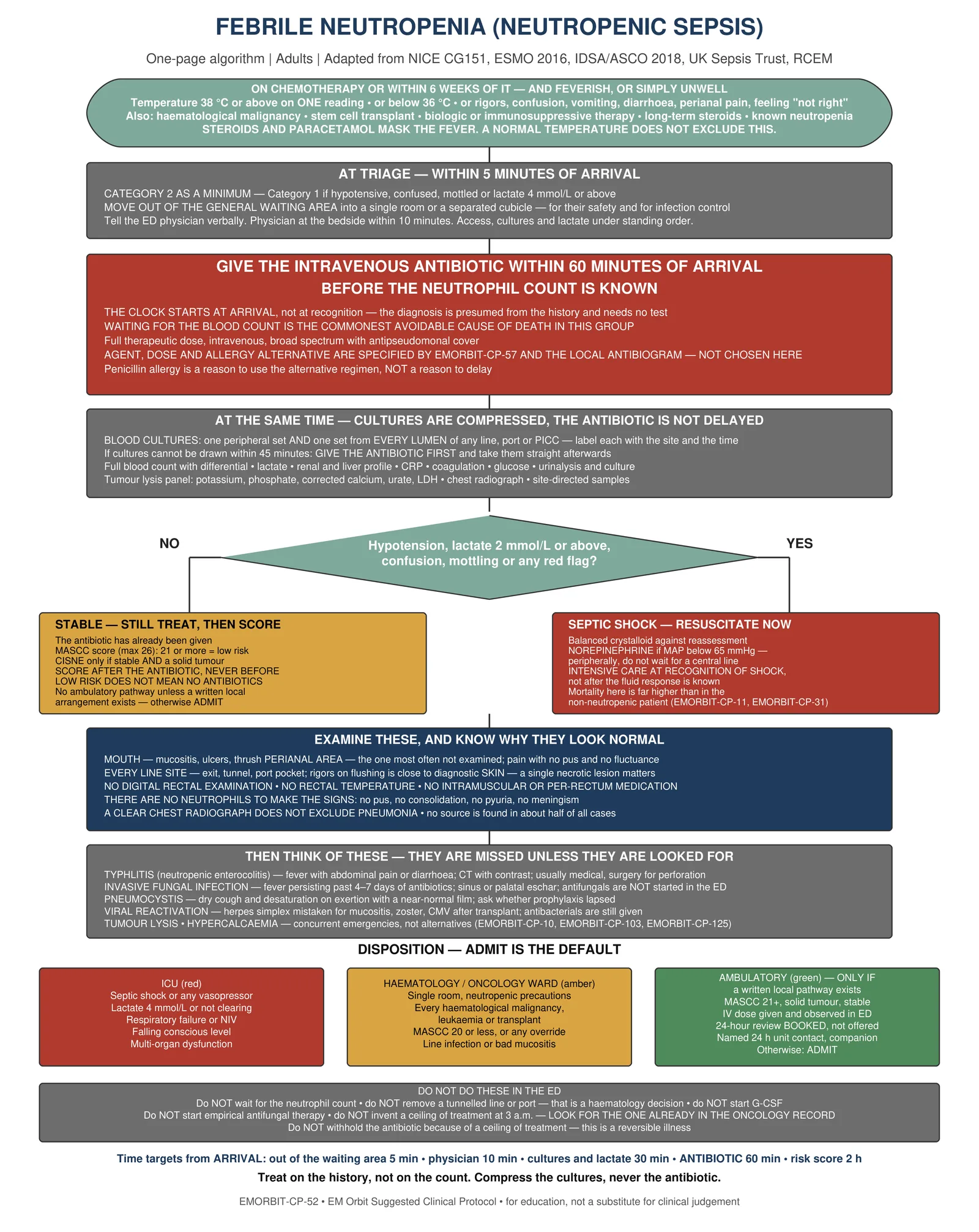
5Algorithm
The one-page algorithm is shown at the top of this page.
6Team roles
6.1Triage Nurse:
6.1.1 Ask every adult presenting with fever or a non-specific deterioration whether they are having any treatment for cancer, and ask for the treatment alert card.
6.1.2 Assign Category 2 as a minimum, or Category 1 where there is any red flag, and inform the ED physician verbally and directly.
6.1.3 Move the patient out of the general waiting area into a single room or separated cubicle within 5 minutes of arrival; offer a surgical mask; apply neutropenic precautions.
6.1.4 Record the time of arrival on the neutropenic sepsis record, obtain intravenous access, and draw blood cultures peripherally and from every lumen of any central venous catheter, together with the full panel and a lactate, under the approved nursing standing order.
6.1.5 Do not take a rectal temperature.
6.2ED Nurses:
6.2.1 Deliver and record every bundle element with its actual time on the neutropenic sepsis record, and escalate to the treating physician as any element approaches its target time.
6.2.2 Chase the first antibiotic dose actively; a dose that has been prescribed but not given is a dose that has not been given.
6.2.3 Label every culture bottle with the site — peripheral, or the named lumen — and the time of collection.
6.2.4 Maintain the isolation and the neutropenic precautions throughout the ED stay, including during boarding and during transfer within the hospital.
6.2.5 Monitor observations and NEWS2 at least every 15 minutes until stable, then hourly; record fluid balance and urine output; report any new symptom.
6.2.6 Do not administer intramuscular or per-rectum medication.
6.3ED Pharmacist:
6.3.1 Ensure the empirical first-dose regimens specified by EMORBIT-CP-57, and the allergy alternatives, are stocked and immediately available in the ED with a first-dose dosing card.
6.3.2 Verify the choice against the allergy history, the renal function and the stewardship policy without delaying the first dose; full first doses are given and subsequent doses adjusted.
6.3.3 Confirm that the six prescription elements required by EMORBIT-CP-57 are recorded, and support the team in obtaining the treating unit's protocol and resistance history.
6.3.4 Audit arrival-to-antibiotic times with the ED quality team.
6.4Haematology and Oncology:
6.4.1 Respond to the ED call within a defined time, provide the treatment protocol, previous cultures and resistance history, and accept the patient for admission under neutropenic precautions.
6.4.2 Make the decisions that are theirs and not the ED's: central venous catheter removal, empirical antifungal therapy, granulocyte colony stimulating factor, transfusion product requirements, and the ceiling of treatment where none is documented.
6.4.3 Ensure that every patient starting anticancer treatment leaves the unit with an alert card and written instructions to attend the ED immediately with fever or feeling unwell, and to say at the first contact that they are having chemotherapy.
6.5Infectious Diseases and Microbiology:
6.5.1 Advise on empirical and directed therapy, on the patient colonised with a resistant organism, and on opportunistic and fungal infection; maintain and publish the local antibiogram that EMORBIT-CP-57 depends on.
6.5.2 Process and report blood cultures urgently, including the differential time to positivity between the line and the peripheral sets, and report preliminary Gram stains and critical results verbally.
6.6Laboratory:
6.6.1 Prioritise the full blood count with differential, the lactate, the renal and liver profile and the tumour lysis panel in any sample labelled as suspected neutropenic sepsis, and report the neutrophil count verbally when it is below 0.5 × 10⁹/L.
6.7Radiology:
6.7.1 Prioritise chest imaging and abdominal computed tomography for this group, communicate critical findings verbally, and record that a normal chest radiograph does not exclude pneumonia in a neutropenic patient.
6.8Infection Prevention and Control:
6.8.1 Define and support the neutropenic precautions applied in the ED, advise where a single room is not available, and advise on additional transmission-based precautions where a transmissible infection is also suspected.
6.9Ambulance and Pre-hospital Providers:
6.9.1 Pre-alert the ED for any patient who reports being on chemotherapy and is febrile or unwell, so that a room and the first dose are prepared before arrival; hand over the temperature, the observations, the regimen and the date of the last cycle.
7The patient's role
7.1 Attend the Emergency Department immediately — not the following morning — with a temperature of 38 °C or above, with shaking or shivering, or simply on feeling unwell, while receiving or within 6 weeks of anticancer treatment.
7.2 Say at the first point of contact, every time: "I am having chemotherapy." This sentence is what starts the pathway and is more useful than any other piece of information.
7.3 Carry and present the treatment alert card, the chemotherapy passport or the treating unit's letter, and know or bring the date of the last cycle.
7.4 Report all symptoms including those that feel trivial or embarrassing, in particular pain around the back passage, mouth soreness, and pain or shivering when the line is flushed.
7.5 Report all medication, including any antibiotic, antifungal or antiviral prophylaxis, any that has been missed, and all allergies with what happened.
7.6 Do not take a temperature rectally, and do not take a medicine by the rectal route.
7.7 Family and carers: raise concern with staff if the patient appears to be deteriorating, and tell staff if the patient is not behaving normally — this concern is itself a trigger.
7.8 Where discharged under a confirmed ambulatory pathway, take the antibiotics exactly as prescribed, attend the 24-hour review, and return immediately for any warning symptom on the sheet.
8Definitions
8.1Febrile Neutropenia (Neutropenic Sepsis): a temperature of 38 °C or above, or other signs or symptoms consistent with clinically significant sepsis, in a person with a neutrophil count of 0.5 × 10⁹/L or below, or a count expected to fall to that level (NICE CG151). Treatment is started before the count is known.
8.2Neutropenia: an absolute neutrophil count below 1.0 × 10⁹/L. Severe neutropenia is a count of 0.5 × 10⁹/L or below; profound neutropenia is a count of 0.1 × 10⁹/L or below.
8.3Nadir: the lowest neutrophil count after a cycle of chemotherapy, typically occurring 7 to 14 days after administration; the period of greatest risk.
8.4Time Zero in This Guideline: the time of arrival at the ED, from which the 60-minute antibiotic target is measured. This differs from T0 in EMORBIT-CP-11, which is the moment of recognition, because in febrile neutropenia the diagnosis is presumed from the history and requires no test; the convention is the same as that used for the child with suspected neutropenic sepsis in EMORBIT-CP-25.
8.5MASCC Risk Index: the Multinational Association for Supportive Care in Cancer scoring system (maximum 26 points) used to identify patients at low risk of serious medical complication; a score of 21 or more indicates low risk.
8.6CISNE: the Clinical Index of Stable Febrile Neutropenia; a score validated only in clinically stable adult outpatients with solid tumours, where 0 is low risk, 1 to 2 intermediate, and 3 or more high risk.
8.7Neutropenic Enterocolitis (Typhlitis): inflammation and necrosis of the caecum and adjacent bowel in a profoundly neutropenic patient, presenting with fever, abdominal pain, distension and diarrhoea; managed medically in most cases.
8.8Differential Time to Positivity: the difference in time between a blood culture drawn from a central venous catheter becoming positive and a simultaneously drawn peripheral culture becoming positive; a difference of approximately two hours or more in favour of the line supports catheter-related bloodstream infection.
8.9Mucositis: inflammation and ulceration of the mucosal surfaces caused by chemotherapy or radiotherapy; both a source of pain and a portal of entry for gut organisms.
8.10G-CSF: granulocyte colony stimulating factor, a growth factor used to prevent or shorten neutropenia; it is not started in the Emergency Department.
8.11Neutropenic (Protective) Precautions: the local package of measures protecting a neutropenic patient from acquired infection, including a single room, strict hand hygiene, exclusion of people with transmissible infection, and restrictions on certain foods and plants.
8.12NICE, ESMO, IDSA, ASCO, MASCC, RCEM, ACEP, ACEM: National Institute for Health and Care Excellence; European Society for Medical Oncology; Infectious Diseases Society of America; American Society of Clinical Oncology; Multinational Association for Supportive Care in Cancer; Royal College of Emergency Medicine; American College of Emergency Physicians; Australasian College for Emergency Medicine.
9Attachments
- Attachment 1: One-page algorithm (top of this page)
- Attachment 2: Risk Assessment — MASCC and CISNE, and the Limits of Both
- Attachment 3: ED Febrile Neutropenia First-Hour Bundle and Time Record
- Attachment 4: Examination Prompts, Isolation and Admission Checklist
11Suggested quality indicators
11.1Time from arrival to the first antibiotic: (Number of patients with presumed febrile neutropenia who received an intravenous antibiotic within 60 minutes of arrival at the ED / Total number of patients with presumed febrile neutropenia) × 100. Target ≥ 90%. The median and 95th centile arrival-to-antibiotic time shall be reported alongside the percentage.
11.2Antibiotic given before the blood count returned: (Number of patients with presumed febrile neutropenia whose first antibiotic dose was given before the full blood count result was available / Total number of patients with presumed febrile neutropenia) × 100. Target ≥ 95%.
11.3Cultures taken from all lumens: (Number of patients with a central venous catheter in whom blood cultures were documented from a peripheral site and from every lumen / Total number of patients with presumed febrile neutropenia and a central venous catheter) × 100. Target ≥ 90%.
11.4Risk score documented: (Number of patients with confirmed febrile neutropenia with a MASCC score, and a CISNE score where applicable, documented in the ED record / Total number of patients with confirmed febrile neutropenia) × 100. Target ≥ 90%.
11.5Not left in the general waiting area: (Number of patients with presumed febrile neutropenia moved from the general waiting area to a single room or separated cubicle within 5 minutes of arrival / Total number of patients with presumed febrile neutropenia) × 100. Target ≥ 90%.
11.6Outcome indicators (monitored, no fixed target): 30-day mortality in patients presenting to the ED with febrile neutropenia; intensive care admission within 48 hours of ED presentation; unplanned intensive care admission within 24 hours of ward admission from the ED; and 7-day ED re-attendance after any discharge in this group. All are reported quarterly with haematology and oncology.
13References
- National Institute for Health and Care Excellence. Neutropenic sepsis: prevention and management in people with cancer. Clinical guideline CG151; 2012.
- Klastersky J, de Naurois J, Rolston K, et al. Management of febrile neutropaenia: ESMO Clinical Practice Guidelines. Ann Oncol. 2016;27(suppl 5):v111–v118.
- Freifeld AG, Bow EJ, Sepkowitz KA, et al. Clinical practice guideline for the use of antimicrobial agents in neutropenic patients with cancer: 2010 update by the Infectious Diseases Society of America. Clin Infect Dis. 2011;52(4):e56–e93.
- Taplitz RA, Kennedy EB, Bow EJ, et al. Outpatient management of fever and neutropenia in adults treated for malignancy: American Society of Clinical Oncology and Infectious Diseases Society of America clinical practice guideline update. J Clin Oncol. 2018;36(14):1443–1453.
- Klastersky J, Paesmans M, Rubenstein EB, et al. The Multinational Association for Supportive Care in Cancer risk index: a multinational scoring system for identifying low-risk febrile neutropenic cancer patients. J Clin Oncol. 2000;18(16):3038–3051.
- Carmona-Bayonas A, Jiménez-Fonseca P, Virizuela Echaburu J, et al. Prediction of serious complications in patients with seemingly stable febrile neutropenia: validation of the Clinical Index of Stable Febrile Neutropenia in a prospective cohort of patients from the FINITE study. J Clin Oncol. 2015;33(5):465–471.
- Daniels R, Nutbeam T, eds. The Sepsis Manual, 7th ed. United Kingdom Sepsis Trust; 2024.
- Evans L, Rhodes A, Alhazzani W, et al. Surviving Sepsis Campaign: International Guidelines for Management of Sepsis and Septic Shock 2021. Crit Care Med. 2021;49(11):e1063–e1143.
- Mermel LA, Allon M, Bouza E, et al. Clinical practice guidelines for the diagnosis and management of intravascular catheter-related infection: 2009 update by the Infectious Diseases Society of America. Clin Infect Dis. 2009;49(1):1–45.
- Heussel CP, Kauczor HU, Heussel G, et al. Early detection of pneumonia in febrile neutropenic patients: use of thin-section CT. AJR Am J Roentgenol. 1997;169(5):1347–1353.
- Nesher L, Rolston KVI. Neutropenic enterocolitis, a growing concern in the era of widespread use of aggressive chemotherapy. Clin Infect Dis. 2013;56(5):711–717.
- Smith TJ, Bohlke K, Lyman GH, et al. Recommendations for the use of WBC growth factors: American Society of Clinical Oncology clinical practice guideline update. J Clin Oncol. 2015;33(28):3199–3212.
- Royal College of Emergency Medicine. Neutropenic sepsis — RCEM clinical audit and best practice guidance. London: RCEM.
- National Confidential Enquiry into Patient Outcome and Death. For better, for worse? A review of the care of patients who died within 30 days of receiving systemic anti-cancer therapy. London: NCEPOD; 2008.
A2Attachment 2: Risk Assessment — MASCC and CISNE, and the Limits of Both
Complete AFTER the first antibiotic has been given. No score on this page may be used to defer, reduce or withhold the first dose.
The MASCC risk index identifies patients at low risk of a serious medical complication. It is scored from the clinical state at presentation and can be completed at the bedside. CISNE is a more conservative index derived and validated only in apparently stable adult outpatients with solid tumours; it requires a monocyte count and therefore cannot be completed before the blood count returns.
| Characteristic | Points | Score |
|---|---|---|
| Burden of febrile neutropenia — no symptoms or mild symptoms | 5 | |
| Burden of febrile neutropenia — moderate symptoms | 3 | |
| Burden of febrile neutropenia — severe symptoms or moribund | 0 | |
| No hypotension (systolic blood pressure above 90 mmHg) | 5 | |
| No chronic obstructive pulmonary disease | 4 | |
| Solid tumour, or haematological malignancy with no previous fungal infection | 4 | |
| No dehydration requiring parenteral fluid | 3 | |
| Outpatient at the onset of fever | 3 | |
| Age under 60 years | 2 | |
| TOTAL (maximum 26). A score of 21 or more identifies LOW risk of serious complication; 20 or less is HIGH risk |
Only one of the three burden-of-illness options is scored. The age criterion is not applied to patients under 16 years, in whom the index is not validated. A high score is a statement about the probability of a complication; it is not a statement that the patient does not need antibiotics.
| Variable | Points | Score |
|---|---|---|
| ECOG performance status of 2 or more | 2 | |
| Stress-induced hyperglycaemia | 2 | |
| Chronic obstructive pulmonary disease | 1 | |
| Chronic cardiovascular disease | 1 | |
| Mucositis of NCI grade 2 or more | 1 | |
| Monocyte count below 0.2 × 10⁹/L | 1 | |
| TOTAL: 0 = low risk | 1–2 = intermediate risk | 3 or more = high risk |
CISNE was derived and validated only in apparently stable outpatients with solid tumours and is not applicable to the unstable patient, to haematological malignancy, to stem cell transplant recipients, or to acute leukaemia. Where CISNE is used it is used in addition to MASCC, not instead of it, and it requires a monocyte count, which means it cannot be calculated at the front door before the blood count returns — it is therefore never a reason to delay the antibiotic.
1What the score is for: to inform the intensity, setting and duration of care after the first dose has been given, and to identify the patient who may — where a confirmed local ambulatory pathway exists — be suitable for early discharge on oral therapy.
2What the score is NOT for: deciding whether to give antibiotics, deciding how quickly to give them, or overriding clinical concern. Low risk does not mean no antibiotics.
3Automatic high risk, whatever the score: haematological malignancy, acute leukaemia or stem cell transplant; anticipated prolonged or profound neutropenia; clinical instability at any point; suspected central line infection; significant mucositis; uncontrolled vomiting or diarrhoea; organ dysfunction; suspected neutropenic enterocolitis; a concurrent oncological emergency; inability to take or absorb oral medication; or the clinician's concern, which requires no justification.
4The known limits of MASCC: it was derived before current chemotherapy regimens and before widespread resistance; it performs less well in haematological malignancy; the "burden of illness" item is subjective and is the item that most often moves a patient across the threshold; it does not include mucositis, which is an independent risk factor; and a low-risk score has been shown to be followed by serious complication in a small but real proportion of patients.
5Before any patient is considered for an ambulatory pathway: section 4.3.10 shall be satisfied in full, including a written local protocol, a named 24-hour contact at the treating unit, a review within 24 hours arranged before the patient leaves, a documented observation period after an intravenous first dose, transport and a companion, and written safety-netting in the patient's language. Where no such arrangement exists, every patient with presumed febrile neutropenia is admitted.
A3Attachment 3: ED Febrile Neutropenia First-Hour Bundle and Time Record
This record shall be applied to the ED notes of every patient with presumed febrile neutropenia, completed contemporaneously, and filed in the medical record. A copy is retained by the ED quality team for audit. Every time on this sheet is measured from the time of arrival at the ED.
| Field | Entry |
|---|---|
| Patient label / MRN | |
| Time of arrival at the ED (the clock starts here) | |
| Trigger: fever ≥ 38 °C / sustained fever / unwell without fever / hypothermia / known neutropenia (circle) | |
| Temperature on arrival (°C), and site used (NOT rectal) | |
| Cancer diagnosis and current regimen | |
| Date of last chemotherapy cycle (and days since) | |
| Haematological malignancy / stem cell transplant / biologic or immunosuppressive therapy (circle) | |
| G-CSF given after the last cycle? (date) | |
| Prophylaxis taken (antibacterial / antifungal / antiviral / Pneumocystis), and any lapse | |
| Central venous catheter: type, number of lumens, rigors on flushing? | |
| Allergies (and the nature of the reaction) | |
| Treating unit and 24-hour contact number | |
| Known resistant organism / recent hospital or antibiotic exposure | |
| Documented ceiling of treatment found? (source and date) |
| Element | Target from arrival | Time done | Initials |
|---|---|---|---|
| Moved out of the general waiting area to a single room or cubicle | ≤ 5 min | ||
| ED physician at the bedside | ≤ 10 min | ||
| Intravenous access obtained | ≤ 30 min | ||
| Blood cultures — PERIPHERAL set (site: ______) | Before antibiotic | ||
| Blood cultures — line lumen 1 (named: ______) | Before antibiotic | ||
| Blood cultures — line lumen 2 (named: ______) | Before antibiotic | ||
| Blood cultures — line lumen 3 (named: ______) | Before antibiotic | ||
| Full blood count and full panel sent | ≤ 30 min | ||
| Lactate sent (result: ______ mmol/L) | ≤ 30 min | ||
| FIRST INTRAVENOUS ANTIBIOTIC GIVEN (agent and dose: ______) | ≤ 60 min | ||
| Antibiotic given BEFORE the neutrophil count was available? (Y/N) | — | ||
| Intravenous fluid started (type and volume: ______) | ≤ 30 min if hypoperfused | ||
| Senior ED physician review | ≤ 60 min | ||
| Haematology / oncology informed (name of team, not of person) | ≤ 60 min | ||
| Treating unit contacted | ≤ 60 min | ||
| MASCC score calculated (score: ______ / 26) | ≤ 2 h | ||
| CISNE calculated where applicable (score: ______) | ≤ 2 h | ||
| Norepinephrine started (rate: ______ mcg/kg/min) | At shock recognition | ||
| Intensive care informed | At shock recognition | ||
| Repeat lactate (result: ______ mmol/L) | 2–4 h | ||
| Disposition decided (destination: ______) | ≤ 4 h from arrival |
| Reason |
|---|
The antibiotic agent, its dose and its route are specified by EMORBIT-CP-57 (Antimicrobial Stewardship for Common ED Infections), the local antimicrobial stewardship policy and the current local antibiogram. This sheet records the timing; it does not select the agent.
Where cultures cannot be drawn within 45 minutes of arrival, give the antibiotic and take the cultures immediately afterwards, and record that here.
A4Attachment 4: Examination Prompts, Isolation and Admission Checklist
The signs of infection may be absent because there are no neutrophils to produce them. The absence of a sign is not the absence of infection.
| ✓ | Site | Finding |
|---|---|---|
| ☐ | Mouth and oropharynx (open the mouth, use a light) | |
| ☐ | Perianal region and perineum — inspect and gently palpate; NO digital rectal examination | |
| ☐ | Every line: exit site, tunnel, port pocket; rigors on flushing? | |
| ☐ | Chest, with respiratory rate and saturation at rest and on exertion | |
| ☐ | Whole skin, including pressure areas, cannula and biopsy sites, nail folds | |
| ☐ | Abdomen, including right iliac fossa tenderness and distension | |
| ☐ | Central nervous system: conscious level, confusion, neck stiffness, focal signs | |
| ☐ | Genitourinary, and gynaecological where relevant |
| ✓ | Item |
|---|---|
| ☐ | The patient may be afebrile or hypothermic and still septic — particularly on corticosteroids or after paracetamol at home. |
| ☐ | A clear chest radiograph does not exclude pneumonia, and an absent chest sign does not either. |
| ☐ | A bland urinalysis does not exclude urinary infection, because pyuria requires neutrophils. |
| ☐ | A perianal abscess may have no fluctuance and no pus; pain is the sign. |
| ☐ | No source is found in roughly half of cases; this is expected and is not a reason to stop treatment. |
| ☐ | Tumour lysis syndrome and hypercalcaemia have been considered and the relevant bloods sent. |
| ☐ | A documented ceiling of treatment has been looked for in the oncology record before any new conversation was started. |
| ✓ | Item |
|---|---|
| ☐ | Moved out of the general waiting area within 5 minutes of arrival — time recorded. |
| ☐ | Single room with neutropenic (protective) precautions; where unavailable, a separated cubicle, the reason documented, and infection control informed. |
| ☐ | Surgical mask offered to the patient; strict hand hygiene by everyone entering; staff and visitors with transmissible infection excluded. |
| ☐ | Additional transmission-based precautions applied where a transmissible infection is also suspected (contact, droplet, or airborne). |
| ☐ | Precautions maintained during boarding and during any transfer within the hospital. |
| ☐ | No rectal temperature, no digital rectal examination, no intramuscular injection, no per-rectum medication. |
| ✓ | Item |
|---|---|
| ☐ | Intravenous antibiotic given, with the time recorded, and given before the neutrophil count returned. |
| ☐ | Blood cultures taken peripherally and from every lumen, each labelled with the site and the time. |
| ☐ | MASCC score documented, with CISNE where applicable, and the reasoning recorded. |
| ☐ | Admitting team is haematology or oncology; infectious diseases and microbiology informed; the treating unit contacted and its protocol and resistance history obtained. |
| ☐ | Single room with neutropenic precautions requested and confirmed on the ward. |
| ☐ | Structured (SBAR) handover given, including arrival time, antibiotic time and agent, culture sites, risk score, observation trend, outstanding investigations, and the ceiling-of-treatment position. |
| ☐ | Granulocyte colony stimulating factor was not started in the ED; where the patient was already receiving it, this has been handed over. |
| ☐ | Where discharge under a confirmed ambulatory pathway is proposed, every criterion in section 4.3.10 is satisfied and the 24-hour review is booked, not offered. |
This checklist shall be completed for every patient with presumed febrile neutropenia and filed in the medical record; a copy is retained by the ED quality team for audit against the indicators in section 11.