Interfacility Transfer of the Critically Ill Patient from the Emergency Department
EMORBIT-CP-91 · Chapter 16 · Cross-cutting ED Standards
Open in the appFree, works on your phone and offline, with every tool alongside.
Evidence base: ICS/FICM 2019; RCEM
1Purpose
1.1 Provide a standardized framework for the decision to transfer, the stabilisation required before departure, the escort and equipment standard, and the handover, for every adult and paediatric patient transferred from the Emergency Department (ED) because the patient is, or is at risk of becoming, critically ill.
1.2 Distinguish the standard transfer, in which stabilisation is completed before departure, from the time-critical transfer, in which the intervention available only at the receiving facility is itself the resuscitation and speed of departure takes priority over further optimisation.
1.3 Define the minimum escort competence, and the oxygen, battery and equipment standard, for every transfer, and require a structured pre-departure checklist (Attachment 2) and a structured handover at the receiving facility.
1.4 Where your institution's interfacility transfer policy differs, that policy governs.
2Who this protocol applies to
2.1 Any adult or paediatric patient in the ED who requires transfer to another hospital for a higher level of care, a time-critical intervention, or a specialist service not available on site, and who is critically ill or at significant risk of deterioration in transit.
2.2 Patients requiring ongoing organ support — airway, ventilatory, circulatory, or renal — during transfer.
2.3 Patients accepted for a time-critical intervention elsewhere: haemorrhage control, mechanical thrombectomy, emergency neurosurgery, primary percutaneous coronary intervention, or another service the receiving specialty agrees is time-critical.
2.4 Transfers between facilities within the same health system and transfers to a facility outside it (private, or in another region), which follow the same standard.
3Not covered by this protocol
3.1 Intra-hospital transfer within the same facility (for example, ED to CT, ED to theatre, ED to the intensive care unit of the same hospital). This is governed by the relevant intra-hospital handover standard, though the stabilisation and monitoring principles in this guideline apply equally.
3.2 Transfer of a stable patient who requires no organ support, for a non-time-critical reason (for example, a routine bed-capacity transfer). This follows the standard non-critical patient transport pathway, not this guideline.
3.3 Repatriation of a patient back to a local facility once the critical phase has resolved. This is governed by the receiving facility's admission process and the local interfacility transfer policy.
3.4 Transfer of a deceased patient, and transfer for organ donation, which follow the relevant local policy.
4Protocol
4.1History and Assessment:
4.1.1Triage and Recognition — the Decision and Who Makes It:
4.1.1.1 The need for transfer is identified as soon as the ED recognises that the patient requires a facility, service, or specialist intervention not available locally.
4.1.1.2 The decision to transfer is made by the senior ED physician (specialist or consultant), in consultation with the relevant specialty and, for any patient requiring airway, ventilatory or circulatory support, with Critical Care/Anaesthesia, consistent with EMORBIT-CP-31 and EMORBIT-CP-35.
4.1.1.3 A named consultant at the receiving facility accepts the referral before departure; the referring physician documents that name, the facility, and the time of acceptance, and remains responsible for the patient until handover is complete.
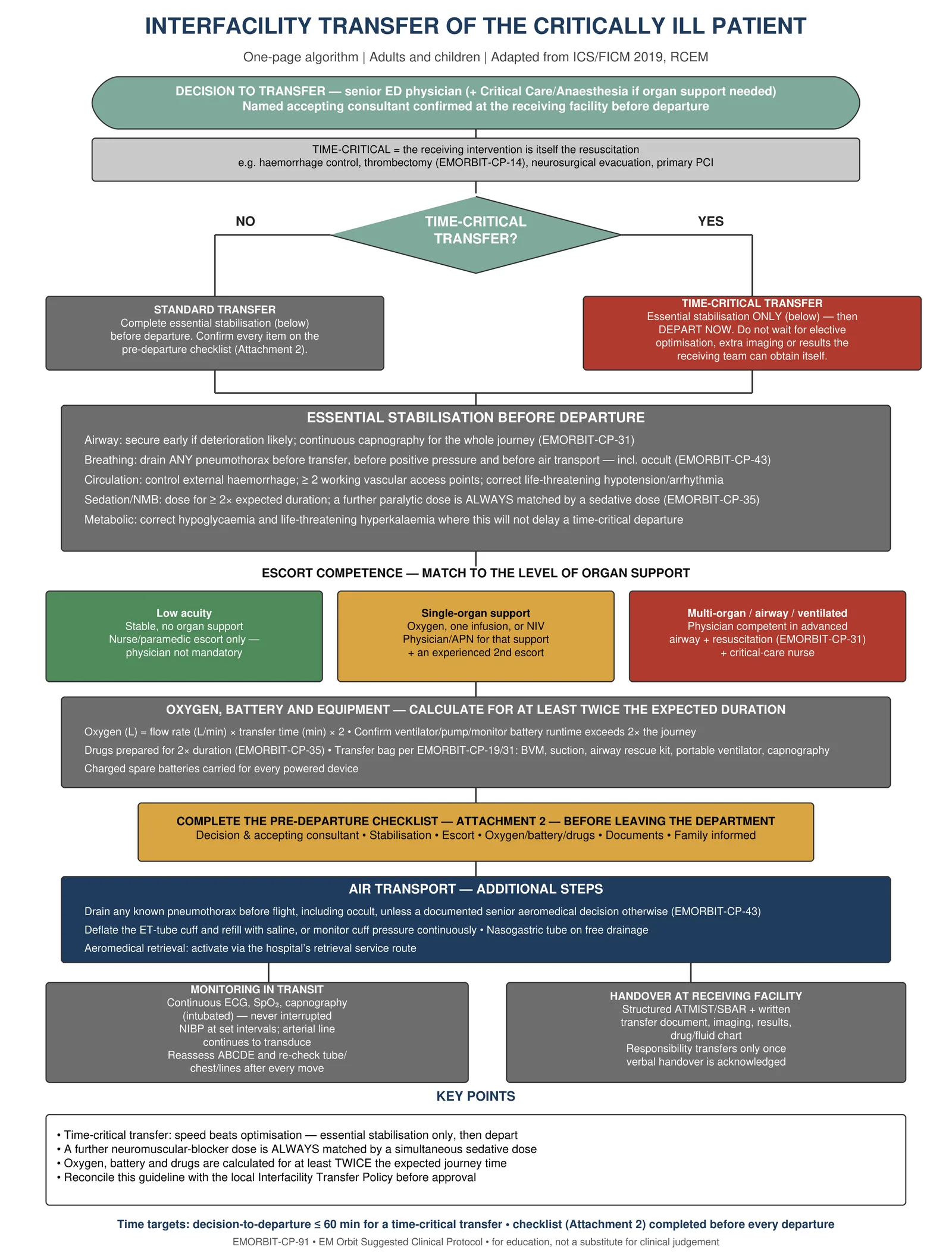
4.1.1.4 Classify every transfer as standard or time-critical before planning departure (Table 1).
4.1.2History (obtained in parallel with stabilisation, never delaying a time-critical departure):
4.1.2.1 AMPLE history, the working diagnosis, interventions already given and the response, allergies, and actual or estimated weight for drug and equipment calculation.
4.1.2.2 Next of kin contact details, and whether they have been informed.
4.1.3Examination:
4.1.3.1 A full ABCDE reassessment immediately before departure. Confirm every vascular access point, tube and drain is patent and secured, and that every running infusion matches the dose and duration calculated for the journey (Table 2, Attachment 2).
4.1.4Risk Stratification — Standard versus Time-Critical Transfer:
4.1.4.1
Table 1: Standard versus time-critical transfer Category Local examples Departure principle Standard transfer A stable patient, or one who can be fully stabilised before departure without losing a time-critical treatment window (e.g., a stable inter-ICU transfer, a stable patient transferred for a bed). Complete essential stabilisation (Table 2) before departure. Do not leave the department until every item on the pre-departure checklist (Attachment 2) is confirmed. Time-critical transfer Uncontrolled haemorrhage needing surgery or interventional radiology not available on site; large-vessel-occlusion stroke for thrombectomy (EMORBIT-CP-14); an extradural or subdural haematoma needing evacuation; ST-elevation myocardial infarction needing primary percutaneous coronary intervention not deliverable on site. Give only essential stabilisation — airway, ventilation, external haemorrhage control — then depart without delay. Do not wait for elective optimisation, further imaging, or a result the receiving team can obtain itself. A senior physician documents the decision and the reason.
4.1.5Reconsidering the Need for Transfer:
4.1.5.1 Before activating transport, confirm the intervention genuinely requires the receiving facility: it is not available, or not deliverable in time, locally. Where local specialist telephone advice can safely change the plan, obtain it — but never at the cost of delaying a time-critical transfer once the decision is made.
4.1.6Special Populations:
4.1.6.1 Children: involve the paediatric intensive care/retrieval service at the point the need for transfer is identified, not at the point of departure; use weight-based equipment and drug dosing throughout. Activate the dedicated paediatric retrieval team by the hospital's pathway where one exists.
4.1.6.2 Pregnancy: left lateral tilt beyond 20 weeks; notify obstetrics before departure; the receiving facility must have obstetric capability if delivery is a realistic risk during transfer.
4.1.6.3 Agitated or behaviourally disturbed patients: achieve adequate sedation before departure; physical restraint is never a substitute for sedation and is used only per the relevant local policy.
4.1.6.4 Bariatric patients: confirm the transport vehicle, stretcher and equipment weight limits before departure.
4.2Investigations:
4.2.1 No investigation shall delay a time-critical transfer beyond what is required for immediate airway, breathing and circulation safety.
4.2.2 Copy all imaging with the patient — transmitted electronically where possible, and on portable media as a backup — together with the radiology report.
4.2.3 Send a printed or electronic copy of the ECG, the key laboratory results, the drug and fluid chart, and the transfer letter.
4.2.4 Cross-matched blood accompanies a patient in whom transfusion is running or anticipated, carried and documented per the massive transfusion process already in use.
4.2.5 A point-of-care blood gas and glucose immediately before departure for any patient with respiratory, circulatory or metabolic instability.
4.3Plan of Care:
4.3.1Immediate Actions (from the decision to transfer):
4.3.1.1 Notify the receiving facility and confirm the accepting consultant; notify the ambulance or aeromedical retrieval service; assign the escort by the competence tier in Table 3.
4.3.1.2 Confirm the mode of transport (road or air) and the likely journey time, including day/night and weather factors where air transport is being considered.
4.3.1.3 Begin the pre-departure checklist (Attachment 2) at the same time as stabilisation; the two run in parallel, not in sequence.
4.3.2Essential Stabilisation Before Departure:
4.3.2.1
Table 2: Essential stabilisation before departure System Action before departure Airway Secure early if deterioration in transit is likely; once secured, continuous waveform capnography is attached for the whole transfer, as required by EMORBIT-CP-31. Breathing Drain any pneumothorax before transfer, before positive-pressure ventilation, and before air transport — including an occult pneumothorax — unless a senior aeromedical decision to the contrary is documented, as required by EMORBIT-CP-43. Circulation Control external haemorrhage; secure at least two functioning vascular access points; correct life-threatening hypotension or arrhythmia so far as achievable within the departure time window. Sedation / neuromuscular blockade Dose analgesia and sedation for at least twice the expected transfer duration. A further neuromuscular-blocker dose is always accompanied by a simultaneous sedative dose recorded on the same line of the chart, as required by EMORBIT-CP-35. Metabolic Correct hypoglycaemia and life-threatening hyperkalaemia where correction will not delay a time-critical departure.
4.3.3Time-Critical Transfer — When Speed Beats Optimisation:
4.3.3.1 Where the transfer is classified as time-critical (Table 1), give only the essential stabilisation in Table 2 and depart without delay. Do not wait for elective optimisation, additional imaging, or a result the receiving team can obtain itself.
4.3.3.2 The senior physician documents the decision, the time, and the reason speed took priority over further stabilisation.
4.3.4Escort, Equipment and Mode of Transport:
4.3.4.1
Table 3: Minimum escort competence by level of organ support Level of support Minimum escort Low acuity — stable, no organ support A nurse or paramedic trained in inter-facility transport. A physician escort is not mandatory. Single-organ support — e.g., supplemental oxygen, a single sedative or vasoactive infusion, non-invasive ventilation A physician or advanced practice nurse competent to manage the specific support being given, with a second escort experienced in critical-care transfer. Multi-organ support, an unstable airway, or any intubated/ventilated patient A physician competent in advanced airway management and resuscitation (EMORBIT-CP-31), accompanied by a nurse or paramedic experienced in critical-care transfer. Never send an escort who is not competent to manage the deterioration the patient is at risk of during the journey.
4.3.4.2 Oxygen, battery life and drug quantities are calculated for at least twice the expected transfer duration and recorded on the checklist (Attachment 2); the transfer bag follows the standard already set in EMORBIT-CP-19 and EMORBIT-CP-31.
4.3.5Monitoring and Reassessment in Transit:
4.3.5.1 Continuous electrocardiogram, pulse oximetry, and — for the intubated patient — capnography, without interruption for the whole journey, per EMORBIT-CP-31 and EMORBIT-CP-35.
4.3.5.2 Non-invasive blood pressure at set intervals appropriate to the patient's acuity; an existing arterial line continues to transduce.
4.3.5.3 Reassess ABCDE, and re-check the tube position, the chest and every line, after every move onto a new surface.
4.3.6Air Transport Considerations:
4.3.6.1 Drain any known pneumothorax before air transport, including an occult pneumothorax, unless a senior aeromedical decision to the contrary is documented — exactly as required by EMORBIT-CP-43, because trapped gas expands as cabin altitude increases.
4.3.6.2 Deflate an air-filled endotracheal tube cuff and refill with saline, or monitor cuff pressure continuously, for the same reason; place a nasogastric tube on free drainage to vent a distending stomach.
4.3.6.3 The availability and activation route of a dedicated national aeromedical retrieval service varies by region; use the hospital's contact and activation details.
4.3.7Handover at the Receiving Facility:
4.3.7.1 Give a structured verbal handover (ATMIST or SBAR, consistent with EMORBIT-CP-14 and EMORBIT-CP-19) to the receiving team, plus the written transfer document, all copied results and imaging, and the drug and fluid chart.
4.3.7.2 Responsibility for the patient transfers to the receiving team only once the verbal handover is complete and acknowledged.
4.3.8Documentation and Reporting:
4.3.8.1 Document: the decision-maker and time, the transfer category (standard or time-critical) and the reason, the accepting consultant and facility, the escort names and competence tier, the completed checklist, the times of departure and arrival, vital signs in transit, any deterioration or intervention en route, and the time and content of the handover.
4.3.8.2 Report any deterioration in transit, or any transfer delayed beyond the expected departure time, through the local incident reporting system, and review at the departmental quality/mortality and morbidity meeting.
5Algorithm
The one-page algorithm is shown at the top of this page.
6Team roles
6.1Triage / ED Nurse:
6.1.1 Prepare equipment and drugs per Attachment 2; act as escort for a low-acuity transfer per Table 3; complete the nursing portion of the checklist.
6.2Pharmacist:
6.2.1 Verify that every infusion and drug quantity is prepared for at least twice the expected transfer duration, and supply the drugs for the journey.
6.3Critical Care / Anaesthesia:
6.3.1 Attend, or provide the physician escort, for any patient requiring airway, ventilatory or circulatory support, per EMORBIT-CP-31 and EMORBIT-CP-35.
6.4Relevant Specialty (Receiving Team):
6.4.1 Accept the referral by a named consultant, confirm the bed and team before departure, receive the structured handover, and reassess the patient immediately on arrival.
6.5Laboratory / Radiology:
6.5.1 Prepare and transmit results and imaging without delay, and provide a portable media copy for the journey.
6.6Ambulance / Aeromedical Crew:
6.6.1 Confirm the vehicle or aircraft, oxygen and power capacity before departure; receive the structured handover; communicate any deterioration en route to the referring or receiving team as agreed locally.
7The patient's role
7.1 Where capacity allows, be informed of the reason for transfer and the destination.
7.2 Family or next of kin are informed of the transfer, the destination, and how to make contact.
8Definitions
8.1Interfacility Transfer: the movement of a patient from one hospital to another for a higher level of care, a time-critical intervention, or a specialist service not available at the sending facility.
8.2Standard Transfer: a transfer in which the patient is, or can be, fully stabilised before departure without losing a time-critical treatment window.
8.3Time-Critical Transfer: a transfer in which the intervention available only at the receiving facility is itself the resuscitation, so that speed of departure takes priority over further optimisation.
8.4Escort: the healthcare professional(s) accompanying the patient during transfer, whose competence is matched to the patient's level of organ support (Table 3).
8.5ATMIST / SBAR: structured handover formats — Age, Time of incident, Mechanism/Medical complaint, Injuries/Information, Signs, Treatment; and Situation, Background, Assessment, Recommendation — used for the verbal handover at the receiving facility.
8.6ICS/FICM: Intensive Care Society / Faculty of Intensive Care Medicine (United Kingdom).
9Attachments
- Attachment 1: One-page algorithm (top of this page)
- Attachment 2: Pre-Departure Transfer Checklist and Equipment Calculation
11Suggested quality indicators
11.1Decision-to-departure time for a time-critical transfer: (Number of time-critical transfers departing the ED within 60 minutes of the decision to transfer / Total number of time-critical transfers) × 100. Target ≥ 80%.
11.2Pre-departure checklist completed: (Number of transfers with a fully completed and filed pre-departure checklist (Attachment 2) / Total number of interfacility transfers) × 100. Target ≥ 95%.
11.3Named accepting consultant documented before departure: (Number of transfers with a named accepting consultant and facility documented before departure / Total number of interfacility transfers) × 100. Target 100%.
11.4Escort competence matched to acuity: (Number of transfers with escort competence matching Table 3 for the patient's level of organ support / Total number of interfacility transfers) × 100. Target 100%.
11.5Structured handover documented at the receiving facility: (Number of transfers with a documented ATMIST/SBAR handover at arrival / Total number of interfacility transfers) × 100. Target ≥ 90%.
11.6Unplanned deterioration in transit (outcome, monitored, no fixed target): (Number of transfers with an unplanned intervention or deterioration en route / Total number of interfacility transfers) × 100.
13References
- Intensive Care Society, Faculty of Intensive Care Medicine. Guidance on: The Transfer of the Critically Ill Adult. 4th ed. London: ICS/FICM; 2019.
- Royal College of Emergency Medicine. Guidance on the interhospital transfer of patients requiring emergency care. London: RCEM.
A2Attachment 2: Pre-Departure Transfer Checklist and Equipment Calculation
| ✓ | Item |
|---|---|
| ☐ | Transfer classified as standard or time-critical, and the reason documented (Table 1). |
| ☐ | A named consultant at the receiving facility has accepted the patient; bed and team confirmed. |
| ☐ | Senior ED physician — and Critical Care/Anaesthesia where the patient needs organ support — has authorised departure. |
| ☐ | Airway secured if deterioration in transit is likely; capnography attached and functioning (intubated patient). |
| ☐ | Any pneumothorax drained, including before air transport, unless a documented senior aeromedical decision otherwise. |
| ☐ | External haemorrhage controlled; at least two functioning vascular access points secured. |
| ☐ | Sedation, analgesia and every infusion dosed or prepared for at least twice the expected transfer duration. |
| ☐ | Escort competence matches the patient's level of organ support (Table 3). |
| ☐ | Oxygen and every device battery calculated for at least twice the expected duration; charged spares carried. |
| ☐ | All imaging, results and the transfer letter copied and travelling with the patient. |
| ☐ | Family or next of kin informed of the transfer and the destination. |
| ☐ | Structured (ATMIST/SBAR) handover prepared and the time of departure recorded. |
| Item | Calculation / standard |
|---|---|
| Oxygen | Litres required = flow rate (L/min) × transfer time (minutes) × 2 (safety factor for delay). Carry a cylinder sized for at least twice the expected journey time (EMORBIT-CP-19, EMORBIT-CP-31). |
| Battery — ventilator, syringe pumps, monitor | Confirm each device's remaining runtime exceeds twice the expected transfer duration; carry charged spares for every battery-powered device. |
| Drugs | Prepare analgesia, sedation and any vasoactive infusion for at least twice the expected duration (EMORBIT-CP-35). |
| Airway / ventilation equipment | The transfer bag specified in EMORBIT-CP-19 and EMORBIT-CP-31: bag-valve-mask, suction, airway rescue kit, portable ventilator, continuous capnography. |
| Monitoring | Continuous ECG, pulse oximetry, and capnography for the intubated patient; non-invasive blood pressure at set intervals; an existing arterial line continues to transduce. |