Hypercalcaemia and Hypocalcaemia in the Emergency Department
EMORBIT-CP-103 · Chapter 6 · Endocrine and Metabolic Emergencies
Open in the appFree, works on your phone and offline, with every tool alongside.
Evidence base: Endocrine Society; SfE 2016
1Purpose
1.1 Provide the standardized ED approach to the recognition and treatment of hypercalcaemia and hypocalcaemia of any cause, in adults and children, treating life-threatening presentations without delay while identifying reversible causes.
1.2 Calcium is dosed by indication. This guideline gives the dose for hypocalcaemia. Calcium for cardiac protection in hyperkalaemia is dosed in EMORBIT-CP-10, and calcium during massive transfusion in EMORBIT-CP-27; those doses are larger or faster and are not replaced by this guideline.
1.3 EMORBIT-CP-48 (Pancreatitis) identifies hypercalcaemia as a cause but has no treatment pathway of its own — this guideline is that pathway. EMORBIT-CP-125 (Oncological Emergencies) points here for hypercalcaemia of malignancy and tumour lysis syndrome.
1.4 Align with the Society for Endocrinology (UK) 2016 Endocrine Emergency Guidance and the Endocrine Society 2022 hypoparathyroidism guideline.
2Who this protocol applies to
2.1 Adults (13 years and over) and children with a corrected serum calcium below 2.20 mmol/L (hypocalcaemia) or above 2.60 mmol/L (hypercalcaemia), or an ionised calcium outside the local reference range, symptomatic or found incidentally.
2.2 Hypercalcaemic crisis: markedly elevated corrected calcium with reduced consciousness, arrhythmia, or severe dehydration.
2.3 Symptomatic hypocalcaemia: tetany, laryngospasm, seizure, or an electrocardiogram change (long QT, arrhythmia) attributable to a low calcium.
2.4 Hypocalcaemia identified after massive transfusion (EMORBIT-CP-27) or in tumour lysis syndrome (EMORBIT-CP-125): the calcium dose here applies; the transfusion or oncological pathway continues to govern the rest of the presentation.
3Not covered by this protocol
3.1 Chronic, mild, asymptomatic hypercalcaemia (corrected calcium below 3.00 mmol/L) with a known stable cause under surveillance (for example, primary hyperparathyroidism): referred for outpatient endocrinology without ED treatment.
3.2 A sodium, potassium or glucose abnormality accompanying the calcium abnormality: managed under EMORBIT-CP-50, EMORBIT-CP-102 or EMORBIT-CP-17 respectively; this guideline treats the calcium only.
3.3 Hypocalcaemia from citrate in massive transfusion during active haemorrhage: treated under EMORBIT-CP-27's own activation pathway using the same doses as this guideline; this is not a second, competing protocol.
3.4 Neonatal hypocalcaemia: outside ED scope, managed by neonatology/paediatrics.
4Protocol
4.1History and Assessment:
4.1.1Triage and Recognition:
4.1.1.1 Any patient with reduced Glasgow Coma Scale (GCS), a seizure, tetany, laryngospasm, or an arrhythmia and a calcium result outside the normal range is triaged to the highest acuity category and reviewed by an ED physician within 5 minutes.
4.1.1.2 Record the time the abnormal calcium result is available and the time of the first treatment step; both feed the performance indicators (section 11).
4.1.2History:
4.1.2.1 Hypercalcaemia: known malignancy, bone pain, renal colic, constipation, polyuria/polydipsia, confusion, recent immobilisation, vitamin D or calcium supplements, thiazide diuretic, lithium.
4.1.2.2 Hypocalcaemia: recent thyroid or parathyroid surgery, chronic kidney disease, malabsorption, alcohol use disorder, perioral tingling, cramps, recent massive transfusion, chemotherapy (tumour lysis), and medications — bisphosphonate, denosumab, foscarnet, long-term proton pump inhibitor.
4.1.3Examination:
4.1.3.1 Volume status, GCS, cardiac rhythm; abdominal examination (pancreatitis, malignancy); a surgical neck scar.
4.1.3.2 Chvostek's sign (facial twitch on tapping the facial nerve) and Trousseau's sign (carpal spasm on cuff inflation above systolic pressure for 3 minutes) support hypocalcaemia but a negative test does not exclude it.
4.1.4Risk Stratification / Severity:
Severity and the initial action are set out in Attachment 2, Table 1.
4.1.5Differential Diagnosis:
4.1.5.1 Pseudohypocalcaemia from hypoalbuminaemia: use the corrected or ionised calcium, never the raw total, before treating (section 4.1.4 note*).
4.1.5.2 Citrate chelation from massive transfusion: manage under EMORBIT-CP-27; the calcium dose is the same as this guideline's.
4.1.5.3 Severe hypomagnesaemia mimics and causes hypocalcaemic symptoms, and blocks correction until treated (section 4.3.2).
4.1.5.4 Electrocardiogram differentiates the two directions: a short QT interval suggests hypercalcaemia; a prolonged QT interval suggests hypocalcaemia.
4.1.6Special Populations:
4.1.6.1 Children: weight-based dosing throughout (Attachment 2 and Attachment 3).
4.1.6.2 Pregnancy: hypercalcaemia is rare — treat the cause and involve obstetrics and endocrinology urgently; bisphosphonates are relatively contraindicated in pregnancy (teratogenicity concern) and are used only after specialist discussion. Hypocalcaemia is treated with the same emergency calcium dose; correct magnesium and involve obstetrics.
4.1.6.3 Post-thyroidectomy or parathyroidectomy: hypocalcaemia is an expected complication — follow the surgical unit's defined postoperative calcium-check protocol.
4.1.6.4 Renal failure or dialysis-dependent patients (EMORBIT-CP-130): use smaller, more cautious fluid volumes for hypercalcaemia rehydration; avoid or reduce bisphosphonate dose; involve nephrology early for dialysis in refractory hypercalcaemia or severe hypocalcaemia.
4.1.6.5 Elderly patients: higher risk of iatrogenic fluid overload during rehydration — reassess volume status frequently.
4.2Investigations:
4.2.1 No investigation delays IV calcium gluconate in a patient with severe symptomatic hypocalcaemia, or the first fluid bolus in hypercalcaemic crisis.
4.2.2 Corrected calcium (formula, Attachment 2, Table 1 note) or ionised calcium on a venous or arterial blood gas — preferred in the unwell patient; albumin, magnesium, phosphate, renal function, and a 12-lead electrocardiogram (QT/QTc; short QT in hypercalcaemia) in every patient.
4.2.3 Parathyroid hormone (PTH) and 25-hydroxy vitamin D: send before treatment where feasible, without delaying life-saving therapy; result turnaround varies by laboratory.
4.2.4 Serum protein electrophoresis and free light chains in hypercalcaemia without an obvious cause, to screen for myeloma.
4.2.5 Tumour lysis panel (potassium, phosphate, corrected calcium, urate, lactate dehydrogenase) where relevant — as EMORBIT-CP-125.
4.3Plan of Care:
4.3.1Immediate Actions (first 5–15 minutes):
4.3.1.1 Airway, breathing, circulation, disability, exposure (ABCDE); continuous cardiac monitoring for any severe presentation; IV access, with a second cannula for hypercalcaemia rehydration.
4.3.1.2 Send the investigations in section 4.2 in parallel; never delay IV calcium gluconate for a severe symptomatic hypocalcaemia while awaiting results.
4.3.2Definitive ED Treatment — Hypercalcaemia: rehydrate first, add a bisphosphonate once rehydrated, and use calcitonin for a severe or refractory crisis, exactly as in Table 2.
Table 2: Hypercalcaemia — treatment ladder Step Adult Child 1. Rehydrate first 0.9% sodium chloride 1000 mL IV over 1 hour, then 250–500 mL/hour titrated to urine output and cardiac status; reassess volaemia hourly 20 mL/kg 0.9% sodium chloride bolus, repeat to response 2. Furosemide NOT given routinely and NEVER before rehydration is complete; only for fluid overload after adequate rehydration, at physician discretion Same principle 3. IV bisphosphonate (once rehydrated, calcium still ≥ 3.00 mmol/L or symptomatic) Zoledronic acid 4 mg IV over ≥ 15 minutes (avoid or reduce dose if eGFR < 35 mL/min — discuss with renal); alternative pamidronate 60–90 mg IV over 2–4 hours. Onset 2–4 days; do not repeat within 7 days Not established in the ED; discuss with paediatrics/endocrinology 4. Calcitonin (severe/refractory, bridges to bisphosphonate) Calcitonin (salmon) 4–8 units/kg subcutaneously or intramuscularly every 6–12 hours for the first 24–48 hours only (tachyphylaxis thereafter) As adult, weight-based; specialist advice 5. Steroid-responsive cause Hydrocortisone or prednisolone for myeloma, lymphoma, vitamin D toxicity or granulomatous disease, dose set with the admitting team/endocrinology As directed by paediatrics 6. Refractory / renal failure Nephrology referral for renal replacement therapy; denosumab as a specialist-initiated alternative where bisphosphonate is contraindicated (where available) Nephrology/paediatrics Stop the causative drug (thiazide, lithium, calcium or vitamin D supplements, calcium-containing antacids). All doses shall be verified against the local formulary by the ED pharmacist; bisphosphonate dose is renal-function dependent.
4.3.3Definitive ED Treatment — Hypocalcaemia: give IV calcium gluconate for any severe symptom and correct magnesium in parallel, exactly as in Table 3.
Table 3: Hypocalcaemia — IV calcium dose (Society for Endocrinology 2016). This is NOT the hyperkalaemia dose in EMORBIT-CP-10 Drug Adult Child Calcium gluconate 10% (preferred peripheral choice) 10–20 mL in 50–100 mL of 5% glucose IV over 10 minutes, through a well-running peripheral cannula, with continuous cardiac monitoring; repeat until symptoms resolve. (Note: EMORBIT-CP-10 gives 30 mL over 5–10 minutes for hyperkalaemia cardioprotection — a different indication.) 0.5 mL/kg IV over 5–10 minutes, maximum 20 mL Calcium chloride 10% (alternative) Used only where gluconate is unavailable, on senior decision: it carries three times the calcium per mL, so the volume is one third that of gluconate. Through a large peripheral vein or central line only — never a small peripheral cannula: extravasation causes severe tissue necrosis Not first-line; specialist advice Magnesium Correct magnesium in parallel per EMORBIT-CP-102 — calcium replacement will not hold durably until magnesium is normal As EMORBIT-CP-102 Maintenance infusion Calcium gluconate 10% 100 mL in 1 litre of 0.9% sodium chloride or 5% glucose at 50–100 mL/hour (Society for Endocrinology 2016), titrated to a low-normal corrected calcium; rate and dilution confirmed with pharmacy Weight-based, pharmacy-guided Onset 1–3 minutes; duration 30–60 minutes — the bolus does not sustain correction and must be followed by the maintenance infusion or oral therapy. Do not give calcium in the same line as sodium bicarbonate without flushing (precipitation).
4.3.4What the ED Does vs the Admitting Team:
4.3.4.1 The ED recognises the abnormality, treats life-threatening symptoms (rehydration with or without calcitonin for severe hypercalcaemia; IV calcium for severe hypocalcaemia), starts the first bisphosphonate dose once the patient is rehydrated, corrects magnesium, and sends the PTH and vitamin D samples.
4.3.4.2 The admitting team or endocrinology interprets the PTH result, identifies and treats the underlying cause (parathyroidectomy work-up, oncology referral, long-term vitamin D or calcitriol dosing), titrates the maintenance calcium infusion, and arranges dialysis with nephrology for a refractory case.
4.3.5Escalation / Refractory:
4.3.5.1 Hypercalcaemic crisis with reduced GCS or arrhythmia refractory to rehydration and calcitonin: call critical care and consider dialysis with nephrology.
4.3.5.2 Hypocalcaemic tetany, seizure, or laryngospasm not responding to repeated calcium gluconate: check and correct magnesium immediately rather than repeating calcium indefinitely; call anaesthesia for airway compromise.
4.3.5.3 Torsades de pointes from a long QT in hypocalcaemia: give IV calcium and magnesium; do not delay defibrillation if the patient becomes pulseless.
4.3.6Monitoring and Reassessment:
4.3.6.1 Continuous cardiac monitoring throughout calcium administration or hypercalcaemia rehydration; fluid balance chart for every patient receiving IV correction.
4.3.6.2 Recheck corrected (or ionised) calcium and renal function every 4–6 hours during hypercalcaemia rehydration, and every 2 hours during hypocalcaemia calcium infusion until stable, then 6–12-hourly.
4.3.7Disposition:
4.3.7.1 ICU / HDU: hypercalcaemic crisis with reduced GCS or arrhythmia; hypocalcaemic tetany, seizure, laryngospasm or arrhythmia requiring a calcium infusion; any patient needing dialysis.
4.3.7.2 Monitored ward bed: moderate hypercalcaemia or hypocalcaemia receiving IV treatment, cause not yet controlled.
4.3.7.3 Discharge: mild, asymptomatic abnormality with a known reversible cause already corrected (for example, a thiazide stopped) and reliable follow-up within 1–2 weeks.
4.3.8Discharge and Follow-up:
4.3.8.1 Document the discharge calcium, the cause identified, the medication change made, and the follow-up arranged (endocrinology or primary care) with a repeat calcium within 1–2 weeks.
4.3.8.2 Safety-net advice: return immediately for tingling, cramps, palpitations, confusion, or reduced consciousness.
4.3.9Documentation and Reporting:
4.3.9.1 Document every calcium result with its time, the dose and rate of every treatment given, symptom response, and the disposition and its reasoning.
4.3.9.2 Report any extravasation of calcium chloride and any overcorrection or adverse event through the local incident reporting system.
5Algorithm
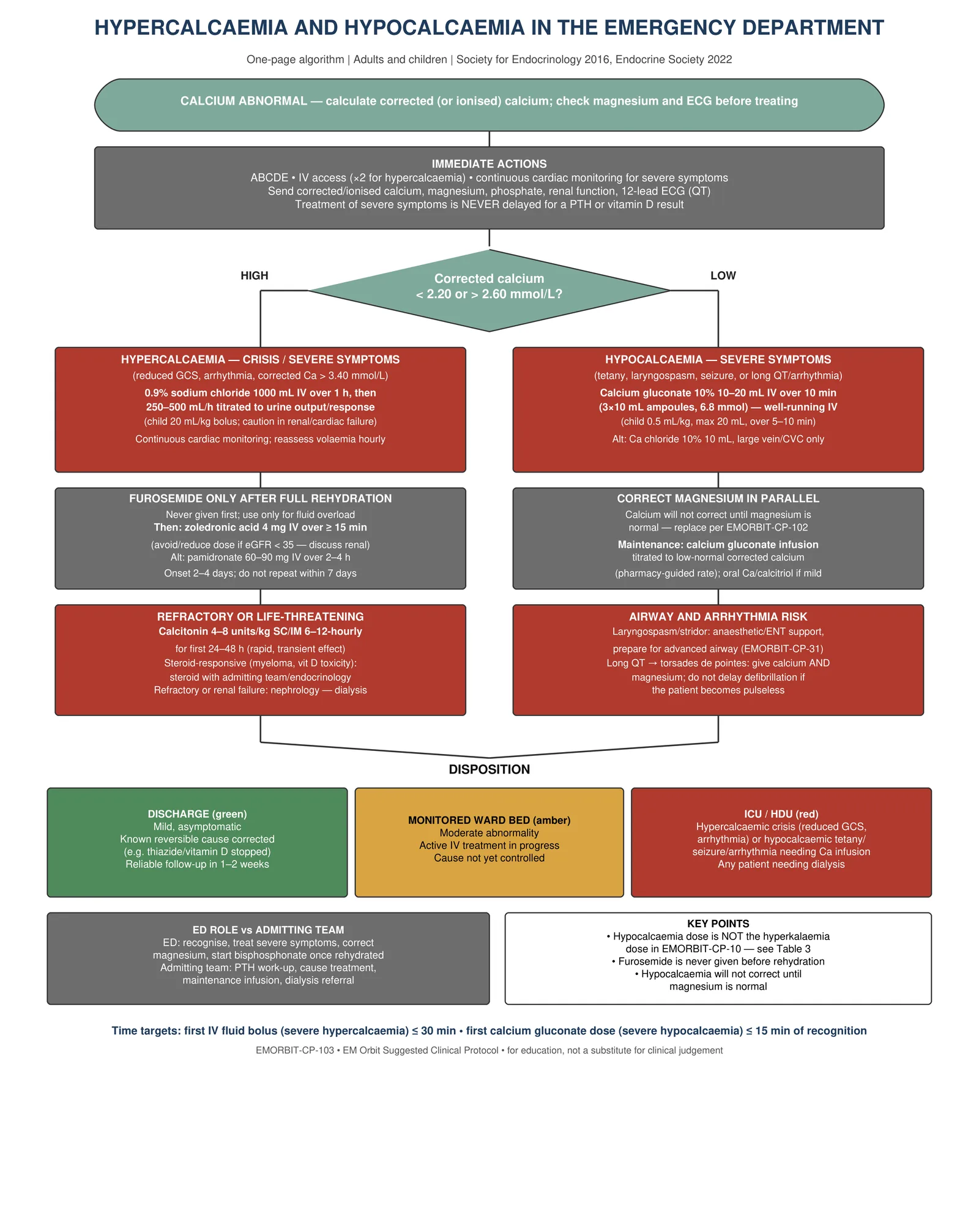
The one-page algorithm is shown at the top of this page.
6Team roles
6.1Triage and ED Nurses Role:
6.1.1 Recognise tetany, seizure, reduced GCS, or an arrhythmia in a patient with a known or suspected calcium abnormality and escalate immediately.
6.1.2 Prepare calcium gluconate for immediate administration when ordered; record the time and volume of every dose and the times of repeat calcium samples.
6.2Pharmacist:
6.2.1 Ensure calcium gluconate, calcium chloride, zoledronic acid or pamidronate, and calcitonin are stocked and available with weight-based paediatric dose guidance.
6.2.2 Verify the bisphosphonate dose against renal function, confirm the calcium gluconate/chloride order matches Table 3, and review the medication list for a causative drug (thiazide, lithium, vitamin D or calcium supplements).
6.3Endocrinology / Admitting Medical Team:
6.3.1 Receive the referral for cause work-up, interpret the PTH result, direct long-term vitamin D/calcitriol or bisphosphonate therapy, and take over calcium monitoring beyond the ED phase.
6.4Laboratory Staff:
6.4.1 Process calcium, magnesium, and PTH results urgently for a symptomatic patient and flag a critical result to the treating team without delay.
6.5Nephrology:
6.5.1 Advise on and arrange dialysis for hypercalcaemia refractory to medical treatment, or for severe hypocalcaemia or hypercalcaemia in renal failure.
7The patient's role
7.1 Report new tingling, cramps, palpitations, confusion, or reduced alertness immediately during observation.
7.2 Attend the arranged follow-up appointment and repeat blood test; take calcium, vitamin D, or calcitriol exactly as instructed, and do not take additional over-the-counter calcium or vitamin D without advice.
8Definitions
8.1Hypercalcaemia: corrected serum calcium above 2.60 mmol/L; a hypercalcaemic crisis is a corrected calcium above 3.40 mmol/L, or any level with severe symptoms.
8.2Hypocalcaemia: corrected serum calcium below 2.20 mmol/L; severe hypocalcaemia is generally below 1.75 mmol/L or any level with tetany, laryngospasm, seizure, or arrhythmia.
8.3Corrected Calcium: measured total calcium adjusted for albumin (Attachment 2, Table 1 note), used because roughly 40–50% of serum calcium is protein-bound.
8.4Hypoparathyroidism: insufficient parathyroid hormone, most commonly after thyroid or parathyroid surgery, causing hypocalcaemia with an inappropriately low or normal PTH.
8.5Humoral Hypercalcaemia of Malignancy: hypercalcaemia caused by tumour secretion of parathyroid hormone-related peptide (PTHrP), distinct from hypercalcaemia caused directly by osteolytic bone metastases.
8.6Chvostek's and Trousseau's Signs: clinical tests for neuromuscular irritability in hypocalcaemia (section 4.1.3); supportive, not diagnostic.
9Attachments
- Attachment 1: One-page algorithm (top of this page)
- Attachment 2: Hypercalcaemia Severity and Treatment Quick Reference
- Attachment 3: Hypocalcaemia Severity and IV Calcium Dose Quick Reference
11Suggested quality indicators
11.1Time to first IV fluid bolus in severe/symptomatic hypercalcaemia ≤ 30 minutes: (Number of patients with severe or symptomatic hypercalcaemia receiving the first 0.9% sodium chloride bolus within 30 minutes of the abnormal result / Total number of patients with severe or symptomatic hypercalcaemia) × 100. Target ≥ 90%.
11.2Time to first calcium gluconate dose in severe symptomatic hypocalcaemia ≤ 15 minutes: (Number of patients with tetany, laryngospasm, seizure or arrhythmia from hypocalcaemia receiving intravenous calcium within 15 minutes of recognition / Total number of such patients) × 100. Target ≥ 90%.
11.3Furosemide given only after documented rehydration: (Number of hypercalcaemia patients given furosemide with a documented adequate rehydration volume beforehand / Total number of hypercalcaemia patients given furosemide) × 100. Target 100%.
11.4Safe disposition: (Number of patients with severe hypercalcaemia or hypocalcaemia admitted to a monitored bed or higher / Total number with severe hypercalcaemia or hypocalcaemia) × 100. Target 100%.
11.5Overcorrection or recurrence (outcome): (Number of patients re-presenting within 30 days with the same calcium abnormality, or with a treatment-related adverse event / Total number treated) × 100. Monitored as an outcome indicator; no numerical target, reviewed as an incident each time.
13References
- Society for Endocrinology Clinical Committee. Society for Endocrinology Endocrine Emergency Guidance: emergency management of severe symptomatic hypercalcaemia in adult patients. Endocr Connect. 2016.
- Society for Endocrinology Clinical Committee. Society for Endocrinology Endocrine Emergency Guidance: emergency management of tetany, seizures and hypocalcaemic cardiac arrhythmia due to severe hypocalcaemia in adult patients. Endocr Connect. 2016.
- Khan AA, Bilezikian JP, Brandi ML, et al. Evaluation and management of hypoparathyroidism: summary statement and guidelines from the Second International Workshop. J Bone Miner Res. 2022;37(12):2568–2585.
- LeGrand SB, Leskuski D, Zama I. Narrative review: furosemide for hypercalcemia: an unproven yet common practice. Ann Intern Med. 2008;149(4):259–263.
- ED Clinical Practice Guidelines EMORBIT-CP-10 (Hyperkalaemia), EMORBIT-CP-27 (Massive Haemorrhage), EMORBIT-CP-48 (Pancreatitis), EMORBIT-CP-102 (Potassium and Magnesium Disorders) and EMORBIT-CP-125 (Oncological Emergencies).
A2Attachment 2: Hypercalcaemia Severity and Treatment Quick Reference
| Direction | Severity | Corrected calcium* / features | Initial action |
|---|---|---|---|
| Hypercalcaemia | Mild | 2.65–3.00 mmol/L, few or no symptoms | Rehydrate; identify the cause; treat as outpatient if reliable |
| Hypercalcaemia | Moderate | 3.01–3.40 mmol/L | Rehydrate; bisphosphonate once rehydrated (Table 2) |
| Hypercalcaemia | Severe / crisis | > 3.40 mmol/L, or any level with reduced GCS, arrhythmia or severe dehydration | Rehydrate urgently, calcitonin, bisphosphonate, critical care review |
| Hypocalcaemia | Mild | 2.00–2.19 mmol/L, asymptomatic or mild paraesthesia | Oral calcium and vitamin D/calcitriol; treat the cause |
| Hypocalcaemia | Moderate | 1.75–1.99 mmol/L | IV calcium if symptomatic (Table 3); correct magnesium |
| Hypocalcaemia | Severe | < 1.75 mmol/L, or any level with tetany, laryngospasm, seizure or arrhythmia/long QT | IV calcium gluconate immediately (Table 3); continuous cardiac monitoring |
*Corrected calcium (mmol/L) = measured total calcium + 0.02 × (40 − albumin g/L); use ionised calcium on a blood gas analyser where available or where albumin is unreliable — treat an ionised calcium below 1.1–1.13 mmol/L as hypocalcaemia (as EMORBIT-CP-27). Local laboratory reference ranges may vary slightly; use the local range where it differs.
| Step | Adult | Child |
|---|---|---|
| 1. Rehydrate first | 0.9% sodium chloride 1000 mL IV over 1 hour, then 250–500 mL/hour titrated to urine output and cardiac status; reassess volaemia hourly | 20 mL/kg 0.9% sodium chloride bolus, repeat to response |
| 2. Furosemide | NOT given routinely and NEVER before rehydration is complete; only for fluid overload after adequate rehydration, at physician discretion | Same principle |
| 3. IV bisphosphonate (once rehydrated, calcium still ≥ 3.00 mmol/L or symptomatic) | Zoledronic acid 4 mg IV over ≥ 15 minutes (avoid or reduce dose if eGFR < 35 mL/min — discuss with renal); alternative pamidronate 60–90 mg IV over 2–4 hours. Onset 2–4 days; do not repeat within 7 days | Not established in the ED; discuss with paediatrics/endocrinology |
| 4. Calcitonin (severe/refractory, bridges to bisphosphonate) | Calcitonin (salmon) 4–8 units/kg subcutaneously or intramuscularly every 6–12 hours for the first 24–48 hours only (tachyphylaxis thereafter) | As adult, weight-based; specialist advice |
| 5. Steroid-responsive cause | Hydrocortisone or prednisolone for myeloma, lymphoma, vitamin D toxicity or granulomatous disease, dose set with the admitting team/endocrinology | As directed by paediatrics |
| 6. Refractory / renal failure | Nephrology referral for renal replacement therapy; denosumab as a specialist-initiated alternative where bisphosphonate is contraindicated (where available) | Nephrology/paediatrics |
Stop the causative drug (thiazide, lithium, calcium or vitamin D supplements, calcium-containing antacids). All doses shall be verified against the local formulary by the ED pharmacist; bisphosphonate dose is renal-function dependent.
A3Attachment 3: Hypocalcaemia Severity and IV Calcium Dose Quick Reference
| Drug | Adult | Child |
|---|---|---|
| Calcium gluconate 10% (preferred peripheral choice) | 10–20 mL in 50–100 mL of 5% glucose IV over 10 minutes, through a well-running peripheral cannula, with continuous cardiac monitoring; repeat until symptoms resolve. (Note: EMORBIT-CP-10 gives 30 mL over 5–10 minutes for hyperkalaemia cardioprotection — a different indication.) | 0.5 mL/kg IV over 5–10 minutes, maximum 20 mL |
| Calcium chloride 10% (alternative) | Used only where gluconate is unavailable, on senior decision: it carries three times the calcium per mL, so the volume is one third that of gluconate. Through a large peripheral vein or central line only — never a small peripheral cannula: extravasation causes severe tissue necrosis | Not first-line; specialist advice |
| Magnesium | Correct magnesium in parallel per EMORBIT-CP-102 — calcium replacement will not hold durably until magnesium is normal | As EMORBIT-CP-102 |
| Maintenance infusion | Calcium gluconate 10% 100 mL in 1 litre of 0.9% sodium chloride or 5% glucose at 50–100 mL/hour (Society for Endocrinology 2016), titrated to a low-normal corrected calcium; rate and dilution confirmed with pharmacy | Weight-based, pharmacy-guided |
Onset 1–3 minutes; duration 30–60 minutes — the bolus does not sustain correction and must be followed by the maintenance infusion or oral therapy. Do not give calcium in the same line as sodium bicarbonate without flushing (precipitation).