Hypokalaemia and Hypomagnesaemia in the Emergency Department
EMORBIT-CP-102 · Chapter 6 · Endocrine and Metabolic Emergencies
Open in the appFree, works on your phone and offline, with every tool alongside.
Evidence base: UK Kidney Association; ACEP
1Purpose
1.1 Provide the standardized ED approach to recognition and treatment of hypokalaemia and hypomagnesaemia of any cause, in adults and children, so that malignant arrhythmia is prevented and potassium replacement is not given at an unsafe rate or concentration.
1.2 Ensure magnesium is checked and corrected together with potassium in every patient, because hypokalaemia refractory to potassium alone is usually due to uncorrected hypomagnesaemia.
1.3 This guideline is the ED reference for the potassium and magnesium doses used elsewhere: EMORBIT-CP-99 (Adult Gastroenteritis) draws its correction doses from this guideline and shall match it exactly; this document is the one to update if a dose changes.
1.4 Align with the structure of EMORBIT-CP-10 (Hyperkalaemia), the magnesium dose already fixed in EMORBIT-CP-38 (Tachyarrhythmias), and standard potassium- and magnesium-replacement practice.
2Who this protocol applies to
2.1 Adults (13 years and over) and children with a measured serum or venous blood gas potassium below 3.5 mmol/L, or a magnesium below 0.70 mmol/L, symptomatic or found incidentally.
2.2 Hypokalaemia or hypomagnesaemia contributing to an arrhythmia, seizure, muscle weakness, or presenting as the cause of another ED presentation (palpitations, collapse, fall).
2.3 Periodic paralysis and refeeding syndrome, for the caution principles in sections 4.1.5 and 4.3.4.
3Not covered by this protocol
3.1 Potassium or magnesium abnormality managed as part of diabetic ketoacidosis or hyperosmolar hyperglycaemic state: follow the potassium replacement schedule in EMORBIT-CP-17 (adult) or EMORBIT-CP-81 (child); do not run a separate hypokalaemia protocol on top of that fluid and insulin regimen.
3.2 Hyperkalaemia and hypermagnesaemia: managed under EMORBIT-CP-10 (Hyperkalaemia); hypercalcaemia and hypocalcaemia under EMORBIT-CP-103 (Calcium Disorders).
3.3 Torsades de pointes and other tachyarrhythmias already being managed under EMORBIT-CP-38: this guideline supplies the magnesium dose used by that pathway; it is not a second, competing pathway.
3.4 The eclampsia/pre-eclampsia magnesium sulphate loading and infusion regimen, which is an obstetric protocol and not a dose in this guideline.
3.5 Chronic, stable, asymptomatic mild hypokalaemia (3.0–3.4 mmol/L) with no red flag, referred for outpatient work-up without ED treatment.
4Protocol
4.1History and Assessment:
4.1.1Triage and Recognition:
4.1.1.1 Any patient with an arrhythmia, seizure, or severe or ascending weakness and a potassium below 2.5 mmol/L or a magnesium below 0.30 mmol/L on venous blood gas or serum electrolytes is triaged to the highest acuity category and reviewed by an ED physician within 5 minutes.
4.1.1.2 Record the time the abnormal result is available and the time of the first replacement dose; both feed the performance indicators (section 11).
4.1.1.3 Check magnesium at the same time as potassium in every patient — the result is needed before deciding the replacement plan, not after.
4.1.2History:
4.1.2.1 Symptoms: muscle weakness (typically ascending and proximal), cramps, fatigue, palpitations, constipation, and, in severe cases, ascending paralysis or respiratory difficulty.
4.1.2.2 Causes to ask about directly: vomiting, diarrhoea, or nasogastric losses; diuretics (loop and thiazide); laxative overuse; poor oral intake, alcohol use disorder, or recent starvation (refeeding risk); insulin or beta-agonist use; proton pump inhibitors and aminoglycosides (magnesium wasting); and a family or personal history of episodic weakness (periodic paralysis).
4.1.2.3 Known chronic kidney disease, dialysis, hyperaldosteronism, Cushing syndrome, renal tubular acidosis, or thyrotoxicosis.
4.1.2.4 Medication list including digoxin, and the time of the last dose in a patient with suspected toxicity.
4.1.3Examination:
4.1.3.1 Cardiovascular: pulse rate and rhythm, blood pressure; look for signs of the arrhythmias in Table 1.
4.1.3.2 Neuromuscular: proximal and ascending weakness, reduced or absent reflexes, respiratory effort — measure forced vital capacity or discuss EMORBIT-CP-97 if ascending weakness raises a wider neuromuscular differential.
4.1.3.3 Volume status and signs of the cause: dehydration, thyroid signs, Cushingoid features, signs of malnutrition or an eating disorder.
4.1.4Risk Stratification / Severity:
Table 1: Severity of hypokalaemia and hypomagnesaemia and the corresponding ED action Severity K⁺ / Mg²⁺ (mmol/L) Typical features Minimum ED action Mild K⁺ 3.0–3.4
Mg²⁺ 0.50–0.69Usually asymptomatic; ECG normal Oral replacement; identify and treat the cause; no cardiac monitoring unless another risk factor is present. Moderate K⁺ 2.5–2.9
Mg²⁺ 0.30–0.49Weakness, cramps, constipation, nausea; T waves flattening, U waves, mild ST depression may appear Oral or IV replacement depending on tolerance; 12-lead ECG; cardiac monitoring if any ECG change or a risk factor for arrhythmia (digoxin, structural heart disease, prolonged QT). Severe K⁺ < 2.5
Mg²⁺ < 0.30Ventricular ectopy or arrhythmia (including torsades de pointes with a prolonged QT); severe or ascending weakness or paralysis; rhabdomyolysis Continuous cardiac monitoring; IV replacement (Table 2/3); correct magnesium and potassium together; senior review. ANY level on digoxin Any Hypokalaemia and hypomagnesaemia both potentiate digoxin toxicity Treat as moderate or above; check a digoxin level if toxicity is suspected. The number alone shall not determine urgency: any ECG change, an ongoing source of loss, or digoxin therapy raises the level of concern regardless of the value. Hypokalaemia that does not correct with potassium replacement is usually due to uncorrected hypomagnesaemia — check magnesium in every patient with hypokalaemia and correct it first or at the same time.
4.1.5Differential Diagnosis:
4.1.5.1 Ascending weakness from a neurological cause (Guillain-Barré syndrome, myasthenic crisis, spinal cord compression) — see EMORBIT-CP-97 if the potassium and magnesium are normal or the weakness does not fit the biochemical severity.
4.1.5.2 Digoxin toxicity presenting with an arrhythmia and hypokalaemia — hypokalaemia potentiates digoxin toxicity; check a digoxin level.
4.1.5.3 Thyrotoxic periodic paralysis in a patient (typically an Asian male) with acute severe hypokalaemic paralysis and undiagnosed hyperthyroidism.
4.1.6Special Populations:
4.1.6.1 Children: weight-based dosing throughout (Tables 2 and 3); discuss every child requiring IV replacement with the paediatric team.
4.1.6.2 Pregnancy: treat severe symptoms without delay; involve obstetrics; the eclampsia magnesium regimen is separate and shall never be confused with the torsades dose in Table 3.
4.1.6.3 Elderly patients on loop or thiazide diuretics: the commonest cause of hypokalaemia seen in the ED; review the diuretic and apply standard replacement.
4.1.6.4 Alcohol use disorder, malnutrition, or refeeding risk: correct potassium, magnesium and phosphate before or with the start of feeding, and give thiamine; see section 4.3.4.
4.1.6.5 Periodic paralysis: total body potassium is often normal — give small doses only (Table 2, oral or slow IV 10–20 mmol) with continuous cardiac monitoring, because standard-volume replacement causes rebound hyperkalaemia as the intracellular shift reverses; treat the trigger (a beta-blocker such as propranolol for thyrotoxic periodic paralysis).
4.2Investigations:
4.2.1 No investigation delays magnesium and potassium replacement in a patient with an arrhythmia or severe symptoms.
4.2.2 Potassium, magnesium, calcium, phosphate, glucose, urea and creatinine on a venous blood gas or serum sample.
4.2.3 12-lead electrocardiogram in every patient with moderate or severe abnormality, or any cardiac symptom.
4.2.4 Digoxin level where the patient takes digoxin and toxicity is suspected.
4.2.5 Thyroid function where thyrotoxic periodic paralysis is suspected; creatine kinase where rhabdomyolysis is possible.
4.3Plan of Care:
4.3.1Immediate Actions (first 5–15 minutes):
4.3.1.1 Airway, breathing, circulation, disability, exposure (ABCDE); continuous cardiac monitoring for any patient with an arrhythmia, severe biochemical derangement, or ECG change.
4.3.1.2 IV access; send the investigations in section 4.2 in parallel; do not wait for magnesium before starting potassium replacement in a patient with severe symptoms — give both together where both are low.
4.3.1.3 Stop every drug contributing to the loss where safe to do so (a diuretic, a laxative) and record the change.
4.3.2Definitive ED Treatment — Potassium: replace by the route and rate in Table 2; never as a bolus or IV push.
Table 2: Potassium replacement — adult and child Route / setting Adult Child Oral (mild, tolerating oral, no red flag) Potassium chloride 40–80 mmol/day in divided doses; recheck in 48–72 hours Weight-based oral potassium under paediatric or pharmacy advice; recheck in 48–72 hours IV — peripheral line Maximum concentration 40 mmol/L; maximum rate 10 mmol/hour Weight-based, to the same maximum concentration; discuss rate with the paediatric team IV — central line, continuous ECG monitoring Maximum rate 20 mmol/hour; higher only in a critical care area under senior direction PICU/senior paediatric direction only NEVER Give intravenous potassium as a bolus or IV push, at any rate or by any route Same These are standard figures; check them against the product information. They match the 40 mmol/L peripheral concentration ceiling already adopted in EMORBIT-CP-17 (DKA). Continuous cardiac monitoring is required for any intravenous potassium infusion. Use a ready-mixed bag in preference to adding potassium at the bedside.
4.3.3Definitive ED Treatment — Magnesium: correct magnesium first, or at the same time as potassium, exactly as in Table 3.
Table 3: Magnesium replacement — adult and child Indication Adult Child Severe symptomatic hypomagnesaemia, seizure, arrhythmia or torsades de pointes Magnesium sulphate 1–2 g (4–8 mmol) IV, diluted, over about 15 minutes (AHA 2025); repeat once after 10–15 minutes if it persists or recurs Magnesium sulphate 25–50 mg/kg IV over 10–15 minutes (maximum 2 g) Moderate hypomagnesaemia, no arrhythmia Magnesium sulphate 4 g (16 mmol) IV in 100–250 mL over 4–6 hours Weight-based under paediatric advice; same maximum 2 g per dose Mild, asymptomatic, tolerating oral Oral magnesium replacement; recheck in 48–72 hours Oral magnesium under paediatric or pharmacy advice This is the same torsades de pointes dose as EMORBIT-CP-38 (Tachyarrhythmias) — do not restate a different one. It is given whether or not the serum magnesium is low. It is NOT the eclampsia/pre-eclampsia loading and infusion regimen (4 g loading then 1 g/hour) — do not confuse the two; the obstetric regimen is not given for torsades or vice versa.
4.3.4Refeeding Syndrome:
4.3.4.1 Check and correct potassium, magnesium and phosphate before, or at the start of, any feeding in a patient at risk (malnutrition, alcohol use disorder, prolonged fasting, an eating disorder, or a large recent unintentional weight loss).
4.3.4.2 Give thiamine before or with the first feed; introduce feeding cautiously and monitor electrolytes daily under the admitting team once replacement has started in the ED.
4.3.5What the ED Does vs the Admitting Team:
4.3.5.1 The ED recognises the abnormality, treats an arrhythmia or severe symptoms, starts safe replacement at the rate and concentration in Tables 2 and 3, and identifies an immediately reversible cause (stops a culprit diuretic).
4.3.5.2 The admitting team continues replacement to a normal level, investigates an unexplained cause (hyperaldosteronism, renal tubular acidosis, endocrine work-up), and manages periodic paralysis and refeeding beyond the first cycle.
4.3.6Escalation / Refractory:
4.3.6.1 An arrhythmia or torsades de pointes that persists despite magnesium and potassium replacement is managed as per EMORBIT-CP-38 (Tachyarrhythmias).
4.3.6.2 Hypokalaemia that does not correct despite adequate potassium replacement: confirm magnesium has been corrected (section 4.1.4) before increasing the potassium dose further.
4.3.6.3 Ascending weakness progressing to respiratory compromise: manage the airway, measure forced vital capacity, and escalate to critical care; discuss EMORBIT-CP-97 if a neurological cause has not been excluded.
4.3.6.4 Suspected rebound hyperkalaemia during periodic paralysis treatment: stop the infusion, recheck potassium, and manage per EMORBIT-CP-10 if hyperkalaemia develops.
4.3.7Monitoring and Reassessment:
4.3.7.1 Continuous cardiac monitoring for any patient receiving IV potassium or IV magnesium for a severe or symptomatic abnormality, continued until the level is stable and the ECG (where abnormal) has normalised.
4.3.7.2 Recheck potassium 2–4 hours after starting IV replacement and again before any change in the infusion rate; recheck magnesium after the dose in Table 3.
4.3.7.3 Fluid balance chart for all patients receiving IV replacement; hourly capillary glucose is not routinely required unless insulin is being given for another indication.
4.3.8Disposition:
4.3.8.1 ICU / HDU: severe symptomatic hypokalaemia or hypomagnesaemia, an arrhythmia or torsades de pointes, IV potassium above the peripheral maximum requiring a central line, periodic paralysis with respiratory involvement, or refractory hypokalaemia despite correction of magnesium.
4.3.8.2 Monitored ward bed: moderate abnormality without an arrhythmia, or active IV replacement in progress once the immediate treatment is complete.
4.3.8.3 Discharge: mild, asymptomatic abnormality (K⁺ 3.0–3.4 mmol/L or Mg²⁺ 0.50–0.69 mmol/L) with a clear, reversible cause already addressed (for example, a diuretic reviewed) and reliable follow-up within one week.
4.3.9Discharge and Follow-up:
4.3.9.1 Document the discharge potassium and magnesium, the cause identified, the medication change made, and the follow-up arranged (primary care or nephrology) with a repeat sample within 48–72 hours to one week.
4.3.9.2 Safety-net advice: return immediately for palpitations, severe weakness, or fainting.
4.3.10Documentation and Reporting:
4.3.10.1 Document every potassium and magnesium result with its time, the volume, rate and route of every replacement dose given, symptom response, and the disposition and its reasoning.
4.3.10.2 Any potassium given by bolus or IV push, or above the maximum rate or concentration in Table 2, is reported through the local incident reporting system for departmental review.
5Algorithm
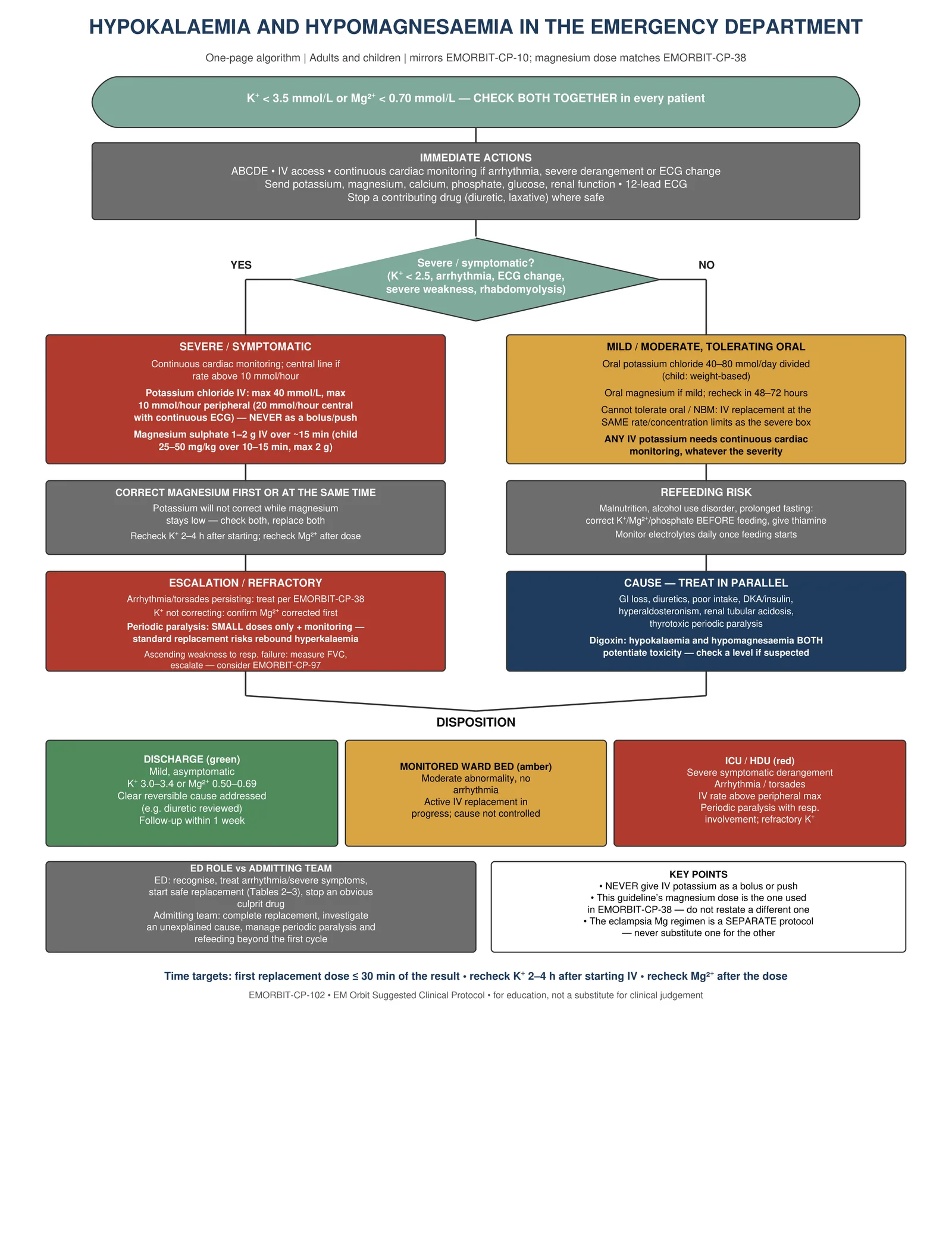
The one-page algorithm is shown at the top of this page.
6Team roles
6.1Triage and ED Nurses Role:
6.1.1 Recognise an arrhythmia or severe weakness in a patient with a known or suspected potassium or magnesium abnormality and escalate immediately.
6.1.2 Prepare potassium chloride and magnesium sulphate for immediate administration when ordered; record the time, volume and rate of every dose.
6.2Pharmacist:
6.2.1 Ensure potassium chloride infusion bags (pre-mixed to 40 mmol/L) and magnesium sulphate are stocked and available in the resuscitation area with weight-based paediatric dose guidance.
6.2.2 Verify the potassium order against Table 2 (concentration and rate) and the magnesium order against Table 3, and confirm the local maximum peripheral rate with Pharmacy where this has not yet been formally set.
6.3Nephrology / Admitting Medical Team:
6.3.1 Receive the referral for cause work-up (hyperaldosteronism, renal tubular acidosis), direct ongoing replacement, and take over monitoring beyond the ED phase.
6.4Laboratory Staff:
6.4.1 Process potassium and magnesium results urgently for a patient with an arrhythmia or severe symptoms and flag a critical result to the treating team without delay.
6.5Paediatrician:
6.5.1 Review every child requiring IV potassium or magnesium before disposition and confirm the dose, rate and follow-up plan.
7The patient's role
7.1 Report new weakness, palpitations, or fainting immediately during observation.
7.2 Attend the arranged follow-up appointment and repeat blood test; take any changed medication as instructed.
8Definitions
8.1Hypokalaemia: serum or plasma potassium below 3.5 mmol/L; severe hypokalaemia is below 2.5 mmol/L, or any level with an ECG change or arrhythmia.
8.2Hypomagnesaemia: serum or plasma magnesium below 0.70 mmol/L; severe hypomagnesaemia is below 0.30 mmol/L.
8.3Refeeding Syndrome: a potentially fatal shift of potassium, magnesium and phosphate into cells when feeding is restarted after a period of malnutrition or fasting, corrected by checking and replacing these electrolytes before and during feeding.
8.4Periodic Paralysis: episodic severe muscle weakness caused by a transcellular shift of potassium (familial or thyrotoxic), in which total body potassium is usually normal and standard-volume replacement risks rebound hyperkalaemia.
8.5Torsades de Pointes: polymorphic ventricular tachycardia on a background of a prolonged QT interval; the emergency treatment is magnesium sulphate as in Table 3, defined fully in EMORBIT-CP-38.
9Attachments
- Attachment 1: One-page algorithm (top of this page)
- Attachment 2: Potassium Replacement Quick Reference
- Attachment 3: Magnesium Replacement Quick Reference
11Suggested quality indicators
11.1Time to first replacement dose ≤ 30 minutes: (Number of patients with severe symptomatic hypokalaemia or hypomagnesaemia receiving the first replacement dose within 30 minutes of the abnormal result / Total number of patients with severe symptomatic hypokalaemia or hypomagnesaemia) × 100. Target ≥ 90%.
11.2Safe IV potassium administration: (Number of patients receiving intravenous potassium at or below the maximum rate and concentration in Table 2, with continuous cardiac monitoring documented / Total number receiving intravenous potassium) × 100. Target 100%.
11.3Magnesium checked with potassium: (Number of patients with hypokalaemia who had a magnesium result documented / Total number of patients with hypokalaemia) × 100. Target ≥ 90%.
11.4Safe disposition: (Number of patients with severe symptomatic hypokalaemia or hypomagnesaemia admitted to a monitored bed or higher / Total number with severe symptomatic hypokalaemia or hypomagnesaemia) × 100. Target 100%.
11.5Outcome — unsafe potassium administration: (Number of patients who received intravenous potassium as a bolus/push or above the maximum rate or concentration in Table 2 / Total number receiving intravenous potassium) × 100. Monitored as an outcome indicator; no numerical target, reviewed as an incident each time.
13References
- Kardalas E, Paschou SA, Anagnostis P, Muscogiuri G, Siasos G, Vryonidou A. Hypokalemia: a clinical update. Endocr Connect. 2018;7(4):R135–R146.
- Cohn JN, Kowey PR, Whelton PK, Prisant LM. New guidelines for potassium replacement in clinical practice: a contemporary review by the National Council on Potassium in Clinical Practice. Arch Intern Med. 2000;160(16):2429–2436.
- Gennari FJ. Hypokalemia. N Engl J Med. 1998;339(7):451–458.
- Pham PC, Pham PM, Pham SV, Miller JM, Pham PT. Hypomagnesemia: a clinical perspective. Int J Nephrol Renovasc Dis. 2014;7:219–230.
- Van Laecke S. Hypomagnesemia and hypermagnesemia. Acta Clin Belg. 2019;74(1):41–47.
- Lott C, Truhlář A, Alfonzo A, et al. European Resuscitation Council Guidelines 2021: Cardiac arrest in special circumstances. Resuscitation. 2021;161:152–219.
- UK Kidney Association. Clinical Practice Guideline: Treatment of Acute Hyperkalaemia in Adults. Bristol: UK Kidney Association; 2023 (structure mirrored by this guideline; see EMORBIT-CP-10).
- Advanced Life Support Group. Advanced Paediatric Life Support: A Practical Approach to Emergencies (APLS), 7th ed. Wiley-Blackwell; 2023.
- ED Clinical Practice Guidelines EMORBIT-CP-10 (Hyperkalaemia), EMORBIT-CP-17 (DKA/HHS), EMORBIT-CP-38 (Tachyarrhythmias), EMORBIT-CP-81 (Paediatric DKA), EMORBIT-CP-97 (Acute Weakness) and EMORBIT-CP-99 (Adult Gastroenteritis).
A2Attachment 2: Potassium Replacement Quick Reference
| Severity | K⁺ / Mg²⁺ (mmol/L) | Typical features | Minimum ED action |
|---|---|---|---|
| Mild | K⁺ 3.0–3.4 Mg²⁺ 0.50–0.69 | Usually asymptomatic; ECG normal | Oral replacement; identify and treat the cause; no cardiac monitoring unless another risk factor is present. |
| Moderate | K⁺ 2.5–2.9 Mg²⁺ 0.30–0.49 | Weakness, cramps, constipation, nausea; T waves flattening, U waves, mild ST depression may appear | Oral or IV replacement depending on tolerance; 12-lead ECG; cardiac monitoring if any ECG change or a risk factor for arrhythmia (digoxin, structural heart disease, prolonged QT). |
| Severe | K⁺ < 2.5 Mg²⁺ < 0.30 | Ventricular ectopy or arrhythmia (including torsades de pointes with a prolonged QT); severe or ascending weakness or paralysis; rhabdomyolysis | Continuous cardiac monitoring; IV replacement (Table 2/3); correct magnesium and potassium together; senior review. |
| ANY level on digoxin | Any | Hypokalaemia and hypomagnesaemia both potentiate digoxin toxicity | Treat as moderate or above; check a digoxin level if toxicity is suspected. |
The number alone shall not determine urgency: any ECG change, an ongoing source of loss, or digoxin therapy raises the level of concern regardless of the value. Hypokalaemia that does not correct with potassium replacement is usually due to uncorrected hypomagnesaemia — check magnesium in every patient with hypokalaemia and correct it first or at the same time.
| Route / setting | Adult | Child |
|---|---|---|
| Oral (mild, tolerating oral, no red flag) | Potassium chloride 40–80 mmol/day in divided doses; recheck in 48–72 hours | Weight-based oral potassium under paediatric or pharmacy advice; recheck in 48–72 hours |
| IV — peripheral line | Maximum concentration 40 mmol/L; maximum rate 10 mmol/hour | Weight-based, to the same maximum concentration; discuss rate with the paediatric team |
| IV — central line, continuous ECG monitoring | Maximum rate 20 mmol/hour; higher only in a critical care area under senior direction | PICU/senior paediatric direction only |
| NEVER | Give intravenous potassium as a bolus or IV push, at any rate or by any route | Same |
These are standard figures; check them against the product information. They match the 40 mmol/L peripheral concentration ceiling already adopted in EMORBIT-CP-17 (DKA). Continuous cardiac monitoring is required for any intravenous potassium infusion. Use a ready-mixed bag in preference to adding potassium at the bedside.
A3Attachment 3: Magnesium Replacement Quick Reference
| Indication | Adult | Child |
|---|---|---|
| Severe symptomatic hypomagnesaemia, seizure, arrhythmia or torsades de pointes | Magnesium sulphate 1–2 g (4–8 mmol) IV, diluted, over about 15 minutes (AHA 2025); repeat once after 10–15 minutes if it persists or recurs | Magnesium sulphate 25–50 mg/kg IV over 10–15 minutes (maximum 2 g) |
| Moderate hypomagnesaemia, no arrhythmia | Magnesium sulphate 4 g (16 mmol) IV in 100–250 mL over 4–6 hours | Weight-based under paediatric advice; same maximum 2 g per dose |
| Mild, asymptomatic, tolerating oral | Oral magnesium replacement; recheck in 48–72 hours | Oral magnesium under paediatric or pharmacy advice |
This is the same torsades de pointes dose as EMORBIT-CP-38 (Tachyarrhythmias) — do not restate a different one. It is given whether or not the serum magnesium is low. It is NOT the eclampsia/pre-eclampsia loading and infusion regimen (4 g loading then 1 g/hour) — do not confuse the two; the obstetric regimen is not given for torsades or vice versa.