Acute Gastroenteritis and Dehydration in Adults
EMORBIT-CP-99 · Chapter 5 · Gastrointestinal and Surgical Emergencies
Open in the appFree, works on your phone and offline, with every tool alongside.
Evidence base: IDSA 2017; NICE
1Purpose
1.1 Standardize the assessment of dehydration severity and the choice of oral or intravenous rehydration for patients aged 13 years and over presenting to Emergency Departments (ED) with acute gastroenteritis.
1.2 Identify quickly the presentations that are not simple gastroenteritis — a surgical abdomen, gastrointestinal bleeding, sepsis from another source, or bloody diarrhoea from a Shiga toxin-producing organism — rather than treating every diarrhoeal illness alike.
1.3 Minimize unnecessary investigation, IV cannulation, and antibiotic use, while treating shock without delay and recognising the high-risk patient early.
1.4 Ensure a documented safety-net for every patient discharged home, and early Infection Control notification for a cluster, post-flood surge, or suspected cholera.
2Who this protocol applies to
2.1 Patients aged 13 years and over (the library adult boundary) with acute diarrhoea (14 days or less), with or without vomiting, and suspected infective gastroenteritis (viral, bacterial, or parasitic).
2.2 Dehydration of any severity judged to be due to gastrointestinal fluid loss, requiring ED assessment or oral/IV rehydration.
2.3 Suspected infective diarrhoea, including food-borne, water-borne, travel-related, cluster-related, or post-flood presentations.
3Not covered by this protocol
3.1 Suspected surgical abdomen — appendicitis, bowel obstruction, perforation, ischaemia, or peritonitis: manage per EMORBIT-CP-15 (Acute Abdominal Pain) and refer surgery without delaying for a trial of oral rehydration.
3.2 Chronic diarrhoea (more than 14 days), an inflammatory bowel disease flare, or a malabsorption disorder: refer gastroenterology.
3.3 Gastrointestinal bleeding (upper or lower) as the primary presentation: manage per the relevant gastrointestinal bleeding guideline.
3.4 Sepsis without a primary gastrointestinal source, or a toxicological cause (poisoning, chemical ingestion): manage per EMORBIT-CP-11 (Sepsis) or the relevant toxicology guideline.
3.5 Hyperemesis gravidarum or another pregnancy-specific vomiting syndrome: manage per the early-pregnancy guideline; a pregnant patient with true gastroenteritis remains within this guideline (4.1.6).
3.6 Patients under 13 years: managed under EMORBIT-CP-80 (Paediatric Gastroenteritis and Dehydration).
4Protocol
4.1History and Assessment:
4.1.1Triage and Recognition:
4.1.1.1 Record a full set of observations and screen for infection risk (cluster, exposure, travel) at triage.
4.1.1.2 Assign the highest acuity category to any patient with a red flag (4.1.5) or any shock feature (Table 1); move to a monitored area and notify the ED physician immediately.
4.1.1.3 Grade dehydration using the clinical scale below and record the tier — mild, moderate, or severe/shock.
Table 1: Clinical assessment of dehydration severity in an adult Feature Mild Moderate Severe / shock Mental status Alert, well Alert, thirsty, mildly anxious Lethargic, confused, or reduced conscious level Mucous membranes / skin turgor Normal Dry mouth; reduced turgor Very dry; skin tents; sunken eyes Heart rate / blood pressure Normal Mild tachycardia; BP normal or a postural drop Tachycardia and hypotension — hypotension is a LATE sign Capillary refill / peripheries Normal Normal or mildly delayed Delayed (≥ 3 seconds); cool, mottled peripheries Urine output Normal Reduced Oliguric or anuric Grade on the WORST feature present, not an average. Any shock feature: manage as shock (4.3.2) regardless of the others. Reassess after every intervention.
4.1.2History:
4.1.2.1 Duration and frequency of diarrhoea and vomiting; stool character (watery, mucoid, bloody).
4.1.2.2 Fever, abdominal pain; recent antibiotic use (Clostridioides difficile risk); sick contacts, cluster or outbreak exposure, recent travel, unsafe water, undercooked food, post-flood exposure.
4.1.2.3 Comorbidity that raises risk (4.1.4); current medicines, in particular diuretics, ACE inhibitors/ARBs, and nephrotoxic drugs; urine output.
4.1.3Examination:
4.1.3.1 General appearance, capillary refill, mucous membranes, skin turgor, pulse and blood pressure (including a postural measurement where dehydration is uncertain).
4.1.3.2 Abdominal examination for distension, localized tenderness, guarding, or a palpable mass; signs of shock (Table 1).
4.1.4Risk Stratification – Severity:
4.1.4.1 Any shock feature, or a red flag from 4.1.5, mandates immediate senior review and IV access.
4.1.4.2 High-risk groups — lower the threshold for investigation, IV fluids, and admission: age over 65; immunocompromise; diabetes, chronic kidney disease, chronic heart failure, or liver disease; frailty or malnutrition; persistent vomiting; high-output diarrhoea; pregnancy (4.1.6).
4.1.5Differential Diagnosis — Red Flags for Another Diagnosis:
4.1.5.1 Distension, localized tenderness, guarding, or a palpable mass: surgical abdomen — EMORBIT-CP-15, refer surgery without delay.
4.1.5.2 Bloody diarrhoea: consider dysentery or a Shiga toxin-producing organism (STEC) — do not give antibiotics or antimotility drugs (4.3.6) until this is excluded; also consider inflammatory bowel disease and, in an older patient with vascular risk factors or atrial fibrillation, ischaemic colitis or mesenteric ischaemia (pain out of proportion to findings; a normal lactate does not exclude it).
4.1.5.3 Severe abdominal pain out of proportion to the examination: treat as a surgical or vascular abdomen until excluded, per EMORBIT-CP-15.
4.1.5.4 Fever, hypotension, or a rising early warning score not explained by volume loss alone: consider sepsis from another source — EMORBIT-CP-11.
4.1.5.5 Anuria or a marked rise in creatinine: acute kidney injury — EMORBIT-CP-58.
4.1.5.6 Failed oral rehydration, persistent vomiting, or altered mental status: escalate for IV fluids and senior review; exclude a competing cause of vomiting (raised intracranial pressure, diabetic ketoacidosis in a known or new diabetic) before attributing it to gastroenteritis.
4.1.6Special Populations:
4.1.6.1 Pregnancy and postpartum (any woman who has started menarche, regardless of age): obtain a pregnancy test without delay if not already known (the triage nurse does not perform it — EMORBIT-CP-73); arrange obstetric review for any pregnant or postpartum patient with moderate or severe dehydration. Antiemetic choice follows the local ondansetron position in EMORBIT-CP-73 (avoid before 10 weeks of gestation unless first-line treatment has failed or dehydration threatens maternal or fetal health, case by case).
4.1.6.2 Older adults (over 65), frailty, and malnutrition: lower threshold for IV fluids and admission; postural hypotension and confusion may be the only signs of significant dehydration.
4.1.6.3 Diabetes: check capillary glucose; new hyperglycaemia, ketosis, or Kussmaul breathing with vomiting suggests diabetic ketoacidosis — manage per EMORBIT-CP-17, not this pathway (EMORBIT-CP-49 for hypoglycaemia below 4.0 mmol/L).
4.1.6.4 Chronic kidney disease, chronic heart failure, or liver disease: smaller, reassessed fluid boluses (Table 2, footnote); involve the relevant specialty early; correct electrolytes per EMORBIT-CP-58 and EMORBIT-CP-50.
4.1.6.5 Immunocompromise (including known HIV, transplant, or chemotherapy): lower threshold for stool culture, blood culture, and admission; consider opportunistic pathogens and discuss with infectious diseases.
4.2Investigations:
4.2.1 No investigation shall delay oral rehydration or, where indicated, an IV bolus for shock. Clinical assessment takes priority over routine laboratory testing.
4.2.2 Mild dehydration: no routine blood tests.
4.2.3 Moderate dehydration: venous blood gas with electrolytes; a low venous bicarbonate supports greater severity and acidosis and should prompt IV fluids and closer reassessment, interpreted alongside the clinical picture and lactate rather than as a standalone cut-off.
4.2.4 Severe dehydration or shock: venous blood gas, urea/electrolytes/creatinine, full blood count if indicated, lactate, and an ECG if an electrolyte abnormality is suspected or the patient has cardiac risk factors.
4.2.5 Stool culture (selective only): bloody diarrhoea, high fever, immunocompromise, symptoms lasting more than 7 days, or a suspected cluster/outbreak/cholera — notify the ED consultant and Infection Control (4.3.7).
4.2.6 Blood culture where sepsis is suspected or the patient is systemically unwell (EMORBIT-CP-11).
4.2.7 Abdominal imaging only where a surgical or vascular differential (4.1.5) is suspected, per EMORBIT-CP-15 — not a routine gastroenteritis investigation.
4.3Plan of Care:
4.3.1Immediate Actions:
4.3.1.1 Shock or severe dehydration (Table 1): move to a monitored area, cardiorespiratory monitoring, IV access without delay, and proceed directly to 4.3.2.
4.3.1.2 Any red flag in 4.1.5: manage the competing diagnosis first; do not continue the gastroenteritis pathway.
4.3.1.3 All other patients: begin oral rehydration (4.3.3) while completing assessment.
4.3.2Intravenous Fluids — Shock or Failed Oral Rehydration:
4.3.2.1 Shock: give the IV bolus below; reassess immediately and repeat if shock persists. Call the senior ED physician after 40 mL/kg or 2 litres, and reconsider a cause of shock other than dehydration (sepsis, cardiac, haemorrhage).
Table 2: Fluid therapy by route and severity Route / indication Volume and rate Oral rehydration solution — mild dehydration Approximately 50 mL/kg over 4 hours, plus replacement of ongoing losses (a cupful of ORS for each loose stool or vomit) Oral rehydration solution — moderate dehydration Approximately 100 mL/kg over 4 hours, small frequent volumes, plus ongoing-loss replacement; reassess hourly IV bolus — shock or severe dehydration 20 mL/kg of a balanced isotonic crystalloid, reassess immediately, repeat if shock persists; senior review after 40 mL/kg or 2 litres, whichever is reached first IV fluid — failed or contraindicated oral rehydration, without shock 500 mL to 1 litre of isotonic crystalloid over 1–2 hours, then reassess; add maintenance once rehydrated (weight-based, or the local adult maintenance regimen) and transition back to oral fluids as soon as tolerated Use a balanced isotonic crystalloid throughout. Check electrolytes before adding potassium to a running infusion (4.2, 4.3.5) and reassess volume status after every bolus.
4.3.2.2 Heart failure, chronic kidney disease, dialysis dependence, or frailty: use 250–500 mL boluses with reassessment rather than an unmonitored 20 mL/kg.
4.3.2.3 Failed or contraindicated oral rehydration without shock: give the IV volume in Table 2, reassess, and transition back to oral fluids as soon as tolerated.
4.3.2.4 Send electrolytes, urea, and creatinine before starting IV fluids if not already done (4.2).
4.3.3Oral Rehydration — First Line:
4.3.3.1 Mild and most moderate dehydration: offer oral rehydration solution (ORS) in small, frequent volumes (Table 2), plus replacement of ongoing losses.
4.3.3.2 A single dose of an antiemetic (ondansetron 4–8 mg orally or intravenously, subject to the pregnancy position in 4.1.6 and a QT-prolongation/electrolyte check) may be given for vomiting that is limiting oral rehydration; do not repeat without senior review.
4.3.3.3 Reassess after every rehydration cycle; escalate to IV fluids (4.3.2) for no improvement, deterioration, or a new red flag.
4.3.4Electrolyte Management:
4.3.4.1 Correct potassium and sodium abnormalities per EMORBIT-CP-102 (Hypokalaemia and Hypomagnesaemia) and EMORBIT-CP-50 (Hyponatraemia and Hypernatraemia) — the correction rates and doses in those guidelines govern and are not restated here.
4.3.4.2 Monitor renal function per EMORBIT-CP-58; consider admission for significant electrolyte or renal derangement.
4.3.5Antidiarrhoeal and Antimicrobial Stewardship:
4.3.5.1 Do not give antimotility drugs (for example loperamide) where bloody diarrhoea or a suspected Shiga toxin-producing organism has not been excluded — risk of haemolytic uraemic syndrome and toxic megacolon.
4.3.5.2 Bloody diarrhoea with suspected STEC: do NOT give antibiotics or antimotility drugs. Send stool culture and monitor for pallor, oliguria, and bruising (haemolytic uraemic syndrome).
4.3.5.3 Antibiotics are not routine. Consider only for a suspected infective cause requiring treatment (cholera, dysentery, severe bacterial infection) or Clostridioides difficile; select the agent from EMORBIT-CP-57 (Antimicrobial Stewardship) — regimens are not restated here.
4.3.5.4 Notify the ED consultant and Infection Control for a cluster of cases, a post-flood surge, or suspected cholera (EMORBIT-CP-107 covers the cholera-specific pathway); apply contact precautions, hand hygiene, and a dedicated toilet or commode where possible.
4.3.6Escalation / Refractory:
4.3.6.1 Shock not responding to 40 mL/kg or 2 litres of crystalloid, a new focal neurological sign, a falling conscious level, or a metabolic derangement not explained by simple dehydration: call the senior ED physician immediately and reconsider the diagnosis (sepsis, surgical abdomen, mesenteric ischaemia, cardiac — 4.1.5).
4.3.6.2 Any deterioration on the ward or in an observation area prompts immediate reassessment and revision of the dehydration tier.
4.3.7Monitoring and Reassessment:
4.3.7.1 Repeat observations at a frequency set by the dehydration tier — at least hourly for moderate dehydration or after IV fluids, continuous for shock.
4.3.7.2 Recheck electrolytes at 4–6 hours where IV fluids are given for moderate/severe dehydration, and at least every 24 hours if abnormal.
4.3.7.3 Record fluid balance (intake and stool/vomiting losses) and urine output.
4.3.8Disposition:
4.3.8.1 Discharge: stable vital signs, tolerating oral fluids, no severe dehydration, no unaddressed red flag from 4.1.5, and reliable follow-up.
4.3.8.2 Admit: severe dehydration, failed ED management, severe electrolyte abnormality, frailty or significant comorbidity, suspected invasive infection, suspected cholera, or any red flag in 4.1.5 requiring inpatient care.
4.3.9Discharge and Follow-up:
4.3.9.1 Give written safety-netting advice (Attachment 2): continue ORS, small frequent fluids, a light diet, strict hand hygiene, and return immediately for inability to drink, persistent vomiting, blood in the stool, reduced urine output, lethargy, or worsening symptoms.
4.3.9.2 Advise exclusion from work (especially food handling or healthcare) until 48 hours after the last episode of vomiting or diarrhoea, per Infection Control guidance.
4.3.9.3 Food handlers and healthcare workers: notify occupational health/Infection Control before return to work, per local policy.
4.3.10Documentation and Reporting:
4.3.10.1 Document: dehydration tier, red flags considered and excluded, fluids given (route, volume, type) and response, investigations and results, and the disposition and its reasoning.
4.3.10.2 Report suspected outbreaks or clusters, suspected cholera, and any case of haemolytic uraemic syndrome through the local infection prevention and outbreak-reporting pathway.
5Algorithm
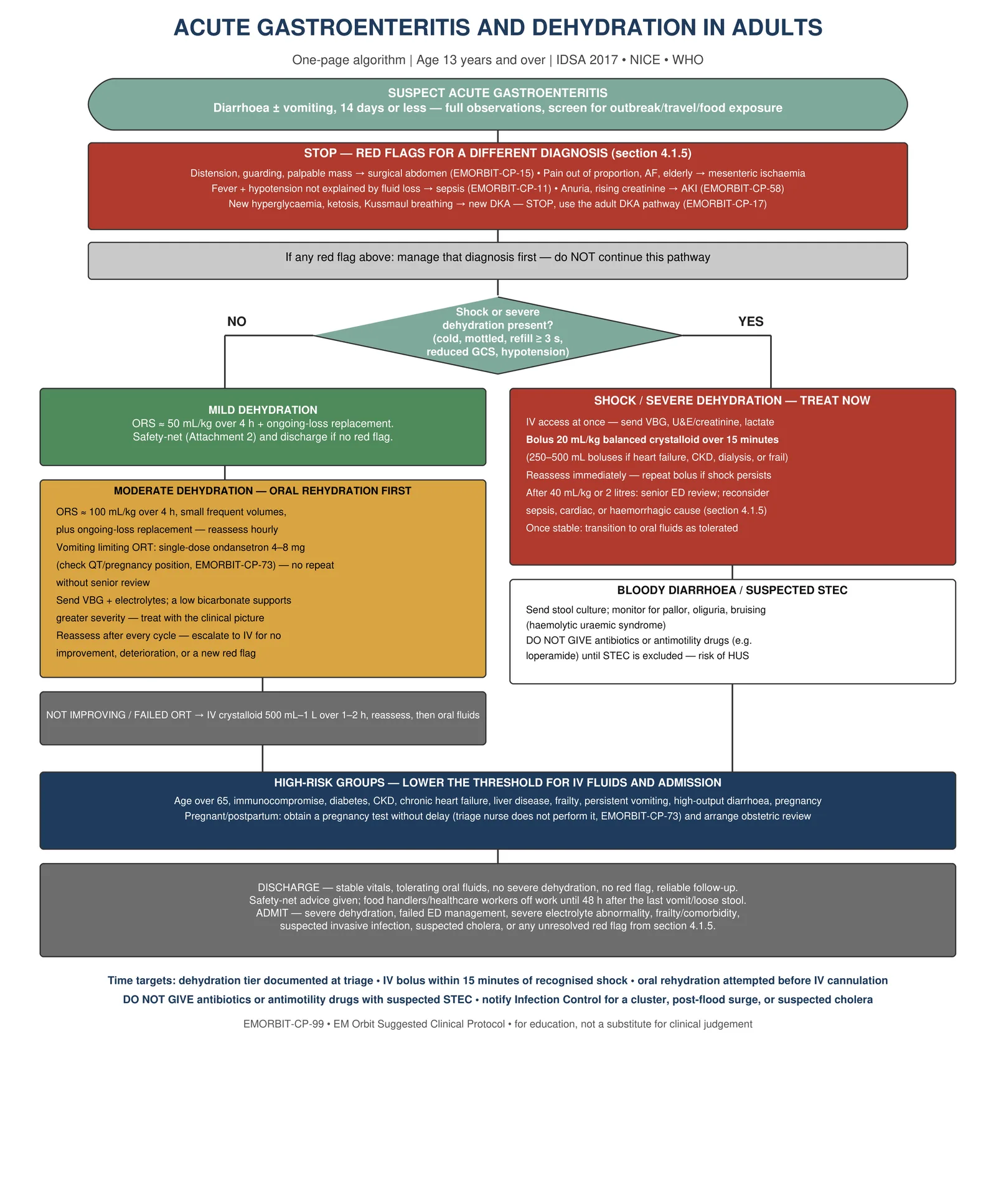
The one-page algorithm is shown at the top of this page.
6Team roles
6.1Triage / ED Nurse:
6.1.1 Record observations, grade dehydration at triage, screen for infection/outbreak risk, and begin oral rehydration while the patient waits for physician review.
6.2Pharmacist:
6.2.1 Verify antiemetic and IV fluid prescriptions, check for QT-prolonging medicines, and support antimicrobial stewardship decisions (4.3.6, EMORBIT-CP-57).
6.3Internal Medicine / Relevant Specialty:
6.3.1 Review patients with a red flag, high-risk comorbidity, or a need for IV fluids and admission; direct admission and follow-up. Surgery reviews any suspected surgical abdomen (EMORBIT-CP-15).
6.4Laboratory / Radiology:
6.4.1 Process venous blood gas, electrolyte, blood culture, and stool samples promptly; report to the treating clinician; radiology performs imaging where a surgical or vascular differential is suspected.
6.5Ambulance / Infection Control:
6.5.1 Pre-alert for a shocked or severely dehydrated patient; Infection Control is notified for a cluster, post-flood surge, or suspected cholera, and advises on precautions and outbreak reporting.
7The patient's role
7.1 Give an accurate history of stool and vomit frequency, character, and oral intake, and report any deterioration promptly.
7.2 Take oral rehydration solution as instructed, and follow the written safety-netting and work-exclusion advice.
7.3 Return immediately, or call the emergency number, for any of the return-immediately features in the discharge advice.
8Definitions
8.1Acute Gastroenteritis: diarrhoea, with or without vomiting, of 14 days or less, usually of infective cause.
8.2Oral Rehydration Solution (ORS): a low-osmolarity glucose–electrolyte solution used to replace fluid deficit and ongoing losses by mouth.
8.3Shiga Toxin-Producing E. coli (STEC) / Haemolytic Uraemic Syndrome (HUS): a cause of bloody diarrhoea in which antibiotics and antimotility drugs increase the risk of the triad of haemolytic anaemia, thrombocytopenia, and acute kidney injury.
8.4High-Risk Group: age over 65, immunocompromise, diabetes, chronic kidney disease, chronic heart failure, liver disease, frailty or malnutrition, persistent vomiting, high-output diarrhoea, or pregnancy — see 4.1.4 and 4.1.6.
9Attachments
- Attachment 1: One-page algorithm (top of this page)
- Attachment 2: Dehydration Assessment and Fluid Therapy Quick Reference
11Suggested quality indicators
11.1Time to IV bolus in a shocked patient: (Number of patients triaged with shock who receive an IV fluid bolus within 15 minutes of triage / Total number of patients triaged with shock due to gastroenteritis) × 100. Target ≥ 90%.
11.2Dehydration tier documented at triage (process): (Number of patients with gastroenteritis who have a documented dehydration tier at triage / Total number of patients presenting with gastroenteritis) × 100. Target ≥ 95%.
11.3Oral rehydration attempted before IV cannulation (process): (Number of non-shocked patients in whom oral rehydration was attempted before IV cannulation / Total number of non-shocked patients requiring rehydration) × 100. Target ≥ 90%.
11.4Safe discharge bundle (safe disposition): (Number of discharged patients with a documented dehydration tier, no unaddressed red flag, and written safety-netting advice given / Total number of patients discharged) × 100. Target ≥ 90%.
11.5Unplanned return within 72 hours (outcome): (Number of patients re-attending within 72 hours with worsening dehydration or a missed diagnosis / Total number discharged) × 100. Monitored as an outcome indicator.
13References
- Shane AL, Mody RK, Crump JA, et al. Infectious Diseases Society of America Clinical Practice Guidelines for the Diagnosis and Management of Infectious Diarrhea. Clin Infect Dis. 2017;65(12):e45–e80.
- National Institute for Health and Care Excellence. Gastroenteritis. Clinical Knowledge Summary. London: NICE.
- World Health Organization. The Treatment of Diarrhoea: A Manual for Physicians and Other Senior Health Workers. 4th rev. Geneva: WHO; 2005.
- World Health Organization. Cholera: fact sheet and outbreak response guidance. Geneva: WHO.
A2Attachment 2: Dehydration Assessment and Fluid Therapy Quick Reference
| Feature | Mild | Moderate | Severe / shock |
|---|---|---|---|
| Mental status | Alert, well | Alert, thirsty, mildly anxious | Lethargic, confused, or reduced conscious level |
| Mucous membranes / skin turgor | Normal | Dry mouth; reduced turgor | Very dry; skin tents; sunken eyes |
| Heart rate / blood pressure | Normal | Mild tachycardia; BP normal or a postural drop | Tachycardia and hypotension — hypotension is a LATE sign |
| Capillary refill / peripheries | Normal | Normal or mildly delayed | Delayed (≥ 3 seconds); cool, mottled peripheries |
| Urine output | Normal | Reduced | Oliguric or anuric |
Grade on the WORST feature present, not an average. Any shock feature: manage as shock (4.3.2) regardless of the others. Reassess after every intervention.
| Route / indication | Volume and rate |
|---|---|
| Oral rehydration solution — mild dehydration | Approximately 50 mL/kg over 4 hours, plus replacement of ongoing losses (a cupful of ORS for each loose stool or vomit) |
| Oral rehydration solution — moderate dehydration | Approximately 100 mL/kg over 4 hours, small frequent volumes, plus ongoing-loss replacement; reassess hourly |
| IV bolus — shock or severe dehydration | 20 mL/kg of a balanced isotonic crystalloid, reassess immediately, repeat if shock persists; senior review after 40 mL/kg or 2 litres, whichever is reached first |
| IV fluid — failed or contraindicated oral rehydration, without shock | 500 mL to 1 litre of isotonic crystalloid over 1–2 hours, then reassess; add maintenance once rehydrated (weight-based, or the local adult maintenance regimen) and transition back to oral fluids as soon as tolerated |
Use a balanced isotonic crystalloid throughout. Check electrolytes before adding potassium to a running infusion (4.2, 4.3.5) and reassess volume status after every bolus.
1Discharge Safety-Netting Advice (give in writing):
- Continue oral rehydration solution and small, frequent fluids; resume a light diet as tolerated.
- Strict hand hygiene; food handlers and healthcare workers stay off work until 48 hours after the last vomit or loose stool, and notify occupational health/Infection Control before returning.
- Return immediately, or call the emergency number, for: inability to drink, persistent vomiting, blood in the stool, reduced urine output, lethargy, or worsening symptoms.