Cholera and Severe Acute Watery Diarrhoea in the Emergency Department
EMORBIT-CP-107 · Chapter 7 · Infectious Disease Emergencies
Open in the appFree, works on your phone and offline, with every tool alongside.
Evidence base: WHO
1Purpose
1.1 This protocol covers the Emergency Department (ED) front-door phase of care for a patient with suspected or confirmed cholera or another cause of severe acute watery diarrhoea. It does not replace your institution's own cholera guideline, which governs definitive management. Note: the fluid-volume tables follow the WHO/GTFCC rehydration plans.
1.2 Standardize early recognition, at triage, of profuse rice-water watery diarrhoea and rapid, severe dehydration, so that fluid resuscitation is started within minutes, not after a routine gastroenteritis work-up.
1.3 Set out the WHO dehydration plans (A, B, C) and the volumes and rates for oral and intravenous rehydration by age, and state that fluid replacement — not antibiotics — is the treatment that saves life.
1.4 Define the enteric-isolation and notification steps for a suspected case or cluster, and point to EMORBIT-CP-99 (Adult Gastroenteritis and Dehydration) for the general work-up this guideline does not restate, to EMORBIT-CP-80 for the paediatric pathway, and to EMORBIT-CP-57 for antimicrobial choice.
2Who this protocol applies to
2.1 Patients aged 13 years and over (the library adult boundary; the institutional guideline is itself scoped to adults) with acute profuse watery diarrhoea, with or without vomiting, of sudden onset, especially with a travel, water-source, food, or outbreak-contact history consistent with cholera.
2.2 Any patient with severe dehydration or hypovolaemic shock from acute diarrhoeal illness in whom cholera is a differential, whether or not the diagnosis is later confirmed.
2.3 Patients pre-alerted by ambulance as part of a known cluster, or presenting during a declared outbreak or after flooding.
3Not covered by this protocol
3.1 Patients under 13 years: managed under EMORBIT-CP-80 (Paediatric Gastroenteritis and Dehydration), which shall apply the same WHO dehydration plans with paediatric weight-based volumes; a severely malnourished child follows the malnutrition-specific rehydration regimen referenced there, not Plan C in Table 2.
3.2 Mild or moderate gastroenteritis without a cholera-consistent picture (no profuse watery stool, no outbreak or high-risk exposure): manage under EMORBIT-CP-99.
3.3 Bloody diarrhoea (dysentery) as the primary presentation: cholera classically causes painless watery, not bloody, stool; assess per EMORBIT-CP-99, including the Shiga toxin-producing organism precautions there.
3.4 Suspected surgical abdomen, gastrointestinal bleeding, or sepsis without a primary diarrhoeal source: manage per EMORBIT-CP-15, the relevant gastrointestinal bleeding guideline, or EMORBIT-CP-11.
4Protocol
4.1History and Assessment:
4.1.1Triage and Recognition:
4.1.1.1 Suspect cholera in any patient with sudden-onset profuse watery ("rice-water") diarrhoea, especially with a history of travel to or residence in an area with a known outbreak, unsafe water or food, post-flood exposure, or contact with a diarrhoea cluster. Ask about these exposures at triage in every patient with acute watery diarrhoea, alongside the standard gastroenteritis triage questions of EMORBIT-CP-99.
4.1.1.2 Grade dehydration immediately using the WHO scale below and act on the worst feature present — do not wait to complete a full assessment before starting fluid in a patient with any severe-dehydration feature.
4.1.1.3 WHO dehydration assessment and fluid plan.
Table 1: WHO dehydration assessment and fluid plan for acute watery diarrhoea/suspected cholera (adult, 13 years and over) Feature No dehydration — Plan A Some dehydration — Plan B Severe dehydration — Plan C Mental status Alert, well Restless, irritable Lethargic, unconscious, or floppy Eyes / thirst Normal; drinks normally Sunken eyes; thirsty, drinks eagerly Very sunken eyes; unable to drink or drinks poorly Skin pinch Goes back quickly Goes back slowly Goes back very slowly (≥ 2 seconds) Pulse / blood pressure Normal Rapid, weak Very rapid, feeble, or absent; hypotension is a LATE sign Action ORS after every loose stool at home; no admission required for dehydration alone ORS 75 mL/kg over 4 hours, reassess, then continue Plan A IV Ringer's lactate — start immediately (section 4.3.2) Grade on the WORST feature present. Any severe-dehydration feature: start IV fluid immediately, do not wait to complete the assessment. Reassess after every phase and move up or down a plan as the picture changes.
4.1.1.4 A patient graded severe dehydration (Plan C) is moved to a monitored area immediately, IV access obtained, and the ED physician notified without delay — this is a time-critical presentation, equivalent in urgency to any other cause of hypovolaemic shock.
4.1.2History:
4.1.2.1 Onset, frequency, and volume of watery stool (patients and carers often describe it as continuous or as soaking through clothing/bedding); vomiting; muscle cramps (from electrolyte loss); last oral intake and urine output.
4.1.2.2 Travel, water source, food, sanitation, and outbreak-contact history (section 4.1.1.1); recent antibiotic use; comorbidity, current medicines (diuretics, ACE inhibitors/ARBs, antihypertensives that mask or worsen hypovolaemia), and allergies.
4.1.3Examination:
4.1.3.1 Full set of vital signs; skin pinch (returns very slowly, ≥ 2 seconds, in severe dehydration), sunken eyes, mucous membranes, level of consciousness, radial pulse volume, capillary refill, and postural blood pressure where dehydration is uncertain.
4.1.3.2 Abdominal examination to exclude a surgical cause (cholera is characteristically painless); look for muscle cramps and signs of hypokalaemia.
4.1.4Risk Stratification – Severity:
4.1.4.1 Severe dehydration (Plan C, Table 1): hypovolaemic shock physiology — start IV fluid immediately (section 4.3.2), in parallel with, not after, further assessment.
4.1.4.2 Some dehydration (Plan B): oral rehydration under supervision, reassessed within four hours; escalate to IV fluid for deterioration, persistent vomiting, or inability to drink.
4.1.4.3 High-risk groups — lower the threshold for IV fluid, admission, and senior review: age over 65; pregnancy; infancy and early childhood (EMORBIT-CP-80); chronic kidney disease, chronic heart failure, or liver disease; malnutrition; immunocompromise.
4.1.5Differential Diagnosis:
4.1.5.1 Other causes of severe acute watery diarrhoea (enterotoxigenic E. coli, rotavirus, other bacterial and viral enteropathogens) are managed identically in the ED — the fluid-first approach does not depend on stool culture confirmation.
4.1.5.2 Bloody diarrhoea, severe abdominal pain out of proportion to examination, or fever with a rigid abdomen point away from cholera — reassess per EMORBIT-CP-99/EMORBIT-CP-15.
4.1.5.3 Diabetic ketoacidosis, adrenal crisis, and other causes of severe volume depletion with vomiting: exclude with a bedside glucose and clinical assessment before attributing collapse to diarrhoeal loss alone.
4.1.6Special Populations:
4.1.6.1 Pregnancy and postpartum (any woman who has started menarche, regardless of age): obtain a pregnancy test without delay if not already known (the triage nurse does not perform it — EMORBIT-CP-73); arrange obstetric review for any pregnant or postpartum patient with Plan B or Plan C dehydration; use the same WHO fluid volumes, with left lateral tilt from approximately 20 weeks' gestation.
4.1.6.2 Older adults, chronic kidney disease, or chronic heart failure: give the same initial resuscitation for shock, then reassess frequently and involve the relevant specialty early for ongoing volume management; do not withhold the initial rapid bolus in a patient who is in shock.
4.1.6.3 Malnutrition (adult or paediatric): a severely malnourished patient is at higher risk of fluid overload from rapid IV rehydration; involve a senior clinician early and reassess more frequently. A malnourished child follows the paediatric severe-malnutrition rehydration pathway (EMORBIT-CP-80), not Table 2.
4.2Investigations:
4.2.1 No investigation shall delay oral or IV rehydration in a patient with severe or some dehydration. Clinical assessment and fluid replacement take priority over laboratory testing.
4.2.2 Severe dehydration or clinical concern: venous blood gas with electrolytes and lactate, urea/electrolytes/creatinine, and capillary glucose. A low bicarbonate and low potassium are expected in cholera and support the diagnosis; correct per EMORBIT-CP-102 and EMORBIT-CP-58 (potassium replacement is not restated here).
4.2.3 Stool sample for culture and, where available, rapid cholera testing, in a patient meeting the case definition (section 4.1.1.1) — send it but never wait for the result before treating.
4.2.4 Notify the laboratory and Infection Control before sending a specimen from a suspected cholera case, so it is handled under appropriate precautions.
4.3Plan of Care:
4.3.1Immediate Actions:
4.3.1.1 Severe dehydration (Table 1): move to a monitored area, IV access (two large-bore cannulae where possible), and proceed directly to intravenous rehydration (section 4.3.2) without waiting for investigations.
4.3.1.2 Some or no dehydration: begin oral rehydration solution (section 4.3.3) while completing assessment; reassess the dehydration grade at every review.
4.3.2Intravenous Fluids — Severe Dehydration (Plan C):
4.3.2.1 Ringer's lactate is the fluid of choice; use 0.9% sodium chloride only if Ringer's lactate is not available, and add potassium once electrolytes are known (0.9% saline does not correct the acidosis or potassium deficit of cholera).
Table 2: WHO Plan C — IV rehydration for severe dehydration (Ringer's lactate; 0.9% saline if Ringer's is not available) Age group First give Then give Adult and child ≥ 12 months 30 mL/kg over 30 minutes 70 mL/kg over 2.5 hours (100 mL/kg total over 3 hours) Infant under 12 months 30 mL/kg over 1 hour 70 mL/kg over 5 hours (100 mL/kg total over 6 hours) Repeat the initial bolus if the radial pulse remains very weak or undetectable. Reassess every 15–30 minutes until a strong pulse returns, then hourly. As soon as the patient can drink (usually within 3–4 hours for adults, 1–2 hours for infants), start ORS alongside the IV fluid to replace ongoing stool losses and supply potassium. Severely malnourished children are NOT rehydrated by this table — refer to the paediatric severe acute malnutrition pathway (EMORBIT-CP-80) for a slower, lower-volume regimen.
4.3.2.2 Reassess every 15–30 minutes until a strong radial pulse and improving mental status return, then hourly. Repeat the initial bolus if the pulse remains very weak. As soon as the patient can drink, start ORS alongside the IV fluid to replace ongoing losses and supply potassium (section 4.3.3).
4.3.2.3 Persistent shock despite the Table 2 volumes, or a deteriorating conscious level: call the senior ED physician immediately and reconsider the diagnosis (sepsis, cardiac, haemorrhage) — as in EMORBIT-CP-99.
4.3.3Oral Rehydration — Plan A and Plan B:
4.3.3.1 No dehydration (Plan A): ORS after every loose stool; the patient can usually be managed as an outpatient with education on when to return (section 4.3.7).
4.3.3.2 Some dehydration (Plan B): ORS 75 mL/kg over 4 hours, given in small frequent volumes, plus replacement of ongoing stool losses with a cupful of ORS after each loose stool; reassess the dehydration grade at 4 hours and move to Plan A, continue Plan B, or escalate to Plan C as the picture indicates.
4.3.3.3 A patient who cannot drink adequately, or who is vomiting persistently, but is not in Plan C: give ORS by nasogastric tube at 20 mL/kg/hour, or move to IV fluid if this is not tolerated or the picture worsens.
4.3.4Antimicrobial Stewardship:
4.3.4.1 Antibiotics are an adjunct that shortens the duration of illness and stool shedding — they do NOT replace fluid resuscitation, which is the treatment that prevents death. Consider a single-dose regimen for a patient with severe dehydration (Plan C) meeting the case definition, once rehydration is underway; select the agent and dose from your institution's cholera guideline and EMORBIT-CP-57 (Antimicrobial Stewardship) — a specific regimen is not invented here and requires local pharmacy confirmation before use.
4.3.4.2 Do not give antimotility drugs (for example loperamide) in suspected cholera or any acute watery diarrhoea of unclear cause.
4.3.4.3 Zinc supplementation in a child follows EMORBIT-CP-80.
4.3.5Isolation and Infection Control:
4.3.5.1 Enteric precautions from the point of suspicion: contact precautions, dedicated toilet or commode, strict hand hygiene (soap and water preferred over alcohol gel for Clostridioides difficile-type spore risk in mixed presentations), and safe disposal of stool and vomitus.
4.3.5.2 Notify the ED consultant and Infection Control for any suspected cholera case or a cluster of severe acute watery diarrhoea. Report the case via the hospital's notifiable-disease pathway.
4.3.6Escalation / Refractory:
4.3.6.1 Shock not responding to the Plan C volumes in Table 2, a falling conscious level, or an electrolyte derangement not explained by the fluid loss alone: call the senior ED physician immediately, involve Critical Care, and reconsider the diagnosis (as EMORBIT-CP-99, section 4.3.6).
4.3.6.2 Any deterioration during observation prompts immediate reassessment and reclassification of the dehydration grade.
4.3.7Monitoring and Reassessment:
4.3.7.1 Continuous or frequent vital signs and level of consciousness during Plan C; reassess dehydration grade at least hourly until stable, then per EMORBIT-CP-99.
4.3.7.2 Measure and record stool and vomitus output where feasible (using a cholera cot or graduated collection where available); recheck electrolytes at 4–6 hours where IV fluid is given, per EMORBIT-CP-99 and EMORBIT-CP-102.
4.3.8Disposition:
4.3.8.1 Discharge (Plan A, or Plan B resolved to Plan A): tolerating oral fluids, stable vital signs, reliable follow-up, and safety-netting given (section 4.3.7).
4.3.8.2 Admit: any patient who required Plan C, failed Plan B, has a high-risk comorbidity (section 4.1.4), or in whom outbreak/notification requirements mandate observation.
4.3.9Discharge and Follow-up:
4.3.9.1 Written safety-netting advice (Attachment 2): continue ORS, safe water and food hygiene, strict hand hygiene, and return immediately for inability to drink, reduced urine output, worsening diarrhoea, or lethargy.
4.3.9.2 Food handlers and healthcare workers: exclude from work and notify occupational health/Infection Control per local policy, as in EMORBIT-CP-99.
4.3.10Documentation and Reporting:
4.3.10.1 Document: time of triage recognition, dehydration grade and every reassessment, fluid given by route/volume/type and response, stool/rapid test sent, antibiotic given if any, and the disposition and its reasoning.
4.3.10.2 Report every suspected cholera case, and any cluster, through the local infection prevention and outbreak-reporting pathway and to Infection Control (section 4.3.6).
5Algorithm
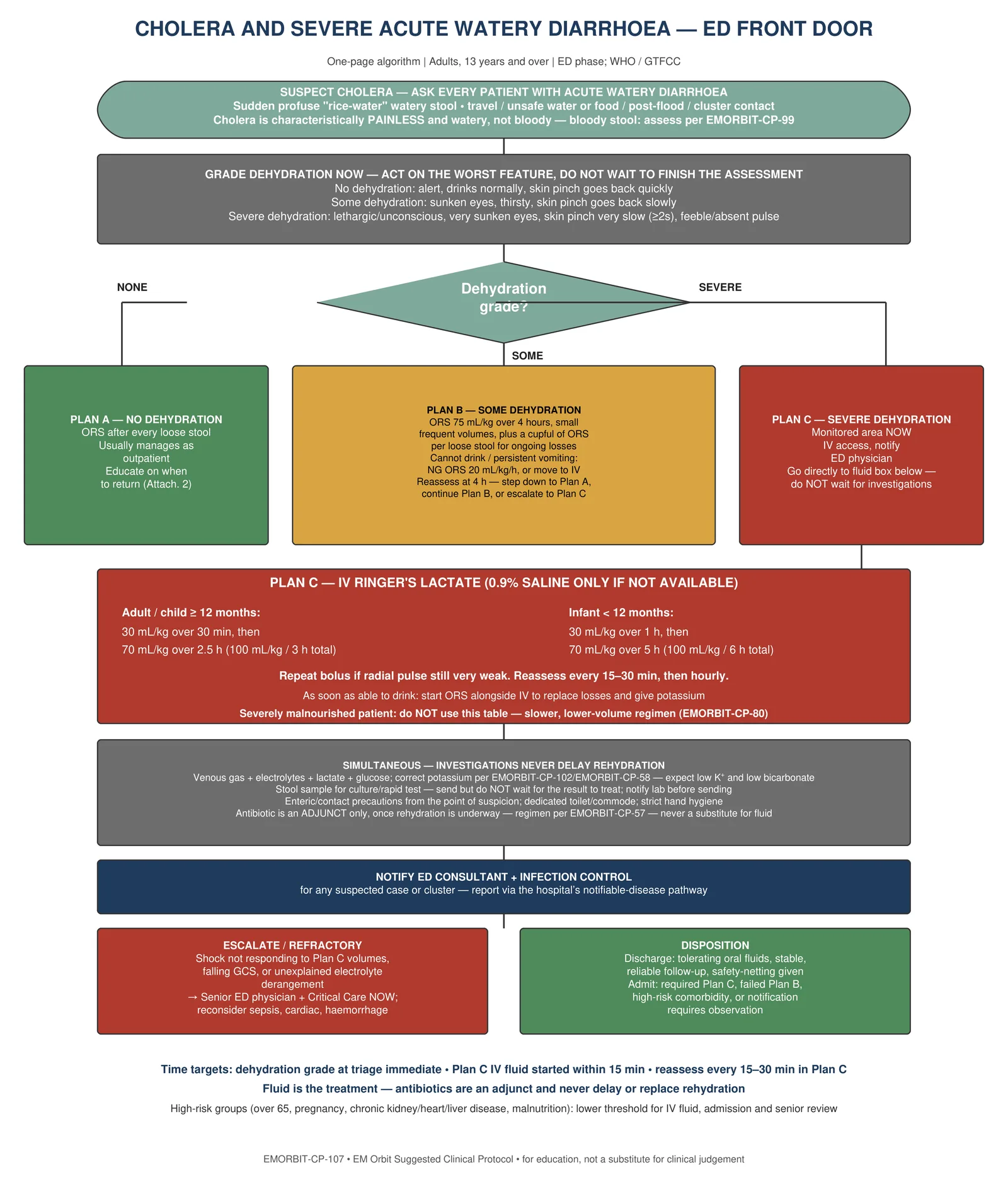
The one-page algorithm is shown at the top of this page.
6Team roles
The roles below are additional to, and consistent with, those defined in your institution's cholera guideline.
6.1Triage / ED Nurse:
6.1.1 Ask travel, water/food, and outbreak-contact questions in every patient with acute watery diarrhoea; grade dehydration at triage using Table 1; escalate any severe-dehydration feature immediately; begin oral rehydration or apply enteric precautions while the patient waits for physician review.
6.2ED Pharmacist:
6.2.1 Verify IV fluid and potassium-replacement prescriptions; support the antimicrobial-stewardship decision once the institutional regimen is confirmed (section 4.3.4).
6.3Infectious Diseases / Infection Control:
6.3.1 Advise on isolation, testing, and antibiotic choice for a confirmed or high-suspicion case; lead notification and outbreak-cluster investigation (section 4.3.6).
6.4Laboratory:
6.4.1 Process electrolytes and lactate urgently; handle stool specimens from a suspected case under appropriate precautions once notified.
6.5Ambulance:
6.5.1 Pre-alert the ED for a shocked or severely dehydrated patient, or for a known cluster, so isolation and IV resuscitation can be prepared before arrival.
7The patient's role
7.1 Give an accurate history of stool frequency and volume, recent travel, water and food source, and any known contacts with similar symptoms.
7.2 Take oral rehydration solution as instructed, and follow the written safety-netting and enteric-hygiene advice.
7.3 Return immediately, or call the emergency number, for inability to drink, reduced urine output, worsening diarrhoea, or lethargy.
8Definitions
The definitions in your institution's cholera guideline apply in full. The following are additional terms used in this protocol.
8.1Suspected Cholera Case (for ED triage): sudden-onset profuse watery ("rice-water") diarrhoea, with or without vomiting, in a patient with a travel, water-source, food, or outbreak-contact history consistent with cholera; treated on this pathway pending confirmation.
8.2WHO Plan A / B / C: the World Health Organization's three-tier rehydration plan for no, some, and severe dehydration from acute watery diarrhoea (Table 1).
8.3Oral Rehydration Solution (ORS): a low-osmolarity glucose–electrolyte solution used to replace fluid deficit and ongoing losses by mouth.
8.4GTFCC: Global Task Force on Cholera Control.
9Attachments
- Attachment 1: One-page algorithm (top of this page)
- Attachment 2: WHO Dehydration and Fluid Plan Quick Reference
11Suggested quality indicators
11.1Time to IV fluid in severe dehydration: (Number of patients graded severe dehydration who receive an IV fluid bolus within 15 minutes of triage recognition / Total number of such patients) × 100. Target ≥ 90%.
11.2Dehydration grade documented at triage (process): (Number of patients with acute watery diarrhoea who have a documented WHO dehydration grade at triage / Total number of such patients) × 100. Target ≥ 95%.
11.3Enteric precautions applied (process): (Number of suspected cholera patients with enteric/contact precautions documented within 30 minutes of recognition / Total number of suspected cholera patients) × 100. Target ≥ 90%.
11.4Safe discharge bundle (safe disposition): (Number of discharged patients with a documented dehydration grade, no unaddressed red flag, and written safety-netting advice given / Total number of patients discharged) × 100. Target ≥ 90%.
11.5Outcome indicator (monitored, no fixed ED target): incidence of unplanned return within 72 hours with worsening dehydration, and every case reported as part of a notified cluster.
13References
- World Health Organization. Cholera Outbreak Toolkit — Case Management. Geneva: WHO.
- World Health Organization. The Treatment of Diarrhoea: A Manual for Physicians and Other Senior Health Workers. 4th rev. Geneva: WHO; 2005.
- Global Task Force on Cholera Control (GTFCC). Cholera case management guidance.
A2Attachment 2: WHO Dehydration and Fluid Plan Quick Reference
| Feature | No dehydration — Plan A | Some dehydration — Plan B | Severe dehydration — Plan C |
|---|---|---|---|
| Mental status | Alert, well | Restless, irritable | Lethargic, unconscious, or floppy |
| Eyes / thirst | Normal; drinks normally | Sunken eyes; thirsty, drinks eagerly | Very sunken eyes; unable to drink or drinks poorly |
| Skin pinch | Goes back quickly | Goes back slowly | Goes back very slowly (≥ 2 seconds) |
| Pulse / blood pressure | Normal | Rapid, weak | Very rapid, feeble, or absent; hypotension is a LATE sign |
| Action | ORS after every loose stool at home; no admission required for dehydration alone | ORS 75 mL/kg over 4 hours, reassess, then continue Plan A | IV Ringer's lactate — start immediately (section 4.3.2) |
Grade on the WORST feature present. Any severe-dehydration feature: start IV fluid immediately, do not wait to complete the assessment. Reassess after every phase and move up or down a plan as the picture changes.
| Age group | First give | Then give |
|---|---|---|
| Adult and child ≥ 12 months | 30 mL/kg over 30 minutes | 70 mL/kg over 2.5 hours (100 mL/kg total over 3 hours) |
| Infant under 12 months | 30 mL/kg over 1 hour | 70 mL/kg over 5 hours (100 mL/kg total over 6 hours) |
Repeat the initial bolus if the radial pulse remains very weak or undetectable. Reassess every 15–30 minutes until a strong pulse returns, then hourly. As soon as the patient can drink (usually within 3–4 hours for adults, 1–2 hours for infants), start ORS alongside the IV fluid to replace ongoing stool losses and supply potassium. Severely malnourished children are NOT rehydrated by this table — refer to the paediatric severe acute malnutrition pathway (EMORBIT-CP-80) for a slower, lower-volume regimen.
1Discharge Safety-Netting Advice (give in writing):
- Continue oral rehydration solution after every loose stool; small, frequent fluids; safe water and food hygiene.
- Strict hand hygiene; food handlers and healthcare workers stay off work per Infection Control advice until cleared.
- Return immediately, or call the emergency number, for: inability to drink, reduced urine output, worsening diarrhoea, or lethargy.