Paediatric Gastroenteritis and Dehydration
EMORBIT-CP-80 · Chapter 12 · Paediatric Emergencies
Open in the appFree, works on your phone and offline, with every tool alongside.
Evidence base: NICE CG84; ESPGHAN 2014
1Purpose
1.1 Standardize the assessment of dehydration and the choice of oral, nasogastric, and intravenous rehydration for children under 13 years presenting to Emergency Departments (ED) with acute gastroenteritis.
1.2 Identify quickly the small number of children whose vomiting or diarrhoea signals a different, more serious diagnosis — surgical, sepsis, or new diabetic ketoacidosis — rather than simple gastroenteritis.
1.3 Minimize unnecessary investigation, intravenous cannulation, and antibiotic use, while treating shock and severe dehydration without delay.
1.4 Ensure safe weight-based dosing of ondansetron and intravenous fluids, and a documented safety-net for every child discharged home.
2Who this protocol applies to
2.1 Children aged 29 days to 12 years 364 days (under 13 years; neonates 28 days or younger — section 4.1.6) presenting with acute diarrhoea (14 days or less), with or without vomiting, and suspected infective gastroenteritis.
2.2 Dehydration of any severity judged to be due to gastrointestinal fluid loss.
2.3 Presentation during a recognized outbreak or cluster, or after food-borne, water-borne, or travel-related exposure, with a diarrhoeal illness.
3Not covered by this protocol
3.1 Neonates 28 days or younger with vomiting or diarrhoea: manage under the febrile-infant pathway (EMORBIT-CP-25, section 4.1.2) — sepsis and metabolic disease are more likely than simple gastroenteritis at this age.
3.2 Suspected surgical abdomen (appendicitis, intussusception, malrotation with volvulus, incarcerated hernia, obstruction or perforation): manage per the paediatric acute abdominal pain pathway and refer paediatric surgery.
3.3 Diarrhoea lasting more than 14 days, inflammatory bowel disease flare, or known malabsorption: refer paediatric gastroenterology.
3.4 Gastrointestinal bleeding as the primary presentation: manage per the relevant gastrointestinal bleeding guideline.
3.5 New-onset diabetic ketoacidosis presenting with vomiting or abdominal pain (section 4.1.5): manage per the paediatric diabetic ketoacidosis pathway, not this guideline.
3.6 Patients aged 13 years and over: managed under the adult gastroenteritis and dehydration guideline.
4Protocol
4.1History and Assessment:
4.1.1Triage and Recognition:
4.1.1.1 Weigh every child (a length-based or age-formula estimate if too unwell to weigh), record a full set of age-appropriate observations and a paediatric early warning score, and measure a capillary glucose in any child who looks unwell, is lethargic, or is not tolerating fluids.
4.1.1.2 Assign the highest acuity category to any child with a red flag (section 4.1.5) or any shock feature (Table 1); move to a monitored area and notify the ED physician immediately.
4.1.1.3 Grade dehydration at triage using the clinical scale below and record the tier — no dehydration, clinical dehydration, or shock.
Table 1: Clinical assessment of dehydration severity in a child (adapted from WHO and NICE CG84) Feature No dehydration Clinical dehydration Shock / severe dehydration Conscious level / appearance Alert, well Normal, irritable or lethargic Reduced conscious level; pale, mottled, ashen Eyes / mucous membranes Normal, moist Sunken; dry Sunken; very dry Heart rate / breathing Normal Tachycardia; normal or fast breathing Tachycardia and tachypnoea (bradycardia is pre-arrest) Peripheral pulses / capillary refill Normal Normal Weak or impalpable; refill ≥ 3 seconds Skin turgor / urine output Normal Reduced turgor; reduced output Reduced turgor; very reduced or absent output Blood pressure Normal Normal Hypotension — a LATE sign in a child Grade on the WORST feature present, not an average. Any shock feature: treat as shock (4.3.4) regardless of the others. Reassess after every intervention.
4.1.2History:
4.1.2.1 Duration and frequency of diarrhoea and vomiting; stool character (watery, mucoid, bloody) and colour of vomit — bilious (green) vomit is a red flag (4.1.5).
4.1.2.2 Oral intake and urine output (wet nappies/voids in the last 24 hours); any recent weight, to gauge weight loss.
4.1.2.3 Fever, abdominal pain, rash; recent antibiotic use; sick contacts, nursery/school outbreak, recent travel, unsafe water, undercooked food.
4.1.2.4 Comorbidity that raises risk: age under 6 months, prematurity or low birth weight, chronic illness, immunocompromise, stoma, malnutrition, or a carer unable to recognize deterioration.
4.1.2.5 Current medicines (nephrotoxic drugs, diuretics) and any known diabetes.
4.1.3Examination:
4.1.3.1 Weight, temperature, heart rate, respiratory rate, blood pressure, capillary refill time, and conscious level, plotted against the age-appropriate ranges in EMORBIT-CP-25 (Febrile Child), Attachment 3.
4.1.3.2 Hydration signs: mucous membranes, skin turgor (abdominal skin pinch), sunken eyes, a sunken or bulging fontanelle in an infant, peripheral perfusion and pulse volume.
4.1.3.3 Abdomen: distension, localized tenderness, guarding, a palpable mass, or absent bowel sounds.
4.1.3.4 Look for a rash (non-blanching is meningococcal until proven otherwise — EMORBIT-CP-25), meningism (neck stiffness, bulging fontanelle, photophobia), and Kussmaul breathing or a ketotic smell.
4.1.4Risk Stratification – Severity:
4.1.4.1 Any shock feature, or two or more clinical-dehydration features plus a red flag from 4.1.5, mandates immediate senior review and IV access.
4.1.4.2 Apply the NICE traffic light system and the paediatric early warning score for suspected sepsis (EMORBIT-CP-25); a rising score or any red traffic-light feature takes priority over this pathway.
4.1.5Differential Diagnosis — Red Flags for Another Diagnosis:
4.1.5.1 Bilious (green) vomiting: malrotation with volvulus until excluded — same-day surgical review, keep nil by mouth, urgent contrast study.
4.1.5.2 Blood in the stool or vomit: consider intussusception (colicky pain, sausage-shaped mass, lethargy, red-currant-jelly stool), dysentery, or Shiga toxin-producing E. coli — do not give antibiotics or antimotility drugs (section 4.3.7).
4.1.5.3 Abdominal distension, localized tenderness, guarding, or a palpable mass: surgical abdomen — refer paediatric surgery without delaying for a trial of oral rehydration.
4.1.5.4 Neck stiffness, bulging fontanelle, non-blanching rash, or altered conscious level: meningitis / meningococcal sepsis — treat per EMORBIT-CP-25 without delay.
4.1.5.5 Polyuria, polydipsia, weight loss, Kussmaul breathing, a ketotic breath, or hyperglycaemia/ketonuria at the bedside: new diabetic ketoacidosis — stop this pathway; the DKA fluid regimen is more cautious than section 4.3.4 (section 4.3.5).
4.1.5.6 Any red NICE traffic-light feature or a rising paediatric early warning score: suspected sepsis — EMORBIT-CP-25.
4.1.5.7 Severe pain out of proportion to the vomiting/diarrhoea, or bile-stained nasogastric aspirate in an infant: surgical review.
4.1.6Special Populations:
4.1.6.1 Infant under 3 months, especially 28 days or younger: lower threshold for admission and investigation; apply EMORBIT-CP-25 section 4.1.2 alongside this guideline.
4.1.6.2 Malnourished, growth-faltering, immunocompromised, or chronic condition (cardiac, renal, short gut): lower threshold for IV fluids and admission; involve the relevant specialty early.
4.1.6.3 Suspected hypernatraemic dehydration (irritability, high-pitched cry, doughy skin texture, hypertonia, or seizure — typically a breast- or formula-fed infant with high stool losses or an incorrectly reconstituted feed): correct slowly (section 4.3.6).
4.1.6.4 Known diabetes: check capillary glucose and ketones before attributing vomiting to gastroenteritis alone (4.1.5); correct hypoglycaemia below 4.0 mmol/L with 2 mL/kg of 10% glucose intravenously (EMORBIT-CP-49).
4.1.6.5 Safeguarding: consider a non-accidental cause where the history is inconsistent, presentations repeat, or the carer appears unable or unwilling to give safe fluids at home.
4.2Investigations:
4.2.1 No investigation shall delay oral rehydration or, where indicated, an intravenous bolus for shock.
4.2.2 No dehydration: no routine blood tests. Bedside capillary glucose in any child who looks unwell, is lethargic, or has reduced oral intake.
4.2.3 Clinical dehydration requiring IV fluids, or shock: venous blood gas with electrolytes, urea, creatinine and glucose before starting IV fluids; full blood count and C-reactive protein if a bacterial cause or sepsis is suspected; blood culture if antibiotics are being considered or the child is unwell.
4.2.4 Stool culture (selective only): bloody diarrhoea, high fever, immunocompromise, recent travel to a high-risk area, symptoms lasting more than 7 days, or a suspected outbreak/cluster — notify the ED consultant and Infection Control (4.3.7).
4.2.5 Urine sample (dipstick and culture where indicated): any infant or young child with unexplained fever, vomiting, or diarrhoea, because urinary tract infection can present this way (EMORBIT-CP-25).
4.2.6 Capillary or blood ketones and glucose in any child with the features in 4.1.5 suggesting new diabetes.
4.2.7 Abdominal ultrasound only where a surgical differential (4.1.5) is suspected, arranged with paediatric surgery/radiology — not a routine gastroenteritis investigation.
4.3Plan of Care:
4.3.1Immediate Actions:
4.3.1.1 Shock or severe dehydration (Table 1): move to a monitored area, cardiorespiratory monitoring, IV or intraosseous access without delay (intraosseous after two failed attempts or 90 seconds), and proceed directly to 4.3.4.
4.3.1.2 Any red flag in 4.1.5: manage the competing diagnosis first; do not continue the gastroenteritis pathway.
4.3.1.3 All other children: begin oral rehydration (4.3.2) while completing assessment.
4.3.2Oral and Nasogastric Rehydration — First Line:
4.3.2.1 Offer a low-osmolarity oral rehydration solution (ORS) in small, frequent volumes. A child who refuses ORS but has no dehydration may continue usual milk feeds and fluids, with ORS to replace ongoing losses.
4.3.2.2 Clinical dehydration: replace the deficit and give maintenance and ongoing-loss volumes as set out below.
Table 2: Fluid therapy by route and indication Route / indication Volume and rate ORS — deficit replacement (clinical dehydration) 50 mL/kg over 4 hours, PLUS maintenance (below), PLUS 5–10 mL/kg ORS for each large watery stool and each vomit Maintenance fluid (oral or IV) — 24-hour volume Holliday–Segar: 100 mL/kg for the first 10 kg + 50 mL/kg for the next 10 kg + 20 mL/kg for each kg over 20 kg IV bolus — shock 20 mL/kg 0.9% sodium chloride over 10 minutes; reassess immediately; repeat if shock persists; senior/PICU review after 40 mL/kg IV deficit replacement — severe dehydration without shock, or failed/contraindicated ORT-NG % dehydration × weight (kg) × 10 = mL, as 0.9% sodium chloride, over 24 hours (48 hours if hypernatraemic — 4.3.6); add maintenance Use an isotonic fluid throughout; add potassium only once the level is known and the child is voiding. Recheck electrolytes at 4–6 hours and at least every 24 hours, more often if abnormal.
4.3.2.3 Continue breastfeeding throughout; do not routinely dilute formula or withhold food beyond 24 hours; resume the usual diet once dehydration is corrected.
4.3.2.4 If the child vomits, wait 5–10 minutes and restart more slowly. A single dose of ondansetron (4.3.3) may be given to allow oral or nasogastric rehydration to succeed before moving to IV fluids.
4.3.2.5 If the child cannot take enough by mouth, or persistently vomits it back, give the same volume by nasogastric tube before escalating to IV fluids — unless there is shock, a red flag (4.1.5), or a contraindication to the nasogastric route (obstruction, reduced conscious level, recent facial or base-of-skull trauma).
4.3.2.6 Reassess hydration and weight after every rehydration cycle; move to IV fluids (4.3.4) for no improvement, deterioration, or a new red flag.
4.3.3Ondansetron:
4.3.3.1 A single oral dose may be given for persistent vomiting preventing successful oral or nasogastric rehydration, once significant dehydration and the red flags in 4.1.5 have been considered.
4.3.3.2 Dose by weight; a single dose only.
Table 3: Ondansetron — single oral dose to permit oral/nasogastric rehydration Weight Dose Notes 8–15 kg 2 mg Single dose only; do not repeat in the ED without senior review 15–30 kg 4 mg Check for a prolonged QT interval, electrolyte disturbance, or other QT-prolonging medicine first Over 30 kg 6–8 mg The local ondansetron position in EMORBIT-CP-73 concerns use in pregnancy (orofacial malformation risk) and does not apply to children 4.3.3.3 Caution: prolonged QT interval, electrolyte disturbance, or another QT-prolonging medicine — obtain an electrocardiogram first. Ondansetron is not a substitute for correcting dehydration.
4.3.4Intravenous Fluids — Shock or Failed Oral/Nasogastric Rehydration:
4.3.4.1 Shock: give the IV bolus in Table 2 above; reassess immediately and repeat if shock persists. Call the senior ED physician and paediatric intensive care after 40 mL/kg, and consider a cause of shock other than dehydration (sepsis, cardiac).
4.3.4.2 Severe dehydration without shock, or failed/contraindicated oral-nasogastric rehydration: give the IV deficit-replacement volume in Table 2 plus maintenance, over 24 hours unless hypernatraemic (4.3.6).
4.3.4.3 Use an isotonic fluid for bolus and maintenance; add potassium only once the level is known and the child is voiding.
4.3.4.4 Send electrolytes, urea, creatinine and glucose before starting IV fluids if not already done (4.2); recheck at 4–6 hours and at least every 24 hours, more often if abnormal.
4.3.4.5 Reassess hydration, weight, and the ongoing need for IV fluid at least every 4 hours; return to oral fluids as soon as tolerated and losses have reduced.
4.3.5Escalation / Refractory:
4.3.5.1 Shock not responding to 40 mL/kg of crystalloid, a new focal neurological sign, a falling conscious level, or a metabolic derangement not explained by simple dehydration: call the senior ED physician and paediatric intensive care immediately and reconsider the diagnosis (sepsis, DKA, cardiac, surgical — 4.1.5).
4.3.5.2 Suspected diabetic ketoacidosis: stop this pathway. DKA fluid resuscitation is more cautious (smaller boluses, careful correction) because of the risk of cerebral oedema — manage per the paediatric DKA pathway, not the boluses in 4.3.4.
4.3.5.3 Any deterioration on the ward or observation area, or a carer's or nurse's concern, prompts immediate reassessment and revision of the dehydration tier.
4.3.6Hypernatraemic Dehydration:
4.3.6.1 Suspect with the features in 4.1.6; confirm with a sodium level from the venous blood gas or electrolytes.
4.3.6.2 Correct SLOWLY: reduce serum sodium by no more than 0.5 mmol/L per hour (approximately 10 mmol/L per 24 hours); replace the fluid deficit over 48 hours, not 24, using an isotonic fluid.
4.3.6.3 Oral or nasogastric rehydration is preferred if tolerated and there is no shock. If IV fluid is required, involve a senior physician or paediatrics and measure electrolytes at least every 4–6 hours until stable and improving.
4.3.6.4 Rapid correction risks cerebral oedema and seizure; a seizure occurring during correction is a fluid/electrolyte emergency — stop or slow the infusion and seek senior/paediatric advice immediately.
4.3.7Antidiarrhoeal and Antimicrobial Stewardship:
4.3.7.1 Do not give antidiarrhoeal or antimotility drugs (for example loperamide), or an antiemetic other than the single ondansetron dose in 4.3.3 — no proven benefit in children and a risk of harm.
4.3.7.2 Antibiotics are not routine. Consider only for: confirmed Shigella, cholera, or Giardia; salmonella gastroenteritis in an infant under 6 months, if immunocompromised, or with proven bacteraemia; Clostridioides difficile; or on advice from the national poison centre/microbiology for a specific pathogen. Choose the agent from the local antimicrobial stewardship pathway.
4.3.7.3 Bloody diarrhoea with suspected Shiga toxin-producing E. coli: do NOT give antibiotics or antimotility drugs — both increase the risk of haemolytic uraemic syndrome. Send stool culture and monitor for pallor, oliguria, and bruising.
4.3.7.4 Notify the ED consultant and Infection Control for a cluster of cases, a post-flood surge, or suspected cholera; apply contact precautions, hand hygiene, and a dedicated toilet or commode where possible.
4.3.8Monitoring and Reassessment:
4.3.8.1 Repeat observations and the paediatric early warning score at a frequency set by the dehydration tier — at least hourly for clinical dehydration or after IV fluids, continuous for shock.
4.3.8.2 Reweigh and reassess hydration after every oral/nasogastric rehydration cycle and every IV bolus or 4-hourly period of maintenance fluid.
4.3.8.3 Record fluid balance (intake and stool/vomiting losses) and urine output.
4.3.9Disposition:
4.3.9.1 Discharge: tolerating oral fluids, no dehydration or corrected clinical dehydration, no red flag from 4.1.5, a reliable carer, and safety-netting advice given and understood (Attachment 2).
4.3.9.2 Admit: shock or ongoing IV fluid requirement, failed oral/nasogastric rehydration, any red flag in 4.1.5, hypernatraemic dehydration, significant electrolyte derangement, an infant under 3 months, or a carer unable to manage or to return.
4.3.9.3 Consultant or senior sign-off before discharging any child who required IV fluids or a nasogastric tube, or who is under 6 months old.
4.3.10Discharge and Follow-up:
4.3.10.1 Give written safety-netting advice (Attachment 2): continue ORS, small frequent fluids, resume the normal diet, strict hand hygiene, and return immediately for reduced urine output, persistent vomiting, blood in the stool, lethargy, drowsiness, or if the child is simply getting worse.
4.3.10.2 Arrange follow-up with the primary care or paediatric service as clinically indicated, and provide a discharge letter.
4.3.10.3 Advise exclusion from school, nursery, or swimming until 48 hours after the last episode of vomiting or diarrhoea, per Infection Control guidance.
4.3.11Documentation and Reporting:
4.3.11.1 Document: weight, dehydration tier, red flags considered and excluded, fluids given (route, volume, type) and response, ondansetron dose if given, investigations and results, and the disposition and its reasoning.
4.3.11.2 Report suspected outbreaks or clusters, suspected cholera, and any case of haemolytic uraemic syndrome through the local infection prevention and outbreak-reporting pathway.
5Algorithm
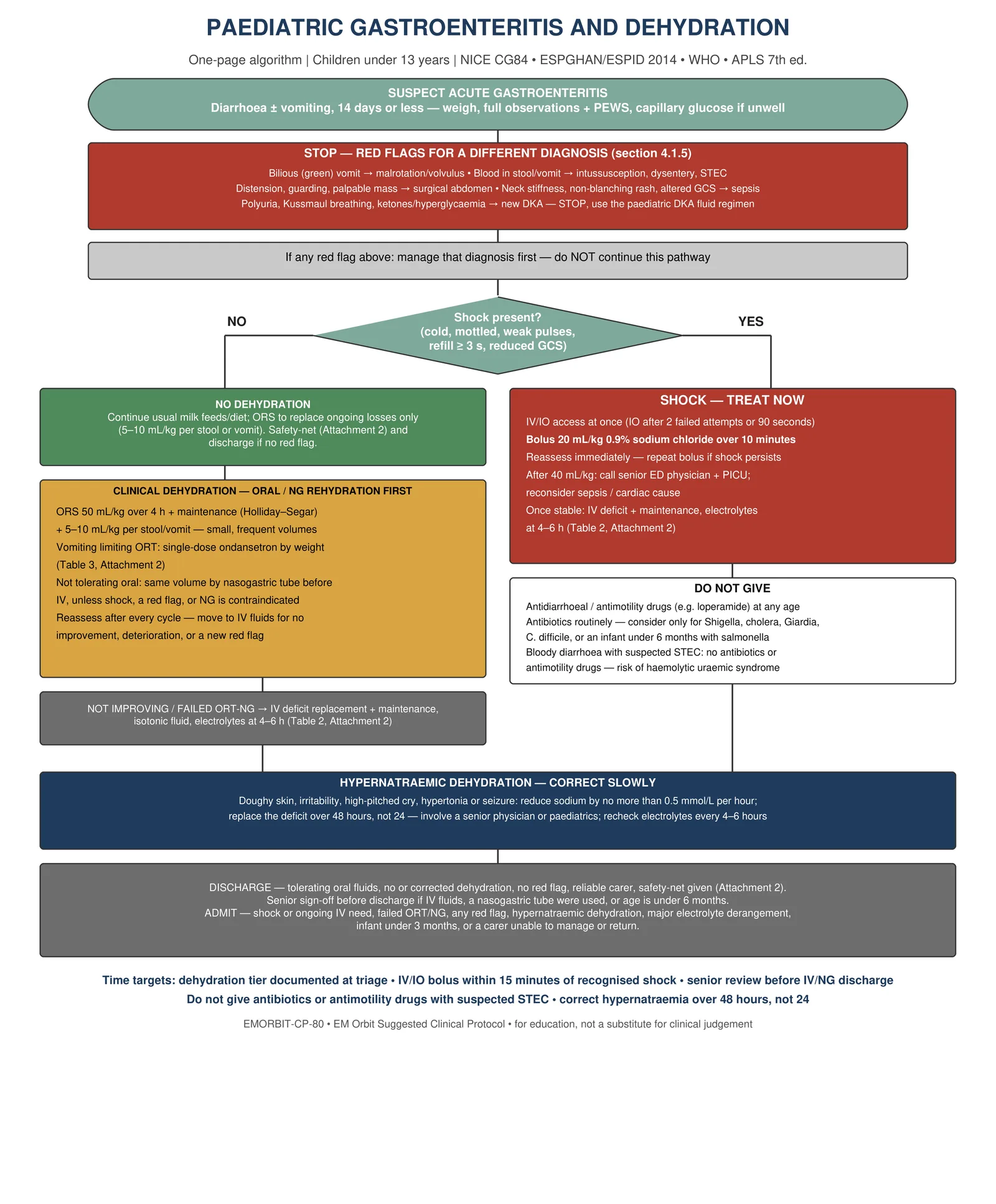
The one-page algorithm is shown at the top of this page.
6Team roles
6.1Triage / ED Nurse:
6.1.1 Weigh the child, record observations and the paediatric early warning score, grade dehydration at triage, and begin oral rehydration while the child waits for physician review.
6.2Pharmacist:
6.2.1 Verify weight-based ondansetron and IV fluid prescriptions, and check for QT-prolonging medicines; support antimicrobial stewardship decisions (4.3.7).
6.3Paediatrics:
6.3.1 Review every child with a red flag, hypernatraemic dehydration, an infant under 3 months, or a need for IV fluids or nasogastric rehydration; direct admission and follow-up.
6.4Laboratory / Radiology:
6.4.1 Process venous blood gas, electrolyte, and stool samples promptly; report to the treating clinician; radiology performs and reports ultrasound where a surgical differential is suspected.
6.5Ambulance / Infection Control:
6.5.1 Pre-alert for a shocked or severely dehydrated child; Infection Control is notified for a cluster, post-flood surge, or suspected cholera, and advises on precautions and outbreak reporting.
7The patient's role
7.1 The parent or carer gives an accurate history of stool and vomit frequency, character, and oral intake, and reports any deterioration promptly.
7.2 The parent or carer gives oral rehydration solution as instructed, continues usual feeding once dehydration is corrected, and follows the written safety-netting advice.
7.3 The parent or carer returns immediately, or calls the emergency number, for any of the return-immediately features in the discharge advice.
8Definitions
8.1Acute Gastroenteritis: diarrhoea, with or without vomiting, of 14 days or less, usually of infective cause.
8.2Oral Rehydration Solution (ORS): a low-osmolarity glucose–electrolyte solution used to replace fluid deficit and ongoing losses by mouth or nasogastric tube.
8.3Holliday–Segar Formula: the standard weight-based method for calculating a child's 24-hour maintenance fluid volume (Table 2).
8.4Hypernatraemic Dehydration: dehydration with a serum sodium above the normal range, in which clinical severity is often underestimated and rapid correction risks cerebral oedema.
8.5Shiga Toxin-Producing E. coli (STEC) / Haemolytic Uraemic Syndrome (HUS): a cause of bloody diarrhoea in which antibiotics and antimotility drugs increase the risk of the triad of haemolytic anaemia, thrombocytopenia, and acute kidney injury.
8.6Paediatric Early Warning Score (PEWS) / NICE Traffic Light System: as defined in EMORBIT-CP-25 (Febrile Child).
9Attachments
- Attachment 1: One-page algorithm (top of this page)
- Attachment 2: Dehydration Assessment, Fluid Therapy, and Ondansetron Dosing Quick Reference
11Suggested quality indicators
11.1Time to IV bolus in a shocked child: (Number of children triaged with shock who receive an IV or IO fluid bolus within 15 minutes of triage / Total number of children triaged with shock due to gastroenteritis) × 100. Target ≥ 90%.
11.2Dehydration tier documented at triage (process): (Number of children with gastroenteritis who have a documented dehydration tier at triage / Total number of children presenting with gastroenteritis) × 100. Target ≥ 95%.
11.3Oral rehydration attempted before IV cannulation (process): (Number of children without shock in whom oral or nasogastric rehydration was attempted before IV cannulation / Total number of non-shocked children requiring rehydration) × 100. Target ≥ 90%.
11.4Safe discharge bundle (safe disposition): (Number of discharged children with a documented dehydration tier, no unaddressed red flag, and written safety-netting advice given / Total number of children discharged) × 100. Target ≥ 90%.
11.5Unplanned return within 72 hours (outcome): (Number of children re-attending within 72 hours with worsening dehydration or a missed diagnosis / Total number discharged) × 100. Monitored as an outcome indicator.
13References
- National Institute for Health and Care Excellence. Diarrhoea and vomiting caused by gastroenteritis in under 5s: diagnosis and management. NICE Clinical Guideline CG84. London: NICE; 2009.
- Guarino A, Ashkenazi S, Gendrel D, et al. European Society for Paediatric Gastroenterology, Hepatology, and Nutrition/European Society for Paediatric Infectious Diseases evidence-based guidelines for the management of acute gastroenteritis in children in Europe. J Pediatr Gastroenterol Nutr. 2014;59(1):132–152.
- World Health Organization. The Treatment of Diarrhoea: A Manual for Physicians and Other Senior Health Workers. 4th rev. Geneva: WHO; 2005.
- Advanced Life Support Group. Advanced Paediatric Life Support: A Practical Approach to Emergencies. 7th ed. Wiley-Blackwell.
- Freedman SB, Ali S, Oleszczuk M, Gouin S, Hartling L. Treatment of acute gastroenteritis in children: an overview of systematic reviews of interventions commonly used in developed countries. Evid Based Child Health. 2013;8(4):1123–1137.
- National Patient Safety Agency. Patient Safety Alert: reducing the risk of hyponatraemia when administering intravenous infusions to children. London: NPSA; 2007.
A2Attachment 2: Dehydration Assessment, Fluid Therapy, and Ondansetron Dosing Quick Reference
| Feature | No dehydration | Clinical dehydration | Shock / severe dehydration |
|---|---|---|---|
| Conscious level / appearance | Alert, well | Normal, irritable or lethargic | Reduced conscious level; pale, mottled, ashen |
| Eyes / mucous membranes | Normal, moist | Sunken; dry | Sunken; very dry |
| Heart rate / breathing | Normal | Tachycardia; normal or fast breathing | Tachycardia and tachypnoea (bradycardia is pre-arrest) |
| Peripheral pulses / capillary refill | Normal | Normal | Weak or impalpable; refill ≥ 3 seconds |
| Skin turgor / urine output | Normal | Reduced turgor; reduced output | Reduced turgor; very reduced or absent output |
| Blood pressure | Normal | Normal | Hypotension — a LATE sign in a child |
Grade on the WORST feature present, not an average. Any shock feature: treat as shock (4.3.4) regardless of the others. Reassess after every intervention.
| Route / indication | Volume and rate |
|---|---|
| ORS — deficit replacement (clinical dehydration) | 50 mL/kg over 4 hours, PLUS maintenance (below), PLUS 5–10 mL/kg ORS for each large watery stool and each vomit |
| Maintenance fluid (oral or IV) — 24-hour volume | Holliday–Segar: 100 mL/kg for the first 10 kg + 50 mL/kg for the next 10 kg + 20 mL/kg for each kg over 20 kg |
| IV bolus — shock | 20 mL/kg 0.9% sodium chloride over 10 minutes; reassess immediately; repeat if shock persists; senior/PICU review after 40 mL/kg |
| IV deficit replacement — severe dehydration without shock, or failed/contraindicated ORT-NG | % dehydration × weight (kg) × 10 = mL, as 0.9% sodium chloride, over 24 hours (48 hours if hypernatraemic — 4.3.6); add maintenance |
Use an isotonic fluid throughout; add potassium only once the level is known and the child is voiding. Recheck electrolytes at 4–6 hours and at least every 24 hours, more often if abnormal.
| Weight | Dose | Notes |
|---|---|---|
| 8–15 kg | 2 mg | Single dose only; do not repeat in the ED without senior review |
| 15–30 kg | 4 mg | Check for a prolonged QT interval, electrolyte disturbance, or other QT-prolonging medicine first |
| Over 30 kg | 6–8 mg | The local ondansetron position in EMORBIT-CP-73 concerns use in pregnancy (orofacial malformation risk) and does not apply to children |
1Discharge Safety-Netting Advice (give in writing):
- Continue oral rehydration solution and small, frequent fluids; resume the normal diet once dehydration is corrected.
- Strict hand hygiene; exclude from school, nursery, or swimming until 48 hours after the last vomit or loose stool.
- Return immediately, or call the emergency number, for: reduced urine output, persistent vomiting, blood in the stool, lethargy or drowsiness, or if the child is simply getting worse.