Hyponatraemia and Hypernatraemia in the Emergency Department
EMORBIT-CP-50 · Chapter 6 · Endocrine and Metabolic Emergencies
Open in the appFree, works on your phone and offline, with every tool alongside.
Evidence base: ESE/ESICM/ERA 2014; SfE
1Purpose
1.1 Provide the standardized ED approach to the recognition and treatment of hyponatraemia and hypernatraemia of any cause, in adults and children, with the goal of treating life-threatening symptoms without causing osmotic demyelination or cerebral oedema.
1.2 This guideline is the ED reference for sodium correction: where another ED CPG states a sodium correction dose (EMORBIT-CP-46 Altered Mental Status; EMORBIT-CP-02 Status Epilepticus), that dose is drawn from this guideline and shall match it exactly; this document, not those, is the one to update if the dose changes.
1.3 Define which sodium correction is the ED's responsibility and which is the admitting team's, so that treatment starts immediately and is not delayed for a diagnosis of the underlying cause.
1.4 Align with the ESE/ESICM/ERA-EDTA 2014 hyponatraemia guideline, the Society for Endocrinology (UK) 2016 emergency guidance, the 2013 US expert panel recommendations, and standard hypernatraemia correction practice.
2Who this protocol applies to
2.1 Adults (13 years and over) and children with a measured serum or venous blood gas sodium below 135 mmol/L (hyponatraemia) or above 145 mmol/L (hypernatraemia), symptomatic or found incidentally.
2.2 Hyponatraemia or hypernatraemia contributing to a seizure, reduced consciousness, or presenting as the cause of another ED presentation (falls, confusion, collapse).
2.3 Hypernatraemic dehydration in a child, for the correction-rate principle; the fluid volumes for gastroenteritis-related dehydration are in EMORBIT-CP-80.
3Not covered by this protocol
3.1 Hypernatraemic dehydration in a child under 13 years due to gastroenteritis: use the fluid deficit and volumes in EMORBIT-CP-80 Paediatric Gastroenteritis and Dehydration; apply the correction-rate principle in this guideline (section 4.3.2).
3.2 Diabetic ketoacidosis or hyperosmolar hyperglycaemic state with an abnormal corrected sodium: managed under EMORBIT-CP-17 (adult); the sodium abnormality corrects with the fluid and insulin protocol there and is not treated separately.
3.3 Sodium abnormality identified as part of an undifferentiated coma or seizure already being managed under EMORBIT-CP-46 or EMORBIT-CP-02: this guideline supplies the sodium-specific dose used by those pathways; it is not a second, competing pathway.
3.4 Chronic, stable, asymptomatic mild hyponatraemia (130–134 mmol/L) with no red flag in section 4.1.4, referred for outpatient work-up without ED treatment.
4Protocol
4.1History and Assessment:
4.1.1Triage and Recognition:
4.1.1.1 Any patient with a seizure, reduced Glasgow Coma Scale (GCS), or cardiorespiratory distress and a sodium outside 135–145 mmol/L on venous blood gas or serum electrolytes is triaged to the highest acuity category and reviewed by an ED physician within 5 minutes.
4.1.1.2 Record the time the abnormal sodium result is available and the time of the first correction step; both feed the performance indicators (section 11).
4.1.1.3 Record whether the onset is acute (within 48 hours, or a clear precipitant such as a new diuretic, post-operative fluids, or polydipsia) or chronic/unknown duration: the correction limit in section 4.3.2 applies regardless, but chronicity affects how cautiously the cause is treated once the patient is out of the ED.
4.1.2History:
4.1.2.1 Symptoms and their time course: headache, nausea, vomiting, confusion, seizure, reduced consciousness, cramps, weakness, polyuria, polydipsia, thirst.
4.1.2.2 Causes to ask about directly: diuretics (especially thiazides), selective serotonin reuptake inhibitors and other antidepressants, desmopressin or oxytocin, antipsychotics, carbamazepine, chemotherapy, recent surgery or endoscopic procedure (post-operative or glycine-irrigation hyponatraemia), excessive water or hypotonic-fluid intake, exercise with excessive water replacement (exercise-associated hyponatraemia), diarrhoea or vomiting, poor oral intake or fever (insensible loss), diabetes insipidus (polyuria, known pituitary or renal disease, lithium), osmotic diuresis (hyperglycaemia, mannitol), and MDMA or other recreational drug use.
4.1.2.3 Known heart failure, cirrhosis, chronic kidney disease, adrenal insufficiency, or hypothyroidism.
4.1.3Examination:
4.1.3.1 Assess volume status: hypovolaemic (dry mucous membranes, reduced skin turgor, postural hypotension, tachycardia), euvolaemic, or hypervolaemic (oedema, raised jugular venous pressure, ascites) — this determines the cause but never delays treatment of severe symptoms.
4.1.3.2 Neurological examination and GCS; look for signs of the causes above (steroid dependence, thyroidectomy scar, jaundice, ascites).
4.1.4Risk Stratification / Severity:
Symptom severity and initial action Severity Features Initial action Severe Seizure, GCS ≤ 8 or a fall of ≥ 2 points, cardiorespiratory distress, vomiting with prostration Hypertonic bolus immediately — section 4.3.2 Moderately severe Nausea without vomiting, confusion, headache, unsteady gait Single hypertonic bolus, treat the cause — section 4.3.2 Mild or asymptomatic None of the above Treat the cause; no hypertonic saline 4.1.5Differential Diagnosis:
4.1.5.1 Pseudohyponatraemia: severe hypertriglyceridaemia or paraproteinaemia falsely lowering a laboratory sodium measured by indirect ion-selective electrode; repeat on a blood gas analyser (direct electrode) if suspected.
4.1.5.2 Hyperglycaemia-corrected sodium: add 1.6–2.4 mmol/L to the measured sodium for every 5.5 mmol/L (100 mg/dL) glucose above 5.5 mmol/L; treat the corrected value, not the measured one.
4.1.5.3 Hypernatraemia mimicking dehydration alone: consider diabetes insipidus, osmotic diuresis, and excess sodium administration (hypertonic saline, sodium bicarbonate) as causes distinct from simple water loss.
4.1.6Special Populations:
4.1.6.1 Children: weight-based dosing throughout (Table 1, Attachment 2; Table 3, Attachment 3); a child with hypernatraemic dehydration from gastroenteritis follows the fluid volumes in EMORBIT-CP-80 and the correction-rate principle here.
4.1.6.2 Pregnancy: treat severe symptoms without delay; involve obstetrics and endocrinology; avoid unnecessary hypertonic saline in mild hyponatraemia of pregnancy, which is usually physiological.
4.1.6.3 Elderly patients on thiazides: the commonest cause of hyponatraemia seen in the ED; stop the thiazide and apply the standard correction limit unless another high-risk factor from Table 1 is present.
4.1.6.4 Athletes / exercise-associated hyponatraemia: caused by water intake exceeding losses, not by sodium depletion; do not give isotonic or hypotonic fluid; treat symptomatic cases with hypertonic saline as in Table 1.
4.1.6.5 Post-transurethral resection of the prostate or other glycine-irrigation procedure: treat as acute hyponatraemia; involve urology and anaesthesia.
4.2Investigations:
4.2.1 No investigation delays a hypertonic saline bolus in a patient with severe symptoms.
4.2.2 Sodium, potassium, glucose, urea and creatinine on a venous blood gas or serum sample; serum osmolality; correct the sodium for glucose (section 4.1.5) before deciding treatment.
4.2.3 Urine sodium and urine osmolality to help the admitting team classify the cause; these do not need to be back before starting treatment.
4.2.4 Thyroid function and a morning or random cortisol in euvolaemic hyponatraemia without an obvious cause, to screen for hypothyroidism and adrenal insufficiency (see EMORBIT-CP-46 for adrenal crisis presentation).
4.2.5 12-lead electrocardiogram if potassium is also abnormal or the patient has cardiac symptoms.
4.3Plan of Care:
4.3.1Immediate Actions (first 5–15 minutes):
4.3.1.1 Airway, breathing, circulation, disability, exposure (ABCDE); protect the airway and manage a seizure per EMORBIT-CP-02 if one occurs.
4.3.1.2 IV access; continuous cardiac and neurological monitoring for any patient with severe symptoms.
4.3.1.3 Send the investigations in section 4.2 in parallel; do not wait for results before giving hypertonic saline to a patient with severe symptoms.
4.3.2Definitive ED Treatment — Hyponatraemia: give the hypertonic bolus and apply the correction limit exactly as in Table 1.
Table 1: Hyponatraemia — hypertonic bolus and correction limit Severity / step Adult Child Severe symptoms (seizure, GCS ≤ 8, cardiorespiratory distress) 3% sodium chloride 150 mL IV over 20 minutes; repeat once or twice to a rise of 4–6 mmol/L or symptom resolution, then stop 3% sodium chloride 2–5 mL/kg IV over 20 minutes; repeat as adult Moderately severe symptoms only (vomiting without prostration, confusion, headache) Single 150 mL bolus of 3% sodium chloride over 20 minutes; treat the cause; recheck sodium at 4 hours 2–5 mL/kg once; treat the cause; recheck sodium at 4 hours Correction limit — standard ≤ 10 mmol/L rise in the first 24 hours; ≤ 8 mmol/L in each subsequent 24 hours Same limit Correction limit — high-risk group* Aim for a rise of 4–6 mmol/L in 24 hours; no more than 8 mmol/L Same limit *High-risk for osmotic demyelination: chronic alcohol use disorder, malnutrition or hypokalaemia, advanced liver disease, serum sodium ≤ 105 mmol/L, burns. Recheck sodium every 2 hours while giving hypertonic saline, then at 6, 12 and 24 hours.
4.3.3Definitive ED Treatment — Hypernatraemia: resuscitate first if shocked, then correct the free-water deficit slowly, exactly as in Table 3 and Table 4.
Table 3: Hypernatraemia — resuscitation and correction rate Item Adult Child Shocked / hypovolaemic Resuscitate with 0.9% sodium chloride boluses first, regardless of sodium 20 mL/kg 0.9% sodium chloride bolus, as EMORBIT-CP-80 Correction rate ≤ 0.5 mmol/L/hour fall (≈ 10 mmol/L per 24 hours); replace the free-water deficit over 48–72 hours Same rate; deficit over 48 hours if hypernatraemic dehydration (EMORBIT-CP-80) Route Oral or nasogastric water preferred; IV 5% dextrose or 0.45% sodium chloride if not tolerated Same Free-water deficit Deficit (L) = weight (kg) × total body water fraction × (serum Na⁺ ÷ 140 − 1) Same formula; use a fraction of 0.6 Monitoring Recheck sodium every 4–6 hours during correction Same 4.3.4What the ED Does vs the Admitting Team:
4.3.4.1 The ED recognises the abnormality, treats severe symptoms with the hypertonic bolus or free-water correction above, achieves a safe initial rate of change, and prevents overcorrection.
4.3.4.2 The admitting team identifies and treats the underlying cause: fluid restriction and further work-up for the syndrome of inappropriate antidiuretic hormone secretion (SIADH), diuretic and cause management for hypervolaemic hyponatraemia, a desmopressin trial for suspected diabetes insipidus, and endocrine referral.
4.3.4.3 Isotonic crystalloid for hypovolaemic hyponatraemia, and diuretics for hypervolaemic hyponatraemia, are titrated by the admitting team once the patient is stable, because both can themselves overcorrect the sodium; the ED does not start a maintenance sodium-correction infusion.
4.3.5Escalation / Refractory:
4.3.5.1 A seizure that continues or recurs despite the hypertonic bolus is managed as status epilepticus per EMORBIT-CP-02, which draws its sodium dose from this guideline.
4.3.5.2 Overcorrection of hyponatraemia — the limit in Table 1 is exceeded or predicted to be exceeded on the scheduled recheck — triggers the rescue in Table 2.
4.3.5.3 A falling conscious level, new headache, or vomiting during hypernatraemia correction suggests cerebral oedema from correcting too fast: stop, slow the rate, and call the admitting team and critical care immediately.
4.3.6Monitoring and Reassessment:
4.3.6.1 Recheck sodium every 2 hours while giving hypertonic saline, then at 6, 12 and 24 hours (Table 1); recheck every 4–6 hours during hypernatraemia correction (Table 3).
4.3.6.2 Continuous cardiac and neurological observation for any patient receiving hypertonic saline or with severe symptoms; fluid balance chart for all patients receiving IV correction.
4.3.6.3 Hypertonic saline is given through a secure line, preferably central if one is already in place; treatment in the ED shall not be delayed to obtain central access.
4.3.7Disposition:
4.3.7.1 ICU / HDU: severe symptomatic hyponatraemia, a running hypertonic saline infusion or repeated boluses, an overcorrection rescue in progress, severe hypernatraemia (≥ 160 mmol/L), or any sign of cerebral oedema during correction.
4.3.7.2 Monitored ward bed: moderate hyponatraemia or hypernatraemia without severe symptoms, or active correction in progress once initial treatment is complete.
4.3.7.3 Discharge: mild, asymptomatic sodium abnormality (130–134 or 146–149 mmol/L) with a clear, reversible cause already corrected (for example, a thiazide stopped), and reliable follow-up within one week.
4.3.8Discharge and Follow-up:
4.3.8.1 Document the discharge sodium, the cause identified, the medication change made, and the follow-up arranged (primary care or endocrinology) with a repeat sodium within one week.
4.3.8.2 Safety-net advice: return immediately for headache, vomiting, confusion, weakness, or seizure.
4.3.9Documentation and Reporting:
4.3.9.1 Document every sodium result with its time, the volume and rate of every hypertonic saline or free-water treatment given, symptom response, and the disposition and its reasoning.
4.3.9.2 An overcorrection rescue (Table 2) is reported through the local incident reporting system for departmental review, because osmotic demyelination is a preventable harm.
5Algorithm
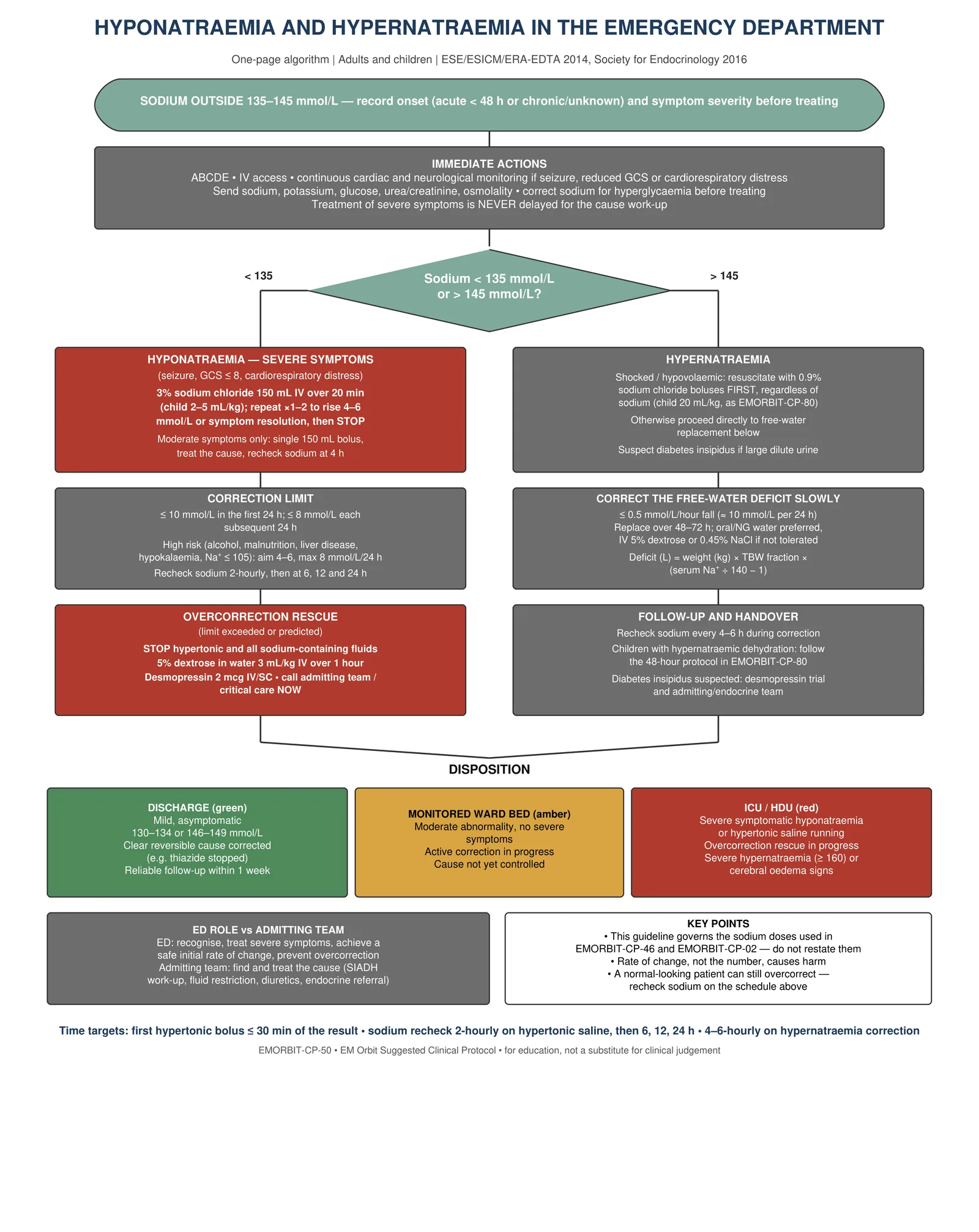
The one-page algorithm is shown at the top of this page.
6Team roles
6.1Triage and ED Nurses Role:
6.1.1 Recognise a seizure, reduced GCS, or cardiorespiratory distress in a patient with a known or suspected sodium abnormality and escalate immediately.
6.1.2 Prepare 3% sodium chloride for immediate administration when ordered; record the time and volume of every dose and the times of repeat sodium samples.
6.2Pharmacist:
6.2.1 Ensure 3% sodium chloride, 5% dextrose, and desmopressin are stocked and available in the resuscitation area with weight-based paediatric dose guidance.
6.2.2 Verify the hypertonic saline order against Table 1, flag any patient in the high-risk group for a lower correction limit, and review the medication list for a causative drug (thiazide, SSRI, desmopressin, carbamazepine).
6.3Endocrinology / Admitting Medical Team:
6.3.1 Receive the referral for cause work-up, arrange urine sodium and osmolality interpretation, direct fluid restriction or diuretic management, and take over sodium monitoring beyond the ED phase.
6.4Laboratory Staff:
6.4.1 Process sodium results from venous blood gas and serum samples urgently for a patient with severe symptoms and flag a critical result to the treating team without delay.
6.5Paediatrician:
6.5.1 Review every child with a sodium abnormality outside the gastroenteritis pathway (EMORBIT-CP-80) before disposition and confirm the correction rate and follow-up plan.
7The patient's role
7.1 Report new confusion, headache, vomiting, weakness, or seizure immediately during observation.
7.2 Attend the arranged follow-up appointment and repeat blood test; take any changed medication as instructed.
8Definitions
8.1Hyponatraemia: serum or plasma sodium below 135 mmol/L; severe hyponatraemia is generally below 125 mmol/L, though symptoms depend more on the rate of fall than the absolute value.
8.2Hypernatraemia: serum or plasma sodium above 145 mmol/L.
8.3Osmotic Demyelination Syndrome: neurological injury, classically affecting the pons, caused by correcting chronic hyponatraemia faster than the limits in Table 1; may present days after apparent improvement.
8.4Syndrome of Inappropriate Antidiuretic Hormone Secretion (SIADH): euvolaemic hyponatraemia with inappropriately concentrated urine in the absence of renal, adrenal, or thyroid failure; a diagnosis of exclusion made by the admitting team.
8.5Diabetes Insipidus: inability to concentrate urine, from reduced antidiuretic hormone (central) or renal resistance to it (nephrogenic), producing large volumes of dilute urine and a rising sodium if water intake cannot keep pace.
8.6Free-Water Deficit: the calculated volume of electrolyte-free water needed to correct hypernatraemia to a normal sodium (Table 3), replaced slowly over 48–72 hours.
8.7Overcorrection: a rise in serum sodium exceeding the limit in Table 1 within the stated period, requiring the rescue in Table 2.
9Attachments
- Attachment 1: One-page algorithm (top of this page)
- Attachment 2: Hyponatraemia Correction and Overcorrection Rescue Quick Reference
- Attachment 3: Hypernatraemia Correction and Free-Water Deficit Quick Reference
11Suggested quality indicators
11.1Time to first hypertonic saline dose ≤ 30 minutes: (Number of patients with severe symptomatic hyponatraemia receiving the first 3% sodium chloride bolus within 30 minutes of the abnormal result / Total number of patients with severe symptomatic hyponatraemia) × 100. Target ≥ 90%.
11.2Correction limit documented and followed: (Number of patients receiving hypertonic saline with the correction limit (Table 1) stated in the record and the scheduled sodium rechecks completed / Total number receiving hypertonic saline) × 100. Target ≥ 90%.
11.3Safe disposition: (Number of patients with severe symptomatic hyponatraemia or hypernatraemia admitted to a monitored bed or higher / Total number with severe symptomatic hyponatraemia or hypernatraemia) × 100. Target 100%.
11.4Overcorrection rate (outcome): (Number of patients whose correction exceeded the limit in Table 1 / Total number treated with hypertonic saline) × 100. Monitored as an outcome indicator; no numerical target, reviewed as an incident each time.
13References
- Spasovski G, Vanholder R, Allolio B, et al. Clinical practice guideline on diagnosis and treatment of hyponatraemia. Nephrol Dial Transplant. 2014;29(Suppl 2):i1–i39.
- Verbalis JG, Goldsmith SR, Greenberg A, et al. Diagnosis, evaluation, and treatment of hyponatremia: expert panel recommendations. Am J Med. 2013;126(10 Suppl 1):S1–S42.
- Society for Endocrinology. Emergency management of severe symptomatic hyponatraemia in adult patients. Endocr Connect. 2016;5(5):G4–G6.
- Sterns RH, Hix JK, Silver S. Treating profound hyponatremia: a strategy for controlled correction. Am J Kidney Dis. 2010;56(4):774–779.
- Sterns RH. Disorders of plasma sodium — causes, consequences, and correction. N Engl J Med. 2015;372(1):55–65.
- Adrogué HJ, Madias NE. Hyponatremia. N Engl J Med. 2000;342(21):1581–1589.
- Adrogué HJ, Madias NE. Hypernatremia. N Engl J Med. 2000;342(20):1493–1499.
- ED Clinical Practice Guidelines EMORBIT-CP-02 (Status Epilepticus), EMORBIT-CP-17 (DKA/HHS), EMORBIT-CP-46 (Altered Mental Status) and EMORBIT-CP-80 (Paediatric Gastroenteritis and Dehydration).
A2Attachment 2: Hyponatraemia Correction and Overcorrection Rescue Quick Reference
| Severity / step | Adult | Child |
|---|---|---|
| Severe symptoms (seizure, GCS ≤ 8, cardiorespiratory distress) | 3% sodium chloride 150 mL IV over 20 minutes; repeat once or twice to a rise of 4–6 mmol/L or symptom resolution, then stop | 3% sodium chloride 2–5 mL/kg IV over 20 minutes; repeat as adult |
| Moderately severe symptoms only (vomiting without prostration, confusion, headache) | Single 150 mL bolus of 3% sodium chloride over 20 minutes; treat the cause; recheck sodium at 4 hours | 2–5 mL/kg once; treat the cause; recheck sodium at 4 hours |
| Correction limit — standard | ≤ 10 mmol/L rise in the first 24 hours; ≤ 8 mmol/L in each subsequent 24 hours | Same limit |
| Correction limit — high-risk group* | Aim for a rise of 4–6 mmol/L in 24 hours; no more than 8 mmol/L | Same limit |
*High-risk for osmotic demyelination: chronic alcohol use disorder, malnutrition or hypokalaemia, advanced liver disease, serum sodium ≤ 105 mmol/L, burns. Recheck sodium every 2 hours while giving hypertonic saline, then at 6, 12 and 24 hours.
| Step | Action |
|---|---|
| 1. Recognise | Correction has exceeded, or is predicted to exceed, the limit in Table 1 on the scheduled recheck. |
| 2. Stop | Stop 3% sodium chloride and all other sodium-containing fluids immediately. |
| 3. Re-lower | Give 5% dextrose in water 3 mL/kg IV over 1 hour (adult and child); repeat guided by the repeat sodium. |
| 4. Prevent further rise | Desmopressin 2 micrograms IV or subcutaneously, repeated every 6–8 hours if the rate of fall must be controlled while re-lowering. |
| 5. Escalate | Call the admitting medical team and critical care/HDU immediately. Document the rescue for incident review. |
A3Attachment 3: Hypernatraemia Correction and Free-Water Deficit Quick Reference
| Item | Adult | Child |
|---|---|---|
| Shocked / hypovolaemic | Resuscitate with 0.9% sodium chloride boluses first, regardless of sodium | 20 mL/kg 0.9% sodium chloride bolus, as EMORBIT-CP-80 |
| Correction rate | ≤ 0.5 mmol/L/hour fall (≈ 10 mmol/L per 24 hours); replace the free-water deficit over 48–72 hours | Same rate; deficit over 48 hours if hypernatraemic dehydration (EMORBIT-CP-80) |
| Route | Oral or nasogastric water preferred; IV 5% dextrose or 0.45% sodium chloride if not tolerated | Same |
| Free-water deficit | Deficit (L) = weight (kg) × total body water fraction × (serum Na⁺ ÷ 140 − 1) | Same formula; use a fraction of 0.6 |
| Monitoring | Recheck sodium every 4–6 hours during correction | Same |
| Group | Fraction of body weight |
|---|---|
| Child | 0.6 |
| Adult male / non-elderly | 0.6 |
| Adult female, or elderly male | 0.5 |
| Elderly female | 0.45 |