Emergency Haemodialysis, CRRT and the Dialysis-Dependent Patient in the Emergency Department
EMORBIT-CP-130 · Chapter 8 · Renal and Urological Emergencies
Open in the appFree, works on your phone and offline, with every tool alongside.
Evidence base: KDIGO 2012 AKI; UK Kidney Association; RCEM
1Purpose
1.1 Provide a standardised framework for the recognition and emergency management of the complications of established dialysis dependence (haemodialysis, continuous renal replacement therapy (CRRT) and peritoneal dialysis (PD)) in patients presenting to the Emergency Department (ED): the missed or shortened session, hyperkalaemia, fluid overload, vascular access complications and bleeding, line and PD-related infection, and uraemic emergencies.
1.2 State who does each step: the ED gives time-critical treatment and takes the samples that cannot be taken later; Nephrology and the dialysis provider/CRRT team decide, prescribe, and deliver dialysis and CRRT.
1.3 Protect the patient's vascular access, which is often their only remaining option, in every ED contact.
1.4 Direct cause-specific treatment to the guideline that already carries the dose (hyperkalaemia, hypoglycaemia, hypertension, poisoning) rather than repeating it here.
2Who this protocol applies to
2.1 Adults and children established on maintenance haemodialysis, CRRT, or peritoneal dialysis, presenting with a dialysis-related complication: missed or shortened session, hyperkalaemia, fluid overload, access complication or bleeding, suspected line or PD-related infection, or a uraemic emergency.
2.2 Haemodynamically stable dialysis-dependent patients in the ED awaiting an intensive care bed who require conventional haemodialysis, and haemodynamically unstable patients in the same position who require CRRT.
2.3 Any hospitalised patient awaiting transfer to a ward or critical care area who needs dialysis as a life-saving measure before the Renal Unit can provide it (section 4.1.4).
2.4 Patients with an infectious disease requiring airborne precautions who are unstable and require dialysis in the ED, per Infection Control Policy.
3Not covered by this protocol
3.1 Stable patients requiring routine, scheduled haemodialysis with no acute complication: referred to the on-call Renal Unit / dialysis-provider physician for the Renal Dialysis Unit, not managed as an ED presentation.
3.2 Acute kidney injury without established dialysis dependence: EMORBIT-CP-58.
3.3 The drug doses and monitoring for hyperkalaemia (EMORBIT-CP-10) and hypoglycaemia (EMORBIT-CP-49): this guideline points to them and does not restate them.
3.4 Vascular access insertion technique for a non-dialysis central venous catheter: EMORBIT-CP-36. Insertion of a temporary dialysis catheter is a nephrology-directed procedure (section 4.3.2).
3.5 Definitive inpatient dialysis and CRRT prescribing, technique, and equipment maintenance, which follow Renal Unit and Intensive Care Unit policy.
4Protocol
4.1History and Assessment:
4.1.1Triage and Recognition:
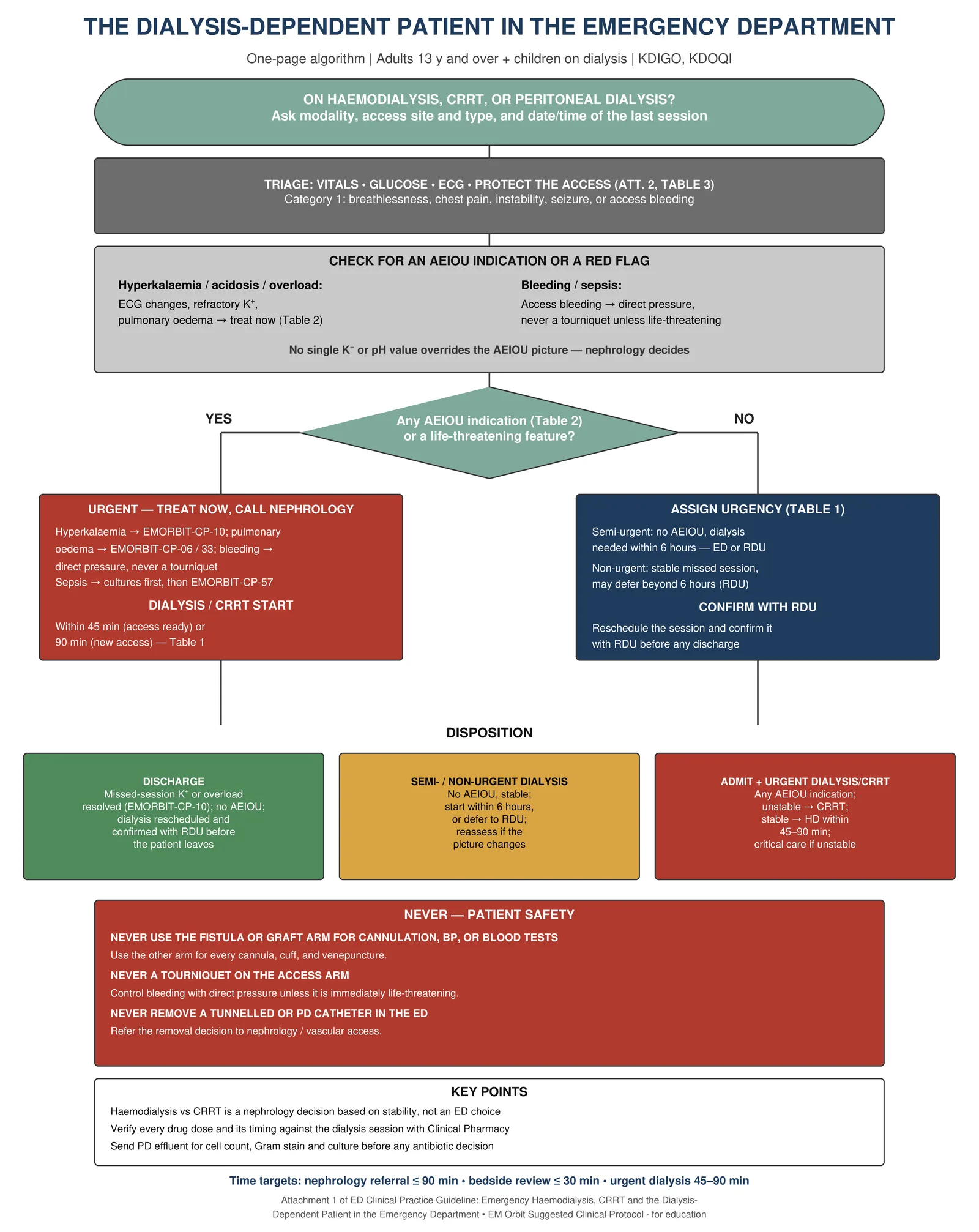
4.1.1.1 Ask every patient at triage: "Are you on dialysis?" — modality (haemodialysis, CRRT, or peritoneal dialysis), access type and site, the unit that dialyses them, and the date and time of the last session.
4.1.1.2 Triage Category 1 (immediate): breathlessness or pulmonary oedema, chest pain, haemodynamic instability, altered consciousness or seizure, active bleeding from the access, or any electrocardiogram (ECG) change of hyperkalaemia.
4.1.1.3 Protect the access from the first contact: identify and mark the fistula/graft arm and apply the access-protection rules (Attachment 2, Table 3) before any cannulation, blood pressure cuff, or venepuncture.
4.1.2History:
4.1.2.1 Renal history: cause of end-stage kidney disease, dialysis modality and schedule (days, times, unit), the date and time of the last session, whether it was missed or shortened and why (transport, illness, isolation, non-attendance), dry weight and usual interdialytic weight gain, access type and site, previous access complications, transplant history, and any residual urine output.
4.1.2.2 Presenting complaint: breathlessness or orthopnoea (fluid overload); fever or rigors (access or PD infection); bleeding from the access; abdominal pain or cloudy PD effluent (PD peritonitis); palpitations or weakness (hyperkalaemia); reduced consciousness (uraemia or hypoglycaemia).
4.1.2.3 Full medication list including phosphate and potassium binders, antihypertensives, and any anticoagulant taken for access patency; recent antibiotics; and the barrier, if any, to attending the scheduled session.
4.1.3Examination:
4.1.3.1 Vital signs and, where available, weight compared with the documented dry weight.
4.1.3.2 Access examination: fistula or graft — thrill and bruit, redness, swelling, discharge, bleeding, aneurysm; tunnelled catheter — exit site and tunnel tenderness or discharge; PD catheter — exit site and, where effluent is available, its clarity.
4.1.3.3 Fluid status: jugular venous pressure, lung crackles, peripheral and sacral oedema, postural blood pressure.
4.1.3.4 Cardiac auscultation for a pericardial rub; neurological examination for asterixis or encephalopathy.
4.1.4Risk Stratification and Differential Diagnosis:
4.1.4.1 Apply the AEIOU indications for urgent renal replacement therapy exactly as in EMORBIT-CP-58 (Table 3): Acidosis, Electrolytes, Intoxication, Overload, Uraemia (Table 2). None of these requires a specific urea or creatinine threshold; the clinical picture decides.
4.1.4.2 Fever in a dialysis-dependent patient: assume the access is the source until excluded, before attributing it to another focus.
4.1.4.3 Chest pain: uraemic pericarditis (as EMORBIT-CP-92) versus acute coronary syndrome — troponin is often chronically elevated in end-stage kidney disease; interpret the trend, not a single value.
4.1.4.4 Abdominal pain in a PD patient is PD peritonitis until proven otherwise, and is assessed alongside a surgical cause.
4.1.5Special Populations:
4.1.5.1 Choice of haemodialysis versus CRRT in the ED is made by the nephrologist on the basis of haemodynamic stability (section 4.1.1 above); it is not an ED physician decision.
4.1.5.2 Children established on dialysis: discuss every case with paediatric nephrology; all doses are weight-based.
4.1.5.3 Pregnancy in a dialysis-dependent patient: involve obstetrics; this is uncommon and high-risk.
4.1.5.4 Patients with an infectious disease requiring airborne precautions: unstable patients are dialysed in the ED under isolation precautions; stable patients are referred by the Renal Unit physician to a designated facility.
4.2Investigations:
4.2.1 Venous blood gas at first access for potassium, pH, bicarbonate, and glucose within minutes; capillary glucose in every patient.
4.2.2 Laboratory urea and electrolytes, creatinine, calcium, phosphate, magnesium, full blood count and C-reactive protein.
4.2.3 12-lead ECG immediately in every patient; review against the high-risk features in EMORBIT-CP-10 (Table 2).
4.2.4 Where line or PD infection is suspected: paired blood cultures — one peripheral and, if a tunnelled catheter is present, one through the catheter, both labelled with site and time (as EMORBIT-CP-36) — before antibiotics, without delaying treatment in septic shock.
4.2.5 PD effluent, where available, for cell count and differential, Gram stain, and culture; a cell count with a neutrophil predominance supports PD peritonitis (ISPD 2022).
4.2.6 Chest radiograph for pulmonary oedema or infection; troponin only where acute coronary syndrome is independently suspected, not as a routine panel.
4.2.7 Same-day PD fluid microscopy and cell count should be available from the laboratory.
Where available.
4.3Plan of Care:
4.3.1Immediate Actions (0–10 minutes):
4.3.1.1 ABCDE assessment; move to a monitored bed, or the resuscitation area if unstable, and apply continuous cardiac monitoring for any hyperkalaemia feature or ECG change.
4.3.1.2 Obtain intravenous access in the arm without the fistula or graft; do not use a tunnelled dialysis catheter for routine access (Table 3).
4.3.1.3 Point-of-care glucose and venous blood gas in every patient before any other treatment.
4.3.1.4 Bleeding fistula or graft: direct manual pressure over the puncture site and limb elevation; never a tourniquet on the access arm unless the bleeding is immediately life-threatening and direct pressure has failed (Table 3); escalate uncontrolled life-threatening bleeding per EMORBIT-CP-27.
4.3.2Definitive ED Treatment by Presentation:
4.3.2.1Hyperkalaemia: treat per EMORBIT-CP-10 (severity table, calcium, insulin-glucose and salbutamol, potassium removal) — doses are not restated here. Contact nephrology at the time of the first result, not after medical treatment has failed; medical treatment is a bridge, dialysis is definitive.
4.3.2.2Hypoglycaemia: treat per EMORBIT-CP-49. In the dialysis-dependent adult, where the standard glucose volume is itself a fluid hazard, EMORBIT-CP-49 (section 4.3.2) gives the exception exactly: 50% glucose may be given on the decision of the senior ED physician, the smallest effective aliquot — 25 mL of 50% = 12.5 g — repeated on the same measurement rule, by a secure large vein, with the reason recorded. This guideline matches that figure and does not restate it differently.
4.3.2.3Fluid overload / pulmonary oedema: sit the patient up, give oxygen or non-invasive ventilation as EMORBIT-CP-33, and start intravenous nitrate as EMORBIT-CP-06 while dialysis is arranged. Give a loop diuretic only if the patient still has residual urine output — most dialysis-dependent patients are oliguric or anuric and diuretics will not work. Refractory pulmonary oedema is an AEIOU indication for urgent dialysis (Table 2).
4.3.2.4Hypertension: treat as a volume problem — arrange ultrafiltration/dialysis, not an intravenous antihypertensive — exactly as EMORBIT-CP-40 (section 4.1.5). Where a genuine hypertensive emergency with acute target-organ damage exists independent of volume status, follow EMORBIT-CP-40 in full.
4.3.2.5Missed or shortened session: treat any resulting hyperkalaemia or fluid overload as above; identify and document the reason for the missed session; refer to nephrology and assign an urgency category (Table 1). Recurrent non-attendance is referred to the renal social work service.
Renal medical social work service, where available.
4.3.2.6Suspected line-related bloodstream infection: take paired blood cultures before antibiotics (section 4.2); start empirical antibiotics per the ED antimicrobial stewardship protocol (EMORBIT-CP-57) and the current local antibiogram — a regimen is not invented here. Do not remove a tunnelled dialysis catheter in the ED (Table 3); refer the removal decision to nephrology/vascular access.
4.3.2.7Peritoneal dialysis peritonitis: send effluent for cell count, Gram stain and culture (section 4.2); do not access, flush, or remove the PD catheter in the ED. Intraperitoneal or empirical antibiotic therapy is a nephrology/Renal Dialysis Unit decision made the same day; a regimen is not invented here.
4.3.2.8Drug dosing: every drug given to a dialysis-dependent patient shall have its dose and timing relative to the dialysis session verified by Clinical Pharmacy against a renal dosing reference before administration; avoid nephrotoxic drugs (non-steroidal anti-inflammatory drugs, aminoglycosides) where any residual renal function remains.
4.3.3Who Arranges Emergency Dialysis, and Where:
4.3.3.1 The ED physician assesses the patient. A pure nephrology presentation is referred to Nephrology; a patient with other comorbidity is referred simultaneously to the relevant specialty and to Nephrology where a nephrology emergency coexists.
4.3.3.2 Nephrology categorises the urgency (Table 1), enters the dialysis or CRRT prescription in the electronic medical record, and obtains informed consent for dialysis and, where no access exists, for a temporary dialysis catheter.
4.3.3.3 A temporary dialysis catheter is inserted by the attending nephrologist, not the ED physician; EMORBIT-CP-36 states the ED's general central-line principles but does not apply to this nephrology-directed procedure.
4.3.3.4 Nephrology notifies the on-call dialysis-provider physician and the nursing supervisor, who identifies the on-call dialysis or CRRT nurse/technician from the rota; that nurse/technician starts and runs the therapy and hands over at shift change per policy.
4.3.3.5 The out-of-hours activation route and contact number for the local dialysis service's on-call rota should be confirmed and displayed in the ED.
4.3.3.6 During dialysis or CRRT in the ED, the ED physician evaluates and treats any unexpected emergency (seizure, myocardial infarction, stroke) immediately and informs the admitting team and Nephrology; the dialysis or CRRT nurse/technician monitors vital signs, the access, and blood flow throughout and informs Nephrology on completion.
4.3.4Escalation and Refractory Presentation:
4.3.4.1 Contact nephrology/critical care immediately for any AEIOU indication (Table 2), for an unstable patient (CRRT candidate), or for uraemic pericarditis with tamponade physiology (EMORBIT-CP-92).
4.3.4.2 Critical care is involved for haemodynamic instability, a requirement for intubation, or CRRT.
4.3.5Monitoring and Reassessment:
4.3.5.1 Continuous cardiac monitoring until any hyperkalaemia or ECG change has resolved, per EMORBIT-CP-10.
4.3.5.2 Vital signs and access-site checks at least every 30 minutes while a concerning finding persists; hourly fluid balance and urine output where measurable.
4.3.6Disposition:
4.3.6.1Critical care / high dependency:
- CRRT, haemodynamic instability, septic shock, or tamponade physiology.
- Any AEIOU indication (Table 2) not yet resolved.
4.3.6.2Admission to a monitored ward bed:
- Haemodialysis completed in the ED, awaiting a ward bed.
- Stable line infection or PD peritonitis for continued intravenous or intraperitoneal antibiotics under Nephrology.
4.3.6.3Discharge:
- A missed-session hyperkalaemia or fluid overload fully resolved per EMORBIT-CP-10, with the rescheduled dialysis session confirmed with the Renal Dialysis Unit before the patient leaves.
- No red flag, no AEIOU indication, and discharge approved by, or discussed with, an ED specialist/consultant and Nephrology.
4.3.7Discharge and Follow-up:
4.3.7.1 Confirm and document the rescheduled dialysis appointment (date, time, unit) and the urgency category assigned (Table 1) before discharge.
4.3.7.2 Written safety-net advice: return immediately for breathlessness, chest pain, palpitations, access bleeding or swelling, fever, or reduced urine output.
4.3.7.3 Reinforce access protection to the patient (Table 3) and reconcile medication, specifically stopping any nephrotoxic over-the-counter drug.
4.3.8Documentation and Reporting:
4.3.8.1 Document the access type and site, the reason for a missed session, the time of nephrology referral and of the nephrology bedside review, the urgency category, treatment given, disposition, and the confirmed follow-up dialysis appointment.
5Algorithm
The one-page algorithm is shown at the top of this page.
6Team roles
6.1Triage / ED Nurse:
6.1.1 Ask "on dialysis?" and identify modality and access at triage; protect the access (Table 3); escalate any red flag immediately.
6.2Pharmacist:
6.2.1 Verify every drug dose and its timing relative to the dialysis session; flag nephrotoxic drugs.
6.3Nephrology / dialysis provider:
6.3.1 Attend within the referral and review time targets (Table 1); categorise urgency; prescribe and consent for dialysis or CRRT; insert the temporary dialysis catheter; deliver and monitor the therapy; decide on removal of a tunnelled catheter or PD catheter.
6.4Laboratory / Radiology:
6.4.1 Process the venous blood gas, electrolytes and PD effluent urgently and report a critical potassium immediately; provide access ultrasound where thrombosis or steal is suspected.
6.5Ambulance / Pre-hospital Providers:
6.5.1 Pre-alert for a known dialysis patient with breathlessness, chest pain, or a missed session, and state the access site so it is protected on arrival.
7The patient's role
7.1 Tell the treating team about dialysis modality, access site, and the date of the last session.
7.2 Report any bleeding, swelling, or pain at the access site immediately.
7.3 Attend the rescheduled dialysis session and return to the ED for any safety-net symptom.
8Definitions
8.1Haemodialysis (HD): renal replacement therapy that filters blood extracorporeally through a dialyser.
8.2Continuous Renal Replacement Therapy (CRRT): prolonged, continuous dialysis therapy for the haemodynamically unstable patient.
8.3Peritoneal Dialysis (PD): renal replacement therapy using the peritoneal membrane and a dwelling dialysate via a permanent peritoneal catheter.
8.4Dry weight: the target post-dialysis weight at which the patient is euvolaemic.
8.5AEIOU: Acidosis, Electrolytes, Intoxication, Overload, Uraemia — the indications for urgent renal replacement therapy (Table 2), as EMORBIT-CP-58.
8.6Urgent / Semi-urgent / Non-urgent: the three nephrology-assigned dialysis-start urgency categories and their ED time targets (Table 1).
9Attachments
- Attachment 1: One-page algorithm (top of this page)
- Attachment 2: Urgency Categories, AEIOU Indications, and Access-Protection Quick Reference
11Suggested quality indicators
11.1Time to nephrology referral within 90 minutes: (Number of dialysis-dependent ED patients with a nephrology referral recorded within 90 minutes of arrival / Total number of such patients) × 100. Target ≥ 90%.
11.2Nephrology bedside review within 30 minutes of referral: (Number of referrals seen by nephrology within 30 minutes / Total number of referrals) × 100. Target ≥ 90%.
11.3Dialysis start within the assigned urgency-category time target (Table 1): (Number of urgent-category patients dialysed within 45/90 minutes / Total number of urgent-category patients) × 100. Target ≥ 90%.
11.4Access protected during the ED visit: (Number of patients with no cannulation, blood pressure cuff, or venepuncture recorded on the fistula/graft arm / Total number of dialysis-dependent patients) × 100. Target 100%.
11.5Safe disposition — confirmed follow-up dialysis: (Number of discharged dialysis-dependent patients with a confirmed rescheduled dialysis appointment documented / Total number discharged) × 100. Target 100%.
11.6Unplanned return within 72 hours: (Number of dialysis-dependent patients returning to the ED within 72 hours of discharge / Total number discharged) × 100. Monitored as an outcome indicator.
13References
- Kidney Disease: Improving Global Outcomes (KDIGO) Acute Kidney Injury Work Group. KDIGO Clinical Practice Guideline for Acute Kidney Injury. Kidney Int Suppl. 2012;2(1):1-138.
- Lok CE, Huber TS, Lee T, et al. KDOQI Clinical Practice Guideline for Vascular Access: 2019 Update. Am J Kidney Dis. 2020;75(4 Suppl 2):S1-S164.
- Li PK, Chow KM, Cho Y, et al. ISPD Peritonitis Guideline Recommendations: 2022 Update on Prevention and Treatment. Perit Dial Int. 2022;42(2):110-153.
A2Attachment 2: Urgency Categories, AEIOU Indications, and Access-Protection Quick Reference
| Category | Trigger | ED time target |
|---|---|---|
| Urgent | Any AEIOU indication (Table 2) or a hospital-protocol life-threatening indication (section 4.1.4) | Dialysis start within 45 minutes where vascular access is available, or 90 minutes where a new access must be inserted |
| Semi-urgent | A dialysis-dependent complication that is not immediately life-threatening | Start within 6 hours |
| Non-urgent | A missed or shortened session with no AEIOU feature and a clinically stable patient | May be deferred beyond 6 hours, in the Renal Dialysis Unit (RDU); the patient returns to the ED or ward to wait |
Nephrology referral shall be made within 90 minutes of arrival; the nephrology physician privileged to start dialysis shall see the patient within 30 minutes of receiving the referral. These two time targets are unchanged from the hospital protocol and are retained.
| Indication | Trigger | ED action |
|---|---|---|
| Acidosis | Severe metabolic acidosis (pH < 7.1) refractory to medical treatment | Venous/arterial gas; call nephrology/critical care. |
| Electrolytes | Hyperkalaemia refractory to, or recurring after, medical treatment | Treat per EMORBIT-CP-10 — doses are not restated here; call nephrology if it persists or recurs. |
| Intoxication | A dialysable drug or toxin (e.g. lithium, salicylate) with the missed session | Manage per EMORBIT-CP-113; discuss with the national poison centre and nephrology. |
| Overload | Fluid overload with pulmonary oedema refractory to diuretics | Oxygen, sit up, NIV per EMORBIT-CP-33; furosemide only if still passing urine; call nephrology. |
| Uraemia | Encephalopathy, pericarditis (rub, effusion — as EMORBIT-CP-92), or uraemic bleeding | Senior ED review; call nephrology/critical care immediately. |
Note — thresholds: other sources state different numeric criteria for the same emergencies — severe hyperkalaemia as K⁺ > 7.0 mmol/L resistant to medical therapy, or 6.1–7.0 mmol/L with cardiac instability; severe metabolic acidosis as pH < 7.2 or base excess < −10, and separately as bicarbonate < 10 mmol/L and/or pH < 7.1. These numbers differ from the AEIOU/EMORBIT-CP-10 thresholds above. This guideline applies the AEIOU framework already adopted for AKI (EMORBIT-CP-58) so that one standard runs across the ED.
| ✓ | Item |
|---|---|
| ☐ | Never use the fistula or graft arm for cannulation, blood pressure measurement, or venepuncture — use the other arm. |
| ☐ | A tunnelled dialysis catheter is for dialysis only; it is not used for routine intravenous drugs or blood tests except as emergency access when no peripheral vein can be found, and only on nephrology advice. |
| ☐ | A bleeding fistula or graft is controlled by direct manual pressure over the puncture site and limb elevation; never apply a tourniquet to the access arm unless the bleeding is immediately life-threatening and direct pressure has failed — call vascular surgery and nephrology at once. |
| ☐ | A tunnelled or permanent dialysis catheter suspected of causing bloodstream infection is not removed in the ED; take cultures, start antibiotics per stewardship, and refer the removal decision to nephrology/vascular access. |
| ☐ | A peritoneal dialysis catheter is not accessed, flushed, or removed in the ED; send effluent for analysis and refer to nephrology. |