Non-Invasive Ventilation and High-Flow Nasal Oxygen in the Emergency Department
EMORBIT-CP-33 · Chapter 1 · Resuscitation and Critical Care
Open in the appFree, works on your phone and offline, with every tool alongside.
Evidence base: BTS/ICS 2016; ERS/ATS 2017
1Purpose
1.1 Standardize the selection, initiation, titration, monitoring, and escalation of non-invasive ventilation (CPAP and bilevel NIV) and high-flow nasal oxygen (HFNO) for adults presenting to the Emergency Department (ED) with acute respiratory failure.
1.2 Ensure the interface and ventilator settings are matched to the precipitant, that the treatment of the precipitant itself follows the relevant the ED guideline, and that a treatment escalation plan is agreed and documented before support is started.
1.3 Ensure timely recognition of failure and escalation to intubation, so that a decision is never delayed beyond the time points set out in this guideline.
1.4 Align practice with BTS/ICS 2016, ERS/ATS 2017, BTS 2017 (oxygen), and the ED-specific settings already stated in EMORBIT-CP-09 (COPD), EMORBIT-CP-06 (heart failure), and EMORBIT-CP-31 (airway).
2Who this protocol applies to
2.1 Adults 13 years and over presenting to, or deteriorating within, the ED with acute type 1 (hypoxaemic) or type 2 (hypercapnic) respiratory failure in whom CPAP, bilevel NIV, or HFNO is being considered.
2.2 Patients on home CPAP or home NIV who present with acute deterioration.
2.3 Patients pre-treated with CPAP, NIV, or HFNO in the pre-hospital setting, even if improved on arrival.
2.4 Patients for whom CPAP, NIV, or HFNO is agreed as the ceiling of treatment (comfort-focused care).
3Not covered by this protocol
3.1 Children under 13 years: acute respiratory failure in this age group is managed with the paediatric critical care team; the age boundary is the ED library standard and departs from the 16-year threshold used in some local NIV protocols.
3.2 A patient who already meets criteria for immediate intubation (EMORBIT-CP-31, Table 1): do not trial non-invasive support first.
3.3 Use of NIV/CPAP/HFNO purely for pre-oxygenation immediately before rapid sequence induction: covered by EMORBIT-CP-31.
3.4 Definitive drug treatment of the precipitant (e.g. bronchodilators and steroids in COPD, diuretic and nitrate in cardiogenic pulmonary oedema, antimicrobials in pneumonia): covered by the relevant the ED guideline, not restated here.
3.5 Chronic, stable outpatient use of home CPAP/NIV for sleep-disordered breathing: not an ED presentation.
4Protocol
4.1History and Assessment:
4.1.1Triage and Recognition:
4.1.1.1 Any patient with severe respiratory distress, SpO₂ that cannot be maintained on oxygen, or a known or suspected acidotic blood gas shall be triaged to the highest acuity category and taken to a monitored area.
4.1.1.2 An ED physician shall attend within 10 minutes. Distinguish type 1 (hypoxaemic, PaO₂ low, PaCO₂ normal or low) from type 2 (hypercapnic, PaCO₂ > 6.0 kPa / 45 mmHg, usually with acidosis) respiratory failure; the type, not the diagnosis alone, drives the modality choice (Table 1, Attachment 2).
4.1.2History:
4.1.2.1 Speed of onset, exercise tolerance, and the suspected precipitant (COPD, cardiogenic pulmonary oedema, pneumonia, neuromuscular or chest wall disease, obesity hypoventilation syndrome).
4.1.2.2 Home CPAP or home NIV use and settings; long-term oxygen therapy; previous NIV, HFNO, or intubation for a similar episode.
4.1.2.3 Any existing treatment escalation plan, advance directive, or resuscitation decision.
4.1.3Examination:
4.1.3.1 Respiratory rate, accessory muscle use, paradoxical abdominal movement, ability to speak in sentences, conscious level, and ability to protect the airway.
4.1.3.2 Signs of the precipitant: wheeze and hyperinflation (COPD); bibasal crackles, raised jugular venous pressure, peripheral oedema (cardiogenic pulmonary oedema); focal crackles or bronchial breathing (pneumonia); a facial or upper-airway reason a mask or nasal interface cannot be used.
4.1.4Risk stratification / severity:
4.1.4.1 Classify by respiratory failure type and severity as set out in the precipitant-specific guideline where one exists (EMORBIT-CP-09 Tables 1–2 for COPD; EMORBIT-CP-06 for cardiogenic pulmonary oedema).
4.1.4.2 Any of pH < 7.25, respiratory rate > 35/min, GCS < 8, or haemodynamic instability identifies a patient who needs a senior decision and critical care involvement from the outset, regardless of precipitant.
4.1.5Differential Diagnosis:
4.1.5.1 Exclude pneumothorax (chest X-ray or lung ultrasound) and consider pulmonary embolism before starting non-invasive support; neither is treated by ventilatory support alone.
4.1.5.2 Consider mixed pictures (e.g. COPD with pneumonia, cardiogenic pulmonary oedema with hypercapnia): treat all precipitants identified, per the relevant local guideline for that precipitant, in parallel with ventilatory support.
4.1.6Special Populations:
4.1.6.1 Pregnancy: manage per the underlying precipitant guideline; use left lateral tilt beyond 20 weeks; involve Obstetrics early.
4.1.6.2 Obesity / obstructive sleep apnoea overlap: higher EPAP (5 cmH₂O or more) is often required; hypoventilation may persist after the acute episode resolves.
4.1.6.3 Immunocompromised patients with hypoxaemic failure: HFNO is a reasonable first-line modality; evidence for a survival benefit over standard oxygen is mixed and intubation shall not be delayed if failure criteria are met (Table 4).
4.1.6.4 Frail and end-of-life patients: a senior physician shall discuss the goals of care and whether CPAP/NIV/HFNO is a bridge, a ceiling, or not appropriate, before starting; involve palliative care for refractory breathlessness where support is not appropriate.
4.1.6.5 Patients on home CPAP/NIV: use the patient's own settings and, where it fits, their own mask as the starting point, then titrate as in Table 3.
4.2Investigations:
4.2.1 Obtain a blood gas (arterial, or venous with a peripheral SpO₂-corroborated oxygenation) before starting, or at the same time without delaying treatment.
4.2.2 Chest X-ray or lung ultrasound in every patient, to identify the precipitant and to exclude pneumothorax before non-invasive support is started.
4.2.3 Repeat the blood gas within 1–2 hours of starting (1 hour precisely for bilevel NIV per EMORBIT-CP-09; at 60 minutes for CPAP per EMORBIT-CP-06) and again at 4 hours, or sooner if deteriorating (Table 4).
4.2.4 Continuous pulse oximetry and ECG from the outset; other investigations (blood count, renal profile, troponin, natriuretic peptide, lactate) as directed by the suspected precipitant guideline.
4.3Plan of Care:
4.3.1Immediate Actions (first 10 minutes):
4.3.1.1 Sit the patient upright at 45° or more; explain the treatment; hold the mask or nasal interface by hand for the first 1–2 minutes before securing.
4.3.1.2 High-flow oxygen while preparing the chosen interface; attach continuous SpO₂, ECG, and non-invasive blood pressure monitoring; obtain IV access.
4.3.1.3 Exclude the exclusions in section 3 (need for immediate intubation, pneumothorax) before proceeding.
4.3.1.4 Inform the senior ED physician; document the treatment escalation plan (intubate if support fails / support is the ceiling / not appropriate — comfort-focused care) and the resuscitation status BEFORE starting.
4.3.1.5 Call Critical Care for pH < 7.25, GCS < 15, haemodynamic instability, or where intubation is part of the plan.
4.3.2Modality Selection: select CPAP, bilevel NIV, or HFNO by precipitant as set out in Attachment 2, Table 1. Treat the precipitant itself per the relevant the ED guideline (EMORBIT-CP-09 for COPD; EMORBIT-CP-06 for cardiogenic pulmonary oedema; the relevant guideline for pneumonia or another cause) at the same time, never after.
4.3.3Initial Settings and Titration: as set out in Attachment 2, Table 3. Interfaces, pressures, flows, and oxygen targets differ by modality and by precipitant; use the row that matches the patient.
4.3.4Contraindications: reviewed before starting, as set out in Attachment 2, Table 2.
4.3.5Monitoring and Reassessment:
4.3.5.1 Continuous SpO₂ and ECG for CPAP and bilevel NIV; continuous SpO₂ for HFNO.
4.3.5.2 Respiratory rate, blood pressure, conscious level, patient–ventilator (or patient–flow) synchrony, mask/cannula fit and leak, and skin integrity every 15 minutes for the first hour, then hourly, until stable.
4.3.5.3 Repeat blood gas at the times in section 4.2 and Table 4; the results, not the interval alone, determine the next step.
4.3.6Failure Criteria and Escalation (Attachment 2, Table 4): failure of CPAP, bilevel NIV, or HFNO by the criteria in Table 4 requires an immediate senior decision on intubation. The decision to intubate follows EMORBIT-CP-31 (Table 1: airway patency, airway protection, adequacy of oxygenation/ventilation, and trajectory) and is never based on a single number. Do not continue failing support beyond the time points in Table 4 without a documented senior decision.
4.3.7Disposition:
4.3.7.1 All patients on CPAP or bilevel NIV require a monitored bed — resuscitation area, designated NIV area, respiratory HDU, or ICU — with staff trained in non-invasive ventilation and a nurse-to-patient ratio no less than 1:2; they shall not be admitted to an unmonitored general ward while on support.
4.3.7.2 A stable patient on HFNO with a falling oxygen requirement may be admitted to a ward bed capable of continuous SpO₂ monitoring; an unstable or high-flow-dependent patient requires HDU/ICU.
4.3.7.3 Support shall continue during transfer, using a transport ventilator or portable high-flow device and oxygen, with the initiation checklist (Attachment 2, Table 5) accompanying the patient.
4.3.8Discharge and Follow-up:
4.3.8.1 Direct ED discharge on CPAP/NIV/HFNO is not routine; almost all patients started on these therapies in the ED are admitted. A patient already established on home CPAP/NIV who is returning to their usual baseline may resume their own device and follow-up under the service already managing them.
4.3.8.2 For a patient in whom NIV/HFNO was used as a ceiling of treatment and this remains appropriate for ongoing care outside hospital, involve palliative care and community services before discharge.
4.3.9Documentation and Reporting:
4.3.9.1 Document: time of recognition, precipitant, modality chosen, time started against the applicable target, settings and every change, blood gas results with times, treatment escalation plan and resuscitation decision, response, failure decision if any, and disposition.
4.3.9.2 Report through the local incident reporting system: any start of CPAP/NIV beyond its time target, any unplanned intubation after CPAP/NIV/HFNO failure where the escalation plan had not been documented, and any adverse event attributed to the interface or settings.
5Algorithm
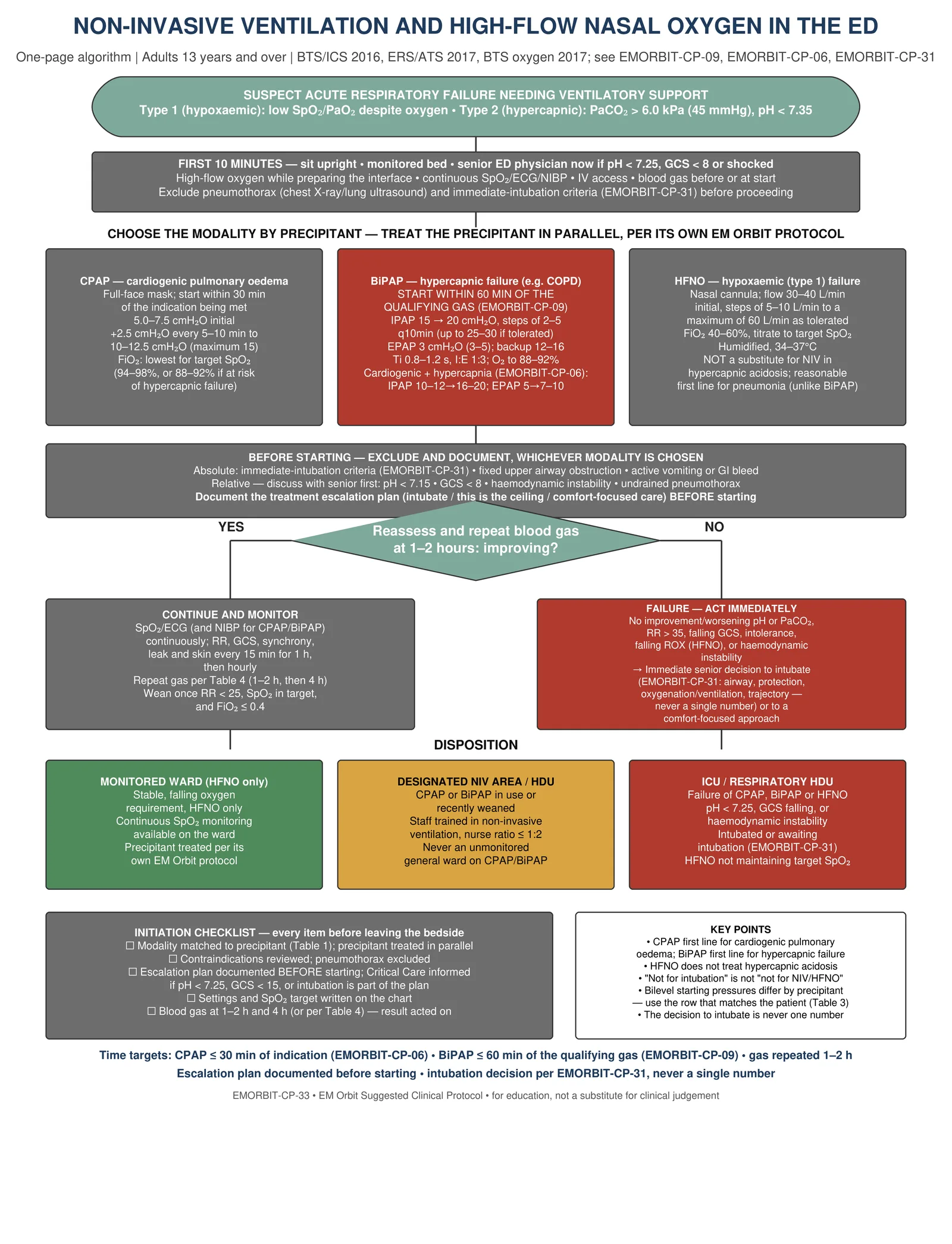
The one-page algorithm is shown at the top of this page.
6Team roles
6.1Triage and ED Nurses Role:
6.1.1 Recognize severe respiratory distress at triage, escalate immediately, and prepare the resuscitation area.
6.1.2 Set up and assist with the chosen interface, record settings and observations at the required intervals, protect skin and nasal bridge, and escalate any failure criterion without delay.
6.2Respiratory Therapist / NIV-trained Nurse:
6.2.1 Prepare and check the ventilator or high-flow device and interface; assist initiation and titration per Attachment 2, Table 3; support transfer with a transport device.
6.3Pharmacist:
6.3.1 Ensure medication for the precipitant is available and reviewed without delay from the ventilatory support; advise on drugs affected by the treatment escalation plan.
6.4Respiratory Medicine / Critical Care:
6.4.1 Respond when notified for pH < 7.25, failure criteria (Table 4), or where intubation is part of the plan; lead advanced airway management per EMORBIT-CP-31; accept patients to HDU/ICU.
6.5Laboratory / Radiology:
6.5.1 Process blood gases and imaging without delay; report critical values (pH, PaCO₂) to the treating team immediately.
6.6Ambulance / Pre-hospital Providers:
6.6.1 Pre-alert the ED for any patient on pre-hospital CPAP/NIV/HFNO; hand over the time started, settings, and response using a structured (ATMIST/SBAR) format.
7The patient's role
7.1 Report worsening breathlessness, mask/cannula discomfort, or leak to staff immediately rather than removing the interface.
7.2 Inform staff of home CPAP/NIV settings, usual oxygen saturation, and any advance care plan.
7.3 Where an escalation plan has been agreed, understand and, where able, take part in that discussion.
8Definitions
8.1CPAP (Continuous Positive Airway Pressure): a single continuous positive pressure delivered through a mask; first-line non-invasive support for cardiogenic pulmonary oedema.
8.2Bilevel NIV / BiPAP: non-invasive ventilation delivering two pressures — inspiratory positive airway pressure (IPAP) and expiratory positive airway pressure (EPAP) — through a mask, without an endotracheal airway; first-line non-invasive support for acute hypercapnic respiratory failure.
8.3High-Flow Nasal Oxygen (HFNO / HFNC): heated, humidified oxygen-air blend delivered at high flow (up to 60 L/min) through a nasal cannula; a hypoxaemic (type 1), not hypercapnic, respiratory support.
8.4Type 1 (hypoxaemic) respiratory failure: low PaO₂ with normal or low PaCO₂.
8.5Type 2 (hypercapnic) respiratory failure: PaCO₂ > 6.0 kPa (45 mmHg), usually with respiratory acidosis (pH < 7.35).
8.6ROX index: (SpO₂/FiO₂) ÷ respiratory rate; a bedside index used to flag the risk of HFNO failure (see Table 4 for the review status of the cut-offs).
8.7Treatment Escalation Plan (TEP) / Ceiling of Treatment: a documented, senior decision — made with the patient where possible — on which treatments (NIV/HFNO, intubation, ICU, cardiopulmonary resuscitation) are appropriate should the patient deteriorate.
9Attachments
- Attachment 1: One-page algorithm (top of this page)
- Attachment 2: Modality Selection, Contraindications, Settings, Failure Criteria and Initiation Checklist
11Suggested quality indicators
11.1Time-critical initiation: (Number of patients in whom CPAP or bilevel NIV was started within the applicable time target — CPAP ≤ 30 minutes for cardiogenic pulmonary oedema per EMORBIT-CP-06, bilevel NIV ≤ 60 minutes for hypercapnic failure per EMORBIT-CP-09 — / Total number of patients meeting the criteria for that modality) × 100. Target ≥ 90%.
11.2Treatment escalation plan documented before starting: (Number of patients with a documented treatment escalation plan before CPAP/NIV/HFNO was started / Total number of patients started on CPAP, NIV, or HFNO) × 100. Target 100%.
11.3Repeat blood gas performed: (Number of patients on CPAP or bilevel NIV with a repeat blood gas within 1–2 hours of starting / Total number of patients on CPAP or bilevel NIV) × 100. Target ≥ 90%.
11.4Safe disposition: (Number of patients discharged from the ED on CPAP or bilevel NIV to a monitored bed meeting the staffing standard in section 4.3.6 / Total number admitted on CPAP or bilevel NIV) × 100. Target 100%.
11.5Unplanned intubation after failure without a documented decision: (Number of patients intubated after CPAP/NIV/HFNO failure in whom the failure decision in Table 4 was not documented beforehand / Total number of unplanned intubations after CPAP/NIV/HFNO) × 100. Monitored as an outcome indicator, without a fixed target.
13References
- Davidson AC, Banham S, Elliott M, et al. BTS/ICS guideline for the ventilatory management of acute hypercapnic respiratory failure in adults. Thorax. 2016;71(Suppl 2):ii1–35.
- Rochwerg B, Brochard L, Elliott MW, et al. Official ERS/ATS clinical practice guidelines: noninvasive ventilation for acute respiratory failure. Eur Respir J. 2017;50(2):1602426.
- O'Driscoll BR, Howard LS, Earis J, et al. BTS guideline for oxygen use in adults in healthcare and emergency settings. Thorax. 2017;72(Suppl 1):ii1–90.
- National Confidential Enquiry into Patient Outcome and Death. Inspiring Change (review of the quality of care provided to patients receiving acute non-invasive ventilation). London: NCEPOD; 2017.
- Gray A, Goodacre S, Newby DE, et al. Noninvasive ventilation in acute cardiogenic pulmonary oedema (3CPO). N Engl J Med. 2008;359(2):142–151.
- Frat JP, Thille AW, Mercat A, et al. High-flow oxygen through nasal cannula in acute hypoxemic respiratory failure. N Engl J Med. 2015;372(23):2185–2196.
- Roca O, Caralt B, Messika J, et al. An index combining respiratory rate and oxygenation to predict outcome of nasal high-flow therapy. Am J Respir Crit Care Med. 2019;199(11):1368–1376.
- Azoulay E, Lemiale V, Mokart D, et al. Effect of high-flow nasal oxygen vs standard oxygen on 28-day mortality in immunocompromised patients with acute respiratory failure: the HIGH randomized clinical trial. JAMA. 2018;320(20):2099–2107.
- Global Initiative for Chronic Obstructive Lung Disease (GOLD). Global Strategy for the Diagnosis, Management, and Prevention of COPD: 2025 Report.
A2Attachment 2: Modality Selection, Contraindications, Settings, Failure Criteria and Initiation Checklist
| Modality | First-line indication in the ED | Reference |
|---|---|---|
| CPAP | Cardiogenic pulmonary oedema with respiratory rate > 25/min, marked work of breathing, or SpO₂ < 90% despite oxygen. | EMORBIT-CP-06 Table 9 |
| Bilevel NIV (BiPAP) | Acute hypercapnic respiratory failure (pH < 7.35, PaCO₂ > 6.0 kPa / 45 mmHg) persisting despite optimal medical therapy, most often due to COPD; also chest wall deformity, neuromuscular disease, and obesity hypoventilation syndrome. Second line in cardiogenic pulmonary oedema when hypercapnia, exhaustion, coexisting COPD, or failure to improve on CPAP. | EMORBIT-CP-09 section 4.3.5; EMORBIT-CP-06 Table 9 |
| High-flow nasal oxygen (HFNO) | Acute hypoxaemic (type 1) respiratory failure without significant hypercapnia (e.g. pneumonia); a patient who cannot tolerate a NIV mask; a bridge during breaks from NIV; comfort-focused care where NIV or intubation is not appropriate. Not a substitute for NIV in hypercapnic acidosis. | This guideline |
Where the precipitant has its own the ED guideline, that guideline governs the treatment of the precipitant; this table and this guideline govern only the choice and running of the ventilatory interface.
| CPAP / Bilevel NIV | HFNO | |
|---|---|---|
| Absolute | Respiratory or cardiac arrest; agonal breathing; need for immediate intubation (EMORBIT-CP-31); severe facial trauma or burns; fixed upper airway obstruction; active vomiting or active upper gastrointestinal bleeding. | Need for immediate intubation (EMORBIT-CP-31); complete nasal or upper airway obstruction; apnoea. |
| Relative — senior discussion before proceeding | pH < 7.15 (or < 7.25 with additional adverse features); GCS < 8, confusion, or agitation; inability to protect the airway; copious secretions; haemodynamic instability (systolic blood pressure < 90 mmHg); recent upper gastrointestinal or facial/oesophageal surgery; bowel obstruction; undrained pneumothorax. | Severe haemodynamic instability; copious secretions with a high aspiration risk; recent nasal, facial, or basal skull surgery or fracture; an uncooperative patient who repeatedly removes the interface. |
| Note | Pneumonia is not a fixed contraindication to non-invasive support; exclude it as an alternative or coexisting diagnosis before starting (EMORBIT-CP-09), and treat the precipitant per the relevant local guideline. NIV is not a treatment for pneumothorax, pulmonary embolism, or pneumonia. | HFNO is an appropriate first-line modality for hypoxaemic respiratory failure due to pneumonia and does not carry the same caution as bilevel NIV in this indication. |
| Modality / indication | Initial setting and titration |
|---|---|
| CPAP — cardiogenic pulmonary oedema | Full-face mask, held by hand for the first 1–2 minutes then strapped. Start 5.0–7.5 cmH₂O; increase by 2.5 cmH₂O every 5–10 minutes to 10–12.5 cmH₂O (maximum 15) as tolerated, guided by respiratory rate, work of breathing, SpO₂, and blood pressure. FiO₂: lowest that achieves target SpO₂ (94–98%, or 88–92% if at risk of hypercapnic failure). (EMORBIT-CP-06 Table 9) |
| Bilevel NIV — hypercapnic failure due to COPD | Full-face mask. Mode: spontaneous/timed (S/T). IPAP 15 cmH₂O; increase by 2–5 cmH₂O approximately every 10 minutes to 20 cmH₂O (usual target), up to 25–30 if tolerated. EPAP 3 cmH₂O (3–5; do not exceed 8 without critical care advice). Backup rate 12–16/min. Inspiratory time 0.8–1.2 s, I:E 1:3. Entrain oxygen to target SpO₂ 88–92% (usually 1–4 L/min); if more than 4 L/min is needed, look for another cause. (EMORBIT-CP-09 Table 7) |
| Bilevel NIV — cardiogenic pulmonary oedema with hypercapnia | IPAP 10–12 cmH₂O; increase by 2 cmH₂O every 5–10 minutes to 16–20 cmH₂O as needed. EPAP 5 cmH₂O; increase to 7–10 cmH₂O for persistent hypoxaemia. FiO₂ as for CPAP above. (EMORBIT-CP-06 Table 9) |
| HFNO | Correctly sized nasal cannula. Flow 30–40 L/min initially; increase in 5–10 L/min steps to a maximum of 60 L/min as tolerated, guided by work of breathing and comfort. FiO₂ 40–60% initially, titrated to target SpO₂ (94–98%, or 88–92% if at risk of hypercapnic failure). Heated humidification, gas temperature 34–37°C. |
Initial settings differ by condition: bilevel NIV is started at a higher initial IPAP with a lower initial EPAP in EMORBIT-CP-09 (COPD: 15 / 3–5) than in EMORBIT-CP-06 (cardiogenic pulmonary oedema with hypercapnia: 10–12 / 5). Both sets of figures are reproduced here as each parent guideline states them, and the starting settings are chosen by precipitant.
| Modality | Failure — act immediately | Reassessment / disposition |
|---|---|---|
| CPAP / bilevel — cardiogenic pulmonary oedema | No improvement, falling conscious level, respiratory rate > 35/min, worsening acidosis, intolerance, or haemodynamic instability at 60 minutes → immediate senior review and a decision on intubation (EMORBIT-CP-31). | Blood gas at baseline and 60 minutes. Wean once respiratory rate < 25/min and SpO₂ within target on FiO₂ ≤ 0.4. Disposition: CCU/HDU/ICU with staff trained in non-invasive ventilation. (EMORBIT-CP-06) |
| Bilevel — hypercapnic failure | No improvement or worsening pH/PaCO₂ at 1–2 hours, respiratory rate > 35, falling GCS, intolerance or persistent asynchrony despite adjustment, inability to clear secretions, or haemodynamic instability → immediate senior decision within 4 hours (earlier if deteriorating) to intubate (if within the treatment escalation plan) or to a comfort-focused approach (if not). | ABG at 1 hour after starting and after any change, then at 4 hours. Disposition: designated NIV area / respiratory HDU / ICU, nurse-to-patient ratio ≤ 1:2; not an unmonitored general ward. (EMORBIT-CP-09) |
| HFNO | Rising respiratory rate or work of breathing, falling ROX index, inability to reach target SpO₂ despite maximum flow and FiO₂, or haemodynamic instability → escalate to bilevel NIV (if hypercapnic) or to intubation per EMORBIT-CP-31 without delay. | Note: the ROX index (SpO₂/FiO₂ ÷ respiratory rate), calculated at 2, 6, and 12 hours, is commonly used to flag a high risk of HFNO failure; cut-offs vary between studies, and it supports rather than replaces clinical judgement of failure. |
The decision to intubate is a clinical judgement made by the most senior clinician available and is never based on a single number (EMORBIT-CP-31, Table 1).
| ✓ | Item |
|---|---|
| ☐ | Indication and modality selected (Table 1); time the indication was met recorded. |
| ☐ | Contraindications reviewed (Table 2); chest X-ray or lung ultrasound reviewed for pneumothorax; alternative/coexisting diagnoses considered. |
| ☐ | Senior ED physician informed; treatment escalation plan documented BEFORE starting: (a) for intubation if the chosen support fails, (b) the chosen support as the ceiling of treatment, or (c) not appropriate — comfort-focused care. Resuscitation status documented and discussed with the patient/family. |
| ☐ | Baseline blood gas obtained before starting (or at the same time, without delaying treatment). |
| ☐ | Settings recorded on the chart (Table 3); SpO₂ target written on the chart. |
| ☐ | Monitoring in place: continuous SpO₂ and ECG (CPAP/NIV) or continuous SpO₂ (HFNO); respiratory rate, blood pressure, GCS, and interface/skin checked every 15 minutes for the first hour, then hourly. |
| ☐ | Repeat blood gas at 1–2 hours (Table 4); precipitant treated per the relevant the ED guideline in parallel — never delayed by the ventilator. |
| ☐ | Failure criteria and the agreed response written in the notes (Table 4). |
| ☐ | Disposition arranged to a monitored bed with staff trained in the chosen modality (Table 4); transfer with a transport ventilator/oxygen and a copy of this checklist. |