Iron, Lithium and Salicylate Poisoning in the Emergency Department
EMORBIT-CP-113 · Chapter 10 · Toxicological and Environmental Emergencies
Open in the appFree, works on your phone and offline, with every tool alongside.
Evidence base: EXTRIP; TOXBASE
1Purpose
1.1 Provide a standardised, evidence-based framework for the recognition and treatment of iron, lithium and salicylate poisoning in the Emergency Department (ED), as agent-specific extensions of the general approach in EMORBIT-CP-21.
1.2 Fix the severity thresholds and extracorporeal (dialysis/EXTRIP) removal triggers for each poison, matching EMORBIT-CP-21 Tables 5, 6 and 7 exactly, so no two guidelines in the library carry different numbers.
1.3 State the two safety features most often missed: the quiescent phase of iron poisoning, which is deceptive, not reassuring; and the danger of intubating a salicylate-poisoned patient without matching their pre-existing minute ventilation.
1.4 Direct decontamination, the general antidote table, and the psychosocial and safeguarding pathway to EMORBIT-CP-21 and EMORBIT-CP-84, rather than repeating them here.
1.5 Align practice with the EXTRIP Workgroup recommendations for salicylate and lithium poisoning and the AACT/American Association of Poison Control Centers consensus for iron.
2Who this protocol applies to
2.1 Any patient with a history of, or clinical or biochemical features consistent with, acute or chronic iron, lithium or salicylate (including aspirin, methyl salicylate/oil of wintergreen, and topical salicylate) poisoning, by any route and whether accidental, deliberate, iatrogenic or exploratory.
2.2 A child with any suspected iron ingestion, regardless of the stated quantity: a single adult iron tablet can be fatal to a toddler (EMORBIT-CP-21 Table 8).
2.3 A patient on long-term lithium therapy presenting with vomiting, diarrhoea, dehydration, a new interacting drug, or neurological symptoms, even without a reported overdose (chronic toxicity).
3Not covered by this protocol
3.1 Cardiac or respiratory arrest on arrival: go immediately to EMORBIT-CP-03; treat the specific poison as an adjunct within the arrest algorithm, with prolonged resuscitation as poisoning is often reversible.
3.2 Paracetamol poisoning without co-ingestion: EMORBIT-CP-22 governs; a paracetamol concentration is still requested in every deliberate overdose under this guideline (section 4.2).
3.3 Other toxidromes without iron, lithium or salicylate involvement: return to EMORBIT-CP-21 for the general approach, or to the agent-specific guideline (opioid/sedative EMORBIT-CP-71, tricyclic/serotonergic/sympathomimetic EMORBIT-CP-112).
4Protocol
4.1History and Assessment:
4.1.1Triage and Recognition:
4.1.1.1 Any patient with reduced consciousness, shock, a Glasgow Coma Scale fall, seizures, or a respiratory pattern suggesting acidaemia (deep, rapid breathing) shall be triaged to the highest acuity category (Category 1 / immediate) and taken directly to the resuscitation area.
4.1.1.2 Ask every deliberate-overdose patient specifically about iron tablets (including prenatal vitamins), lithium, and aspirin or salicylate-containing products (including topical oil of wintergreen and teething gels) — these are not volunteered unless asked.
4.1.2History:
4.1.2.1 Agent, formulation and strength, time of ingestion, maximum possible quantity, and whether modified-release or enteric-coated (delays and prolongs toxicity for all three).
4.1.2.2 Lithium: acute-on-therapeutic versus acute-in-lithium-naive versus chronic accumulation; recent dose change, dehydration (vomiting, diarrhoea, diuretic, hot weather), or a new interacting drug (NSAID, ACE inhibitor/ARB, diuretic).
4.1.2.3 Salicylate: co-ingestion of other analgesics or sedatives, chronic therapeutic use in the elderly (a lower, more dangerous level for the same features), and any hearing change (tinnitus is an early sign).
4.1.2.4 Iron: exact tablet count and elemental iron content per tablet (varies by preparation) to estimate the elemental dose in mg/kg; time since ingestion, because early gastrointestinal symptoms can resolve before the dangerous phase (4.1.4).
4.1.3Examination:
4.1.3.1 Full vital signs, Glasgow Coma Scale, capillary glucose, and a respiratory-pattern assessment (deep sighing respiration in salicylate toxicity is compensatory hyperventilation and must not be sedated or slowed).
4.1.3.2 Lithium: fine tremor progressing to coarse tremor, clonus, hyperreflexia, ataxia, confusion, and, in severe toxicity, seizures and coma.
4.1.3.3 Salicylate: tinnitus, deafness, sweating, vomiting, and — in severe toxicity — agitation, confusion, hyperthermia, and non-cardiogenic pulmonary oedema.
4.1.3.4 Iron: abdominal tenderness, haematemesis or melaena, and signs of shock; a normal early abdominal examination does not exclude a large ingestion (4.1.4).
4.1.4Risk Stratification – Severity: Table 1 (Attachment 2) sets the severity/treatment trigger and the extracorporeal removal trigger for each poison; use it at first assessment and at every reassessment.
Table 1: Severity trigger, ED treatment and extracorporeal (dialysis/EXTRIP) removal trigger, by poison — thresholds match EMORBIT-CP-21 Tables 5 and 6 exactly Poison Severity / treatment trigger ED treatment Extracorporeal removal trigger Iron Elemental iron > 60 mg/kg ingested, or serum iron > 90 micromol/L (500 mcg/dL) at 4–6 hours, or shock, acidosis, or reduced consciousness at any level Desferrioxamine 15 mg/kg/hour IV (adult and child), reduced after 4 to 6 hours; maximum 80 mg/kg in 24 hours (EMORBIT-CP-21 Table 6). Consider whole bowel irrigation (EMORBIT-CP-21 Table 4). None — dialysis does not remove iron. Desferrioxamine and supportive care only. Lithium Level > 5.0 mmol/L, or > 4.0 mmol/L with impaired kidney function, or reduced consciousness, seizures or a life-threatening dysrhythmia at any level, or a level not expected to fall below 1.0 mmol/L within 36 hours with optimal supportive care IV 0.9% sodium chloride to euvolaemia; stop lithium and any interacting drug (NSAID, ACE inhibitor/ARB, diuretic). No activated charcoal — lithium is not adsorbed. Intermittent haemodialysis (EMORBIT-CP-21 Table 5). Repeat the level 6 to 8 hours after the session — rebound is common. Salicylate Level > 7.2 mmol/L (100 mg/dL) acutely, or > 6.5 mmol/L (90 mg/dL) with impaired kidney function, or any level with altered mental status, hypoxaemia requiring oxygen, arterial pH ≤ 7.20, or failure of standard therapy IV sodium bicarbonate to a urine pH of 7.5 or above, for a level > 2.2 mmol/L (30 mg/dL) and rising or a symptomatic patient; keep serum potassium ≥ 4.0 mmol/L — alkalinisation fails while the patient is hypokalaemic. Intermittent haemodialysis (EMORBIT-CP-21 Table 5); also corrects acidosis and fluid overload. A single concentration never excludes toxicity for any of the three poisons (EMORBIT-CP-21 Table 7): repeat the level at the interval in that table until it is clearly falling.
4.1.5Differential Diagnosis:
4.1.5.1 A mixed acid-base picture (respiratory alkalosis from direct respiratory-centre stimulation plus a high-anion-gap metabolic acidosis) is characteristic of salicylate poisoning and distinguishes it from a pure metabolic or respiratory disorder; consider it in any unexplained mixed picture, not only a reported aspirin overdose.
4.1.5.2 Lithium neurotoxicity mimics other causes of confusion, ataxia and tremor (EMORBIT-CP-46); it lags the serum level, so a normal or falling level does not exclude ongoing toxicity, and a "therapeutic" level does not exclude chronic toxicity in a dehydrated or renally impaired patient.
4.1.5.3 Iron poisoning with a normal early examination and normal vital signs may still progress; do not discount the history because the patient currently looks well (4.1.4).
4.1.6Special Populations:
4.1.6.1 Pregnancy: iron is directly toxic to the mother and, through maternal shock and acidosis, to the fetus; treat the mother in full, including desferrioxamine, which is not withheld for pregnancy. Salicylate crosses the placenta and chronic high-dose use is associated with fetal effects; treat maternal toxicity in full and involve Obstetrics. Lithium is teratogenic in early pregnancy but an acute overdose is still treated in full; involve Obstetrics.
4.1.6.2 Children: treat any reported iron ingestion as potentially serious regardless of the stated amount (EMORBIT-CP-21 Table 8); calculate the elemental iron dose in mg/kg as soon as the preparation is known. Salicylate toxicity in children can present with hypoglycaemia and a more purely metabolic acidosis than in adults.
4.1.6.3 Elderly and chronic lithium or salicylate users: chronic toxicity occurs at a lower level than acute toxicity and is more dangerous for the same measured concentration — do not reassure on the level alone (EMORBIT-CP-21 Table 7 note).
4.2Investigations:
4.2.1 Capillary blood glucose immediately; paracetamol and salicylate concentrations in every deliberate overdose regardless of the reported agent, per EMORBIT-CP-21 and EMORBIT-CP-22.
4.2.2 Venous or arterial blood gas with lactate, electrolytes, urea and creatinine, and a 12-lead ECG (QT interval) in every patient with suspected iron, lithium or salicylate toxicity.
4.2.3 Salicylate concentration on arrival and repeated every 2 to 4 hours until clearly falling (EMORBIT-CP-21 Table 7) — a single level never excludes toxicity because absorption is erratic and tablet concretions continue to release drug.
4.2.4 Lithium concentration on arrival and repeated every 4 to 6 hours until falling (EMORBIT-CP-21 Table 7); state on the request whether the ingestion is acute, acute-on-therapeutic, or chronic, because interpretation differs.
4.2.5 Serum iron concentration at 4 to 6 hours post-ingestion (not immediately, which can be falsely reassuring); erect abdominal radiograph may show radiopaque tablets, but a negative film does not exclude a significant ingestion — chewable and liquid preparations are often not radiopaque.
4.2.6 Urine pH hourly once urinary alkalinisation is started for salicylate poisoning, targeting 7.5 or above.
4.3Plan of Care:
4.3.1Immediate Actions:
4.3.1.1 Resuscitation-first assessment per EMORBIT-CP-21: airway, breathing, circulation, glucose, before the poison is confirmed. Do not sedate or otherwise slow the compensatory hyperventilation of salicylate toxicity — it is protecting the patient from acidaemia.
4.3.1.2 Decontamination follows EMORBIT-CP-21 Table 4 exactly. Activated charcoal does not bind iron or lithium and is not given for either. Whole bowel irrigation is considered for a large or modified-release iron or lithium ingestion, at the rates in EMORBIT-CP-21 Table 4.
4.3.2Iron — Desferrioxamine: give per Table 1 (Attachment 2) — do not wait for the 4 to 6 hour serum iron level before starting desferrioxamine in a shocked, acidotic, or significantly symptomatic patient; the clinical picture, not the level, drives the decision to treat early. Vin-rosé discolouration of the urine confirms iron-desferrioxamine chelation but its absence does not exclude toxicity.
4.3.3Lithium — Rehydration and Removal of the Precipitant: give IV 0.9% sodium chloride to restore euvolaemia (Table 1); stop lithium and any interacting drug (NSAID, ACE inhibitor/ARB, diuretic). Distinguish acute-in-lithium-naive poisoning (large gastrointestinal load, neurotoxicity may lag by many hours as the drug moves from serum into brain) from chronic accumulation (smaller apparent overdose, neurotoxicity can be severe at a "therapeutic" level) — treat the clinical picture, not only the number.
4.3.4Salicylate — Urinary Alkalinisation: give IV sodium bicarbonate for the indication in Table 1: 1 to 2 mmol/kg (1 to 2 mL/kg of 8.4%) as an IV bolus, then an infusion of about 150 mmol (150 mL of 8.4%) in 1 litre of 5% glucose at 1.5 to 2 times the maintenance rate, targeting a urine pH of 7.5 to 8; check and keep serum potassium at 4.0 mmol/L or above before and during alkalinisation — a hypokalaemic kidney reabsorbs potassium and excretes hydrogen ion instead, defeating alkalinisation of the urine. Monitor capillary glucose hourly: cerebral glucopenia can occur with a normal serum glucose.
4.3.5Extracorporeal Removal: contact nephrology/critical care and the national poison centre (use the local number) immediately on meeting a Table 1 trigger for lithium or salicylate — do not wait until the trigger is fully met to start the conversation, because vascular access and machine set-up take time. Arrange emergency haemodialysis per EMORBIT-CP-130. Dialysis has no role in iron poisoning.
4.3.6Escalation and Refractory Presentation:
4.3.6.1 Never intubate a salicylate-poisoned patient without matching their pre-intubation minute ventilation. A fall in minute ventilation after induction and during mechanical ventilation causes a rapid drop in blood pH, drives salicylate into the central nervous system, and has caused sudden death during and shortly after intubation. If intubation cannot be avoided, set an initial respiratory rate and tidal volume that reproduce the patient's own pre-intubation minute ventilation, involve a senior physician and anaesthesia/critical care, and have sodium bicarbonate ready to correct any fall in pH immediately.
4.3.6.2 Any AEIOU indication for urgent renal replacement therapy (EMORBIT-CP-58 Table 3) from lithium, salicylate, or their consequences: discuss with the national poison centre and nephrology/critical care immediately, matching EMORBIT-CP-58 exactly.
4.3.6.3 Seizures: benzodiazepines per EMORBIT-CP-02; a seizure in lithium or salicylate toxicity is itself a trigger for urgent extracorporeal removal (Table 1).
4.3.7Monitoring and Reassessment:
4.3.7.1 Continuous pulse oximetry, ECG, and hourly vital signs and Glasgow Coma Scale for any patient meeting a Table 1 severity trigger; hourly capillary glucose during salicylate treatment.
4.3.7.2 Repeat the relevant level at the interval in EMORBIT-CP-21 Table 7 until it is clearly falling and the patient is asymptomatic; a rising or non-falling level despite treatment is escalated, not merely repeated later.
4.3.8Disposition:
4.3.8.1ICU / HDU:
- Any Table 1 extracorporeal removal trigger, or an AEIOU indication (EMORBIT-CP-58 Table 3).
- Shock, reduced consciousness, seizures, or a salicylate-poisoned patient requiring intubation.
- Desferrioxamine infusion where equivalent monitoring is not available on the ward.
4.3.8.2Monitored ward bed:
- Symptomatic iron, lithium or salicylate poisoning not meeting an ICU/HDU criterion, for serial levels per EMORBIT-CP-21 Table 7.
- Modified-release preparation of any of the three (12 to 24 hours, monitored, per EMORBIT-CP-21 Table 7).
4.3.8.3Discharge:
- Asymptomatic, normal examination, and the EMORBIT-CP-21 Table 7 observation period completed for the specific agent.
- Iron: symptom-free at 6 hours with a normal examination (EMORBIT-CP-21 Table 7).
- Psychosocial assessment completed for any deliberate act (EMORBIT-CP-84).
4.3.8.4 Discharge shall be by, or after discussion with, an ED specialist/consultant.
4.3.9Discharge and Follow-up:
4.3.9.1 Refer every deliberate poisoning for psychiatric/psychosocial follow-up per EMORBIT-CP-84.
4.3.9.2 Lithium: arrange follow-up lithium level and renal function after any significant ingestion, and review the precipitating drug interaction or dehydration with the prescribing team.
4.3.9.3 Give safety-netting advice on the delayed and deceptive course of iron poisoning specifically, and on safe storage of iron tablets, lithium and aspirin-containing products away from children.
4.3.10Documentation and Reporting:
4.3.10.1 Document: agent, formulation, time and estimated dose (elemental iron in mg/kg where relevant); every level with its time; treatment given with dose and time; the poisons centre call with adviser and reference number; the observation period and its end point; and the disposition decision.
4.3.10.2 Any case requiring desferrioxamine, extracorporeal removal, or intubation for salicylate poisoning is captured for the departmental audit (section 11).
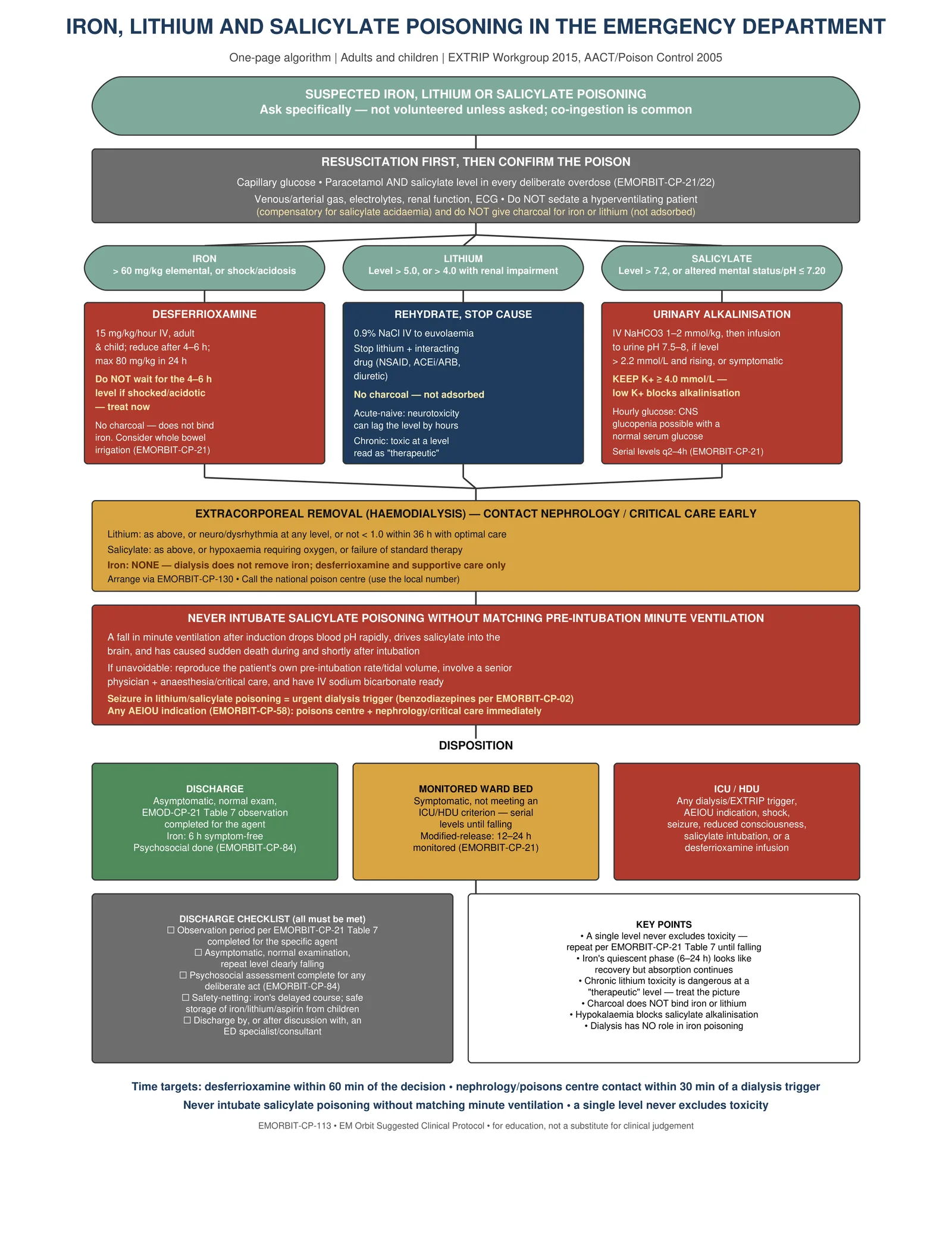
5Algorithm
The one-page algorithm is shown at the top of this page.
6Team roles
6.1Triage and ED Nurses Role: ask specifically about iron, lithium and aspirin/salicylate products in every deliberate overdose; obtain hourly urine pH during alkalinisation and hourly glucose during salicylate treatment; record every dose, time and level.
6.2Pharmacist: confirm desferrioxamine and sodium bicarbonate stock and dosing; verify the desferrioxamine and alkalinisation infusion prescriptions; advise on drugs interacting with lithium.
6.3Nephrology / Critical Care: attend on notification of any Table 1 extracorporeal removal trigger or AEIOU indication; arrange emergency haemodialysis per EMORBIT-CP-130.
6.4Laboratory Staff: process iron, lithium and salicylate levels, blood gas and electrolytes urgently and report a critical result to the ED immediately.
6.5Poisons Centre (the national poison centre): provide risk assessment and treatment advice for every case meeting a Table 1 trigger, and confirm the dialysis decision with nephrology.
6.6Psychiatry / Mental Health Liaison: complete the psychosocial assessment for every deliberate poisoning before discharge, per EMORBIT-CP-84.
7The patient's role
7.1 Inform staff of every substance and quantity taken, including tablet counts, and any lithium or aspirin-containing product used regularly.
7.2 Remain in the department for the full observation period, because iron and lithium toxicity can appear or worsen after an initial period of feeling well.
7.3 Accept the referral for psychosocial follow-up where offered.
8Definitions
8.1Elemental Iron: the amount of iron metal in a tablet, which varies by salt (ferrous sulfate, fumarate, gluconate) and is smaller than the tablet's total weight; toxicity is assessed on the elemental dose in mg/kg.
8.2Quiescent Phase (Iron): the apparent recovery 6 to 24 hours after ingestion, between the initial gastrointestinal symptoms and the later shock/acidosis phase, during which absorption and tissue injury continue despite the patient looking well.
8.3Desferrioxamine: an iron-chelating agent given by IV infusion; doses in Table 1 (Attachment 2) match EMORBIT-CP-21 Table 6 exactly.
8.4EXTRIP Workgroup: the international collaboration whose systematic reviews set the evidence-based indications for extracorporeal (dialysis) removal of a poison, used for the lithium and salicylate triggers in Table 1.
8.5Urinary Alkalinisation: IV sodium bicarbonate given to raise urine pH to 7.5 or above, which traps ionised salicylate in the renal tubule and increases its excretion; fails if the patient is hypokalaemic.
9Attachments
- Attachment 1: One-page algorithm (top of this page)
- Attachment 2: Severity, Treatment and Extracorporeal Removal Quick Reference
11Suggested quality indicators
11.1Time to desferrioxamine where indicated: (Number of patients meeting the Table 1 iron treatment trigger who received desferrioxamine within 60 minutes of the decision / Total number meeting the trigger) × 100. Target ≥ 90%.
11.2Potassium checked and repleted before/during salicylate alkalinisation: (Number of salicylate-poisoned patients receiving urinary alkalinisation with a potassium ≥ 4.0 mmol/L documented before or during the infusion / Total number receiving alkalinisation) × 100. Target 100%.
11.3Nephrology/poisons-centre contact for an extracorporeal removal trigger: (Number of patients meeting a Table 1 lithium or salicylate extracorporeal removal trigger with nephrology/critical care and the poisons centre contacted within 30 minutes of recognition / Total number meeting a trigger) × 100. Target 100%.
11.4Serial levels repeated per EMORBIT-CP-21 Table 7: (Number of lithium or salicylate poisoning patients with repeat levels taken at the specified interval until falling / Total number of such patients) × 100. Target ≥ 95%.
11.5Minute-ventilation-matched intubation strategy documented (outcome): (Number of salicylate-poisoned patients requiring intubation with a documented ventilator strategy matching pre-intubation minute ventilation / Total number of salicylate-poisoned patients intubated) × 100. Monitored as an outcome indicator.
13References
- Juurlink DN, Gosselin S, Kielstein JT, et al; EXTRIP Workgroup. Extracorporeal treatment for salicylate poisoning: systematic review and recommendations from the EXTRIP workgroup. Ann Emerg Med. 2015;66(2):165–181.
- Decker BS, Goldfarb DS, Dargan PI, et al; EXTRIP Workgroup. Extracorporeal treatment for lithium poisoning: systematic review and recommendations from the EXTRIP workgroup. Clin J Am Soc Nephrol. 2015;10(5):875–887.
- Manoguerra AS, Erdman AR, Booze LL, et al; American Association of Poison Control Centers. Iron ingestion: an evidence-based consensus guideline for out-of-hospital management. Clin Toxicol (Phila). 2005;43(6):553–570.
- Baird-Gunning J, Lea-Henry T, Hoegberg LCG, Gosselin S, Roberts DM. Lithium poisoning. J Intensive Care Med. 2017;32(4):249–263.
- O'Malley GF. Emergency department management of the salicylate-poisoned patient. Emerg Med Clin North Am. 2007;25(2):333–346.
A2Attachment 2: Severity, Treatment and Extracorporeal Removal Quick Reference
| Poison | Severity / treatment trigger | ED treatment | Extracorporeal removal trigger |
|---|---|---|---|
| Iron | Elemental iron > 60 mg/kg ingested, or serum iron > 90 micromol/L (500 mcg/dL) at 4–6 hours, or shock, acidosis, or reduced consciousness at any level | Desferrioxamine 15 mg/kg/hour IV (adult and child), reduced after 4 to 6 hours; maximum 80 mg/kg in 24 hours (EMORBIT-CP-21 Table 6). Consider whole bowel irrigation (EMORBIT-CP-21 Table 4). | None — dialysis does not remove iron. Desferrioxamine and supportive care only. |
| Lithium | Level > 5.0 mmol/L, or > 4.0 mmol/L with impaired kidney function, or reduced consciousness, seizures or a life-threatening dysrhythmia at any level, or a level not expected to fall below 1.0 mmol/L within 36 hours with optimal supportive care | IV 0.9% sodium chloride to euvolaemia; stop lithium and any interacting drug (NSAID, ACE inhibitor/ARB, diuretic). No activated charcoal — lithium is not adsorbed. | Intermittent haemodialysis (EMORBIT-CP-21 Table 5). Repeat the level 6 to 8 hours after the session — rebound is common. |
| Salicylate | Level > 7.2 mmol/L (100 mg/dL) acutely, or > 6.5 mmol/L (90 mg/dL) with impaired kidney function, or any level with altered mental status, hypoxaemia requiring oxygen, arterial pH ≤ 7.20, or failure of standard therapy | IV sodium bicarbonate to a urine pH of 7.5 or above, for a level > 2.2 mmol/L (30 mg/dL) and rising or a symptomatic patient; keep serum potassium ≥ 4.0 mmol/L — alkalinisation fails while the patient is hypokalaemic. | Intermittent haemodialysis (EMORBIT-CP-21 Table 5); also corrects acidosis and fluid overload. |
A single concentration never excludes toxicity for any of the three poisons (EMORBIT-CP-21 Table 7): repeat the level at the interval in that table until it is clearly falling.