Oncological Emergencies in the Emergency Department
EMORBIT-CP-125 · Chapter 15 · Haematological and Oncological Emergencies
Open in the appFree, works on your phone and offline, with every tool alongside.
Evidence base: ESMO; NICE NG234 2023 (MSCC)
1Purpose
1.1 Provide a standardised, evidence-based framework for the recognition and first-hour Emergency Department (ED) treatment of six oncological emergencies: malignant spinal cord compression (MSCC), superior vena cava (SVC) obstruction, tumour lysis syndrome, hyperviscosity syndrome, immunotherapy (checkpoint-inhibitor) toxicity, and raised intracranial pressure from brain metastases.
1.2 Fix the two safety features most often missed: rasburicase causes haemolysis in G6PD deficiency, which is regionally common and shall be checked before the first dose; and checkpoint-inhibitor toxicity is easily missed because it can affect any organ, at any time, with a non-specific presentation.
1.3 Direct neutropenic sepsis, hypercalcaemia treatment, hyperkalaemia treatment, acute kidney injury and the general spinal red-flag/imaging pathway to their owning guidelines (EMORBIT-CP-52, 103, 10, 58 and 68 respectively) rather than restating them.
1.4 State clearly where the ED gives the time-critical first treatment (dexamethasone in MSCC and raised intracranial pressure; fluids and electrolyte correction in tumour lysis; life-threatening immunotherapy toxicity) and where oncology/haematology and the relevant specialty take over the definitive decision (radiotherapy or surgery for MSCC, stenting for SVC obstruction, plasmapheresis/leukapheresis for hyperviscosity, the steroid and drug-hold decision for non-life-threatening immunotherapy toxicity).
2Who this protocol applies to
2.1 Any patient with known or suspected malignancy, currently or previously treated with chemotherapy, radiotherapy or immunotherapy, presenting with an acute or deteriorating symptom consistent with any of the six emergencies in Table 1 (Attachment 2).
2.2 A patient with a new malignant diagnosis suspected for the first time because of one of these presentations (for example, a first presentation of SVC obstruction or spinal cord compression from an undiagnosed cancer).
3Not covered by this protocol
3.1 Febrile neutropenia without another oncological emergency: EMORBIT-CP-52 governs in full; run it in parallel, not instead, if another emergency in Table 1 is also present.
3.2 Cauda equina syndrome or cord compression of a non-malignant cause: EMORBIT-CP-68 governs; the imaging pathway is identical and is not repeated here.
3.3 Hypercalcaemia or hyperkalaemia without another feature in Table 1: EMORBIT-CP-103 and EMORBIT-CP-10 govern the treatment in full.
3.4 Cardiac or respiratory arrest on arrival: go immediately to EMORBIT-CP-03; treat the specific oncological emergency as an adjunct once resuscitation is underway.
4Protocol
4.1History and Assessment:
4.1.1Triage and Recognition:
4.1.1.1 Any patient with known or suspected malignancy and a new neurological deficit, stridor, reduced consciousness, or a critical electrolyte result shall be triaged to the highest acuity category (Category 1 / immediate) and taken directly to the resuscitation area.
4.1.1.2 Ask specifically about current or recent chemotherapy, radiotherapy, and immunotherapy (including the specific checkpoint-inhibitor agent and the date of the last dose) — immunotherapy toxicity can present months after the last dose and is not volunteered unless asked.
4.1.2History:
4.1.2.1 Cancer type, stage, and current treatment; date of the last cycle (for neutropenic sepsis risk per EMORBIT-CP-52) and the last immunotherapy dose (for immunotherapy toxicity, which is not time-limited to a recent dose).
4.1.2.2 Back pain with a change in character, new leg weakness, or any change in bladder or bowel habit in any patient with known or suspected malignancy — ask directly, as these symptoms are under-reported.
4.1.2.3 Bleeding, visual change, or confusion in a patient with myeloma or a lymphoproliferative disorder (hyperviscosity); breathlessness or facial swelling worse lying flat (SVC obstruction).
4.1.3Examination:
4.1.3.1 Full vital signs, Glasgow Coma Scale, capillary glucose, and a focused neurological examination of both lower limbs, perianal sensation and anal tone in any patient with a back-pain or leg-symptom history (as EMORBIT-CP-68).
4.1.3.2 Facial and neck swelling, jugular venous distension, and stridor (SVC obstruction); fundoscopy where feasible, and mucosal bleeding (hyperviscosity); a full systems review by organ (immunotherapy toxicity, which can present in skin, gut, lung, endocrine, cardiac or neurological systems).
4.1.4Risk Stratification – Severity: Table 1 (Attachment 2) sets the recognition trigger, the immediate ED action, and the escalation route for each of the six emergencies; use it at first assessment and at every reassessment.
4.1.5Differential Diagnosis:
4.1.5.1 A new focal neurological deficit or reduced consciousness in a patient with known malignancy is a brain metastasis with raised intracranial pressure, a spinal cord compression, a stroke, or a metabolic cause (hypercalcaemia, hyponatraemia) until one is confirmed; do not assume the cancer diagnosis explains every symptom.
4.1.5.2 Breathlessness in a patient with malignancy has the same broad differential as EMORBIT-CP-95 (acute dyspnoea) in addition to SVC obstruction and pericardial involvement (EMORBIT-CP-92) — do not anchor on the cancer diagnosis alone.
4.1.5.3 New confusion is worked up per EMORBIT-CP-46; in this population it may be hypercalcaemia, hyperviscosity, raised intracranial pressure, immunotherapy encephalitis, or sepsis rather than a direct effect of the malignancy.
4.1.6Special Populations:
4.1.6.1 Pregnancy: malignancy in pregnancy is uncommon but any of the six emergencies is treated in full, with obstetric involvement from the outset; dexamethasone is not withheld for a life- or function-threatening indication, but the dose and the decision are made jointly with obstetrics and oncology.
4.1.6.2 Children: oncological emergencies in children (leukaemia, lymphoma, and solid tumours with cord or airway compression) follow the same recognition principles; treat via the paediatric oncology and paediatric emergency team, using paediatric doses confirmed with pharmacy — no paediatric dose is stated in this guideline.
4.1.6.3 G6PD deficiency: regionally common — check status before the first dose of rasburicase in every patient; if unknown and the patient is unstable, discuss with haematology before giving the drug rather than delaying all treatment.
4.2Investigations:
4.2.1 Full blood count, urea and electrolytes, calcium, phosphate, urate, lactate dehydrogenase (LDH), and a venous blood gas in every patient presenting with a suspected oncological emergency.
4.2.2 Urgent whole-spine MRI for suspected spinal cord compression (as EMORBIT-CP-68); contrast CT chest for suspected SVC obstruction; urgent CT or MRI brain for suspected raised intracranial pressure or a new focal deficit.
4.2.3 Troponin and 12-lead ECG in any patient on a checkpoint inhibitor with chest pain, breathlessness, palpitations, or new arrhythmia — myocarditis is easily missed and carries a high mortality.
4.2.4 G6PD status before the first dose of rasburicase; group and save in any patient with suspected hyperviscosity, sent with the request explicitly marked to avoid an automatic top-up transfusion.
4.3Plan of Care:
4.3.1Immediate Actions:
4.3.1.1 Airway, breathing, circulation, IV access, and the bloods above, in every patient. A temperature of 38°C or above in a patient on anticancer treatment is treated as neutropenic sepsis until excluded — antibiotic within 60 minutes, per EMORBIT-CP-52; do not wait for the neutrophil count.
4.3.1.2 Contact oncology or haematology as soon as an emergency in Table 1 is recognised — do not wait for a bed, a definitive scan, or a full work-up before making the call.
4.3.2Malignant Spinal Cord Compression: give dexamethasone 16 mg; nurse flat or log-roll if the spine is unstable; request emergency whole-spine MRI within 24 hours. The imaging, bladder-scan and referral pattern is identical to EMORBIT-CP-68 and is not restated here. Route the case through the MSCC coordinator where the hospital has one in addition to the on-call spinal/oncology team.
4.3.3SVC Obstruction: sit the patient upright; treat any stridor as a shared-airway emergency (senior help, as EMORBIT-CP-124 pattern); request urgent contrast CT chest. Do not give a steroid before discussing with oncology/haematology where lymphoma is a possible diagnosis — an empirical dose can lyse lymphoma tissue and obscure the diagnostic biopsy. Refer to interventional radiology for stenting where the obstruction is severe or refractory to first measures.
4.3.4Tumour Lysis Syndrome: give IV 0.9% sodium chloride; treat hyperkalaemia exactly per EMORBIT-CP-10 and hypocalcaemia exactly per EMORBIT-CP-103 — doses are not restated here. Do not alkalinise the urine for tumour lysis (unlike the salicylate-poisoning pathway, EMORBIT-CP-113) — it worsens calcium-phosphate deposition in the renal tubule. Give rasburicase for high-risk patients only after G6PD status is checked; use allopurinol for lower-risk patients. Any AEIOU indication for urgent renal replacement therapy is managed exactly per EMORBIT-CP-58.
4.3.5Hyperviscosity Syndrome: do not transfuse red cells before discussion with haematology — a transfusion raises viscosity further and can precipitate or worsen the syndrome. Plasmapheresis (paraprotein-related) or leukapheresis (extreme leucocytosis) is the definitive treatment and is arranged by haematology; it is not performed in the ED.
4.3.6Immunotherapy (Checkpoint-Inhibitor) Toxicity: call oncology before starting a steroid for any new symptom in a patient on, or previously treated with, a checkpoint inhibitor — grading by the treating oncology team determines the steroid dose and whether the drug is permanently or temporarily held. For life-threatening toxicity (myocarditis with arrhythmia or haemodynamic compromise, or respiratory failure from pneumonitis), give high-dose intravenous corticosteroid immediately and call oncology and cardiology/critical care at the same time, rather than waiting for the discussion to start treatment.
4.3.7Raised Intracranial Pressure from Brain Metastases: give dexamethasone (dose per the product information and oncology advice); avoid straining and Valsalva manoeuvres; request urgent CT or MRI brain. Refer to neurosurgery and oncology for any mass effect or evidence of herniation.
4.3.8Escalation and Refractory Presentation:
4.3.8.1 Any progressing neurological deficit, stridor, an AEIOU indication (EMORBIT-CP-58), pre-plasmapheresis hyperviscosity, a life-threatening immunotherapy toxicity, or a falling Glasgow Coma Scale is discussed with critical care immediately, in addition to oncology/haematology.
4.3.8.2 Seizures are treated per EMORBIT-CP-02; a seizure in tumour lysis syndrome, hyperviscosity, or raised intracranial pressure is itself an escalation trigger, not only a symptom to control.
4.3.9Monitoring and Reassessment:
4.3.9.1 Continuous cardiac monitoring and hourly vital signs and Glasgow Coma Scale for any patient meeting a Table 1 trigger; repeat neurological and perianal examination if there is any deterioration while awaiting imaging or transfer (as EMORBIT-CP-68).
4.3.9.2 Repeat potassium, calcium, phosphate, urate and renal function at the interval set by EMORBIT-CP-10 and EMORBIT-CP-58 for tumour lysis syndrome, until stable.
4.3.10Disposition:
4.3.10.1ICU / HDU:
- A progressing neurological deficit, stridor, an AEIOU indication, pre-plasmapheresis hyperviscosity, a life-threatening immunotherapy toxicity, or a falling Glasgow Coma Scale.
4.3.10.2Monitored / oncology ward bed:
- Moderate tumour lysis syndrome or hypercalcaemia on treatment; a stable spinal cord compression or SVC obstruction awaiting definitive therapy.
4.3.10.3Discharge:
- Only after direct discussion with oncology/haematology, for a mild and controlled abnormality with a normal neurological examination and safety-netting given.
4.3.10.4 Discharge shall be by, or after discussion with, an ED specialist/consultant and the oncology/haematology team.
4.3.11Discharge and Follow-up:
4.3.11.1 Arrange oncology/haematology follow-up for every patient discharged after an oncological emergency, with the specific abnormality and its trend documented for the receiving team.
4.3.11.2 Give safety-netting advice specific to the emergency treated (for example, new leg weakness or bladder change after treated MSCC; new visual or neurological symptoms after treated hyperviscosity).
4.3.12Documentation and Reporting:
4.3.12.1 Document: the specific emergency, the time of oncology/haematology contact, the G6PD result where rasburicase is considered, every dose and time, and the disposition decision.
4.3.12.2 Any case of checkpoint-inhibitor myocarditis, or a patient meeting an AEIOU indication, is captured for the departmental audit (section 11).
5Algorithm
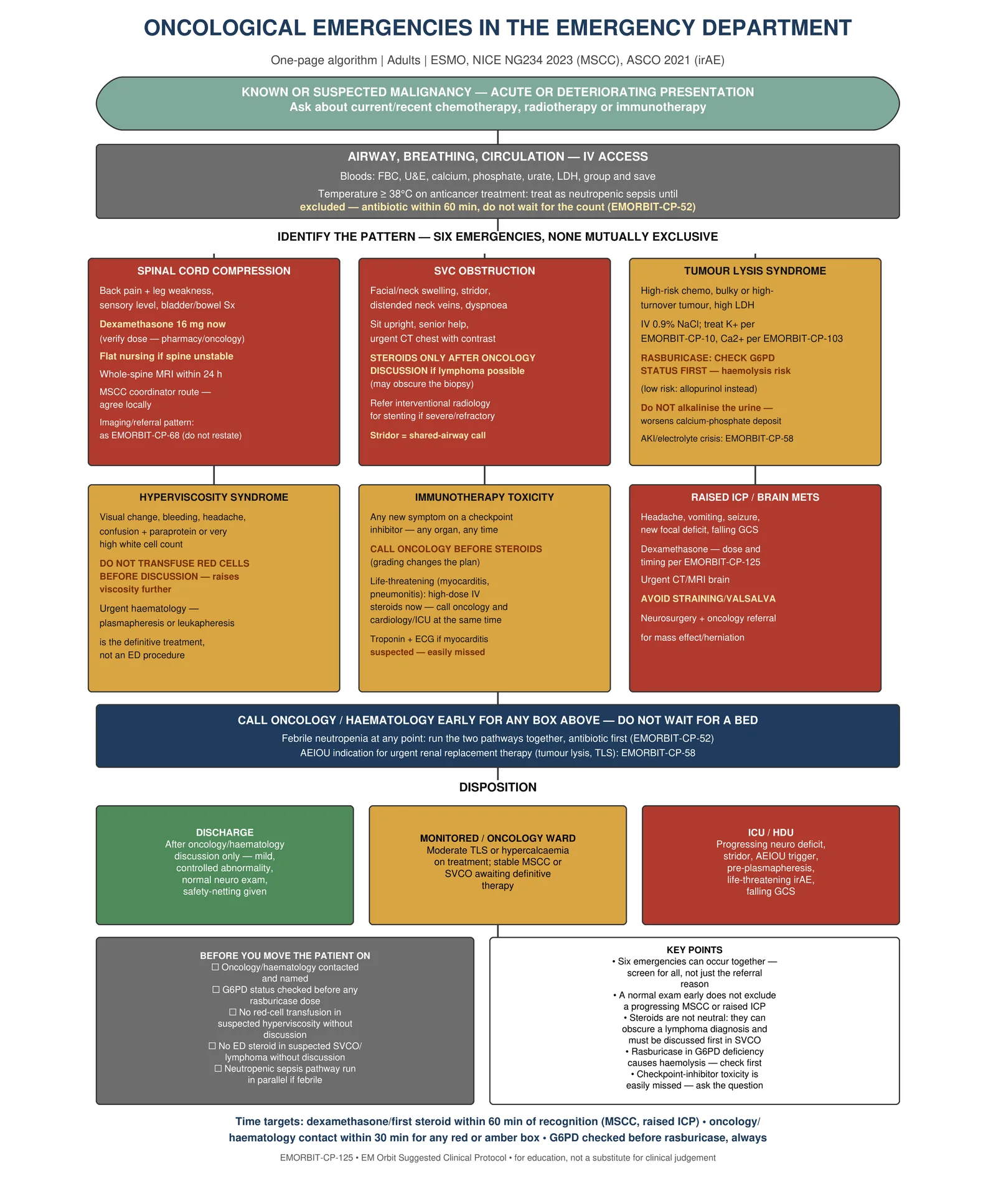
The one-page algorithm is shown at the top of this page.
6Team roles
6.1Triage and ED Nurses Role: ask specifically about current or recent chemotherapy, radiotherapy and immunotherapy in any patient with known or suspected malignancy; record the time of oncology/haematology contact and every dose given.
6.2Pharmacist: confirm the dexamethasone dose for spinal cord compression and for raised intracranial pressure, and the rasburicase dose and G6PD requirement, against the local formulary before administration.
6.3Medical Oncology / Haematology: attend or advise by telephone on notification of any Table 1 trigger; make the steroid-hold decision in immunotherapy toxicity and the lymphoma-discussion decision in SVC obstruction; arrange plasmapheresis/leukapheresis and definitive MSCC/SVCO treatment.
6.4Laboratory Staff: process potassium, calcium, phosphate, urate, LDH and G6PD urgently and report a critical result to the ED immediately.
6.5Radiology: perform the emergency whole-spine MRI or contrast CT chest without delay, at any hour, and communicate the result directly to the referring ED physician.
6.6Critical Care: attend on notification of a progressing deficit, stridor, an AEIOU indication, pre-plasmapheresis hyperviscosity, or a life-threatening immunotherapy toxicity.
7The patient's role
7.1 Inform staff of the cancer diagnosis and stage, the current treatment, and the date of the last chemotherapy, radiotherapy or immunotherapy dose.
7.2 Report any new back pain, leg weakness, bladder or bowel change, visual change, bleeding, or breathlessness immediately, rather than waiting to be asked.
7.3 Attend the arranged oncology/haematology follow-up after discharge.
8Definitions
8.1Malignant Spinal Cord Compression (MSCC): compression of the spinal cord or cauda equina by direct tumour extension or vertebral collapse; the recognition and imaging pathway is the same as EMORBIT-CP-68.
8.2Tumour Lysis Syndrome (Cairo-Bishop): the metabolic syndrome of hyperkalaemia, hyperphosphataemia, hyperuricaemia and hypocalcaemia (laboratory TLS), with clinical TLS defined by the addition of acute kidney injury, arrhythmia or seizure.
8.3Hyperviscosity Syndrome: the clinical syndrome of visual, neurological and mucosal bleeding symptoms caused by a markedly raised serum paraprotein or an extreme leucocyte or red cell count.
8.4Immune-Related Adverse Event (irAE): an inflammatory toxicity of any organ caused by a checkpoint inhibitor, graded by severity, which determines whether the drug is held and the steroid dose used.
8.5G6PD Deficiency: an inherited enzyme deficiency, common in this region, in which rasburicase precipitates severe haemolysis; status is checked before the first dose.
9Attachments
- Attachment 1: One-page algorithm (top of this page)
- Attachment 2: Recognition and First-Hour ED Action Quick Reference
11Suggested quality indicators
11.1Time to dexamethasone in suspected MSCC ≤ 60 minutes: (Number of patients with a red-flag presentation for MSCC given dexamethasone within 60 minutes of recognition / Total number with a red-flag presentation for MSCC) × 100. Target ≥ 90%.
11.2G6PD status checked before rasburicase: (Number of patients given rasburicase with a documented G6PD result, or a documented discussion with haematology where the result was not yet available / Total number given rasburicase) × 100. Target 100%.
11.3Oncology/haematology contact within 30 minutes of a Table 1 trigger: (Number of patients meeting a Table 1 trigger with oncology or haematology contacted within 30 minutes of recognition / Total number meeting a trigger) × 100. Target ≥ 90%.
11.4Whole-spine MRI performed within 24 hours for suspected MSCC: (Number of patients with suspected MSCC scanned within 24 hours of the ED request / Total number of such requests) × 100. Target ≥ 90%.
11.5No steroid given before oncology discussion in suspected lymphoma-related SVC obstruction (outcome): (Number of such patients receiving a steroid only after a documented oncology/haematology discussion / Total number of such patients given a steroid) × 100. Monitored as an outcome indicator.
13References
- National Institute for Health and Care Excellence. Metastatic spinal cord compression in adults: diagnosis and management. NICE Guideline NG234. London: NICE; 2023.
- Cairo MS, Bishop M. Tumour lysis syndrome: new therapeutic strategies and classification. Br J Haematol. 2004;127(1):3–11.
- Coiffier B, Altman A, Pui CH, Younes A, Cairo MS. Guidelines for the management of pediatric and adult tumor lysis syndrome: an evidence-based review. J Clin Oncol. 2008;26(16):2767–2778.
- Cheng S. Superior vena cava syndrome: a contemporary review of a historic disease. Cardiol Rev. 2009;17(1):16–23.
- Brahmer JR, Abu-Sbeih H, Ascierto PA, et al. Management of immune-related adverse events in patients treated with immune checkpoint inhibitor therapy: ASCO Guideline Update. J Clin Oncol. 2021;39(36):4073–4126.
- Stone MJ, Bogen SA. Evidence-based focused review of management of hyperviscosity syndrome. Blood. 2012;119(10):2205–2208.
- Vecht CJ, Hovestadt A, Verbiest HB, van Vliet JJ, van Putten WL. Dose-effect relationship of dexamethasone on Karnofsky performance in metastatic brain tumors: a randomized study of doses of 4, 8, and 16 mg per day. Neurology. 1994;44(4):675–680.
- European Society for Medical Oncology (ESMO) Clinical Practice Guidelines: oncological emergencies.
A2Attachment 2: Recognition and First-Hour ED Action Quick Reference
| Emergency | Recognition / trigger | Immediate ED action | Escalation / referral |
|---|---|---|---|
| Malignant spinal cord compression (MSCC) | Back pain with leg weakness, a sensory level, or new bladder/bowel dysfunction in a patient with known or suspected malignancy | Dexamethasone 16 mg (dose to be verified with pharmacy/oncology); flat/log-roll nursing if the spine is unstable; whole-spine MRI within 24 hours. Imaging and referral pattern as EMORBIT-CP-68 — not restated here. | MSCC coordinator route (where available) and the on-call spinal/oncology team immediately. |
| Superior vena cava (SVC) obstruction | Facial or neck swelling, distended neck veins, stridor, dyspnoea worse lying flat | Sit upright; senior help for any stridor (shared-airway call); urgent contrast CT chest. Steroids only after discussion with oncology/haematology where lymphoma is possible — an empirical dose can obscure the diagnostic biopsy. | Interventional radiology for stenting where severe or refractory; oncology/haematology for the underlying diagnosis and radiotherapy or chemotherapy. |
| Tumour lysis syndrome (TLS) | High-risk chemotherapy, a bulky or high-turnover tumour, or a rising LDH, urate, potassium or phosphate, or a falling calcium (Cairo-Bishop criteria) | IV 0.9% sodium chloride; treat potassium per EMORBIT-CP-10 and calcium per EMORBIT-CP-103 — not restated here. Do not alkalinise the urine (unlike salicylate poisoning) — it worsens calcium-phosphate deposition in the kidney. | Rasburicase for high-risk patients only after G6PD status is checked (haemolysis risk); allopurinol for lower-risk patients. AEIOU indication for urgent renal replacement therapy: EMORBIT-CP-58. |
| Hyperviscosity syndrome | Visual disturbance, mucosal or retinal bleeding, headache, confusion, with a paraprotein (myeloma/Waldenström) or a very high white cell count (leukaemia) | Do not transfuse red cells before discussion with haematology — it raises viscosity further and can precipitate the syndrome. | Urgent haematology; plasmapheresis (paraprotein) or leukapheresis (hyperleukocytosis) is the definitive treatment and is not performed in the ED. |
| Immunotherapy (checkpoint-inhibitor) toxicity | Any new symptom in a patient on, or previously treated with, a checkpoint inhibitor — any organ, at any time after the last dose | Call oncology before starting steroids — grading determines the plan and whether the drug is held. For life-threatening toxicity (myocarditis with arrhythmia or haemodynamic compromise, respiratory failure from pneumonitis), start high-dose IV corticosteroid immediately while calling oncology and cardiology/ICU at the same time. | Oncology for grading and drug hold; cardiology/ICU for suspected myocarditis (troponin and ECG in every case — this toxicity is easily missed). |
| Raised intracranial pressure from brain metastases | Headache, vomiting, seizure, a new focal deficit, or a falling conscious level | Dexamethasone (dose per the product information and oncology advice); avoid straining/Valsalva; urgent CT or MRI brain. | Neurosurgery and oncology for mass effect or herniation; critical care if the airway or conscious level is threatened. |
These six can occur together in the same patient — screen for all of them, not only the one suggested by the referral. A normal examination early in the presentation does not exclude a progressing spinal cord compression or raised intracranial pressure.