Acute Pancreatitis in the Emergency Department
EMORBIT-CP-48 · Chapter 5 · Gastrointestinal and Surgical Emergencies
Open in the appFree, works on your phone and offline, with every tool alongside.
Evidence base: ACG 2024; IAP/APA 2013; WSES 2019
1Purpose
1.1 Provide a standardized, evidence-based framework for the diagnosis, severity assessment, fluid resuscitation, analgesia, and disposition of adults and adolescents presenting to the Emergency Department (ED) with acute pancreatitis.
1.2 Replace outdated aggressive fluid resuscitation with the goal-directed moderate regimen now shown to reduce fluid overload without increasing organ failure or necrosis (WATERFALL trial 2022; ACG 2024).
1.3 Standardize the diagnostic panel to serum lipase alone, aligned with EMORBIT-CP-15, and remove amylase from ED practice.
1.4 Ensure early recognition of gallstone pancreatitis complicated by cholangitis, of hypertriglyceridaemia and hypercalcaemia as causes, and of severe disease requiring critical care.
1.5 Align with the American College of Gastroenterology (ACG), the International Association of Pancreatology / American Pancreatic Association (IAP/APA), and the World Society of Emergency Surgery (WSES).
2Who this protocol applies to
2.1 Adults and adolescents (13 years and over) presenting with suspected or confirmed acute pancreatitis, diagnosed by at least two of: (1) characteristic abdominal pain — acute-onset, severe, persistent epigastric pain, often radiating to the back; (2) serum lipase at least three times the upper limit of normal (EMORBIT-CP-15); (3) characteristic findings on cross-sectional imaging.
2.2 First presentation and recurrent/relapsing acute pancreatitis of any cause.
2.3 Acute pancreatitis complicated by gallstones and cholangitis, hypertriglyceridaemia, hypercalcaemia, alcohol use, post-ERCP pancreatitis, drug-induced pancreatitis, or of undetermined cause.
3Not covered by this protocol
3.1 Children under 13 years: manage under the paediatric surgical/gastroenterology pathway; aetiology, presentation and disposition differ from the adult pattern.
3.2 Chronic pancreatitis without an acute exacerbation, and pancreatic malignancy without acute pancreatitis, which are outpatient gastroenterology/oncology pathways.
3.3 Acute abdominal pain in which pancreatitis has been excluded by the diagnostic criteria above: manage per EMORBIT-CP-15.
3.4 Established infected pancreatic necrosis or a pancreatic pseudocyst/walled-off necrosis presenting electively for drainage: these are admitting-team (gastroenterology/surgery) decisions once the acute ED phase is complete.
4Protocol
4.1History and Assessment:
4.1.1Triage and Recognition:
4.1.1.1 Severe, persistent epigastric or upper abdominal pain, especially with vomiting or radiation to the back, shall be triaged no lower than Category 2; assign Category 1 if there is shock, marked tachypnoea, reduced consciousness, or a rigid abdomen.
4.1.1.2 Obtain IV access, send bloods including lipase (never amylase) at triage, and start monitoring (heart rate, blood pressure, respiratory rate, SpO₂, temperature) without waiting for physician review.
4.1.2History (obtained in parallel with treatment):
4.1.2.1 Pain onset, character, radiation, and relation to alcohol or a fatty meal; nausea and vomiting; previous episodes and known gallstones or hypertriglyceridaemia.
4.1.2.2 Alcohol history (quantity and duration); full medication list (thiazides, azathioprine, valproate, GLP-1 agonists and others associated with drug-induced pancreatitis); recent ERCP; abdominal trauma.
4.1.2.3 Known diabetes, hypertriglyceridaemia, hypercalcaemia (hyperparathyroidism, malignancy), or chronic kidney disease.
4.1.3Examination:
4.1.3.1 Vital signs; epigastric tenderness, guarding, distension, and bowel sounds; jaundice; signs of shock or respiratory compromise.
4.1.3.2 Grey Turner (flank) and Cullen (periumbilical) bruising are late, rare signs of retroperitoneal haemorrhage and are not required for diagnosis.
4.1.4Risk Stratification and Severity:
4.1.4.1 Assess severity using SIRS, BISAP, and organ failure (modified Marshall score) as set out in Table 1.
Table 1: Severity assessment in the ED (assess within 24 hours of arrival; reassess SIRS at 48 hours) Tool Criteria Action / interpretation SIRS (≥ 2 of 4) Temperature < 36 °C or > 38 °C; heart rate > 90/min; respiratory rate > 20/min or PaCO₂ < 32 mmHg; white cell count < 4 or > 12 ×10⁹/L, or > 10% immature (band) forms. Present on arrival, or persisting at 48 hours, predicts severe disease and organ failure — escalate early. BISAP (1 point each, within 24 h) BUN > 8.9 mmol/L (25 mg/dL); Impaired mental status; SIRS present; Age > 60 years; Pleural effusion on imaging. Score ≥ 3: high risk of mortality and organ failure. Involve the senior ED physician and critical care early. Organ failure (modified Marshall, any one system, score ≥ 2) Respiratory: PaO₂/FiO₂ < 300. Cardiovascular: systolic blood pressure < 90 mmHg despite fluids, or vasopressor requirement. Renal: creatinine ≥ 170 micromol/L (1.9 mg/dL). Transient (< 48 h) = moderately severe disease. Persistent (≥ 48 h) = severe disease (revised Atlanta classification) — refer to critical care. Severity scores support escalation; they do not replace clinical judgement or serial reassessment. A patient who looks unwell with a low score shall still be escalated.
4.1.4.2 A normal score does not exclude deterioration: reassess vital signs, urine output, and mental status at least every 4 hours in the first 24 hours.
4.1.5Differential Diagnosis:
4.1.5.1 Perforated peptic ulcer, mesenteric ischaemia, acute cholecystitis or cholangitis, ruptured or leaking abdominal aortic aneurysm, myocardial infarction (inferior), and diabetic ketoacidosis (which may itself precipitate or accompany pancreatitis — manage per EMORBIT-CP-17 if both are present).
4.1.5.2 An unexplained metabolic acidosis with abdominal pain is ischaemia until proved otherwise (EMORBIT-CP-15).
4.1.6Special Populations:
4.1.6.1 Pregnancy and any woman who has started menarche (regardless of age): gallstone disease is the commonest cause in pregnancy. The triage nurse does not perform the pregnancy test; the treating team asks "pregnant?" and "last period?" and obtains the test without delay (EMORBIT-CP-73). Prefer ultrasound and non-contrast MRI over CT; involve obstetrics early.
4.1.6.2 Elderly: presentation may be atypical with less pain; mortality is higher for a given severity score — have a lower threshold for admission and critical care discussion.
4.1.6.3 Alcohol use disorder or malnutrition: give thiamine before or with any glucose-containing fluid to reduce the risk of precipitating Wernicke encephalopathy; assess for concurrent withdrawal.
4.1.6.4 Diabetes: hypertriglyceridaemia-induced pancreatitis is more common; check for coexisting diabetic ketoacidosis (EMORBIT-CP-17), which changes the insulin and fluid plan.
4.2Investigations:
4.2.1 Serum lipase — the only pancreatic enzyme requested; amylase is not requested alongside it and the two shall not be requested together (EMORBIT-CP-15). Lipase at least three times the upper limit of normal, with consistent pain, supports the diagnosis; a normal result does not exclude it if imaging is characteristic.
4.2.2 Full blood count, urea and electrolytes, calcium, magnesium, triglycerides, liver function tests and bilirubin, C-reactive protein, venous blood gas with lactate, and coagulation screen in every patient.
4.2.3 Transabdominal ultrasound within 24 hours in every patient, to identify gallstones, sludge, or biliary dilation.
4.2.4 Contrast-enhanced CT is not routine at presentation: reserve it for diagnostic doubt or clinical deterioration; early CT (within the first 72–96 hours) does not reliably show necrosis (EMORBIT-CP-15).
4.2.5 Beta-hCG in every woman who has started menarche; ECG and troponin where cardiac disease is a differential; blood cultures before antibiotics only where infection is suspected and without delaying treatment.
4.3Plan of Care:
4.3.1Immediate Actions (first 30 minutes):
4.3.1.1 Oxygen if hypoxaemic (target SpO₂ 94–98%); continuous monitoring; two large-bore IV cannulae; send the investigation panel above.
4.3.1.2 Assess volume status and begin fluid resuscitation (Table 2) and analgesia (EMORBIT-CP-28) together — neither shall wait for the other.
4.3.1.3 Urinary catheter and hourly urine output in any patient with SIRS, hypotension, or a BISAP score of 3 or more.
4.3.2Definitive ED Treatment — Fluids, Analgesia, Antibiotics, Feeding and Biliary Pathway:
4.3.2.1 Follow Table 2 in full for fluid rate, analgesia, antibiotic policy, feeding, and the gallstone/cholangitis pathway.
Table 2: Fluid, analgesia, antibiotics, feeding and biliary quick reference Domain ED action Fluid resuscitation GOAL-DIRECTED MODERATE regimen (ACG 2024; WATERFALL trial). Assess volume status. If hypovolaemic: balanced crystalloid (lactated Ringer’s) 10 mL/kg over 1–2 hours. If euvolaemic: no bolus. Maintenance 1.5 mL/kg/hour. Reassess at 6, 12 and 24 hours (heart rate, blood pressure, urine output ≥ 0.5 mL/kg/hour, haematocrit/urea trend, signs of fluid overload). Do NOT use an aggressive regimen (large bolus plus ≥ 3 mL/kg/hour) — shown to increase fluid overload without reducing organ failure or necrosis. Use the sepsis 30 mL/kg bolus (EMORBIT-CP-11) only if the patient meets septic shock criteria. Analgesia Per EMORBIT-CP-28. Severe pain = Triage Category 2, first analgesia within 20 minutes. Titrated IV opioid (morphine or fentanyl) is first line; there is no clinically significant contraindication from sphincter of Oddi spasm. Non-steroidal anti-inflammatory drugs only with the standard cautions (hypovolaemia/renal risk). Antibiotics NOT given prophylactically at any severity, and not for sterile necrosis. Start only for confirmed or strongly suspected infected necrosis, cholangitis, or another confirmed extra-pancreatic infection. Select the agent per EMORBIT-CP-57 (Antimicrobial Stewardship) and the local antibiogram. Feeding Start oral intake as soon as tolerated (hunger, no vomiting, no ileus, no severe pain) — a low-fat solid diet, not a staged clear-liquid build-up. Do not keep the patient nil by mouth by default. Enteral (nasogastric/nasojejunal) feeding is preferred to parenteral nutrition if the oral route fails beyond 72 hours (admitting-team decision). Gallstone pancreatitis Ultrasound within 24 hours in every patient. Cholangitis (fever, jaundice, rising bilirubin) = urgent ERCP within 24 hours, antibiotics now, emergency gastroenterology referral — do not wait for the pancreatitis to settle. No cholangitis and no ductal obstruction: ERCP timing and cholecystectomy timing are admitting-team decisions. Hypertriglyceridaemia / hypercalcaemia Send triglycerides and calcium in every patient. Triglycerides > 11.3 mmol/L (1000 mg/dL) support hypertriglyceridaemia as the cause — insulin infusion or apheresis is an admitting-team/critical-care decision. Marked hypercalcaemia: treat per EMORBIT-CP-103 (Hypercalcaemia and Hypocalcaemia) and identify the cause with endocrinology.
4.3.3Escalation and Refractory Disease:
4.3.3.1 Escalate to the senior ED physician and critical care immediately for a BISAP score of 3 or more, any organ failure (Table 1), hypotension not responding to the initial fluid step, or hypoxaemia.
4.3.3.2 Suspected infected necrosis (deterioration after the first week, new organ failure, or gas on imaging) is an admitting-team/critical-care decision on antibiotics and source control; the ED does not start antibiotics for this on imaging alone without discussion.
4.3.3.3 Cholangitis complicating gallstone pancreatitis is a time-critical referral for antibiotics and ERCP within 24 hours (Table 2); treat per the sepsis pathway (EMORBIT-CP-11) if septic shock criteria are met.
4.3.4Monitoring and Reassessment:
4.3.4.1 Vital signs and pain score at least hourly while unstable, then 4-hourly; urine output hourly if catheterised; repeat SIRS assessment at 48 hours.
4.3.4.2 Reassess fluid status at 6, 12 and 24 hours; watch for signs of over-resuscitation (rising oxygen requirement, new crackles, falling urine output with peripheral oedema) as well as under-resuscitation.
4.3.5Disposition:
4.3.5.1Critical care / HDU referral:
- BISAP score 3 or more, any organ failure, or persisting SIRS at 48 hours.
- Hypotension, hypoxaemia, or oliguria not responding to the initial fluid step.
- Suspected infected necrosis or septic shock (with EMORBIT-CP-11 as appropriate).
4.3.5.2Ward admission (the default for the great majority of patients):
- Mild disease (no organ failure, BISAP 0–2) still requires admission for fluids, analgesia and monitoring; exceptional early discharge of the very mildest cases is a shared decision with the admitting team, not the default ED pathway.
- Gallstone pancreatitis without cholangitis: ward admission with gastroenterology/general surgery follow-up for ERCP and cholecystectomy timing.
4.3.5.3 Cholangitis: emergency gastroenterology referral for ERCP within 24 hours (Table 2), in addition to ward or critical-care admission as severity dictates.
4.3.6Discharge and Follow-up:
4.3.6.1 No patient with a first or uncertain diagnosis of acute pancreatitis is discharged directly from the ED; admission is the default pending fluids, analgesia response, and severity reassessment.
4.3.6.2 Where the admitting team agrees exceptional ED discharge for the mildest, reliable, well-supported patient, provide written safety-netting advice (return for worsening pain, fever, vomiting, or jaundice) and arrange gastroenterology follow-up including ultrasound-directed cholecystectomy planning.
4.3.7Documentation and Reporting:
4.3.7.1 Document: the diagnostic criteria met, lipase result, imaging findings, SIRS/BISAP/organ-failure scores and the time each was assessed, the fluid regimen and rate given, analgesia given, antibiotic decision and rationale, and the disposition and referral times.
4.3.7.2 Pancreatitis presentations shall be captured for the departmental audit (section 11).
5Algorithm
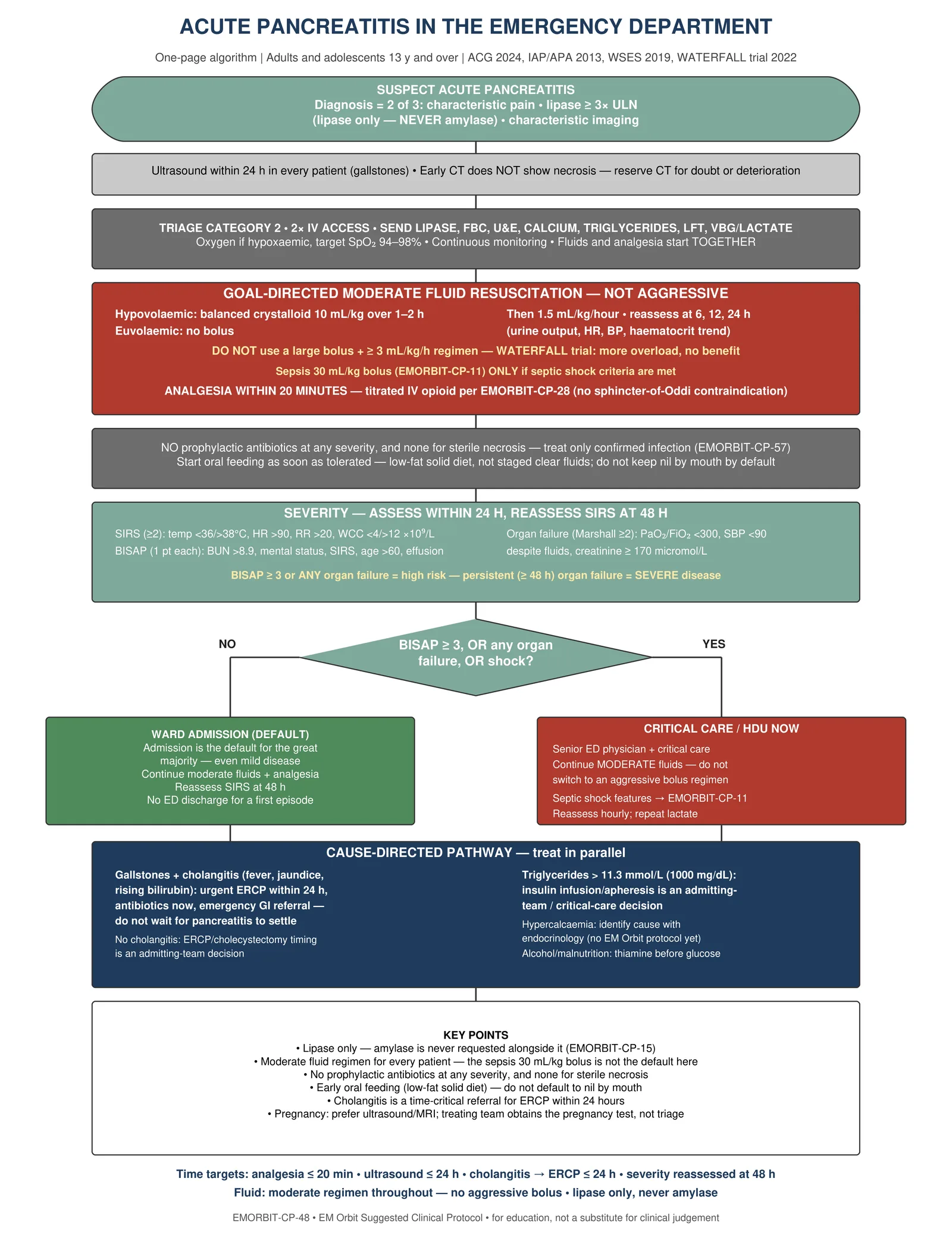
The one-page algorithm is shown at the top of this page.
6Team roles
6.1Triage and ED Nurses Role:
6.1.1 Recognize severe or persistent upper abdominal pain at triage, assign the appropriate category, obtain IV access and send lipase (never amylase) without waiting for physician review.
6.1.2 Record vital signs and urine output at the frequency required by severity; escalate any deterioration immediately.
6.2Pharmacist:
6.2.1 Verify opioid analgesia dosing per EMORBIT-CP-28, review the medication list for drug-induced pancreatitis, and advise on antibiotic selection per EMORBIT-CP-57 only when infection is confirmed or strongly suspected.
6.3Gastroenterology / General Surgery:
6.3.1 Receive emergency referral for cholangitis and ERCP within 24 hours; make the ERCP and cholecystectomy timing decision for gallstone pancreatitis without cholangitis; lead ongoing inpatient management of severe disease and suspected infected necrosis.
6.4Laboratory and Radiology:
6.4.1 Process lipase, triglycerides and calcium urgently; perform transabdominal ultrasound within 24 hours; radiology confirms with the treating physician before any CT ordered for diagnostic doubt or deterioration, not for routine staging.
6.5Ambulance / Pre-hospital Providers:
6.5.1 Pre-alert the ED for any patient with severe abdominal pain and shock; hand over using the structured (ATMIST/SBAR) format.
7The patient's role
7.1 Report the character and radiation of the pain, alcohol intake, gallstone history, and all medications, including any recent new prescription.
7.2 Report worsening pain, fever, jaundice, or breathlessness immediately during observation and after discharge.
7.3 Attend arranged gastroenterology/surgical follow-up, including any appointment for cholecystectomy.
8Definitions
8.1Acute Pancreatitis: acute inflammation of the pancreas diagnosed by at least two of: characteristic pain, lipase at least three times the upper limit of normal, or characteristic imaging findings.
8.2SIRS: systemic inflammatory response syndrome — two or more of abnormal temperature, heart rate, respiratory rate, or white cell count (Table 1).
8.3BISAP: Bedside Index for Severity in Acute Pancreatitis — a 5-point score (BUN, impaired mental status, SIRS, age, pleural effusion) calculated within 24 hours; a score of 3 or more indicates high risk.
8.4Revised Atlanta Classification: mild (no organ failure, no complications), moderately severe (transient organ failure under 48 hours and/or local complications), or severe (persistent organ failure of 48 hours or more).
8.5Organ Failure (Modified Marshall Score): a score of 2 or more in the respiratory, cardiovascular, or renal system (Table 1); transient if it resolves within 48 hours, persistent if it does not.
8.6Infected Pancreatic Necrosis: necrotic pancreatic or peripancreatic tissue with confirmed or strongly suspected infection, usually arising beyond the first week; management is an admitting-team/critical-care decision.
8.7ERCP: endoscopic retrograde cholangiopancreatography — used urgently to relieve biliary obstruction in gallstone pancreatitis complicated by cholangitis.
8.8Goal-Directed Moderate Fluid Resuscitation: a volume-status-guided regimen (bolus only if hypovolaemic, then 1.5 mL/kg/hour, with frequent reassessment) shown to cause less fluid overload than an aggressive fixed-volume regimen, without increasing organ failure or necrosis (WATERFALL trial 2022).
9Attachments
- Attachment 1: One-page algorithm (top of this page)
- Attachment 2: Severity Scoring and Fluid / Analgesia / Antibiotics / Feeding / Biliary Quick Reference
11Suggested quality indicators
11.1Time to first analgesia within 20 minutes of arrival: (Number of pancreatitis patients receiving analgesia within 20 minutes of triage / Total number of pancreatitis patients presenting to the ED) × 100. Target ≥ 90%.
11.2Lipase-only diagnostic ordering: (Number of pancreatitis patients for whom lipase alone, and not amylase, was ordered / Total number of pancreatitis patients) × 100. Target 100%.
11.3Goal-directed moderate fluid regimen documented: (Number of pancreatitis patients with a documented moderate fluid regimen, and no aggressive bolus regimen given outside septic shock / Total number of pancreatitis patients requiring IV fluids) × 100. Target ≥ 90%.
11.4Severity assessed within 24 hours: (Number of pancreatitis patients with BISAP/SIRS and organ-failure status documented within 24 hours of arrival / Total number of pancreatitis patients admitted) × 100. Target ≥ 90%.
11.5Safe disposition of severe disease: (Number of patients with a BISAP score of 3 or more, or any organ failure, referred to critical care/HDU within 1 hour of recognition / Total number of such patients) × 100. Target ≥ 95%.
11.6Unplanned escalation to ICU within 48 hours of ward admission: (Number of pancreatitis patients admitted to a ward who are escalated to ICU within 48 hours / Total number of pancreatitis patients admitted to a ward) × 100. Monitored as an outcome indicator.
13References
- American College of Gastroenterology. ACG Clinical Guideline: Management of Acute Pancreatitis. Am J Gastroenterol. 2024.
- Working Group IAP/APA Acute Pancreatitis Guidelines. IAP/APA evidence-based guidelines for the management of acute pancreatitis. Pancreatology. 2013;13(4 Suppl 2):e1–15.
- Leppäniemi A, Tolonen M, Tarasconi A, et al. 2019 WSES guidelines for the management of severe acute pancreatitis. World J Emerg Surg. 2019;14:27.
- de-Madaria E, Buxbaum JL, Maisonneuve P, et al. Aggressive or Moderate Fluid Resuscitation in Acute Pancreatitis (WATERFALL trial). N Engl J Med. 2022;387(11):989–1000.
- Banks PA, Bollen TL, Dervenis C, et al. Classification of acute pancreatitis—2012: revision of the Atlanta classification and definitions by international consensus. Gut. 2013;62(1):102–111.
- Wu BU, Johannes RS, Sun X, Tabak Y, Conwell DL, Banks PA. The early prediction of mortality in acute pancreatitis: a large population-based study. Gut. 2008;57(12):1698–1703.
A2Attachment 2: Severity Scoring and Fluid / Analgesia / Antibiotics / Feeding / Biliary Quick Reference
| Tool | Criteria | Action / interpretation |
|---|---|---|
| SIRS (≥ 2 of 4) | Temperature < 36 °C or > 38 °C; heart rate > 90/min; respiratory rate > 20/min or PaCO₂ < 32 mmHg; white cell count < 4 or > 12 ×10⁹/L, or > 10% immature (band) forms. | Present on arrival, or persisting at 48 hours, predicts severe disease and organ failure — escalate early. |
| BISAP (1 point each, within 24 h) | BUN > 8.9 mmol/L (25 mg/dL); Impaired mental status; SIRS present; Age > 60 years; Pleural effusion on imaging. | Score ≥ 3: high risk of mortality and organ failure. Involve the senior ED physician and critical care early. |
| Organ failure (modified Marshall, any one system, score ≥ 2) | Respiratory: PaO₂/FiO₂ < 300. Cardiovascular: systolic blood pressure < 90 mmHg despite fluids, or vasopressor requirement. Renal: creatinine ≥ 170 micromol/L (1.9 mg/dL). | Transient (< 48 h) = moderately severe disease. Persistent (≥ 48 h) = severe disease (revised Atlanta classification) — refer to critical care. |
Severity scores support escalation; they do not replace clinical judgement or serial reassessment. A patient who looks unwell with a low score shall still be escalated.
| Domain | ED action |
|---|---|
| Fluid resuscitation | GOAL-DIRECTED MODERATE regimen (ACG 2024; WATERFALL trial). Assess volume status. If hypovolaemic: balanced crystalloid (lactated Ringer’s) 10 mL/kg over 1–2 hours. If euvolaemic: no bolus. Maintenance 1.5 mL/kg/hour. Reassess at 6, 12 and 24 hours (heart rate, blood pressure, urine output ≥ 0.5 mL/kg/hour, haematocrit/urea trend, signs of fluid overload). Do NOT use an aggressive regimen (large bolus plus ≥ 3 mL/kg/hour) — shown to increase fluid overload without reducing organ failure or necrosis. Use the sepsis 30 mL/kg bolus (EMORBIT-CP-11) only if the patient meets septic shock criteria. |
| Analgesia | Per EMORBIT-CP-28. Severe pain = Triage Category 2, first analgesia within 20 minutes. Titrated IV opioid (morphine or fentanyl) is first line; there is no clinically significant contraindication from sphincter of Oddi spasm. Non-steroidal anti-inflammatory drugs only with the standard cautions (hypovolaemia/renal risk). |
| Antibiotics | NOT given prophylactically at any severity, and not for sterile necrosis. Start only for confirmed or strongly suspected infected necrosis, cholangitis, or another confirmed extra-pancreatic infection. Select the agent per EMORBIT-CP-57 (Antimicrobial Stewardship) and the local antibiogram. |
| Feeding | Start oral intake as soon as tolerated (hunger, no vomiting, no ileus, no severe pain) — a low-fat solid diet, not a staged clear-liquid build-up. Do not keep the patient nil by mouth by default. Enteral (nasogastric/nasojejunal) feeding is preferred to parenteral nutrition if the oral route fails beyond 72 hours (admitting-team decision). |
| Gallstone pancreatitis | Ultrasound within 24 hours in every patient. Cholangitis (fever, jaundice, rising bilirubin) = urgent ERCP within 24 hours, antibiotics now, emergency gastroenterology referral — do not wait for the pancreatitis to settle. No cholangitis and no ductal obstruction: ERCP timing and cholecystectomy timing are admitting-team decisions. |
| Hypertriglyceridaemia / hypercalcaemia | Send triglycerides and calcium in every patient. Triglycerides > 11.3 mmol/L (1000 mg/dL) support hypertriglyceridaemia as the cause — insulin infusion or apheresis is an admitting-team/critical-care decision. Marked hypercalcaemia: treat per EMORBIT-CP-103 (Hypercalcaemia and Hypocalcaemia) and identify the cause with endocrinology. |