Anaemia and Red Cell Transfusion in the Emergency Department
EMORBIT-CP-88 · Chapter 15 · Haematological and Oncological Emergencies
Open in the appFree, works on your phone and offline, with every tool alongside.
Evidence base: BSH; AABB 2023
1Purpose
1.1 This protocol covers the Emergency Department (ED) front-door phase of red cell transfusion: recognising when a stable ED patient with anaemia needs a red cell transfusion, applying the restrictive threshold, giving one unit at a time, and recognising a transfusion reaction early. It does not replace, amend, or restate your institution's own guideline on Packed Red Blood Cell (RBC) Administration; that guideline governs definitive management, including component selection and long-term transfusion planning. Where your institution's own guideline sets a different threshold, that guideline governs.
1.2 This guideline governs the ED patient with anaemia who is not exsanguinating. A patient who is haemodynamically unstable from bleeding, or in whom the massive haemorrhage protocol is activated, is managed under EMORBIT-CP-27 (Massive Haemorrhage) — that pathway is not restated here. A patient bleeding from the upper gastrointestinal tract follows the identical thresholds already stated in EMORBIT-CP-16, to which this guideline points rather than repeats. A patient with sickle cell disease follows EMORBIT-CP-90, where transfusion is a Haematology decision.
1.3 State the restrictive transfusion threshold, single-unit-and-reassess practice, and which patients do not need an ED transfusion; set out the bedside identity check and consent principle; and ensure early recognition of a transfusion reaction, including transfusion-associated circulatory overload (TACO).
1.4 Align with the British Society for Haematology (BSH) administration guideline, the AABB 2023 international threshold consensus, and NICE NG24, and point to EMORBIT-CP-27, EMORBIT-CP-16, EMORBIT-CP-90, and EMORBIT-CP-06 rather than restate their content.
2Who this protocol applies to
2.1 Any ED patient of any age with anaemia, confirmed or strongly suspected, in whom red cell transfusion is being considered, and who is not exsanguinating and does not meet massive haemorrhage protocol activation criteria.
2.2 A patient with a haemoglobin result reported as critically low by the laboratory, however identified.
2.3 A patient pre-alerted or transferred from another facility for anaemia or transfusion.
3Not covered by this protocol
3.1 Exsanguinating haemorrhage or activation of the massive haemorrhage protocol: governed in full by EMORBIT-CP-27, including its own transfusion ratios and calcium replacement, not restated here.
3.2 Upper gastrointestinal bleeding: the transfusion threshold, restrictive strategy, and variceal-specific target are governed by EMORBIT-CP-16, which states the identical figures used in Table 1.
3.3 Sickle cell disease: the decision between simple and exchange transfusion is a Haematology-led decision under EMORBIT-CP-90, not restated here.
3.4 Definitive component selection, crossmatch and antibody-screen logistics, long-term or chronic transfusion programme planning, and formal reaction investigation, governed by your institution's own guideline and the Blood Bank/Haematology service.
4Protocol
4.1History and Assessment:
4.1.1Triage and Recognition:
4.1.1.1 Triage acuity by haemodynamic status and symptom severity, not by the haemoglobin number alone: breathlessness at rest, chest pain, syncope, or a heart rate that does not settle raise the category; a well, chronically anaemic patient does not require a high acuity category on the haemoglobin alone.
4.1.1.2 A haemoglobin result flagged critically low by the laboratory shall be telephoned to the treating team immediately and shall prompt urgent clinical reassessment, not an automatic transfusion order.
4.1.1.3 Exclude an exsanguinating or actively bleeding source first (section 3): a patient who is haemodynamically unstable or bleeding visibly is managed under EMORBIT-CP-27, not this pathway.
4.1.2History:
4.1.2.1 Onset — acute blood loss versus long-standing anaemia: a chronic, compensated anaemia is tolerated at a lower haemoglobin than an acute fall of the same value, because circulating volume and compensatory mechanisms have adjusted.
4.1.2.2 Suspected cause (iron deficiency, chronic disease, chronic kidney disease, hemolysis, marrow failure, malignancy) so far as it changes urgency or the differential, without repeating a full outpatient anaemia work-up in the ED.
4.1.2.3 Known cardiovascular disease, heart failure (EMORBIT-CP-06), or renal impairment, each of which lowers the fluid-overload margin and raises the transfusion threshold (Table 1).
4.1.2.4 Previous transfusion or a previous transfusion reaction; known red cell alloantibodies; and any personal, religious, or documented objection to blood products.
4.1.3Examination:
4.1.3.1 Haemodynamic status, pallor, and signs of active bleeding (melaena, haematemesis, PV bleeding, visible external bleeding) — any of these redirects the patient to EMORBIT-CP-27 or EMORBIT-CP-16.
4.1.3.2 Baseline signs of fluid status (jugular venous pressure, basal crackles, peripheral oedema) before the first unit, to allow a fluid-overload reaction to be recognised as a change from baseline.
4.1.4Risk Stratification and Severity:
4.1.4.1 Symptomatic anaemia with haemodynamic compromise, evidence of active bleeding, or a falling haemoglobin over hours: reassess urgently for an exsanguinating source and manage under EMORBIT-CP-27 or EMORBIT-CP-16 if found.
4.1.4.2 Stable anaemia meeting the threshold in Table 1 (Attachment 2), without an unstable bleeding source: transfuse in the ED as described in section 4.3.
4.1.4.3 Stable, chronic, asymptomatic anaemia not meeting the threshold: does not need an ED transfusion (Table 1) — investigate and refer the cause instead.
4.1.5Differential Diagnosis:
4.1.5.1 The cause of the anaemia is not always apparent in the ED: iron deficiency, anaemia of chronic disease or chronic kidney disease, haemolysis, marrow failure or infiltration, and an occult gastrointestinal or gynaecological source are the principal considerations; formal work-up (iron studies, B12/folate, reticulocyte count, haemolysis screen) is arranged through Haematology or outpatient follow-up rather than completed in the ED.
4.1.6Special Populations:
4.1.6.1 Elderly patients and patients of small body habitus: at the highest risk of transfusion-associated circulatory overload (TACO — Table 2). Transfuse one unit at a time, at a slower rate, with closer observation.
4.1.6.2 Cardiovascular disease or acute coronary syndrome: use the 80 g/L threshold and the 80–100 g/L target (Table 1); balance the risk of myocardial ischaemia against the risk of volume overload.
4.1.6.3 Pregnancy and the postpartum patient: physiological dilutional anaemia is expected and is not, by itself, a transfusion indication; where transfusion is considered, involve Obstetrics and follow EMORBIT-CP-73/EMORBIT-CP-75 for the wider pregnancy pathway; use group O RhD-negative units where emergency blood is required in a woman of child-bearing potential.
4.1.6.4 Children: transfuse using a weight-based volume rather than a fixed unit; the ED pharmacist verifies the calculation and the infusion rate against the paediatric formulary before the unit is started.
4.1.6.5 Declines blood products (e.g. on religious grounds), or lacks capacity to consent: discuss urgently with the treating consultant and Haematology; document the discussion and any advance directive; treat under emergency/implied consent principles where the patient cannot consent and transfusion is immediately life-saving, consistent with local law and local consent policy.
4.2Investigations:
4.2.1 Full blood count confirming the haemoglobin that triggers the threshold decision (Table 1); repeat after each unit given (section 4.3.5).
4.2.2 Group and screen, or crossmatch where a red cell alloantibody is known or suspected — notify the Blood Bank early, as crossmatch may take longer where antibodies are present.
4.2.3 Coagulation screen where bleeding, liver disease, or anticoagulation is present or suspected.
4.2.4 Reticulocyte count, haemolysis screen, and iron/B12/folate studies are not routinely required in the ED and are arranged through Haematology or outpatient follow-up unless the result will change ED management.
4.3Plan of Care:
4.3.1Immediate Actions:
4.3.1.1 Confirm the patient is not exsanguinating and has no unstable bleeding source (section 3); if either is present, manage under EMORBIT-CP-27 or EMORBIT-CP-16 instead of this pathway.
4.3.1.2 Intravenous access and baseline vital signs, including a fluid-status assessment (section 4.1.3), before the first unit is started.
4.3.2Definitive ED Treatment — Transfusion Decision and Administration:
4.3.2.1 Restrictive threshold and single-unit administration are set out in Table 1 (Attachment 2).
4.3.2.2 Give one unit, then reassess the patient clinically and with a repeat haemoglobin before deciding whether a further unit is needed. Do not prescribe more than one unit in advance in a patient who is not exsanguinating; an expected rise is approximately 10 g/L per adult unit.
4.3.2.3 Standard adult infusion time per unit: approximately 90 to 120 minutes, to a maximum of 4 hours per unit; give each unit more slowly, and consider involving the ED pharmacist on diuretic use, in a patient at higher risk of fluid overload (section 4.1.5).
4.3.2.4 Bedside identity check: positive identification of the patient using two independent identifiers, checked against the unit and the prescription by two staff members immediately before the transfusion is started — "right blood, right patient" — every time, for every unit. The exact local checklist/form is an institutional and Blood Bank document and is not reproduced here.
4.3.2.5 Consent: obtain and document verbal consent for a non-emergency transfusion, having discussed the reason, the alternatives, and the material risks. Where the patient cannot consent and transfusion is immediately life-saving, treat under emergency/implied consent and document the reasoning; where a patient with capacity declines blood products, follow section 4.1.5 above.
4.3.2.6 A patient meeting the threshold in Table 1 but who is asymptomatic, chronic, and stable does not automatically need an ED transfusion — see section 4.1.4 and Table 1.
4.3.3Recognising a Transfusion Reaction:
4.3.3.1 Recognition and immediate action for each reaction type, including TACO and TRALI, are set out in Table 2 (Attachment 2) and are not restated here.
4.3.3.2 Observe every patient closely for the first 15 minutes of each unit, when most acute reactions begin, and reassess vital signs at completion of each unit.
4.3.4Escalation / Refractory:
4.3.4.1 Any reaction beyond a simple, self-limiting febrile or urticarial response (Table 2): stop the transfusion, notify the Blood Bank and Haematology immediately, and manage per your institution's own reaction pathway.
4.3.4.2 A patient who deteriorates, develops active bleeding, or becomes haemodynamically unstable during this pathway: escalate to EMORBIT-CP-27 without delay.
4.3.5Monitoring and Reassessment:
4.3.5.1 Vital signs before starting, at 15 minutes, and on completion of each unit, and whenever the patient reports a new symptom during the transfusion.
4.3.5.2 Repeat haemoglobin after each unit, or after the transfusion episode is complete, before any further transfusion decision.
4.3.6Disposition:
4.3.6.1Discharge: haemoglobin above the threshold or symptoms resolved, no transfusion reaction, haemodynamically stable, and a plan in place for the underlying cause.
4.3.6.2Admission: ongoing transfusion requirement, an unclear or concerning cause, a transfusion reaction requiring observation, or a comorbidity (cardiovascular, renal) that needs inpatient monitoring after transfusion.
4.3.7Discharge and Follow-up:
4.3.7.1 Arrange outpatient investigation of the underlying cause with the relevant service (Haematology, Gastroenterology, Gynaecology) as indicated; provide written safety-netting advice covering breathlessness, chest pain, fever, rash, or dark urine in the hours after discharge, with an instruction to return immediately.
4.3.8Documentation and Reporting:
4.3.8.1 Record the indication, the haemoglobin that triggered transfusion, the bedside identity check, consent, the number of units given, vital signs at each monitoring point, and any reaction.
4.3.8.2 Report any transfusion reaction, an identity-check omission, or a transfusion given outside this threshold through the local incident reporting system (Serious Hazards of Transfusion).
5Algorithm
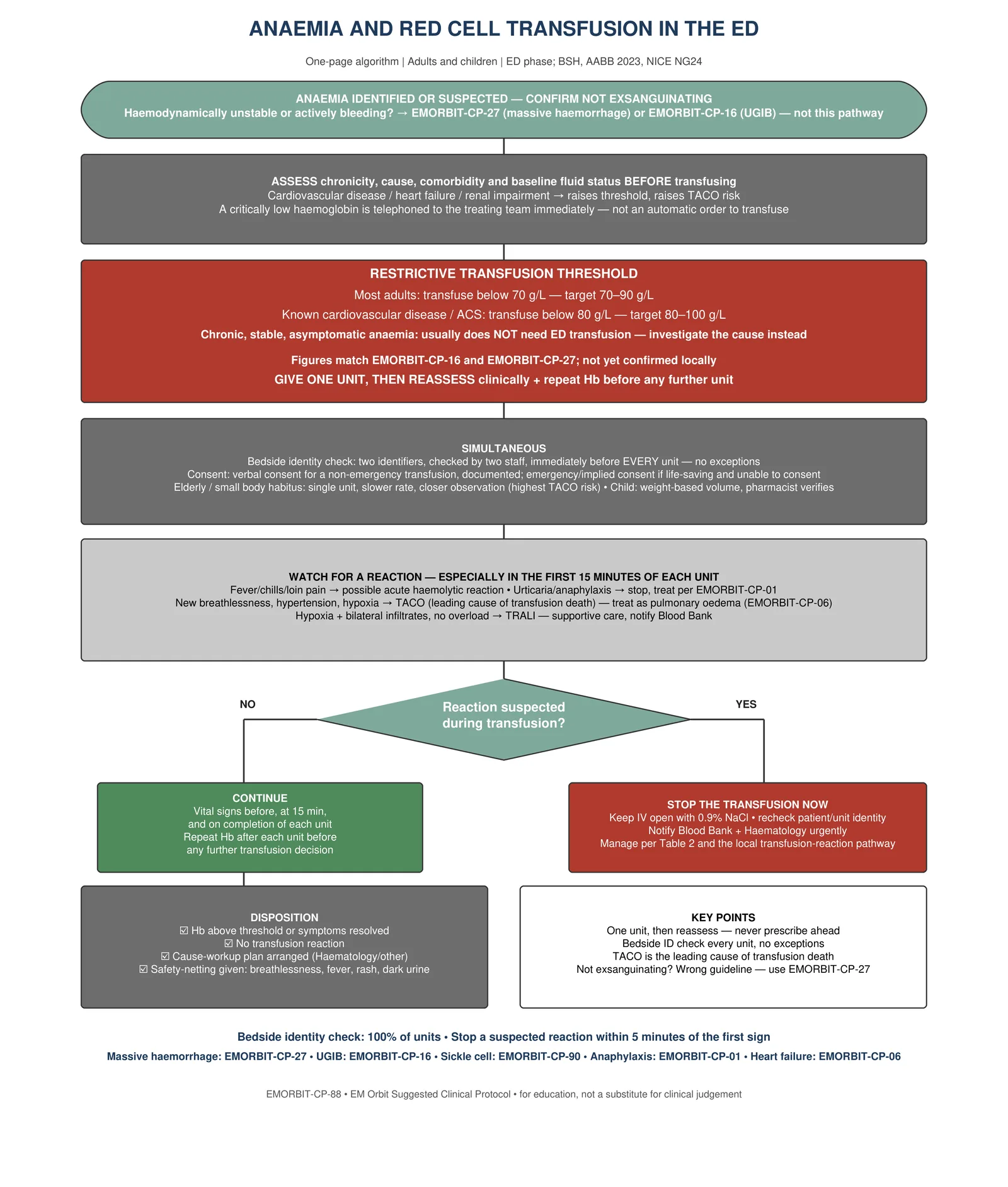
The one-page algorithm is shown at the top of this page.
6Team roles
The roles below are additional to, and consistent with, those defined in your institution's own Packed Red Blood Cell (RBC) Administration guideline.
6.1Triage / ED Nurse:
6.1.1 Escalate a critically low haemoglobin result immediately; perform the bedside identity check with a second staff member for every unit; record vital signs at the intervals in section 4.3.5; recognise and immediately report any change suggestive of a reaction.
6.2ED Physician:
6.2.1 Confirm the patient is not exsanguinating; apply the threshold in Table 1; document the transfusion decision, consent, and the plan after each unit; lead the response to any reaction.
6.3ED Pharmacist:
6.3.1 Verify the paediatric weight-based volume and infusion rate; advise on diuretic use in a patient at higher risk of fluid overload; review medication that affects bleeding or transfusion risk.
6.4Haematology / Blood Bank:
6.4.1 Advise on the transfusion decision where the cause is unclear or the patient has known alloantibodies; lead investigation of any reported reaction; direct your institution's own reaction pathway.
6.5Laboratory:
6.5.1 Process the full blood count, group and screen or crossmatch, and telephone a critically low haemoglobin result without delay.
7The patient's role
7.1 Tell staff about any previous transfusion, transfusion reaction, known red cell antibodies, or any personal or religious objection to blood products.
7.2 Report any new symptom — breathlessness, chest pain, fever, rash, back or loin pain, or dark urine — immediately during or after a transfusion.
7.3 Attend the arranged follow-up for investigation of the underlying cause of the anaemia.
8Definitions
The definitions in your institution's own Packed Red Blood Cell (RBC) Administration guideline apply in full. The following are additional terms used in this protocol.
8.1Restrictive Transfusion Strategy: transfusing at a lower haemoglobin threshold than historical practice, shown to reduce mortality and complications compared with a liberal strategy in most adult populations.
8.2Transfusion-Associated Circulatory Overload (TACO): acute or worsening pulmonary oedema caused or worsened by transfusion, occurring during or within 6 hours of a unit; the leading cause of transfusion-related death.
8.3Transfusion-Related Acute Lung Injury (TRALI): acute hypoxaemia with bilateral pulmonary infiltrates within 6 hours of transfusion, without evidence of fluid overload.
8.4Single-Unit Policy: giving one unit of red cells, then clinically reassessing and repeating the haemoglobin, before deciding whether a further unit is needed.
9Attachments
- Attachment 1: One-page algorithm (top of this page)
- Attachment 2: Transfusion Threshold and Reaction Recognition Quick Reference
11Suggested quality indicators
11.1Restrictive threshold applied: (Number of ED red cell transfusions given at a pre-transfusion haemoglobin at or below the Table 1 threshold for the patient's population / Total number of ED red cell transfusions) × 100. Target ≥ 90%.
11.2Single-unit-and-reassess compliance: (Number of non-exsanguinating ED transfusion episodes in which a repeat haemoglobin was documented before any further unit was given / Total number of such episodes receiving more than one unit) × 100. Target ≥ 90%.
11.3Bedside identity check documented: (Number of ED red cell units with a documented two-identifier bedside check by two staff members / Total number of ED red cell units administered) × 100. Target 100%.
11.4Time to stopping a suspected reaction: (Number of suspected transfusion reactions in which the transfusion was stopped within 5 minutes of the first sign or symptom / Total number of suspected transfusion reactions) × 100. Target ≥ 95%.
11.5Outcome indicator (monitored, no fixed ED target): incidence of TACO or another transfusion reaction reported per unit transfused.
13References
- British Society for Haematology. Guideline on the administration of blood components. Br J Haematol. 2017 (reaffirmed).
- Carson JL, Stanworth SJ, Guyatt G, et al. Red blood cell transfusion: 2023 AABB international guidelines. JAMA. 2023;330(19):1892-1902.
- National Institute for Health and Care Excellence. Blood transfusion. NICE Guideline NG24. London: NICE; 2015.
A2Attachment 2: Transfusion Threshold and Reaction Recognition Quick Reference
For use when a stable ED patient with anaemia is being considered for red cell transfusion. Not for the exsanguinating patient (EMORBIT-CP-27) or upper gastrointestinal bleeding (EMORBIT-CP-16), which carry their own pathway.
| Population | Transfuse when haemoglobin is | Target after transfusion |
|---|---|---|
| Most adult ED patients | Below 70 g/L | 70 to 90 g/L |
| Known cardiovascular disease or acute coronary syndrome | Below 80 g/L | 80 to 100 g/L |
| Chronic, stable, asymptomatic anaemia (e.g. uncomplicated iron deficiency) | Transfusion is usually not indicated in the ED regardless of the numeric threshold | Treat the cause; arrange outpatient/Haematology follow-up (section 4.3.7) |
Figures reproduced from EMORBIT-CP-27 (Massive Haemorrhage) and EMORBIT-CP-16 (Upper Gastrointestinal Bleeding), which state the same thresholds. Where your institution's own Packed Red Blood Cell (RBC) Administration guideline sets a different threshold, that guideline governs. Give one unit, then reassess clinically and with a repeat haemoglobin before deciding on a further unit — do not prescribe multiple units in advance in a non-exsanguinating patient.
| Reaction | Recognition | Immediate ED action |
|---|---|---|
| Acute haemolytic reaction | Fever, chills, loin/chest pain, hypotension, or dark urine, typically within minutes of starting the unit — usually an ABO-incompatible unit | STOP the transfusion immediately. Keep the line open with 0.9% sodium chloride; recheck the identity of the patient against the unit; notify the Blood Bank and Haematology urgently; send the return pack per your institution's own guideline |
| Febrile non-haemolytic reaction | Temperature rise of 1°C or more, chills, without haemodynamic compromise | Stop or slow the transfusion; exclude haemolysis and sepsis before restarting; antipyretic; observe |
| Allergic / anaphylactic reaction | Urticaria alone, or a life-threatening airway/breathing/circulation problem | Urticaria alone: stop, treat, may cautiously restart once settled. Anaphylaxis: STOP the transfusion and manage per EMORBIT-CP-01 without delay |
| Transfusion-associated circulatory overload (TACO) | New or worsening breathlessness, hypertension, tachycardia, or hypoxia during or within 6 hours of a unit — the leading cause of transfusion-related death | STOP or slow the transfusion; sit the patient up; oxygen; treat as acute pulmonary oedema (EMORBIT-CP-06); the ED pharmacist advises on diuretic use; consider TRALI as a differential |
| Transfusion-related acute lung injury (TRALI) | Acute hypoxaemia and bilateral infiltrates within 6 hours of transfusion, without evidence of fluid overload | STOP the transfusion; treat as acute respiratory distress with supportive oxygen/ventilation; notify Blood Bank — this is a reportable reaction |
For any reaction beyond a simple febrile or urticarial response: stop the transfusion, keep the unit and giving set, notify the Blood Bank and Haematology, and report through the local incident reporting system (Serious Hazards of Transfusion). Reaction investigation and further component decisions follow your institution's own guideline and are not restated here.