Maternal-Fetal Triage and the Pregnant Patient in the Emergency Department
EMORBIT-CP-75 · Chapter 11 · Obstetric and Gynaecological Emergencies
Open in the appFree, works on your phone and offline, with every tool alongside.
Evidence base: AWHONN MFTI; RCOG
1Purpose
1.1 This protocol covers the Emergency Department (ED) front-door phase of care for a pregnant or recently delivered woman who presents to the ED rather than directly to the labour and delivery unit. It does not replace, amend, or restate your institution's own Maternal Fetal Triage guideline; definitive maternal-fetal triage follows that guideline. Coded triage and acuity levels follow the receiving obstetric unit's triage guideline and are not restated here.
1.2 Standardize recognition, at ED triage, of every woman who is pregnant or has delivered, miscarried, or had a termination of pregnancy within the last 6 weeks, whatever her presenting complaint, and define which of these women are directed straight to obstetric triage and which are assessed in the ED first.
1.3 Set out the physiological changes of pregnancy that alter normal vital-sign thresholds and can mask deterioration, so that a "normal" reading is not read as reassurance where it is not.
1.4 State plainly that diagnostic imaging is never withheld from a pregnant woman when it is needed for a maternal emergency, and that fetal assessment is arranged in parallel with, and never before, maternal stabilisation.
1.5 Point to EMORBIT-CP-73 for the pregnancy test and the anti-D decision, to EMORBIT-CP-74 for hypertensive disorders of pregnancy, to EMORBIT-CP-64 for abdominal/pelvic trauma in pregnancy, and to EMORBIT-CP-29 for the triage category definitions used throughout; align with the AWHONN Maternal Fetal Triage Index (MFTI) and RCOG guidance.
2Who this protocol applies to
2.1 Any woman who states, or is known, to be pregnant at any gestation, or who has delivered, miscarried, or had a termination of pregnancy within the last 6 weeks, presenting to a general ED (rather than directly to labour and delivery/obstetric triage) with any complaint, obstetric or non-obstetric.
2.2 Any woman of child-bearing age whose pregnancy status is unknown and who is screened positive under EMORBIT-CP-73 or EMORBIT-CP-74.
2.3 Patients pre-alerted by ambulance as pregnant or recently delivered, and patients transferred from another facility.
3Not covered by this protocol
3.1 A woman presenting directly to, or already under the care of, labour and delivery/obstetric triage — governed there by your institution's own Maternal Fetal Triage guideline, not by this protocol.
3.2 Bleeding and pain in early pregnancy without a direct-transfer criterion (section 4.1.1.4): assessed under EMORBIT-CP-73.
3.3 Hypertensive disorders of pregnancy meeting the diagnostic criteria of pre-eclampsia or gestational hypertension: managed under EMORBIT-CP-74, into which this guideline's screening (section 4.1.1.4) refers a woman.
3.4 Definitive obstetric assessment, cardiotocograph interpretation, tocolysis, and inpatient obstetric or neonatal care, governed by your institution's own Maternal Fetal Triage guideline and by Obstetrics.
4Protocol
4.1History and Assessment:
4.1.1Triage and Recognition:
4.1.1.1 Every woman of child-bearing age attending the ED shall be asked at triage whether she is pregnant, or has been pregnant, delivered, miscarried, or had a termination of pregnancy in the last 6 weeks, and the answer, with the gestation or the date of the pregnancy event, shall be recorded (consistent with EMORBIT-CP-73 and EMORBIT-CP-74). (The triage nurse asks the two questions and escalates; the pregnancy test follows EMORBIT-CP-73.)
4.1.1.2 Direct-to-obstetrics criteria: active labour (regular painful contractions, show, ruptured membranes), a visible presenting part or an urge to push, cord prolapse, antepartum haemorrhage beyond spotting, reduced or absent fetal movements, or a reported abnormal fetal heart rate — call the obstetric/midwifery team to attend the ED immediately and arrange transfer to labour and delivery in parallel, rather than waiting for a full ED assessment.
4.1.1.3 The gestation from which a pregnant woman with a primary obstetric complaint is taken directly to the labour and delivery/obstetric triage area, rather than assessed first in the general ED, is the receiving obstetric unit's threshold, set by its viability gestation and on-site neonatal cover. Below that gestation, and for any non-obstetric emergency (trauma, cardiac arrest, medical illness) at any gestation, the woman is assessed in the ED as described here.
4.1.1.4 The following are triaged Category 1 (immediate), per EMORBIT-CP-29: a seizure or eclampsia; any reduced conscious level; any new focal neurological deficit or acute visual loss; pulmonary oedema or oxygen saturation below 95% on air; systolic blood pressure 160 mmHg or more or diastolic 110 mmHg or more (identical to EMORBIT-CP-40/EMORBIT-CP-74); cord prolapse; antepartum or postpartum haemorrhage with haemodynamic compromise; and cardiac arrest or peri-arrest.
4.1.1.5 A pregnant or recently delivered woman meeting a Category 1 or Category 2 criterion is taken to the resuscitation area or a monitored bay, and the ED physician and, where a direct-to-obstetrics or Category 1 criterion is met, the obstetric team, are informed by direct verbal communication (EMORBIT-CP-29).
4.1.2History:
4.1.2.1 Gestation by dates and by scan where known, or the date and mode of the pregnancy event (delivery, miscarriage, termination) where she has already delivered or lost the pregnancy.
4.1.2.2 The presenting complaint in full, whether or not she believes it is related to the pregnancy; fetal movements where gestation makes this relevant; vaginal bleeding or loss; contractions.
4.1.2.3 Relevant obstetric history: parity, this pregnancy's complications (hypertension, diabetes, placenta praevia or accreta, multiple pregnancy), and any high-risk factor known to the booking team.
4.1.2.4 Current medication including antenatal supplements and anticoagulation, and allergies.
4.1.3Examination:
4.1.3.1 Full ABCDE primary survey first, whatever the presenting complaint and whatever the gestation; obstetric examination (fundal height, presentation, vaginal loss) is performed by, or with, the obstetric/midwifery team once the woman is stable, and is never allowed to delay maternal resuscitation.
4.1.3.2 Interpret every vital sign against the pregnancy-adjusted physiology in Table 1 (Attachment 2), not against the standard adult range alone.
4.1.3.3 A supine, hypotensive pregnant woman beyond approximately 20 weeks' gestation is repositioned (section 4.3.1) before further haemodynamic work-up, because aortocaval compression is a common and reversible cause.
4.1.4Risk Stratification and Severity:
4.1.4.1 Emergent — obstetric or maternal emergency: any Category 1 criterion above; suspected placental abruption, uterine rupture, or amniotic fluid embolism; maternal cardiac arrest or peri-arrest at any gestation.
4.1.4.2 Urgent — assess promptly in the ED with obstetric awareness: a Category 2 or 3 presentation (EMORBIT-CP-29) in a pregnant or recently delivered woman that is not itself an obstetric emergency — for example trauma, chest pain, headache, or infection — where the pregnancy changes the differential, the imaging decision, or the drug choice, but does not itself mandate direct obstetric transfer.
4.1.4.3 Non-urgent: a minor complaint in a well pregnant woman, managed in the ED as for a non-pregnant patient, with pregnancy documented and any pregnancy-relevant safety-netting given.
4.1.5Differential Diagnosis:
4.1.5.1 Physiological mimics of pathology, per Table 1: physiological tachycardia or breathlessness mistaken for sepsis or pulmonary embolism; a raised white cell count or D-dimer over-interpreted as infection or thromboembolism; supine hypotension mistaken for haemorrhagic shock.
4.1.5.2 Conditions specific to pregnancy that present atypically: pre-eclampsia and eclampsia (EMORBIT-CP-74), placental abruption, pulmonary embolism (pregnancy is itself a risk factor), and peripartum cardiomyopathy presenting as breathlessness late in pregnancy or in the puerperium.
4.1.6Special Populations:
4.1.6.1 Postpartum, post-miscarriage and post-termination (up to 6 weeks): the same recognition applies; pre-eclampsia, eclampsia, sepsis and venous thromboembolism can all present for the first time after the pregnancy has ended, and are missed when the pregnancy is not asked about (EMORBIT-CP-74).
4.1.6.2 Trauma in pregnancy: assessed under EMORBIT-CP-64, which this guideline's triage recognition feeds; the pregnancy test and anti-D question still apply (EMORBIT-CP-73).
4.1.6.3 Multiple pregnancy and known high-risk pregnancy (placenta praevia/accreta, previous caesarean, IVF pregnancy): treat as higher acuity for any bleeding or pain and involve obstetrics early.
4.2Investigations:
4.2.1 Diagnostic imaging, including computed tomography and plain radiography, is never withheld from a pregnant woman when it is clinically indicated for a maternal emergency. Shield the abdomen where this does not delay or degrade an essential study. The imaging decision follows the same clinical indications as in a non-pregnant patient; where feasible, use the modality with least ionising radiation without compromising the maternal diagnosis (per international imaging-in-pregnancy guidance).
4.2.2 Send a pregnancy test, per EMORBIT-CP-73, in every woman of child-bearing age whose pregnancy status is not already known, and never delay resuscitation or imaging for the result.
4.2.3 The anti-D decision follows EMORBIT-CP-73 in full and is not restated here.
4.2.4 Fetal assessment — fetal heart auscultation or cardiotocography, arranged with the obstetric/midwifery team at a gestation where it is appropriate — is arranged in parallel with, and never before, maternal stabilisation (identical wording to EMORBIT-CP-74).
4.3Plan of Care:
4.3.1Immediate Actions:
4.3.1.1 Primary survey (ABCDE) takes priority over any obstetric assessment, at any gestation.
4.3.1.2 Left lateral tilt, or manual uterine displacement where the patient must remain supine (for example on a trauma board or during resuscitation), from approximately 20 weeks' gestation onward, to relieve aortocaval compression (EMORBIT-CP-19/EMORBIT-CP-64).
4.3.1.3 Oxygen, intravenous access, and monitoring as clinically indicated; do not withhold any time-critical maternal treatment or medication because the patient is pregnant without first checking pregnancy safety — involve the ED pharmacist where there is doubt.
4.3.2Definitive ED Action — Streaming:
4.3.2.1 Direct to obstetrics now: any woman meeting a direct-to-obstetrics or Category 1 criterion (section 4.1.1.4) — call the obstetric/midwifery team to the ED and arrange transfer to labour and delivery in parallel with, not after, initial resuscitation.
4.3.2.2 Manage in the ED with obstetric awareness: a Category 2–3 presentation that is not itself an obstetric emergency — proceed with the relevant ED guideline (chest pain, trauma, headache, sepsis, etc.), applying the pregnancy-specific adjustments in Table 1 and involving obstetrics for advice or bedside review as needed.
4.3.2.3 Manage in the ED as routine: a non-urgent complaint in a well pregnant or recently delivered woman — assess and treat as for any ED patient, with the pregnancy documented.
4.3.3Escalation — Maternal Cardiac Arrest:
4.3.3.1 Cardiac arrest in a woman at approximately 20 weeks' gestation or beyond: continuous manual left uterine displacement throughout resuscitation, and proceed to resuscitative hysterotomy (perimortem caesarean) as per EMORBIT-CP-03 where return of spontaneous circulation has not occurred within the time window that guideline specifies — the procedure is performed for maternal benefit and is not deferred to await fetal viability. This guideline does not restate the technique or timing, which are governed by EMORBIT-CP-03.
4.3.4Monitoring and Reassessment:
4.3.4.1 Continue left lateral tilt or displacement throughout the ED stay from 20 weeks; reassess vital signs against Table 1, not the standard adult range; repeat observations at an interval set by the acuity level assigned (EMORBIT-CP-29).
4.3.5Disposition:
4.3.5.1 Direct-to-obstetrics and Category 1 criteria met: transfer to labour and delivery/obstetric triage or admit under Obstetrics, per your institution's own Maternal Fetal Triage guideline.
4.3.5.2 Managed in the ED for a non-obstetric emergency: admit or discharge under the relevant ED guideline, with obstetric review before discharge wherever the presenting condition or its treatment could affect the pregnancy.
4.3.5.3 Non-urgent and well: discharge with pregnancy-relevant safety-netting and confirmation that routine antenatal care is in place.
4.3.6Discharge and Follow-up:
4.3.6.1 Written safety-netting advice covering reduced fetal movements, bleeding, leaking fluid, severe headache or visual disturbance, and epigastric pain, with an instruction to return immediately or contact the labour and delivery unit; confirm she knows how to access antenatal or EPAU follow-up.
4.3.7Documentation and Reporting:
4.3.7.1 Record the two triage questions and answers, the gestation or pregnancy-event date, the direct-to-obstetrics or category decision and its time, the pregnancy test and anti-D decisions (by reference to EMORBIT-CP-73), and any obstetric team attendance with its time.
4.3.7.2 Report through the local incident reporting system any delay in recognising pregnancy or in obstetric notification, and any case in which the direct-to-obstetrics gestation threshold was unclear in practice, for review against section 4.1.1.4.
5Algorithm
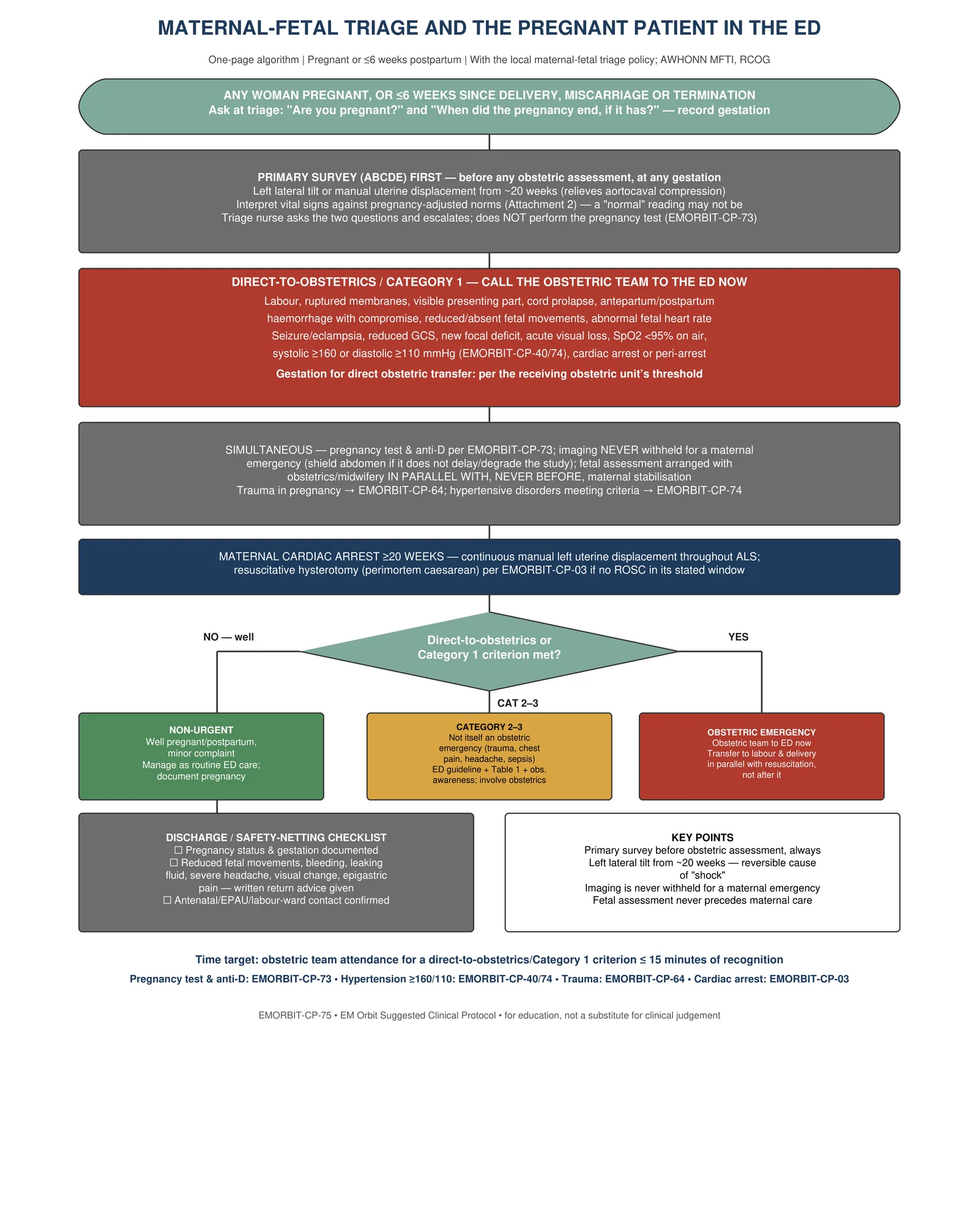
The one-page algorithm is shown at the top of this page.
6Team roles
The roles below are additional to, and consistent with, those defined in your institution's own Maternal Fetal Triage guideline.
6.1Triage Nurse:
6.1.1 Ask the two pregnancy questions of every woman of child-bearing age; record gestation or pregnancy-event date; apply the direct-to-obstetrics and Category 1 criteria; escalate immediately. Does not perform the pregnancy test (EMORBIT-CP-73).
6.2ED Physician:
6.2.1 Confirm the streaming decision (section 4.3.2); apply left lateral tilt/displacement from 20 weeks; call the obstetric team for any direct-to-obstetrics or Category 1 criterion, or where pregnancy changes management of a non-obstetric emergency.
6.3Obstetric/Midwifery Team:
6.3.1 Attend the ED on referral for any direct-to-obstetrics or Category 1 criterion; perform fetal assessment once arranged; direct transfer to labour and delivery.
6.4ED Pharmacist:
6.4.1 Advise on medication safety in pregnancy and lactation on request; verify anti-D and any obstetric medication given in the ED against EMORBIT-CP-73/EMORBIT-CP-74.
6.5Laboratory and Radiology:
6.5.1 Process the pregnancy test and group and save urgently; proceed with clinically indicated imaging without delay, using abdominal shielding where it does not compromise the study.
6.6Ambulance and Pre-hospital Providers:
6.6.1 Pre-alert the ED for a pregnant or recently delivered patient with any red-flag feature, stating gestation and the presenting problem.
7The patient's role
7.1 Tell staff, at triage, if you are pregnant or have been pregnant, delivered, miscarried, or had a termination of pregnancy in the last 6 weeks, whatever the reason for your visit.
7.2 Report reduced fetal movements, bleeding, leaking fluid, contractions, severe headache, visual disturbance, or epigastric pain immediately, including during the ED stay.
7.3 Family and carers: raise any concern about the woman's condition with staff.
8Definitions
The definitions in your institution's own Maternal Fetal Triage guideline apply in full. The following are additional terms used in this protocol.
8.1Direct-to-Obstetrics: a woman with a primary obstetric complaint or a direct-to-obstetrics criterion (section 4.1.1.4) who is taken to labour and delivery/obstetric triage rather than assessed first in the general ED.
8.2Left Lateral Tilt / Uterine Displacement: positioning that shifts the gravid uterus off the aorta and inferior vena cava, relieving aortocaval compression, applied from approximately 20 weeks' gestation.
8.3Resuscitative Hysterotomy (Perimortem Caesarean Section): emergency delivery performed during maternal cardiac arrest for maternal benefit; technique and timing are governed by EMORBIT-CP-03.
8.4Postpartum Period (for this guideline): up to 6 weeks after delivery, miscarriage, or termination of pregnancy, consistent with EMORBIT-CP-74.
8.5AWHONN MFTI, RCOG: Association of Women's Health, Obstetric and Neonatal Nurses Maternal Fetal Triage Index; Royal College of Obstetricians and Gynaecologists.
9Attachments
- Attachment 1: One-page algorithm (top of this page)
- Attachment 2: Pregnancy Physiology and Triage Quick Reference
11Suggested quality indicators
11.1Pregnancy status documented at triage: (Number of women of child-bearing age with pregnancy status and, where applicable, gestation documented at triage / Total number of women of child-bearing age triaged) × 100. Target ≥ 95%.
11.2Time to obstetric team attendance for a direct-to-obstetrics or Category 1 obstetric criterion: (Number of such patients with obstetric attendance within 15 minutes of the criterion being identified / Total number of such patients) × 100. Target ≥ 90%.
11.3Correct positioning from 20 weeks: (Number of pregnant patients ≥ 20 weeks receiving imaging, a procedure, or resuscitation with left lateral tilt or manual uterine displacement documented / Total number of such patients) × 100. Target ≥ 90%.
11.4Safe streaming: (Number of patients meeting a direct-to-obstetrics or Category 1 criterion who were transferred to labour and delivery or seen by obstetrics without first completing a full ED work-up / Total number of such patients) × 100. Target 100%.
11.5Outcome indicator (monitored, no fixed ED target): incidence of delayed recognition of pregnancy or of maternal deterioration reported as a patient safety incident.
13References
- Association of Women's Health, Obstetric and Neonatal Nurses (AWHONN). Maternal Fetal Triage Index, 2nd ed. Washington, DC: AWHONN; 2015.
- Royal College of Obstetricians and Gynaecologists. Maternal Collapse in Pregnancy and the Puerperium. Green-top Guideline No. 56; 2019.
- Royal College of Obstetricians and Gynaecologists / Royal College of Emergency Medicine. Guidance on the management of the pregnant trauma patient.
- American College of Obstetricians and Gynecologists. Guidelines for Diagnostic Imaging During Pregnancy and Lactation. Committee Opinion No. 723; 2017 (reaffirmed).
A2Attachment 2: Pregnancy Physiology and Triage Quick Reference
For use at triage and in the initial ED assessment of any woman who is pregnant or has been pregnant, delivered, miscarried, or had a termination of pregnancy within the last 6 weeks.
| Parameter | Normal change in pregnancy | Trap |
|---|---|---|
| Heart rate | Rises 10–20 beats/min above non-pregnant baseline by the third trimester | A "normal" heart rate for a non-pregnant adult may already reflect early compensation for haemorrhage |
| Blood pressure | Falls in the second trimester, returns towards booking value by term | A blood pressure that looks normal may be a significant fall from her booking reading |
| Respiratory rate / breathlessness | Mild tachypnoea and a sensation of breathlessness are common and normal, especially in the third trimester | New or severe breathlessness, breathlessness at rest, or breathlessness that stops her talking is never attributed to pregnancy alone until assessed |
| Blood count | Plasma volume rises more than red cell mass (dilutional anaemia); white cell count up to 15–16 ×10⁹/L is normal, higher in labour | A white cell count in this range does not, by itself, indicate infection |
| D-dimer | Rises progressively through pregnancy and is not a validated rule-out test | A raised D-dimer in pregnancy does not exclude, and does not by itself diagnose, venous thromboembolism |
| Supine position (from ~20 weeks) | The gravid uterus compresses the aorta and vena cava, reducing venous return and cardiac output (aortocaval compression) | Hypotension or collapse in the supine position may be positional, not haemorrhagic — reposition before further work-up |
These changes apply from early pregnancy and increase with gestation; use them to interpret vital signs, never to dismiss a symptom the patient describes as new, severe or different from her normal pregnancy.