Management of Epistaxis in the Emergency Department
EMORBIT-CP-85 · Chapter 14 · ENT, Ophthalmic and Dental Emergencies
Open in the appFree, works on your phone and offline, with every tool alongside.
Evidence base: ENT UK 2016; AAO-HNS 2020
1Purpose
1.1 Provide a standardised, evidence-based framework for the assessment and stepwise management of epistaxis (adult and paediatric) in the Emergency Department (ED), from first aid through to definitive ENT referral.
1.2 Ensure that first aid is given a full and correctly performed trial before any procedure is attempted, and that escalation follows a fixed ladder: first aid, topical vasoconstrictor and anaesthetic, chemical cautery, anterior packing, then posterior packing with admission.
1.3 Ensure that a posterior bleed with airway or haemodynamic compromise is recognised and treated as a resuscitation case, and that anticoagulation and blood pressure are managed by pointing to the ED guidelines that govern them (EMORBIT-CP-89, EMORBIT-CP-27, EMORBIT-CP-40) rather than by parallel instructions in this document.
1.4 Align practice with the American Academy of Otolaryngology–Head and Neck Surgery (AAO-HNS) Clinical Practice Guideline: Nosebleed (Epistaxis) 2020 and ENT UK Epistaxis Management Guidelines 2016.
2Who this protocol applies to
2.1 All patients of any age presenting to, or developing within, the ED with bleeding from the nose (anterior or posterior source), including a single episode, recurrent episodes, and epistaxis occurring on an anticoagulant or antiplatelet agent.
2.2 Epistaxis following facial or nasal trauma, where this guideline applies to the bleeding once major injury has been excluded or is being managed in parallel (EMORBIT-CP-19, EMORBIT-CP-64).
2.3 Epistaxis as a presenting feature of suspected coagulopathy, malignancy, or hereditary haemorrhagic telangiectasia, for the purpose of ED first aid and referral.
3Not covered by this protocol
3.1 Epistaxis occurring as part of major trauma with haemodynamic instability from other injuries, managed under the ED major trauma guideline (EMORBIT-CP-19) with this guideline applied to the nasal bleeding component.
3.2 Activation, pack composition, and product issue for the massive haemorrhage protocol, which are governed by EMORBIT-CP-27; this guideline states only when to activate it.
3.3 Choice and dosing of an anticoagulant or antiplatelet reversal agent, which is governed by EMORBIT-CP-89; this guideline states only when to apply it.
3.4 Formal ENT procedures — examination under anaesthesia, sphenopalatine artery ligation, and embolisation — which are ENT-performed and governed by EMORBIT-CP-27 (source-specific actions) and local ENT practice.
4Protocol
4.1History and Assessment:
4.1.1Triage and Recognition:
4.1.1.1 Apply the local triage standard (EMORBIT-CP-29). Category 1 (resuscitation area): airway compromise, shock index ≥ 1, bleeding swallowed into the pharynx despite first aid, or a suspected posterior bleed with haemodynamic instability.
4.1.1.2 Category 2 as a minimum: bleeding not controlled after 15 minutes of correctly performed first aid, a patient on an anticoagulant with major bleeding (EMORBIT-CP-89), or recurrent bleeding within 24 hours.
4.1.1.3 Category 3: a single episode already controlled by first aid on arrival, in an otherwise well patient.
4.1.1.4 Start first aid at triage, without waiting for physician review: sit the patient up, lean forward, pinch the soft cartilaginous part of the nose continuously for 10–15 minutes, apply an ice pack to the dorsum, and instruct the patient to spit out rather than swallow blood.
4.1.2History:
4.1.2.1 Side, duration, estimated volume, and whether this is a first episode or recurrent; time and technique of first aid already attempted.
4.1.2.2 Anticoagulant or antiplatelet therapy: the agent, the dose, and the time of the last dose, recorded as a mandatory field per EMORBIT-CP-89.
4.1.2.3 Trauma, nose-picking, forceful nose-blowing, intranasal drug use (including cocaine and prolonged decongestant spray use), recent nasal or sinus surgery, and known hereditary haemorrhagic telangiectasia or a family history of it.
4.1.2.4 Symptoms suggesting a coagulopathy or haematological malignancy (easy bruising, gum bleeding, fatigue, unexplained weight loss), and symptoms suggesting a nasal or nasopharyngeal mass (unilateral nasal obstruction, unilateral recurrent bleeding, facial pain, or a neck lump).
4.1.2.5 Comorbidity: known hypertension and its control, chronic liver disease, chronic kidney disease and dialysis, and pregnancy.
4.1.3Examination:
4.1.3.1 Vital signs including the shock index (heart rate ÷ systolic blood pressure); a value of 1 or more indicates significant blood loss.
4.1.3.2 Anterior rhinoscopy with adequate light and suction after the nose has been decongested with the topical vasoconstrictor, to identify a visible bleeding point, most commonly at Little's area (Kiesselbach's plexus) on the anterior septum.
4.1.3.3 Examine for a posterior source when bleeding continues from both nostrils or into the oropharynx despite correctly performed first aid and no anterior point is seen; nasal endoscopy, where available, is an ENT assessment.
4.1.3.4 A raised blood pressure is commonly reactive to pain, anxiety, or the bleed itself; note it but do not treat it as the primary problem (see 4.1.6).
4.1.4Risk Stratification – Severity:
4.1.4.1 Minor — controlled by first aid alone, stable observations, no anticoagulant-related major bleeding.
4.1.4.2 Moderate — requires topical treatment, cautery, or a single anterior pack; stable observations.
4.1.4.3 Major — uncontrolled after an anterior pack, a posterior source, haemodynamic compromise, or major bleeding on an anticoagulant as defined in EMORBIT-CP-89 (Table 1 of that guideline). Classify by that definition rather than by estimated volume alone.
4.1.5Differential Diagnosis:
4.1.5.1 Local: digital trauma, dry mucosa, septal deviation or perforation, foreign body (suspect in a child with unilateral foul-smelling discharge), acute sinusitis, nasal or sinus tumour (unilateral, painless, recurrent — refer to ENT), granulomatous disease.
4.1.5.2 Systemic: anticoagulant or antiplatelet therapy, coagulopathy (congenital or acquired), thrombocytopenia, chronic liver or kidney disease, hereditary haemorrhagic telangiectasia.
4.1.5.3 Severe or resistant hypertension may coexist and shall be assessed on its own merits (EMORBIT-CP-40); it is not treated as the cause of the nosebleed and acute BP-lowering is not the treatment for the bleed (4.1.6).
4.1.6Blood Pressure — Do Not Treat the Number: Raised blood pressure at presentation is usually reactive to pain, anxiety, or blood loss and typically falls once the bleeding is controlled and the patient is calm. Do not give a rapid IV or "stat" antihypertensive to lower blood pressure for epistaxis alone. Treat pain and anxiety, control the bleed, and re-measure once settled. Where severe hypertension with acute hypertension-mediated organ damage is independently suspected, manage in parallel per EMORBIT-CP-40.
4.1.7Special Populations:
4.1.7.1 Children (under 13 years): most epistaxis is anterior, from Little's area, related to digital trauma or dry mucosa, and settles with first aid and topical treatment; cautery may need a cooperative child or ENT support under general anaesthesia. Recurrent epistaxis with bruising or other bleeding raises coagulopathy; a pattern inconsistent with the history raises safeguarding, which is addressed under EMORBIT-CP-83 (flag any concern to the ED lead directly in the interim).
4.1.7.2 Pregnancy: epistaxis is more frequent because of pregnancy-related nasal mucosal vascularity. First aid, topical treatment, cautery, and packing are used as in the non-pregnant adult. Avoid imaging with ionising radiation unless clearly indicated. Manage any associated severe hypertension per EMORBIT-CP-40 and involve obstetrics if features of a hypertensive disorder of pregnancy are present.
4.1.7.3 Elderly and hereditary haemorrhagic telangiectasia: posterior and recurrent bleeding is more common; a lower threshold for ENT referral and specialist outpatient management (e.g., cautery under endoscopic guidance, topical agents) applies.
4.1.7.4 Anticoagulated patients: identify the agent and the time of the last dose at triage. Local measures (first aid, topical treatment, cautery, packing) are the primary treatment and are usually sufficient; do not routinely stop or reverse the anticoagulant for bleeding controlled by local measures. For bleeding meeting the major-bleeding definition, apply EMORBIT-CP-89 in full — this guideline does not restate its reversal doses.
4.2Investigations:
4.2.1 No investigation shall delay first aid or topical treatment. Epistaxis controlled by first aid alone in an otherwise well patient needs no blood tests.
4.2.2 Full blood count, coagulation screen, group and save (crossmatch if transfusion is anticipated), and renal function for: major bleeding, bleeding requiring a pack, bleeding on an anticoagulant, or a patient who appears unwell.
4.2.3 Point-of-care or urgent INR where the patient takes a vitamin K antagonist and reversal per EMORBIT-CP-89 is being considered.
4.2.4 CT or nasendoscopy for suspected tumour or a foreign body not visualised anteriorly — arranged with ENT, not a routine ED investigation.
4.3Plan of Care:
4.3.1Immediate Actions (first 15 minutes):
4.3.1.1 Resuscitation area, ABCDE, high-flow oxygen, and two large-bore cannulae for any patient meeting the Category 1 criteria in 4.1.1; consider activating the massive haemorrhage protocol per its own triggers (EMORBIT-CP-27) if the patient is shocked or bleeding is uncontrolled.
4.3.1.2 For every other patient: first aid exactly as in 4.1.1, timed by the clock, without interruption to "check" before 10 minutes have passed.
4.3.1.3 Establish the anticoagulant status and the time of the last dose; do not give a rapid antihypertensive for an incidentally raised blood pressure (4.1.6).
4.3.2Definitive ED Treatment — the Escalation Ladder (Attachment 2):
4.3.2.1 Where first aid alone fails after a full 10–15 minute trial, escalate one step at a time as set out in Attachment 2: topical vasoconstrictor and anaesthetic; then, if a bleeding point is seen and bleeding continues, chemical cautery to that point only, one side per session; then anterior nasal packing if the point is not seen or bleeding continues after cautery.
4.3.2.2
Table 1: Escalation ladder — agents, technique and cautions (adult and child) Step How Child Caution 1. First aid Sit up, lean forward; pinch the soft cartilaginous part of the nose continuously for 10–15 minutes by the clock; ice pack to the dorsum; spit out swallowed blood Same technique; an adult must apply the pressure Releasing early to "check" restarts the bleed — do not check before 10 minutes 2. Topical vasoconstrictor + anaesthetic Topical vasoconstrictor (e.g. oxymetazoline 0.05% or phenylephrine 0.5%) with topical local anaesthetic (e.g. lidocaine 2–5%), sprayed or on a soaked pledget, left in place 10 minutes Same agents; smaller volume Systemic absorption can raise heart rate/blood pressure — use the minimum effective amount, caution in severe cardiovascular disease 3. Chemical cautery Silver nitrate 75% stick applied to the visible bleeding point only, 3–10 seconds, one side only in a single session Same if cooperative; otherwise ENT for cautery under general anaesthesia Never cauterise both sides of the septum in the same or a recent session — risk of septal perforation 4. Anterior nasal pack Nasal tampon (expands with moisture/saline) or ribbon gauze with an antiseptic paraffin dressing, along the floor of the nose; both sides if needed Smaller size; ENT support for a young or distressed child Confirm full expansion; antibiotic cover for a pack left in place is given per EMORBIT-CP-57 5. Posterior pack / balloon Postnasal balloon catheter (or Foley catheter balloon), combined with anterior packing; secure over the columella with a gauze bridge, never a bare clamp ENT and paediatric anaesthesia involvement Naso-pulmonary reflex (hypoxia, bradycardia); continuous SpO₂ and cardiac monitoring; admit Adjunct: topical tranexamic acid Tranexamic acid 100 mg/mL injection solution applied topically on a soaked pledget or gauze to the bleeding site Same preparation, smaller volume Adjunct only — evidence for reducing the need for packing is mixed (NoPAC 2021); never delays cautery or packing Escalate one step at a time; do not pack before first aid and topical treatment have been given a fair trial, and do not withhold packing once first aid and topical treatment have failed.
4.3.2.3 Topical tranexamic acid may be added at any step as an adjunct; it is not a substitute for cautery or packing where either is indicated.
4.3.2.4 Where bleeding continues from both nostrils or into the pharynx despite a correctly sited anterior pack, treat as a posterior bleed: insert a posterior balloon catheter combined with anterior packing, admit, and start continuous SpO₂ and cardiac monitoring with humidified oxygen because of the risk of the naso-pulmonary reflex.
4.3.3Escalation / Refractory Bleeding:
4.3.3.1 Uncontrolled bleeding despite a posterior pack, or any airway or haemodynamic compromise, is a resuscitation case: activate the massive haemorrhage protocol if its triggers are met (EMORBIT-CP-27) and call ENT immediately for examination under anaesthesia, sphenopalatine artery ligation, or referral for embolisation, as set out in EMORBIT-CP-27.
4.3.3.2 For major bleeding in a patient on an anticoagulant, apply EMORBIT-CP-89 in parallel with local haemostatic measures; reversal does not replace packing.
4.3.4Monitoring and Reassessment:
4.3.4.1 Vital signs every 15 minutes while an intervention is being escalated, then hourly once bleeding is controlled and the patient is stable.
4.3.4.2 Continuous SpO₂ and cardiac monitoring for any posterior pack or balloon, for the duration it remains in place in the ED.
4.3.4.3 Reassess the airway and swallowing at each observation in a patient with a posterior pack or bilateral anterior packs.
4.3.5Disposition (Attachment 3):
4.3.5.1
Table 2: Disposition tiers Tier Criteria Immediate resuscitation Airway compromise, shock index ≥ 1, bleeding swallowed into the pharynx despite first aid, or suspected posterior bleed with haemodynamic instability. Treat as a resuscitation case; consider the massive haemorrhage protocol (EMORBIT-CP-27) if triggered. Admit under ENT Posterior pack or balloon in situ; anterior pack that has failed once; major bleeding in a patient on an anticoagulant (EMORBIT-CP-89); recurrent bleeding despite two cautery attempts; suspected tumour or hereditary haemorrhagic telangiectasia. Discharge with ENT follow-up Bleeding fully controlled by first aid, topical treatment, or a single cautery, or an anterior pack in place for planned outpatient removal; stable observations; safe home circumstances.
4.3.6Discharge and Follow-up:
4.3.6.1 ENT follow-up shall be arranged for: any anterior pack left in place (for planned removal at ENT follow-up), any patient discharged with a pack, recurrent epistaxis, and suspected hereditary haemorrhagic telangiectasia or tumour.
4.3.6.2 Referral follows the hospital's ENT pathway for epistaxis; pack removal is at ENT follow-up.
4.3.6.3 Written advice: avoid nose-blowing, hot food and drink, hot showers/baths, straining, and heavy lifting or strenuous exercise for the period advised by ENT (typically 1–2 weeks); apply a bland emollient (e.g. white soft paraffin) to the anterior septum; return immediately if bleeding recurs and is not controlled by first aid, or if there is difficulty breathing, chest pain, or feeling faint.
4.3.6.4 Anticoagulant plan: document explicitly whether the drug was continued, withheld, or reversed, and who is responsible for the next decision, per EMORBIT-CP-89.
4.3.7Documentation and Reporting:
4.3.7.1 Document: time of triage and of first aid started, duration and adequacy of first aid, side and estimated volume, anticoagulant and last dose, each step of the escalation ladder with the time and outcome, vital signs, pack type and side(s), ENT contact and outcome, and the discharge or admission decision with follow-up arranged.
4.3.7.2 Recurrent or major epistaxis presentations are captured for the departmental audit (section 11).
5Algorithm
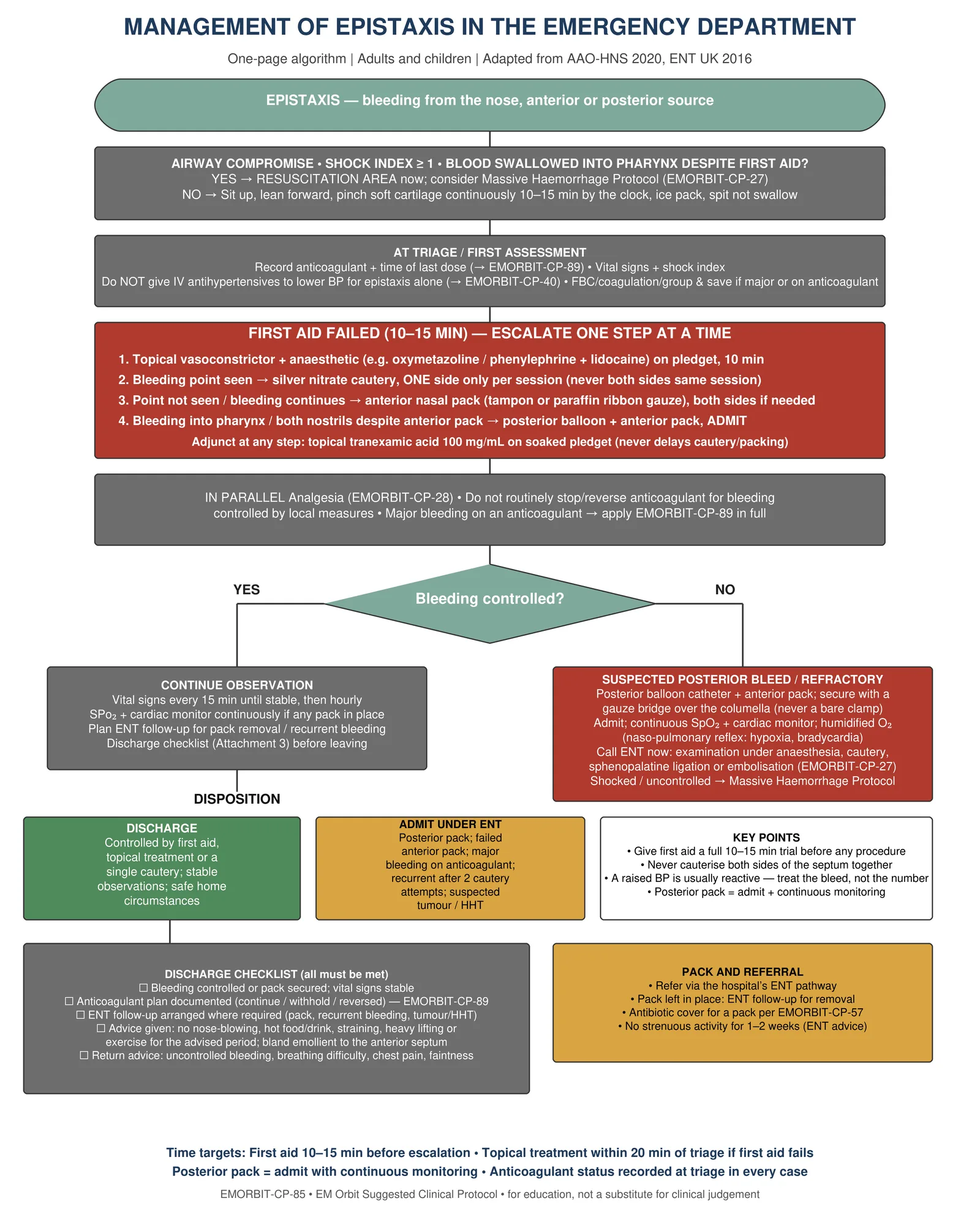
The one-page algorithm is shown at the top of this page.
6Team roles
6.1Triage / ED Nurses:
6.1.1 Start first aid immediately at triage and time it; record the duration and technique.
6.1.2 Record vital signs and the shock index; identify and document the anticoagulant and the time of the last dose.
6.1.3 Prepare and assist with topical treatment, cautery, and packing equipment; monitor SpO₂ and cardiac rhythm continuously for a posterior pack.
6.1.4 Give the written discharge advice and confirm the patient's understanding, with an interpreter where required.
6.2Pharmacist:
6.2.1 Confirm the topical vasoconstrictor and anaesthetic agents stocked and their concentrations; advise on antibiotic cover for a pack left in place per EMORBIT-CP-57.
6.2.2 Support the anticoagulant plan at discharge in conjunction with EMORBIT-CP-89.
6.3ENT (Otorhinolaryngology):
6.3.1 Attend for a failed anterior pack, a posterior bleed, or suspected tumour; perform examination under anaesthesia, cautery, sphenopalatine artery ligation, or arrange embolisation as set out in EMORBIT-CP-27.
6.3.2 Provide the ED–ENT referral pathway, with pack removal at ENT follow-up, referenced in 4.3.6.
6.4Laboratory:
6.4.1 Process full blood count, coagulation screen, and group and save/crossmatch samples for major or anticoagulant-related bleeding as a priority.
6.5Ambulance / Pre-hospital Providers:
6.5.1 Continue first aid en route; pre-alert the ED for uncontrolled bleeding, suspected posterior bleed, or haemodynamic instability.
7The patient's role
7.1 Perform first aid correctly for the full 10–15 minutes without checking early.
7.2 Report all medications, particularly anticoagulants and antiplatelets, and the time of the last dose.
7.3 Follow the written discharge advice, including avoidance of nose-blowing, hot food and drink, and heavy lifting or exercise for the advised period.
7.4 Return to the ED immediately if bleeding recurs and is not controlled by first aid, or if breathing difficulty, chest pain, or faintness develops.
7.5 Attend the arranged ENT follow-up, including for pack removal.
8Definitions
8.1Epistaxis: bleeding from the nasal cavity, classified as anterior (the great majority, usually from Little's area / Kiesselbach's plexus) or posterior (from branches of the sphenopalatine artery, more often heavier and harder to control).
8.2Shock Index: heart rate divided by systolic blood pressure; a value of 1 or more indicates significant blood loss.
8.3Major Bleeding: as defined in EMORBIT-CP-89 — bleeding at a critical site or causing haemodynamic compromise, a haemoglobin fall of 20 g/L or more, or a requirement for two or more units of red cells.
8.4Hereditary Haemorrhagic Telangiectasia (HHT): an inherited vascular disorder causing recurrent epistaxis and mucocutaneous telangiectasia, requiring specialist ENT/vascular management.
8.5Naso-pulmonary Reflex: reflex hypoxia and bradycardia associated with posterior nasal packing, requiring continuous monitoring.
9Attachments
- Attachment 1: One-page algorithm (top of this page)
- Attachment 2: Escalation Ladder — Agents, Technique and Cautions Quick Reference
- Attachment 3: Disposition Tiers and Discharge Checklist
11Suggested quality indicators
11.1Time to topical vasoconstrictor/anaesthetic treatment ≤ 20 minutes of triage when first aid alone has failed: (Number of patients receiving topical treatment within 20 minutes of triage / Total number of epistaxis patients requiring escalation beyond first aid) × 100. Target ≥ 90%.
11.2Escalation ladder followed in order (first aid before cautery or packing): (Number of patients whose record shows first aid attempted before any procedure / Total number of epistaxis patients) × 100. Target ≥ 95%.
11.3Anticoagulant status and last dose documented at triage: (Number of epistaxis patients with the agent and last-dose time recorded at triage / Total number of epistaxis patients) × 100. Target ≥ 95%.
11.4ENT follow-up arranged where required: (Number of patients discharged with a pack, recurrent bleeding, or suspected tumour/HHT who have documented ENT follow-up / Total number meeting any of those criteria) × 100. Target ≥ 95%.
11.5Unplanned return within 7 days with recurrent bleeding: (Number of epistaxis patients re-attending within 7 days with recurrent bleeding / Total number discharged) × 100. Monitored as an outcome indicator.
13References
- Tunkel DE, Anne S, Payne SC, et al. Clinical Practice Guideline: Nosebleed (Epistaxis). Otolaryngol Head Neck Surg. 2020;162(1_suppl):S1–S38.
- ENT UK. Epistaxis Management Guidelines. London: ENT UK; 2016.
- Bequignon E, Vérillaud B, Robard L, et al. Emergency management of epistaxis: guidelines of the French Society of Otorhinolaryngology (SFORL). Eur Ann Otorhinolaryngol Head Neck Dis. 2017.
- National Institute for Health and Care Excellence. Clinical Knowledge Summary: Nosebleeds (epistaxis). London: NICE.
- Reuben A, Appelboam A, Stevens KN, et al. The Use of Tranexamic Acid to Prevent Nasal Packing in Traumatic Epistaxis (NoPAC): a randomised controlled trial. Ann Emerg Med. 2021.
- Royal College of Emergency Medicine. Best Practice Guideline: Epistaxis. London: RCEM.
A2Attachment 2: Escalation Ladder — Agents, Technique and Cautions Quick Reference
| Step | How | Child | Caution |
|---|---|---|---|
| 1. First aid | Sit up, lean forward; pinch the soft cartilaginous part of the nose continuously for 10–15 minutes by the clock; ice pack to the dorsum; spit out swallowed blood | Same technique; an adult must apply the pressure | Releasing early to "check" restarts the bleed — do not check before 10 minutes |
| 2. Topical vasoconstrictor + anaesthetic | Topical vasoconstrictor (e.g. oxymetazoline 0.05% or phenylephrine 0.5%) with topical local anaesthetic (e.g. lidocaine 2–5%), sprayed or on a soaked pledget, left in place 10 minutes | Same agents; smaller volume | Systemic absorption can raise heart rate/blood pressure — use the minimum effective amount, caution in severe cardiovascular disease |
| 3. Chemical cautery | Silver nitrate 75% stick applied to the visible bleeding point only, 3–10 seconds, one side only in a single session | Same if cooperative; otherwise ENT for cautery under general anaesthesia | Never cauterise both sides of the septum in the same or a recent session — risk of septal perforation |
| 4. Anterior nasal pack | Nasal tampon (expands with moisture/saline) or ribbon gauze with an antiseptic paraffin dressing, along the floor of the nose; both sides if needed | Smaller size; ENT support for a young or distressed child | Confirm full expansion; antibiotic cover for a pack left in place is given per EMORBIT-CP-57 |
| 5. Posterior pack / balloon | Postnasal balloon catheter (or Foley catheter balloon), combined with anterior packing; secure over the columella with a gauze bridge, never a bare clamp | ENT and paediatric anaesthesia involvement | Naso-pulmonary reflex (hypoxia, bradycardia); continuous SpO₂ and cardiac monitoring; admit |
| Adjunct: topical tranexamic acid | Tranexamic acid 100 mg/mL injection solution applied topically on a soaked pledget or gauze to the bleeding site | Same preparation, smaller volume | Adjunct only — evidence for reducing the need for packing is mixed (NoPAC 2021); never delays cautery or packing |
Escalate one step at a time; do not pack before first aid and topical treatment have been given a fair trial, and do not withhold packing once first aid and topical treatment have failed.
A3Attachment 3: Disposition Tiers and Discharge Checklist
| Tier | Criteria |
|---|---|
| Immediate resuscitation | Airway compromise, shock index ≥ 1, bleeding swallowed into the pharynx despite first aid, or suspected posterior bleed with haemodynamic instability. Treat as a resuscitation case; consider the massive haemorrhage protocol (EMORBIT-CP-27) if triggered. |
| Admit under ENT | Posterior pack or balloon in situ; anterior pack that has failed once; major bleeding in a patient on an anticoagulant (EMORBIT-CP-89); recurrent bleeding despite two cautery attempts; suspected tumour or hereditary haemorrhagic telangiectasia. |
| Discharge with ENT follow-up | Bleeding fully controlled by first aid, topical treatment, or a single cautery, or an anterior pack in place for planned outpatient removal; stable observations; safe home circumstances. |
| ✓ | Item |
|---|---|
| ☐ | Bleeding fully controlled, or pack secured and patient comfortable; vital signs stable. |
| ☐ | Anticoagulant plan documented (continued / withheld / reversed) with the responsible team named, per EMORBIT-CP-89. |
| ☐ | ENT follow-up arranged where required (pack in place, recurrent bleeding, suspected tumour or HHT). |
| ☐ | Written advice given: avoid nose-blowing, hot food/drink, hot showers, straining, heavy lifting or exercise; apply a bland emollient to the anterior septum. |
| ☐ | Return advice given: come back immediately for recurrent uncontrolled bleeding, breathing difficulty, chest pain, or feeling faint. |