Reversal of Anticoagulation and Management of Bleeding on Anticoagulants and Antiplatelets
EMORBIT-CP-89 · Chapter 15 · Haematological and Oncological Emergencies
Open in the appFree, works on your phone and offline, with every tool alongside.
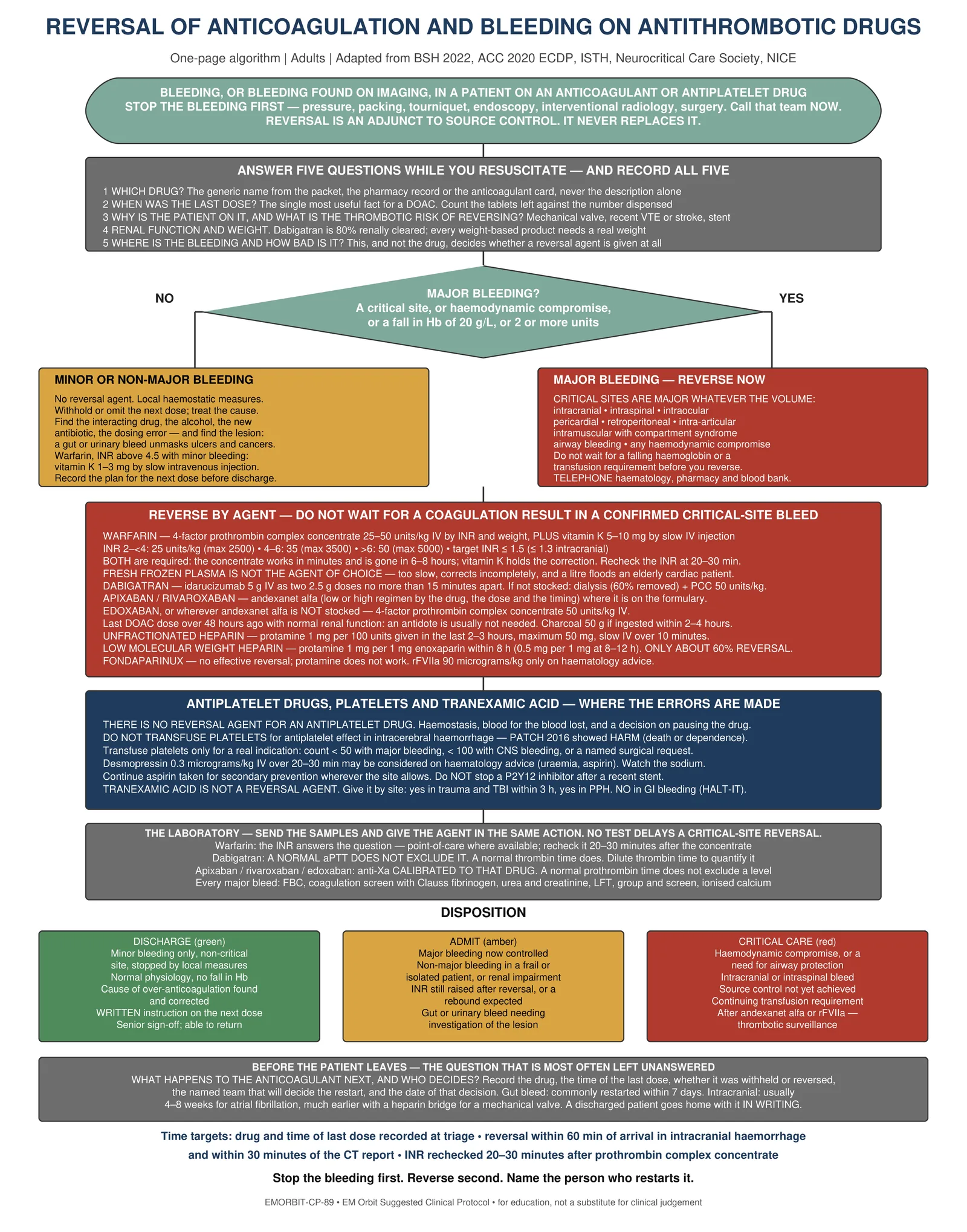
Evidence base: ACC 2020 ECDP; BSH 2022; ACEP
1Purpose
1.1 Provide a single, standardized, evidence-based framework for the reversal of anticoagulation and the management of bleeding in patients taking anticoagulant and antiplatelet drugs who present to the Emergency Department (ED), for adults and, where relevant, for children.
1.2 Establish the first principle of this guideline: reversal is an adjunct to haemostasis, never a substitute for it. A reversal agent stops the drug from working; it does not close a bleeding vessel. Mechanical compression, packing, endoscopy, interventional radiology and surgery remain the treatments that stop bleeding, and none of them shall be delayed while a reversal agent is obtained.
1.3 Make this guideline the single point of truth for reversal across the ED guideline library, so that the reversal tables appearing in the guidelines on head injury, upper gastrointestinal bleeding, massive haemorrhage, stroke and intracerebral haemorrhage, and the poisoned patient are quick references that point back to this document rather than parallel and divergent standards.
1.4 Define a structured approach that is applied to every such patient before any product is ordered: which agent, the time of the last dose, the indication and the thrombotic risk of reversing it, the renal function, and the site and severity of the bleeding.
1.5 Define major, clinically relevant non-major and minor bleeding, and fix the list of sites that are treated as major regardless of the volume lost — intracranial, intraspinal, intraocular, pericardial, retroperitoneal, intra-articular, intramuscular with compartment syndrome, and any bleeding causing haemodynamic compromise.
1.6 Eliminate the four commonest errors in this presentation: giving fresh frozen plasma instead of prothrombin complex concentrate for warfarin; transfusing platelets reflexly for an antiplatelet drug, which is harmful in intracerebral haemorrhage; waiting for a coagulation result before reversing a confirmed critical-site bleed; and allowing a patient to leave the ED with an anticoagulant stopped and nobody named as responsible for restarting it.
1.7 Ensure consistency of practice among all healthcare providers (HCP) and alignment with the British Society for Haematology (BSH), the American College of Cardiology (ACC) 2020 Expert Consensus Decision Pathway, the International Society on Thrombosis and Haemostasis (ISTH), the Neurocritical Care Society, the European guideline on major bleeding and coagulopathy following trauma (6th edition), the National Institute for Health and Care Excellence (NICE), the Royal College of Emergency Medicine (RCEM), the American College of Emergency Physicians (ACEP) and the Australasian College for Emergency Medicine (ACEM).
2Who this protocol applies to
2.1 Adults and children presenting to the ED with bleeding of any severity while taking an anticoagulant: a vitamin K antagonist (warfarin, acenocoumarol, phenindione), a direct oral anticoagulant (dabigatran, apixaban, rivaroxaban, edoxaban), unfractionated or low molecular weight heparin, fondaparinux, or a parenteral direct thrombin inhibitor.
2.2 Adults and children presenting with bleeding while taking an antiplatelet agent: aspirin, clopidogrel, ticagrelor, prasugrel, dipyridamole, or a glycoprotein IIb/IIIa inhibitor.
2.3 Bleeding occurring during or after the administration of a thrombolytic agent in the ED or within 24 hours of it.
2.4 Patients on any of the above who require emergency surgery or an urgent invasive procedure, in whom the anticoagulant must be reversed or allowed to wear off before the procedure.
2.5 Patients on any of the above found to have bleeding at a critical site on imaging, including asymptomatic or minimally symptomatic intracranial haemorrhage found on a CT performed for another reason.
2.6 Patients who have taken an intentional or accidental overdose of an anticoagulant, including superwarfarin (long-acting rodenticide) ingestion, jointly with the ED guideline on the poisoned patient.
3Not covered by this protocol
3.1 Bleeding in a patient who is not taking an antithrombotic agent, which is managed under the guideline appropriate to the site of bleeding and, where major, under the ED guideline on massive haemorrhage.
3.2 Congenital bleeding disorders (haemophilia A and B, von Willebrand disease) and acquired factor inhibitors, which require factor-specific replacement under direct haematology and haemophilia centre direction; the ED role is recognition, immediate haematology contact and administration of the patient's own factor concentrate without delay.
3.3 Disseminated intravascular coagulation, liver-disease coagulopathy and dilutional coagulopathy of massive transfusion, which are managed under the ED guideline on massive haemorrhage and by haematology; prothrombin complex concentrate is not a routine substitute for plasma in these states.
3.4 Heparin-induced thrombocytopenia, which is a prothrombotic emergency managed by haematology; protamine has no role and heparin in all forms shall be stopped.
3.5 The routine periprocedural interruption and bridging of anticoagulation for elective surgery, which is a pre-assessment and anticoagulation-clinic function, not an ED one.
3.6 Long-term choice and dosing of anticoagulant therapy, and the management of over-anticoagulation in an asymptomatic outpatient who can be managed by the anticoagulation clinic.
4Protocol
4.1History and Assessment:
4.1.1Triage and Recognition:
4.1.1.1 Any patient who reports taking a "blood thinner" and has any bleeding, any head injury however trivial the mechanism, any new severe headache, back pain, abdominal or flank pain, or unexplained shock, shall have the antithrombotic drug and the time of the last dose recorded at triage as a mandatory field.
4.1.1.2 Triage category shall be assigned on the physiology and the site, not on the drug alone: Category 1 for bleeding with haemodynamic compromise, airway bleeding, or a reduced conscious level; Category 2 for any suspected critical-site bleed (including any head injury on an anticoagulant), gastrointestinal bleeding with melaena or haematemesis, or bleeding that is not controlled by simple pressure; Category 3 for controlled bleeding at a non-critical site in a stable patient.
4.1.1.3 The clock starts at arrival. For a patient with a confirmed or strongly suspected intracranial haemorrhage on an anticoagulant, the target is administration of the reversal agent within 60 minutes of ED arrival, and within 30 minutes of the CT report.
4.1.1.4 The triage nurse shall alert the treating physician, and the physician shall alert the pharmacy and the blood bank, before the CT result is available in any anticoagulated patient with a suspected intracranial bleed, so that the product is being prepared while the scan is being done.
4.1.1.5 A patient who says they take "a tablet for the blood" and cannot name it shall not be recorded as "on an anticoagulant, drug unknown" and left there. The family shall be asked to bring the packets, and the pharmacy and electronic records shall be checked while the patient is being assessed.
4.1.2History — the five questions (Table 2), obtained in parallel with resuscitation:
4.1.2.1 Which agent, and at what dose. The generic name, the strength and the frequency. Twice-daily dosing suggests apixaban or dabigatran; once-daily suggests rivaroxaban, edoxaban or warfarin. Confirm against the packet, the pharmacy record, the electronic medication record or the anticoagulation clinic — never on the description alone.
4.1.2.2 The time of the last dose. This is the single most useful piece of information for a direct oral anticoagulant and is frequently not recorded. Count the tablets remaining against the number dispensed where the patient is uncertain.
4.1.2.3 The indication and the thrombotic risk of reversing (Table 10): atrial fibrillation with its CHA₂DS₂-VASc components, venous thromboembolism and how recent, a mechanical heart valve and its position and type, an intracardiac thrombus, antiphospholipid syndrome, active cancer, a coronary stent and its date and type.
4.1.2.4 Renal function and weight. Ask about known chronic kidney disease and dialysis. Dabigatran is approximately 80 per cent renally cleared; edoxaban about 50 per cent; rivaroxaban about 35 per cent; apixaban about 27 per cent. An acute kidney injury converts a "last dose 30 hours ago" into a fully anticoagulated patient.
4.1.2.5 The site and the severity of bleeding (Table 1), and its duration and rate.
4.1.2.6 Also ask about: other drugs that potentiate bleeding (a second antithrombotic, a non-steroidal anti-inflammatory drug, a selective serotonin reuptake inhibitor, an azole antifungal, amiodarone, a macrolide, or a protease inhibitor); alcohol; liver disease; a known bleeding disorder; a recent fall or trauma; recent surgery or a recent procedure; and previous bleeding on the same drug.
4.1.2.7 Where the presentation may be an intentional overdose rather than a bleed, take the psychosocial history and manage jointly with the ED guideline on the poisoned patient.
4.1.3Examination:
4.1.3.1 ABCDE assessment with continuous reassessment. Airway bleeding and a falling conscious level are the two findings that convert this into an immediate airway problem.
4.1.3.2 Vital signs including the shock index (heart rate divided by systolic blood pressure); a shock index of 1 or more indicates significant blood loss even where the blood pressure is still within the normal range, and is particularly useful in the elderly patient on a beta-blocker whose heart rate cannot rise.
4.1.3.3 Identify the site: full external inspection including the scalp, the mouth and the nose; rectal examination for melaena where gastrointestinal bleeding is suspected; abdominal and flank examination for a retroperitoneal bleed; the calves and thighs for a large intramuscular haematoma with compartment signs; and the puncture and cannulation sites.
4.1.3.4 Neurological examination with the Glasgow Coma Scale and pupils in every patient — a critical-site bleed is often the reason for the presentation rather than the complaint. A new headache, a new focal deficit, new confusion, or a new back pain with leg weakness in an anticoagulated patient is an intracranial or intraspinal bleed until imaging says otherwise.
4.1.3.5 Examine specifically for the concealed critical-site bleeds that are missed: retroperitoneal (flank or back pain, a femoral neuropathy with a positive psoas sign, unexplained hypotension, a falling haemoglobin with no visible blood); intraspinal (back pain with any sensory level, urinary retention or leg weakness — a surgical emergency in hours); intraocular (sudden visual loss or a painful red eye); and pericardial (muffled sounds, a raised jugular venous pressure, a paradoxical pulse — use point-of-care ultrasound).
4.1.3.6 Point-of-care ultrasound where available: pericardial effusion, free intraperitoneal fluid, an abdominal aortic aneurysm, and inferior vena cava assessment.
4.1.4Severity and Risk Stratification:
4.1.4.1 Classify the bleed as major, clinically relevant non-major, or minor using Table 1. This classification, and not the name of the drug, determines whether a reversal agent is given.
4.1.4.2 A bleed at a critical site is major irrespective of the volume lost, the blood pressure, the haemoglobin or the transfusion requirement. The critical sites are: intracranial, intraspinal, intraocular, pericardial, retroperitoneal, intra-articular, intramuscular with compartment syndrome, and airway bleeding threatening patency.
4.1.4.3 Any bleeding causing haemodynamic compromise is major, whatever the site.
4.1.4.4 Stratify the thrombotic risk of reversing at the same time (Table 10). Reversal is a balance of two deaths, not a balance of a death against an inconvenience, and the balance shall be recorded.
4.1.4.5 Where the bleed is major and the patient is shocked, activate the massive haemorrhage protocol in parallel (EMORBIT-CP-27); reversal runs alongside the protocol and does not replace it.
4.1.5Differential Diagnosis and the Traps:
4.1.5.1 The bleed is the presentation of a lesion, not simply of the drug. Gastrointestinal bleeding on an anticoagulant unmasks ulcers and cancers, and haematuria unmasks urological malignancy. Every such patient needs the appropriate investigation of the site, not just reversal and discharge.
4.1.5.2 A normal coagulation screen does not exclude a direct oral anticoagulant (Table 9). Do not use it as a reason to withhold reversal in a patient with a confirmed critical-site bleed.
4.1.5.3 A patient on an anticoagulant who is shocked with no visible bleeding has a concealed bleed until proven otherwise — retroperitoneal, intraperitoneal, thoracic, or from a ruptured aneurysm — but may equally have sepsis, a pulmonary embolism (on a failing anticoagulant), a myocardial infarction or an arrhythmia. Do not stop looking once a plausible answer is found.
4.1.5.4 Bleeding despite a therapeutic level is common, and bleeding with a supratherapeutic level does not mean the drug is the only problem. Look for thrombocytopenia, liver disease, renal failure, an interacting drug, and, in a patient on warfarin, a recent change in diet, alcohol intake or antibiotic therapy.
4.1.5.5 Heparin-induced thrombocytopenia presents with a falling platelet count and thrombosis, not bleeding, and is worsened by any heparin.
4.1.5.6 Superwarfarin (long-acting rodenticide) ingestion causes a markedly raised INR that recurs over weeks; vitamin K in large and prolonged oral doses is the treatment, and the INR must be rechecked at 24 and 48 hours (EMORBIT-CP-21).
4.1.6Special Populations:
4.1.6.1 Children: anticoagulants in children are almost always low molecular weight heparin or warfarin, prescribed for congenital heart disease, a central line-associated thrombosis, Kawasaki disease, cancer or a prosthetic valve. Direct oral anticoagulants are used in older children in some indications. Every reversal decision in a child shall be made with paediatric haematology; vitamin K is dosed at 250 to 300 micrograms/kg by slow intravenous injection, and prothrombin complex concentrate at 25 to 50 units/kg, both on haematology advice. Protamine is dosed on the heparin given, as in adults.
4.1.6.2 The elderly: the largest group. Falls, frailty, polypharmacy, renal impairment and low body weight all raise the bleeding risk, and the volume load of fresh frozen plasma is least well tolerated here. A trivial fall on an anticoagulant is not a trivial presentation — see the ED guideline on head injury.
4.1.6.3 Pregnancy and the puerperium: low molecular weight heparin is the anticoagulant of pregnancy; warfarin is teratogenic and direct oral anticoagulants are not recommended. Protamine reverses low molecular weight heparin only partially. Vitamin K, prothrombin complex concentrate and tranexamic acid are all acceptable in pregnancy. Involve obstetrics and the obstetric haemorrhage pathway immediately; give tranexamic acid 1 g intravenously for post-partum haemorrhage; and remember that reversal in the mother does not anticoagulate or reverse the fetus.
4.1.6.4 Renal impairment and dialysis: raises the effect and the duration of every renally cleared anticoagulant, and adds uraemic platelet dysfunction, for which desmopressin is of particular value. Dabigatran is dialysable; the factor Xa inhibitors are not.
4.1.6.5 Liver disease: a baseline coagulopathy, thrombocytopenia and a raised INR that is not caused by warfarin. Prothrombin complex concentrate may still be appropriate, but the INR is an unreliable guide and haematology shall be involved.
4.1.6.6 Patients who decline blood components, including Jehovah's Witnesses: prothrombin complex concentrate, fibrinogen concentrate, vitamin K, tranexamic acid and recombinant factors are accepted by many patients who decline red cells, plasma and platelets. Establish and document exactly what is accepted, taking the history from the patient alone wherever possible, and never delay resuscitation while doing so (see EMORBIT-CP-27).
4.2Investigations:
4.2.1 No investigation shall delay the reversal of a confirmed critical-site bleed. Send the samples and give the agent in the same action.
4.2.2 In every bleeding patient on an antithrombotic agent: full blood count, coagulation screen including prothrombin time, INR, activated partial thromboplastin time and Clauss fibrinogen; urea, electrolytes and creatinine with an estimated glomerular filtration rate; liver function tests; group and screen (cross-match where major); and a venous or arterial blood gas reporting lactate, haemoglobin and ionised calcium.
4.2.3 Point-of-care INR where the patient takes a vitamin K antagonist and the device is available; it shortens the time to the correct dose of concentrate. Where it is not available, the sample shall be marked urgent and telephoned.
4.2.4 Drug-specific assays, where the result will change the decision and only where they can be obtained quickly (Table 9): thrombin time (or dilute thrombin time / ecarin clotting time) for dabigatran, and anti-Xa activity calibrated to the specific drug for apixaban, rivaroxaban, edoxaban, low molecular weight heparin and fondaparinux. State the drug on the request form.
4.2.5 Imaging directed at the site: non-contrast CT brain for any suspected intracranial bleed; CT of the abdomen and pelvis, with contrast where the patient is stable enough, for a suspected retroperitoneal bleed; MRI (or CT where MRI is not immediately available) for a suspected spinal haematoma; and point-of-care ultrasound at the bedside for pericardial and intraperitoneal blood.
4.2.6 Endoscopy for gastrointestinal bleeding as per the ED guideline on upper gastrointestinal bleeding — endoscopy shall not be postponed solely to correct an INR that is within the therapeutic range.
4.2.7 12-lead electrocardiogram in any patient with a coronary stent, chest pain, or significant blood loss.
4.2.8 Repeat the INR 20 to 30 minutes after prothrombin complex concentrate, then at 4 to 6 hours and at 24 hours; repeat the full blood count and the fibrinogen during and after resuscitation.
4.3Plan of Care:
4.3.1The First Principle — Haemostasis First (this section governs everything below it):
4.3.1.1 Reversal never replaces mechanical or surgical haemostasis and is an adjunct to source control. A reversal agent removes the drug effect; it does not close a vessel, tamponade a varix, clip an ulcer, embolise an artery or evacuate a haematoma.
4.3.1.2 Apply direct pressure, elevate, pack, use a tourniquet, apply a pelvic binder, insert nasal packing, apply topical haemostatic agents, or apply a compression device to a puncture site — immediately and before any pharmacy call is made.
4.3.1.3 Call the team that can achieve definitive source control at the same moment the reversal agent is ordered, not after it has been given: endoscopy for gastrointestinal bleeding, interventional radiology for a retroperitoneal or visceral bleed, surgery for an intra-abdominal or vascular bleed, neurosurgery for an intracranial or intraspinal bleed, ear, nose and throat for uncontrolled epistaxis, and obstetrics for post-partum haemorrhage.
4.3.1.4 Where source control is achieved and bleeding stops, the case is not over: the decision about the anticoagulant still has to be made and recorded (section 4.3.10).
4.3.2Immediate Actions (first 10 minutes):
4.3.2.1 Resuscitation area for any major bleed. Airway, high-flow oxygen, two large-bore cannulae, continuous monitoring, and blood taken at the moment of cannulation.
4.3.2.2 Apply mechanical haemostasis (4.3.1) and call the source-control team.
4.3.2.3 Answer the five questions (Table 2) and record them.
4.3.2.4 Classify the bleed using Table 1.
4.3.2.5 Where the bleed is major: telephone the on-call haematologist, the clinical pharmacist and the blood bank. An electronic order alone is not sufficient — prothrombin complex concentrate and andexanet alfa require reconstitution and are not kept ready to run.
4.3.2.6 Activate the massive haemorrhage protocol where the patient is shocked or the bleeding is uncontrolled (EMORBIT-CP-27).
4.3.2.7 Give the reversal agent for the drug the patient takes (sections 4.3.3 to 4.3.7), without waiting for coagulation results in a confirmed critical-site bleed.
4.3.2.8 Maintain the physiology that allows a clot to form: keep the patient warm, correct ionised calcium above 1.1 mmol/L, correct acidosis, and transfuse to the targets in the massive haemorrhage guideline.
4.3.3Warfarin and Other Vitamin K Antagonists:
4.3.3.1 For major bleeding at any INR: four-factor prothrombin complex concentrate 25 to 50 units/kg intravenously dosed by the INR and the weight (Table 4), plus phytomenadione (vitamin K) 5 to 10 mg by slow intravenous injection. Both are required.
4.3.3.2 The concentrate works within 10 to 30 minutes but is cleared within 6 to 8 hours; vitamin K takes 4 to 6 hours to act but sustains the correction. Giving the concentrate without vitamin K guarantees a rebound in the INR and a re-bleed, and is a common error.
4.3.3.3 Do not wait for the INR before ordering the concentrate in a patient with a confirmed critical-site bleed. Send the sample and order the product in the same action, and use the "unknown INR" row of Table 4 if the result is not back when the product is ready.
4.3.3.4 Target an INR of 1.5 or below after reversal, and 1.3 or below in intracranial haemorrhage or before an intracranial or neuraxial procedure. Recheck the INR 20 to 30 minutes after the infusion, then at 4 to 6 hours and at 24 hours. A persistently raised INR after an adequate dose requires a repeat dose on haematology advice.
4.3.3.5 Fresh frozen plasma is not the agent of choice. It must be thawed and group-matched, which costs time that a patient with an intracranial bleed does not have; it corrects the INR incompletely because the factor concentrations in plasma are only at physiological levels; and the volume required — approximately 15 mL/kg, about 1 litre in a 70 kg adult — causes transfusion-associated circulatory overload in the elderly cardiac population that takes warfarin. It shall be used only where prothrombin complex concentrate is genuinely unavailable, and vitamin K shall be given in every case.
4.3.3.6 For minor or non-major bleeding and for a raised INR without bleeding, use the scenario rows of Table 3. Most such patients need withholding of the drug and oral or low-dose intravenous vitamin K, not a concentrate.
4.3.3.7 Consider the cause of the raised INR in every case: a new interacting drug (particularly an antibiotic, an azole antifungal or amiodarone), alcohol, intercurrent illness, heart failure, diarrhoea, a change in diet, or a dosing error. Correcting the INR without correcting the cause returns the patient to the ED.
4.3.3.8
Table 3: Warfarin and other vitamin K antagonists — reversal by scenario (adults) Scenario Vitamin K (phytomenadione) Prothrombin complex concentrate Notes MAJOR BLEEDING, any INR 5 to 10 mg by slow intravenous injection, given at the same time as the concentrate (the British Society for Haematology specifies 5 mg intravenously). Four-factor prothrombin complex concentrate 25 to 50 units/kg intravenously, dosed by the INR and the body weight (Table 4). Do not wait for the INR result before ordering it. Both agents are required. The concentrate corrects the INR within 10 to 30 minutes but is cleared within 6 to 8 hours; without vitamin K the INR rebounds and the patient re-bleeds. Recheck the INR 20 to 30 minutes after the infusion, then at 4 to 6 hours and at 24 hours. Minor bleeding, INR above 4.5 1 to 3 mg by slow intravenous injection Not indicated Withhold warfarin. Recheck the INR at 24 hours and give a further dose of vitamin K if it remains above the therapeutic range. Look for a local cause and for an interacting drug. No bleeding, INR 5.0 to 8.0 Not routinely required; give 1 to 2 mg orally where there is a high bleeding risk Not indicated Withhold one or two doses of warfarin, reduce the maintenance dose, and recheck the INR within 2 to 3 days. Identify the cause: a new interacting drug, alcohol, diarrhoea, heart failure, or a dosing error. No bleeding, INR above 8.0 1 to 5 mg orally (the intravenous preparation may be given orally) Not indicated Withhold warfarin. Recheck the INR at 24 hours and repeat the vitamin K if it remains above 8.0. Admission is not automatically required; discharge depends on the frailty of the patient, the social circumstances and the ability to return. Emergency surgery required within hours 5 mg by slow intravenous injection As for major bleeding, timed to the start of surgery and guided by the INR Where surgery can safely wait 6 to 12 hours, vitamin K 5 mg intravenously alone may be sufficient; recheck the INR before incision and target 1.5 or below (1.3 or below for neuraxial or intracranial procedures). Fresh frozen plasma Not applicable Not the agent of choice Fresh frozen plasma is inferior to prothrombin complex concentrate: it must be thawed and cross-matched, which takes time; it corrects the INR incompletely and slowly; and the volume needed (15 mL/kg, about 1 litre in a 70 kg adult) causes circulatory overload in exactly the elderly, cardiac population that takes warfarin. Use it only where the concentrate is genuinely unavailable, and give vitamin K in every case. Target an INR of 1.5 or below after reversal for major bleeding, and 1.3 or below for intracranial haemorrhage or before an intracranial or neuraxial procedure. Prothrombin complex concentrate shall be ordered at the moment a critical-site bleed is identified — in an anticoagulated patient with a confirmed intracranial haemorrhage, send the INR sample and order the concentrate in the same action, and give it without waiting for the result.
4.3.3.9
Table 4: Four-factor prothrombin complex concentrate — dose by INR and weight for warfarin reversal in major bleeding (units of factor IX; maximum 2500, 3500 or 5000 units by INR band, per the product label) INR before reversal Dose 50 kg 70 kg 90 kg 110 kg or more 2.0 to under 4.0 25 units/kg (maximum 2500 units) 1250 1750 2250 2500 (capped) 4.0 to 6.0 35 units/kg (maximum 3500 units) 1750 2450 3150 3500 (capped) Above 6.0 50 units/kg (maximum 5000 units) 2500 3500 4500 5000 (capped) Unknown, and bleeding into a critical site 25 to 50 units/kg on haematology advice — do not delay — — — — Dose by actual body weight, capped at 100 kg for the calculation in most product monographs, and never exceeding the maximum stated in the licence of the product held by the local pharmacy. Weight-based dosing is used here because it is what the product licence and the British Society for Haematology specify; a fixed-dose strategy (for example 1500 units repeated as required by the INR) is used in some services and shall be adopted only if local clinical governance and the blood bank agree a single local standard. Reconstitution and infusion take time — the pharmacist or the blood bank shall be telephoned, not sent an electronic order alone.
4.3.4Direct Oral Anticoagulants:
4.3.4.1 Establish which drug it is. Dabigatran is a direct thrombin inhibitor with a specific antidote; apixaban, rivaroxaban and edoxaban are factor Xa inhibitors with a different one. They are not interchangeable and the reversal agents are not interchangeable.
4.3.4.2 Dabigatran with major bleeding: idarucizumab 5 g intravenously, given as two consecutive 2.5 g infusions or injections no more than 15 minutes apart. It is a specific monoclonal antibody fragment, its effect is immediate and complete, and it does not carry a prothrombotic effect of its own. A second 5 g dose may be needed where bleeding recurs or the dilute thrombin time rises again, which occurs mainly in renal impairment.
4.3.4.3 Factor Xa inhibitor with major bleeding: andexanet alfa where it is held on the local formulary, in the low-dose or high-dose regimen determined by the drug, the dose taken and the time since the last dose (Table 5). Where it is not held, four-factor prothrombin complex concentrate 50 units/kg intravenously is the fallback and is what shall be given.
4.3.4.4 The availability of both specific antidotes on the local formulary shall be confirmed before use, and the stocked location, the quantity held, the reconstitution time and the named contact shall be published in Attachment 2. Where an agent is not stocked, the fallback in Table 5 applies and the department shall not be left improvising at the bedside.
4.3.4.5 Andexanet alfa carries a recognised arterial and venous thrombotic risk and interferes with the anticoagulant effect of unfractionated heparin, which matters where the patient may need cardiopulmonary bypass or an early heparin infusion. It shall be given only after discussion with the on-call haematologist.
4.3.4.6 Activated charcoal 50 g orally in an adult (1 g/kg, maximum 50 g, in a child) may be given where the last dose was taken within 2 to 4 hours and the airway is intact or protected. All four direct oral anticoagulants are adsorbed by charcoal. It is an adjunct and shall never delay a reversal agent.
4.3.4.7 Haemodialysis removes dabigatran — it is only about 35 per cent protein-bound, and approximately 60 per cent is removed by 2 to 4 hours of dialysis. This is the fallback where idarucizumab is unavailable, and an adjunct in severe renal failure. It does not remove the factor Xa inhibitors, which are highly protein-bound.
4.3.4.8 Where the last dose was more than 48 hours ago and renal function is normal, a specific antidote is usually not indicated: the drug has largely gone. Send a drug-calibrated level where it would change the decision, and manage the bleed on its merits.
4.3.4.9
Table 5: Direct oral anticoagulants — reversal in major bleeding (adults). Availability of every specific antidote shall be confirmed against the local formulary before use Drug Specific agent Dose and administration Where the specific agent is not stocked Dabigatran (direct thrombin inhibitor) Idarucizumab 5 g intravenously, given as two consecutive 2.5 g infusions or injections no more than 15 minutes apart. The effect is immediate and complete. A second 5 g dose may be given where bleeding recurs or the dilute thrombin time rises again, which happens mainly in renal impairment. Four-factor prothrombin complex concentrate 50 units/kg intravenously (of uncertain benefit for dabigatran) and consider haemodialysis: dabigatran is only about 35 per cent protein-bound and approximately 60 per cent is removed by 2 to 4 hours of dialysis. Involve nephrology early. Activated charcoal where ingestion was within 2 to 4 hours. Apixaban, rivaroxaban (factor Xa inhibitors) Andexanet alfa where held on the local formulary Low-dose regimen: 400 mg intravenous bolus at approximately 30 mg/minute, then 4 mg/minute for up to 120 minutes. High-dose regimen: 800 mg bolus at approximately 30 mg/minute, then 8 mg/minute for up to 120 minutes. The regimen is selected by the drug, the dose taken, and the time since the last dose, per the product monograph — the high-dose regimen is used for rivaroxaban above 10 mg, or apixaban above 5 mg, taken within the preceding 8 hours. Four-factor prothrombin complex concentrate 50 units/kg intravenously (maximum 5000 units). This is not a specific antidote and the evidence is observational, but it is the accepted fallback and is what most services give. Activated charcoal where ingestion was within 2 to 4 hours. Edoxaban None licensed Andexanet alfa is not licensed for edoxaban and shall not be used for it outside a specialist decision. Four-factor prothrombin complex concentrate 50 units/kg intravenously; activated charcoal where ingestion was within 2 to 4 hours. Any factor Xa inhibitor, last dose more than 48 hours ago with normal renal function None A specific antidote is not indicated. Anticoagulant effect is unlikely to be contributing; send a drug-calibrated anti-Xa level where the result would change the decision, and treat the bleed on its merits. Supportive care, source control and blood components as required. Any direct oral anticoagulant, ingestion within 2 to 4 hours Activated charcoal, as an adjunct Activated charcoal 50 g orally in an adult (1 g/kg, maximum 50 g, in a child), in a patient with an intact or protected airway. All four direct oral anticoagulants are adsorbed by charcoal. The window is longer than the general 1-hour rule used for other ingestions because absorption of these drugs continues over several hours; the decision is made with the poisons centre where the presentation is an overdose rather than a bleed (see EMORBIT-CP-21). Charcoal is an adjunct only. It shall never delay a reversal agent, resuscitation or source control. Andexanet alfa is expensive, is not universally stocked, carries a recognised arterial and venous thrombotic risk, and interferes with the anticoagulant effect of unfractionated heparin — so a patient who has received it cannot be safely heparinised for cardiopulmonary bypass for several hours. It shall be given only after discussion with the on-call haematologist. Where andexanet alfa is on the formulary, the stocked location, the reconstitution time and the named contact shall be published locally. Where it is not, this guideline stands and prothrombin complex concentrate 50 units/kg is the ED agent for factor Xa inhibitor-associated major bleeding.
4.3.5Heparins and Fondaparinux:
4.3.5.1 Unfractionated heparin: protamine sulfate, 1 mg for every 100 units given in the preceding 2 to 3 hours, to a maximum of 50 mg, by slow intravenous injection over at least 10 minutes and no faster than 5 mg per minute. For an infusion, calculate from the dose delivered over the last 2 to 3 hours only, because the half-life is 60 to 90 minutes. Reversal is essentially complete; recheck the activated partial thromboplastin time.
4.3.5.2 Low molecular weight heparin: protamine sulfate gives only partial reversal. Give 1 mg per 1 mg of enoxaparin (or per 100 anti-Xa units of dalteparin or tinzaparin) where the last dose was within 8 hours, and 0.5 mg per 1 mg where it was 8 to 12 hours earlier, to a maximum of 50 mg. Protamine neutralises approximately 60 per cent of the anti-Xa activity, so the patient may continue to bleed after a full dose — the receiving team shall be told explicitly that reversal is incomplete.
4.3.5.3 Protamine given rapidly causes hypotension, bradycardia, pulmonary hypertension and anaphylactoid reactions; give it slowly, with the patient monitored and with resuscitation drugs available. Risk is higher after previous protamine exposure, on protamine-containing insulin, and in patients with a fish allergy or a previous vasectomy. Excess protamine is itself a weak anticoagulant, so do not over-dose it.
4.3.5.4 Fondaparinux has no effective reversal agent. Protamine does not work and shall not be used. The half-life is 17 to 21 hours and the drug is renally cleared. For life-threatening bleeding, recombinant activated factor VII 90 micrograms/kg intravenously may be considered on haematology advice only, accepting a substantial arterial thrombotic risk; prothrombin complex concentrate is of uncertain benefit. Supportive care, source control and blood components are the mainstay.
4.3.5.5
Table 6: Heparins, fondaparinux and thrombolytic-associated bleeding (adults) Agent Reversal Dose Cautions and notes Unfractionated heparin (infusion or subcutaneous) Protamine sulfate — complete reversal 1 mg of protamine neutralises approximately 100 units of unfractionated heparin given in the preceding 2 to 3 hours; maximum 50 mg in a single dose. For an infusion, calculate from the dose delivered over the last 2 to 3 hours only, because the half-life is about 60 to 90 minutes. Give by slow intravenous injection over at least 10 minutes (no faster than 5 mg/minute). Rapid injection causes hypotension, bradycardia, pulmonary hypertension and anaphylactoid reactions. Higher risk in patients with previous protamine exposure, in those on protamine-containing insulins, and after vasectomy or fish allergy. Excess protamine is itself a weak anticoagulant. Recheck the activated partial thromboplastin time after administration. Low molecular weight heparin (enoxaparin, dalteparin, tinzaparin) Protamine sulfate — partial reversal only Last dose within 8 hours: 1 mg protamine per 1 mg of enoxaparin (or per 100 anti-Xa units of dalteparin or tinzaparin), maximum 50 mg. Last dose 8 to 12 hours ago: 0.5 mg per 1 mg (or per 100 anti-Xa units). Beyond 12 hours, protamine is rarely indicated. A second dose of 0.5 mg per 1 mg may be given if bleeding continues. Protamine neutralises only about 60 per cent of the anti-Xa activity of low molecular weight heparin, and the anti-IIa effect more completely than the anti-Xa effect. The patient may therefore continue to bleed after a full dose — tell the receiving team that reversal is incomplete. Accumulates in renal impairment; the effect is prolonged. Fondaparinux No effective reversal agent Protamine is ineffective and shall not be used. For life-threatening bleeding, recombinant activated factor VII 90 micrograms/kg intravenously may be considered on haematology advice only; four-factor prothrombin complex concentrate is of uncertain benefit and is sometimes used. Supportive care, source control and blood components are the mainstay. The half-life is 17 to 21 hours and the drug is renally cleared, so the effect is long and is much longer in renal impairment. Recombinant activated factor VII carries a substantial arterial thrombotic risk and is a haematology decision, never an ED one. Thrombolytic agent (alteplase, tenecteplase, streptokinase, urokinase) Stop the infusion; replace fibrinogen Stop the infusion immediately. Send fibrinogen, prothrombin time, activated partial thromboplastin time, full blood count and a cross-match. Give cryoprecipitate 10 units (or fibrinogen concentrate per the local massive transfusion pathway) where the fibrinogen is below 1.5 g/L. Where cryoprecipitate is not immediately available, give tranexamic acid 1 g intravenously over 10 minutes. Transfuse platelets where the count is below 100 × 10⁹/L. Control the blood pressure. Consistent with EMORBIT-CP-14. Any new headache, fall in conscious level, rise of 4 or more NIHSS points, new severe hypertension or vomiting during or within 24 hours of thrombolysis requires the infusion to be stopped and an urgent non-contrast CT brain. Inform the stroke physician, neurosurgery and critical care. Argatroban, bivalirudin (parenteral direct thrombin inhibitors) No specific agent Stop the infusion. The half-life is short (argatroban approximately 45 minutes, bivalirudin approximately 25 minutes with normal renal function). Supportive care and source control. Prothrombin complex concentrate may be considered on haematology advice for life-threatening bleeding. Argatroban is hepatically cleared and is prolonged in liver failure; bivalirudin is partly renally cleared. Both are usually given in a monitored setting where the infusion can simply be stopped. Where the patient is on an anticoagulant for a mechanical heart valve, a recent pulmonary embolism, or an intracardiac thrombus, the decision to reverse a heparin is still made on the bleeding, but cardiology or haematology shall be involved at the same time so that a plan to re-anticoagulate exists before the patient leaves the ED.
4.3.6Thrombolytic-Associated Bleeding:
4.3.6.1 Stop the infusion immediately at the first suspicion. In a patient who has received thrombolysis for stroke, a rise of 4 or more NIHSS points, a fall in conscious level, a new severe headache, acute hypertension, nausea or vomiting during or within 24 hours of the infusion requires an urgent non-contrast CT brain.
4.3.6.2 Send fibrinogen, prothrombin time, activated partial thromboplastin time, full blood count, and group and cross-match.
4.3.6.3 Give cryoprecipitate 10 units (or fibrinogen concentrate per the local massive transfusion pathway) where the fibrinogen is below 1.5 g/L. Where cryoprecipitate is not immediately available, give tranexamic acid 1 g intravenously over 10 minutes. Transfuse platelets where the count is below 100 × 10⁹/L.
4.3.6.4 Control the blood pressure, inform the stroke physician, neurosurgery and critical care immediately, and hand over to the guideline for the bleed that has occurred. This is consistent with, and does not replace, the ED guideline on acute ischaemic stroke (EMORBIT-CP-14).
4.3.7Antiplatelet-Associated Bleeding:
4.3.7.1 There is no reversal agent for an antiplatelet drug. Management is mechanical and surgical haemostasis, replacement of the blood lost, and a decision about whether the drug can be paused.
4.3.7.2 Platelet transfusion shall not be given to correct antiplatelet effect in intracerebral haemorrhage. The PATCH trial (Lancet 2016) found that it increased death or dependence at 3 months (adjusted odds ratio 2.05) and increased serious adverse events. There is no evidence of benefit in traumatic intracranial haemorrhage either.
4.3.7.3 Platelets are transfused only for a conventional indication: a count below 50 × 10⁹/L with active major bleeding; below 100 × 10⁹/L with central nervous system bleeding or before an intracranial or neuraxial procedure; a known qualitative platelet disorder; or a specific request from the neurosurgeon or operating surgeon. The indication recorded shall be the count or the surgical request, not the name of the antiplatelet drug.
4.3.7.4 Desmopressin 0.3 micrograms/kg intravenously in 50 mL of 0.9% sodium chloride over 20 to 30 minutes may be considered on haematology advice, particularly in uraemic platelet dysfunction and after aspirin. The Neurocritical Care Society recommends 0.4 micrograms/kg in antiplatelet-associated intracranial haemorrhage. Monitor for hyponatraemia, restrict free water, and give it slowly to avoid flushing and hypotension.
4.3.7.5 Aspirin taken for secondary cardiovascular prevention should usually be continued. Where it must be stopped for haemostasis, restart within 3 to 5 days and no later than 7 days; interrupting it increases cardiovascular mortality.
4.3.7.6 Do not stop a P2Y₁₂ inhibitor in a patient with a recent coronary stent on ED initiative — see section 4.3.9 and Table 10.
4.3.7.7
Table 7: Antiplatelet-associated bleeding — what is and is not supported by evidence Intervention Position Detail Platelet transfusion in spontaneous intracerebral haemorrhage on an antiplatelet agent HARMFUL — shall not be given for the antiplatelet effect alone The PATCH trial (Lancet 2016) randomised 190 patients with supratentorial intracerebral haemorrhage on antiplatelet therapy and found that platelet transfusion increased the odds of death or dependence at 3 months (adjusted odds ratio 2.05) and increased serious adverse events. Platelet transfusion is therefore not given to correct antiplatelet effect in intracerebral haemorrhage. There is no evidence of benefit in traumatic intracranial haemorrhage either. Platelet transfusion for another indication Give where a conventional indication exists Platelet count below 50 × 10⁹/L with active major bleeding; below 100 × 10⁹/L with central nervous system bleeding or before an intracranial or neuraxial procedure; known qualitative platelet disorder; or a specific request from the neurosurgeon or the operating surgeon before an emergency operation. The indication shall be recorded as the count or the surgical request, not as "on clopidogrel". Desmopressin May be considered on haematology advice Desmopressin 0.3 micrograms/kg intravenously in 50 mL of 0.9% sodium chloride over 20 to 30 minutes (the Neurocritical Care Society recommends 0.4 micrograms/kg for antiplatelet-associated intracranial haemorrhage). It improves platelet function, particularly in uraemia and after aspirin or a cyclo-oxygenase inhibitor. Watch for hyponatraemia (restrict free water and check sodium), facial flushing and hypotension if given too fast. Avoid in unstable cardiovascular disease and in patients with a history of hyponatraemic seizures. Stopping the antiplatelet agent Individualised — usually continue aspirin Aspirin taken for secondary cardiovascular prevention should usually be continued; interrupting it increases cardiovascular death. Where it must be stopped for haemostasis, restart within 3 to 5 days and no later than 7 days. For dual antiplatelet therapy after coronary stenting, see Table 9 and section 4.3.9 — do not stop the P2Y₁₂ inhibitor without discussing it with cardiology. Tranexamic acid By site of bleeding, not by drug Tranexamic acid is not an antiplatelet reversal agent. It is given where the site of bleeding supports it (Table 8) and is not given simply because the patient is on an antiplatelet drug. Platelet function testing in the ED Not indicated Point-of-care platelet function assays do not predict bleeding outcome or guide transfusion in the emergency setting, are not validated for this purpose, and shall not be used to decide whether to transfuse. The practical message is short: for a patient bleeding on an antiplatelet agent, the treatment is mechanical and surgical haemostasis, blood components for the blood lost, and a decision about whether the drug can be paused. There is no reversal agent. Reaching for platelets is the commonest error in this group and, in intracerebral haemorrhage, it causes harm.
4.3.8Tranexamic Acid — Where It Helps and Where It Does Not:
4.3.8.1 Tranexamic acid is an antifibrinolytic. It is not a reversal agent: it does not lower the INR, does not restore thrombin generation, and does not reverse any anticoagulant or antiplatelet drug. Giving it in place of the correct reversal agent delays definitive treatment.
4.3.8.2 It is given by the site and mechanism of bleeding, not by the drug the patient takes (Table 8): yes in major trauma and in traumatic brain injury with a GCS of 12 or less, within 3 hours of injury; yes in post-partum haemorrhage; considered topically in epistaxis.
4.3.8.3 It shall not be given routinely in gastrointestinal bleeding. HALT-IT (Lancet 2020, 12,009 patients) showed no reduction in death due to bleeding and a significant increase in venous thromboembolic events and seizures.
4.3.8.4 It is not routinely given in spontaneous intracerebral haemorrhage: TICH-2 showed a small reduction in haematoma growth without functional benefit.
4.3.8.5
Table 8: Tranexamic acid — where it helps, where it does not, and where it harms Setting Position Dose and evidence Major trauma with, or at risk of, significant haemorrhage GIVE, as early as possible 1 g intravenously over 10 minutes then 1 g over 8 hours, within 3 hours of injury (CRASH-2, 2010). Paediatric: 15 to 20 mg/kg (maximum 1 g) over 10 minutes then 2 mg/kg/hour. Benefit falls with every minute of delay and is lost, with possible harm, after 3 hours. Traumatic brain injury with a GCS of 12 or less GIVE within 3 hours 1 g intravenously over 10 minutes then 1 g over 8 hours (CRASH-3, 2019). Consistent with EMORBIT-CP-20. Not given where the pupils are fixed and dilated bilaterally. Post-partum haemorrhage GIVE 1 g intravenously over 10 minutes, repeated once after 30 minutes if bleeding continues (WOMAN trial, 2017). Safe in pregnancy. Epistaxis and mucosal bleeding Topical use may be considered Topical tranexamic acid applied on soaked gauze or a pledget is used in many departments for anterior epistaxis; the evidence is mixed (NoPAC, 2021, was negative for the need for packing). It is reasonable, cheap and low-risk as an adjunct to correct first-aid technique and local pressure. Acute gastrointestinal bleeding DO NOT GIVE The HALT-IT trial (Lancet 2020, 12,009 patients) found no reduction in death due to bleeding and a significant increase in venous thromboembolic events and in seizures. Tranexamic acid shall not be given routinely for upper or lower gastrointestinal bleeding. Consistent with EMORBIT-CP-16. Spontaneous intracerebral haemorrhage Not routinely given TICH-2 (Lancet 2018) showed a small reduction in haematoma growth but no improvement in functional outcome. It is not a substitute for reversal of the anticoagulant and is not recommended as routine ED treatment. As a reversal agent for warfarin, a direct oral anticoagulant or an antiplatelet drug NOT a reversal agent Tranexamic acid is an antifibrinolytic. It does not restore thrombin generation, does not lower the INR, and does not reverse any anticoagulant. Giving it instead of the correct reversal agent delays definitive treatment.
4.3.9Special Situations:
4.3.9.1 The anticoagulated patient needing emergency surgery. Where the operation cannot wait, reverse as for major bleeding and inform the anaesthetist and the surgeon of the agent given, the dose, the time and the expected duration of the effect. For warfarin, where surgery can safely wait 6 to 12 hours, vitamin K 5 mg intravenously alone may be sufficient; recheck the INR before incision and target 1.5 or below, or 1.3 or below for a neuraxial or intracranial procedure. For a direct oral anticoagulant, delay is the best reversal where it is safe — most surgery can proceed 24 to 48 hours after the last dose in a patient with normal renal function. Idarucizumab is licensed for emergency surgery; andexanet alfa is not, and its interference with heparin makes it particularly problematic before cardiopulmonary bypass. Neuraxial anaesthesia shall not be used in a patient with residual direct oral anticoagulant effect.
4.3.9.2 Pregnancy. Low molecular weight heparin is the anticoagulant of pregnancy and is only partially reversed by protamine. Vitamin K, prothrombin complex concentrate and tranexamic acid are acceptable in pregnancy. Give tranexamic acid 1 g intravenously for post-partum haemorrhage. Involve obstetrics and activate the obstetric haemorrhage pathway at once, position the patient with left lateral tilt beyond 20 weeks, and remember that a woman on a mechanical valve in pregnancy is one of the highest thrombotic-risk patients in this guideline.
4.3.9.3 The mechanical heart valve. The thrombotic risk of reversal is high, particularly for a mitral valve and for older ball-cage or tilting-disc designs; valve thrombosis is rapid and frequently fatal. Reversal is still given for life-threatening bleeding, particularly intracranial — the bleed is certain and the thrombosis is a probability — but cardiology and haematology shall be called at the same time as the product is ordered, and a re-anticoagulation plan agreed before the patient leaves the ED. Unfractionated heparin is usually the bridging agent because it can be stopped instantly.
4.3.9.4 The recent coronary stent on dual antiplatelet therapy. Stent thrombosis presents as ST-elevation myocardial infarction and is frequently fatal; the risk is highest in the first 30 days after implantation and remains elevated for 6 to 12 months with a drug-eluting stent. Continue aspirin wherever the site of bleeding allows. Do not stop the P2Y₁₂ inhibitor without cardiology; where it must be stopped for life-threatening bleeding, document the decision, the specialties consulted, and restart at the earliest safe opportunity, ideally within 5 days.
4.3.9.5 The patient already reversed who is now thrombosing. Prothrombin complex concentrate, andexanet alfa and recombinant activated factor VII all carry a thrombotic risk. Treat the event on its merits with haematology and the relevant specialty, and record it as an outcome indicator.
4.3.9.6
Table 10: Thrombotic risk of reversing — the situations in which the decision needs a second specialty in the conversation Situation Why the risk is high What the ED does Mechanical heart valve, particularly mitral, and older-generation (ball-cage or tilting-disc) valves Valve thrombosis is rapid, frequently fatal, and may occur within days of anticoagulation being stopped. The mitral position and older valve designs carry the highest risk. Still reverse for life-threatening bleeding, especially intracranial — a fatal bleed is certain, valve thrombosis is a probability. Call cardiology and haematology at the same time as the concentrate is ordered, and agree the re-anticoagulation plan (usually an unfractionated heparin infusion, which can be stopped instantly) before the patient leaves the ED. Coronary stent within the last 30 days, and drug-eluting stent within 12 months Stent thrombosis presents as ST-elevation myocardial infarction and is frequently fatal. The risk is highest in the first month. Continue aspirin wherever the site of bleeding allows it. Do not stop the P2Y₁₂ inhibitor on ED initiative — call cardiology. Where it must be stopped for life-threatening bleeding, document who decided and restart at the earliest safe opportunity, ideally within 5 days. Venous thromboembolism within the last month, especially with an inferior vena cava filter in situ Early recurrence rates are high, and a filter without anticoagulation thromboses. Reverse for major bleeding; involve haematology; plan the earliest safe restart and document it. Consider a retrievable filter only on specialist advice. Ischaemic stroke or transient ischaemic attack within the last month, intracardiac thrombus, antiphospholipid syndrome, active cancer A high early recurrence rate, and in antiphospholipid syndrome a particular tendency to catastrophic thrombosis on withdrawal. Reverse for major bleeding; involve the relevant specialty at the time of reversal; the restart decision belongs to that specialty and shall be named in the ED record. Reversal already given, and the patient is now thrombosing Prothrombin complex concentrate, andexanet alfa and recombinant activated factor VII all carry a recognised thrombotic risk; andexanet alfa in particular has a reported arterial and venous thrombotic event rate of around 10 per cent in the trial population. Treat the thrombotic event on its merits with haematology and the relevant specialty. Record the event as an outcome indicator (section 11) so that the department can monitor it.
4.3.10Restarting Anticoagulation — the Decision That Must Not Be Left Unstated:
4.3.10.1 Every patient leaving the ED shall leave with a documented answer to: what happens to the anticoagulant next, and who decides? This applies to the admitted patient, the transferred patient and the discharged patient equally. The commonest source of avoidable harm arising from this guideline is a patient whose anticoagulant is stopped in the ED and never restarted because nobody was named as responsible.
4.3.10.2 The ED records the plan. For a critical-site bleed the ED does not make the final restart decision — that belongs to the specialty that owns the bleed and the specialty that owns the indication (Table 11).
4.3.10.3 The minimum dataset to record and hand over, for every patient: the drug, the date and time of the last dose, whether it was withheld or reversed and with what, the reason, the named team that will make the restart decision, and the date on which that decision is to be made.
4.3.10.4 For a discharged patient, the instruction shall be given in writing in the patient's own language — whether to take the next dose, when, and who to contact — and the same instruction shall appear in the discharge letter to the primary care physician and to the anticoagulation clinic.
4.3.10.5 Broad guidance to inform the conversation, not to replace it: gastrointestinal bleeding is commonly restarted within 7 days once haemostasis is secure, and restarting is associated with lower mortality and lower thromboembolism than not restarting; intracranial haemorrhage is typically restarted at 4 to 8 weeks for atrial fibrillation, and much earlier, usually with a heparin bridge, for a mechanical valve.
4.3.10.6
Table 11: Restarting anticoagulation — who decides, and when. The ED records the plan; it rarely makes the final decision alone Bleed Who owns the decision Usual timing What the ED must do before the patient leaves Gastrointestinal bleeding Gastroenterology with the admitting medical team; the anticoagulation indication owner (cardiology or haematology) where the indication is complex Commonly within 7 days once haemostasis is secure. Restarting is associated with lower mortality and lower thromboembolism than not restarting, at the cost of a higher re-bleeding rate. Record: the drug stopped, the date and time of the last dose, the reason it was stopped, the named team that will decide the restart, and the date on which that decision is to be made. Intracranial haemorrhage Neurosurgery and the stroke or neurology team, with cardiology where there is a mechanical valve Typically 4 to 8 weeks for atrial fibrillation, individualised by the AHA/ASA 2022 and local neurosurgical practice; much earlier, and usually with an unfractionated heparin bridge, for a mechanical valve. The ED shall not restart anticoagulation after an intracranial bleed. Record the same four items above, and state explicitly in the handover that the restart decision is outstanding and to whom it belongs. Bleeding at a non-critical site, patient discharged from the ED The ED clinician, in consultation with the prescriber or anticoagulation clinic Usually the drug is continued, or one or two doses are withheld and then resumed. The decision is made and recorded before the patient leaves. Give the patient written instructions stating, in their own language, whether to take the next dose, when, and who to contact. Send the same instruction to the primary care physician and the anticoagulation clinic in the discharge letter. Anticoagulation withheld but not reversed (for example a negative CT after a fall on warfarin) The ED clinician with the admitting or primary care team Where the drug is continued, say so. Where it is withheld, say for how long and who will review it. A decision to withhold shall never be left unstated. The commonest source of harm in this guideline is a patient who stops an anticoagulant in the ED and never restarts it because nobody was named as responsible. Emergency surgery in an anticoagulated patient The operating surgeon and anaesthetist, with haematology Restart by the surgical team once haemostasis is secure, usually with a heparin bridge where the thrombotic risk is high. Record the reversal given with the time and dose, the last anticoagulant dose, the renal function, and the thrombotic risk category (Table 10) on the handover to theatre. Every patient leaving the ED — admitted, transferred or discharged — shall leave with a documented answer to the question "what happens to the anticoagulant next, and who decides?" This is a Performance Indicator (section 11) and a mandatory field in the ED record.
4.3.11Monitoring and Reassessment:
4.3.11.1 Continuous cardiac monitoring, pulse oximetry, and blood pressure at least every 5 minutes during active bleeding and during the administration of any reversal agent.
4.3.11.2 Reassess the site of bleeding after every intervention, and reassess the conscious level and the neurology at least every 15 minutes in any patient with, or at risk of, an intracranial bleed.
4.3.11.3 During protamine administration: watch for hypotension, bradycardia and anaphylactoid reaction; slow or stop the injection and treat as for anaphylaxis (EMORBIT-CP-01) if these occur.
4.3.11.4 After prothrombin complex concentrate: recheck the INR at 20 to 30 minutes, and watch for the signs of arterial and venous thrombosis over the following days — this is an inpatient responsibility that shall be handed over explicitly.
4.3.11.5 After idarucizumab: recheck the thrombin time or dilute thrombin time; a rising value indicates redistribution of dabigatran and may require a second dose.
4.3.11.6 Recheck the full blood count and fibrinogen during and after resuscitation, and maintain ionised calcium above 1.1 mmol/L, temperature at or above 36 °C, and pH above 7.2.
4.3.12Disposition:
4.3.12.1Critical care admission:
- Any major bleed with haemodynamic compromise, a need for airway protection, or a continuing transfusion requirement.
- Any intracranial or intraspinal bleed requiring neurosurgical care or close neurological observation.
- Any patient who has received andexanet alfa or recombinant activated factor VII, for thrombotic surveillance, unless critical care and haematology agree otherwise.
- Any patient in whom source control has not been achieved.
4.3.12.2Ward admission (under the specialty that owns the bleed):
- Major bleeding that has been controlled, after reversal, for observation, repeat coagulation testing and the restart decision.
- Clinically relevant non-major bleeding in a patient who is frail, lives alone, has renal impairment, or has a supratherapeutic level.
- Any patient in whom the INR remains markedly raised after reversal, or in whom a rebound is expected.
- Any gastrointestinal or urinary bleed requiring inpatient investigation of the underlying lesion.
4.3.12.3Discharge from the ED (all criteria):
- Minor bleeding only, from a non-critical site, that has stopped and is controlled by local measures.
- Normal physiology, no significant fall in haemoglobin, and no critical-site symptoms.
- The cause of any over-anticoagulation identified and addressed, and the interacting drug stopped or adjusted where relevant.
- A written, language-appropriate instruction on the anticoagulant — whether to take the next dose and when — and a named contact.
- Arrangements made for the INR or clinic review that the plan requires, and for investigation of the underlying lesion where the site was gastrointestinal or urinary.
- A responsible adult and the ability to return, and written advice on the symptoms that require immediate return.
- Discharge approved by, or discussed with, the ED specialist or consultant where the patient is on any anticoagulant.
4.3.13Documentation and Reporting:
4.3.13.1 Document, as a minimum: the agent, the dose and the time of the last dose; the indication and the thrombotic risk category; the renal function and the weight; the site and the severity classification (Table 1); the mechanical or surgical haemostasis applied and the source-control team called, with times; every reversal agent with its dose, route and time of administration; the INR before and after reversal with times; the specialties consulted with the advice given; the restart plan with the named owner and the review date; and the disposition.
4.3.13.2 Where any of the five questions could not be answered, record that it could not be answered and what was done instead.
4.3.13.3 Bleeding events associated with a medication error, an incorrect reversal agent, a delay in obtaining a product, or the unavailability of a formulary agent shall be reported through the local incident reporting system, so that stock and pathway failures are visible.
4.3.13.4 Thrombotic events occurring within 30 days of a reversal given in the ED shall be reported to the ED quality team as an outcome indicator (section 11).
4.3.13.5 Every case of major bleeding on an antithrombotic agent shall be recorded in the departmental register with the time intervals in the algorithm, for the audit in section 11.
5Algorithm
The one-page algorithm is shown at the top of this page.
6Team roles
6.1Triage Nurse:
6.1.1 Record the antithrombotic drug and the time of the last dose as a mandatory field for every patient with bleeding, head injury, unexplained pain at a critical site, or unexplained shock.
6.1.2 Assign the triage category on the physiology and the site (section 4.1.1), and move any suspected critical-site bleed on an anticoagulant to the resuscitation area.
6.1.3 Alert the treating physician immediately for any anticoagulated patient with a head injury, a new headache, new back pain with neurological symptoms, or haemodynamic compromise.
6.2ED Nurses:
6.2.1 Apply and maintain mechanical haemostasis, obtain two large-bore cannulae, and draw the full bleeding-patient blood set at the moment of cannulation.
6.2.2 Know where prothrombin complex concentrate, vitamin K, idarucizumab, andexanet alfa (where stocked), protamine, tranexamic acid, cryoprecipitate and desmopressin are kept, and how long each takes to reconstitute.
6.2.3 Administer protamine slowly, over at least 10 minutes, with the patient monitored, and stop the injection and escalate immediately for hypotension, bradycardia or a reaction.
6.2.4 Record the exact time of administration of every reversal agent on the bleeding record, and the time the INR sample was taken and resent.
6.2.5 Ensure the written anticoagulant instruction is given to the discharged patient in their own language and that receipt is documented.
6.3Clinical Pharmacist:
6.3.1 Maintain and publish the local formulary status, stock location, quantity held and reconstitution time of every agent in Attachment 2, and escalate any stock-out immediately.
6.3.2 Verify the reversal agent, the dose against the INR, the weight, the renal function and the drug taken, and attend the resuscitation area for any critical-site bleed on an anticoagulant.
6.3.3 Identify interacting drugs that precipitated the bleed and advise on their adjustment; reconcile the medication list.
6.3.4 Advise on the restart plan and ensure it is documented; supply the patient's written anticoagulant instruction.
6.4Haematology / Transfusion Medicine:
6.4.1 Be contactable at the moment a major bleed on an antithrombotic agent is identified, and advise on the agent, the dose, repeat dosing and the fallback where a specific antidote is not stocked.
6.4.2 Advise on patients with liver disease, renal failure, congenital bleeding disorders, antiphospholipid syndrome, and those who decline blood components.
6.4.3 Issue prothrombin complex concentrate, cryoprecipitate and fibrinogen concentrate without delay on the agreed reversal and major haemorrhage pathways, and advise on the restart plan where the indication is haematological.
6.5The Source-Control Specialties (Surgery, Gastroenterology, Interventional Radiology, Neurosurgery, ENT, Obstetrics, Ophthalmology):
6.5.1 Attend at the time of the call, not after reversal has been given; reversal is an adjunct to the definitive procedure that these teams provide.
6.5.2 State explicitly, at the time of the discussion, the target INR or coagulation state required before the procedure, so that the ED does not over-treat or under-treat.
6.6Cardiology:
6.6.1 Advise immediately on any patient with a mechanical valve, an intracardiac thrombus or a coronary stent within 12 months, and own the decision on the P2Y₁₂ inhibitor and the re-anticoagulation plan.
6.7Laboratory and Blood Bank:
6.7.1 Process the INR, coagulation screen with fibrinogen, full blood count and cross-match urgently and report critical results verbally.
6.7.2 Provide drug-calibrated anti-Xa assays and thrombin-based assays for dabigatran within the agreed turnaround time, and state clearly on the report which calibrator was used.
6.7.3 Issue products on the agreed reversal pathway without waiting for a written prescription where the pathway has been activated by telephone, in accordance with local policy.
6.8Radiology:
6.8.1 Prioritise the non-contrast CT brain for any anticoagulated patient with a suspected intracranial bleed and report it verbally and immediately, recognising that the reversal clock runs from the report.
6.8.2 Provide urgent CT of the abdomen and pelvis for suspected retroperitoneal bleeding, MRI or CT for suspected spinal haematoma, and an interventional service for embolisation.
6.9Ambulance and Pre-hospital Providers:
6.9.1 Pre-alert the ED for any bleeding patient known to be on an anticoagulant, and for any head injury on an anticoagulant however minor the mechanism.
6.9.2 Bring the patient's medication packets and the anticoagulant card where they can be found, and hand over the drug name and the time of the last dose.
7The patient's role
7.1 Carry the anticoagulant alert card or an equivalent record at all times, and show it at triage; tell every healthcare provider the name of the drug, not simply that you take "a blood thinner".
7.2 Bring the medication packets to the ED, or ask a relative to bring them, so that the drug and the remaining tablets can be checked.
7.3 State when the last dose was taken, as exactly as possible.
7.4 Report all other medication, including painkillers bought without a prescription, herbal products and supplements, and alcohol intake.
7.5 Attend for the INR or clinic reviews arranged, and do not change or stop the anticoagulant without speaking to the prescriber.
7.6 Follow the written instruction given on discharge about whether and when to take the next dose, and contact the named service if anything is unclear.
7.7 Return immediately for: any new or severe headache, confusion, weakness or difficulty speaking; new back pain with leg weakness or difficulty passing urine; black or bloody stool, vomiting blood, or coffee-ground vomit; a large or expanding bruise or a swollen, painful limb; bleeding that does not stop with pressure; or feeling faint, breathless or unusually tired.
7.8 Family and carers: bring the packets, be prepared to state the time of the last dose, and know the return advice above.
8Definitions
8.1Major Bleeding: bleeding into a critical site; or bleeding causing haemodynamic compromise; or a fall in haemoglobin of 20 g/L or more; or bleeding requiring transfusion of two or more units of red cells (ISTH definition, adapted).
8.2Critical Site: intracranial, intraspinal, intraocular, pericardial, retroperitoneal, intra-articular, intramuscular with compartment syndrome, and airway bleeding threatening patency. Bleeding at these sites is major regardless of the volume lost.
8.3Clinically Relevant Non-Major Bleeding: bleeding that does not meet the definition of major bleeding but requires medical intervention, an unscheduled clinical contact, interruption of the anticoagulant, hospital admission, or causes pain or impairment of daily activities (ISTH / Kaatz 2015).
8.4Direct Oral Anticoagulant (DOAC): dabigatran (a direct thrombin inhibitor) and apixaban, rivaroxaban and edoxaban (direct factor Xa inhibitors). Formerly called novel or non-vitamin K antagonist oral anticoagulants.
8.5Four-Factor Prothrombin Complex Concentrate (PCC): a plasma-derived concentrate of factors II, VII, IX and X with proteins C and S, dosed in units of factor IX, which replaces the vitamin K-dependent factors within minutes.
8.6Idarucizumab: a humanised monoclonal antibody fragment that binds dabigatran with an affinity far greater than that of dabigatran for thrombin, producing immediate and complete reversal.
8.7Andexanet Alfa: a recombinant modified, catalytically inactive factor Xa decoy that binds and sequesters factor Xa inhibitors; it carries a thrombotic risk and interferes with the anticoagulant effect of unfractionated heparin.
8.8Phytomenadione (Vitamin K₁): the vitamin K preparation used to restore hepatic synthesis of the vitamin K-dependent clotting factors; it acts over 4 to 6 hours and sustains the correction achieved by prothrombin complex concentrate.
8.9Protamine Sulfate: a basic protein that binds and neutralises heparin; complete for unfractionated heparin, approximately 60 per cent for low molecular weight heparin, and ineffective for fondaparinux.
8.10Anti-Xa Assay: a chromogenic assay of factor Xa inhibition. It must be calibrated to the specific drug being measured; a routine heparin-calibrated assay does not quantify apixaban, rivaroxaban, edoxaban or fondaparinux.
8.11Dilute Thrombin Time (dTT) and Ecarin Clotting Time (ECT): assays that quantify dabigatran concentration. A normal standard thrombin time excludes a clinically relevant dabigatran level.
8.12Source Control: the mechanical, endoscopic, radiological or surgical intervention that physically stops the bleeding. Reversal is an adjunct to source control and never a substitute for it.
8.13BSH, ACC, ISTH, NCS, EHRA, NICE, RCEM, ACEP, ACEM: British Society for Haematology; American College of Cardiology; International Society on Thrombosis and Haemostasis; Neurocritical Care Society; European Heart Rhythm Association; National Institute for Health and Care Excellence; Royal College of Emergency Medicine; American College of Emergency Physicians; Australasian College for Emergency Medicine.
9Attachments
- Attachment 1: One-page algorithm (top of this page)
- Attachment 2: Reversal Agents by Drug, with Doses
- Attachment 3: Laboratory Interpretation by Agent
- Attachment 4: Restart Decision and Handover Checklist
11Suggested quality indicators
11.1Agent and time of last dose documented: (Number of patients presenting with bleeding on an antithrombotic agent in whom the drug name and the date and time of the last dose are documented in the ED record / Total number of such patients) × 100. Target ≥ 95%.
11.2Time to reversal agent in intracranial haemorrhage: (Number of anticoagulated patients with intracranial haemorrhage in whom the reversal agent was administered within 60 minutes of ED arrival / Total number of such patients) × 100. Target ≥ 80%. Reported alongside the median time from CT report to administration, with an internal standard of 30 minutes.
11.3INR rechecked after warfarin reversal: (Number of patients given prothrombin complex concentrate for warfarin-associated bleeding in whom an INR was rechecked within 60 minutes of the end of the infusion / Total number of such patients) × 100. Target ≥ 90%.
11.4Vitamin K given with prothrombin complex concentrate: (Number of patients given prothrombin complex concentrate for a vitamin K antagonist who also received intravenous vitamin K in the ED / Total number of such patients) × 100. Target 100%.
11.5Restart plan documented before the patient leaves the ED: (Number of patients whose anticoagulant was withheld, reversed or continued, in whom the ED record states the plan for the anticoagulant, the named team responsible for the restart decision, and the review date / Total number of such patients) × 100. Target ≥ 90%.
11.6Outcome indicators (monitored, no fixed target): thrombotic events (arterial or venous) within 30 days of a reversal agent given in the ED; in-hospital mortality of major bleeding on an antithrombotic agent; the proportion of antiplatelet-associated intracerebral haemorrhage patients who received a platelet transfusion without a conventional indication (expected to be zero); re-bleeding within 7 days; and the number of episodes in which a formulary reversal agent was unavailable.
13References
- British Society for Haematology. Guideline on the management of bleeding in patients on antithrombotic agents (2022 update). Br J Haematol. 2022.
- Makris M, Van Veen JJ, Tait CRM, Mumford AD, Laffan M; British Committee for Standards in Haematology. Guideline on the management of bleeding in patients on antithrombotic agents. Br J Haematol. 2013;160(1):35–46.
- Keeling D, Baglin T, Tait C, et al.; British Committee for Standards in Haematology. Guidelines on oral anticoagulation with warfarin — fourth edition. Br J Haematol. 2011;154(3):311–324.
- Tomaselli GF, Mahaffey KW, Cuker A, et al. 2020 ACC Expert Consensus Decision Pathway on Management of Bleeding in Patients on Oral Anticoagulants. J Am Coll Cardiol. 2020;76(5):594–622.
- Levy JH, Ageno W, Chan NC, Crowther M, Verhamme P, Weitz JI; Subcommittee on Control of Anticoagulation of the ISTH. When and how to use antidotes for the reversal of direct oral anticoagulants: guidance from the SSC of the ISTH. J Thromb Haemost. 2016;14(3):623–627.
- Schulman S, Kearon C; Subcommittee on Control of Anticoagulation of the ISTH. Definition of major bleeding in clinical investigations of antihemostatic medicinal products in non-surgical patients. J Thromb Haemost. 2005;3(4):692–694.
- Kaatz S, Ahmad D, Spyropoulos AC, Schulman S; Subcommittee on Control of Anticoagulation of the ISTH. Definition of clinically relevant non-major bleeding in studies of anticoagulants in atrial fibrillation and venous thromboembolic disease in non-surgical patients. J Thromb Haemost. 2015;13(11):2119–2126.
- Frontera JA, Lewin JJ 3rd, Rabinstein AA, et al. Guideline for reversal of antithrombotics in intracranial hemorrhage: a statement for healthcare professionals from the Neurocritical Care Society and Society of Critical Care Medicine. Neurocrit Care. 2016;24(1):6–46.
- Rossaint R, Afshari A, Bouillon B, et al. The European guideline on management of major bleeding and coagulopathy following trauma: sixth edition. Crit Care. 2023;27(1):80.
- Greenberg SM, Ziai WC, Cordonnier C, et al. 2022 Guideline for the management of patients with spontaneous intracerebral hemorrhage: a guideline from the American Heart Association / American Stroke Association. Stroke. 2022;53(7):e282–e361.
- Pollack CV Jr, Reilly PA, van Ryn J, et al. Idarucizumab for dabigatran reversal — full cohort analysis (RE-VERSE AD). N Engl J Med. 2017;377(5):431–441.
- Connolly SJ, Crowther M, Eikelboom JW, et al. Full study report of andexanet alfa for bleeding associated with factor Xa inhibitors (ANNEXA-4). N Engl J Med. 2019;380(14):1326–1335.
- Connolly SJ, Sharma M, Cohen AT, et al. Andexanet for factor Xa inhibitor-associated acute intracerebral hemorrhage (ANNEXA-I). N Engl J Med. 2024.
- Baharoglu MI, Cordonnier C, Al-Shahi Salman R, et al. Platelet transfusion versus standard care after acute stroke due to spontaneous cerebral haemorrhage associated with antiplatelet therapy (PATCH): a randomised, open-label, phase 3 trial. Lancet. 2016;387(10038):2605–2613.
- HALT-IT Trial Collaborators. Effects of a high-dose 24-h infusion of tranexamic acid on death and thromboembolic events in patients with acute gastrointestinal bleeding (HALT-IT): an international randomised, double-blind, placebo-controlled trial. Lancet. 2020;395(10241):1927–1936.
- Sprigg N, Flaherty K, Appleton JP, et al. Tranexamic acid for hyperacute primary intracerebral haemorrhage (TICH-2): an international randomised, placebo-controlled, phase 3 superiority trial. Lancet. 2018;391(10135):2107–2115.
- CRASH-2 Trial Collaborators. Effects of tranexamic acid on death, vascular occlusive events, and blood transfusion in trauma patients with significant haemorrhage (CRASH-2): a randomised, placebo-controlled trial. Lancet. 2010;376(9734):23–32.
- CRASH-3 Trial Collaborators. Effects of tranexamic acid on death, disability, vascular occlusive events and other morbidities in patients with acute traumatic brain injury (CRASH-3): a randomised, placebo-controlled trial. Lancet. 2019;394(10210):1713–1723.
- Steffel J, Collins R, Antz M, et al. 2021 European Heart Rhythm Association Practical Guide on the use of non-vitamin K antagonist oral anticoagulants in patients with atrial fibrillation. Europace. 2021;23(10):1612–1676.
- Douketis JD, Spyropoulos AC, Murad MH, et al. Perioperative management of antithrombotic therapy: an American College of Chest Physicians clinical practice guideline. Chest. 2022;162(5):e207–e243.
- National Institute for Health and Care Excellence. Atrial fibrillation: diagnosis and management. NICE guideline NG196; 2021. And: Venous thromboembolic diseases: diagnosis, management and thrombophilia testing. NICE guideline NG158; 2020 (updated 2023).
- Royal College of Emergency Medicine. Best practice guidance and clinical standards relevant to the bleeding patient on anticoagulants. London: RCEM.
A2Attachment 2: Reversal Agents by Drug, with Doses
This attachment is the single point of truth for reversal across the ED guideline library. Where another ED guideline contains a reversal table, that table is a quick reference and this attachment prevails.
Note 1: reversal is an adjunct to source control, never a substitute for it. Mechanical, endoscopic, radiological or surgical haemostasis is called at the same moment the reversal agent is ordered.
Note 2: the availability of prothrombin complex concentrate, idarucizumab, andexanet alfa, fibrinogen concentrate and recombinant activated factor VII is subject to the local formulary. This table shall be completed locally and republished whenever stock changes.
Note 3: reconstitution takes time. Telephone the pharmacist or the blood bank; an electronic order alone is not sufficient.
| Agent | On local formulary? | Stocked location | Reconstitution time and named contact |
|---|---|---|---|
| Four-factor prothrombin complex concentrate | ☐ Yes ☐ No | ||
| Phytomenadione (vitamin K) injection | ☐ Yes ☐ No | ||
| Idarucizumab | ☐ Yes ☐ No | ||
| Andexanet alfa | ☐ Yes ☐ No | ||
| Protamine sulfate | ☐ Yes ☐ No | ||
| Tranexamic acid | ☐ Yes ☐ No | ||
| Desmopressin | ☐ Yes ☐ No | ||
| Cryoprecipitate / fibrinogen concentrate | ☐ Yes ☐ No | ||
| Recombinant activated factor VII | ☐ Yes ☐ No | ||
| Activated charcoal | ☐ Yes ☐ No |
| Category | Definition | What it means in the ED |
|---|---|---|
| MAJOR BLEEDING | Any one of: (a) bleeding into a critical site (see the row below); (b) bleeding causing haemodynamic compromise — systolic blood pressure below 90 mmHg, a shock index of 1 or more, or a need for vasopressors or fluid resuscitation; (c) a fall in haemoglobin of 20 g/L or more; or (d) bleeding requiring transfusion of two or more units of red cells. (ISTH definition, adapted.) | Resuscitate, obtain source control, and give the reversal agent for the drug the patient takes. Reversal shall be started in the ED and shall not be deferred to the ward. |
| Critical sites — MAJOR regardless of the volume lost | Intracranial (including intracerebral, subdural, extradural and subarachnoid); intraspinal; intraocular; pericardial; retroperitoneal; intra-articular; intramuscular with compartment syndrome; and airway bleeding that threatens patency. | A small intracranial, intraspinal, intraocular, pericardial or retroperitoneal bleed is a major bleed. Do not wait for haemodynamic instability, a haemoglobin fall or a transfusion requirement before reversing. |
| Clinically relevant non-major bleeding | Bleeding that does not meet the definition of major bleeding but requires a medical intervention, an unscheduled contact with a clinician, an interruption of the anticoagulant, hospital admission, or causes pain or impairment of daily activities. (ISTH / Kaatz 2015.) | Stop or withhold the anticoagulant, apply local haemostatic measures, and treat the cause. A reversal agent is not routinely given. Reassess after local measures; escalate if bleeding continues or the patient destabilises. |
| Minor bleeding | Bleeding that does not meet either definition above: bruising, a self-limiting nosebleed, mild gum bleeding, a single episode of scanty haematuria, light menstrual loss. | No reversal agent. Local measures, patient education, and a review of the anticoagulant dose, the indication and interacting medication. Look for an unmasked lesion where the site is gastrointestinal or urinary. |
The distinction between a critical site and a non-critical site matters more than the estimated blood loss. A patient with a 5 mL intracerebral haematoma and a normal blood pressure has a major bleed and needs reversal within the hour; a patient with a brisk but compressible nosebleed usually does not.
| Scenario | Vitamin K (phytomenadione) | Prothrombin complex concentrate | Notes |
|---|---|---|---|
| MAJOR BLEEDING, any INR | 5 to 10 mg by slow intravenous injection, given at the same time as the concentrate (the British Society for Haematology specifies 5 mg intravenously). | Four-factor prothrombin complex concentrate 25 to 50 units/kg intravenously, dosed by the INR and the body weight (Table 4). Do not wait for the INR result before ordering it. | Both agents are required. The concentrate corrects the INR within 10 to 30 minutes but is cleared within 6 to 8 hours; without vitamin K the INR rebounds and the patient re-bleeds. Recheck the INR 20 to 30 minutes after the infusion, then at 4 to 6 hours and at 24 hours. |
| Minor bleeding, INR above 4.5 | 1 to 3 mg by slow intravenous injection | Not indicated | Withhold warfarin. Recheck the INR at 24 hours and give a further dose of vitamin K if it remains above the therapeutic range. Look for a local cause and for an interacting drug. |
| No bleeding, INR 5.0 to 8.0 | Not routinely required; give 1 to 2 mg orally where there is a high bleeding risk | Not indicated | Withhold one or two doses of warfarin, reduce the maintenance dose, and recheck the INR within 2 to 3 days. Identify the cause: a new interacting drug, alcohol, diarrhoea, heart failure, or a dosing error. |
| No bleeding, INR above 8.0 | 1 to 5 mg orally (the intravenous preparation may be given orally) | Not indicated | Withhold warfarin. Recheck the INR at 24 hours and repeat the vitamin K if it remains above 8.0. Admission is not automatically required; discharge depends on the frailty of the patient, the social circumstances and the ability to return. |
| Emergency surgery required within hours | 5 mg by slow intravenous injection | As for major bleeding, timed to the start of surgery and guided by the INR | Where surgery can safely wait 6 to 12 hours, vitamin K 5 mg intravenously alone may be sufficient; recheck the INR before incision and target 1.5 or below (1.3 or below for neuraxial or intracranial procedures). |
| Fresh frozen plasma | Not applicable | Not the agent of choice | Fresh frozen plasma is inferior to prothrombin complex concentrate: it must be thawed and cross-matched, which takes time; it corrects the INR incompletely and slowly; and the volume needed (15 mL/kg, about 1 litre in a 70 kg adult) causes circulatory overload in exactly the elderly, cardiac population that takes warfarin. Use it only where the concentrate is genuinely unavailable, and give vitamin K in every case. |
Target an INR of 1.5 or below after reversal for major bleeding, and 1.3 or below for intracranial haemorrhage or before an intracranial or neuraxial procedure. Prothrombin complex concentrate shall be ordered at the moment a critical-site bleed is identified — in an anticoagulated patient with a confirmed intracranial haemorrhage, send the INR sample and order the concentrate in the same action, and give it without waiting for the result.
| INR before reversal | Dose | 50 kg | 70 kg | 90 kg | 110 kg or more |
|---|---|---|---|---|---|
| 2.0 to under 4.0 | 25 units/kg (maximum 2500 units) | 1250 | 1750 | 2250 | 2500 (capped) |
| 4.0 to 6.0 | 35 units/kg (maximum 3500 units) | 1750 | 2450 | 3150 | 3500 (capped) |
| Above 6.0 | 50 units/kg (maximum 5000 units) | 2500 | 3500 | 4500 | 5000 (capped) |
| Unknown, and bleeding into a critical site | 25 to 50 units/kg on haematology advice — do not delay | — | — | — | — |
Dose by actual body weight, capped at 100 kg for the calculation in most product monographs, and never exceeding the maximum stated in the licence of the product held by the local pharmacy. Weight-based dosing is used here because it is what the product licence and the British Society for Haematology specify; a fixed-dose strategy (for example 1500 units repeated as required by the INR) is used in some services and shall be adopted only if local clinical governance and the blood bank agree a single local standard. Reconstitution and infusion take time — the pharmacist or the blood bank shall be telephoned, not sent an electronic order alone.
| Drug | Specific agent | Dose and administration | Where the specific agent is not stocked |
|---|---|---|---|
| Dabigatran (direct thrombin inhibitor) | Idarucizumab | 5 g intravenously, given as two consecutive 2.5 g infusions or injections no more than 15 minutes apart. The effect is immediate and complete. A second 5 g dose may be given where bleeding recurs or the dilute thrombin time rises again, which happens mainly in renal impairment. | Four-factor prothrombin complex concentrate 50 units/kg intravenously (of uncertain benefit for dabigatran) and consider haemodialysis: dabigatran is only about 35 per cent protein-bound and approximately 60 per cent is removed by 2 to 4 hours of dialysis. Involve nephrology early. Activated charcoal where ingestion was within 2 to 4 hours. |
| Apixaban, rivaroxaban (factor Xa inhibitors) | Andexanet alfa where held on the local formulary | Low-dose regimen: 400 mg intravenous bolus at approximately 30 mg/minute, then 4 mg/minute for up to 120 minutes. High-dose regimen: 800 mg bolus at approximately 30 mg/minute, then 8 mg/minute for up to 120 minutes. The regimen is selected by the drug, the dose taken, and the time since the last dose, per the product monograph — the high-dose regimen is used for rivaroxaban above 10 mg, or apixaban above 5 mg, taken within the preceding 8 hours. | Four-factor prothrombin complex concentrate 50 units/kg intravenously (maximum 5000 units). This is not a specific antidote and the evidence is observational, but it is the accepted fallback and is what most services give. Activated charcoal where ingestion was within 2 to 4 hours. |
| Edoxaban | None licensed | Andexanet alfa is not licensed for edoxaban and shall not be used for it outside a specialist decision. | Four-factor prothrombin complex concentrate 50 units/kg intravenously; activated charcoal where ingestion was within 2 to 4 hours. |
| Any factor Xa inhibitor, last dose more than 48 hours ago with normal renal function | None | A specific antidote is not indicated. Anticoagulant effect is unlikely to be contributing; send a drug-calibrated anti-Xa level where the result would change the decision, and treat the bleed on its merits. | Supportive care, source control and blood components as required. |
| Any direct oral anticoagulant, ingestion within 2 to 4 hours | Activated charcoal, as an adjunct | Activated charcoal 50 g orally in an adult (1 g/kg, maximum 50 g, in a child), in a patient with an intact or protected airway. All four direct oral anticoagulants are adsorbed by charcoal. The window is longer than the general 1-hour rule used for other ingestions because absorption of these drugs continues over several hours; the decision is made with the poisons centre where the presentation is an overdose rather than a bleed (see EMORBIT-CP-21). | Charcoal is an adjunct only. It shall never delay a reversal agent, resuscitation or source control. |
Andexanet alfa is expensive, is not universally stocked, carries a recognised arterial and venous thrombotic risk, and interferes with the anticoagulant effect of unfractionated heparin — so a patient who has received it cannot be safely heparinised for cardiopulmonary bypass for several hours. It shall be given only after discussion with the on-call haematologist. Where andexanet alfa is on the formulary, the stocked location, the reconstitution time and the named contact shall be published locally. Where it is not, this guideline stands and prothrombin complex concentrate 50 units/kg is the ED agent for factor Xa inhibitor-associated major bleeding.
| Agent | Reversal | Dose | Cautions and notes |
|---|---|---|---|
| Unfractionated heparin (infusion or subcutaneous) | Protamine sulfate — complete reversal | 1 mg of protamine neutralises approximately 100 units of unfractionated heparin given in the preceding 2 to 3 hours; maximum 50 mg in a single dose. For an infusion, calculate from the dose delivered over the last 2 to 3 hours only, because the half-life is about 60 to 90 minutes. Give by slow intravenous injection over at least 10 minutes (no faster than 5 mg/minute). | Rapid injection causes hypotension, bradycardia, pulmonary hypertension and anaphylactoid reactions. Higher risk in patients with previous protamine exposure, in those on protamine-containing insulins, and after vasectomy or fish allergy. Excess protamine is itself a weak anticoagulant. Recheck the activated partial thromboplastin time after administration. |
| Low molecular weight heparin (enoxaparin, dalteparin, tinzaparin) | Protamine sulfate — partial reversal only | Last dose within 8 hours: 1 mg protamine per 1 mg of enoxaparin (or per 100 anti-Xa units of dalteparin or tinzaparin), maximum 50 mg. Last dose 8 to 12 hours ago: 0.5 mg per 1 mg (or per 100 anti-Xa units). Beyond 12 hours, protamine is rarely indicated. A second dose of 0.5 mg per 1 mg may be given if bleeding continues. | Protamine neutralises only about 60 per cent of the anti-Xa activity of low molecular weight heparin, and the anti-IIa effect more completely than the anti-Xa effect. The patient may therefore continue to bleed after a full dose — tell the receiving team that reversal is incomplete. Accumulates in renal impairment; the effect is prolonged. |
| Fondaparinux | No effective reversal agent | Protamine is ineffective and shall not be used. For life-threatening bleeding, recombinant activated factor VII 90 micrograms/kg intravenously may be considered on haematology advice only; four-factor prothrombin complex concentrate is of uncertain benefit and is sometimes used. Supportive care, source control and blood components are the mainstay. | The half-life is 17 to 21 hours and the drug is renally cleared, so the effect is long and is much longer in renal impairment. Recombinant activated factor VII carries a substantial arterial thrombotic risk and is a haematology decision, never an ED one. |
| Thrombolytic agent (alteplase, tenecteplase, streptokinase, urokinase) | Stop the infusion; replace fibrinogen | Stop the infusion immediately. Send fibrinogen, prothrombin time, activated partial thromboplastin time, full blood count and a cross-match. Give cryoprecipitate 10 units (or fibrinogen concentrate per the local massive transfusion pathway) where the fibrinogen is below 1.5 g/L. Where cryoprecipitate is not immediately available, give tranexamic acid 1 g intravenously over 10 minutes. Transfuse platelets where the count is below 100 × 10⁹/L. Control the blood pressure. | Consistent with EMORBIT-CP-14. Any new headache, fall in conscious level, rise of 4 or more NIHSS points, new severe hypertension or vomiting during or within 24 hours of thrombolysis requires the infusion to be stopped and an urgent non-contrast CT brain. Inform the stroke physician, neurosurgery and critical care. |
| Argatroban, bivalirudin (parenteral direct thrombin inhibitors) | No specific agent | Stop the infusion. The half-life is short (argatroban approximately 45 minutes, bivalirudin approximately 25 minutes with normal renal function). Supportive care and source control. Prothrombin complex concentrate may be considered on haematology advice for life-threatening bleeding. | Argatroban is hepatically cleared and is prolonged in liver failure; bivalirudin is partly renally cleared. Both are usually given in a monitored setting where the infusion can simply be stopped. |
Where the patient is on an anticoagulant for a mechanical heart valve, a recent pulmonary embolism, or an intracardiac thrombus, the decision to reverse a heparin is still made on the bleeding, but cardiology or haematology shall be involved at the same time so that a plan to re-anticoagulate exists before the patient leaves the ED.
| Intervention | Position | Detail |
|---|---|---|
| Platelet transfusion in spontaneous intracerebral haemorrhage on an antiplatelet agent | HARMFUL — shall not be given for the antiplatelet effect alone | The PATCH trial (Lancet 2016) randomised 190 patients with supratentorial intracerebral haemorrhage on antiplatelet therapy and found that platelet transfusion increased the odds of death or dependence at 3 months (adjusted odds ratio 2.05) and increased serious adverse events. Platelet transfusion is therefore not given to correct antiplatelet effect in intracerebral haemorrhage. There is no evidence of benefit in traumatic intracranial haemorrhage either. |
| Platelet transfusion for another indication | Give where a conventional indication exists | Platelet count below 50 × 10⁹/L with active major bleeding; below 100 × 10⁹/L with central nervous system bleeding or before an intracranial or neuraxial procedure; known qualitative platelet disorder; or a specific request from the neurosurgeon or the operating surgeon before an emergency operation. The indication shall be recorded as the count or the surgical request, not as "on clopidogrel". |
| Desmopressin | May be considered on haematology advice | Desmopressin 0.3 micrograms/kg intravenously in 50 mL of 0.9% sodium chloride over 20 to 30 minutes (the Neurocritical Care Society recommends 0.4 micrograms/kg for antiplatelet-associated intracranial haemorrhage). It improves platelet function, particularly in uraemia and after aspirin or a cyclo-oxygenase inhibitor. Watch for hyponatraemia (restrict free water and check sodium), facial flushing and hypotension if given too fast. Avoid in unstable cardiovascular disease and in patients with a history of hyponatraemic seizures. |
| Stopping the antiplatelet agent | Individualised — usually continue aspirin | Aspirin taken for secondary cardiovascular prevention should usually be continued; interrupting it increases cardiovascular death. Where it must be stopped for haemostasis, restart within 3 to 5 days and no later than 7 days. For dual antiplatelet therapy after coronary stenting, see Table 9 and section 4.3.9 — do not stop the P2Y₁₂ inhibitor without discussing it with cardiology. |
| Tranexamic acid | By site of bleeding, not by drug | Tranexamic acid is not an antiplatelet reversal agent. It is given where the site of bleeding supports it (Table 8) and is not given simply because the patient is on an antiplatelet drug. |
| Platelet function testing in the ED | Not indicated | Point-of-care platelet function assays do not predict bleeding outcome or guide transfusion in the emergency setting, are not validated for this purpose, and shall not be used to decide whether to transfuse. |
The practical message is short: for a patient bleeding on an antiplatelet agent, the treatment is mechanical and surgical haemostasis, blood components for the blood lost, and a decision about whether the drug can be paused. There is no reversal agent. Reaching for platelets is the commonest error in this group and, in intracerebral haemorrhage, it causes harm.
| Setting | Position | Dose and evidence |
|---|---|---|
| Major trauma with, or at risk of, significant haemorrhage | GIVE, as early as possible | 1 g intravenously over 10 minutes then 1 g over 8 hours, within 3 hours of injury (CRASH-2, 2010). Paediatric: 15 to 20 mg/kg (maximum 1 g) over 10 minutes then 2 mg/kg/hour. Benefit falls with every minute of delay and is lost, with possible harm, after 3 hours. |
| Traumatic brain injury with a GCS of 12 or less | GIVE within 3 hours | 1 g intravenously over 10 minutes then 1 g over 8 hours (CRASH-3, 2019). Consistent with EMORBIT-CP-20. Not given where the pupils are fixed and dilated bilaterally. |
| Post-partum haemorrhage | GIVE | 1 g intravenously over 10 minutes, repeated once after 30 minutes if bleeding continues (WOMAN trial, 2017). Safe in pregnancy. |
| Epistaxis and mucosal bleeding | Topical use may be considered | Topical tranexamic acid applied on soaked gauze or a pledget is used in many departments for anterior epistaxis; the evidence is mixed (NoPAC, 2021, was negative for the need for packing). It is reasonable, cheap and low-risk as an adjunct to correct first-aid technique and local pressure. |
| Acute gastrointestinal bleeding | DO NOT GIVE | The HALT-IT trial (Lancet 2020, 12,009 patients) found no reduction in death due to bleeding and a significant increase in venous thromboembolic events and in seizures. Tranexamic acid shall not be given routinely for upper or lower gastrointestinal bleeding. Consistent with EMORBIT-CP-16. |
| Spontaneous intracerebral haemorrhage | Not routinely given | TICH-2 (Lancet 2018) showed a small reduction in haematoma growth but no improvement in functional outcome. It is not a substitute for reversal of the anticoagulant and is not recommended as routine ED treatment. |
| As a reversal agent for warfarin, a direct oral anticoagulant or an antiplatelet drug | NOT a reversal agent | Tranexamic acid is an antifibrinolytic. It does not restore thrombin generation, does not lower the INR, and does not reverse any anticoagulant. Giving it instead of the correct reversal agent delays definitive treatment. |
A3Attachment 3: Laboratory Interpretation by Agent
Which test answers the question, how to read it, and which test gives false reassurance.
| Agent | Test that answers the question | How to read the result | Tests that mislead |
|---|---|---|---|
| Warfarin and other vitamin K antagonists | INR (point-of-care or urgent laboratory) | The INR reflects the anticoagulant effect directly and is used both to decide the dose of concentrate and to confirm reversal. Recheck 20 to 30 minutes after the concentrate, then at 4 to 6 hours and 24 hours. | None, but an INR that is therapeutic does not exclude a serious bleed; and a normal INR in a patient who says they take warfarin should prompt a check of adherence, not reassurance about the bleed. |
| Dabigatran | Thrombin time (TT) — exquisitely sensitive; dilute thrombin time or ecarin clotting time to quantify | A normal thrombin time excludes a clinically relevant dabigatran level. A dilute thrombin time or ecarin clotting time gives a concentration. Renal function is essential, because clearance is about 80 per cent renal. | A normal activated partial thromboplastin time does NOT exclude dabigatran effect. The aPTT is insensitive at lower concentrations and flattens at higher ones; it may be normal in a patient with a clinically significant level. The INR is unreliable and shall not be used. |
| Apixaban, rivaroxaban, edoxaban | Anti-Xa activity calibrated to the specific drug | A drug-calibrated anti-Xa level below the laboratory threshold (typically below 30 to 50 ng/mL) makes a clinically relevant effect unlikely. State the drug on the request form so that the laboratory uses the correct calibrator. | A heparin-calibrated (routine) anti-Xa assay does not quantify these drugs and shall not be reported as though it did — although a result of zero on a sensitive heparin-calibrated assay makes a significant level unlikely. The prothrombin time and INR are insensitive — a normal PT does not exclude a clinically relevant level, particularly with apixaban. The aPTT is unhelpful. |
| Unfractionated heparin | Activated partial thromboplastin time ratio, or heparin-calibrated anti-Xa activity | Either is valid; the local laboratory standard shall be used consistently. Check after protamine to confirm reversal. | The INR is mildly affected and is not a measure of heparin effect. |
| Low molecular weight heparin | Anti-Xa activity calibrated to low molecular weight heparin, taken 4 hours after a dose | Rarely needed acutely; useful in renal impairment, at the extremes of weight, and in pregnancy. It does not change the decision to give protamine in a life-threatening bleed. | The activated partial thromboplastin time is normal or near-normal at therapeutic doses and gives false reassurance. The INR is not affected. |
| Fondaparinux | Anti-Xa activity calibrated to fondaparinux | Available in few laboratories and rarely changes acute management. | Routine coagulation tests are normal. |
| Aspirin, clopidogrel, ticagrelor, prasugrel | None that is useful in the ED | The full blood count gives the platelet count, which is needed for transfusion decisions and to exclude thrombocytopenia as a contributor. That is all the ED needs. | Platelet function analysers and aggregometry are not validated to guide emergency transfusion and shall not be used for that purpose. |
| Any patient with major bleeding | Full blood count, coagulation screen with Clauss fibrinogen, group and screen, urea, electrolytes and creatinine, liver function, blood gas with lactate and ionised calcium | These are needed for the resuscitation regardless of the anticoagulant, and identify a coexisting coagulopathy, hypocalcaemia, acidosis, liver disease or renal failure. | A normal coagulation screen never excludes a direct oral anticoagulant. Do not use a normal screen as a reason to withhold reversal in a patient with a confirmed critical-site bleed. |
No laboratory test shall delay the reversal of anticoagulation in a patient with a confirmed critical-site bleed. Send the samples and give the agent in the same action. Where the agent, the last dose and the renal function are all known, the decision to reverse can be made without any coagulation result at all.
No laboratory test shall delay reversal in a patient with a confirmed critical-site bleed.
State the specific drug on every anti-Xa request so that the laboratory uses the correct calibrator; a routine heparin-calibrated anti-Xa result shall not be reported as a level of apixaban, rivaroxaban, edoxaban or fondaparinux.
A normal activated partial thromboplastin time does not exclude a clinically significant dabigatran level; a normal thrombin time does.
A normal prothrombin time does not exclude a clinically relevant factor Xa inhibitor level, particularly with apixaban.
A4Attachment 4: Restart Decision and Handover Checklist
To be completed for every patient on an antithrombotic agent before they leave the Emergency Department — admitted, transferred or discharged.
The commonest avoidable harm arising from this guideline is not a failure to reverse. It is a patient whose anticoagulant was stopped in the ED and never restarted, because no one was named as responsible for the decision.
| Situation | Why the risk is high | What the ED does |
|---|---|---|
| Mechanical heart valve, particularly mitral, and older-generation (ball-cage or tilting-disc) valves | Valve thrombosis is rapid, frequently fatal, and may occur within days of anticoagulation being stopped. The mitral position and older valve designs carry the highest risk. | Still reverse for life-threatening bleeding, especially intracranial — a fatal bleed is certain, valve thrombosis is a probability. Call cardiology and haematology at the same time as the concentrate is ordered, and agree the re-anticoagulation plan (usually an unfractionated heparin infusion, which can be stopped instantly) before the patient leaves the ED. |
| Coronary stent within the last 30 days, and drug-eluting stent within 12 months | Stent thrombosis presents as ST-elevation myocardial infarction and is frequently fatal. The risk is highest in the first month. | Continue aspirin wherever the site of bleeding allows it. Do not stop the P2Y₁₂ inhibitor on ED initiative — call cardiology. Where it must be stopped for life-threatening bleeding, document who decided and restart at the earliest safe opportunity, ideally within 5 days. |
| Venous thromboembolism within the last month, especially with an inferior vena cava filter in situ | Early recurrence rates are high, and a filter without anticoagulation thromboses. | Reverse for major bleeding; involve haematology; plan the earliest safe restart and document it. Consider a retrievable filter only on specialist advice. |
| Ischaemic stroke or transient ischaemic attack within the last month, intracardiac thrombus, antiphospholipid syndrome, active cancer | A high early recurrence rate, and in antiphospholipid syndrome a particular tendency to catastrophic thrombosis on withdrawal. | Reverse for major bleeding; involve the relevant specialty at the time of reversal; the restart decision belongs to that specialty and shall be named in the ED record. |
| Reversal already given, and the patient is now thrombosing | Prothrombin complex concentrate, andexanet alfa and recombinant activated factor VII all carry a recognised thrombotic risk; andexanet alfa in particular has a reported arterial and venous thrombotic event rate of around 10 per cent in the trial population. | Treat the thrombotic event on its merits with haematology and the relevant specialty. Record the event as an outcome indicator (section 11) so that the department can monitor it. |
| Bleed | Who owns the decision | Usual timing | What the ED must do before the patient leaves |
|---|---|---|---|
| Gastrointestinal bleeding | Gastroenterology with the admitting medical team; the anticoagulation indication owner (cardiology or haematology) where the indication is complex | Commonly within 7 days once haemostasis is secure. Restarting is associated with lower mortality and lower thromboembolism than not restarting, at the cost of a higher re-bleeding rate. | Record: the drug stopped, the date and time of the last dose, the reason it was stopped, the named team that will decide the restart, and the date on which that decision is to be made. |
| Intracranial haemorrhage | Neurosurgery and the stroke or neurology team, with cardiology where there is a mechanical valve | Typically 4 to 8 weeks for atrial fibrillation, individualised by the AHA/ASA 2022 and local neurosurgical practice; much earlier, and usually with an unfractionated heparin bridge, for a mechanical valve. | The ED shall not restart anticoagulation after an intracranial bleed. Record the same four items above, and state explicitly in the handover that the restart decision is outstanding and to whom it belongs. |
| Bleeding at a non-critical site, patient discharged from the ED | The ED clinician, in consultation with the prescriber or anticoagulation clinic | Usually the drug is continued, or one or two doses are withheld and then resumed. The decision is made and recorded before the patient leaves. | Give the patient written instructions stating, in their own language, whether to take the next dose, when, and who to contact. Send the same instruction to the primary care physician and the anticoagulation clinic in the discharge letter. |
| Anticoagulation withheld but not reversed (for example a negative CT after a fall on warfarin) | The ED clinician with the admitting or primary care team | Where the drug is continued, say so. Where it is withheld, say for how long and who will review it. | A decision to withhold shall never be left unstated. The commonest source of harm in this guideline is a patient who stops an anticoagulant in the ED and never restarts it because nobody was named as responsible. |
| Emergency surgery in an anticoagulated patient | The operating surgeon and anaesthetist, with haematology | Restart by the surgical team once haemostasis is secure, usually with a heparin bridge where the thrombotic risk is high. | Record the reversal given with the time and dose, the last anticoagulant dose, the renal function, and the thrombotic risk category (Table 10) on the handover to theatre. |
Every patient leaving the ED — admitted, transferred or discharged — shall leave with a documented answer to the question "what happens to the anticoagulant next, and who decides?" This is a Performance Indicator (section 11) and a mandatory field in the ED record.
| Item | Entry |
|---|---|
| Drug and dose (generic name) | |
| Date and time of the last dose | |
| Indication, and thrombotic risk category (Table 10) | |
| Creatinine / eGFR, and weight | |
| Site of bleeding, and severity class (Table 1) |
| Event | Time | Initials |
|---|---|---|
| ED arrival (T0) | ||
| Mechanical haemostasis applied | ||
| Source-control team called (state which) | ||
| Haematology / pharmacy telephoned | ||
| CT (or other imaging) reported | ||
| Reversal agent ordered (state agent and dose) | ||
| Reversal agent administered | ||
| INR resent after reversal | ||
| Departure from the ED (destination) |
| ✓ | Item |
|---|---|
| ☐ | Mechanical or surgical source control achieved, or the team responsible for achieving it has attended and has a plan. |
| ☐ | The drug, the dose and the time of the last dose are recorded — or it is recorded that they could not be obtained, and what was done instead. |
| ☐ | The bleed has been classified as major, clinically relevant non-major, or minor, and the classification is recorded. |
| ☐ | Where a vitamin K antagonist was reversed: prothrombin complex concentrate and intravenous vitamin K were both given, and the INR has been resent. |
| ☐ | Platelets were not transfused for antiplatelet effect alone; any platelet transfusion given is justified by a recorded count or a named surgical request. |
| ☐ | Tranexamic acid was given or withheld according to the site of bleeding (Table 8), and not as a substitute for reversal. |
| ☐ | The thrombotic risk of reversal has been considered and recorded, and cardiology or haematology has been involved where Table 10 requires it. |
| ☐ | The restart plan is documented: what happens to the anticoagulant next, which named team decides, and on what date. |
| ☐ | For a discharged patient: a written instruction in the patient's own language on whether and when to take the next dose, with a named contact. |
| ☐ | The underlying lesion is being investigated where the site was gastrointestinal or urinary. |
| ☐ | The discharge letter to the primary care physician and the anticoagulation clinic states the reversal given, the drug status, and the restart plan. |
| ☐ | Any medication error, delay, or unavailability of a formulary agent has been reported through the local incident reporting system. |