Trauma in Pregnancy — Emergency Department Resuscitation and the Obstetric Interface
EMORBIT-CP-119 · Chapter 11 · Obstetric and Gynaecological Emergencies
Open in the appFree, works on your phone and offline, with every tool alongside.
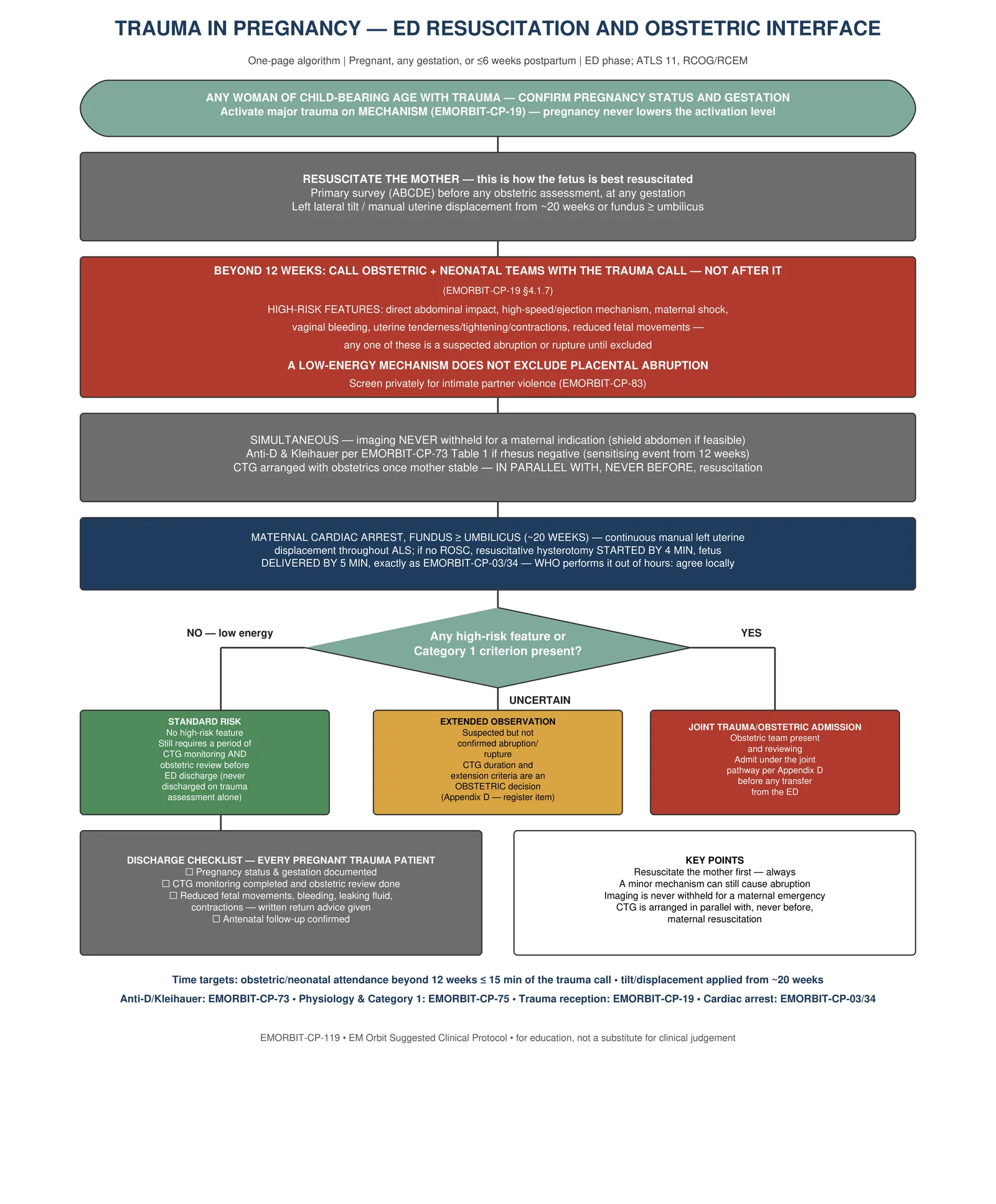
Evidence base: ATLS 11; RCOG
1Purpose
1.1 This protocol covers the Emergency Department (ED) front-door phase of care for a pregnant or recently delivered woman with trauma. It does not replace your institution's own guideline on obstetric trauma management, which is not restated here; definitive obstetric-trauma management follows that guideline, and the clinical content below should be checked against it before use.
1.2 State the governing principle: resuscitate the mother — this is how the fetus is best resuscitated. Maternal stabilisation is never deferred to, or compromised for, a fetal assessment.
1.3 Cover recognition at triage or arrival, the first-hour ED actions and time targets, and disposition and handover into Appendix D and Obstetrics; definitive obstetric assessment, cardiotocograph (CTG) interpretation and duration, and inpatient obstetric or neonatal care remain governed there and are not restated.
1.4 Set out the gestation-linked thresholds already fixed by other ED guidelines — team activation, positioning, anti-D/Kleihauer, and resuscitative hysterotomy timing — in one place (Table 1, Attachment 2), each matched exactly to the guideline that owns it, so nothing is duplicated or restated with a different figure.
1.5 Align with Advanced Trauma Life Support (ATLS) 11th edition and RCOG/RCEM joint guidance on the pregnant trauma patient, alongside the institutional appendix. Point to EMORBIT-CP-19 (Major Trauma — ED Reception), EMORBIT-CP-64 (Abdominal and Pelvic Trauma), EMORBIT-CP-75 (Maternal-Fetal Triage), EMORBIT-CP-73 (Early Pregnancy — anti-D and Kleihauer), EMORBIT-CP-27 (Massive Haemorrhage) and EMORBIT-CP-03/EMORBIT-CP-34 (Cardiac Arrest / Traumatic Cardiac Arrest — resuscitative hysterotomy).
2Who this protocol applies to
2.1 Any woman known or stated to be pregnant, at any gestation, or within 6 weeks of delivery, miscarriage or termination of pregnancy (the postpartum definition in EMORBIT-CP-75), presenting to the ED with trauma of any mechanism, blunt or penetrating.
2.2 Any woman of child-bearing age with trauma whose pregnancy status is unknown, pending the pregnancy test obtained by the treating team under EMORBIT-CP-73/EMORBIT-CP-19.
2.3 Patients pre-alerted by ambulance as pregnant with trauma, and patients transferred from another facility.
3Not covered by this protocol
3.1 Trauma in a woman confirmed not pregnant and outside the postpartum window: managed under EMORBIT-CP-19 and EMORBIT-CP-64 alone.
3.2 Non-traumatic pregnancy presentations: bleeding or pain in early pregnancy (EMORBIT-CP-73), hypertensive disorders of pregnancy (EMORBIT-CP-74), and general obstetric triage (EMORBIT-CP-75) — this guideline applies only where trauma is the presenting problem.
3.3 Definitive obstetric assessment, CTG interpretation and duration, tocolysis, and inpatient obstetric or neonatal care: governed by Appendix D and by Obstetrics.
3.4 Resuscitative hysterotomy technique and timing: governed by EMORBIT-CP-03 §4.1.6 and EMORBIT-CP-34, cross-referenced in section 4.3.3, not restated.
3.5 Non-traumatic maternal cardiac arrest: managed under EMORBIT-CP-03 in full.
4Protocol
4.1History and Assessment:
4.1.1Triage and Recognition:
4.1.1.1 Activate as major trauma on mechanism per EMORBIT-CP-19, whatever the gestation; pregnancy does not lower the activation level, and a normal blood pressure in a pregnant trauma patient is not reassurance (EMORBIT-CP-19 §4.1.4) — she compensates and then decompensates abruptly.
4.1.1.2 Ask, or confirm, pregnancy status and gestation (or the date of a recent pregnancy event) in every woman of child-bearing age with trauma, per EMORBIT-CP-73/EMORBIT-CP-75; the triage nurse asks and escalates, and does not perform the pregnancy test.
4.1.1.3 Beyond 12 weeks' gestation: call the obstetric and neonatal teams to attend WITH the trauma call, not after it (EMORBIT-CP-19 §4.1.7, Table 1 Attachment 2). Assign left lateral tilt or manual uterine displacement to a named team member at the moment of arrival, from approximately 20 weeks (Table 1). Record the fundal height and the time of the last fetal movement on arrival.
4.1.1.4 Declare "trauma in pregnancy" aloud so the team applies this guideline's additions to the standard trauma sequence from the first minute, not after the primary survey.
4.1.2History:
4.1.2.1 Mechanism in full — direct abdominal blow, deceleration, seatbelt position and type, ejection, fall, assault, road-traffic collision speed and role (driver, passenger, pedestrian) — a low-energy mechanism does not exclude placental abruption.
4.1.2.2 Gestation by dates or scan; fetal movements; contractions, tightening or vaginal bleeding or fluid loss since the injury; previous obstetric history and complications; rhesus status if known; current medication and allergies.
4.1.2.3 Screen privately for intimate partner violence — pregnancy is a recognised time of increased risk, and trauma may itself be its consequence — per EMORBIT-CP-83; document sensitively and act on any disclosure.
4.1.3Examination:
4.1.3.1 Full ABCDE primary survey first, at any gestation; obstetric examination (fundal height, uterine tone and tenderness, contractions, vaginal loss) follows once the primary survey is complete, or is performed alongside it by the obstetric team once present, and never delays maternal resuscitation.
4.1.3.2 Interpret every vital sign against the pregnancy-adjusted physiology in EMORBIT-CP-75 Table 1 (not restated here): a "normal" heart rate or blood pressure may already reflect compensation for haemorrhage.
4.1.3.3 Examine specifically for signs of placental abruption (uterine tenderness, a tense or "woody" uterus, contractions, vaginal bleeding — bleeding may be entirely concealed) and for uterine rupture (severe pain, loss of contour, palpable fetal parts, maternal shock out of proportion to visible loss).
4.1.4Risk Stratification and Severity:
4.1.4.1 High risk — treat as a major obstetric-trauma emergency: any Category 1 criterion of EMORBIT-CP-75; direct abdominal impact; high-speed or ejection mechanism; maternal shock; vaginal bleeding; uterine tenderness, tightening or contractions; reduced or absent fetal movements; suspected abruption or uterine rupture; any major trauma activation criterion of EMORBIT-CP-19.
4.1.4.2 Standard risk — assess and observe: a lower-energy mechanism (fall from standing, minor road-traffic collision) without a high-risk feature — still warrants a period of CTG monitoring and obstetric review before discharge (section 4.3.5), because abruption can follow apparently minor trauma.
4.1.5Differential Diagnosis:
4.1.5.1 Physiological mimics of shock in pregnancy, per EMORBIT-CP-75 Table 1 (not restated): supine hypotension from aortocaval compression, corrected by tilt/displacement before further haemodynamic work-up.
4.1.5.2 Placental abruption and uterine rupture as causes of shock disproportionate to visible external blood loss; a non-traumatic obstetric emergency (pre-eclampsia, eclampsia) coinciding with or precipitating the traumatic event.
4.1.6Special Populations:
4.1.6.1 Postpartum, post-miscarriage and post-termination (up to 6 weeks): the same recognition and gestation-linked thresholds at their most recent value apply; involve obstetrics as for an ongoing pregnancy where relevant to the mechanism.
4.1.6.2 Pre-viable and early gestation: the primary survey, tilt threshold and imaging principle (section 4.2) are unchanged; obstetric involvement and the extent of fetal assessment are an obstetric decision.
4.1.6.3 Suspected intimate partner violence: manage per EMORBIT-CP-83; safety planning and disclosure never delay trauma care.
4.2Investigations:
4.2.1 Diagnostic imaging, including computed tomography and plain radiography, is never withheld from a pregnant trauma patient when it is clinically indicated (EMORBIT-CP-19 §4.2: a negative or pending pregnancy test never delays imaging in the unstable patient); shield the abdomen where this does not delay or degrade an essential study.
4.2.2 Group and save/crossmatch, venous or arterial blood gas with lactate, and coagulation, per EMORBIT-CP-19/EMORBIT-CP-27; send the pregnancy test per EMORBIT-CP-73 in any woman whose status is not already known, without delaying resuscitation or imaging.
4.2.3 Anti-D and Kleihauer/flow cytometry: apply EMORBIT-CP-73 Table 1 (Attachment 2) exactly — every rhesus D negative pregnant trauma patient is a potentially sensitising event from 12 weeks; not restated in full here.
4.2.4 Fetal assessment — a period of cardiotocography, arranged with the obstetric team once the mother is stable, is arranged in parallel with, and never before, maternal resuscitation and imaging (identical wording to EMORBIT-CP-75/EMORBIT-CP-74). Its duration and the criteria for extending it are an obstetric decision, not stated in this protocol — see the institutional appendix.
4.3Plan of Care:
4.3.1Immediate Actions:
4.3.1.1 Primary survey (ABCDE) takes priority over any obstetric assessment, at any gestation; resuscitate the mother first — this is how the fetus is best resuscitated.
4.3.1.2 Left lateral tilt, or manual uterine displacement where the patient must remain supine (trauma board, imaging table), from approximately 20 weeks (Table 1); do not compromise chest compression quality for tilt if the patient is in cardiac arrest (section 4.3.3).
4.3.1.3 Oxygen, two large-bore intravenous lines, and blood rather than large-volume crystalloid where haemorrhage is suspected — activate EMORBIT-CP-27 on any trigger.
4.3.2Definitive ED Action:
4.3.2.1 Confirm obstetric and neonatal team attendance for any pregnancy beyond 12 weeks (section 4.1.1); proceed with trauma resuscitation per EMORBIT-CP-19/EMORBIT-CP-64 in parallel, not waiting for their arrival.
4.3.2.2 High-risk feature present (section 4.1.4): admit under the joint trauma/obstetric pathway per Appendix D; obstetric review before any disposition decision.
4.3.2.3 Standard risk, no high-risk feature: a period of CTG monitoring (duration per Appendix D/obstetric decision) and obstetric review before discharge is still required (section 4.3.5) — trauma in pregnancy is never discharged on the trauma assessment alone.
4.3.3Escalation — Maternal Cardiac Arrest:
4.3.3.1 Cardiac arrest at a gestation with the fundus at or above the umbilicus (approximately 20 weeks): continuous manual left uterine displacement throughout resuscitation, and proceed to resuscitative hysterotomy — started by 4 minutes and the fetus delivered by 5 minutes from the onset of arrest if there is no return of spontaneous circulation — exactly as per EMORBIT-CP-03 §4.1.6 and EMORBIT-CP-34. Performed in the resuscitation room without moving the patient, for maternal benefit; not restated in full here. The procedure is performed by the most senior trained clinician present, including out of hours.
4.3.3.2 Where the traumatic cardiac arrest reversible-causes bundle applies (penetrating mechanism, suspected chest or haemorrhagic cause), run it per EMORBIT-CP-34 alongside the hysterotomy pathway above; the two are not sequential.
4.3.4Monitoring and Reassessment:
4.3.4.1 Continue left lateral tilt or displacement throughout the ED stay from 20 weeks; reassess vital signs against EMORBIT-CP-75 Table 1, not the standard adult range; repeat observations at the interval set by the trauma activation level (EMORBIT-CP-19) or the EMORBIT-CP-29 triage category, whichever is higher acuity.
4.3.5Disposition:
4.3.5.1 High risk (section 4.1.4): admit under the joint trauma/obstetric pathway per Appendix D, with obstetric review completed before transfer from the ED.
4.3.5.2 Every pregnant trauma patient, however minor the mechanism, has obstetric review and a period of CTG monitoring before ED discharge — abruption can follow apparently trivial trauma; this is not an ED-only disposition.
4.3.5.3 Maternal cardiac arrest with hysterotomy performed, or ROSC achieved: handover per EMORBIT-CP-03/EMORBIT-CP-34 and to the neonatal team for the delivered infant.
4.3.6Discharge and Follow-up:
4.3.6.1 Written safety-netting covering reduced fetal movements, bleeding, leaking fluid, contractions, severe headache, visual disturbance and epigastric pain, with an instruction to return immediately, after obstetric review and CTG have been completed (section 4.3.5); confirm antenatal follow-up is in place.
4.3.7Documentation and Reporting:
4.3.7.1 Record: mechanism, gestation or pregnancy-event date, time of obstetric/neonatal team attendance, time tilt/displacement was applied, the anti-D and Kleihauer decision (by reference to EMORBIT-CP-73), CTG outcome and its duration, and — where arrest occurred — the hysterotomy decision, its time and who performed it.
4.3.7.2 Report through the local incident reporting system any delay to obstetric/neonatal team attendance beyond 12 weeks, any trauma discharge without the obstetric review and CTG in section 4.3.5, and any case in which the operator for resuscitative hysterotomy was unclear in practice.
5Algorithm
The one-page algorithm is shown at the top of this page.
6Team roles
The roles below are additional to, and consistent with, those defined in EMORBIT-CP-19 and Appendix D.
6.1Triage Nurse: Ask the pregnancy questions of every woman of child-bearing age with trauma; record gestation or pregnancy-event date; activate major trauma on mechanism regardless of gestation; escalate immediately. Does not perform the pregnancy test.
6.2Trauma Team Leader / ED Physician: Confirm obstetric/neonatal team activation beyond 12 weeks; assign tilt/displacement from 20 weeks at arrival; lead the primary survey ahead of any obstetric assessment; make or confirm the disposition decision (section 4.3.5).
6.3Obstetric/Midwifery Team: Attend on activation for any pregnancy beyond 12 weeks with trauma; arrange and interpret CTG once the mother is stable; perform the pre-discharge obstetric review; direct further obstetric management under Appendix D.
6.4General/Trauma Surgery: Lead haemorrhage control and any surgical decision as for any major trauma patient (EMORBIT-CP-19); attend for suspected uterine rupture alongside obstetrics.
6.5ED Pharmacist: Confirm anti-D availability and dosing (EMORBIT-CP-73); advise on medication safety in pregnancy for any trauma-related drug.
6.6Laboratory and Radiology: Process the pregnancy test, group and save/crossmatch and Kleihauer urgently; proceed with clinically indicated imaging without delay, using abdominal shielding where it does not compromise the study.
6.7Ambulance and Pre-hospital Providers: Pre-alert the ED for any trauma patient known or stated to be pregnant, stating gestation, mechanism and any pre-hospital intervention.
7The patient's role
7.1 Tell staff, as soon as possible, if you are pregnant or have been pregnant, delivered, miscarried, or had a termination of pregnancy in the last 6 weeks.
7.2 Report reduced fetal movements, bleeding, leaking fluid, contractions, or worsening pain at any point during the ED stay, including after the initial assessment.
7.3 Family and carers: raise any concern about the woman's condition, or about how the injury occurred, with staff.
8Definitions
The definitions in EMORBIT-CP-75 and EMORBIT-CP-19 (Major Trauma — ED Reception) apply in full. The following are additional terms used in this protocol.
8.1Appendix D (Obstetric Trauma Management Guidelines): the section of EMORBIT-CP-19 (Major Trauma — ED Reception) governing definitive obstetric-trauma care; adopted in full by this protocol and named in EMORBIT-CP-19 §4.1.7.
8.2Left Lateral Tilt / Uterine Displacement: positioning that shifts the gravid uterus off the aorta and inferior vena cava, relieving aortocaval compression, applied from approximately 20 weeks' gestation.
8.3Resuscitative Hysterotomy (Perimortem Caesarean Section): emergency delivery performed during maternal cardiac arrest for maternal benefit; technique and timing are governed by EMORBIT-CP-03 and cross-referenced in EMORBIT-CP-34.
8.4Placental Abruption: premature separation of a normally sited placenta, which can follow trauma of any severity and may present with entirely concealed haemorrhage.
9Attachments
- Attachment 1: One-page algorithm (top of this page)
- Attachment 2: Gestation-Linked Thresholds Quick Reference
11Suggested quality indicators
11.1Pregnancy status documented at trauma triage: (Number of women of child-bearing age with trauma who have pregnancy status and, where applicable, gestation documented at triage / Total number of such women triaged) × 100. Target ≥ 95%.
11.2Time to obstetric/neonatal team attendance beyond 12 weeks: (Number of pregnant trauma patients beyond 12 weeks with obstetric/neonatal attendance within 15 minutes of the trauma call / Total number of such patients) × 100. Target ≥ 90%.
11.3Correct positioning from 20 weeks: (Number of pregnant trauma patients ≥ 20 weeks receiving imaging, a procedure, or resuscitation with left lateral tilt or manual uterine displacement documented / Total number of such patients) × 100. Target ≥ 90%.
11.4Obstetric review and CTG before discharge: (Number of pregnant trauma patients discharged from the ED with obstetric review and a period of CTG monitoring documented / Total number of pregnant trauma patients discharged from the ED) × 100. Target 100%.
11.5Outcome indicator (monitored, no fixed ED target): incidence of placental abruption or fetal loss diagnosed after ED discharge following trauma, reported as a patient safety incident.
13References
- American College of Surgeons Committee on Trauma. Advanced Trauma Life Support (ATLS) Student Course Manual, 11th ed. Chicago: American College of Surgeons; 2018. (Trauma in Pregnancy chapter.)
- Royal College of Obstetricians and Gynaecologists / Royal College of Emergency Medicine. Guidance on the management of the pregnant trauma patient.
- Royal College of Obstetricians and Gynaecologists. Maternal Collapse in Pregnancy and the Puerperium. Green-top Guideline No. 56; 2019.
A2Attachment 2: Gestation-Linked Thresholds Quick Reference
For use at triage and in the initial ED assessment of any woman who is pregnant or within 6 weeks of delivery, miscarriage or termination of pregnancy, presenting with trauma.
| Action | From what gestation | Owning guideline |
|---|---|---|
| Obstetric and neonatal teams called with the trauma call, not after it | Beyond 12 weeks | EMORBIT-CP-19 §4.1.7 |
| Left lateral tilt, or manual uterine displacement if the patient must stay supine | From approximately 20 weeks (or fundus at/above the umbilicus) | EMORBIT-CP-19 / EMORBIT-CP-64 / EMORBIT-CP-75 |
| Anti-D and, from 20 weeks, a Kleihauer/flow cytometry test, for a rhesus D negative woman (trauma is a potentially sensitising event) | At or after 12 weeks (anti-D); 20 weeks (Kleihauer) | EMORBIT-CP-73 Table 7 — not restated |
| Resuscitative hysterotomy if there is no ROSC in maternal cardiac arrest: started by 4 minutes, fetus delivered by 5 minutes | Fundus at or above the umbilicus (approximately 20 weeks) | EMORBIT-CP-03 §4.1.6 / EMORBIT-CP-34 — not restated |
These four thresholds are not the same number for the same reason: 12 weeks triggers team activation; 20 weeks is the point aortocaval compression becomes physiologically significant. Do not merge them.