Traumatic Cardiac Arrest — Reversible-Causes Bundle and the Resuscitative Thoracotomy Decision
EMORBIT-CP-34 · Chapter 1 · Resuscitation and Critical Care
Open in the appFree, works on your phone and offline, with every tool alongside.
Evidence base: RCEM; ERC 2021; ATLS 11
1Purpose
1.1 This protocol covers the Emergency Department (ED) front-door phase of traumatic cardiac arrest, section 1.8 "Traumatic Cardiac Arrest" and its Appendix B of your institution's Major Trauma Management Policy. It does not replace, amend, or restate that policy. Note: the full policy text has not yet been reconciled against every point of clinical content below; verify locally before relying on it.
1.2 State, for the ED team, that correcting the reversible causes of traumatic cardiac arrest — haemorrhage control, airway, bilateral thoracostomy, and blood — takes priority over chest compressions and adrenaline, which alone rarely restore an output in hypovolaemic or obstructive traumatic arrest.
1.3 Set out the resuscitative thoracotomy decision with criteria identical to EMORBIT-CP-63 (Chest Trauma), so the same decision reads the same way from either guideline, and state who decides and when it is stood down.
1.4 State the basis for the decision to stop resuscitation in traumatic cardiac arrest.
1.5 Align with the Royal College of Emergency Medicine (RCEM) Best Practice Guideline, Traumatic Cardiac Arrest in Adults (2022); the European Resuscitation Council (ERC) 2021 guideline on cardiac arrest in special circumstances; and Advanced Trauma Life Support (ATLS) 11th edition.
2Who this protocol applies to
2.1 Patients 13 years and over (the local adult threshold) in cardiac arrest from blunt or penetrating trauma, occurring in or arriving at the ED with no signs of life, or with signs of life lost en route.
2.2 Peri-arrest trauma patients in whom a reversible traumatic cause (haemorrhage, tension pneumothorax, tamponade, hypoxia) is identified or strongly suspected and the bundle in section 4.3.1 is indicated pre-emptively.
3Not covered by this protocol
3.1 Non-traumatic cardiac arrest: managed under EMORBIT-CP-03 (Adult Cardiac Arrest) in full.
3.2 Children under 13 years in traumatic cardiac arrest: managed under EMORBIT-CP-24 (Paediatric Arrest), which already carries the same bundle scaled to the child — bilateral thoracostomy, blood components 10 mL/kg with tranexamic acid, pelvic binder and long-bone splintage — and is not restated here.
3.3 Trauma team activation, ATMIST, roles, damage-control resuscitation outside the arrest itself, disposition and transfer: governed by EMORBIT-CP-19 (Major Trauma — ED Reception) and the policy; this guideline supplies only the arrest-specific sequencing and the thoracotomy decision.
3.4 The massive haemorrhage and transfusion protocol, and the decompression/chest-drain technique: governed by EMORBIT-CP-27 and EMORBIT-CP-43 respectively; this guideline states only the point at which each is triggered inside the arrest sequence.
3.5 Resuscitative hysterotomy technique and timing for the pregnant patient at or above 20 weeks: governed by EMORBIT-CP-03 (section 4.1.6), cross-referenced in Special Populations below, not restated.
3.6 Cardiac arrest with a non-traumatic cause coexisting with trauma (for example a medical collapse causing a road traffic collision): assessed as it arises and may require both this guideline and EMORBIT-CP-03.
4Protocol
4.1History and Assessment:
4.1.1Triage and Recognition:
4.1.1.1 Any patient with no signs of life (no central pulse, no respiratory effort, no response) and a mechanism of trauma is a Category 1 activation to the resuscitation area as per EMORBIT-CP-19; the trauma call and, where penetrating chest trauma is described, a request for the on-call general/trauma surgeon are made in the same call.
4.1.1.2 The ten-second round (EMORBIT-CP-19) still applies where the crew is present; it is omitted only where the patient is in extremis, per that guideline.
4.1.1.3 Declare "traumatic cardiac arrest" aloud so that the reversible-causes bundle (section 4.3.1), not the standard non-traumatic arrest sequence, is what the team starts.
4.1.2History:
4.1.2.1 From the ATMIST and any bystander: mechanism, blunt or penetrating, time the signs of life were lost, whether witnessed, and time since injury — this bears directly on the thoracotomy decision (section 4.3.2).
4.1.2.2 Pre-hospital interventions and their times: tourniquet, pelvic binder, decompression, airway, fluids or blood, and duration of pre-hospital cardiopulmonary resuscitation (CPR).
4.1.3Examination:
4.1.3.1 A rapid, simultaneous four-part screen while the bundle is started: airway and chest movement; bilateral breath sounds; extended focused assessment with sonography in trauma (eFAST) for pericardial fluid and free intraperitoneal fluid; pelvis and long bones for deformity or instability.
4.1.3.2 Absent pupillary reactivity alone is not a reason to stop resuscitation in the acute phase and is not part of this decision.
4.1.4Risk Stratification – Severity:
4.1.4.1 Penetrating mechanism with recently witnessed signs of life: the group most likely to benefit from the bundle and, where chest-specific, from resuscitative thoracotomy (section 4.3.2).
4.1.4.2 Blunt mechanism, or signs of life lost for a prolonged or unwitnessed period: survival is markedly lower; the bundle is still performed in full, but thoracotomy is not undertaken without a clear, treatable cause found on eFAST or examination (section 4.3.2).
4.1.5Differential Diagnosis:
4.1.5.1 A medical cause preceding the traumatic event (myocardial infarction, arrhythmia, seizure, hypoglycaemia) that itself caused the collapse or crash: consider and treat per EMORBIT-CP-03 alongside this guideline where suggested by history.
4.1.6Special Populations:
4.1.6.1 Pregnancy at or above 20 weeks, or a uterus palpable at or above the umbilicus: apply continuous manual left uterine displacement without compromising compression quality; if there is no return of spontaneous circulation (ROSC), resuscitative hysterotomy is started by 4 minutes and the fetus delivered by 5 minutes, exactly as per EMORBIT-CP-03 section 4.1.6 — not restated in full here. It is performed in the resuscitation room without moving the patient, for maternal benefit, alongside the bundle in section 4.3.1.
4.1.6.2 Children under 13 years: follow EMORBIT-CP-24 in full (Clinical Exclusion Criteria, above).
4.1.6.3 Anticoagulated patients: haemorrhage control and reversal per EMORBIT-CP-27 and EMORBIT-CP-89 proceed alongside the bundle; do not delay the bundle to establish anticoagulant status.
4.2Investigations:
4.2.1 eFAST is performed at the bedside during the initial assessment and repeated at a rhythm check, in 10 seconds or less, without extending any pause — the same rule as EMORBIT-CP-03; it distinguishes true cardiac standstill from organised cardiac activity with no output, identifies tamponade, and identifies free intraperitoneal fluid.
4.2.2 Point-of-care blood gas for potassium, ionised calcium, haemoglobin and lactate, and a group-and-save or crossmatch sample, taken on the first vascular access — never delaying the bundle.
4.2.3 No investigation shall interrupt the reversible-causes bundle, chest compressions, or defibrillation of a shockable rhythm.
4.3Plan of Care:
4.3.1Immediate Actions — the Reversible-Causes Bundle:
4.3.1.1 In traumatic cardiac arrest, correcting the reversible causes takes priority over chest compressions and adrenaline. The five actions in Table 1 are started simultaneously, by name-allocated roles, alongside — not instead of — standard resuscitation; adrenaline is not relied upon as the primary treatment.
4.3.1.2
Table 1: The reversible-causes bundle — performed simultaneously, before or alongside chest compressions and adrenaline Action How Who / cross-reference Control catastrophic external haemorrhage Direct pressure, tourniquet, haemostatic dressing, pelvic binder Procedure doctor at the bedside — EMORBIT-CP-19, EMORBIT-CP-27 Open and secure the airway with 100% oxygen Airway manoeuvre, adjunct or definitive airway; ventilate — do not hyperventilate Airway operator — EMORBIT-CP-31 Bilateral finger thoracostomy Fourth or fifth intercostal space, mid-axillary line, within the safe triangle — for any suspected chest cause, regardless of examination findings; decompress the other side if the patient remains compromised after one Procedure doctors, one each side — technique per EMORBIT-CP-43 (not restated here) Pelvic binder and long-bone splintage Confirm binder position over the greater trochanters; splint every long-bone deformity EMORBIT-CP-19 Blood, not crystalloid Activate the massive haemorrhage pathway; warmed blood components in an empirical ratio; tranexamic acid within 3 hours of injury EMORBIT-CP-27 (not restated here) Chest compressions and adrenaline Started and continued as for any arrest, but never in place of, and never delaying, the five actions above Compressors — EMORBIT-CP-03 for technique and drug doses These are the "universal actions" of your institution's Major Trauma Management Policy traumatic cardiac arrest pathway (section 1.8 and Appendix B), consistent with their description in EMORBIT-CP-03, EMORBIT-CP-19, EMORBIT-CP-24 and EMORBIT-CP-27. Roles for each action are allocated by name before or at the moment of arrest, as in EMORBIT-CP-19.
4.3.1.3 If a shockable rhythm (ventricular fibrillation or pulseless ventricular tachycardia) is identified at any point, defibrillate immediately per EMORBIT-CP-03 without interrupting the bundle.
4.3.2Resuscitative Thoracotomy Decision:
4.3.2.1 Applies where a chest cause is suspected or a penetrating chest or epigastric wound is present and the patient has arrested or is arresting despite the bundle.
4.3.2.2
Table 2: Resuscitative thoracotomy decision — identical criteria to EMORBIT-CP-63 Item Detail Best outcome group Penetrating chest trauma with witnessed signs of life lost within a short interval (in the range of 10 to 15 minutes) before or on arrival. Blunt traumatic cardiac arrest Outcomes are poor; thoracotomy is not indicated without a clear, treatable cause identified by eFAST or examination. Who decides The trauma team leader or a surgeon, at the bedside — not a reflex response. Stand-down Stood down the moment it is clear the criteria are not met. Coordination With EMORBIT-CP-27 for concurrent massive transfusion, and with EMORBIT-CP-63 for the same decision from the chest-trauma side. Status Note: the criteria, and who may make this decision out of hours, follow the hospital's policy. This table is reproduced without change from EMORBIT-CP-63 (Chest Trauma), section 4.3.5, so that the same decision reads identically from either guideline.
4.3.3Escalation and Refractory Cases:
4.3.3.1 If the patient remains in arrest once every element of the bundle (Table 1) has been completed and any indicated thoracotomy decision made, reassess for a cause not yet addressed (occult haemorrhage, missed contralateral pneumothorax, hypoxia from airway malposition) before considering the case refractory.
4.3.3.2 Call for senior surgical and critical-care presence at the bedside as soon as the case is recognised as traumatic cardiac arrest, not only once it becomes refractory.
4.3.4Monitoring and Reassessment:
4.3.4.1 Repeat eFAST at each rhythm check; a sudden sustained rise in end-tidal carbon dioxide indicates ROSC and prompts an immediate pulse check, exactly as in EMORBIT-CP-03.
4.3.4.2 Reassess both sides of the chest after any single thoracostomy: if the patient remains compromised, decompress the other side (bilateral tension occurs in trauma).
4.3.5Disposition:
4.3.5.1 ROSC achieved: hand over immediately into EMORBIT-CP-04 (Post-Cardiac Arrest Care) for the medical elements, while continuing haemorrhage control, the massive transfusion protocol, and urgent surgical or interventional radiology treatment per EMORBIT-CP-19 and the policy — these proceed together, not in sequence.
4.3.5.2 Resuscitative thoracotomy performed: immediate transfer to theatre or continued resuscitation in the operating theatre per the surgical team's direction.
4.3.5.3 Resuscitation stopped: see "Termination of Resuscitation" below; the medico-legal and mortuary pathway follows the hospital's policy and national law.
4.3.6Termination of Resuscitation:
4.3.6.1 The decision to stop is made by the most senior clinician present, after correcting every reversible cause the bundle addresses, stated aloud, timed, and documented — the same standard as EMORBIT-CP-03.
4.3.6.2 No cardiac activity on eFAST after the bundle is completed, particularly in blunt trauma with no signs of life on arrival, carries a very poor prognosis and supports stopping; ongoing organised cardiac activity on eFAST (pseudo-pulseless electrical activity), a shockable rhythm, or a reversible cause not yet corrected are reasons to continue.
4.3.6.3 Family shall be informed by a named clinician as soon as the decision is made, per EMORBIT-CP-03.
4.3.7Discharge and Follow-up:
4.3.7.1 Not applicable to the arrested patient; for the patient who achieves ROSC, discharge and follow-up are governed by the admitting surgical or critical-care team and EMORBIT-CP-04.
4.3.8Documentation and Reporting:
4.3.8.1 Record: time signs of life were lost (where known), time of arrival, time each element of the bundle was completed, eFAST findings and times, the thoracotomy decision with its time and decision-maker, the outcome, and — where resuscitation was stopped — the time and the name of the deciding clinician.
4.3.8.2 Report any delay to bilateral thoracostomy, to blood component administration, or to the thoracotomy decision through the local incident reporting system, and for departmental mortality and morbidity review.
5Algorithm
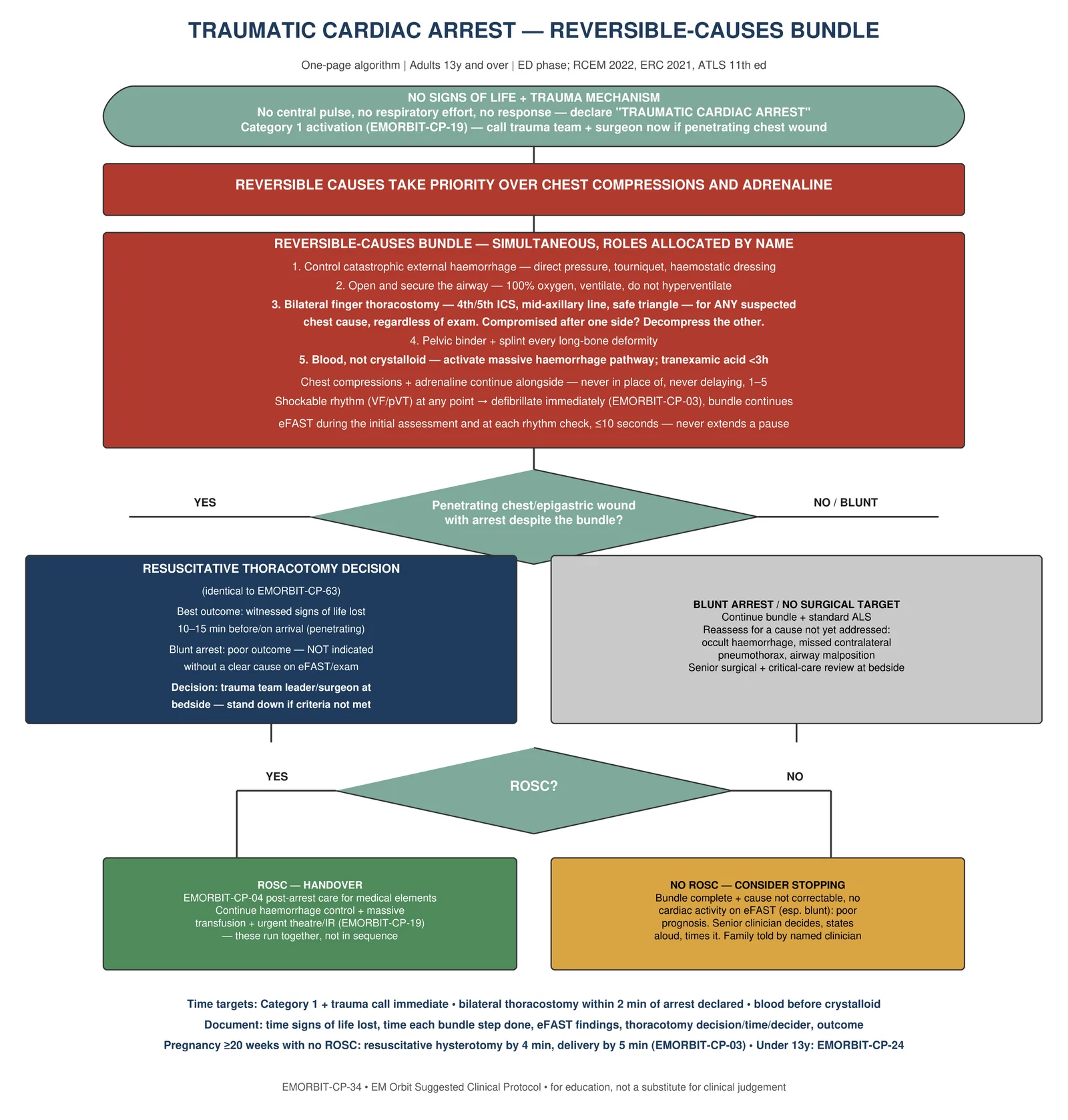
The one-page algorithm is shown at the top of this page.
6Team roles
6.1Triage/ED Nurses: Recognise absent signs of life with a trauma mechanism and activate Category 1 immediately; assist with the bundle; record every time point.
6.2ED Pharmacist: Verify tranexamic acid and any weight-based drug dose; confirm blood component availability with the transfusion laboratory.
6.3General/Trauma Surgery: Attend for any penetrating chest or epigastric wound with arrest or peri-arrest physiology; make or confirm the thoracotomy decision (Table 2); lead the theatre plan after ROSC or thoracotomy.
6.4Critical Care/Anaesthesia: Attend for airway control and post-ROSC stabilisation; support the massive transfusion protocol.
6.5Laboratory/Blood Bank: Issue emergency blood components without delay on activation, per EMORBIT-CP-27.
6.6Ambulance/Pre-hospital Providers: Pre-alert with the ATMIST, including the time signs of life were lost and any pre-hospital tourniquet, binder, decompression or blood, per EMORBIT-CP-19.
7The patient's role
7.1 Not applicable to the arrested patient. Family and carers: staff will explain what is happening and offer the opportunity to be present, per EMORBIT-CP-03.
8Definitions
8.1Traumatic Cardiac Arrest: cardiac arrest resulting from blunt or penetrating trauma, in which hypovolaemia, hypoxia, tension pneumothorax and tamponade are the predominant and often correctable causes, distinct from primary cardiac arrest.
8.2Signs of Life: any pupillary response, spontaneous movement, organised electrocardiographic activity, or respiratory effort, at the scene or on arrival.
8.3Reversible-Causes Bundle: the simultaneous set of actions in Table 1 — haemorrhage control, airway, bilateral thoracostomy, pelvic/limb splintage and blood — performed ahead of, and alongside, chest compressions and adrenaline.
8.4Resuscitative Thoracotomy: as defined in EMORBIT-CP-63 — emergency thoracotomy performed in the ED to relieve tamponade, control intrathoracic haemorrhage, or perform open cardiac massage and cross-clamp the aorta, in a patient in or approaching traumatic cardiac arrest.
9Attachments
- Attachment 1: One-page algorithm (top of this page)
- Attachment 2: Reversible-Causes Bundle and Resuscitative Thoracotomy Decision Quick Reference
11Suggested quality indicators
11.1Time to bilateral thoracostomy: (Number of traumatic cardiac arrests with bilateral thoracostomy performed within 2 minutes of the arrest being declared / Total number of traumatic cardiac arrests) × 100. Target ≥ 90%.
11.2Blood, not crystalloid, as first fluid: (Number of traumatic cardiac arrests in whom the first litre of resuscitation fluid was a blood component / Total number of traumatic cardiac arrests requiring volume replacement) × 100. Target ≥ 90%.
11.3Thoracotomy decision documented: (Number of resuscitative thoracotomy decisions with the decision-maker, the time, and the criterion met or not met documented / Total number of resuscitative thoracotomies considered) × 100. Target 100%.
11.4Survival to hospital admission (outcome indicator, monitored, no fixed ED target): (Number of traumatic cardiac arrests achieving ROSC sustained to admission / Total number of traumatic cardiac arrests) × 100.
13References
- Royal College of Emergency Medicine. Best Practice Guideline: Traumatic Cardiac Arrest in Adults. London: RCEM; 2022.
- Lott C, Truhlář A, Alfonzo A, et al. European Resuscitation Council Guidelines 2021: Cardiac arrest in special circumstances. Resuscitation. 2021;161:152–219.
- American College of Surgeons Committee on Trauma. Advanced Trauma Life Support (ATLS) Student Course Manual. 11th ed. Chicago: ACS; 2018.
- Burlew CC, Moore EE, Moore FA, et al. Western Trauma Association critical decisions in trauma: resuscitative thoracotomy. J Trauma Acute Care Surg. 2012;73(6):1359–1363.
- Seamon MJ, Haut ER, Van Arendonk K, et al. An evidence-based approach to patient selection for emergency department thoracotomy: a practice management guideline from the Eastern Association for the Surgery of Trauma. J Trauma Acute Care Surg. 2015;79(1):159–173.
A2Attachment 2: Reversible-Causes Bundle and Resuscitative Thoracotomy Decision Quick Reference
| Action | How | Who / cross-reference |
|---|---|---|
| Control catastrophic external haemorrhage | Direct pressure, tourniquet, haemostatic dressing, pelvic binder | Procedure doctor at the bedside — EMORBIT-CP-19, EMORBIT-CP-27 |
| Open and secure the airway with 100% oxygen | Airway manoeuvre, adjunct or definitive airway; ventilate — do not hyperventilate | Airway operator — EMORBIT-CP-31 |
| Bilateral finger thoracostomy | Fourth or fifth intercostal space, mid-axillary line, within the safe triangle — for any suspected chest cause, regardless of examination findings; decompress the other side if the patient remains compromised after one | Procedure doctors, one each side — technique per EMORBIT-CP-43 (not restated here) |
| Pelvic binder and long-bone splintage | Confirm binder position over the greater trochanters; splint every long-bone deformity | EMORBIT-CP-19 |
| Blood, not crystalloid | Activate the massive haemorrhage pathway; warmed blood components in an empirical ratio; tranexamic acid within 3 hours of injury | EMORBIT-CP-27 (not restated here) |
| Chest compressions and adrenaline | Started and continued as for any arrest, but never in place of, and never delaying, the five actions above | Compressors — EMORBIT-CP-03 for technique and drug doses |
These are the "universal actions" of your institution's Major Trauma Management Policy traumatic cardiac arrest pathway (section 1.8 and Appendix B), consistent with their description in EMORBIT-CP-03, EMORBIT-CP-19, EMORBIT-CP-24 and EMORBIT-CP-27. Roles for each action are allocated by name before or at the moment of arrest, as in EMORBIT-CP-19.
| Item | Detail |
|---|---|
| Best outcome group | Penetrating chest trauma with witnessed signs of life lost within a short interval (in the range of 10 to 15 minutes) before or on arrival. |
| Blunt traumatic cardiac arrest | Outcomes are poor; thoracotomy is not indicated without a clear, treatable cause identified by eFAST or examination. |
| Who decides | The trauma team leader or a surgeon, at the bedside — not a reflex response. |
| Stand-down | Stood down the moment it is clear the criteria are not met. |
| Coordination | With EMORBIT-CP-27 for concurrent massive transfusion, and with EMORBIT-CP-63 for the same decision from the chest-trauma side. |
| Status | Note: the criteria, and who may make this decision out of hours, follow the hospital's policy. |
This table is reproduced without change from EMORBIT-CP-63 (Chest Trauma), section 4.3.5, so that the same decision reads identically from either guideline.