Open Fractures and Traumatic Amputations
EMORBIT-CP-109 · Chapter 9 · Trauma and Musculoskeletal Emergencies
Open in the appFree, works on your phone and offline, with every tool alongside.
Evidence base: BOAST/NICE NG37
1Purpose
1.1 Provide a standardised, evidence-based framework for the ED recognition, immediate haemorrhage and wound management, IV antibiotic timing, and urgent combined orthopaedic–plastic–vascular referral of open fractures and traumatic amputations, in patients of all ages.
1.2 Ensure resuscitation and life-threatening injury always take priority over the limb, that neurovascular status is assessed and documented before and after every manipulation, and that hard signs of vascular injury go directly to the surgical team without waiting for imaging.
1.3 Ensure the first dose of IV antibiotic is given within 1 hour of arrival in every case, that the wound is photographed once, covered with a saline-soaked dressing and not re-explored in the ED, and that an amputated part is wrapped, bagged and cooled in ice-water — never placed directly on ice.
1.4 Align with BOAST: Open Fractures (BOAST 4), NICE NG37 and the Gustilo–Anderson classification, cross-checked against EMORBIT-CP-19 (Major Trauma), EMORBIT-CP-27 (Massive Haemorrhage), EMORBIT-CP-28 (Pain Management), EMORBIT-CP-56 (Tetanus), EMORBIT-CP-57 (Antimicrobial Stewardship) and EMORBIT-CP-66 (Acute Compartment Syndrome).
2Who this protocol applies to
2.1 Any patient of any age with a wound in communication with an underlying fracture (any Gustilo–Anderson type, I to IIIC) or with a suspected or confirmed traumatic amputation, complete or partial.
2.2 A limb with signs of vascular or neurological injury after high-energy trauma, even before a fracture is confirmed on imaging.
2.3 A mangled extremity — combined skeletal, soft-tissue, vascular and/or neural injury raising concern for limb viability.
3Not covered by this protocol
3.1 A closed fracture with intact overlying skin — managed under the relevant limb-fracture guideline (Lower Limb Injuries, Upper Limb Injuries, or Fragility Hip Fracture, EMORBIT-CP-65).
3.2 A simple laceration or degloving wound with no underlying fracture — managed as a soft-tissue wound.
3.3 Chronic or non-traumatic amputation stumps (surgical, vascular or diabetic) — not an ED trauma pathway.
4Protocol
4.1History and Assessment:
4.1.1Triage and Recognition:
4.1.1.1 Any exposed bone, a wound overlying a deformed limb, or a traumatic amputation shall be triaged no lower than Category 2, and Category 1 where there is uncontrolled haemorrhage, an ischaemic limb, or haemodynamic compromise.
4.1.1.2 Resuscitation and management of life-threatening injury takes priority over any limb problem (primary survey per EMORBIT-CP-19); the limb is never assessed before the airway, breathing and circulation.
4.1.2History:
4.1.2.1 Mechanism and time of injury (starts the tranexamic acid window and the antibiotic clock), energy transfer, environment (soil, water, sewage — changes contamination risk), and any pre-hospital tourniquet, dressing or splint with the time applied.
4.1.2.2 Tetanus immunisation history; anticoagulant, antiplatelet or bleeding-disorder history; allergy status, in particular to penicillins and cephalosporins.
4.1.3Examination:
4.1.3.1 Document distal neurovascular status before and after every splint, dressing, reduction or manipulation — a palpable pulse never excludes vascular injury (EMORBIT-CP-66 principle applies equally here).
4.1.3.2Hard signs of vascular injury (go directly to the surgical team, do not wait for imaging): active or pulsatile external haemorrhage, a rapidly expanding or pulsatile haematoma, a palpable thrill or audible bruit, or a hard-ischaemic limb (absent pulses, pallor, paraesthesia, pain, paralysis, poikilothermia).
4.1.3.3Soft signs of vascular injury (assess further, do not delay other care): a history of arterial bleeding now ceased, a wound proximate to a named artery, a small non-expanding haematoma, a nerve deficit adjacent to a named artery, reduced pulses, a high-risk mechanism (posterior knee or anterior elbow dislocation), or an ankle-brachial/arterial pressure index ≤ 0.9.
4.1.3.4 Assess and document the wound size, contamination and soft-tissue loss for the Gustilo–Anderson working estimate (Attachment 2, Table 1) — definitive typing occurs at surgical debridement.
4.1.4Risk Stratification – Severity: the Gustilo–Anderson classification and infection risk are set out in Attachment 2 (Table 1); it guides antibiotic and referral urgency and is not restated here.
4.1.5Differential Diagnosis:
4.1.5.1 Closed fracture with overlying pre-existing skin breach (not a true open fracture); isolated soft-tissue laceration without fracture; acute limb ischaemia of non-traumatic cause; evolving acute compartment syndrome (EMORBIT-CP-66) as a complication rather than the presenting diagnosis.
4.1.6Special Populations:
4.1.6.1 Children: physeal (growth-plate) involvement changes the surgical plan; pain and vascular assessment follow the same principles — a normal-looking colour and capillary refill do not exclude vascular injury. Use weight-based antibiotic dosing (Attachment 2, Table 2), checked against the product information.
4.1.6.2 Pregnancy and postpartum: apply the same haemorrhage-control and antibiotic-timing thresholds; involve obstetrics for any pregnant patient with major limb trauma.
4.1.6.3 Anticoagulated patients: correct coagulopathy per EMORBIT-CP-89 in parallel with, not instead of, immediate surgical referral; anticoagulation does not explain ongoing external bleeding — control it mechanically first.
4.2Investigations:
4.2.1 Plain radiographs of the injured limb, including the joint above and below; do not delay haemorrhage control, antibiotics or surgical referral while awaiting imaging.
4.2.2 Group and save or crossmatch according to estimated blood loss and the Massive Haemorrhage pathway (EMORBIT-CP-27) where activated.
4.2.3 Full blood count, coagulation, renal function (baseline before any aminoglycoside) and creatine kinase where crush or prolonged compression is suspected (EMORBIT-CP-66 rhabdomyolysis panel).
4.2.4 CT angiography for a limb with soft signs of vascular injury or an ankle-brachial/arterial pressure index ≤ 0.9; a limb with hard signs goes directly to the surgical/vascular team without waiting for CT angiography.
4.3Plan of Care:
4.3.1Immediate Actions:
4.3.1.1 Control external haemorrhage in this order: direct pressure; wound packing; an arterial tourniquet for compressible limb bleeding; direct clamping of a visible vessel only as a last resort. Apply the tourniquet per EMORBIT-CP-27 and write the time of application on the tourniquet and in the notes. Place the tourniquet 5–7 cm proximal to the wound (EMORBIT-CP-27).
4.3.1.2 Give tranexamic acid 1 g IV as soon as possible per EMORBIT-CP-27. Do NOT give tranexamic acid more than 3 hours after injury unless there is evidence of hyperfibrinolysis.
4.3.1.3 Photograph the wound once. Remove only gross surface debris — do not scrub, irrigate, probe or re-explore the wound in the ED. Cover with a saline-soaked gauze and an occlusive dressing, and do not remove or disturb that dressing again until theatre.
4.3.1.4 Realign gross deformity and splint the limb after analgesia (EMORBIT-CP-28); document distal neurovascular status immediately before and after.
4.3.1.5Traumatic amputation — the amputated part: wrap it in saline-soaked gauze, place it in a sealed bag, and place that bag in a container of ice-water. NEVER place the part in direct contact with ice or dry ice — direct contact freezes and destroys the tissue.
4.3.2Definitive ED Treatment – Escalation:
4.3.2.1 Give the first dose of IV antibiotic within 1 hour of arrival, always before the patient leaves the ED — co-amoxiclav or cefuroxime, clindamycin for genuine penicillin allergy (Attachment 2, Table 2).
4.3.2.2 Analgesia per EMORBIT-CP-28, titrated to effect; consider a fascia iliaca block (EMORBIT-CP-28, Table 7) for a femoral shaft or neck fracture once distal neurovascular status is documented.
4.3.2.3 Hard signs of vascular injury: call Vascular Surgery/Orthopaedics immediately and go directly to theatre or arteriography — do not wait for CT angiography or for the fracture to be typed.
4.3.2.4 A mangled or ischaemic limb, uncontrollable haemorrhage, or crush syndrome is a life- or limb-threatening emergency: escalate immediately in parallel with resuscitation; primary amputation is a decision for the surgical team, not the ED.
4.3.2.5 Watch for evolving acute compartment syndrome, particularly after a tibial fracture, crush injury or prolonged ischaemia — manage per EMORBIT-CP-66 if suspected.
4.3.3Monitoring and Reassessment:
4.3.3.1 Reassess distal neurovascular status at every handover, after every intervention, and at least hourly while the patient remains in the ED.
4.3.3.2 A tourniquet left in place is a time-critical device: communicate its presence and application time at every handover and to the receiving surgical team.
4.3.4Disposition:
4.3.4.1 Every Gustilo II or III open fracture, and every traumatic amputation, is referred to and admitted under the combined orthopaedic–plastic team, with vascular surgery where there is arterial injury (EMORBIT-CP-19 major trauma pathway where the mechanism qualifies). This is not discharged from the ED.
4.3.4.2 A genuinely low-energy, isolated Gustilo I fracture of a minor bone, with a reassuring neurovascular examination, may be considered by the treating orthopaedic team for discharge with next-day fracture-clinic follow-up only where local orthopaedic on-call policy confirms this pathway.
4.3.4.3 Decision to amputate a mangled limb is documented in the medical record and requires the sign-off of two of the three attending consultants (Orthopaedics, Vascular Surgery, Plastic Surgery) — an inpatient governance step, not an ED action.
4.3.5Discharge and Follow-up:
4.3.5.1 For the rare patient discharged under section 4.3.4: written safety-netting for increasing pain, numbness, weakness, spreading redness or fever; confirm antibiotic course, tetanus status (EMORBIT-CP-56 Table 5), and a booked fracture-clinic appointment before leaving.
4.3.6Documentation and Reporting:
4.3.6.1 Document: mechanism and time of injury, tourniquet application and (where removed) removal time, time of first antibiotic dose, neurovascular findings at every check, the photograph, vascular hard/soft signs, and the time of surgical referral and review.
4.3.6.2 Report through the local incident reporting system: any first antibiotic dose beyond 1 hour of arrival, and any tourniquet whose time of application was not recorded.
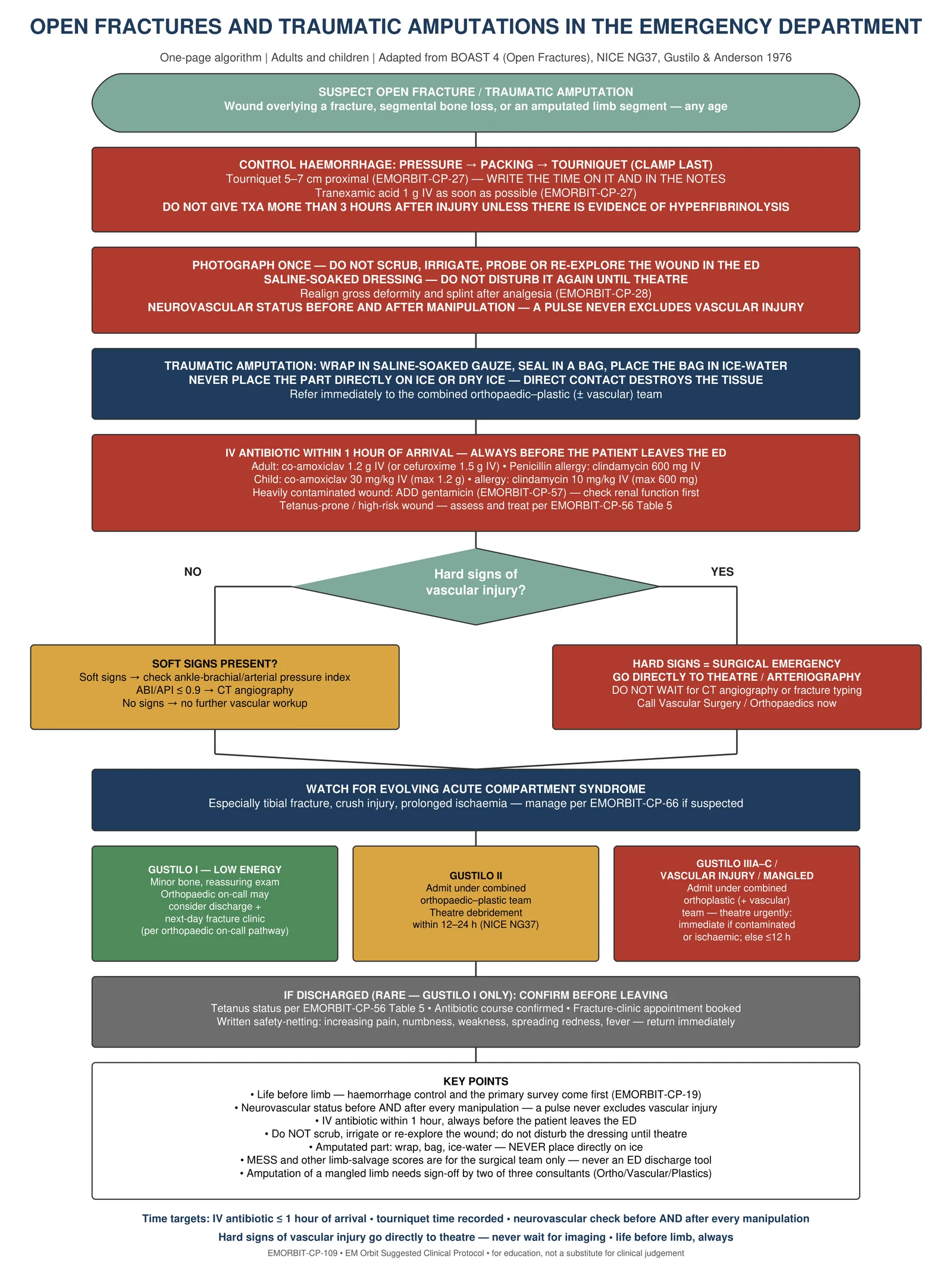
5Algorithm
The one-page algorithm is shown at the top of this page.
6Team roles
6.1Triage and ED Nurses Role:
6.1.1 Recognise an open wound overlying a deformed limb or a traumatic amputation, assign Category 1–2, and apply direct pressure or a tourniquet under the approved standing order (EMORBIT-CP-27) without waiting for physician review.
6.1.2 Take the single wound photograph, apply the saline-soaked dressing, and perform serial distal neurovascular observations at the frequency in section 4.3.3.
6.2Pharmacist:
6.2.1 Verify the antibiotic choice, dose and allergy status before every dose; confirm renal function before an aminoglycoside is added; support the paediatric dosing (Attachment 2, Table 2).
6.3Orthopaedic Surgery / Vascular Surgery / Plastic Surgery:
6.3.1 Attend immediately for hard signs of vascular injury; form the combined orthoplastic team for every Gustilo II/III fracture and traumatic amputation; perform debridement, fixation, vascular repair and the two-consultant amputation sign-off where indicated.
6.4Laboratory / Radiology:
6.4.1 Expedite group and save/crossmatch and plain radiographs; prioritise CT angiography for soft-sign or ankle-brachial-index-abnormal limbs without delaying ED first-hour actions.
6.5Ambulance / Pre-hospital Providers:
6.5.1 Report tourniquet site and application time, mechanism, and how an amputated part was packaged; hand over using the structured (ATMIST/SBAR) format.
7The patient's role
7.1 Report increasing pain, numbness, tingling or weakness in the injured limb immediately, including after a splint or dressing is applied.
7.2 Bring any amputated part and its container to hospital where safe to do so, and attend the arranged follow-up.
8Definitions
8.1Open Fracture: a fracture in communication with an overlying disruption of the skin; may be associated with a mangled limb.
8.2Gustilo–Anderson Classification: grades an open fracture by wound size and soft-tissue injury (Attachment 2, Table 1); assigned definitively at surgical debridement.
8.3Mangled Extremity: a severe combined skeletal, soft-tissue and/or neural injury raising concern for limb viability.
8.4Mangled Extremity Severity Score (MESS): a surgical decision-support score for limb salvage versus amputation; not an ED disposition tool.
8.5Traumatic Amputation: complete or partial separation of a limb segment at the time of injury.
8.6Tourniquet Time: the time an arterial tourniquet is applied, recorded on the device and in the notes; communicated at every handover.
9Attachments
- Attachment 1: One-page algorithm (top of this page)
- Attachment 2: Gustilo–Anderson Classification and Antibiotic/Tetanus Quick Reference
11Suggested quality indicators
11.1Time to first IV antibiotic dose ≤ 60 minutes from arrival: (Number of open-fracture/traumatic-amputation patients receiving the first antibiotic dose within 60 minutes of arrival / Total number of such patients) × 100. Target ≥ 90%.
11.2Tourniquet application time recorded: (Number of patients with a tourniquet applied whose application time is documented on the device and in the notes / Total number of patients with a tourniquet applied) × 100. Target 100%.
11.3Neurovascular status documented before and after every manipulation: (Number of cases with a documented pre- and post-manipulation neurovascular examination / Total number of open-fracture/traumatic-amputation cases requiring manipulation) × 100. Target ≥ 95%.
11.4Safe disposition: (Number of Gustilo II/III and traumatic-amputation patients admitted under the combined orthopaedic–plastic (± vascular) team with no ED discharge / Total number of such patients) × 100. Target 100%.
11.5Unplanned return or deep infection within 30 days: monitored as an outcome indicator without a fixed target, reviewed case-by-case at departmental audit.
13References
- Gustilo RB, Anderson JT. Prevention of infection in the treatment of one thousand and twenty-five open fractures of long bones. J Bone Joint Surg Am. 1976;58(4):453–458.
- National Institute for Health and Care Excellence. Fractures (complex): assessment and management. NICE guideline NG37. London: NICE; 2016.
- British Orthopaedic Association / British Association of Plastic, Reconstructive and Aesthetic Surgeons. BOAST: Open Fractures (BOAST 4). London: BOA.
- Nanchahal J, Nayagam S, Khan U, et al. Standards for the Management of Open Fractures of the Lower Limb. London: Royal Society of Medicine Press.
A2Attachment 2: Gustilo–Anderson Classification and Antibiotic/Tetanus Quick Reference
| Type | Wound | Soft tissue / contamination | Infection risk |
|---|---|---|---|
| I | < 1 cm | Clean, minimal contamination | 0–2% |
| II | > 1 cm | Moderate soft-tissue injury and contamination | 2–5% |
| IIIA | Usually large | Severe soft-tissue injury, highly contaminated, but bone adequately covered | 5–10% |
| IIIB | Usually large | Extensive soft-tissue loss, exposed bone, periosteal stripping, massive contamination — needs flap cover | 10–50% |
| IIIC | Usually large | Associated arterial injury requiring repair | 25–50% |
Type is assigned definitively at surgical debridement, not in the ED; an ED working estimate guides antibiotic and referral urgency only. The Mangled Extremity Severity Score (MESS) and other limb-salvage scores are decision-support tools for the surgical team's salvage/amputation decision — they are NOT used by the ED to decide disposition or discharge.
| Situation | Adult dose | Paediatric dose (check against the product information) |
|---|---|---|
| Every open fracture / traumatic amputation — first-line | Co-amoxiclav 1.2 g IV (matches EMORBIT-CP-19); alternative cefuroxime 1.5 g IV | Co-amoxiclav 30 mg/kg IV (max 1.2 g); cefuroxime 50 mg/kg IV (max 1.5 g) |
| Genuine penicillin/cephalosporin allergy | Clindamycin 600 mg IV (matches EMORBIT-CP-19) | Clindamycin 10 mg/kg IV (max 600 mg) |
| Heavily contaminated wound (soil, agricultural, aquatic, sewage) | ADD gentamicin — dosed per the local aminoglycoside table (Antimicrobial Stewardship, EMORBIT-CP-57); check renal function first | Not established |
| Tetanus prophylaxis | An open fracture is at minimum a tetanus-prone wound, and a contaminated or delayed one is high-risk — assess and treat per EMORBIT-CP-56 Table 5 |
Confirm allergy status before every dose. Repeat the antibiotic at the time of surgical debridement; do not continue prophylaxis beyond 72 hours after injury, or until definitive soft-tissue closure, whichever is sooner (NICE NG37). Doses to be verified by Clinical Pharmacy; the aminoglycoside add-on and every paediatric dose are register items with no confirmed local source (Antimicrobial Stewardship, EMORBIT-CP-57, Table 13).