Fragility Hip Fracture and Femoral Fractures, including the Fascia Iliaca Block
EMORBIT-CP-65 · Chapter 9 · Trauma and Musculoskeletal Emergencies
Open in the appFree, works on your phone and offline, with every tool alongside.
Evidence base: NICE CG124; BOAST; RCEM
1Purpose
1.1 Provide a standardised, evidence-based framework for the recognition, imaging, early analgesia (including the fascia iliaca block), frailty care, and disposition of adults with a suspected or confirmed fragility hip fracture or femoral shaft fracture in the Emergency Department (ED).
1.2 Ensure the fascia iliaca block is offered to every eligible patient as time-critical analgesia, with the agent, dose, competency and observation standards stated explicitly, and every disagreement between the local protocol and national guidance reported rather than silently resolved.
1.3 Ensure the frailty bundle — delirium screening with the 4AT, pressure-area care, fluid balance and anticoagulant review — is applied to every patient, and that the orthogeriatric pathway and the time-to-theatre target are followed without avoidable delay.
1.4 Align practice with NICE Clinical Guideline CG124 (Hip fracture: management), BOAST / British Orthopaedic Association standards, the RCEM Best Practice Guideline on the fascia iliaca block, and the Association of Anaesthetists 2020 guideline for hip fracture management.
2Who this protocol applies to
2.1 Adults (13 years and over — the local adult age boundary) presenting with hip, groin or thigh pain after a fall or direct trauma, with or without an inability to weight-bear, in whom a hip (proximal femoral) or femoral shaft fracture is suspected.
2.2 Patients with a normal initial X-ray but persisting clinical suspicion of an occult hip fracture.
2.3 Patients with a confirmed pathological fracture of the proximal or shaft femur.
2.4 Hip fracture as part of a major trauma presentation — imaging and analgesia as below, but activate the major trauma pathway (EMORBIT-CP-19) for the primary survey and associated injuries.
3Not covered by this protocol
3.1 Isolated soft-tissue hip or thigh injury with a normal examination, able to weight-bear, and no red flag — managed as musculoskeletal injury without this pathway.
3.2 Established periprosthetic or peri-implant fracture around a previous hip replacement with a clear alternative orthopaedic pathway already in place locally (manage per that pathway; analgesia and the fascia iliaca block sections of this guideline still apply).
3.3 Open fracture or traumatic amputation — managed per the ED open fracture / major trauma guideline in addition to this one.
4Protocol
4.1History and Assessment:
4.1.1Triage and Recognition:
4.1.1.1 Triage Category 2 (time-critical analgesia) for any patient with suspected hip or femoral fracture — this aligns with the Severe pain band and 20-minute analgesia target already set in EMORBIT-CP-28, which lists fractured neck of femur explicitly.
4.1.1.2 Classic signs — inability to weight-bear, and a leg that is shortened and externally rotated — support the diagnosis but may be absent; groin, hip or thigh pain after a fall in an older person is suspicious even with a normal-looking leg.
4.1.1.3 Move to a monitored area; ABCDE; assess for other injuries common in a mechanical fall (wrist, proximal humerus, pelvic ramus) and for a medical cause of the fall (syncope, stroke, sepsis, hypoglycaemia).
4.1.2History:
4.1.2.1 Mechanism and energy of injury (a fall from standing height suggests fragility fracture; a road traffic collision or fall from height suggests major trauma with a possible femoral shaft fracture).
4.1.2.2 Anticoagulant and antiplatelet use, bone-health history (previous fragility fracture, osteoporosis treatment), baseline mobility and cognition (for comparison with the 4AT), comorbidities, and time last eaten (for anaesthetic planning).
4.1.2.3 Pain history using a standard pain score tool (EMORBIT-CP-28 Table 1), including a validated observational scale where the patient has dementia or cannot self-report.
4.1.3Examination:
4.1.3.1 Look for shortening and external rotation, swelling, bruising, and tenderness on hip movement or palpation; examine the whole limb for a femoral shaft deformity.
4.1.3.2 Document the distal neurovascular examination of the limb before any block or analgesia that could mask it, and skin integrity over pressure points.
4.1.3.3 Secondary survey for associated injury, and a falls assessment (gait, vision, medication review, home hazards) once the acute episode is stabilised.
4.1.4Risk Stratification and Severity:
4.1.4.1 Clinical fracture: inability to weight-bear with shortening, external rotation, or focal tenderness — proceed directly to imaging and this pathway.
4.1.4.2 Occult fracture: pain and inability to weight-bear with a normal or equivocal X-ray — do not discharge; proceed to MRI or CT (section 4.2).
4.1.4.3 Fracture site on imaging: intracapsular (subcapital, transcervical, basicervical) or extracapsular (intertrochanteric, subtrochanteric) determines the surgical approach but not the ED pathway, which is identical for both.
4.1.5Differential Diagnosis:
4.1.5.1 Pubic ramus or acetabular fracture, hip dislocation (usually higher-energy trauma or after arthroplasty), septic arthritis of the hip, and soft-tissue injury or muscle strain without fracture.
4.1.5.2 A pathological fracture through a bone lesion (osteoporosis, malignancy, metabolic bone disease) after minimal or no trauma — image the whole femur and involve orthopaedic oncology where a lesion is seen.
4.1.6Special Populations:
4.1.6.1 Frail older patient (the great majority): apply the full frailty bundle in section 4.3.2 to every patient regardless of presenting mobility.
4.1.6.2 Anticoagulated patient: reverse and manage per EMORBIT-CP-89; do not delay analgesia or the fascia iliaca decision while awaiting coagulation results (section 4.3.2).
4.1.6.3 Cognitive impairment or known dementia: screen with the 4AT against the patient's own baseline from a collateral historian, per EMORBIT-CP-46; use an observational pain scale.
4.1.6.4 Young patient / high-energy mechanism: manage as major trauma; a femoral shaft fracture in this group needs traction and early orthopaedic involvement (section 4.3.2) and is at higher risk of significant blood loss.
4.1.6.5 Patient for whom surgery may not be offered (severe frailty, patient or family declines): involve orthopaedics, geriatric medicine and, where appropriate, palliative care early for a shared decision; analgesia, the fascia iliaca block and the frailty bundle still apply in full.
4.2Investigations:
4.2.1 No investigation shall delay analgesia. Analgesia, including the fascia iliaca block, is not withheld pending imaging or blood results.
4.2.2Imaging: X-ray of the pelvis and a lateral view of the affected hip is first-line. If the X-ray is negative but clinical suspicion remains high (pain, inability to weight-bear), arrange MRI of the hip within 24 hours (gold standard for occult fracture, NICE CG124); CT of the hip if MRI is unavailable, contraindicated, or would be delayed beyond about 1 hour (the 1-hour figure is an operational rule, not a NICE-specified cut-off). Do not discharge a patient with a negative X-ray and ongoing high suspicion without arranging this second-line imaging.
4.2.3 Bloods: full blood count, renal profile and electrolytes, group and save (crossmatch if haemoglobin low or shaft fracture), coagulation profile if anticoagulated, glucose, and calcium if a pathological fracture is suspected.
4.2.4 12-lead ECG in every patient (pre-operative risk assessment; also screens for a cardiac or syncopal cause of the fall).
4.2.5 Chest X-ray if a cardiorespiratory cause for the fall is suspected, or as part of pre-operative assessment per local practice.
4.3Plan of Care:
4.3.1Immediate Actions (first 20 minutes):
4.3.1.1 Pain score now; regular paracetamol (1 g every 6 hours, oral or intravenous, per EMORBIT-CP-28) started immediately; avoid non-steroidal anti-inflammatory drugs (renal risk in the frail older patient, and peri-operative bleeding risk).
4.3.1.2 IV opioid titrated to effect; start at 25–50% of the adult increment in the frail or elderly and titrate slowly (EMORBIT-CP-28 Table 10). First analgesia within 20 minutes of arrival (Table 3).
4.3.1.3 Splint the limb in the position of comfort before any transfer or radiography; a long-bone fracture should not travel to imaging unsplinted (EMORBIT-CP-28).
4.3.1.4 IV access; monitoring; nil by mouth pending the anaesthetic and surgical plan.
4.3.2Definitive ED Treatment — Fascia Iliaca Block:
4.3.2.1 Offer a fascia iliaca block to every patient with a suspected or confirmed hip or femoral shaft fracture unless contraindicated, in addition to (never instead of) paracetamol, and give it in the ED rather than deferring it to the ward or the anaesthetic room — as EMORBIT-CP-28 and RCEM (2020).
4.3.2.2 Performed by an ED physician who has completed departmental training and sign-off for the technique, or an anaesthetist, per the practitioner register held under EMORBIT-CP-28 Table 7. Ultrasound guidance is preferred where the operator is trained in it.
4.3.2.3Agent, concentration, volume and maximum dose:
Table 1: Fascia iliaca block — agent, concentration, volume and maximum dose by weight (cross-checked against EMORBIT-CP-28 Table 7) Agent Concentration Usual adult volume Maximum dose Levobupivacaine 0.25% (2.5 mg/mL) or 0.5% (5 mg/mL) 20–40 mL (local protocol); 30–40 mL, 0.3–0.4 mL/kg (EMORBIT-CP-28) Maximum 2 mg/kg lean body weight. The local protocol and EMORBIT-CP-28 agree on this figure. Bupivacaine 0.25% or 0.5% 20–40 mL Never more than 2 mg/kg, with or without adrenaline (EMORBIT-CP-28). Ropivacaine (alternative, where stocked) 0.2% 30–40 mL Maximum 2 mg/kg lean body weight (EMORBIT-CP-28; not in the local protocol). Calculate the total milligram dose from the patient's actual or estimated body weight and record it before injecting, not after. Reduce the dose in the frail, the elderly and the low-weight patient. The local protocol's own worked example ("~35–40 mL of 0.25% levobupivacaine for a 2 mg/kg, 70 kg dose") is arithmetically inconsistent with its own dose table (2 mg/kg of a 70 kg adult = 140 mg = 56 mL at 0.25%); this guideline uses the table figures. Full technique, contraindications and the practitioner competency register are as EMORBIT-CP-28 Table 7.
4.3.2.4 Anticoagulation and the block: EMORBIT-CP-28 requires that therapeutic anticoagulation or a significant coagulopathy prompt anaesthetic advice rather than an automatic exclusion. RCEM (2020) guidance states the fascia iliaca block may be given regardless of anticoagulant or antiplatelet status, because the compartment is compressible and non-neuraxial. The block may be given regardless of anticoagulation (RCEM 2020), with the timing agreed with anaesthesia; analgesia is never delayed.
4.3.2.5 Other contraindications: known allergy to the local anaesthetic; infection at the injection site; a pre-existing ipsilateral femoral neuropathy not yet documented; local trauma preventing anatomical access; patient refusal or inability to consent with no lawful alternative basis.
4.3.2.6 Observe with continuous monitoring for at least 30 minutes after the block; record time, agent, concentration, volume, total milligrams, side, operator and the pain score before and at 30 minutes; repeat the distal neurovascular examination.
4.3.2.7Local anaesthetic systemic toxicity (LAST):
Table 2: Local anaesthetic systemic toxicity (LAST) after a fascia iliaca block — immediate management (full detail: EMORBIT-CP-28 Table 8) Step Action Recognise Early: circumoral tingling, metallic taste, tinnitus, visual disturbance, agitation. Late: loss of consciousness, seizures, arrhythmia, cardiovascular collapse. Onset may be delayed up to 60 minutes, and clearance is slower in the frail elderly — vigilance continues beyond the 30-minute post-block observation period. Stop and call Stop injecting immediately. Call for help; state clearly that this is suspected LAST. Send for the lipid emulsion pack. Airway, breathing, seizures 100% oxygen; secure the airway if compromised. Treat seizures with a benzodiazepine (midazolam or lorazepam). Lipid emulsion 20% Bolus 1.5 mL/kg over 1 minute, then infusion 15 mL/kg/hour. If not improving, repeat the bolus up to twice at 5-minute intervals and double the infusion to 30 mL/kg/hour. Do not exceed a cumulative total of approximately 12 mL/kg. This matches the local protocol's bolus and infusion rate (its 0.25 mL/kg/minute infusion = 15 mL/kg/hour); the local protocol does not state the repeat-bolus escalation or the maximum cumulative dose, which are added here from EMORBIT-CP-28 / AAGBI 2010. Cardiac arrest Standard resuscitation, continued — recovery from local anaesthetic arrest may take over an hour. Avoid vasopressin, calcium-channel blockers, beta-blockers and lidocaine. Preparation Lipid emulsion 20% and its dosing card shall be immediately available wherever the block is performed, and checked on the resuscitation equipment check.
4.3.3Definitive ED Treatment — Femoral Shaft Fracture:
4.3.3.1 Apply a traction splint (for example a Thomas splint) for a mid-shaft femoral fracture — this reduces pain and blood loss and is the single most effective non-drug analgesic for this injury (EMORBIT-CP-28).
4.3.3.2 A femoral shaft fracture may cause major concealed blood loss (up to 1–1.5 L per closed fracture): monitor for haemodynamic compromise and crossmatch blood.
4.3.3.3 Notify Orthopaedics for definitive skeletal traction or fixation; the choice of traction versus early fixation is an orthopaedic decision.
4.3.4Definitive ED Treatment — Frailty Bundle (apply to every patient):
4.3.4.1Delirium: screen with the 4AT — the local delirium tool of choice for the ED (EMORBIT-CP-46) — every patient aged 65 and over, and any younger patient with dementia or frailty. A hip fracture is itself a listed trigger for 4AT screening in EMORBIT-CP-46. Treat pain actively; untreated pain is itself a common cause of delirium.
4.3.4.2Pressure areas: assess pressure-injury risk on arrival; use a pressure-relieting mattress or overlay and reposition at least every 2 hours from the point of diagnosis, not only after admission — prolonged trolley waits are a recognised cause of avoidable pressure injury in this group.
4.3.4.3Fluids: IV fluids as needed for hydration or resuscitation, guided by clinical assessment and urine output (target approximately 0.5–1 mL/kg/hour); avoid both under- and over-hydration, with extra caution in renal impairment and heart failure. A maintenance formula of 25–30 mL/kg/day is used here as a reasonable operational guide.
4.3.4.4Anticoagulants: reverse per EMORBIT-CP-89. For a vitamin K antagonist requiring surgery, target an INR of 1.5 or below before theatre (EMORBIT-CP-89, "emergency surgery required" scenario). For a direct oral anticoagulant, current guidance (Association of Anaesthetists 2020) does not support routinely delaying surgery or giving a reversal agent solely to expedite theatre in the absence of active bleeding — proceed per the time since the last dose and renal function, agreed with anaesthesia.
4.3.5Escalation / Refractory Pain:
4.3.5.1 Pain uncontrolled despite paracetamol, a titrated opioid and a fascia iliaca block: senior ED review; consider a further cautious opioid titration; involve anaesthesia for a continuous fascia iliaca catheter where the department has this capability.
4.3.5.2 Do not repeat the fascia iliaca block empirically — a second full-dose block risks exceeding the cumulative local anaesthetic maximum; recalculate the cumulative mg/kg given before any further local anaesthetic of any kind.
4.3.6Monitoring and Reassessment:
4.3.6.1 Reassess the pain score after every analgesic intervention and at least hourly; continuous monitoring for 30 minutes after the fascia iliaca block, with ongoing vigilance for delayed LAST (Table 2).
4.3.6.2 Reassess the distal neurovascular examination after the block and before transfer to the ward.
4.3.7Disposition:
4.3.7.1 Admit under Orthopaedics (or the Trauma service for a major-trauma femoral shaft fracture); a confirmed hip or femoral fracture is not discharged from the ED.
4.3.7.2 Orthogeriatric / comprehensive geriatric assessment as early as possible (Table 3); this is a multidisciplinary, not an ED-only, standard.
4.3.7.3 Target time to theatre: within 36 hours of arrival at the ED, or of diagnosis if the fracture occurs as an inpatient (NICE CG124). The ED's contribution is not to add avoidable delay through late analgesia, late imaging, or late referral.
4.3.7.4 An occult fracture awaiting MRI, and a pathological fracture awaiting oncology input, are admitted for observation and analgesia rather than discharged.
4.3.8Discharge and Follow-up:
4.3.8.1 Direct ED discharge is exceptional for this presentation. Where imaging fully excludes a fracture and the patient can weight-bear safely, discharge with analgesia, written safety-netting advice, and a falls-prevention referral where a fall mechanism was present.
4.3.8.2 Every admitted patient shall have a falls and bone-health assessment before final hospital discharge (NICE CG124) — an inpatient and orthogeriatric responsibility, recorded in the discharge summary.
4.3.9Documentation and Reporting:
4.3.9.1 Document: mechanism, time of arrival, time of first analgesia, pain scores before and after every intervention, fascia iliaca block details (agent, concentration, volume, total milligrams, time, operator, side, ultrasound use, post-block observations), imaging and findings, 4AT score, pressure-area assessment, anticoagulant status and any reversal given, orthopaedic referral time, and disposition.
4.3.9.2 Report any suspected LAST event, and any fascia iliaca block dose exceeding 2 mg/kg, through the local incident reporting system.
5Algorithm
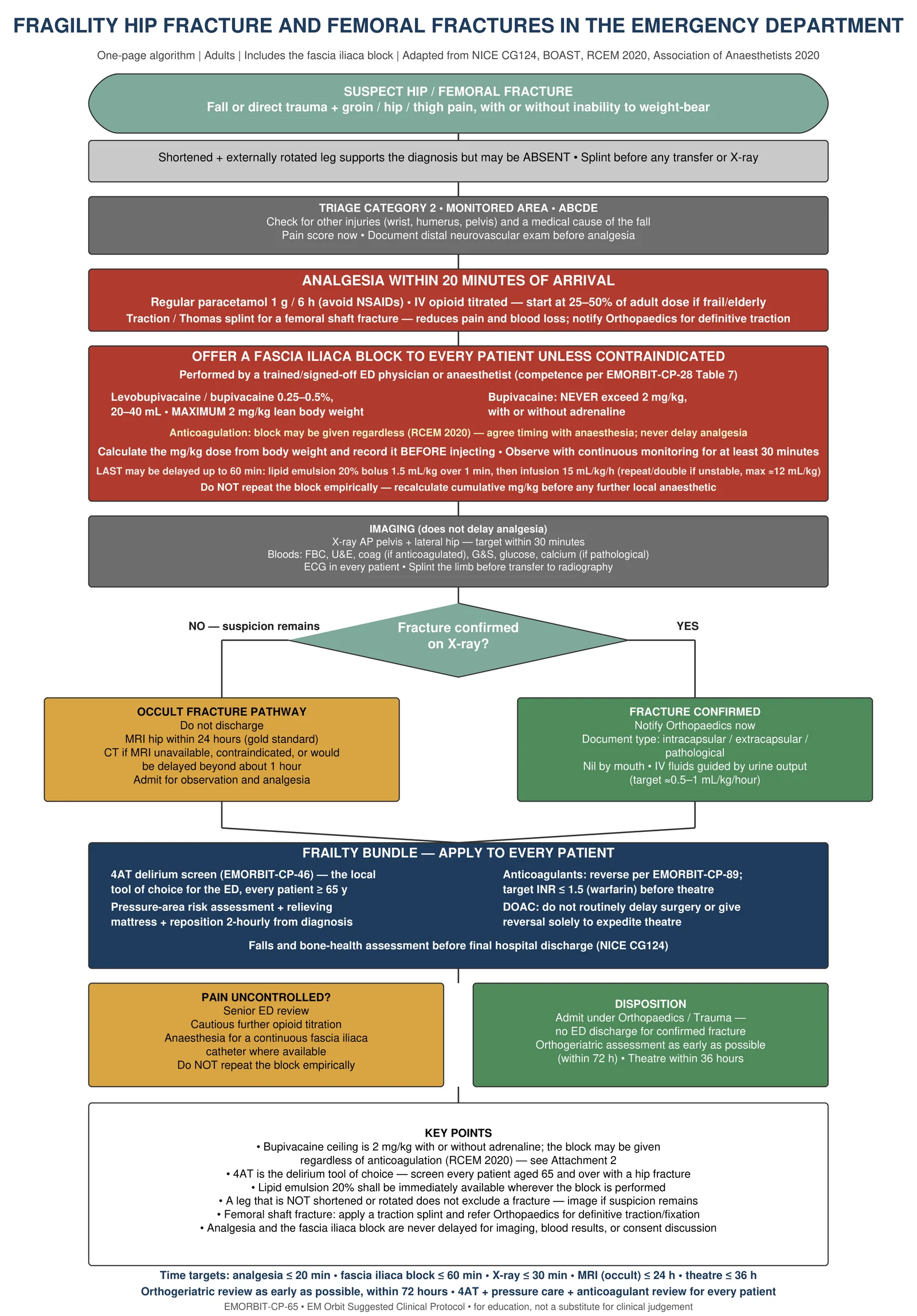
The one-page algorithm is shown at the top of this page.
6Team roles
6.1Triage and ED Nurses Role:
6.1.1 Recognise suspected hip fracture at triage, assign Category 2, record the pain score, and initiate the analgesia pathway per the triage standing order.
6.1.2 Assist with the fascia iliaca block; monitor and record observations for 30 minutes after the block; apply pressure-area and repositioning care from the point of diagnosis.
6.2Pharmacist:
6.2.1 Verify every analgesic and local anaesthetic dose against the local formulary; confirm lipid emulsion 20% stock and expiry; review the medication list for anticoagulants and interacting drugs.
6.3Orthopaedic Surgery:
6.3.1 Accept referral after imaging; decide the surgical plan and the need for traction; coordinate with the orthogeriatric team for the time-to-theatre target.
6.4Anaesthesia:
6.4.1 Available for advice on the fascia iliaca block in the anticoagulated patient; leads the response to suspected LAST; supports peri-operative anticoagulation management with orthopaedics.
6.5Geriatric Medicine / Orthogeriatric Team:
6.5.1 Comprehensive geriatric assessment as early as possible; supports the 4AT, delirium prevention, bone-health and falls assessment, and post-operative rehabilitation planning.
6.6Radiology:
6.6.1 Prioritise the hip and pelvis X-ray and, where arranged, the second-line MRI or CT for occult fracture within the target time.
6.7Ambulance / Pre-hospital Providers:
6.7.1 Splint the limb, give analgesia per the pre-hospital protocol, and hand over the mechanism, time of injury and analgesia already given using a structured (ATMIST/SBAR) format.
7The patient's role
7.1 Report the exact site and severity of pain, and any anticoagulant, antiplatelet or bone-protection medication taken.
7.2 Report new numbness, tingling, a metallic taste, or ringing in the ears after the fascia iliaca block, and any worsening pain or new symptoms during observation.
7.3 Take part in the falls and bone-health assessment and any physiotherapy or rehabilitation plan before discharge.
8Definitions
8.1Fragility (Hip) Fracture: a fracture of the proximal femur occurring from a fall from standing height or lower, usually in an older person with reduced bone density.
8.2Intracapsular Fracture: subcapital, transcervical or basicervical fracture of the femoral neck, within the hip joint capsule.
8.3Extracapsular Fracture: intertrochanteric or subtrochanteric fracture, outside the joint capsule.
8.4Pathological Fracture: a fracture through bone weakened by osteoporosis, malignancy or metabolic bone disease, often with minimal or no trauma.
8.5Occult Fracture: a clinically suspected hip fracture with a normal or equivocal initial X-ray, confirmed or excluded by MRI or CT.
8.6Fascia Iliaca Block (FICB): injection of local anaesthetic beneath the fascia iliaca to block the femoral, obturator and lateral femoral cutaneous nerves, used for hip and femoral fracture analgesia.
8.7Local Anaesthetic Systemic Toxicity (LAST): a potentially fatal complication of local anaesthetic absorption or intravascular injection, causing neurological and cardiovascular toxicity, treated with lipid emulsion (Table 2).
8.84AT: the validated four-item bedside delirium screen and the ED tool of choice (EMORBIT-CP-46).
8.9Orthogeriatric Care: joint orthopaedic and geriatric medicine management of the older patient with a fracture, from admission through rehabilitation.
9Attachments
- Attachment 1: One-page algorithm (top of this page)
- Attachment 2: Fascia Iliaca Block Dosing, Local Anaesthetic Systemic Toxicity, and ED Time-Target Quick Reference
11Suggested quality indicators
11.1Time to first analgesia ≤ 20 minutes of arrival: (Number of hip/femoral fracture patients receiving first analgesia within 20 minutes of arrival / Total number of such patients) × 100. Target ≥ 90% (as EMORBIT-CP-28).
11.2Fascia iliaca block performed: (Number of hip fracture patients who received a fascia iliaca block / Total number of hip fracture patients without a contraindication to the block) × 100. Target ≥ 70% (as EMORBIT-CP-28).
11.34AT completed in patients aged 65 and over: (Number of patients aged 65 and over with hip fracture and a documented 4AT score / Total number of such patients) × 100. Target ≥ 80% (as EMORBIT-CP-46).
11.4Time to theatre within 36 hours: (Number of patients undergoing surgery within 36 hours of arrival at the ED or of diagnosis / Total number of patients undergoing surgery for hip fracture) × 100. Target ≥ 90% (NICE CG124 standard).
11.5Orthogeriatrician review within 72 hours: (Number of patients reviewed by geriatric medicine within 72 hours of admission / Total number of hip fracture admissions) × 100. Target ≥ 90% (proposed; confirm against the National Hip Fracture Database benchmark).
11.630-day mortality following hip fracture: Monitored as an outcome indicator without a fixed target; reviewed case-by-case at departmental audit.
13References
- National Institute for Health and Care Excellence. Hip fracture: management. NICE Clinical Guideline CG124; 2011 (updated 2023).
- British Orthopaedic Association / British Geriatrics Society. Standards and guidance for the care of patients with fragility hip fracture (BOAST).
- Griffiths R, Babu S, Dixon P, et al. Guideline for the management of hip fractures 2020: Association of Anaesthetists. Anaesthesia. 2021;76(2):225–237.
- Royal College of Emergency Medicine. Best Practice Guideline: Fascia Iliaca Block in the Emergency Department. London: RCEM; 2020.
- Association of Anaesthetists of Great Britain and Ireland. AAGBI Safety Guideline: Management of Severe Local Anaesthetic Toxicity. London: AAGBI; 2010.
- National Hip Fracture Database. Annual Report — time-to-theatre and orthogeriatric review standards.
A2Attachment 2: Fascia Iliaca Block Dosing, Local Anaesthetic Systemic Toxicity, and ED Time-Target Quick Reference
| Agent | Concentration | Usual adult volume | Maximum dose |
|---|---|---|---|
| Levobupivacaine | 0.25% (2.5 mg/mL) or 0.5% (5 mg/mL) | 20–40 mL (local protocol); 30–40 mL, 0.3–0.4 mL/kg (EMORBIT-CP-28) | Maximum 2 mg/kg lean body weight. The local protocol and EMORBIT-CP-28 agree on this figure. |
| Bupivacaine | 0.25% or 0.5% | 20–40 mL | Never more than 2 mg/kg, with or without adrenaline (EMORBIT-CP-28). |
| Ropivacaine (alternative, where stocked) | 0.2% | 30–40 mL | Maximum 2 mg/kg lean body weight (EMORBIT-CP-28; not in the local protocol). |
Calculate the total milligram dose from the patient's actual or estimated body weight and record it before injecting, not after. Reduce the dose in the frail, the elderly and the low-weight patient. The local protocol's own worked example ("~35–40 mL of 0.25% levobupivacaine for a 2 mg/kg, 70 kg dose") is arithmetically inconsistent with its own dose table (2 mg/kg of a 70 kg adult = 140 mg = 56 mL at 0.25%); this guideline uses the table figures. Full technique, contraindications and the practitioner competency register are as EMORBIT-CP-28 Table 7.
| Step | Action |
|---|---|
| Recognise | Early: circumoral tingling, metallic taste, tinnitus, visual disturbance, agitation. Late: loss of consciousness, seizures, arrhythmia, cardiovascular collapse. Onset may be delayed up to 60 minutes, and clearance is slower in the frail elderly — vigilance continues beyond the 30-minute post-block observation period. |
| Stop and call | Stop injecting immediately. Call for help; state clearly that this is suspected LAST. Send for the lipid emulsion pack. |
| Airway, breathing, seizures | 100% oxygen; secure the airway if compromised. Treat seizures with a benzodiazepine (midazolam or lorazepam). |
| Lipid emulsion 20% | Bolus 1.5 mL/kg over 1 minute, then infusion 15 mL/kg/hour. If not improving, repeat the bolus up to twice at 5-minute intervals and double the infusion to 30 mL/kg/hour. Do not exceed a cumulative total of approximately 12 mL/kg. This matches the local protocol's bolus and infusion rate (its 0.25 mL/kg/minute infusion = 15 mL/kg/hour); the local protocol does not state the repeat-bolus escalation or the maximum cumulative dose, which are added here from EMORBIT-CP-28 / AAGBI 2010. |
| Cardiac arrest | Standard resuscitation, continued — recovery from local anaesthetic arrest may take over an hour. Avoid vasopressin, calcium-channel blockers, beta-blockers and lidocaine. |
| Preparation | Lipid emulsion 20% and its dosing card shall be immediately available wherever the block is performed, and checked on the resuscitation equipment check. |
| Milestone | Target | Source |
|---|---|---|
| First analgesia | Within 20 minutes of arrival | EMORBIT-CP-28 (Severe pain band, includes fractured neck of femur) |
| Fascia iliaca block, if not contraindicated | Within 60 minutes of arrival | Proposed by this guideline — not a published standard; requires local agreement |
| X-ray (pelvis and lateral hip) | Within 30 minutes of arrival | Proposed by this guideline — not a published standard; requires local agreement |
| MRI hip for occult fracture | Within 24 hours | NICE CG124 (2011, updated 2023) |
| Orthogeriatrician / comprehensive geriatric assessment | As early as possible, within 72 hours | BOAST / National Hip Fracture Database standard — exact figure carried from published audit standards |
| Surgery | Within 36 hours of arrival at the ED, or of diagnosis if the fracture occurs as an inpatient | NICE CG124 (2011, updated 2023) |