ED Handover and Safe Discharge Standard
EMORBIT-CP-128 · Chapter 16 · Cross-cutting ED Standards
Open in the appFree, works on your phone and offline, with every tool alongside.
Evidence base: RCEM; ACEM
1Purpose
1.1 Provide a standardized framework for structured clinical handover — at shift change, on transfer to a ward or department, and to an ambulance or retrieval crew — and for safe discharge from the Emergency Department (ED), for every adult and paediatric patient.
1.2 Require that every pending result, at every handover and every discharge, has a named clinician responsible for reviewing it and acting on it.
1.3 Define the discharge safety net: vital signs rechecked and any abnormality explained before discharge, medicines reconciled, follow-up booked rather than advised, and written return advice given in the patient’s own language.
1.4 Identify the patient groups at higher risk of an adverse event after discharge, and set the standard for the patient who leaves before assessment or treatment is complete, or against medical advice, including the capacity assessment that precedes that decision.
2Who this protocol applies to
2.1 Every adult and paediatric patient handed over between clinicians at shift change in the ED.
2.2 Every patient transferred from the ED to a ward or department within the same hospital, or handed over to an ambulance or retrieval crew.
2.3 Every patient discharged from the ED to home, to a care facility, or into the care of another agency.
2.4 Every patient who leaves, or wishes to leave, before assessment or treatment is complete, or against medical advice.
3Not covered by this protocol
3.1 The stabilisation, escort competence and equipment standard for the interfacility transfer of a critically ill patient to another hospital: governed by EMORBIT-CP-91. This guideline covers only the handover step of that transfer.
3.2 Confirming death, and the handover associated with it: governed by EMORBIT-CP-127.
3.3 The psychosocial assessment and disposition decision for self-harm: governed by EMORBIT-CP-84. This guideline’s discharge safety net applies in addition, not instead.
3.4 The capacity and restraint framework itself is not restated here: it is governed by EMORBIT-CP-26, applied to the specific decision at hand.
4Protocol
4.1History and Assessment:
4.1.1Triage and Recognition — When a Structured Handover Is Required:
4.1.1.1 A structured handover is given, and is expected to be received and acknowledged, at every shift change, at every transfer of clinical responsibility to a ward or department, and at every handover to an ambulance or retrieval crew.
4.1.1.2 The giving clinician is named and remains responsible for the patient until the receiving clinician has acknowledged the handover; the receiving clinician is named and confirms they have understood it.
4.1.2History (carried into the handover, not re-taken by the receiving team from nothing):
4.1.2.1 The presenting problem, the working diagnosis, treatment given and the response, allergies, and the patient’s own or family’s understanding of events so far.
4.1.2.2 Every investigation sent and not yet resulted, with the time it was sent.
4.1.3Examination — Pre-Discharge Reassessment:
4.1.3.1 A full set of vital signs is rechecked shortly before discharge. A patient is not discharged while a vital sign remains abnormal and unexplained.
4.1.3.2 Reassess conscious level and, where relevant, mobility and the ability to self-care at the level required at home.
4.1.4Risk Stratification — High-Risk Discharge:
4.1.4.1
Table 1: High-risk discharge factors and the action required Factor Action at discharge Age 75 or older, or clinical frailty Senior ED physician aware before discharge; lower the threshold for a safety-netting phone call within 24 hours. Lives alone, or no reliable carer for the first 24 hours Confirm a responsible contact before discharge. Do not discharge to an empty home a patient unable to self-care. Re-attendance to any ED within 72 hours Senior ED physician reviews before a second discharge and documents why it is safe. Altered mental status not back to documented baseline Not discharged — admitted under the general medical team, as required by EMORBIT-CP-46. Self-harm or a mental health presentation Disposition follows the psychosocial assessment in EMORBIT-CP-84; not discharged before it is complete. Safeguarding concern — child, older or vulnerable adult Safeguarding referral per EMORBIT-CP-83 made before discharge; discharge is not delayed for the referral to be actioned, but is not used to avoid making it. Patient or family does not read or speak the discharge language Written return advice provided in the patient’s own language; an interpreter used for verbal advice. Leaving before assessment or treatment is complete, or against medical advice Assess capacity for this specific decision (EMORBIT-CP-26). See 4.3.6.
4.1.5Special Populations:
4.1.5.1 Children: the discharging clinician gives return advice to the parent or guardian, in their own language, and confirms they can act on it; safeguarding concerns follow EMORBIT-CP-83.
4.1.5.2 Pregnancy and postpartum: obstetric review before discharge for any pregnancy-related presentation; return advice includes the obstetric red flags for the trimester.
4.1.5.3 Cognitive impairment, learning disability, or a language or communication barrier: return advice is given to, and understanding confirmed with, a person able to act on it — an interpreter, family member or carer — and this is documented, not assumed.
4.1.5.4 A patient without a fixed address or reliable contact: confirm how follow-up and any abnormal result will reach them before discharge; do not book follow-up that depends on a contact method known to be unreliable.
4.2Investigations:
4.2.1 No investigation is repeated or newly requested by the receiving clinician solely because it was not mentioned at handover: the giving clinician documents every result awaited and its named owner.
4.2.2 A result that returns abnormal after the patient has left the department is escalated to the named owner recorded at handover or discharge, who is responsible for informing the patient or the receiving team and for documenting that this was done.
4.3Plan of Care:
4.3.1Immediate Actions (from the decision to hand over or discharge):
4.3.1.1 Identify which of the three handover contexts applies — shift change, ward/department transfer, or ambulance/retrieval crew — or that the patient is being discharged, and begin the corresponding standard below.
4.3.1.2 Confirm the identity of the receiving clinician (or, for discharge, that the patient or an appropriate person can receive the advice) before starting the handover.
4.3.2Structured Handover Standard — ISBAR:
4.3.2.1 Give every handover in the ISBAR format (Identification, Situation, Background, Assessment, Recommendation — Attachment 2), face-to-face or by a documented secure method where face-to-face is not possible.
4.3.2.2 Ward or department transfer: ISBAR to the receiving nurse and physician; the receiving team reassesses the patient on arrival and does not rely on the handover alone.
4.3.2.3 Ambulance or retrieval crew: ISBAR (or ATMIST, as used in EMORBIT-CP-91) to the crew; for the interfacility transfer of a critically ill patient, the full stabilisation, escort and equipment standard of EMORBIT-CP-91 applies in addition.
4.3.2.4 Shift change: ISBAR for every patient not yet disposed, with explicit note of anyone awaiting a time-critical result, an unreviewed escalation, or a plan agreed with a specialty that has not yet been actioned.
4.3.3Discharge Safety Net:
4.3.3.1 Complete the Discharge Safety-Net Checklist (Attachment 2) for every ED discharge: vital signs rechecked and any abnormality explained, medicines reconciled against the pre-attendance list, follow-up booked with a date, time and location given to the patient (not merely advised), and written return advice given in the patient’s own language.
4.3.3.2 Abnormal vital signs at discharge are the strongest predictor of an adverse event after leaving the department: they are rechecked and explained before the patient goes, not documented and overlooked.
4.3.4High-Risk Discharge — Additional Safeguards:
4.3.4.1 Where any factor in Table 1 is present, apply the stated action in addition to the standard safety net, and record that it was applied.
4.3.4.2 A re-attendance within 72 hours of a previous ED discharge is reviewed by a senior ED physician before any second discharge, who documents why the discharge is safe.
4.3.5Discharge Against Medical Advice, and Leaving Before Care Is Complete:
4.3.5.1 Assess and document capacity for this specific decision, per the capacity framework in EMORBIT-CP-26 (not restated here); capacity is presumed and is decision-specific.
4.3.5.2 Where the patient lacks capacity and faces a serious risk of harm, prevent them leaving by the least restrictive means, with senior ED physician, security and mental health input, following the restraint framework in EMORBIT-CP-26. The lawful basis for detaining or restraining a patient follows national law and hospital policy; seek legal services advice where in doubt.
4.3.5.3 Where the patient has capacity and still wishes to leave, document the assessment, the information and risks explained, and the refusal; give written return advice; and inform psychiatry and, with the patient’s consent, the family, consistent with the local policy on the patient who leaves against medical advice.
4.3.6Monitoring and Reassessment:
4.3.6.1 Track every pending result to its named owner until it is reviewed and actioned; an unreviewed result with no named owner is escalated to the ED quality team.
4.3.6.2 Monitor re-attendance within 72 hours of discharge as a department-level indicator (section 8).
4.3.7Disposition:
4.3.7.1 Discharge home: the safety net (above) is complete and no factor in Table 1 requires a different pathway.
4.3.7.2 Discharge with early review: a high-risk factor is present but does not itself require admission; a booked review — telephone or in person — is arranged within a time frame the senior ED physician documents.
4.3.7.3 Admit: any criterion in Table 1 or elsewhere in this guideline that specifies admission, or where the senior ED physician judges the risk of discharge to be unacceptable.
4.3.8Discharge and Follow-up:
4.3.8.1 Follow-up is booked, with the date, time, location and how to attend given to the patient in writing — never left as verbal advice to "see your doctor" or "come back if needed" alone.
4.3.8.2 The discharge letter states the presenting complaint, the working diagnosis, treatment given, medicines reconciled, the named owner of any pending result, the follow-up arranged, and is sent to the family physician the same day.
4.3.9Documentation and Reporting:
4.3.9.1 Document: the giving and receiving clinician at every handover, the ISBAR content, the named owner of every pending result, the pre-discharge vital signs and any explanation given for an abnormality, medicines reconciliation, the follow-up booked, the return advice given and the language used, and, where relevant, the capacity assessment.
4.3.9.2 Report through the local incident reporting system, for review by the ED quality team: any pending result with no named owner that is later found unreviewed; any discharge in which an abnormal vital sign was not explained; any re-attendance within 72 hours associated with a missed diagnosis or an incomplete safety net; and any patient who leaves without a documented capacity assessment.
5Algorithm
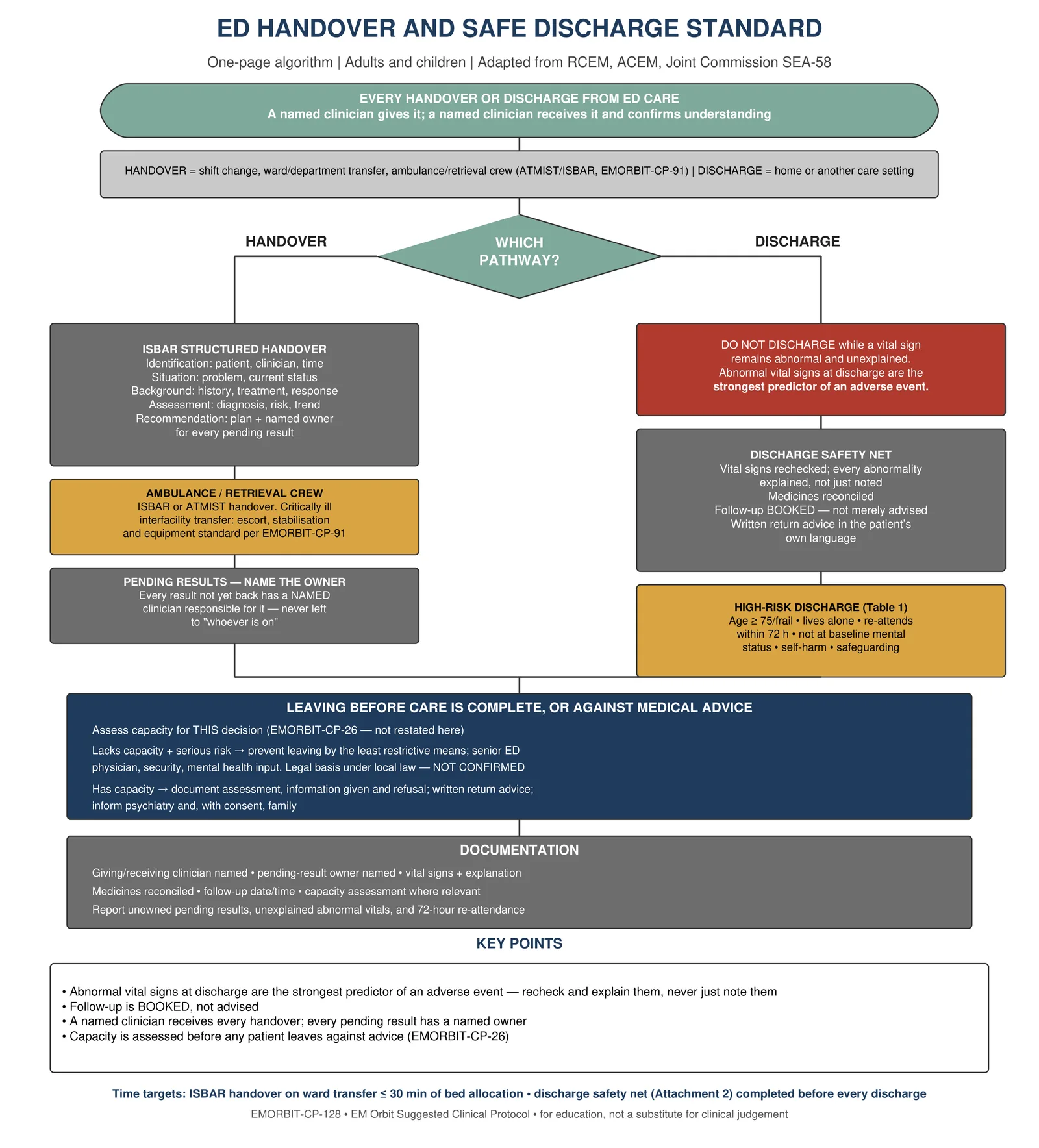
The one-page algorithm is shown at the top of this page.
6Team roles
6.1Triage / ED Nurse:
6.1.1 Give and receive the ISBAR handover at shift change and on transfer to the ward; recheck and document vital signs before discharge; complete the nursing portion of the Discharge Safety-Net Checklist.
6.2Pharmacist:
6.2.1 Reconcile medicines against the pre-attendance list for every discharge, and flag any interaction, duplication or omission before the patient leaves.
6.3Relevant Specialty / Receiving Team (Ward or Referral Specialty):
6.3.1 Receive the structured handover, accept ownership of every pending result assigned to them, and reassess the patient on arrival rather than relying on the handover alone.
6.4Laboratory / Radiology:
6.4.1 Report any critical or unexpected result directly to the named owner recorded at handover or discharge.
6.5Ambulance / Retrieval Crew:
6.5.1 Receive the ISBAR or ATMIST handover; for a critically ill patient being transferred between facilities, follow the escort and equipment standard in EMORBIT-CP-91.
7The patient's role
7.1 Receive written return advice in their own language, including what to watch for and when and where to return.
7.2 Be told the date, time and location of any follow-up booked, and how to attend it.
7.3 Where leaving against medical advice, be told the risks explained and given the same written return advice as any other discharge.
8Definitions
8.1ISBAR: a structured handover format — Identification, Situation, Background, Assessment, Recommendation.
8.2Named owner: the specific clinician, identified by name, responsible for reviewing a pending result and acting on it, as distinct from a team or a shift.
8.3Safety net / safety-netting: the combination of a rechecked and explained clinical state, booked follow-up, and written return advice that allows a patient to be discharged safely.
8.4Discharge against medical advice: a discharge, or a decision to leave, that takes place against the treating clinician’s advice, after a capacity assessment for that specific decision.
8.5ATMIST: a structured handover format used for interfacility transfer — Age, Time of incident, Mechanism/Medical complaint, Injuries/Information, Signs, Treatment (EMORBIT-CP-91).
9Attachments
- Attachment 1: One-page algorithm (top of this page)
- Attachment 2: ISBAR Handover Template and Discharge Safety-Net Checklist
11Suggested quality indicators
11.1Structured handover completed on ward transfer: (Number of ward/department transfers with an ISBAR handover completed within 30 minutes of bed allocation / Total number of ward/department transfers) × 100. Target ≥ 90%.
11.2Named owner documented for every pending result: (Number of handovers and discharges with every pending result assigned a named owner / Total number of handovers and discharges audited) × 100. Target 100%.
11.3Discharge safety net completed: (Number of ED discharges with vital signs rechecked, any abnormality explained, medicines reconciled and follow-up booked, all documented / Total number of ED discharges audited) × 100. Target ≥ 95%.
11.4Capacity documented for discharge against medical advice: (Number of discharges against medical advice with a documented capacity assessment / Total number of discharges against medical advice) × 100. Target 100%.
11.5Unplanned re-attendance within 72 hours (outcome, monitored, no fixed target): (Number of patients re-attending any ED within 72 hours of an ED discharge / Total number of ED discharges) × 100.
13References
- Royal College of Emergency Medicine. Best practice guidance on clinical handover and safe discharge from the Emergency Department. London: RCEM..
- Australasian College for Emergency Medicine. Statement on clinical handover in the Emergency Department. Melbourne: ACEM..
- The Joint Commission. Sentinel Event Alert, Issue 58: Inadequate hand-off communication. Oak Brook, IL: The Joint Commission; 2017.
- British Medical Association Junior Doctors Committee. Safe Handover: Safe Patients — Guidance on Clinical Handover for Clinicians and Managers. London: BMA; 2004.
A2Attachment 2: ISBAR Handover Template and Discharge Safety-Net Checklist
| Element | Content |
|---|---|
| Identification | Patient name, medical record number, age; the giving and the receiving clinician, named; date and time of handover. |
| Situation | The presenting problem and current status, in one sentence. |
| Background | Relevant history, treatment already given, and the response to it. |
| Assessment | Working diagnosis, current risk, and trend — improving, static, or deteriorating. |
| Recommendation | The plan, the monitoring required, the trigger for escalation, and — for every pending result — the named clinician who owns it. |
| ✓ | Item |
|---|---|
| ☐ | Vital signs rechecked shortly before discharge. |
| ☐ | Any abnormal vital sign explained in the record, not only noted. |
| ☐ | Medicines reconciled against the pre-attendance list. |
| ☐ | Follow-up booked — appointment date, time and location given to the patient, not merely advised. |
| ☐ | Written return advice given in the patient’s own language, including when and where to return. |
| ☐ | High-risk discharge factors (Table 1) checked and any required safeguard actioned. |
| ☐ | Where the patient is leaving against medical advice or before assessment is complete, capacity is assessed and documented (EMORBIT-CP-26; section 4.3.6). |
| ☐ | Discharge letter completed and sent to the family physician the same day. |