Death in the ED, Breaking Bad News and Organ Donation Referral
EMORBIT-CP-127 · Chapter 16 · Cross-cutting ED Standards
Open in the appFree, works on your phone and offline, with every tool alongside.
Evidence base: RCEM; NICE CG135
1Purpose
1.1 Standardize how ED staff confirm death, determine medico-legal status, and break the news to the family using the SPIKES framework, aligned with the Academy of Medical Royal Colleges Code of Practice and Royal College of Emergency Medicine guidance.
1.2 State plainly that in a medico-legal death every line, tube and drain is left in place and the body is not washed, moved or otherwise prepared until the medico-legal authority has given clearance.
1.3 Ensure every potential organ and tissue donor is referred to the organ donation service early, and make explicit that referral is a notification, not consent, and is never delayed pending certainty of eligibility.
1.4 State that death certification, police/medico-legal notification, and organ donation follow national law and the hospital's operational routes.
2Who this protocol applies to
2.1 Any patient who dies, or in whom death is confirmed, in the ED — expected or unexpected, after resuscitation is stopped (EMORBIT-CP-03, EMORBIT-CP-34), or on arrival with no signs of life.
2.2 Any patient who is a potential organ and/or tissue donor, including donation after circulatory death.
2.3 Sudden, unexpected death in infancy or childhood (SUDIC) — managed jointly with EMORBIT-CP-83.
2.4 Any death in which the cause, manner or circumstances may make the case medico-legal (Table 1, Attachment 2).
3Not covered by this protocol
3.1 Formal determination of brainstem death, multimodal neuroprognostication, and the organ or tissue retrieval procedure itself, performed in intensive care or theatre by the relevant specialty and the organ donation service, not by the ED (section 4.2).
3.2 Forensic post-mortem examination and criminal investigation, conducted by the competent medico-legal authority, not the ED.
3.3 Long-term bereavement counselling, coordinated by community/primary care and the hospital bereavement service where one exists.
4Protocol
4.1History and Assessment:
4.1.1Triage and Recognition:
4.1.1.1 Confirming death follows resuscitation stopped per EMORBIT-CP-03 or EMORBIT-CP-34, or a patient who arrives with no signs of life; this guideline does not restate those termination-of-resuscitation criteria.
4.1.1.2 Do not confirm death until a reversible mimic — hypothermia, sedative or neuromuscular-blocking drug effect, or a metabolic cause — has been considered, exactly as in EMORBIT-CP-03.
4.1.2History:
4.1.2.1 Establish the time last known well or seen alive, the circumstances of collapse or death, resuscitation status (DNACPR), background illness, and any feature suggesting an unnatural, unexpected or unexplained death.
4.1.2.2 Identify the patient and next of kin. Where the patient is unidentified, follow the hospital identification and mortuary process. (use the local identification route)
4.1.3Examination (Confirming Death):
4.1.3.1 Confirm the absence of a central pulse for at least 5 minutes, together with absent heart sounds, no respiratory effort, and fixed, dilated pupils unresponsive to light, per the Academy of Medical Royal Colleges Code of Practice.
4.1.3.2 Record the exact time death is confirmed and the name of the confirming clinician. Verification of death is distinct from legal certification of the cause of death, which follows the hospital process. (use the local certification route)
4.1.4Risk Stratification — Medico-legal Death:
4.1.4.1 Table 1 (Attachment 2) lists the categories of medico-legal death; if any one applies, refer to the police/forensic authority without delay. (follow the local notification route to the police/forensic authority)
4.1.4.2 In a medico-legal death, do not remove any line, tube, dressing or drain, and do not wash, move or otherwise prepare the body until the medico-legal authority has given clearance.
4.1.5Differential Diagnosis: Not applicable once death is confirmed by the criteria above. The only differential is a reversible mimic (hypothermia, sedation, neuromuscular blockade), which is excluded before death is confirmed, not after.
4.1.6Special Populations:
4.1.6.1 Sudden unexpected death in infancy or childhood (SUDIC): manage as a safeguarding-level response per EMORBIT-CP-83 — preserve the child's position and clothing, do not clean the child, and involve the on-call paediatrician and, following the local process, the police. A joint agency response is required.
4.1.6.2 Pregnancy: consider resuscitative hysterotomy before termination of resuscitation where it applies, per EMORBIT-CP-03/EMORBIT-CP-118; once death is confirmed, involve obstetric and, where relevant, neonatal teams in the family conversation.
4.1.6.3 Different faith and cultural requirements: ask the family's wishes explicitly. Several faiths require burial within 24 hours — expedite the medico-legal and mortuary process accordingly wherever the death is not held for medico-legal reasons, and involve the hospital religious support service.
4.1.6.4 Unaccompanied or unidentified patients: follow the hospital process for tracing next of kin and formal identification before the family conversation can take place.
4.2Investigations:
4.2.1 No investigation is required to confirm death.
4.2.2 In a medico-legal death, take no further samples beyond those already taken for clinical care unless directed by the medico-legal authority; do not discard any sample, line or device.
4.2.3 Where organ or tissue donation is a realistic possibility, blood grouping and virology samples may be requested by the organ donation service once referral is made; these are directed by that service, not initiated independently by the ED.
4.3Plan of Care:
4.3.1Immediate Actions:
4.3.1.1 Record the exact time of death and the name of the confirming clinician; inform the ED clinician-in-charge/senior physician immediately.
4.3.1.2 In a suspected medico-legal death, leave every line, tube and drain in place and do not move, wash or otherwise prepare the body (Table 1).
4.3.2Definitive ED Actions:
4.3.2.1 This guideline carries no drug treatment; the definitive ED action is the notification and referral bundle below, run in parallel, not in sequence.
4.3.2.2 Determine and document medico-legal status (Table 1) before any further action on the body.
4.3.2.3 Refer every patient who is a potential organ and/or tissue donor to the organ donation service as early as possible, alongside the family conversation, not after it. Referral is a notification, not consent, and does not require certainty of eligibility.
4.3.2.4 Break the news to the family using the SPIKES framework (Setting, Perception, Invitation, Knowledge, Emotions, Strategy/summary) in a private room, with an interpreter where needed, and document the conversation (Attachment 1).
4.3.2.5 Offer the family the opportunity to see and spend time with the patient, and involve the hospital religious/chaplaincy support service according to their wishes.
4.3.3Escalation — Refractory or Disputed Situations:
4.3.3.1 Where the family disputes the determination of death, do not argue: involve the senior ED physician and, where available, chaplaincy/religious support, and re-explain calmly.
4.3.3.2 Where a family member becomes aggressive, or there is any risk that the death scene or evidence may be compromised, involve hospital security and the police without delay.
4.3.4Monitoring and Reassessment: Not applicable to the deceased patient. A family member who becomes unwell during the conversation is managed as an ED patient in their own right.
4.3.5Disposition:
4.3.5.1 Non-medico-legal, non-donor death: complete death certification per the hospital process and transfer to the mortuary; expedite where the family's faith requires early burial. (use the local certification and mortuary route)
4.3.5.2 Potential organ/tissue donor: continue physiological care as directed by the organ donation service pending its assessment; do not foreclose the possibility of donation in any conversation with the family before the donation team has spoken with them.
4.3.5.3 Medico-legal death: the body, all lines and tubes, and the immediate surroundings are preserved; transfer and release are directed by the police/forensic authority, not by the ED. (follow the local route directed by the police/forensic authority)
4.3.6Discharge and Follow-up:
4.3.6.1 Give the family a bereavement information leaflet with contact numbers for the mortuary, chaplaincy, and the forensic authority where relevant. (use the local contact details)
4.3.6.2 Notify the patient's primary care/community physician of the death.
4.3.6.3 Offer a hot debrief to the treating team and staff support (peer support or occupational health) after every death, and especially after a paediatric or violent death.
4.3.7Documentation and Reporting:
4.3.7.1 Record: time of death and the confirming clinician; medico-legal status and the reasoning; who was informed and when; the SPIKES conversation and who was present; the donation referral (made, considered, or declined and why); religious/cultural arrangements; and disposition.
4.3.7.2 Report any delay in family notification, in medico-legal referral, or in organ-donation referral through the local incident reporting system.
5Algorithm
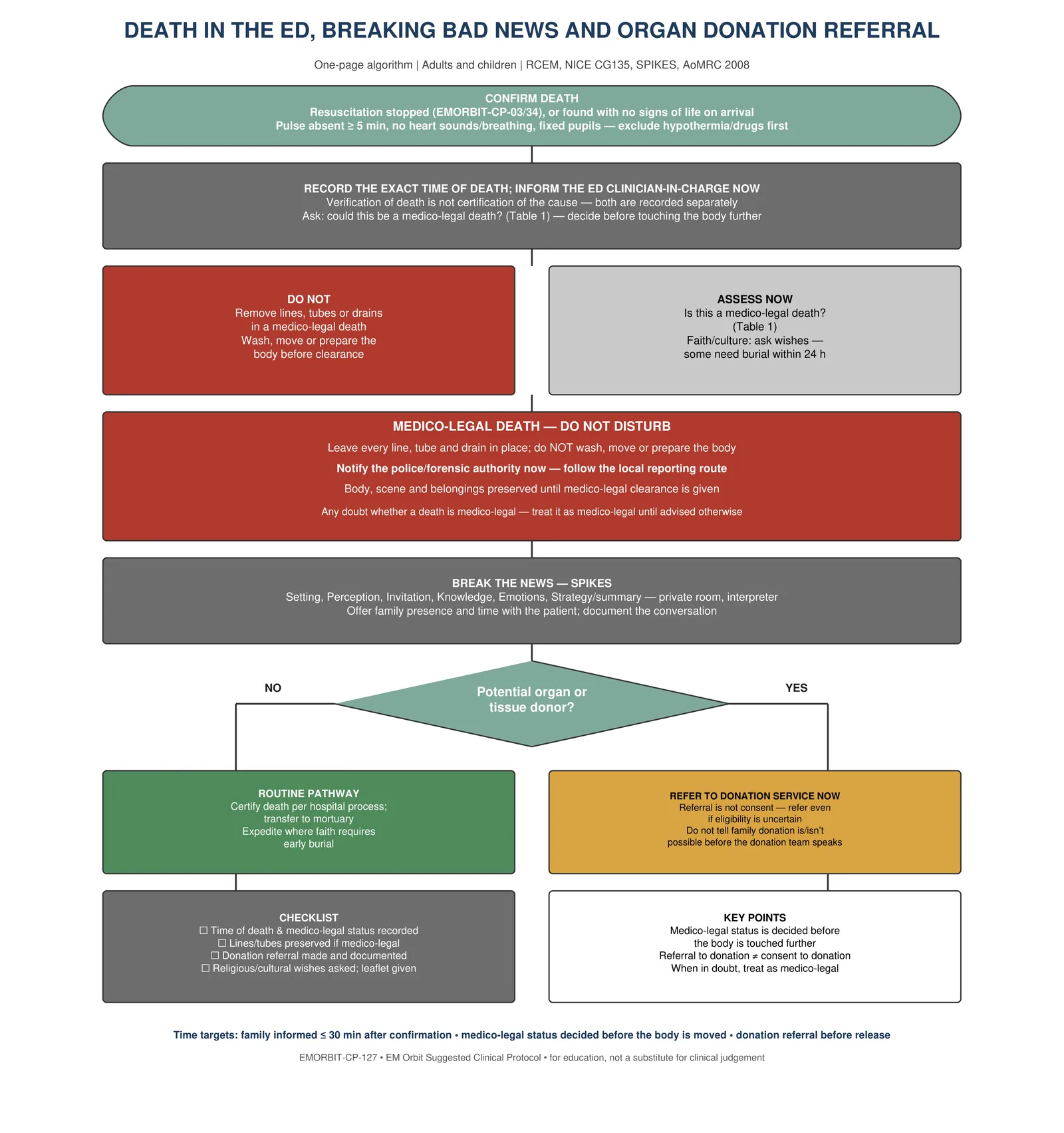
The one-page algorithm is shown at the top of this page.
6Team roles
6.1Triage / ED Nurse: Support the family, arrange a private room, contact chaplaincy/religious support, and assist with care of the body once medico-legal clearance is confirmed.
6.2ED Physician: Confirm death, determine medico-legal status, lead the SPIKES conversation, make the organ-donation referral, and complete documentation.
6.3Hospital Security / Police (medico-legal deaths): Attend, preserve the scene, and direct handling of the body per local law. (follow the local route)
6.4Organ Donation Coordinator / Service: Receive the referral, assess eligibility, approach the family for consent (not the ED), and coordinate retrieval.
6.5Mortuary Staff: Receive the body per the hospital process once released.
6.6Religious / Chaplaincy Support: Attend according to the family's faith and wishes.
6.7Child Protection Lead (SUDIC): Joint response per EMORBIT-CP-83.
7The patient's role
7.1 Family: tell staff of any religious, cultural or personal wishes for the care of the body and the timing of arrangements.
7.2 Family: ask staff any question about what happens next; staff will explain what is known and what is not yet known.
8Definitions
8.1SPIKES: Setting, Perception, Invitation, Knowledge, Emotions, Strategy/Summary — a six-step protocol for delivering bad news (Baile et al., 2000).
8.2Medico-legal Death: a death that must be reported to the police, forensic, or other competent authority because its cause, manner or circumstances are unnatural, unexpected, unexplained, or otherwise fall within Table 1.
8.3Verification of Death: the clinical confirmation that death has occurred; distinct from certification of the cause of death.
8.4Organ Donation Referral: notifying the organ donation service of a potential donor; it authorizes assessment, not procurement, and is separate from consent.
8.5Donation after Circulatory Death (DCD) / Donation after Brainstem Death (DBD): the two categories of deceased donation, coordinated by intensive care and the organ donation service, not by the ED.
8.6SUDIC: Sudden Unexpected Death in Infancy and Childhood.
9Attachments
- Attachment 1: One-page algorithm (top of this page)
- Attachment 2: Medico-legal Death Categories, and Organ Donation Referral and Bereavement Checklist
11Suggested quality indicators
11.1Time to family notification: (Number of deaths in which the family was informed within 30 minutes of confirmation of death / Total deaths) × 100. Target ≥ 90%.
11.2Medico-legal status documented: (Number of deaths with medico-legal status explicitly documented before the body was moved / Total deaths) × 100. Target 100%.
11.3Lines and tubes preserved in medico-legal deaths: (Number of medico-legal deaths in which lines and tubes were left in situ / Total medico-legal deaths) × 100. Target 100%.
11.4Organ-donation referral made: (Number of potential donors referred to the organ donation service / Total potential donors identified) × 100. Target 100%.
11.5Outcome indicator (monitored, no fixed ED target): the number of complaints or incidents relating to bereavement care, medico-legal handling, or donation referral, reviewed at departmental mortality and morbidity review.
13References
- Academy of Medical Royal Colleges. A Code of Practice for the Diagnosis and Confirmation of Death. London: AoMRC; 2008.
- National Institute for Health and Care Excellence. Organ donation for transplantation: improving donor identification and consent rates for deceased organ donation. NICE Clinical Guideline CG135; 2011.
- Baile WF, Buckman R, Lenzi R, Glober G, Beale EA, Kudelka AP. SPIKES-A six-step protocol for delivering bad news: application to the patient with cancer. Oncologist. 2000;5(4):302-311.
- Royal College of Emergency Medicine. Guidance on sudden death and the care of the bereaved in the emergency department. RCEM best practice guidance.
- Royal College of Pathologists, Royal College of Paediatrics and Child Health. Sudden Unexpected Death in Infancy and Childhood: Multi-Agency Guidelines for Care and Investigation. London; 2016.
- United Arab Emirates. Federal Decree-Law No. (5) of 2016 Concerning Regulating Human Organs and Tissues Transplantation.
A2Attachment 2: Medico-legal Death Categories, and Organ Donation Referral and Bereavement Checklist
| Category | Examples |
|---|---|
| Unnatural or violent death | Trauma, poisoning, burns, drowning, electrocution, or any death not clearly due to natural disease |
| Unexpected or unexplained death | No known terminal illness, or death not reasonably anticipated from the known condition |
| Death within 24 hours of admission, or during or after a procedure or anaesthetic | Includes death shortly after ED arrival or during resuscitation |
| Death in custody, or during or after restraint | Police or hospital security involvement of any kind |
| Occupational or industrial death | A suspected work-related cause |
| Death without recent medical attendance | No treating physician able to certify the cause of death |
| Any death of a child (SUDIC) | A joint agency response is required per EMORBIT-CP-83, whatever the apparent cause |
This list is not exhaustive. Where there is any doubt whether a death is medico-legal, treat it as medico-legal and seek advice before the body is moved, washed or prepared.
| ✓ | Item |
|---|---|
| ☐ | Time of death and the confirming clinician recorded. |
| ☐ | Medico-legal status determined and documented before the body was moved (Table 1). |
| ☐ | In a medico-legal death: every line, tube and drain left in situ; body not washed or moved. |
| ☐ | Family informed in a private room using the SPIKES framework; interpreter used where needed. |
| ☐ | Potential organ/tissue donor referred to the organ donation service — referral made, not deferred pending certainty of eligibility. |
| ☐ | Family NOT told that donation is, or is not, possible before the donation service has spoken with them. |
| ☐ | Religious and cultural wishes asked, and chaplaincy/religious support offered. |
| ☐ | Primary care/community physician notified of the death. |
| ☐ | Bereavement information leaflet given, with mortuary and forensic-authority contact details. |
| ☐ | Hot debrief offered to the treating team. |