Postpartum Haemorrhage and Emergency Delivery in the Emergency Department
EMORBIT-CP-118 · Chapter 11 · Obstetric and Gynaecological Emergencies
Open in the appFree, works on your phone and offline, with every tool alongside.
Evidence base: RCOG GTG 52; FIGO 2022; ALSO
1Purpose
1.1 Standardise emergency department recognition and first-hour management of imminent or unavoidable emergency delivery, and of postpartum haemorrhage (PPH), when a woman cannot be transferred to the delivery suite in time.
1.2 Establish that a crowning patient is never transferred — obstetrics and the neonatal/paediatric team are called to attend the ED, and delivery proceeds where the patient is.
1.3 Define the four Ts of PPH, the exact uterotonic and tranexamic acid doses (matching EMORBIT-CP-27), and the point at which the massive haemorrhage protocol is activated.
1.4 State clearly which actions the ED performs itself without waiting (delivery of an imminent birth, uterine massage, uterotonics, tranexamic acid, bimanual compression) and which are performed by Obstetrics attending the resuscitation room (examination under anaesthesia, manual removal of the placenta, compression sutures, embolisation referral, hysterectomy).
1.5 Align practice with RCOG Green-top Guideline No. 52, FIGO 2022, WHO PPH recommendations, the WOMAN trial, ALSO, and RCOG Green-top Guideline No. 42 (shoulder dystocia).
2Who this protocol applies to
2.1 Imminent or unavoidable vaginal delivery in the Emergency Department — crowning, an irresistible urge to push, or a precipitate labour too advanced for safe transfer.
2.2 Any vaginal bleeding of 500 mL or more after delivery (primary PPH), or any postpartum bleeding of any volume with haemodynamic compromise, occurring in or brought to the ED.
2.3 Excessive bleeding from 24 hours to 12 weeks after delivery (secondary PPH) presenting to the ED.
2.4 A woman who has delivered immediately before arrival (in transit, at home, or unattended) and requires assessment of the third stage, the genital tract and the newborn.
3Not covered by this protocol
3.1 Bleeding or pain before delivery at a viable or pre-viable gestation, and antepartum haemorrhage — managed under EMORBIT-CP-75 (Maternal-Fetal Triage) and the obstetric antepartum pathway, not this guideline.
3.2 Bleeding or pain in a confirmed non-pregnant, or an early (under 14 weeks) pregnancy — EMORBIT-CP-73 (Early Pregnancy).
3.3 Hypertensive disorders of pregnancy without haemorrhage — EMORBIT-CP-74, though pre-eclampsia and eclampsia are a Table 2 cause of coagulopathy and a contraindication to ergometrine (Table 3).
3.4 Trauma in a pregnant or postpartum patient as the primary presentation — EMORBIT-CP-19 (Major Trauma) and the trauma-in-pregnancy addendum, with this guideline applied if PPH follows.
3.5 Anticoagulation reversal and blood component ratios, which follow EMORBIT-CP-27 in full and are not restated here.
4Protocol
4.1History and Assessment:
4.1.1Triage and Recognition:
4.1.1.1 Imminent delivery: an irresistible urge to push, crowning, or a rapidly advancing labour — Category 1, straight to the resuscitation room or a dedicated delivery space. Call Obstetrics and the neonatal/paediatric team immediately, together. Do not transfer a crowning patient to another department or facility; deliver where she is.
4.1.1.2 Postpartum haemorrhage: any bleeding meeting Table 1. Category 1 for major or massive bleeding or any sign of shock. Call Obstetrics and Anaesthesia immediately; a senior midwife if available.
4.1.1.3 Recognise shock from the whole picture, not the blood pressure alone: a healthy pregnant or recently pregnant woman compensates and can lose a large volume before becoming hypotensive.
4.1.1.4
Table 1: Postpartum haemorrhage — severity and activation Category Definition ED action Minor Estimated blood loss 500–1000 mL, no clinical shock Uterine massage, first-line uterotonic (Table 3), IV access, group and screen, continue observation Major Blood loss over 1000 mL and continuing, or any postpartum bleeding with clinical shock Two large-bore IV lines, crossmatch, full bundle (section 4.3.3, Table 3) Massive Blood loss over 2000 mL, ongoing loss exceeding 150 mL/minute, or any EMORBIT-CP-27 activation trigger Activate the massive haemorrhage protocol immediately (EMORBIT-CP-27) — do not wait for a haemoglobin result Secondary (24 hours to 12 weeks postpartum) Excessive bleeding after the first 24 hours, usually endometritis or retained products of conception Assess for shock and sepsis; where septic, cultures and antimicrobials within 1 hour (EMORBIT-CP-11); obstetrics/gynaecology referral (section 4.3.6). Not the massive haemorrhage pathway unless shocked A woman who moves up a category is managed at the higher category, with the time documented.
4.1.2History (taken in parallel with resuscitation and delivery, never delaying either):
4.1.2.1 Gravidity and parity, gestation, time of onset of labour and of rupture of membranes, contraction frequency, and any known complication of this pregnancy — known placenta praevia or placenta accreta spectrum is a high risk of massive PPH; alert Obstetrics, Anaesthesia and the blood bank in advance where it is known.
4.1.2.2 Previous PPH, previous caesarean section (accreta and rupture risk), grand multiparity, multiple pregnancy, macrosomia, prolonged labour, chorioamnionitis or fever in labour, and pre-eclampsia (EMORBIT-CP-74) — each raises the probability of atony.
4.1.2.3 Anticoagulant use, known bleeding disorder, blood group and rhesus status if known, drug allergies, and — in the unbooked or no-antenatal-care patient — treat the blood group as unknown and crossmatch or use group O rhesus D negative red cells as per EMORBIT-CP-27 until the group is confirmed.
4.1.3Examination:
4.1.3.1 Full observations; perineal inspection for crowning or for a presenting part; abdominal palpation for fundal height, uterine tone and a second fetus.
4.1.3.2 After delivery: uterine tone and position (a soft, non-palpable or low fundus suggests atony or uterine inversion — Table 2), volume and character of vaginal loss (weigh swabs where possible; visual estimation under-reports loss), inspection of the perineum, vagina and cervix for trauma, and inspection of the placenta and membranes for completeness.
4.1.3.3 If the umbilical cord is seen or felt below or beside the presenting part before the baby is born (cord prolapse): do NOT push the cord back. Minimise handling. Relieve pressure on the cord — a gloved hand elevating the presenting part, and the mother in the knee-chest or left-lateral position with the head down. Call Obstetrics and theatre immediately; this is a category 1 obstetric emergency, usually requiring immediate delivery by caesarean section.
4.1.4Risk Stratification — Severity (Table 1):
4.1.4.1 Repeat the assessment continuously through the third stage and after delivery; a woman who moves from minor to major bleeding is managed at the higher category, with the time documented.
4.1.5Differential Diagnosis:
4.1.5.1
Table 2: The four Ts — cause, clue and the first ED action Cause Approx. share Clue First ED action Tone ~70% Uterus soft, boggy or not palpable as a firm mass after delivery of the placenta Uterine massage of the fundus + first-line uterotonic (Table 3). Uterine massage (rubbing the fundus) is not the same as fundal pressure — never push down on the fundus to try to deliver the baby or the placenta Trauma ~20% Uterus firm and contracted but bleeding continues; a visible perineal, vaginal or cervical laceration; sudden pain, shock or loss of station with a soft, non-palpable fundus (uterine inversion) Inspect the genital tract under adequate light and analgesia; obstetrics repairs any laceration. Uterine inversion: do NOT remove an adherent placenta before the uterus is replaced. Push the fundus back up through the cervix immediately; call obstetrics and anaesthesia at once — uterine relaxation to permit replacement is an obstetric/anaesthetic decision Tissue ~10% Placenta or membranes incomplete on inspection; placenta not delivered within 30 minutes of the baby Obstetric review for manual removal in theatre. Do not pull on the cord before the signs of placental separation (a gush of blood, lengthening of the cord, the fundus rising and becoming firm and globular) — uncontrolled traction risks uterine inversion Thrombin ~1% Oozing from puncture sites, no clot forming, known bleeding disorder or anticoagulant, or a cause of coagulopathy (abruption, amniotic fluid embolism, severe pre-eclampsia/HELLP, sepsis) Coagulation screen with fibrinogen; treat per EMORBIT-CP-27 (reversal agents, Table 4 there; fibrinogen replacement trigger 2.0 g/L in obstetric haemorrhage) The four Ts commonly coexist (for example atony after prolonged labour with a laceration from instrumental delivery); treat every cause found, not only the first.
4.1.6Special Populations:
4.1.6.1 Unbooked or no antenatal record: treat as high risk for every complication above; blood group, rhesus status and any risk factor are unknown until established.
4.1.6.2 Anticoagulated, known bleeding disorder, or severe pre-eclampsia/HELLP/suspected amniotic fluid embolism: manage the coagulopathy (Thrombin, Table 2) under EMORBIT-CP-27 in parallel with uterotonic treatment; involve haematology and obstetrics together.
4.1.6.3 Under 18 years: see her, and give the history where possible, with a female nurse present as a chaperone; consent and safeguarding as per local policy.
4.1.6.4 The newborn: managed under EMORBIT-CP-24 (newborn life support) once delivered — not restated here (section 4.3.2).
4.2Investigations:
4.2.1 Full blood count, coagulation screen with fibrinogen, group and crossmatch (state units required), urea and electrolytes, and a venous gas with lactate in any woman with major or massive bleeding or clinical shock — do not wait for results before starting treatment.
4.2.2 Send the crossmatch sample at the same time as activating the massive haemorrhage protocol where an EMORBIT-CP-27 trigger is met; group O rhesus D negative red cells until group-specific blood is available.
4.2.3 Bedside ultrasound, where available and without delaying treatment, may show a retained placenta or clot, or free fluid suggestive of uterine rupture — it does not replace clinical assessment of the uterus and genital tract.
4.3Plan of Care:
4.3.1Immediate Actions:
4.3.1.1 Call Obstetrics and Anaesthesia immediately for imminent delivery or for any PPH; add the neonatal/paediatric team for imminent delivery. Do not wait for them to arrive before starting time-critical treatment.
4.3.1.2 Oxygen to maintain normal saturation; two large-bore intravenous lines; warmed crystalloid; catheterise the bladder (a full bladder impairs uterine contraction) and leave the catheter in to monitor output.
4.3.2Emergency Delivery in the ED:
4.3.2.1 Normal delivery: support the perineum; check for a cord around the neck (slip it over the head if loose; if tight and delivery is otherwise imminent, clamp and cut it); deliver the anterior shoulder with gentle downward traction, then the posterior shoulder with gentle upward traction; note the exact time of birth. Delayed cord clamping for at least 60 seconds if the baby is vigorous (as per EMORBIT-CP-24); two clamps and cut between them. Controlled cord traction is only applied after the signs of placental separation (Table 2) — pulling before separation risks uterine inversion.
4.3.2.2 Shoulder dystocia (the shoulders fail to deliver with gentle traction; the head may retract): call for help (Obstetrics, Anaesthesia, neonatal team) at once. McRoberts manoeuvre (sharply flex and abduct the mother's hips onto her abdomen) with suprapubic pressure are the first-line ED actions. Never apply fundal pressure — it worsens impaction and risks uterine rupture. Never use excessive traction on the head — it risks a brachial plexus injury. If the shoulders do not deliver, further manoeuvres are performed by the most experienced clinician present without delay, because fetal hypoxia is time-critical.
4.3.2.3 Breech presentation (buttocks or feet presenting): if delivery is not imminent, call Obstetrics urgently and prepare for likely caesarean section — do not attempt to deliver a non-imminent breech in the ED. If delivery is already under way and cannot be stopped: hands off the breech — do not pull — allow delivery by maternal effort alone until the scapulae are visible, then call for the most experienced clinician present to assist; full breech delivery technique is an obstetric-level skill and is outside ED scope beyond this outline.
4.3.2.4 The newborn: dry, wrap and keep warm; note the time of birth; assess tone, breathing and heart rate; give 5 inflation breaths if not breathing effectively — full newborn life support, drug doses and equipment sizes are set out in EMORBIT-CP-24 and are not restated here. Apgar score at 1 and 5 minutes. Hand over to the neonatal team on arrival.
4.3.3Postpartum Haemorrhage — Definitive ED Treatment:
4.3.3.1 Uterine massage of the fundus (not fundal pressure) as soon as atony is recognised, continued while drugs are prepared. Give the first-line uterotonic and, in sequence if bleeding continues, the further agents in Table 3 — doses, timing and contraindications are exact and shall not be varied. Ergometrine is contraindicated in hypertension, pre-eclampsia and eclampsia; carboprost is contraindicated in asthma.
4.3.3.2 Tranexamic acid 1 g intravenously over 10 minutes as soon as possible, within 3 hours of birth; repeat once if bleeding continues after 30 minutes or restarts within 24 hours (Table 3, matches EMORBIT-CP-27).
4.3.3.3
Table 3: Uterotonic and adjunct drugs in postpartum haemorrhage — adult doses Drug Dose and route Timing / repeat Contraindications and cautions Oxytocin — FIRST LINE 10 IU by slow intravenous injection, or intramuscularly; then an infusion of 10–40 IU in 500–1000 mL, run at the rate that keeps the uterus contracted Start as soon as atony is recognised, together with uterine massage Give the IV bolus slowly — rapid injection can cause hypotension. No absolute contraindication Ergometrine 500 micrograms by slow intravenous injection or intramuscularly A single ED dose; a repeat dose is an obstetric decision CONTRAINDICATED in hypertension, pre-eclampsia, eclampsia (EMORBIT-CP-74) and cardiac disease Carboprost (15-methyl PGF2α) 250 micrograms intramuscularly (or directly into the myometrium, by the obstetric team) Repeat every 15 minutes if needed, to a maximum of 8 doses (2 mg total) CONTRAINDICATED in asthma. Caution in cardiac, pulmonary, hepatic or renal disease Misoprostol 800 micrograms sublingually (or rectally if she cannot take it orally) Single dose; an adjunct, not a substitute for oxytocin Shivering and pyrexia are expected side effects, not a reason to withhold it Tranexamic acid 1 g intravenously over 10 minutes As soon as possible; repeat 1 g once if bleeding continues after 30 minutes or restarts within 24 hours; give within 3 hours of birth (matches EMORBIT-CP-27) As per EMORBIT-CP-27 All doses in this table require verification against the local formulary and smart-pump library by Clinical Pharmacy, and confirmation by Obstetrics, before use. Doses are the standard RCOG/FIGO/WHO doses.
4.3.3.4 Bimanual uterine compression as an ED bridging measure for continuing atonic haemorrhage: one gloved hand as a fist in the anterior vaginal fornix, the other compressing the fundus abdominally, the uterus compressed between the two hands. Where trained staff and the device are immediately available, intrauterine balloon tamponade may be placed in the ED as a further bridging measure (as per EMORBIT-CP-27) while awaiting Obstetrics.
4.3.3.5 Activate the massive haemorrhage protocol on any Table 1 trigger (EMORBIT-CP-27) — group O rhesus D negative red cells, the 1:1:1 component ratio, and calcium and fibrinogen replacement (fibrinogen trigger 2.0 g/L in obstetric haemorrhage) all follow that guideline and are not restated here.
4.3.4Escalation and Refractory Bleeding:
4.3.4.1 Obstetrics performs, attending the resuscitation room: examination under anaesthesia and repair of genital tract trauma; manual removal of a retained placenta; exploration for retained products; uterine compression (B-Lynch) sutures; referral for uterine artery embolisation by interventional radiology (where available, including out of hours); and, as a life-saving last resort, hysterectomy.
4.3.4.2 Where Obstetrics has not yet arrived and the woman is exsanguinating, the senior ED clinician continues bimanual compression (and external aortic compression — firm pressure against the spine just above the umbilicus) as a bridge only, and does not attempt a definitive obstetric procedure.
4.3.4.3 Anaesthesia prepares for immediate transfer to theatre; do not delay transfer to obtain further investigations once the decision for theatre is made.
4.3.5Monitoring and Reassessment:
4.3.5.1 Continuous ECG, SpO₂ and non-invasive blood pressure; uterine tone and vaginal loss checked at least every 15 minutes until controlled; hourly urine output; repeat full blood count, coagulation and fibrinogen after each treatment step or every 30–60 minutes in ongoing bleeding (as EMORBIT-CP-27).
4.3.6Disposition:
4.3.6.1 Ongoing massive bleeding, or any bleeding requiring an obstetric procedure: direct transfer to theatre with Obstetrics and Anaesthesia.
4.3.6.2 Controlled major PPH with ongoing risk: admit under Obstetrics to a high-dependency or intensive care setting.
4.3.6.3 Controlled minor PPH: admit under Obstetrics to the postnatal ward.
4.3.6.4 The newborn: handover to the neonatal/paediatric team per EMORBIT-CP-24; a baby not requiring resuscitation stays with the mother where possible.
4.3.7Discharge and Follow-up:
4.3.7.1 No woman with major or massive PPH, or any woman delivered in the ED, is discharged directly from the ED — admission under Obstetrics.
4.3.7.2 Suspected secondary PPH with normal haemodynamics and no sepsis may be discharged with obstetric/gynaecology follow-up arranged and written return advice (return immediately for heavy bleeding, fever, or feeling unwell), consistent with the discharge safety-net standard.
4.3.8Documentation and Reporting:
4.3.8.1 Document: time of birth and Apgar scores where delivery occurred in the ED; time PPH was recognised and its category; estimated blood loss serially; every drug, dose and time given; uterine tone checks; placenta and membrane inspection findings; the time, name and designation of every Obstetrics, Anaesthesia and neonatal call and attendance; any procedure with time and clinician; and the disposition with a full handover.
5Algorithm
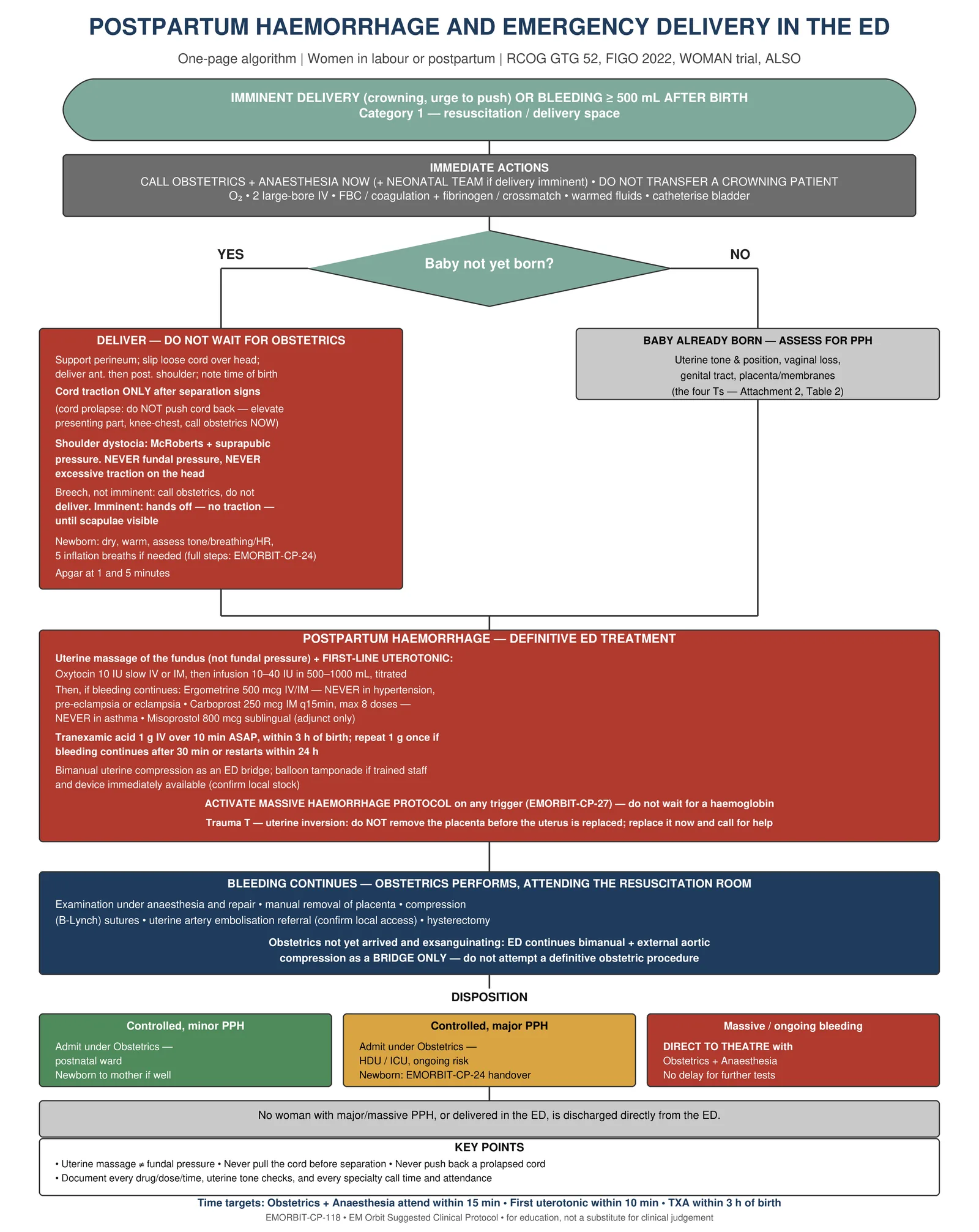
The one-page algorithm is shown at the top of this page.
6Team roles
6.1Triage / ED Nurse:
6.1.1 Recognise crowning or an irresistible urge to push and call Obstetrics, Anaesthesia and the neonatal team immediately; prepare a delivery pack and warming for the newborn; record the time of birth; weigh swabs to estimate blood loss where possible.
6.2Pharmacist:
6.2.1 Verify every dose in Table 3 against the local formulary and smart-pump library; confirm ergometrine and carboprost contraindications are checked before administration; confirm tranexamic acid and uterotonic stock.
6.3Obstetrics and Gynaecology:
6.3.1 Attend the resuscitation room immediately for imminent delivery or confirmed/suspected PPH; perform examination under anaesthesia, manual removal of the placenta, compression sutures, embolisation referral or hysterectomy as needed; direct disposition.
6.4Anaesthesia:
6.4.1 Attend for major or massive PPH and for any emergency delivery complication; provide analgesia and prepare for immediate transfer to theatre.
6.5Neonatology / Paediatrics:
6.5.1 Attend for any delivery in the ED; assume care of the newborn after initial newborn life support per EMORBIT-CP-24.
6.6Laboratory / Blood Bank:
6.6.1 As per EMORBIT-CP-27: issue components without delay on activation, prioritise fibrinogen and crossmatch results, report critical results verbally.
6.7Ambulance / Pre-hospital Providers:
6.7.1 Pre-alert the ED for imminent delivery or postpartum bleeding in transit; record any blood loss estimate and time of birth if delivery occurred pre-hospital; structured (ATMIST/SBAR) handover.
7The patient's role
7.1 Inform staff, where able, of any known pregnancy complication, allergy, bleeding disorder, or objection to a blood product.
7.2 Understand that transfer to theatre or admission to a high-dependency setting may be recommended urgently, and that this is to protect her safety.
7.3 Attend obstetric or gynaecology follow-up as arranged, and return immediately for heavy bleeding, fever, or feeling unwell after discharge.
8Definitions
8.1Primary Postpartum Haemorrhage: blood loss of 500 mL or more from the genital tract within 24 hours of birth, or any amount with haemodynamic compromise.
8.2Secondary Postpartum Haemorrhage: excessive bleeding from 24 hours to 12 weeks after birth, usually due to endometritis or retained products of conception.
8.3The Four Ts: Tone (uterine atony), Trauma (laceration, rupture, inversion), Tissue (retained placenta or membranes), Thrombin (coagulopathy) — Table 2.
8.4Uterine Inversion: the uterine fundus turns inside out, wholly or partly through the cervix, typically after excessive cord traction — a Trauma-category cause of PPH requiring immediate replacement before the placenta is removed.
8.5Shoulder Dystocia: failure of the fetal shoulders to deliver with gentle traction after the head is born, requiring additional manoeuvres.
8.6Crowning: the widest part of the fetal head is visible at the vulva and does not recede between contractions — delivery is imminent.
9Attachments
- Attachment 1: One-page algorithm (top of this page)
- Attachment 2: Severity/Activation, the Four Ts, and the Uterotonic Drug Quick Reference
11Suggested quality indicators
11.1Time to first uterotonic in confirmed PPH: (Number of confirmed PPH patients given the first uterotonic within 10 minutes of recognition / Total number of confirmed PPH patients) × 100. Target ≥ 90%.
11.2Tranexamic acid within the 3-hour window: (Number of confirmed PPH patients given tranexamic acid within 3 hours of birth / Total number of confirmed PPH patients requiring tranexamic acid) × 100. Target 100%.
11.3Obstetrics attendance within 15 minutes of the call: (Number of confirmed or suspected PPH or imminent-delivery patients with Obstetrics present within 15 minutes of the call / Total number of such patients) × 100. Target ≥ 90%.
11.4Safe disposition with complete handover: (Number of PPH patients transferred to theatre, a high-dependency setting, or the postnatal ward with a documented handover including estimated blood loss, drugs given and the ongoing plan / Total number of PPH patients) × 100. Target 100%.
11.5Newborn Apgar score documented at 5 minutes: (Number of infants delivered in the ED with a 5-minute Apgar score documented / Total number of infants delivered in the ED) × 100. Target ≥ 95%.
11.6Emergency hysterectomy for postpartum haemorrhage: Rate per 1000 deliveries managed under this guideline. Monitored as an outcome indicator without a fixed target, reviewed case-by-case at departmental audit.
13References
- Royal College of Obstetricians and Gynaecologists. Prevention and Management of Postpartum Haemorrhage: Green-top Guideline No. 52. BJOG. 2017;124(5):e106–e149.
- Escobar MF, Nassar AH, Theron G, et al. FIGO recommendations on the management of postpartum hemorrhage 2022. Int J Gynaecol Obstet. 2022;157(Suppl 1):3–50 (exact author order and page range carried from the published FIGO 2022 recommendations — confirm before use).
- World Health Organization. WHO recommendations for the prevention and treatment of postpartum haemorrhage. Geneva: WHO; 2012, with the 2017–2018 updated recommendations on uterotonic agents.
- WOMAN Trial Collaborators. Effect of early tranexamic acid administration on mortality, hysterectomy, and other morbidities in women with post-partum haemorrhage (WOMAN): an international, randomised, double-blind, placebo-controlled trial. Lancet. 2017;389(10084):2105–2116.
- Royal College of Obstetricians and Gynaecologists. Shoulder Dystocia: Green-top Guideline No. 42, 2nd edition. BJOG. 2012.
- American Academy of Family Physicians. Advanced Life Support in Obstetrics (ALSO) Provider Course Syllabus.
- Jauniaux ERM, Alfirevic Z, Bhide AG, et al. Placenta Praevia and Placenta Accreta: Diagnosis and Management. Green-top Guideline No. 27a. BJOG. 2019;126(1):e1–e48.
A2Attachment 2: Severity/Activation, the Four Ts, and the Uterotonic Drug Quick Reference
| Category | Definition | ED action |
|---|---|---|
| Minor | Estimated blood loss 500–1000 mL, no clinical shock | Uterine massage, first-line uterotonic (Table 3), IV access, group and screen, continue observation |
| Major | Blood loss over 1000 mL and continuing, or any postpartum bleeding with clinical shock | Two large-bore IV lines, crossmatch, full bundle (section 4.3.3, Table 3) |
| Massive | Blood loss over 2000 mL, ongoing loss exceeding 150 mL/minute, or any EMORBIT-CP-27 activation trigger | Activate the massive haemorrhage protocol immediately (EMORBIT-CP-27) — do not wait for a haemoglobin result |
| Secondary (24 hours to 12 weeks postpartum) | Excessive bleeding after the first 24 hours, usually endometritis or retained products of conception | Assess for shock and sepsis; where septic, cultures and antimicrobials within 1 hour (EMORBIT-CP-11); obstetrics/gynaecology referral (section 4.3.6). Not the massive haemorrhage pathway unless shocked |
A woman who moves up a category is managed at the higher category, with the time documented.
| Cause | Approx. share | Clue | First ED action |
|---|---|---|---|
| Tone | ~70% | Uterus soft, boggy or not palpable as a firm mass after delivery of the placenta | Uterine massage of the fundus + first-line uterotonic (Table 3). Uterine massage (rubbing the fundus) is not the same as fundal pressure — never push down on the fundus to try to deliver the baby or the placenta |
| Trauma | ~20% | Uterus firm and contracted but bleeding continues; a visible perineal, vaginal or cervical laceration; sudden pain, shock or loss of station with a soft, non-palpable fundus (uterine inversion) | Inspect the genital tract under adequate light and analgesia; obstetrics repairs any laceration. Uterine inversion: do NOT remove an adherent placenta before the uterus is replaced. Push the fundus back up through the cervix immediately; call obstetrics and anaesthesia at once — uterine relaxation to permit replacement is an obstetric/anaesthetic decision |
| Tissue | ~10% | Placenta or membranes incomplete on inspection; placenta not delivered within 30 minutes of the baby | Obstetric review for manual removal in theatre. Do not pull on the cord before the signs of placental separation (a gush of blood, lengthening of the cord, the fundus rising and becoming firm and globular) — uncontrolled traction risks uterine inversion |
| Thrombin | ~1% | Oozing from puncture sites, no clot forming, known bleeding disorder or anticoagulant, or a cause of coagulopathy (abruption, amniotic fluid embolism, severe pre-eclampsia/HELLP, sepsis) | Coagulation screen with fibrinogen; treat per EMORBIT-CP-27 (reversal agents, Table 4 there; fibrinogen replacement trigger 2.0 g/L in obstetric haemorrhage) |
The four Ts commonly coexist (for example atony after prolonged labour with a laceration from instrumental delivery); treat every cause found, not only the first.
| Drug | Dose and route | Timing / repeat | Contraindications and cautions |
|---|---|---|---|
| Oxytocin — FIRST LINE | 10 IU by slow intravenous injection, or intramuscularly; then an infusion of 10–40 IU in 500–1000 mL, run at the rate that keeps the uterus contracted | Start as soon as atony is recognised, together with uterine massage | Give the IV bolus slowly — rapid injection can cause hypotension. No absolute contraindication |
| Ergometrine | 500 micrograms by slow intravenous injection or intramuscularly | A single ED dose; a repeat dose is an obstetric decision | CONTRAINDICATED in hypertension, pre-eclampsia, eclampsia (EMORBIT-CP-74) and cardiac disease |
| Carboprost (15-methyl PGF2α) | 250 micrograms intramuscularly (or directly into the myometrium, by the obstetric team) | Repeat every 15 minutes if needed, to a maximum of 8 doses (2 mg total) | CONTRAINDICATED in asthma. Caution in cardiac, pulmonary, hepatic or renal disease |
| Misoprostol | 800 micrograms sublingually (or rectally if she cannot take it orally) | Single dose; an adjunct, not a substitute for oxytocin | Shivering and pyrexia are expected side effects, not a reason to withhold it |
| Tranexamic acid | 1 g intravenously over 10 minutes | As soon as possible; repeat 1 g once if bleeding continues after 30 minutes or restarts within 24 hours; give within 3 hours of birth (matches EMORBIT-CP-27) | As per EMORBIT-CP-27 |
All doses in this table require verification against the local formulary and smart-pump library by Clinical Pharmacy, and confirmation by Obstetrics, before use. Doses are the standard RCOG/FIGO/WHO doses.