Major Incident and Mass Casualty — Emergency Department Response
EMORBIT-CP-126 · Chapter 16 · Cross-cutting ED Standards
Open in the appFree, works on your phone and offline, with every tool alongside.
Evidence base: NHS EPRR; MIMMS
1Purpose
1.1 Define the Emergency Department (ED) clinical response to a declared major incident or mass casualty event: declaration and the METHANE message, the first-15-minute actions, primary triage sieve and secondary triage sort, casualty flow, chemical/biological/radiological/nuclear (CBRN) decontamination sequencing, documentation and identification, staff welfare, stand-down and debrief.
1.2 This is the ED action-card layer only. It has been written without sight of the hospital's own Major Incident Plan, which governs overall hospital command, mutual aid and business continuity. It must be reconciled against that plan, and any conflict resolved in the plan's favour, before use.
1.3 Direct the specific clinical management of the injury or exposure each casualty presents with to the relevant existing EM Orbit Clinical Protocol (CPG) — this guideline does not restate them.
2Who this protocol applies to
2.1 Every casualty presenting to, or triaged at, the Emergency Department once a major incident has been declared, whether transported by ambulance, self-presenting, or already an inpatient of the ED at the time of declaration.
2.2 Any event — conventional (blast, structural collapse, transport, fire), or CBRN — in which the number, severity or type of casualties exceeds, or threatens to exceed, the department's normal capacity to respond.
2.3 A declared internal incident (for example, a fire, a utility failure or an internal contamination event) that requires the department to move to the major-incident triage and casualty-flow process in this guideline.
3Not covered by this protocol
3.1 A single high-acuity patient or a cluster of patients manageable within normal department capacity using the standard triage categories of EMORBIT-CP-29 — this does not require declaration.
3.2 Overall hospital command, mutual-aid activation, business continuity and public communications, which are governed by the hospital Major Incident Plan, not this guideline.
3.3 Definitive management of the specific injury or exposure once a casualty has been triaged, which follows the relevant existing ED CPG (section 4.3.2) and is not restated here.
4Protocol
4.1History and Assessment:
4.1.1Triage and Recognition — Declaration and the METHANE Message:
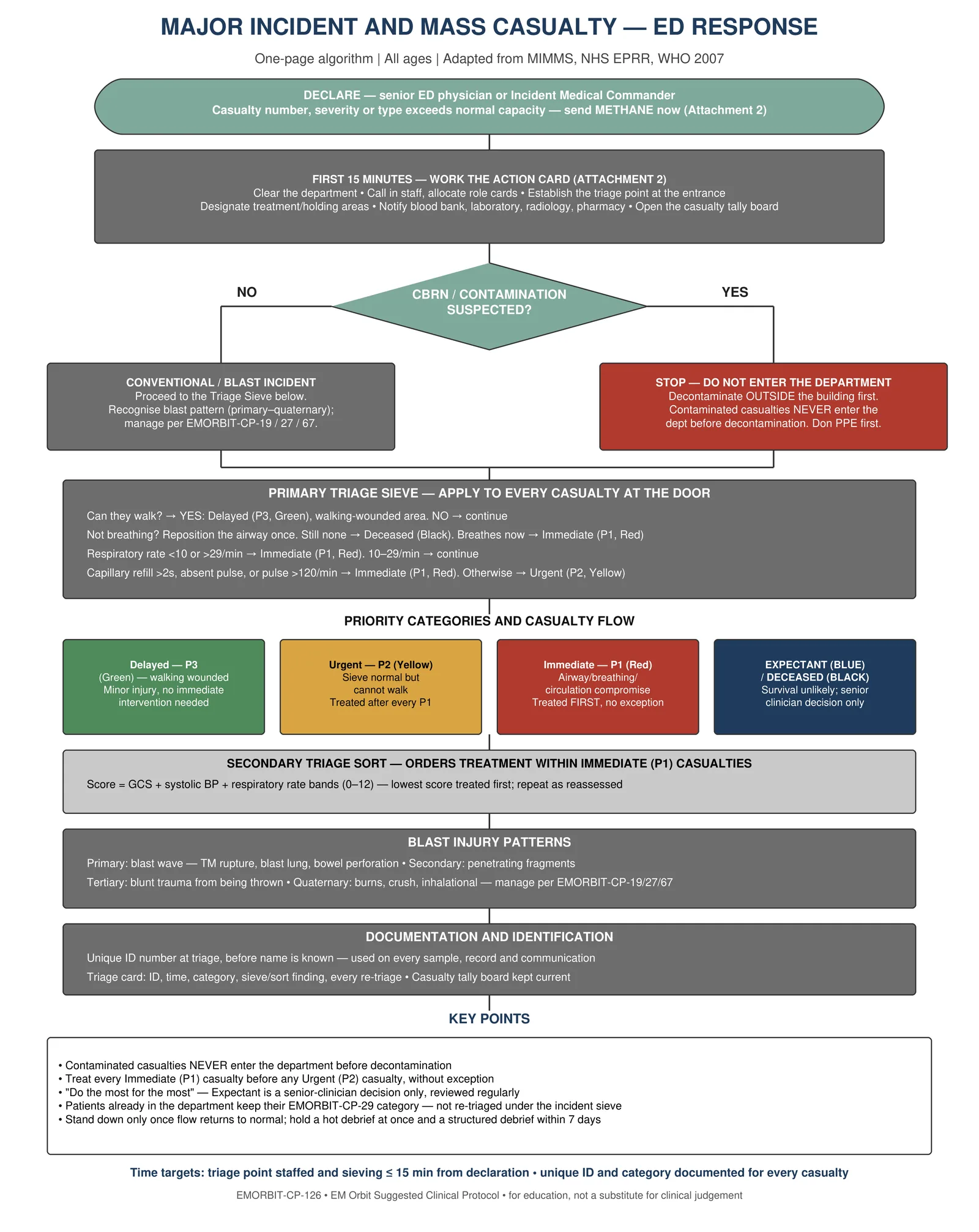
4.1.1.1 Declared by the senior ED physician present, or by the hospital Incident Medical Commander once designated, when casualty number, severity or type exceeds, or threatens to exceed, normal department capacity.
4.1.1.2 On declaration, send a METHANE message (Attachment 2) to ambulance control and hospital control, and repeat/update it as the picture changes.
4.1.1.3 On declaration of a major incident, the department moves to this triage system (primary sieve and secondary sort) and the five-category scale of EMORBIT-CP-29 is suspended for incident casualties; patients already in the department retain their assigned EMORBIT-CP-29 category (as required by EMORBIT-CP-29).
4.1.2First 15 Minutes:
4.1.2.1 The ED physician in charge works through the ED First-15-Minutes Action Card (Attachment 2) without delay: it covers clearing the department, staff call-in and role-card allocation, establishing the triage point, and notifying support services.
4.1.3Risk Stratification — Triage Sieve and Sort:
4.1.3.1
Table 1: Major-incident triage categories and casualty flow Category (colour) Criteria Flow Immediate — P1 (Red) Airway compromise, uncontrolled external haemorrhage, respiratory rate <10 or >29/min, absent radial pulse or capillary refill >2 s. Resuscitation area — treated first, without exception. Urgent — P2 (Yellow) Significant injury tolerating a short delay: sieve findings normal but cannot walk. Urgent treatment area, after every Immediate casualty. Delayed — P3 (Green) Walking wounded; minor injury not needing immediate intervention. Walking-wounded/minor area, away from the resuscitation flow. Expectant (Blue) Injury incompatible with survival given the resources available. Declared only when casualty numbers overwhelm capacity despite maximal effort. Comfort-care area; reviewed regularly and reclassified if resources allow. Deceased (Black) No breathing after the airway is opened/repositioned once, and no other sign of life. Holding area, away from the treatment flow. Do not attempt resuscitation on a casualty triaged Deceased under the sieve. Any clinician may raise a category. Only the senior clinician present (ED physician in charge or Incident Medical Commander) declares Expectant, reviews it regularly, and may lower any category.
4.1.3.2
Table 2: Primary Triage Sieve — repeat whenever a casualty is moved, deteriorates, or is reassessed Step Assessment Result → category 1 Can the casualty walk? Yes → Delayed (P3): direct to the walking-wounded area. No → step 2. 2 Is the casualty breathing? No → open/reposition the airway once. Still not breathing → Deceased. Breathes only after repositioning → Immediate (P1). 3 Respiratory rate <10 or >29/min → Immediate (P1). 10–29/min → step 4. 4 Capillary refill / pulse >2 s (or radial pulse absent, or pulse >120/min if refill cannot be assessed) → Immediate (P1). Otherwise → Urgent (P2). The sieve is a rapid physiological filter, not a diagnosis.
4.1.3.3
Table 3: Secondary Triage Sort — orders treatment within Immediate (P1) casualties once demand exceeds capacity Physiological variable Value Score Glasgow Coma Scale 13–15 / 9–12 / 6–8 / 4–5 / 3 4 / 3 / 2 / 1 / 0 Systolic blood pressure (mmHg) >89 / 76–89 / 50–75 / 1–49 / 0 4 / 3 / 2 / 1 / 0 Respiratory rate (breaths/min) 10–29 / >29 / 6–9 / 1–5 / 0 4 / 3 / 2 / 1 / 0 Sum the three scores (0–12, excluding a casualty already Deceased). The lowest total is treated first among Immediate casualties. Repeat as casualties are reassessed.
4.1.4Differential Diagnosis — Type of Incident:
4.1.4.1 A CBRN incident is suspected from the mechanism, an unexplained pattern of symptoms in multiple casualties, or a hazard reported in the METHANE message; treat as CBRN until excluded (section 4.1.4).
4.1.4.2 A blast incident produces recognisable injury patterns: primary (blast-wave — tympanic membrane rupture, blast lung, bowel perforation), secondary (penetrating fragment wounds), tertiary (blunt trauma from being thrown or struck by debris), and quaternary (burns, crush, inhalational, and psychological injury). A structural-collapse or post-detonation environment may add a quinary contaminant exposure — manage per the relevant existing CPG (EMORBIT-CP-19, EMORBIT-CP-27, EMORBIT-CP-67) and flag any suspected contaminant to Radiation Safety/Infection Control.
4.1.5CBRN — Decontamination Sequencing:
4.1.5.1 Contaminated casualties never enter the department before decontamination. Stop casualty flow into the building, establish a decontamination line outside (upwind, uphill of the entrance where feasible), and don personal protective equipment before any contact with a contaminated or potentially contaminated casualty.
4.1.5.2 Life-saving intervention (airway, external haemorrhage control) is given during decontamination where a trained, protected clinician is available; it is never delayed to complete a full decontamination in a casualty who is dying, but decontamination is completed before that casualty enters the department.
4.1.5.3 Agent-specific antidotes and treatment: organophosphate/nerve-agent per EMORBIT-CP-69; radiological/nuclear exposure and potassium iodide per EMORBIT-CP-117; not restated here.
4.1.6Special Populations:
4.1.6.1 Children: triage using a weight/length-based paediatric tool where available (for example a paediatric major-incident triage tape); keep with a parent or carer wherever triage category allows.
4.1.6.2 Pregnancy: involve obstetrics early for any pregnant casualty triaged Immediate or Urgent.
4.1.6.3 Patients already in the department at declaration: retain their EMORBIT-CP-29 category and continue to be managed and re-triaged as normal; they are not re-triaged under the incident sieve.
4.1.6.4 Staff who are themselves casualties, or whose relatives are involved: are stood down from their incident role and triaged as casualties; do not allow a personally involved staff member to continue working the incident.
4.2Investigations:
4.2.1 No investigation delays triage, decontamination, or the first-hour treatment of an Immediate casualty.
4.2.2 Laboratory and radiology work to the major-incident protocol activated in section 4.3.1: prioritise group and save/crossmatch and portable imaging for Immediate casualties; deploy point-of-care testing to the treatment areas where available.
4.2.3 Blood bank mobilises the massive transfusion process for multiple casualties per EMORBIT-CP-27; this is not restated here.
4.3Plan of Care:
4.3.1Immediate Actions:
4.3.1.1 Work through the ED First-15-Minutes Action Card in full (Attachment 2) before any other departmental activity resumes.
4.3.2Definitive ED Treatment:
4.3.2.1 Treatment order follows the priority set by the triage sieve and sort (Tables 1–3): every Immediate casualty is treated before any Urgent casualty, without exception.
4.3.2.2 The specific clinical management of each casualty's injury or exposure follows the relevant existing CPG — major trauma (EMORBIT-CP-19), massive haemorrhage (EMORBIT-CP-27), burns (EMORBIT-CP-67), organophosphate/chemical (EMORBIT-CP-69), radiation/potassium iodide (EMORBIT-CP-117) — and is not restated here.
4.3.2.3 "Do the most for the most": when casualty numbers overwhelm the resources available, effort is directed to the casualties most likely to survive with the resources that exist. A casualty for whom survival is very unlikely even with unlimited resources is triaged Expectant (Table 1), a decision made and regularly reviewed by the senior clinician present, and reversed the moment resources allow.
4.3.3Escalation / Refractory — When Demand Still Exceeds Capacity:
4.3.3.1 The ED physician in charge escalates to the hospital Incident Medical Commander for additional staff, space, blood products or mutual aid, per the hospital Major Incident Plan (not restated here).
4.3.3.2 Re-apply the triage sieve and sort at every point of hand-off or delay; a casualty's category can rise or fall as their condition or the department's capacity changes.
4.3.4Monitoring and Reassessment:
4.3.4.1 The ED physician in charge and triage officer maintain a running casualty tally board (numbers by category, treated, awaiting, disposed) and update hospital control at a fixed interval agreed locally.
4.3.4.2 Re-triage every casualty in a holding or waiting area at that same interval, and immediately if a casualty deteriorates.
4.3.5Disposition:
4.3.5.1 Immediate casualties flow to the resuscitation area; Urgent to the urgent-treatment area; Delayed to the walking-wounded/minor area; Expectant to the comfort-care area; Deceased to the holding area — away from the active treatment flow (Table 1).
4.3.5.2 Disposition from each area (theatre, intensive care, ward, discharge, mortuary) follows the same admission and referral pathway as the casualty's specific injury under the relevant existing CPG.
4.3.6Discharge and Follow-up:
4.3.6.1 A Delayed (walking-wounded) casualty is fully assessed before discharge — the walking-wounded area is not a location to be missed; apply the same discharge-safety criteria as the casualty's specific presentation.
4.3.6.2 Provide every discharged casualty with written information on how to seek follow-up, and record the discharge on the casualty tally board before they leave.
4.3.7Documentation and Reporting:
4.3.7.1 Allocate a unique incident identification number to every casualty at the point of triage — before name or normal registration is available — and use it on every subsequent record, sample and communication until formal identification is confirmed.
4.3.7.2 Document on the triage card: the identification number, time of triage, triage category and the sieve/sort finding that produced it, and every subsequent re-triage.
4.3.7.3 Report the incident through the local incident reporting system and review at the post-incident debrief (section 4.3.9).
4.3.8Stand-Down, Staff Welfare and Debrief:
4.3.8.1 The ED physician in charge, in agreement with the hospital Incident Medical Commander, declares stand-down once casualty flow has returned to normal capacity.
4.3.8.2 Offer immediate welfare support (rest, fluids, food) to all staff involved, and access to structured psychological support/staff welfare services in the days following.
4.3.8.3 Hold a hot debrief immediately after stand-down and a structured post-incident debrief within 7 days, and feed findings back into this guideline and the departmental escalation plan.
5Algorithm
The one-page algorithm is shown at the top of this page.
6Team roles
6.1Triage / ED Nurse:
6.1.1 Apply the Primary Triage Sieve (Table 2) to every arriving casualty at the department entrance; allocate the unique identification number and triage card; maintain the casualty tally board.
6.2Pharmacist:
6.2.1 Open the major incident drug/antidote stock (organophosphate/CBRN antidotes per EMORBIT-CP-69, potassium iodide per EMORBIT-CP-117); support blood bank in mobilising the massive transfusion process (EMORBIT-CP-27).
6.3Relevant Specialty (per role-card call-in list):
6.3.1 Report to the department as called; form secondary treatment teams; a senior specialist attends the resuscitation area for an Immediate casualty requiring their specialty, per EMORBIT-CP-19.
6.4Laboratory / Radiology:
6.4.1 Activate the major-incident laboratory and imaging protocol; prioritise group and save/crossmatch and portable imaging for Immediate casualties.
6.5Ambulance / Pre-Hospital:
6.5.1 Transmit the METHANE message and repeated updates to hospital control; apply the primary triage sieve at the scene where achievable; communicate the number, severity and type of incoming casualties ahead of arrival.
7The patient's role
7.1 Cooperate with identification and triage even where normal registration is not possible.
7.2 Wait at the designated area for the assigned triage category unless directed otherwise by staff.
7.3 Family or next of kin report to the designated friends-and-family reception point for information; media and the public are directed away from the clinical area.
8Definitions
8.1Major Incident: an event in which the number, severity or type of casualties exceeds, or threatens to exceed, normal department capacity to respond, requiring special arrangements.
8.2METHANE: the structured message sent on declaration — My call sign/location, Exact location, Type of incident, Hazards, Access/egress, Number/severity/type of casualties, Emergency services present/required (Attachment 2).
8.3Primary Triage Sieve: the rapid physiological filter (walk, breathe, respiratory rate, capillary refill/pulse) applied to every casualty to allocate an initial priority category (Table 2).
8.4Secondary Triage Sort: a physiological scoring tool (Glasgow Coma Scale, systolic blood pressure, respiratory rate) used to order treatment within the Immediate category when demand exceeds capacity (Table 3).
8.5CBRN: chemical, biological, radiological or nuclear hazard.
8.6Expectant: a casualty whose injury is incompatible with survival given the resources available; declared only by the senior clinician present, reviewed regularly, and reversible if resources allow (Table 1).
8.7Incident Medical Commander: the senior clinician designated to direct the medical response to the incident, per the hospital Major Incident Plan.
9Attachments
- Attachment 1: One-page algorithm (top of this page)
- Attachment 2: METHANE Message Card and ED First-15-Minutes Action Card
11Suggested quality indicators
11.1Time from declaration to triage point established: (Number of declared incidents with the triage point staffed and sieving casualties within 15 minutes of declaration / Total number of declared incidents) × 100. Target ≥ 90%.
11.2Casualties allocated a unique identification number and triage category at triage: (Number of incident casualties with both documented / Total number of incident casualties) × 100. Target 100%.
11.3Immediate (P1) casualties treated before any Urgent (P2) casualty: (Number of incidents in which treatment order matched triage priority / Total number of declared incidents) × 100. Target 100%.
11.4Documented disposition for every casualty at stand-down: (Number of casualties with disposition — ward, theatre, discharge or mortuary — documented at stand-down / Total number of incident casualties) × 100. Target 100%.
11.5Post-incident debrief held within 7 days (outcome/process, monitored): (Number of declared incidents with a structured debrief held within 7 days / Total number of declared incidents) × 100.
13References
- Advanced Life Support Group. Major Incident Medical Management and Support (MIMMS): A Practical Guide. 4th ed. Chichester: Wiley-Blackwell; 2021.
- NHS England. Emergency Preparedness, Resilience and Response (EPRR) Framework. London: NHS England; 2022.
- World Health Organization. Mass Casualty Management Systems: Strategies and Guidelines for Building Health Sector Capacity. Geneva: WHO; 2007.
- Champion HR, Sacco WJ, Copes WS, et al. A revision of the Trauma Score. J Trauma. 1989;29(5):623–629.
- DePalma RG, Burris DG, Champion HR, Hodgson MJ. Blast injuries. N Engl J Med. 2005;352(13):1335–1342.
- National Emergency Crisis and Disasters Management Authority (NCEMA), United Arab Emirates. National mass-casualty/major incident response framework.
A2Attachment 2: METHANE Message Card and ED First-15-Minutes Action Card
| Content | |
|---|---|
| M | My call sign and location |
| E | Exact location of the incident |
| T | Type of incident |
| H | Hazards present and potential |
| A | Access and egress routes |
| N | Number, severity and type of casualties |
| E | Emergency services present and required |
| ✓ | Action |
|---|---|
| ☐ | Declare the major incident and send the METHANE message to hospital control; repeat and update as the picture changes. |
| ☐ | Clear the department: discharge, transfer or relocate every patient who can safely move; escalate any patient who cannot. |
| ☐ | Call in staff per the role-card list; open the major incident action cards and allocate roles (triage officer, treatment-area leads, documentation, runner). |
| ☐ | Establish the triage point at the department entrance; the triage officer applies the Primary Triage Sieve (Table 2) to every arriving casualty. |
| ☐ | If a chemical, biological, radiological or nuclear (CBRN) hazard is possible, stop casualty flow into the building and set up decontamination outside (section 4.1.4). |
| ☐ | Designate the Immediate, Urgent and Delayed treatment areas and the holding areas for Expectant and Deceased casualties. |
| ☐ | Notify blood bank, laboratory, radiology, pharmacy and portering per their role cards; alert the on-call specialties. |
| ☐ | Open the casualty tally board and begin unique-number identification (section 4.3.7) for every casualty from the point of triage. |
| ☐ | Designate a friends-and-family/media reception point away from the clinical area. |