Acute Radiation Syndrome and Potassium Iodide Prophylaxis in the Emergency Department
EMORBIT-CP-117 · Chapter 10 · Toxicological and Environmental Emergencies
Open in the appFree, works on your phone and offline, with every tool alongside.
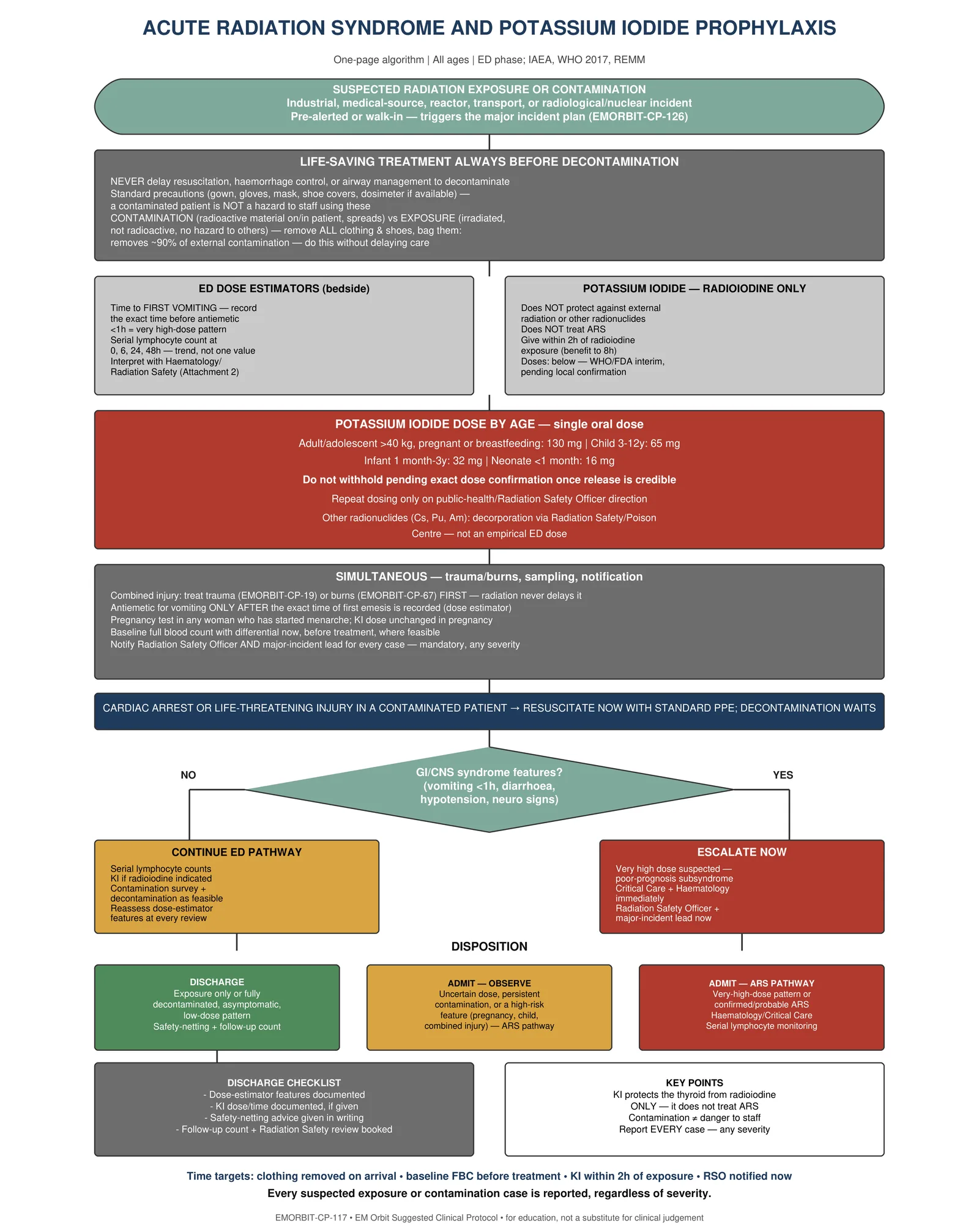
Evidence base: IAEA; WHO; REMM
1Purpose
1.1 This guideline adopts your institution's Clinical Practice Guidelines "Management of Acute Radiation Syndrome" and "Potassium Iodide Prophylaxis" in full, and adds the Emergency Department (ED) front-door phase of care for a patient with suspected or confirmed radiation exposure or contamination. It does not replace, amend, or restate either institutional document. KI dose bands follow the WHO 2017 and US FDA 2001 iodine thyroid-blocking bands.
1.2 Standardize ED recognition of radiation exposure and contamination, the sequencing of life-saving treatment before decontamination, bedside dose-estimation cues, and the indications and dosing for potassium iodide (KI) prophylaxis.
1.3 Set out clearly that KI protects the thyroid against radioiodine only, and does not treat acute radiation syndrome (ARS) or protect against external irradiation or other radionuclides.
1.4 Define the ED/institutional-pathway boundary: the ED recognises, resuscitates, decontaminates or defers decontamination appropriately, gives KI where indicated, takes the baseline blood sample, and refers; definitive ARS staging, marrow-suppression management, and internal-contamination decorporation therapy are governed by the local guidelines, Radiation Safety, and Haematology/Critical Care.
1.5 Point to EMORBIT-CP-126 (Major Incident, parallel) for mass-casualty triage and decontamination-line management, to EMORBIT-CP-67 and EMORBIT-CP-19 for combined thermal/traumatic injury, to EMORBIT-CP-52 for neutropenic fever following marrow suppression, and to EMORBIT-CP-29 for the triage standard — none of these is restated here.
2Who this protocol applies to
2.1 Any patient of any age with suspected or confirmed exposure to ionising radiation (external whole- or partial-body irradiation) or contamination with radioactive material (external skin/clothing contamination or internal contamination by inhalation, ingestion, or a wound), from an industrial, medical-source, reactor, transport, or radiological/nuclear incident.
2.2 Patients pre-alerted by ambulance or the hospital emergency plan as part of a radiological or nuclear incident, including a suspected radioiodine release requiring KI prophylaxis assessment.
2.3 Patients with a credible occupational radiation-badge alert or a witnessed high-dose exposure, even if currently asymptomatic.
3Not covered by this protocol
3.1 Routine diagnostic or therapeutic medical radiation (for example, standard imaging or nuclear medicine therapy) without an incident: not in scope.
3.2 Definitive ARS staging, marrow-suppression management, growth-factor therapy, and internal-contamination decorporation agents beyond the ED phase: governed by the local Acute Radiation Syndrome guideline and Haematology/Critical Care (section 4.3.2).
3.3 Neutropenic fever following marrow suppression: managed under EMORBIT-CP-52 (Febrile Neutropenia), not restated here.
3.4 Combined thermal or blast injury management: managed under EMORBIT-CP-67 (Burns) and EMORBIT-CP-19 (Major Trauma), which take priority (section 4.1.1.1).
3.5 Mass-casualty triage sieve/sort, decontamination-line staffing, and scene command: governed by EMORBIT-CP-126 (Major Incident, parallel), not restated here.
4Protocol
4.1History and Assessment:
4.1.1Triage and Recognition:
4.1.1.1 Life-saving treatment always comes before decontamination. Never delay resuscitation, haemorrhage control, or airway management to decontaminate a patient.
4.1.1.2 A patient contaminated with radioactive material is not a hazard to staff using standard precautions (gown, gloves, mask, shoe covers, and a personal dosimeter where available) — treat as clinically indicated.
4.1.1.3 Distinguish contamination (radioactive material on or in the patient; can spread to staff and surfaces; removed by decontamination) from exposure (irradiated by a source; the patient is not radioactive and poses no hazard to others). A patient exposed to an external beam or a shielded source, with no contamination, needs no decontamination.
4.1.1.4 Removing all clothing and shoes, and bagging them, removes on the order of 90% of external contamination. Do this at triage or on arrival where feasible, without delaying assessment or treatment; retain bagged items, as they may be needed as evidence in a deliberate-release incident.
4.1.1.5 A suspected radiological or nuclear incident triggers the hospital major incident plan and EMORBIT-CP-126; triage under EMORBIT-CP-29, with a minimum urgent category for any symptomatic or high-dose-suspected patient.
4.1.2History:
4.1.2.1 Time, duration, and nature of exposure or contamination; distance from and shielding from the source; type of incident (industrial source, medical source, reactor, transport, dispersal device); any badge-dosimeter or survey-meter reading available from the scene or Radiation Safety.
4.1.2.2 Time of onset of any nausea, vomiting, or diarrhoea since exposure — record the exact time before giving an antiemetic, as time-to-emesis is a bedside dose estimator (Attachment 2).
4.1.2.3 Associated trauma or burns (section 4.1.1.1); occupational radiation history; pregnancy status; current medicines and allergies, including any known iodine sensitivity.
4.1.3Examination:
4.1.3.1 Primary survey (ABCDE) first, irrespective of contamination status; full exposure once immediately life-threatening problems are addressed.
4.1.3.2 Skin: early transient erythema at high local doses; a radiation skin burn typically appears days after exposure, not immediately — a normal-looking skin surface does not exclude a significant dose.
4.1.3.3 A contamination survey with a calibrated survey meter (Geiger–Müller or equivalent), performed by or with the Radiation Safety Officer, identifies contaminated sites before and after decontamination; where no survey meter is available, treat clinically and involve Radiation Safety without delay.
4.1.3.4 Full assessment for combined trauma or burn injury (section 4.1.1.1); these are managed on their own pathway first.
4.1.4Risk Stratification – Severity:
4.1.4.1 ARS bedside dose estimators.
Table 2: Acute radiation syndrome (ARS) — ED bedside dose estimators (interim reference; formal nomogram is a local-guideline/Haematology function, not reproduced here) Feature Lower-dose pattern Very-high-dose pattern Time from exposure to first vomiting None, or onset after 2 hours Onset under 1 hour — record the exact time Diarrhoea, hypotension, neurological signs in the first hours Absent Present — suggests gastrointestinal/CNS subsyndrome, poor prognosis Serial absolute lymphocyte count (0, 6, 24, 48 hours) Stable or slowly falling Rapid decline — predicts marrow-suppressive ARS These are ED triage estimators only. Formal dose reconstruction and ARS staging follow the local Acute Radiation Syndrome guideline, with Haematology and the Radiation Safety Officer.
4.1.4.2 ARS runs through a prodromal phase (hours), a latent phase, a manifest-illness phase (hematopoietic, gastrointestinal, or neurovascular subsyndrome depending on dose), and recovery or death; the ED typically sees only the prodromal phase. A very short prodromal latency (vomiting within 1 hour) with diarrhoea, hypotension, or neurological signs suggests a very high dose and a poor-prognosis subsyndrome — escalate immediately (section 4.3.3).
4.1.5Differential Diagnosis:
4.1.5.1 Gastroenteritis, acute anxiety/panic reaction, chemical exposure, and sepsis can mimic the ARS prodrome; do not attribute vomiting to radiation without a credible exposure history, and do not dismiss a credible exposure history because symptoms are mild.
4.1.6Special Populations:
4.1.6.1 Pregnancy and postpartum (any woman who has started menarche, regardless of age): obtain a pregnancy test without delay if not already known (the triage nurse does not perform it — EMORBIT-CP-73); give the same adult KI dose (130 mg) where indicated — the thyroid-protection benefit to the fetus/infant outweighs the small risk; involve Obstetrics for any radiation-exposed pregnant patient.
4.1.6.2 Children: use the paediatric weight/age KI bands (Attachment 2, Table 1) — children carry the highest lifetime thyroid-cancer risk from radioiodine, so KI is especially important where indicated; estimate weight by the APLS convention (EMORBIT-CP-24/EMORBIT-CP-25) where actual weight is unavailable.
4.1.6.3 Combined injury (trauma or burns plus radiation): treat the trauma or burn first, per EMORBIT-CP-19/EMORBIT-CP-67; decontaminate as feasible without delaying that treatment; involve Radiation Safety early, as combined injury carries a worse prognosis than either injury alone.
4.2Investigations:
4.2.1 Full blood count with manual differential before any treatment where feasible (baseline), then repeated at approximately 6, 24, and 48 hours — the serial absolute lymphocyte count trend is the ED's practical dose-estimation tool (Attachment 2); a single value is not interpretable alone.
4.2.2 Contamination survey with a calibrated survey meter before and after decontamination, where available (section 4.1.1.3).
4.2.3 Pregnancy test in any woman who has started menarche, regardless of age.
4.2.4 Standard trauma or burn work-up as clinically indicated for combined injury (not restated here).
4.2.5 Radiation Safety Officer/Medical Physics consultation for any confirmed exposure or contamination — do not wait for this before starting the above.
4.3Plan of Care:
4.3.1Immediate Actions:
4.3.1.1 Primary survey and resuscitation take priority over decontamination and dose assessment in every patient, using standard precautions (section 4.1.1.1–4.1.1.2).
4.3.1.2 Remove all clothing and shoes and bag them where feasible without delaying care (section 4.1.1.1); wash exposed skin and hair with soap and water where contamination is confirmed or suspected, directed by Radiation Safety where available.
4.3.2Potassium Iodide Prophylaxis:
4.3.2.1 KI protects the thyroid against radioiodine only. It does NOT protect against external irradiation or other radionuclides, and it does NOT treat ARS. Give KI only where radioiodine exposure or a credible risk of it is present (for example, a reactor accident or radioiodine source release), on the direction of the hospital emergency plan/Radiation Safety Officer or public-health authority.
4.3.2.2 Dosing.
Table 1: Potassium iodide (KI) dosing for radioiodine exposure — WHO 2017 / US FDA 2001 interim figures, NOT YET RECONCILED with the local Potassium Iodide Prophylaxis guideline Age / group KI dose (single oral dose) Notes Adult and adolescent >40 kg (≥12 years), pregnant or breastfeeding woman 130 mg Same dose in pregnancy — thyroid-protection benefit outweighs risk Child 3–12 years (or 20–40 kg) 65 mg Use weight where age and weight bands disagree Infant 1 month – 3 years (or 10–20 kg) 32 mg Neonate birth – 1 month 16 mg Highest thyroid-cancer risk group from radioiodine Give ideally before or within 2 hours of exposure; still of some benefit up to 8 hours. A single dose is usually sufficient for a single acute release — repeat dosing only on public-health/Radiation Safety Officer direction, never routinely.
4.3.2.3 Do not withhold KI pending exact dose confirmation once a radioiodine release is credible and the incident direction is to administer it — the window of benefit is short (best within 2 hours, of some benefit to 8 hours).
4.3.2.4 Contraindication: a known genuine iodine hypersensitivity is rare; discuss with Toxicology/Radiation Safety before withholding in a high-risk exposure rather than withholding automatically.
4.3.2.5 Internal contamination with other radionuclides (for example, caesium, plutonium, americium) requires specific decorporation agents (such as Prussian blue or DTPA) obtained through the Radiation Safety Officer, the national poison centre, or the local guideline — a dose is not invented or stocked empirically in the ED.
4.3.3Symptomatic and Supportive Care:
4.3.3.1 Antiemetic for nausea/vomiting per formulary after the exact time of first emesis has been recorded (section 4.1.1.2), since this timing is a dose estimator that antiemetic treatment does not need to precede.
4.3.3.2 Analgesia and standard supportive care as clinically indicated; treat any combined trauma or burn injury on its own pathway (section 4.1.1.1).
4.3.3.3 Growth-factor therapy (for example, G-CSF) for anticipated marrow suppression is a local-guideline/Haematology decision beyond the ED phase — not initiated in the ED.
4.3.4Escalation / Refractory:
4.3.4.1 Gastrointestinal or CNS syndrome features — vomiting within 1 hour of exposure, diarrhoea, hypotension, or neurological signs — indicate a very high dose with a poor-prognosis subsyndrome. Call Critical Care and Haematology immediately, and notify the Radiation Safety Officer and the hospital major-incident lead without delay.
4.3.4.2 Any haemodynamic instability from combined trauma or burn injury is managed on its own pathway in parallel (section 4.1.1.1), never deferred for radiation assessment.
4.3.5Monitoring and Reassessment:
4.3.5.1 Serial vital signs and level of consciousness; serial absolute lymphocyte count as above (section 4.2); ongoing communication with the Radiation Safety Officer for any confirmed contamination or exposure.
4.3.6Disposition:
4.3.6.1 Discharge: exposure only (no contamination), asymptomatic, low-dose pattern on the estimators in Table 2, and no high-risk feature — with safety-netting and a follow-up blood count arranged per the local guideline.
4.3.6.2 Discharge after successful decontamination: contamination fully cleared on survey, asymptomatic, low-dose pattern — as above.
4.3.6.3 Admit under the institutional ARS pathway (Haematology/Critical Care): any patient with a very-high-dose pattern (Table 2), confirmed or probable dose sufficient to cause ARS, persistent contamination not clearing with decontamination, or any high-risk feature in section 4.1.4 — with continued serial lymphocyte monitoring.
4.3.6.4 Any patient given KI: document the dose and time, and provide the onward public-health follow-up contact.
4.3.7Discharge and Follow-up:
4.3.7.1 Written safety-netting advice: return for bleeding, bruising, fever, sore throat, hair loss, or recurrence/worsening of vomiting or diarrhoea (Attachment 2).
4.3.7.2 Arrange follow-up blood count and Radiation Safety/occupational-health review per the local guideline; provide contact details once the local route is confirmed.
4.3.8Documentation and Reporting:
4.3.8.1 Document: time and type of exposure/contamination, survey-meter results if performed, exact time of first vomiting, KI given (dose, time, indication), serial lymphocyte results, and the disposition and its reasoning.
4.3.8.2 Notify the Radiation Safety Officer and the hospital major-incident lead, and report through the local incident-reporting system, for every suspected radiation exposure or contamination event — mandatory regardless of severity.
4.3.8.3 Notification: Notify the national radiation regulator and the national emergency-management authority through the hospital's emergency-notification route; do not invent a contact name or number.
5Algorithm
The one-page algorithm is shown at the top of this page.
6Team roles
The roles below are additional to, and consistent with, those defined in the two local guidelines.
6.1Triage / ED Nurse:
6.1.1 Ask exposure/contamination history in any patient from an industrial, medical-source, reactor, or radiological incident; begin clothing removal where feasible without delaying care; record the exact time of any first vomiting; standard precautions only, no special isolation beyond that.
6.2ED Pharmacist:
6.2.1 Verify the KI dose and timing, especially in children and pregnancy, once the institutional dose bands are confirmed (section 4.3.2); verify antiemetic and other supportive-care dosing.
6.3Radiation Safety Officer / Medical Physics:
6.3.1 Attend for any confirmed or suspected contamination; direct the survey, decontamination sequence, and any internal decorporation therapy; confirm the KI indication with the hospital emergency plan.
6.4Haematology:
6.4.1 Advise on serial lymphocyte-count interpretation and lead marrow-suppression management beyond the ED phase.
6.5Laboratory:
6.5.1 Process serial full blood counts urgently; handle specimens from a contaminated patient under Radiation Safety precautions once notified.
6.6Ambulance / Pre-hospital:
6.6.1 Pre-alert the ED with the exposure/contamination type, whether pre-hospital decontamination was performed, and any available dosimetry, so precautions and KI can be prepared before arrival.
7The patient's role
7.1 Report the circumstances and time of exposure, any dosimeter reading, and the exact time of any vomiting or diarrhoea accurately.
7.2 Cooperate with decontamination, the contamination survey, and specimen collection.
7.3 Attend all follow-up appointments, and report bleeding, bruising, fever, sore throat, or hair loss promptly.
8Definitions
The definitions in the two local guidelines apply in full. The following are additional terms used in this protocol.
8.1Contamination: radioactive material on or in a patient, which can spread to others and is removed by decontamination.
8.2Exposure: irradiation by a source without the patient becoming radioactive; poses no hazard to others.
8.3Acute Radiation Syndrome (ARS): the clinical syndrome following a significant whole- or large-partial-body radiation dose, progressing through prodromal, latent, manifest-illness, and recovery/death phases.
8.4Potassium Iodide (KI): a thyroid-blocking agent that saturates the thyroid with stable iodine, reducing uptake of radioactive iodine; protects the thyroid only, not other organs.
8.5Decorporation: treatment (for example, Prussian blue, DTPA) that reduces the body burden of an internally deposited radionuclide other than iodine.
8.6REMM: Radiation Emergency Medical Management, a US National Library of Medicine/HHS clinical decision-support resource.
9Attachments
- Attachment 1: One-page algorithm (top of this page)
- Attachment 2: Potassium Iodide Dosing and ARS Dose-Estimator Quick Reference
11Suggested quality indicators
11.1Time to KI administration where indicated: (Number of patients with a confirmed radioiodine-exposure indication who receive KI within 2 hours of exposure or of arrival, whichever is later / Total number of such patients) × 100. Target ≥ 90%.
11.2Contamination survey and precautions documented (process): (Number of suspected-contamination patients with a survey and standard-precautions status documented within 30 minutes of recognition / Total number of such patients) × 100. Target ≥ 90%.
11.3Radiation Safety Officer notification (process): (Number of suspected exposure/contamination cases with Radiation Safety Officer notification documented / Total number of such cases) × 100. Target 100%.
11.4Safe disposition: (Number of discharged patients with a documented dose-estimator assessment, no unaddressed red flag, and written safety-netting advice given / Total number of patients discharged) × 100. Target ≥ 90%.
11.5Outcome indicator (monitored, no fixed ED target): incidence of marrow-suppressive ARS confirmed on admission among patients presenting through this pathway.
13References
- International Atomic Energy Agency. Generic Procedures for Medical Response During a Nuclear or Radiological Emergency. Vienna: IAEA.
- World Health Organization. Iodine Thyroid Blocking: Guidelines for Use in Planning for and Responding to Radiological and Nuclear Emergencies. Geneva: WHO; 2017.
- US Food and Drug Administration. Guidance: Potassium Iodide as a Thyroid Blocking Agent in Radiation Emergencies. Rockville, MD: FDA; 2001.
- US National Library of Medicine / US Department of Health and Human Services. Radiation Emergency Medical Management (REMM). remm.hhs.gov.
A2Attachment 2: Potassium Iodide Dosing and ARS Dose-Estimator Quick Reference
| Age / group | KI dose (single oral dose) | Notes |
|---|---|---|
| Adult and adolescent >40 kg (≥12 years), pregnant or breastfeeding woman | 130 mg | Same dose in pregnancy — thyroid-protection benefit outweighs risk |
| Child 3–12 years (or 20–40 kg) | 65 mg | Use weight where age and weight bands disagree |
| Infant 1 month – 3 years (or 10–20 kg) | 32 mg | |
| Neonate birth – 1 month | 16 mg | Highest thyroid-cancer risk group from radioiodine |
Give ideally before or within 2 hours of exposure; still of some benefit up to 8 hours. A single dose is usually sufficient for a single acute release — repeat dosing only on public-health/Radiation Safety Officer direction, never routinely.
| Feature | Lower-dose pattern | Very-high-dose pattern |
|---|---|---|
| Time from exposure to first vomiting | None, or onset after 2 hours | Onset under 1 hour — record the exact time |
| Diarrhoea, hypotension, neurological signs in the first hours | Absent | Present — suggests gastrointestinal/CNS subsyndrome, poor prognosis |
| Serial absolute lymphocyte count (0, 6, 24, 48 hours) | Stable or slowly falling | Rapid decline — predicts marrow-suppressive ARS |
These are ED triage estimators only. Formal dose reconstruction and ARS staging follow the local Acute Radiation Syndrome guideline, with Haematology and the Radiation Safety Officer.
1Discharge Safety-Netting Advice (give in writing):
- Return immediately for bleeding, bruising, fever, sore throat, hair loss, or worsening/recurrent vomiting or diarrhoea.
- Attend the arranged follow-up blood count and Radiation Safety/occupational-health review.
- Do not repeat a KI dose unless instructed by the public-health authority or the hospital emergency plan.