Organophosphate and Carbamate Poisoning in the Emergency Department
EMORBIT-CP-69 · Chapter 10 · Toxicological and Environmental Emergencies
Open in the appFree, works on your phone and offline, with every tool alongside.
Evidence base: WHO; TOXBASE
1Purpose
1.1 Provide a standardized, evidence-based framework for the safe recognition, decontamination, and treatment of patients of all ages presenting to the Emergency Department (ED) with organophosphate or carbamate poisoning.
1.2 Protect staff from secondary contamination through decontamination and personal protective equipment (PPE) before clinical contact.
1.3 Ensure atropine and oxygen are given without delay, titrated to a clinical end point (a dry chest, heart rate, and blood pressure) rather than to pupil size, and that this dose is not confused with the bradycardia dose in EMORBIT-CP-39.
1.4 Ensure recognition of the intermediate syndrome and safe observation through its window, and align with World Health Organization (WHO) guidance and the toxicology literature (Eddleston 2008; Senanayake and Karalliedde 1987).
2Who this protocol applies to
2.1 Patients of any age with suspected or confirmed exposure (ingestion, dermal, inhalational, or ocular) to an organophosphate or carbamate pesticide, insecticide, or related compound, whether occupational, accidental, or deliberate (self-poisoning).
2.2 Patients with a compatible cholinergic toxidrome and no other explanation, even without a confirmed agent or history.
2.3 Asymptomatic patients with a credible history of exposure: symptom onset may be delayed, particularly with fat-soluble organophosphates, and these patients require the observation period in this guideline, not immediate discharge.
3Not covered by this protocol
3.1 A different toxidrome (anticholinergic, sympathomimetic, opioid, sedative-hypnotic, or serotonergic): manage per EMORBIT-CP-21 (General Approach to the Poisoned Patient), which sets out the full toxidrome table.
3.2 A confirmed or suspected chemical mass-casualty incident (for example, a nerve agent release affecting multiple casualties): this guideline covers the individual patient; the department’s mass-casualty and decontamination response is EMORBIT-CP-126 (Major Incident and Mass Casualty) and the hospital Major Incident Plan.
3.3 Chronic, low-level occupational exposure without an acute cholinergic toxidrome: refer to occupational health; this guideline is for the acute ED presentation.
4Protocol
4.1History and Assessment:
4.1.1Triage and Recognition:
4.1.1.1 Staff protection and decontamination come before clinical contact (section 4.3.1). Any patient with a cholinergic toxidrome, or a credible history of organophosphate/carbamate exposure with any Airway, Breathing, or Circulation (A/B/C) compromise or seizure, shall be triaged to Category 1 and taken directly to the resuscitation area.
4.1.1.2 Recognise the cholinergic toxidrome and assess severity using Table 1.
Table 1: Clinical severity — assess and reassess continuously; a single assessment can be misleading Tier Clinical features ED priority Mild Salivation, lacrimation, sweating, miosis, mild gastrointestinal symptoms; normal mental status and ventilation. Decontaminate, monitor closely; give atropine if any secretions, bronchospasm, or bradycardia are present. Moderate Bronchorrhoea, wheeze, bradycardia or hypotension, fasciculations; consciousness preserved. Atropine titrated to a dry chest (Table 2); continuous monitoring; senior ED physician review. Severe Respiratory failure, seizures, reduced consciousness, cardiovascular collapse, flaccid paralysis. Atropine and airway control immediately; senior ED physician and Critical Care/Toxicology now; avoid suxamethonium (EMORBIT-CP-31). Severity can progress rapidly and unpredictably, particularly with fat-soluble organophosphates and with carbamates that have not yet been fully absorbed. A patient assessed as mild on arrival requires the same continuous reassessment as any other poisoned patient (EMORBIT-CP-21).
4.1.1.3 Miosis and bradycardia support the diagnosis but may be absent or reversed (nicotinic effects can cause tachycardia and hypertension); treat on the toxidrome and exposure history, not on pupil size alone.
4.1.2History (obtained in parallel with treatment):
4.1.2.1 Agent name and formulation if the container or product is available, route and time of exposure, estimated quantity, co-ingestants, and whether the exposure was occupational, accidental, or deliberate.
4.1.2.2 First aid already given (clothing removal, washing, activated charcoal), and any pre-hospital atropine given and its response.
4.1.2.3 AMPLE history (Allergies, Medications, Past history, Last meal, Events); deliberate self-poisoning is a common route of presentation regionally and requires a psychosocial assessment before discharge (section 4.3.6; EMORBIT-CP-84).
4.1.3Examination:
4.1.3.1 Structured ABCDE with continuous reassessment: airway secretions, respiratory rate and effort, air entry and wheeze, heart rate, blood pressure, pupil size, level of consciousness, fasciculations, and muscle power (proximal and neck flexion).
4.1.3.2 Core temperature, capillary glucose, and a 12-lead electrocardiogram (ECG) in every patient (section 4.2).
4.1.4Differential Diagnosis:
4.1.4.1 Other causes of a cholinergic toxidrome (physostigmine or neostigmine overdose, some mushroom species) and other toxidromes altogether: see the toxidrome table in EMORBIT-CP-21, which is not restated here.
4.1.4.2 Bronchorrhoea and wheeze can mimic severe asthma or pulmonary oedema; bradycardia and hypotension can mimic sepsis or a primary cardiac cause. The combination of secretions, miosis, and a compatible exposure history distinguishes cholinergic poisoning.
4.1.5Special Populations:
4.1.5.1 Pregnancy and any woman who has started menarche (regardless of age): treatment is unchanged; atropine and pralidoxime are not withheld. The triage nurse does not perform the pregnancy test; the treating team asks "pregnant?" and "last period?" and obtains the test without delay (EMORBIT-CP-73). Use left lateral tilt beyond 20 weeks and involve obstetrics early.
4.1.5.2 Children: greater risk from dermal absorption because of thinner skin and a larger surface-area-to-weight ratio; dose atropine and pralidoxime by weight (Table 2). A female nurse chaperone is provided for a minor undergoing decontamination where appropriate.
4.1.5.3 Deliberate self-poisoning: treat the physical illness first; a psychosocial assessment is mandatory before discharge (section 4.3.6). Confirm allergy status before any standing-order drug is given.
4.2Investigations:
4.2.1 This is a clinical diagnosis. No investigation shall delay staff decontamination, oxygen, or atropine.
4.2.2 Plasma or red-cell cholinesterase activity supports the diagnosis and severity retrospectively but does not guide the immediate treatment decision. Treatment is never delayed to await the result.
4.2.3 Continuous cardiac monitoring and a 12-lead ECG in every patient (QT prolongation and arrhythmia are recognised); venous or arterial blood gas, urea and electrolytes, and capillary glucose.
4.2.4 Paracetamol and salicylate levels where deliberate co-ingestion is possible, per the general approach to the poisoned patient (EMORBIT-CP-21); beta-hCG in every woman who has started menarche (EMORBIT-CP-73).
4.3Plan of Care:
4.3.1Immediate Actions (before, and during, clinical contact):
4.3.1.1 Staff protection and decontamination come first. Don personal protective equipment (gown, gloves, eye protection) before touching the patient or contaminated clothing. Remove and bag all clothing; wash the skin with soap and water in a ventilated area; irrigate exposed eyes. Do not let contaminated clothing, wash water, or vomit contact staff.
4.3.1.2 Triage Category 1 for any A/B/C compromise or seizure; IV access; continuous monitoring (ECG, SpO₂, non-invasive blood pressure); capillary glucose.
4.3.1.3 High-flow oxygen and atropine are given together, from arrival, in every symptomatic patient — neither is delayed for the other (Table 2).
4.3.2Definitive ED Treatment — Atropine, Pralidoxime and Benzodiazepines:
4.3.2.1 Follow Table 2 in full for atropine, pralidoxime, and benzodiazepine dosing.
Table 2: Atropine, pralidoxime and benzodiazepine — first-hour dosing Drug Adult dose Child dose Notes Atropine — give immediately, with oxygen 1 to 2 mg IV, DOUBLED every 5 minutes until the chest is clear of secretions and the patient is dry. 20 micrograms/kg IV, doubled every 5 minutes to the same end point. End point is drying of secretions, heart rate and blood pressure — not pupil size. Very large cumulative doses may be required. Pralidoxime (oxime) 30 mg/kg IV over 30 minutes, then 8 mg/kg/hour. 30 mg/kg IV over 30 minutes, then 8 mg/kg/hour. Give alongside atropine, never instead of it. Pralidoxime where stocked. Benzodiazepine for seizures (EMORBIT-CP-02) Lorazepam 4 mg IV; or midazolam 10 mg buccal/IM if no IV access. Lorazepam 0.1 mg/kg IV (max 4 mg); or midazolam 0.3 mg/kg buccal or 0.2 mg/kg IM (max 10 mg). Maximum two doses in total; see EMORBIT-CP-02 for the full second-line anti-seizure pathway. This atropine regimen is deliberately different from, and larger than, the bradycardia dose in EMORBIT-CP-39 (500 micrograms in increments to a maximum of 3 mg): that dose targets a modest increase in heart rate, whereas this dose targets full muscarinic antagonism and drying of secretions, and the 3 mg ceiling does not apply here. Poisons advice: the national poison centre (use the local number).
4.3.2.2 Continue doubling the atropine dose every 5 minutes until the chest is clear of secretions and the patient is dry; very large cumulative doses (into the tens or hundreds of milligrams) may be required and are expected, not a cause to stop.
4.3.2.3 Distinguish continued cholinergic crisis (secretions persist) from atropine toxicity (dry, flushed skin, agitation, tachycardia, hyperthermia, urinary retention): once the chest is dry, further doses are titrated down, not continued on a fixed schedule.
4.3.3Escalation and Refractory Poisoning:
4.3.3.1 Call the senior ED physician and Critical Care/Toxicology immediately for respiratory failure, seizures, reduced consciousness, cardiovascular collapse, or persisting secretions despite repeated atropine doubling (Table 1, severe tier).
4.3.3.2 If advanced airway management is required, avoid suxamethonium: plasma cholinesterase is already inhibited by the poison, so its metabolism is prolonged and paralysis may be markedly prolonged. Use rocuronium instead, per EMORBIT-CP-31 (Emergency Airway Management and Rapid Sequence Induction), which is not restated here.
4.3.3.3 Seizures are treated with a benzodiazepine per EMORBIT-CP-02 (Table 2); status epilepticus not responding to two benzodiazepine doses is managed in full under EMORBIT-CP-02.
4.3.3.4 Cardiac arrest: standard Advanced/Paediatric Life Support, with atropine continued at the doses in Table 2 (not the cardiac-arrest ALS atropine dose, which is not used in current arrest algorithms) alongside the arrest drugs.
4.3.4Monitoring and Reassessment:
4.3.4.1 Reassess the chest, heart rate, blood pressure, respiratory effort, and level of consciousness after every atropine dose; document the response and the running cumulative dose.
4.3.4.2 Observe through the intermediate syndrome window, approximately 24 to 96 hours after exposure or after apparent recovery from the acute cholinergic crisis: proximal limb weakness, neck-flexion weakness, cranial nerve signs, and respiratory muscle weakness. This requires ventilatory support, not more atropine, and is distinct from delayed organophosphate-induced polyneuropathy, which presents later.
4.3.4.3 Carbamate poisoning is generally shorter-acting than organophosphate poisoning because carbamylation of cholinesterase reverses spontaneously, but it is assessed and treated identically in the ED; do not assume it is mild without reassessment.
4.3.5Disposition:
4.3.5.1ICU/HDU:
- Any respiratory compromise or ventilatory support required.
- Ongoing atropine or pralidoxime requirement, seizure, or reduced consciousness.
- Intermediate syndrome, or a highly toxic agent by history.
4.3.5.2Ward / monitored bed:
- Cholinergic signs resolved, atropine no longer required, no respiratory compromise, but still within the intermediate-syndrome window (24–96 hours) and requiring continued observation.
4.3.5.3 Admission is the default for every symptomatic patient. A patient with a confirmed or strongly suspected exposure who remains completely asymptomatic after full decontamination may be considered for discharge only after Toxicology/senior ED review; the observation period before discharge is agreed with the poisons centre or toxicology.
4.3.6Discharge and Follow-up:
4.3.6.1 No patient is discharged during the intermediate-syndrome window without senior/toxicology review. Provide written safety-netting advice: return immediately for new weakness, breathing difficulty, drooping eyelids, or double vision.
4.3.6.2 Deliberate self-poisoning: complete a psychosocial assessment before discharge (self-harm guideline EMORBIT-CP-84); a safe environment and observation level apply until that assessment is complete.
4.3.6.3 Advise on safe storage and handling of pesticides to prevent re-exposure and exposure of family members; occupational exposures are referred to occupational health.
4.3.6.4 Notify pesticide poisoning through the hospital's notifiable-disease and occupational-health pathways.
4.3.7Documentation and Reporting:
4.3.7.1 Document: time of exposure and of decontamination, the toxidrome and severity tier, the time and cumulative dose of every atropine and pralidoxime administration, benzodiazepines given, the poisons centre call (adviser and reference number), the observation period, intermediate-syndrome screening, the psychosocial assessment where relevant, and the disposition.
4.3.7.2 Organophosphate/carbamate poisoning presentations shall be captured for the departmental audit (section 11).
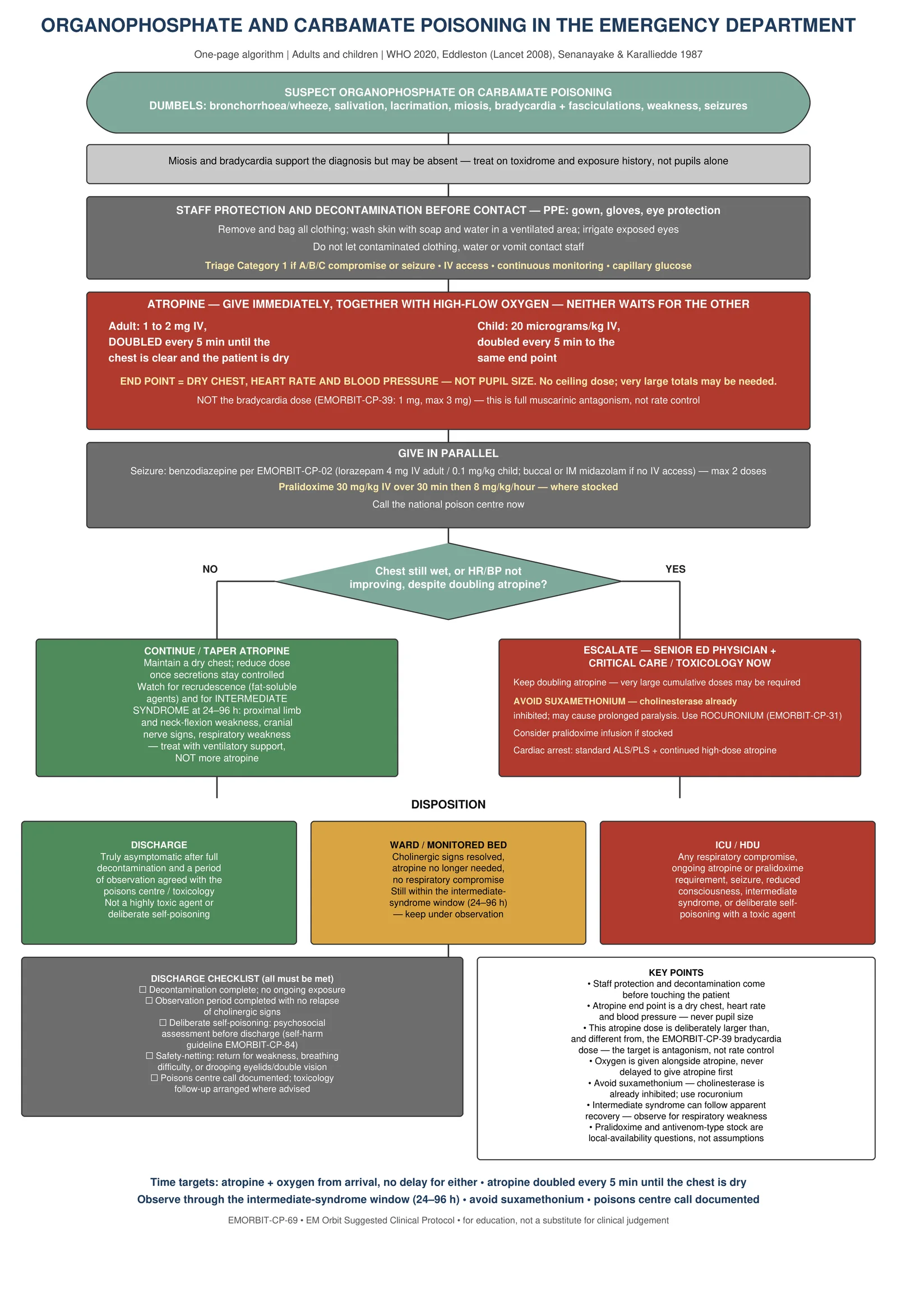
5Algorithm
The one-page algorithm is shown at the top of this page.
6Team roles
6.1Triage and ED Nurses Role:
6.1.1 Don PPE and begin decontamination (clothing removal, skin washing) before full clinical assessment; assign Category 1 for any A/B/C compromise or seizure.
6.1.2 Prepare and record every atropine dose and the time of each reassessment; maintain a running cumulative dose total visible to the team.
6.2Pharmacist:
6.2.1 Verify atropine, pralidoxime, and benzodiazepine dosing against the local formulary; confirm pralidoxime stock and infusion preparation capability and escalate any shortfall to the ED and Pharmacy leads.
6.3Clinical Toxicology / Critical Care:
6.3.1 Attend for any severe-tier presentation (Table 1), refractory cholinergic crisis, or intermediate syndrome; advise on pralidoxime use and on the disposition of the asymptomatic exposed patient.
6.4Laboratory:
6.4.1 Process plasma/red-cell cholinesterase where available and report the turnaround time to the treating team; this result does not delay treatment.
6.5Ambulance / Pre-hospital Providers:
6.5.1 Decontaminate before transport where feasible; pre-alert the ED with the agent, route, and any atropine already given, using the structured (ATMIST/SBAR) format.
7The patient's role
7.1 Report the product name, route, time, and quantity of exposure, and any first aid already given.
7.2 Report new weakness, breathing difficulty, or visual symptoms immediately during observation and after discharge.
7.3 Store pesticides and chemicals safely, out of reach of children, and in their original containers, to prevent re-exposure.
8Definitions
8.1Organophosphate: a class of pesticide (and, rarely, a nerve agent) that inhibits acetylcholinesterase irreversibly, causing accumulation of acetylcholine at muscarinic and nicotinic receptors and in the central nervous system.
8.2Carbamate: a related class of pesticide that inhibits acetylcholinesterase reversibly (carbamylation), generally producing a shorter and milder illness, but managed identically in the ED.
8.3Cholinergic Toxidrome: the muscarinic, nicotinic, and central nervous system pattern of acetylcholinesterase inhibition (DUMBELS: diarrhoea, urination, miosis, bronchorrhoea/bronchospasm, emesis, lacrimation, salivation, plus fasciculations, weakness, and seizures).
8.4Atropinisation: the clinical end point of atropine therapy — a dry chest, a heart rate and blood pressure adequate for perfusion — as distinct from, and not defined by, pupil size.
8.5Intermediate Syndrome: proximal limb, neck-flexion, and respiratory muscle weakness with cranial nerve signs, arising approximately 24 to 96 hours after exposure or apparent recovery, requiring ventilatory support (Senanayake and Karalliedde, 1987).
8.6Organophosphate-Induced Delayed Neuropathy (OPIDN): a distinct, later peripheral neuropathy from a small number of organophosphates, separate from the acute cholinergic crisis and the intermediate syndrome.
9Attachments
- Attachment 1: One-page algorithm (top of this page)
- Attachment 2: Severity Tiers and Atropine / Pralidoxime / Benzodiazepine Quick Reference
11Suggested quality indicators
11.1Time to first atropine dose: (Number of symptomatic patients receiving atropine within 10 minutes of recognition / Total number of organophosphate/carbamate poisoning patients treated in the ED) × 100. Target ≥ 90%.
11.2Staff decontamination before contact: (Number of patients for whom PPE and decontamination were documented before clinical contact / Total number of such patients) × 100. Target 100%.
11.3Poisons centre consultation documented: (Number of patients with a documented poisons centre call, adviser, and reference number / Total number of symptomatic patients) × 100. Target ≥ 95%.
11.4Suxamethonium avoided at intubation: (Number of intubated organophosphate/carbamate poisoning patients paralysed with rocuronium rather than suxamethonium / Total number of such patients intubated) × 100. Target 100%.
11.5Safe disposition: (Number of severe-tier patients (Table 1) admitted to ICU/HDU / Total number of severe-tier patients) × 100. Target 100%.
11.6Intermediate syndrome recognised before discharge: (Number of admitted patients screened for proximal/neck-flexion weakness and respiratory muscle strength before discharge / Total number of admitted patients) × 100. Monitored as an outcome indicator.
13References
- World Health Organization. Guidelines for Poison Control. Geneva: WHO (organophosphorus pesticide poisoning management principles).
- Eddleston M. Management of acute organophosphorus pesticide poisoning. Lancet. 2008;371(9612):597–607.
- Senanayake N, Karalliedde L. Neurotoxic effects of organophosphorus insecticides: an intermediate syndrome. N Engl J Med. 1987;316(13):761–763.
- Peter JV, Sudarsan TI, Moran JL. Clinical features of organophosphate poisoning: a review of different classification systems and approaches. Indian J Crit Care Med. 2014;18(11):735–745.
- Buckley NA, Eddleston M, Li Y, Bevan M, Robertson J. Oximes for acute organophosphate pesticide poisoning. Cochrane Database Syst Rev. 2011;(2):CD005085.
- Eddleston M, Buckley NA, Eyer P, Dawson AH. Management of acute organophosphorus pesticide poisoning. Lancet. 2008;371(9612):597–607 (companion review of pathophysiology and evidence for atropine and oximes).
A2Attachment 2: Severity Tiers and Atropine / Pralidoxime / Benzodiazepine Quick Reference
| Tier | Clinical features | ED priority |
|---|---|---|
| Mild | Salivation, lacrimation, sweating, miosis, mild gastrointestinal symptoms; normal mental status and ventilation. | Decontaminate, monitor closely; give atropine if any secretions, bronchospasm, or bradycardia are present. |
| Moderate | Bronchorrhoea, wheeze, bradycardia or hypotension, fasciculations; consciousness preserved. | Atropine titrated to a dry chest (Table 2); continuous monitoring; senior ED physician review. |
| Severe | Respiratory failure, seizures, reduced consciousness, cardiovascular collapse, flaccid paralysis. | Atropine and airway control immediately; senior ED physician and Critical Care/Toxicology now; avoid suxamethonium (EMORBIT-CP-31). |
Severity can progress rapidly and unpredictably, particularly with fat-soluble organophosphates and with carbamates that have not yet been fully absorbed. A patient assessed as mild on arrival requires the same continuous reassessment as any other poisoned patient (EMORBIT-CP-21).
| Drug | Adult dose | Child dose | Notes |
|---|---|---|---|
| Atropine — give immediately, with oxygen | 1 to 2 mg IV, DOUBLED every 5 minutes until the chest is clear of secretions and the patient is dry. | 20 micrograms/kg IV, doubled every 5 minutes to the same end point. | End point is drying of secretions, heart rate and blood pressure — not pupil size. Very large cumulative doses may be required. |
| Pralidoxime (oxime) | 30 mg/kg IV over 30 minutes, then 8 mg/kg/hour. | 30 mg/kg IV over 30 minutes, then 8 mg/kg/hour. | Give alongside atropine, never instead of it. Pralidoxime where stocked. |
| Benzodiazepine for seizures (EMORBIT-CP-02) | Lorazepam 4 mg IV; or midazolam 10 mg buccal/IM if no IV access. | Lorazepam 0.1 mg/kg IV (max 4 mg); or midazolam 0.3 mg/kg buccal or 0.2 mg/kg IM (max 10 mg). | Maximum two doses in total; see EMORBIT-CP-02 for the full second-line anti-seizure pathway. |
This atropine regimen is deliberately different from, and larger than, the bradycardia dose in EMORBIT-CP-39 (500 micrograms in increments to a maximum of 3 mg): that dose targets a modest increase in heart rate, whereas this dose targets full muscarinic antagonism and drying of secretions, and the 3 mg ceiling does not apply here. Poisons advice: the national poison centre (use the local number).