Delirium in the Older Patient
EMORBIT-CP-122 · Chapter 13 · Psychiatric and Behavioural Emergencies
Open in the appFree, works on your phone and offline, with every tool alongside.
Evidence base: NICE CG103 2023; SIGN 157
1Purpose
1.1 Provide a standardized, evidence-based framework for the screening, precipitant search, non-drug management, and safe disposition of patients aged 65 years and over (and younger patients with dementia or frailty) presenting to the Emergency Department (ED) with delirium.
1.2 Ensure delirium is actively screened for with the 4AT — the local delirium tool of choice (EMORBIT-CP-46), so that the hypoactive form, which is quiet, withdrawn and easily missed, is detected as reliably as agitated delirium.
1.3 Ensure every patient has a structured search for the precipitant (PINCH ME, EMORBIT-CP-46 Table 7) and a medication review before any drug for behaviour is considered, and that non-drug measures are always tried first.
1.4 Ensure that, where sedation cannot be avoided, the lowest effective dose is used, haloperidol and other antipsychotics are never given to a patient with Parkinson disease or dementia with Lewy bodies, and physical restraint is not used to manage delirium.
1.5 Ensure family or carer involvement, avoidance of ward and bed moves where possible, and alignment with NICE CG103 (2023) and SIGN 157.
2Who this protocol applies to
2.1 Patients aged 65 years and over presenting with, or developing during the ED stay, an acute and fluctuating change in mental state, attention, or level of arousal.
2.2 Patients of any age with known dementia, frailty, or severe illness presenting with such a change from their own baseline.
2.3 A positive 4AT (score 4 or above) obtained during screening under EMORBIT-CP-46.
3Not covered by this protocol
3.1 The general differential diagnosis of altered mental status, the full 4AT procedure, and the complete precipitant table, which are set out in EMORBIT-CP-46 and are not restated here.
3.2 Acute behavioural disturbance requiring rapid tranquillisation or restraint as the presenting problem in a patient with no evidence of delirium, which is managed under EMORBIT-CP-26; where both are present, both guidelines apply together (section 4.3.2).
3.3 A chronic, stable cognitive impairment with no acute change from baseline is not delirium; collateral history establishes the baseline.
4Protocol
4.1History and Assessment:
4.1.1Triage and Recognition:
4.1.1.1 Screen with the 4AT (EMORBIT-CP-46 Table 6) every patient aged 65 years and over with any alteration in behaviour, attention, or arousal, and every younger patient with dementia, frailty, or severe illness. The 4AT is the local delirium tool of choice; no other screening tool replaces it.
4.1.1.2 Actively look for hypoactive delirium — the quiet, withdrawn, drowsy or slow patient — which is missed far more often than the agitated form and carries an equal or worse prognosis; apply the 4AT even where the patient is not disturbing the department.
4.1.1.3 Time zero for this guideline is the moment delirium is recognised or the 4AT is positive; the time targets in section 11 run from that point.
4.1.2History (from the patient and, wherever possible, a family member, carer, or the person who knows them):
4.1.2.1 The patient's own cognitive baseline — the 4AT is scored against this, not against a population norm.
4.1.2.2 Onset and course: acute and fluctuating supports delirium; gradual and stable over months suggests dementia alone.
4.1.2.3 Full medication list, recent changes, and alcohol intake, for the review in section 4.3.2.
4.1.3Examination:
4.1.3.1 The general medical examination, vital signs and glucose that direct the precipitant search are set out in EMORBIT-CP-46 (Table 7, "PINCH ME") and are not repeated here.
4.1.3.2 A bladder scan and an abdominal and rectal (where indicated and consented) examination in every delirious older patient — retention and constipation are common and reversible precipitants (EMORBIT-CP-46 Table 7; EMORBIT-CP-59).
4.1.4Risk Stratification – Severity:
4.1.4.1 A positive 4AT is not a diagnosis but an instruction to find the cause — it does not, on its own, determine admission, discharge, or the need for medication.
4.1.4.2 Severity is judged instead by the safety risk it creates: falls, wandering, pulling at lines or tubes, distress to the patient, or risk to others — not by the 4AT score.
4.1.5Differential Diagnosis:
4.1.5.1 Work the full differential and reversible-cause table in EMORBIT-CP-46 (Tables 3 and 4); it is not restated here.
4.1.5.2 A positive urine dipstick alone does not diagnose urinary tract infection in an older person and is never the explanation for delirium (EMORBIT-CP-46 Table 7; EMORBIT-CP-60) — asymptomatic bacteriuria is common and is not treated for this indication.
4.1.5.3 Dementia superimposed by delirium is common; a worse-than-usual presentation in a known dementia patient is delirium until a precipitant has been sought.
4.1.6Special Populations:
4.1.6.1 Parkinson disease and dementia with Lewy bodies: these patients are markedly sensitive to antipsychotics. Haloperidol and other antipsychotics are never given. Continue the patient's usual dopaminergic medication on schedule — stopping it can itself precipitate acute deterioration.
4.1.6.2 Known dementia: score the 4AT against the patient's own baseline, obtained from a collateral historian; familiar carers, hearing aids and spectacles are treatment, not comfort measures (EMORBIT-CP-46).
4.1.6.3 End-of-life care: where delirium occurs in a patient on a palliative pathway, treat the reversible precipitant only where it is consistent with the agreed goals of care, and manage distress in line with the palliative care plan.
4.2Investigations:
4.2.1 Directed by the precipitant search in EMORBIT-CP-46 Table 7 (glucose, full blood count, urea and electrolytes, calcium, C-reactive protein, urinalysis only where symptomatic, chest radiograph and electrocardiogram where indicated) — not a fixed panel for every patient, and not restated here.
4.2.2 Glucose below 4.0 mmol/L is treated as hypoglycaemia in every ED pathway (EMORBIT-CP-49); an electrocardiogram is taken in every delirious older patient because myocardial infarction can present as delirium without chest pain (EMORBIT-CP-46).
4.3Plan of Care:
4.3.1Immediate Actions:
4.3.1.1 Confirm the 4AT is complete and documented before any other decision about this presentation is made.
4.3.1.2 Start non-drug measures immediately and in every patient, before any drug is considered: reorientate the patient and explain what is happening; ensure hearing aids (working batteries) and spectacles are on; keep a clock, calendar and adequate lighting in view; encourage a family member or familiar carer to stay; promote sleep, hydration, nutrition, and early mobilisation; avoid unnecessary moves between bays or wards.
4.3.1.3 Begin the precipitant search (EMORBIT-CP-46 Table 7, "PINCH ME") and the medication review (Table 1) in parallel with the non-drug measures; neither is deferred to await the other.
4.3.2Definitive ED Treatment — Precipitant Treatment and Medication Review:
4.3.2.1 Treat every precipitant found, per EMORBIT-CP-46 Table 7 and the specific guideline for that cause (sepsis: EMORBIT-CP-11; retention: EMORBIT-CP-59; urinary tract infection only if symptomatic: EMORBIT-CP-60; pain: EMORBIT-CP-28; hyponatraemia and other electrolyte disturbance: EMORBIT-CP-46 Table 4).
4.3.2.2 Review the medication list with the pharmacist (Table 1); stop or reduce a deliriogenic drug where it can be stopped safely, and do not start a new sedative or anticholinergic drug for this presentation.
4.3.2.3 Failure to improve with the precipitant treated is a reason to re-examine and look for a missed cause, not a reason to sedate (EMORBIT-CP-46).
4.3.3Escalation — Where a Drug for Behaviour Cannot Be Avoided:
4.3.3.1 A drug is considered only where non-drug measures have failed and the patient is a danger to themselves or others, or is too distressed to allow essential treatment — never for staff convenience.
4.3.3.2 Physical restraint is not used to manage delirium: it carries a high risk of fracture, pressure injury, prolonged delirium and death in this group (EMORBIT-CP-26).
4.3.3.3 Never give haloperidol or any other antipsychotic to a patient with Parkinson disease or dementia with Lewy bodies. Where sedation is unavoidable in these patients, a small dose of lorazepam (0.5–1 mg, oral or intramuscular) is used instead.
4.3.3.4 Where an antipsychotic is not contraindicated, use the lowest effective dose of haloperidol — the older/frail-adult dose in EMORBIT-CP-26 Table 3 (0.5–2 mg intramuscularly), which is a quarter to a half of the standard adult dose; obtain an electrocardiogram first wherever the patient allows it. The full agent list, routes and cautions are in EMORBIT-CP-26 Table 3 and are not repeated here.
4.3.3.5 Where both acute behavioural disturbance and delirium are present, apply EMORBIT-CP-26 for the acute safety episode alongside this guideline for the precipitant search and ongoing management.
4.3.4Monitoring and Reassessment:
4.3.4.1 Repeat the 4AT, or a structured description of alertness and attention where it cannot be completed, whenever the presentation changes, and record the time.
4.3.4.2 Reassess for a new or missed precipitant if the patient is not improving as expected, rather than escalating sedation.
4.3.5Disposition:
4.3.5.1Admission (under the general medical team, per the disposition decision in EMORBIT-CP-46):
- Delirium not resolved, or the precipitant requires inpatient treatment.
- No safe home circumstances, or the family/carer cannot support the patient at home during recovery.
- Geriatric medicine referral where locally agreed, for unresolved delirium or a frail patient with multiple precipitants (EMORBIT-CP-46).
4.3.5.2 Discharge from the ED requires: the precipitant identified and treated, or a clear plan for its outpatient treatment; the 4AT improving toward the patient's own baseline; a safe home environment with a family member or carer able to supervise; and discharge by, or after discussion with, an ED specialist or consultant.
4.3.6Discharge and Follow-up:
4.3.6.1 Written information for the patient and family on delirium, the precipitant treated, and what to watch for; follow-up with the general practitioner or geriatric service; the medication changes made are named in the discharge letter (EMORBIT-CP-46).
4.3.6.2 Where a drug for behaviour was given in the ED, this is stated in the discharge letter with an instruction that it is not continued unless specifically indicated.
4.3.7Documentation and Reporting:
4.3.7.1 Document: the 4AT score and time, the precipitants sought and treated (Table 7, EMORBIT-CP-46), the medication review (Table 1), the non-drug measures applied, any drug given for behaviour with dose, route, time and indication, and the disposition decision and who authorised it.
4.3.7.2 Any use of haloperidol or another antipsychotic in a patient subsequently found to have Parkinson disease or dementia with Lewy bodies is reported through the local incident reporting system.
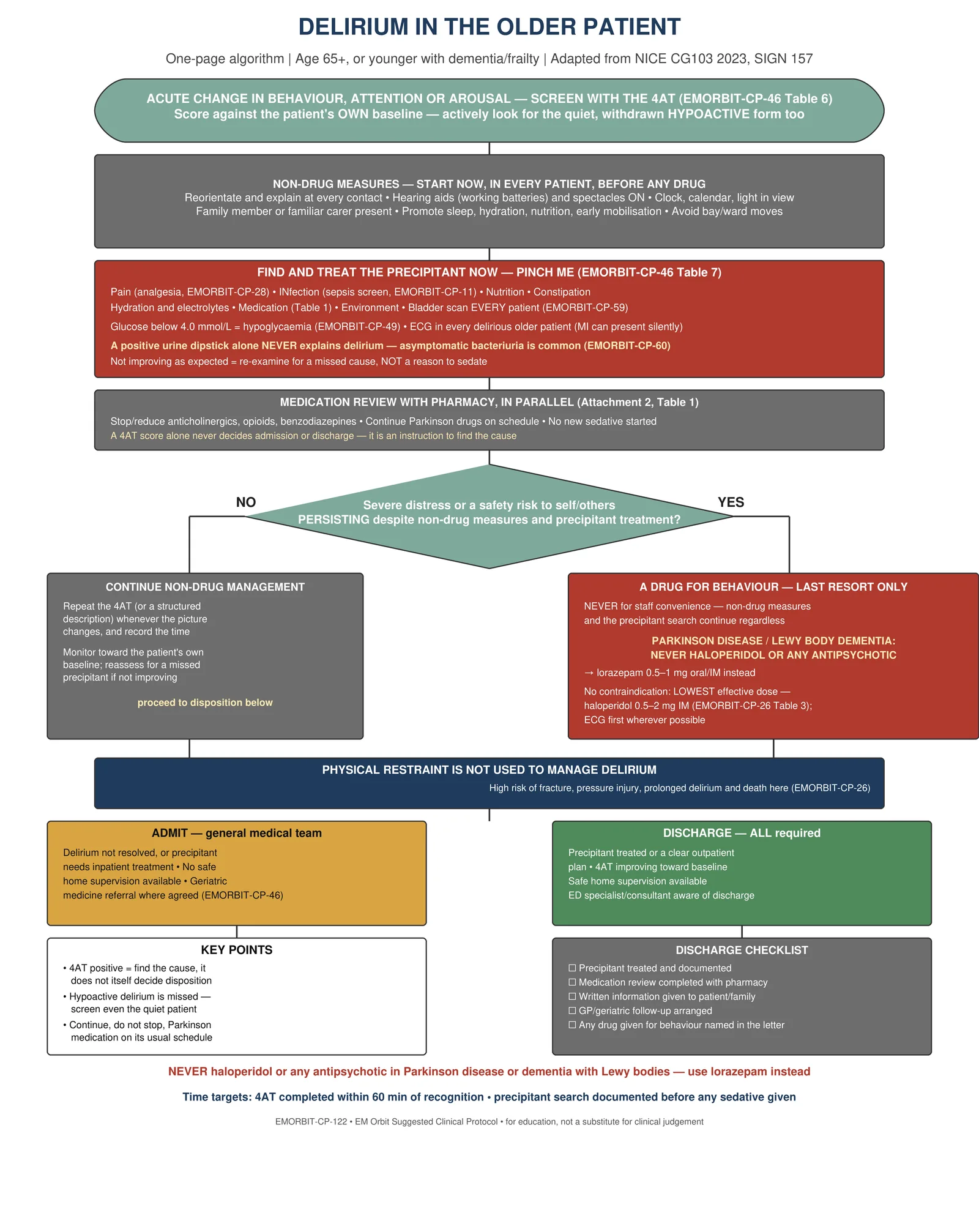
5Algorithm
The one-page algorithm is shown at the top of this page.
6Team roles
6.1Triage and ED Nurses Role:
6.1.1 Flag any older patient with a change in behaviour, attention or arousal at triage; complete or prompt the 4AT; put hearing aids and spectacles on the patient and keep a clock and adequate lighting in view.
6.1.2 Support non-drug measures throughout the stay and avoid unnecessary bay or ward moves.
6.2Pharmacist:
6.2.1 Complete the medication review (Table 1) with the treating team; identify drugs that can be stopped or reduced safely, and confirm formulary availability of lorazepam and haloperidol.
6.3Geriatric Medicine:
6.3.1 Support the 4AT and precipitant search; accept referral for unresolved delirium or a frail patient with multiple precipitants where locally agreed (EMORBIT-CP-46).
6.4General Medical / Admitting Team:
6.4.1 Accept admission where the criteria in section 4.3.4 are met; continue the precipitant treatment and medication review; arrange geriatric medicine follow-up.
6.5Family or Carer (where present and with the patient's consent):
6.5.1 Provide the collateral history and the patient's cognitive baseline; stay with the patient where possible; take part in the discharge conversation and the written information given.
7The patient's role
7.1 Tell the treating team, or have a family member or carer tell them, if something feels different from usual — new confusion, drowsiness, or agitation.
7.2 Keep hearing aids, spectacles, and any usual walking aid with you; ask for them if they are not to hand.
7.3 Allow a family member or friend to stay and to be involved in the assessment and the discharge conversation where possible.
7.4 Return to the ED, or contact the general practitioner or geriatric service, if the confusion returns or worsens after discharge.
8Definitions
8.1Delirium: an acute, fluctuating disturbance of attention and awareness, developing over hours to days, with an underlying medical cause; hyperactive, hypoactive, or mixed in presentation.
8.2Hypoactive Delirium: delirium presenting with reduced activity, withdrawal, drowsiness or slowed speech, rather than agitation; it is under-recognised and carries an equal or worse prognosis than the agitated form.
8.34AT: the validated four-item bedside delirium screen and the ED tool of choice (EMORBIT-CP-46) — alertness, AMT4, attention (months backwards), and acute change or fluctuating course; 4 or above indicates possible delirium.
8.4PINCH ME: the bedside aide-mémoire for the precipitant search — Pain, INfection, Nutrition, Constipation, Hydration, Medication, Environment (EMORBIT-CP-46 Table 7).
8.5Anticholinergic Burden: the cumulative effect of medications with anticholinergic activity, a recognised and often reversible contributor to delirium (Table 1).
9Attachments
- Attachment 1: One-page algorithm (top of this page)
- Attachment 2: Medication Review and Non-Drug Delirium Management Quick Reference
11Suggested quality indicators
11.14AT completed within 60 minutes of recognition: (Number of patients aged 65 and over screened with the 4AT within 60 minutes of recognition / Total number of such patients) × 100. Target ≥ 80% (as EMORBIT-CP-46).
11.2Precipitant search documented before any sedative or antipsychotic is given: (Number of delirium patients with a documented precipitant search (Table 7, EMORBIT-CP-46) before any sedative or antipsychotic / Total number given a sedative or antipsychotic) × 100. Target 100%.
11.3No antipsychotic given in Parkinson disease or dementia with Lewy bodies: (Number of patients with known Parkinson disease or dementia with Lewy bodies given haloperidol or another antipsychotic for delirium / Total number of such patients) × 100. Target 0%.
11.4Safe disposition — follow-up arranged at discharge: (Number of patients discharged after delirium with follow-up and written information documented / Total number discharged after delirium) × 100. Target ≥ 90%.
11.5Physical restraint used to manage delirium: (Number of delirium episodes in which physical restraint was used / Total number of delirium presentations) × 100. Monitored as an outcome indicator, target 0%.
13References
- National Institute for Health and Care Excellence. Delirium: prevention, diagnosis and management in hospital and long-term care. NICE guideline CG103; updated 2023.
- Scottish Intercollegiate Guidelines Network. Risk reduction and management of delirium. SIGN 157; 2019.
- Bellelli G, Morandi A, Davis DHJ, et al. Validation of the 4AT, a new instrument for rapid delirium screening: a study in 234 hospitalised older people. Age Ageing. 2014;43(4):496–502.
A2Attachment 2: Medication Review and Non-Drug Delirium Management Quick Reference
| Class / example | Why it matters | Action |
|---|---|---|
| Anticholinergics — first-generation antihistamines, oxybutynin, amitriptyline, hyoscine | Cumulative anticholinergic burden is a recognised, reversible cause of delirium. | Stop or substitute with the pharmacist; do not start a new one in this presentation. |
| Opioids, benzodiazepines and Z-drugs | Sedating and deliriogenic, but abrupt withdrawal (especially of benzodiazepines and alcohol) is itself a precipitant (EMORBIT-CP-46 Table 7). | Reduce to the lowest effective dose; do not stop abruptly if long-term use or withdrawal is suspected — manage as EMORBIT-CP-121. |
| Corticosteroids and dopaminergic drugs | Steroids can provoke delirium; abruptly stopping a Parkinson drug can precipitate acute akinesia and worsen confusion. | Corticosteroids: review need and dose. Parkinson medication: continue on the usual schedule wherever possible — do not stop it. |
| Any drug recently started, stopped or changed | A new temporal association is often the clue. | Reconcile with family, the community pharmacy and the primary care record (EMORBIT-CP-46 Table 7). |
This table is a prompt for medication review, not an exhaustive anticholinergic burden scale; the pharmacist completes the full reconciliation. The precipitant search itself is Table 7 of EMORBIT-CP-46 and is not repeated here.
1Non-drug measures — before any drug is considered:
- Reorientate the patient; explain what is happening and why, at every contact.
- Hearing aids in with working batteries; spectacles on; a clock, calendar and adequate lighting in view.
- A family member or familiar carer present wherever possible.
- Promote sleep, hydration, nutrition and early mobilisation; avoid unnecessary bay or ward moves.
2If a drug cannot be avoided:
- Parkinson disease or dementia with Lewy bodies: never haloperidol or another antipsychotic — lorazepam 0.5–1 mg, oral or intramuscular, instead.
- No contraindication: lowest effective dose of haloperidol, 0.5–2 mg intramuscularly (EMORBIT-CP-26 Table 3); electrocardiogram first wherever possible.
- Physical restraint is not used to manage delirium (EMORBIT-CP-26).