Urinary Tract Infection and Pyelonephritis in the Emergency Department
EMORBIT-CP-60 · Chapter 8 · Renal and Urological Emergencies
Open in the appFree, works on your phone and offline, with every tool alongside.
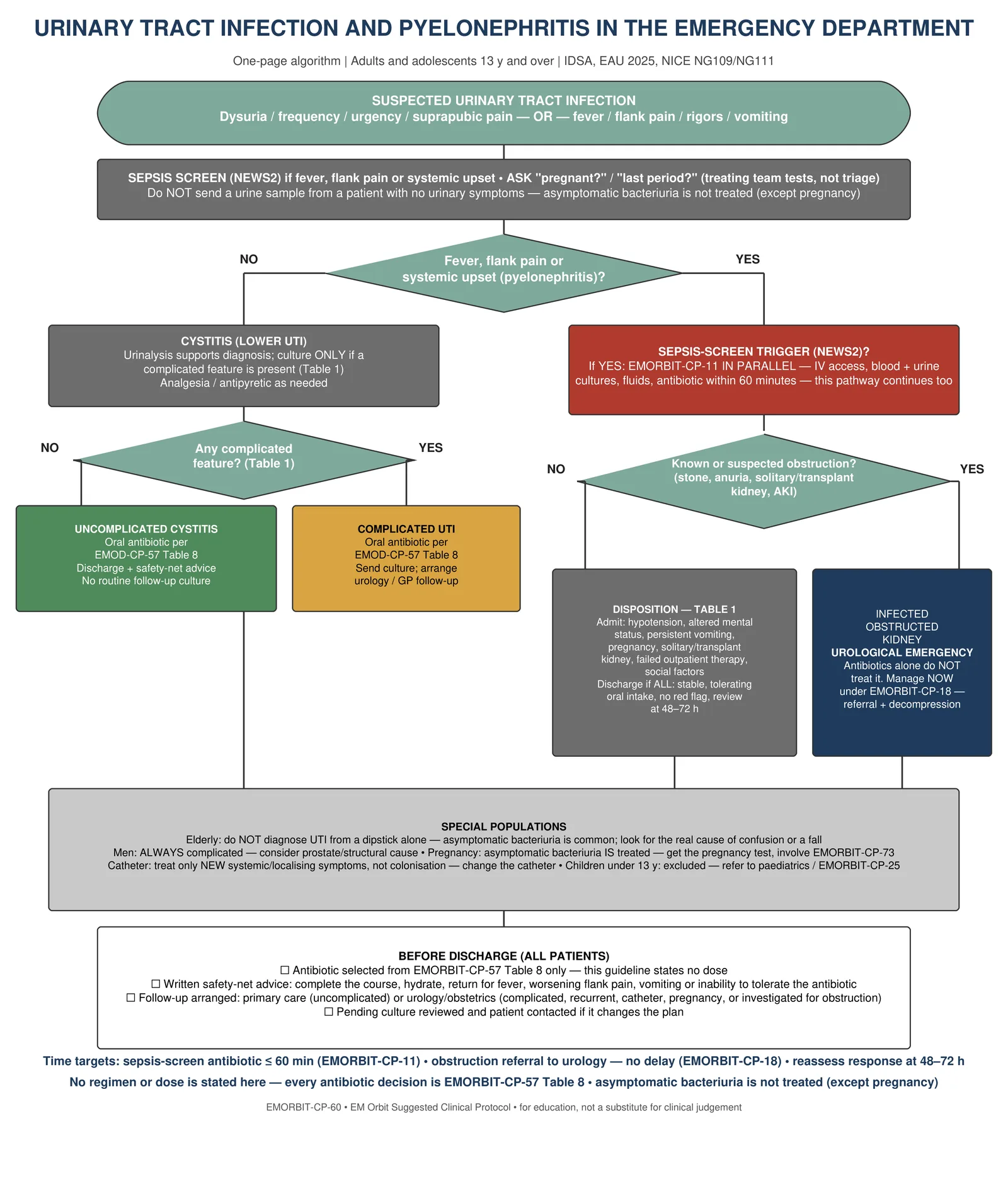
Evidence base: IDSA; EAU 2025; NICE NG111
1Purpose
1.1 Provide a standardized, evidence-based framework for the diagnosis, risk stratification, and disposition of adults and adolescents presenting to the Emergency Department (ED) with a urinary tract infection (UTI) or acute pyelonephritis.
1.2 Reduce over-diagnosis from urinalysis alone, particularly in older people, and stop the treatment of asymptomatic bacteriuria except in pregnancy or before planned urological instrumentation.
1.3 Ensure the infected obstructed kidney is recognised as a urological emergency requiring immediate decompression, not antibiotics alone, and referred without delay under EMORBIT-CP-18.
1.4 Keep antibiotic selection a single, centrally maintained decision: this guideline never states a regimen; the agent, dose, route and duration are set out in EMORBIT-CP-57 (Antimicrobial Stewardship) Tables 7 and 8.
1.5 Align with the Infectious Diseases Society of America (IDSA), the European Association of Urology (EAU), and the National Institute for Health and Care Excellence (NICE) NG109 and NG111.
2Who this protocol applies to
2.1 Adults and adolescents (13 years and over) presenting with symptoms or signs of a lower urinary tract infection (cystitis) or an upper urinary tract infection (acute pyelonephritis).
2.2 Catheter-associated urinary tract infection, recurrent urinary tract infection, and urinary tract infection in pregnancy, as an ED front-door recognition and first-hour pathway.
2.3 Men with urinary tract infection symptoms, who are always managed as complicated (section 4.1.4).
2.4 Pyelonephritis presenting with, or evolving into, sepsis or septic shock, managed jointly with EMORBIT-CP-11.
2.5 Suspected urinary tract infection with known or suspected urinary obstruction, managed jointly with EMORBIT-CP-18.
3Not covered by this protocol
3.1 Children under 13 years: urinary tract infection in children is managed under the paediatric pathway. A child who appears septic or unwell is managed under EMORBIT-CP-25 (The Febrile Child) and referred to paediatrics; urine collection technique and antibiotic choice in children differ from adults and are not extrapolated from this guideline.
3.2 Asymptomatic bacteriuria without urinary symptoms: excluded from treatment (section 4.1.4) except in pregnancy and before planned urological instrumentation (EMORBIT-CP-57).
3.3 Renal colic in which infection is not suspected: managed under EMORBIT-CP-18. Where infection and obstruction coexist, both this guideline and EMORBIT-CP-18 apply, and EMORBIT-CP-18 governs the urological emergency.
3.4 Epididymo-orchitis, managed under EMORBIT-CP-61. Acute bacterial prostatitis is a differential in men with lower urinary tract symptoms and fever (section 4.1.3) but is not covered by this guideline; treat as complicated UTI/urosepsis pending urology and antimicrobial stewardship review.
3.5 Sexually transmitted urethritis and cervicitis, chronic pelvic pain, and interstitial cystitis, which are outpatient genitourinary medicine or urology matters.
4Protocol
4.1History and Assessment:
4.1.1Triage and Recognition:
4.1.1.1 Dysuria, frequency, urgency, or suprapubic pain without fever suggests cystitis; fever above 38 °C, flank pain, costovertebral angle tenderness, or nausea and vomiting suggests pyelonephritis — full clinical criteria are set out in EMORBIT-CP-57 Table 7.
4.1.1.2 Any patient with fever, flank pain, or systemic upset shall have a sepsis screen (NEWS2) at triage; a high score triggers EMORBIT-CP-11 in parallel with this guideline, not instead of it.
4.1.1.3 The triage nurse asks every woman "are you pregnant?" and "what was the date of your last period?" and escalates; the triage nurse does not perform the pregnancy test — the treating team obtains it without delay (library decision).
4.1.1.4 A urine sample is not sent from a patient without urinary symptoms; a positive dipstick or culture in an asymptomatic patient is not evidence of infection (section 4.1.4).
4.1.2History:
4.1.2.1 Duration and character of symptoms, number and timing of previous urinary tract infections, and response to previous treatment.
4.1.2.2 Urinary catheter or recent instrumentation, known stone or structural abnormality, diabetes, immunosuppression, renal transplant, and antibiotic use within the last 90 days.
4.1.2.3 Sexual activity and contraception, allergy history, and — in men — lower urinary tract symptoms suggesting prostatic disease.
4.1.3Examination:
4.1.3.1 Vital signs including temperature, heart rate, respiratory rate, blood pressure, and oxygen saturation; abdominal and suprapubic palpation; flank and costovertebral angle tenderness; signs of sepsis.
4.1.3.2 Check for an indwelling catheter and inspect it for blockage, encrustation, or bypassing; a digital rectal examination is performed only where prostatitis is a specific concern.
4.1.4Risk Stratification – Severity:
4.1.4.1 Classify every patient as uncomplicated or complicated, and apply the pyelonephritis admission criteria, using Table 1.
Table 1: Complicated UTI risk features and pyelonephritis disposition criteria Category Criteria Complicated UTI (any ONE feature) Male sex; pregnancy (any woman who has started menarche, regardless of age); indwelling urinary catheter or recent urinary instrumentation; known structural or functional urinary tract abnormality (stone, stricture, neurogenic bladder, vesico-ureteric reflux); poorly controlled diabetes or immunosuppression; renal transplant or a single functioning kidney; healthcare-associated or hospital-onset infection, or an antibiotic course within the last 90 days; child under 13 years (paediatric pathway). Admit — pyelonephritis / urosepsis (any ONE feature) Hypotension, tachypnoea, altered mental status, or any sepsis screen trigger — manage per EMORBIT-CP-11 in parallel. Suspected or confirmed urinary obstruction — this is an infected obstructed kidney and a urological emergency under EMORBIT-CP-18, not a disposition decision on its own. Persistent vomiting preventing oral antibiotics. Pregnancy. Solitary or transplanted kidney. Failure of outpatient therapy at 48–72 hours. Diagnostic uncertainty in a systemically unwell patient. Social factors preventing safe follow-up. Discharge candidate — mild to moderate pyelonephritis (ALL required) Clinically stable after ED assessment, with or without one intravenous dose; tolerating oral intake; no sepsis-screen trigger and no feature above; no suspicion of obstruction; reliable review arranged within 48–72 hours; oral antibiotic selected per EMORBIT-CP-57 Table 8 dispensed with written safety-netting advice. Uncomplicated UTI is a lower urinary tract infection in a non-pregnant patient over 13 years with none of the complicated features above. Any complicated feature moves the patient to the complicated pathway regardless of how mild the symptoms appear.
4.1.4.2 The severity of symptoms does not reliably predict complications; apply Table 1 regardless of how well the patient looks.
4.1.5Differential Diagnosis:
4.1.5.1 Renal colic and the infected obstructed kidney (EMORBIT-CP-18); pelvic inflammatory disease, ovarian torsion, and — in any woman who has started menarche — ectopic pregnancy (EMORBIT-CP-73); appendicitis; acute bacterial prostatitis in men (section 4.1.4).
4.1.5.2 In a woman with a positive pregnancy test, pain shall not be attributed to a urinary tract infection on the basis of a dipstick alone: pyuria occurs with any pelvic inflammation, including a leaking ectopic pregnancy (EMORBIT-CP-73).
4.1.6Special Populations:
4.1.6.1 Elderly: asymptomatic bacteriuria is common and a positive dipstick or culture without urinary symptoms shall not be treated as infection; confusion or a fall with a positive urinalysis and no urinary symptoms requires a search for the actual cause (dehydration, constipation, pain, drugs, hypoxia) rather than a default diagnosis of UTI (EMORBIT-CP-57).
4.1.6.2 Men: any urinary tract infection in a man is complicated (Table 1); consider a structural or prostatic cause and arrange urology follow-up.
4.1.6.3 Pregnancy (any woman who has started menarche, regardless of age): asymptomatic bacteriuria IS treated in pregnancy (EMORBIT-CP-57); obtain the pregnancy test and manage jointly with EMORBIT-CP-73. Antibiotic selection in pregnancy is a recorded gap in EMORBIT-CP-57 pending a pregnancy-adapted regimen — discuss with obstetrics and clinical pharmacy.
4.1.6.4 Catheter-associated infection: do not treat catheter colonisation or a positive culture from a long-term catheter without systemic or new localising symptoms; where treatment is indicated, change the catheter and send the culture from the new one, not the old one.
4.1.6.5 Children under 13 years: excluded from this guideline (section 3); refer to paediatrics.
4.2Investigations:
4.2.1 Urinalysis (dipstick) supports the diagnosis in a symptomatic patient but shall not be used as a screening test in an asymptomatic patient, and is unreliable in older people and in long-term catheter users — diagnose on symptoms, not on the dipstick alone.
4.2.2 Urine culture only where a complicated feature is present (Table 1), in pregnancy, in pyelonephritis, after treatment failure, or in recurrent infection — not for uncomplicated cystitis (EMORBIT-CP-57 Table 7).
4.2.3 Blood cultures from two separate sites and a venous or arterial blood gas with lactate in every patient with pyelonephritis and systemic upset, before the first antibiotic dose where this does not delay treatment beyond 45 minutes (EMORBIT-CP-11).
4.2.4 Renal function and electrolytes; a pregnancy test (beta-hCG) in every woman who has started menarche, regardless of age.
4.2.5 Renal tract imaging (ultrasound or, where obstruction is suspected, CT KUB per EMORBIT-CP-18) for: suspected obstruction, failure to improve at 48–72 hours, recurrent pyelonephritis, a solitary or transplanted kidney, or a palpable mass — not routinely for uncomplicated cystitis or a first straightforward pyelonephritis that is responding to treatment.
4.3Plan of Care:
4.3.1Immediate Actions:
4.3.1.1 Sepsis screen (NEWS2) and, where triggered, the EMORBIT-CP-11 pathway in every patient with fever, flank pain, or systemic upset.
4.3.1.2 IV access, analgesia (EMORBIT-CP-28) and antiemetic as needed, and antipyretic for fever; oral fluids where tolerated.
4.3.1.3 An obstructed, infected urinary tract is a urological emergency: antibiotics alone do not treat it. Where obstruction is known or suspected (previous stone, anuria, a solitary or transplanted kidney, hydronephrosis on imaging, or acute kidney injury with pyelonephritis), manage jointly and without delay under EMORBIT-CP-18, which sets the urology referral and decompression time targets. This guideline does not restate them.
4.3.2Definitive ED Treatment:
4.3.2.1 Empirical antibiotic therapy is selected from EMORBIT-CP-57 Table 8 by syndrome (cystitis, complicated UTI, or pyelonephritis) and route by severity; this guideline states no agent, dose, or duration of its own.
4.3.2.2 Asymptomatic bacteriuria is not an infection and is not treated, except in pregnancy and before planned urological instrumentation (EMORBIT-CP-57).
4.3.2.3 Where a urinary catheter is the likely source, change it before or with the first antibiotic dose where practicable.
4.3.3Escalation – Refractory:
4.3.3.1 No clinical improvement, or new deterioration, at 48–72 hours of appropriate antibiotic therapy: reassess for an undrained collection (renal or perinephric abscess) or unrecognised obstruction with renal tract imaging, and involve urology.
4.3.3.2 Any patient meeting sepsis criteria at any point is escalated under EMORBIT-CP-11 regardless of the stage of this pathway.
4.3.4Monitoring – Reassessment:
4.3.4.1 Vital signs and NEWS2 at a frequency set by severity; reassess response to the first antibiotic dose within 48–72 hours for both admitted and discharged patients.
4.3.4.2 Urine output where a catheter is in place or obstruction is a concern; escalate any new fever, hypotension, or falling urine output for senior review.
4.3.5Disposition:
4.3.5.1 Apply Table 1 for admission versus safe discharge; the infected obstructed kidney is referred and managed under EMORBIT-CP-18 regardless of this disposition decision.
4.3.5.2 Uncomplicated cystitis: discharge with oral antibiotic (EMORBIT-CP-57 Table 8) and safety-netting advice; no routine follow-up culture is required if symptoms resolve.
4.3.5.3 Complicated UTI not meeting an admission criterion in Table 1: discharge with oral antibiotic per EMORBIT-CP-57, a sent culture, and urology or primary-care follow-up arranged.
4.3.6Discharge and Follow-up:
4.3.6.1 Provide written advice to complete the antibiotic course, maintain oral hydration, and return immediately for fever, worsening flank pain, vomiting, or inability to tolerate oral antibiotics.
4.3.6.2 Arrange follow-up appropriate to the risk group: primary care for uncomplicated cystitis; urology for recurrent, complicated, or catheter-associated infection and for any patient investigated for obstruction; obstetrics for pregnancy (EMORBIT-CP-73).
4.3.6.3 A discharged patient with a pending culture is contacted if the result changes the treatment plan.
4.3.7Documentation and Reporting:
4.3.7.1 Document: the symptoms supporting the diagnosis, the complicated features present or absent (Table 1), sepsis screen result, cultures sent, the antibiotic selected with reference to EMORBIT-CP-57 Table 8, and the disposition decision and rationale.
4.3.7.2 Urinary tract infection and pyelonephritis presentations are captured for the departmental audit (section 11).
5Algorithm
The one-page algorithm is shown at the top of this page.
6Team roles
6.1Triage and ED Nurses Role:
6.1.1 Ask every woman "are you pregnant?" and "last period?" and escalate; do not perform the pregnancy test.
6.1.2 Perform the sepsis screen (NEWS2) at triage for fever, flank pain, or systemic upset; do not send a urine sample from an asymptomatic patient.
6.1.3 Collect a clean-catch or catheter-port urine sample using correct technique to avoid contamination.
6.2Pharmacist:
6.2.1 Verify every antibiotic selection against EMORBIT-CP-57 Table 8 and the current antibiogram, check renal function and allergy history, and adjust the dose for renal impairment.
6.2.2 Flag any patient for whom pregnancy or breastfeeding changes the antibiotic choice, per the pregnancy-adapted regimen gap recorded in EMORBIT-CP-57.
6.3Urology:
6.3.1 Respond immediately to any referral for a known or suspected infected obstructed kidney under EMORBIT-CP-18.
6.3.2 Accept follow-up referrals for recurrent, complicated, and catheter-associated infection, and for structural evaluation.
6.4Obstetrics:
6.4.1 Receive referral for every pregnant patient with suspected pyelonephritis or a complicated urinary tract infection, jointly with EMORBIT-CP-73.
6.5Laboratory and Radiology:
6.5.1 Process urine and blood cultures and report susceptibilities to the treating team; maintain the local antibiogram that underpins EMORBIT-CP-57.
6.5.2 Perform renal tract imaging on the indications in section 4.2 and report obstruction, abscess, or an alternative diagnosis.
6.6Ambulance / Pre-hospital Providers:
6.6.1 Pre-alert the ED for any patient with fever, flank pain, and haemodynamic compromise, using the structured (ATMIST/SBAR) format.
7The patient's role
7.1 Report the duration and character of symptoms, previous urinary infections, catheter or stent history, and all medications and allergies.
7.2 Complete the full antibiotic course as prescribed, maintain oral fluid intake, and attend any arranged follow-up or repeat culture.
7.3 Return immediately, or call the emergency number, for fever, worsening pain, vomiting, or inability to keep down the antibiotic.
8Definitions
8.1Urinary Tract Infection (UTI): infection of the urinary tract, classified as lower (cystitis) or upper (pyelonephritis) by the site of symptoms.
8.2Uncomplicated UTI: a lower urinary tract infection in a patient over 13 years with none of the complicated features in Table 1.
8.3Complicated UTI: a urinary tract infection in the presence of any feature in Table 1 that increases the risk of treatment failure or of a structural or functional cause.
8.4Acute Pyelonephritis: infection of the renal parenchyma and collecting system, presenting with fever, flank pain, or costovertebral angle tenderness, with or without lower urinary tract symptoms.
8.5Asymptomatic Bacteriuria: bacteria in the urine without urinary symptoms; not an infection and not treated, except in pregnancy and before planned urological instrumentation (EMORBIT-CP-57).
8.6Urosepsis: sepsis in which the urinary tract is the confirmed or suspected source; managed jointly under EMORBIT-CP-11.
8.7Catheter-Associated UTI (CAUTI): a urinary tract infection with a new systemic or localising symptom in a patient with an indwelling urinary catheter; catheter colonisation alone is not treated.
8.8Obstructed Infected Kidney (Pyonephrosis, Obstructive Pyelonephritis): infection of an obstructed collecting system; a urological emergency requiring immediate antibiotics and emergency decompression, managed under EMORBIT-CP-18.
8.9Recurrent UTI: two or more episodes in six months, or three or more in twelve months.
8.10IDSA, EAU, NICE, NEWS2: Infectious Diseases Society of America; European Association of Urology; National Institute for Health and Care Excellence; National Early Warning Score 2.
9Attachments
- Attachment 1: One-page algorithm (top of this page)
- Attachment 2: Complicated UTI Risk Features and Pyelonephritis Disposition Criteria Quick Reference
11Suggested quality indicators
11.1Time to first antibiotic dose in pyelonephritis/urosepsis meeting a sepsis-screen trigger: (Number of such patients receiving the first intravenous antibiotic dose within 60 minutes of recognition, per EMORBIT-CP-11 / Total number of such patients) × 100. Target ≥ 90%.
11.2Blood cultures before antibiotics: (Number of pyelonephritis/urosepsis patients with blood cultures taken before the first antibiotic dose / Total number of such patients) × 100. Target ≥ 90%.
11.3Antibiotic selection concordant with EMORBIT-CP-57 Table 8: (Number of ED urinary tract infection prescriptions concordant with EMORBIT-CP-57 Table 8, or with a documented reason for departure / Total number of ED urinary tract infection prescriptions) × 100. Target ≥ 85%.
11.4Infected obstructed kidney referred to urology under EMORBIT-CP-18: (Number of patients with UTI/pyelonephritis and suspected obstruction referred to urology without delay / Total number of such patients) × 100. Target 100%.
11.5Unplanned return within 7 days with worsening or recurrent infection: (Number of discharged UTI/pyelonephritis patients re-attending within 7 days with worsening or recurrent symptoms / Total number discharged) × 100. Monitored as an outcome indicator.
13References
- Gupta K, Hooton TM, Naber KG, et al. International Clinical Practice Guidelines for the Treatment of Acute Uncomplicated Cystitis and Pyelonephritis in Women: Infectious Diseases Society of America and the European Society for Microbiology and Infectious Diseases. Clin Infect Dis. 2011;52(5):e103–e120.
- Nicolle LE, Gupta K, Bradley SF, et al. Clinical Practice Guideline for the Management of Asymptomatic Bacteriuria: 2019 Update by the Infectious Diseases Society of America. Clin Infect Dis. 2019;68(10):e83–e110.
- European Association of Urology. EAU Guidelines on Urological Infections. Arnhem: EAU Guidelines Office; 2025.
- National Institute for Health and Care Excellence. Pyelonephritis (acute): antimicrobial prescribing. NICE guideline NG109; 2018.
- National Institute for Health and Care Excellence. Urinary tract infection (recurrent): antimicrobial prescribing. NICE guideline NG111; 2018.
A2Attachment 2: Complicated UTI Risk Features and Pyelonephritis Disposition Criteria Quick Reference
| Category | Criteria |
|---|---|
| Complicated UTI (any ONE feature) | Male sex; pregnancy (any woman who has started menarche, regardless of age); indwelling urinary catheter or recent urinary instrumentation; known structural or functional urinary tract abnormality (stone, stricture, neurogenic bladder, vesico-ureteric reflux); poorly controlled diabetes or immunosuppression; renal transplant or a single functioning kidney; healthcare-associated or hospital-onset infection, or an antibiotic course within the last 90 days; child under 13 years (paediatric pathway). |
| Admit — pyelonephritis / urosepsis (any ONE feature) | Hypotension, tachypnoea, altered mental status, or any sepsis screen trigger — manage per EMORBIT-CP-11 in parallel. Suspected or confirmed urinary obstruction — this is an infected obstructed kidney and a urological emergency under EMORBIT-CP-18, not a disposition decision on its own. Persistent vomiting preventing oral antibiotics. Pregnancy. Solitary or transplanted kidney. Failure of outpatient therapy at 48–72 hours. Diagnostic uncertainty in a systemically unwell patient. Social factors preventing safe follow-up. |
| Discharge candidate — mild to moderate pyelonephritis (ALL required) | Clinically stable after ED assessment, with or without one intravenous dose; tolerating oral intake; no sepsis-screen trigger and no feature above; no suspicion of obstruction; reliable review arranged within 48–72 hours; oral antibiotic selected per EMORBIT-CP-57 Table 8 dispensed with written safety-netting advice. |
Uncomplicated UTI is a lower urinary tract infection in a non-pregnant patient over 13 years with none of the complicated features above. Any complicated feature moves the patient to the complicated pathway regardless of how mild the symptoms appear.