Alcohol Withdrawal and Delirium Tremens in the Emergency Department
EMORBIT-CP-121 · Chapter 13 · Psychiatric and Behavioural Emergencies
Open in the appFree, works on your phone and offline, with every tool alongside.
Evidence base: NICE CG100; ASAM 2020
1Purpose
1.1 Provide a standardised, evidence-based framework for recognising and treating alcohol withdrawal and delirium tremens in the Emergency Department (ED), using symptom-triggered benzodiazepine dosing as the default and a fixed-dose alternative where symptom-triggered scoring is not possible.
1.2 Ensure that confusion or agitation is never attributed to alcohol withdrawal until head injury, sepsis and hypoglycaemia have been excluded, and that parenteral thiamine is given early to every patient at risk of Wernicke encephalopathy.
1.3 Direct the assessment and treatment of hepatic encephalopathy, hepatic synthetic failure and the general altered-mental-status and seizure work-up to EMORBIT-CP-100, EMORBIT-CP-46 and EMORBIT-CP-02 respectively, rather than restating them here.
1.4 Set out the escalating regimen for delirium tremens and the point at which Critical Care is involved.
1.5 Align practice with NICE CG100 and the ASAM 2020 Clinical Practice Guideline on Alcohol Withdrawal Management.
2Who this protocol applies to
2.1 Any patient aged 13 years or over with known or probable alcohol dependence presenting with signs or symptoms of withdrawal — tremor, sweating, tachycardia, hypertension, anxiety, agitation, nausea, or hallucinations — occurring, typically, 6 to 72 hours after the last drink or a reduction in intake.
2.2 Any patient with suspected or confirmed delirium tremens: withdrawal with confusion, disorientation, severe agitation, or autonomic instability.
2.3 Any patient with a withdrawal seizure, or a history of previous withdrawal seizures or delirium tremens, presenting before symptoms have fully declared.
3Not covered by this protocol
3.1 Acute alcohol intoxication alone, with no evidence of withdrawal: manage supportively.
3.2 Status epilepticus, or a seizure lasting more than 5 minutes or recurring without recovery: go immediately to EMORBIT-CP-02; return here once the seizure is controlled to continue the withdrawal regimen and thiamine.
3.3 Known decompensated liver disease with jaundice, ascites, or encephalopathy as the presenting problem: manage under EMORBIT-CP-100, using the lorazepam preference (Table 2) if withdrawal treatment is also needed.
3.4 Cardiac or respiratory arrest on arrival: go immediately to EMORBIT-CP-03.
4Protocol
4.1History and Assessment:
4.1.1Triage and Recognition:
4.1.1.1 Any patient with severe agitation, a withdrawal seizure, or clinical features of delirium tremens shall be triaged to the highest acuity category (Category 1 or 2) and taken to a monitored area.
4.1.1.2 Handle every patient non-judgementally. Alcohol dependence is a medical condition; the manner of assessment and treatment is the same as for any other emergency presentation.
4.1.1.3 An ED physician shall attend within 15 minutes of triage for any patient scoring in the moderate-to-severe range or showing autonomic instability.
4.1.2History:
4.1.2.1 Usual daily alcohol intake, pattern of drinking, time of the last drink, and any recent reduction or enforced abstinence (admission, incarceration, illness).
4.1.2.2 Previous withdrawal seizures or delirium tremens — the strongest predictor of a severe course this time.
4.1.2.3 Co-ingestants, other substance use, current medication, and any recent head injury or fall.
4.1.2.4 AMPLE history (Allergies, Medications, Past history, Last meal, Events); collateral history from family or accompanying persons where available.
4.1.3Examination:
4.1.3.1 Full set of vital signs including temperature; tremor, sweating, pupil size, and level of agitation or confusion; a focused neurological examination looking for a lateralising sign or evidence of head injury.
4.1.3.2 Score the Clinical Institute Withdrawal Assessment for Alcohol, revised (CIWA-Ar) at presentation and hourly thereafter while treatment is titrated (Table 1, Attachment 2).
4.1.3.3 Examine for a source of sepsis, for signs of chronic liver disease, and for injury from a fall or seizure.
4.1.4Risk Stratification – Severity:
4.1.4.1 High risk / delirium tremens: disorientation, hallucinations with agitation, autonomic instability (tachycardia, hypertension, fever, sweating), or a CIWA-Ar score persistently above 15 despite treatment.
4.1.4.2 Moderate risk: CIWA-Ar 8–10 to 15, autonomic features present, no confusion.
4.1.4.3 Low risk: CIWA-Ar below 8–10, mild tremor and anxiety only, orientated.
4.1.4.4 Elevated risk regardless of current score: previous withdrawal seizure or delirium tremens, prolonged heavy intake, concurrent acute illness, or a benzodiazepine or other sedative co-dependence.
4.1.5Differential Diagnosis:
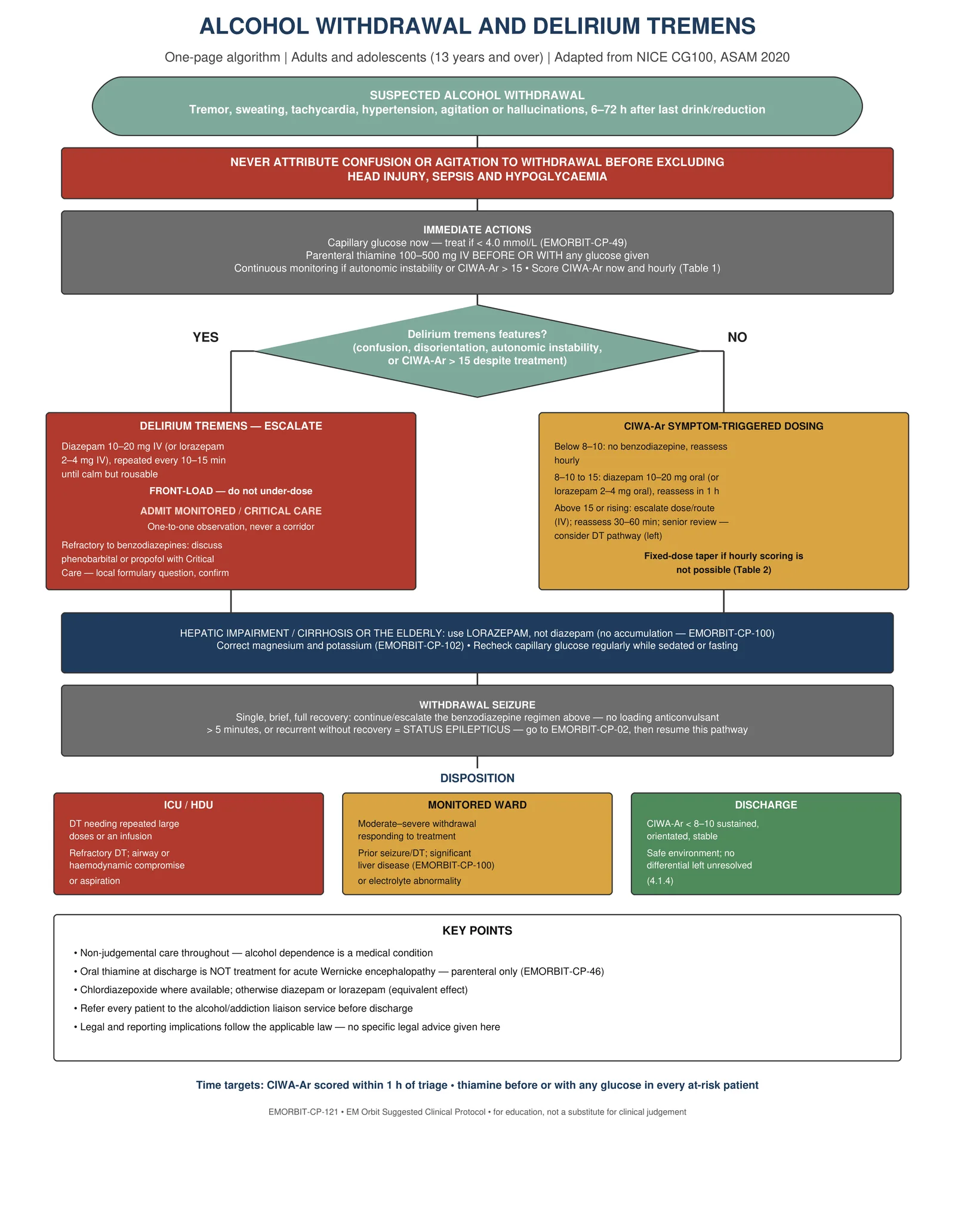
4.1.5.1 Never attribute confusion or agitation to alcohol withdrawal until head injury, sepsis and hypoglycaemia have been excluded (safety item — check capillary glucose immediately, treat below 4.0 mmol/L per EMORBIT-CP-49, and examine for injury and infection before settling on withdrawal as the cause).
4.1.5.2 Wernicke encephalopathy (EMORBIT-CP-46) — the two-of-four Caine criteria; can coexist with withdrawal and is treated in parallel, not sequentially.
4.1.5.3 Hepatic encephalopathy (EMORBIT-CP-100), sedative or benzodiazepine withdrawal from another source, and other causes of altered mental status in the differential framework of EMORBIT-CP-46.
4.1.6Special Populations:
4.1.6.1 Hepatic impairment or cirrhosis: use lorazepam, not diazepam, because it is cleared by glucuronidation and does not accumulate (Table 2); manage synthetic liver failure and encephalopathy under EMORBIT-CP-100.
4.1.6.2 Pregnancy: alcohol withdrawal in pregnancy is a high-risk presentation for both mother and fetus; involve Obstetrics early, treat withdrawal and give thiamine as below, and do not withhold treatment because of pregnancy.
4.1.6.3 The elderly: lower starting doses, more frequent reassessment, and a lower threshold to consider a coexisting cause (sepsis, subdural haematoma, delirium — EMORBIT-CP-122) rather than withdrawal alone.
4.1.6.4 Adolescents (13 years and over): alcohol dependence is uncommon but occurs; assess and treat as above with paediatric/adolescent dosing on specialist advice, and involve safeguarding review where appropriate.
4.2Investigations:
4.2.1 Capillary blood glucose immediately in every patient with confusion or agitation; treat below 4.0 mmol/L per EMORBIT-CP-49 without waiting for the rest of the work-up.
4.2.2 Venous blood gas with sodium, potassium, magnesium and lactate; full blood count, urea, electrolytes and creatinine, liver function tests, and coagulation.
4.2.3 Magnesium and potassium: check and correct per EMORBIT-CP-102 — hypomagnesaemia and hypokalaemia are common in alcohol dependence and can prolong or worsen withdrawal and provoke arrhythmia.
4.2.4 12-lead ECG for arrhythmia and the QT interval; septic screen (examination, chest X-ray, urinalysis, blood cultures where indicated) if any feature suggests infection.
4.2.5 CT brain where there is a lateralising sign, a head injury, a first seizure, or confusion that does not track with the CIWA-Ar score.
4.3Plan of Care:
4.3.1Immediate Actions:
4.3.1.1 Continuous monitoring (pulse oximetry, blood pressure, ECG) for any patient with autonomic instability or a CIWA-Ar score above 15; IV access; capillary glucose.
4.3.1.2 Parenteral thiamine for every patient at risk (alcohol dependence, malnutrition, poor recent intake): thiamine 100 to 500 mg intravenously, or one pair of ampoules of the combined parenteral vitamin B and C preparation, before or with any glucose given, exactly as EMORBIT-CP-46 and EMORBIT-CP-49. Oral thiamine is not adequate treatment. Where thiamine is not immediately to hand, glucose is not delayed — give thiamine as soon as it arrives.
4.3.2Definitive ED Treatment — Symptom-Triggered Benzodiazepine (default): score CIWA-Ar hourly and dose per Table 1 (Attachment 2). This uses less total benzodiazepine and a shorter course than fixed dosing and is the default wherever hourly reassessment is possible.
Table 1: CIWA-Ar symptom-triggered benzodiazepine dosing (score every 1 hour until below 8–10 for 24 hours, then 4-hourly) CIWA-Ar score Action Note Below 8–10 No benzodiazepine required at this assessment Continue hourly scoring; reassess for a rising trend 8–10 to 15 Diazepam 10–20 mg orally (or lorazepam 2–4 mg orally where diazepam is unsuitable — Table 2), reassess in 1 hour Symptom-triggered, not fixed-schedule, dosing Above 15, or a rising score despite treatment Diazepam 10–20 mg orally or IV (or lorazepam equivalent — Table 2); reassess in 30–60 minutes; repeat and escalate if still rising Involve a senior ED physician; consider the delirium tremens pathway (4.3.4) below Symptom-triggered dosing (CIWA-Ar) uses less total benzodiazepine and shorter treatment than a fixed schedule and is preferred where the patient can be reassessed hourly. Use the fixed-dose alternative (Table 2) where hourly reassessment is not possible, where communication or cooperation is limited (language, cognitive impairment, ongoing intoxication), or where CIWA-Ar cannot be scored reliably.
4.3.3Fixed-Dose Alternative and Agent Choice: use fixed-dose tapering (Table 2) where hourly CIWA-Ar reassessment is not possible; choose lorazepam over diazepam in significant hepatic impairment, cirrhosis, the elderly, or respiratory disease.
Table 2: Benzodiazepine choice and fixed-dose alternative Agent / situation Regimen Note Diazepam (long-acting) — first choice, normal hepatic function Symptom-triggered per Table 1; or fixed-dose 10–20 mg orally every 6–8 hours, tapered over 3–5 days Long half-life self-tapers and gives a smoother course; accumulates in hepatic impairment Lorazepam (short-acting, no active metabolite) — hepatic impairment or cirrhosis, the elderly, or respiratory disease 1–2 mg orally or IV every 2–4 hours symptom-triggered; or fixed-dose 1–2 mg every 6–8 hours, tapered Metabolised by glucuronidation, not oxidation: preferred in significant liver disease (EMORBIT-CP-100) because it does not accumulate Route Oral where the patient can safely swallow and absorb; IV for delirium tremens, vomiting, or an unreliable oral route IM absorption is erratic for both agents and is not used Chlordiazepoxide is used where available; otherwise diazepam or lorazepam achieves the same effect and is used instead.
4.3.4Seizures:
4.3.4.1 A single, brief withdrawal seizure with full recovery: continue or escalate the benzodiazepine regimen above; a loading anticonvulsant (phenytoin, levetiracetam) is not indicated for alcohol withdrawal seizures — benzodiazepines are the treatment.
4.3.4.2 A seizure lasting more than 5 minutes, or recurring without recovery between seizures, is status epilepticus: manage per EMORBIT-CP-02 and continue thiamine and the withdrawal regimen once controlled.
4.3.5Delirium Tremens: escalate to high-dose, front-loaded IV benzodiazepine and involve Critical Care early (Table 3, Attachment 3). Delirium tremens carries significant mortality untreated and is nursed in a monitored area with one-to-one observation, never a corridor.
Table 3: Delirium tremens — escalating high-dose benzodiazepine regimen Step Regimen Note First-line Diazepam 10–20 mg IV (or lorazepam 2–4 mg IV), repeated every 10–15 minutes until the patient is calm but rousable Front-load — do not under-dose; doses required can be very large Continuing large requirement Continue repeated IV boluses; a continuous infusion may be needed on Critical Care advice Admit to a monitored/critical care area once repeated dosing is required (4.3.6) Refractory to benzodiazepines Discuss phenobarbital or propofol with Critical Care Use only where phenobarbital is stocked and the prescriber is authorised Delirium tremens carries significant mortality untreated. A patient in delirium tremens is nursed in a monitored area with one-to-one observation, never a corridor, and is discussed with Critical Care early rather than after repeated dosing has already failed.
4.3.6Fluids and Electrolytes: correct dehydration with intravenous crystalloid as clinically indicated; correct magnesium and potassium per EMORBIT-CP-102 (Table 3 there gives the replacement doses); recheck capillary glucose regularly while sedated or fasting.
4.3.7Escalation and Refractory Presentation:
4.3.7.1 A CIWA-Ar score that continues to rise despite the Table 1 regimen, or a patient requiring repeated large IV doses to achieve control, meets the delirium tremens pathway (4.3.4) and Critical Care shall be contacted.
4.3.7.2 Benzodiazepine-refractory delirium tremens (Table 3): discuss phenobarbital or propofol with Critical Care under senior direction; this is not an ED-initiated regimen.
4.3.8Monitoring and Reassessment:
4.3.8.1 CIWA-Ar hourly until below 8–10 for 24 hours, then 4-hourly; full vital signs (including temperature) at the same frequency for any patient scoring in the moderate-to-severe range or on the fixed-dose regimen.
4.3.8.2 Reassess the differential (4.1.4) at any point the clinical picture does not track with the CIWA-Ar trend — a worsening score with a normal autonomic picture is not simply "more withdrawal".
4.3.9Disposition:
4.3.9.1ICU / HDU:
- Delirium tremens requiring repeated large benzodiazepine doses or a continuous infusion.
- Benzodiazepine-refractory delirium tremens.
- Airway compromise, aspiration, or haemodynamic instability.
4.3.9.2Monitored ward bed (Internal Medicine):
- Moderate-to-severe withdrawal (CIWA-Ar consistently above 15) responding to treatment.
- Previous withdrawal seizure or delirium tremens with ongoing features.
- Significant hepatic impairment (EMORBIT-CP-100), or an unresolved medical or electrolyte abnormality.
4.3.9.3Discharge:
- CIWA-Ar consistently below 8–10, orientated, stable vital signs, and a safe environment with support to complete any outpatient taper.
- No unresolved differential (4.1.4) and no ongoing indication for admission.
4.3.9.4 Discharge or admission decisions in a patient with coexisting liver disease shall be made jointly with the team managing EMORBIT-CP-100.
4.3.10Discharge and Follow-up:
4.3.10.1 Refer every patient to the addiction/alcohol liaison service for ongoing management and relapse-prevention planning. Where a dedicated alcohol liaison service is available, it shall be used.
4.3.10.2 Prescribe oral thiamine on discharge for ongoing nutritional support; this does not treat an acute Wernicke presentation, which requires the parenteral regimen above (EMORBIT-CP-46).
4.3.10.3 Give safety-netting advice: return immediately for confusion, hallucinations, a seizure, or worsening tremor and sweating after discharge.
4.3.10.4 Note any legal or reporting implication of the presentation (for example, driving, occupational, or third-party safety concerns).
Legal and reporting duties for alcohol-related presentations follow national law and hospital policy. No specific legal advice is given here.
4.3.11Documentation and Reporting:
4.3.11.1 Document: CIWA-Ar scores and trend, every benzodiazepine dose with time and route, thiamine given, glucose and electrolyte results and corrections, and the differential considered and excluded.
4.3.11.2 Any delirium tremens, any withdrawal seizure, and any admission to a monitored or critical care area shall be captured for the departmental audit (section 11).
5Algorithm
The one-page algorithm is shown at the top of this page.
6Team roles
6.1Triage and ED Nurses Role: score CIWA-Ar at the stated frequency, apply monitoring, and escalate a rising score or new confusion or agitation to the ED physician without delay; record every dose and time.
6.2Pharmacist: confirm which benzodiazepine and which thiamine preparation are on the current formulary; verify dosing in hepatic impairment; advise on the phenobarbital formulary question (Table 3) if raised.
6.3Internal Medicine / Critical Care: accept admission for moderate-to-severe withdrawal and delirium tremens; attend early for a rising CIWA-Ar despite treatment or a benzodiazepine-refractory presentation.
6.4Laboratory Staff: process electrolyte, liver function and glucose samples urgently and report a critical potassium, magnesium or glucose result to the ED immediately.
6.5Ambulance / Pre-hospital Providers: hand over the alcohol history, any pre-hospital seizure, and any benzodiazepine already given, using the structured (ATMIST/SBAR) format.
7The patient's role
7.1 Give an accurate account of usual intake, time of the last drink, and any previous withdrawal seizure or delirium tremens.
7.2 Remain in the department for the assessment and treatment period even if symptoms feel manageable, because deterioration can occur over hours.
7.3 Accept the referral to the addiction/alcohol liaison service and the safety-netting advice given at discharge.
8Definitions
8.1Alcohol Withdrawal Syndrome: the cluster of autonomic and neurological features that follows a reduction or cessation of alcohol intake in a dependent drinker, typically 6 to 72 hours after the last drink.
8.2CIWA-Ar: the Clinical Institute Withdrawal Assessment for Alcohol, revised — a validated symptom score used to trigger and titrate benzodiazepine dosing (Table 1).
8.3Delirium Tremens: severe alcohol withdrawal with confusion, disorientation, and autonomic instability; a medical emergency with significant untreated mortality.
8.4Symptom-Triggered Dosing: giving a benzodiazepine only when the CIWA-Ar score reaches a defined threshold, rather than on a fixed schedule; reduces total dose and treatment duration.
9Attachments
- Attachment 1: One-page algorithm (top of this page)
- Attachment 2: CIWA-Ar Symptom-Triggered Dosing and Fixed-Dose Alternative
- Attachment 3: Delirium Tremens Escalation Regimen
11Suggested quality indicators
11.1Time to first CIWA-Ar score: (Number of patients with a CIWA-Ar score recorded within 1 hour of triage / Total number of patients presenting with alcohol withdrawal) × 100. Target ≥ 90%.
11.2Thiamine given before or with glucose: (Number of at-risk patients receiving parenteral thiamine before or with any glucose load / Total number of at-risk patients) × 100. Target 100%.
11.3Hypoglycaemia, sepsis and head injury excluded before treating as withdrawal: (Number of confused or agitated patients with capillary glucose checked and a focused examination for injury or sepsis documented before withdrawal treatment / Total number of such patients) × 100. Target 100%.
11.4Safe disposition of delirium tremens: (Number of patients with delirium tremens admitted to a monitored or critical care area / Total number of patients with delirium tremens) × 100. Target 100%.
11.5Unplanned return with worsening withdrawal within 72 hours: (Number of discharged patients returning with worsening withdrawal or delirium tremens within 72 hours / Total number discharged) × 100. Monitored as an outcome indicator.
13References
- National Institute for Health and Care Excellence. Alcohol-use disorders: diagnosis and management of physical complications. NICE guideline CG100. London: NICE; 2010 (last updated).
- American Society of Addiction Medicine. Clinical Practice Guideline on Alcohol Withdrawal Management. J Addict Med. 2020;14(3S Suppl 1):1–72.
- Sutton LJ, Jutel A. Alcohol withdrawal syndrome in critically ill patients: identification, assessment, and management. AACN Adv Crit Care. 2016;27(2):175–185.
A2Attachment 2: CIWA-Ar Symptom-Triggered Dosing and Fixed-Dose Alternative
| CIWA-Ar score | Action | Note |
|---|---|---|
| Below 8–10 | No benzodiazepine required at this assessment | Continue hourly scoring; reassess for a rising trend |
| 8–10 to 15 | Diazepam 10–20 mg orally (or lorazepam 2–4 mg orally where diazepam is unsuitable — Table 2), reassess in 1 hour | Symptom-triggered, not fixed-schedule, dosing |
| Above 15, or a rising score despite treatment | Diazepam 10–20 mg orally or IV (or lorazepam equivalent — Table 2); reassess in 30–60 minutes; repeat and escalate if still rising | Involve a senior ED physician; consider the delirium tremens pathway (4.3.4) below |
Symptom-triggered dosing (CIWA-Ar) uses less total benzodiazepine and shorter treatment than a fixed schedule and is preferred where the patient can be reassessed hourly. Use the fixed-dose alternative (Table 2) where hourly reassessment is not possible, where communication or cooperation is limited (language, cognitive impairment, ongoing intoxication), or where CIWA-Ar cannot be scored reliably.
| Agent / situation | Regimen | Note |
|---|---|---|
| Diazepam (long-acting) — first choice, normal hepatic function | Symptom-triggered per Table 1; or fixed-dose 10–20 mg orally every 6–8 hours, tapered over 3–5 days | Long half-life self-tapers and gives a smoother course; accumulates in hepatic impairment |
| Lorazepam (short-acting, no active metabolite) — hepatic impairment or cirrhosis, the elderly, or respiratory disease | 1–2 mg orally or IV every 2–4 hours symptom-triggered; or fixed-dose 1–2 mg every 6–8 hours, tapered | Metabolised by glucuronidation, not oxidation: preferred in significant liver disease (EMORBIT-CP-100) because it does not accumulate |
| Route | Oral where the patient can safely swallow and absorb; IV for delirium tremens, vomiting, or an unreliable oral route | IM absorption is erratic for both agents and is not used |
Chlordiazepoxide is used where available; otherwise diazepam or lorazepam achieves the same effect and is used instead.
A3Attachment 3: Delirium Tremens Escalation Regimen
| Step | Regimen | Note |
|---|---|---|
| First-line | Diazepam 10–20 mg IV (or lorazepam 2–4 mg IV), repeated every 10–15 minutes until the patient is calm but rousable | Front-load — do not under-dose; doses required can be very large |
| Continuing large requirement | Continue repeated IV boluses; a continuous infusion may be needed on Critical Care advice | Admit to a monitored/critical care area once repeated dosing is required (4.3.6) |
| Refractory to benzodiazepines | Discuss phenobarbital or propofol with Critical Care | Use only where phenobarbital is stocked and the prescriber is authorised |
Delirium tremens carries significant mortality untreated. A patient in delirium tremens is nursed in a monitored area with one-to-one observation, never a corridor, and is discussed with Critical Care early rather than after repeated dosing has already failed.