Jaundice and Acute Liver Failure in the Emergency Department
EMORBIT-CP-100 · Chapter 5 · Gastrointestinal and Surgical Emergencies
Open in the appFree, works on your phone and offline, with every tool alongside.
Evidence base: EASL 2017; AASLD; BSG
1Purpose
1.1 Provide a structured approach to the adult and adolescent ED patient with new jaundice, to the early recognition of acute liver failure, and to the ED-phase management of the complications of decompensated cirrhosis.
1.2 Standardize recognition of acute liver failure (jaundice with any coagulopathy and any encephalopathy) and ensure acetylcysteine, glucose control, avoidance of sedation, and early transplant-centre discussion happen regardless of cause.
1.3 Point to, and not duplicate, the existing the ED guidelines that already govern paracetamol overdose (EMORBIT-CP-22), upper gastrointestinal and variceal bleeding (EMORBIT-CP-16), sepsis (EMORBIT-CP-11), altered mental status (EMORBIT-CP-46), hypoglycaemia (EMORBIT-CP-49) and abdominal pain/cholangitis (EMORBIT-CP-15).
1.4 Align with EASL, AASLD and the British Society of Gastroenterology.
2Who this protocol applies to
2.1 Adults and adolescents (13 years and over) presenting with new jaundice, clinically or biochemically, of any cause.
2.2 Known or newly recognised acute liver failure of any cause.
2.3 Known cirrhosis presenting with a decompensating event: new or worsening ascites, encephalopathy, gastrointestinal bleeding, or suspected infection (including spontaneous bacterial peritonitis).
2.4 Suspected alcoholic hepatitis or acute-on-chronic liver failure.
3Not covered by this protocol
3.1 Children under 13 years: manage under the paediatric hepatology pathway; aetiology and disposition differ markedly from the adult pattern.
3.2 Isolated Gilbert syndrome or another chronic, previously characterised, stable unconjugated hyperbilirubinaemia without a new acute change.
3.3 Suspected or confirmed paracetamol overdose as the sole presentation without established hepatotoxicity: manage per EMORBIT-CP-22, which owns the treatment-line, acetylcysteine regimen and referral thresholds for that indication.
3.4 Suspected variceal or non-variceal upper gastrointestinal bleeding as the presenting complaint: manage per EMORBIT-CP-16, which owns terlipressin, antibiotic prophylaxis and transfusion thresholds; this guideline is followed in parallel for the jaundice and liver-failure aspects only.
3.5 Established chronic liver disease follow-up, transplant listing, and inpatient hepatology management beyond the ED phase: these are the responsibility of the receiving hepatology/gastroenterology and transplantation service.
4Protocol
4.1History and Assessment:
4.1.1Triage and Recognition:
4.1.1.1 New jaundice with any of confusion, drowsiness, or a bleeding tendency shall be triaged no lower than Category 2; assign Category 1 for reduced consciousness, shock, or overt gastrointestinal bleeding.
4.1.1.2 Obtain IV access and send bloods (Investigations, below) at triage without waiting for physician review; check a capillary glucose immediately.
4.1.2History (obtained in parallel with treatment):
4.1.2.1 Onset and duration of jaundice; itch, pale stool, dark urine; abdominal pain and its site; fever or rigors.
4.1.2.2 All medications and supplements in the preceding 3 months (prescribed, over-the-counter and herbal), paracetamol intake specifically, alcohol quantity and duration, recreational drug use, recent travel, and sick contacts.
4.1.2.3 Known chronic liver disease, hepatitis B or C, previous decompensation (ascites, encephalopathy, variceal bleeding), and any change in personality, sleep pattern, or day-to-day function reported by family (early encephalopathy).
4.1.3Examination:
4.1.3.1 Conscious level and asterixis; stigmata of chronic liver disease (spider naevi, palmar erythema, gynaecomastia, caput medusae); abdominal distension, shifting dullness, and tenderness; peripheral oedema; signs of bleeding.
4.1.3.2 Fever, rigors and right upper quadrant tenderness with jaundice suggest cholangitis (Table 1) — manage per EMORBIT-CP-15 without delay.
4.1.4Risk Stratification and Severity:
4.1.4.1 Acute liver failure is jaundice with any coagulopathy (INR ≥ 1.5) and any grade of encephalopathy, in a patient without pre-existing cirrhosis, of less than 26 weeks’ duration. Grade hepatic encephalopathy by West Haven criteria: Grade I — mild confusion, altered sleep-wake cycle; Grade II — lethargy, disorientation, asterixis; Grade III — marked confusion, incoherent speech, sleeping but rousable; Grade IV — coma, unresponsive to pain.
Table 2: Acute liver failure — the ED bundle (jaundice + any coagulopathy + any encephalopathy, no pre-existing cirrhosis) Action Detail Acetylcysteine — every cause Give the same intravenous acetylcysteine regimen and total dose (300 mg/kg) as EMORBIT-CP-22, regardless of the cause of liver failure, once acute liver failure is recognised. Evidence of benefit is strongest for paracetamol; in non-paracetamol acute liver failure it is supported by a randomised trial showing improved transplant-free survival specifically in early-grade (I–II) encephalopathy, not in more advanced disease. Check the regimen against the product information. Glucose Capillary glucose at least hourly (EMORBIT-CP-49): the glycogen store and gluconeogenesis are both impaired. Maintain above 4.0 mmol/L with 10% glucose infusion; involve the medical/critical care team early for a rising requirement. No sedatives Avoid benzodiazepines, opioids and other sedating drugs where possible: they mask the encephalopathy grade that drives referral and disposition. Use the lowest effective analgesia (EMORBIT-CP-28) and reassess conscious level before and after any dose given. Do not correct the INR The INR is the prognostic marker, not a bleeding risk to be normalised. Do NOT give fresh frozen plasma to correct it unless there is active bleeding or an invasive procedure is planned; vitamin K may be given. (Matches EMORBIT-CP-22.) Avoid hepatotoxic and nephrotoxic drugs Review the medication list; stop non-steroidal anti-inflammatory drugs and any other hepatotoxic or nephrotoxic agent; adjust renally cleared drugs. Nurse head-up, treat seizures Nurse at 30° head-up; treat any seizure per the standard ED pathway; a falling conscious level with a rising blood pressure and falling pulse suggests cerebral oedema — discuss with critical care immediately. Early transplant-centre discussion Refer on the early indicators in Table 3, not on the King’s College transplantation criteria — by the time they are met the opportunity for optimal transfer may have passed. Refer through the hospital's transplant-centre referral pathway. 4.1.4.2 Refer to the transplant centre on the early indicators (Table 2), never wait for the King’s College transplantation criteria (Table 3) to be met.
4.1.5Differential Diagnosis:
4.1.5.1 Classify by pattern before the cause is known (Table 1).
Table 1: Pattern of jaundice — narrows the cause before liver function tests return Pattern Typical picture Leading causes Pre-hepatic Unconjugated hyperbilirubinaemia; normal liver enzymes; normal INR; no dark urine Haemolysis (send blood film, reticulocytes, haptoglobin, direct antiglobulin test), Gilbert syndrome, resolving large haematoma Hepatocellular Conjugated and unconjugated bilirubin; ALT/AST rise out of proportion to alkaline phosphatase Viral hepatitis A/B/C/E, drug-induced (including paracetamol — EMORBIT-CP-22), ischaemic ("shock liver"), autoimmune, alcohol-related, acute-on-chronic decompensation Cholestatic / post-hepatic Conjugated bilirubin; alkaline phosphatase and gamma-glutamyl transferase rise out of proportion to ALT/AST; pale stool, dark urine, itch Gallstone obstruction, ascending cholangitis (Tokyo Guidelines 2018 — manage per EMORBIT-CP-15), malignant biliary obstruction, drug-induced cholestasis Send liver enzymes, bilirubin (with a split if available), coagulation, and a paracetamol level in every patient with new jaundice, regardless of the presumed cause. Fever, rigors and right upper quadrant pain with jaundice are cholangitis until excluded — manage per EMORBIT-CP-15 (Tokyo Guidelines 2018) with antibiotics within 1 hour and urgent biliary drainage.
4.1.5.2 In pregnancy or the puerperium, jaundice with abdominal pain, hypertension, or thrombocytopenia is acute fatty liver of pregnancy or HELLP syndrome until excluded — both are obstetric emergencies.
4.1.6Special Populations:
4.1.6.1 Pregnancy and any woman who has started menarche (regardless of age): acute fatty liver of pregnancy and HELLP syndrome are obstetric emergencies presenting with jaundice; obstetric review is mandatory at first assessment (contact the on-call obstetric team and ask them to attend, not a telephone opinion) (EMORBIT-CP-74). The triage nurse does not perform the pregnancy test; the treating team asks "pregnant?" and "last period?" and obtains the test without delay (EMORBIT-CP-73).
4.1.6.2 Alcohol use disorder: give parenteral thiamine before or with any glucose load (as for EMORBIT-CP-46 and EMORBIT-CP-49); assess for concurrent Wernicke encephalopathy and withdrawal; suspect alcoholic hepatitis with a recent heavy drinking history, jaundice, and a tender enlarged liver.
4.1.6.3 Known cirrhosis: any deterioration is acute-on-chronic liver failure until a precipitant is found (infection including spontaneous bacterial peritonitis, gastrointestinal bleeding, constipation, diuretic overuse, dehydration, a new sedating or nephrotoxic drug) — find and treat the precipitant, per EMORBIT-CP-46.
4.1.6.4 Elderly: biliary obstruction and malignancy are more common causes; presentation may be atypical with less pain.
4.2Investigations:
4.2.1 Full liver panel (bilirubin with a split where available, ALT, AST, alkaline phosphatase, gamma-glutamyl transferase, albumin), coagulation screen (prothrombin time/INR), full blood count, urea and electrolytes, creatinine, capillary and laboratory glucose, and a paracetamol level in every patient with new jaundice, regardless of history.
4.2.2 Venous blood gas with lactate; blood cultures where infection or sepsis is suspected (EMORBIT-CP-11), without delaying antibiotics.
4.2.3 Viral hepatitis serology (A, B, C, E) and, where available, autoimmune and metabolic screen, directed by the working diagnosis and not sent as a reflex panel in every patient.
4.2.4 Abdominal ultrasound (with Doppler of the portal and hepatic veins where thrombosis is considered) in every patient with new jaundice, to identify biliary obstruction and assess the liver and spleen.
4.2.5 Diagnostic ascitic tap in any patient with cirrhosis, ascites and any deterioration (fever, abdominal pain, encephalopathy, renal impairment): spontaneous bacterial peritonitis is defined by an ascitic fluid polymorphonuclear neutrophil count of 250 cells/mm³ or more. Perform in discussion with gastroenterology; coagulopathy alone is not a contraindication.
4.2.6 Ammonia is not required to diagnose or exclude hepatic encephalopathy and shall not be used to grade it (as EMORBIT-CP-46): grade clinically by West Haven criteria (Table 2) and look for a precipitant.
4.3Plan of Care:
4.3.1Immediate Actions (first 30 minutes):
4.3.1.1 IV access, the investigation panel above, and a capillary glucose; oxygen if hypoxaemic (target SpO₂ 94–98%); continuous monitoring.
4.3.1.2 Grade encephalopathy and screen for coagulopathy at first assessment: the combination defines acute liver failure and drives the bundle in Table 2.
4.3.2Definitive ED Treatment — Acute Liver Failure, Decompensated Cirrhosis and Related Presentations:
4.3.2.1 Where the patient meets the definition of acute liver failure, follow the bundle in Table 2 in full and grade encephalopathy and check the King’s College criteria (Table 3) at the point of transplant-centre referral.
4.3.2.2Decompensated cirrhosis and its precipitants (find and treat in parallel):
- Suspected variceal bleeding: manage per EMORBIT-CP-16 (terlipressin and prophylactic antibiotic within 60 minutes, restrictive transfusion) — do not restate or vary those doses here.
- Spontaneous bacterial peritonitis (ascitic neutrophil count ≥ 250 cells/mm³): start empirical intravenous antibiotics without delay, agent selected per EMORBIT-CP-57 and the local antibiogram (ceftriaxone is the usual first-line choice where third-generation cephalosporin cover is appropriate and there is no genuine allergy); involve gastroenterology.
- Hepatorenal syndrome (rising creatinine in a cirrhotic patient with ascites, not responding to stopping diuretics and a trial of volume expansion, with no other identified cause): stop diuretics, nephrotoxic drugs and NSAIDs; discuss albumin and vasoconstrictor therapy (terlipressin) with gastroenterology/critical care — this is an admitting-team decision on dosing.
- Hepatic encephalopathy: find and treat the precipitant (EMORBIT-CP-46); start lactulose titrated to 2–3 soft stools per day; avoid sedatives.
- Suspected alcoholic hepatitis: calculate Maddrey’s discriminant function where the diagnosis is being considered for admission planning; a score of 32 or more indicates severe disease. Corticosteroid therapy is a hepatology decision after infection has been excluded — the ED does not start it. Give parenteral thiamine before glucose; avoid hepatotoxic drugs.
- Ascending cholangitis: manage per EMORBIT-CP-15 (Tokyo Guidelines 2018) — antibiotics within 1 hour and urgent biliary drainage referral; do not wait for the jaundice to be otherwise characterised.
4.3.3Escalation and Refractory Disease:
4.3.3.1 Escalate to the senior ED physician and critical care immediately for any Table 2 indicator, Grade III–IV encephalopathy, hypotension, or a rising lactate.
4.3.3.2 Discuss every patient meeting a Table 2 early indicator with the hepatology or liver transplantation service; state clearly which King’s College criteria (Table 3) are and are not met. Escalate through the on-call medical/gastroenterology registrar to the transplant-centre referral pathway.
4.3.4Monitoring and Reassessment:
4.3.4.1 Conscious level and encephalopathy grade at least hourly while acute liver failure is suspected; capillary glucose at least hourly (EMORBIT-CP-49); repeat liver panel, coagulation, creatinine, and a blood gas with lactate every 6 to 12 hours, or sooner if deteriorating.
4.3.4.2 Reassess for a new precipitant (infection, bleeding, a new drug) in any cirrhotic patient who deteriorates after admission.
4.3.5Disposition:
4.3.5.1Critical care / liver-unit discussion:
- Any Table 2 early indicator, or any grade of encephalopathy with coagulopathy (acute liver failure).
- Hepatorenal syndrome, septic shock from spontaneous bacterial peritonitis or cholangitis, or a Maddrey discriminant function of 32 or more.
4.3.5.2Ward admission (the default for jaundice and decompensated cirrhosis without a Table 2 indicator):
- New jaundice with a precipitant identified and treated, no coagulopathy or encephalopathy, for further gastroenterology work-up.
- Decompensated cirrhosis responding to treatment of the precipitant.
4.3.6Discharge and Follow-up:
4.3.6.1 No patient with new jaundice, suspected acute liver failure, or a first decompensation of known cirrhosis is discharged directly from the ED; admission is the default pending the panel above and specialist review.
4.3.6.2 Where the admitting team agrees exceptional ED discharge for a well, reliable patient with a benign, previously characterised cause, arrange gastroenterology follow-up and written safety-netting advice (return for confusion, bleeding, worsening jaundice, or fever).
4.3.7Documentation and Reporting:
4.3.7.1 Document: the jaundice pattern and suspected cause, encephalopathy grade and its trend, coagulation and glucose results and their trend, whether acetylcysteine was given and when, the precipitant found and treated in decompensated cirrhosis, and the time and outcome of any transplant-centre or hepatology discussion.
4.3.7.2 Acute liver failure presentations and deaths shall be captured for the departmental audit (section 11).
5Algorithm
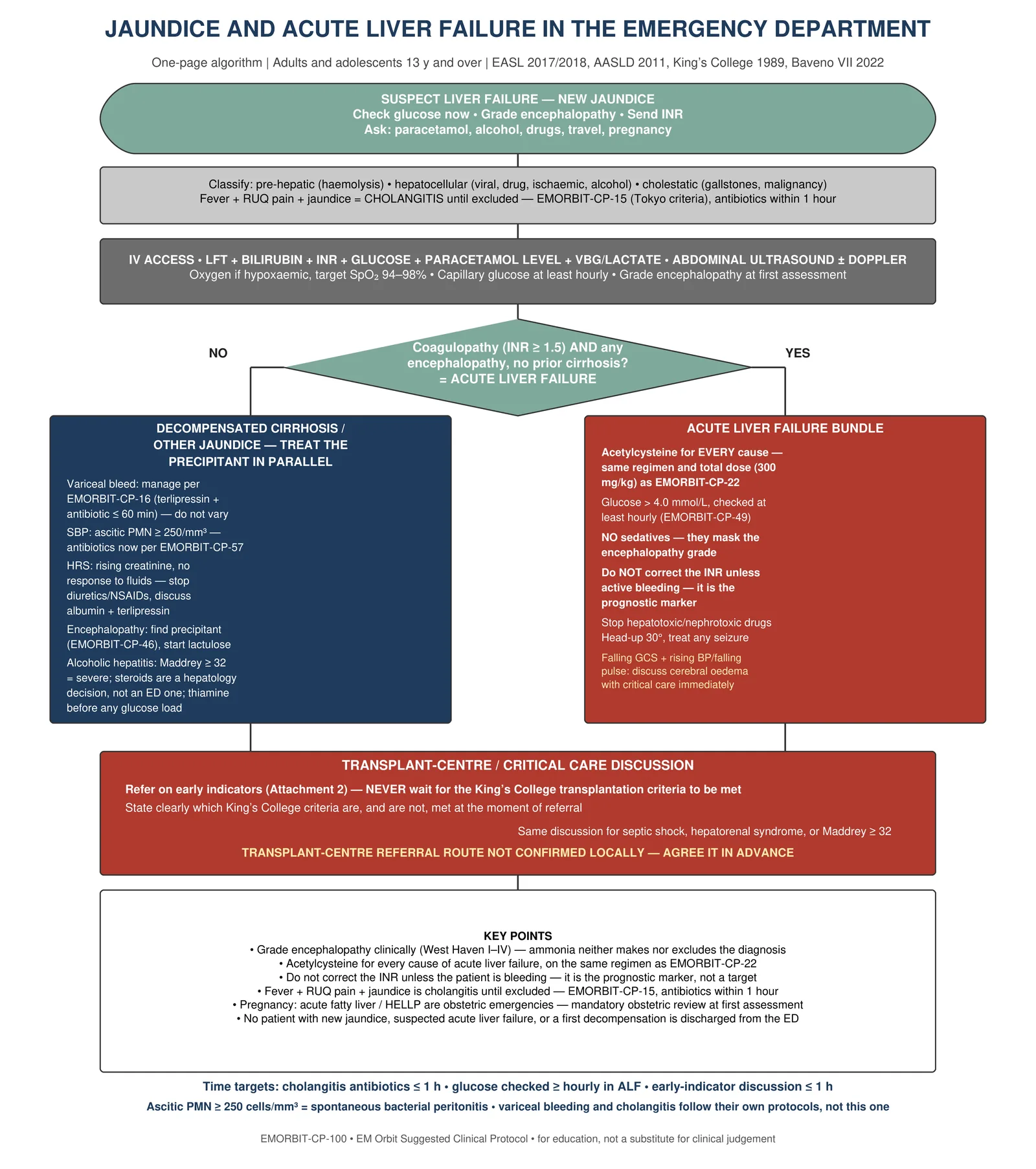
The one-page algorithm is shown at the top of this page.
6Team roles
6.1Triage and ED Nurses Role:
6.1.1 Recognize jaundice with confusion or bleeding at triage, assign the appropriate category, obtain IV access and send bloods without waiting for physician review; check capillary glucose immediately and at least hourly if acute liver failure is suspected.
6.2Pharmacist:
6.2.1 Verify the acetylcysteine regimen and total dose against EMORBIT-CP-22 for non-paracetamol acute liver failure before it is given; review the medication list for hepatotoxic and nephrotoxic drugs; advise on antibiotic selection per EMORBIT-CP-57 for spontaneous bacterial peritonitis and cholangitis.
6.3Gastroenterology / Hepatology:
6.3.1 Receive early referral on the Table 2 indicators, advise on lactulose, hepatorenal syndrome management and Maddrey scoring, perform diagnostic ascitic taps where indicated, and lead ongoing inpatient and transplant-centre liaison.
6.4Laboratory and Radiology:
6.4.1 Process the liver panel, coagulation screen and paracetamol level urgently; perform abdominal ultrasound with Doppler where indicated; process ascitic fluid cell count and culture urgently.
6.5Ambulance / Pre-hospital Providers:
6.5.1 Pre-alert the ED for any patient with jaundice, confusion, or gastrointestinal bleeding; hand over using the structured (ATMIST/SBAR) format.
7The patient's role
7.1 Report all medications, supplements and alcohol intake accurately, including any recent new prescription.
7.2 Report worsening confusion, drowsiness, bleeding, or abdominal swelling immediately during observation and after discharge.
7.3 Attend arranged gastroenterology/hepatology follow-up.
8Definitions
8.1Acute Liver Failure: jaundice accompanied by any coagulopathy (INR ≥ 1.5) and any grade of encephalopathy, of less than 26 weeks’ duration, in a patient without pre-existing cirrhosis.
8.2Acute-on-Chronic Liver Failure: acute decompensation of known cirrhosis, usually with a precipitant, associated with organ failure and high short-term mortality.
8.3West Haven Grade: the clinical grading of hepatic encephalopathy from I (mild confusion) to IV (coma) — Table 2.
8.4King’s College Criteria: prognostic criteria identifying patients with acute liver failure who require liver transplantation, separate for paracetamol and non-paracetamol causes (Table 3).
8.5Spontaneous Bacterial Peritonitis: infection of ascitic fluid without a surgically treatable source, defined by an ascitic fluid polymorphonuclear neutrophil count of 250 cells/mm³ or more.
8.6Hepatorenal Syndrome: progressive renal impairment in a patient with advanced cirrhosis and ascites, not responding to volume expansion, with no other identified cause.
8.7Maddrey’s Discriminant Function: a score used in suspected alcoholic hepatitis; 32 or more indicates severe disease and is the threshold considered for corticosteroid therapy by hepatology.
9Attachments
- Attachment 1: One-page algorithm (top of this page)
- Attachment 2: Differential Pattern, Acute Liver Failure Bundle, and King’s College Criteria Quick Reference
11Suggested quality indicators
11.1Time to acetylcysteine in recognised acute liver failure: (Number of acute liver failure patients started on acetylcysteine within 60 minutes of recognition / Total number of acute liver failure patients) × 100. Target ≥ 90%.
11.2Ascitic tap performed for cirrhosis with ascites and deterioration: (Number of such patients undergoing a diagnostic ascitic tap in the ED / Total number of cirrhotic patients with ascites presenting with fever, pain, encephalopathy or renal impairment) × 100. Target ≥ 85%.
11.3Glucose monitored at least hourly in acute liver failure: (Number of acute liver failure patients with hourly capillary glucose documented / Total number of acute liver failure patients) × 100. Target ≥ 90%.
11.4Safe disposition — transplant-centre/hepatology discussion within 1 hour of a Table 2 indicator: (Number of patients discussed within 1 hour of meeting a Table 2 early indicator / Total number of such patients) × 100. Target ≥ 95%.
11.5Unplanned escalation to ICU within 48 hours of ward admission for jaundice or decompensated cirrhosis: (Number of such patients escalated to ICU within 48 hours / Total number of such patients admitted to a ward) × 100. Monitored as an outcome indicator.
13References
- European Association for the Study of the Liver. EASL Clinical Practice Guidelines on the management of acute (fulminant) liver failure. J Hepatol. 2017;66(5):1047–1081.
- European Association for the Study of the Liver. EASL Clinical Practice Guidelines for the management of patients with decompensated cirrhosis. J Hepatol. 2018;69(2):406–460.
- European Association for the Study of the Liver. EASL Clinical Practice Guidelines: Management of alcohol-related liver disease. J Hepatol. 2018;69(1):154–181.
- Lee WM, Larson AM, Stravitz RT. AASLD Position Paper: The Management of Acute Liver Failure: Update 2011. Hepatology. 2012;55(3):965–967.
- Vilstrup H, Amodio P, Bajaj J, et al. Hepatic Encephalopathy in Chronic Liver Disease: 2014 Practice Guideline by the American Association for the Study of Liver Diseases and the European Association for the Study of the Liver. Hepatology. 2014;60(2):715–735.
- O’Grady JG, Alexander GJ, Hayllar KM, Williams R. Early indicators of prognosis in fulminant hepatic failure. Gastroenterology. 1989;97(2):439–445.
- Lee WM, Hynan LS, Rossaro L, et al. Intravenous N-acetylcysteine improves transplant-free survival in early stage non-acetaminophen acute liver failure. Gastroenterology. 2009;137(3):856–864.
- de Franchis R, Bosch J, Garcia-Tsao G, Reiberger T, Ripoll C; Baveno VII Faculty. Baveno VII – Renewing consensus in portal hypertension. J Hepatol. 2022;76(4):959–974.
- Yokoe M, Hata J, Takada T, et al. Tokyo Guidelines 2018: diagnostic criteria and severity grading of acute cholangitis. J Hepatobiliary Pancreat Sci. 2018;25(1):17–30.
A2Attachment 2: Differential Pattern, Acute Liver Failure Bundle, and King’s College Criteria Quick Reference
| Pattern | Typical picture | Leading causes |
|---|---|---|
| Pre-hepatic | Unconjugated hyperbilirubinaemia; normal liver enzymes; normal INR; no dark urine | Haemolysis (send blood film, reticulocytes, haptoglobin, direct antiglobulin test), Gilbert syndrome, resolving large haematoma |
| Hepatocellular | Conjugated and unconjugated bilirubin; ALT/AST rise out of proportion to alkaline phosphatase | Viral hepatitis A/B/C/E, drug-induced (including paracetamol — EMORBIT-CP-22), ischaemic ("shock liver"), autoimmune, alcohol-related, acute-on-chronic decompensation |
| Cholestatic / post-hepatic | Conjugated bilirubin; alkaline phosphatase and gamma-glutamyl transferase rise out of proportion to ALT/AST; pale stool, dark urine, itch | Gallstone obstruction, ascending cholangitis (Tokyo Guidelines 2018 — manage per EMORBIT-CP-15), malignant biliary obstruction, drug-induced cholestasis |
Send liver enzymes, bilirubin (with a split if available), coagulation, and a paracetamol level in every patient with new jaundice, regardless of the presumed cause. Fever, rigors and right upper quadrant pain with jaundice are cholangitis until excluded — manage per EMORBIT-CP-15 (Tokyo Guidelines 2018) with antibiotics within 1 hour and urgent biliary drainage.
| Action | Detail |
|---|---|
| Acetylcysteine — every cause | Give the same intravenous acetylcysteine regimen and total dose (300 mg/kg) as EMORBIT-CP-22, regardless of the cause of liver failure, once acute liver failure is recognised. Evidence of benefit is strongest for paracetamol; in non-paracetamol acute liver failure it is supported by a randomised trial showing improved transplant-free survival specifically in early-grade (I–II) encephalopathy, not in more advanced disease. Check the regimen against the product information. |
| Glucose | Capillary glucose at least hourly (EMORBIT-CP-49): the glycogen store and gluconeogenesis are both impaired. Maintain above 4.0 mmol/L with 10% glucose infusion; involve the medical/critical care team early for a rising requirement. |
| No sedatives | Avoid benzodiazepines, opioids and other sedating drugs where possible: they mask the encephalopathy grade that drives referral and disposition. Use the lowest effective analgesia (EMORBIT-CP-28) and reassess conscious level before and after any dose given. |
| Do not correct the INR | The INR is the prognostic marker, not a bleeding risk to be normalised. Do NOT give fresh frozen plasma to correct it unless there is active bleeding or an invasive procedure is planned; vitamin K may be given. (Matches EMORBIT-CP-22.) |
| Avoid hepatotoxic and nephrotoxic drugs | Review the medication list; stop non-steroidal anti-inflammatory drugs and any other hepatotoxic or nephrotoxic agent; adjust renally cleared drugs. |
| Nurse head-up, treat seizures | Nurse at 30° head-up; treat any seizure per the standard ED pathway; a falling conscious level with a rising blood pressure and falling pulse suggests cerebral oedema — discuss with critical care immediately. |
| Early transplant-centre discussion | Refer on the early indicators in Table 3, not on the King’s College transplantation criteria — by the time they are met the opportunity for optimal transfer may have passed. Refer through the hospital's transplant-centre referral pathway. |
| Paracetamol-induced | Non-paracetamol | |
|---|---|---|
| Single criterion | Arterial pH < 7.30 after adequate fluid resuscitation, more than 24 hours after ingestion; OR arterial lactate > 3.5 mmol/L at 4 hours, or > 3.0 mmol/L at 12 hours, after full resuscitation | Prothrombin time > 100 seconds (INR > 6.5) |
| Combination criterion (all three) | Prothrombin time > 100 s (INR > 6.5), creatinine > 300 micromol/L, and grade III or IV encephalopathy | Any three of: age < 10 or > 40 years; aetiology of non-A non-B hepatitis, halothane, or an idiosyncratic drug reaction; jaundice-to-encephalopathy interval > 7 days; prothrombin time > 50 s (INR > 3.5); bilirubin > 300 micromol/L |
A patient who meets these criteria is already very sick and may be too late for optimal transfer. State clearly, at the moment of referral, which criteria the patient does and does not meet.