Drowning
EMORBIT-CP-115 · Chapter 10 · Toxicological and Environmental Emergencies
Open in the appFree, works on your phone and offline, with every tool alongside.
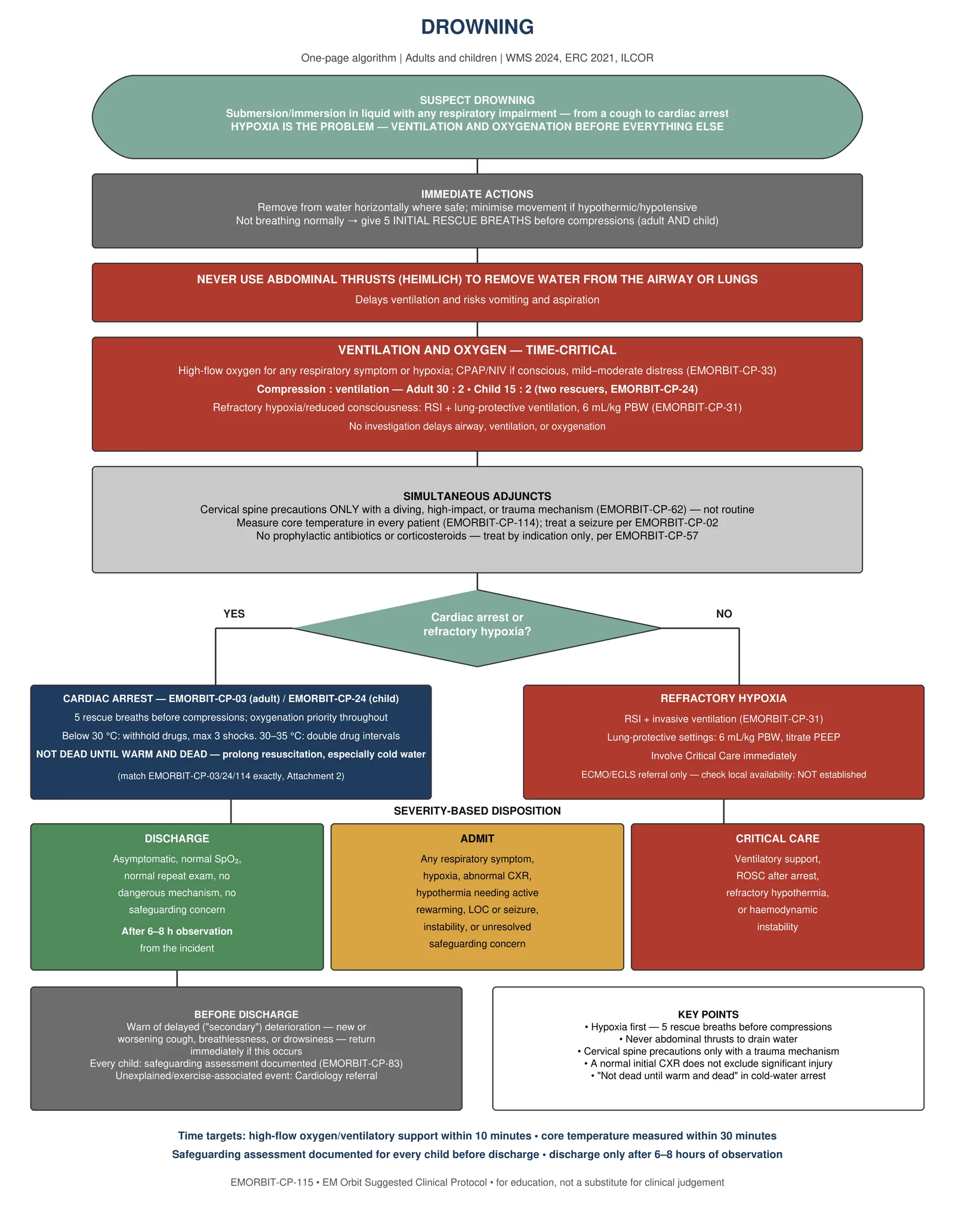
Evidence base: WMS 2024; ERC 2021
1Purpose
1.1 Standardize the immediate Emergency Department (ED) management of drowning: ventilation and oxygenation before all else, rescue-breath-first resuscitation, and correct use of cervical spine precautions.
1.2 Define who requires admission or Critical Care, who is safe for a period of ED observation, and who can be discharged, including the observation period before discharge.
1.3 Ensure every child presenting after a submersion incident receives a safeguarding assessment, and that hypothermia and cardiac arrest are managed exactly as in EMORBIT-CP-03/24/114.
1.4 Align ED practice with the Wilderness Medical Society (WMS) drowning guideline, European Resuscitation Council (ERC) 2021, and ILCOR.
2Who this protocol applies to
2.1 Any patient of any age presenting after submersion or immersion in liquid (pool, sea, open water, bathtub, flood water) with any degree of respiratory impairment, from a single episode of coughing to cardiac arrest.
2.2 A patient rescued from water who is asymptomatic at presentation but had any period of coughing, choking, or breathing difficulty during or immediately after the incident.
2.3 An infant or child brought in after a bath, pool, or other domestic submersion, whether or not currently symptomatic (section 4.1.5, safeguarding).
2.4 Suspected deliberate self-harm by submersion.
3Not covered by this protocol
3.1 Diving-related decompression illness or arterial gas embolism with no aspiration or respiratory impairment: a different entity, not managed by this guideline.
3.2 Definitive management of the precipitating cause (seizure disorder, arrhythmia, alcohol/substance use, trauma) once the patient is stable, governed by the relevant local guideline (section 4.1.4).
3.3 Definitive skeletal survey, forensic assessment, and the multi-agency child protection process, which are the paediatric team's and statutory agencies' work (EMORBIT-CP-83).
3.4 Cardiac arrest management itself is governed by EMORBIT-CP-03 (adult) and EMORBIT-CP-24 (child); this guideline states only the drowning-specific modifications (section 4.3.2).
4Protocol
4.1History and Assessment:
4.1.1Triage and Recognition:
4.1.1.1 Drowning is the process of experiencing respiratory impairment from submersion or immersion in liquid; the outcome is classified as death, morbidity, or no morbidity. Do not use the terms "near-drowning", "dry drowning", or "wet drowning".
4.1.1.2 Hypoxia is the problem in drowning — ventilation and oxygenation come before everything else. Triage to a high acuity category, and a physician shall attend without delay, for any respiratory distress, reduced consciousness, or haemodynamic instability.
4.1.1.3 Start high-flow oxygen at triage under the approved nursing standing order for any respiratory symptom or SpO₂ below normal, without waiting for physician review.
4.1.1.4 Remove the patient from the water horizontally where this can be done safely, to reduce the risk of collapse around the time of rescue from loss of hydrostatic support; minimise unnecessary movement or an upright posture in a hypothermic or hypotensive patient.
4.1.2History:
4.1.2.1 Type of water (fresh, salt, pool, or contaminated — flood or sewage water), estimated submersion duration, water temperature, whether the event was witnessed, time to rescue, and whether bystander CPR or rescue breaths were given.
4.1.2.2 A mechanism suggesting trauma — diving, jumping or falling into water, a boating or motor vehicle incident — which changes the cervical spine decision (section 4.3.1).
4.1.2.3 A preceding seizure, syncope, chest pain or palpitations before the submersion, alcohol or other substance use, suicidal intent, and any family history of unexplained drowning, syncope, or sudden death (possible channelopathy, section 4.1.4).
4.1.2.4 For an infant or child: who was supervising, where, and for how long; ask specifically, do not infer from age alone (section 4.1.5).
4.1.3Examination:
4.1.3.1 Full set of vital signs, work of breathing, chest auscultation, SpO₂, Glasgow Coma Scale, and core temperature (oesophageal, rectal, or bladder) in every patient — hypothermia is common and is easily missed if not measured (EMORBIT-CP-114).
4.1.3.2 Examine for evidence of trauma (head, chest, spine) where the mechanism suggests it, and for signs of non-accidental injury in a child (EMORBIT-CP-83).
4.1.3.3 A normal initial chest examination or chest X-ray does not exclude significant lung injury, which can evolve over hours (section 4.3.4).
4.1.4Risk Stratification and Severity:
4.1.4.1 Asymptomatic: brief witnessed submersion, cough only, clear auscultation, normal SpO₂ and examination.
4.1.4.2 Mild–moderate: abnormal auscultation (crackles) with or without early pulmonary oedema, no hypotension.
4.1.4.3 Severe: pulmonary oedema with hypotension, or an isolated respiratory arrest with a palpable pulse.
4.1.4.4 Cardiac arrest: manage per EMORBIT-CP-03 (adult) or EMORBIT-CP-24 (child) with the drowning-specific modifications in section 4.3.2. [Severity-grade thresholds above follow the widely used Szpilman classification — verify exact grade definitions against the current WMS 2024 guideline before use.]
4.1.5Differential Diagnosis:
4.1.5.1 A seizure, syncope, or a cardiac arrhythmia (including a channelopathy such as long QT) causing the submersion rather than resulting from it — consider especially in an unexplained or exercise-associated drowning event.
4.1.5.2 Alcohol or substance intoxication, hypoglycaemia, and trauma (diving into shallow water) as alternative or contributing causes.
4.1.5.3 Decompression illness or arterial gas embolism in a diver with no significant aspiration (excluded from this guideline, section 2).
4.1.6Special Populations:
4.1.6.1 Children: use the 5 initial rescue breaths and the 15:2 compression-to-ventilation ratio (EMORBIT-CP-24, Attachment 2). Every child presenting after a submersion incident shall receive a safeguarding assessment before discharge (EMORBIT-CP-83) — an infant submerged in a bath, an unsupervised toddler, an inconsistent or delayed history, or a repeat presentation are all safeguarding triggers.
4.1.6.2 Pregnancy: prioritise maternal oxygenation, left lateral tilt once the pregnancy is clinically evident, and involve Obstetrics for any significant hypoxia or instability.
4.1.6.3 Pre-existing epilepsy or cardiac disease: obtain a 12-lead ECG in every symptomatic patient (arrhythmia, QT prolongation, hypothermic J waves); refer to Cardiology for an unexplained or exercise-associated drowning event or an abnormal ECG.
4.2Investigations:
4.2.1 Core temperature by a low-reading thermometer (oesophageal, rectal, or bladder) in every patient — do not rely on a standard thermometer, which under-reads at low temperature; manage any hypothermia found per EMORBIT-CP-114.
4.2.2 Venous or arterial blood gas for oxygenation, pH, and lactate; standard pulse oximetry is unreliable in a cold or poorly perfused patient.
4.2.3 Chest X-ray as a baseline; repeat if the patient deteriorates during observation — a normal initial film does not exclude significant aspiration or evolving pulmonary oedema.
4.2.4 12-lead ECG in every symptomatic patient. Blood glucose in every patient. Alcohol level and toxicology screen where intoxication is suspected as a contributing cause.
4.2.5 Cervical spine imaging only where a dangerous mechanism is present — diving, a high-impact water entry, or another trauma mechanism (EMORBIT-CP-62); do not image or immobilise routinely in its absence (section 4.3.1).
4.2.6 No investigation shall delay airway, ventilation, or oxygenation support.
4.3Plan of Care:
4.3.1Immediate Actions:
4.3.1.1 A bystander or rescuer shall not enter the water beyond their own training and ability; reach or throw a rescue aid before entering the water.
4.3.1.2 Open the airway and, if the patient is not breathing normally, give 5 initial rescue breaths before starting compressions, in both adults and children — drowning arrest is hypoxic, and oxygenation is the priority (matches EMORBIT-CP-03/24).
4.3.1.3 Never use abdominal thrusts (the Heimlich manoeuvre) to try to remove water from the airway or lungs. This delays ventilation and risks vomiting and aspiration.
4.3.1.4 Apply cervical spine precautions only where a diving, high-impact, or other trauma mechanism is present (EMORBIT-CP-62). Do not apply routine spinal immobilisation to every drowning patient — it is not indicated without such a mechanism and delays rescue and ventilation.
4.3.1.5 High-flow oxygen for any respiratory symptom or hypoxia; continuous positive airway pressure (CPAP) or non-invasive ventilation for a conscious patient with mild–moderate respiratory distress (EMORBIT-CP-33); rapid sequence induction (EMORBIT-CP-31) for reduced consciousness or hypoxia refractory to non-invasive support.
4.3.2Definitive ED Treatment:
4.3.2.1 Lung-protective ventilation for any patient requiring invasive ventilation: tidal volume 6 mL/kg predicted body weight, with positive end-expiratory pressure titrated for oxygenation — drowning produces a non-cardiogenic pulmonary-oedema/ARDS-like picture; avoid excessive tidal volumes.
4.3.2.2 Do not give prophylactic antibiotics or corticosteroids. Reserve antibiotics for evidence of established infection, grossly contaminated water (sewage or flood water), or clinical deterioration, and select the regimen per EMORBIT-CP-57 and Antimicrobial Stewardship — a regimen is not specified here.
4.3.2.3 Manage hypothermia per EMORBIT-CP-114 (passive, active external, or active internal rewarming by stage); rewarming precedes prognostication.
4.3.2.4 Treat a seizure per EMORBIT-CP-02 (Status Epilepticus).
4.3.2.5 Cardiac arrest — manage per EMORBIT-CP-03 (adult) or EMORBIT-CP-24 (child), with the drowning-specific modification of 5 initial rescue breaths before compressions and continued priority on oxygenation. Where core temperature is below 30 °C, withhold adrenaline and other drugs and limit defibrillation to three shocks; between 30 °C and 35 °C, double the drug intervals (matches EMORBIT-CP-03/24 and EMORBIT-CP-114 exactly, Attachment 2). "Not dead until warm and dead" — resuscitation shall be prolonged, especially after cold-water submersion.
4.3.3Escalation and Refractory Features:
4.3.3.1 Hypoxia persisting despite high-flow oxygen or non-invasive support: proceed to rapid sequence induction and invasive ventilation (EMORBIT-CP-31) and involve Critical Care immediately.
4.3.3.2 Refractory pulmonary oedema/ARDS or refractory hypothermic arrest: involve Critical Care; extracorporeal support (ECMO/ECLS or extracorporeal rewarming) is a referral, not an ED-delivered treatment, and is arranged through the hospital's critical care pathway.
4.3.4Monitoring and Reassessment:
4.3.4.1 Continuous SpO₂, ECG, and core temperature throughout the ED stay; reassess respiratory status and repeat auscultation at least hourly during the observation period, because deterioration can be delayed (section 4.3.6).
4.3.4.2 Any new or worsening respiratory symptom, falling SpO₂, or new crackles during observation mandates senior review and, where indicated, a repeat chest X-ray before discharge is considered.
4.3.5Disposition:
4.3.5.1 Discharge: asymptomatic, normal SpO₂ on room air, a normal repeat examination and auscultation, no dangerous mechanism, and no safeguarding concern (child), after a period of ED observation of 6 to 8 hours from the incident, with safe supervision arranged.
4.3.5.2 Admit: any respiratory symptom or abnormal auscultation, hypoxia at any point, an abnormal chest X-ray, hypothermia requiring active rewarming, any period of unconsciousness or seizure, cardiovascular instability, or an unresolved safeguarding concern in a child (admit under Paediatrics with safeguarding review even if otherwise medically fit, EMORBIT-CP-83).
4.3.5.3 Critical Care: any requirement for ventilatory support, cardiac arrest with return of spontaneous circulation, refractory hypothermia, or haemodynamic instability.
4.3.6Discharge and Follow-up:
4.3.6.1 Warn every discharged patient of delayed respiratory deterioration — new or worsening cough, breathlessness, or drowsiness — which can appear hours after an apparently mild event, from aspiration pneumonitis or evolving pulmonary oedema; advise immediate return if this occurs. ("Secondary drowning" is the lay term for this pattern; it is not a separate diagnosis but the phenomenon shall be safety-netted for.)
4.3.6.2 Refer for Cardiology/electrophysiology assessment after an unexplained or exercise-associated drowning event or an abnormal ECG (section 4.1.4), and for Neurology after a seizure.
4.3.6.3 Give water-safety and supervision advice to the patient or, for a child, to the carer, and confirm the safeguarding assessment outcome is documented before any child leaves the department (EMORBIT-CP-83).
4.3.7Documentation and Reporting:
4.3.7.1 Record: submersion duration and water type if known, time to rescue and any bystander CPR or rescue breaths given, core temperature trend, all SpO₂/chest X-ray/ECG results, ventilation settings if intubated, the cervical spine decision and its rationale, the observation period start and end with reassessment findings, and the safeguarding assessment outcome for every child.
4.3.7.2 Report any delay to rescue breaths or ventilation, or any spinal immobilisation applied without a qualifying mechanism, through the local incident reporting system.
5Algorithm
The one-page algorithm is shown at the top of this page.
6Team roles
6.1Triage/ED Nurse:
6.1.1 Recognize the submersion history, start high-flow oxygen under the approved standing order, measure core temperature early, and flag any safeguarding concern for a child immediately.
6.2ED Pharmacist:
6.2.1 Confirm no antibiotic or corticosteroid is given without a defined indication, and support the drug-dosing component of hypothermia and cardiac arrest management (EMORBIT-CP-03/24/114).
6.3Critical Care / Anaesthesia:
6.3.1 Attend for rapid sequence induction, refractory hypoxia or ARDS, cardiac arrest, and any extracorporeal referral discussion.
6.4Paediatrics / Child Protection Lead:
6.4.1 Review every child presenting after a submersion incident and confirm the safeguarding assessment is complete before discharge (EMORBIT-CP-83).
6.5Cardiology:
6.5.1 Review any unexplained or exercise-associated drowning event or a significant ECG abnormality for a possible channelopathy.
6.6Radiology:
6.6.1 Report the chest X-ray and any trauma imaging, and expedite a repeat film requested during the observation period.
7The patient's role
7.1 Complete the full observation period even if feeling well.
7.2 Return to the ED immediately for any new or worsening breathlessness, cough, or drowsiness in the days after discharge.
7.3 Attend any arranged Cardiology or Neurology follow-up, and follow the water-safety and supervision advice given.
8Definitions
8.1Drowning: the process of experiencing respiratory impairment from submersion or immersion in liquid; the outcome is classified as death, morbidity, or no morbidity. The terms "near-drowning", "dry drowning", and "wet drowning" are not used.
8.2Circum-rescue Collapse: haemodynamic collapse occurring immediately before, during, or after rescue from water, related to loss of hydrostatic support and a change in posture.
8.3"Secondary Drowning": a non-clinical, lay term for delayed respiratory deterioration (aspiration pneumonitis or evolving pulmonary oedema) appearing hours after an apparently mild immersion event; not a distinct diagnosis, but a pattern that must be safety-netted for.
8.4Lung-protective Ventilation: mechanical ventilation using a limited tidal volume (6 mL/kg predicted body weight) and titrated positive end-expiratory pressure to reduce ventilator-associated lung injury.
9Attachments
- Attachment 1: One-page algorithm (top of this page)
- Attachment 2: Ventilation, Hypothermic Arrest, and Disposition Quick Reference
11Suggested quality indicators
11.1Time to ventilatory support/oxygen: (Number of patients with drowning-related respiratory impairment given high-flow oxygen or ventilatory support within 10 minutes of arrival / Total number of such patients) × 100. Target ≥ 90%.
11.2Core temperature measured: (Number of drowning patients with a core temperature recorded within 30 minutes of arrival / Total number of drowning patients) × 100. Target ≥ 95%.
11.3Correct cervical spine decision: (Number of drowning patients in whom cervical spine imaging was obtained if, and only if, a dangerous mechanism was documented / Total number of drowning patients) × 100. Target 100%.
11.4Safe disposition — safeguarding: (Number of children presenting after a submersion incident with a documented safeguarding assessment before discharge / Total number of such children) × 100. Target 100%.
11.5Outcome indicator (monitored, no fixed ED target): unplanned re-attendance within 72 hours with a new respiratory symptom following ED discharge for drowning.
13References
- Szpilman D, Bierens JJLM, Handley AJ, Orlowski JP. Drowning. N Engl J Med. 2012;366(22):2102–2110.
- Wilderness Medical Society. Wilderness Medical Society Clinical Practice Guidelines for the Prevention and Treatment of Drowning: 2024 Update.
- Lott C, Truhlář A, Alfonzo A, et al.; European Resuscitation Council. European Resuscitation Council Guidelines 2021: cardiac arrest in special circumstances. Resuscitation. 2021;161:152–219.
- International Liaison Committee on Resuscitation (ILCOR). Consensus on Science with Treatment Recommendations: recognition and resuscitation of the drowning victim.
A2Attachment 2: Ventilation, Hypothermic Arrest, and Disposition Quick Reference
| Item | Adult | Child |
|---|---|---|
| Initial rescue breaths | 5, before compressions | 5, before compressions |
| Compression: ventilation (no advanced airway) | 30: 2 | 15: 2 (two rescuers, EMORBIT-CP-24) |
| If intubated | Tidal volume 6 mL/kg predicted body weight; titrate PEEP for oxygenation | Same principle |
| Core temperature | Action |
|---|---|
| Below 30 °C | Withhold adrenaline and other drugs; limit defibrillation to 3 shocks |
| 30–35 °C | Double the drug intervals |
| Any | Continue CPR during active rewarming; refer for extracorporeal rewarming; not dead until warm and dead |
| Item | Rule |
|---|---|
| Cervical spine precautions | Only with a diving, high-impact, or other trauma mechanism (EMORBIT-CP-62) — not routine |
| Discharge criteria | Asymptomatic, normal SpO₂ on room air, normal repeat examination, no dangerous mechanism, no unresolved safeguarding concern, after 6 to 8 hours of ED observation from the incident |
| Safety-net | Warn of delayed respiratory deterioration in the days after discharge — return immediately for new/worsening breathlessness, cough, or drowsiness |